Showing posts with label Mary Kom. Show all posts
Showing posts with label Mary Kom. Show all posts
By the end of Mary Kom, Sunil Thapa had become like a father figure to Priyanka Chopra-Omung Kumar
10:17 AM

Natasha Coutinho (HINDUSTAN TIMES; February 9, 2026)
Nepali actor Sunil Thapa, 68, who played Priyanka Chopra Jonas’ boxing coach in Mary Kom (2014), died on Saturday following a cardiac episode. Filmmaker Omung Kumar, who directed the film, remembered the late actor and their association.
“We were looking for someone with the right physique and a very expressive face,” Omung recalls, adding, “When I saw a video of Sunil Thapa ji, the superstar from Nepal, I was immediately kicked about it. I also remembered him from Ek Duuje Ke Liye (1981).”
Omung believes the casting felt almost destined. “Two years before Mary Kom, I had sketched the coach’s character in my storyboard. When I met Thapa ji, I realized the sketch looked exactly like him,” he says. He also recalls how Thapa became a source of strength for Priyanka after her father Ashok Chopra died days before the shoot began in 2013: “By the end of the film, Sunil had become like a father figure to her.”
Thapa appeared in over 300 Nepali films. He was widely known for his iconic role as Rate Kaila in the film Chino and was recently seen in The Family Man Season 3.
Priyanka Chopra Jonas’s tribute
“You will always be my Coach Sir. You kept me together when I had just lost my dad. You loved me and helped me through many tough days without even realising. Your warm hugs and your laugh will always be part of my memories,” she wrote on Instagram.
She added, “Gone too young but never forgotten. Thank you for your kindness at a time when I was broken. Rest in peace, Sunil Thapa.”
Had I been an insider, mujhe sar aankhon par baitha liya hota-Darshan Kumaar
9:42 AM
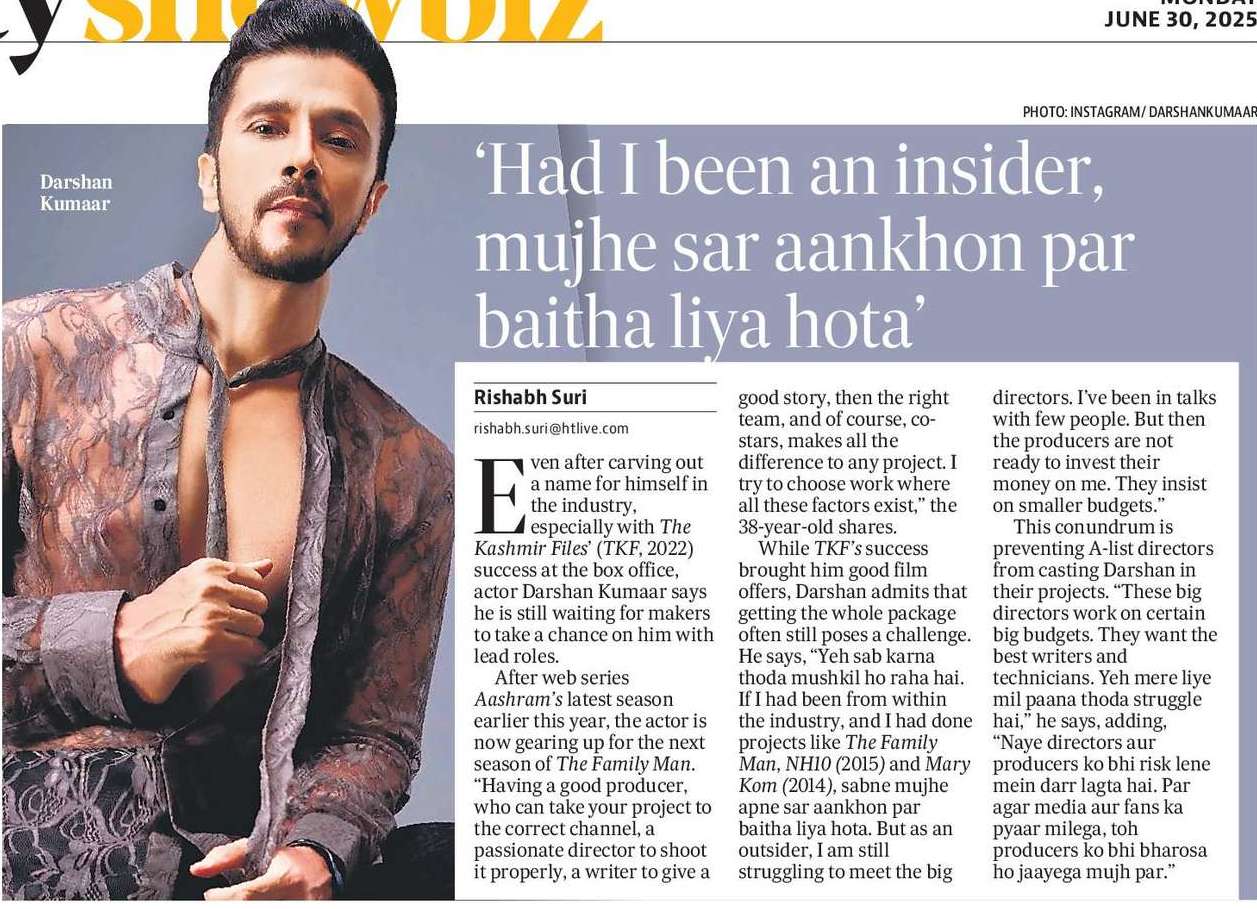
Rishabh Suri (HINDUSTAN TIMES; June 30, 2025)
Even after carving out a name for himself in the industry, especially with The Kashmir Files’ (TKF, 2022) success at the box office, actor Darshan Kumaar says he is still waiting for makers to take a chance on him with lead roles.
After web series Aashram’s latest season earlier this year, the actor is now gearing up for the next season of The Family Man.
“Having a good producer, who can take your project to the correct channel, a passionate director to shoot it properly, a writer to give a good story, then the right team, and of course, co-stars, makes all the difference to any project. I try to choose work where all these factors exist,” the 38-year-old shares.
While TKF’s success brought him good film offers, Darshan admits that getting the whole package often still poses a challenge.
He says, “Yeh sab karna thoda mushkil ho raha hai. If I had been from within the industry, and I had done projects like The Family Man, NH10 (2015) and Mary Kom (2014), sabne mujhe apne sar aankhon par baitha liya hota. But as an outsider, I am still struggling to meet the big directors. I’ve been in talks with few people. But then the producers are not ready to invest their money on me. They insist on smaller budgets.”
This conundrum is preventing A-list directors from casting Darshan in their projects. “These big directors work on certain big budgets. They want the best writers and technicians. Yeh mere liye mil paana thoda struggle hai,” he says, adding, “Naye directors aur producers ko bhi risk lene mein darr lagta hai. Par agar media aur fans ka pyaar milega, toh producers ko bhi bharosa ho jaayega mujh par.”
Kareena Kapoor and Alia Bhatt dominate the list of day 1 collections of top 10 female centric films
8:55 AM

Box Office India Trade Network
CREW is the third highest opening ever as far as female lead driven films go only behind VEERE DI WEDDING and GANGUBAI KATHIAWADI though final numbers can even take it above the latter. It is a holiday which has pushed the film to the levels of GANGUBAI KATHIAWADI but even without that, it would have been in the top ten
The top ten list is dominated by films of Kareena Kapoor and Alia Bhatt who are probably the biggest female stars of the past two decades or so. There is also HEROINE (Kareena Kapoor) sitting on 11th place. CREW is an ensemble cast featuring other female stars like Tabu and Kriti Sanon. Hence, its a package but Kareena Kapoor is the main driving force as far as box office goes. There is only one double digit film and that is also a Kareena Kapoor starrer, VEERE DI WEDDING
There have been five heroines in the Hindi film industry who would be in the all time great list and were undisputed in their times and they are Vyjayanthimala, Mumtaz, Hema Malini, Sridevi and Madhuri Dixit and post this opening of CREW, Kareena Kapoor joins the list. Maybe the level of success is not as high as the other names above but the longevity makes up for that. If the success ratio of Alia Bhatt keeps up over the next few years, her name will also be up there with the all time greats, making it seven heroines.
The opening of the film is also boost to the films featuring the heroines as central leads as today most of the top female stars want such roles which makes it tough to get a top male star and a top female star in the same film catering to the mass audience as it will be male dominated.
The problem occurs that today films post pandemic have to cater to a wider audience to get an initial. As a result, it has to be more commercial and cinematic which is tougher with females. It leads the heroines towards action and they play avenging angels or spy agents and basically become the heroes. But the fact remains that heroines become stars due to their songs and glamour but this all goes out of the window in an action/thriller film.
Obviously its action which is going to take these opening numbers higher but how do you do it retaining the essence of the Hindi film heroine with songs and glamour as presenting the heroine like a male will not cut it with the wider audience.
The top ten opening days for heroine led films are as follows.
1. Veere Di Wedding - 10,42,00,000 (Kareena Kapoor)
2. Gangubai Kathiawadi - 9,62,00,000 (Alia Bhatt)
3. Crew - 9,50,00,000 apprx (Kareena Kapoor) (Holiday)
4. Dear Zindagi - 8,62,00,000 (Alia Bhatt)
5. Tanu Weds Manu Returns - 8,61,00,000 (Kangana Ranuat)
6. Mary Kom - 8,32,00,000 (Priyanka Chopra)
7. Ragini MMS 2 - 7,93,00,000 (Sunny Leone)
8. Manikarnika - The Queen Of Jhansi - 7,66,00,000 (Kangana Ranaut)
9. Jism 2 - 7,46,00,000 (Sunny Leone)
10. Raazi - 7,33,00,000 (Alia Bhatt)
Is a tax-free film ticket cheaper? Experts share their views
8:18 AM

Every year, several films are declared tax-free by some state(s). In the past, some films have had eight to nine states declaring them tax-free. But what does that really mean – for the cinemas and for moviegoers?
Niharika Lal (BOMBAY TIMES; May 16, 2023)
HOW MUCH CHEAPER IS YOUR TAX-FREE TICKET?
In December 2018, two GST slabs were announced for films – 18% for tickets above Rs. 100, and 12% for tickets below Rs. 100. This tax is divided between the state and central government (State GST and Central GST). When a state declares a film ‘tax-free’, it exempts half of the entertainment tax, which would be either 9% or 6%, as per the ticket price. For the multiplex audience, since there are hardly any tickets available below Rs. 100, the default exemption would be 9%.
TAX-FREE STATUS HAD A BIGGER IMPACT IN THE PRE-GST ERA
Cinema hall owners say that declaring a film tax-free had a bigger impact in the pre-GST years, when every state had different entertainment tax and the state governments could exempt the whole amount. Now, with GST in play, a moviegoer still needs to pay Central GST even for tax-exempted films.

‘TAX-FREE EXEMPTION DECLARATIONS CREATE AWARENESS ABOUT A FILM’
Rajender Singh Jyala, Chief Programming Officer PVR INOX Limited, says, “Whether a film will perform better after tax exemption largely depends upon its content. For a moviegoer, tax-exempted tickets used to be cheaper in the pre-GST era. Now, when a film is declared tax-free (it is more about that) it creates awareness about the film among the audience. Hence, even if the film is declared tax-free in only one or two states, the film performs well in other states too.”
‘IT WORKS AS A PUBLICITY TOOL AND INCREASES LONGEVITY IN THEATRES’
Producer Girish Johar, several of whose films were declared tax-free in pre-GST years, says, “There are three reasons why producers want their films to be declared tax-free. First, it lures moviegoers to watch a film, second, it works as a publicity and marketing tool because a state government is endorsing your film; and third, the film gets longevity and instead of four weeks, it may end up getting eight weeks in the cinema hall.”
WHAT MAKES A FILM ELIGIBLE TO BE TAX-FREE?
There’s no fixed criteria for a film to claim exemption. Usually, socially relevant films or inspiring stories are made tax-free. From films on issues, such as Toilet: Ek Prem Katha, Chhapaak and Hindi Medium, to biopics like Mary Kom and historical films like Tanhaji: The Unsung Warrior have been declared tax-free over the years.
Sometimes states also declare films tax-free to show solidarity with its theme and in some cases producers apply for a tax-free status. In their film policy, some states have the provision of declaring a film tax-free when a certain portion of a film is shot in the state. Overall the decision resides with the state government.

Amitabh Bachchan to flag off Kaun Banega Crorepati 14 with Aamir Khan and army officers
8:12 AM
Upala KBR (MID-DAY; July 22, 2022)
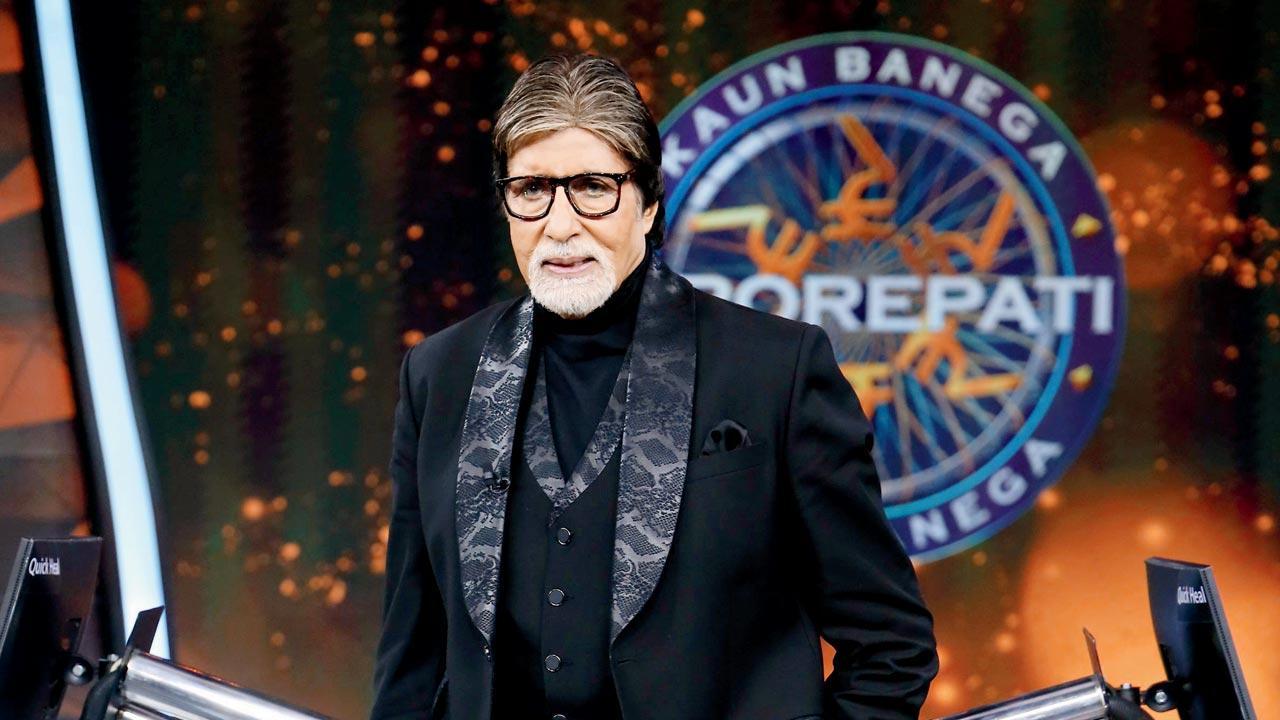
It’s that time of the year again, when Amitabh Bachchan invites the common man to take the hot seat opposite him. The megastar began shooting for the 14th season of Kaun Banega Crorepati (KBC) on Tuesday. Since 2022 marks the 75th year of India’s independence, the team decided to open with a special event that saw Aamir Khan and Army veterans celebrating the milestone.
Director Arun Sheshkumar says, “This year, we have invited heroes who have made a difference to the country — from sports, armed forces and the film industry. We shot a grand event with Aamir Khan on the hot seat, [pitted against] two decorated veteran army personnel, a colonel and a major. Indian football captain Sunil Chhetri and boxer Mary Kom also played a round against each other. Mr Bachchan hosted them as they played the game, shared touching stories and celebrated the spirit of India.”
Earlier this week, Bachchan posted a picture on Instagram that saw him, dressed in a hoodie and pyjamas, on the reality show’s set. “He will sport an all-new look, not the harem pants. He joked that saree ko kaat ke pyjama bana diya,” grins the director.
In awe of Bachchan’s commitment to the show, he says, “Mr Bachchan completes his films before he starts KBC. That has been his practice. He brushes up on his [hosting] skills, and does rehearsals for a month or so before the shoot.”
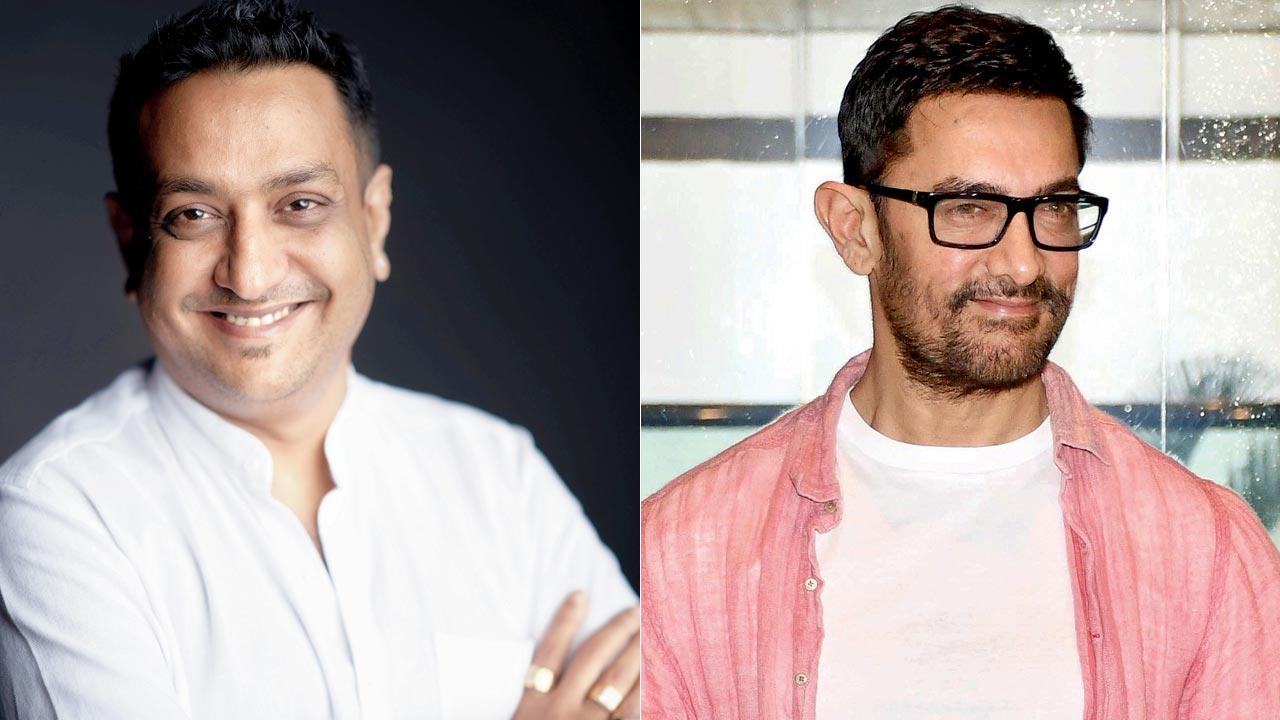
Arun Sheshkumar and Aamir Khan
I’ve had the doors shut on my face when I’ve gone to ask for work-Darshan Kumaar
8:11 AM
Iti Shree Misra (BOMBAY TIMES; July 1, 2022)
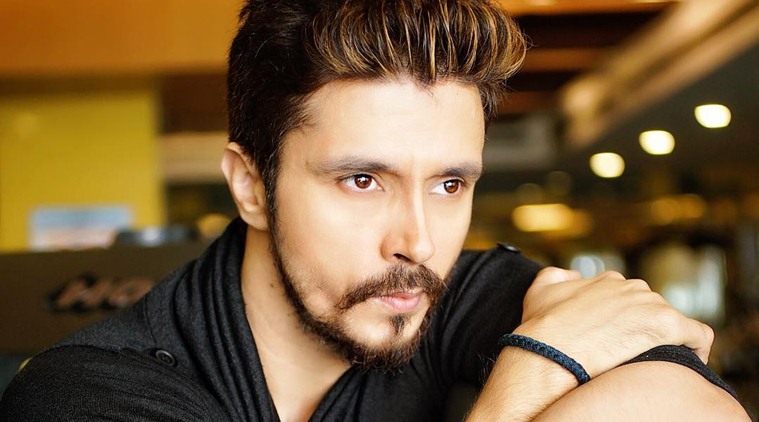
Darshan Kumaar, who is enjoying the popularity he has gained in recent times, feels grateful for all the love he is getting from the audience. “It feels surreal actually. It’s taken a long, long time for me to come here but I don’t want to take all of this for granted. It feels good now when people recognize me and acknowledge me. I have some wonderful projects in my repertoire, I have been fortunate to have worked with some of the best people in the industry in TV and in films and now web too. For instance, now I’m working with Satish sir, Anupam sir and Neena Gupta ji again in Kaagaz 2. I have learnt so much from them,” he says.
‘I WOULD CARRY MY SHOES IN A PACKET TO AUDITIONS SO THAT THEY WOULDN’T GET DIRTY’
Remembering that period of struggle when he would subside on glucose biscuits and travel on foot across Mumbai for auditions, only to be rejected, Darshan says, “I would wear slippers and carry my shoes in a packet so that they wouldn’t get dirty, and would change into them for auditions. There have been so many times when I’ve had the doors shut on my face when I’ve gone to ask for work. And now, people are sending me scripts at my home.”
But he says there were people along the way who helped him and gave him advice which he follows till date. He shares, “Working with Neena Gupta ji, Naseer sir in theatre and the likes of Sanjay Leela Bhansali, Manoj Pahwa, Satish Kaushik, Prakash Jha sir has been a very enriching experience for me. I remember I was so nervous when I had to face the media for the first time during the promotion of Mary Kom. I was just in my jeans and T-shirt and was so nervous when all the cameras started popping in my face. I would close my eyes each time the flash would go on. Then Priyanka (Chopra Jonas) told me, just be your honest self because nothing is hidden from the camera. Be honest and be confident. And that’s what I did.”
‘WHEN I STARTED MY CAREER THERE WERE VERY FEW OPTIONS FOR ACTORS’
Doing theatre and ads helped Darshan, also seen as the antagonist in Anushka Sharma’s NH10 and a lawyer in Aishwarya Rai Bachchan starrer Sarbjit, carry on with his dreams. “When I started my career there were very few options for actors. I was mainly focusing on my theatre shows at that time. Once during my morning walk I met Dimpy, a casting director, who used to reside in the same society. She asked me to visit her office and audition for a TV series. It was my first audition and that’s how I got selected for my first serial Chhoti Bahu,” he says. Later, Darshan went on to do shows like Baba Aiso Varr Dhoondo and Devon Ke Dev. . . Mahadev.
‘OTT HAS HELPED MANY THEATRE ACTORS AS WELL AS METHOD ACTORS’
Talking about television these days, Darshan says, “I understand that our TV industry works on TRPs and so the content providers are also focussing on the tracks which are mostly loved by our audiences.”
And although Darshan is busy with film projects, he says he would love to be on a TV show again. “I would love to host a reality show. TV is the best medium to connect with people as you become a part of their everyday life and in turn are showered with immense love.”
Ask him why these days there are few experienced actors from theatre making a foray on TV and Darshan says, “Now thanks to the OTT platform it has opened a new horizon for actors as well as producers, directors and technicians. So now along with good content there is a demand for good actors in our industry. I believe this has helped many theatre actors as well as method actors to perform their dream roles in TV serials as well as in OTT and other various platforms. On the other hand now all newcomers are getting a good opportunity to perform in serials where they are earning as well as learning their craft everyday so it’s a win-win situations for everyone.”
I’m glad Priyanka Chopra acknowledged that an actor from the Northeast should’ve played Mary Kom-Lin Laishram
8:06 AM

Manipuri actor Lin Laishram says that there is a lot of talent in the Northeast that’s yet to be discovered
Onkar Kulkarni (BOMBAY TIMES; January 20, 2022)
Lin Laishram, who hails from Manipuri, has praised Priyanka Chopra Jonas for acknowledging the lack of diverse casting in her 2014 film Mary Kom. In a recent interview, Priyanka looked back at the movies she has been a part of in her two-decade-long career. Talking about the biopic on boxer MC Mary Kom, who hails from Manipur, she agreed that someone from the Northeast should have played the leading role. “I look nothing like her,” Priyanka had said.
Lin, who also played a small part in the film, appreciated the fact that Priyanka has acknowledged that an actor from the Northeast would have been better suited to portray the boxer on the big screen.
In a chat with BT yesterday, Lin said, “I really appreciate that Priyanka owned up to it, and this speaks volumes because she’s not only a Bollywood actor but an international star. So, for her to stand up for something which is a fact only garners more respect not only from me, but from all the people who go through racism or discrimination on a daily basis. ”
In her earlier interactions, a few years ago, Lin had opened up about this misrepresentation in the film.
So, when asked whether she had expressed her reservations with the film's team while working on it, she said, “Unfortunately, I didn’t. I was too young and new to the industry. A movie was getting made on our people and I was just happy being part of it. Back then, I felt that was the process. I feel casting is one of the most important processes of filmmaking, especially in a biopic. Keeping the look of the actor close to the ethnicity of the character is extremely important for believability and authenticity.”
Lin feels that Bollywood lacks options when it comes to casting Northeastern actors in their projects. “There is a lot of talent waiting to be explored from the Northeast. Unfortunately, people don’t write significant roles for us. Writers and directors feel disconnected and producers feel that we are not saleable enough. But with OTT platforms coming in, this is changing. We have a few options opening up and I’m hoping to see more projects for us,” says the actor who featured in the movie Axone (2020), which revolved around a bunch of friends from the Northeast living in Delhi.
In her recent interview with an international publication, Priyanka had said that she was skeptical about taking on the role of the boxing champion in the beginning, not only because she would be playing such a renowned athlete but also because they looked nothing like each other. She also added that the part should have gone to someone from the Northeast, but she was greedy as an actor to get a chance to tell the story because the athlete inspired her a lot.
--------------------
‘WHY COULDN’T A DUSKY ACTRESS BE CAST AS JHULAN GOSWAMI?’
Recently, a video announcing the film Chakda Xpress, which features Anushka Sharma as former Indian women’s cricket captain Jhulan Goswami, was shared. However, the casting choice did not sit well with many. While fans were excited to see the talented actresses in front of the camera after four years, the strained accent and artificially darkened skin drew criticism. “Why couldn’t a dusky actress be cast as Jhulan Goswami in #ChakdaXpress? Why take a supremely lighter slim actress and get her so bronzed up? Beyond me (sic),” said a netizen, a sentiment that was shared by several people.

It’ll be a shame if an actor of another ethnicity plays Mirabai Chanu-Bijou Thaangjam
8:28 AM

Itishree Misra (BOMBAY TIMES; August 12, 2021)
Saikhom Mirabai Chanu became a household name overnight after she bagged India’s first medal at the Tokyo Olympics — winning a silver in women’s weightlifting (49 kg). Given Bollywood’s recent fascination with sports biopics, netizens started wondering how soon a biopic would be announced on Chanu’s triumph. But one point that was stressed upon by many was that the actor portraying her should be from northeast India, like her. One of these voices was that of actor Bijou Thaangjam, who also belongs to Chanu’s home state Manipur. A few days after Chanu’s win, Bijou took to Twitter to call out the bias in Bollywood against actors from the northeast. The actor, who has been part of films like Mary Kom, Shivaay and Paltan, among others, spoke about being approached by a casting director for the role of a domestic help. “When are we gonna change. We live in a time where @mirabai_chanu & @MangteC (MC Mary Kom) brings glory for the nation and yet, our Cinema is still stuck to portraying Northeastern in such stereotypical characters (sic),” he wrote, adding that these characters are often written in stereotypical manner, portraying people from the northeast as “stupid and weird”. In an interaction with us, Bijou shares the issues that actors from the northeast face in Bollywood.
What are the issues that actors from the northeast face in Bollywood?
In the name of inclusivity, actors from northeast India are often called to audition for very stereotypical roles. People from the entire northeast region, Nepal and Northern Himalayan region are put in a bracket called “Chinese looking”. This is very offensive and degrading. We, as actors, are only given roles like domestic help, security guard, salesman, waiter or someone who works in spas and resorts. This is not about looking down on any profession, but how these characters are written and portrayed as caricatures and stereotypes in films. And these are all tertiary characters, with either no dialogues or just one or two scenes in the entire film.
According to you, why are there no A-list actors from the northeast?
I am going to call it cultural bias. Filmmakers, or more precisely the people who fund filmmakers, do not believe that Indian audiences will flock to see northeast Indian leads. This causes a sort of self-fulfilling prophecy. There are no northeast Indian stars, so northeast Indian are not cast in starring roles, so northeast Indian actors don’t get a chance to become stars.... and repeat ad infinitum. Thus, the filmmakers’ bias is confirmed. I can remember only Danny Denzongpa being of some significance in Bollywood.
Why are there so few actors from the northeast in the industry?
Because Bollywood is racist and sexist. As much as celebrities claim to be for minorities and for women, when it comes down to it, they’re full of it. If you look at the top stars, you won’t find more than a handful who aren’t north Indian. Among the women in that line-up, most of them are gori chitti. The argument has been made that minorities aren’t “bankable” or that most women can’t “open a movie”. But this has been proven wrong time and again.
Unfortunately, northeast Indian actors get typecast as people with thick accent who often just get cast as extras. Such stereotypes provide people with a template and they don’t see it as something wrong. Northeast Indians have no intention or desire to dominate Bollywood or take all the major roles, which seems to be what people fear the most. What actors from northeast India really want, is positive and fair representation when they do happen to be on screen, i.e. three-dimensional characters that don’t portray stereotypical roles. Now, why would anyone object to this unless they’re overtly or covertly racist?
You also wrote about how an actor from the northeast should be cast in the biopic of Mirabai Chanu whenever it’s made.
Film is a visual medium, and people connect to it faster. It’ll be a shame if an actor of another ethnicity plays the role in today’s day and age. Inclusivity is a big thing across the world, and it’s about time that we as a country practice it as well.
What do you think needs to change in the industry?
Representation! Whether it is representation of northeast Indians or representation of the LGBTQIA+ community, people want to see themselves on the screen. They want to be able to resonate with a character that looks like them, acts like them and has some characteristics like them. Hence, it’s important to look at the northeast region of India to realise how large and diverse culture it has. All the states of the northeast have their own ethnic identities. The representation of that in films and television leaves a lot to be desired.
As an actor from the northeast, what are the kind of roles you’d like to play?
First and foremost, I want to be called an actor, not a northeast Indian actor. I am looking for roles which are authentic, fair, and have humanity – where we are not the side script to the larger stories and are not just seen through mainland eyes.
Adil Hussain hopes a face from Northeast portrays Mirabai Chanu
7:57 AM

Rishabh Suri (HINDUSTAN TIMES; July 27, 2021)
Given Bollywood’s love for biopics, it won’t be long before one is announced on Indian weightlifter, and now Olympic silver medallist, Saikhom Mirabai Chanu. While Chanu’s inspiring journey would certainly make for an interesting watch, the casting is what interests actor Adil Hussain more.
Explaining the reason, the actor cites how Mary Kom, the 2014 movie made on the life of the boxer from Manipur, saw Priyanka Chopra Jonas portray her. Hussain has maintained ever since that an actor from the Northeast should have been cast in the lead role. “This isn’t at all a judgment on Priyanka, she’s a very accomplished artiste. I’m saying that the Hindi film industry lost an opportunity,” says the actor, who hails from Goalpara, Assam.
Hussain, 57, explains that it was a missed chance to introduce some “amazing faces” from the remote parts of the country to the masses. “If someone makes this movie, I’m sure they’d be more imaginative and cast someone from the Northeast,” he hopes.
The Pareeksha (2019) actor believes that this would be the industry’s chance to redeem itself. He adds, “I hope they make the right choice. They should make the film so well that they don’t have to invest in a star, like Ang Lee did in Life Of Pi (2012).”
He feels that Chanu’s achievement is very crucial, as it gives hope to people in the Northeast the most. “Northeast is always neglected by mainland India — politically and economically. We’re still to be looked at as a part of India by a lot of people, who think that people from Arunachal Pradesh, Nagaland, Mizoram are Chinese,” admits Hussain.
He adds, “One of Chanu’s coaches had described her as the most dedicated and hard-working person. That’s the quality of our people. When they want something, they do it. I feel emotionally charged.”

I am waiting to get my due as an actor and not appearance-Lin Laishram
8:13 AM

Axone actor Lin Laishram on the race discourse in India and why despite having worked in Bollywood for six years, she hasn't made it to the top
Mohar Basu (MID-DAY; June 18, 2020)
 As the discourse around Black Lives Matter intensified in the US following the death of George Floyd, in India, a well-timed film Axone was released as a reminder of the prejudices faced by people hailing from the North-East. Lin Laishram, who headlines the film along with Sayani Gupta, sees it as her debut despite making an entry in the industry with Mary Kom (2014). Post the sports drama, she featured in a host of films including Prashant Nair's acclaimed Umrika, but none, by virtue of their narrative, structure, propelled her to the limelight.
"There are no roles written for me," says Laishram, explaining that even that even though more parts are being written for women, the industry is at a nascent stage when it comes to understanding these roles. "I love Bollywood films, but never felt I could belong to the same industry as Karisma Kapoor, my idol, because we look nothing like each other. I am a minority who looks a certain way — from my facial features to cultural differences. It makes [getting roles] exceedingly difficult. I am waiting to get my due as an actor and not appearance."
With Axone becoming a major talking point, ever since it released on Netflix, Laishram opines that there "is a lack of representation". "It's imperative at this time to shed light on the issues of racism faced. No other Hindi film before has written a story on the lives of North East people." The mainstream audience has normalised stigmatisation and name-calling of those from the North East, says the actor. "The stereotyping and prejudice comes from a lack of awareness. Being called 'Cheeni' is as problematic as being tagged 'Madrasi'. It is important to reflect the racism faced with empathy over rage. I am glad Axone helps strike a productive dialogue. Layered with humour, the story helps drive the point home."
I am fiercely ambitious, and I am proudly ambitious. I will always be-Priyanka Chopra
8:26 AM

Madhureeta Mukherjee (BOMBAY TIMES; October 8, 2019)
 Yes, she’s an international actor, she hobnobs with crème de la crème in the West, sashays on the red carpets of Hollywood with the glitterati and all that jazz, but deep down, she’s every bit the cool desi girl. Someone who dared to dream big, while unnerving a few, and inspiring most. And behind all that success and glory is years of sweat and toil. Priyanka Chopra Jonas — always high on confidence, spunk and unbeatable willpower — tells us, “I have never been a sharer of my life. I share a lot of trivial things, but the other side of it, I have never spoken about it”. In a conversation with BT, the actress talks about how her upcoming film, The Sky Is Pink, helped her heal, the lessons she learnt from her dad, living in two homes (across continents) and her dream life with hubby, Nick Jonas. Read on...
You are constantly shuttling back and forth between the US and India. While Mumbai will always be your home ground, does America also feel like home now?
Well, my apartment in New York feels like home, as I have been living there for over two-and-a-half years. I love going back there. Now, Nick and I are looking for a place in Los Angeles, and that will be the first home that we will build together, so I am really excited about it.
What is the first thing you do as soon as you land in Mumbai?
There are two flights that I usually take. One, where I land at around 3 am, and the other, at 1 pm. When I take the latter, the first thing I do is have an elaborate lunch at home. My mom gives instructions to the staff at home to start readying the food as soon as I head out of the airport. I miss my comfort food and ghar ka khana in the US. We get Indian food almost everywhere in America, and even my chef in New York knows how to make some Indian dishes, but my home food in Mumbai tastes different. Yahan ke ghee mein hi farak hai.
Coming from Bareilly to Mumbai and winning the Miss India and Miss World titles, then following your Bollywood dreams, stardom, fame, et al. Then, gradually making a transition to the West with American shows and Hollywood movies, and of course, marrying a pop star. Your life seems to be what dreams are made of, at least from the outside...
I can’t begin telling you what all it took to get there. As a person, I have never been a sharer of my life. I share a lot of trivial things, as I like doing that, but the other side of it, which is all about my trials, tribulations and strife, and things that emotionally hurt or affect me… I have never spoken about it. I don’t want to play victim, I don’t need sympathy and I don’t want people to say, ‘Hai, kitni mushkil life thi, dekho achha hua ki acchi cheezein mil gayi usko’. You don’t need that. Everyone’s life is tough, and everyone has their own struggle. I am really glad that my life looks like a fairy tale, as that was the intention (smiles). I am really blessed, and even though the journey has been arduous, and tough at every step, the end game has always been good and positive. I feel that someone is looking out for me.
After your 2016 release Jai Gangaajal, this week, we will be seeing you in Shonali Bose’s The Sky Is Pink. We believe that your journey with her started long ago, even before you met Nick, and the two of you developed a great bond...
Shonali came to my New York home early last year and finalised the film. At that point, Nick was nowhere in the scene. Cut to June, we start dating and by August, we were engaged, and that is when we began filming. By then, Shonali knew that we would be getting married at some point during the year. It (marriage) was right in the middle of the schedule of a massively difficult movie. In retrospect, it was quite ironic; it was such a joyous moment in my life, and here we were, shooting this film where we are talking about difficult things like death.
Shonali said that nothing distracts you from what you are doing. So, you could be shooting a tough scene, and cut to a few hours later, you could be pouring over wedding details….
This will be a slightly long-winded answer… when I first started acting in movies back in 2003, I didn’t know what acting was all about. I thought that it was a glamorous profession where you wear lovely clothes, dance and look beautiful. In the course of the next few years, I realised that it was such an amazing craft and what I bring to it, is what it will be. Whatever happens between ‘action’ and ‘cut’ is my job and that space is my playing field. The moment I realised that, I had to figure out how to do it. I also realised that if I stay in my character, I get bored. It works for other actors and I tried that, too, but it does not work for me. I prep before I come on set, I do workshops and I know my lines pat. But on set, I do chichorapan, laugh and enjoy myself. When the camera and lights turn on, I switch to my character. It is also because I know my character really well before I start the movie, so much that my character becomes my best friend. If you ask me how my character will react in a particular situation, I can exactly tell you that. I prefer it this way, as it keeps my performance spontaneous and alive.
Is there any character that was hard to come out of after the shoot ended?
This one (The Sky Is Pink). Not the role, really, but it’s about the way you get attached to a film. This movie has impacted me a lot in a positive way. It helped me deal with emotions, which I hadn’t dealt with before. I had a lot of dark emotions regarding my father’s death and for a long time I didn’t know how to process it. I always looked up to my dad and he was my friend. We used to call each other twins as we were the same people. I didn’t process that loss after he passed away, I was angry, and I took it out on myself. I was self-destructive in a way and I emotionally went through all that. But through the course of this movie, that changed. The whole thought behind the story is, why not celebrate the life that a person lived, instead of living through the sorrow attached to him or her not being there. There was such a lightness to that thought, that I think I healed with this film. I had to open up my heart and go to deep places for this movie. It is special, as it is inspired by real-life people who thrive in extraordinary circumstances.
In the past, you have spoken a lot about confidence being that one key element, which has helped you get this far. Does all that willpower and confidence stem from the fact that you didn’t have it easy, and you had to have that fighting spirit to sail through and survive — in two different entertainment industries across the globe?
I taught myself to be confident, you are not born with it. It is an exercise that we all can teach ourselves. I learnt it when I went to boarding school in Class III. I was this brat, as I was my parents’ only child for a while, and then my brother came along, and I got brattier as he was getting all the attention. I was sent to boarding school and the environment was so different there. My dad sat me down and told me that the beauty of going to a new place is that you can be whoever you choose to be and no one else will know the difference. Every time I entered a new environment, I told myself… who do I want to be now, I can be that person. That’s why I say that confidence is important; that is the easiest thing you can teach yourself and the best thing you can learn.
Would you say that you are fiercely ambitious? And did you ever have people around tell you, ‘Oh, she is too ambitious’?
Yes, I am fiercely ambitious, though I think that the word ambition has a really bad connotation, when it comes to women. When it comes to men, it is considered sexy and hot, and people say, ‘Wow, he’s so ambitious’. But while referring to ambitious women, they will say, ‘Badi ambitious hai!’ You get the difference? I chose to defy that. I have always chosen to defy that. I am fiercely ambitious, and I am proudly ambitious. I will always be! I feel girls have been denied opportunities for such a long time that if you allow ambition to become a bad word, women will not get or seek opportunities. Today, we are in an environment where we are surrounded by some amazing men who stand by us and want us to thrive. They are listening to us. Yes, all of them out there are not like that, but I choose to focus on the positive. So, at this stage, you can’t let social norms or stereotypes dictate your behaviour, because then, we will never evolve.
You are part of two massive movie industries, and you have also featured on Forbes 100 Most Powerful Women List (in 2017 and 2018). What are your thoughts on the pay parity issue, which has been a raging discussion in the West, too? In India, do you see a significant change?
Look at how amazing it is that the conversation has started, and it is so loud. Pehle koi sochta bhi nahi tha. I was told by a filmmaker many years ago that if I don’t settle for the price I was being paid, which was about two per cent of my male co-actor’s remuneration, I would be replaced by another actress. I was also relatively established by that time. It affected me and at that point, I told myself that I will be irreplaceable, and that there will be a day when you will only want a Priyanka Chopra in your film. I strove to work towards that. The pay parity debate reflects how women have been devalued in society in every aspect. A woman has to work twice as hard to make the same amount of money as a man, in most cases. This conversation must turn into action, and it will take people to get woke and the industry to get woke. It is happening slowly. Pay parity is still looked upon as… zaroorat kya hai? Today, in our industry, we have so many female actors and filmmakers whose films open well, and the audience go to watch them because they are good. With this change, even the remuneration for women needs to change. We have also worked just as hard. I believe that we are going in the right direction, but yes, a lot of work still needs to be done.
On another note, it will be a year of being married. So, is Nick catching up on Bollywood movies? Which are his PeeCee favourites?
Hmnn…not really. He watched Mary Kom by himself one day. I was traveling and he called me and said, ‘Babe, I am missing you, so I am watching your movie’. I thought that was really sweet. Right now, we are both discovering each other’s professional lives. Before I met him, I didn’t know much about the Jonas brothers and their music. He is discovering my work, too. We share things like…. this is my first video, this is the movie I am embarrassed about and stuff like that.
We believe you have said that having a baby is your priority right now...
Well, it is not like it is priority; what I said has been misconstrued, as usual. I said that I hope we are blessed with it, whenever it happens. Yes, it is something I would want for us as the next step… like making a family and building a home together.

Five Best Film National Awards in six years is an unusual script in the narrative of any studio-Ajit Andhare
8:04 AM

Rachana Dubey (BOMBAY TIMES; August 26, 2019)
As the head honcho of a leading movie studio in India, he has a lot to feel elated about. With five National Award-winning films in the company’s repertoire, Viacom18 Studios’ COO Ajit Andhare, has a lot riding on his shoulders now, more so, after the studio’s clutter-breaking film AndhaDhun was honoured with National Awards recently. In a conversation with BT, he gave an insight into the road ahead for the studio, and what has contributed to its growth across various markets. Excerpts:
The success of AndhaDhun was not something you had anticipated. The film won the National Film Award for Best Hindi Film, and Ayushmann Khurrana, too, bagged the Best Actor Award for his performance in the film. Your thoughts?
I’m thrilled that AndhaDhun has bagged the highest film honours in the country. In a year of outstanding films like Badhaai Ho, Uri: The Surgical Strike and Padmaavat, the best film award for AndhaDhun is hard to anticipate. Nothing gives the producer in me more joy than watching the film you’ve nurtured right from the script stages to be loved and lauded. Having said that, nobody sets out to make a film with the intention of bagging awards. When I first heard the narration from Sriram Raghavan (director, AndhaDhun), I knew we had a winner. By winner, I meant a great script and an unusual story that needed to be told. I believed in the story and with a few changes to it and the right cast, I was confident we had a solid film on our hands. All of us — Sriram, Sanjay Routray (producer) and I — are overwhelmed with the love the film garnered globally. We thank the audience and eminent jury for embracing AndhaDhun.
A film like AndhaDhun,which is a dark comedy, rarely gets this kind of recognition at the box office and award ceremonies. Your film studio has won National Awards on four other occasions with extremely different kinds of films. What do you think your studio has done differently to achieve this success and honour?
Viacom18 Studios is the only studio in India that has bagged five best film National awards in the last six years with Bhaag Milkha Bhaag (2013), Queen (2014), Mary Kom (2015), Dhh (2018) and now AndhaDhun (2019). Unusual and incredible stories are our DNA. Five Best Film National Awards in six years is an unusual script in the narrative of any studio. We have taken creative risks and searched for answers in places not many would venture into. Bhaag Milkha Bhaag’s unique success created a new category of biopics, Queen and Mary Kom showed that heroism in a script can come from a woman, instead of only heroes. Dhh (Gujarati film) draws its magical quality from the innocence of childhood, while AndhaDhun is dark, macabre humour ensconced in a thriller. There is earnest intent to find such stories and talented storytellers around which, a strong content ethos has been built over many years. We have also done other unusual films like Maanjhi, Drishyam, Toilet - Ek Prem Katha and a blockbuster like Padmaavat. Our films that did not do as well as expected such as Lucknow Central or Rangoon also demonstrate a strong creative idea at its core. An important aspect here is our complete involvement from the script stage to ensure that we have the best film. We aren’t just ‘suits’ as studios are often known as. It’s our instinct for storytelling, belief in new talent be it directors, co-producers or actors, that sets us apart.
Has all the recognition that your projects have received changed your approach to the kind of films you give the nod to?
If awards are what you mean, no! And it’s not just about giving the nod to a film, it’s also about understanding what the creative vision is and whether it resonates with us. Selecting and developing winning films with gifted luminaries like Rakeysh Omprakash Mehra, Sanjay Leela Bhansali, Vishal Bhardwaj, Sriram Raghavan, the Phantom directors (Anurag Kashyap, Vikramaditya Motwane, Vikas Bahl and Madhu Mantena) or newer directors like Omung Kumar or Manish Saini requires tremendous commitment, courage and a touch of empathy for their craft. Above all, we are passionate about storytelling and that drives everything at our studio. There are also several films that we’ve let go off that we couldn't identify with, even if they were from pedigreed names. Being faithful to only stories that we understand instead of just reputations, has served our cause well.
AndhaDhun’s success has added a lot of muscle to the studio’s existing strength in the market. How do you plan to capitalise on it?
I think maybe our future partners will now take us more seriously (Laughs!). On a more serious note, I think, we are on the right track, on a journey that we began to ‘redefine Indian cinema’. I want to continue doing good cinema, across various languages. Viacom18 Studios is currently looking at expansion down South, where I believe we have a lot to learn from. With respect to AndhaDhun, we’ve just sold the Tamil rights and are currently in the process of finding partners that would be able to do justice to the film across languages. We’ve been flooded with requests, but we want to be doubly sure before giving the go-ahead.
Who will headline the cast of the South remakes of AndhaDhun? Can you tell us more about the project?
AndhaDhun will soon have a Tamil as well as Telugu remake. Prashanth will be reprising the role of Akash in the Tamil version, and I think, it’s going be an interesting take on the Hindi one.
What kind of line-up is the studio planning for the next two years?
We are focussed on building a complete portfolio across regional, Hindi and Hollywood films. Our exciting Hindi slate features Laal Singh Chaddha with Aamir Khan, a big franchise comedy Doghouse, a heartwarming comedy Motichoor Chaknachoor and a thriller remake, which is in post-production stage. We are also planning a project on the story of the Indian women cricketers focussing on Mithali Raj and her team. Then, of course, we have Top Gun: Maverick leading our Hollywood slate. On the regional front, we have some soon-to-be-announced projects like Dada and Vasantrao under development. Our Tamil slate includes films with Karthi and Jyothika, a soon-to-be-released film with Dulquer Salman, one each with Vijay Sethupati and Vikram. We have already made two films with Nagarjuna in Telugu and one with Dileep in Malayalam. There is Nikka Zaildar (Punjabi film) with Ammy Virk due for release in September.
A distinct quality of the studio is its strong regional presence. Content can reach far and wide either in the form of remakes or dubbing it in other languages. That increases the repertoire of the studio manifold, and in the bargain, helps all kinds of content find a larger audience across platforms. What are your thoughts on this?
Indian cinema is now exposed to a larger global audience thanks to the OTT platforms. The line demarcating Hindi films and regional films is diminishing with more crossovers. The new-age audience is hungry for better concepts, newer stories irrespective of the language. We want to cater to this expanding audience. There’s good content available across Tamil, Malayalam, Marathi, Gujarati and Telugu cinema, and we want to collaborate with some of the best talents across regions. We’ve tremendous success with our Marathi films starting with Aapla Manus, Ani…Dr. Kashinath Ghanekar, Bhai and expanded our portfolio down South with Telugu films like Devadasa, Manmadhudu 2, and announced Tamil films with some of the best talents. Our maiden Malayalam film, Kodathi Samaksham Balan Vakeel, starring Dileep, ran over 50 days in theatres. I think this is just the beginning, and there’s a lot more to explore. (smiles)
After setting a new benchmark for the studio, does it become difficult to choose projects that can live up to the expectations that the audience has from the company?
Yes, National Awards are a gratification, but making films with awards and image in crosshair isn’t a helpful tip. It’s a great time to be making cinema as madness and maturity in content both co-exist. We have built a legacy and we strive to live up to it.
Apart from films, your studio is all set to present digital content as well, right?
Yes, besides our films, you will soon see our digital content from Tipping Point. We recently produced a few exciting series that were announced earlier, and they will be released on major digital platforms soon. There are tons of stories waiting to be told in the universe.

Tricolour movies, then and now: How Bollywood has re-invented films on desh bhakti over the years
7:41 AM

How Bollywood has re-invented films on desh bhakti over the years and made it more diverse — from war films to sports and now, social issues
BOMBAY TIMES (August 17, 2019)
The Hindi film industry has always managed to touch the hearts of cinephiles with films having a dash of patriotism and love for “desh ki mitti”. Over the years Bollywood has managed to invent and re-invent movies based on nationalism and patriotism, leading to a high success rate at the Indian box-office.
Down the decades, films like Kismet, Purab Aur Paschim, Shaheed, Upkar, Border, Ab Tumhare Hawale Watan Saathiyo, Kesari, Baby, Uri: The Surgical Strike and Lagaan have been but a few among many films that celebrated the essence of desh bhakti, evoking the love for the country among cinegoers.
Currently, Indian filmmakers are flipping through real stories to explore the genre. Apart from obvious instances such as recent war films (Uri: The Surgical Strike and Paltan come to mind) that let filmmakers tap the patriotism genre, stories of sportspersons (Dangal, Mary Kom, Bhaag Milkha Bhaag, Gold to name a few) and real incidents, where commoners played the hero (Airlift, Raazi, Pad Man, India's Most Wanted) have come to be ready formula.

‘EVERYONE FEELS PATRIOTIC’
Actor Arjun Kapoor, who starred in India's Most Wanted, says patriotism in films should not be used to further personal agenda but to encourage love for the nation. “Everyone feels patriotic. To be able to speak about it without being jingoistic is great. Sometimes you have to be jingoistic to motivate and encourage, which is also great as long as it is not used for personal agenda. You should not exploit people’s patriotic notions for personal gains,” he said.
 Actress Yami Gautam, who is on roll with the success of Uri — based on the 2016 surgical strikes that India conducted following a terrorist attack in Uri in Jammu and Kashmir — said that “gone are the days of chest-thumping patriotism”. New-age Bollywood films such as Uri seem to thrive on a maxim Yami herself endorses: “Apne desh se behad mohabbat karo, jee tod mehnat karo and desh ka naam roshan karo (love your nation immensely, work hard and make your nation proud).” She added that the success of Uri underlines the nation’s sentiment towards its soldiers.
Producer Sandip Ssingh, who has bank-rolled movies like Mary Kom, Sarbjit and PM Narendra Modi, believes that it’s the love for matrubhoomi that makes the movies strike a chord with the people. “Whether it was Manoj Kumar, who was known as ‘Mr. Bharat’, he made those films and people got emotionally connected to him.. These films will work as it already has an emotional chord attached to it, which is the nation,” he said.

WAR FILMS AND BEYOND
The war film in Bollywood really came of age with Chetan Anand’s 1964 classic, Haqeeqat, based on the 1962 Indo-China war, and probably the most accomplished war drama Hindi mainstream has ever made. The decades that followed saw Border, LOC Kargil, Lakshya, 1971 and Paltan explore various military themes, mostly highlighting patriotism.
 Actor Harshvardhan Rane, who starred in Paltan, says cinema with a patriotic vibe involves the audience. This is perhaps the only aspect about the genre that has not changed over the generations. “Love for your motherland is a very strong emotion and motivation for a story to be told. Films made with a patriotic backdrop tends to involve the audience into the plot immediately,” he said. But with changing time, filmmakers realised that there is more to explore.
In 2001, director Ashutosh Gowariker made Aamir Khan-starrer Lagaan, in which a group of villagers fight the Britishers for tax reduction via a cricket match. The film set a trend of blending desh bhakti with the sports genre in new-age Bollywood. Then there was Rang De Basanti, which, beyond being a blockbuster, also drew a connect between today’s youth and their need to find a purpose and the freedom struggle of Shahid Bhagat Singh, Rajguru, Sukhdev and Chandrashekhar Azad. Bhagat Singh, in fact, has been a subject of numerous biopics.
Actor Sonu Sood, who has essayed Bhagat Singh in 2002’s Shaheed-e-Azam, said, “There is a lot of change in films that are being made on patriotism, because people are expecting it. People have got certain thinking issues towards patriotic films and the type of content provided to the actor and audience, is something which was needed for very long.”
It was just soon after that stories revolving around women made it through — Shah Rukh Khan’s Chak De! India, Alia Bhatt’s Raazi and Kangana Ranaut's Manikarnika - The Queen of Jhansibeing some examples.
— IANS

Sincerity will help Sharmin Segal grow-Priyanka Chopra
9:10 AM

Priyanka Chopra showers praise on Sanjay Leela Bhansali's niece Sharmin Segal after watching rushes of her debut vehicle, Malaal
Sonia Lulla (MID-DAY; June 29, 2019)
A visit to the country to shoot for the last leg of The Sky Is Pink doubled up as an opportunity for Priyanka Chopra Jonas to play mentor to Sanjay Leela Bhansali's niece Sharmin Segal. Chopra, who developed a fondness for the youngster following their collaboration on Mary Kom (2014) and Bajirao Mastani (2015), decided to watch the rushes of her debut vehicle, Malaal.
During their interaction, the young actor, we hear, even taught Chopra the hook step of her track, Udhal Ho. Evidently impressed by Segal's performance, Chopra tells mid-day, "I am proud of Sharmin. As an assistant director on Bajirao Mastani and Mary Kom, she worked closely with me. I saw how hardworking and sincere she is. These are traits that will help her grow as an actor. I've seen how committed she is towards turning her dream of becoming an actor into reality."
This isn't the first time that the star — who counts Bhansali amongst her closest friends in the industry — has extended a helping hand to the debutant. Having learnt that Segal's appearance in Udhal Ho was similar to her Marathi mulgi act in Pinga, Chopra recommended that she work with the same makeup and fashion artist who had designed her look in the song.
Why just Vivek Oberoi, I faced when when I cast Priyanka Chopra as Mary Kom as well-Omung Kumar
7:59 AM

Rachana Dubey (BOMBAY TIMES; May 23, 2019)
Director Omung Kumar admits that he was apprehensive about helming the biopic on Prime Minister Narendra Modi, but he is heaving a sigh of relief now, as the film has overcome several hurdles and is finally opening in cinemas, tomorrow. Excerpts from a chat with BT...
The release of your film, PM Narendra Modi, was stalled by the Election Commission of India (ECI) less than 24 hours before release (on April 10). Despite seeking legal recourse, you had to wait for the elections to wrap up before you could release the film. Finally, it’s scheduled to hit theatres tomorrow. How do you feel?
I am relieved (smiles). It’s not as if we knew how to handle a situation like that. We thought that we had made an honest film and the window for release was apt. However, others didn’t see it that way and we faced a lot of heat for it. The producers have run into huge losses. The film had created the right buzz at that time, which has somewhat dipped in the last few weeks. The entire episode has left a bad taste in our mouth. I hope that all these delays and troubles that we have been through benefits the film.
Since its inception, the biopic has been in the eye of a lot of controversies. Did that affect you while making it?
I work with blinkers on. I don’t think about anything other than my work. Also, Sandeep Ssingh (producer) ensured that nothing reaches me. It’s a humongous responsibility to direct a film that narrates the story of the current PM of our country. I’ve not attempted a political film; it’s about the person, with all the facts of his professional life in place and all the dots joined with more focus on the personal journey of the man. I am politically insulated and so, I don’t get influenced by anything even remotely political. I see everything with a neutral eye. For me, this is the story of a chaiwala, who became the prime minister of India.
You faced a lot of flak for casting Vivek Anand Oberoi as the central character...
I faced flak when I cast Priyanka Chopra as Mary Kom in her biopic, but the film went on to win a National Award. I faced the same heat for Vivek. From where I see it, he’s perfectly cast in the role and he’s done his best. When I started researching for the film, I found a picture of him as Narendra Modi online. I was stunned that he had already been considered for a film on the PM before.
Isn’t it a strange coincidence that your film was announced weeks before the campaigns for Lok Sabha polls flagged off, and it was originally scheduled to open on the day the first phase of elections began?
We were always clear that we will release the film around April. What we didn’t know at that time was that the polls would coincide with our release date. It’s sheer coincidence. After the dates for the Lok Sabha polls were announced, we couldn’t even move our film because the next few weeks were already taken by other films. We didn’t want to take a chance. My only job was to deliver the film on time with the scale intact. We shot in 38 days, but we researched and did all our math during the six months prior to that. We announced the film in December 2018. We wanted to announce it before that, but we were in two minds. Finally, we announced the film only when we went on floors.
Your film has consistently been accused of being a propaganda vehicle…
If that was true, everyone would make feature films for their election campaigns instead of doing some work in their respective constituencies. I have no inclination towards politics. I’ve attempted to make a clean, inspirational film, which touches upon everything, including the Gujarat riots. I don’t think I have made a film that can influence voters; I don’t think any film can do that.
Did you meet PM Narendra Modi?
No, because I didn’t want to be influenced. I wanted to keep the approach neutral. Vivek came with his own research and understanding of the character. Without making it caricaturish, he’s tried to capture the spirit of the man. He improvised the dialogue to such a degree that he’s been credited as the codialogue and screenplay writer of the film. His inputs were fantastic.

In Bollywood, the sports biopic goes faster, higher, stronger
9:05 AM

Two releases, nine on track to the finish line by 2019 – sport was everyone’s favourite subject in cinema this year. In the coming months, almost every other biopic will be a sports film! Here’s why you’ll see a lot more sweat and blood on the big screen
Abhimanyu Mathur (BOMBAY TIMES; December 31, 2018)
 The year 2018 saw eight biopics hit the screens. From a controversial writer in pre-Partition India and a movie star, to a crusader against menstrual taboos, there was no common theme in the films, except for two — both Soorma and Gold were films based on hockey. One told the story of Sandeep Singh, who fought bullet wounds to stage a miraculous comeback, and the other told the legendary tale of independent India’s first Olympic gold. Although sports biopics have been around for over a decade — Chak De! India set the ball rolling — 2018 was the year that really hit the ball out of the park. Apart from the two releases, the year saw over a dozen announcements of films on past Olympic champions, current sporting sensations, and even forgotten glory tales from Indian sport.
 From on-field victories to on-screen hits
Over the next twelve months, at least nine sports biopics are up for release, which constitute almost 40 per cent of the total biopics being made in Hindi. And you can’t blame the makers. All the sports biopics made over the last five years have recovered their cost in box-office sales. Add to it satellite rights and other earnings, and making a sports biopic seems to be a sure shot money-earner. So, what makes these movies tick? Screenwriter Prasoon Joshi, who wrote Bhaag Milkha Bhaag, says, “When I was researching for the film, I met Milkha Singh ji and interacted with him. As I was leaving, I heard him say to someone else, “Iss aadmi ko sports mein koi interest nahi. Bas personal sawaal pooch raha tha.” And that is true. For me, Milkha Singh’s story is not a story of sports, but one of struggle. That’s what sports films give us — the underdogs, the winners who emerge from struggle, which is a universal theme. That’s why they work.”
 It’s no secret that the real money in sports when it comes to India is in cricket — men’s cricket to be precise. According to a leading international publication, seven out of the top 10 highest-earning Indian sportspersons in 2017 were male cricketers. Curiously enough though, when it comes to cinema, cricket movies are not among the top-earners. The highest-grossing sports movies of India are usually based on female sportspersons from small towns in less-than-glamorous sports. Dangal earned Rs 2,000 crore as opposed to the Rs 216 crore run of MS Dhoni’s biopic. Mary Kom’s biopic earned more than the documentary of Sachin Tendulkar and biopic of Mohammad Azharuddin, neither of which crossed the Rs 100-crore mark at the box office. “In the last few years, even as sports viewers, we have been moving away from just cricket. With the badminton, kabaddi, and all other leagues coming up, audience today is exposed to more sports and more stories from those sports. What we look for are unknown stories and that we get from other sports. The more unknown the story, the greater the intrigue. Ab Sachin ki life ke baare mein toh humein sab pata hi hai. From childhood, we have grown up tabulating each incident, each run, and each record of his. This is where the newer stories and achievers from relatively less popular sports come in,” says writer Saiwyn Quadras, who wrote Mary Kom, and is currently writing a script on the Indian football team’s win at the 1962 Asian Games.
 Actors say that despite the extensive training and preparation, the thrill of playing a sportsperson and getting a peek into an achiever’s mind is what attracts them to this genre. Speaking to us earlier this year, Shraddha Kapoor, who plays badminton champion Saina Nehwal in her next, had said, “There is so much training that goes into it, there is a lot of hard work that goes into it. It is extensive prep, it is extremely demanding, but I am very excited to play the role. I held her Olympic medal in my hand, that is one heavy medal. It must have been such a terrific feeling to win that medal. It was a surreal moment for me to hold that medal.”
Many in the industry say it’s a welcome trend, since cinema can use its wide reach to highlight more stories of sports that are relatively unknown to audience. Akshay Kumar, who played a hockey coach in Gold, says, “Sports films can make a lot of difference. Cinema has the power to bring about change. Sports films can go a long way in creating sports culture in the country. Films like Dangal, Bhaag Milkha Bhaag, etc. told people in India that there are other sports in the country apart from cricket; other sportspersons we can be proud of. And cinema needs to keep doing that.”

SPORTS BIOPICS YOU’LL SEE IN 2019/2020 – AND JUST ONE OF THEM IS ON CRICKET
- ’83 (based on India’s first Cricket World Cup win), starring Ranveer Singh as Kapil Dev
- Saina Nehwal biopic, starring Shraddha Kapoor
- Pullela Gopichand biopic, starring Sudheer Babu
- Dingko Singh biopic, starring Shahid Kapoor as the boxer
- KD Jadhav biopic, starring Sangram Singh as the wrestler
- Abhinav Bindra biopic, starring Harshvardhan Kapoor as the Olympic gold medallist
- Para athlete Murlikant Petkar biopic, starring Sushant Singh Rajput
- Film on Mohun Bagan’s 1911 win over East Yorkshire Football Club, starring John Abraham
- Film on the Indian football team that won the 1962 Asian Games, starring Ajay Devgn
- Biopics on Dhyan Chand, PT Usha, PV Sindhu, Mithali Raj and Deepa Malik have also been announced


Akshay Kumar, Chitrangda Singh to attend IFFI in Goa
8:45 AM

Gold and Soorma to be showcased in a special section that will recognize the contributions of sportsmen
MID-DAY (November 12, 2018)
AS the 49th edition of the International Film Festival of India (IFFI) in Goa is organising a special section for sports films, members from the film fraternity, including Akshay Kumar, Chitrangda Singh, Reema Kagti and Rakeysh Omprakash Mehra, will attend the gala to present their sports-centric films.
The movies to be screened include this year’s releases Gold and Soorma. Bhaag Milkha Bhaag (2013), Mary Kom (2014), M S Dhoni - The Untold Story (2016) will also be screened. Aiming to celebrate sports and recognise the contribution of Indian sportspersons, the sports section, which is being introduced under the Khelo India campaign, will take place at the Joggers’ Park in Altinho, near Panaji.
The film festival, which is slated to be held from November 20 to 28, will showcase 212 films from over 68 countries. Israel is the country of focus at the gala. A retrospective of Ingmar Bergman will also be held to mark the the filmmaker’s 100th birth anniversary.
Omung Kumar returns to Manipur for his next sports-drama, Yubi Lakpi
8:15 AM
After Mary Kom, the National Award-winning director returns to Manipur for a film on rugby
Natasha Coutinho (MUMBAI MIRROR; April 26, 2018)
Omung Kumar, the National Award winning director of the Mary Kom biopic that featured Priyanka Chopra, will be returning to the North-East for his next, Yubi Lakpi. “I’ve been writing this film for the past two years. It’s on rugby, a game that has its origin in Manipur where it was played with a coconut for centuries. We will start the film in Manipur and after the interval move to London. We will also be shooting in Mauritius,” informs Kumar who was in Manipur for research and will leave for London next month.
 He plans to roll early next year. “We have five writers on the
project—one is from Manipur, another from Australia, two from Mumbai,
and me,” says the filmmaker, quick to add that going back to Manipur was
not a planned move, the story just came along.
He plans to roll early next year. “We have five writers on the
project—one is from Manipur, another from Australia, two from Mumbai,
and me,” says the filmmaker, quick to add that going back to Manipur was
not a planned move, the story just came along.
While Mary Kom was the inspiring story of one woman in the boxing ring, this film will focus on a team. “Rugby is still an alien sport for most Indians. Few know about the rugby competition for the Calcutta Cup that was launched in India but is now played between England and Scotland. The film will touch on this and other incidents that are a part of the sport’s history,” explains Kumar.
Producer Sandeep Singh adds that in some scenes Mauritius will pass off as Manipur. “The film will be largely shot in Mauritius and UK with a few portions set in Manipur because shooting in the state is difficult,” he reasons, confident that Omung who specialises in sports-dramas will do justice to this one too.
Besides the protagonist the duo plans to use local talent from Manipur and UK. “We will undergo classes in Manipuri and will work on their rugby skills for six months,” Sandeep signs off.
Natasha Coutinho (MUMBAI MIRROR; April 26, 2018)
Omung Kumar, the National Award winning director of the Mary Kom biopic that featured Priyanka Chopra, will be returning to the North-East for his next, Yubi Lakpi. “I’ve been writing this film for the past two years. It’s on rugby, a game that has its origin in Manipur where it was played with a coconut for centuries. We will start the film in Manipur and after the interval move to London. We will also be shooting in Mauritius,” informs Kumar who was in Manipur for research and will leave for London next month.
He plans to roll early next year. “We have five writers on the
project—one is from Manipur, another from Australia, two from Mumbai,
and me,” says the filmmaker, quick to add that going back to Manipur was
not a planned move, the story just came along.While Mary Kom was the inspiring story of one woman in the boxing ring, this film will focus on a team. “Rugby is still an alien sport for most Indians. Few know about the rugby competition for the Calcutta Cup that was launched in India but is now played between England and Scotland. The film will touch on this and other incidents that are a part of the sport’s history,” explains Kumar.
Producer Sandeep Singh adds that in some scenes Mauritius will pass off as Manipur. “The film will be largely shot in Mauritius and UK with a few portions set in Manipur because shooting in the state is difficult,” he reasons, confident that Omung who specialises in sports-dramas will do justice to this one too.
Besides the protagonist the duo plans to use local talent from Manipur and UK. “We will undergo classes in Manipuri and will work on their rugby skills for six months,” Sandeep signs off.
Other director would have presented Sanjay Dutt in his previous avatar, I focussed more on his acting-Omung Kumar
7:47 AM

Hiren Kotwani (BOMBAY TIMES; September 16, 2017)
Omung Kumar entered Bollywood with a bang. While his directorial debut, Mary Kom, bagged the National Award for
Best Popular Film Providing Wholesome Entertainment, his second outing,
Sarbjit, was equally impressive. The film, which told the story of an
Indian farmer convicted of being a spy by Pakistan, received glowing
reviews. However, after two movies based on real characters, Omung has
turned to fiction for his third directorial, Bhoomi. What makes this
movie even more significant is the fact that it marks the comeback of
Sanjay Dutt after his release from prison. With the father-daughter
story, also starring Aditi Rao Hydari, nearing its date with cinemas,
we caught up with the filmmaker for a Q & A. Excerpts...
After biopics like Mary Kom and Sarbjit, what prompted you to make Bhoomi?
When I decided to direct a Bollywood film, I approached many actors with a script I had with me for long. Though most of them are friends, they became choosy when it came to giving their nod to that project. That's when I decided to pen a script for an actress. Being a first-timer, I had to prove myself and I told my writers to come up with a script that no actress could refuse. The result was Mary Kom. I had no plans to make a biopic for my second directorial venture. It was Sandeep Singh, my partner, who suggested a film on Sarabjit Singh. Though I told him that I would be labelled a biopic maker, at his insistence, when I read the script, I knew that the story had to be told. Talking about Bhoomi, my plan was only to produce the film. I had five scripts with me and when I narrated all of them to Sanjay Dutt, he chose Bhoomi saying that it was fantastic. Then he asked me why I wasn't directing it. So, in a way, this film chose me.
Years ago, in Pitaah, Sanjay Dutt had played a father who avenges his daughter's rape and murder when he doesn't get justice from the law...
Bhoomi is different, it's a mature story. I know that many films have been made on the subject. Also, there has been no change in our legal system, but as far as our movie goes, the story and execution are different. You will also see the daughter joining the fight along with the father.
How did you zero in on Aditi Rao Hydari to play the daughter?
Once Baba was on, it was basically about who fits the bill to play the title role. We needed a strong performer, who can deliver an intense performance. Aditi was our first choice, but her dates were not available. However, once she heard the script, she said that she would push everything else to do this film. She is like a tigress in the film and beautifully matches up to Sanjay.
Considering that Bhoomi is Sanjay's first venture after he completed his prison sentence, do you feel the pressure of giving him a successful comeback film?
That's where I think I come in. While some other director would have presented Sanjay Dutt in his previous avatar, I focussed on his acting, nuances, and the detailing... Since this is his comeback film, the pressure was there, but once I started shooting, the story took over. Only when the promotions began did we feel the pressure again.

Has Sanjay Dutt seen the film?
He loved it. In fact, he feels that he got more than what he was expecting. That is satisfying for us, too.
Since your movie highlights the issue of rape, which has become rampant in our country, what is your take on the laws that deal with such a heinous crime in India?
We need stricter laws and a quicker justice system. While researching for the film, we learnt that in every 20 minutes, one rape happens in India. When there's public outrage, the system is shaken up, but not every rapist gets the strictest punishment. When you watch the film, you will agree that this is what all rapists deserve.
Reportedly, you were upset about the 13 cuts asked for by the CBFC (Central Board of Film Certification)...
That's not true. At the end of the day, the Censor Board is also doing its job. Yes, there are cuts and they were expected. All I can say is, the cuts haven't hampered the narrative..
What's the easiest and the most difficult aspect of directing Sanjay Dutt?
The easiest part of directing Sanjay is that if you give him a five-ten page dialogue, he will do it in one go. The most difficult thing was, well, he would some times ask, 'Itna bolna zaroori hai kya?' We would then work to reduce the dialogues. So, he would say one line and convey the rest through his eyes and facial expressions. Of course, you will get all the reaction you wanted and his performance will still give you the goosebumps.
Apparently, you've formed such a great bond with Sanjay that you'll be working with him again in your next production...
Yes, my assistant Aarambhh Singh is directing Malang. It's a very good subject - intense and commercial at the same time. However, since Sanjay wanted Bhoomi to be his comeback, we made it first.
After biopics like Mary Kom and Sarbjit, what prompted you to make Bhoomi?
When I decided to direct a Bollywood film, I approached many actors with a script I had with me for long. Though most of them are friends, they became choosy when it came to giving their nod to that project. That's when I decided to pen a script for an actress. Being a first-timer, I had to prove myself and I told my writers to come up with a script that no actress could refuse. The result was Mary Kom. I had no plans to make a biopic for my second directorial venture. It was Sandeep Singh, my partner, who suggested a film on Sarabjit Singh. Though I told him that I would be labelled a biopic maker, at his insistence, when I read the script, I knew that the story had to be told. Talking about Bhoomi, my plan was only to produce the film. I had five scripts with me and when I narrated all of them to Sanjay Dutt, he chose Bhoomi saying that it was fantastic. Then he asked me why I wasn't directing it. So, in a way, this film chose me.
Years ago, in Pitaah, Sanjay Dutt had played a father who avenges his daughter's rape and murder when he doesn't get justice from the law...
Bhoomi is different, it's a mature story. I know that many films have been made on the subject. Also, there has been no change in our legal system, but as far as our movie goes, the story and execution are different. You will also see the daughter joining the fight along with the father.
How did you zero in on Aditi Rao Hydari to play the daughter?
Once Baba was on, it was basically about who fits the bill to play the title role. We needed a strong performer, who can deliver an intense performance. Aditi was our first choice, but her dates were not available. However, once she heard the script, she said that she would push everything else to do this film. She is like a tigress in the film and beautifully matches up to Sanjay.
Considering that Bhoomi is Sanjay's first venture after he completed his prison sentence, do you feel the pressure of giving him a successful comeback film?
That's where I think I come in. While some other director would have presented Sanjay Dutt in his previous avatar, I focussed on his acting, nuances, and the detailing... Since this is his comeback film, the pressure was there, but once I started shooting, the story took over. Only when the promotions began did we feel the pressure again.
Has Sanjay Dutt seen the film?
He loved it. In fact, he feels that he got more than what he was expecting. That is satisfying for us, too.
Since your movie highlights the issue of rape, which has become rampant in our country, what is your take on the laws that deal with such a heinous crime in India?
We need stricter laws and a quicker justice system. While researching for the film, we learnt that in every 20 minutes, one rape happens in India. When there's public outrage, the system is shaken up, but not every rapist gets the strictest punishment. When you watch the film, you will agree that this is what all rapists deserve.
Reportedly, you were upset about the 13 cuts asked for by the CBFC (Central Board of Film Certification)...
That's not true. At the end of the day, the Censor Board is also doing its job. Yes, there are cuts and they were expected. All I can say is, the cuts haven't hampered the narrative..
What's the easiest and the most difficult aspect of directing Sanjay Dutt?
The easiest part of directing Sanjay is that if you give him a five-ten page dialogue, he will do it in one go. The most difficult thing was, well, he would some times ask, 'Itna bolna zaroori hai kya?' We would then work to reduce the dialogues. So, he would say one line and convey the rest through his eyes and facial expressions. Of course, you will get all the reaction you wanted and his performance will still give you the goosebumps.
Apparently, you've formed such a great bond with Sanjay that you'll be working with him again in your next production...
Yes, my assistant Aarambhh Singh is directing Malang. It's a very good subject - intense and commercial at the same time. However, since Sanjay wanted Bhoomi to be his comeback, we made it first.

As the new face of Assam tourism, Priyanka Chopra to develop a series with the government
7:58 AM

Sanyutka Iyer (MUMBAI MIRROR; May 5, 2017)
Priyanka Chopra who became the brand ambassador of Assam tourism on December 24 while she was on a week-long visit to India, recently revealed that there is a lot more in the pipeline than just promoting the state with a poster and video campaign.
 Speaking to Mirror,
the 34-year-old actress-filmmaker-singer said, “When I met Assam’s
Chief Minister saab (Sarbananda Sonowal), we spoke a lot about what we
could do together because the idea of me coming on-board was always
about developing the film industry in the region and bringing
opportunities to the local talent and artistes.”
Speaking to Mirror,
the 34-year-old actress-filmmaker-singer said, “When I met Assam’s
Chief Minister saab (Sarbananda Sonowal), we spoke a lot about what we
could do together because the idea of me coming on-board was always
about developing the film industry in the region and bringing
opportunities to the local talent and artistes.”PeeCee recalls her first run-in with the North East’s seven sisters – Arunachal Pradesh, Assam, Meghalaya, Manipur, Mizoram, Nagaland and Tripura – while she was filming Omung Kumar’s biopic Mary Kom and met the inspirational sportswoman herself. “I travelled through the states extensively. In our lengthy conversations, Mary Kom told me many stories of the seven sisters. So, when three years later, I was offered a chance to be an asset to the region, I wanted to discuss the best platforms to appeal to the young people. I told the CM, why just films, television should be an option too,” she recounted, adding that with her “tiny production house” she plans to develop a series which will showcase the musicians, pop culture, sports personalities as well as the adventure opportunities and wildlife that the state boasts of.
“The series will highlight aspects of the state that the rest of India is unaware of. The script is not concrete yet but I am hoping it will roll soon,” she said, adding that she will be a narrator and the face of the series. She has already completed shooting for one campaign. “I have a say in all the creatives that feature me. I’ve had a conversation with the Government’s team working on the videos and hopefully, the local population will receive it well,” she added.
While her Marathi production, Ventilator, has bagged three National Awards, she is already coproducing six other regional films, three of which are presently on the floors. Speaking about her first Sikkimese production, Pahuna, which also features footballer Baichung Bhutia in a guest role, Priyanka said that the project was her first step towards the North East. “It’s not only my first film there, but also the first film to ever come out of Sikkim. I have partnered with the Government of Sikkim and we are launching an entire film industry there with local actors and technicians. People in the seven sisters are soon going to get used to making their own films,” Priyanka signed off.
Subscribe to:
Posts (Atom)