Showing posts with label Makdee. Show all posts
Showing posts with label Makdee. Show all posts
I was asked to replace the word chaddi from Jungle Jungle Baat Chali Hai-Gulzar
11:26 PM

Natasha Coutinho (BOMBAY TIMES; November 14, 2024)
Celebrated Indian poet, lyricist, author, screenwriter and film director Gulzar has penned iconic children’s songs like Lakdi Ki Kaathi from Masoom (1983), Jungle Jungle Baat Chali Hai from The Jungle Book (1989) and Panga from Makdee (2002), the latter two composed by Vishal Bhardwaj. Not many know that even the popular prayer Humko Mann Ki Shakti Dena from Guddi (1971) was written by him. On the occasion of Children’s Day, in a chat at his Bandra bungalow, Gulzar spoke to us about some of his favourite works for children.
‘Many are not aware that the lyrics of Humko Mann Ki Shakti Dena were written by me’
Gulzar explains that the idea behind the song was to portray what a young schoolgirl prays for and how she expresses her thoughts. He says, “Humko Mann Ki Shakti Dena went on to become the morning prayer at many schools. Many people don’t know the lyrics were written by me. I was recently working with Shaad Ali (director) at the recording studio, and he mentioned that they used to sing Humko Mann Ki Shakti Dena in school. He was taken by surprise when Shankar Mahadevan mentioned that the lyrics were written by me. If you speak from your heart, it reaches children. Back then, the great Indian poet Kedarnath Singh had told me, ‘Your work has gone beyond your name, which is a great thing.’”
‘Writing for children isn’t about getting the grammar right’
Talking about how he develops the idea that connects with children, he cites the example of Lakdi Ki Kathi (Masoom), a song that has resonated with children across generations. “The idea came from the thought that if you make a child sit on a walking stick and call it a horse, they know it isn’t real, but they still enjoy the experience because of their imagination. It’s also important to use places that they are familiar with, for example, they have heard their parents speaking about visiting the sabzi mandi (vegetable market) or Mehrauli and so on. So, the song must have a familiar environment. Writing for children isn’t about getting the grammar right, it’s about throwing grammar out of the window and connecting with the child’s thought process. Children enjoy tongue twisters, what we give them in textbooks is boring.”
‘I was asked to replace the word chaddi from the song Jungle Jungle Baat Chali Hai’
Recalling a controversy over the lyrics of another popular song, he shares, “NFDC had some objection to the lines, Jungle Jungle baat chali hai, pata chala hai, arre chaddi pehen ke phool khila hai (The Jungle Book, 1989).
“I was told, ‘Gulzar saab ab aap poetry mein chaddi bhi le aayenge.’ There was a silly suggestion to replace the word chaddi with lungi. I asked them if Mowgli in The Jungle Book had put on anything else throughout the film? Ab chaddi ko kuch aur bolenge? Vishal Bhardwaj (music composer for The Jungle Book) has a knack for understanding children, he made films like Makdee and The Blue Umbrella, but didn’t find encouragement from the trade. Vishal himself is a little child for me.”
‘I have been working with physically challenged children since 1972’
Gulzar shares, “Since the time I made Koshish in 1972, I have been working with physically challenged children. Every year these children come down from Bhopal and I walk with them at the Mumbai Marathon. These children feel so happy when they appear on television and that gives me immense joy, too. I wish to continue working with children till I’m alive.”
'Inspired to write poems during Covid'
He says, "I wrote a poem on a crow during COVID-19, when death was surrounding us, ambulances were constantly passing by, people were wearing masks but this crow near my house, was busy building it’s nest. Hearing the little crows caw was so inspiring. I ended up writing 14 children’s poems that were published by my friend Sushil Shukla with illustrations by Allen Shaw."
Photo: Prathamesh Bandekar
I don’t think that re-releasing a film is the answer, says Shabana Azmi
8:34 AM
Akash Bhatnagar (HINDUSTAN TIMES; August 31, 2024)
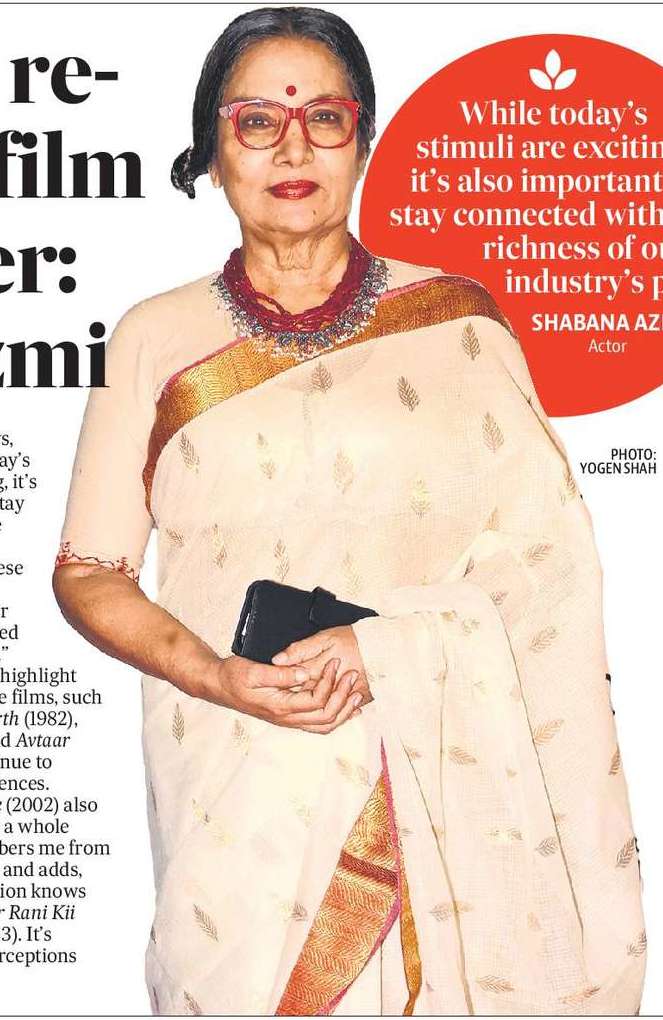
The trend of re-releasing classic films is gaining momentum in Bollywood, with the recent re-release of the Gangs of Wasseypur franchise (2012), Rehnaa Hai Terre Dil Mein (2001), Tumbbad, and Laila Majnu (both 2018), among several others, making waves. Veteran actor Shabana Azmi, however, has reservations about this trend. “I don’t think that re-releasing a film is the answer, because everything today is so easily available,” she remarks.
But she does acknowledge that re-releases offer younger audiences a chance to reconnect with the simplicity of classic Indian cinema. “To each their own. I can’t dictate what others should do,” she says, adding, “While today’s stimuli are exciting, it’s also important to stay connected with the richness of our industry’s past. These films had their significance in their time and some lasted longer than others.”
Azmi goes on to highlight some of her notable films, such as Ankur (1974), Arth (1982), Mandi, Masoom and Avtaar (1983), which continue to resonate with audiences. “Strangely, Makdee (2002) also stands out because a whole generation remembers me from that film,” she says and adds, “The latest generation knows me from Rocky Aur Rani Kii Prem Kahaani (2023). It’s interesting how perceptions evolve.”
We’re an insensitive society, giving trash to our kids as entertainment-Vishal and Rekha Bhardwaj
8:22 AM

Chandrima Pal (BOMBAY TIMES; June 28, 2024)
For the World Music Day concert in Kolkata, multi-hyphenate power couple Rekha and Vishal Bhardwaj took time off from their hectic schedule and many interactions with fellow artistes and filmmakers to speak to us. In a cosy room with a piano, family portraits and antiques, the duo shared their views on cinema, poetry, music and more.
There is considerable excitement around music and musicians being discovered on digital platforms. You have collaborated with some of them as well. Some argue that social media has no scope for a deeper engagement with music. What is your take on it?
Vishal Bhardwaj: I don’t mind using any means to reach out to as many people as possible with my work. That’s how you sell profound and aesthetic ideas like literature and music. It is like meethi dawai.
‘OTT broke the myth that everything has to be in English to be successful’
Rekha Bhardwaj: Besides, there are so many Instagram handles that are sharing good poetry, actors are reading from scripts, reciting couplets. I have discovered some very good music and talent in the process. Our film work gets a wider audience anyway. I see an opportunity in using the apps and various social media platforms to get people to discover the more serious and niche aspects of our craft.
The two of you met at Delhi University. Music and poetry brought you together and defines your relationship even today. Now when you visit college campuses or interact with young students, do you see the same passion and commitment towards music or poetry among them?
RB: It’s a bit of a mixed bag, really. You meet some people who are still very rooted and there are those who are not seriously invested into music. There are purists and there are people who have ‘jawani ka josh.’ There are very few who are taking up music and poetry seriously. Like the Kabir Cafe in Delhi, who seem to have some potential.
So if an aspiring musician comes to you, seeking your advice, would you encourage them to pursue music as a career? Or give them a sense of reality?
RB: I would first hear him or her out to see if there is talent and the inclination to do the hard work that is required to be successful. You see, if your definition of success is being liked by everyone, you are likely to be unhappy with whatever you do or achieve. If you get 100 followers, you will crave for a thousand more. And even then you will sulk. We have never craved numbers. But focussed on our art and people just came along, connected with our work. Like Gulzar Saab has always told us, “Success on your terms.”
VB: When we came up, they were very dark times. Now there are so many platforms to showcase your work. At that time there were only recording companies and they were advocating only popular music. Perhaps rightfully so. For them it was commerce. For us it is art. There’s a huge difference. But if you are really talented you can defy the odds with your perseverance and hard work. There is no room for arrogance or shortcuts here.
My question to you Vishal is why have Indian filmmakers stopped making films and music for children? Your composition Jungle Jungle Baat Chali Hai (lyrics by Gulzar) for Jungle Book still resonates. And after your Ruskin Bond adaptations, you did not return to the genre. Why is that?
(Smiles) I started this movement with Makdee and The Blue Umbrella and somewhere went on to do different kinds of work. We are a very insensitive adult society. We do nothing for our children, and in the name of entertainment we give them the trash of Bollywood, the really bad dubbed versions of foreign shows. But yes, we are planning a sequel of Makdee, and Shweta Prasad (played a double role) will be involved in the making of the film.
Isn’t there better scope for children’s movies and shows on the OTT platforms?
It is worse. OTT is not interested because they say they work on subscriptions and children are not their subscribers. They’ll never make any investments for Indian content for that age group. I tried working with Ruskin Bond’s Mr Oliver’s Diary (a gun-toting, violin playing headmaster, a leopard and other creatures). My long-time associate Aditya Nimbalkar and I had a script. I went to everyone. Trust me, no one was interested.
There is a lot of interesting work happening with languages on OTT though. We see productions with multilingual casts and stories that reflect the plurality that is India. Does this excite you as a filmmaker and composer?
I have been using various dialects and actors from the time I made Kaminey. There was a Bengali gangster, and a Nigerian one. I love all languages and dialects and the authenticity that they bring to any film. The biggest positive of OTT is this, they broke this myth that everything has to be done in English to be commercially successful. And I had a big problem with it. I had an issue with Richard Attenborough’s Gandhi. Because it was made in English by a Hollywood studio to appease the world market. In the film, beggars are begging in English in Indian streets. I felt so disconnected with it even though it was a beautiful cinematic experience. It just did not have that authenticity.
RB: Even in Slumdog Millionnaire…
VB: That’s right. In slums we do not speak in English or read Three Musketeers. I had a problem with that.
Vishal on his version of Patta Patta Buta Buta
I have been trying to work with this song for four decades. The lyrics are universal; you can put it in any context. It could be political or personal. Patta patta buta buta haal hamara jaane je…(hums) every leaf, every plant knows my state of mind except the flower…We are happy that we finally managed to give this classic our own touch, and released it on World Music Day.
------------------------------
"It was a beautiful concert in Kolkata. Vishal and Shubha Mudgal, Papon and I blended Kabir and Lalan Fakir, Amrita Pritam and Sahir Ludhianvi respectively" - Rekha Bhardwaj.
"Meera and Kabir, it is good in a way. Chalo shuruwat toh ki hai!"- Vishal Bharadwaj
I was scared Naseeruddin Shah would not only dislike Kuttey's script, but also tell me to not make it-Aasmaan Bhardwaj
8:36 AM
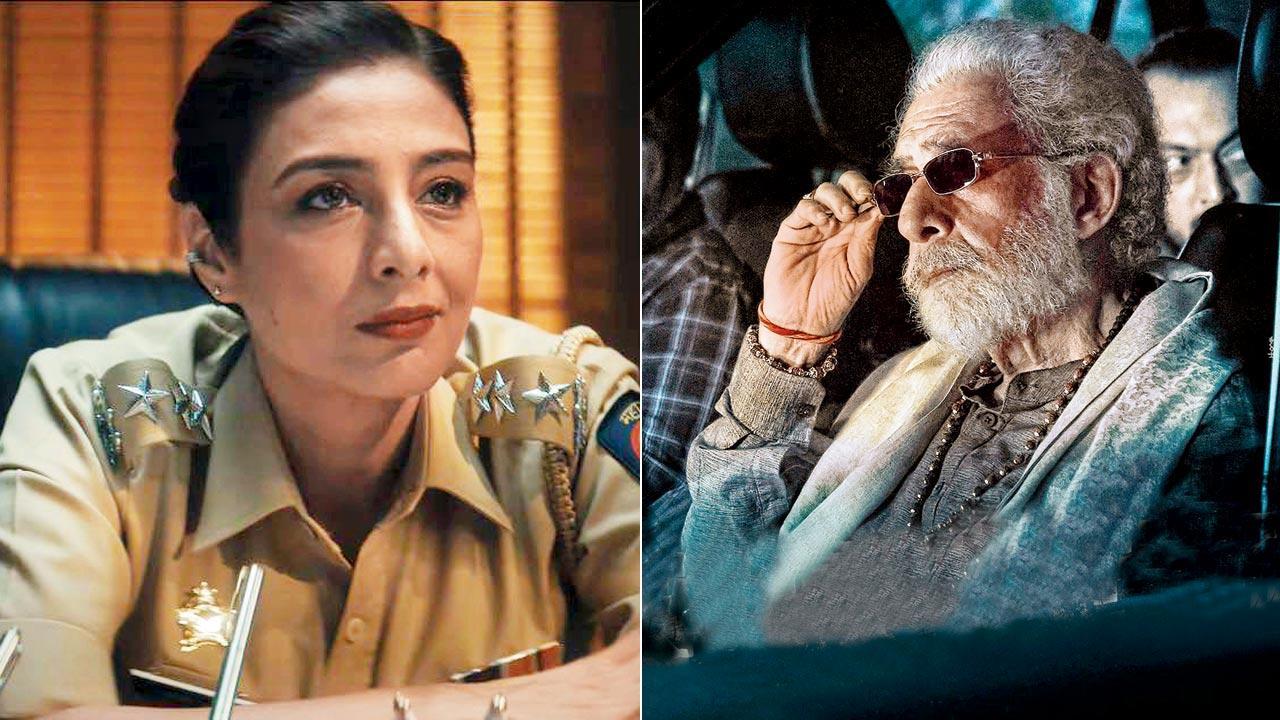
Debutant director Aasmaan, whose Kuttey boasts a stellar cast, says he initially didn’t expect Naseeruddin Shah and Tabu to give their nod to film
Hiren Kotwani (MID-DAY; January 13, 2023)
It happened during the shoot of Makdee (2002). Aasmaan Bhardwaj was only seven at the time, but as he stood on the set of his filmmaker-father Vishal Bhardwaj’s directorial debut, he knew he wanted to be a director. “The ambience, the energy, it all fascinated me in such a way that then and there, I made up my mind on [growing up to become a filmmaker],” he begins.
Over 20 years on, Aasmaan has realised his ambition. His directorial debut, Kuttey, opens in screens today. Interestingly, he had first written the crime comedy in January 2019 while studying filmmaking. “I had finished an assignment earlier. My teacher said that since we had about six months in hand, I could write [another story] till I graduated,” he recollects.
Little did he know then that he would turn director with this script. When the time came, it was his filmmaker-father who helped him take the decision. “I went to my father with five scripts, of which two were shortlisted. He explained that Kuttey’s script is unique, and would be a better pick for my first film because of the way it is written. We both felt it would also showcase me as a writer.”
In Kuttey, the first-time director has brought together a dream cast — Naseeruddin Shah, Tabu, Konkona Sen Sharma, Kumud Mishra, Arjun Kapoor, Radhika Madan and Shardul Bhardwaj. That some of today’s finest actors gave their nod says a thing or two about the script’s merit. Aasmaan admits that being Vishal’s son helped him get access to them.
“My father could call or message them, saying that his son would like to narrate a script to them. After that, the decision of doing the movie was entirely theirs. I had never expected Tabu ma’am or Koko ma’am to say yes. In fact, I was scared Naseer bhai would not only dislike the script, but also tell me to not make it,” he grins.
He was understandably anxious when shooting with Shah, Tabu and Sen Sharma. “I was so lost in Tabu’s performance that I forgot to say cut. On Naseer bhai’s first day of shoot, I was nervous all day. But they were all easy to work with because they are fabulous actors.”
As he follows in his father’s footsteps, what aspects has he imbibed from him as a storyteller? “Whatever I know today, I have learnt it from him, and my mother [Rekha Bhardwaj]. Like him, I want to make diverse movies.”
I found a distributor for my first film after over a 100 screenings-Vishal Bhardwaj
7:44 AM

Niharika Lal (BOMBAY TIMES; November 30, 2019)
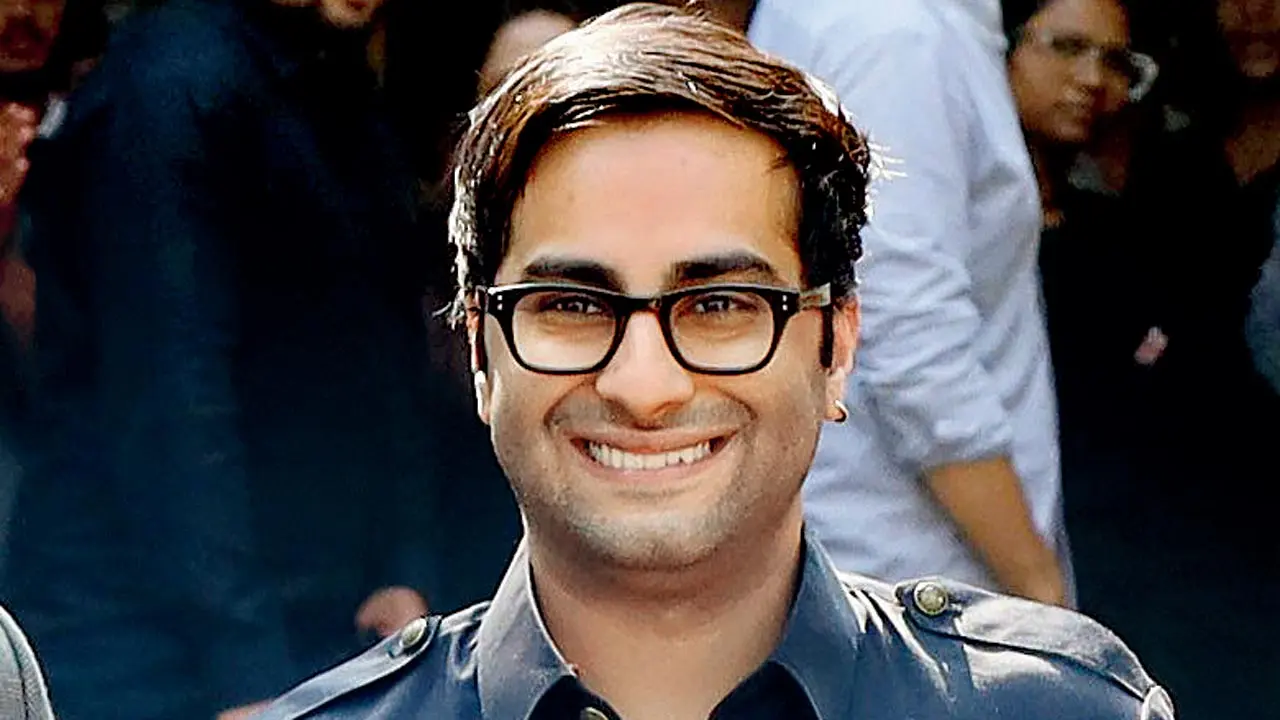
 Speaking at a session titled ‘Indian Cinema Inspiring Entrepreneurs’ at Film Bazaar, organised by NFDC on the sidelines of International Film Festival of India (IFFI), Vishal Bhardwaj reminisced about the first film he made and shared how the internet gave rise to opportunities that didn’t exist when he had joined the film industry. He also spoke about how the film industry has changed over time with more women occupying important positions. Vani Tripathi Tikoo, CBFC member and co-panellist in this session, advised budding filmmakers to celebrate rather than feel disheartened by rejections. Excerpts:
MY FIRST FILM TAUGHT ME MARKETING, DISTRIBUTION AND PRODUCING A FILM: VISHAL
Sharing the trouble he went through to release his first film, Vishal said, “The Children’s Films Society of India (CFSI) sponsored Makdee, my first film. They had invested around ₹ 50 lakhs. And when I showed the first cut to the committee, they rejected it. I came from a music background and there was no precedent that a music composer could become a director. When I showed the film to my friends they said that it was not a Pather Panchali, but it was not a bad film either.”
Vishal said that this gave him the courage to take the film forward. “I bought the film from CFSI, and got a loan of ₹50 lakhs, which was a huge amount for me at that time. For a whole year, I must have screened Makdee over a 100 times for distributors, and finally, I was able to con someone (laughs)! But in that one year, I had learnt marketing, distribution and every other aspect that comes after filmmaking. Those days, I used to be depressed, but later, I realised that because of that one year, I learnt how to become a producer. After this, I wrote, directed and co-produced Maqbool (2004).”
LEARN TO ACCEPT REJECTIONS WITHOUT BEING HEARTBROKEN: VANI TO BUDDING FILMMAKERS
Talking about rejections, Vani Tripathi Tikoo told budding filmmakers at the session, “You should be able to accept rejections. I tell my students not to feel bad because someone said no. The no is for the work, and not for you. You shouldn’t question your capabilities because of rejections. Instead, you should work on improving your craft. For a film, you have to work with several people, who may have a different mindset than yours. It’s almost like certifying a film.”
UNLIKE EARLIER, IT’S EASIER TO CONTACT A STUDIO NOW: VISHAL
In reply to a question on scriptwriting, Vishal said, “There was a time when it was difficult to reach a studio, but now, if you have good content, you can contact a studio. Most of the studios are now hiring writers. Junglee Pictures had developed their films’ scripts with in-house writers. Delhi Belly came to be because Kiran’s (Rao) amusement while reading the script caught Aamir’s (Khan) attention. Akshat Verma (scriptwriter of Delhi Belly) had simply sent the script to Aamir.”
Adding to it, Vani said, “Recently, I met a young filmmaker (Sanjeev Vig) who never attended any film school. But he felt very strongly about a subject and put it into a script for a short film and then sent it to Naseer bhai (Naseeruddin Shah). Naseer, who is otherwise very picky with projects, called Sanjeev and asked him to meet. The film was called Rogan Josh (2018), and it bagged several awards.”
IT’S THE BEST TIME TO BE IN THE FILM INDUSTRY: VISHAL
Vani emphasised that a young person has more opportunities to write and direct now than before. She said, “You can’t wait for eternity for someone to come and pick your script to make a film. You should make it yourself ! If no one chooses your script, use your phone camera, shoot it and post it.”
Vishal told budding filmmakers that now with the availability of multiple channels and digital platforms, it was the best time to be a filmmaker. He said, “When I came to the industry, there were two TV channels and then there were films, there was nothing in between. Today, there are so many opportunities. I think the digital boom is so good, films are doing well at the box office, so it is the best time to be in the filmmaking business. When we came to the industry, tab aisa tha jaise - film industry mein jana gunaah hai. Film mein aapka beta ja raha hai toh matlab khatam, beti ki toh baat hi chhoriye. Now, we have more female assistant directors, more female studio heads in the industry.”
I have never given producers a chance to manipulate me-Vishal Bhardwaj
8:48 AM

As part of the 49th edition of IFFI, Bollywood filmmakers Vishal Bhardwaj, Abhishek Chaubey and Ramesh Sippy talk about how times have changed with corporates entering the film industry, the need for creative freedom and how artistes need to be objective about their craft
Rachana Dubey (BOMBAY TIMES; November 25, 2018)
 The ongoing NFDC Film Bazaar in Goa, which is part of the 49th edition of International Film Festival of India (IFFI), had an interesting panel of guests yesterday, to discuss the contributions made by individuals in cinema, who have broken away from routine formulas of filmmaking. Filmmakers Vishal Bhardwaj, Abhishek Chaubey and Ramesh Sippy participated in a moderated discussion that covered topics like censorship, taking over the reins of a film as a director and producer, and all the responsibility that comes along with that.
About his initial experiences and what coaxed him to take up production, though he was only a writer and a director, Vishal told the audience, “When I made Makdee (2002) and Maqbool (2003), it was difficult to release them because there were no multiplexes that could play those movies. Post Maqbool, things became easier, but it’s now that the fruit has ripened. Times have changed. Corporates entered and that changed the scenario to a great deal. But there was a time when we had individual producers and that was a tricky space to be in. I remember how Gulzar saab was angry about Hu Tu Tu (1999) being cut by the producers. The version of the film that he had in mind didn’t reach the theatres. I became a producer by default because CFSI (Children’s Film Society India) had rejected Makdee, but I wanted to release it. So I had to step forth. I have never been manipulated by a producer and I have never given them a chance to do that, because I saw Gulzar saab go through it. The final cut of my film is always mine.”
Abhishek Chaubey, who has helmed films like Ishqiya, Dedh Ishqiya and Udta Punjab, and has also written movies, took the plunge as a producer with A Death In The Gunj a year ago. When asked about taking that path, he said, “It’s important for creative people to take control of their work. When you turn producer, you become more responsible for putting the money where the mouth is. You know how much has been spent and where, and you control the resources. Today, I have better access to funds when I direct a film or produce a film. Vishal (Bhardwaj) sir mentored me and now, I just think it is important that I do what he did for me.”
The filmmakers on the panel have all been producers and directors on their individual projects, so the pertinent question asked to them was whether they ever lost objectivity over their films, given that they were close to the subject. Vishal said, “You know, you need more hands that can slap you. You need friends who can show you better and disagree with you, otherwise you can’t be objective about your craft.”
 Ramesh Sippy added, “Be as self-critical as possible. When you complete a film, be brave to see where you started and where you have reached, and whether you have been lopsided in your approach. Having friends who can give you advice is helpful, but you have to be your own critic. Raj Kapoor would see his films, show them to others and even if it needed to be reshot, he retained his original thought. Producers must understand this and allow a filmmaker that liberty to do so.”
Creative arenas, particularly films, have been braving censorship all along, more stringently so in the last couple of years. Bring up the subject and Abhishek, whose film Udta Punjab (2016) had to fight to find its way to cinemas, said, “Powers that be don’t take art seriously. They don’t see films or arts as cultural documents of a time.”
Vishal summed up, “What is the point of saying anything? Do they listen? They do what they want. We are the only nation that puts a ‘smoking kills’ disclaimer on a running visual, which is just ridiculous.”
Rajinikanth is my first choice if I make King Lear-Vishal Bhardwaj
7:48 AM

MID-DAY (September 20, 2017)
South icon Rajinikanth would be the first choice for the role of King Lear if Vishal Bharadwaj decides to make a fourth film on William Shakespeare’s tragedies. Bhardwaj has successfully adapted Shakespeare’s Macbeth, Othello and Hamlet into Maqbool (2004), Omkara (2006) and Haider (2014) respectively.
“Before making Haider, I had worked on the script of King Lear and visualised Rajinikanth in the lead role. He will be my first choice, if and when I decide to make the film,” Bharadwaj said at the recently concluded Brahmaputra Valley Film Festival in Guwahati.
Asked why he chose Shakespeare’s tragedies to make his signature films, the filmmaker said that while Maqbool was an accident, the other two films were his attempt to complete the trilogy. “For my second film, I was looking for a story when I decided to make Omkara and finally there was a pressure to make the third of the trilogy. Haider was a difficult film for me. I had to ensure that the film matches up to the first two films and at the same time, I wanted to make a film in Kashmir against the backdrop of conflict,” he said.
Next on Bhardwaj’s wish list is a trilogy of Shakespeare’s comedies, but there is nothing on the horizon as of now. Asked whether the legacy of filmmakers like Satyajit Ray was now lost, Bhardwaj said that was not true as a generation of filmmakers have emerged watching his films and many different kinds of films are being made.
He further appealed to the maestro’s son Sandip Ray to part with the rights of the filmmaker’s works so that others can make films on his stories. “Ray was a master storyteller and many of his stories can be made into great films,” he added.
The director, who made his debut with the children’s film Makdee (2002) and went on to make The Blue Umbrella (2007) regretted that not many films were being made exclusively for children. “There is hardly any creative effort on the part of adults to make films for children and even films made by the Children’s Film Society of India are not commercially viable,” he said. “This must change and we as members of the society must ensure that more such films are made and children get to see these in cinema halls,” Bharadwaj said.

After Vishal Bhardwaj, now his son Aasmaan makes a film on a story by Ruskin Bond
7:47 AM

Twenty-year-old Aasmaan’s third short film is an adaptation of the writer’s short story, The Thief
Sanyukta Iyer (MUMBAI MIRROR; November 16, 2016)
Eleven years after Vishal Bhardwaj’s Blue Umbrella, based on Ruskin Bond’s 1980 novel of the same name came out, the writer-filmmaker-composer’s son Aasmaan’s third short film, an adaptation of Ruskin Bond’s story, The Thief, is ready to take wings.
 The 20-year-old filmmaker started work on the script in early February
last year and even though the shooting schedule looked much longer on
paper, Aasmaan wrapped up the film with a seven-day shoot that was
followed by four-five days of patchwork. “The schedule was spread over a
month between July-end and the beginning of August since it was raining a
lot,” he recalls, adding that his short, also titled The Thief, is now
one of the 38 official selections for the category of “Viewing Room” at
the 10th edition of NFDC’s Film Bazaar in Goa this year.
A record 202 films, including 131 fiction features and 33 documentaries, were submitted to the Viewing Room which serves as a mentoring platform for films-in-progress to find sales agents, film festivals, buyers, distributors and financing.
Aasmaan, currently a screenwriting student at the School of Visual Arts in New York, has already completed two short films – The Identities, featuring Kalki Koechlin, Vivaan Shah and Harish Khanna which released in 2013, and Murder On The Deccan Express, featuring Vivaan Shah and Aneesha Joshi, which released in 2015.
 The Thief features Chandan Roy Sanyal, Rahul Kumar and
Aditi Sharma in a special appearance and is the story of a boy who goes
through a change of heart. Prod Aasmaan on how similar he is to his
protagonist and he guffaws, “Like him, I have learnt many things by
making mistakes but I wouldn’t say that I have gone so far as to steal
from another person.”
Aasmaan believes that his prolific father who has co-produced the film along with singer-wife Rekha and co-written it with him and Aditya Nimbalkar has been a crucial part of his cinematic journey. “It is because of him that I am so passionate about filmmaking. I want to be more like him. I wanted to join the army before but my father’s decision to make Makdee exposed me to this world,” the youngster signs off.
Makdee girl Shweta Basu Prasad directs documentary on classical music
8:30 AM

Roshmilla Bhattacharya (MUMBAI MIRROR; June 21, 2014)
Shweta Basu Prasad, the name may not immediately ring a bell. We are talking about the 11-year-old whose double role in Makdee won her the National Award for Best Child Artiste.
Subsequetly, she was seen in Ekta Kapoor's soap, Kahani Ghar Ghar Kii, as Shreyas Talpade's sister in Iqbal and in RGV's Darna Zaroori Hai. She then moved down South and disappeared from the Bollywood skyscape.
Turns out that in the interim she has co-produced a short film featuring Naseeruddin Shah with a friend whose name she's unwilling to reveal and directed a documentary on classical music titled Roots.
It features the who's who of the music world, from sarod maestro Amjad Ali Khan and his sons Aman and Ayan, violinist L Subramanium, Kathak guru Birju Maharaj, vocalists Pandit Jasraj and Shubha Mudgal, Pandit Shiv Kumar Sharma and Hari Prasad Chaurasia, to B'town biggies like Imtiaz Ali and Muzaffar Ali, composers Shantanu Moitra, Amit Trivedi, writer-lyricist-composer Gulzar, Oscar winner AR Rahman and her mentor-director Vishal Bhardwaj.
"I started work on Roots when I was 20 and it's been the focus of my life for the past three years," says Shweta who studied Hindustani classical music which her friends dismissed as boring. "So I started researching, attending seminars and concerts, and came up with the idea of a 90-minute docu-feature which explores the visibility of Hindustani and Carnatic music."
Her trips to less known corners of the country opened her eyes to the unfair taxes levied on the makers of musical instruments while Bhardwaj rued that many Bollywood composers opted for electronic music over live musicians, rendering the latter jobless. The classical touch that Shiv-Hari brought into music they composed for Yash Chopra is missing too, with commercial chartbusters ruling.
These and other issues will be discussed in Roots that will unveil towards the month end. "I'd like to screen it at schools, colleges and film institutes, take it to film fests and then try for a satellite and theatrical release," says Shweta who now wants to return to her acting career. "I haven't received any offers yet but I'm open to them."
As for music, well, she'll continue to play the sitar but as a hobby.
Subscribe to:
Posts (Atom)