Showing posts with label Majrooh Sultanpuri. Show all posts
Showing posts with label Majrooh Sultanpuri. Show all posts
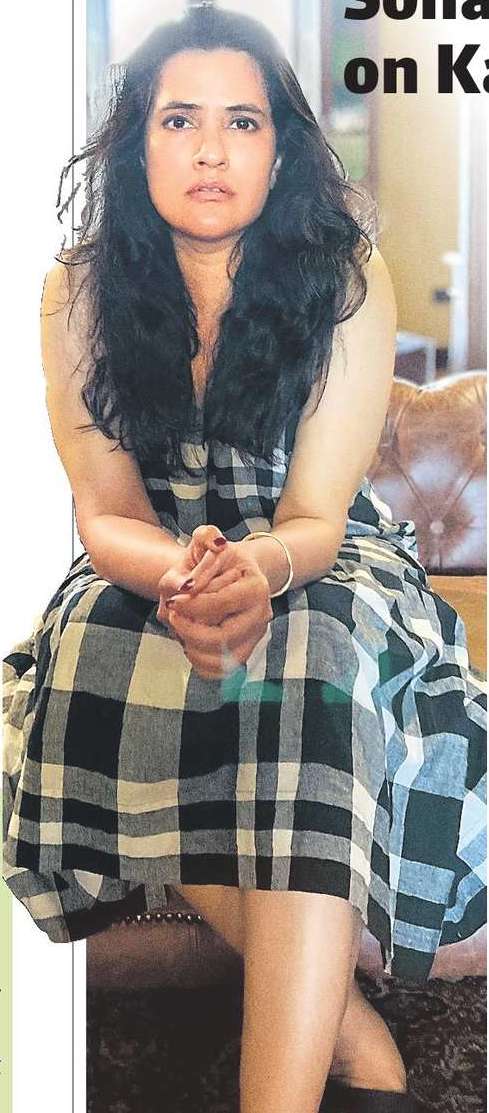
Sona Mohapatra claps back at trolls on Kaanta Laga remarks
9:27 AM
Vishakha Pandit (HINDUSTAN TIMES; July 6, 2025)
Singer Sona Mohapatra has responded to the criticism over her recent remarks on Kaanta Laga music video directors Radhika Rao and Vinay Sapru, denying allegations of insensitivity after actor Shefali Jariwala’s death.
Speaking to us, Sona (49) said, “What do the people of India feel about performative grief? It’s insidious self-promotion riding on a pretty performer’s untimely demise — it should upset everyone. These songs and legends are the musical heritage we stand on.”
It all started on Friday, when she shared an Instagram Story about the directors “retiring the song” after Shefali’s passing, writing: “3 legends created Kaanta Laga. Composer, lyricist, and singer: R D Burman, Majrooh Sultanpuri, Lata Mangeshkar... These two only created a smutty video with a 19-year-old. RIP and all for the 42-year-old lady but legacy???”
Several social media users accused Sona of being “insensitive” by refusing to name Shefali. Some also pointed out that Sona had voiced the 2004 remix Kabhi Aar Kabhi Paar, which had an equally sensuous video.
However, on Saturday, the singer shared a follow-up post: “Are we okay with our legends fading and getting disconnected from their own creations? Calling yourself the ‘makers’ of Kaanta Laga is okay when you are just the makers of a remix video?”
Meena Kumari told my parents to allow me to visit her home four days a week to learn Urdu-Sachin Pilgaonkar
8:52 AM

Mohammed Wajihuddin (THE TIMES OF INDIA; September 10, 2023)
You ring the doorbell and a maid ushers you into an aesthetically decorated room. A few minutes of surveying the antique furniture, sepiatoned photographs, awards and shields jostling for space on a pedestal later, you are greeted with warm ‘adaab’.
As soon as actor-director Sachin Pilgaonkar breezes in and occupies a small wooden chair, the smiling actor leaves you in no doubt that he is “in love with Urdu.” Known mostly by his screen name Sachin, he gets down to conversing in chaste Urdu. Words like “deeda-o-danishta” (intentionally), “khushgawar” (congenial), “jafa” (tyranny of the beloved) and “wafa” (trust) punctuate the conversation.
A pucca Maharashtrian whose mother tongue is Marathi, Sachin has just won the Mohsin-e-Urdu (Ambassador of Urdu) award from the citybased socio-cultural organisation Urdu Markaz for his “true love for Urdu.” “I have yet to come across a Maharashtrian whose mother tongue is Marathi but speaks Urdu so fluently. He is Urdu’s ambassador because he lives, speaks and bats for it,” explains Urdu Markaz’s director Zubair Azmi. Azmi adds that Byculla-based Burhani College too will be awarded the Mohsin-e-Urdu.
Before Independence, Urdu was spoken widely across north India, leaving a deep influence on films, literature and culture. Post-partition, it became synonymous with the minority community, a reminder of the event that divided the subcontinent. However, even today many legends in Hindi cinema, including Gulzar and Dharmendra continue to use Urdu extensively.
“A language has no religion. It is wrong to say Urdu is a language of Muslims alone. It belongs to India and has added to our literary and cultural heritage,” declares Sachin, who was all of 9 when he acted in Sharat Chandra Chattopadhyay-penned, Hrishikesh Mukherjee-directed ‘Majhli Didi’ (1967) with Meena Kumari and Dharmendra in the lead. Meena Kumari grew very fond of the boy; one day she asked him about the language he spoke at home. “Marathi,” replied the then child actor. The legendary Meena Kumari whom Sachin called “Meena Apa’’ while she addressed him as “Sachu Baba”, asked him to bring his parents to the sets.
“Meena Apa told my parents to allow me to visit her home four days a week to learn Urdu. She said she saw a bright future for me in the industry provided I learnt the nuances and diction of the language and spoke it well,” recalls Sachin.
Thus began his intense tutoring in Urdu from the actress whose original name was Mahjabeen Bano. Bollywood’s tragedy queen, she also wrote poetry with Naaz as her takhalus (pen name). Having worked in 65 films as child artiste, he graduated and went on to act and direct a number of Hindi, Marathi, Kannada and Bhojpuri films and television serials. If films like ‘Geet Gaata Chal’ (1975), ‘Balika Badhu’ (1976), ‘Ankhiyon Ke Jharokhon Se’ (1978), ‘Sholay’ (1975) and ‘Satte Pe Satta’ (1982) made him a household name, the serial ‘Tu Tu Main Main’ (2000) established him as a known face on the small screen.
How much has Urdu helped him as an actor? “Oh, I would have remained adhura (incomplete) if Urdu had not come into my life. Why only acting, I would not have been the confident person I am today if I had not learned how to speak this beautiful language,” says the boy who grew up in a 1BHK flat in Dadar. Sachin later moved to Juhu, and then to Lokhandwala.
“I also enjoyed going to Meena Apa’s big house at Janki Kutir in Juhu because she would send a big car to pick me up from Dadar. For one hour, Meena Apa played table tennis with me while another hour was devoted to Urdu.”
After her demise, says Sachin, he was fortunate to have been taught by veteran poet-lyricist Majrooh Sultanpuri, his neighbour in Juhu. Like other kids, Sachin addressed him as “Abba”. On one Eid, all the children lined up in Abba’s room to receive a 10-rupee note each as Eidi (gift). “Instead of money, he gave me a ghazal which he wrote in Devnagri before me,” he recalls. “It was my best award.”
The real challenge was 'Ghazab Ka Hai Din' which had a toota phoota metre-Anand Shrivastav
7:52 AM

Majrooh Sultanpuri; Anand-Milind
Roshmila Bhattacharya (MUMBAI MIRROR; October 4, 2018)
The one person who can claim to have known Majrooh Sultanpuri, whose birth anniversary was on October 1, since the day he was born, is Milind of the composer duo Anand and Milind. His late father, music director Chitragupta Saab, and Majrooh Saab, were a formidable duo in the ’50s, ’60s and the early ’70s and Milind flashbacks to the bungalow in Khar where they lived till he moved to Powai in 2003. On his way home from school, he remembers seeing Anand Bakshi writing in the verandah and another lyricist Prem Dhawan sitting under a coconut tree in the garden. A third, Rajendra Krishan, would be sitting in the living room by the telephone while Majrooh Saab would be working in the music room.
This year, as part of Chitragupta’s centenary celebrations, the junction between 14th Road and Khar Danda was named Sangeetkar Chitragupta Chowk, with the notations from the song “Papa Kehte Hain Bada Naam Karega” on the plaque. This popular track from Qayamat Se Qayamat Tak was penned by Majrooh saab for Anand and Milind. “We finished it in one sitting even though we changed the metre in the second line. But the real challenge was 'Ghazab Ka Hai Din' which had a toota-phoota metre and had chhota chhota dialogues in every line. I don’t know anyone other than Majrooh uncle who could have written this song,” asserts the younger music director.
He goes on to fondly reminisce about some of the gems his father and his Majrooh uncle composed, including Oonche Log’s “Jaag Dil-E-Deewana Rut” and “Mujhe Darde Dil Ka” from Akashdeep to “Jodi Hamari Jamega Kaise Jani” which had Manna De singing for a Chaplenesque Mehmood in an anglicised accent and Asha Bhosle crooning for gaon ki gori Aruna Irani in a dehati accent. “Only a master wordsmith could rise up to this challenge,” asserts Milind, who also collaborated with the veteran lyricist for an album, Lal Dupatta Malmal Ka, which was turned into a film for television following the popularity of the songs.
His Majrooh Uncle would always call him his “gora beta” and it was only years later that he revealed that it was because while his siblings, Anand, Savita and Sudha, were all fair, Milind had a slightly darker complexion. “He didn’t want me to feel inferior to them in any way,” he laughs, adding that though he worked a lot more with Sameer who was a year older than him and a year younger than Anand, the veteran lyricist was a favourite because he never let them feel the age difference.
“He served the best kebabs and was full of jokes till he lost his son Eram. But time heals and today, Milind’s daughter, Ritika Shrivastava, who is an assistant director, has worked with Majrooh Saab’s grandson and Andalib’s son, Farzan, who is also an AD. “So it’s the third generation working together now,” Milind says.

I had to prove myself time and again-Sameer
8:31 AM

Tanvi Trivedi (BOMBAY TIMES; January 31, 2016)
One of the few lyricists in
Bollywood who has worked with three generations of musicians and
filmmakers, Sameer Anjaan has entered the Guinness World Records for
penning the most number of film songs. Having written 4,000 songs,
Sameer reveals his survival secret in an interview. Excerpts from the
chat:
From Tum paas aaye (Kuch Kuch Hota Hai) to Char baj gaye (F.A.L.T.U), how will you describe your journey?
I was not expecting to come this far. But I continued to work and adapted myself to newer generations. In the last 35 years, I have worked with more than hundred music directors. This generation has newer thoughts and ideas of approaching music, but melodies have remained the same.
How did you adapt yourself to the newer generation?
It was difficult to let go of old thoughts and incorporate newer styles. But I realised that if I didn't prove myself to the newer filmmakers and composers, they would forget about me. It was important to reinvent myself and compose songs like Anarkali disco chali (Housefull 2) or Char baj gaye (F .A.L.T .U).
Some say that music and lyrics have lost its souls and don't have a recall value. Do you agree?
Writers are not to be blamed for this. The whole scenario lacks depth in thought. We don't make the kind of films we made during yesteryear. The music and lyrics for a Mother India will obviously be different from a Coolie No.1. Nowadays, writers lack versatility. Even today, people compare me with Javedji (Akhtar) and Gulzar saab. They belonged to my father's generation. With corporatisation of Bollywood, films are all about stars. Even though music is the most important part of Hindi films, creativity levels have gone down.
What inspires you to write?
I have been inspired by Anand Bakshi and Majrooh Sultanpuri. Ninety five per cent of my work has been with Nadeem Shravan, Himesh Reshammiya and Anand-Milind. So, my inspiration comes from people I work with, too. For the Char baj gaye song, I was inspired by Shah Rukh Khan's dialogue 'Picture abhi baaki hai mere dost'.
How do you keep a record of songs that you have written?
I don't collect any data or keep a record of my work. It's my friend Biswas Nerulkar who brought it to my notice that I had writ ten the highest number of songs and should enter the Guinness World Records.
From Tum paas aaye (Kuch Kuch Hota Hai) to Char baj gaye (F.A.L.T.U), how will you describe your journey?
I was not expecting to come this far. But I continued to work and adapted myself to newer generations. In the last 35 years, I have worked with more than hundred music directors. This generation has newer thoughts and ideas of approaching music, but melodies have remained the same.
How did you adapt yourself to the newer generation?
It was difficult to let go of old thoughts and incorporate newer styles. But I realised that if I didn't prove myself to the newer filmmakers and composers, they would forget about me. It was important to reinvent myself and compose songs like Anarkali disco chali (Housefull 2) or Char baj gaye (F .A.L.T .U).
Some say that music and lyrics have lost its souls and don't have a recall value. Do you agree?
Writers are not to be blamed for this. The whole scenario lacks depth in thought. We don't make the kind of films we made during yesteryear. The music and lyrics for a Mother India will obviously be different from a Coolie No.1. Nowadays, writers lack versatility. Even today, people compare me with Javedji (Akhtar) and Gulzar saab. They belonged to my father's generation. With corporatisation of Bollywood, films are all about stars. Even though music is the most important part of Hindi films, creativity levels have gone down.
What inspires you to write?
I have been inspired by Anand Bakshi and Majrooh Sultanpuri. Ninety five per cent of my work has been with Nadeem Shravan, Himesh Reshammiya and Anand-Milind. So, my inspiration comes from people I work with, too. For the Char baj gaye song, I was inspired by Shah Rukh Khan's dialogue 'Picture abhi baaki hai mere dost'.
How do you keep a record of songs that you have written?
I don't collect any data or keep a record of my work. It's my friend Biswas Nerulkar who brought it to my notice that I had writ ten the highest number of songs and should enter the Guinness World Records.
"Vijay Anand was only 21 when Nau Do Gyarah released; one of Hindi cinema's youngest directors"
7:38 AM

Roshmilla Bhattacharya (MUMBAI MIRROR; January 20, 2015)
 After Funtoosh, the ninth
highest grosser of 1956, Dev Anand started work on
Khaali Botal, based on AJ Cronin's 1953 novel, Beyond This
Place, about a son's quest to prove the innocence of his father
convicted for a murder. The actor was on his way to Mahabaleshwar for a
shoot when his younger brother, Vijay Anand, fondly called Goldie, told
him that he wanted to narrate a script he'd just completed. “Why don't
you drive down with me, you can tell me your story on the way,“ Dev
suggested.
After Funtoosh, the ninth
highest grosser of 1956, Dev Anand started work on
Khaali Botal, based on AJ Cronin's 1953 novel, Beyond This
Place, about a son's quest to prove the innocence of his father
convicted for a murder. The actor was on his way to Mahabaleshwar for a
shoot when his younger brother, Vijay Anand, fondly called Goldie, told
him that he wanted to narrate a script he'd just completed. “Why don't
you drive down with me, you can tell me your story on the way,“ Dev
suggested.Goldie immediately got into the car and started narrating the story of Madan, who sets out from Delhi in his truck upon learning that his uncle has left him nine lakh rupees in cash and two lakh rupees worth of property in Mumbai, after a fallout with his own son. En route, he stops at a wedding where the bride, disguised as a Sikh boy, sneaks into his truck. He discovers later that the bickering partner is actually a pretty girl and loses his heart too.
They reach Mumbai only to learn that Madan's uncle is dead and his son has inherited everything. When he protests, he is thrown into jail on charges of kidnapping the runaway heiress. The many twists and turns in the plot fascinated Dev Anand. On reaching his hotel in Mahabaleshwar he immediately called his office in Mumbai and informed them that since Raj Khosla, the director of Khaali Botal, was not ready with the script yet, they would roll with a film Goldie had written and which, on his insistence, he would direct too. The film's title, Nau Do Gyarah, borrowed from the familiar Hindi idiom meaning 'to run away' and the numbers were also a pointer to the legacy Madan hoped to inherit.
“Nau Do Gyarah marked Vijay Anand's debut with Navketan as an independent film director. He was only 21 when the film released, one of Hindi cinema's youngest directors,“ says Mohan Churiwala, a close associate of Dev Anand.
They bought a truck in Delhi and drove down to Mumbai, with Dev at the wheel singing Hum hain rahi pyaar ke, Kishore Kumar's song reflecting his own philosophy of life. “Back in the '50s, Hindi films weren't as technically proficient and many wondered how Goldie saab managed to can the kind of shots he did. He revealed that they had tied the camera to the bonnet of the truck with cinematographer V Ratra clinging on to it. Goldie saab, holding him by the waist from behind, would whisper instructions in his ear which Ratra followed, sitting atop the moving vehicle,“ recalls Churiwala.
The film had other evergreen hits like Aaja panchi akela hai and Aankhon mein kya ji set to tune by SD Burman and penned by Majrooh Sultanpuri. Sahir Ludhianvi had been Dada Burman's frequent collaborator till their fallout during Pyaasa and Majrooh entered the picture. “After convincing Majrooh saab to write some sher-o-shayari for my film, I went and bought all his books and read up all that had ever flowed from his pen so by the time we started work on Nau Do Gyarah, I understood his poetry well and felt confident enough to suggest some changes,“ admitted Goldie, pointing out that while writing Aankhon mein kya ji, Majrooh had suggested the words, sunhera badal. “But since the song was to be picturised at night, I told him that rupahala badal would be more apt as you expect silvery moonlight rather than golden sunlight at night. He agreed.“
Churiwala reveals that the song got them into a sticky situation with the censors because after this Dev asks, “Baadal mein kya ji?“ and when Kalpana Kartik answers, “Kissi ka aanchal“, prods, “Aanchal mein kya ji?“ The pointed reference to a part of the female anatomy was veiled in a play of words, “Ajab si hulchal.“
“The song was only passed after Dev saab persuaded the censors there was no double entendre involved,“ says Churiwala.
Nau Do Gyarah was Mona Singh's last film. Introduced by Navketan as Kalpana Kartik in the 1951 Baazi, she went on to star with Dev Anand in Aandhiyan, Taxi Driver, Humsafar, House No.44 and Nau Do Gyarah. She secretly married him on the sets of Taxi Driver in '54 and two years later their son Suneil was born. After Nau Do Gyarah she was never seen on screen again. Dev returned with Madhubala and Nalini Jaywant a year later in Khaali Botal, retitled Kala Pani.
Subscribe to:
Posts (Atom)