Showing posts with label Maithili Rao. Show all posts
Showing posts with label Maithili Rao. Show all posts
Meena Kumari is iconic & represents older period in cinema; Kajol symbolizes 20th century-Maithili Rao
8:11 AM
Abigail Banerji (HINDUSTAN TIMES; March 1, 2023)
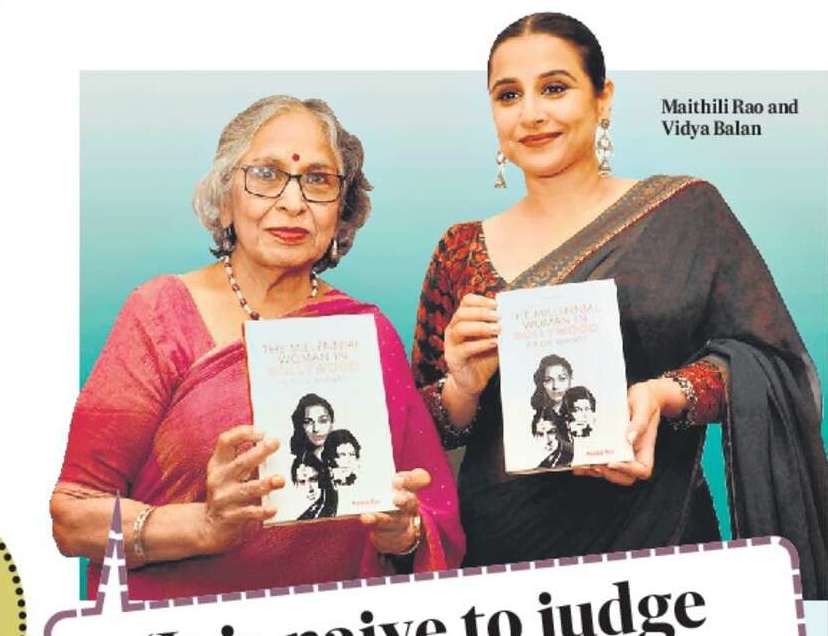
“I must have watched at least 100 or more Bollywood films when I was writing the book,” says author Maithili Rao. Her third book, The Millennial Woman In Bollywood: A New ‘Brand’? was launched by actor Vidya Balan in Mumbai recently. The duo engaged in an animated discussion on the role of women in cinema. In her book, Rao explores the nature of female characters and the change they have undergone.
She first started writing the book in 2019 and had a draft ready by 2020. “But I lost two chapters and I had to rewrite them as I am not very tech-savvy,” she laughs.
Talking about the book, she says, “This idea has been with me since 2015 after I wrote my book on (late actor) Smita Patil. I didn’t want to focus on any one actor (male or female) or filmmaker.” Out of all the chapters she wrote, Rao reveals she enjoyed writing about the subversives — Devdas (2002), Dev D (2005) and Saheb Biwi Aur Gangster (2011). “It was fun to write. The characters were positive and took charge of their lives.”
During her travels to the US, she was exposed to the idea of millennial women. The curiosity behind this phenomenon in India made her want to further explore it in her writing. “Millennial women are independent, don’t get involved in politics and are a part of the I, Me, Mine generation,” she adds.
Understanding and writing about female-centric characters was always her priority. The 80-year-old writer says, “My work made me consciously look at and deconstruct how women have been portrayed in cinema. It is naive to judge every female character based on whether they are feminist enough or at all. It is more interesting to create complex characters that engage with you.”
While the book looks at films from the 2000s, Rao says, “You can’t just write about the last 20 years without looking at the films that came before. I write about the idea of an archetypal Indian mother which has changed over the years. She is now younger, no longer desexualized and sitting and making aloo parathas for her laadla beta,” she explains.
The cover of the book features three female actors from different time periods — late Meena Kumari, Kajol Devgn and Vidya Balan. Ask her about it and she explains, “Meena Kumari is iconic and represents the older period in cinema, while Kajol symbolizes the 20th century. For me, in the current period, it had to be Vidya as her films show the evolution (of female roles).”
Smita Patil's biography by Maithili Rao will be launched on late actress's 60th birthday
7:53 AM

Maithili Rao's biography on Smita Patil will be launched on the late actress's 60th birthday, on Oct 17. Mirror presents exclusive excerpts
MUMBAI MIRROR (October 15, 2015)
Anita's favourite term for her sister is: free bird. A free spirit. This free-spirited attitude was innate to her right from childhood to the time she became an actor and then a star. Smita wanted to be at the wheel, drive all the time. She'd tell the driver, tum peechhe baitho. She was also very impatient. If somebody misbehaved on the road, did not follow the rules, she'd give them the choicest gaalis.
Anita who characterizes herself as being an obedient child marvels at how Smita had an inborn sense of adventure. Smita had this great craving to drive a jhonga - the army jeep. She had a friend, Dilshad (she was one of the ADs on Attenborough's Gandhi), who was just as crazy. 'I don't know how the hell they got hold of a jhonga. They drove all the way from Delhi to Bombay in those days! It was scary. I told Smi: think of your face. What'll happen to your career if anything happens to your face! She didn't give a damn. What'll happen, she'd say without a care. Chambal was not safe at that time.
Her only condition was: Don't tell Maa. And my condition was, she had to call every night. It had to be on a landline of course. It did not strike her even once what'd happen to her career if anything went wrong. Until she reached Bombay, my heart was in my mouth.' Anita adds: The girls wore turbans, pants and shirts, as if that was protection enough.
Smita's first car was a small Fiat, a two-seater according to Hitendra Ghosh. She dragged him home and wanted him to ride with her when she drove. He was a bit scared, he confesses.
He told her, 'You are driving in Tardeo and what if you go and dash into something?' But drive with her he had to. Friends couldn't be let off so easily. This desire to drive extended to bikes too. Smita graduated from bicycle to scooter in Pune, as most Pune girls did. She wanted to drive a big motorbike. And she pestered Hitu to somehow help her do this. He had become part of the family, and when they were staying on Forjett Street, their top-floor flat had a room to the side as soon as you entered.
Smita's father was not a minister anymore and the Patils were often out of Bombay, on their social work. Though Hitu had PG digs nearby in Tardeo, it was an unwritten rule that he would come and stay at the Patil house in the parents' absence. Smita badgered Hitu to get her to ride a big bike. He realized that Aladin, a sound engineer, lived in the same building as Smita. Aladin had two sons and they had a bike. Hitu approached them, and asked if they could teach Smita. They readily agreed and taught Smita in a small Tardeo lane. Later, on some other film unit, a lot of bikes were brought for the shoot. Smita asked the stuntman to teach her to ride a bike properly.
And he obliged. Ever since, she rode a bike whenever she could. It is something Shabana speaks of with awe: when they were together shooting for Mandi, Shabana learnt that the tomboy who played volleyball with the boys could also ride a bike. Difficult to imagine the traditional Smita we see in handloom saris as a biker girl.
— Smita Patil, A Brief Incandescence is published by HarperCollins India
Subscribe to:
Posts (Atom)