Showing posts with label Main Vaapas Aaunga. Show all posts
Showing posts with label Main Vaapas Aaunga. Show all posts
Naseeruddin Shah's favourite line was ‘There are no bad actors, there are only lazy actors’-Aahana S Kumra
11:19 PM

S Farah Rizvi (HINDUSTAN TIMES; September 5, 2026)
The eagle has landed – this was how actor Aahana S Kumra and her batchmates reacted when actor-theatre director Naseeruddin Shah walked onto their film school campus 20 years ago. To them, he was not merely a teacher but a standard-setter.
"For some reasons he always knew if we reached unprepared,” Kumra recounts her college and theatre days. “And you could never prepare enough, because he was always over-prepared as a teacher. His favourite line was ‘There are no bad actors, there are only lazy actors.’”
The teaching phase soon shifted from the classroom to the stage for both mentor and mentee.
In 2010, while Kumra was backstage at a play, “Naseer sir approached me with a George Bernard Shaw script. ‘Take and read this,’ he said. That was the day where I finally started to act for a play and in 2011 I performed for By George, at the NCPA under his direction. And it also earned me painting from him and Ratna (Pathak Shah) maam.”
Kumra says that as his students, they all value his sharp insight into the industry’s calculated realities. “He understands that young actors rarely get second chances,” she explains. “If you say no to a producer, you’re replaced. He knows producers have inflated egos—a lost chance is often lost forever.”
On a lighter note, she shares that he fondly calls her a “feisty cat,” and she shares new actors ask her, ‘Naseer sir ke sath kaise kaam kar sakte hain’ and she reverts, ‘Koi tareeka hain hi nahi unke sath kaam kar paane ka. It’s sheer good luck.”
On Main Vapas Aaunga, she adds, “I cried when saw him on screen no doubt it one of his best. He just loves Imtiaz Ali and calls him a rare director. Sir always enjoys portraying a Sardar character—he understands they speak with such buland awaz and as they age it becomes feeble yet authoritative.”
And what does the master think of his former student?
He told us at an event, “Ahana Kumra is one of my students and now also a good friend. Her career hasn’t gone as well as I’d hoped, but she’s been doing some offbeat films. She’s a girl with gumption, and I definitely feel her day will come. Some find success at 20, others at 30 or 40. Look at Boman Irani and Gajraj Rao. So I keep encouraging her and telling her not to get disheartened. I really believe her time will come.” (Input by Aadrika Sominder)
What Mumbai is now, the stars of that time used to stay in Lahore-Vedang Raina
10:19 AM

Nishad Neelambaran (HINDUSTAN TIMES; August 15, 2026)
Vedang Raina has been riding high after the success of Imtiaz Ali’s Main Vaapas Aaunga. The 26-year-old actor has been praised for his strong performance in the romantic drama that revolves around the partition period in 1947. It wasn’t just a film for Raina, but a redemption after Jigra (2024), and an eye-opener in a lot of ways, as he holds the film responsible for changing his perspective on the significance of Independence Day and what it meant for the country back then. Excerpt:
What a year you have had with Main Vaapas Aaunga. Did you always anticipate it becoming the biggest movie of the year?
No, I still don’t think it’s the biggest movie of the year. But it’s done its bit and found its audience. I’m very grateful for that. While shooting the only thing I understood at that time was that it’s an honour to be part of a film in which Imtiaz Ali is directing, and to be playing the younger version of Naseeruddin Shah. I think those two things were like the highlight of my journey in this industry.
What was Imtiaz Ali’s process like?
It wasn’t really like a narration, not in the typical sense. With him, it was like he had certain ideas in his head. It lasted maybe two minutes, and he spoke about the concept of the film. And this is the character I want you to play. And for me, it was the fact that Imtiaz sir was making it. I said, okay, fine. Like, I’m on it. Let me know when we start.
What does Independence Day mean to you after Main Vaapas Aaunga?
I feel this immense sense of belonging to the country and an immense sense of pride. After Main Vaapas Aaunga, I’ve had a different outlook on what that day meant, how much it means to the people and how important it was in the history of our country. As a kid, I did not get into it that much. But now, I really got in-depth into what that day was like for so many people. And what it stands for now.
You also went to the partition museum. Did that open up a different world to you of what actually happened decades ago?
Yes, 100%. That was probably the most important thing that I did in pre-production. Sharvari and I went to the partition museum in Amritsar. We spent four hours there. The museum was amazing, but it was those anecdotes from the people. There were 15-20 minute videos of actual people who went through that partition journey. And what that migration was like for them. That experience was really important.
What were the things that you found that we don’t talk about when we talk about Independence Day and partition?
The Radcliffe Line [drawn by Sir Cyril Radcliffe] that we know of: I didn’t know that Sir Radcliffe hadn’t ever been in India before. He came here for a few weeks, and he was in his hotel room. And he had so much pressure from the higher-ups to make the line between India and Pakistan that he didn’t really get to go talk to the people, understand what it means, what those areas mean, what those people are like in those places. And for them, it was kind of just like a line that they drew. Which sounds so terrible. Lahore was such a big part of Indian culture. It was the heart of India. What we call Madhya Pradesh right now was Lahore because that was kind of central India. It was not the capital, but it was the hub of culture, art, music and movies. What Mumbai is now, the stars of that time used to stay in Lahore and everything used to come from there... And I’m thinking just that line could have changed the lives of maybe 1000s of people.
Have you heard anything about partition or the freedom struggle from your grandparents or parents?
I must have heard stories about the partition, but also we are from Kashmir. My grandparents were in Kashmir at that time. So, it was different for them. They didn’t experience any migration at that time. Later they did, of course. My nana used to talk about how things were, what Mahatma Gandhi was doing, what Pandit Jawahar Lal Nehru ji was doing, and what the political climate was. He is very politically aware. He’s always had very strong opinions on politics.
Do you have strong political views as well?
Yeah, I’d say not as extreme as him. I do have political opinions, and I do have strong opinions.
Diljit, in Main Vaapas Aaunga, says the major problem in partition was that there was no social media. If we had to go through something similar now, how do you think the Gen Z would react? Will they ‘clock it’?
(Laughs) 100 per cent they will. We’ve seen a little whiff of what social media and something that is an important subject to our country means in recent times, right? And just imagine something like the partition [happening]. Well, there would be one side where Gen Z would be making those reels, but also we are such a strong collective voice now. And not just Gen Z, but all generations. Because of social media, we have a strong, collective voice that cannot be ignored. That is something that we’ve proven.
Vedang Raina on Main Vaapas Aaunga's BO miracle: "There is no other example..."
3:31 PM

Actor Vedang Raina opens up about dating rumours, the emotional rollercoaster of Main Vaapas Aaunga, and why a compliment from Imtiaz Ali will always matter more than the rest
Sonal Kalra (HINDUSTAN TIMES; July 11, 2026)
His relationship status sparks almost as much curiosity as his film choices. Fresh off the success of Main Vaapas Aaunga, a film that went from a disappointing start to one of the year’s most talked-about success stories, Vedang Raina has plenty on his mind.
For starters, the 25-year-old confirms that he “is currently single”. Notably, he was rumoured to be dating actor Khushi Kapoor. Asked what attracts him to someone, he says with a smile, “Kindness. There are other qualities too, but if you are not kind, everything else falls flat.”
Raina is still processing the extraordinary journey of his latest release. “It’s been quite overwhelming. The first couple of days or three days was a lot to take in. There were a lot of things being said about the film, which is now being unanimously loved by critics and audiences. The screenings that we went for... I have never seen reactions like that, and I felt it had to amount to something,” he says.
The film’s poor initial box-office performance left him disheartened: “It was very shattering. And then the turnaround took place. I guess it makes this entire thing even more special. There is no other example where it happened like this. I regained my faith in the fact that good films will find an audience.”
The actor believes the film’s success has offered reassurance to filmmakers across the industry. “If the product is good, people are going to love it regardless of all things around,” he says.
Among the many compliments he received, one mattered more than the rest. “I think the compliment that matters to me the most is always going to be Imtiaz (Ali) sir’s,” he says, admitting he put immense pressure on himself while playing the younger version of veteran actor Naseeruddin Shah.
If the success of Main Vaapas Aaunga has reaffirmed Raina’s faith in audiences, it has also given him a moment to reflect on the journey so far. Just three films old in the industry, the actor has already worked with filmmakers Zoya Akhtar (The Archies, 2023), Vasan Bala (Jigra, 2024) and now Imtiaz Ali... experiences he believes have shaped both his craft and outlook. He speaks about the lessons he’s carried from each, the choices he makes as an actor and why instinct remains his biggest guide.
What’s one thing you’ve taken away from each director you’ve worked with?
Zoya taught me much more than acting. The kind of person I’m shaping up to be has a lot to do with her. With Vasan sir, I saw a different school of filmmaking and acting. If I hadn’t done those first two films, I don’t think I would have been able to do what I did with Imtiaz sir.
Who’s the most brutal critic at home?
My father (businessman Ayush Raina). The other opinion I really care about is my younger sister’s. She’s trying to become a filmmaker. Whatever she tells me, I believe her.
What’s the biggest misconception that got busted once you became an actor?
I always thought getting your first film would be the biggest achievement ever. Now I realize the journey actually gets more complicated after that, as you suddenly have important decisions to make.
When it comes to choosing films, how much is gut instinct versus advice from people with experience in cinema?
When it comes to doing a film, it’s always about what I feel like doing. Choosing a film is a very emotional decision because you’re going to be part of that journey for such a long time. You have to be emotionally invested and almost obsessed with it. If I knew the decision had been made by someone else, I won’t be able to live with it.
You come across as very calm. But what is it that would anger Vedang Raina, if at all?
This is how I’ve always been, and I hear this all the time but it’s not true at all! It takes a lot to get my temper up, but I do get angry. In fact, I get triggered at the silliest things, such as the Wi-Fi not working or the TV not turning on. Maybe that’s a Gen-Z problem. Apart from that, it’s only my characters that bring out those emotions.
Who is your dream director to work with?
Christopher Nolan followed by Martin Scorsese. There are so many Indian directors I’d love to work with as well, but if I’m dreaming as big as possible, I’d choose those two.
Among Indian actors, whose career would you study as a student?
Everyone’s career trajectory is unique. Ranbir Kapoor, Ranveer Singh and Vicky Kaushal have all had their individual journeys. But I can’t emulate someone else’s trajectory, I can only admire it.
Earlier, there were certain actor-director collaborations, like Shah Rukh Khan would say, ‘If it’s a Yash Chopra film, I’m not even going to listen to the script’. Is there a director whose film you’d say yes to blindly?
Imtiaz sir. Even with Main Vaapas Aaunga, it wasn’t a narration, just five minutes of him talking about certain ideas he had. I simply said, ‘Sir, I’m doing it’. Today too, if he came to me, I wouldn’t ask for the script. I’d just say yes.
Main Vaapas Aaunga is stunning. It’s an act of rebellion by the filmmaker-Mahesh Bhatt
10:50 AM

Vinay MR Mishra (BOMBAY TIMES; July 8, 2026)
For over five decades, Mahesh Bhatt has worn many hats — filmmaker, producer, mentor and one of Hindi cinema’s most fearless storytellers. As he turns producer for the play Wo Subah Hum Hi Se Aayegi, the filmmaker reflects on theatre feeling more truthful than cinema today, the need for artistes to resist playing safe, and Sadak 2 being his final directorial.
‘Theatre is the mother of all storytelling’
For a filmmaker who built his career on emotionally raw cinema, it is perhaps fitting that Bhatt now finds himself gravitating towards theatre. Producing Wo Subah Hum Hi Se Aayegi has reignited his belief in what he calls storytelling in its purest form.
“Theatre is the mother of all storytelling. At this stage of my life, I find myself drawn more to essentials, to the bare bones of truth. Theatre strips away all the machinery. There are no retakes, no visual effects, no AI. All that remains is a naked, trembling encounter between the performer and the audience. In this age, information floods us like a tsunami and truth is slipping out of our fingers. Everything is curated. Even our so-called wounds are curated and varnished. Theatre is one place you need to go to when you’ve lost your path,” Bhatt says.
‘The thirst to make stories that listen to the heart continues in the industry’
When asked if filmmakers today are playing it safe creatively in the age of algorithms and box office pressures, Bhatt, known for films such as Arth (1982), Saaransh (1984) Naam (1986) and Aashiqii (1990), disagrees. “We did have Main Vaapas Aaunga. It’s stunning. It’s an act of rebellion by the filmmaker. I may have stopped making movies, but the thirst to make stories that listen to the beat of the human heart still exists in the industry,” he shares.
‘Time is the only critic’
He is careful to clarify that his criticism is not directed at a younger generation of filmmakers. Instead, he believes they are often pressurized into chasing immediate success. “One of the greatest challenges of these times is how to avoid massification. Most of the young filmmakers I see have enormous fire in them, but they want to be successful like yesterday! So, you cut yourself. You prune yourself. I am not cynical about young people. The audience has the latitude and the bandwidth to oscillate between different kinds of cinema. Yes, some films may not move the needle immediately. But there are movies that are judged by how they survive the passage of time. Time is the only critic,” he explains.
‘If art doesn’t have the audacity to take risks, then it is not art’
Bhatt recalls a remark by acclaimed Hollywood filmmaker Francis Ford Coppola that has stayed with him. “‘If art doesn’t have the audacity to take risks, then it is not art.’ There is an entrenched belief in the marketplace, which they hurl at you every hour, that only tentpole movies — films that cater to the lowest common denominator and testosterone — will work. They have their place. But they cannot be the only stories we tell. I would say that, having played on both sides, having oscillated between intensely personal movies and hardcore commercial films, I found success on both sides,” he mentions.
‘How the world chooses to remember me is their privilege’
Despite a career spanning over five decades, Bhatt says he has no desire to dictate how history remembers him. Recalling a recent event in Delhi centred around a retrospective on Indian cinema, he says, “I was invited because the organizers felt I was a force that spoke to India in the ’80s and ’90s, and India spoke to me. Then you discover there was Mehboob Khan before you, Guru Dutt, and so many filmmakers before Independence. You realize you’re just another brick in the wall. You are not a monument. You’re lucky if you make certain films that connect with the hearts of the people living in your time. Some endure; some sink. We like to believe our work becomes monumental, but memory is the first casualty. Just as I choose how I remember people, they will choose how they remember me. And how the world chooses to remember me is their privilege,” he ends.
Sooraj Barjatya told me ‘You’re harming the industry by working less’-Irshad Kamil
10:24 AM

Lyricist Irshad Kamil says the biggest challenge before him isn’t writing another hit. It’s finding a more honest language for romance
Soumya Vajpayee (MUMBAI MIRROR; July 12, 2026)
Irshad Kamil has little left to prove. Over two decades, he has written some of Hindi cinema’s most memorable songs, from Tum Se Hi, Nadaan Parindey and Kun Faya Kun to Agar Tum Saath Ho and the recent Saiyaara. Yet the National Award-winning lyricist insists he is still a student.
“My journey has been about coincidences and evolution,” he says with a laugh. “It’s about what I want to become.” Sitting over tea on a rain-soaked afternoon in Andheri, Kamil looks back at a career that began almost by accident. As a student with a deep interest in theatre and poetry at Panjab University, he drifted into television before finding his way to films. More than 100 films later, he still believes every project teaches him something new.
Still learning
“I stumbled into television. I stumbled into films,” he says. “With every song, I understand a little more about what it means to be a lyricist. There are so many layers to lyric writing. Just as there are many kinds of love, I’m still learning them.” That desire to keep evolving changed the way he works.
For years, Kamil deliberately restricted himself to four films annually. Then filmmaker Sooraj Barjatya offered advice that stayed with him.
“‘Irshad, you’re harming the industry by working less,’” he recalls. “That really struck me.” He decided to say yes more often. “The more time you spend in a creative environment, the more you learn. That’s how projects like Krishnavataram and the ghazal EP with Papon happened.”
Making love believable
If there is one emotion Kamil keeps returning to, it is love. Ironically, he considers it the hardest to write. “I feel most love songs don’t have the purity that love deserves,” he says. “My language for every film is love. I want to redefine that language for today’s world.”
His ambition is not to make lyrics more poetic, but more truthful. “Love has evolved. Society has evolved. I want to reflect that in my writing. I want songs to feel less fake.”
That philosophy shapes Main Vaapas Aaunga, on which he worked alongside A R Rahman while simultaneously writing for Tere Ishk Mein. Before beginning, the pair watched James Mangold’s Bob Dylan biopic, A Complete, Unknown together. “Bob Dylan’s journey charged me creatively,” he says.
One song from Main Vaapas Aaunga, Kya Kamaal Hai, juxtaposes images of Partition with those of present-day refugees. “For me, it isn’t just a song,” he says. “It’s a dream of love, peace and hope.”
No room for ornament
Kamil is equally clear about what he doesn’t want his lyrics to become. “In every art form, people struggle to balance mass appeal with artistic quality,” he says. “We’re diluting art to make it more popular. Dilution isn’t the solution. Accessibility is.”
Instead of reaching for ornate vocabulary, he prefers words people are familiar with. “I don’t want to impress listeners with difficult words from a dictionary. I’m trying to make my lyrics more accessible without compromising on quality. At the same time, I’m trying to redefine myself, and romantic songs in films.”
That openness also informs his collaborations. Having worked with veterans such as Rahman, Pritam, Vishal-Shekhar, Amit Trivedi, and now with a younger wave: Shashwat Sachdev, Tanishk Bagchi, Sachet-Parampara, Vishal Mishra, Sarthak Kalyani, Hiral Viradia, is the process of working with new-age composers different? “There’s no fixed pattern,” he says. “Every composer has a different way of thinking, so every project challenges you differently. That’s where the learning happens.”
Some of his most rewarding work has emerged from those unstructured sessions. While writing Dhurandhar, he, director Aditya Dhar and composer Shashwat Sachdev often worked through the night, with Dhar’s home doubling up as a studio.
“We’d start at six in the evening and sometimes continue till six the next evening,” he says. “Phir Se was born during one of those sessions.”
The long game
Unlike singers and composers, lyricists rarely enjoy the visibility of live performances. But Kamil believes the profession has become more sustainable.
“Being a lyricist now comes with a pension plan,” he says, referring to royalties collected through IPRS. “Sometimes the royalty from a successful song can become many times what you were originally paid. And it keeps coming.”
Social media often compares him with Gulzar, Javed Akhtar and Anand Bakshi. Others have likened aspects of his recent work to Bob Dylan. Kamil accepts the compliments but rejects the comparison.
“There can never be another Bob Dylan,” he says. “Just as there can never be another Sachin Tendulkar. Every artist has their own zone. Irshad Kamil has to remain Irshad Kamil.”
Perhaps that is why, even after two decades in Hindi cinema, Kamil still speaks less about success than about discovery. At 54, his ambition is simpler, or perhaps some might say harder: to write songs that feel a little more honest than the ones he wrote yesterday.
Why Main Vaapas Aaunga is not a 12th Fail
3:28 PM

Box Office India Trade Network
MAIN VAAPAS AAUNGA has seen a good run at the box office without really breaking out to more areas outside NCR, Punjab, Mumbai city and Bangalore. NCR and Punjab is down to the regional flavor and other two do well with gentry films. The film is going to end up with similar business to 12TH FAIL (2023) but that film was a HIT and MAIN VAAPAS AAUNGA will not be. These films are basically down to budgets as they never reach much of the audience.
Its actually pretty weird that the writers and media raves and even the industry sees them as the better films but in real world around you, not many have seen or even know about them. This is why these films can be commercial HITS (budget to box office) but never HITS for the public. For commercial hit, it comes down to the budget and the budget of MAIN VAAPAS AAUNGA is three times of 12TH FAIL which is the problem. The budget of the film is more than a SATYAPREM KI KATHA and almost as much as TERI BAATON MEIN AISA ULJHA JIYA and will not do as much business as these films. No doubt even non theatrical will be less than these but that does not come into the equation for theatrical success.
MAIN VAAPAS AAUNGA has done extremely well to get this 47 crore nett mark so far from a 1 crore nett start and this would have looked phenomenal before the pandemic. But post pandemic, we have seen MAHAVATAR NARSIMHA and THE KASHMIR FILES and compared to them, this trend is nothing. Basically due to the budget, the film needed to start at 2-3 crore nett and then find this appreciation from the areas where it has been liked.
Post the pandemic, there have been three of these much raved about films (12TH FAIL, LAAPATAA LADIES, MAIN VAAPAS AAUNGA) and within the industry, you sort of understand now why they are talked about so much as films are watched in a different way from a regular watcher. But its 2026 and you would think the rest, be it media or social media, will be more reflective of the wider society but that's not the case.
For the record 12TH FAIL was a HIT, LAAPATAA LADIES was a FLOP and MAIN VAAPAS AAUNGA may turn out to be AVERAGE.
2026 January to June: Bollywood finds its mojo again
8:44 AM

Vinay MR Mishra (BOMBAY TIMES; July 4, 2026)
Just six months ago, Bollywood was staring at another uncertain year. Today, the mood is noticeably brighter. Driven by the record-smashing success of Dhurandhar The Revenge, strong performances from the war action film Border 2, followed by the horror comedy Bhooth Bangla, and now the sleeper hit Main Vaapas Aaunga, the Hindi film industry finally has something it has lacked for years: momentum.
Yet beneath the celebrations lies a reality check. While a handful of films have soared, many others have struggled to survive, making 2026 a story so far, one of spectacular highs and equally visible lows. As trade analyst Taran Adarsh puts it, "It has been a case of kam khushi zyada gham. We've had successes, but very few that you can count on your fingertips."
'The biggest hit of 2026 is the word of mouth’
If the first half of 2026 proved anything, it is that Bollywood's audience has become more discerning than ever. Films that connected emotionally and generated strong word-of-mouth continued to grow beyond their opening weekend. Films that relied solely on star value found the road much tougher.
"The biggest trend in the first half of 2026 was the power of word-of-mouth," says trade analyst Ramesh Bala. "Films like Main Vaapas Aaunga, Border 2, Bhooth Bangla, and Dhurandhar The Revenge sustained because audiences connected with them."
Akkshay Rathie, Director - Ashirwad Theatres Pvt Ltd, adds, "To see Main Vaapas Aaunga open small but grow day by day purely on the merits of word-of-mouth is extremely encouraging.”
Novelty is winning. Formulas aren't
One of the clearest shifts this year has been the audience's appetite for fresh storytelling. "I don't think audiences are rewarding the repetition of a genre or style that has worked before. What people really appreciate is novelty and bravery from filmmakers. The repetition and herd mentality of trying to replicate success is something that we should put well behind us and we should have filmmakers staying true to their conviction to the stories that they really want to tell and to genres that come very naturally to them. And the more we see that happening, the more successful we'll be as an industry at the box office," says Rathi.
The Dhurandhar Effect
The biggest winner of the year was undoubtedly Dhurandhar The Revenge, which shattered box-office records and redefined the upper ceiling of Hindi cinema's theatrical potential.
Rathi shares, "One movie that really towers above every other movie in the last six months is of course Dhurandhar The Revenge. The box-office collections that we witnessed were truly historic. We realized that the glass ceiling we thought existed at the Rs. 500-600 crore benchmark has been shattered. The potential of the Hindi-speaking market is humongous."
He adds, "I hope more films attempt to build the intrinsic value that allows them to go closer to those numbers."
'Average films won't survive'
While the industry celebrates its winners, films like O'Romeo, which was highly anticipated due to the reunion of Kaminey duo Shahid Kapoor and Vishal Bhardwaj, and Chand Mera Dil starring Ananya Panday and Lakshya that looked promising didn’t quite shine at the box office.
While Hai Jawani Toh Ishq Hona Hai may have recovered its budget, the film's poor reviews and underwhelming box office performance have left a lingering sense of disappointment. Do Deewane Seher Mein, won appreciation from critics and the audience, but the film couldn’t draw in the crowds. Ikkis, Ek Din and Pati Patni Aur Woh Do also failed to attract the kind of audience they were expected to.
"The gap between films that work and films that don't has become very evident," says Taran Adarsh. Ramesh Bala echoes the concern. "Audiences have become far more selective, making it difficult for average films to survive."
The second half could be even bigger
The industry now turns its attention to a packed second-half slate. From King and Toxic, Dhamaal 4 and Ramayana, the coming months are loaded with franchise titles, star vehicles and large-scale spectacles.
"With the kind of movies lined up in the second half, 2026 is well on its way to being an iconic year," says Rathi.
Bala adds, "If these films live up to expectations, the second half could be even stronger than the first."
-------------------------------
Rishabh Suri (HINDUSTAN TIMES; July 2, 2026)
The first half of 2026 has delivered a much-needed boost to the film industry, with audiences backing films across genres, languages and budgets. Strong theatrical footfalls, breakout regional successes and the return of comedy have helped restore confidence in the business after a volatile few years.
“For the industry, admissions are up by at least 10%, and the box office, our estimate is, would be up by at least 16-17%, if not more,” says Kamal Gianchandani, president of the Multiplex Association of India.
What worked
From patriotic dramas and comedies to regional cinema, the year’s biggest successes came from varied genres. Sunny Deol’s Border 2 emerged as one of the biggest hits of the year, while Dhurandhar The Revenge became the highest-grossing Hindi film of 2026 so far.
Comedy also found favour with audiences. Akshay Kumar’s reunion with Priyadarshan in Bhooth Bangla paid off at the box office, while his latest release, Welcome To The Jungle, has continued the momentum, netting over Rs. 80 crore within five days of its release.
For Devang Sampat, managing director, Cinepolis India, the biggest takeaway has been the diversity of successful films: “Dhurandhar The Revenge, Border 2, Bhooth Bangla all did well, but for me the real takeaway is how broad the success has been. The business has come from all kinds of films, across languages and across budgets, not just the big titles.”
One of the biggest surprises of the year has been Imtiaz Ali’s Main Vaapas Aaunga. Despite a modest opening, strong word of mouth helped the film steadily gain momentum and move towards hit status.
Reflecting on the film’s journey, Imtiaz had earlier told us, “It’s the audience who has embraced the film. Somewhere, the industry had started saying ki ‘Arre kuchh bhi halka phulka de do audience ko, chal jaayega, emotional mat do’. But the people proved this wrong.”
What didn’t
Yet, not every well-reviewed film translated into ticket sales. Vishal Bhardwaj’s O'Romeo, Ananya Panday and Lakshya’s Chand Mera Dil, Anurag Kashyap’s Bandar and Kangana Ranaut’s Bharat Bhhagya Viddhaata failed to generate the expected box-office momentum despite positive reviews and strong subjects.
Trade analyst Atul Mohan believes financial discipline is becoming just as important as content in determining a film’s fate. “The first half has been so far, so good. Like Akshay Kumar and Ranveer Singh, actors need to shoulder the responsibility of a film, and not burden it with their high fees,” he says.
The message from the first half of 2026 is clear: audiences are showing up for good stories, regardless of genre or budget. But they are also more selective than ever, making strong content and positive word-of-mouth Bollywood’s safest bets.
Someone did imagine Akshaye Khanna as Rehman Dakait-Sanjay Suri
9:44 AM

Priyanka Sharma (MID-DAY; June 30, 2026)
Sure, the love that Sanjay Suri has been receiving for his performance in Imtiaz Ali’s Main Vaapas Aaunga has left him elated. Interestingly, it has also made the actor greedy for opportunities. “I don’t have much time left. I am 55! So, I better do more work,” he laughed.
What stopped him all these years? Over his 26-year career, the actor hasn’t been seen on screen as frequently as he would have liked. There is a reason for that, he stated.
“Throughout my career, the query has been ‘Why do we see less of you?’ My only answer would be that I felt underutilized. I would get a lot of offers [to play] a well-educated, well-to-do, smart, and suave guy. That’s where it ended. There would be nothing more to offer [in the roles]. So, there has been creative short-sightedness in imagining me,” explained Suri.
Hopefully, that will change. The actor believes that directors today prefer casting against type. He said, “Times have changed. For instance, someone did imagine Akshaye Khanna as Rehman Dakait [in Dhurandhar, 2025], right? These directors don’t want run-of-the-mill [casting], which is exciting. So, I’m hoping for diverse opportunities to come my way. The slotting still happens, but a few of the directors as well as OTT entertainment have changed that.”
Imtiaz Ali is leading you to love, not hate-Sanjay Suri
9:47 AM

Sanjay Suri says he joined ‘Main Vaapas Aaunga’ knowing that director Imtiaz Ali would treat the Partition story from the lens of inclusivity, not divisiveness
Priyanka Sharma (MID-DAY; June 26, 2026)
It took only a phrase for Sanjay Suri to give his nod to Imtiaz Ali’s Main Vaapas Aaunga. “Imtiaz used this line, ‘Opening of the heart’. That is what I was hoping someone would make,” recalled Suri, referring to Ali’s Partition drama that views the historic chapter through the lens of inclusivity, not divisiveness.
In the Naseeruddin Shah, Diljit Dosanjh, Sharvari, and Vedang Raina-starrer, Suri plays a Sikh man separated from his family after Partition and spends the rest of his life waiting for them. Ali’s treatment, coupled with the role, was just what the actor was looking for.
“There was a comfort in working with Imtiaz because I knew he is not leading you to hate. He is leading you to love, and to opening of the heart. The film asks what we humans are made of. This othering is so non-inclusive. If we live a life with inclusivity, it can be a joy to live,” reflected Suri.
His fondness for Ali began with the first meeting itself. Suri recalled how they spoke more about life than his role. “I’m from Kashmir and he has a connect with the place. So, we chatted about life and then he said, ‘I am making a film, which is being seen from an old man’s viewpoint.’ Then we started talking about humans seeing grief, loss, and identity.”
Fenil's Bollywood Talk # 940
2:26 PM

WILL WELCOME TO THE JUNGLE EMERGE AS ANOTHER HIT FOR AKSHAY KUMAR AFTER BHOOTH BANGLA?
From today, 7:30 pm onwards, the paid previews of Welcome To The Jungle will begin across the country. The film has been in the news ever since it got launched, thanks to the popularity of the series, mainly the first part. Moreover, the film is arguably the biggest multi-starrer of all time.
Welcome To The Jungle stars Akshay Kumar, Suniel Shetty, Disha Patani, Jacqueline Fernandez, Arshad Warsi, Jackie Shroff, Paresh Rawal, Raveena Tandon, Lara Dutta, Farida Jalal, Johny Lever, Shreyas Talpade, Tusshar Kapoor, Rajpal Yadav, Krushna Abhishek, Kiku Sharda, Daler Mehndi, Aftab Shivdasani, Mukesh Tiwari, Yashpal Sharma, Kiran Kumar, Zakir Hussain, Vindu Dara Singh, Urvashi Rautela, Hemant Pandey, Brijendra Kala, Feroze Khan, Late Pankaj Dheer, Puneet Issar, Sudesh Berry and many more. It is directed by Ahmed Khan, while the first two parts – Welcome and Welcome Back – were directed by Anees Bazmee.
The teaser and trailer of Welcome To The Jungle have been entertaining and it looks like a grand, fun-filled entertainer. However, the challenges remain. The trailer hasn’t wowed the audience. The songs, though quirky, have not worked as intended.
As a result, as it usually happens, people have decided to wait for the response and then book tickets. This is also reflected in the advance sales, though the bookings until now are decent. There was hope that Welcome To The Jungle would emerge as Akshay Kumar’s highest opener by crossing the earnings of Mission Mangal (Rs. 28.45 crores). However, it seems like it's not going to happen. At best, the hope is that the film will open in the range of Rs. 17 crores and Rs. 20 crores on Friday. As for paid previews, Bhooth Bangla collected Rs. 3.50 crores and Welcome To The Jungle should aim at crossing this figure.
Meanwhile, Main Vaapas Aaunga collected more than the first week’s collections in the second weekend. While Week 1 earnings were Rs. 11.23 crores, its second week collections were Rs. 11.50 crores. It is rock-steady on weekdays as well. The film is expected to cross the Rs. 30 crore mark by the end of its second week.
As for Cocktail 2, it opened at Rs. 12.25 crores and went on to earn Rs. 15.50 crores and Rs. 16.50 crores on Saturday and Sunday, respectively. But it dropped to Rs. 5.25 crores on Monday, while Tuesday's jump was limited, when it earned Rs. 5.50 crores. The film has earned Rs. 55 crores in 5 days. As of now, a lifetime of Rs. 100 crore seems like a remote possibility.
From today, 7:30 pm onwards, the paid previews of Welcome To The Jungle will begin across the country. The film has been in the news ever since it got launched, thanks to the popularity of the series, mainly the first part. Moreover, the film is arguably the biggest multi-starrer of all time.
Welcome To The Jungle stars Akshay Kumar, Suniel Shetty, Disha Patani, Jacqueline Fernandez, Arshad Warsi, Jackie Shroff, Paresh Rawal, Raveena Tandon, Lara Dutta, Farida Jalal, Johny Lever, Shreyas Talpade, Tusshar Kapoor, Rajpal Yadav, Krushna Abhishek, Kiku Sharda, Daler Mehndi, Aftab Shivdasani, Mukesh Tiwari, Yashpal Sharma, Kiran Kumar, Zakir Hussain, Vindu Dara Singh, Urvashi Rautela, Hemant Pandey, Brijendra Kala, Feroze Khan, Late Pankaj Dheer, Puneet Issar, Sudesh Berry and many more. It is directed by Ahmed Khan, while the first two parts – Welcome and Welcome Back – were directed by Anees Bazmee.
The teaser and trailer of Welcome To The Jungle have been entertaining and it looks like a grand, fun-filled entertainer. However, the challenges remain. The trailer hasn’t wowed the audience. The songs, though quirky, have not worked as intended.
As a result, as it usually happens, people have decided to wait for the response and then book tickets. This is also reflected in the advance sales, though the bookings until now are decent. There was hope that Welcome To The Jungle would emerge as Akshay Kumar’s highest opener by crossing the earnings of Mission Mangal (Rs. 28.45 crores). However, it seems like it's not going to happen. At best, the hope is that the film will open in the range of Rs. 17 crores and Rs. 20 crores on Friday. As for paid previews, Bhooth Bangla collected Rs. 3.50 crores and Welcome To The Jungle should aim at crossing this figure.
Meanwhile, Main Vaapas Aaunga collected more than the first week’s collections in the second weekend. While Week 1 earnings were Rs. 11.23 crores, its second week collections were Rs. 11.50 crores. It is rock-steady on weekdays as well. The film is expected to cross the Rs. 30 crore mark by the end of its second week.
As for Cocktail 2, it opened at Rs. 12.25 crores and went on to earn Rs. 15.50 crores and Rs. 16.50 crores on Saturday and Sunday, respectively. But it dropped to Rs. 5.25 crores on Monday, while Tuesday's jump was limited, when it earned Rs. 5.50 crores. The film has earned Rs. 55 crores in 5 days. As of now, a lifetime of Rs. 100 crore seems like a remote possibility.
I may not have a Rs. 100 cr film to my credit, but I’ve been fortunate to be part of some wonderful films-Sanjay Suri
3:17 PM

Neha Maheshwri (BOMBAY TIMES; June 12, 2026)
Joining the TV show Juhi Mui marks a full-circle moment for Sanjay Suri. Having begun his career on television in 1997 before moving to films, the show’s socially relevant theme and limited commitment made it an appealing proposition.
He says, “I kept myself away from longer commitments. This was a month-long commitment, and we’ve kept the track open so I can return when required. In cinema too, I’ve mostly been part of socially relevant films. When this show was offered to me, I felt it was a good story and socially relevant too.”
Talking about returning to the medium after nearly three decades, he shares, “I hosted the travel show Indian Holiday nearly 30 years ago followed by Yehi Toh Pyar Hai as the lead. Then Pyaar Mein Kabhi Kabhi happened, followed by films and producing, and life took another trajectory. So, this is like my ghar wapsi after 30 years.”
Sanjay believes the distinctions between television, films, and OTT are increasingly becoming irrelevant. He says, “You’ve got to remain platform-agnostic and do the work you want to do, especially at this stage of my career. Earlier too, it wasn’t that I didn’t want to take up a TV show. I simply couldn’t commit to one or two years because I was focusing on films.”
The actor dismisses the belief that film actors turn to television only when opportunities elsewhere become scarce. He says, “That could be someone’s perception. Even back in the day, I sat at home for two years and didn’t do anything. I’ve just had a release with Imtiaz Ali’s Main Vaapas Aaunga, have an upcoming OTT show, and will dabble in short films. If you look at the 27 years I’ve been active since 1999, I may not have a Rs. 100-crore film to my credit, but I’ve been fortunate to be part of some wonderful films that have stood the test of time. My aspirations have never been driven by panic or visibility.”
Over time, Sanjay stopped measuring success by mainstream benchmarks and focused instead on work that aligned with his creative instincts.
He shares, “I was never offered a buffet of films. It was always, ‘Okay, he does this alternate kind of cinema,’ and maybe that forms a perception. I did a commercial film, Tera Jadoo Chal Gayaa, which was Abhishek Bachchan’s second film, but my experience was that everything revolved around one person. In those days, cinema was very hero-driven. Either you’re the lead, or you’re reduced to nothing. I said, ‘Okay, I’ll play on my T20 ground.’ I don’t mind being a brick in the wall, but if you take that brick out, it should make an impact. Even when I turned producer, it wasn’t from the point of view of making money. It was about telling stories. I Am became one of the largest crowdfunded films in the country and went on to win a National Award. That was great gratification for everyone involved.”
Imtiaz Ali on Main Vaapas Aaunga's slow opening: "We are not a star-driven film, so it was supposed to be like this"
9:52 AM

The filmmaker on his latest movie’s slow-burn box office journey, why Gen Z is often misunderstood, and Diljit Dosanjh
Akash Bhatnagar (HINDUSTAN TIMES; June 19, 2026)
Even as Main Vaapas Aaunga (MVA) records a gradual uptick at the box office, filmmaker Imtiaz Ali says he always expected the film to find its audience over time rather than through a blockbuster opening.
“We are not a star-driven film, so it was supposed to be like this. If people like it, they will tell others to watch it, and that’s how the film will grow,” he says.
Ali is particularly encouraged by the response from younger viewers, who he believes are yearning for deeper connections. “I feel the younger generation needs love the most. They are sensitive, romantic and seeking commitment, but they are often misunderstood and labelled as flaky. Their lives are different from previous generations, but they are searching for something meaningful,” he says.
Set against the backdrop of Partition, the film intertwines a love story with the lived experiences of survivors. “When I heard their stories of what they’ve seen, what they remember now after 78 years, I realized that no love story can happen in a vacuum. It happens in the real world, and the real world of the era of partition was necessary for the setting of this love story,” says Ali.
He was also unfazed about mounting a large-scale film led by relatively new actors Vedang Raina and Sharvari. “I am a man, not from the trade, but from the art of filmmaking. I do understand the power of cinema and performance, and also the power of good casting. If all those things come together, then there is a certain power that is created. I had no doubt that both these actors will be able to headline this story well,” he says, adding, “But I also knew that on the poster, there is also Diljit (Dosanjh). Everybody in the world knows him and they are interested to see what he’s doing. I was sure that there was going to be a poster appeal because he is there.”
While Imtiaz Ali has made romances across decades, he claims that he “doesn’t come from a point of understanding love”. “In Socha Na Tha (2005), the confusion of Viren (played by actor Abhay Deol) was actually my confusion of committing in a direction but your heart pulling you in another. I didn’t have an answer for that but I made a movie on it. Jab We Met (2007), in my mind, was not even a love story. It is about two people who meet as strangers and eventually become like the other. They complete each other and realize that [they are in love] later,” he says.
Similarly, Main Vaapas Aaunga (MVA) is set up as a love story, but also showcases the ordeal faced by the people of Punjab during the 1947 Partition. Does Ali feel that the film should be made tax free, especially in Punjab? “A lot of people have said that this is a story of Punjab, and also in a way of Bengal and other parts of India. If people feel that way genuinely and if that comment of national interest is out, then there must be a process in these states to see if the film can be made tax free and we’d be looking into it,” he says.
The filmmaker also asserts on the universality of the story, insisting that tragic incidents like the Partition are happening even today, something he brought out with the video of Kya Kamaal Hai in MVA’s end credits. And it was Diljit who pushed for it.
“I must thank him and Irshad (Kamil, lyricist) for encouraging me to make the video. I had never done or seen anything of this sort, but Diljit said, ‘Ye to karna hi hai kyunki ye phir isko sabki film bana dega’,” he shares.
Fenil's Bollywood Talk # 939
4:11 PM

WILL COCKTAIL 2 MANAGE TO OPEN BETTER THAN COCKTAIL?
After two weeks of multiple releases, the next two weeks will see just one major Hindi film trying its luck at the box office – Cocktail 2. Like any other Maddock production, the romcom has been extensively marketed and is constantly in the news.
Cocktail 2 stars Shahid Kapoor, Kriti Sanon and Rashmika Mandanna and is directed by Homi Adajania. The songs are peppy while the film’s promos promise a vibrant, youthful entertainer. For many months, there were murmurs that Kriti and Rashmika play lesbian lovers. However, they recently clarified at an event that it's not true. One song from the film, ‘Mashooka’, has especially worked well and is big on Instagram Reels.
However, the film faces some roadblocks. While there’s excitement for the film, a section of the audience will prefer to wait-and-watch, that is, go through the response and then book tickets. The film’s ‘A’ certification has raised eyebrows. It won’t affect business, as proven by Dhurandhar and Dhurandhar The Revenge that adult rating is no more a roadblock. However, viewers are curious why such a rating has been given to a film that doesn't seem really adult.
Cocktail 2’s advance booking is decent and is expected to have a double digit opening if collections jump as intended in the evening and night shows. The first part, Cocktail (2012), starring Saif Ali Khan, Deepika Padukone and Diana Penty, opened at Rs. 10.47 crores. The aim of Cocktail 2 would be to go past this figure. With limited competition from holdover releases, the film should then aim for a Rs. 45-50 crore weekend.
Meanwhile, Haunted – Echoes Of The Past emerged as a surprise last week. An opening of Rs. 1.50 crores was considered the best-case scenario pre-release. But it went on to collect Rs. 2.25 crores and is the best-performing film of the week. The weekday trend is weak. But the job is done and it’ll the end Week 1 with earnings totaling Rs. 14 crores.
On the other hand, Main Vaapas Aaunga was expected to take a Rs. 2-3 crore start. Sadly, it opened at just Rs. 1.10 crores. One expected the collections to double on Saturday and Sunday. That didn’t happen and the film collected Rs. 1.85 crores and Rs. 2.50 crores respectively.
Thankfully, the Monday hold was strong, when the film collected as much as on Friday. On Tuesday, due to the discounted rates, collections jumped to Rs. 1.50 crores. On Wednesday, the earnings should have come down. Instead, the film collected Rs. 1.75 crores. The film is expected to collect around Rs. 11.50 crores in Week 1. It needs to earn as much or more than Week 1 to come out with some sort of respectable collections.
After two weeks of multiple releases, the next two weeks will see just one major Hindi film trying its luck at the box office – Cocktail 2. Like any other Maddock production, the romcom has been extensively marketed and is constantly in the news.
Cocktail 2 stars Shahid Kapoor, Kriti Sanon and Rashmika Mandanna and is directed by Homi Adajania. The songs are peppy while the film’s promos promise a vibrant, youthful entertainer. For many months, there were murmurs that Kriti and Rashmika play lesbian lovers. However, they recently clarified at an event that it's not true. One song from the film, ‘Mashooka’, has especially worked well and is big on Instagram Reels.
However, the film faces some roadblocks. While there’s excitement for the film, a section of the audience will prefer to wait-and-watch, that is, go through the response and then book tickets. The film’s ‘A’ certification has raised eyebrows. It won’t affect business, as proven by Dhurandhar and Dhurandhar The Revenge that adult rating is no more a roadblock. However, viewers are curious why such a rating has been given to a film that doesn't seem really adult.
Cocktail 2’s advance booking is decent and is expected to have a double digit opening if collections jump as intended in the evening and night shows. The first part, Cocktail (2012), starring Saif Ali Khan, Deepika Padukone and Diana Penty, opened at Rs. 10.47 crores. The aim of Cocktail 2 would be to go past this figure. With limited competition from holdover releases, the film should then aim for a Rs. 45-50 crore weekend.
Meanwhile, Haunted – Echoes Of The Past emerged as a surprise last week. An opening of Rs. 1.50 crores was considered the best-case scenario pre-release. But it went on to collect Rs. 2.25 crores and is the best-performing film of the week. The weekday trend is weak. But the job is done and it’ll the end Week 1 with earnings totaling Rs. 14 crores.
On the other hand, Main Vaapas Aaunga was expected to take a Rs. 2-3 crore start. Sadly, it opened at just Rs. 1.10 crores. One expected the collections to double on Saturday and Sunday. That didn’t happen and the film collected Rs. 1.85 crores and Rs. 2.50 crores respectively.
Thankfully, the Monday hold was strong, when the film collected as much as on Friday. On Tuesday, due to the discounted rates, collections jumped to Rs. 1.50 crores. On Wednesday, the earnings should have come down. Instead, the film collected Rs. 1.75 crores. The film is expected to collect around Rs. 11.50 crores in Week 1. It needs to earn as much or more than Week 1 to come out with some sort of respectable collections.
Is a Hollywood 'Obsession' sidelining Hindi releases?
2:59 PM

After filmmaker Anurag Kashyap claimed that Hollywood films are getting priority over Hindi films in theatres, trade experts weigh in on the impact on Indian releases
Akash Bhatnagar (HINDUSTAN TIMES; June 17, 2026)
The global success of the Hollywood horror film Obsession, which has reportedly earned 330 times its budget, has become a case study in world cinema. However, it has sparked mixed reactions within the Hindi film industry.
Filmmaker Anurag Kashyap recently expressed concern on his Instagram Stories that theatre chains are prioritizing Obsession over Hindi releases, including his film Bandar (released on June 5) and recent Friday releases such as Main Vaapas Aaunga, Governor, and others.
Trade analyst Komal Nahta, however, believes international films aren’t an impediment. He shares, “Only bad content is coming in the industry. Bandar is not doing well even otherwise, so the number of shows isn’t going to make a difference,” adding, “If in two shows, they can’t get houseful, what will they get in 20 shows?”
Trade analyst Atul Mohan adds that multiplex programming is largely driven by audience response. He says, “In a way, Anurag is right. Business is ruthless. If a film doesn’t do well in the first two days, they reduce the shows drastically, which doesn’t give time for word of mouth to spread. Hindi films deserve that time to grow.”
Film exhibitor Akshaye Rathi echoes the sentiment and says that the audience makes the ultimate decision. “If Main Vaapas Aaunga or any other film have very good occupancy levels, cinemas across the country would increase the number of shows, like they did for Haunted – Echoes Of The Past in the same week. So, it’s not about the theatres but what the audience decides,” he shares.
--------------------------------------------------
These are business-oriented decisions. There is a policy for encouraging local produce, and there should also be a policy for encouraging local cinema. But there are arguments on both sides of the matter, and can’t be compared.
- IMTIAZ ALI, DIRECTOR OF MAIN VAAPAS AAUNGA
--------------------------------------------------
Nothing is coming in the industry except bad content. If Anurag thinks it is because of Obsession that Bandar is not doing well, he should see the collections. Critical acclaim is not the same as the box office, and when we talk about competition, we talk about box office. So, Obsession is not acting as an impediment to the running of Indian films at all.
- KOMAL NAHTA, TRADE ANALYST
--------------------------------------------------
‘FOR EVERY DHURANDHAR, THERE WILL BE FIVE EXPENSIVE FILMS THAT WILL BOMB’
Rishabh Suri (HINDUSTAN TIMES; June 17, 2026)
For Indian films to not get enough attention from theatres, despite having good reviews, does not go down well with Anurag.
He tells us, “Films like Bandar and Main Vaapas Aaunga should get proper shows so that people can watch them, allowing word of mouth to build up. Then another problem is that there’s an audience that is getting used to seeing such films on OTT. So you’re building an audience only for event movies. But such films are so expensive, and the hit-and-miss ratio is huge. For every Dhurandhar, there will be five expensive films that will bomb.”
He emphasizes strategic show timings for smaller films too. He adds, “Bandar’s night shows were full. But who’s going to go watch Bandar at 9 am, when it is going to upset you for the rest of the day? There’s human psychology also involved.”
Obsessed with Obsession? Anurag Kashyap calls out limited screenings for Indian films
9:24 AM

HINDUSTAN TIMES (June 15, 2026)
Filmmaker Anurag Kashyap has voiced his frustration over the way theatres are giving limited screen space to Indian films while continuing to schedule multiple shows for the Hollywood horror film Obsession, released on May 29.
Sharing his concerns on Instagram Stories (inset above), Kashyap said the issue was not the film’s popularity but the lack of visibility for local releases. “If we don’t priorities our own films with better showcasing, then I don’t understand how we will grow,” he wrote.
Kashyap noted that his recently released film Bandar faced a similar challenge last week, while Main Vaapas Aaunga, Sing Geetham and Governor are now struggling to secure enough screens.
However, social media reactions seem divided on the matter. While some agreed with Kashyap, others think that quality content is what is missing from the Indian film industry.
A user commented, “You are making boring films like Bandar, what to say.” Another wrote, “He has almost everytime delivered good content...We should genuinely prioritize our own cinema.” One person shared, “First learn to give quality content then speak about showtimes. Don’t teach theatres how to run.”
Kashyap’s comments come amid a crowded box-office weekend that saw nine films release on the same day: : Main Vaapas Aaunga, Governor, Bharat Bhhagya Viddhaata, Haunted 3D, Sing Geetham, Varavu, Disclosure Day, Backrooms and Heer Sara, raising concerns about screen availability and the impact on smaller titles during their crucial opening weekend.
Thank God for Dhurandhar. We are allowed longer films now-Imtiaz Ali
9:20 AM

Madhureeta Mukherjee (BOMBAY TIMES; June 15, 2026)
There is a reason Imtiaz Ali’s stories linger. Beneath the romance, music and heartbreak lies a deeper search — for home, for meaning, for the versions of ourselves we leave behind as we move through life. With Main Vaapas Aaunga, inspired by an emotional return to his childhood home, the filmmaker once again turns inward, exploring memory, longing and the ache of belonging.
In this conversation, Imtiaz reflects on love and loss, the purity today’s generation is searching for, and the invisible pull of the past. He reflects on why the stories that stay with us are often not born from cinema, but from life itself.
Would you say, there’s a certain beauty in that sense of loss?
There’s beauty in that because it brings you to yourself. The yearning, therefore, sometimes cannot be cerebrally understood. Everyone always feels that they have left something behind, in whatever they might have achieved. You feel…kya choot gaya? Inevitably, you want to go back to that. I guess the feeling of who we were is something we can never leave behind, however far we go.
From Love Aaj Kal, Rockstar to Tamasha – your films often ask whether love liberates us or consumes us. Has your own understanding of love changed over time?
I feel the simplistic answer is that it’s the being consumed that liberates you. It’s the surrender that liberates you. You realise your power when you surrender. And it’s easier said than done. In love, you’re constantly engaged with yourself. You are constantly talking to yourself. I’ve noticed that people who are in love with different women at different times in their lives, are in love in the same way. They yearn in the same way. If somebody is, let’s say, obsessive, then they will be obsessive in every relationship of theirs. They will try to find someone to shower love and affection on, and become obsessive about. The thing is, I don’t have answers about love or life, if I had answers, I wouldn’t be making movies.
So, you’re finding your answers through movies, characters, stories?
I don’t think I’ve found anything from my movies (laughs).
And you insist you aren’t a romantic? You have this image of being a romantic, a bit of a philosopher, too…
I am not. These words like romantic, philosopher and all of that sound very boring to me. I don’t know why I have this image. Tell me, how do I break this image?
Music in your cinema isn’t just something that happens in the background or around the story – it forms a character. It adds to the emotional rhythm, literally. You seek something from music emotionally that dialogue alone cannot achieve?
Oh, I love the work of music. I don’t listen to music too much, but I’ve always been a fan of music in films – whether it’s being part of the making of the song, the background music or shooting to music. The biggest thrill of shooting for me is when music plays on a set. I am the director who prays every day that we are not forced to reduce or remove music from films. For romantic movies, sometimes we connect to the music first and then the story.
This is your second collaboration with Diljit Dosanjh after the much-acclaimed Amar Singh Chamkila. He has an interesting emotional quality about him; he can appear really vulnerable, restrained with a certain kind of power. How do you direct someone like him?
He has somehow kept himself pure. He’s connected to himself and for that reason, he has not done many things that other people do. He is not like an actor who’s standardized in a certain way he lives. He doesn’t care for the obvious things, but some other things. Like, when we were starting out with Chamkila, we had to postpone the shoot, because of which one and a half months of his dates got wasted. I called him and told him about the problem. He said, ‘Koi nahi paaji. Main chala jaunga. Main solo trip pe chala jaunga pahadon mein. Problem hi nahi hai. Meri taraf se toh ho gaya.’ I said, ‘Lekin aapke days waste ho gaye.’ He said, ‘Arey, waste thodi hote hain dates. Mujhe jaana tha pahadon mein, toh solo trip pe chala jaata hoon.’ So, he went ahead and did whatever he wanted.
You’ve made generational love stories and worked with actors across generations. Today, in a world that is increasingly instant, performative and filtered, do you think people still crave the purity and beauty of truly connecting with another person?
I feel you can be very lonely in the present world. There is so much noise all around us that it’s difficult to talk and communicate. I believe this generation is seeking much more than before. For instance, today getting intimate with a girl or a guy is not difficult. Previous generations were distracted by the thought, as they knew that they would get intimate after marrying the person. Now that happens early on, they get over it and they aren’t lusting anymore. Lust is out of the park. What this generation is seeking is pure. They are digging deeper and are truly trying to find meaning. It’s just that they are very lost.
How do you protect your own sensitivity in an industry that can often become transactional and noisy?
I believe that the film industry is actually better than most other places in the world, because there are drifters and dreamers here. And no matter how smart they pretend to be, at the end of the day, all of these great guys in the film industry who talk about numbers and all of that, they are basically dreamers and drifters. What they want to do is to huddle somewhere and talk about cinema (laughs). This is what I have realized. Otherwise, it wouldn’t be possible for a rank outsider like me to be here. It must have been the kindness of some people that gave me my first step, my first break, right? The world is what it is, but I feel that the film industry is better, really, than most of the other parts of the world.
Your cinema generally revolves around the idea of yearning, not just from the point of view of yearning for romantic love, but yearning to come into yourself, to become someone else. What was the starting point for this film Main Vaapas Aaunga?
There was a point when I went home to the place which I call home, which was just a company quarter in Jamshedpur where I grew up. My earliest memories are from there. It was a rented place, but every time I think of home, I think of that place. One day, I went back there with my dad and I got so overwhelmed, I just went straight inside the house and in the courtyard, and obviously the present occupants found it strange. The courtyard had changed; that whole area seemed like it had changed, and something came over me, and I broke down. I never cry, in fact, my mother feels there’s something wrong with my system. But I broke down. I kept asking myself…what happened here? There was this sense of loss, but it’s not as though I’ve lost something.
Love portrayed in your films is rarely idealistic. It’s messy, transformative and often heartbreaking. Do you think our cinema still struggles to portray emotionally complex relationships with honesty?
For me, it’s impossible to show something clean and perfect because I would have no reference. If you asked me to make a clean love story with no heartache, I wouldn’t know where to begin because I’ve not seen it in my life, and I don’t think it exists. I don’t go out to make love stories, really. I make stories where people have various emotions and I follow those characters and see where they come at. And sometimes, of course, there’s an echo of what I’ve seen and felt, since I don’t draw from cinema as inspiration, I draw only from life as inspiration. Yes, I feel relationships are messy sometimes. They have the potential to be messier if the film duration were longer.
Now we’re slowly going back to longer films…
Thank God for Dhurandhar. We are allowed longer films now (laughs).
In Bollywood, at one time, romantic films were celebrated as spectacle films, today, action seems to occupy that space. Do you think filmmakers should make more romances for theatrical viewing?
I don’t think that era of romances can go away. A prominent producer recently told me, ‘Imtiaz ji, good love stories always run. If there are more action films being made, then that is the time to make a good love story.’ I think that is true. There will always be a Qayamat Se Qayamat Tak, and suddenly, you won’t even remember the other movies around you. I’m not saying that films of other genres are not good, but somehow, the memorability of a Qayamat Se Qayamat Tak or Maine Pyar Kiya is much more.
All of Imtiaz Ali’s women are mature but have a childish quality to them-Anjana Sukhani
10:01 AM
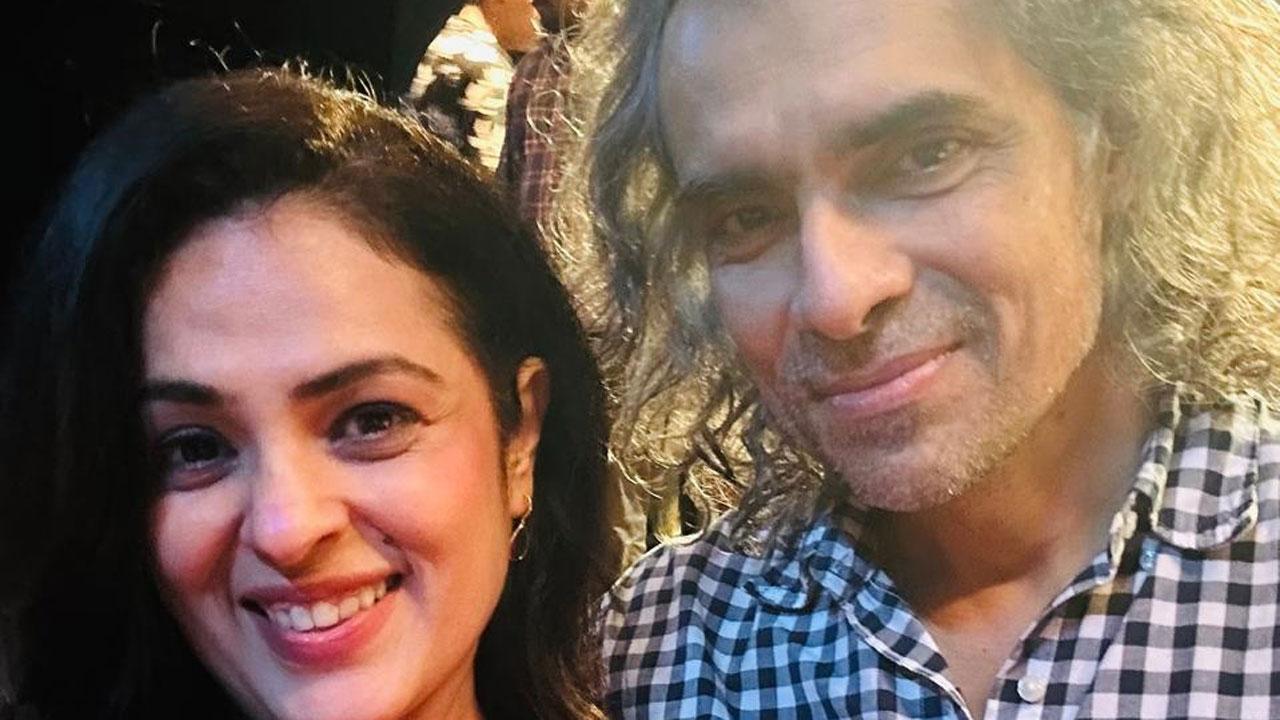
Priyanka Sharma (MID-DAY; June 13, 2026)
“How many actors can really say that I am in an Imtiaz Ali film?” asks Anjana Sukhani, her excitement evident as she speaks to mid-day about Main Vaapas Aaunga. Her journey began with a call inviting her to meet the filmmaker. The role: Naseeruddin Shah’s daughter-in-law and caretaker in the Diljit Dosanjh, Vedang Raina, and Sharvari Wagh-starrer.
“He wanted to see me on camera,” recalls Sukhani, who was first asked to send an introduction video. “When I met him at his office, I think he saw Meher in me. He narrated the part to me. And [I had] no questions. Who am I to say no to Imtiaz?” she says. During their discussions, she realised that Meher shares shades of Geet from Jab We Met (2007).
“Like Geet, [played by Kareena Kapoor Khan] Meher has no filter. I feel all of Imtiaz’s women are mature but have a childish quality to them. She innocently speaks about the wrong things at the most unfavourable time. It’s an endearing character,” says the actor.
Sukhani also cherishes her experience of working alongside Shah. Marvelling at the veteran actor’s commitment, she says, “Every time I did a scene with him, I teared up because of the way he performed. Just watching him perform is a masterclass in itself.”
Her admiration also extends to Dosanjh. “Diljit comes with a lot of sincerity and honesty as an artiste. He knows everybody’s lines, so when I fumbled, he would tell me my line.”
(Crisp) Movie Review: MAIN VAAPAS AAUNGA by FENIL SETA
3:52 PM

Main Vaapas Aaunga focuses on two parallel tracks, but this is not Love Aaj Kal. It also differs from other partition dramas because the focus is not just on the one who witnessed the horrors but also on his family. The love story is sweet while the present-day track keeps viewers captivated. Imtiaz Ali reserves the best for the last 20 minutes. On the flipside, a few scenes are random, and the direction gets incoherent in some places. Viewers don't fully understand what exactly happened with a crucial character. The makers touch upon an important issue of inter-generational trauma, but they do not establish it properly. The music, shockingly, is forgettable. This is among Naseeruddin Shah’s most accomplished works in his illustrious career. However, the makers need to release the film with subtitles in all cinemas. Without subs, one won't fully grasp what he's uttering. Diljit Dosanjh is natural and charming as always. Sharvari leaves a huge mark despite limited screen time. She flawlessly looks and acts the part of a girl whom a man loves for almost 78 years. Vedang Raina dominates several key scenes and proves his worth. Banita Sandhu (Kaveri), Rajat Kapoor (Iqbal Grewal), Anjana Sukhani (Meher), Manish Chaudhari (Muzaffar), Danish Pandor (Afzal), Satnam Singh (Pali) and Abhay Rana (young Pali) do well in supporting roles. Dolly Ahluwalia (Ishar’s grandmother) does not have much to do initially, but is very memorable in a crucial scene. All in all, Main Vaapas Aaunga is worth watching for its subject and finale.
My rating - *** out of 5!
My rating - *** out of 5!
Fenil's Bollywood Talk # 938
10:57 AM

WILL THE FOUR RELEASES FIND AUDIENCE THROUGH WORD OF MOUTH?
Last week’s Hai Jawani Toh Ishq Hona Hai has underperformed, but the weekday trend is decent. The film has collected Rs. 31.95 crores in 5 days and if it can hit the Rs. 50 crore mark in its lifetime, it’ll be a fair result. However, it’ll be a challenge to do so due to several releases this Friday.
The biggest release of the week is Main Vaapas Aaunga, directed by Imtiaz Ali. It stars Diljit Dosanjh, Vedang Raina, Sharvari and Naseeruddin Shah and tells the story of a man who had to migrate due to Partition. Imtiaz is known for having two tracks running parallel. Main Vaapas Aaunga uses that template, yet it differs from the Love Aaj Kal movies.
However, since it looks like a niche film, the excitement is limited among a section of the audience. The music sadly hasn’t worked as intended. As a result, the opening will be low, around Rs. 2-3 crores. But the film has the potential to grow dramatically from Saturday, if reports are positive.
Bharat Bhhagya Viddhaata has Kangana Ranaut playing the role of a nurse in the 26/11 terror attacks. The trailer is quite nail-biting, but since hype is limited, an opening of Rs. 1 crore is expected.
The same goes for Governor, starring Manoj Bajpayee. Though it tells a fascinating story from the pages of history, the material is such that it won’t immediately excite the audience. Both films will need good word-of-mouth to make an impact.
Finally, Haunted – Echoes Of The Past is the second part of the Haunted series. Like the first part, it stars Mimoh Chakraborty, is directed by Vikram Bhatt and will release in 3D. A film like this appeals to the masses. However, the trailer seems to have many AI visuals, which have been criticized. Shockingly, the promotion is very low-key.
Yet, it might surprise and open better than Bharat Bhhagya Viddhaata and Governor. Vikram’s last horror film, 1920: Horrors Of The Heart (2023), opened at Rs. 1.40 crore and that should be the aim of Haunted – Echoes Of The Past as well.
Hypermasculinity is not a genre-Vedang Raina
9:05 AM

Akash Bhatnagar (HINDUSTAN TIMES; June 2, 2026)
With filmmaker Imtiaz Ali’s upcoming romance Main Vaapas Aaunga, actor Vedang Raina is stepping into a genre that has recently taken a backseat to action spectacles and larger-than-life heroes. However, he isn’t convinced that genres determine a film’s success
“Something works because the audience accepts it regardless of what is working in reality apart from that film. And then you think it’s the genre that is working. If the film is good, the genre works, not the other way round,” he says.
The actor feels the industry’s tendency to categorise successes can be misleading. “Firstly, hypermasculinity is not a genre. I don’t think it is the reason a film works; it works because it has great content. Amid this, a 12th Fail (2023) worked and I don’t know what category it falls in. So, at the end it’s about the content that is working,” he explains.
Just two films into his career, with The Archies (2023) and Jigra (2024), Vedang is already among the most talked-about young actors in the industry. Yet, he remains grounded: “I’m just starting out and I’m just privileged to even be part of an Imtiaz Ali film. These are things that were beyond my imagination even five years ago.”
He adds, “Right now I don’t feel successful. I don’t feel like I’ve even begun. I have a long way to go and I want to achieve certain milestones as an artiste, but I’m also proud of where I’ve reached today.”
His next also features actor-singer Diljit Dosanjh, whom Vedang has long admired. “When I saw Amar Singh Chamkila (2024), it blew my mind. I can only take inspiration from him; I don’t consider us in the same league at all,” he says.
Subscribe to:
Posts (Atom)