Showing posts with label Mai. Show all posts

Asha Bhosle was shivering; yet asked if I wanted a retake-Mahesh Kodiyal

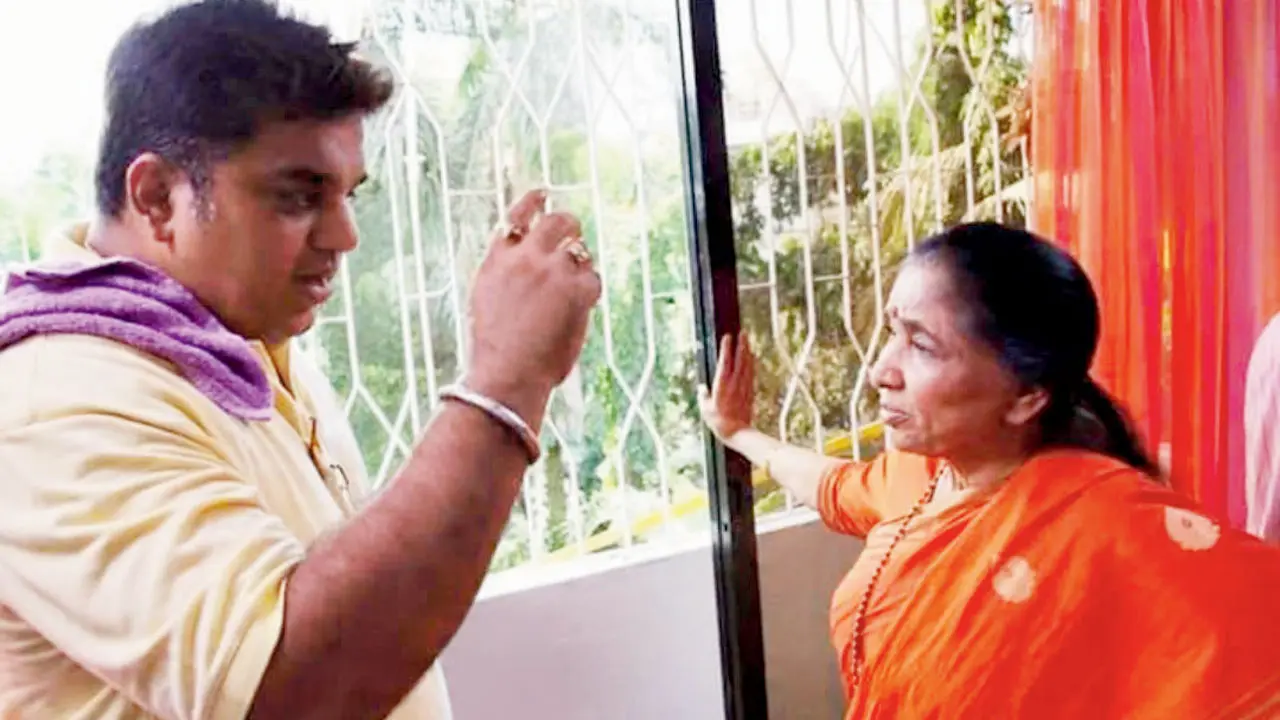
Mahesh Kodiyal on directing Asha Bhosle's debut film Mai: ‘While recording the song, I found my actress in her’

Chaitanya Padukone (MID-DAY; April 14, 2026)

Asha Bhosle’s penchant for reinvention was never quite restricted to singing. At 79, the veteran singer expanded her art and made her acting debut with the Hindi film, Mai (2013), directed by Mahesh Kodiyal. 

When mid-day reached out to the director, currently based in Las Vegas, he expressed his sadness at the passing of the legend. “It’s shattering news. Having Ashaji in my film was a milestone in my life,” he said.

Casting Bhosle as an Alzheimer’s patient in the Padmini Kolhapure-starrer was an unusual choice. Was it the director’s gut feeling that led him to cast her instead of an actor? Almost, said Kodiyal, adding, “In the concept stage, I wove in a lullaby to be sung by Asha ji. On the day of recording it, while I was narrating the song’s situation to her, I realized that I had discovered my actress in my singer. Asha ji’s enthusiasm and passion during the workshop and shooting were unmatched. Her dedication to match or outdo her co-stars was extraordinary.”

The late singer’s sincerity extended to her acting too. Recalling his fondest memory with her, Kodiyal shared, “For a scene where I had to film Asha ji in torrential rain, she sat patiently in drenched clothes through several retakes without complaining. After the shot was okayed, she was shivering. Yet, she asked me if I wanted a retake. I couldn’t resist touching her feet [seeing] her dedication.”

Asha Bhosle, ‘I will only do Mai if Padmini is in it’-Padmini Kolhapure

‘I got my first film because of Asha atya’

Natasha Coutinho (HINDUSTAN TIMES; April 14, 2026)

Actor Padmini Kolhapure’s association with late singer Asha Bhosle goes beyond films; it is rooted in family. The two, who worked together in Mai (2013) — Bhosle’s acting debut at 79 — are connected through Padmini’s father, late Pandharinath Kolhapure, a first cousin of Bhosle and her sister, late singer Lata Mangeshkar.

“She introduced me to (late actor) Dev Anand, because of which I landed my debut Ishk Ishk Ishk (1974). I called her Asha atya [father’s sister in Marathi]. As a child, I remember her coming home every Diwali with a bag full of gifts,” she shares.

Talking about Bhosle’s decision to take on Mai, the 60-year-old reveals, “I remember her saying, ‘I will only do the film if Padmini is in it’.”

She also lists some of her favourite songs sung by Bhosle that were picturised on her. “Kabhi Kisiko Muqammal Jahan Nahi Milta (Ahista Ahista, 1981), Puchho Na Yaar Kya Hua (Zamaane Ko Dikhana Hai, 1981), Anari Ka Khelna (Woh 7 Din, 1983), and so many more,” she says.

Kolhapure fondly recalls more intimate memories: “On her last birthday, she gifted Poonam (Dhillon, actor-politician) and me saris from her personal collection. Her favourite dish was Mooga Mole Randai, a Saraswat dish from the coastal regions of Goa, Karwar and Mangalore. She especially loved the one my father would prepare.”

Who wouldn’t want to play a hero who is thrashing baddies and settling scores with them?-Sakshi Tanwar

Sakshi Tanwar: Out of my comfort zone

Sakshi Tanwar dives deep into the series Mai, going through the toughest scenes that broke her, and won her the Best Actor nomination in the mid-day and Radio City Hitlist OTT
Upala KBR (MID-DAY; February 19, 2023)

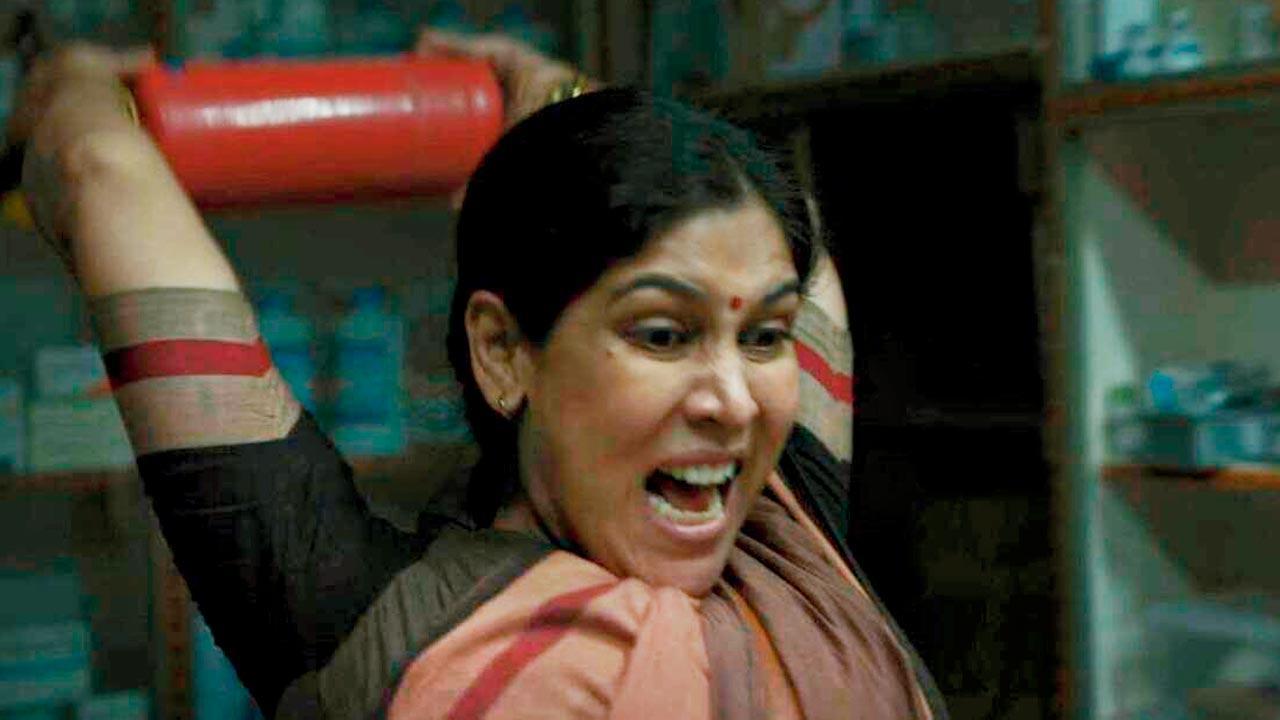
Sakshi Tanwar is known for her quiet and strong, yet fiercely independent roles in television and movies. So, it doesn’t come as a surprise to see the actor pack a punch in the web series Mai: A Mother’s Rage, which streamed on Netflix last year.

Her performance as the grief-stricken, distraught, and conflicted mother, who treads a fine balance between the good and morally incorrect, got her nominated in mid-day and Radio City Hitlist OTT awards in the Best Actor (Female): Series category.

“I did it because it was different and challenging,” starts off Tanwar, who consciously chose the role that helped her explore her skill as an actor, beyond the scope of things she has previously done on television.

“Mai was something I had never done before. It was totally out of my comfort zone. I have played so many central characters before Mai, but this was like a full-on roller coaster. [There was] action, underworld, scams, corruption, crime, anger, guilt, and everything dark that I had not explored earlier. And who wouldn’t want to play a hero who is thrashing baddies and settling scores with them?”

The actor believes that credit should be given where it’s due. Tanwar says that creator Atul Mongia and director Anshai Lal helped her to develop the layered role of Sheel Chaudhary. “I loved the role, but I wasn’t sure if I was suitable for it or [if I] could [even] do it. After the mock shoot, I was exhausted and apprehensive as I realised that it was going to be a demanding shoot. But they were happy and I was on board,” recollects the actor, adding that finding the balance between the good and bad was the best part of the script.

“Sometimes, I would know what to do before the scene would start, but it was a struggle and I would find it somewhere while doing the scene. I can say it has been the toughest project till now.”

Tanwar believes that awards encourage artistes to do better. “Since childhood we are all conditioned to work in a manner that gets us appreciation. So, when you get an award you do feel happy, but my biggest validation is when people tell me that they liked a particular performance. It feels like I got an invisible certificate for my good work.”

Cast your vote for the Hitlist OTT Awards
Sakshi Tanwar has been nominated in the Best Actor (Female): Series category for Mai: A Mother’s Rage.

The other nominees are:
- Amruta Subhash (Saas Bahu Achaar Pvt Ltd)
- Fatima Sana Shaikh (Modern Love Mumbai)
- Huma Qureshi (Maharani S02)
- Masaba Gupta (Masaba Masaba S02)
- Shriya Pilgaonkar (Gulty Minds)
- Shriya Pilgaonkar (The Broken News)
- Shefali Shah (Delhi Crime S02)

There are 16 categories that the public can vote in. Log on to www.radiocity.in/hitlistott to cast your vote.

Voting lines close on February 22.

Mothers on OTT are more complex, layered and pivotal to the story than ever before

A MOM-ENTOUS SHIFT
IN NARRATIVE

Sugandha Rawal (HINDUSTAN TIMES; May 7, 2022)

They are strong, fierce, vulnerable, spirited, ambitious, and even vengeful if need be. Mothers in recent web projects can be described as all this and more. From actor Sushmita Sen entering the narcotics business to protect her kids in Aarya, and actor Sakshi Tanwar out to find the killers of her daughter in Mai, to actor Rasika Dugal exploring the complexities of motherhood as she deals with her husband’s infidelity in Out Of Love — the characters of mothers we are seeing now are more complex, nuanced and layered than they were ever before.

Dugal is elated that motherhood is no longer glorified or oversimplified. “A mother-child relationship is no longer shown as perfect or devoid of conflict. In many stories, we see the fears, anxieties and confusions of being a parent, co-existing with the joys of it. Even though I have no experience of being a parent in real life, Dr Meera Kapoor and her relationship with her son Abhi, especially in season two of Out Of Love, gave me a glimpse of how demanding yet beautiful parenting can be,” she shares.

Actor Raveena Tandon in Aranyak and actor Madhuri Dixit Nene in The Fame Game, are other such characters who drove the narratives with their courage and fearlessness when it came to their children. “For a long time, we had a very fixed notion of how a mother needs to be portrayed on screen. Now, the writing has caught up with the times and we are showing women of today, and that stands true for my show, The Fame Game, with Madhuri,” says director Bejoy Nambiar.

To this, director Vinay Waikul, who helmed Aranyak, adds, “Life is not unidimensional, and that stands true for the characters of mothers on screen. This realisation has changed the whole narrative.” And this is something screenwriter Charudutt Acharya agrees with, adding that the “concept of a stay-at-home mom is also changing”.

According to actor Sahher Bambba, who played the role of a mother to a 33-year-old on screen at the age of 23, the change is empowering in many ways. “Now, cinema is reflecting the reality, which is that there are many facets to motherhood. Back in the day, after a woman hit a certain age, it would be the end of her career. Now, it doesn’t stand true, and it is because of such diverse roles,” she says.

However, there is still a long way to go, feels actor Kitu Gidwani, who recently played a mother in the show, Potluck. “We don’t believe that older women can be hot, happy, successful, vibrant, intelligent and path-breaking. We still have a big fear of older women in this country. Maybe the younger ones have more scope, but not older women. For instance, we are still [predominantly seeing women play] a mother supporting her kids’ decisions, and stuff like that. Where are the guts to show women breaking and finding their own? I want to see that, and hope it comes soon,” ends Gidwani.

A MOM-ENTOUS SHIFT
IN NARRATIVE


A MOM-ENTOUS SHIFT
IN NARRATIVE

I was very happy that a star like Vidyut Jammwal came forward and appreciated my work-Sahil Sultanpuri

The 2019 flick Commando 3 is today remembered not just for it’s action and performances of Vidyut Jammwal and Gulshan Devaiah, but also for the song 'Akhiyaan Milavanga'. Not many are aware that this Mannan Shaah composition was penned by Sahil Sultanpuri. We got a chance to catch up with the 54-year-old lyricist and speak to him about the response to the Commando 3 track and also collaborating with Asha Bhosle. He also made some interesting observations on the trend of remixes and the nepotism row.

What kind of feedback did you get for 'Akhiyaan Milavanga'?
The feedback was tremendous and the song had a wide reach. And we all know how nasty people can get in the comments section on YouTube. If they don’t like a song or a promo, they criticize openly. But surprisingly, I didn’t see a single negative comment for the song! It’s a proud feeling to get so much love from the aam junta.

'Akhiyaan Milavanga' was composed by Mannan Shaah. Tell us about your experience of working with him…
This is the first time I worked with Mannan bhai although we had spoken in the past. Our music sittings were amazing and it was a truly novel experience. When you begin to work with an established music composer who has several hits under his belt, you might wonder ki naa jaane yeh kaisa aadmi hoga. You wonder if you’ll able to match that person’s wavelength and understand his or her style of working. But the way he works, communicates, explains the tune etc was class apart and very heartening. He’s a singer as well and hence, he was able to nicely sing the tune and that helped me in memorizing the flow of the track.

And the era then was of Hindi songs peppered with Punjabi lyrics, and that trend continues even today. So he had asked to put some Punjabi words as he was sure that it’ll give a nice touch to the song. I was more than happy to do so. So yes, overall, the experience of working with him was great. Aise talented logon ko definitely aur oopar aana chahiye. This is what I strongly feel.


'Akhiyaan Milavanga' was picturized on Vidyut Jammwal and it was good to see an action hero like him getting into the romance zone in the song! How was your experience meeting with him? What did he have to say about the song?
I had met him for the first time at a function. This was when Commando 3 was on floors, as far as I remember. As there were too many people present, we couldn’t talk much but he did tell me that he liked the song. Later, we met properly at the success party of the film. He told me that, “Gaane ka response bahut accha raha, Sahil. Aapne bahut achchi tarike se gaana likha hai. Waise toh maine bahut saare gaane kiye hai. Lekin lip sync gaana karne ka mazaa hi alag hai”. I was obviously very happy that a star like Vidyut came forward and appreciated my work. He also added, “Kabhi kabhi gaanon ke jo shabd hai, woh dil mein utar jaate hai aur woh shabd aapse acting karwa lete hai!” Funnily, I didn’t understand as he said all this in English aur meri angrezi itni achchi nahi hai. 


I went through your filmography and realized that you also wrote a song in Mai, which starred Asha Bhosle as an actor. Tell us about your experience of working with her…
Before Mai, I had written a single that was sung by Asha Bhosle along with Bathiya & Santhush. They are very famous artists from Sri Lanka. While working on the song, I had met Asha ji at her house, Prabhu Kunj, in Mumbai. I sat there for a long time and it was an honour when she explained the tune to me. I still have the recording of our music sitting that we did that day! She has years of experience of singing and communicating with people. These factors coupled with her positivity make her one of the greatest singers ever in the world. Once you work with her, you feel like you have achieved a PhD! I felt like sitting in front of a music institution. The way I felt with her, I had never felt like that way before.

Interestingly, the song that I wrote in Mai, 'Dhakku Makum', is sung by Zanai Bhosle, her granddaughter. It was her first song and I feel deeply honoured that I am the one who wrote Zanai Bhosle’s first ever song. Penning this song was a challenge. After all, it was about a kid singing a song. And Asha ji was supposed to dance in the film on this song. So I used the popular line in Maharashtra, ‘Yere Yere Pausa’, and then wrote an original song.

A lot of remixes are being churned out today. It reduces the work offered to lyricists as most of the times, the original lyrics are retained. What are your views on this trend?
A music company has all the right to remix and recreate the song but in the process, creativity suffers to an extent. It’s not like the composers are using the same lyrics as it was in the original. The trend nowadays is to change some words here and there but the original hook line is retained. Nevertheless, if the original song writers were able to think of such terrific hook lines, I feel that even the current lyricists can do so. Kya hum aise hook line nahi likh sate? The fact that we don’t have confidence on our lyricists is disappointing. I don’t want to compare myself with the lyrcisits of that era. They are our seniors and their contribution is invaluable. But somewhere, we can at least make an effort to write equally good compositions, if not better. Similarly, we should at least also try to maintain the golden era, if we can’t create another golden era. Lekin remix karke hum bewajah uss golden era ko kharab kyun kar rahe hai?

The nepotism debate never dies down, more so after the untimely demise of Sushant Singh Rajput. As an outsider, what is your opinion on this row and do you feel you were at a disadvantage because you didn’t belong to a film family?
Well, in our industry, outsiders do get chances. The ones who are established today were also outsiders at one point. If you have earned name and fame and lot of wealth, it is obvious that you would pass it on to your offspring. So if someone is trying to promote his/her child, it’s his right and there’s nothing wrong in that. What is wrong, however, is trying to cut off chances of a genuinely talented person. Outsiders have no authority to cry foul over this practise. They would have done the same if they were born in a star family. And let’s not forget that talent is an important criteria and that’s what contributes to success.

And there are so many lyricists today like Manoj Muntashir, Kumaar, etc who are all outsiders. One can say that they became big as they got the support of bigger films and artists. But then, they got that support in the first place, despite the fact that they are not from the industry. Hence, the whole nepotism debate doesn’t hold water.

I won’t allow women to be depicted regressively-Anushka Sharma


On Women’s Day, actor-producer Anushka Sharma discusses how she has tried to change female portrayal on screen by telling stories from feminist gaze
Mohar Basu (MID-DAY; March 8, 2021)

In her 13-year career so far, Anushka Sharma has showcased different shades of women — from the ambitious wedding planner in Band Baaja Baaraat (2010) to the spirited Aarfa in Sultan (2016) and the self-reliant Mamta in Sui Dhaaga (2018). Though the characters resided in different universes, a common thread tied them — each had a strong head on her shoulders and the agency to take life decisions. Sharma stepped up her efforts to change the depiction of women in Indian cinema as she launched her production house in 2015 and backed female-led stories.  

As she puts her weight behind another powerful story Mai, the actor-producer says she knew early on in her career that she didn’t want to be boxed as the leading man’s arm candy. “I have been conscious enough to select roles that I felt could contribute towards changing the portrayal of women on screen. I was done seeing myself as an accessory. I vowed that as a producer, I will not allow women to be depicted regressively,” she says. Sharma admits it wasn’t easy to swim against the tide. “It took a lot of self-belief, but it was liberating to do this for myself.” 

Her productions are proof that she walked the talk. If NH10 (2015) told the story of a woman raising her voice against honour killing, Bulbbul (2020) depicted the folklore of a blood-thirsty witch from a feminist gaze. Her upcoming offering Mai, headlined by Sakshi Tanwar, revolves around a mother who accidentally gets sucked into the world of violence and power. Sharma says that with each project, she aims to challenge society’s patriarchal ways. “Movies have the power to impact change and help people determine what is right and wrong. By being clear about how we will depict women in cinema, we can alter the mindset of people, and shatter age-old beliefs and customs. My film choices and productions are a testimony to the fact that I’m committed to sparking a conversation in society about equality, self-respect and empowerment.”