Showing posts with label Mahesh Bhatt interview. Show all posts
Showing posts with label Mahesh Bhatt interview. Show all posts
One of the greatest roles Alia is playing today is the role of a mother-Mahesh Bhatt
11:18 PM

Vinay MR Mishra (BOMBAY TIMES; August 8, 2026)
Filmmaker Mahesh Bhatt has directed some of Hindi cinema's most memorable actresses. Yet, when he speaks about daughter Alia Bhatt, there is genuine surprise in his voice. During an interview when asked if he is proud of her daughter being the biggest star in the country, he first corrects us, 'one of the biggest stars of the country', and then goes on to say,
"She's astounded me because Soni and I never thought she had this kind of latent talent in her. We didn't really have what you would call a film culture at home. I kept making movies, but that was my work. When I saw her in Highway, I was astounded. I'm again astounded by her in Gangubai Kathiawadi. From where did she get that body language? She was never exposed to that kind of society or culture. I woke up to her exactly the way the nation woke up to her."
One compliment, in particular, convinced him she had truly disappeared into the character. "For me the greatest compliment to performance came from an event to Jharkhand. A tribal woman who watched Udta Punjab said she believed Alia belonged to her community. I thought, 'Oh my God, this is as real as it can get.'"
He goes on to add, "I always tell my children that whenever you feel you're soaring towards the zenith, remember you haven't even scratched the surface."
'One of the greatest roles Alia is playing today is the role of a mother'
Asked whether he sees shades of his younger self in Alia, Bhatt smiles before saying evolution has made her better than the previous generation.
"She has a drive. Every generation is superior to the previous one. Evolution has its own way of improving itself. There is this thirst she has. She oscillates between Mumbai, Cannes, Singapore and Hyderabad, shoots films, fulfils professional commitments, comes back home and continues to play the role of a wife and a mother. It is an astounding kind of energy. (However), One of the greatest roles she's playing today is the role of a mother. It is very humbling to watch. You're such a big star, but you never make anyone around you feel that. The role of a mother becomes the most important role you will ever play. She's promoting films across the country, yet she's constantly running her home," he explains.
'Raha is a vibrant version of Pooja'
If Alia continues to surprise him as an actor and mother, granddaughter Raha Kapoor has transformed the entire family's dynamic. "She'll outdistance Ranbir Kapoor and Alia by miles. She's different. She has a different vibe. When she comes, the whole house becomes hostage to her energy. For those few hours, she becomes the centre of everything," he confesses.
Does he spend a lot of time with her? Bhatt replies, "I recently went with Neetu (Kapoor) to her school for her Grandparents' Day. Soni was in Istanbul. We were walking through a cloud of soap bubbles. I was holding Raha's hand while Neetu was holding the other. It was a beautiful moment. That was something which I remember doing with only Pooja. It brought back memories of walking with Pooja when she was little. Suddenly, time collapsed. She is a vibrant version of Pooja. (Eventually) The same kind of family."
Bhatt laughs while describing his unusual bond with his granddaughter. "She can't quite figure me out. She probably wonders, 'Who is this man and why does he speak the way he speaks?' I manage to tell her one story. She enjoys correcting me whenever I pronounce the name of an animal incorrectly. Soni is very protective of her. She has got the best Nani, and Dadi," he explains.
He continues, "And her father. Oh my God. I'm also astounded by the role he's playing as a parent. And they both are stars. It just shows that this narrative that, working actors especially stars neglect their children, which we heard in our days is a thing of the dark past and is not true anymore. Today you have better communication. You have CCTV cameras shooting for and you can see what's going on at home."
'Pooja and I grew up together'
As Raha reminds him of Pooja, his eldest daughter, one cannot help but mention her. Bhatt's bond with eldest daughter Pooja Bhatt has often fascinated the industry, but he believes their closeness was forged long before fame arrived.
"When you become a father at 22 and you're struggling, life is different. I'd carry her water bottle to school. I'd wait around Bandra because I didn't have enough money to travel back and forth. I was unemployed. I spent a lot of time with her. I'd take her to my music sittings. She would sit there in her school uniform while the sessions went on. She, amongst my children, has spent the maximum time with me in those days. She has the courage to stand alone," he ends.
Main Vaapas Aaunga is stunning. It’s an act of rebellion by the filmmaker-Mahesh Bhatt
10:50 AM

Vinay MR Mishra (BOMBAY TIMES; July 8, 2026)
For over five decades, Mahesh Bhatt has worn many hats — filmmaker, producer, mentor and one of Hindi cinema’s most fearless storytellers. As he turns producer for the play Wo Subah Hum Hi Se Aayegi, the filmmaker reflects on theatre feeling more truthful than cinema today, the need for artistes to resist playing safe, and Sadak 2 being his final directorial.
‘Theatre is the mother of all storytelling’
For a filmmaker who built his career on emotionally raw cinema, it is perhaps fitting that Bhatt now finds himself gravitating towards theatre. Producing Wo Subah Hum Hi Se Aayegi has reignited his belief in what he calls storytelling in its purest form.
“Theatre is the mother of all storytelling. At this stage of my life, I find myself drawn more to essentials, to the bare bones of truth. Theatre strips away all the machinery. There are no retakes, no visual effects, no AI. All that remains is a naked, trembling encounter between the performer and the audience. In this age, information floods us like a tsunami and truth is slipping out of our fingers. Everything is curated. Even our so-called wounds are curated and varnished. Theatre is one place you need to go to when you’ve lost your path,” Bhatt says.
‘The thirst to make stories that listen to the heart continues in the industry’
When asked if filmmakers today are playing it safe creatively in the age of algorithms and box office pressures, Bhatt, known for films such as Arth (1982), Saaransh (1984) Naam (1986) and Aashiqii (1990), disagrees. “We did have Main Vaapas Aaunga. It’s stunning. It’s an act of rebellion by the filmmaker. I may have stopped making movies, but the thirst to make stories that listen to the beat of the human heart still exists in the industry,” he shares.
‘Time is the only critic’
He is careful to clarify that his criticism is not directed at a younger generation of filmmakers. Instead, he believes they are often pressurized into chasing immediate success. “One of the greatest challenges of these times is how to avoid massification. Most of the young filmmakers I see have enormous fire in them, but they want to be successful like yesterday! So, you cut yourself. You prune yourself. I am not cynical about young people. The audience has the latitude and the bandwidth to oscillate between different kinds of cinema. Yes, some films may not move the needle immediately. But there are movies that are judged by how they survive the passage of time. Time is the only critic,” he explains.
‘If art doesn’t have the audacity to take risks, then it is not art’
Bhatt recalls a remark by acclaimed Hollywood filmmaker Francis Ford Coppola that has stayed with him. “‘If art doesn’t have the audacity to take risks, then it is not art.’ There is an entrenched belief in the marketplace, which they hurl at you every hour, that only tentpole movies — films that cater to the lowest common denominator and testosterone — will work. They have their place. But they cannot be the only stories we tell. I would say that, having played on both sides, having oscillated between intensely personal movies and hardcore commercial films, I found success on both sides,” he mentions.
‘How the world chooses to remember me is their privilege’
Despite a career spanning over five decades, Bhatt says he has no desire to dictate how history remembers him. Recalling a recent event in Delhi centred around a retrospective on Indian cinema, he says, “I was invited because the organizers felt I was a force that spoke to India in the ’80s and ’90s, and India spoke to me. Then you discover there was Mehboob Khan before you, Guru Dutt, and so many filmmakers before Independence. You realize you’re just another brick in the wall. You are not a monument. You’re lucky if you make certain films that connect with the hearts of the people living in your time. Some endure; some sink. We like to believe our work becomes monumental, but memory is the first casualty. Just as I choose how I remember people, they will choose how they remember me. And how the world chooses to remember me is their privilege,” he ends.
Stories on screen are being used to push people away from each other-Mahesh Bhatt
10:01 AM

Noting that filmmakers today are weaponizing stories to drive hate, Mahesh Bhatt says he is hosting chat show ‘Pehchaan’ to spotlight those who quietly serve humanity
Priyanka Sharma (MID-DAY; April 16, 2026)
It’s not every day that Mahesh Bhatt hosts a chat show. Then again, it’s not every day that an urgent show comes his way. Within seconds of getting on a call, the filmmaker, succinctly yet philosophically, explained what drew him to the SonyLIV show. “When the house is on fire, you don’t debate; you bring water. Pehchaan is that water, because you know where the world is right now,” he stated.
Directed by Suhrita Das and produced by Vinay Bhardwaj, the unscripted series features Bhatt in conversation with 13 individuals from the Sikh community, who dedicated their lives to seva. To the host, it’s notable that the chat show’s subjects don’t preach their truth, but practice it.
“They have drawn strength from their faith and translated it into action. We’re becoming a sound-byte society and we think we can solve the world’s problems just by talking, tweeting, or putting our ideas on Instagram. These individuals [on the show] are unsung and not seeking accolades. Today, when division is growing by the hour, Pehchaan speaks about connection.”
According to him, artistes must focus on building connection in today’s times of hate and division. “Any narrative that makes you look at your fellow human being again and listen to him/her and see him/her as a living, throbbing human being who has got his/her hidden wounds is what every filmmaker and storyteller actually should (tell). Stories should give you insights into [another human’s] complexities and the turbulence of life. It’s supposed to glue people together. Filmmakers can use a story as a weapon or as a way to stitch,” he said.
Referring to Pehchaan, Bhatt said that stories have the power to bring one close to the “saviour” within them.
“So many of the Sikhs were wounded in 1984. But they didn't wear that wound or used it to separate themselves from the stream of life. They, in fact, more vigorously got engaged with life. That is the reason I am so passionate about Pehchaan because in the terrible times that we live in, anything that can through our audio visual bring a human being close to his own heart (is needed), because there's a saviour in every human being. And it's only through stories and encounters like this, that you wake them up to that saviour inside. Only when a story makes you touch that inner gold that everybody has been gifted, even the person that you resent, detest and disagree with, you have no other choice but to look at him as a reflection of what is called the Almighty. And I think if Pehchaan makes you look at your people, your next door person or your neighbour, in a different way, it will succeed. That will be far more important than the TRPs it generates.”
When asked if stories on screen, today, are “stitching” people together, he rued, “I don’t think so. The entertainment world and media have done the opposite. They are pushing people away from each other, by the hour. In fact, anybody who talks about gluing people together is looked as a person who has utopian ideas, an idealist or belongs to a time which is regressive.”
An artiste on the brink of extinction is the most creative-Mahesh Bhatt
8:10 AM
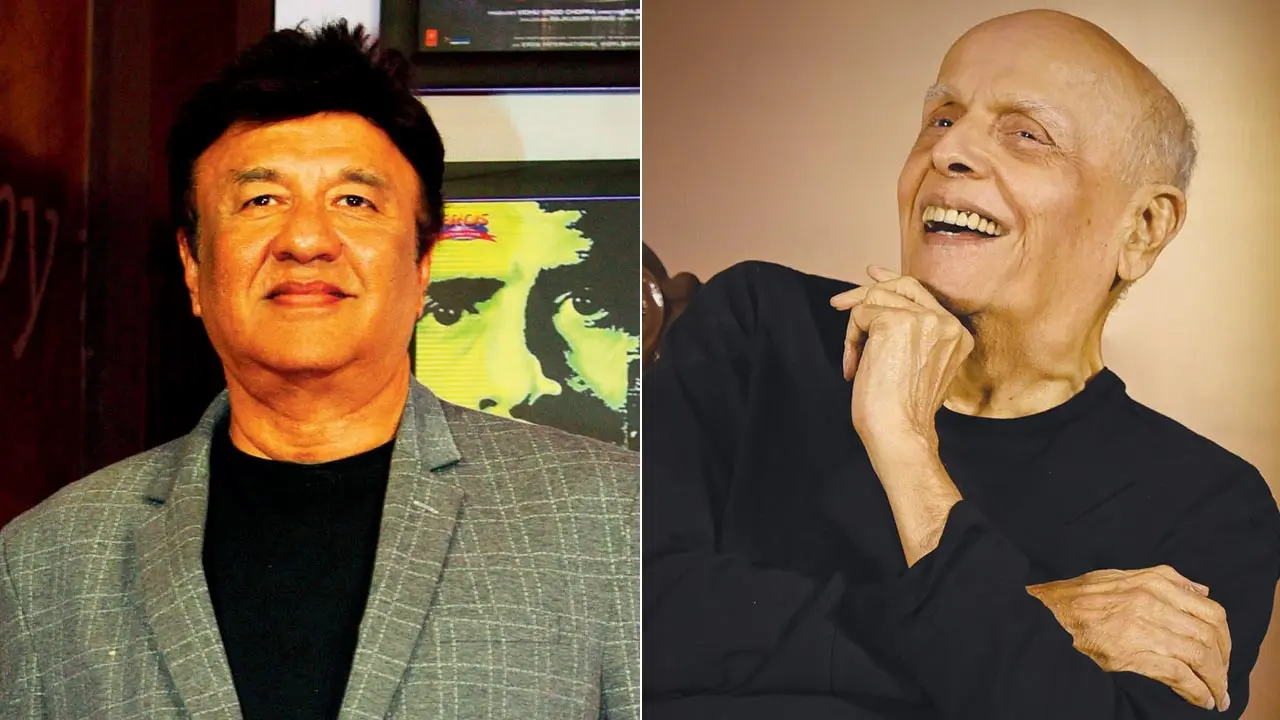
As Anu Malik returns to Bollywood with Tu Meri Poori Kahani seven years after he was called out in #MeToo movement, filmmaker Mahesh Bhatt thinks new composers cannot match his passion
Upala KBR (MID-DAY; September 3, 2025)
"It’s not comeback music, it’s a hit-back music,” says Mahesh Bhatt, referring to composer Anu Malik returning to Bollywood with the former’s film, Tu Meri Poori Kahani. After Malik was accused of sexual harassment by several singers in the #MeToo movement in 2018, work offers dried up and the musician stepped away from the limelight. Seven years on, as he returns with the love story’s album, the filmmaker says it was producer Vikram Bhatt’s idea to rope him in.
“I didn’t want six different songs from different music composers. I wanted somebody with a unified vision. So, Vikram suggested Anu Malik’s name and that was it. Anu and I go a long way. We did Phir Teri Kahani Yaad Aayee [1993]. The album is remembered even now,” shares the senior filmmaker.
Tu Meri Poori Kahani, which sees him serve as the creator, stars newcomers Arhaan Patel and Hirranya N Ojha, and is directed by his protégé Suhrita Das. Having been with the album since its inception, the creator believes he was right in choosing Malik for the job. “I wish the younger lot of music composers matched his passion. An artiste on the brink of extinction is the most creative. The survival mechanism kicks in as an artiste, who is almost a fame-junkie, suffers from withdrawals and wants to rebirth himself.”
In the aftermath of the #MeToo movement, it seemed to be the end of the road — and many would say fittingly so — for Malik. But the veteran filmmaker says the reason for the composer fading into oblivion was the entry of the new-age musicians. “The generation changes, and every music director is an expression of his times. Few can deconstruct themselves, and retain their wisdom. But Anu was not a fluke. He took the break in his stride and came back rich with his creations, despite the winter he went through.”
However, Bhatt had one condition before he signed Malik on — that he should remain true to his sound. “I told him he must not piggyback on the trends, thinking that he needs to cater to Gen Z’s musical taste. I told him to keep his late father, Sardar Malik saab in mind, while composing.”
Mukul Dev lost his mother last year; grief can take a toll-Mahesh Bhatt
8:44 AM

Renuka Vyavahare (BOMBAY TIMES; May 26, 2025)
Actor Mukul Dev passed away on May 23. He was in the ICU for a week and was battling health issues. Mugdha Godse expressed, "Shocked and saddened. He was a great actor and a friend."
Mukul made a striking Bollywood debut in 1996 with Mahesh Bhatt’s Dastak, a thriller that also launched Sushmita Sen and Sharad Kapoor. In a conversation with Bombay Times, the renowned director recalled his impression of Mukul and what made him special in a film that launched three newcomers.
Shocked by the news, Bhatt said, “Vikram Bhatt called me up this morning and said, Bhatt saab, I have heard the news and I'm so frightened to even confirm this news. Vikram was my associate in Dastak so most of the action scenes and most of the work was done by him with all these three actors, you know. He had a deep bond with him. So, he called me and asked me to verify and then I called Pooja, she was close to Mukul and Pooja herself was astounded. And then we started to inquire from here, there, everywhere until it came through some source on Instagram that he had passed away. So, then I did confirm that to Pooja who was quite devastated, even to Vikram. Mukul was a very close member of our tribe which kind of journeyed through time, you know.”
Remembering Mukul, the director said, “What flickers on the screen of my mind is Mukul’s radiant smile. The most heart-warming smile that would be not only on his lips but in his entire gait, from his eyes, lips, eyes, his entire body would smile when he smiled. He was not aggressive in his demeanour. He was shy, not very outgoing. I don't mean he was shy that he would step back but he was always within the boundaries of his own given space. He would very respectfully carry himself within that. One thing that I noticed very early about him was he was very generous because all three of them were newcomers in the film. You always felt his warmth; never felt his obtrusive presence. There was no attempt of his to flash like a neon sign trying to make his presence felt.”
How did he discover the actor, we ask. “People would come to me because they knew that I was always looking for new people. I would cast new faces in movies. So, I think like Anupam Kher and Rahul Roy, Mukul too came to me looking for an opening in the movies. That’s how Dastak happened. The film was around Sushmita. She came with the dazzle of being Miss Universe. Obviously, tinseltown looks for faces which are radiant and have run up to the glamour world. She came with her thunder, but she was not the kind of person who would flaunt it. She had the humility to own up that she was a beginner. Like all of them. All three were equally confident. I thought Mukul had the charm and I just thought that he fitted that role, he had the language. He was a person who was quite distinct from the raw look of Sharad Kapoor. I needed someone who looked the opposite of Sharad Kapoor so I cast Mukul. He was refined and well-groomed and kind of cultured. Not somebody who like Sharad, had the dust of life on him.”
The director says he heard of Mukul through common friends over the years but drifted apart. “The harsh truth about our business is that when we work, we work on intense projects and we are so intensely engaged with each other. And that's the glue, right? And then when the movie gets over, irrespective of what the outcome of the film is, if you don't work together, you do drift apart. Because you're all fiercely engaged in your own activity of life. Especially if you happen to drift away and go to another town. I used to keep on meeting his brother, Rahul. Very charming man. I used to keep on inquiring about him. I heard he was in Delhi, looking after his ailing mother. He lost her and grief can take a toll. He was ailing himself. Loneliness is a very difficult space to deal with, especially when you have been in the arc lights. And then to be in Delhi and away from the so-called razzle and dazzle of Mumbai. This is based on what I heard but losing an ailing parent can erode you.”
On a concluding note, Bhatt said, “Mukul did leave in his own way his footprints on the sands of time. I remember him as a very warm, endearing man. Mukul Dev still smiles in my head. A radiant smile that lights up my heart.”
Filmmakers of yesteryear had a gambler’s spirit. Now, executives decide when to greenlight films-Mahesh Bhatt
8:21 AM
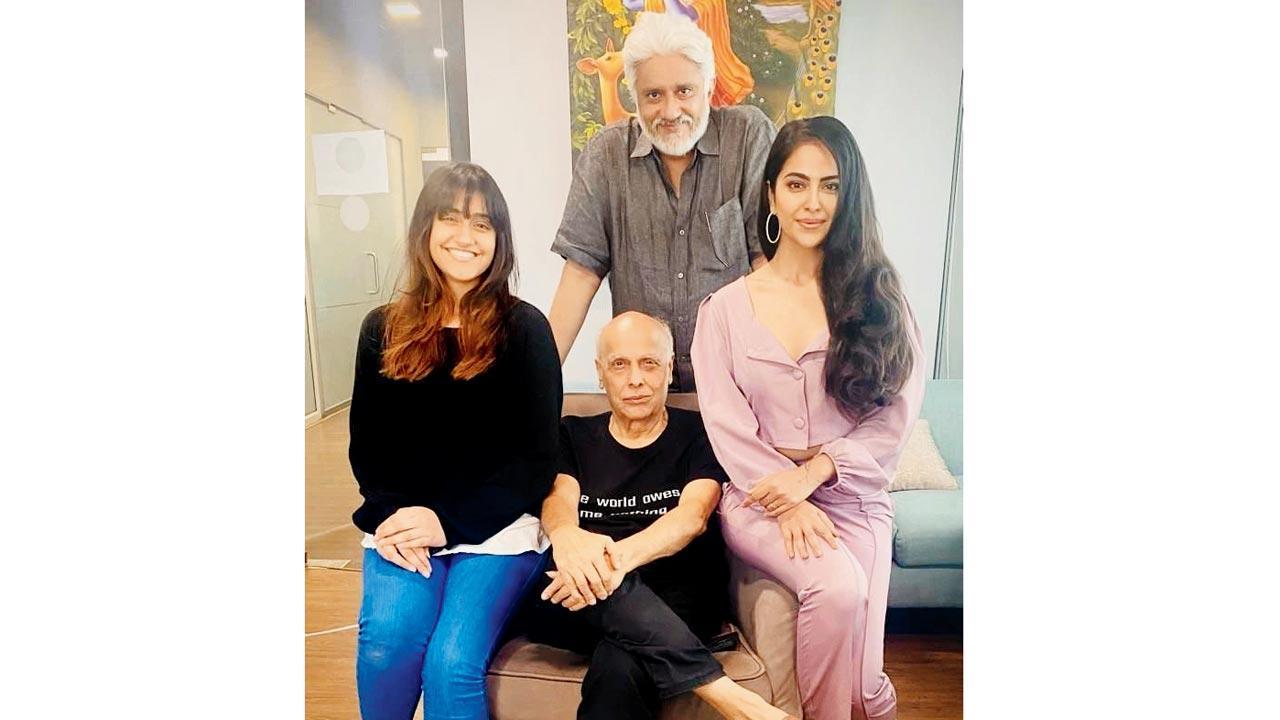
Having presented Avika Gor of Balika Vadhu fame in a different light in Bloody Ishq, producer Mahesh Bhatt on why he doesn’t rely on star power to deliver a success
Mohar Basu (MID-DAY; July 30, 2024)
Considering the fact that web releases are consumed by cinewatchers at a time that’s most convenient to them, the OTT boom has eased the stress related to a ‘Friday box-office performance’. But the day of his film’s release is still a euphoric one for Mahesh Bhatt, who has spent decades keeping tabs on the opening numbers of his movies. Bhatt’s Disney+ Hotstar production Bloody Ishq, which aired on the platform on Friday, opened to mixed reviews. What makes the offering particularly special, however, is that it marks a prominent commercial release for actor Avika Gor, who acquired immense fame as a child actor for her role in the teleshow, Balika Vadhu.
The casting, though unusual, is not a surprising move, given the fact that Bhatt has consistently invested in actors instead of ‘stars’. “[Late producer] Rajkumar Barjatya told me something vital during [the filming of] Saaransh [1984]. I was in search of a producer for the film. Sanjeev Kumar was a dear friend. People had assumed that Sanjeev would lead the film while Anupam [Kher] would be the second lead. But Anupam insisted that he lead it. He [spoke with] passion, and I agreed. When Sanjeev saw the film, he admitted that he wouldn’t have been able to do what Anupam did. Mr Barjatya told me, ‘You pick the actor you believe in, kyunki, ultimately, chalti toh picture hi hai’. Today, Anupam has done 500 movies, and Saaransh was a defining one for him. Since the release of Raaz, we have predominantly worked with new people. When the hoopla passes, the movie stays with you,” says Bhatt, lamenting that today, producers choose to invest in stars to make a project “safe”.
Calling the new breed of movie-makers “risk averse”, he says, “Moneybags know that star power makes a project safe. But, I don’t want to rely on the star to do well. I want our story to hold people’s attention.”
Easily among the names who’ve contributed to creating the identity of horror films in Indian cinema, Bhatt believes the decision to determine if the genre has evolved significantly over the years rests with the audience.
“We achieved a breakthrough with Raaz. Horror, until then, was seen with disdain. By stitching good music and keeping human relationships at the narrative’s core, we made a spectacular film. And while we made several franchises in the genre, I don’t think [today’s filmmakers] have been able to break new ground as storytellers. Filmmakers of yesteryear had a gambler’s spirit. Now, executives decide when to greenlight films. Storytelling today is not as path-breaking as it was a decade ago.”
He points to his daughter Pooja Bhatt’s film, Jism (2003), to further his case. “No one thought that a leading lady would promote the idea that ‘the body knows no love, just lust’. To make edgy, neurotic films, you need a free pass.”
Even though production houses have become commercially aware in the aftermath of the setbacks they faced during the pandemic, several artistes have faced challenges due to the industry’s changing norms. “It is difficult to make content these days. Even in Hollywood, people who have been in the industry for years are seeking alternate jobs. The industry is in shambles. The traditional way of movie-making is getting outdated.”
Aashiqui had the truth of my life and the musical vision of Gulshan Kumar-Mahesh Bhatt
8:21 AM
Amidst a row over the ownership and creative rights of the Aashiqui franchise, Mahesh Bhatt, who directed the original in 1990, breaks his silence
Renuka Vyavahare (BOMBAY TIMES; October 11, 2023)
Part autobiographical, starring brand news faces Rahul Roy and Anu Agarwal, director Mahesh Bhatt’s Aashiqui became a smash hit in 1990. Its music topped the charts for years and continues to resonate with listeners. The romantic musical saw a sequel headlined by Aditya Roy Kapur and Shraddha Kapoor and directed by Mohit Suri in 2013. A third successor, Aashiqui 3, was announced in September last year by the same collaborators (T-Series and Vishesh films) with Kartik Aaryan in the lead and to be helmed by Anurag Basu.
However, a row over the ownership and creative rights of the franchise seems to have ensued, given Vishesh Films’ recent public notice followed by Mukesh Bhatt’s statement (he heads the banner, after Mahesh and he parted ways). Taking to their official Instagram handle, Vishesh Films issued a notice on September 25.
Excerpts from the statement said, “Vishesh Films is the producer and joint rightful owner of the intellectual property rights associated with the Aashiqui franchise. Any communication made without our involvement is unauthorized and fraudulent.”
Mahesh Bhatt, who made the iconic 1990 original, spoke to Bombay Times exclusively, shedding light on the issue.
‘Right isn’t always legal’
He said, “In this time and age when the moral compass of the world has shattered, and it’s become a moral desert, it’s important that elders behave like elders. Right isn’t always legal, and 50 per cent rights are in any case with T-Series. But I choose to stand for what’s morally right. In the case of Aashiqui, that moral legacy belongs to Gulshan Kumar and, in his absence, to Bhushan Kumar. Gulshan’s vision, support, and timeless music are at the heart of Aashiqui’s enduring impact.”
‘Aashiqui began with Gulshan Kumar’
Mahesh Bhatt recounted, “I remember that I was shooting at Horizon Hotel in Juhu, and a man who was standing at the corner of my set introduced himself as a music baron, who had just moved to Mumbai from Delhi. He said, ‘Main Shivji ka bhakt hu. Unhonay mujhe sapne mein kaha ke main aapke paas aau. Aapse film banwau. Aapka naam Mahesh hai na?’ I said yes. He said, ‘Music ka bank hai mere paas. Anurada ji (Paudwal) humare company ke saath hai. Aapko jo gaane pasand hai aap le lijiye, ya naye banwalijie. Ek acchisi musical bana dijiye. Main aapko promise karta hu, Hindustan kay konay konay mein main yeh gaane le jayunga. Har ghar mein bajwaunga. Badle mein, aap 50 per cent le lijiye.’ The simplicity and innocence with which he spoke was the beginning of Aashiqui. I distinctly remember I was shooting Dil Hai Ki Manta Nahin (1991) in Madhumalai forest (Tamil Nadu) with Aamir Khan and Pooja (Bhatt). In that forest, I heard one of the songs from Aashiqui playing. I turned to Pooja and said, ‘That man promised me that he will take the music across India."
The resurgence of the franchise
“When we decided to have a resurgence of the Aashiqui franchise, Bhushan was aware that he was up against a formidable brand called Aashiqui (1990) and its music, but he wanted to keep his father’s legacy alive. I personally feel that since I was the person whom Gulshan Kumar came to, I must speak up. They (T-Series) own the 50 per cent rights anyway, and the moral right of a product belongs to the person who gave birth to it. Let the legal experts sit down and discuss the details, I am talking about the moral compass, and I want to set the record straight. I have nothing to gain from this,” Bhatt says.
‘Aashiqui had the truth of my life’
He further elaborates, “I am known as an autobiographical filmmaker for my films like Arth (1982) or Zakhm (1998), but the romance you see in Aashiqui (1990) between Rahul Roy and Anu Agarwal is based on my first love with Lorraine Bright (Pooja Bhatt’s mother). I was 16 and she was 14 and studying in Bombay Scottish. The classroom scenes, her being thrown out and becoming my responsibility… my personal life was in Aashiqui. That film had the truth of my life and the musical vision of Gulshan.”
The ownership debate
The ownership debate doesn’t interest me because I have never been a man of business. I have consciously stayed away from it. I don’t have the stomach to sit down and argue the legal aspects. That’s for the legal experts to sort out. We are talking about the moral background. We come from a time when everything wasn’t spelt out. If you gave someone your word, you stood by it. Those values need to be resurrected even more today as everyone looks at the other with distrust.”
There has never been a child like the one that is coming-Mahesh Bhatt
4:05 PM

Excited to become ‘the coolest granddaddy’, Mahesh Bhatt is sure that the baby will have ‘extraordinary’ genes
Sugandha Rawal (HINDUSTAN TIMES; June 28, 2022)
Mahesh Bhatt is all set to take on the “most challenging role” of his life, as he’s going to be a grandfather soon. Overwhelmed with the news of his daughter, actor Alia Bhatt, and son-in-law, actor Ranbir Kapoor’s pregnancy, the filmmaker says the kid will come with “extraordinary” genes. “This is the most challenging role, which life is asking me to play. It is a magical moment for the whole family. Alia has been a magical child since the beginning. She has amazed me with her extraordinary talent. And, her marriage with Ranbir was [another] great [moment in our lives]. I love the boy,” Mahesh tells us.
The filmmaker is certain that his grandchild will be as amazing as its parents. He adds, “There has never been a child like the one that is coming and there will never be a child [like that]. Every child is unique. It (the baby) is going to be a universe in itself.”
Ever since the news of the pregnancy surfaced, the filmmaker has been flooded with messages stating that he will be “the coolest granddaddy on this planet”. Talking about Alia and Ranbir entering the new phase of their life, the filmmaker says that nothing can prepare the parents-to-be for the “magical ride” to parenthood, which comes with its share of bumps and joys. “They will have to grope, fumble and stumble and find their own ways to deal with the kid. Because this is real life, not reel life. When real life steps into your organised life, it brings its magic, wilderness and challenges. A new story is going to emerge with the arrival of this child. The baby is sure to have extraordinary genes of Alia and Ranbir,” he says.
Ask if he is ready with the book of wisdom to give to the couple as a father and the 73-year-old adds that they will have to experience and learn on their own. “I’ve never been someone who’d give advice to my children. The child (Alia and Ranbir’s unborn) will teach several lessons to the parents,” he explains.
After dating for many years, Alia and Ranbir got married in April 2022 at Ranbir’s Mumbai home, Vastu, in the presence of their close friends and family members.
As the wise say: Autumn is just another spring-Mahesh Bhatt pens a touching letter to Sanjay Dutt
8:17 AM

On Sanjay Dutt’s 60th birthday, filmmaker-friend Mahesh Bhatt pens a letter to the actor
Mahesh Bhatt (MUMBAI MIRROR; July 29, 2019)
Dear Sanju,
When Ingmar Bergman (the iconic Swedish filmmaker) turned 70, Akira Kurosawa (the great Japanese film maker) wrote him a letter for his birthday. In this letter he wrote, “A human is born a baby, becomes a boy, goes through youth, the prime of life and finally returns to being a baby before he closes his life. This is, in my opinion, the most ideal way of life. I believe you would agree that a human becomes capable of producing pure works, without any restrictions, in the days of his second babyhood.”
Don’t ask me why Sanju, but having shot with you for Sadak 2 after being away from the director’s chair for 20 years, I feel exactly the same way about you. You are a man, entering the phase of your second babyhood.
Every time we are about to shoot an important scene, I see you dive deeper and deeper into the wilderness locked in the innermost chambers of your heart and bring out a fire which dazzles not only me but also the younger generation of actors, like Alia Bhatt and Aditya Roy Kapur. Watching you now, I am absolutely convinced that as you touch 60, your “real” work, the work that stems from the “real” you, is just beginning.
Today, the footprints of time, and real life experience, are visible on your gorgeous face like never before. Your life proves that it is by suffering, and suffering alone, that one ceases to be just a mere acting machine. The periods of solitude that you’ve experienced in prison, face to face with suffering, have woken you up to deep love, compassion and understanding.
In this industry, where there are no second acts, you have proved time and again to the world that has always been too keen to write your obituary, that you have the ability to re-invent yourself. How lovely it is to reconnect with you in the ‘Autumn years’ of our lives, Sanju. But as the wise say: Autumn is just another spring.
Happy Birthday.
Love, Mahesh
Alcoholism sirf mard ki jaagir nahi hai, women battle with it too-Pooja Bhatt
9:00 AM

Mahesh and Pooja Bhatt speak about why their film Daddy is relevant in modern India, and why it needs a female interpretation
Jaspreet Nijher (BOMBAY TIMES; May 9, 2018)
Filmmaker Mahesh Bhatt and his daughter Pooja Bhatt are known to speak their mind. Recently, before the staging of the theatrical adaptation of their film, Daddy, in Chandigarh, they spoke to us about the relevance of this 1989 film today, and their own battle with alcoholism. Pooja, who made her Bollywood debut with Daddy, is keen on re-narrating the story, albeit from a female perspective. In a conversation, the duo spoke to us in characteristic Bhatt style — unrestrained and effusive.
Why the need to reinterpret the film Daddy into a play?
Mahesh: At a time like this when there is all-pervasive darkness, when your leaders boast of connecting every village and city with electricity, there is an inner darkness, which you can’t look away from. At this time, it is pertinent to reopen Daddy, which was based on human evolution. The idea of these adaptations, for both films Daddy and Arth, came from this bright theatre actor Imran Zahid whom I met in Delhi more than a decade ago. To get out of Mumbai and come to Delhi, to meet these uncontaminated, clean youth with a fresh naivety, touched me so much that I agreed to their idea. To see the film from their perspective, but not from a patronising view, is also difficult without the need to interfere.
How much of yourself from the film do you see in the play?
Mahesh: I am not obsessed with my imaginary greatness. I am a fumbling, stumbling human, and the film deals with the most vulnerable, fragile phases of my life, when I had almost come to the brink of the abyss. But I looked the darkness in the eye, and pulled myself back, and I am still here. The human heart is as old as life itself, and hence the struggles shown in the film are still very relevant for the human race, and this narrative of man oscillating between dread and hope.
Pooja, how much of the play reflects your subjective emotions from the film?
It is ironic. I keep telling my siblings I have an edge, for you have only seen the flight of Mahesh Bhatt, I have seen him in the gutters. I have seen him pick himself up from that gutter and return to life. And the irony of that reality was, the girl who picks up her father from the dumps, and weans him off alcohol had to herself struggle with it many years later. So, life comes back a full circle. Alcoholism mard ki jaagir nahi hai. Men can turn to alcohol and tom-tom about it, but no one expects women to have a problem, especially if they are in the public eye. If I didn’t have the same blood and genes in me as my father’s, I wouldn’t have been able to pull myself out. We call ourselves role models, but roles models aren’t people who look pretty at all times. They are someone who show people they are as human as others, they have the same frailties where they fall and pick themselves up then, and share it with the world.
So, we are referring to the same genes that make you as unrestrained in speech as Bhatt saab?
Oh, that is a genetic flaw! All four of us siblings have the same core, even if we have different perspectives. My father gave me the inheritance of a quote from Swami Vivekananda, ‘Be truthful and be fearless’. How many of us actually live the things we retweet on Twitter, and walk our talk by sharing our weaknesses with the world? It’s been many months since I’ve been sober now. But people don’t want me to talk about it. I didn’t drink hiding inside, so I will not recover in the closet. We have to take away this word shame from our supposed frailties- from rape, domestic abuse, alcoholism. I drank like I lived — copiously and fully, and I will recover like that.
You ever felt the need to take your subjective battle to your films?
Yes, in fact I am in talks over it. We have seen a Sharaabi with Amitabh Bachchan, a Daddy with Anupam Kher, but where is the female perspective? So, I have been promised that I will be given a script with a woman protagonist dealing with alcohol. With women, this problem runs even deeper. We conceal our drinking because we don’t drink with our husbands and parents. And the pressure is even more because we compete with men, we are body shamed and morally lectured.
Every weekend, Vinod Khanna & I would drive down to Osho’s ashram in his white Mercedes-Mahesh Bhatt
7:06 AM

Mahesh Bhatt (MID-DAY; April 28, 2017)
My earliest memory of Vinod is from the sets of Raj Khosla’s Mera Gaon Mera Desh (1971) , where I was the third assistant, and he was making his debut as a villain — Jabbar Singh, not Gabbar Singh! At the very first shot of the film where Vinod dismounts a horse, kicks open a door, and draws his gun out, Raj Khosla said the prophetic words, “This guy will set this nation ablaze.” As an assistant who was entrusted to attend to actor’s needs, we became very close right from the beginning — even while he was a rising star, and I was a struggling nobody. When the opportunity came for me to direct a film, it was a foregone conclusion in my head that he would agree to star in it, although the movie, ironically titled Mukti, got shelved, for financial reasons.
The loss of Vinod’s mother, who he was extremely close to, had jolted him to seek answers to existential questions of life — who are we, where are we coming from, and where are we going. I introduced him to ‘Bhagwan Rajneesh’, so he could find solace in the Godman’s tips. I was already a sanyasi by then. Every weekend, Vinod and I would drive down to Osho’s ashram (in Pune) in his white Mercedes, meditate for hours, listen to the Godman’s discourse, read books on Sufism, Nanak, the Gita… Those were intoxicating days.
As an actor, Vinod immediately fit the demands of the times. He was extremely good-looking by the standards of the film industry. Women would swoon over his physique, charm, and charisma. Men would look up to him for the obvious machismo. He remained the only contender who could take on the might of Amitabh Bachchan, or perhaps even dethrone him in the '70s. This was the prevailing narrative. And this is why, if you notice, whenever Vinod did a film with Big B — Hera Pheri (1976), Amar Akbar Anthony (1977), Khoon Pasina (1977), Parvarish (1977), Muqaddar Ka Sikander (1978) — audiences instantly lapped it up. They were a delight to watch together.
But much beyond his ambition or determination to succeed as an actor, Vinod had an adventurous spirit. What kind of person would gamble his stardom to seek enlightenment? He packed off at the peak of his career to become a gardener in Osho’s ashram in Oregon. It was considered a suicidal move by the industry. By the time he returned in the '80s, India and its movies had altogether changed. I did Jurm (1990) upon his return from the ‘circus’. Many people still remember that film for the song, Jab koi baat bigad jaaye.
Vinod was basically a man who celebrated life. His spiritual guru also encouraged sensual pursuits, and he thirsted for life’s answers. Over years, while we differed on our views on politics, spirituality and God, and drifted apart, we still stayed in touch. I’ll never forget the time he once called me over to meet him at Filmistaan Studio, Goregaon. I was no more Osho’s disciple — having figured that all I had received from the Godman were words; nothing had changed within me. Vinod was worried for me because the news of me flushing my Osho mala (prayer beads) down the commode had reached the Godman. He wanted to protect me from the wrath of ‘God’. It’s at moments like these that one unwittingly reveals their love and affection. Behind that tough exterior of a hero was a largehearted man, who could cry easily at the sight of suffering, and was generous to a fault. Vinod, to me, is not the person I’ll remember from flickering images of the silver screen. He touched my life, and changed its course. People don’t cease to exist because they die. They continue to breathe within you. As Vinod will — until I die.
Mahesh Bhatt directed Vinod Khanna in Lahu Ke Do Rang (1979), Jurm (1990) and Maarg (1992)
(As told to Mayank Shekhar)
Alia is my real-life masterpiece. No cinema of mine can even come close to her-Mahesh Bhatt
8:16 AM

Renuka Vyavahare (BOMBAY TIMES; April 10, 2017)
Articulate and intelligent,
acclaimed director, screenwriter and producer Mahesh Bhatt, 68, has the
gift of the gab. His words are not bound by his necessity to say the
right thing and that sets him apart. His audacious thoughts and beliefs
make you sit up and listen. As his next production Begum Jaan gears up
for release, he gets candid about reinventing his brand of cinema, his
message for daughter Alia Bhatt and his take on Kangana Ranaut's views
on nepotism in Bollywood. Excerpts...
At one point, many raised eyebrows at the Bhatt camp's 'erotic thrillers', which did well at the box office. Did that trigger your quest for reinvention?
We were caught in a self-imitating loop, in which the market feels safe when you follow a certain template. Our films were packaged well and had great music, but somewhere, the content was getting dumbed down. I discovered that Raaz was good, Raaz 2 was also reasonably good but Raaz 3, despite being a hit, had a diminishing impact. That was the time I realised that we had become everything that I hated when I began my journey. I was reminded of the Mahesh Bhatt, who stood outside Rajshri's office to make Saaransh, with fire in his belly and a vision. We had to purge the cobweb of space that we had made this place into.
Why did you stop making films like Arth and Saaransh?
Times had changed. People who were going out there and watching movies like Arth and Saaransh in the 80s were no longer going to theatres in the 90s as the place had become a pigsty! India was moving towards the digital age, so we decided to make movies like Aashiqui that catered to the young and restless of the 90s.
Did the fact that socially-relevant films seldom did well at the box office also trigger your need for change?
When Zakhm got a National Award but didn't do well at the box office, I discovered this is the kind of India where people say they want good movies but they actually don't watch them. It made me a little bitter. I didn't want to pander to a niche audience. Ultimately, it's a business of entertainment. I am not here to steer the conscience of the nation into some direction, which will change them forever. I am here to entertain, engage, inspire and stimulate them. Thus, as a policy change, we decided to make movies, which will bravely and audaciously aim for the box office. Raaz turned out to be a hit at a time when horror, as a genre, was sniggered at and most believed, 'You can't make movies without stars'. With Raaz, we found a recipe - high-concept story, great music, edge-of-the-seat experience and a dash of erotica.
You don't regret modifying your sensibility to achieve box office success?
Is it dumb to make films that people want to watch? Or is it wise to make movies that they don't want to watch? People who saw movies like Raaz, Murder and Jism are from our country! They didn't come from Mars. Why did they pay money to watch these films? People thought that I had sold my soul to the devil for 30 pieces of silver. Yes, 30 pieces of silver is what I set out for when I began my journey. As Charlie Chaplin said, 'I went into the business for the money, and the art grew out of it.' When I was 16, my father was not doing well, so I had to go out and supplement my household income. I came to make a living and support my family. I had to survive in this dog-eat-dog business, so I was unapologetic about what we made. We dared to junk the old skin.
So, with Vishesh Films completing 30 years, you have made a conscious decision to move away from the Bhatt movie template and focus on films like Begum Jaan...
We thought that the best way to celebrate this feat is by supporting path-breaking cinema made by enigmatic film makers like Srijit Mukherji. However, Begum Jaan is not a modified continuity of the Mahesh Bhatt kind of cinema. It's a new bird in town. We needed an outside surge of energy. The Hindi adaptation has taken a quantum leap from the Bengali original (Rajkahini). Srijit and Kausar Munir wrote it and her personality gave it the flavour and emotional sub text, which Hindi cinegoers can relate to as Bollywood films are faster in terms of their pace than Bengali movies.
Will we see you return as a director soon? It has been speculated that you will direct Alia, Sanjay Dutt and Pooja Bhatt in a sequel to Sadak. True?
Direction? No. Mahesh Bhatt, the director is dead and he led a happy life. I don't believe in reincarnations. What has bloomed from my dust is a far more vibrant plant called Vishesh Films. I had reinvented myself as a director in the 80s and 90s, but my desire to make movies has withered away.
But one hopes you'll direct Alia someday.
Alia is an intelligent girl and she knows it when I say that her father is an extinct volcano. Once upon a time, there was a filmmaker who made these movies, but I do not have the desire to make them anymore and nothing can take me back to doing it.
As a father and a filmmaker, how do you view Alia's early success?
Alia has astounded me and I am awestruck by her ability to dedicate herself so sincerely to whatever she has done. She has fiercely moved away from the work she has done previously. You talk about my cinematic masterpieces, I think Alia is my real-life masterpiece and no cinema of mine can even come close to her. Also, I keep on telling Alia, 'You should do your work seriously but never take yourself too seriously. Be proud of your achievements but don't become the first member of your fan club.'
You launched Kangana in Gangster. She recently spoke about nepotism in Bollywood. Your thoughts?
There is some truth to what she says. The film industry not only in India but also Hollywood, is insular. It's inward-looking. It doesn't look beyond its own little window, so it seems like a fortress to an outsider, hence I don't grudge her view. That is the reality, but you can't generalise this kind of critique. My career says that my doors will always be open for all. When an Anupam Kher walked in through my door at 28 and got Saaransh, it launched his unimaginably productive career. I have always done this kind of work. Even when Kangana came to us, she was a brilliant actor and today, she has much to be proud of. There is no denying that entertainment industries are insular, but you can't generalise that statement and apply it to everyone. There is this self congratulatory attitude that since I was an outsider, my journey was more difficult than yours, which was from Juhu to box office peak. It's a good rhetoric, but it's the people who decide who is a star and who isn't. We may have the power to give you an opportunity, but we don't have the power to decide which film will work and which won't.
All your films, including Begum Jaan, have had strong female characters...
My mother, Shirin Mohammad Ali, was a single parent who brought us up, inspired us and inculcated in us the values of respecting the diversity of this country. You should allow others to disagree with you. She was not married to my father in those days and did not lament about it or make some tragedy out of her life. She did not prescribe her aberration to anybody either. She proved that it's possible to live life on your own terms with dignity, no matter where you come from.
At one point, many raised eyebrows at the Bhatt camp's 'erotic thrillers', which did well at the box office. Did that trigger your quest for reinvention?
We were caught in a self-imitating loop, in which the market feels safe when you follow a certain template. Our films were packaged well and had great music, but somewhere, the content was getting dumbed down. I discovered that Raaz was good, Raaz 2 was also reasonably good but Raaz 3, despite being a hit, had a diminishing impact. That was the time I realised that we had become everything that I hated when I began my journey. I was reminded of the Mahesh Bhatt, who stood outside Rajshri's office to make Saaransh, with fire in his belly and a vision. We had to purge the cobweb of space that we had made this place into.
Why did you stop making films like Arth and Saaransh?
Times had changed. People who were going out there and watching movies like Arth and Saaransh in the 80s were no longer going to theatres in the 90s as the place had become a pigsty! India was moving towards the digital age, so we decided to make movies like Aashiqui that catered to the young and restless of the 90s.
Did the fact that socially-relevant films seldom did well at the box office also trigger your need for change?
When Zakhm got a National Award but didn't do well at the box office, I discovered this is the kind of India where people say they want good movies but they actually don't watch them. It made me a little bitter. I didn't want to pander to a niche audience. Ultimately, it's a business of entertainment. I am not here to steer the conscience of the nation into some direction, which will change them forever. I am here to entertain, engage, inspire and stimulate them. Thus, as a policy change, we decided to make movies, which will bravely and audaciously aim for the box office. Raaz turned out to be a hit at a time when horror, as a genre, was sniggered at and most believed, 'You can't make movies without stars'. With Raaz, we found a recipe - high-concept story, great music, edge-of-the-seat experience and a dash of erotica.
You don't regret modifying your sensibility to achieve box office success?
Is it dumb to make films that people want to watch? Or is it wise to make movies that they don't want to watch? People who saw movies like Raaz, Murder and Jism are from our country! They didn't come from Mars. Why did they pay money to watch these films? People thought that I had sold my soul to the devil for 30 pieces of silver. Yes, 30 pieces of silver is what I set out for when I began my journey. As Charlie Chaplin said, 'I went into the business for the money, and the art grew out of it.' When I was 16, my father was not doing well, so I had to go out and supplement my household income. I came to make a living and support my family. I had to survive in this dog-eat-dog business, so I was unapologetic about what we made. We dared to junk the old skin.
So, with Vishesh Films completing 30 years, you have made a conscious decision to move away from the Bhatt movie template and focus on films like Begum Jaan...
We thought that the best way to celebrate this feat is by supporting path-breaking cinema made by enigmatic film makers like Srijit Mukherji. However, Begum Jaan is not a modified continuity of the Mahesh Bhatt kind of cinema. It's a new bird in town. We needed an outside surge of energy. The Hindi adaptation has taken a quantum leap from the Bengali original (Rajkahini). Srijit and Kausar Munir wrote it and her personality gave it the flavour and emotional sub text, which Hindi cinegoers can relate to as Bollywood films are faster in terms of their pace than Bengali movies.
Will we see you return as a director soon? It has been speculated that you will direct Alia, Sanjay Dutt and Pooja Bhatt in a sequel to Sadak. True?
Direction? No. Mahesh Bhatt, the director is dead and he led a happy life. I don't believe in reincarnations. What has bloomed from my dust is a far more vibrant plant called Vishesh Films. I had reinvented myself as a director in the 80s and 90s, but my desire to make movies has withered away.
But one hopes you'll direct Alia someday.
Alia is an intelligent girl and she knows it when I say that her father is an extinct volcano. Once upon a time, there was a filmmaker who made these movies, but I do not have the desire to make them anymore and nothing can take me back to doing it.
As a father and a filmmaker, how do you view Alia's early success?
Alia has astounded me and I am awestruck by her ability to dedicate herself so sincerely to whatever she has done. She has fiercely moved away from the work she has done previously. You talk about my cinematic masterpieces, I think Alia is my real-life masterpiece and no cinema of mine can even come close to her. Also, I keep on telling Alia, 'You should do your work seriously but never take yourself too seriously. Be proud of your achievements but don't become the first member of your fan club.'
You launched Kangana in Gangster. She recently spoke about nepotism in Bollywood. Your thoughts?
There is some truth to what she says. The film industry not only in India but also Hollywood, is insular. It's inward-looking. It doesn't look beyond its own little window, so it seems like a fortress to an outsider, hence I don't grudge her view. That is the reality, but you can't generalise this kind of critique. My career says that my doors will always be open for all. When an Anupam Kher walked in through my door at 28 and got Saaransh, it launched his unimaginably productive career. I have always done this kind of work. Even when Kangana came to us, she was a brilliant actor and today, she has much to be proud of. There is no denying that entertainment industries are insular, but you can't generalise that statement and apply it to everyone. There is this self congratulatory attitude that since I was an outsider, my journey was more difficult than yours, which was from Juhu to box office peak. It's a good rhetoric, but it's the people who decide who is a star and who isn't. We may have the power to give you an opportunity, but we don't have the power to decide which film will work and which won't.
All your films, including Begum Jaan, have had strong female characters...
My mother, Shirin Mohammad Ali, was a single parent who brought us up, inspired us and inculcated in us the values of respecting the diversity of this country. You should allow others to disagree with you. She was not married to my father in those days and did not lament about it or make some tragedy out of her life. She did not prescribe her aberration to anybody either. She proved that it's possible to live life on your own terms with dignity, no matter where you come from.

On Vishesh Films' 30th anniversary, Mahesh Bhatt revisits seven intensely personal dramas
8:19 AM

As Vishesh Films completes three decades on April 2, its lodestar, Mahesh Bhatt, talks about its latest offering and six intensely personal dramas that are cherished memories today
Roshmila Bhattacharya (MUMBAI MIRROR; April 1, 2017)

BEGUM JAAN (2017)
This Partition drama is a new spring for Vishesh Films. After a few flops, a gloom had descended over the establishment which had the infrastructure and access to money, but the core from where my films had come had withered. That’s when I accidentally stumbled on this Bengali film, Rajkahini, whose director, Srijit Mukherji, was suggested to me by my writer Suhrita Sengupta.
I’d liked his work and when invited to see the film at a preview theatre, I dragged my reluctant brother, Mukesh Bhatt, along. I was devastated by it. The film shook me, my body and soul. I came out of the screening, hugged Srijit tightly and said, “As long as there are storytellers and filmmakers like you, the moral compass of the nation is intact.” In that embrace was born the narrative of Begum Jaan.
When Mukesh saw how overwhelmed I was by the film, he decided to remake it in Hindi. With all his caution and worldly wiseness, Mukesh Bhatt has taken many risks based on my gut instincts. He’s as much a gambler as me, without whom we would not have come this far.

ZAKHM (1998)
So many painful memories because this film was semiautobiographical, based on my proud origin of having a Hindu father, a Muslim mother and a Christian schooling. It was my last directorial and because it dealt with communal politics and the carnage post ’92-’93, my mother was concerned believing that by taking up for secular values, I’d upset the ultra right-wing forces. She died after the first schedule and I had to unmask her Muslim identity which she had hidden behind a sari, tika and mangalsutra when she was alive and had to tell the family that her last wish was to be buried.
She went into the grave as Shirin Mohammad Ali as she didn’t have her husband’s name attached to her. It was graceful of the man in charge of the burial ground in Byculla to let me perform the last rites after learning that I was a Hindu by the name of Mahesh Bhatt. When I stepped into the grave and turned her face towards Kaba, it was the most intimate time I spent with my mother who was no more. That became the defining image planted in the climax which touched the nation’s consciousness.

SADAK (1991)
I remember an enchanting night in Mysore’s Brindavan Gardens where we were shooting Nadeem-Shravan’s romantic track, “Tumhe Apna Banaane Ki Kasam” with a young Pooja Bhatt and the new star Sanjay Dutt. In between shots, I would be listening to a commentary on the Gulf War. Sanjay wondered why I was interested in something happening in Iraq. We had to finish the shoot before dawn becauses it was an expensive location but even though we stretched ourselves, one shot remained. I resigned myself to completing it elsewhere but Sanjay protested, saying, “We have to shoot it here.”
I told him it was impossible to carry the equipment to a distant location before daybreak. “I’ll do it,” he said, and lugging one of the huge archlights, turned to the lightboys and commanded, “Follow me.” They did and we got the shot before the sun came up.

DADDY (1989)
Not for nothing was I labelled the “autobiographical” filmmaker. I went through the attics of my life and shamelessly pulled out stuff others shudder to reveal to the world, including my battle with the bottle, to launch my 16-year-old daughter Pooja Bhatt as an actress in Daddy. It’s a film about an alcoholic struggling to reform for his daughter, part fiction-part real.
My wife Soni Razdan is away in Hong Kong with our newborn child and Pooja was staying with me in Juhu during the shoot. Every night she would rehearse her lines for the next day, perform them for me, then go to bed. One night, after she and the rest of the world had fallen asleep, I had a sudden craving to go to a bar and have a drink.
‘Who would know’, I asked myself. My wife was away and my daughter, asleep. A voice replied from deep within, “You can con the world, you can con your child, but how can you con yourself Mahesh Bhatt? You would know.”
I didn’t have that drink and it was a turning point for me in my struggle with alcoholism. The next morning, I rewrote the climax with Anupam Kher who played the alcoholic, being offered a drink by the baddie before going on stage and tossing the whiskey and the temptation away. What happened in life was transported to the movies. Celluoid has been my intimate diary and I’ve let the world into that space because there’s nothing to hide.

NAAM (1986)
After the critically acclaimed Saaransh and Arth, this was my first money-spinner. It enjoyed a golden jubilee run and brought back Sanjay Dutt after a string of disasters. It also put the spotlight back on Salim Khan after a split with his scriptwriter partner Javed Akhtar.
I have to thank Kumar Gaurav for making Naam possible for us. When I narrated the idea to his producer-father, Rajendra Kumar admitted it was good but then apprehensively turned to his son and pointed out that Sanjay Dutt’s role in this two-hero film was more powerful. “Why not do a film with you at the heart of it?” he suggested.
Without blinking an eye Kumar Gaurav replied, “If we’re going to make this movie, it has to be on this story.” Seeing his conviction his father agreed but ironically, Rajendra Kumar’s fears are confirmed because despite Kumar Gaurav’s brilliant performance, Naam is Sanjay’s show.

ARTH (1982)
The film was done and was the talk of the town. But there were no takers. The end —Shabana Azmi’s character Pooja choosing not to return to her philandering husband or jump into the arms of her lover who promises her the moon but opting to live alone as a single mother to her maid’s daughter—was too bold and unconventional for our Hindi film industry.
There was another problem. My narrative stood on the shoulders of two brilliant actresses, Shabana and Smita Patil, but the latter had moved out of the art house circuit into Bollywood’s A-list. She was convinced I’d been grossly unfair to her character, Kavita, pruning some of her best scenes to make her look like a lesser actress to build up Shabana. An uncomfortable silence stretched between us which I didn’t know how to bridge.
One day, I ran into her at Parkview Hotel. I’d gone to drop off playwright Vijay Tendulkar whom she’d come to meet. The staircase was too narrow to avoid a collision. She tried to walk away but I wouldn’t let her. “Smita, you can’t do this to me. You can accuse me of being a less talented director who could not do justice to your part, but to accuse me of being partial is unfair and you know it,” I entreated, looking into her eyes.
“How can you do this to me? Now I can’t even be angry with you. You’ve taken away all my anger,” she wailed. She went on to watch the film and liked it. And our almost-sour relationship had a happy ending.
SAARANSH (1984)
On the first day of the new year, when my colleagues, after a night of indulgence were still recovering from the hangover, I was at Mehboob Studio with my actors and technicians, and the entire Barjatya family, gearing up to take the first shot of my new film. I shouted, “Action” and in the foreground a telephone began to ring. A grainy image of Anupam Kher as BV Pradhan, a retired school teacher of 70, walked into the frame to pick up the receiver. A disembodied voice — mine — informed him that his only son was dead after being mugged while returning from an Independence Day celebration in New York. The shot was okayed in one take but instead of the usual claps and smiles I could see that my producers were uncomfortable.
Rajkumar Barjatya, speaking for his family, asked me respectfully if it was the right shot for the mahurat given that we were announcing an end. I pointed out that the essence of Saaransh was coming to terms with the finality of death and debunking the popular notion of immortality. With my words their concerns melted away as the true meaning of Saaransh asserted itself with the first shot.

After banking on sex and thrills for BO success, Mahesh Bhatt now wants to focus on quality
7:49 AM

Mahesh Bhatt admits Vishesh Films needs steroid shot, will oversee move to focus on content-driven cinema
Sonil Dedhia (MID-DAY; March 16, 2017)
For almost a decade, filmmaker brothers Mahesh and Mukesh Bhatt were known to unapologetically bank on sex and thrill to get a grip on box office success. From erotic thrillers like the 'Murder' (pictured below) and 'Jism' franchise to supernatural films like the 'Raaz' series, films emerging from the Vishesh Films banner have been commercially successful. But their last few films, 'Blood Money', 'Khamoshiyan' and 'Mr X', were washouts at the BO, and it’s believed that Mahesh felt it was time to reinvent themselves.
Vidya Balan-starrer 'Begum Jaan' is an outcome of this introspection, he admits. “The film marks a renaissance for Vishesh Films. It’s a new homecoming for me. This is the kind of cinema I was known for in my formative years. That withered away. I am privileged to have a filmmaker like Srijit Mukherji [director] on board,” he says. He agrees that the audience is bored of the kind of cinema they have produced in the last few years.

“We had become complacent. We felt everything was going well with our production house. We were making films that generated revenue since they were smartly packaged, but they looked like assembly line productions. The economic model was working, but we had lost an emotional connect [with the audience] for which we were known. It was as if we were cloning our own content,” he shares.
Bhatt knows the secret for a production house’s longevity is relevance through constant reinvention, when he says, “We were known as thinking leaders [of the industry] and that’s where we want to be. The audience gave us a reality check. We are now set to ride on new energy with content-centric cinema.”
I'm happy to play traffic cop for Alia Bhatt-Mahesh Bhatt
8:04 AM

Mahesh Bhatt wished his lil’ girl a day before her 24th birthday to beat everybody at the draw and yesterday was busy redirecting gifts and bouquets to her bachelorette pad
Natasha Coutinho (MUMBAI MIRROR; March 16, 2017)
 Alia Bhatt turned 24
on Wednesday with a quiet celebration at her bachelorette pad. The
actress, who had been living with dad Mahesh Bhatt and mum Soni Razdan,
moved into her own apartment last year with sister Shaheen and her
doting dad says he’s happy to send all the gifts and bouquets arriving
at his door for her to Alia’s new home.
Alia Bhatt turned 24
on Wednesday with a quiet celebration at her bachelorette pad. The
actress, who had been living with dad Mahesh Bhatt and mum Soni Razdan,
moved into her own apartment last year with sister Shaheen and her
doting dad says he’s happy to send all the gifts and bouquets arriving
at his door for her to Alia’s new home.“I’m happy to play the traffic cop and redirect all the gifts and flowers which have been descending all day in Soni’s and my space and ask them to take them to the lady’s house across the street. Her mom and me are mighty pleased to be in her new house and bring in her birthday with her,” says Bhatt, recalling the baby who’d entered the world at 4 am, 24 years ago today, is one of Bollywood’s bright young stars.
Bhatt smiles as he remembers his friend, philosopher and guide, U G Krishnamurti, telling him, “This lil’ girl of yours will be a star one day.” Alia was barely nine at the time and it seemed like the kind of a statement to pep up a youngster. “He saw in her the potential that we as parents don’t see in our little ones,” admits Bhatt.
The past year has brought Alia awards and accolades galore for her performances in Abhishek Chaubey’s dark drug drama, Udta Punjab, and Gauri Shinde’s coming-of-age story, Dear Zindagi. Bhatt is proud that his daughter remains grounded thanks to her mother and her upbringing.
“The family is very supportive and Alia is lucky to be in a space where everybody celebrates her achievements. She is constantly given a reality check and made to look at the achievements of other actors and performers to keep her hunger alive. Fortunately, she’s not a person who is easily satiated by what she has achieved,” asserts the admiring father, who on the eve of her birthday sent her a quote from the Psalm Ode, stating, ‘Teach your tongue to say I do not know, and you will progress’, insisting that once people start believing that they know everything there is to know, it makes them rowdy.
Bhatt wanted to be the first one to wish his baby so the day before, he walked up to her house at around 7 pm. “She was surprised. She reminded me that her birthday was the next day and I told her I wanted to beat everybody at the draw. I wished her again on Wednesday morning. The rest of the day is always planned by her mother who is very particular about celebrating birthdays. I’m just informed and toe the line,” he laughs.
He nostalgically says they all have a collage of memories of her birthdays which melt into each other. “Before I could blink my eye, my lil’ girl is a shining star in the sky. I was awestruck when I first laid my eyes on her in the early hours of the morning. I’m still awestruck when I see her going from strength to strength, doing things which are beyond my imagination. My wonderful baby has always had this ability to astound me and keep marvelling at this gift of life,” he says emotionally.
While he is happy to cater to all his daughter’s demands, Bhatt who has given up direction, says he has no plans to return with a film for Alia. “She knows that page has turned. She is doing brilliant work and there are brilliant filmmakers and writers around to contribute to her evolution as an actor. I can hopefully put together a project in my company for her but Mahesh Bhatt, the director, bloomed and then crumbled into dust. I don’t believe in reincarnation,” he signs off.
I’ll always cherish the memory of the four of us cycling on the island-Mahesh Bhatt
8:04 AM

Fresh from a holiday in Maldives, Mahesh Bhatt celebrates his ‘dysfunctional family’, which has created a new ‘normal’
Roshmila Bhattacharya (MUMBAI MIRROR; December 20, 2016)
Mahesh Bhatt has just returned from a four-day vacation in the Maldives, deconstructed, and is trying to put himself back together. The family holiday was Alia’s gift to her mother, Soni Razdan, on her 60th birthday and Bhatt marvels at how his 23-year-old daughter who is all for staying “fiercely connected”, has given birth to the whatsapp group where she keeps the chatter going. He admits that he had willingly thrown himself into work and set out to achieve all that he has. And though he has no regrets, he realizes today, at 68, that while he has given his four children— Pooja, Rahul, Shaheen and Alia— everything, he held back the most important thing and it was time to give more of himself.
So, the workaholic writer-filmmaker who was never into vacations, allowed himself to be persuaded into going on this break with Soni and daughters, Alia and Shaheen. He found himself in a villa with a private beach, mesmerised by the pristine beauty and overwhelmed by the explosive silence. “I’ll always cherish the memory of the four of us cycling on the island. I bought a Panama hat which cost a bomb and even got myself sunglasses for the first time because the sunlight was too bright,” he reveals. “The real treasures of this holiday were not just the splendid sights of nature but the treasures hidden within oneself... Of gratitude, compassion and the sense of ‘we-ness’. The real treasures of life waiting for me to discover them.”
He also discovered how big a star Alia had become as people approached her for photographs, autographs and to rave about her performances. He was also left dumbfounded by Shaheen’s unique connection with wildlife, including sea turtles and fishes. He’s equally moved by her piece on depression in Mumbai Mirror and will have it framed for his study. “Unlike me it wasn’t an act of bravado. She wrote about the paralysing biochemical aberration with a candid simplicity. To see your child look into the abyss of depression and not blink but emerge stronger is a proud moment for any parent,” he says.
Since his return, he’s also been bonding with son Rahul and admits it’s another proud moment when people call his fitness guru son the architect of Aamir Khan’s impressive wrestler body in an upcoming film. He’s also moved to hear Rahul talk about him in glowing terms in recent interviews. “We’ve had a wounded past, but it’s never too late to make up and rebirth a father/son relationship,” he reasons, pointing out that in a strange paradox, his four beautiful children who have come out of what people believe to be a dysfunctional home, have gone on to to create their own normal, living life on their terms.
Next year, his daughters will collaborate on a project for the family banner, Vishesh Films, with Shaheen scripting Aashiqui 3 and Alia top-lining the cast. How does that feel? “Don’t count your chickens before they hatch, this is showbiz,” he warns. “Yes, the script is in Shaheen’s young and capable hands but when Aashiqui 3 will become a go-go project, we’ll know only by and by. The intention is there, but as we have seen many times before, there’s many a slip between the cup and the lip.”
Mahesh Bhatt sells remake rights of Arth; new version will have 21st century interpretation
7:50 AM

Avinash Lohana (MUMBAI MIRROR; October 21, 2016)
Mahesh Bhatt’s path-breaking 1982 marital drama, Arth, could return to the screen in a new avatar. The film’s writer-filmmaker has sold its remake rights.
Confirming the same Bhatt told Mirror, “Two gentlemen, Sarath Chandra and Pravesh Bhardwaj, approached for the rights of Arth. Sarath and his mother both have been great admirers of the film and he had been chasing me for eight months. He is enamoured by the narrative and has taken up the challenge to remake it. The film will be a given a 21st century interpretation, contemporised by a new mind as per the new age. Sarath wants me to have a creative gaze on the film. I have suggested them a writer who can work on the script.”
Arth is a semi-autobiographical film about a filmmaker having an extra-marital relationship with an actress for whom he decides to leave his wife. It delved into Bhatt’s relationship with Parveen Babi it featured Shabana Azmi in a National Award-winning performance as the wife, Kulbhushan Kharbanda as his screen alter ego and Smita Patil as the actress. There was also Rohini Hattangadi as a maid in an abusive marriage and Raj Kiran as the wife’s sympathetic friend. The film had a memorable sound track by Jagjit and Chitra Singh.
In an earlier interview to Mirror Bhatt had admitted that the iconic film had found it difficult to find buyers because the heroine had refused to return to the husband and chosen instead to walk the path alone. “Its DNA was perceived as a threat to the established narrative of a man-woman relationship and distributors would walk out of a screening to tell me that the film was a disaster,” he informed.
A chance meeting with Hrishikesh Mukherjee who was the chairman of the National Award jury that year led to it being entered for the National honours and it went on to bag Shabana the Silver Lotus for Best Actress. Immediately afterwards Rajkumar Barjatya decided to distribute it and the rest is box-office history.
Was it difficult to give away the rights to what is undoubtedly one of his most iconic films? “Not at all, it was done before, Balu Mahendra remade it in 1993 in Tamil as Marupadiyum. I am not finicky about rights,” Bhatt signed off.
I don’t work with stars; Alia is one-Mahesh Bhatt
8:20 AM

Mahesh Bhatt reveals why he hasn’t worked with his youngest daughter; says a collaboration is possible only if he thinks he can contribute to her brand value
Letty Mariam Abraham (MID-DAY; August 10, 2016)
He is a man of many words and hardly pulls his punches. His frank, candid opinions can easily endear one to him. That’s Mahesh Bhatt for you. In a freewheeling chat with hitlist, the filmmaker talks about his upcoming TV show, Naamkarann, how Barkha Bisht reminds him of late actress Smita Patil and why he doesn’t expect daughters, Pooja and Alia, to follow moral codes. Excerpts:
Is your new show a remake of your 1998 directorial venture, Zakhm, which was inspired by your life?
Zakhm was fiercely autobiographical, based on my mother and my troubled life. But Naamkarann is not a rehash. It takes off where Zakhm ends. It’s drawn from my life, but isn’t entirely my story. It isn’t a sequel either. It’s centered on a 10-year-old girl.
Why did you decide to go back to TV instead of making a sequel?
Television today is the medium of mass entertainment. Filmmakers of great repute are on TV or making mini series, even in the West. There are so many characters in a story; you can’t do justice to all of them in just 150 minutes.
Television is run on the TRP game. Have you made the show keeping that in mind?
We have been given creative freedom by the channel. They gave us inputs and an understanding of what people want.
Are you convinced with the choice of actors?
Barkha [Bisht] is a fascinating actress. She reminds me of Smita Patil.
You could have easily got a bigger name for the show.
I am not a slave to names. I am known to work with new people.
Thriller and spooky shows are ruling the small screen. Do we have takers for a heartwarming story like this?
Why not, if they could embrace Janam in 1984, Buniyaad in 1986 and Daddy in 1989? If there’s space for a Naagin or an Udaan, there is space for Naamkarann too.
What stereotypes does this show intend to break?
The stereotype that you need a male figure to establish your identity. It also asks a fundamental question: why elders preach what they don’t practice. I have no business to ask Pooja or Alia to follow a morality code, which I myself never followed.
Has Alia lent her voice to the show track?
No, Monali Thakur has sung the song composed by Anu Malik and written by Kausar Munir.
When will we see Alia working in your films?
Only when I contribute to her brand. She will kick me out if I do not contribute to her growing stature. But, for emotional reasons, I don’t work with stars; Alia is one. Nor do I use my children as my meal ticket. I am active, more relevant than them. Only when our mutual needs coincide, we might work.
Hasn’t she expressed interest to work with you?
After Hamari Adhuri Kahani, she told me, ‘Papa you must write a film like that for me’ and I wondered what had happened to her. I don’t think she needs to hold her father’s hand. Whenever she is at the crossroads, she texts me and we talk.
Alia is more successful than Pooja...
That’s because she is younger, more dedicated. But, Pooja has been a star; she chose to move away. She hasn’t been able to establish herself as a filmmaker, but she is still in the driving seat. To me, she is far more successful because she has lived life on her own terms and has never leaned towards her father for a single penny. My daughters [Alia, Pooja and Shaheen] are standing on their feet.
India is ready for Love Games...good people have sex too-Mahesh Bhatt
7:50 AM

Mahesh Bhatt says India's ready for a film in which good people have sex
MUMBAI MIRROR (April 7, 2016)
 Flashback to 1974 and the dawn of my cinematic career... The refusal of
the Censor Board to certify my film, Manzilein Aur Bhi Hain, revolving
around two gangsters and a prostitute, on the grounds that it is against
the holy institution of marriage, opens my eyes to the mass perception
that in Indian cinema only bad people have sex, the good ones fall in
love. The film is mutilated, mauled and finally sees the light of day.
It is a disaster!
Flashback to 1974 and the dawn of my cinematic career... The refusal of
the Censor Board to certify my film, Manzilein Aur Bhi Hain, revolving
around two gangsters and a prostitute, on the grounds that it is against
the holy institution of marriage, opens my eyes to the mass perception
that in Indian cinema only bad people have sex, the good ones fall in
love. The film is mutilated, mauled and finally sees the light of day.
It is a disaster! Fade out...
Fade in to 2015 and a darkened auditorium... After a screening of Love Games, I am told by the Examining Committee of the CBFC that they will certify the film only if we agree to 18 cuts. I point out to Vikram (writer-director Vikram Bhatt) that nothing has changed in four decades. The power wielders are still locked in a time warp, completely out of sync with reality.
We approach the Tribunal and our film is cleared with just one sound bite muted. But the real victory is when a young RJ tells us, during a promotional tour, that Delhi is not unfamiliar with our characters — swingers in the hedonistic pursuit of carnal bliss. He candidly admits to being on Tinder himself and urging his listeners to confess to their marital transgressions on his show.
Yes, what Bollywood thinks is an aberration, is all too identifiable. India is ready for Love Games, it's time for our movie makers... and our censors... to wake up and smell the coffee because good people have sex too.
Even the stone-hearted, blinkered viewer will feel the pain of Dr Siras-Mahesh Bhatt
7:53 AM

After watching the movie, filmmaker MAHESH BHATT dissects Hansal Mehta's portrayal of homosexuality
MUMBAI MIRROR (February 17, 2016)
 "Attention is the rarest and purest form of generosity," said the French
philosopher, activist and mystic, Simone Weil. I have always believed
that stories have the power to awaken us to the truth. Works of writers,
who write from their wounds, have the power to take us via their
stories into the truths of other people, whose lives we are wilfully
blind to, because we are busy amusing ourselves with comfortable lies.
"Attention is the rarest and purest form of generosity," said the French
philosopher, activist and mystic, Simone Weil. I have always believed
that stories have the power to awaken us to the truth. Works of writers,
who write from their wounds, have the power to take us via their
stories into the truths of other people, whose lives we are wilfully
blind to, because we are busy amusing ourselves with comfortable lies. Director Hansal Mehta and writer Apurva Asrani do just that in their film Aligarh. They take us from our safe sanctuaries and our prisons, out of the same old Bollywood stories we have been telling ourselves, and pull us into the life of Dr Shrinivas Ramchandra Siras, a linguist and author in Aligarh University, who was humiliated and ousted from his position because of his sexual orientation.
This under-two hour biographical drama, made by brilliant technicians and actors, Manoj Bajpayee and Rajkummar Rao, is not just a film about the rights of homosexuals. It is a passionate cry, bringing into focus every human being's right to be different from the herd, and to demand from the custodians of law our right to live our lives our way.
Homosexuality, which has been a part of human history for millennia, is controversial for all individuals, including homosexuals themselves, because it is not a dominant sexual orientation, and does not naturally lead to procreation. Whether individuals within a society agree with the practice or not, the central issue that Aligarh bravely spotlights is the right to freedom of choice within the confines of one's own personal space.
From the first shot of Dr. Siras being driven home in a rickshaw on a wintery night, and the subsequent nightmare that unfolds thereafter, Hansal makes the viewer realise that the problem of this persecuted minority is a burning issue, simply because of ones own apathy. He makes us realise that we are personally responsible for viewing homosexuality as something disgraceful, and have turned the other way when they are humiliated by society under our noses.
As I sat watching this film, I couldn't help but marvel at how India of 2016 has drastically changed from the India of the last century. Here is a filmmaker and his team who have taken a clear position and are crusading to change the nation's belief towards sexuality.
I remember that in 1998, Dilip Kumar, Javed Akhtar, Vijay Tendulkar and I filed a PIL in the Supreme Court when the film Fire was obstructed by the Shiv Sena. We had sought a directive to restore the rule of law and the Constitution, before the situation slipped into total anarchy. During that process a lot of gay rights groups suddenly appeared out of the woodwork and wanted to jump onto the Fire bandwagon, taking out candle light protests outside theatres. Their voices sought to be heard not just on the issue of freedom of speech in the virtual world but also in the real world. They attempted, at that point, to broaden the discourse. When they approached us to join them, Dilip saab took a step back. He did not want us to crusade for gay rights, only for freedom of speech back then.
When I look back at that moment now, I marvel at the quantum leap that Hansal, Manoj, Rajkummar and Apurva have taken. They've given us a moving document, which will make even the stone-hearted, blinkered viewer feel the pain and loneliness of Dr. Siras, perhaps make him feel that he too was responsible for the tragic hand that he was dealt.
If attention is indeed the rarest and purest form of generosity, then Aligarh is the most generous human document to have flowered in these mind-numbing times. Where most filmmakers are attempting to lull an audience into sleep, Aligarh, and the haunting face of Manoj Bajpayee, wakes you up, jolts you out of your slumber.
Subscribe to:
Posts (Atom)