Showing posts with label Maharashtra. Show all posts
Showing posts with label Maharashtra. Show all posts
Maharashtra FDA reopens surrogate advertising battle with Vimal Elaichi notices
11:17 PM

Fourteen years after Maharashtra’s gutkha and pan masala advertising crackdown, the FDA has issued show-cause notices to Shah Rukh Khan, Ajay Devgn and Tiger Shroff over a Vimal Elaichi advertisement, alleging it could amount to surrogate promotion of Vimal Pan Masala
Abhitash Singh (MID-DAY; August 17, 2026)
Fourteen years after Maharashtra's Food and Drug Administration (FDA) launched a crackdown on gutkha, pan masala and scented supari advertising, the battle over surrogate promotion has resurfaced, this time involving three Bollywood stars.
Former Maharashtra FDA Commissioner Mahesh Zagade, who led the 2012 crackdown, says the action forced gutkha and pan masala brands to pull advertisements from television and hoardings and dried up their sponsorship of Ganpati mandals in Mumbai and Pune.
Now, the FDA has issued show-cause notices to Shah Rukh Khan, Ajay Devgn and Tiger Shroff over their endorsement of Vimal Elaichi, alleging that the campaign is a surrogate front to promote Vimal Pan Masala.
The notices were delivered to Khan's Mannat residence in Bandra, Devgn's bungalow in Juhu and Shroff's production firm. The actors have been asked to place their explanations on record and pull down promotional material from their social media and digital channels within 15 days.
The FDA has invoked Sections 24 and 53 of the Food Safety and Standards (FSS) Act, 2006, along with provisions of the Consumer Protection Act. It has alleged that the use of identical brand identity, dialogues and presentation creates deceptive brand recall for a prohibited product.
‘We banned them in 2012’
Zagade said the issue was tackled during his tenure more than a decade ago. “When I banned gutkha, pan masala, and scented supari back in 2012, it was the first time such a blanket ban was imposed in Maharashtra. The moment the ban took effect, all promotional advertisements were immediately taken off air and stripped from hoardings.”
The surrogate trap
Adv Jamshed Mistry, Bombay High Court, said Section 5 of the Cigarettes and Other Tobacco Products Act (COTPA), 2003 prohibits direct and indirect advertising of tobacco products. “Surrogate advertising is strictly prohibited under the Cigarettes and Other Tobacco Products Act (COTPA), 2003. Section 5 prohibits direct and indirect advertising of tobacco products, and the statutory rules explicitly recognise the use of a tobacco product’s name or brand to promote other goods, services, or events as indirect advertising. If an ad for a product like elaichi is used as a vehicle to promote a banned brand, it attracts regulatory scrutiny.”
When the ads disappeared
Zagade said the crackdown also hit corporate sponsorship of Ganpati mandals. “Back then, Ganpati mandals in Mumbai and Pune were heavily sponsored and flooded with hoardings by gutkha and pan masala giants. That year, their funding dried up completely. Many mandals approached me seeking exemptions, but I refused point-blank. For the next two years during my tenure, not a single ad appeared. If these ads crept back in, subsequent commissioners clearly failed to pursue the enforcement stringently.”
He said the FDA had also acted against celebrities over misleading endorsements. “I had issued personal notices to top actors for misleading endorsements—including fake joint-pain oils—and registered over 450 cases against fictitious claims under food and drug laws. When one veteran actor was confronted, he immediately withdrew. Ground-level action has to be sustained and systemic, not just occasional media hype.”
The due diligence question
The case also raises questions about how much responsibility celebrity endorsers have to investigate the brands they promote, particularly where a brand is also associated with a restricted or prohibited product. Adv Behzd Irani and Adv Ruchika Sharma, Advocates, Bombay High Court, said the advertisement would have to be assessed as a whole.
“The FDA’s allegation essentially raises the question of whether the advertisement of an otherwise permissible product is being used to indirectly promote a prohibited product under the same brand umbrella,” they said.
“Legally, the mere use of a common brand name may not, by itself, establish surrogate advertising. The advertisement has to be considered in its entirety, including its presentation, packaging, brand recall, and the overall impression it creates upon the consumer. Importantly, a show-cause notice is an initiation of regulatory proceedings and should not be equated with a conclusive finding of contravention.”
They said celebrity endorsers should exercise greater due diligence when a brand has an established association with a restricted or prohibited product. “In such circumstances, due diligence should extend beyond verifying the legality of the product being advertised and should include an assessment of whether the campaign could reasonably be construed as indirect or surrogate promotion.”
The lawyers said the actors should cooperate with the FDA and submit relevant agreements, legal clearances and due-diligence material. They added that, unless removal has specifically been directed, a show-cause notice itself does not amount to a final finding of illegality, though continuing the campaign would require caution.

A copy of the show-cause notice issued by the Maharashtra FDA to the actors over the advertisement
If you feel suicidal, call me for help, Nana Patekar tells distressed farmers
2:46 PM

Vaibhav Ganjapure & Sumukh Kulkarni (THE TIMES OF INDIA; May 19, 2026)
Nagpur: Veteran actor Nana Patekar made an emotional appeal to distressed farmers on Monday, urging those battling suicidal thoughts to reach out for help, instead of taking irreversible steps, as he reflected on the deep emotional scars left by Maharashtra's agrarian crisis. Addressing the Jal Kranti Parishad in Nagpur, Patekar, who started NAAM Foundation around a decade ago, said farmers' suffering profoundly altered his understanding of life and pushed him away from the glamour of cinema to rural communities struggling with debt, drought and uncertainty.
"Even a frog jumps to save itself when someone tries to step on it. Then imagine how deep the pain of a farmer must be when he decides to end his own life."
Patekar said he and his colleagues often tried to intervene by speaking directly to distressed farmers and encouraging them to reconsider their decisions. Reflecting on his journey into social work, he recalled how he once planned to buy a car with his savings, but changed his mind after watching a television report on farm suicides. The money, he said, was instead diverted to support affected families.
"Visits to places like Beed changed me," he said. "When you see several young widows of farmers with their children and shattered families, you realize immediate intervention is necessary."
Those experiences eventually led to expansion of Naam Foundation, which has since worked on farmer welfare, water conservation and rural development initiatives across Maharashtra and other states.
"The happiness Naam Foundation has given me is greater than all awards and money from cinema," Patekar said. The actor also spoke candidly about his personal life and career, admitting that late Marathi actor Vikram Gokhale, with whom he shared screen in the acclaimed film, Natsamrat, was "better than me in every aspect of acting".
Recalling the making of ‘Natsamrat', Patekar said the role carried enormous emotional weight and was originally conceived as a stage production before he pushed for its cinematic adaptation.
He referred to theatre veterans like Shreeram Lagoo, saying roles such as Natsamrat demanded immense psychological and physical intensity from performers.
Quoting the iconic Shakespearean line used in the film — "To be or not to be, that is the question" — Patekar said he would still love to perform a play at the Suresh Bhat Auditorium someday.
Moving away from cinema, he said he now felt disconnected from urban life. "City walls feel like coffins to me now," he said. "I feel more alive in villages."
Patekar said he wished to adopt a village in a hilly region and spend more time working directly with rural communities, particularly on water conservation and sustainable development. Coming from a modest background, he said emotional connections formed in villages carried deep personal meaning for him. "When someone in a village pats me on the back, it feels like a father's touch," he said. "We are not political parties. We do not want awards. What matters is the satisfaction on people's faces because of the work we do," he said.
BMC budget 2026-27: Entertainment tax levy may push up film ticket prices
4:40 PM

Sanjeev Devasia & Bella Jaisinghani (THE TIMES OF INDIA; February 26, 2026)
Mumbai: The civic body is all set to impose entertainment tax after Sept 2026, once the state urban development department gives its assent to the BMC. The civic body, which intends to impose the tax on theatres, multiplexes, bowling alleys, cable TV providers, public ticket-based shows, discotheques, pubs, pool parlours, exhibitions, races, and circuses, among various forms of entertainment, is looking at mopping a revenue of over Rs 500 crore; in 2016-17, it had collected Rs 376 crore from entertainment tax levied in the city.
The prospect of film tickets becoming costlier in Mumbai looms large after the fresh imposition of entertainment tax, said experts. Nitin Datar, president of the COEAI (Cinema Owners and Exhibitors Association of India), said, "Since the GST levy was implemented, the Centre had allowed individual states to collect entertainment tax. But Maharashtra and some northern states have not implemented it."
The BMC budget document stated that as per the amendment to Maharashtra Entertainment Duty Act, the responsibility for collecting entertainment tax/fees previously levied by state govt, has been entrusted to the local authorities.
It also stated the state revenue and forest department had extended the exemption from entertainment duty from Sept 16, 2017, to Sept 30, 2026, and accordingly a proposal has been submitted to the urban development department. "We will be seeking data from the revenue authorities that are the district collectorate and will follow the model and features of the tax system adopted by them, while they levied the tax. However, that would be subject to the urban development department approving our proposal," said an official.
Datar said, "Many states in the south were levying this tax, but Maharashtra was not doing so. There are many taxes that businessmen pay to the Centre and to the states. Now with the imposition of this tax in Mumbai, it is almost certain that ticket prices will rise. The quantum of increase depends on the percentage. If 10% entertainment tax is levied, in multiplexes the ticket cost will rise from say Rs 100 to Rs 110, but in a single-screen theatre where tickets cost Rs 30-40, maximum Rs 80, even a three or four rupee increase means a lot."
Nitin Tej Ahuja, CEO, Producers Guild of India, said, "I have not reviewed the BMC tax proposal so I am yet to ascertain what it entails and what its implications are. Conceptually, however, we have made many representations to the central as well as various state govts against local bodies charging entertainment tax. The underpinning principle behind the introduction of the GST regime was ‘One Nation One Tax' and one doesn't understand the rationale why the entertainment industry should be singled out for additional levies. The whole idea behind GST was to subsume all these multiple taxes into one tax."
Birendea Nath Tiwari, president of FWICE (Federation of Western India Cine Employees), said, "The film and television industry has only recently stabilized after years of pandemic losses and the sharp impact of OTT platforms on theatrical footfall. Any re-introduction of entertainment tax at the municipal level must be handled very cautiously. If the levy directly increases ticket prices, the immediate burden will fall on the common audience, and that ultimately reduces footfall in theatres—which again affects workers and daily-wage technicians across the industry."
"FWICE believes the objective of revenue generation for the civic body should not come at the cost of revival of cinema exhibition. We request that either the tax be kept nominal or structured in a way that it is not passed on to consumers. Otherwise exhibitors, already struggling with maintenance, electricity and rental costs, will face additional financial pressure. If ticket prices rise, audiences shift faster to digital platforms, and that harms the entire ecosystem— producers, distributors, theatre owners and thousands of workers."
"Therefore, any policy must balance civic revenue with protection of employment and theatrical business sustainability. FWICE expects ticket prices may increase if the tax is directly applied per ticket, unless the govt caps or absorbs part of the levy. Theatres could face further financial strain, especially single-screen cinemas, unless concessions or differential rates are provided."
Renuka Shahane on Marathi-Hindi row: "Slapping people will not help the language"
2:49 PM

HINDUSTAN TIMES (July 19, 2025)
Actor Renuka Shahane has weighed in on the ongoing language debate in Maharashtra, urging people to respect local languages and cultures while firmly opposing any form of aggression in the name of linguistic pride. The 58-year-old, who hails from Maharashtra, shared her thoughts on the tensions that have emerged between Hindi and Marathi speakers in the state.
“If you’ve been living in a place for a long time, it’s good to understand the local language and culture, and be respectful of it. I don’t like people who don’t feel the necessity to be accommodating of the local language and culture,” Renuka said on the podcast InControversial.
However, she added that she’s against any kind of violence. “I don’t like the fact that people can be rude about it. Going into a place where Marathi is not spoken and slapping two-three people won’t help the language in any way. We have to find ways to have people accept the language in a convenient manner. Language is not something that should be forced.”
Renuka’s husband, actor Ashutosh Rana (58), who hails from Madhya Pradesh, also addressed the issue recently. “Bhasha samwaad ka vishay hoti hai, vivaad ka nahin. Bharat samwaad mein vishwas rakhta hai, vivaad mein nahin,” he told ANI, emphasizing that language should be a tool for dialogue, not controversy. Renuka and Ashutosh’s comments come amid tensions in Maharashtra around language identity.
The debate reignited recently after the state government announced — and then rolled back — a decision to make Hindi a compulsory third language in schools. Since then, several confrontations have been reported where individuals, allegedly linked to the Maharashtra Navnirman Sena, have clashed with people for not speaking in Marathi.
Ayesha Takia speaks out after case filed against husband: "It was a night of horror for our family"
10:07 AM

HINDUSTAN TIMES (March 6, 2025)
Former actor Ayesha Takia penned a note on Instagram Stories on Tuesday after a case was filed against her husband, entrepreneur Abu Farhan Azmi, and two locals by Goa Police for “creating a ruckus” in North Goa’s Candolim area over rash driving.
Farhan, who was driving a luxury SUV, was stopped by some locals in the Candolim area and a fight took place. He called the police and reportedly told the locals to back off, warning them that he had a licensed firearm for protection.
Now, Ayesha has claimed that her husband and son were bullied and left traumatized: “It was a night of horror for our family up until this morning... My husband and son were brutally bullied and feared for their lives as goons tormented them for hours.”
The 38-year-old added, “The hatred for Maharashtra has reached unbelievable heights in Goa... as they repeatedly cursed Farhan and my son for being from Maharashtra and having a big car.”
She added that they have “video proof and evidence”. A police release states that “the individuals involved were fighting in a public place, disturbing public peace, and causing affray”.
CID fans, darwaza tod do: Daya, Abhijeet are coming back
11:05 PM
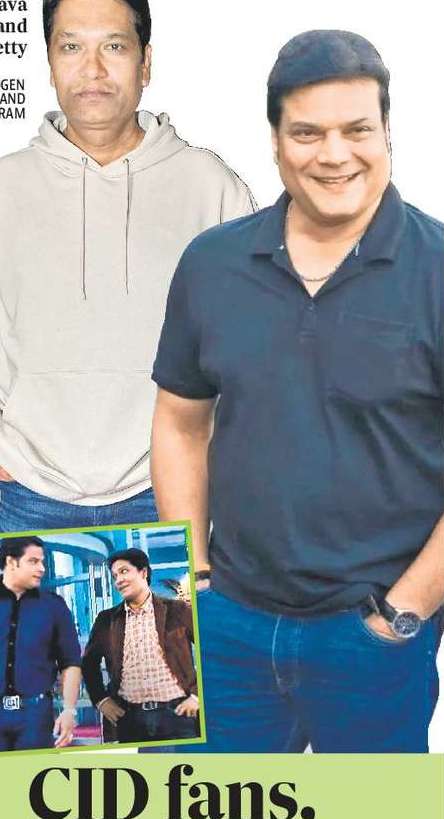
Rishabh Suri (HINDUSTAN TIMES; April 25, 2024)
CID, the iconic crime show featuring iconic characters, has kept fans glued to their screens for nearly three decades before it went off air. Now we have learnt that actors Aditya Shrivastava and Dayanand Shetty, who played Abhijeet and Daya, respectively, are coming back! However, there’s a twist! The dynamic duo won’t be reprising their characters; Shetty confirms, “Yes, we’re making a comeback, but not as Abhijeet and Daya.”
So, how exactly are they coming back? Well, this time it will not be about solving crime — it will be all about satisfying wanderlust and taste buds!
Shrivastava spills the beans, saying, “Daya and I have been partners in crime-solving for 20 years, and our bond is unbreakable. Our old CID crew came up with this brilliant idea of a travel show, and we are gearing up to launch it on YouTube in May. Get ready for a rollercoaster ride filled with travel tales and foodie fun. We’ve already explored Satara, Maharashtra, and now we’re spicing things up in Goa!”
The overwhelming demand from fans to see the CID dream team back in action pushed them to embark on this new adventure, admit both actors. But wait, there’s more! Shrivastava and Shetty will be seen in a film too. “We have completed a film. We have gotten a lot of love from the audiences till now; hopefully it will continue,” he concludes.
Maharashtra land for free for storytellers; Filmmakers rejoice
8:12 AM

Industry welcomes the state government’s announcement to allow shoots on government land free of cost
Vinay MR Mishra (BOMBAY TIMES; March 29, 2024)
Last week, the state government, in a government resolution (GR), announced that films, documentaries and advertisements can be shot on government land free of cost. The decision, which has been applauded by filmmakers, was made to send a positive message that the state is conducive to film production.
Reacting to this news, filmmaker Siddharth Roy Kapur said, “This not only fosters creativity but also underscores the state’s commitment to supporting the entertainment industry. Simplifying the process through a single-window clearance system further enhances efficiency, making Maharashtra an even more attractive destination for filmmakers.”
‘We hope booking these venues for filming will become a quick process’
The GR mentions that producers will have to go through a single-window clearance system. They will be charged Rs. 40,000 for advertisements, Rs. 1 lakh for TV serials and Rs. 2.5 lakh for films.
Shibasish Sarkar, President, Producers Guild of India, says that with this move, hopefully, the process will now be more efficient. “It’s a welcome move and we hope that booking these venues for filming will become a quick and efficient process under the single-window permission mechanism. Also, with a fixed security deposit, it helps us to get a go ahead to shoot on their live locations without paying multiple other costs and without confining us to shoot on limited sets.”
Simplifying what the process will now entail, producer J D Majethia explains, “All permissions like fire, road, BMC or anything required for the shoot, will be given to the producer through one window. Producers will not have to go to four different authorities for the same. They will apply at one window, and the government-appointed person will grant permission for it.”
‘Audience will get to see more of Mumbai’s heritage sites’
Talking about the tangible impact of the GR, Cine & TV artistes association (CINTAA) secretary Amit Behl shares, “We will be able to see more heritage sites and monuments, airports and railways which are owned by the government. The audience has missed seeing this and now they can have access to it.”
‘It can be the beginning of a new era for Marathi cinema’
This will possibly also be a game-changer for the Marathi film industry as well. “It is a monumental boost for the Marathi film industry. With our budgets often tighter than Bollywood or South Indian cinema, this support allows us to allocate funds more strategically, enhancing crucial aspects of our productions. Moreover, it empowers us to plan locations meticulously, enriching storytelling possibilities. This initiative can be the beginning of a new era for Marathi cinema, fostering creativity and resourcefulness while amplifying our cultural impact,” says Akshay Bardapurkar who is known for films like Chandramukhi, Tamasha Live, AB Ani CD.
‘It will boost tourism in Maharashtra’
Actor-producer Adinath Kothare, whose production house helms several popular TV shows, adds, “There are budget constraints with Marathi shows and films. Thus, live locations become a luxury. This will encourage filmmakers to shoot in prime areas. It will boost tourism in Maharashtra. Most shows will exploit popular parts of Maharashtra that will help them generate revenue.”
Producers’ bodies rejoice as Maharashtra government announces free shooting in state from April 1
9:00 AM
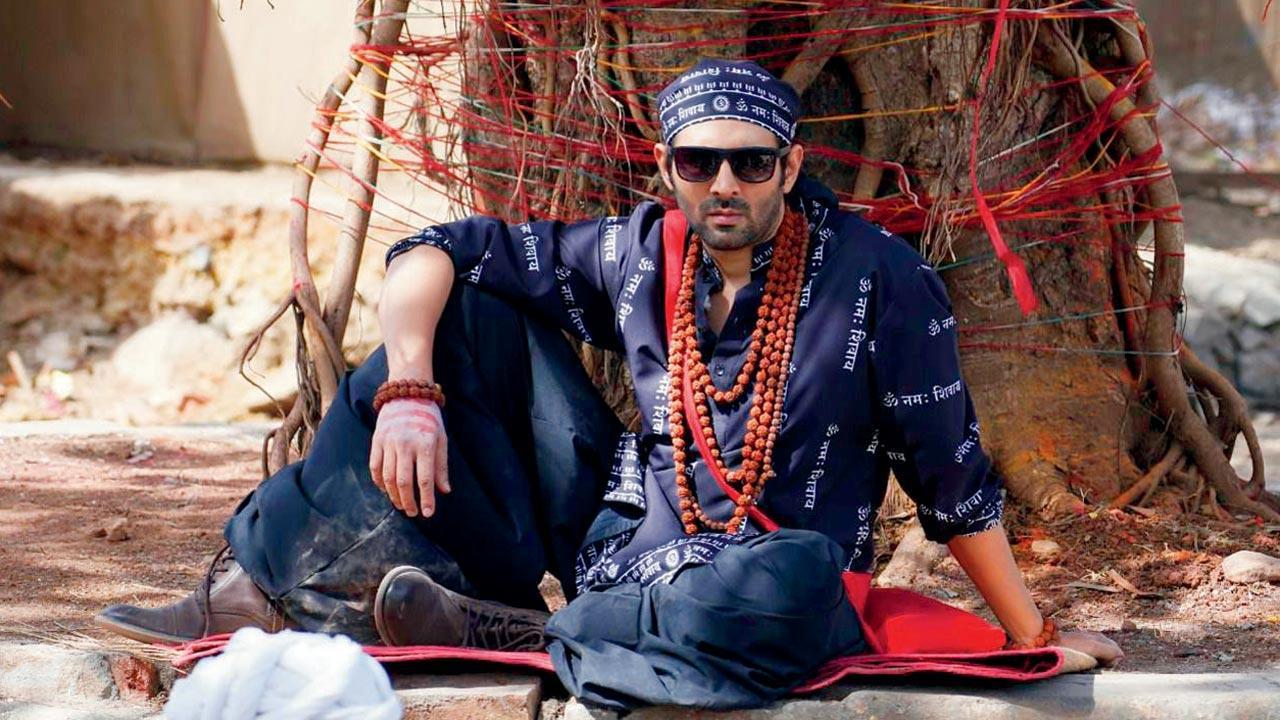
Bhool Bhulaiyaa 3 is among the many films being shot in Maharashtra
Producers’ bodies rejoice as Maha govt announces free shooting in state from April 1, making it attractive filming destination
Upala KBR (MID-DAY; March 28, 2024)
On March 16, the Maharashtra government announced that shooting of films, documentaries, web series and advertisements will be allowed free of cost on government land in the state from April 1. The decision signals that the state is conducive to film production, making it an attractive and budget-friendly location.
Abhay Sinha, president, Indian Motion Picture Producers’ Association (IMPPA), says, “IMPPA was trying to convince the Maharashtra government to do something as producers were running to Uttar Pradesh, which offers huge subsidies. This move will help producers reduce their budgets, and will support the film industry’s growth in the state.”
While shooting will be free of charge, a nominal security deposit of Rs 40,000 for commercials, Rs 1 lakh for TV shows, and Rs 2.5 lakh for films and series will be required. Producers will be able to go through a single-window clearance to shoot anywhere in the state. The new scheme, however, doesn’t cover projects being shot in Film City, Goregaon, and the Film City in Kolhapur.
Sinha adds, “This will be applicable not only for Hindi and Marathi films, but for regional language movies as well.”
Trade analyst Atul Mohan is glad that the state government has kicked off the initiative. He says, “Uttar Pradesh, Madhya Pradesh, and Jammu & Kashmir have been offering incentives to producers. I guess it’s better late than never.”
You need to make time for romance in your life after you become a parent-Kalki Koechlin
8:18 AM

Onkar Kulkarni (BOMBAY TIMES; March 19, 2024)
Recently, Kalki Koechlin went diving in the coastal regions of Maharashtra. Leaving behind fancy locales that many actors pick for their getaways, the actress chose a local experience in Sindhudurg that’s close to her heart and home. Kalki currently lives in Goa, but keeps coming back to Mumbai for work. The trip was a sweet surprise planned by her friends, marking her 40th birthday.
She shares, “My friends know that I love diving, but ever since I became a mother, I haven’t had time to do that. My partner (Guy Hershberg) and I were told to leave at 6 am and reach the destination, where I saw a bullock cart waiting for us with diving gear and that’s when the surprise unfolded.”
‘I feel that once you become parents, you don’t really get much time off’
The actress had parked herself for two days at a farm stay in Parule, Sindhudurg. The getaway was also a romantic trip for the couple as it was minus their four-year-old daughter Sappho. “It was a child-free holiday. My partner and I were happy to have experienced that. I feel that once you become a parent, you don’t get much time off. For the first time, neither of us was there with Sappho overnight. Our friend was babysitting her. This holiday was a good reminder for us that you need to make time for your partner and romance in your life even after you become a parent,” says Kalki.
‘It is good to know what’s happening locally’
A big fan of scuba diving, Kalki has been to Thailand many times for her dives, but it was the first time she explored the sport in Maharashtra. She shares, “It is good to know what’s happening around you, locally. I was surprised when I discovered that diving takes place in Maharashtra. It looked like an untouched territory. There are these stunning little islands that we went to by boat. There are a lot of corals around those uninhabited islands. It is clean and the visibility underwater is very good.”
‘It was nice to be cut off and just be surrounded by the sky and the sea’
The actress loved the rustic experience of a farm stay. “The sight of eight women grating coconut in the kitchen is something you don’t get to see. No luxurious hotel can match up to that type and quality of food. It was nice to be cut off and be in a space where I was surrounded by the sky and the sea. The food was also delicious.”
Single screen theatres claim that Marathi films are a burden
2:39 PM

Ordered to present 44 shows a yr in city & 112 in rest of state or pay Rs. 10 lakh fine, owners complain about thin audiences & high overheads; industry bodies suggest adoption of revenue-sharing models
Bella Jaisinghani (MUMBAI MIRROR; February 25, 2024)
The owner of a large single screen cinema hall with 700 seats in Central Mumbai watches in trepidation as barely 10-15 people arrive to watch a Marathi film at a weekday show. As the projection rolls, his heart sinks to think of the air-conditioning costs, staff salaries, taxes and overheads that must be paid in crores when his annual income is not even Rs 5 lakh.
Single-screen cinema halls in the state are complaining that multiple govt restrictions have made survival near impossible. One millstone around the neck is that all theatres must screen 44 shows of Marathi movies per year within Mumbai limits, and 112 shows in the rest of the state. Should they fail, their annual licence is not renewed.
In 2023, Maharashtra govt announced it would levy a fine of Rs 10 lakh on halls that fail to fulfil this condition. Theatre owners say most single screens have already shut, this is another nail in the coffin. Marathi films have heart and soul, but few big stars, foreign locales or pre-release publicity to attract spectators.
Viraf Vatcha, secretary of Cinema Owners and Exhibitors Association, India (COEAI), a union of single screen theatre owners, said, "The initial GR (government resolution) to screen Marathi pictures was issued in 1968--but that was a mere recommendation. Subsequently, the state govt began to put pressure on theatres after many more Marathi movies began to be produced." Soon it became a compulsory rule.
In 2009, COEAI filed a petition in Bombay High Court, citing the lack of audience for Marathi movies, difficulty in procuring Marathi films, and questioning why govt was forcing them to popularize Marathi cinema if it could not make the audience watch regional movies.
On the other hand, perceiving a lack of screening opportunities for Marathi cinema, the nodal filmmakers' body Akhil Bharatiya Marathi Chitrapat Mahamandal approached state govt authorities as well as HC to urge theatres to reserve shows for Marathi films.
Vatcha said, "We informed the govt and HC that there is no audience for Marathi films in certain locations. So restricting our licences on this basis and not renewing them is unfair."
South Mumbai single screens such as Sterling, Eros, Excelsior, Regal and theatres in Kurla draw scarcely any viewers for Marathi movies. Vatcha's family-run New Shirin Talkies at Jacob Circle was an 800 seater but barely had any audience for Marathi shows.
“How does one pay property tax, bear the cost of air-conditioning, projection, staff salaries, taxes and overheads if we run to empty theatres? We are not allowed to do any other business on the premises either. So we closed down,” he said.
In 2010, high court passed an interim order saying the petitioner (single screen owners) cannot be burdened to show Marathi pictures and consequently forced to incur losses. "The court twice instructed the state's home ministry, which oversees our industry, to bring all stakeholders together and find an amicable solution," said Vatcha.
The home department formed a committee by selecting five members from the Chitrapat Mahamandal and five from COEAI which submitted its report in 2014. Ten years and 15-20 reminders later, the state govt continues to turn a deaf ear to all exhibitors' woes, they said.
There is another side to the coin. Squeezed for space amid the mammoth Hindi industry, low-budget Marathi cinema is struggling to find suitable options to reach audiences.
Director Ananth Narayan Mahadevan's new Marathi film ‘Aata Vel Zaali’ released on Feb 23. He said, “I am happy you are taking up the issue of Marathi films finding space in theatres. At this very moment, my producer is sitting with an exhibitor trying to negotiate at least a few prime show timings for our film. Unfortunately Maharashtra is the only state where regional cinema is overshadowed by Hindi movies. Marathi films tend to suffer neglect and receive an unfair deal, therefore this uprising (by filmmakers). In other regions you see that Tamil, Telugu, Malayalam and Bengali films are given pride of place. Here for some reason, our distributors are overwhelmed by the power and prestige of Hindi films. As a result, Marathi cinema has suffered greatly. Despite the Maharashtra govt order to screen Marathi films, we filmmakers are still at loggerheads with theatres seeking a few prime shows. My movie is based on the subject of euthanasia and talks to senior citizens. They may miss it if we screen just one show, that too at 9 am.”
Mahadevan approached a leading cinema in the Maharashtrian heartland of Dadar to screen his film. "But they sought a rent amount of Rs 1 lakh which we cannot afford. Why not devise a revenue sharing model like multiplexes do? Single screen halls are shooting themselves in the foot and not giving good Marathi cinema a chance to breathe either," the director said.
Meghraj Rajebhosle, president of the Akhil Bharatiya Marathi Chitrapat Mahamandal, understands the plight of single screen owners even though he is on the opposite side of the fence. He said, "Single screens are large theatres with 800-1,000 capacity that are unable to fill seats for Marathi movies. So I think the govt should utilize its own vast properties to build small theatres of 100-200 seat capacity and promote regional cinema in partnership with private entities on a percentage sharing basis. That way exhibitors and producers will both earn revenue. We are willing to cooperate in this effort."
While the Marathi screening rule applies to large corporate-run multiplexes too, it is single screens that feel suffocated. Their revenues and expenses are a world apart.
Prakash Chaphalkar is president of the Multiplex Association of India, but was himself forced to close six of his single screen theatres in Ratnagiri and Sangli. "Multiplexes and single screens are on entirely different planes. While multiplexes can apportion one small hall out of four or five to show a Marathi movie, single screens have to allot the only hall they have. Approximately 100 Marathi pictures are released each year but not even 5% are a success. They are like vegetables which become rotten if not consumed in time."
Chaphalkar says screening regional movies is a political issue. "Also remember the Maharashtra govt gave tax incentives to multiplexes in 2002 and told them they would have to show Marathi movies in return. But single screens receive no incentive. They are dependent on ticket revenue for every little expense. And distributors are unwilling to give them Marathi films if the locality does not have a sizable population of Maharashtrians. It is multiplexes that consume the entire content of the city," said Chaphalkar.
You tell people of Tamil Nadu that Hindi is the language of Hindus, see what happens then-Javed Akhtar
8:43 AM

Niharika Lal (BOMBAY TIMES; January 14, 2024)
Speaking at a session titled ‘Hindi and Urdu: Siamese Twins’ in Delhi, Javed Akhtar discussed the origins, forms and usage of languages. Pointing out that since most young actors can only read English, Akhtar said that all dialogues are now written in the Roman script (English) for them. “Now we write Hindi dialogues in English for most new actors.” The writer and lyricist also shared that he learnt Punjabi in Maharashtra.
“Main film industry mein gaya ’60s mein. Ab wahan mera director Punjabi, cameraman Punjabi, assistant director Punjabi, actors Punjabi – main Punjabi Maharashtra mein seekha hoon!”
You can’t find any Urdu phrase without Hindi terms: Akhtar
Discussing the intertwined nature of Urdu and Hindi, Akhtar said, “I challenge you to think of an Urdu phrase without using any Hindi terms. You won’t be able to find any such phrase because it’s impossible. You can’t speak any Urdu phrase without using Hindi terms. The syntax is the same, 90 per cent vocabulary is the same. Why can’t some of us scholars, writers and researchers put together a common dictionary in the forgotten language which we call Hindustani? A dictionary with some of the excellent words of both languages – Hindi and Urdu – in one place. Imagine how rich our vocabulary will be!”
He added that he doesn’t write for language speakers but for his audience, who are Indians. He stated, “I’m writing Hindustani for Hindustanis. I’m not writing for Urduwallahs and Hindiwallahs. I’m writing for Hindustanis.”
Akhtar added, “It’s been about 200 years since the separation of Hindi and Urdu was accepted by the authorities. But they were always one. Do the Arabs in the Middle East speak Urdu? Urdu is the language of only the Indian subcontinent. This has nothing to do with religion. You go and tell people of Tamil Nadu that Hindi is the language of Hindus, see what happens then.”
‘I told Amitabh Bachchan that no one can describe mood like Firaaq’
The film industry veteran spoke at length about Mirza Ghalib, Mir Taqi Mir, and Firaaq Gorakhpuri. Recalling an instance when Amitabh Bachchan had asked him, “Aap Firaaq ko itna kyu maante hain?” Akhtar said he explained the expressions of Firaaq’s sher to Bachchan saying that there’s no other writer who can describe moods like Firaaq.
In those days, I was continuously working. I didn’t even know how people were crazy about me-Hema Malini
8:20 AM

Rishabh Suri (HINDUSTAN TIMES; March 21, 2023)
She debuted in 1968 with Sapnon Ka Saudagar and soon became the Dream Girl (1977). 55 years later, actor Hema Malini’s charm and grace are just the same.
When we ask her about spending more than five decades in the industry, she replies, “I keep wondering yeh samay kahaan nikal gaya! You look back on these 55 years, it is so nice and beautiful. But you have to keep moving ahead. I am busy with my constituency. However, if any good offer comes for acting, I would definitely love to work.”
When the actor stepped into the industry, all actors would work in multiple shifts in a single day. But, things have completely changed since then and social media as well as other mediums of entertainment have become all pervasive now. “In those days, I was continuously working. I didn’t even know how important I was, how people were crazy about me. It was just about ‘arre yeh film ki shooting yahaan hai, jaana hai’... I couldn’t enjoy my stardom. I was engrossed in work. After I got married, career slowed down a bit, and after having a child, it slowed down further. Now, when I finally look back, I feel nice. I feel proud that I worked so much. Jeene ka ek maqsad hota hai, duniya mein aaye ho toh kuchh kaam kiya,” she adds.
And the work continues. She brought her ballet Ganga to Mumbai for the first time recently. “Before Covid, we had done five shows. It is weird that I had performed at other places but never in Mumbai! The Maharashtra government has taken it up for their 75 river-cleaning project. They felt it would fit perfectly,” she beams.
Ask her if we would see her on OTT soon and she answers, “After working on the big screen all my life, it will feel a bit funny. Chhoti screen pe dikhega, maza nahin aayega. I don’t know how the public will take it.”
Aap aage badho hum aapke saath hain, says Maha Cultural Affairs Minister Sudhir Mungantiwar to Bollywood
8:47 AM

At the recently held 67th Wolf777news Filmfare Awards, Deputy Chief Minister Devendra Fadnavis and Sudhir Mungantiwar, Minister of Cultural Affairs, Government of Maharashtra, stressed on how the government is creating policies that will bring ease in doing business to support the film industry
Rachana Dubey (BOMBAY TIMES; August 4, 2022)
The 67th Wolf777news Filmfare Awards recently concluded in Mumbai amidst great pomp and show. The evening that celebrated the finest filmmakers, artistes and technicians in Hindi cinema also spotlighted the greatness of the state of Maharashtra, which partnered with the event as a part of the Azadi Ka Amrit Mahotsav initiative. The evening began with Deputy Chief Minister Devendra Fadnavis and Sudhir Mungantiwar, Minister of Cultural Affairs, Government of Maharashtra, lighting the ceremonial lamp. It was followed by an ode to the cultural heritage of the state and a speech by Sudhir Mungantiwar that highlighted the strong connection between the Hindi film industry and the state.
“Yeh baat sahi hai ki jis bhoomi pe hum hain, iss bhoomi se hi 1913 mein pehli shuruat Dadasaheb Phalke ne ki Raja Harishchandra banake… Jab main Marathi bhasha ki film ki baat karta hoon, toh uski pehli film, Ayodhyecha Raja, 1932 mein V Shantaram ji ke nirdeshan mein bani,” said Mungantiwar.
Talking about how Bollywood is the pride of the state of Maharashtra, he added, “The film industry will always have our support. It’s an industry that brings this state its aan, baan aur shaan. Aaj hamare upmukhyamantri Devendra ji aur hum yahan yeh batane ke liye upasthit hai ki aap aage badho hum aapke saath hain. We are working towards creating policies that encourage the film business to thrive in the state and encourage filmmakers to shoot here.”
“We are rich in geographical beauty. Yahan aisi sundar-sundar jagahein hai ki Switzerland jaane ki aavashaykta nahi hai. Bharat ka Tiger Capital Vidarbha mein hai, jungle hamare paas hai, nadiya hai, bahut paani hai, we have a lot of biodiversity, too. The state is rich in cultural and historical heritage. The film industry doesn’t just entertain all of us, it makes us think and reflect. It influences us in so many ways. When I arrived here, I was thinking of the first love letter I wrote to my wife, which had a Hindi film song in it. And when she had welcomed me into her maiden home, she, too, was inspired by a Hindi film song to convey her emotions. This industry has a role to play in everyone’s life. The Filmfare Awards are not just an acknowledgement of the work that the industry puts in, it’s also a form of encouragement to the industry that relieves everyone’s stress,” said Mungantiwar.
Sending his wishes out to the whole industry and hoping that it grows from strength to strength, he added, “Main bhagwaan Siddhivinayak ke charno mein prarthana karta hoon ki jo desh ki chitranagri Mumbai mein hai, yeh bahut fale-fule itni aage badhe ki jitna GST film industry ne pichle paanch saal mein nahi bhara uska dus guna woh agle saal mein de sake, itna vyavasay usko mile.”
In his address, Deputy Chief Minister of Maharashtra Devendra Fadnavis said, “Mumbai is the entertainment and economic capital of India. We are very proud of our film industry. Main aisa maanta hoon ki jo hamara Bollywood hai usne duniya mein apni ek pehchaan banayi hai. Regional film industries are also making a name for themselves. Hamari Marathi film industry toh pehle se hi ek apni alag pehchaan rakhti thi. Lekin aaj jis prakar se dakshin ki filmon ne hamare desh mein hungama machaya aur duniya mein ek naya chitra tayar kiya hai, mujhe aisa lagta hai ki ek bahut hi naye daur se aaj hamari film industry guzar rahi hai. This industry doesn’t merely entertain, it creates employment and gives wings to dreams. We are working on creating policies that bring ease in doing business here. We hope to facilitate whatever the industry requires in various areas for its smooth functioning. The new government in Maharashtra is for everyone and for the film industry, too.”
Bollywood gets into caution mode as Coronavirus cases rise
8:17 AM

Sugandha Rawal (HINDUSTAN TIMES; June 15, 2022)
The surge in Coronavirus cases in the country, especially in Maharashtra, has turned out to be a big worry for the film industry. Even though actors such as Shah Rukh Khan and Kartik Aaryan have recovered from the virus, the alarm bells have not stopped ringing. “Just like in other parts of the country and industry, the sentiment is the same — caution, caution and more caution. That is the only way forward, and we need to be really careful about the same,” says producer Boney Kapoor.
For the past few days, Maharashtra has been seeing a constant surge in cases, with the state’s environment and tourism minister, Aaditya Thackeray, saying that the state could be seeing the fourth wave of the virus crisis. And industry insiders reveal that makers have started to take extra precautionary measures for shoots.
“Right now, it is more of a wait and watch situation. We have seen some great successes on the big screen in recent times, and the industry wants to keep up the momentum. That’s why everyone has become extra careful and is leaning on past lessons from the previous waves of situations to avoid a breakout on set,” producer and trade expert Girish Johar tells us.
Birendra Nath Tiwari, president of the Federation of Western India Cine Employees (FWICE), reveals that the junior artists have been told to mask up on set, and plans to administer booster doses are set in motion: “It is important for them to be extra cautious because they will be the first ones to be told to go off set if cases continue to rise.”
That’s not the only concern. “Everyone is scared and wondering if theatres will be closed once again, or if capacity will be back at 50%,” shares trade expert Atul Mohan, adding, “If theatres’ woes are back in Maharashtra, it will have a ripple effect in the whole country.”
Filmmaker Madhur Bhandarkar, on the other hand, stresses that it is important to hold on to the positives and wait for things to unfold instead of fretting about them: “Let’s see how it unfolds in the coming month.”

Maharashtra govt lifts all COVID restrictions, but masks, rapid antigen tests, staggered breaks to continue on sets
8:40 AM

As Maharashtra govt lifts all COVID restrictions, studios tread with caution; masks, rapid antigen tests, staggered breaks to continue on sets
Mohar Basu, Uma Ramasubramanian (MID-DAY; April 2, 2022)
On Thursday, the Maharashtra government announced that all pandemic-related restrictions, including the mandatory wearing of masks, were being lifted from April 2 that marks Gudi Padwa. This comes after over two years of stringent adherence with safety norms as the world underwent several waves of the pandemic. However, with Shanghai witnessing its largest virus outbreak since March 2020, the need to have our guard up cannot be emphasized enough — a school of thought that most Bollywood productions are aligning with. Despite the lifting of curbs, many movie sets are retaining the Coronavirus protocols that were put in place after the second lockdown.
The team of Kiran Rao’s upcoming comedy-drama, backed by Aamir Khan, recently completed a 10-day schedule in Madh Island. Sources from the team inform that no-mask-no-entry will be a non-negotiable rule going forward as well.
A unit hand reveals, “Working with masks has become a norm, and we have been told that masking up will be necessary while on the set. Temperature monitoring too will continue to ensure everyone’s safety.”
The team at the production house is apparently contemplating whether they should do away with rapid antigen testing in light of the dwindling cases in the city.
Streaming giants, including Netflix, Amazon Prime Video and Disney+ Hotstar, have taken a tough stand on that front. Rapid antigen testing will be compulsory on the sets of their productions. A prime example is a Netflix non-fiction show that is currently being filmed in north India.
Most Bollywood productions had done away with bio-bubble shoots since late last year. Studios, however, remain steadfast in their efforts to minimise the risk of exposure. The team of Tiger Shroff and Kriti Sanon’s Ganapath, for instance, has prohibited the use of public transport.
A source from the unit reveals, “The unit’s safety is the producer’s top priority. As the team of 80 will shoot in and around Mumbai over the next few weeks, the makers are ensuring that everyone has access to production vehicles.”
Measures such as hair and make-up teams using gloves, and staggered lunch breaks to avoid crowding will remain firmly in place, as seen on the Mira Road set of Siddhant Chaturvedi’s Yudhra. Most producers are also retaining COVID insurances in case of hospitalisation, depending on each case and severity.
Salman Khan lends support to underprivileged kids’ education; supplies school necessities in 3 districts
8:13 AM

Upala KBR (MID-DAY; March 17, 2022)
From providing financial assistance to the Hindi film industry’s 25,000 daily-wage workers, to giving ration kits to the underprivileged — Salman Khan helped many during the two lockdowns. Now, the actor has turned his attention to the educational needs of underprivileged children in rural areas. He has begun the initiative in the interiors of Palghar, Aurangabad and Parbhani districts as his not-for-profit organisation, Being Human, has an established network in the region.
Rahul N Kanal, Yuva Sena leader, who is coordinating the endeavour with the actor, reveals that the organisation has sent stationery, sanitisers and masks for students. “We have reached out to many schools in rural and tribal areas of those districts. Our on-ground volunteers check with the schools about their requirements, which are then supplied by Salman’s NGO. Salman bhai’s family has been involved,” he says.
After the pandemic, the superstar has apparently decided to put more emphasis on education and children’s health. Kanal adds, “These are the two aspects that he is closely working on. Now that the [educational aid] is underway, he intends to focus on nourishment. He has also asked me about the possibility of distributing protein bars to school kids.”
Exhibitors and trade cheer as theatres in Mumbai are now allowed to operate at 100% capacity
7:29 PM
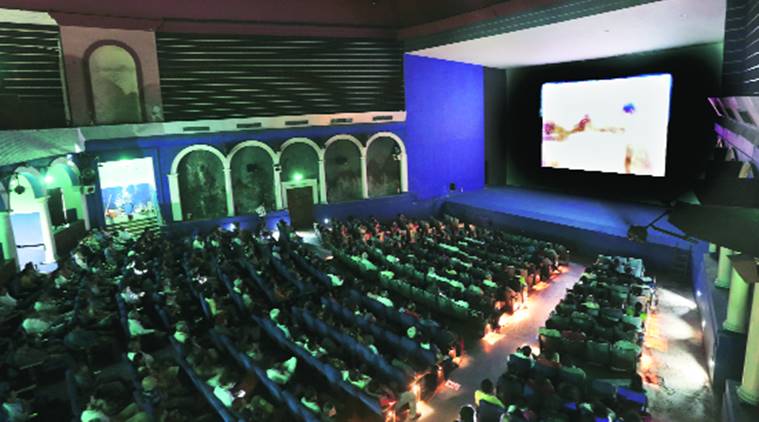
With COVID-19 restrictions eased by the Maharashtra government, theatres in Mumbai are now allowed to operate at 100 per cent capacity
Rachana Dubey (BOMBAY TIMES; March 4, 2022)
On Wednesday, the film industry heaved a sigh of relief as the Maharashtra government eased Coronavirus restrictions in 14 districts, including Mumbai, allowing theatres to operate at 100 per cent capacity.
Cinema halls first shut shop in March 2020 when COVID-19 cases began to surge, which impacted several summer releases. Films like Gulabo Sitabo and Shakuntala Devi were among the first films to find their way to OTT platforms.
After the first lockdown, cinemas opened their doors for a short while, but the second wave saw them pulling the shutters down again. In October 2021, theatres in Maharashtra were allowed to operate at 50 per cent capacity. Around Diwali last year, theatres in most parts of the country were operational.
Rohit Shetty’s Sooryavanshi starring Akshay Kumar, became the first big-budget film to release after theatres reopened in Maharashtra post the second lockdown. Kabir Khan’s '83 was released on December 24,2021. However, though the film opened to raved reviews, it didn’t see a long run at the theatres owing to the surge in Omicron cases.
Following that, the release of Shahid Kapoor-starrer Jersey, which was set to hit the screen on December 31, 2021, was postponed. Now, with most businesses back on track, it was only a matter of time before theatres went back to running at full capacity.
Kamal Gianchandani of PVR Cinemas and the head of the Multiplex Association of India says, “This is a positive move and it has been timed very well. There is a long line-up of interesting films that will benefit in a big way, and as a chain reaction, it will also give a lot of impetus to the business. Gangubai Kathiawadi is doing well and this move will escalate its business and help a film like Jhund as well as the subsequent releases, too.”
Manoj Desai of G-7 cinemas and Maratha Mandir adds, “I am very happy that we can house more people for every screening. Hopefully, this move will send out a message to the audience that they can come back to theatres. It will also encourage more filmmakers to consider theatrical releases. We have high hopes from films like Radhe Shyam and Bachchhan Paandey. I am eager to put the ‘House Full’ board outside the screens once again.”
Rakesh Sippy of Raksha Entertainment, which distributes Hindi films, believes that the audience has been ready for this move for some time now. “If you look at the next few weeks, every Friday, there is a big release lined up, all the way up to May. And with time, more filmmakers will be happy to bring their movies to theatres first. Maharashtra and the Mumbai circuit contributes to a film’s collection in a big way. This move will bring more hope to the entire exhibition chain,” he says.
Independent exhibitor Akshaye Rathi says, “The vaccination drives have played a big role in eliminating fear from people’s minds. The fact that Gangubai Kathiawadi’s tickets were unavailable at one point in the week only underlines how eagerly people wanted to come back. Good content that has waited for months to release is being lapped up. It’s a sign that the business of cinema will only move upward and onward from here. Of course, we all need to be cautious and act responsibly at all times to ensure this run is never disrupted again.”
Maharashtra allows 100% in eateries, offices, malls and theatres
8:13 AM
2 Doses Must To Enter Crowded Public Places
Priyanka Kakodkar (THE TIMES OF INDIA; March 3, 2022)
Mumbai : With the easing of the Omicron wave, the state government on Wednesday significantly rolled back curbs in 14 districts with high vaccination rates like Mumbai, Pune and Nagpur, allowing 100% capacity in shopping complexes, restaurants, theatres, gyms and religious places from Friday. However, it has insisted on double vaccination for those entering crowded public spaces, including restaurants and sporting events, and using public transport despite the Bombay High Court pushing the state to drop the rule for Mumbai’s local trains, reports Priyanka Kakodkar.
Attendance for social, political, sports and religious events has been allowed up to 50% of venue capacity. The government has also allowed government and private offices to function with full capacity across the state.
----------------------------------------
Mumbai : The state government has allowed 14 municipalities and districts with high vaccination and low positivity and oxygen bed occupancy, greater freedom. These come under what the government has called ‘List A’, and areas in this list have also been allowed 100% capacity in cinema halls, spas, swimming pools, auditoriums, tourist spots and entertainment parks. In other districts, only 50% capacity is allowed.
“While we welcome the move to open restaurants fully, we fail to understand why not open up for the whole of Maharashtra instead of only 14 districts. This will also help the industry to bounce back in a much faster way,” said Shivanand Shetty, president of the Indian Hotel and Restaurant Association.
Attendance for marriages, funerals and other social, academic, political, sports and religious events has been allowed up to 50% venue capacity in ‘List A’ districts. Where there are gatherings of more than 1,000 people, the district disaster management authority can impose restrictions. Other districts can have gatherings of up to 50% of the venue.
Offline classes have been allowed at all academic institutions, including pre-schools and Anganwadis. But these institutions are encouraged to leverage the hybrid model. Industrial and scientific institutions can also function at full capacity. Indeed, the new rules say any activity – even those not mentioned in the guidelines – can operate at 100% capacity in ‘List A’ districts and 50% in remaining areas.
There are no curbs on inter-state or intra-state travel for those who are fully vaccinated. Others will need a negative RT-PCR test within 72 hours. However, the state has insisted on full vaccination for those entering crowded public spaces, including public transport, restaurants, malls, theatres, auditoriums, sporting events, tourist spots and religious places. It has also insisted on total vaccination for staff in industrial activity or offices interacting with the public and those engaged in home delivery. The district disaster management authority can enforce full vaccination on any public service activity where there is the possibility of interaction with citizens.
How Rajshri Deshpande is helping single-handedly build schools in Maharashtra’s Aurangabad tehsil
10:17 PM
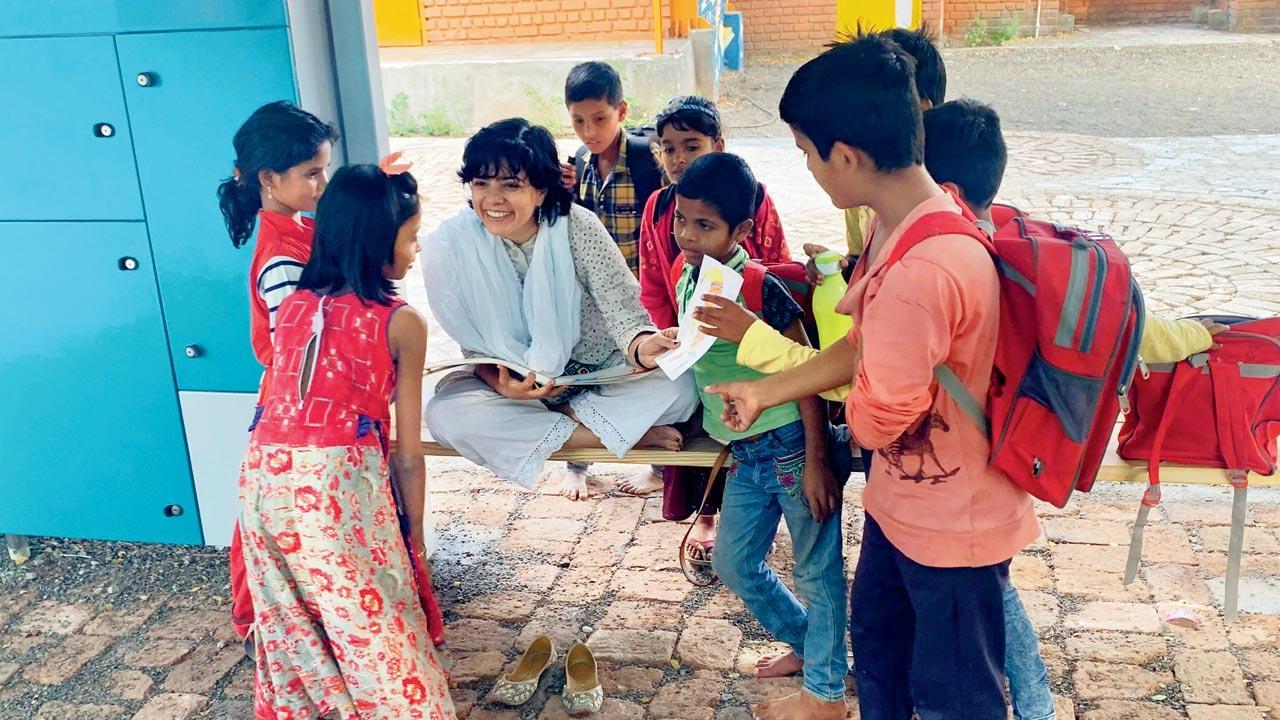
Rajshri Deshpande with students at the recently constructed Zilla Parishad Primary School in Pandhari
A theatre and film actress’ phenomenal work in helping single-handedly build schools in Maharashtra’s Aurangabad tehsil is a story of perseverance rare in the glamour world
Jane Borges (MID-DAY; February 6, 2022)
In 2018, when Sacred Games made its startling debut on Netflix, actress Rajshri Deshpande, who was cast as Subhadra, wife of the antagonist Ganesh Gaitonde (Nawazuddin Siddiqui), was working overtime in Pandhari village in the Aurangabad tehsil. She remembers having to skip being part of the crime web-series’ media promotions, and even holding back on several new film offers that followed its success, because she had made a promise to the villagers. Deshpande, at the time, was in the midst of rebuilding the Zilla Parishad Primary School in Pandhari, home to around 75 children. The dilapidated building meant that the kids were studying in the open grounds or under a tree.
Having worked in the village through her NGO Nabhangan Foundation for nearly five years, the actor had felt an almost desperate need to provide a pucca structure to the children. “I had appealed to the local authorities, but they didn’t seem to have the budget for it,” she says. On an impulse, Deshpande remembers telling them that she would take up the cause. “I wasn’t an educator or architect. I didn’t even know what it takes to build a school,” she tells us. And yet, two years later, Deshpande had managed to raise Rs 60 lakh and gift a new school to the kids of Pandhari. Today, the Zilla Parishad school is home to nearly 125 kids.
Next up, she hopes to rebuild another school in the tribal village of Dhorkin, in the Paithan tehsil of Aurangabad district, not too far away from this one. The actor is looking to collaborate with private firms and individuals to raise Rs 30 lakh before the new academic year begins.
This is the third project that Deshpande has taken up. She previously repaired the toilets at a government school in Ambi village in Pune district. “Ever since the kids of Pandhari got a new school, a lot of teachers from the nearby villages have been reaching out to me, requesting that I help them too,” says Deshpande. Most are in a state of ruin and disrepair. The classrooms are crammed and poorly ventilated, the walls collapsing, and the toilets broken.
“It’s sad that children are being denied something as basic as education in a safe structure,” says Deshpande, admitting that she hasn’t been able to pursue all the requests, primarily due to lack of funding and support from villagers. “This particular teacher from Dhorkin had reached out to me even before the pandemic. She had shared pictures of the school. At some point, I decided to visit the village, and meet the locals, who were more than happy to be part of my effort.”
Deshpande believes that for any new project to succeed, all the stakeholders need to be on the same page. “I don’t begin any work, until I don’t have the support of the local residents,” she says. “The ultimate goal is to ensure that a village is self-sufficient, but for that we need to focus on holistic development. My work cannot end at building a school structure or taking care of the village’s water needs. We also have to ensure that they have enough opportunities to earn a living. Till the time, economic stability is missing in homes, the kids won’t have a happy environment in the house, and won’t be able to focus on education. It’s all connected.”
The actor is also hoping that these schools don’t just become centres of learning, but help hone creative talent too. Late last year, Deshpande opened a library at the ZP school in Pandhari named after veteran theatre stalwart Satyadev Dubey. The library comprises nearly 1,500 books on a range of subjects, including the arts, music, science, and environment.
“The kids will be trained to read, so that they develop an appreciation for books. There’s also a theatre group that will visit the school from Aurangabad regularly, and perform plays here. From next year onwards, I am looking to hire someone from the field of sports or martial arts to coach the students.” Since Dhorkin is in the same district as Pandhari, Deshpande says she will be extending the facilities to the new tribal school as well.
She rues about the state of affairs in several of Maharashtra’s villages, describing the apathy as tragic. “It’s sad that even two years into the pandemic, we still have to distribute ration among villagers. Change can’t be implemented on paper alone.”
Deshpande can’t wrap her head around why the Centre and state governments have fallen short, despite so many schemes being announced during the annual budgets, and the existence of the Right to Education Act 2009, which lays down norms and standards for how schools should function. “I wish I knew [the reason for this]. It would have solved the mystery for me,” she says.
She, however, believes that small efforts by individuals will go a long way. Dipali Choure, a teacher from the ZP school in Pandhari says that only this week Desphande had sent across badminton kits and skipping ropes for the kids. “They now enjoy coming here; attendance has increased and most of them prefer to spend time after school hours too. Earlier, they would struggle to concentrate in class, especially in the peak of the summer season. The new school has been built in such a way that it’s cool and airy throughout. This is a great environment for them to study.”
To learn more or contribute: https://www.instamojo.com/@Nabhangan Foundation
Restaurants, theatres and malls have to shut by 10 pm in Maharashtra
8:41 AM

Priyanka Kakodkar & Bella Jaisinghani | TNN (THE TIMES OF INDIA; January 9, 2022)
Mumbai: Faced with the Omicron wave, the Maharashtra government has introduced measured curbs aimed at controlling crowds and pushing for vaccinations, but sparing the economic engine. The restrictions, which will come into force on Monday, include a night curfew from 11pm to 5am where moving out is allowed only for essential purposes. Also, no movement will be allowed in groups of five or more people from 5 am to11 pm.
Gyms, beauty salons, spas, swimming pools and wellness centres will be shut. However, hair-cutting salons are allowed to operate at 50% capacity, though they must close between 10 pm and 7 am.
Entertainment parks, zoos, museums, forts and tourist spots will be closed. Schools and colleges in the state have to remain closed till February 15. BMC chief Iqbal Singh Chahal said the restrictions will apply to Mumbai as they are.
-----------------------
Mumbai: The state government has allowed malls, markets and restaurants to operate at 50% capacity. Cinemas and drama theatres have also been allowed 50% capacity. The only riders are that those entering have to be fully vaccinated and that all these establishments have to close between 10 pm and 8 am.
Private offices have been advised to keep attendance at 50% and offer flexible and staggered timings to keep crowding down. Government offices will not be allowed visitors without the permission of the head of the office.
“We don’t want to shut down livelihoods but to curtail crowds. We do not want to impose a lockdown and close down everything,” said chief minister Uddhav Thackeray in a statement. “But no restrictions will be effective unless we all adhere to Covid protocols,” he added.
The new notification gets tougher on vaccinations. Although construction and industrial activities as well as cargo transport activities are allowed, these are only for the fully vaccinated. Only fully vaccinated people can attend private offices. Also, besides those working in malls and restaurants, now people engaged in e-commerce and home delivery have to be fully vaccinated as well. Additional restrictions can be enforced separately for districts with low vaccination coverage.
Those in the gym and beauty parlour trade are upset. Anita Mohan Salunke, who runs Plush Hema’s Salon in Khar, said, “It is middle-class ladies like me who make up the largest number of beauticians in the city. The big chains are but a few. I trained and worked at a big salon, took a shop on a rent of Rs 1. 65 lakh and started my business. How will I survive if we face another closure?”
Haami Basan of Planet Muscle gymnasium in Andheri West, said, “Another closure will drive the final nail into the coffin for many gyms. Business is at an all-time low with prolonged shutdowns, monthly rent amounts of Rs 4-5 lakh, salaries and overhead costs.”
Restaurants had been allowed to revert to pre-Coronavirus pandemic timings in November 2021, and the trade is hopeful the timings will be extended once again. “In Mumbai we had been allowed to stay open till 1:30 am. Now it’s back to 10 pm. We support the government in the fight against Covid but we hope timings are extended once again,” said Shivanand Shetty, president of the Indian Hotels and Restaurant Association.
Subscribe to:
Posts (Atom)