Showing posts with label Lucifer. Show all posts
Showing posts with label Lucifer. Show all posts
There is a vacuum created by Hindi cinema with exceptions of filmmakers like Rohit Shetty-Vivek Oberoi
8:25 AM
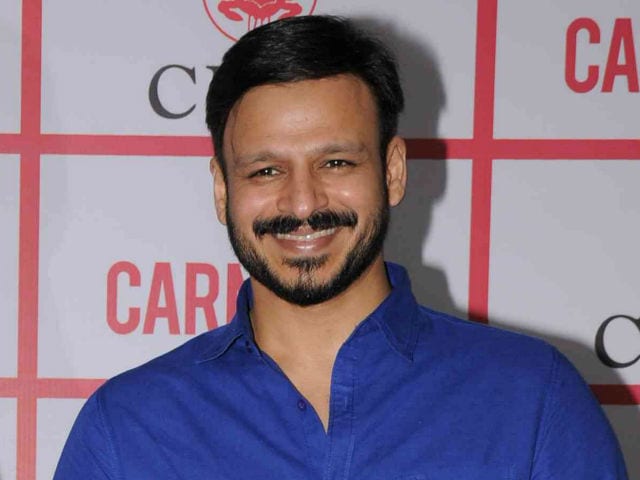
Rachana Dubey (BOMBAY TIMES; April 5, 2022)
While Vivek Oberoi has done a variety of films in his career in the Hindi film industry, he has occasionally picked up projects from the South, too, to push his boundaries. While Rakta Charitra (2010) marked his debut in Telugu cinema, more recently, he has been seen in films like Vivegam (Tamil), Lucifer (Malayalam) and Rustum (Kannada). His next outing is the Malayalam actioner Kaduva, which is set in the 1990s and will see him locking horns with Prithviraj Sukumaran.
“As an actor, it’s important for me to understand the milieu in which the film is set,” he says, adding, “Irrespective of whether it’s an out-and-out commercial film or a content-driven project, I create a backstory for my character and understand the motives which drive his actions. Whether I play the good guy or the bad guy, I approach every role with the same level of sincerity and aim to make it as genuine as possible.”
Elaborating about working in the south film industry, Vivek who has shared screen space with renowned actors like Ajith and Ram Charan, shares, “It takes a very different approach, especially Malayalam cinema. Clubbing them under one bracket is not has its own identity, peculiarities and specialities. What I like about Malayalam cinema is their innovation in storytelling and the intricacy with which they write their screenplays. Malayalam cinema never had enough money to make big scale films. The size of their content has grown considerably. Lucifer was big budget-wise and so is Kaduva.”
Vivek says, “Even with big budgets, it’s now part of their DNA to work with detailed storytelling and engage people, sometimes even without a visual spectacle.”
Talking about Tamil and Telugu cinema, the actor adds, “Tamil and Telugu cinema have been bigger in terms of financial play and in recent times, their films are engaging audiences all over the country, and registering great box office collections. There is a vacuum created by Hindi cinema with exceptions of filmmakers like Rohit Shetty. We have stopped the Manmohan Desai and Prakash Mehra entertainers and veered towards more urban stories. We went into the zone of calling family entertainers, formula films, something that all of India responds to. While it has its benefits, it leaves behind the ability to entertain an all-India audience. South Indian filmmakers are fulfilling that in great style — they’re able to do it with newness, visual appeal and storytelling. Initially, our films would be remade in the south and it is a kind of a role reversal now. We are constantly remaking films from their narratives. There is a connect on a story level with their content. The south film industry takes a very different approach, which is incredible.”
“The reason I love working in the South Indian film industries is because I have built wonderful relationships across industries. Working there is like working with friends. They have innovative ideas and there is a strong potential to bring them to the Hindi speaking audience. The other thing is the commercial success, which the south has been able to provide well,” he signs off.
Malayalam cinema has the ability to offer characters with unique complexities-Vivek Oberoi
8:24 AM
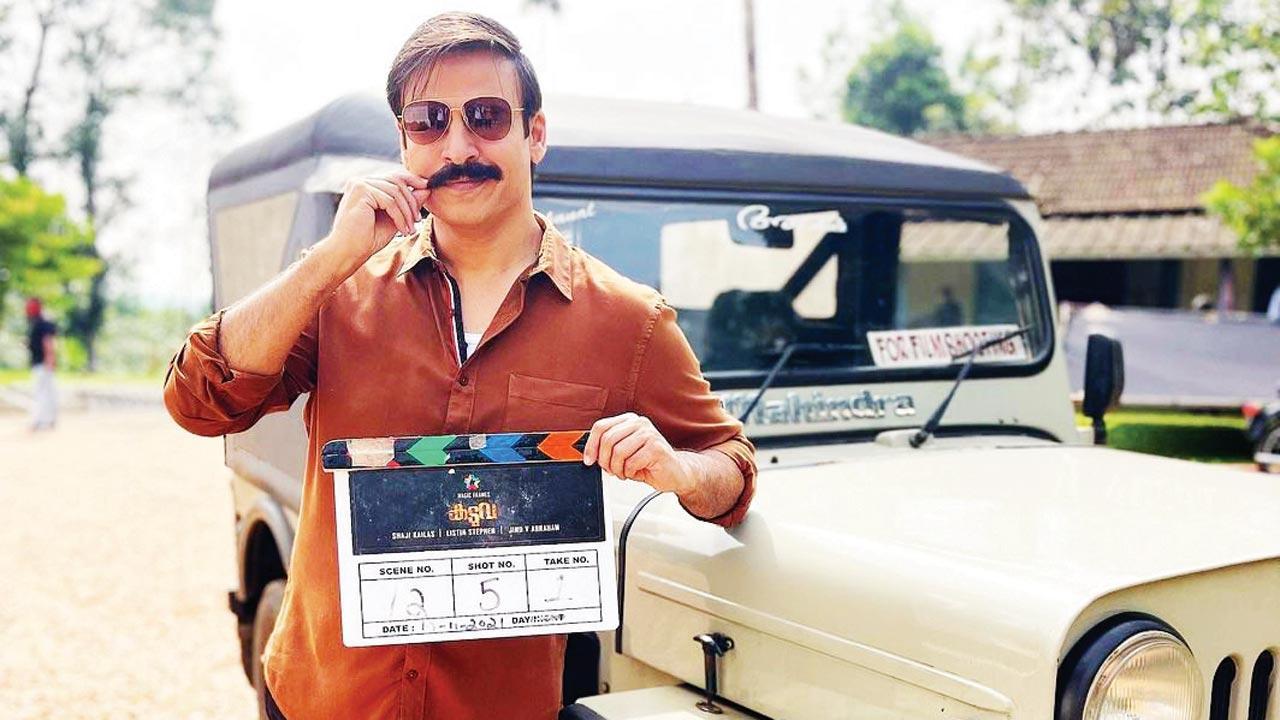
Vivek on gravitating towards Malayalam cinema as he plays antagonist in Prithviraj’s Kaduva
Mohar Basu (MID-DAY; November 13, 2021)
Of late, Vivek Oberoi is becoming a frequent face in South films, cherishing the different narratives they bring to the screen. As he kicks off the shoot of Kaduva, his second Malayalam venture after Lucifer (2019), he says the story of a deep conflict between two strong-headed men drew him in.
“The character I play is not a typical antagonist; that’s what made me gravitate towards playing him. He is a church-going, morally upright family man. But he probably has too much power at his disposal,” says the actor. The film, directed by Shaji Kailas, will see Oberoi pitted against Prithviraj Sukumaran.
The OTT revolution over the past year clearly showed us that Malayalam cinema is undergoing a renaissance of sorts. Oberoi seconds the notion. “Malayalam cinema has the ability to offer characters with unique complexities. I enjoyed playing Bobby in Lucifer that won me critical acclaim as well as commercial success. Kaduva and my character in it have the same potential.”
But his journey wouldn’t be complete without exhaustive prep. “The first step is to understand the cultural aspects that affect the character, then grasp the finer nuances. [I find] Malayalam the toughest among the southern languages, having done films in each language. You will catch me pacing up and down the set, trying to perfect my dialogues.”
Once lost in translation, subtitles are now in the global spotlight
4:01 PM

Indian movies used to have infamously awkward subtitles. Thanks to streaming platforms, they are getting a slick makeover
Sonam Joshi (THE TIMES OF INDIA; February 16, 2020)
 ‘Once you overcome the one-inch tall barrier of subtitles, you will be introduced to many more amazing films,” said Bong Joon Ho, director of the Korean film Parasite. The movie’s sweep at the Oscars has been hailed as a victory over that barrier.
After decades of neglect, subtitles are having a moment. In India, our infamously bad subtitles have inspired memes and parodies. But in the last few years, there has been a sea change in how subtitles are written, because of streaming platforms and new markets. Filmmakers and producers see them as a bridge to a wider audience.
“Subtitling is no longer just the domain of festival films. Now every film releases on a streaming platform sooner or later,” says Mumbai-based subtitler Jahan Singh Bakshi. “The volume of work has increased and the awareness among filmmakers and audiences has gone up. As cinema becomes global, how a film performs depends on how it’s been translated on screen.”
Subtitling is more complicated than literal translation. “It is about how to translate the essence of a dialogue for an English speaking audience,” says Bakshi, who has given Hindi-to-English subtitles for films and series such as Sacred Games, Badhaai Ho and Chhapaak. “You have to take liberties, due to cultural differences and line length. The challenge is to play with language in a way that even if you deviate from the text, you retain the emotion.”
Streaming platforms have clear guidelines for subtitles, with some preferring two or three-line subtitles in a single frame and others wanting their speakers identified.
It is important to understand the cultural context and the audience, says Kochi-based subtitler Vivek Ranjit, who has done Malayalam-to-English subtitles for films such as Angamaly Diaries and Lucifer. “I usually try to find proverbs, idioms and alternatives close to the situation,” he says. For instance, a scene from the film Jomonte Suvisheshangal where actor Dulquer Salmaan is playing dumb charades with Malayalam films was changed to Hollywood films matching his actions. Similarly, Bakshi changed an allusion to the actor Raj Babbar with Al Pacino in Khandaani Shafakhana.
Jokes and songs, which involve wordplay and local nuances, are the most challenging. “For instance, Malayalam lyrics are full of metaphors, and look silly when translated in English,” says Ranjit.
In India, subtitles have contributed to the wide popularity and commercial success of regional films such as Kumbalangi Nights, Charlie, Angamaly Diaries and Lucifer. Chennai’s veteran subtitler Rekhs, who has captioned over 520 films since 2010, says that subtitles are now a priority in the Tamil industry. “Viewers notice, and discern quality,” she says. She credits social media with advocating for better subtitles. Online pages such as Rally for Subtitles in Bengaluru and Mumbai Subtitles Database and ticketing platforms such as BookMyShow have started indicating if a film is playing with subtitles.
“The translation has to be according to the flavour of the movie,” says Rekhs, who has even used emoticons in the subtitles for the Rajinikanth starrer Kabali. “For instance, for a period film such as Bahubali: The Beginning, I used phrases such as ‘did not’ and ‘cannot’ rather than the shortened version can’t and didn’t because it went with the flavour of the film.” Her own team has grown to 12 people, and works on subtitles in Malayalam, Kannada, Telugu and Hindi, in addition to Tamil.
While some subtitling work is done by experienced professionals, a considerable amount is also handled by bigger companies. This includes subtitling for streaming platforms seeking to expand their audience through content localisation, releasing international titles with Hindi subtitles and dubs.
“It is easier to sell a film when you have subtitles done in multiple languages,” says Jyothi Nayak, SVP, Prime Focus Technologies (PFT). Subtitles are also popular with millennials. “The younger generation is on the go and on their smartphones and prefer the subtitled version,” says Nayak.
“As the OTT revolution picked up in India, the subtitling business has grown exponentially,” says Mohan Naidu, VP, Vista India, whose network of subtitling professionals has grown from a handful to over 500 today. Freelancers working with them earn anywhere from Rs 15,000 to Rs 75,000 working out of their homes, he says. PFT, which provides subtitling services for 13 languages, worked on 40,000 hours of subtitling last year, an increase of 50% as compared to the previous year. It has an in-house team of 350-400 professionals, and recruited 800-900 freelancers last year.
“Earlier subtitles were published from Hindi, regional and international languages to English, but now we see demand for regional language subtitling as well,” Nayak says. The highest demand is for subtitles in English, Hindi, Tamil, Telugu, Marathi, Bengali, Kannada and Malayalam.
Meanwhile, Rekhs is hopeful that Parasite’s win can also open doors here. “If a Korean film can be selected for the Oscars, so can an Indian film,” she says. “It depends on how it is translated. I’m sure there will be a National Award for subtitles soon.”

I’m the guy whose professional obituaries have been surfacing since 2004, but I am still here, unbreakable-Vivek Oberoi
9:53 PM

Rachana Dubey (BOMBAY TIMES; April 8, 2019)
Vivek Anand Oberoi has been in the news since December last year, ever since it was announced that he would headline the cast of Prime Minister Narendra Modi’s biopic, titled PM Narendra Modi. In January, posters of the film featuring Vivek as PM Modi were launched in over 20 languages. All of these, including the teaser and trailer that were unveiled in the subsequent months, collectively drew more criticism than appreciation for the film. Recently, the movie was even dragged to court and accused of being ‘propaganda material’. Today is a crucial day for the film’s makers, as a petition against it is expected to be heard in the Supreme Court. In the meanwhile, according to a statement given by the producers, its release date has now been moved to April 11 from April 5. Vivek spoke to Bombay Times about his journey which has been anything but a cakewalk...
Bank Chor, Krrish 3 and Great Grand Masti were some of your last films that released between 2016 and 17. With PM Narendra Modi slated for release this week, and with all the controversies surrounding it, are you anxious?
More than anything else, I’m eager for the audience to watch this film. We’ve put in our heart and soul into it and the journey has been incredible. It was almost impossible, but we finished the film with its scale intact, in 38 days. We travelled from the hot landscape of Kutch to the freezing terrain of Harsil (Uttarakhand). This film was more difficult and taxing for me than all the 45 films I’ve done in my 18-year-long career.
It's learnt that you were being considered to play PM Modi for another biopic, much before this film was made. Why didn’t that project happen?
It wasn’t one project. A lot of people thought of making a film on Modi ji, including me. In my case, it started when I attended the swearing-in ceremony in 2014. Everyone believed his story amazing, but Sandeep Ssingh (producer) was the only one to say it with conviction, ‘Main bana raha hoon, aap aaiye’. Omung Kumar was approached to direct, but he wasn’t sure at the outset. I told him that he shouldn’t shy away from what he’s good at, which is making biopics. It will be interesting to see what his take on the subject is because he is politically insulated. For Omung, it was about unravelling the layers of a man’s personality. I am politically astute and I understand it. I was involved with student politics and during my student years, I was also a GS in the university.
What is it that really drives you to give the nod to a project such as this biopic?
I am on two extremes. When I am working on a film, I am committed and I give it my all. Cold and hot weather and a demanding scene don’t deter me, but I only take up a project when I am inspired enough. It’s not for the money or the thrill of adding another film to my CV. Like I took up Lucifer in Malayalam, knowing that it’s a tough language to speak. But my reason for doing it was that I didn’t want to miss a chance to reunite with Mohanlal (they worked in Company, 2002). I was also warned against trying new media (web series). I was told I would end up getting written-off completely, but here I am. I didn’t sink.
Your career started with a bang with Saathiya and Company. You were touted to be one of the most promising actors in the early 2000s. Interesting roles and intense performances also won you accolades. Given this, your career graph has not been as extensive as it could have been. Do you feel you could have given more to the industry and received more from it?
I’m the guy whose professional obituaries have been surfacing since 2004. Due or no due, the fact is that I am still here, unbreakable. I have worked in six languages and won around 20 awards and I still get some great work to do. Instead of being in the rat-race, and running to the finishing line, I am spending time watching my kids grow. Acting gives me joy, but so does playing football in the garden with my son and lighting up my daughter’s dollhouse with her. I am on crazy schedule even now, but I don’t miss a chance to feed my bachchas and break bread with my wife and parents. I believe in maintaining work-life balance. Each day makes me feel like a winner and gives me a sense of fulfillment. I’ve often been asked about not getting my due in the industry. On the contrary, I am blessed with so much that I don’t see life in a unidimensional manner. I have a happy family and I choose the work I do. I am Destiny’s child because there’s nothing that hasn’t happened to shut me down and I'm still going strong. This is my life and I have accepted it with a smile. What else can I do? Crying is not an option, woh sab screen pe theek hai.
Shortly after you attended the PM’s swearing-in ceremony, people made memes of your look at the event with comments about how you even made it there...
(Laughs!) Yes, I remember that. It still makes me smile. In 2004, people said how did I make it to the film industry, in 2014, people asked how did I make it to the PM’s swearing-in ceremony, and in 2019, they are asking how did I get the role. Someday, there will be a biopic on me if people keep asking these questions, which I don’t mind.
But how did you really make it to PM Modi’s swearing-in ceremony?
I don’t like to wear my relationships on my sleeves. I built a beautiful equation with Mr Modi when he was the Chief Minister (CM) of Gujarat. I’ve personally seen him work, and people don’t realise this but after Atal Bihari Vajpayee, he’s the only leader I campaigned for.
So, at some point, you do plan to get into politics?
I don’t know where life will take me, but for now, you will see me as a full-fledged politician for two hours on screen.
Are you in awe of PM Modi?
I am not a bhakt for sure. For me, it was a question of whether Modi ji's story inspires enough. It does. To me, even Dhirubhai Ambani’s story is just as inspirational. I am excited about this film because it tells every chaiwala and chowkidar that you too can become the PM.
It’s often said that getting too close to a subject could hamper your objectivity. In your case, you knew PM Modi very well. Didn’t that become a deterrent at any point?
One approach is to adapt the physicality of the person you’re playing. Omung and Sandeep ensured that I don’t caricature Modi ji. We were clear that the spirit of the man needs to be captured and portrayed. I did that when I played Maya Dolas in Shootout At Lokhandwala (2007). The man had curly hair, but it looked funny when I wore a wig to match his appearance. He also had a thick Marathi accent. Eventually, we decided to go without all of this and just focus on the kind of person Maya was. I studied him in great detail —his criminal history and met the cops who had shot him. The idea was to bring out that high he was riding on in the short span of his life.
Your film has been in the eye of controversies since inception. Even its release date has been moved twice. Did you anticipate that you might have to fight so many battles for this film to see the light of the day?
Yes, one knew that this might happen. Our legal team had warned us, but I could never understand why so many people (referring to political leaders) are scared of this film releasing. And if a film is so powerful, then people in politics should make films instead of campaigning and doing any other work in their constituencies. It’s great for cinema. If that theory was true, every election season would have a flurry of films. I think we’re giving too much importance to this issue. People will watch the film and decide whether it’s good or bad. Making films can never help anyone win elections. If someone thinks it is propaganda, let them prove it.
Biopics in India are often blamed for white-washing their subjects. Your film is being accused of it even before release.
Let them blame us, but we have never given that a thought. I’ve made this film for the mass audience. I’m told that Richard Attenborough was also accused of white-washing Mahatma Gandhi in Gandhi. The film is considered to be iconic. Uske aage hamari film ki kya haisiyat hai?
In a two-hour film, how much of Modi’s life have you really covered? Does your film also touch upon the Gujarat riots, which took place in 2002?
We’ve covered a great spectrum. Omung has done tremendous justice in his effort to bring out as much of Modi ji’s life as possible in a short screen time of about two hours. There’s everything right up to his swearing-in ceremony. It’s his trials and tribulations that make the film inspirational.
Lastly, will we get to see Narendra Modi in the film?
We tried incorporating a portion at the end but it didn’t work. There is enough Modi in me, but not the real Modi ji in the film.

Vivek Oberoi excited to reunite with 'gracious and warm' Mohanlal after 16 years with Lucifer
6:45 AM

Mohar Basu (MID-DAY; July 13, 2018)
Malayalam star Prithviraj Sukumaran’s directorial venture is special for Vivek Oberoi for reasons that are more than one. Lucifer not only marks his full-fledged Malayalam film debut, but also sees him get together with South star Mohanlal 16 years after they featured in Oberoi’s Bollywood debut outing, Company.
A sense of nostalgia makes itself evident when Oberoi tells mid day, “It’s been 16 years since Company [released] and I’m so excited to reunite with Mohanlal. He is among the finest actors in the country, apart from being a great human being. We had the best time shooting for Company, and despite his stardom in the South, he was gracious and warm.”
Lucifer — set to kickoff in Trivandrum on July 18, and then in Mumbai and Kuttikkanam — sees Oberoi slip into the role of the antagonist. Given that also features Manju Warrier, Tovino Thomas and Saniya Iyappan, Oberoi says he was persuaded to give his nod to it. “The subject, script and opportunity to work with such a talented cast and crew is what drew me to the movie. Prithviraj, who makes his debut as director, gave me an incredible narration of this challenging and complex script. I was sold,” he says.
The actor begins a month-long prep next month. In order to learn Malayalam, he plans to appoint a diction coach soon to ensure that his pronunciation is on point.

Subscribe to:
Posts (Atom)