Showing posts with label Lisa Ray. Show all posts
Showing posts with label Lisa Ray. Show all posts
Without a life that’s rich in experiences, what are you going to write about?-Lisa Ray
10:32 AM

Her image caused traffic accidents in the 90s and she survived an ‘incurable’ cancer in the noughties. Now, she istaking on the final frontier of female silence: menopause
Anindita Paul (MUMBAI MIRROR; May 3, 2026)
On her first wedding anniversary, Lisa Rani Ray took off her ring and threw it at her husband. There was no catalyst for the outburst; it was a surge of inexplicable, white-hot fury.
“When I calmed down, I couldn’t explain, even to myself, where all this rage was coming from,” says Ray, who, at 37, was blindsided by the hormonal wreckage of a premature menopause that no one had prepared her for.
It is 9 am, and Ray is navigating the morning on the “flimsy glue of caffeine” following a gruelling 12-hour shoot. At 54, she possesses a lightness that suggests a woman finally comfortable in her own skin, yet her path to this point has been a series of startling departures.
She describes her formative years as “precocious and even pretentious,” a child who was reading Dostoyevsky and Camus before she hit double digits. While the public eventually became obsessed with her face, Ray always viewed herself as a writer in waiting. When her memoir Close to the Bone was released, it revealed a prose style as evocative as her screen presence—flavourful, textured, and strikingly intellectual. This is a woman who treats language with the same reverence she does her survival.
“I had always imagined that I would work as a writer,” she says of the 1991 trip to India where she was scouted for the world of fashion. “I still believe that I was born to be a writer. I just took a very long detour. Without a life that’s rich in experiences, what are you going to write about? You have to have your heart torn out of your chest to be able to really have the sensitivity to see the world through a different lens.”
Billboards that became a public health hazard
That detour began with a “risqué” red swimsuit and a photograph by Chien Wein Lee. The image became a piece of urban folklore; blown up onto hoardings along Mumbai’s Marine Drive, it was famously blamed for causing traffic accidents as drivers swerved to catch a glimpse of the newcomer.
While the film industry’s power players scrambled to sign her, Ray was in Toronto, navigating what she calls her “first life in pieces.” In August 1991, her father swerved to avoid a car; the resulting crash left her mother a quadriplegic. Ray spent her initial weeks of stardom in an ICU, managing insurance forms in a daze of “liquid grief.”
“My entire life had been shattered into bits,” she recalls. “I realized early on that all these things we aspire for are completely hollow. I should have felt like on top of the world and I didn’t. I was confused, lost and even suicidal… and yet, it was the height of my fame. That taught me very early on to look for something more enduring.”
That search for substance led her to radical cinema. She chose projects like Deepa Mehta’s Oscar-nominated Water and The World Unseen, playing characters that lived on the fringes. She was the perennial outsider, a position she used to her advantage. “I didn’t really have a reputation because I was still the outsider. That meant I could slip in and slip out as I chose.”
The cost of survival
In 2009, the narrative shifted with a diagnosis of multiple myeloma, a rare blood cancer. Ray chose to dismantle the wall of silence, documenting the toll in her blog, The Yellow Diaries. “Disease will do that sometimes, compel you to pull out these vulnerable pieces of yourself,” she says.
Survival, however, came with a hidden price. At 37, chemotherapy forced her into premature menopause. While the world had become comfortable discussing her cancer, this chapter was shrouded in taboo. “Unlike the cancer diagnosis, I received no support for this. I realized that like so many women, I was carrying the weight of confusion and shame alone.” It took a decade of insomnia and thinning hair before the “geek” in Ray took over.
She immersed herself in the science of hormonal health, eventually starting Hormone Replacement Therapy (HRT) and “project managing” her middle age with weightlifting and magnesium. Now, she is scaling that recovery into NuHer, a science-backed midlife clinic she co-founded to provide the medical roadmap she was denied.
“I refuse to believe that women should shrink and disappear once they hit menopause,” she says. “Instead, I think of it as a real opportunity to really step into their full power. These are their wisdom years.”
The poet on the roof
Life is now lived in Goa, where a shipping container’s worth of books—her most prized possession—serves as the anchor for her home. Her literary focus has moved from the complex structures of Salman Rushdie to a more “honest, pared down” style of writing—a shift that mirrors her own evolution. This autumn, she will finally fulfil her original ambition with the publication of her poetry collection.
She still finds resonance in Hemingway’s A Moveable Feast, specifically a line about an eccentric poet: “Monsieur Dunning est monte sur le toit et il refuse catégoriquement de descendre!” (Monsieur Dunning has gone up on the roof and he categorically refuses to come down!) “I’ve always loved this phrase,” she laughs. Of course, she does. After all, it captures a sense of defiant, perhaps eccentric, withdrawal from the world—a literal and figurative “checking out” that Ray clearly finds both amusing and relatable.
“Whenever I need a break from life, I send this phrase as a message to my friends.” Monsieur Dunning might stay on the roof, and Lisa Ray may still send out that text every now and again, but she isn’t hiding anymore – she has simply decided that from now on, the view will be entirely her own.
Tannishtha Chatterjee-Sharib Hashmi's Breast Of Luck takes on the C-word with jokes and joy
2:17 PM

Actor Tannishtha Chatterjee turns her cancer journey into a play that uses humour, music and community to confront illness head-on
Sharmila Ganesan (THE TIMES OF INDIA; February 4, 2026)
So, your doctor is a man?” he asks, eyes on the road. “Yes,” she shrugs, head wrapped in a scarf. “The oncologist is a man. He was referred to me by my gynaecologist.” “Okay. She must be sure of his credentials then.” “He. My gynaecologist is a man.” “What? You mean he touches you?”
Questionable questions, awkward puns, well-timed expletives and several unreciprocated high-fives animate ‘Breast of Luck’, a play whose protagonists choose to sing, dance and laugh their way through the grimness of cancer.
Co-written and staged by Tannishtha Chatterjee — who was diagnosed with stage IV oligometastatic cancer last year — and Sharib Hashmi, whose wife has beaten mouth cancer four times, the musical comedy, directed by Leena Yadav, opened at the G5A in Mumbai recently to a packed house.
The room included Naseeruddin Shah, Dia Mirza, Tanvi Azmi and Divya Dutta, apart from Chatterjee’s doctors and cancer survivors. At the end of the first show, Chatterjee turned to the room and said, “Honestly, I don’t know how I am doing except that I have stopped chasing certainty.” Shah reassured her: “This is the most cathartic and best thing you could have done for yourself.”
Songs Over Sorrow
To be staged at the Kala Ghoda Arts Festival on February 4 to mark World Cancer Day, the script sees opposites distract before they attract. Sheila Roy is a cool, composed classical singer, while Arun Mohan is a goofy divorced stockbroker who punctuates dad jokes with high-fives. When she launches into her riyaaz every morning at 5, he winces and rings her up on the intercom, begging her to stop. Their heated exchanges morph into real-world meetings on a dating app. Just as Roy begins to enjoy Mohan’s company, the story swerves: she is diagnosed with stage IV oligometastatic breast cancer.
She pushes Mohan away, convinced love will only expose her vulnerability. He refuses to leave, insisting on staying, his caregiving peppered with relentless puns. That refusal to surrender humour, intimacy or companionship to illness anchors the play’s emotional centre.
Often reduced to a serious trope in movies, the Big C finds its funny bone in the drama. “Exactly. That is the USP,” Hashmi says. “Otherwise, it could easily have become a sad story. We chose to see it from a lighter side — with songs, jokes, laughter.”
The play draws from a deep personal well. Interspersed through the second half are real hospital visuals — insurance IVRs (interactive voice responses), chemotherapy rooms, and injections. At one point, you watch Chatterjee singing through an injection. “The targeted medicine was extremely painful. But when I sing, those 10 minutes used to pass more quickly,” says Chatterjee, who had invited her friend, a documentary cinematographer, to shoot on the last day of her chemo.
Music, laughter and community sustained Chatterjee through the medical journey. Incidentally, Chatterjee — best known for her performances in ‘Dekh Indian Circus’ (2011), ‘Gulaab Gang’ (2014), and ‘Angry Indian Goddesses’ (2015) — was supposed to meet Hashmi of ‘Family Man’ and ‘Filmistaan’ fame on the day her biopsy report arrived. Hashmi had been shooting for her film ‘Full Plate’ and had casually discussed a collaboration.
“The day I got my report, I was supposed to meet Sharib for coffee. I almost cancelled,” she recalls. “I was devastated. But I thought if I go home, I’ll have to tell my mother and I’ll feel worse. So I went.”
A year before Chatterjee was diagnosed, she had lost her father to cancer. “He died in my arms in the hospital ICU. He was so full of life. When I was diagnosed, my main concern was my mom, who’s 70 plus. How would I give this news to her? Because it wasn’t stage one, or stage two, or even stage three — it was stage four.”
When she confided in Hashmi, he called his wife Nasreen, who has lived with cancer since 2018. “She gave me a lot of strength,” Chatterjee says. “She said, ‘Look at me. I’ve relapsed four times. I’m here. I’m doing everything.’ After that call, I looked at Sharib and said, let’s write a play for her.”
The script took shape during chemotherapy. Rehearsals were scheduled between hospital visits. Improvisations were shaped as much by pain as by laughter. “I was writing while going through treatment. I wanted to laugh constantly. I didn’t want to pull myself down,” says Chatterjee, who found humour in the mundane — doctors clinically debating silicone implants, nurses scolding her and her friends for laughing too loudly in hospital rooms.
The rehearsals weren’t easy. “I had, and still have, terrible nerve damage in my shoulder and left arm. Everyone had to be careful while hugging me or touching me because it’s excruciating if it goes beyond a certain range of mobility.”
Hashmi relates to Arun Mohan not only as a performer but as a caregiver. “After my wife’s diagnosis, our lives changed completely,” he says. “But she treated cancer like a fever — with courage, humour, incredible strength. We tried to bring that spirit into the play.”
Medical professionals echo that sentiment carefully. Breast oncoplastic surgeon Dr Vani Parmar notes that a cancer diagnosis often arrives as a shock, particularly for younger women. “The treatments — radical surgeries, long chemotherapy sessions, hair loss, weakness — lead to immense physical, emotional, social and financial strain, along with a constant fear of recurrence and death,” she says. Changes to appearance, she adds, often trigger anxiety and depression. “‘Chemo brain’, or brain fog, is also part of the territory.”
Chatterjee recalls days when she told her doctor she couldn’t do another chemo cycle. “He understood. He knew that in three days, I’d feel differently.” That reassurance — from doctors and fellow survivors — mattered enormously.
While psychological counselling is not routinely integrated into many hospitals, it is increasingly being recognized as an essential part of cancer care.
Dr. Priyadarshini Deo, counsellor at the Centre for Cancer and Palliative Care at Kokilaben Dhirubhai Ambani Hospital, points to studies showing that humour and movement-based activities can significantly enhance emotional health. “Humour and lightness reduce stress, ease anxiety, improve communication and strengthen relationships, especially with caregivers,” she says.
Argument For Lightness
A case for lightness arrives in actor Lisa Ray’s memoir Close To The Bone, in which she recalls the day she was diagnosed with cancer by a “jittery, rabbit-faced doctor”. “He spoke very slowly, pausing for a long time between each word, as if to gauge my reaction. You. Have. Multiple. Myeloma.”
The doctor, Ray writes, reminded her of the rabbit in ‘Alice in Wonderland’. “As he kicked me down the hole, he never said the word ‘cancer’.” “Oh,” Ray replied. “Do you want me to get you some water?”
Her response, she writes, might seem strange. “But he did look parched. Also, it never occurred to me that I wouldn’t get better… I was framing it as just another adventure.”
Apart from music, what sustained Chatterjee after her diagnosis was community. “I cried alone in my car with my reports,” she says. “My sister told me — you can’t save yourself alone.” Friends video-called her and joked about everything from Trump’s antics to local absurdities. “It helped me sleep. It made me feel light.”
Why, we ask her, is cancer so often portrayed in popular culture only through despair and solemnity? “Because it usually comes from an external perspective, not lived experience,” Chatterjee says. “I think there’s a fear — how can I be sensitive (towards the topic)? I was fearless because it’s me.”
The play does not trivialize her struggles, including her prolonged insurance battles. Her arguments with an automated voice convey her frustration. “The day my insurance refused me, I was at my lowest. The treatment is excruciatingly expensive. I’m not a commercial actor. I’m an alternative, arthouse actor. I’m not rolling in money. And I have a mother and a daughter to take care of,” says Chatterjee. Her daughter lived with the actor’s sister in the US during treatment.
Care for the caregiver, too, is crucial, Dr Parmar reminds us. “There is emotional burnout, financial strain and disrupted routines. Clear communication, shared decision-making and emotional support make the biggest difference.” She urges the integration of psychological and financial support into standard cancer care. “Good healthcare at an affordable cost is a right.”
“My doctors told me this isn’t just about cancer,” Chatterjee says. “In any illness, people should watch it — to see how art, music, laughter and community are therapeutic.”
The audience response suggests the message has landed. Survivors have cried and laughed in equal measure. Caregivers have recognized themselves. Those who have lost loved ones have found something gentler than grief alone. Hashmi’s wife has seen the play three times. “She loved it,” he says.
To be recognized by an esteemed person like Kate Middleton is a motivation to carry on with my work-Manisha Koirala
6:49 AM
Akash Bhatnagar (HINDUSTAN TIMES; November 1, 2024)
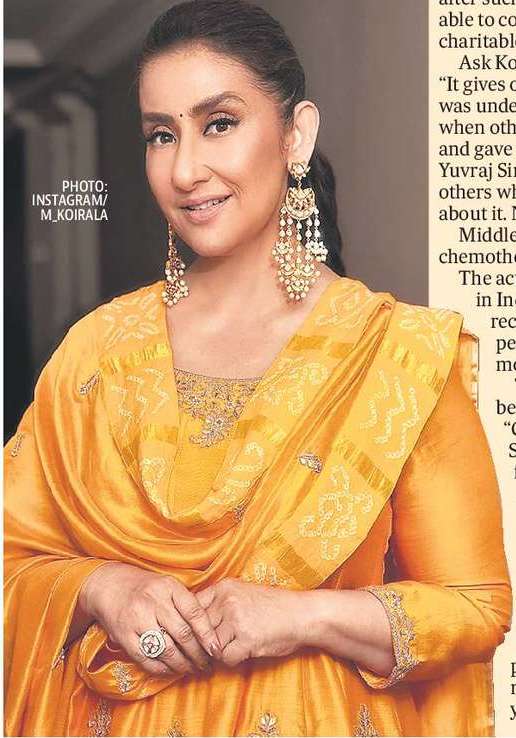
A survivor of stage IV ovarian cancer, actor Manisha Koirala recently received a letter from the Princess of Wales, Kate Middleton, where she expressed her joy at learning that Koirala is cancer free after such a serious diagnosis and has been able to continue her professional and charitable work while inspiring many.
Ask Koirala about the letter and she says, “It gives one the strength to go on. When I was undergoing treatment, it meant a lot when other cancer patients reached out and gave me hope. I really thank (cricketer) Yuvraj Singh, (actor) Lisa Ray and a few others who came out of cancer and spoke about it. Now, it’s my time to do the same.”
Middleton, who underwent preventative chemotherapy this year, is now cancer free.
The actor, who works towards cancer care in India and Nepal, adds, “To be recognized by such an esteemed person like the Princess is a motivation to carry on with my work.”
Talking about what is required for better cancer care, Koirala says, “Cancer treatments are expensive. So, it’s important to make it available for everyone. We also need more awareness about a healthy lifestyle. Cancer is no longer a death sentence, so more education is needed.”
Calling cancer her “biggest teacher”, Koirala adds, “No matter how painful, it taught me the most valuable lessons. It’s about being proactive, pro solution, living in the moment and figuring out what gives you joy.”
Unfortunately for Kate Middleton, there were so many bizarre rumours flying around that she was forced to come out-Manisha Koirala
8:15 AM

BOMBAY TIMES (March 30, 2024)
Recently, when the Princess of Wales Kate Middleton announced her battle with cancer, my heart went out to her. I could sense that the family was not comfortable telling the world about Kate’s battle (at least not yet). But given the tremendous pressure and fake news doing the rounds, it seemed she had no choice but take a drastic step and put an end to all the unwarranted speculation.
When I was diagnosed with cancer, I was looking for some positive articles and there weren’t many people talking about it.
But I came out because I realized, just as I was desperately looking for hope, I needed to share it with others as well. I began reaching out to people and Lisa Ray, a cancer survivor, messaged me on Facebook. It was very comforting for me to have received a positive message from her. I remember Yuvraj Singh also talking about it, then there was a cyclist and a Hollywood actress, who spoke a little while wearing a wig. I told myself that if I ever get okay, not only will I talk about my journey but also give a truthful picture of myself. Not a flowery one.
It wasn’t a cakewalk. It was the most difficult phase of my life, but I was blessed with great family support and doctors. This encouraged me to speak about my struggle, fears as well as my recovery.
Yes, there’s fear. You are worried about how people will respond to you when you come out with your diagnosis. But it is nothing compared to the phase when you are facing death – at that moment it doesn’t matter how people look at you. Your priority is to recover. It is important to get the right information and encouragement, and I did that to help me sail through the gruelling chemotherapy. When you know you are fine and you realize that there is a 50 per cent chance of you surviving, that’s when you start thinking about your looks, the hair loss and how people perceive you now. I thought I would never be able to work again. But I was wrong.
Once I came out, I got tons of love and support. I received messages from strangers on social media. I thought that I would be judged, and people would pity me. My fears were unfounded because people were encouraging and caring enough for me to be able to go through this journey.
Which is why I am slightly uncomfortable with the way the media went all out with all the conspiracy theories and conjectures about Kate’s absence from public life. When someone is quiet about a personal matter and not reachable, you imagine the worst. And very quickly at that. Before jumping to any kind of conclusion, one must think a hundred times, because you don’t know the kind of struggle they are going through.
Unfortunately for Kate, there were so many bizarre rumours flying around that she was forced to come out, even if it may not have been her first choice. One must understand that there are some people who want to deal with something like cancer quietly because that is the best way for them to heal. For others, sharing this may be cathartic. It is a personal choice, and we need to respect that.

I stood up against a lot of egos in the industry-Lisa Ray
8:13 AM
Iti Shree Misra (BOMBAY TIMES; May 17, 2023)
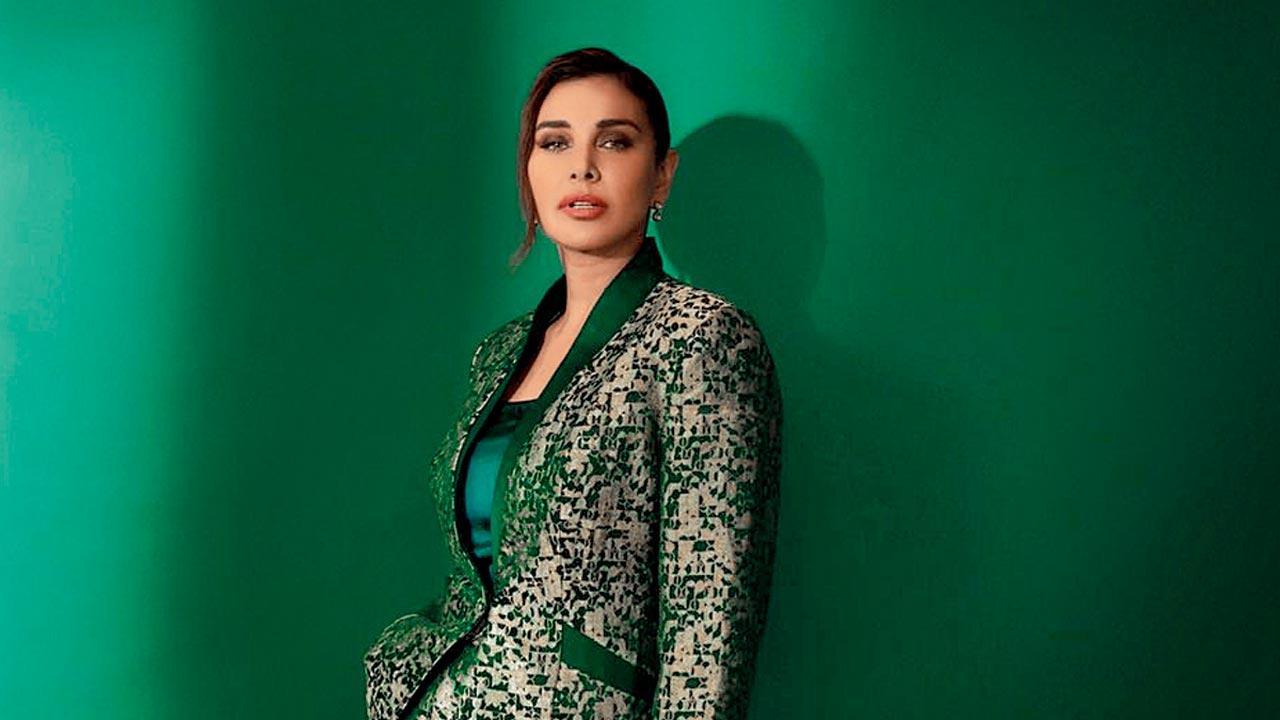
Actress, entrepreneur and writer, Lisa Ray, seen in films like Water, Kusoor and more recently in the OTT show Four More Shots Please! talks about her twin daughters, her acting career and more in a freewheeling chat with us. Excerpts:
Priyanka Chopra Jonas recently spoke about her struggle in the Hindi film industry. How has your journey been in Bollywood?
I refused to play the game and I stood up against a lot of egos in the industry. I won’t say I paid the price for that because I never wanted to be part of mainstream Bollywood, so I was in a very different position. I think that Priyanka is a bold, intelligent, accomplished and driven woman. She inspires the younger generation to pursue their vision uncompromisingly. That’s another subtle message she gives out.
With movies like Water and I Can't Think Straight, each role and story you have picked are bold and have left an impact. What was the thought process behind choosing such roles?
I have always been someone who never wanted to take the conventional path. And looking back now, I stand behind all of my decisions. They were not easy at that time. Fortunately, we are going through a new era of unconventional storytelling and finding an audience for that. When I started on this path that was not the case, so I did it because I truly believe that entertainment, movies and streaming content are like Trojan horses. You have an opportunity to actually get a particular mission or a perspective across to an audience, wrapped up in beautiful packaging. So it was my mission to be in projects that were beautiful, that resonated, that were entertaining, but also had a story behind it. And I am really proud of that.
What type of movie projects and roles are you interested in pursuing?
First of all, I have never pursued any project. I am an accidental actress, I never planned to be in this profession. I don’t do anything that people imagine you should do. I have never networked, I have hardly ever auditioned, nothing. Whatever came my way was meant for me. And I am of course very lucky for that. I don’t know how I did any of this. Right now, I am not actively pursuing any projects.
As a mother of twin daughters and someone who works in different fields, what is your mantra for managing things and finding the right balance?
My mantra is to be calm, grounded and humble because that’s very important. I have a tattoo on my ankle of a lotus. And it goes out of a shlok from the film Water Padma patram evam bhasa, which means ‘Live like a water lotus’. I endeavour to be like that, to be in the world, but float just a little bit above it.
How has been your journey as a mother?
Oh my god, it’s amazing. It transforms you on a fundamental level and it has taught me all about unconditional love and understanding. It has been a wonderful experience.
Lisa Ray admits to cringing when Afreen Afreen is played
8:02 AM
HINDUSTAN TIMES (May 11, 2023)
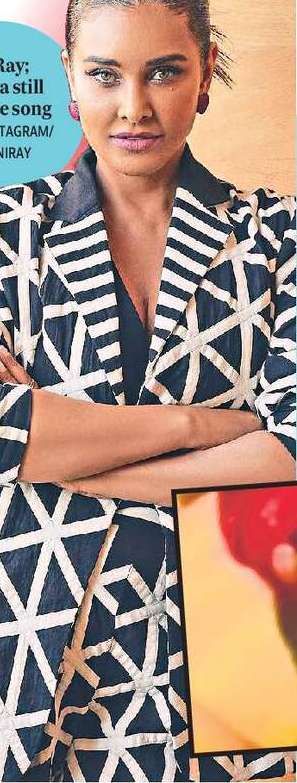
Actor-model Lisa Ray, who starred in the popular 90s hit Afreen Afreen, admits to feeling “uncomfortable sharing or celebrating” the track.
Sharing a clip of the song — composed and sung by the late Nusrat Fateh Ali Khan — on Instagram, she wrote, “The song often plays on cue for events where I am invited to speak and I inwardly cringe while offering a polite smile. Today, as great troubadours I listened to in my youth are passing into the light, I recognise the power of a song to evoke an emotional response in the audience that is tied to who you once were.” She continues, “Hearing this song today is no longer about a personal association but represents a universal rite of passage — in the same timbre of falling in love for the first time, writing your first poem, reflexively planning your future — a pitch, a note, a video that reminds us of a world of beauty and possibility and innocence that once was. But what would be a revelation today is others also comprehending this truth and freeing me from an association with the song, for the reasons and more above (I’m just walking around in the desert after all).”
However, fans and followers urged her to cherish the song in their comments on the post. One fan wrote, “This song is truly a rite of passage for so many of us, I feel it in my soul and in fact it was the song I danced to at my wedding sangeet.”
Another commented, “Look at it with gratitude grace love... It got you fame and you look absolutely gorgeous in this song.”
20 Years of Raaz: Dino Morea, Bipasha Basu, Vikram Bhatt go down memory lane
8:16 AM

Juhi Chakraborty (HINDUSTAN TIMES; February 1, 2022)
Counted among the best-known Indian horror films, Raaz completes two decades today. Actor Dino Morea, who starred in the 2002 film, shares that besides the movie’s story and music, his onscreen chemistry with actor Bipasha Basu Singh Grover, his then girlfriend, still remains a talking point. “When people saw our chemistry on the big screen, they immediately fell in love with us,” he says.
Morea adds that working with her was “fantastic”. “It makes shooting far more easier when you know the person. Our off-screen romance helped us have that chemistry on the screen,” he shares.
Back then, the horror genre was still reeling from the stigma of being reduced to B-grade films. So did Morea have any apprehensions about choosing it as his second film? “No. I was getting to work with the Bhatts, who had made some fantastic films. It was an honour for me to be getting a big film,” he shares.
----------------------------
Rishabh Suri (HINDUSTAN TIMES; February 1, 2022)
While Raaz was a turning point for Bipasha Basu Singh Grover, the actor wasn’t the first choice for the lead character, Sanjana. She tells us, “It was being shot with Lisa Ray and Dino Morea. I had gone for the first day of shoot, as Dino was my boyfriend then. It so happened that Lisa couldn’t do the film, and Mukesh (Bhatt, co-producer) requested me to play the role.”
She was just a film old when she said a yes to this horror film. And she says it helped her decide that she wanted to pursue acting, which was never her long-term plan, as she got a pivotal role when other female actors only played love interests. She adds, “The success of Raaz is why I decided acting is the profession I want to be part of, that it is fun. It made me realise I have potential as an actor.”
----------------------------
Titas Chowdhury (HINDUSTAN TIMES; February 1, 2022)
Vikram Bhatt, who directed Raaz, recalls how no one believed in the film. “Everybody thought I was making a mistake. A big producer said to me, ‘Kya yaar, tu flop hero aur Ajnabee (2001) ki vamp ke saath picture bana raha hai’,” Bhatt shares.
He also reveals that the film was first offered to actor Anil Kapoor, who refused to do a horror film, and that actor Lisa Ray had shot for a portion of the film: “We were left in a lurch after she left. When Dino came in, he said, ‘Why don’t you try out my girlfriend, Bipasha? She’s lovely!’”
Talking about how Raaz was a game-changer in his career, Bhatt says, “In every filmmaker’s life, there comes a film which is hard to beat. Raaz is that film for me. It’s a badge of honour.”

I feel really happy hearing my daughters' delighted shrieks when I’m writing in my office-Lisa Ray
8:29 AM

Sonil Dedhia (HINDUSTAN TIMES; May 16, 2020)
“I have sort of already gone through the dark night of the soul, simplified my life and made friends with the reality of change. And that has definitely given me the tools to face this pandemic. The other thing I consciously do is to moderate my intake of information and time on social media,” shares actor Lisa Ray, who is also a cancer survivor.
The 48-year-old is currently in Singapore with her one-year-old twin daughters. “We pulled our girls from school before the Coronavirus lockdown, but keeping them engaged has its own challenges. I’ve turned our home into a play school, and I feel really happy hearing their delighted shrieks when I’m writing in my office. Mornings and evenings, we put on masks and go for a bit of fresh air,” shares Ray, who is currently working on her next book, after her debut memoir Close to the Bone.
From cleaner air to liberated wildlife, the lockdown has had many positive effects on Nature, something that the actor is happy about. “Just like it takes pressure and heat to create a diamond, these times have the potential to mould something precious from difficult circumstances. I wish it didn’t take a pandemic to convince society that we need to do things differently. We need to respect our planet and the natural world,” she ends.
I am confident in my middle aged body-Lisa Ray
7:37 AM

Juhi Chakraborty (HINDUSTAN TIMES; November 4, 2019)
It is quite apparent from her social media posts that Lisa Ray likes to keep it real. Recently, when Lisa shared a no-makeup selfie on social media and termed it “free and unfiltered”, it went viral. For the model-turned-actor, it is all about keeping it real even in the virtual world.
“Today, I’m so confident and unshakeable in my own middle-aged body that truth telling comes easily to me,” shares the 47-year-old, adding, “I’m not interested in only projecting unreality. We need to start a dialogue that is an antidote to the unrealistic expectations that the beauty industry propagates through social media. Enough!”
This real side of her also reflects in Lisa’s first book, an autobiography. She says she is so much in love with writing now that she is ready to be a full-time writer, which has always been her dream. “I want to officially announce that I’ve signed a three book contract,” she adds, jubilantly.
But that does not mean that she has put her acting career on the back-burner. She will be seen in the second season of web series Four More Shots Please! and in a feature film 99 Songs, which premiered at the Busan Film Festival.
Lisa has, however, never chased Bollywood films. Her filmography is pretty sparse. “My career is an accident. I never aspired to be a part of Bollywood. It’ s not part of my aesthetic and artistic reference points,” she responds.
“I’ve acted in independent films abroad that brought me acclaim and satisfaction, though the Indian audience is ignorant of the fact I have a career outside India. I am an introvert and I can’t even relate to most Hindi films, so why would I put my energy towards acting in them?” Lisa concludes.
I have always defied perceptions and labels-Lisa Ray
8:06 AM
Deepali Singh (DNA; June 1, 2019)
When we compliment Lisa Ray on the emerald green ensemble she has on for her book launch event, the model, actress and now, author, tells us, “My friends were like, it’s your book launch, you have to wear something bright!’” It certainly highlights her light green eyes and we tell her that these days, there are awards for stylish authors as well. “That’s the thing, why can’t we be both, right?” she asks.
In a way, the cancer survivor’s entire life has been all about defying norms and fighting off labels. One of India’s first supermodels, the daughter of a Bengali father and Polish mother started her journey with entertainment at the age of 16. Close To The Bone is her insightful travelogue about her life-changing experiences, including her acting projects, her battle with eating disorders, being diagnosed with Multiple Myeloma at the age of 37, her spiritual quest, her heartaches and triumphs along the way. “There is no contract any of us sign that we are going to get through life without any problems. Yet, we have the tendency to feel ashamed about presenting what are perceived to be our flaws. For me, my flaws are what make me beautiful.
I believe we are more beautiful for having been broken. That is me today,” she states, pointing to the chemotherapy scar on her chest. “Sometimes during shoots, they ask if they should cover it, and I say, ‘Don’t, it’s part of who I am’.” Over to Lisa...
It’s been a while since we saw you on the silver screen. Are you open to acting in Bollywood projects or doing web series?
I am a part of the web series Four More Shots Please. That was a great experience. Then, I have A R Rahman’s film 99 Songs. I only do the projects that really interest me because it’s my time away from my family and my writing.
Writing’s always been a part of your journey, right?
Always, since I was a child. I’ve only been delayed by 30 years! (Laughs). That is also one of the motivations behind writing the book, to explain this slightly surreal trajectory that my life has taken. Having said that, I have some stories to tell now and some experiences under my belt, so perhaps I will be a stronger writer for it. My entire career is literally an accident on many different levels. Entering the entertainment business in India has definitely been an accident. Also, it’s hard to understand because today’s entertainment world has changed so much since 1991, when I started. It wasn’t such a machine as it is today. So I thought it’s a worthwhile story to tell. Of course, it took me away from what I think is my primary passion and calling – writing. But I never stopped writing. I have been compulsively writing — journals, notebooks, poetry, articles for magazines. I literally have stacks and stacks of cardboard boxes from the last 20 years of my life!
So there’s a lot more to expect from you?
Yes, and it has helped a lot when it came to writing this book. Eventually, I would like to write fiction. I’m an observer. I create a back-story for strangers and I’m an introvert by nature. That’s my comfort zone and that’s how I process and understand the world around me.
What’s the idea behind the title of the book?
It’s an intriguing title, which I think, works on a few different levels. As a writer, it interests me. I am as taken by how a story is told as the story itself. Each and every sentence I wrote in the book, the title ended up being a manifestation of that. It’s a little bit lyrical and enigmatic and a little hard to place. Also, it’s a play on words, considering I was diagnosed with bone cancer and I have lived a life close to the bone. It implies stripping away a lot of peripheral stuff. But it’s open to interpretation and that’s also what I wanted.
What has been the takeaway for you as the author of this book?
For me, it’s a chance to connect, to reveal, to take control of my own narrative. Having been in this business for as long as I have — having started very young and having developed as woman in terms of my voice and my authenticity — I still am labelled. It’s a double-edged sword to be successful in the glamour business. You invite all the things that people consider define success — fame, money and reputation. On the other hand, you are boxed. People actually feel angry and threatened if I don’t conform exactly to those perceptions of me, over the years. My personal journey has always been about defying perceptions and labels. I was born a rebel and that’s come from my parents. So, the book is an opportunity for me to define myself as I feel. The book is a revelation for me, probably the most creative project I have ever been a part of in my life, even bigger than a film release.
With your husband Jason by your side and your twin daughters, Sufi and Soleil, do you feel more settled and sorted now?
There is less restlessness, perhaps. I was chasing answers, love, wholeness and I found them all within myself. I married the most incredible man but that happened after I started loving myself. I wasn’t looking for him to complete me. Everything else has fallen into place. I decided to become a mother at this age in my life because I knew that I was whole and fulfilled and I could be a good mother. I did it at the time it was right for me, because I had healed myself and I was ready to be able to give as much as take. But yes, I do get restless. I have a lot of ambitions. I want to be great writer. I want to win the Booker prize! And I don’t see that as a contradiction to who I am. Why can’t I be both?
Ayushmann Khurrana asked me, “What’s more important, your life or breast?”-Tahira Kashyap
8:34 AM

Without #selflove, Lisa Ray and Tahira Kashyap say they wouldn’t have survived cancer, found humour in bleak disease arithmetic or felt beautiful in radically altered bodies
Aastha Atray Banan (MID-DAY; May 19, 2019)
A small suitcase plump with makeup sits behind a chair at Taj Lands’ End’s House of Nomad. The stylist follows our gaze, and says, “She doesn’t need too much of it.” Lisa Ray is propped up on a high stool, speaking of being comfortable in her new skin. Tahira Kashyap, who has been listening to her, calls her hot in the way that a fan would. Ray cracks up, shaking her arm to prove she has bat wings. “Where? What!” Tahira goes, “She is so hot!” Kashyap has enjoyed the preview excerpt she received of Ray’s memoir, Close To The Bone. She has sent her a text message saying so, which Ray seems to have missed in a barrage of book promotion sessions. “Check your phone, right now!” Kashyap demands.
They stand shoulder to shoulder, peering into the phone screen; Ray in a black drape with a white streak of tie and dye, Kashyap in a white-black polka dotted wrap dress. They are twinning, without realising it. As they speak over milky tea (“I like a little bit of tea in my milk,” says Ray), they discover other connections, including an affinity for practicing Buddhism and thumbing their nose at morbidly bad news.
Ray has an interesting body of work behind her, including Deepa Mehta’s Oscar nominee Water. Kashyap, who directed the well-received Toffee, a short film about unlikely friendships, is married to actor Ayushmann Khurrana, and is working on her feature movie, to be produced by Atul Kasbekar and Tanuj Garg.
They talk a lot, and laugh more, admiring each other’s resilience and commitment to trashing myths around women and cancer. Ray has survived multiple myeloma, a form of blood cancer, which she announced to the world at the red carpet of Toronto International Film Festival in 2009.
Using her fame for cancer advocacy also extends to interviews around the memoir, just as Kashyap has leveraged her public image to document her recovery from ducta carcinoma in situ, since she was diagnosed last September.
mid-day: In the book, you say you asked the doctor if he’d like a glass of water when he revealed the diagnosis, and you didn’t react.
Ray: He looked stressed at my reaction. Maybe he expected me to bawl.
Kashyap: My first reaction was funny. I had been feeling like my right breast was heavy, and had experienced a secretion. The gynaec asked for a mammogram and ultrasound, but the radiologist said, ‘you have calcifications in your breast, but you are just 35 and have two kids. You don’t need it’. He sent me back. The gynaec said it could be a mammary infection, and, to be sure, sent me to an expert who I didn’t know was an oncologist. When I saw oncology written outside the department, I said, ‘WTF!’ Then, the doctor shared data with me.
Ray: Oh my god, statistics!
Kashyap: He said I had a two per cent chance of acquiring breast cancer. After the mammogram, they found more calcifications, and it went to 30 per cent. Then I went for an MRI, and they found a sort of shadow at the back of breast, and it became 70 per cent. It was 90 per cent after the biopsy. It was stage 0 cancer, but aggressive and had spread all over the breast. There were so many people around me when I heard the news. We are conditioned not to react. But when my husband and I were back alone in the hotel room in Delhi, my first reaction was, “Behen****, lag kayi!” And we laughed. But, when I was told I needed a mastectomy, I had no joke handy. Ayushmann made me realise, it’s only remedial treatment. “What’s more important, your life or breast?” I really wanted to say to him, ‘my breast!’ It’s associated so strongly with femininity. But, as we went along, I realised my body doesn’t define me. I got reconstruction surgery, of course, but my view of myself had changed.
Ray: It’s funny what bothers you when you are diagnosed, the little things. I used to cope with it by laughing, and writing. But, what killed me was getting a port [disc and tube transplanted in the chest to connect to a major vein typically for chemotherapy and transfusions]. My veins were hard to find, so this helped. I still have it.
Kashyap: Hey, I had one too! Right here (points to right side of chest). While I was on chemo, I attended a panel discussion where one woman said she had rejected drugs and was using some alternative Chinese herbs. I think that takes balls. My cancer was aggressive and malignant, so I am gald I took the drugs. But I realised that I had very little information and control over how my body worked. I still don’t know whether it’s good to eat one thing or another. I’m off dairy and gluten right now.
Ray: I got over with medication in 2010, and was on maintenance therapy. I wanted to go off drugs completely, but two years later, I had a relapse. I saw it as a sign, that I needed drugs and something else. Because in cancer, no one ever talks talk of nutrition. I went to a retreat in Florida that explores how nutrition can reverse disease. So, suddenly, you have an instruction manual for your body, like you would for a gadget. That was a big takeaway.
mid-day: How did the condition change your notion of beauty?
Ray: Just to be able to live is a win. I had always been deeply affected by the fact that I was defined by beauty. And so, I chose a moment on the red carpet to declare my fight against cancer. I was 40 pounds overweight due to steroids. I said, I am going to fight this, and that moment, broke the spell of the pathology of perfection. The images we see today on social media and in magazines don’t exist. When I started modelling, there was no airbrushing pictures. I posted pictures of myself with no hair, and it didn’t matter. Nothing matters when you are fighting for your life. I am happy now to be who I am, comfortable in this new skin (jiggles her arms and laughs).
Kashyap: You have so much to deal with physically that you try and win the fight mentally. People offered me so much love online, and their validation gave me energy. My parents had freaked out. When I went bald [she grew tired of wigs and decided to come out with a clean pate], my mother said she’d meet me when I had hair back on my head and cut the call. I called her back, this time on Facetime. There is no escaping me. I was resilient when it came to self love. I remember a time a few years ago when I’d be insecure because there were many gorgeous women around my husband all the time, and now I was posing bald on social. I was photographed barebacked, the surgery cut snaking around. I genuinely felt cool. And my practice of Buddhist chanting helped. Strength suddenly kicked in.
Ray: I practice Buddhism too! Tibetan Buddhism. I spent close to six months at a retreat in Dharamshala.
Kashyap: Really? It has helped me immensely. It’s about being happy and I had made up my mind that I would be. I was a negative person three years ago, and I’m not sure how I would’ve dealt with this challenge back then. But Nichiren Buddhism made me stop being the victim.
Ray: My doctor said to my husband, who wanted to know more about the disease after we met, that life expectancy in multiple myeloma was eight years, according to statistics. He was worried. It meant I had four more years to go. This was in 2012. But I wouldn’t believe anything they said. My practice had made me resilient. Everyone should find some sort of practice that resonates with them, and creates a cushion when needed.
mid-day: Lisa says she is wary of the “war imagery around cancer”. But, for you, Tahira, hasn’t it been effective in blunting a disease whose idea can kill before it actually does?
Ray: (Interjects) No, let me explain. Warrior, yes. That’s an incredible imagery. I think that’s really important...
Kashyap: Yes, it’s not really a fight. It’s more about awareness.
Ray: The problem with saying fight is that you are speaking of something outside your body. How can you fight against your own body? That’s not the way forward in healing. The disease is inside you. For me, it was about accepting and building my immune system.
Kashyap: The fight is against taboo and stigma. A very close family member said to me, ‘now that you’ve been diagnosed, don’t speak about it’. I was told by the doctors that women who know about their cancer don’t speak up or seek treatment due to shame. That’s unacceptable. Then, there are those women who will agree to chemo, but not to a mastectomy. What I’m saying is, get your tests done, take caution. Do it for your kids.
mid-day: Lisa has often spoken about working towards reaching a space where she has strength and energy, which she owes the children. Where does motherhood feature in the fight against cancer?
Kashyap: I never felt something bad was happening to me or that I was going away anywhere, and so that mamta never kicked in! Yes, I was in the hospital for seven days, so I told my children that I was coming back with two stitches. But they had no clue. It hit my son when I went bald, and he asked me not to come in front of his friends. But I did to him what I did to my mother. I came in front of them and said, ‘hello everyone!’ I normalised my condition. The next time he seems someone bald, he won’t think it’s embarrassing or weird.
mid-day: Have there been moments of loneliness?
Kashyap: We are all connected. We need a support system. People are very essential. I value every person I come in touch with now.
Ray: I’d add to that by saying there were so many instances of random kindness that I encountered. It was from people I didn’t even know. And when I’d ask them, what can I do for you, they’d all say, pay it forward. I have tried to do that, make that the theme of my life.

Sufi and Soleil, Ray's children join them. LOCATION COURTESY/TAJ LANDS END COFFEE SHOP, HOUSE OF NOMAD

Make up is the uniform I wear to go to work-Lisa Ray
8:33 AM

In her first book, and hopefully not the last, Lisa Ray survives misconceptions, toxic relationships, multiple myeloma and more
Aastha Atray Banan (MID-DAY; May 19, 2019)
We might just have yet another promising writer in a Bollywood actor, we think, after negotiating Close to the Bone, a warm and detailed memoir by Lisa Ray that releases tomorrow. People are often, not what they seem - Ray, for one, has acquired far more formal acting training than we imagined - and life is as much happy and morbid for the famous as it is for the average Joe, you realise. The "dreamer gypsy", encouraged by her Bengali father and Polish mother "to keep flying" discusses learning to act, finding and losing love, negotiating an eating disorder and surviving a rare form of blood cancer in an intelligent, inspiring personal story. Edited excerpts from the interview.
The book is vastly detailed. How long did it take to write?
I was first asked to write in 2010. But I had a block, more than just a writer's block. I needed to digest my life a bit more. It's my debut, and I have more at stake than if I was doing a movie. I was an accidental actress, but always wanted to be a writer. I have come back to it [the dream] now.
Your mother calls you and your father "dreamers", but your mother's drive is evident in your person. Who are you more like?
We become our mothers, and I have embraced the reality. I cherish it today. I didn't know what the entry point to my story would be, so to trace my own impulses and decisions, I had to go back to my parents. They are the original rebels. I am practical like my mother, and switch to being creative when I act. I picked up my love for literature from my father.
You talk about never fitting in, and glorifying your differences.
Yes, that's why writing this book was important. It was hard to live like that, waiting for societal validation, for so many years. I have been wanting to live my own truth.
For someone who has for the large part of her career been seen as a hot model, you've spent a lot of time studying acting. Did you stop trying to be taken seriously at some point?
It's an ongoing struggle. The fame happened when I was very young, and unexpectedly. I have a problem with being perceived as uni-dimensional. I have put on shooting make-up and I am talking about my book, which is a serious piece of writing. Why not? When I get glammed up, and transform, it's like a person putting on a suit to head to work. It's my uniform. At one time, I would dress as raggedy as possible, to say, you don't know me. Today, even with make-up, I feel naked.
You talk of Bollywood as being a Gatsbyish world.
It was like the crazy tea party and I was Alice. I was being courted by everyone. Nobody understood that I was just 16 [when I was introduced to films] and that I was dealing with the personal tragedy of my mother's accident. I was coveted, but I had tragedy [to deal with]. So, was I successful? I had to confront that question at 16. It somehow helped me go beyond the idea of success.
You've invested a few beautiful paragraphs discussing the passing of your mother and the idea of grief. Has your idea of death changed since?
It's the great mystery. I don't embrace it, but I don't see it as a great fear. My Tibetan Buddhist practice is about rehearsing your death. As an actor, you prepare for a role, and it's the same with death. My practice has helped me. I ask everyone to contemplate their death because it takes away the fear. If you avoid [the thought of] it, it may overpower you.
What's next for you?
I certainly hope to write more books. I already have an idea brewing in my head. I will continue with my cancer advocacy. I will also be in front of the camera, and spend time with my family. I just hope this writing debut will mean I spend a lot more time writing.
In my mind, the real me could never live up to the glamorous girl on the billboards-Lisa Ray
8:21 AM

Model and actor Lisa Ray on why she decided to write a no-holds-barred memoir instead of an account on dealing with cancer
Anjana Vaswani (MUMBAI MIRROR; May 19, 2019)
One afternoon, I was having coffee in a suburban five-star hotel coffee shop. I was sitting on my own, hiding in full view in a ripped t-shirt, my hair in disarray. I eavesdropped on a conversation between two young men at the table next to me. I could sense their curious glances out of my peripheral vision... ‘Hey, look at her. She’s not bad, huh’ [one of them said, in Hindi]. The other guy regarded me coolly and asserted, ‘She’s okay.’ He turned back to his friend, ‘But, she’s no Lisa Ray.’
This scene, which makes it into Lisa Ray’s memoir (to hit bookstores tomorrow), played out in the mid-1990s — an era marked by such brazen prudery and hypocrisy, that while kissing scenes were still deemed offensive in films, Ray, just a teenager, shot to fame when she wore a risqué red bathing suit and appeared on the cover of a glossy magazine, run by Maureen Wadia.
The exchange at the coffee shop amused her to no end then, as it does now. Looking back, Ray, now 47, believes it also captures how she felt at the time. “In my mind, the real me could never live up to the glamorous girl on the billboards… that me did not exist,” says Ray, who struggled with body image issues — which manifested in bulimia — while the world around her came to define her as a “sex symbol”.
Now, in a voice that’s startlingly honest, Ray tells her story in Close To The Bone (Harper Collins), a biography that she says has been in the works for 25 years. Sitting in the living room of her Bandra apartment, which is awash with sunlight, Ray appears calm and even has a spring in her step as though she’s recently been relieved of some weighty emotional baggage.
Ray’s is, after all, a journey of incredible highs and lows — from an accident which left her mother paralysed just as she was getting her first taste of success, to battling life-threatening cancer, which relapsed soon after her marriage in 2012, to last year, when she became a mother of twin girls via surrogacy.
Through it all, Ray says, she had been acutely aware that hers would be a story worth telling someday. “I have this unique ability to both be in a situation, and also watch as it unfolds,” she says. So, when she first put pen to paper, she had a trove of mental snapshots to rely on — “Distinct memories of the way someone moved their hands as they spoke, or the reflection on a glass picture frame…”
She also obsessively kept notes — she stowed away boxes and boxes of diaries, which she’s maintained since she was 14 or 15. The trips to Mumbai from Hong Kong, where she’s been living for the last four years, “helped me to draw on memories”, she says. “The sights and smells of Bandra would help take me back in time.”
The result is a powerful narrative, in which Ray has not just embraced her past, but made peace with it. What this book isn’t, however, is a story about her dealing with cancer — the book the publisher had originally commissioned her to write, based on her blog The Yellow Diaries, which chronicles her experiences with multiple myeloma, a cancer of plasma cells, which she has been receiving treatment for since 2009.
“How could I write about the disease in isolation from the rest of my life, when I truly believe that its seeds were sowed earlier on,” says Ray. An old entry on her blog reads: “A few months ago my bone marrow started sending me messages…. The attempt to communicate probably started earlier. Time when I was ‘busy’. Building a career and impersonating myself… So I couldn’t hear my marrow gently carbonating. Trying to get my attention. Instead of tuning in to my body, I tuned out like a landlocked pirate tuning out the sounds of the sea.”
“I felt that I had to tell my story in its entirety, and fortunately the publishers were very supportive,” she says. A six month extension stretched into eight years. “Something prevented me from moving forward, and I realised I needed to digest my life first,” says Ray.
The manuscript she finally turned in, a day before the birth of her twins, Sufi and Soleil, in June 2018, is a beautifully written and deeply introspective account. Ray deftly weaves between a childhood spent in Canada and Kolkata, the influences her Polish mother and Bengali father had on her and the events that helped shape her life. The account is also audacious. Ray has opened up about her conflicted relationship with Wadia and other prominent celebrities, and also heaped the book with generous doses of deeply personal conversations and anecdotes.
For instance, Ray quotes designer James Ferreira who once told her: “I designed something these stupid Indians will not understand. I wish they would just open their eyes to beauty and stop being so conservative because everyone is sucking c**k anyway,” she writes. She has also candidly detailed her own indiscretions — an affair with a married man and when she lashed out at a watchman — but Ray thinks nothing of this. “I haven’t made anything up,” she says, comforting her 11-month-old daughter who has just woken from a nap.
“Besides, there is compassion at the core of my writing and I think that should smoothen out any rough edges. That, and the fact that a lot of these incidents happened 25 years ago,” she says. “Part of this has been about removing masks. Masks are sometimes necessary in the profession I am in, but I have always found it easiest to be truthful.”
Ray admits that her transformation is not quite complete yet. “I still have my days,” she says. “But, I am more comfortable in my skin now than I’ve ever been.”
BT EXCLUSIVE: Lisa Ray welcomes twin daughters via surrogacy
8:19 AM

Neha Maheshwri (BOMBAY TIMES; September 17, 2018)
Motherhood is one of the most beautiful feelings in the world and cradling one’s baby, a heavenly experience. That’s exactly the glory Lisa Ray is currently basking in. The actress recently became mommy to twin daughters via surrogacy. BT got in touch with Lisa to know more about her new role and she shared, “At the moment, my life is full of cascading emotions, attempting to co-ordinate feeding, napping and play schedules while juggling work, self-care, travel and time with friends, family and my hubby. My life has been full of crazy adventures, but right now, I’m experiencing a new level of anarchy and love. I can’t wait to bring our daughters to our home in Mumbai.”
The actress admitted that becoming a mother was not on the cards when she was younger. She explained, “Many things in my life have been unplanned. So, when the desire for children grew after I married my soulmate, Jason Dehni, it frankly caught me by surprise.”
Lisa shared, “Every new phase of life challenges my openness and the ability to adapt with each new experience.” Lisa and Jason have named their daughters Sufi — the mystic — and Soleil — the French word for ‘sun’. They were born via surrogacy in Tbilisi, Georgia, in June. “It has been an arduous and interesting experience. Having been diagnosed with multiple myeloma (a form of blood cancer) in 2009, which requires me to be on a lifelong dose of medication, preempted the possibility for me to carry children myself. Fortunately, technology has progressed where there are choices and new possibilities for having children. My husband and I decided to pursue surrogacy. India was the obvious choice. We consulted a reputed fertility doctor, but a week before we could begin, India outlawed commercial surrogacy. We were crushed. While I understand the pressing need to regulate the industry and prevent exploitation of surrogate mothers, it was a case of literally throwing out the baby with the bath water. But, I was determined. My husband and I were advised we could continue the process in India and that there were ‘ways’. But we did not want to bring our children into the world under a cloud of uncertainty,” she said.
Lisa narrated the tough and, at times, frustrating journey they had to undertake, “We hired an agency to help, had an unsuccessful attempt in Mexico, and spent a lot of money, emotional resources and sleepless nights. But as a cancer survivor, I firmly believe in overcoming the odds. And with my husband and a few close friends’ support, we hoped for the best. Finally, we settled on Georgia, where the surrogacy process is legal, transparent, regulated and overall beneficial for both sides. We relocated to Tbilisi for a few months for the birth.”
The actress believes that she has successfully buried her old views that having kids would slow her down. Talking about her husband’s role in their journey, she said, “My husband and I are becoming parents in our mid-40s, which is also unconventional, but the right time for us. I love to see Jason with them, growing into his new role as a father, holding them, changing diapers, with a burp cloth I got him, which is embroidered with ‘Men Who Change Diapers, Change the World’.”
The actress says she wanted to share her story to clear the myths around surrogacy. “I wanted to share our struggles and triumph. Having been open about my cancer journey and receiving so much unconditional support, sharing this moment of happiness feels right. Hopefully, our story can give hope to others who are struggling to have kids. Life throws you both challenges and miracles, and I’m unspeakably grateful for my miracle daughters,” she said. So, what plans does she have for her girls in future? “I will teach my girls to be resilient, strong, open, and that they can achieve anything they set their hearts on. There are no boundaries, except the ones in our minds and children have no idea of what they can and cannot achieve. Bringing up the next generation to be kind is the greatest chance we have for a better future. I can’t resist whispering in their tiny ears — ‘The Future is Female’,” she asserted.

Lisa Ray has named her daughters Sufi — the mystic — and Soleil — the French word for sun

My writing is a way to reclaim my inner life and thoughts-Lisa Ray
8:05 AM
As she gives the final touches to her book, actor-model Lisa Ray
says she has been collecting anecdotes in her head all her life
Aastha Atray Banan (MID-DAY; February 4, 2018)
We, as a nation, will never forget Lisa Ray’s haunting beauty in Nusrat Fateh Ali Khan’s Afreen Afreen. Post that, she never really left the public eye — doing small roles in movies, and anchoring travel shows. In 2009, after she was diagnosed with a rare cancer, she underwent stem cell treatment and beat it — inspiring many who lose faith when they get diagnosed. She has been leading the crusade ever since.
It’s only recently that we have seen a new side of her — the poet. Sample this, “Give it away. My heart whispers... No. They do me the kindness to not say, ‘You fool’. But my shoulders are narrow built. Neither fortune nor pain can rest here.” Ray shared this piece on Instagram, where she recently started posting poems under the moniker @protestpoet.
She is also penning a memoir and tells us from Vietnam that she is “feverishly working towards a deadline.” Edited excerpts from an interview:
What are your earliest memories of reading?
I have very few memories that don’t revolve around reading, writing or conversations surrounding literature and books. I am an only child and words have been my refuge. I was able to construct my own rich, inner worlds and also, process the world around me through poetry and writing. I cycled through the classics, as I was a precocious child. So, I was reading Dickens and Dostoyevsky before my teens. Herman Hesse and Camus spoke to my teenage existentialist angst.
How has it helped you through the years?
The height of my fame in India — the mid 90s — was a particularly perplexing time for me, personally. I joke that I became a victim of India’s industrial entertainment complex. I was labelled and branded a sex symbol, when in reality, I was a sad and sensitive girl trying to cope with private tragedy and make sense of the deeper questions. Fame has never appealed to me. So, I decided to go into hiding in my flat. For many months, I simply read from morning to night, along with baking quiches. There was no home delivery in those days in Mumbai, so a close friend would come over with supplies and we painted murals on my wall. It was bliss. I feel very little need of social interaction.
When did writing happen to you?
I’ve always written. I don’t know how to survive without it. Not only is it a way for me to express my daily wonder at life and its nuances, but it’s a way to define myself. It’s rather unfortunate in India — as I have not come across this in my career abroad — but people tend to label you. My so-called career is not me. It’s a side effect of my life’s mission to experience everything on my own terms. So, my writing is a way to reclaim my inner life and thoughts. I write my life story. I’ve rebelled in so many overt and subtle ways against the system, but only I can be the author of my life story.
Poetry is a completely different ball game. How did you get hooked to it?
Poetry has always been a passion. There are so many poets I admire and whose work nurtures me — from Mary Oliver to Naomi Shihab Nye to my dear friend Tishani Doshi. Poetry has a way of awakening empathy and humanity in an instant. What is the truth of love? This moment? Sorrow? Poetry steers me towards compassion and universal love in a way no other art form does.
Do you write about situations close to you, or about yourself?
Right now, poetry has been flowing as a personal response to the increasing narrowness of the world we live in. Everywhere you turn, there are walls. Society is choking off the oxygen to open mindedness and empathy. But, my recent poetry, which I’m finally sharing, is also simply influenced by everyday events. I value solitude and meditation and stillness and a lot of my words come from that place.
Aastha Atray Banan (MID-DAY; February 4, 2018)
We, as a nation, will never forget Lisa Ray’s haunting beauty in Nusrat Fateh Ali Khan’s Afreen Afreen. Post that, she never really left the public eye — doing small roles in movies, and anchoring travel shows. In 2009, after she was diagnosed with a rare cancer, she underwent stem cell treatment and beat it — inspiring many who lose faith when they get diagnosed. She has been leading the crusade ever since.
It’s only recently that we have seen a new side of her — the poet. Sample this, “Give it away. My heart whispers... No. They do me the kindness to not say, ‘You fool’. But my shoulders are narrow built. Neither fortune nor pain can rest here.” Ray shared this piece on Instagram, where she recently started posting poems under the moniker @protestpoet.
She is also penning a memoir and tells us from Vietnam that she is “feverishly working towards a deadline.” Edited excerpts from an interview:
What are your earliest memories of reading?
I have very few memories that don’t revolve around reading, writing or conversations surrounding literature and books. I am an only child and words have been my refuge. I was able to construct my own rich, inner worlds and also, process the world around me through poetry and writing. I cycled through the classics, as I was a precocious child. So, I was reading Dickens and Dostoyevsky before my teens. Herman Hesse and Camus spoke to my teenage existentialist angst.
How has it helped you through the years?
The height of my fame in India — the mid 90s — was a particularly perplexing time for me, personally. I joke that I became a victim of India’s industrial entertainment complex. I was labelled and branded a sex symbol, when in reality, I was a sad and sensitive girl trying to cope with private tragedy and make sense of the deeper questions. Fame has never appealed to me. So, I decided to go into hiding in my flat. For many months, I simply read from morning to night, along with baking quiches. There was no home delivery in those days in Mumbai, so a close friend would come over with supplies and we painted murals on my wall. It was bliss. I feel very little need of social interaction.
When did writing happen to you?
I’ve always written. I don’t know how to survive without it. Not only is it a way for me to express my daily wonder at life and its nuances, but it’s a way to define myself. It’s rather unfortunate in India — as I have not come across this in my career abroad — but people tend to label you. My so-called career is not me. It’s a side effect of my life’s mission to experience everything on my own terms. So, my writing is a way to reclaim my inner life and thoughts. I write my life story. I’ve rebelled in so many overt and subtle ways against the system, but only I can be the author of my life story.
Poetry is a completely different ball game. How did you get hooked to it?
Poetry has always been a passion. There are so many poets I admire and whose work nurtures me — from Mary Oliver to Naomi Shihab Nye to my dear friend Tishani Doshi. Poetry has a way of awakening empathy and humanity in an instant. What is the truth of love? This moment? Sorrow? Poetry steers me towards compassion and universal love in a way no other art form does.
Do you write about situations close to you, or about yourself?
Right now, poetry has been flowing as a personal response to the increasing narrowness of the world we live in. Everywhere you turn, there are walls. Society is choking off the oxygen to open mindedness and empathy. But, my recent poetry, which I’m finally sharing, is also simply influenced by everyday events. I value solitude and meditation and stillness and a lot of my words come from that place.
I am an accidental actress; I have been writing my whole life, like a covert writer-Lisa Ray
7:56 AM

Debarati Sen (BOMBAY TIMES; December 17, 2017)
Fuelled by her desire to write, Lisa Ray, a self-confessed bookworm, has decided to pen her memoirs followed by her book on poetry. The former actress-model has been Instagramming her poems and has gathered much love for it on social media.
Diagnosed with multiple myeloma in 2009, Lisa fought the disease and not just emerged a victor, but also became a shining example of positivity, hope and inspiration for many. She aspires to be a full-time writer, actress, painter, and more. And at 45, there is nothing stopping her. In a candid chat with Bombay Times on Day 2 of the Times Litfest 2017, Lisa shares her story, in her own words…
‘I HAVE ALWAYS LOVED POETRY’
I have been writing my whole life, like a covert writer. Now, I am working on my memoir. It is very close to my heart. My poems are already on Instagram but there is a book on my poetry just around the corner. But first, I want to come out with my memoir. I think I will probably combine the two — I hope to be able to intersperse verse with poetry. Poetry has a very different impact on how people perceive things. In a sense, poetry was a precursor to social media, because in just a couple of lines, you can say something impactful. I have always been a huge fan of the medium.
‘MY LIFE HAS HAD MANY DIFFERENT DIMENSIONS’
Movies, especially Bollywood has always been a part of my life. I have been very fortunate. I am an accidental actress. It isn’t something I really planned on. I just went with it. I flowed with life. I still act occasionally. I have a very interesting project next year. However, acting has never been the first and foremost thing in my life. My life has always had many different dimensions.
‘THERE WAS ALWAYS A SENSE OF CREATIVITY’
I write poems, as well as paint. I hope to actually get into writing full time. After my memoir, I will write fiction. That does not mean I will stop taking the occasional acting project. They are all connected and work together nicely. It is all about self-expression. We are the ones who create labels but I believe even business can be creative. My husband is a businessman and he exercises creativity in his own way! Creativity can have different outlets.
‘I AM LIVING MY LIFE TO THE FULLEST’
I do a lot of motivational workshops across India. It has become my passion. I am living my life to the fullest. I am a creative person, so I end up practicing and preparing for a creative life. I shuttle between Hong Kong and Bombay. I feel that this is the best phase of my life. Commercially speaking, I also have a film coming up. It’s a once-in-a-lifetime opportunity as I am working with people I really love and respect.
‘I BELIEVE IN PAYING IT FORWARD’
When I was diagnosed with cancer, it was a very difficult phase in my life. But many people came forward and helped me whole-heartedly. I was so touched and I wondered how I would pay them back. If only we can take little acts of kindness and take it forward, it would be great.
Did Lisa Ray just take a MASSIVE dig at Ae Dil Hai Mushkil?
2:10 PM

~ SPOILERS AHEAD ~
Lisa Ray is one of the inspirational women in Bollywood today. It’s always a pleasure to read her interviews, especially her fight with cancer. A recent interview that she gave to a prominent entertainment daily was no exception as she spoke about her journey, how she accidentally came into Bollywood, her achievements and of course, the lessons she learnt thanks to her fight with cancer. However, she added one important point that made this interview stand out from the rest.
Lisa categorically made it clear that she is not happy with the way cancer is used in our films to add a twist. To quote Lisa, "Personally, I cringe when cancer is used as a dramatic device in a plot and the heroine dies of it. That's a type of exploitation. It's not that it doesn't happen, but there's no nuance and you are terrifying the audience. I will write a film about cancer from my perspective and believe me, it will be entertaining and uplifting without making things up." (READ FULL INTERVIEW HERE)
It’s hard to read this statement and not to draw comparisons to the recently released successful film, Ae Dil Hai Mushkil. The Karan Johar flick had Anushka Sharma as a cancer patient. She is suddenly shown to be suffering from this disease in the later part of the movie. In fact, just like Lisa said it, cancer was indeed used as a dramatic device and Anushka does pass away in the film’s finale. So is Lisa trying to imply that she isn’t happy with Ae Dil Hai Mushkil?
The other films that she might be referring to are the last year’s debacle Katti Batti, featuring Kangana Ranaut as the terminally ill patient and this year’s Sanam Teri Kasam that shows Mawra Hocane passing away due to an incurable disease. However, since Ae Dil Hai Mushkil has just released, one can’t help but think of it first before any other flick.
I cringe when cancer is used as a dramatic device in a plot & the heroine dies of it-Lisa Ray
8:02 AM

Lakshmi V (BOMBAY TIMES; December 8, 2016)
She might not be seen on the
big screen often, but Lisa Ray has enough on her plate to keep her busy. Working towards empowering women, aiding cancer patients, running a
yoga studio - the actress has been doing things that she has always loved
to. In a bareit-all conversation, Lisa tells us why she considers
herself an 'accidental actress' and how she is at peace with the term 'cancer survivor'.
You were in Mumbai recently, and had also visited Bodh Gaya. Are you in the quest of finding inner peace?
I am frequently in Mumbai; it's my home. The concept of living in only one city is foreign to me. In fact, in the last two years, I've been more in Mumbai than Hong Kong as I was settling into our new flat. I'm also continuing my work in the field of cancer and women empowerment, as well as writing my memoir. I've spent six months in Dharamshala and was close to becoming part of a monastery. So, the inner pull towards Buddhism has always been strong. I believe that is partially why I'm here today and why I've been able to live with cancer remember, my condition is incurable. So, inner peace is no longer a luxury; it's a necessity to live in the world today.
Do you feel you have missed out on a potential career in Bollywood? You made a comeback with a brief role in Veerappan this year...
I never wanted a career in Bollywood. I've said 'no' more often than 'yes' and my 'no's have been directed to popular, mainstream directors and producers at the height of my fame in the mid-90s. My career has been a happy accident. By nature, I'm an introvert. So I've been a terrible misfit from the start. I was thrown into the business at 16 following a personal tragedy and I thought I'd do this for a year and then go on to a more normal life. This is my 25th year in the business and I've always followed my heart. For me, lasting in a fickle business for 25 years on my own terms is a huge success. For the past decade, I've had a career outside India where I had the opportunity to do everything - star in an Oscar-nominated film, screen test for a James Bond film, do a national stage production, become a travel ambassador, receive one of the most prestigious awards for service and even co-design a line of saris. It's been a fantastic run, while sticking to my own values.
Does it mean Bollywood has taken a back seat?
No, I have a film with Prawaal Raman and I'm looking at signing one more film. Honestly, it's not my main focus, but it's wonderful to do a film or two a year with like-minded people.
You have been vocal about your battle with cancer. What has the fight taught you?
Cancer has forced me to understand what is important in my life and focus on my personal priorities. It has also taught me that I'm more resilient than I thought I was. I believe true strength comes from inside. But I'm not special; everyone has the potential to overcome great difficulties.
Every time people use the term 'cancer survivor' to describe you, does it make you feel uncomfortable?
That's a good question. I think I've made peace with it; I think of it as something to be celebrated. The problem is that there's still so much fear and misinformation about cancer in India. I think sharing my story with people and telling them that I'm living with cancer and yet thriving is a good message. This year, I worked on a documentary about my cancer story and also about the promise of immunotherapy as a powerful treatment. I'm on medication, I do a blood test once a month, I still feel nervous before the results, but I also don't allow any of this to get into the way of living, and by that I mean really living a full life.
How difficult is it for anyone to make their way back into the glam industry after battling cancer?
I think B-Town is no more supportive or unsupportive about cancer than the general population. We are seeing more representation of cancer on screen and that's good to normalise it. Personally, I cringe when cancer is used as a dramatic device in a plot and the heroine dies of it. That's a type of exploitation. It's not that it doesn't happen, but there's no nuance and you are terrifying the audience. I will write a film about cancer from my perspective and believe me, it will be entertaining and uplifting without making things up.
Would you consider returning to modelling? Or grooming aspirants?
I'm a misfit in this industry and I've never done anything by the book. So my way of grooming aspirants would either be to tell them to find another profession or do their own thing. I don't even know how to do my own make-up. I have never been a quintessential model or actress; but honestly, neither were most of my friends from early modeling days. I don't have to work at all, but I choose to. I'm 44 and I enjoy doing occasional shoots, but don't put me in a box. I think my time is better spent writing, living and sharing my life experiences.
You were in Mumbai recently, and had also visited Bodh Gaya. Are you in the quest of finding inner peace?
I am frequently in Mumbai; it's my home. The concept of living in only one city is foreign to me. In fact, in the last two years, I've been more in Mumbai than Hong Kong as I was settling into our new flat. I'm also continuing my work in the field of cancer and women empowerment, as well as writing my memoir. I've spent six months in Dharamshala and was close to becoming part of a monastery. So, the inner pull towards Buddhism has always been strong. I believe that is partially why I'm here today and why I've been able to live with cancer remember, my condition is incurable. So, inner peace is no longer a luxury; it's a necessity to live in the world today.
Do you feel you have missed out on a potential career in Bollywood? You made a comeback with a brief role in Veerappan this year...
I never wanted a career in Bollywood. I've said 'no' more often than 'yes' and my 'no's have been directed to popular, mainstream directors and producers at the height of my fame in the mid-90s. My career has been a happy accident. By nature, I'm an introvert. So I've been a terrible misfit from the start. I was thrown into the business at 16 following a personal tragedy and I thought I'd do this for a year and then go on to a more normal life. This is my 25th year in the business and I've always followed my heart. For me, lasting in a fickle business for 25 years on my own terms is a huge success. For the past decade, I've had a career outside India where I had the opportunity to do everything - star in an Oscar-nominated film, screen test for a James Bond film, do a national stage production, become a travel ambassador, receive one of the most prestigious awards for service and even co-design a line of saris. It's been a fantastic run, while sticking to my own values.
Does it mean Bollywood has taken a back seat?
No, I have a film with Prawaal Raman and I'm looking at signing one more film. Honestly, it's not my main focus, but it's wonderful to do a film or two a year with like-minded people.
You have been vocal about your battle with cancer. What has the fight taught you?
Cancer has forced me to understand what is important in my life and focus on my personal priorities. It has also taught me that I'm more resilient than I thought I was. I believe true strength comes from inside. But I'm not special; everyone has the potential to overcome great difficulties.
Every time people use the term 'cancer survivor' to describe you, does it make you feel uncomfortable?
That's a good question. I think I've made peace with it; I think of it as something to be celebrated. The problem is that there's still so much fear and misinformation about cancer in India. I think sharing my story with people and telling them that I'm living with cancer and yet thriving is a good message. This year, I worked on a documentary about my cancer story and also about the promise of immunotherapy as a powerful treatment. I'm on medication, I do a blood test once a month, I still feel nervous before the results, but I also don't allow any of this to get into the way of living, and by that I mean really living a full life.
How difficult is it for anyone to make their way back into the glam industry after battling cancer?
I think B-Town is no more supportive or unsupportive about cancer than the general population. We are seeing more representation of cancer on screen and that's good to normalise it. Personally, I cringe when cancer is used as a dramatic device in a plot and the heroine dies of it. That's a type of exploitation. It's not that it doesn't happen, but there's no nuance and you are terrifying the audience. I will write a film about cancer from my perspective and believe me, it will be entertaining and uplifting without making things up.
Would you consider returning to modelling? Or grooming aspirants?
I'm a misfit in this industry and I've never done anything by the book. So my way of grooming aspirants would either be to tell them to find another profession or do their own thing. I don't even know how to do my own make-up. I have never been a quintessential model or actress; but honestly, neither were most of my friends from early modeling days. I don't have to work at all, but I choose to. I'm 44 and I enjoy doing occasional shoots, but don't put me in a box. I think my time is better spent writing, living and sharing my life experiences.

Lisa Ray launches her own perfume; to be available in India soon
7:40 AM

Sonil Dedhia (MID-DAY; November 19, 2016)
Most cancer survivors say, more draining than the chemotherapy sessions are the questions that come from friends, family and acquaintances, forcing you to live your pain over and over again. But for the beautiful Lisa Ray, it’s her life’s mission. The actress was diagnosed with Multiple Myeloma, a cancer of plasma cells, in 2009. While she, like all cancer patients, has borne her share of trauma, Lisa survived the disease and spends a fair bit of her time spreading awareness about various cancers, and offering people hope.
For her, celebritydom is a weapon to make common cause and raise funds. The Indo-Canadian actress recently launched her perfume, which she says is going to be available in India soon. “We received a positive feedback and are already in talks to get the perfume to India. I hope things work according to plan. We should be in the market by mid- next year.”
A portion of the proceeds will go towards funding the philanthropy work surrounding cancer. But there is one more reason why Indian should pick up a bottle. The jasmine or mogra, which is the base for her scent, is sourced from farmers across India. “Every bottle supports jasmine farmers here. We source the flowers at fair trade prices,” Lisa says. She and partner Barb Stegemann, who is a fragrance entrepreneur and heads Make Perfume, Not War, are keen to encourage fair trade practices among farmers in economically weak parts of the world. For Stegemann, perfumes symbolises love, hope and peace.
She is behind Afghan Orange Blossom, Vetiver of Haiti and other scents made from flowers farmed on land devastated by conflict. Lisa says the two intend to work with the Blind Persons Association of India in Mumbai, to help train the visually impaired in perfumery, given their heightened sense of smell.
Salman's Rape remark row: Kangana Ranaut goes where filmi folk won't
8:04 AM

Sanyukta Iyer & Avinash Lohana (MUMBAI MIRROR; June 23, 2016)
While Bollywood has turned a deaf ear to Salman Khan's latest foot-in-mouth situation, his father, Salim Khan, hit back with 'Why should he apologise or clarify?' after issuing a Twitter apology on his star son's behalf, and Subhash Ghai called the fracas another instance of things being 'lost in translation', Kangana Ranaut chose to take a stand.
When the actress was asked for a comment on Bhai's "raped woman" remark at the launch of Shirish Kunder's new web series, Kriti, in Bandra on Wednesday, the Queen actress didn't mince words despite fair warnings from her team to steer clear of the controversy. "We all agree that it is a horrible thing to say. It's extremely insensitive but I'd also like to say that we shouldn't encourage the tendency to point fingers at each other and feel superior by pulling each other down," she stated emphatically.
"As a society, we have to take responsibility and stand united. This is disgraceful for a society, not an individual," Kangana continued, adding, "We collectively feel sorry for that thought process."
While the Twitterati trained their guns on Salman's co-stars, Anushka Sharma and Sonam Kapoor, who lead the Bollywood pack of feminists, no one has come out to condemn the 50-year-old actor's comment that incited controversy when, during a presser, he told reporters that he felt like a 'raped woman' every time he walked out of a ring while training for his upcoming wrestling drama. He had later added, "I don't think I should have (said that)", going on to explain that he found it hard to walk.
Criticising Salman for the incident, the Shiv Sena on Wednesday urged directors to boycott him till he tendered an unconditional apology. "I have not seen a celebrity more shameless than Salman Khan. He's displayed a destructive nature from the beginning. He shoots endangered animals, kills footpath dwellers and now this. People still consider him a hero," Sena spokesperson Manisha Kayande told the media.
Meanwhile, Bhai has showed no inclination to apologise, choosing instead to hop on a flight to Madrid where he is set to perform at an awards ceremony.
----------------------
A clutch of Bollywood women minced no words as they criticised Salman Khan’s now infamous statement
MID-DAY (June 23, 2016)
Kangana Ranaut is known to take a stand and speak her mind. The actress has done it again by flaying Salman Khan for his recent remarks in which he compared himself to a raped woman at a media interaction for his upcoming film, Sultan. The star reportedly said that every time he shot for a tough scene, he felt “like a
raped woman”.
Kangana, who was the chief guest at the launch of Shirish Kunder’s short film, Kriti, at a suburban preview theatre yesterday, did not pull her punches when asked about Salman’s statement. “We all agree that it’s a horrible thing to say; something that is extremely insensitive,” she said. The actress further stated, “ But let’s not encourage that mentality where we want to point fingers at each other and want to feel greater by running people down by trolling them. As a society, we have to take responsibility and stand united. It’s a disgrace for the whole society and not an individual. So, like what Salim (Khan) uncle says is right; that we are all sorry about it. It’s not about an individual. We all collectively feel sorry for that thought process.”
Apart from Kangana, Sallu’s Hum Aapke Hain Koun (1994) co-star actress Renuka Shahane tweeted: “There is no consent in rape. There is consent in acting & actors are also paid for it. A rape victim has to pay forever! Be human please! (sic).”
Taking on the star was also Sonali Bendre Behl, who ironically was also involved in the infamous blackbuck case with Salman during the shoot of their 1999 film, Hum Saath Saath Hain. Sonali tweeted: “Retraction or no retraction saying it itself is not cool! Stop treating rape lightly! # respect women (sic).” Lisa Ray also tweeted about the controversy: “Just got wind of Salman’s inappropriate and insensitive remark in my current time zone”.
Subscribe to:
Posts (Atom)