Showing posts with label Lata Mangeshkar. Show all posts
Showing posts with label Lata Mangeshkar. Show all posts
Mukesh - The voice that made heartbreak sing, 50 years on
10:37 AM

Renowned playback singer Mukesh died on this day in 1976, hours before a Detroit concert. Half a century later, his son Nitin recalls the haunting final days of a voice that continues to comfort millions
Avijit Ghosh (THE TIMES OF INDIA; August 27, 2026)
For anyone nursing a heartbreak, his voice fell like gentle rain on parched earth. With every note rendered, the heart seemed to heal to its touch.
Even now, exactly 50 years after his passing on August 27, 1976, Mukesh, the master of melancholy, continues to comfort millions on aching afternoons and vagabond nights.
The Delhi-born singer passed away following a fifth heart attack, shortly before a sold-out musical show with the peerless Lata Mangeshkar in faraway Detroit. The two singers, who shared a close bond, were on a series of shows across cities in the US and Canada.
The Delhi-born singer passed away following a fifth heart attack, shortly before a sold-out musical show with the peerless Lata Mangeshkar in faraway Detroit. The two singers, who shared a close bond, were on a series of shows across cities in the US and Canada.
Last days, final moments
Mukesh’s son, Nitin Mukesh, who was with him in his room at Hotel Pontchartrain during the fatal heart attack, remembers that three days earlier, his father had asked Lata in Montreal if Nitin could sing a few songs at the show.
“I don’t know why he said that. He had never done that before,” says Nitin, who would go on to become a popular playback singer in his own right.
Introduced by Lata to the audience, Nitin sang the chartbuster Kabhi Kabhie Mere Dil Mein. Mukesh played the harmonium. After the show, Nitin received accolades from the audience.
But when he asked his father about his performance, Mukesh simply said, “Bahut achha tha (it was very good), but there is room for improvement.”
“He didn’t praise me to the skies,” Nitin says. “But my mother told me later that he called her and said, ‘Tumhare bete ne to apne baap ko bhi peeche chhod diya (Your son has left his father far behind)’.” The next day, Nitin again crooned a few songs, this time in Toronto. The father-son duo sang Jaane Kahan Gaye Woh Din from Mera Naam Joker as a duet.
Nitin got to sing a lesser-heard stanza: “Is dil ke ashiyaan mein bas unke khayal reh gaye / Tod ke dil woh chal diye, hum phir akele reh gaye.” The words turned out to be strangely prophetic. “It’s been 50 years since I sang those lines, but they still haunt me,” Nitin says.
That was to be the last time Mukesh sang on stage. They took the train to Detroit on August 26, a day before the scheduled show. Father and son shared a room at the hotel. On August 27, the fateful day, Nitin stepped out for lunch.
“When I returned, I saw him peacefully asleep. I let him be and dozed off,” he says. Nitin remembers being woken up by his father, who teased him: “Aaj mera gala ekdum theek hai, aaj tujhe nahi gaane doonga (My voice feels perfect today, so I won’t let you sing at all).”
Mukesh then stepped into the shower. “Suddenly, I had an awful vision. I did something which I had never done before. I knocked on the door and said, ‘Papa’. He was almost irritable. ‘Kya hai? I am getting ready.’”
Nitin started feeling more relaxed. But when Mukesh took more time, he called him a second time — only to get a similar response.
A couple of minutes later, the door opened and Mukesh emerged, panting. He took a cushion and sat on the chair. “I instantly sensed something was wrong, and started patting his back gently. He said, ‘Don’t touch me, I am feeling uncomfortable.’ He was also sweating.”
Nitin called Lata and the hotel reception. The paramedics arrived within minutes, but before them came Lata with her ‘bhabhi’. She applied a tika on Mukesh’s forehead. “Lata didi was scared and aghast,” says Nitin.
“My father scolded me, ‘Why did you have to call her, main theek ho jaoonga (I’ll be alright),’ he said.” Before the paramedics put him on a wheelchair and took him down to the ambulance, Mukesh asked for the Ramayan, which he read and recited every day. “In the ambulance, he was calling out to his own mother,” says Nitin.
The ambulance reached Detroit General Hospital in about 10 minutes. Nitin was relieved to see an Indian doctor among the medical staff. “I knew that at least one of the doctors would know who he was treating,” he says. Mukesh was wheeled into emergency. The Ramayan was returned. That was the last Nitin saw him alive.
Mukesh was only 53. Sadly, two other singing greats — Mohammed Rafi and Kishore Kumar — also died in their 50s.
The importance of no. 9
Nitin says the number nine held a special significance in Mukesh’s life. Nitin Mukesh was born on July 27 — the numerals adding up to nine. When his father travelled to Kenya and Mauritius for shows in 1963, he chose June 27 as the travel date. In 1976, they left for the US-Canada tour on July 27. In Detroit, after Mukesh saw that the hotel room number was 2007, he said: “Sabse achha show hoga (It’ll be the best show).” The Detroit performance would have been the ninth show of the tour. Ironically, Mukesh also passed away on August 27.
The Ramayan album
Mukesh’s seven-album magnum opus, Tulsi Ramayan, remains an evergreen classic. One of the albums, Sundarkand, has 6.6 million plays on YouTube, along with more than 3,500 emotional comments.
Old-timers recall how the devotional tracks would play in temples near their homes, becoming a part of their daily lives.
Many singers have since recorded the Ramayan, but Mukesh was “the pioneer”, Nitin points out. “So many people come and talk to me about the Ramayan. And, till date, the album fetches royalty,” he says.
Mukesh’s rendition of the epic is rich, resonant and filled with a devoutness that comes from deeply feeling the words. The seven albums were recorded over seven to eight years, during which the singer survived four heart attacks. The album’s composer and Mukesh’s friend, Murli Manohar Swaroop, once reassured Nitin after his father’s fourth attack:
“Chinta mat kar, Nitin, papa ko kuchh nahi honewala hai. Ramayan baaki hai, bhai (Don’t worry, Nitin, nothing will happen to your dad. The Ramayan is still left).”
The recording of the final Ramayan album was completed just a few days before Mukesh and Nitin flew out for the tour. “When he came back home that night, he sobbed like a child and said, ‘My mission is complete’.”
A special duet with Salil Da
Many of Mukesh’s signature tracks were recorded with Shankar-Jaikishan. But several of his unforgettable numbers, including the song for which he received the National Award, Kai Baar Yun Bhi Dekha Hai from Rajnigandha, were composed by Salil Chowdhury.
“So many male singers sang for him. But he handpicked the songs that he gave Papa. They sat and sang together, ate and drank together,” says Nitin.
Nitin also recalls that Salil da ruffled feathers when he gave the Anand song Kahin Door Jab Din Dhal Jaaye to Mukesh.
The original Bengali version, Aamaye Proshno Kore Neel Dhrubotaara, had been sung by Hemant Kumar. “But he insisted that Mukesh would sing the number,” Nitin says.
He also remembers the forgotten Kaise Manaoon Piyawa from the 1961 film Chaar Diwari — a song that “perished like an unseen desert flower” when it was first released. “But in America, the audience still asks for that song.”
Salil Chowdhury’s tunes for Madhumati and Anand were chartbusters. But Nitin points to two other Salil classics sung by Mukesh — Zindagi Khwab Hai from Jagte Raho and Nain Hamare from Annadata. “They are perennial favourites,” he says.
A great match
Leg-spinner B S Chandrashekhar, who fashioned a bunch of unforgettable Test victories for India in the 1970s, was perhaps Mukesh’s greatest fan.
Journalist Raju Bharatan once wrote in the Weekly that the ace spinner possessed more than 100 records of K L Saigal and over 300 albums of Mukesh.
Former India captain Sunil Gavaskar has recalled how Chandra would be fired up by a Mukesh song playing on a transistor radio in the stands.
When Ajit Wadekar’s team returned after winning India’s first Test series in England in 1971, Chandrashekhar was the toast of the nation. His leg-breaks and googlies had produced a dream spell of 6/38 and destroyed England at The Oval. Mukesh was in hospital at the time, having suffered his second heart attack. Chandra drove straight from the airport to meet his idol.
“He was India’s man of the moment. But he came to the hospital to meet Papa. My father was also thrilled and humbled. The doctors took care to ensure that he wasn’t too excited. Both were in tears,” recalls Nitin. “Chandra could hardly speak Hindi. But he knew every Mukesh song.”
Over the years, the singer and the cricketer developed a strong mutual admiration society. Every time Chandra was in Bombay, he would visit Mukesh at his residence. “On different occasions, he brought Gavaskar, Vishwanath, and Syed Kirmani home,” Nitin says.
In 1973, against Tony Lewis’s visiting team, Chandrashekhar scalped a record 35 wickets at Bombay’s Brabourne Stadium. “Chandra signed and gifted the record-breaking ball and a bat signed by the Indian cricket team to my younger brother, Mohnish,” he recalls.
Chandra was in Bangalore when Mukesh passed away. The story goes that the flights were fully booked and Chandra barely managed to get himself onboard. “He was heartbroken, absolutely uncontrollable,” says Nitin. Chandra later named his son Nitin as a mark of respect to the singer.
The voice that never left
Mukesh may have been gone for five decades, but the emotional intimacy of his voice has never really faded.
His songs continue to find listeners in moments of loneliness, nostalgia and heartbreak. His Ramayan continues to play in homes and temples. And the memories of the man behind that unmistakable voice continue to live on through those who knew him.
The singer is long gone. The songs endure.
We were hoping Asha Bhosle would live another eight years and reach a hundred-A R Rahman
2:14 PM

In a conversation around Asha Forever, his tribute to Asha Bhosle, A R Rahman reflects on grief, legacy, and why India must celebrate its artistes while they are still alive
Niharika Lal (BOMBAY TIMES; June 22, 2026)
When Lata Mangeshkar passed away, A R Rahman was devastated. Her death also brought another thought into focus: one of India’s last living legends, Asha Bhosle, was ageing and, too often, the country waits until its icons are gone before celebrating them. Here was an artiste whose career stretched across eight decades, who had sung Indian classical, semi-classical and pop, who had helped define every era of modern Indian film music, and who, even in her ’90s, was singing.
That realisation led to Asha Forever, a collaboration between Rahman and Bhosle – a tribute to her life, work and legacy. The project brought together Rahman, students from Trinity Laban Conservatoire of Music and Dance in London, and Asha Bhosle, who listened to the young musicians over video calls.
“Everything happened beautifully,” Rahman recalls. But the song’s journey took an unexpected turn. It was delayed by logistical hurdles and pending approvals. Rahman assumed there would be time.
Rahman says, “We were hoping she would live another eight years and reach a hundred.” Asha Bhosle passed away before the song could be completed. “I was pretty shaken. I was constantly following her health. Last year she had a serious issue, but she survived. She became okay. She was walking. She was joking. I thought she had a few more years,” recalls Rahman.
Unable to immediately return to the project, he put it aside. Months later, on World Music Day on June 21, Rahman chose to release the first glimpse of Asha Forever.
‘I DECIDED TO MAKE A SONG WITH HER TO CELEBRATE HER LEGACY’
For Rahman, the song is also an attempt to change the way India remembers its artists. Rahman shares, “Asha ji – we all know what a legend she is. But in India, we celebrate people only after they’re gone, not when they’re alive. In the West, you see great artistes being celebrated. Everybody comes together and shows appreciation. Here, we give someone a lifetime achievement award and move on. So I thought, why don’t we do something more? She was alive last year and still singing beautifully. I decided to make a song with her to celebrate her legacy and everything she had achieved in life.”
He adds, “We recorded the song last year. Even though she wasn’t keeping well, she came to the studio. We shot the video too. Everything was in place, but unfortunately it got delayed. We were hoping she would live another eight years and reach a hundred. Sadly, that didn’t happen.”
‘I’M A HUGE FAN OF BOTH SISTERS – LATA JI AND ASHA JI’
When asked what he thinks the legacy of someone as legendary as Asha Bhosle, Rahman says, “The proof of the pudding is when people come on stage and sing, or when they give interviews and talk. All of that is artistry, not just hearing somebody on a music streaming app. Then people know who’s the real deal, and who’s been produced, or made into an artiste. In this case, I’m a huge fan of both the sisters – Lata Mangeshkar and Asha Bhosle – and, in fact, all three, Hridaynath Mangeshkar, too. Through this song, we are not only celebrating Asha ji, but the entire family. We adore people like them – who are relentless, who form a very strong foundation. They’re embedded in the veins of India, in the motion. Both sisters have such strong personalities that they don’t overlap. They were not in competition with each other, and that’s fantastic.”
Grief has to be beautified in music: Rahman
Can music help cope with grief? For Rahman, “Grief is part of the true self.” He explains, “If somebody has empathy, they have love. And if they have love, they have empathy. Music is all about that. Every chord, every melodic counterpoint – if it doesn’t affect you, if it doesn’t stir a feeling within you, it’s not music at all. I come from both the old school and the new school, so for me, all of that becomes notes — notes through which to express something.”
“And grief is not...” he pauses. “Grief has to be beautified in music. It has to be coloured in a way that people can experience that grief and still find beauty in it. You know, like ghazals are. It’s beautiful.”
----------------------------------------
‘An artiste’s true legacy is not just the songs’
There is often much discussion about an artiste’s legacy after they pass away. For Rahman, that legacy is far beyond the songs. “For me, it’s not just the songs. It’s the way they’ve handled life, the way they’ve navigated musical complexities, the way they’ve remained relentless in pursuing excellence.”
Discussing Asha Bhosle’s attention to detail and her commitment to excellence, Rahman says that even when she was unwell last year, she never compromised.
“Even then, she would say, ‘Use the right voice, okay? Use the right takes.’ She was very, very particular about it. She’d say, ‘I know you’ll do it, but I still have to tell you.’ She cared deeply about how she sounded. All of that is part of the legacy. The whole 360 degrees of who they are.”
Veteran singer Suman Kalyanpur passes away at 89
8:52 AM
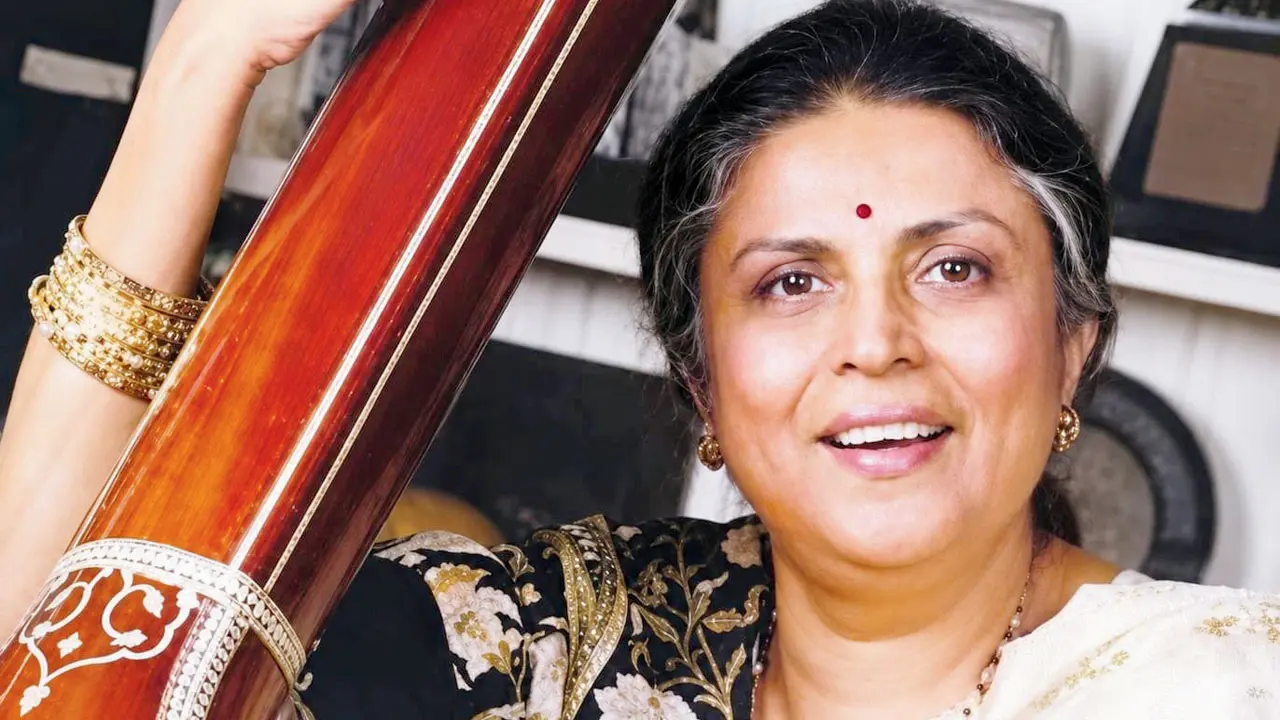
Bella Jaisinghani (THE TIMES OF INDIA; June 1, 2026)
Mumbai: Weeks after Asha Bhosle passed away April 12, India lost another stalwart singer Suman Kalyanpur at age 89 on Sunday May 31. Her voice bore such striking similarity to that of melody queen Lata Mangeshkar that common listeners sometimes mistook one for the other.
Born Suman Hemmady on January 28, 1937, in Dhaka (undivided India), she went on to make a glorious career as a playback singer in Hindi and Marathi apart from a few other Indian languages. Her non-film songs span bhajans, ghazals and Marathi abhang and bhavgeet.
After completing school from St Columba, Mumbai, an artistic Suman enrolled in the JJ School of Art to learn painting. She went on to learn vocal music from Pt Keshavrao Bhole, Ustad Khan Abdul Rehman Khan and Master Navrang.
Her early successes came in two films Shukrachi Chandni and Mangu (1954) followed by a colourful pyramid layered with Sharaabi sharaabi yeh saawan ka mausam, Rahein na rahein hum, Aajkal tere mere pyar ke charche, Na na karte pyaar, Na tum hamein jaano, Parbaton ke pedon par and Nimbonichya zhaada maage. Her duets with Mohammed Rafi peaked in the early 1960s, driven by the Lata-Rafi rift.
As news of her death broke Sunday, NCP leader Sharad Pawar and singer Fayyaz were among the first to express condolence.
Pawar said, "The news of the passing of Suman Kalyanpur is extremely heartbreaking. With her sweet, melodious, and soul-stirring voice, she enriched the world of Indian music. Her immortal songs in Hindi, Marathi, and numerous other regional languages have reigned supreme over the emotional realms of generations. With her demise, the curtains are drawn on an era of gold in Indian classical and light music. I offer my heartfelt tribute to her and extend my condolences to her family."
Suman had married businessman Ramanand Kalyanpur in 1958. She is survived by her daughter Charu Agny and son-in-law Manoj Agny.
--------------------------------------
Narendra Kusnur (MID-DAY; June 2, 2026)
After news of singer Suman Kalyanpur’s death came in on Sunday night, one noticed two common reactions. One was that she was the closest to sound like Lata Mangeshkar, and the other was that she didn’t get the accolades she deserved.
Both responses may be justified, but the fact remains that Kalyanpur had some iconic hits in the 1960s. Even today, songs like Na Tum Hamein Jaano (Baat Ek Raat Ki, 1962), Tumne Pukaara (Rajkumar, 1964), Na Na Karte Pyar (Jab Jab Phool Khile, 1965), and the super-hit Aajkal Tere Mere Pyaar Ke Charche (Brahmachari, 1968) rule radio shows and talent competitions.
The Padma Bhushan awardee passed away in Mumbai at the age of 89, following old age-related issues. Her death comes seven weeks after that of Asha Bhosle, and is thus seen as the definitive end of the Golden Era. Though Kalyanpur is best remembered as a Hindi playback singer, she was also admired for her Marathi bhavgeet and bhajans, Punjabi shabd and wedding songs, and tunes in Bengali, Assamese, Gujarati, Kannada, and other regional languages. Her rendition of the Marathi devotional song, Keshava Madhava, is an audience favourite.
Born Suman Hemmady in Dhaka on January 28, 1937, she moved to Mumbai with her family when she was six. She took formal training in singing and painting. She got an offer from All India Radio in 1952, and sang in the Marathi film Shukrachi Chandni the following year. In 1954, she sang in Mangu and Darwaza.
After marriage, her husband Ramanand Kalyanpur encouraged her to pursue her singing career. The hits came in the first half of the 1960s, with Garjat Barsat, a duet with Kamal Barot in Barsat Ki Raat (1960), the Dil Ek Mandir (1963) title track, Ajahun Na Aaye Balma in Sanjh Aur Savera (1964), and Mere Mehboob Na Ja in Noor Mahal (1965).
During this time, many had noticed how similar Kalyanpur’s voice texture and style of delivery was to Mangeshkar’s, and often listeners found it difficult to differentiate between the two. It began when they sang Kabhi Aaj Kabhi Kal in Chand (1959), but became more noticeable when Kalyanpur got many songs with Mohammed Rafi after his four-year fallout with Mangeshkar in 1964. In Mamta (1966), Mangeshkar was hugely admired for Rahen Na Rahen Hum, and very few people knew the alternate version was sung by Kalyanpur.
She slowed down in the 1970s, and subsequently kept a low profile. In the few interviews she gave, she attributed her destiny for not getting the attention she may have deserved, also saying her songs were dropped from some films. Of course, the melodies she has left behind fill a treasure trove.
Asha Bhosle looked weak at Arjun Tendulkar's wedding reception-Saira Banu
8:21 AM

Samarth Goyal (HINDUSTAN TIMES; April 14, 2026)
The passing of Asha Bhosle on Sunday in Mumbai has left a profound void in Indian music. For veteran actor Saira Banu, the loss is both personal and deeply emotional.
“I had spoken to her during Ramzan, but then I didn’t realise that would be our last conversation. When I heard about her health, it was a complete shock,” she tells us, adding, “I saw a video of her at a function (cricketer Arjun Tendulkar’s wedding in March). She looked so weak. I had never imagined she would become unwell so suddenly.”
Looking back at their early years, Banu, 81, paints a vivid portrait of Bhosle’s warmth. “Lata bai (Bhosle’s sister, late veteran Lata Mangeshkar) sang for me most of the time. But whenever Asha tai recorded for me, she would be in a playful mood,” she shares.
Banu recalls shooting for the 1961 film Junglee, when she was “very young” and her voice was “quite thin”: “While singing (in the recording studio), Asha tai would gesture towards her throat, as if to say that she was matching my softer pitch. It would make me laugh endlessly!”
Beyond the humour, Banu also remembers Asha’s personality, which she believes is the reason behind her legacy. “There was something regal about her presence. She carried herself beautifully,” she says.
“She and Lata bai were like family. Dilip sa’ab (Kumar, late actor and Banu’s husband) and I shared so many moments with them: music, conversations, food. Losing her feels like losing a part of that world. It’s a void that can never truly be filled,” she ends.
I would lie in Asha Bhosle and Lata Mangeshkar’s lap when they would do riyaz-Mumtaz
8:19 AM

Natasha Coutinho (HINDUSTAN TIMES; April 14, 2026)
Singer Asha Bhosle died on Sunday at the age of 92 due to multi-organ failure. With a career spanning over eight decades and 12,000 songs, she left a legacy as one of India’s most versatile voices, transforming music across genres.
Now, recalling her final memory of the singer, veteran actor Mumtaz says, “I rushed when I heard she was hospitalized… I wanted to speak to her, but couldn’t as the doctors informed us she is critical. As I was leaving the hospital a few minutes later, her family called to say she had passed away. The next day I visited her home, and when I saw Asha ji, her face had a certain noor.”
The duo has delivered hits such as Koi Shahri Babu (Loafer, 1973) and Duniya Mein Logon Ko (Apna Desh, 1972). “Asha ji would always tell me the song Aaja O Mere Raja has been the most difficult song of her career because of the voice variations,” the 78-year-old shares.
Sharing personal memories from their days as neighbours in Mumbai’s Walkeshwar, she shares, “I remember lying in Asha ji and Lata (Mangeshkar, Bhosle’s sister and late veteran singer) ji’s lap when they would do riyaz with their tanpura.”
Earlier, Mumtaz had shared a video from Diwali 2023 on Instagram, dancing with the late singer that had instantly gone viral.
“We danced at Asha ji’s home… Jackie Shroff (actor) had egged me on to get her on the floor, but she was shy,” the veteran recalls.
When Asha Bhosle calmed Sanjay Dutt and Urmila Matondkar in the studio
10:50 AM
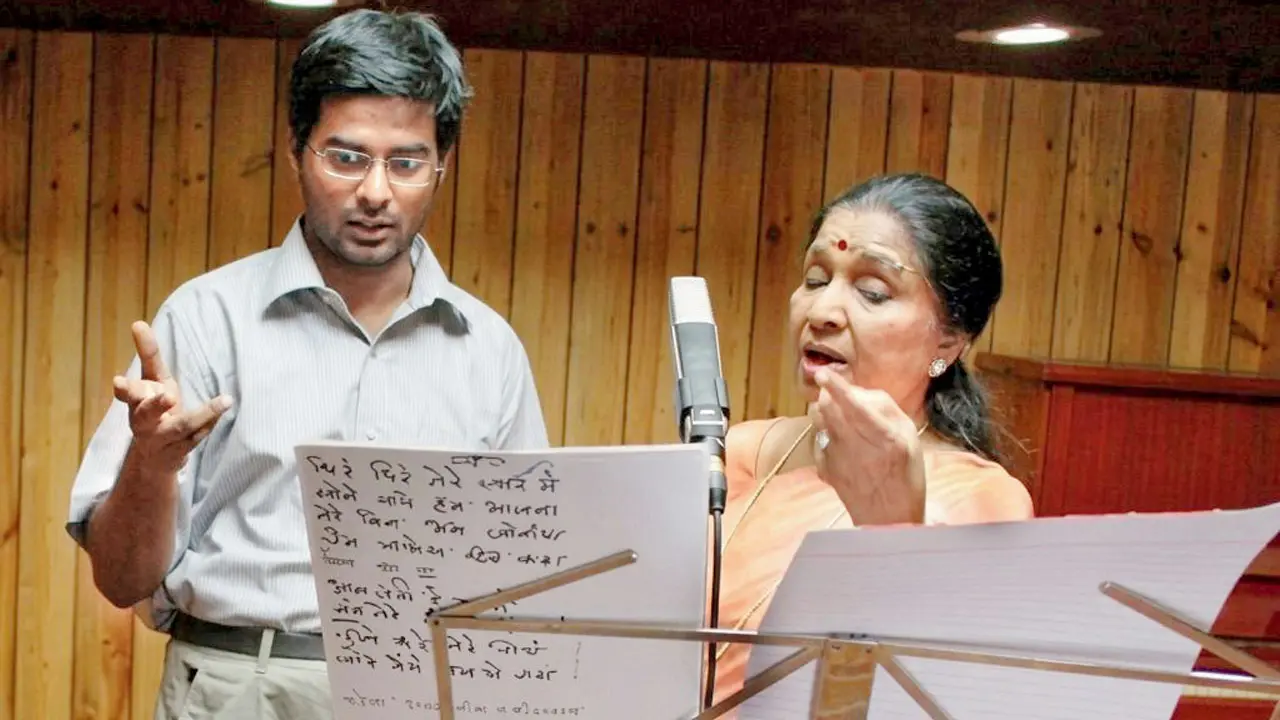
The writer with Asha Bhosle in 2006. Pics/By Special Arrangement
As the world mourns the loss of a legend, journalist and filmmaker S Ramachandran reminisces about the beloved artiste’s lesser-known facets
S Ramachandran (MID-DAY; April 13, 2026)
My first encounter was with Asha tai over three-and-a -half decades ago as a rookie journalist, when she was recording for a Marathi song at a suburban recording studio. When the film’s director realized that I was a journalist, he was perturbed because he thought that I would leak the music of the film, and Tai promptly put her arm around me and said, “To lahan mula aahe. Tu tyachyaavar sanshay kasa gheu shakto?”
And her arm continued to be around me when I directed several music videos with her. Starting with the Aap Ke Dil Mein song with Sanjay Dutt as part of the Asha & Friends album. She would often make fun of me and mimic me pulling up my trousers during the shoot, as I had lost weight by then. She was a terrific mimic, and she even imitated the legendary Sunil Dutt, who was like a brother to her, when she met Sanjay Dutt.
Sanju’s surprise
In fact, how we got Sanjay Dutt to sing for her is a funny story. When we called Sanju and told him that Asha ji would like to speak to him, Sanju thought it was actress Asha Parekh calling him to attend a Cine Artists Association meeting. When he realized it was Asha Bhosle wanting to sing with him, he almost fell off his chair. Later at the recording, she narrated how she had even sung with Sunil Dutt once and put Sanju at ease. She did the same with Urmila Matondkar as well, telling her to calm down and just sing.
A field of her own
That’s the reason why she took on breezy numbers with O P Nayyar, the rocking ones with R D Burman and went on to collaborate a lot with international artistes from Boy George for Bow Down Mister in 1991, Kronos Quartet for You’ve Stolen My Heart, Michael Stipe for The Way You Dream, Code Red for We Can Make It, and finally with Gorillaz for The Shadowy Light in 2026.
Damon Albarn of Gorillaz was a fan of her psychedelic work with Panchamda in the 1970s, and was amazed at her ability to reproduce the same magic at the age of 92.
Culinary prowess
Once we had a 6 am call time for a music video shoot of hers with Urmila Matondkar at Mukesh Mills, Colaba, and she was there at 5.30 am, all cheery and perked up, gobbling up the breakfast she carried from home, also bringing extra for all those working on the shoot. No wonder she had everyone, from Tom Cruise to Amitabh Bachchan, to British boxer Amir Khan, eating out of her hands, be it in the music domain or at her global restaurants. She cooked so well, like her sister, the late Lata Mangeshkar. I have had the fortune of being fed by them and listening to her fun comments on not being able to taste their best dishes, as I am a vegetarian.
Iconic duet
Interestingly, when we were set to sing and shoot a collaborative song with Brett Lee, the Aussie pacer was a bit apprehensive. “My wife is delivering a baby, and I don’t want to be linked to a lady.” Then we showed him Asha tai’s picture and body of work and explained that she was 72 and 43 years older than Brett, who was 29 then. So Brett came in and recorded, and later, when he came to the shoot, she told him, “If you get a son, call him Sachin!” not after Sachin Dev Burman, but her favourite cricketer and Brett’s bête noire, Sachin Tendulkar.
What sibling rivalry?
The legend once spoke to me about the so-called rivalry that the entire industry and fans felt existed between her and her legendary sister. “We sang 80 songs together. How can she be a competitor? She was already a star when I started. How can one have two Taj Mahals? So, I had to pick a niche for myself. In fact, Geeta Dutt was a competitor. I was just her younger sister,” she said.
A perfect symmetry
Incidentally, both sisters passed away at the age of 92 and died four years apart, as their age difference was four years. And both died on a Sunday at the Breach Candy hospital. It is as if fate itself aligned to a perfect symmetry, leaving fans in silence and to play their swansongs — that only their melodies can fill.

Asha Bhosle offers her blessings to then up and coming cricketer Mali Richards, the son of West Indies cricketing great Sir Viv Richards, at the CCI in 2005. PIC/Santosh Harhare, mid-day archives
Javed Akhtar opens up about Asha Bhosle's ‘agni pariksha’ moment
10:45 AM

As told to Upala KBR (MID-DAY; April 13, 2026)
They say that a small tree can never grow under the shade of a big one, but if anyone proved it wrong, it was Asha ji. Lata ji [Mangeshkar] was a goddess [in Hindi playback singing]; no singer could hold their own in front of her. Many singers tried to sing like her. But Asha ji developed her own style of singing and created her own identity. The Mangeshkar sisters ruled the Indian film music industry for over 55 years.
Life experiences create depth, and that was present in both of them. She sang her first song when she was only 10 years old. That means an 83-year career and what an impact she has left!
I will always remember what Ashaji told me once. She said, ‘When you look for happiness in life and relationships, you may be hurt. True happiness lies only in your work. If you think you have done your work well, that will give you true satisfaction.’
Among my favourite songs that I had written for her is Radha Kaise Na Jale from Lagaan [2001]. There is also Kanha Jo Aaye Palat Ke from Sardari Begum [1996]. When I would write the lyrics, I would know that only Ashaji could sing it.
In Rahul Rawail’s film [Aur Pyaar Ho Gaya, 1997], she was to sing a song with Nusrat Fateh Ali Khan. It was a challenging tune, and Asha ji realized it was her agni pariksha. She heard it twice with rapt attention before going behind the mic. When she sang it, Nusrat Fateh Ali couldn’t stop saying, ‘Waah, waah!’
My sister, a star
Javed Akhtar recalled how he interviewed Lata Mangeshkar for a TV channel, where she reflected on her sister Asha Bhosle’s versatility. He said, “Lata ji told me, ‘Asha can sing the songs that I have. Lekin Asha ne jo saare gaane gaye hai, woh saare gaane main nahin gaa sakti’.”
India hums 'Abhi Na Jao Chod Kar' as Asha Bhosle passes away
10:37 AM

PM Modi, celebs such as Shah Rukh Khan, Tendulkar, music fraternity remember iconic singer’s legacy
Rajesh N Naidu (THE ECONOMIC TIMES; April 13, 2026)
Asha Bhosle, whose incandescent voice lit up film screens over more than seven decades, died in Mumbai on Sunday.
Prime Minister Narendra Modi called her “one of the most iconic and versatile voices India has ever known.” Her voice had a “timeless brilliance” that elevated soulful melodies and vibrant compositions, he said.
Bollywood star Shah Rukh Khan described her voice as “one of the pillars of Indian cinema” and would continue to resonate around the world for centuries. Filmmaker Ram Gopal Varma said her voice gave Rangeela (1995) “an immortal soul and raw, youthful fire.” The title track Rangeela Re was a thunderclap that shook Bollywood, he said.
Cricket great Sachin Tendulkar called it “a deeply sad day for India, and for music lovers across the world,” saying time itself seemed to have paused, though her eternal songs would keep her timeless forever.
Ashalata Dinanath Mangeshkar was born September 8, 1933, making her debut as a singer in the Hindi film industry in the film Chunariya in 1948 at the age of 15. Three women dominated female playback singing at the time — her sister Lata Mangeshkar, Shamshad Begum and Geeta Dutt. Against this backdrop, carving out a niche was an almost insurmountable challenge. But she was undaunted, trekking from one studio to another, meeting one music director after another. She began to sing in low-budget films such as Madari (1950), Titli (1951) and Thokar (1953).
Range & Versatility
“Lata ji never reduced her fees. This fact worked in Asha ji’s favour. Music directors who could not afford Lata ji’s fees collaborated with Asha ji,” said veteran music critic Rajiv Vijayakar.
It was in 1957 that the turning point came in the form Naya Daur, when music director O P Nayyar brought out the best in her on an upbeat soundtrack brimming with hits, showcasing her vocals alongside those of Mohammed Rafi. She and Nayyar would go on to collaborate on other hit musicals such as Tumsa Nahin Dekha (1957), Howrah Bridge (1958), Kashmir Ki Kali (1964) and Mere Sanam (1965).
Life at this point was turbulent on other fronts as well. She married Ganpatrao Bhosale when she was 16 but that wasn’t a happy union, forcing her to become a single parent to three children. Later, she went on to marry R D Burman in 1980.
What made Asha Bhosle stand out were her sheer range and versatility, giving voice to a world of infinite possibilities. She could be the innocent, the nautch girl, the vamp, and, most memorably, the tawaif, delivering an outstanding performance on the Umrao Jaan soundtrack (1981).
Long Career
In a career spanning more than 78 years, she excelled in almost every emotion, sentiment, mood or genre of Hindi film music, whether it was the cabaret song Piya Tu Ab To Aaja from the film Caravan (1971), the ghazals of Umrao Jaan, or the poignant classical song Mana Anand Bhayo in Vijeta (1996). She gave her voice to actors ranging from Madhubala, Vyjayanthimala and Asha Parekh to Mumtaz, Helen, Zeenat Aman, Rekha, Urmila Matondkar, Kajol and Madhuri Dixit.
Among her international collaborations, one of the last was her appearance on the Gorillaz album, The Mountain, released earlier this year. She also collaborated with Michael Stipe of rock band R.E.M. on the 2002 track The Way You Dream and with Boy George in 1991 for Bow Down Mister. Incidentally, UK band Cornershop’s tribute, Brimful of Asha, became a hit in the late 1990s after a Fatboy Slim remix.
“The range and versatility of Asha ji’s singing is unmatchable,” said Lalit Pandit of the music director duo Jatin-Lalit. “In playback singing, there are two types of singers — one who has a melodious voice and sings what a music director has created. But an artiste like Asha ji added new dimensions and nuances to songs. In the song Zara Jhoom Loo Main (Dilwale Dulhania Le Jayenge, 1995), just listen carefully to how she sings the words ‘thandi thandi pawan.’ It is her contribution. It took the song to another level.”
This ability to add subtle detailing became a hallmark of her career. Her collaboration with music director R D Burman in films such as Teesri Manzil (1966), Caravan (1971) and Ijaazat (1987) would spawn all-time classics Aaja Aaja, Daiyya Main Kahan Aa Phasi and Mera Kuch Saaman.
These underscored not only her vocal range but her intricate understanding of music. In fact, the initial inspiration for the composition of the song Mera Kuch Saaman from Ijaazat came from her own humming of the lyrics written by Gulzar.
Music composer Anu Malik, who had a long association with Bhosle, recalled how helpful she was to a newcomer.
“I was only a 17-year-old teenager when Asha ji helped me,” Malik said. “She was at the peak of her career in the 1970s, working with all great directors. But she made time and met me. She sang my first song in the film Hunterwaali (1977). She gave me so much love and affection like her son. This shows her greatness as an artiste who had empathy and care for people around her.
Beyond film music, Bhosle was known for her ghazal collaborations with the legendary Ghulam Ali as well as with Hariharan.
Contemporary Voice
“One of the best qualities in Asha ji was that she always kept with the times,” shares veteran playback singer Udit Narayan. “There are singers whose voice quality deteriorates as they age or reach the last leg of their career. But Asha ji’s voice was always contemporary. This is the mark of a great artiste who represented not just music but the history of Indian cinema.”
Comparisons between the two Mangeshkar sisters were natural but weren’t really justified. “Both sisters must not be compared. Both represent history in different ways. In every field there are comparisons between two great people, whether it is Sachin Tendulkar or Sunil Gavaskar, or singers Pankaj Mullick and K L Saigal,” said Gujarati novelist and former music critic Anil Rawal.
“Both are great and provide a long and sumptuous thali of exquisite and diverse emotions to listeners.”
Bhosle sang more than 12,000 songs for more than 1,000 Hindi films. In addition to this, she sang in 20 Indian and foreign languages. She was awarded the Padma Vibhushan in 2008. Besides this, she won six Filmfare Awards for singing and two National Awards. She received the Dadasaheb Phalke Award in 2000.
-------------------------------------------------------
Avijit Ghosh (THE TIMES OF INDIA; April 13, 2026)
Asha Bhosle, whose voice foregrounded the rebellious notes of desire and abandon in Hindi film music at a time when such attributes were frowned upon in cinema and society, who overcame the looming shadow of her peerless sister Lata Mangeshkar to become the empress of a versatile music universe, and whose voice is sub-consciously part of every Indian's emotional archive, passed away on Sunday. She was 92.
Asha tai, as she was fondly called, was admitted to a Mumbai hospital on Saturday following exhaustion and chest infection.
A Dadasaheb Phalke recipient, her career spanned nearly eight decades and more than 11,000 songs; her best rendered under the baton of O P Nayyar and R D Burman.
Rollicking duets (especially with Kishore Kumar), bhajans, ghazals, qawwalis, discos, Indi-pop, Bhosle didn't just sing for every possible genre, she owned them all, enthralling Gen Now and Gen Nehru alike. "All singers are actors. We just act with our voices," she once said.
Her voice was an ideological antonym of her sister's. At its core, Lata's voice personified decorum and goodness, attributes tailor-made for decent leading ladies in the 1950s and 60s while Asha's embodied dissent created space for celluloid social outsiders such as cabaret dancers and gangster's girls.
Nobody also adapted better to the changing trends. And nobody defied age like her. It's scarcely believable that even in 2026, she collaborated with Gorillaz, a virtual British band. An era has ended. But Asha Bhosle is forever.
-------------------------------------------------------
Avijit Ghosh (THE TIMES OF INDIA; April 13, 2026)
Societies clinging to the past while dreaming of the future are often trapped in a duality. India, just out of the clutches of colonialism, too experienced this. The nation’s attitude to the female playback voice was complicated. After all, voices are secret catalogues of social history.
Around Independence, several singers such as Zohrabai Ambalewali, Rajkumari, Amirbai Karnataki, Shamshad Begum, Geeta Dutt, jostled for space and ascendancy in Hindi film music. But within a few years, Lata Mangeshkar’s voice encapsulating purity and propriety became the gold standard.
Asha Bhosle, almost four years younger, began her career under the shadow of her elder sister Lata. Keen to find her own voice, the Sangli-born singer listened to a farrago of foreign artistes: samba singer Carmen Miranda, the joyous Caterina Valente, even the breathless Elvis Presley. “Slowly,” Asha revealed in an interview to composer Salil Chowdhury on DD Bangla in 1993, “I carved out a different style from my sister.”
In time, the two became antonyms to each other. Lata’s voice had the innocence of a morning hymn, the sanctity of a temple while Asha’s evoked the sizzle of cabaret, the rush of a French kiss. “Lata didi and I are like Mahatma Gandhi and Nehru. Gandhi was great; Nehru wasn’t bad either,” Asha told Outlook magazine in April, 2006.
The sisters were fundamentally apart, even in their choices and their personalities. She thinks with her “head”, me with my “heart”, Asha once said. Perhaps, circumstances played a role. Lata started singing for films at 13 after their father singer-actor Deenanath Mangeshkar’s untimely demise. She never married. Lata disapproved when Asha eloped.
In the 1950s and 60s, Asha wasn’t the preferred singer of most A-list music directors, barring OP Nayyar. She was rarely the playback for major heroines. She once credited BR Chopra for giving her the chance to sing for a big movie, Dilip Kumar’s ‘Naya Daur’ (music: OP Nayyar, 1957).
By mid-60s, Asha had carved out her distinctiveness. Her range expanded. And her voice was richer in tone, more nuanced in texture. Three songs exemplify this. ‘Aagey bhi jaane na tu’ (Waqt, composer: Ravi, 1965) underlined a felicity for aligning each note with the lyric’s emotional intent. In ‘Teesri Manzil’ (1966), young composer R D Burman rewrote film music grammar, capturing the new musical zeitgeist. In ‘Teesri Kasam’, set in hinterland Bihar and released the same year, her rendition of ‘Pan khaye saiyan hamaaro’ was flawless flavouring the film with a folksy authenticity. The three belonged to three different musical worlds.
Music director R D Burman, whom she would marry in 1980, “really exploited the full potential of my voice and challenged me to greater heights,” she told journalist Kavita Chhibber in a long 2003 interview. “When he offered me Aaja aaja, I was petrified…but didi said you are a Mangeshkar and you can do it.” The remark reveals how Lata was also a mentor despite their differences.
Broadly speaking, R D preferred Lata for his more classical compositions. But the nightclubs with cigarette smoke and the grungy hippy joints were Asha’s fiefdom. These settings were home to some of the most furious and distinctive 70s rhythms. ‘Mera naam hai Shabnam’ (film: Kati Patang, 1970), ‘Piya tu ab to aaja’ (film: Caravan, 1971), ‘Dum maaro dum’ (film: Hare Rama Hare Krishna, 1972) and many more.
In 1981, ‘Umrao Jaan’ (music: Khayyam) became to Asha what films like ‘Anarkali’ and ‘Pakeezah’ were to Lata. Her voice became an extension of the courtesan’s melancholic life. “Through her voice, you reach Umrao Jaan’s soul,” Khayyam told this reporter in 2008.
Compared to Lata, Asha was more eager to embrace and adapt to shifting music trends. Hers was the sensual voice that the more conservative India sought to consign to the background. But as the country changed and evolved, she found wings. In 1980s, when disco was the celluloid favourite and ghazals the flavor of private albums, she sang ‘Disco Station’ for Bappi Lahiri (film: Hathkadi, 1982) and outshone Pakistani singer, Ghulam Ali, in Meraj-eGhazal (1983). And when Indi-Pop took centre stage in the 1990s, she delivered one of its most memorable tracks, “Jaanam samjha karo (1997).”
Much before the two sisters reached the autumn of their careers, Asha had become the preferred voice for a new generation of singers. She was their lighthouse and lodestar. Whether we like Asha or Lata has more to do with the person we are rather than the songs they sang. We see in their voices our own reflections. For true lovers of music, it is never Lata or Asha; it is always both.
-------------------------------------------------------
The most prolific recorded artiste ever, songstress from Mangeshkar clan mastered a range of genres and held millions in thrall with her sensual, exuberant voice
Bella Jaisinghani (THE TIMES OF INDIA; April 13, 2026)
Exemplary singer Asha Bhosle, whose life quilt was woven by skeins of struggle and triumph, passed away at age 92 Sunday. The evergreen artiste breathed her last at Breach Candy Hospital, a day after being hospitalized for cardiac and respiratory ailments.
An innocuous “chance” given to her by All India Radio at the age of 15 led into a career spanning 11,000 songs, the final flourish being a three-hour concert at age 90.
Her son Anand Bhosle said the final rites will be performed at Shivaji Park crematorium at 4pm Monday April 13 with full state honours. Members of the public can pay respects from 11am to 3pm at her residence Casa Grande in Lower Parel.
Born Sept 8, 1933 in Sangli to noted Natyasangeet exponent Pt Deenanath Mangeshkar and Shevantibai, Ashaji defied the adage that nothing grows beneath the shade of a vast banyan tree. She blossomed into a robust musical persona despite the abundant talent and fame of her older sister, legendary singer Lata Mangeshkar. “It is the sapling’s will to grow that helps it sprout,” she said.
Their rivalry became a frequent topic of conversation down the years. Siblings Meena, Usha and Hridaynath Mangeshkar were also stalwart artistes who bonded firmly as India’s first family of playback singing.
Financial compulsions initially forced Asha ji to accept songs that Lata ji declined -cabaret numbers, and songs picturized on the lead heroine’s sister or friend, dancer and vamp. But that turned out to be a blessing in disguise as Asha ji’s full plumage of vocals unfurled before the nation. Her partnership with Helen is history.
In her heyday she recorded seven or eight songs, flitting between studios, languages and genres. Old visuals of her recording in a pastel cotton sari with a flower in her hair slowly graduated to beautiful silken saris with similar coloured faux blossoms as the years wore on.
Diverse composers like Madan Mohan, O P Nayyar, Kalyanji Anandji, Laxmikant Pyarelal, R D Burman and Khayyam, and Marathi music directors Shridhar Phadke and Hridaynath Mangeshkar partnered her journey. Between her early hits like ‘Aaiye meherbaan’ to ‘Tora mann darpan kehlaye’ and ‘Sapna mera toot gaya’ to the memorable Umrao Jaan ghazals, everything in between was as consequential.
The in-house Mangeshkar pool of talent also created a fragrant bouquet of melodies. Ashaji laughingly recalled how she felt shy to sing ‘Tarun aahe raatra ajoon’, a beautifully erotic Marathi bhavgeet composed by her brother Hridaynath ‘Bal’ Mangeshkar. Son Hemant Bhosle tuned the whisperlike ‘Jaage jaage nainon mein’ for her in Damaad.
However the stairway to heaven was paved with gold and rocks both. Asha ji was candid about the numerous setbacks she suffered in her personal life including domestic abuse by her first husband Ganpatrao Bhosle, whom she eloped with and married as an impressionable teenager. Her liaison with composer O P Nayyar ended in bitterness while her second marriage to R D Burman was no bed of roses either.
“Irrespective of all the ups and downs I was facing in my personal life, the moment I stood before the microphone, I shut that out of my mind and concentrated solely on the song I had to deliver. There were days my children were sick but I had to come to the studio and sing a peppy or romantic number. God gave me troubles but he also gave me the strength to overcome them. I have worked hard. Very hard,” she said in an interview to Doordarshan.
Shreya Ghoshal’s tribute to Lata Mangeshkar moves Mumbai
9:55 AM

Debarati S Sen (BOMBAY TIMES; March 9, 2026)
Paying tribute to a legendary singer with an 80-year career spanning nearly 45,000 songs is no easy task. Yet, that is precisely what Shreya Ghoshal achieved at her concert Letters To Lata Didi held at Jio World Garden on Saturday night. The evening was unlike the typical large-scale concert spectacle. There were no confetti bursts, fireworks or pyrotechnics; only pure music, delivered straight from the heart. With no costume changes and no breaks, she sang non-stop through more than 50 songs, each unfolding like a musical letter to the timeless legacy of Lata Mangeshkar, whose voice defined generations of Indian cinema and music.
“Aaj ki yeh shaam mere liye sabse khaas hai”
She opened with a traditional Ganesh vandana, followed by the classic Aayega Aanewala. Setting the emotional tone for the evening, Ghoshal addressed the audience
“Aaj ki yeh shaam mere liye sabse khaas, most important, sentimental and emotionally close to my heart evening hai. And main shayad kitni bhi tayaari kar loon, aaj ke din ki tayaari poori nahi hai. I think you will sense my vulnerability my emotion today. We are all here celebrating the legacy of Maa Saraswati, hamari pyari Lata Didi. This tribute is from all of us fans, from me and the musicians and isko sametne ke liye humne yeh ek zariya apnaya hai. Didi ko hum itna upar rakhte hain, unka jo sthan bhagwanon ke jagah hai. Hum sab fans ke taraf se hai yeh show and iss legacy ko celebrate karne ke liye aap sab saath mein gaiyega zaroor. I am sure Didi is smiling upon us from the heavens.”
Memories, music and ‘letters’
The evening’s narrative unfolded through music interspersed with audio-visual segments featuring messages and memories from people who knew and worked closely with Lata Mangeshkar. Tributes from Nitin Mukesh, Anandji Shah (Kalyanji-Anandji), Prasoon Joshi, Sachin Tendulkar and Prakash Peters added a deeply personal dimension to the concert. Shreya also shared memories of how Lata Mangeshkar’s voice shaped her own musical journey since childhood.
“Uss choti si ladki ko zara bhi andaza nahi tha ke yehi woh awaaz hai jo uska haath thaamkar usse uske aane wale kal ki oor le jayegi. I was too young but Lata Ji ke awaaz ne mujhe iss tarah khincha ki maine music se pyaar karna shuru kar diya. We formed a spiritual bond, that’s the asar of her voice. Karodo Bharatiyon ki tarah maine unhe sunne se zyada mehsoos kiya. Aur inn jazbaaton ko hum sabne jiya hai, lekin shayad unhe poori tarah jata nahi sakein. Toh aaj ki yeh shaam unhi unkahi baaton ko inn khaton ke zariye aapko samarpit karte hain.”
The first meeting with Lata Didi
The singer also recalled her first meeting with Lata Mangeshkar in 2005. “I was recording in her studio and she came there. I ran down to meet her and when she saw me, unhone mujhse kaha, ‘Tum Shreya ho na?’ Main unhe kuch bhi nahi bol payi. I was so stunned, meri bolti bandh ho gayi. Uss din main unse mil nahi rahi thi, mujhe uss din Lata Didi ke darshan ho gaye the. Uss waqt kuch nahi sujha, main thank you bhi nahi bol payi. Aaj mujhe Didi ko thank you bolna hai, for the soul, music you were for me.”
Choosing from a legendary repertoire
Selecting songs from Lata Mangeshkar’s vast repertoire proved to be one of the biggest challenges confessed Shreya. “Today, we are trying to cover all the eras of Lata Didi’s blockbusters,” she said.
“There are songs with so many composers including S D Burman, Laxmikant-Pyarelal, Kalyanji-Anandji and so many hit duets with the likes of Mohamad Rafi, Kishore Kumar. She worked with Laxmikant-Pyarelal for around 35 years and sang around 700 songs with just them. There are so many eras of her songs, her repertoire is simply massive. Ek se ek behtareen gaane hain unke. Main kya chunu? Finally, we just had to pick chits of which ones to sing!”
Introducing the song Aa Jaan-E-Jaan, she noted with a smile, “This was probably the only cabaret that Lata Didi ever sang. If you listen to this song you will realize that even in a cabaret there can be so much divinity, spirituality and itna apnapan and pyaar, even though it is a seduction song.” The evening featured several Lata Mangeshkar duets performed with singers Javed Ali and Kinjal Chatterjee.
A feminist inspiration
Speaking on the eve of International Women’s Day, Shreya highlighted Lata Mangeshkar’s enduring influence beyond music. “Lata Didi has always inspired us. Woh sabse badi feminist hain and tomorrow we are celebrating Women's Day. She has inspired us not just as a musician but also as a human being, living by her own terms. She gave us a sense of purpose. Aisi kitni auratein thi 40s, 50s and 60s ke daur mein jinhone kitna kuch iconic kiya.”
Music in its purest form
More than 40 musicians performed live on stage, including the UAE Philharmonic Orchestra and a choir, recreating the grand orchestral feel of the golden era of film music. Praising the ensemble, Ghoshal said, “Aaj lag raha jaise Lata Didi ke recording studio mein sab kuch live hota tha, waise hi hum conductor ke haath pe tike hue hain. I feel all this energy is very much missing in today’s film music.”
Among the distinguished guests present were members of the Mangeshkar family, Nitin Mukesh, Anandji Shah and Shantaben, Sonu Nigam, Prasoon Joshi, Kumarmangalam Birla, Dr Neerja Birla, Virender Sehwag and Anjali Tendulkar.
After the concert, Usha Mangeshkar was invited on stage and blessed the singer. “Aaj mere samne sirf Didi dikh rahi hai aur uski awaaz aa rahi hai mere kaon mein. Bachpan se main Didi ke saath recordings mein jaati thi, aakhri gaane tak. Ek ek cheez yaad aa raha hai. Bahut accha gaya Shreya. Bhagwan aapko hamesha Didi ka ashirwad zaroor denge!”
A standing ovation for the finale
As the evening drew to a close, Ghoshal performed songs such as Lukka Chuppi, Ae Mere Watan Ke Logon, Naam Gum Jayega and Rahein Na Rahein Hum.
For the final song — which she described as “a hug from all of us to Lata Didi” — the audience switched on their phone flashlights as she sang the immortal Lag Jaa Gale. Overcome with emotion, Ghoshal teared up on stage as the crowd rose to its feet in a standing ovation.
Palak Muchhal is the torchbearer of industry’s music legacy-Mithoon
9:46 AM

Natasha Coutinho (HINDUSTAN TIMES; January 28, 2026)
Music director-composer Mithoon, an introvert, admits performing on stage isn’t easy despite a 20-year career. “I’ve never been much of a stage artiste. I’ve been making music for 20 years but never been comfortable on stage,” he says.
“Only recently have I developed a specific sound for my band, and I’m not competing with any artiste. When the audience sees an artiste live, it’s an intimate experience, that’s the vision I want to give them.”
When asked if India’s booming live music scene influenced him, Mithoon says, “No. It’s more of an internal journey of being prepared that happened to coincide with the boom, but I’m happy live music is being celebrated in the country.”
He adds, “The audience understands, and many introverts present in the audience enjoy the music along with me. What they appreciate is honesty. It’s ‘main jaisa hoon, aapka hoon.”
Mithoon says he and wife, singer Palak Muchhal, keep work talk out of their home. “She’s a busy professional herself. We do riyaz together and discuss some musicality, but we keep work sanctified.”
Calling himself her biggest critic, he adds, “Since the time she sang the female version of ‘Meri Aashiqui Tum Hi Ho’ (Aashiqui 2), I’ve always believed in her potential and have been demanding of the level I expect from her,” Mithoon says.
Praising her, he adds, “There’s an unsaid legacy led by Lata ji (Mangeshkar), Kavita ji (Krishnamurthy), Alka ji (Yagnik), Shreya (Ghoshal), Palak belongs there on her own merit, she is the torchbearer of the music industry’s legacy.”
Meanwhile, brother-in law Palaash is currently making news for taking the legal route to deal with a cheating and financial fraud case initiated by former fiancee and cricketer Smriti Mandhana’s friend, Vidnyan Mane. Mithoon however chooses to steer clear of the controversial subject.
My unconventional voice became my biggest strength-Madhubanti Bagchi
10:23 AM

Following up her smash hit ‘Aaj Ki Raat’ with the latest song from ‘Thamma’, Madhubanti Bagchi on breaking into the industry with an unusual voice and dance numbers
Priyanka Sharma (MID-DAY; October 13, 2025)
When Tamannaah Bhatia dazzled in Aaj Ki Raat from Stree 2 (2024), it promised a resurgence of special dance numbers. The popular song also guaranteed something else — the breakthrough of a unique voice, Madhubanti Bagchi. Even though she had been singing Hindi film songs since 2019, it took Sachin-Jigar’s composition to mark her arrival. Now that she has reunited with the composers for Tum Mere Na Huye, a dance song in Thamma, mid-day speaks to her about new fame, fear of typecasting, and the challenge of having an unusual voice. Excerpts from the interview.
Tum Mere Na Huye marks another collaboration with composers Sachin-Jigar. What was their brief for the song?
They wanted the song to be intimate yet cinematic, something that would not just complement the narrative of Thamma, but also stand strong as an individual piece of music. Sachin-Jigar added their signature depth to the composition, ensuring that every note had its own space to breathe. For me, the challenge and joy were to bring that vision alive vocally.
Your collaboration with them is turning out to be solid — first Aaj Ki Raat, now the Thamma song.
Working with Sachin-Jigar has always been a creatively fulfilling experience. Aaj Ki Raat gave us a chance to explore a high-energy, dynamic sound. With the Thamma track, we ventured into a space that is far more emotional. That contrast speaks volumes about their versatility. What I admire most is how they bring out the best in every singer. They know exactly how to guide you, yet give you the freedom to interpret and make the song your own. With them, it never feels transactional, it feels like a true collaboration.
You’ve emerged as one of the most sought-after voices in Hindi cinema. How validating has it been to experience this rise?
It feels gratifying and quite humbling. Every singer dreams of their voice reaching millions, but when filmmakers and composers of such calibre trust you repeatedly, it becomes the highest form of validation. What excites me most is the diversity. I’ve lent my voice to some of the most popular leading ladies of today. To adapt my singing to bring alive their emotions on screen has been a challenge as well as a joy.
Your rise is also special because your voice is unconventional for Hindi playback. Was it difficult to get the big break?
It’s true that my voice is different from the usual palette in Hindi playback. Breaking in wasn’t instant, there were moments of doubt. But I always focused on staying true to my sound rather than fitting into a mould. What helped was finding the right collaborators — composers like Sachin-Jigar, Pritam da, and Amit Trivedi, and filmmakers like Sanjay Leela Bhansali, who were willing to experiment and give my voice space to tell the story authentically. Once that alignment happened, things started clicking. In the end, I feel fortunate that what initially seemed unconventional became my biggest strength.
Having voiced dance numbers one after another, do you fear getting typecast?
I’ve had several dance numbers, but each one has its own personality. At the same time, I actively seek out projects that challenge me vocally. I have sung in Heeramandi [2024] and Coke Studio. Rather than fearing typecasting, I focus on growth and experimentation.
Your singing influences in Hindi cinema?
Begum Akhtar for her depth and mastery in ghazals, Lata Mangeshkar and Asha Bhosle for their range and timeless appeal and Arijit Singh for redefining contemporary playback with his emotive singing.
I'm far from done. There's so much to learn, so little time, says Asha Bhosle on her 92nd birthday
9:23 AM

Asha Bhosle with a young A R Rahman
Renuka Vyavahare (BOMBAY TIMES; September 8, 2025)
Beginning her musical journey at the tender age of 10, Padma Vibhushan Asha Bhosle has built an illustrious career spanning over eight decades. A force to reckon with, she is celebrated for her immense talent, versatility, and, above all, her remarkable ability to adapt and evolve with the times. A Guinness World Record holder for being the most recorded artist in music history, Asha Bhosle's enduring legacy is not just rooted in her distinct voice or range—but in the indomitable spirit that continues to define her and her longevity. As she turns 92, she opens her heart, reminiscing about a legendary journey and the timeless landmarks along the way in a heartfelt exclusive with Bombay Times.
'Quite contrary to my public image, I am reclusive'
I am 92-years-old and I take this opportunity to thank all my well-wishers who have supported me in my long journey. Had it not been for your love, I wouldn’t have made it this far. Every time I hear your applause, it pushes me to go further and test uncharted territories in this vast ocean of music and art. Quite contrary to my public image, I am reclusive at heart. I am shy to discuss my achievements because I have so much more to learn in so little time.
'Cinema’s popularity brought an end to the golden era of theatre'
Prior to the advent of cinema (silent cinema then talkies), the only public entertainment platform was theatre. My wonderful actor, singer, composer and writer father, Master Dinanath Mangeshkar owned his own travelling theatre company. I, along with my four siblings (Lata Mangeshkar, Usha Mangeshkar, Meena Khadikar and Hridaynath Mangeshkar) travelled with the theatre company all over India where my father performed these grand musicals to a rapt audience. Therefore, I grew up in an atmosphere of music and the performing arts. It was great that Dadasaheb Phalke laid the foundation of cinema in India but as cinema rose to prominence over the years, our theatre company sadly folded. Soon after, my father passed away in 1942 at the height of The Quit India Movement.
'Looking back: How my journey began'
In 1943, World War II was raging in Europe and that’s when I recorded my first Marathi song at the age of 10. Around this time the Battle for Stalingrad in Russia was in full swing. My first record label read ‘British India’. World War Two era was one of rationing and hardships and we often slept on empty stomachs. I remember attending a political rally at Shivaji Park in Mumbai where I first saw Mahatma Gandhi and I was very impressed by his speech and other leaders such as Jawaharlal Nehru, Sardar Patel and Abdul Ghaffar Khan. The partition of India in 1947 was a painful experience for many Indians, but we managed to live through that as well.
‘Sometimes I recorded as many as seven songs a day’
When I moved to Mumbai, (then Bombay), the British had left it in pristine shape. It was a grand city, and I was in awe of it. I loved travelling on trams, trains and buses hopping from one studio to the next. Working in the emerging music industry (termed Bollywood today) was full of new experiences. As people heard me sing, more work came my way. Sometimes I recorded as many as 7 songs a day. Years later, I was informed that I had got a mention in the Guinness World Records as the most recorded artist (around 11,000 songs). Honestly, I did not work to break any records.
‘My husband Rahul Dev Burman was the finest musical genius of our times’
Music evolves every decade or so. According to me, the first music composer who brought a new exciting western sound to Hindi cinema was C Ramchandra. He experimented with Rock and Roll and took a leaf out from Bill Haley and Elvis Presley’s style of music. Suddenly, that was a rage, and I adapted to this western style to keep up with the times. Then came OP Nayyar with his rustic Punjab folk music sound which went through the roof. I adapted to this style as well and remained relevant. Post O P Nayyar, came the finest musical genius of our times; my late husband Rahul Dev Burman (a prince by birth from the royal family of Tripura, but an Emperor by his deeds). RDB’s revolutionary style of compositions, sound, technique are admired even today. R D Burman passed away in 1994 and a year later in 1995, another musical genius A R Rahman unleashed a fresh new brilliant sound on an unsuspecting audience through Rangeela. When I sang Rangeela Re and Tanha Tanha Yahan Pe Jeena for him, I was 62 years old! I thank ARR for bringing the best out of an elderly person.
'Dekhi Zamane Ki Yaari, Bichhde Sabhi Bari Bari'
I take this opportunity to remember the wonderful singers that I have worked with…my older sister Bharat Ratna Lata Mangeshkar, Padma Shri Mohammed Rafi, Shri Kishore Kumar, Shri Manna Dey, Shri Mukesh, Shri Hemant Kumar, Smt Geeta Dutt, Smt Shamshad Begum and the list goes on. I shared a great rapport with them, not only as colleagues but also as close friends. I recall one common factor between all these great artists - they were all simple human beings without a nasty bone in their system. Unfortunately, most of my close friends and colleagues have passed away and I mourn their loss, a void that can never be filled. On this note, I recall Rafi Saab’s famous song; composed by the late Sachin Dev Burman and penned by the late Kaifi Azmi Sahab…Dekhi Zamane Ki Yaari, Bichhde Sabhi Bari Bari…!
'I am not done yet'
Since my name is Asha (hope), I would like to conclude by saying, I am not done yet. On 12th Sep ‘25, a song sung by me with a very popular British Band shall be launched. I am happy to say that whenever musical boundaries were being broken, I remained the common thread for experimentation by all these great composers of extraordinary calibre. I’m proud to see the growth of my granddaughter Zanai, who is a music composer, writer, singer, classical dancer and an actor. As Mr. AR Rahman recently remarked; that my family (Mangeshkar / Bhosle / Burman) has done nothing but music for 4 generations. He went on to add that this family knows nothing other than music. I take that as a compliment.
I was told to look like a blonde cabaret singer, but I walked in wearing a saree-Usha Uthup
8:50 AM
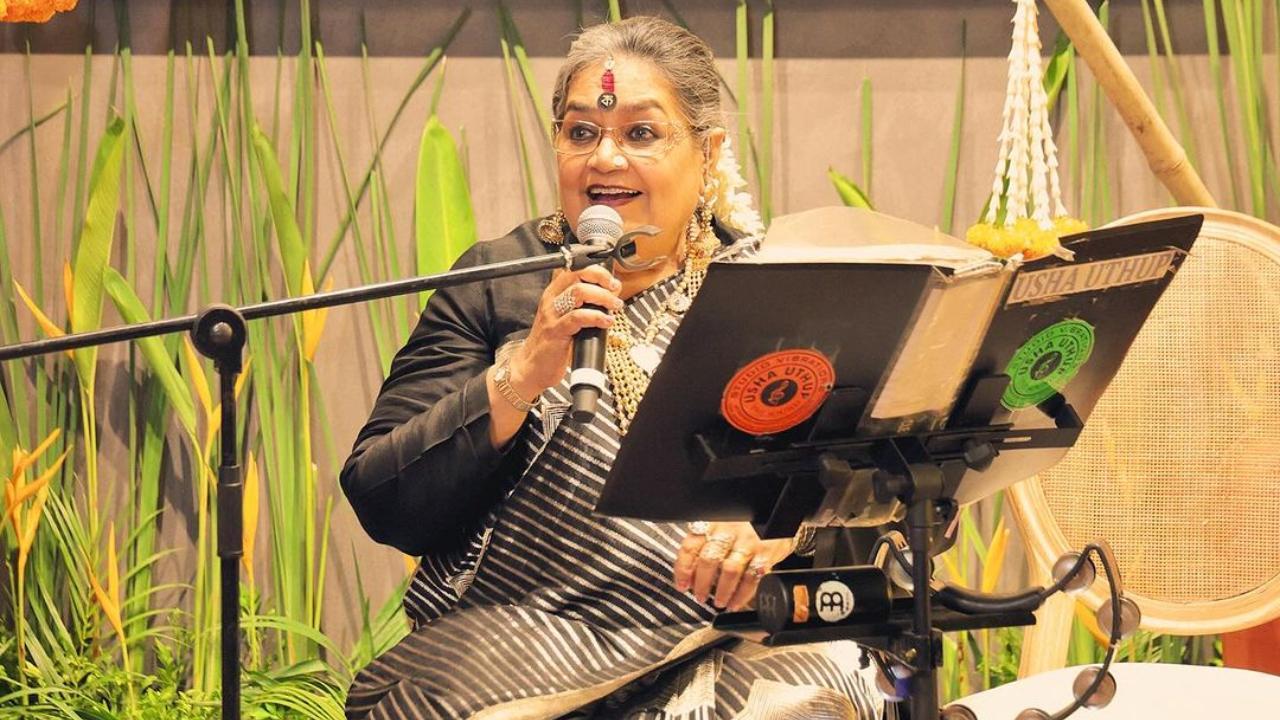
Debarati S Sen (BOMBAY TIMES; July 12, 2025)
From the nightclubs of 1960s Mumbai to prestigious international stages, Usha Uthup has never needed glitter or gimmicks to command attention. With her powerful, genre-defying voice and signature Kanjivaram sarees, she stood tall – and sang louder – than many around her. In a conversation with Bombay Times, the veteran singer talks about identity, resilience, and how music continues to keep her soul alive. Read on…
With a voice that didn’t fit the mould and a look that defied trends, you’ve broken barriers. Looking back, what gave you the courage to be unapologetically yourself?
Honestly, it all came down to my middle-class upbringing. Back then, there was no Instagram, WhatsApp, fashion shows or stylists. I just wore what I had. When I started singing in Mumbai’s nightclubs around 1969, the expectation was that a nightclub singer should wear glamorous gowns, have blonde hair, and carry that typical Western image. And then I walked in, this gharelu girl in a saree. The contrast worked in my favour. It wasn’t planned or strategic. I didn’t know anything about branding or presentation. I was just being myself.
I never felt pressured to sound a certain way: Usha Uthup
Thank God for the sarees it gave me a unique identity. Things moved slowly back then, not like today’s times of instant fame. I wasn’t part of the film industry or trying to be Lata ji or Asha ji. I was simply a live performer, singing in nightclubs and concerts. So no, I don’t have a hard-luck story. I’ve been fortunate. My voice may not have fit the mould, but my timing was right, and I truly believe the song is always bigger than the singer.
Did you ever feel pressured to sound a certain way or conform to industry expectations?
No, I never felt pressured to sound a certain way, and I never gave in to any kind of pressure. There’s peer pressure, family pressure, societal expectations, but at the end of the day, the decision is always yours. Yes, there are moments when you may feel pushed, but you still have the power to say yes or no. That’s something I’ve learned over the years, and it’s a message I try to pass on, not just to my children, but to everyone.
What role did music play in shaping your life, thoughts, personality and other passions?
Music is something I need. It’s not just about listening to it, I believe it’s about living it. I truly can’t imagine my life without the stage. That’s where I come alive. Music is in my blood, and performing is like breathing to me. All I ever ask for is the strength and energy to keep doing what I love. Music truly flows, and I believe, just like life, it’s cyclic. What once was, always finds a way back. That’s why retro never really goes out of style. Even when I perform new songs, the audience inevitably asks for the old favourites. From cabaret to Carnatic, jazz to Janapad (folk), I’ve been blessed to explore it all. And I wouldn’t have it any other way.
Sona Mohapatra claps back at trolls on Kaanta Laga remarks
9:27 AM
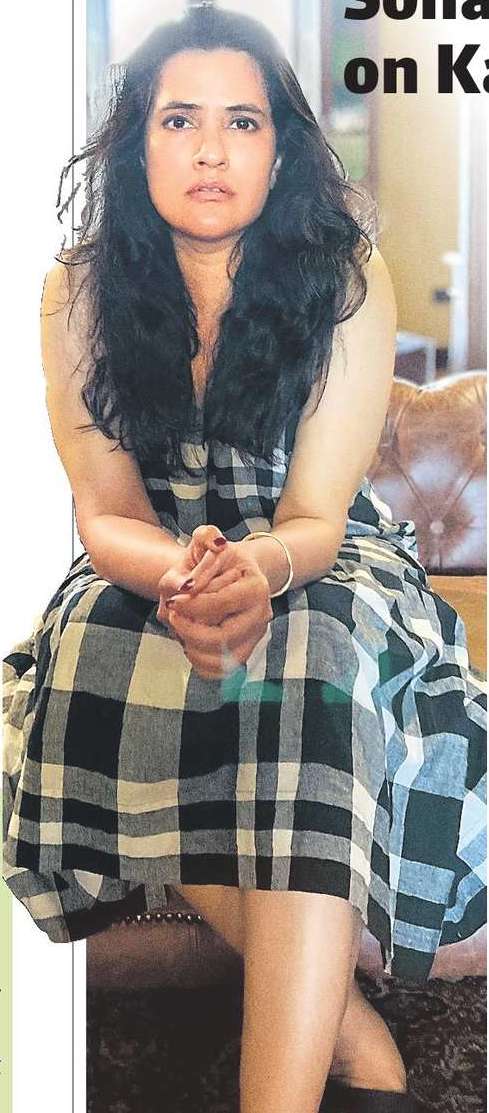
Vishakha Pandit (HINDUSTAN TIMES; July 6, 2025)
Singer Sona Mohapatra has responded to the criticism over her recent remarks on Kaanta Laga music video directors Radhika Rao and Vinay Sapru, denying allegations of insensitivity after actor Shefali Jariwala’s death.
Speaking to us, Sona (49) said, “What do the people of India feel about performative grief? It’s insidious self-promotion riding on a pretty performer’s untimely demise — it should upset everyone. These songs and legends are the musical heritage we stand on.”
It all started on Friday, when she shared an Instagram Story about the directors “retiring the song” after Shefali’s passing, writing: “3 legends created Kaanta Laga. Composer, lyricist, and singer: R D Burman, Majrooh Sultanpuri, Lata Mangeshkar... These two only created a smutty video with a 19-year-old. RIP and all for the 42-year-old lady but legacy???”
Several social media users accused Sona of being “insensitive” by refusing to name Shefali. Some also pointed out that Sona had voiced the 2004 remix Kabhi Aar Kabhi Paar, which had an equally sensuous video.
However, on Saturday, the singer shared a follow-up post: “Are we okay with our legends fading and getting disconnected from their own creations? Calling yourself the ‘makers’ of Kaanta Laga is okay when you are just the makers of a remix video?”
I was four months pregnant...on one occasion I felt I should kill myself-Asha Bhosle
9:17 AM

Asha with her son Anand. She was pregnant with him when she had attempted to end her life. Pic/Getty Images
In a new book about the legendary Asha Bhosle, author Ramya Sarma dwells deep into the struggle that the singer defied to keep living, singing, and cooking
MID-DAY (June 22, 2025)
In 1949, Asha, at about sixteen years of age, eloped with Ganpatrao Bhosle, a man who was twenty years older than she was. For her, it was all about love, a romance that, unfortunately, went painfully sour very quickly.
But with her perhaps hasty, perhaps exciting, perhaps fated, runaway marriage she lost something far more valuable and meaningful than just her singlehood. She lost her eldest sister. “It was a love marriage, and Lata didi did not speak to me for a long time. She disapproved of the alliance.”*
Was this because Bhosle had been Lata’s personal secretary? Did the elder sister feel guilty for having allowed her younger sibling to meet a man so unsuitable for her? That might never be spoken of, but the elopement caused a rift that lasted for many years.
The marriage was a painful one for Asha, but it instilled steel into her spine and made her a strong, resilient woman. It would logically have put emotion into her voice too, adding pathos, sorrow, depth and empathy to her music. Rumour has it that Ganpatrao was a drunkard who beat his wife even when she was pregnant, very often resulting in her needing hospitalization.
Asha explains, “The family was very conservative and they could not handle a singing star for a daughter-in-law. My husband was short-tempered. Maybe he liked to inflict pain, maybe he was a sadist. But no one would hear about it outside. I gave him respect, never questioned what he did. I just did my duty as per Hindu dharma.”
There was continuous abuse and ill-treatment and finally Asha was asked to leave, “when I was expecting my youngest son, my third child, Anand. I went back to my mother, sisters and brother.” There were thoughts of ending the torment for good. “On one occasion I felt I should kill myself. I was ill. I was four months pregnant and found myself in hospital where the conditions were so bad that I thought I had landed in hell. I was in mental agony. So I swallowed a bottle of sleeping tablets. But the love I had for my unborn child was so strong that I did not die. I was dragged back to life, to living.”
Rumour has it that the sisters [Lata Mangeshkar and Asha Bhosle] monopolized the world they ruled, not allowing anyone else who could match them to last beyond a song or two, even deliberately sabotaging the competition. Is there any truth in this?
Asha has said, “Neither didi nor I had the time to go to a music director and ask them not to take any other singer, new or not. So I am puzzled why we were accused of monopolizing the music scene. Our life experience added to our work, and every music director wants a playback singer they can vibe with on a professional level.”
Singer Alka Yagnik, who slid into the space that Asha was eased out of as age and contemporary music started ruling in the early 1980s, and then stayed there for over thirty years, had this to say to the Times of India when asked if it was difficult being pitted against the Mangeshkars: “When a new artiste comes in, people want to find out if they can outdo the seniors. Everybody has their own place. Nobody can take Lata ji’s and Asha ji’s place. When I started, people used to say that it is difficult for a newcomer to break through because the two sisters were ruling the industry with their voices. But whenever I met them, they were nice and affectionate. People say that they resented it when someone new came, but honestly, I never felt it.”
Speaking to singer Sonu Nigam for a special interview for Stardust magazine, Asha said, “Rumours were being spread that the Mangeshkar sisters have monopoly in the music industry. They were spread by a music director who then introduced new singers in the industry, but nobody could become, or was even a close competitor to, Lata Mangeshkar then. And nobody can be Lata Mangeshkar even today. I never liked anybody speaking against us.” “When these rumours were doing the rounds, all I said was, ‘Hum hatt jaate hain, aap gaaiye’ [We will step aside, you sing]...”
Gaana aur khaana
Asha confesses that if she had not found success as a singer, she would have become a cook. “I’d have cooked in four houses and made money,” she once said in an interview. Ask any of the celebrities from the film world who have worked with her and they will all talk about at least one culinary favourite she has cooked for them, apart from a song that they can never forget. Her forte is Indian cuisine and it is said that the Kapoor family still requests Asha to make her famous paya (trotters) curry, Goan fish curry and dal for them. The kadhai gosht and biryani have a huge fan club too.
*Asha Bhosle is quoted as saying in an interview.
Excerpted with permission from Asha Bhosle: A Life in Music by Ramya Sarma, published by Amaryllis, Manjul Publishing House
With AI, it’s harder to judge the authenticity of a singer-Kavita Krishnamurti
8:29 AM

Debarati S Sen (BOMBAY TIMES; June 1, 2025)
In 1971, Bollywood playback singer Kavita Krishnamurti began her musical journey with composer Hemant Kumar, alongside the iconic Lata Mangeshkar. Fast forward to November 2024, she lent her voice to The Sabarmati Report, adding another milestone to her career spanning over five decades. With over 23,000 songs to her credit, she’s worked with Salil Chowdhury, Laxmikant–Pyarelal, RD Burman, OP Nayyar, Naushad, AR Rahman and others.
In a candid conversation at her Andheri home, she spoke about her journey, the changing music industry, the impact of technology, AI and more. Excerpts…
You have been a part of the music industry for over five decades, do you remember the experience of recording you first film song?
I began doing concerts with Hemanta Da (Hemanta Mukherjee) while still in college. One day, he called me to Rajkamal studio, saying, “Chole esho at 10 am, don’t go to college tomorrow.” Sitting with his harmonium, he taught me four lines of Shokhi Bhabona Kahare Bole — a beautiful song. I had no idea why, until the door opened and Lata Mangeshkar Ji walked in. I don’t know how I didn’t faint! Hemanta Da, who called her Lata, said, “You’ll sing four lines with her. (Lata r shathe charte line gaite hobe)”. During the final rehearsal, standing beside her, I completely forgot my lines. I was so mesmerized that I lost track of my cue! Hemanta Da reminded me, “Now we’re going for a take—don’t forget your lines. Lata is a perfectionist, one take okay.” We did two takes, and I finally sang. That was my first film song, Shriman Prithviraj (1972). And my first lucky mascot was Lata Ji.
What do you feel about the evolution of the music industry from the era of live orchestras to the digital age, and how it impacted you as a playback singer?
I consider myself very lucky to have witnessed and worked with legendary artists while also collaborating with younger composers like Jatin-Lalit, Anu Malik, Nadeem-Shravan, Anand-Milind, and A R Rahman. I started in the ’70s when playback singing was done with a full orchestra—one mistake meant redoing the entire song. Music directors had an incredible ear; Pyarelal Bhai could pinpoint a single violinist in a 30-piece orchestra playing the wrong note. He’d say: You (His name) sitting in the third row, the fifth violinist, you were told C major, but you are playing C minor. Correct that note.’ That was the precision of that era. Today, everything is computerized. I slowly adapted to these changes, but by 2004, when technology completely took over, I found myself stepping back.
With advancements in technology and AI today, what are your concerns about the use of artificial intelligence in music?
It's difficult for the common listener to distinguish between a naturally skilled singer and one enhanced by pitch correction and AI. Musicians can recognize true artistry, but for the average person, technology has blurred the lines. With AI refining sur and even creating harkats, the authenticity of a singer is harder to judge. While AI is a breakthrough in medicine, its role in music raises concerns and AI in music is a question mark for me, as it opens the door to potential misuse.
However, at the same time, technology is good too. I'm not so young now and for me, to think that I can sing one line and take a breath, and then sing the next line, really helps. Earlier, I would record entire songs in one go, but now recording line by line, with breaks in between has become a habit and makes the process easier.
You’d mentioned a poignant encounter with the legendary Geeta Dutt. What struck you the most?
Guru Dutt's youngest brother, Vijay Padukone, was my Rakhi brother. He introduced me to advertising jingles while I was a student in St Xaviers. I first met Geeta Dutt at a studio in Worli during my debut jingle recording. As the door opened, I was struck by her beauty and presence. I touched her feet and sat down. She was recording a butter commercial in Hindi and Bengali that I had to sing in Tamil. Her voice was pure magic. Though she was in the twilight of her career, facing personal loss and financial struggles, her aura remained intact. She barely spoke, just said, ‘Bhalo theko’. At that time, she was famous but had no money—yet nothing could take away her personality or her gift for singing. For me, Lata Ji and Asha Ji are the greatest singers I’ve ever met, but there are songs that only Geeta Dutt could have sung. Waqt Ne Kiya Kya Haseen Sitam—I don’t think even Lata Ji or Asha Ji could have delivered it the way she did.
You've sung for some of the biggest music directors. Tell us about a few of your favourite songs.
That's tough! But if I had to choose, I’d say Hawa Hawai, Dil Ne Kaha Chupke Se, and my songs from Hum Dil De Chuke Sanam. I love the ones I did with Rahman, like Tu Hi Re, Dheeme Dheeme, Kay Sera Sera. Maar Daala from Devdas is a favorite too, along with the title track of Hum Dil De Chuke Sanam and Hamesha Tumko Chaha from Devdas. Yeh sab mujhe bahut pasand hai.
Shreya Ghoshal sets BKC ablaze with melody: "Mumbai tumhari aur meri love story hai"
8:41 AM

Debarati S Sen (BOMBAY TIMES; May 26, 2025)
Saturday evening turned into a surreal musical celebration as Shreya Ghoshal took centrestage at BKC, delivering an unforgettable performance that was nothing short of electric. Thousands gathered to watch the melody queen live in action, and she did not disappoint, holding the audience in rapturous delight from the first note to the final bow.
As the evening set in and the crowd erupted in deafening cheers, Shreya made a powerful entrance singing “Sunn Raha Hai”, setting the tone for a night of nostalgia, emotion, and celebration. “Are you ready to sing with me, Mumbai? Are you ready to party?” she asked, and the crowd responded with euphoric chants of “Shreya, Shreya!”
“Mujhe iss din ka intezar saalon se tha!”
Brimming with emotion, Shreya expressed how special the Mumbai concert was for her. “Finally the day has come, and I am performing in Mumbai (The same show was to be held earlier on May 10 at the same venue). I am so excited! Trust me Mumbai, mujhe iss din ka intezar saalon se tha!” she said, visibly overwhelmed.
“Bahut gaana hai, it's going to be an incredible night. Sab saath mein gaane wale hain. Hope you are prepared with some moves!” She then set the stage ablaze with chart-toppers like “Tum Kya Mile”, “Jadu Hai Nasha Hai”, and many more, turning the ground into one massive karaoke session with the audience singing in unison.
“Mumbai tumhari aur meri love story hai”
Declaring her eternal bond with the city, Shreya said, “I have a perfect song, because Mumbai tumhari aur meri love story hai. Aisi love story honi hai because Mumbai mera ghar hai, meri Bhoomi hai, mera sab kuch hai.” That heartfelt proclamation was followed by songs that touched the soul, “O Rangrez,” “Piyu Bole,” “O Saathi Re,” and “Deewani Mastani”.
As she sang, Shreya also took time to connect with fans holding up placards. “You’ve travelled 12,000 kilometres to be here!?” she read aloud in amazement. One fan had brought her a painted portrait to which she asked, “Main yeh rakh loon?” A girl from Kota caught her eye, prompting a warm, “You are from Kota! Hello, girl from my place!”
“Singing a Gulzar Saab song is an award in itself”
Shreya paid rich tributes to the lyricists and composers who’ve shaped her musical journey. “Gulzar saab ka koi gaana agar ga liya toh wohi award hai apne aap mein.” Reflecting on her blessed journey, she added, “Mujhe saare composers ne apne best gaane diye hain. Main bahut shukr guzar hoon unn sab ka. Aaj bhi woh sab gaane dil ko chhoote hain… because acche music ki life bahut lambi hoti hai.” She then delivered those very timeless tunes that audiences continue to cherish, proving that good music indeed has no expiration date.
“Aaj sabse surili audience hai. Kasam se”
As the audience harmonized note-for-note, Shreya playfully joked, “Everywhere I perform, I say, ‘I have the best singing audience today.’ I have said this in so many places that iss sentence ka koi trust value nahi raha. Iske toh memes bhi ban chuka hai. But today I really have to say, ‘Aaj sabse surili audience hai. Sacchi main, kasam se.’” Popular Bollywood singers were spotted cheering from the audience including Benny Dayal, Amit Trivedi, Aditi Singh Sharma, and Shalmali Kholgade.
“The reason I became a singer is because of Lata Ji’s voice”
In one of the evening’s most poignant moments, Shreya paid tribute to her greatest inspiration, Lata Mangeshkar. “The reason I became a singer is because of her voice. Her songs inspired me to choose music beyond just a simple passion or a career.” She followed this with soul-stirring renditions of “Lag Jaa Gale” and “Abhi Na Jao Chhod Kar”.
“This is the first time I am singing this verse on stage”
In a surprise, Shreya sang a verse she had never sung live before. “There are so many songs I want to sing but never have the time. But aaj main tayyari karke aayi hoon. This is the first time I am singing this verse from ‘Main Agar Kahoon’ on stage.”
The magical moment left the audience spellbound. She also performed duets with singers Kinjal Chatterjee and Chaitanya Devadhe, fondly calling him “Chaitu.” They sang some favorites like “Manwa Laage,” “Tere Naina,” “Teri Ore,” “Dagabaaz Re,” and “Saans.”
“Thank you for being with me despite the rain”
Despite a mid-concert drizzle, the crowd stayed rooted to their spots. Organizers swiftly distributed free raincoats to all. Shreya smiled and thanked them saying, “Thank you for being with me despite the rain today.” Towards the end, she warmly introduced every member of her band and background vocalists, showing her appreciation for the people who make the magic happen behind the scenes.
After nearly 40 songs and three hours of pure musical bliss, Shreya closed the night with a powerful tribute to India’s armed forces with “Vande Mataram”.
Subscribe to:
Posts (Atom)