Showing posts with label Lahore. Show all posts
Showing posts with label Lahore. Show all posts
People on other sets will tell you you’re an amazing actor. Sanjay Leela Bhansali will say, ‘Faltu! Kya hai yeh?’-Richa Chadha
10:13 AM
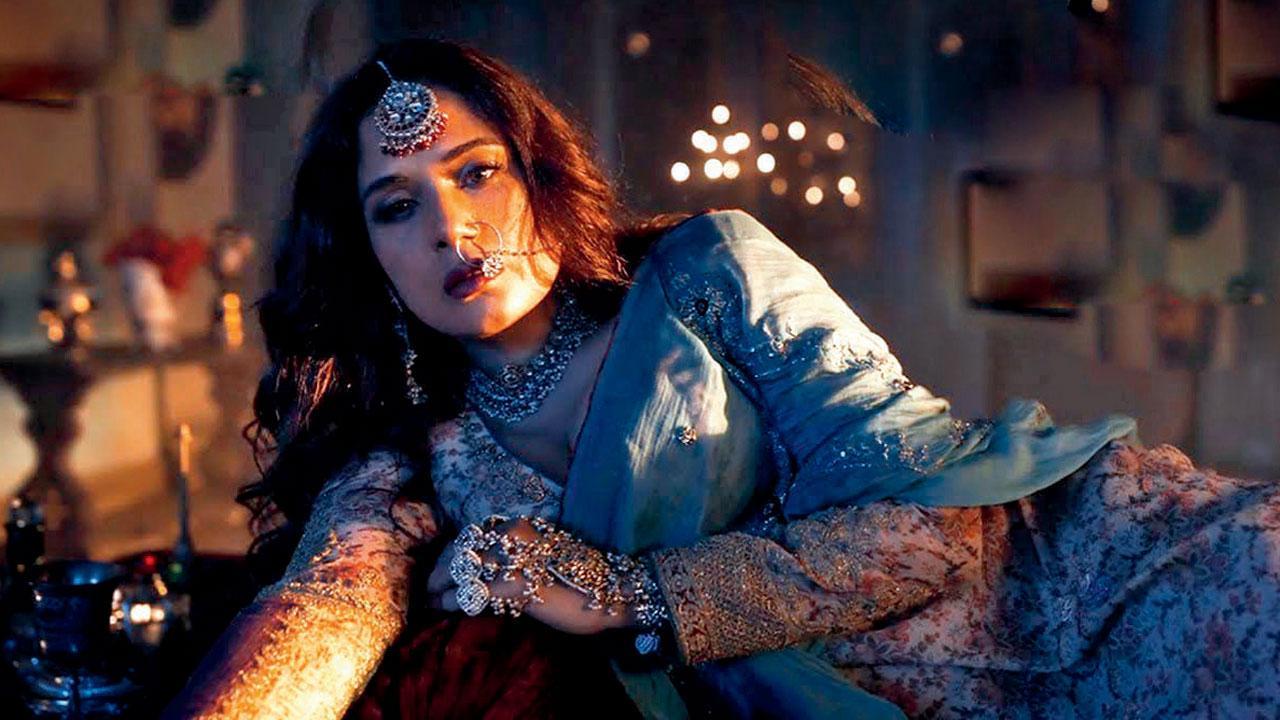
With Pakistani actors deeming Heeramandi a case of cultural appropriation, Richa highlights the two countries’ shared history and how her grandfather hailed from Lahore
Mohar Basu (MID-DAY; May 4, 2024)
The female characters Sanjay Leela Bhansali has crafted in Heeramandi: The Diamond Bazaar are fierce, manipulative and audacious. In contrast, the creator paints a picture of vulnerability with Richa Chadha’s Lajjo, who drowns herself in alcohol and delusion after being dumped by her lover. Over the past few days, the actor has been winning love for her part, which echoes well beyond its two episodes.
Chadha notes it is Lajjo’s pain that is resonating with the audiences. “Lajjo is a human reflection of this world’s pain, of people’s loneliness. She suffers from lack of love and wants to belong to someone desperately. People have always seen me play a tomboy or a boisterous part. This is a shift,” smiles the actor, who stars with Manisha Koirala, Sonakshi Sinha, Aditi Rao Hydari, Sanjeeda Shaikh and Sharmin Segal in the series.
A lot of her love for Lajjo comes from the sheer joy of working with Bhansali. Giving shape to the creator’s vision of the character has been both exhilarating and demanding.
“He juices every ounce of you. I love being pushed to my extreme, feeling like, ‘Oh my God, I know nothing.’ On a bad day, you are destroyed. But the next day, you rise with a new confidence. Working with him is an ego-destruction exercise. People on other sets will tell you that you’re an amazing actor. When you come here, he’ll say, ‘Faltu! Kya hai yeh?’ With him, I went back to the rasa of acting. Once I caught [my character’s sur], I understood why it felt like a raw wound. Playing her felt like being in a world of ghazals. Sanjay sir is carrying forward the torch of storytelling in this subcontinent that represents greats like K Asif and Kamal Amrohi. This is a way of preserving our heritage.”
But many actors in Pakistan feel Heeramandi, which tells the story of Lahore’s courtesans, is an attempt at appropriation. Bhansali admitted that when it was conceptualised as a movie, he had considered casting Mahira Khan and Fawad Khan.
Chadha defends the show, saying, “I don’t see it as appropriation. My character’s name is Lajwanti. My grandfather is a Punjabi from Lahore, Sharmin’s grandfather studied in Lahore University. Our roots are the same. Most of us would love to see a world without borders, [bound] by a spirit of love. Appropriation would be Rooney Mara playing Tiger Lily in Pan [2015]. In the original story, Tiger Lily was a princess from the Piccaninny tribe, native Americans who inhabit Neverland. Here, we are the same race.”
Ali Zafar hits out at Javed Akhtar, calls his remarks on 26/11 ‘insensitive’
8:34 AM

HINDUSTAN TIMES (February 25, 2023)
Pakistani actor-singer Ali Zafar, who recently hosted Javed Akhtar and performed in front of him, has now reacted to the veteran writer-lyricist’s earlier remarks on his country.
Last week, at the Faiz Festival held in Lahore, Akhtar had spoken about how perpetrators of the 26/11 Mumbai terror attacks are “roaming freely” in Pakistan.
Reacting to this, Ali took to his Instagram Stories and stated that Akhtar’s remarks could “deeply hurt the sentiments” of people. He wrote, “Guys, I love you all and truly value your praise and criticism equally. But I always request one thing — verify facts before reaching any conclusion or judgement. I was not present at the Faiz Mela nor aware of what was said until the next day, when I saw it on social media.”
He went on to add, “I am a proud Pakistani and naturally, no Pakistani would appreciate any statement against its country or people, specially at an event meant to bring hearts closer than farther. We all know how much Pakistan has suffered and continues to suffer at the hands of terrorism. Such insensitive and uncalled-for remarks can deeply hurt the sentiments of so many people.”
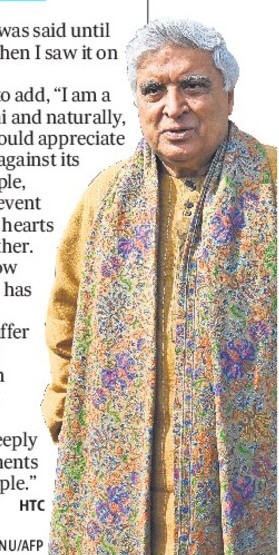
Javed Akhtar’s remarks in Pakistan draw praise
8:27 AM
THE TIMES OF INDIA (February 22, 2023)
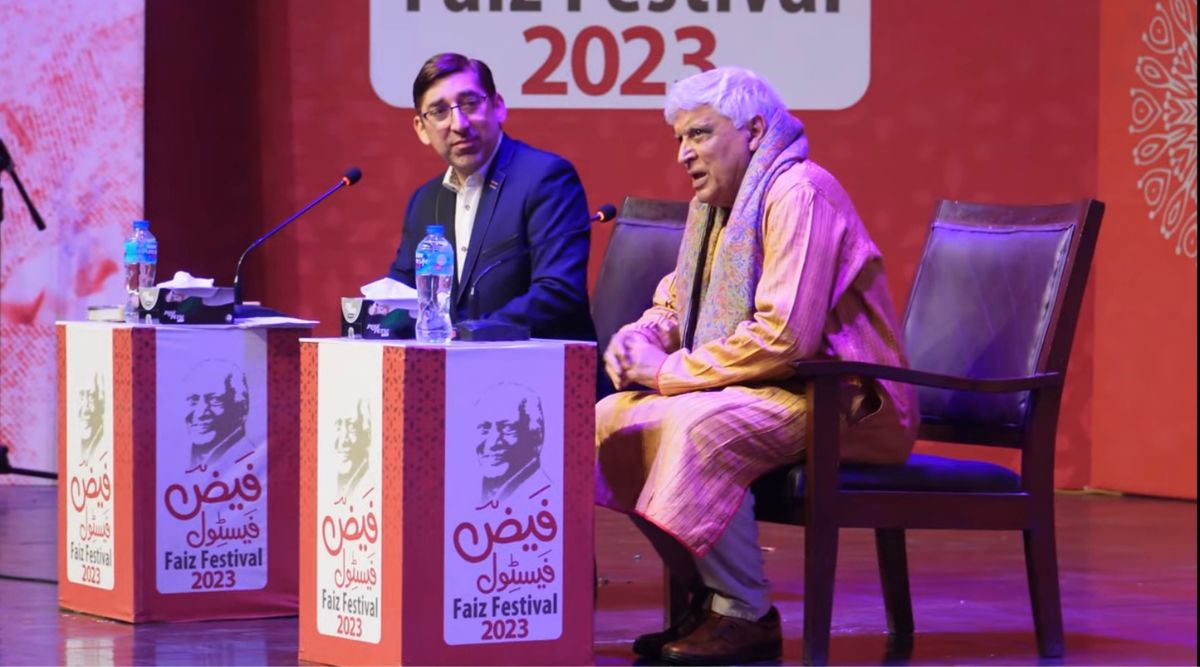
Lahore: The perpetrators of the 26/11 Mumbai terror attacks are still roaming freely in Pakistan, so Pakistanis should not feel offended when India talks about the 2008 carnage, poet and lyricist Javed Akhtar said at a festival held in memory of poet Faiz Ahmed Faiz in Lahore.
In a video that has gone viral, he is seen making these comments in response to an audience member who told him to take with him a message of peace and tell Indians that Pakistan is “a positive, friendly and loving country.”
He further said, “We should not blame each other...The atmosphere is tense, that should be doused.”
The 78-year-old lyricist also said that though Pakistani artists have been welcomed in India, Pakistan has never held a single show of the late Lata Mangeshkar. “We hosted big functions of Nusrat Fateh Ali Khan and Mehdi Hasan. You never organised a function for Lata Mangeshkar,” he said.
Bollywood actor Kangana Ranaut praised Javed Akhtar for his candid remarks in Lahore about the 26/ 11 terror attacks, tweeting: “Ghar mein ghuss ke maara (He hit them in their own land)”.
“We are people from Mumbai, we have seen the attack on our city. They (attackers) did not come from Norway or Egypt. They are still roaming freely in your country. So if there is a grievance in the heart of a Hindustani, you should not feel offended,” Akhtar said at the seventh Faiz Festival that was hosted by Adil Hashmi, the grandson of the poet Faiz. At the Lahore event, Akhtar spoke at length about language, poetry, performing arts, love and friendship.
He left Pakistan on Monday after the conclusion of the three-day festival which attracted a large audience from all walks of life at Lahore's Alhamra Arts Council. He said Urdu's original name was Hindvi and when everything was divided (during the Partition), “Urdu being a language could not be divided, so it was pushed to Pakistan).”
Regarding lack of depth of performing arts and arts, the lyricist said speed of communication has come at the cost of depth.
It was my destiny to be an Indian-Adnan Sami
7:57 AM

Juhi Chakraborty (HINDUSTAN TIMES; August 15, 2021)
For musician Adnan Sami, his birthday falling on the same date as India’s Independence Day is not a coincidence. The Lahore-born singer firmly believes that he was always meant to be an Indian citizen and is grateful to share his birthday with his country.
“Today, I’m a firm believer that there’s no such thing as a coincidence. My destiny was written in India. My future and my dharmabhoomi were all connected to India. The love I have for India was so rooted from my childhood that it was like the angels were telling me. ‘You need to shift your focus over there’. I can’t write off this part of my life as mere coincidence. It’s far deeper than that,” he shares.
Sami, who turns 50 this year, says, “The way God created my destiny, it was almost as if it was planned that I was supposed to be an Indian. It was my destiny to be an Indian. It was unfortunate that the Partition happened, but God had his own way of telling me that I belong here. It’s like my birthday was the biggest hint that I belonged to India.”
The musician may have got his Indian citizenship only in 2016, but he admits that his relationship with India started the day he landed in the country for the first time in 1999 for work. “That was a start of an incredible love affair, and it continues, and reflects in my music and in everything I do. I’m a romantic at heart, I write love songs. And the ultimate love story I have is with India,” he muses.
However, Sami can never forget the struggle he had to face in order to get through the citizenship process and the fact that his application got rejected for technical reasons.
He recalls, “I never lost hope, I never gave up. I said, ‘I’ll do it again’. And that’s why it took me 16 years to do it. People think that one fine day, I became an Indian citizen. They have no idea how long I had to wait. And it was worth the struggle. I’d have waited another 16 years,” the Padma Shree awardee continues, “I just felt that this was home, right from the moment I landed here for the first time. This was the missing piece of the puzzle which made my life complete. I’ll never take it for granted.”
While the singer-composer is overseas with his wife Roya and daughter Medina, he says they do have some big plans for his 50th birthday. “Agar meri taraf se celebration mein koi kami aati hai toh woh pura desh poora kar deta hai. Everybody has a reason to smile on my birthday and I love that! It’s very special,” Sami concludes.
Pran birth centenary: How Bollywood got its baddie, by chance
9:00 AM

Pran's daughter Pinky shares memorable events of their life, as family marks his centenary birthday
Shaheen Parkar (MID-DAY; February 12, 2020)
 Hindi films' most celebrated villain Pran would have turned 100 today. The actor, who switched to playing character roles later in his career, passed away in 2013. While his family has not planned a mega celebration to mark the occasion, they will begin the day by visiting the Pran Chowk at Carter Road, Bandra, to pay floral tributes. The corner, which leads to Union Park, was named after him in 2018.
Pran's daughter Pinky Bhalla tells mid-day, "The family will get together at my place in Juhu. It will be a quiet affair, just the way he would have wanted it to be. We will go to the Pran Chowk in the day."
Though Pran's career spanned six decades, his three children kept their distance from the industry. An exception was son Sunil Sikand, who worked as an assistant to the late filmmaker Manmohan Desai, with whom Pran collaborated on several projects, including Dharam Veer (1977), Amar Akbar Anthony (1977) and Naseeb (1981). Sunil directed Farishta (1984) and Lakshmanrekha (1991), which featured his father, but did not pursue Bollywood, thereafter.
"Now, Sunil leads a retired life in Goa," informs Bhalla. "My other brother Arvind Sikand is a businessman, based in London. He has been [living] there for decades."
Bhalla recalls that in their childhood, they were kept away from the industry. "We barely watched films. Dad made sure we had a normal upbringing. We never went on the sets or attended filmy events."
This stemmed from the fact that before Pran, the family had no connection with the industry. "It was a chance meeting with a film writer that landed him [Pran] his first role. The elders of the family realised only later that he was pursuing acting. Dad was born in Delhi, and did his schooling there. The family moved to Lahore, but returned to Delhi before the Partition."
Pran did not resort to any over-the-top gimmicks to make the villain look like a caricature. Flaunting suits and boots, and with his penetrating eyes, deep baritone and trademark whiff of the cigarette, he emerged to be among the most stylish and suave baddies in B-Town. His iconic catchphrase "Barkurdhar" was enough to instil fear among audiences, so much so that it is suggested that parents refused to name their kids Pran, owing to his menacing on-screen persona.
The actor's other memorable performances include Upkar (1967), Johnny Mera Naam (1970), Victoria No 203 (1972) and Don (1978). One of his most applauded acts was in the Amitabh Bachchan-starrer Zanjeer (1973), which had the chartbuster, Yaari hai iman mera yaar meri zindagi.
Bhalla recalls that apart from acting, "dad was a cricket buff. He would not miss a single match when India was playing."
Even later on in his life, while he was ailing, he would stay abreast about matches, with the scores.

The family at Pran's 90th birthday celebration in 2010
Bharat director Ali Abbas Zafar on building historically accurate Lahore railway station to depicting a circus from the '60s
9:07 AM

Upala KBR (MID-DAY; April 29, 2019)
 "It was like making seven different films," says director Ali Abbas Zafar, the ambitious scale of Bharat not lost on him. The central plot of the Salman Khan-starrer — that of tracing India's journey from the Partition to the present day through the protagonist's point of view — may be simple, but executing it was a different ball game altogether.
The director, along with production designer Rajnish Hedao and stylists Alvira Agnihotri and Ashley Rebello, dedicated one-and-a-half years to research the different eras before taking the Katrina Kaif and Disha Patani film on floors.
The most challenging chapter, he says, was recreating the Partition. "The way the Partition was depicted in Richard Attenborough's Gandhi [1982], was my benchmark. We shot the sequence over 10 days in Punjab, in the freezing cold. The scene required us to recreate a station near Lahore, replete with a steam engine. Of the five functioning steam engines in the country, we had one brought to Punjab. The art department worked on it for four days to make it resemble those from the Northern Frontier Railways of 1947."
When cinematographer Marcin Laskawiec came on board, he had detailed mood boards ready for him. "We did thorough research, based on the material available in libraries and museums, of what a circus looked like in the '60s. Salman's look in that decade is modelled on Elvis Presley, who was a rage at the time. We got vintage cars, costumes and even newspapers made, to stay true to the era. Reimagining the '70s and '80s [was relatively easier] as we could source props from bazaars in purani Delhi, but we built everything from scratch for the preceding decades."
Zafar adds that a distinct colour palette has been used to depict each period. "The Partition era is in desat [desaturation] mode, while we have employed Eastman colour for the '60s and '70s, and sparkling colours for the next two decades."

Kalank is not one person’s effort; it requires an army of people to create something so grand-Amrita Mahal Nakai
10:23 PM

BT talks to art director Amrita Mahal Nakai about what went into the making of the period drama’s grand sets
Neha Maheshwri (BOMBAY TIMES; April 5, 2019)
 The promos of Karan Johar’s upcoming magnum opus, Kalank — set in the pre-Independence era — has already created a buzz. Now, the grandeur of the film’s set is also becoming one of the talking points. BT caught up with art director Amrita Mahal Nakai, the woman behind the design of the majestic set, to know more about it.
 Amrita credits director Abhishek Varman for giving specific instruction. She says, “We followed Abhishek’s vision and also, the script left no margin for error. We started working on the design around the end of 2016.”
Th in all its glory. Amrita shares, “Our set of Hira Mandi is a rather fantastical version of Lahore in the 1940s, though we have retained the essence of the city as it was back then.”
Amrita says, “We used a little bit of imagination and borrowed architecture from across the globe. Two designers — Anita Rajagopalan and Donald Reagan — were brought on board for this grand set as I was also working on another film at that time. Aparna Raina collaborated with me to design the set for the Chaudhry house and haveli.”
 Talking about the colour palette used, she says, “We have shown restraint in the use of colours, so that it doesn’t look jarring. We have taken our liberties, but well within the canvas of the film. Red colour has been used extensively in Kalank. It’s a strong colour and is pretty much there in every frame of the film. We used various shades of it. Hira Mandi is the most vibrant of all the sets, so we used colours depicting the same.”
Talking about the nitty gritties of the project, Amrita specifically mentions the pond and its hues. She shares, “We had a large tank of water, and I was clear that I didn’t want the water to look blue. That’s not the look I had in mind, as I am not a fan of blue. Also, that was not a part of the palette. At the same time, I didn’t want any other dark colour either. Another huge challenge was to keep the water clean during the 45-day schedule of the shoot. We devised a method through which the water looked green and we all loved it.”
But doesn’t working on such a large scale come with its own challenges? “Totally,” agrees Amrita, adding, “To make Abhishek’s vision real was a challenge. In today’s day and age, people are hardly putting up grand sets. They rely more on VFX to make sets look grand, but we built a set to give it a more real look. Of course, the makers will be using visual effects to enhance scenes, but we have kept it as real as possible. This would probably be the largest set I have ever designed.”
However, after all the hurdles, Amrita looks satisfied with the outcome of her effort. “This is not one person’s effort; it requires an army of people to execute something as grand as this. Working with Binod sir (Pradhan, cinematographer), who makes the frame look 20 times better, was phenomenal. That kind of sums up my journey in the film.”

People should know the loving father Saadat Hasan Manto was-Arshad Farooq
8:37 AM

(From left) Nighat Patel, Nuzhat Arshad, director Nandita Das, Nusrat Jalal and Nuzhat's husband Arshad Farooq
Manto's daughters on why they agreed to part with his story for the Nandita Das-helmed biopic
Mohar Basu (MID-DAY; September 5, 2018)
Determined to be true to the story of Saadat Hasan Manto in her biopic featuring Nawazuddin Siddiqui, director Nandita Das dedicated 10 years to discover the man behind the enigma. It was her passion that won over the writer's daughters, Nuzhat Arshad and Nusrat Jalal, thus convincing them to part with their story.
In a chat with mid-day, Arshad reveals that she first met Das in Lahore in March 2007. "I believe Manto's personal life hasn't been given its due share of coverage. People should know the loving father and affectionate husband that he was. He was castigated during his lifetime, but he continues to be as relevant today as he was sixty-three years ago."
Though his works were pertinent, obscenity charges were levelled against many of his creations. The repeated defamatory allegations sent Manto plunging into the abyss of alcoholism, which, in turn, pushed his family into poverty. However, Arshad credits mother Safia for shielding them in troubled times. "As for our father, he saw a reflection of him in me and nicknamed me Jujiajee. He used to make me sit on his lap and sing Chanda Rai Ja Rai," she says.
Jalal remembers her father as a man who firmly believed in gender equality. "Manto did not shy away from helping around the house. He would even sweep the floor, so that his daughters could crawl around. He also made toys for us from discarded cigarette boxes and matchsticks."
Pakistani director Sarmad Khoosat had brought Manto's life to the big screen with his 2015 eponymous offering. But Arshad believes that Das's rendition will unravel other facets of the famed writer. "Nandita worked closely with the family to understand the intricacies of Manto on a personal level, unlike Sarmad who never bothered asking us about what he was like as a person."
Jalal chimes in, "Nandita has essentially focussed on my father's life when he was in Bombay. Sarmad's focus, on the other hand, was on Manto's life in Lahore. He intended to make a television serial, but eventually condensed it and released it as a film."
Die-hard Salman Khan fan evades Tiger Zinda Hai ban in Pakistan; books theatre for private screening
8:14 AM

Mohar Basu (MID-DAY; March 20, 2018)
Three months after Tiger Zinda Hai was banned in Pakistan for showing the country’s “national security and law enforcement institutions in a demeaning manner”, a die-hard Salman Khan fan, based out of Lahore, evaded the government’s decision to screen the film. The youngster, who prefers to remain anonymous to ensure his safety, booked an auditorium at a Lahore theatre and hosted a private screening of the film on March 17 for his friends, family and fellow Salman fans.
Keen on watching Salman’s latest offering, the youngster procured the digital rights for a one-time viewing of the Ali Abbas Zafar-directed film. Speaking to mid-day, an attendee revealed that the screening saw a turnout of 150-strong members. “It was a great experience. Tiger Zinda Hai depicts the ties of love between India and Pakistan in such a pure way. We were cheering and hooting during Salman’s action scenes. The film may have been banned here, but we endorse the idea of brotherhood that it promotes. We wish we didn’t have to hold the screening discreetly. We want to tell Salman Bhai we have immense love for him and his movies.”
The attendee added that the initial plan was to organise a home screening for some close friends, but the increasing number of participants compelled them to book a theatre. “The man, who took the initiative, had to pay a hefty sum for the digital rights. The movie was screened via a USB in the digital cinema projector.”
Though Salman was unavailable for comment, his father Salim Khan was ecstatic to hear of the initiative. He said, “It’s a wonderful gesture. I feel films from India should be allowed to release in Pakistan, and their films should be allowed to screen here. That will happen only once the situation between the two countries improves.”

Noor Jehan had called me at least 10 times before boarding the plane-Pran
7:50 AM

Roshmila Bhattacharya (MUMBAI MIRROR; February 15, 2018)
I met him a couple of months after he had brought in his 78th birthday on February 12, 1998. I went expecting the bad man of my celluloid nightmares but found instead a frail fatalist reeling from his first visit to a hospital and the trauma of learning that one of the valves of his heart had shut down. Despite the youthful green of his kurta, Pran looked like a tired old man, often running out of breath, but unwilling to cut short our conversation.
As we meandered down memory lanes, he spoke about being discovered outside a ‘paan’ shop in Lahore by Wali Mohammed Wali, a leading script, dialogue and song writer of the time. Wali saab offered him the role of the villain in his upcoming Punjabi film, Yamla Jat, along with the address of Pancholi Studio where he promised to set up a meeting for him with his boss and the film’s producer, Mr Pancholi. But to the writer’s horror, the teenager did not turn up for the appointment the next day, convinced that the movie offer had been made in an inebriated state and not worth following up on. So instead of the studio, Pran Sikand headed to his photography shop and it was business as usual.
But the following weekend, he bumped into Wali saab again, at the Plaza theatre, and after cursing him roundly for the embarrassment he’d caused, the industry bigwig collared him to the studio the next morning, where Pran was signed for a monthly salary of Rs 50. The pre-Partition drama also featured M Ismail, Durga Khote and Noor Jehan as the heroine’s younger sister.
Yamla Jat which was unveiled in 1940 was a jubilee hit and two years later, Pran was signed as the leading man of Khandan opposite Noor Jehan. Their romance was limited only to the screen, a painfully shy Pran taking to his heels every time he was instructed to run after his heroine, but a real-life love story was playing out away from the camera. The film’s director, Shaukat Hussain Rizvi, was captivated by 17-year-old Noor Jehan and they tied the knot the same year and shifted to then Bombay. But after the Partition, Noor Jehan chose to move to Pakistan where she was born, settling down in Karachi. She mothered three children, before Rizvi and she separated in 1953. Later, she married Ejaz Durrani, a Pakistani actor-filmmaker popular for his portrayals of Ranjha and Mirza in Heer Ranjha and Mirza Sahiban, nine years younger than her, and took the curtain call after Ghalib in 1961 but never stopped singing. That marriage too ended in a divorce after three more children.
Meanwhile, Pran had married Shukla in 1945 and two years later was happily settled in Lahore, the proud father of a son, when communal fires that were sparking off across the city led to him sending his wife and young son to family in Indore. He promised to join them in time for the lil’ one’s first birthday and reached Indore on August 11 with a small suitcase. He never returned home and after the Partition, moved to Maximum City.
He was without a job for a few months, then in a span of three days signed four films—Ziddi, Apradhi, Grihasti and Wali Mohammed Wali’s own production Putli— going on to become one of Bollywood’s most hated khalnayaks. This was reiterated by the findings of a survey in the’60s across three states—Maharashtra, UP and Punjab—that threw up the startling fact that not a single school or college-going child had been named Pran during the time.
Over the years, the badmash metamorphosed into the widely respected Malang Chacha after Manoj Kumar’s Upkar and a much-loved Sher Khan after Prakash Mehra’s Zanjeer. When he was honoured with a Lifetime Achievement Award years later, he brought the audience to his feet and their standing ovation brought tears to his eyes. “Destiny, that’s the deciding factor. What has to happen will happen, even God cannot change your taqdeer…” These lines came not from any dialogue sheet but from his conviction that what’s written in the stars cannot be kept away from you.
Interestingly, while Pran was making box-office history this side of the border, his first leading lady was making history as Pakistan’s Malika-e-Tarannum (Queen of Melody) for lending her voice to the maximum number of film songs and becoming the country’s first female director. He never went back to Lahore but Noor Jehan did fly down to Mumbai to attend a musical gala in 1982, ‘Mortal Men, Immortal Memories,’ as the chief guest. “She was really nervous about that trip and had called me at least 10 times before boarding the plane. I reassured her that I’d be waiting for her at the airport here with a special bus,” Pran had reminisced. As her “Awaaz De Kahan Hai” resonated through Mumbai’s Shanmukhananda Hall memories came flooding back, of a time when borders hadn’t been drawn and countries hadn’t been divided.

Nandita Das drops the idea of shooting portions of Manto biopic in Lahore
7:48 AM

Indo-Pak tensions prompted Nandita Das to shift location of her next closer home
Avinash Lohana (MUMBAI MIRROR; October 11, 2016)
 Mirror (January 13, 2015)
had earlier reported that Saadat Hasan Manto who authored close to 300
short stories, 100 radio plays, numerous essays and film scripts before
his untimely death at the age of 42, is the subject of Nandita Das' next
directorial after making her debut with Firaaq in 2008. She has the
full support of his three daughters, Nighat, Nuzhat and Nusrat, and other
family members who live in Lahore. They have shared many nuggets from
his life,
not found in books, which have been incorporated into the screenplay.
Mirror (January 13, 2015)
had earlier reported that Saadat Hasan Manto who authored close to 300
short stories, 100 radio plays, numerous essays and film scripts before
his untimely death at the age of 42, is the subject of Nandita Das' next
directorial after making her debut with Firaaq in 2008. She has the
full support of his three daughters, Nighat, Nuzhat and Nusrat, and other
family members who live in Lahore. They have shared many nuggets from
his life,
not found in books, which have been incorporated into the screenplay.“Manto is not a typical biopic but will focus on the seven most tumultuous years of his life, from 1946 to 1952. It takes us through his glorious days in '40s Bombay, the Partition and then his downward spiralling life in Lahore. The repeated obscenity trials made things worse for him, but he continued to be prolific and sharp with his pen. His fight for freedom of expression is all the more relevant today,“ Nandita had said earlier.
Mirror has now learnt that Nandita wanted to shoot some portions for the film, featuring Nawazuddin Siddiqui as Manto, in Lahore as the writer had moved from Mumbai (then Bombay) to the newly created Pakistan in January 1948 following the Partition. However, owing to the ongoing Indo-Pak tensions post the Uri attacks on September 18, the actor-director will now shoot these portions in India.
“We all know that Manto spent three-fourth of his life in India but had to leave Bombay, the city he loved, and spent only his last seven years in Lahore. So, to maintain authenticity, we did have plans to shoot in Lahore. But considering the present situation between the two countries, we will need to shoot those portions somewhere in India. We are looking at several options. I have recently returned from a recce in Delhi,“ informs Nandita.
She had first read stories by Manto in college, and later much of Dastavez, a five-volume collection of his work. She says, “I have always wanted to make a film on his works, but his essays made me realise that his life was equally stirring and dramatic. Today, I feel equipped, both emotionally and creatively, to tell this story that so needs to be told.“ Nandita earlier shot for Deepa Mehta's 1998 period drama, Earth, which featured Aamir Khan, in Delhi even though it was set in Lahore. She starts rolling with Manto in the third week of December.
“After a short break, we will shoot till end of February. I'm currently busy with the prep and have a million things to put together!“ sighs the actress director who has co-written the script with Mir Ali Husain who has earlier written Nagesh Kukunoor's Dor.
Ali Zafar gifts 4-bedroom villa in Lahore, spread over 15,000 sq feet, to his wife Ayesha
7:40 AM

Avinash Lohana (MUMBAI MIRROR; September 9, 2015)
Ali Zafar has gifted a four-bedroom villa in Lahore, spread over 15,000 square feet, to his wife Ayesha. Mirror (February 24) had earlier reported that Ayesha had given birth to their daughter, Alyza, and the dream house is the actor's return gift to his better half.
"It's been under construction for over three years. We've just moved in a few months back. Ayesha was really touched by the gift and has done the interiors herself with a little bit of help from me. We've kept the decor modern, classy and minimal. We have installed music systems which will play all the time," Ali informs excitedly.
The villa has an indoor swimming pool bang in the centre. Every room has an attached terrace and a view to the pool. And the basement has been converted into Ali's recording studio.
"I come from a modest background. My parents were professors and we used to live with my grandparents in a small room. So, like everyone else, I have been wishing for a house like this for a long time and been working hard towards it," admits Ali, adding that his parents live in the adjacent bungalow. "I'm very close to my family and wanted them to be near me."
Would he want to buy a property in Mumbai? "Mumbai has been kind to me but I don't think as a Pakistani national I could buy property there. I visit the city, do my work and come back. This is my home," he signs off.

Abhay Deol-Diana Penty-Ali Fazal's Happy Bhag Jayegi might be shot in Pakistan
8:01 AM

Avinash Lohana (MUMBAI MIRROR; July 31, 2015)
Mirror (January 21) was the first to report that four years after Cocktail, Diana Penty would be making a comeback on screen with Abhay Deol in Tanu Weds Manu director Aanand L. Rai's upcoming debut production, the romcom, Happy Bhag Jayegi. Aanand had admitted then that while they were filming Raanjhanaa he kept telling Abhay that their journey together wasn't complete. "He was fab in the film but it wasn't a full-fledged role," he had rued. Now Mirror has learnt that Abhay will be playing the lead in a cross-border love story, which will be directed by Mudassar Aziz. Aanand wants to shoot parts of the film in Pakistan.
Confirming the news Aanand says, "Yes, it's a light-hearted romcom based in Amritsar and Lahore. The two cities are close to each other and we do wish to shoot certain portions in Pakistan. We have applied for permissions."
Even though Kabir Khan had to shoot in Gulmarg for scenes set in Pakistan in his just-released Bajrangi Bhaijaan and recreate parts of the neighbouring country in Punjab for Phantom, Aanand remains optimistic. "Mine is a fun film and it does not raise any political issues," he reasons.
Ali Fazal plays the third lead but Aanand would not be drawn into a discussion on characters and plot details. All he says is, "We are looking to kick off at the end of August or the first week of September."
I want people to know who he actually was-Sarabjit Singh's sister Dalbir
7:58 AM

Priya Gupta (BOMBAY TIMES; May 26, 2015)
Dalbir Singh, 61, is the
older sister of Sarbjit Singh, a farmer from Bhikhiwind in
Punjab (just 5 kms away from the Indo-Pakistan border). He by mistake
crossed over in 1990 while farming, got mistaken as an Indian spy,
was given capital punishment in 1991, but was not hanged. He was kept in
the Kot Lakhpat jail in Lahore for 23 years, before he was killed by
inmates a few days after the death of Afzal Guru in India. During his 23
years in jail, his older sister Dalbir Singh who treated him more like
her son than her brother, made it her life's agenda to get him released.
While she finally did not succeed in getting him released, she is
determined to reach his real story to the world through a film being
made based on his life. The film will be directed by Omung Kumar, the
National Award-winning director or Mary Kom. Dalbir Singh met her
brother only three times in those 23 years. She opens up to Bombay Times
for the first time after her brother's death in 2013 and recounts the
three times she met her brother in jail. Excerpts:
Did instances like the Kargil War affect you?
At the time of Kargil, I got very scared. There is a nearby village called Khasa, where many army officers live. I went to meet them and asked Brigadier sahab, given the situation how it would affect the way Pakistan would treat our prisoners. I was scared that if there would be war, how would the prisoners come out? I met another Brigadier who told me that if there would be war, we would open up the jail and release the prisoners, so that an innocent man should not get bombed and die in jail. But he didn't know what the Pakistanis would do. We would feel scared that Khuda na kare, if there was a bomb thrown in jail, how would he be able to run? My heart would sink if there was a flood or earthquake in Lahore.
How did Sarbjit actually cross over to Pakistan?
 Our
village is just about 4-5 kms from the border. I myself have gone many
times to the other side while working together with the women from the
other side on our fields. We would be working on our respective fields
and some times, even eat a meal together with the Pakistani brothers and
sisters on the other side.
Gradually and slowly, the situation got bad to worse and they first
put a rough line to segregate the boundary and then, there were some
fundamentalists on both sides who did not have good thoughts. Though I
believe that ours were not as negative as the people on the other side.
There would be things smuggled in across the borders, but the women had
good behaviour towards each other and there was no enemity. However,
if
there was anybody who went the other side by mistake, they would be
caught and put behind bars termed as 'spies'. That night, we had finished
our dinner when a friend of Sarbjit came and took him to the fields to
work. The field was right next to the border. As is usually the case in
Punjab, the men drink and then work. Sarbjit and his friend too had their
full share of drinks and then, Sarbjit put his axe on his shoulder and
not realising
which direction he was walking, he walked into the Pakistani side. At
that time, there was not even a wire to show the borderline. He was
caught and blindfolded and only the next morning, he realised that he
was in Lahore's Kot Lakhpat jail, accused of being an Indian spy by the
name of Manjit Singh. Sarbjit was very fond of playing kabadi and he
would often tell me, 'You wait and see. One day the world will know me as this famous pahelwan.' I didn't
know then that he would one day become world famous, but not as a
kabadi player. When Sarbjit suddenly disappeared, I initially thought
that he must have been picked up by a terrorist group. But it was nine
months later when he was first presented in the Pakistani courts that he
wrote a letter to me, telling us how he had been arrested, accused of
being a man called Manjit Singh, who was allegedly behind four bomb
blasts. He asked me to please get Shri Akhand Sahib path done. After
that, in every subsequent letter, he wrote to me details of what he went
through. I have all his letters kept in a big bag with me. On August
15, 1991, he was held guilty and sentenced to be hanged. But for so many
years, they neither released him nor hanged him despite my making so
many appeals and requests for his forgiveness, even though he had
committed no crime.
Our
village is just about 4-5 kms from the border. I myself have gone many
times to the other side while working together with the women from the
other side on our fields. We would be working on our respective fields
and some times, even eat a meal together with the Pakistani brothers and
sisters on the other side.
Gradually and slowly, the situation got bad to worse and they first
put a rough line to segregate the boundary and then, there were some
fundamentalists on both sides who did not have good thoughts. Though I
believe that ours were not as negative as the people on the other side.
There would be things smuggled in across the borders, but the women had
good behaviour towards each other and there was no enemity. However,
if
there was anybody who went the other side by mistake, they would be
caught and put behind bars termed as 'spies'. That night, we had finished
our dinner when a friend of Sarbjit came and took him to the fields to
work. The field was right next to the border. As is usually the case in
Punjab, the men drink and then work. Sarbjit and his friend too had their
full share of drinks and then, Sarbjit put his axe on his shoulder and
not realising
which direction he was walking, he walked into the Pakistani side. At
that time, there was not even a wire to show the borderline. He was
caught and blindfolded and only the next morning, he realised that he
was in Lahore's Kot Lakhpat jail, accused of being an Indian spy by the
name of Manjit Singh. Sarbjit was very fond of playing kabadi and he
would often tell me, 'You wait and see. One day the world will know me as this famous pahelwan.' I didn't
know then that he would one day become world famous, but not as a
kabadi player. When Sarbjit suddenly disappeared, I initially thought
that he must have been picked up by a terrorist group. But it was nine
months later when he was first presented in the Pakistani courts that he
wrote a letter to me, telling us how he had been arrested, accused of
being a man called Manjit Singh, who was allegedly behind four bomb
blasts. He asked me to please get Shri Akhand Sahib path done. After
that, in every subsequent letter, he wrote to me details of what he went
through. I have all his letters kept in a big bag with me. On August
15, 1991, he was held guilty and sentenced to be hanged. But for so many
years, they neither released him nor hanged him despite my making so
many appeals and requests for his forgiveness, even though he had
committed no crime.
Why was it difficult for you to meet him?
I did not even have a passport, but right from 1990, I tried a lot to go but I never got the permission. At times, I would read in the newspapers that yes, his family can come and meet him, but then, there was a call from Pakistan that there was news printed there that they would not grant us permission. Finally, I met Rahul Gandhiji and took his help to get the visa for me and finally got the visa along with my husband, Sarbjit's wife and his two daughters Swapandeep and Poonam (Swapandeep was adopted by Dalbir as she does not have kids of her own). While we got the visa and reached Lahore, we were still not allowed to meet him. The jail authorities would say that they had not got permission from Islamabad and Islamabad would say that Lahore had not given the permission. After nine days of feeling mentally tortured, living in the Gurudwara Dera Sahib there, I decided to appeal in the High Court. The judge was very kind and he immediately granted permission. It was too late that day, but the next day on April 23, 2008, we all went to jail to see Sarbjit.
 What happened in jail that day?
He had been kept in a tiny room where you could hardly stand up, with tall walls outside with a big lock. A mother can easily recognise her son. As soon as they opened the door to his room for us to go inside, I recognised him. He was standing at an angle and seeing him, my heart was sinking. His eyesight had gone weak and he wore a broken pair of glasses tied with thread to hold them together. I told him, 'At least you could have worn proper glasses.' He said, 'I got a lot of gaalis to even get this.' I remembered that in one of his letters to me, he had written how his eyes burn and itch but the authorities would abuse and harass him, but not give him medicines or glasses. I wanted to hug him but was not allowed to do so even once, so I held his hand and sat down on the other side of the bars next to him.
I held his hands and told him, 'Sarbjit, I wish I could have turned blind before seeing you like this.' I cried profusely so much so that I fell down holding the bars and got hurt on my fore head. That day, knowing we were coming to meet him, he had requested the jail authorities to allow him some water, cold drink and ingredients for tea, as he wanted to make tea for me and serve me. They had given him a stove and he had made tea himself, sticking his hands out of the bars, and then kept it in a flask to serve us later. When I fell down, he got hassled and quickly gave me water and the cold drink. Most of the 48 minutes went into crying, but fortunately, he met his daughters and we talked a little about his case. I also tied him a rakhi and he said, 'I have nothing to give you today .' He had tears in his eyes, but he tried to hide them from me even though I knew. I fed him a piece of barfi like I always did and he bit my hand with his teeth. He said, 'You have come to give me strength, then why are you scared?' He recognised his daughters as he had seen their pictures through the newspaper reports. He told me how the Indian prisoners would send him newspaper cuttings hidden below his rotis. And these he stored in that register that he had kept. At that time, he was sure that he would come back. The one regret I had was that I was not allowed to hug him.
What was his jail like?
There was no fan inside but outside for us, there was a small fan kept. Inside his room, he had a small pot of water with which he had to manage for the whole day, his bathing, washing clothes, using the washroom or drinking.
Did you visit him again?
I met him again in 2011, when he showed me a diary and register, where he said that he had written every word of what had happened to him in those many years. I wanted that diary after he died, as I wanted everyone to know what he went through in jail, but it was not given to me. When his body came in 2013, only that clay pot came with it. I got to meet him for three hours in 2011. And on this visit, I went to meet him twice. Unlike the last visit, this time he had not taken his bath, not prepared anything for me and looked indifferent. He was quiet and I asked him what happened. He said, 'Didi, for many many days, I don't even eat or sleep or take a bath and I keep thinking why I am in this state and I keep thinking whether I will come back or not. I can't even tell you what I go through here.' I felt that if he kept thinking like that, he would get mentally ill. I summed up strength to give him some and wanted to tie many rakhis that I had taken from here, many of which had been given to me by women in the village. He said, 'Chalo, you give them to me. I will keep tying it up slowly later.' I said, 'No, why are you talking like this? You will be with me in our aangan on the next rakhi.' It's only when I visited him for the second time that he was waiting for me, ready to serve me lassi that he had made mixing curd and water and the jail dal. He knew that I was the only one he could tell and told me how they would abuse Indians a lot there. If you asked the jail authorities for medicines or glasses or water, they would say, 'Aaj bahar nikale? Aaj paani pilaye hi dete hain tumhe.' He said, 'Sometimes, they would beat me, sometimes I managed by begging them for forgiveness.'
Was it ever proven that Sarbjit had been convicted wrongly?
The sole witness of the Pakistani police, Shaukat Ali was once interviewed by an Indian journalist, who managed to find him there and he said, 'I don't know whether Sarbjit has done it and whether he is Manjit or Sarbjit. Those days, my father had died and the police had asked me to say that Sarbjit was Manjit and that he had committed the bomb blasts in court and I said it.'
How did he finally die?
Over the years, there were many times when I would wonder if he would ever come back, but then again, I would meet people and get assured that he would come back. I had kept all the navratras, slept on the floor for 23 years, but it was after meeting S M Krishnaji, the External Affairs Minister, that I felt most assured that Sarbjit would be released for sure. I don't know from where I got the strength to fight, but I was determined and had decided that I would fight, come what may. But I quickly trust people and start feeling they are my own, but got cheated each time. Before Sheikh sahab, all the lawyers who represented us took the money from us, but cheated us in court. They did not even present our case of him not being Manjit, even though they had the papers proving that. Afzal Guru had been hanged in India a couple of days before Sarbjit was attacked in prison. We learnt that there was a man who would go inside jail and supply sharpened spoons and knives made from sandooks inside jail to the prisoners there. I feel the Pakistani prisoners there took Afzal's revenge by killing Sarbjit. I was with Swapandeep the day he was attacked. I had been having a severe back problem for two days and was in terrible pain. I could not sleep and was restless when suddenly I got a call from Pakistan telling me how he had been attacked. I screamed and woke up Swapandeep who was sleeping, but I thought we would still be able to treat him and get him back alive. It's only when I got his body in the hospital in Lahore that I finally broke down and realised that I had lost my son forever. Uss pal meri umeed bhi khatam ho gayi aur intezaar bhi.
Are you free now?
No, I try but I can never forget Sarbjit. I wish he had come back. For 23 years, my only goal was to get him released. But now, I want people to know who he actually was. What happened with Sarbjit inside jail? What happens to Indians inside Pakistani jails? There is an innocent Pakistani prisoner in Tihar, who has paralysis, that Sarbjit would tell me about. Through this film, I want a message to go to all. I could not bring back Sarbjit, but I hope that this Pakistani child in Tihar is released.
Did instances like the Kargil War affect you?
At the time of Kargil, I got very scared. There is a nearby village called Khasa, where many army officers live. I went to meet them and asked Brigadier sahab, given the situation how it would affect the way Pakistan would treat our prisoners. I was scared that if there would be war, how would the prisoners come out? I met another Brigadier who told me that if there would be war, we would open up the jail and release the prisoners, so that an innocent man should not get bombed and die in jail. But he didn't know what the Pakistanis would do. We would feel scared that Khuda na kare, if there was a bomb thrown in jail, how would he be able to run? My heart would sink if there was a flood or earthquake in Lahore.
How did Sarbjit actually cross over to Pakistan?
Our
village is just about 4-5 kms from the border. I myself have gone many
times to the other side while working together with the women from the
other side on our fields. We would be working on our respective fields
and some times, even eat a meal together with the Pakistani brothers and
sisters on the other side.
Gradually and slowly, the situation got bad to worse and they first
put a rough line to segregate the boundary and then, there were some
fundamentalists on both sides who did not have good thoughts. Though I
believe that ours were not as negative as the people on the other side.
There would be things smuggled in across the borders, but the women had
good behaviour towards each other and there was no enemity. However,
if
there was anybody who went the other side by mistake, they would be
caught and put behind bars termed as 'spies'. That night, we had finished
our dinner when a friend of Sarbjit came and took him to the fields to
work. The field was right next to the border. As is usually the case in
Punjab, the men drink and then work. Sarbjit and his friend too had their
full share of drinks and then, Sarbjit put his axe on his shoulder and
not realising
which direction he was walking, he walked into the Pakistani side. At
that time, there was not even a wire to show the borderline. He was
caught and blindfolded and only the next morning, he realised that he
was in Lahore's Kot Lakhpat jail, accused of being an Indian spy by the
name of Manjit Singh. Sarbjit was very fond of playing kabadi and he
would often tell me, 'You wait and see. One day the world will know me as this famous pahelwan.' I didn't
know then that he would one day become world famous, but not as a
kabadi player. When Sarbjit suddenly disappeared, I initially thought
that he must have been picked up by a terrorist group. But it was nine
months later when he was first presented in the Pakistani courts that he
wrote a letter to me, telling us how he had been arrested, accused of
being a man called Manjit Singh, who was allegedly behind four bomb
blasts. He asked me to please get Shri Akhand Sahib path done. After
that, in every subsequent letter, he wrote to me details of what he went
through. I have all his letters kept in a big bag with me. On August
15, 1991, he was held guilty and sentenced to be hanged. But for so many
years, they neither released him nor hanged him despite my making so
many appeals and requests for his forgiveness, even though he had
committed no crime.Why was it difficult for you to meet him?
I did not even have a passport, but right from 1990, I tried a lot to go but I never got the permission. At times, I would read in the newspapers that yes, his family can come and meet him, but then, there was a call from Pakistan that there was news printed there that they would not grant us permission. Finally, I met Rahul Gandhiji and took his help to get the visa for me and finally got the visa along with my husband, Sarbjit's wife and his two daughters Swapandeep and Poonam (Swapandeep was adopted by Dalbir as she does not have kids of her own). While we got the visa and reached Lahore, we were still not allowed to meet him. The jail authorities would say that they had not got permission from Islamabad and Islamabad would say that Lahore had not given the permission. After nine days of feeling mentally tortured, living in the Gurudwara Dera Sahib there, I decided to appeal in the High Court. The judge was very kind and he immediately granted permission. It was too late that day, but the next day on April 23, 2008, we all went to jail to see Sarbjit.
What happened in jail that day?He had been kept in a tiny room where you could hardly stand up, with tall walls outside with a big lock. A mother can easily recognise her son. As soon as they opened the door to his room for us to go inside, I recognised him. He was standing at an angle and seeing him, my heart was sinking. His eyesight had gone weak and he wore a broken pair of glasses tied with thread to hold them together. I told him, 'At least you could have worn proper glasses.' He said, 'I got a lot of gaalis to even get this.' I remembered that in one of his letters to me, he had written how his eyes burn and itch but the authorities would abuse and harass him, but not give him medicines or glasses. I wanted to hug him but was not allowed to do so even once, so I held his hand and sat down on the other side of the bars next to him.
I held his hands and told him, 'Sarbjit, I wish I could have turned blind before seeing you like this.' I cried profusely so much so that I fell down holding the bars and got hurt on my fore head. That day, knowing we were coming to meet him, he had requested the jail authorities to allow him some water, cold drink and ingredients for tea, as he wanted to make tea for me and serve me. They had given him a stove and he had made tea himself, sticking his hands out of the bars, and then kept it in a flask to serve us later. When I fell down, he got hassled and quickly gave me water and the cold drink. Most of the 48 minutes went into crying, but fortunately, he met his daughters and we talked a little about his case. I also tied him a rakhi and he said, 'I have nothing to give you today .' He had tears in his eyes, but he tried to hide them from me even though I knew. I fed him a piece of barfi like I always did and he bit my hand with his teeth. He said, 'You have come to give me strength, then why are you scared?' He recognised his daughters as he had seen their pictures through the newspaper reports. He told me how the Indian prisoners would send him newspaper cuttings hidden below his rotis. And these he stored in that register that he had kept. At that time, he was sure that he would come back. The one regret I had was that I was not allowed to hug him.
What was his jail like?
There was no fan inside but outside for us, there was a small fan kept. Inside his room, he had a small pot of water with which he had to manage for the whole day, his bathing, washing clothes, using the washroom or drinking.
Did you visit him again?
I met him again in 2011, when he showed me a diary and register, where he said that he had written every word of what had happened to him in those many years. I wanted that diary after he died, as I wanted everyone to know what he went through in jail, but it was not given to me. When his body came in 2013, only that clay pot came with it. I got to meet him for three hours in 2011. And on this visit, I went to meet him twice. Unlike the last visit, this time he had not taken his bath, not prepared anything for me and looked indifferent. He was quiet and I asked him what happened. He said, 'Didi, for many many days, I don't even eat or sleep or take a bath and I keep thinking why I am in this state and I keep thinking whether I will come back or not. I can't even tell you what I go through here.' I felt that if he kept thinking like that, he would get mentally ill. I summed up strength to give him some and wanted to tie many rakhis that I had taken from here, many of which had been given to me by women in the village. He said, 'Chalo, you give them to me. I will keep tying it up slowly later.' I said, 'No, why are you talking like this? You will be with me in our aangan on the next rakhi.' It's only when I visited him for the second time that he was waiting for me, ready to serve me lassi that he had made mixing curd and water and the jail dal. He knew that I was the only one he could tell and told me how they would abuse Indians a lot there. If you asked the jail authorities for medicines or glasses or water, they would say, 'Aaj bahar nikale? Aaj paani pilaye hi dete hain tumhe.' He said, 'Sometimes, they would beat me, sometimes I managed by begging them for forgiveness.'
Was it ever proven that Sarbjit had been convicted wrongly?
The sole witness of the Pakistani police, Shaukat Ali was once interviewed by an Indian journalist, who managed to find him there and he said, 'I don't know whether Sarbjit has done it and whether he is Manjit or Sarbjit. Those days, my father had died and the police had asked me to say that Sarbjit was Manjit and that he had committed the bomb blasts in court and I said it.'
How did he finally die?
Over the years, there were many times when I would wonder if he would ever come back, but then again, I would meet people and get assured that he would come back. I had kept all the navratras, slept on the floor for 23 years, but it was after meeting S M Krishnaji, the External Affairs Minister, that I felt most assured that Sarbjit would be released for sure. I don't know from where I got the strength to fight, but I was determined and had decided that I would fight, come what may. But I quickly trust people and start feeling they are my own, but got cheated each time. Before Sheikh sahab, all the lawyers who represented us took the money from us, but cheated us in court. They did not even present our case of him not being Manjit, even though they had the papers proving that. Afzal Guru had been hanged in India a couple of days before Sarbjit was attacked in prison. We learnt that there was a man who would go inside jail and supply sharpened spoons and knives made from sandooks inside jail to the prisoners there. I feel the Pakistani prisoners there took Afzal's revenge by killing Sarbjit. I was with Swapandeep the day he was attacked. I had been having a severe back problem for two days and was in terrible pain. I could not sleep and was restless when suddenly I got a call from Pakistan telling me how he had been attacked. I screamed and woke up Swapandeep who was sleeping, but I thought we would still be able to treat him and get him back alive. It's only when I got his body in the hospital in Lahore that I finally broke down and realised that I had lost my son forever. Uss pal meri umeed bhi khatam ho gayi aur intezaar bhi.
Are you free now?
No, I try but I can never forget Sarbjit. I wish he had come back. For 23 years, my only goal was to get him released. But now, I want people to know who he actually was. What happened with Sarbjit inside jail? What happens to Indians inside Pakistani jails? There is an innocent Pakistani prisoner in Tihar, who has paralysis, that Sarbjit would tell me about. Through this film, I want a message to go to all. I could not bring back Sarbjit, but I hope that this Pakistani child in Tihar is released.

Welcome To Karachi to be shot in Karachi & will also get a release in Pakistan
4:28 AM

Sanyukta Iyer (MUMBAI MIRROR; April 9, 2015)
Even though Salman Khan and Shah Rukh Khan-starrers have excellent box office track records in Pakistan, our neighbour's Censor Board has not always been kind to Bollywood films.
Recently, Neeraj Pandey's thriller Baby, starring Akshay Kumar was not allowed a release and was eventually banned in the country. But producer, Vashu Bhagnani, has received great news this week, and his upcoming film Welcome To Karachi has been invited to Karachi and Lahore with open arms.
Not only will portions of the film be shot in the cities, the film will also release simultaneously in both the countries in May. "There is a flight to and from Karachi only once a week, so the unit will be staying for 6 days. It's crazy since the film's release is coming up next month," says Vashu Bhagnani, whose film follows the journey of two Indian men, Arshad Warsi and Jackky Bhagnani, who are captured by the Taliban. "The political satire is about two Indians who land in Karachi without their passports," he says. "We've shot 90 per cent of the film in London and the last 10 per cent has been shot in Indore, Bombay and of course, Karachi," reveals Vashu, adding that the London schedule comprised of a large number of Pakistani supporting actors as well.
Interestingly, when the film was being shot in Wales, a large set was recreated to resemble Karachi.
During the shooting of the scenes, both Arshad and Jackky were mistaken as real Taliban people and the shoot was halted by Scotland Yard authorities. "But the film is made with zero negativity towards any nationality or religion in mind," cleared Vashu.
Apart from filming in Karachi, the unit has also been invited by the Cultural Ministry of Pakistan, to launch the trailer of the film in Lahore and promote their film through the country.
Pakistani actress Kubra Khan, who made her debut in the 2014, Pakistani film Na Maloom Afraad will make her Bollywood debut in the film. She along with American dancer-actress Lauren Gottlieb, of ABCD: Any Body Can Dance fame are the film's female leads. While Lauren plays an ISI agent in the film, Kubra is the love interest of Jaccky Bhagnani.
"The title of the film caught their attention while we were shooting in London. For an Indian film to have a Pakistani city's name in its title made it easy for us to find Pakistani distributors," Vashu smiles.
Karan Johar won't direct partition drama Kalank; Abhishek Varman takes over
9:05 AM

Priya Gupta (BOMBAY TIMES; November 30, 2014)
 We have learnt that 2 States
director Abhishek Varman's next is titled Kalank.
The film, that is a period love story set against the backdrop of
Partition, was originally researched by Karan's father Yash Johar, who
had been through Partition himself, and had visited Lahore for
this. Karan, while speaking to us earlier, had told us how every time he
went back to this film, it reminded him of his father and he could not
get himself to direct it even though it is a beautiful love story in a
setting that his father loved. Karan had even cast for it way back in
2006. We have now learnt that recently, when Abhishek was trying to
decide what to make next, he mentioned to his mentor Karan that he
wanted to make a period film. And the gracious Karan immediately gave
him his story. We will wait to see now who Abhishek casts in his
version of Kalank.
We have learnt that 2 States
director Abhishek Varman's next is titled Kalank.
The film, that is a period love story set against the backdrop of
Partition, was originally researched by Karan's father Yash Johar, who
had been through Partition himself, and had visited Lahore for
this. Karan, while speaking to us earlier, had told us how every time he
went back to this film, it reminded him of his father and he could not
get himself to direct it even though it is a beautiful love story in a
setting that his father loved. Karan had even cast for it way back in
2006. We have now learnt that recently, when Abhishek was trying to
decide what to make next, he mentioned to his mentor Karan that he
wanted to make a period film. And the gracious Karan immediately gave
him his story. We will wait to see now who Abhishek casts in his
version of Kalank.
Check out Katrina Kaif shooting at Gateway Of India & 'Lahore' for Phantom
8:07 AM

Katrina Kaif zooms past the Gateway of India for an upcoming spy thriller set against the backdrop of the Mumbai terror attacks
Ankur Pathak (MUMBAI MIRROR; September 15, 2014)
On Sunday morning, Mirror spotted Katrina Kaif shooting for her upcoming film, Phantom, at Gateway of India.
The film, co-starring Saif Ali Khan and directed by Kabir Khan, focuses on the geopolitical consequences of the 26/11 attacks that shook the city in 2008. The director was shooting the exteriors of the Taj Mahal Palace Hotel, which was one of the places attacked by terrorists.
A source close to the production revealed, "The scene shows Katrina arriving at the scene of the crime. It is an important moment in the movie and the unit was anxious for obvious reasons. Due to the sensitivity of the location, procuring permissions was a time consuming process. And that is why Kabir applied for and got approval months in advance."
To avoid star-gazers, the crew arrived on location at 5.30 am and began filming at the crack of dawn. By 8.30 a.m., major portions had been wrapped up without hiccups.
Another scene in the film, required three Pakistani artistes. But the ongoing political crisis in Islamabad has delayed the visa process and the trio will be able to join the team only later in the year. For now, their Indian counterparts, including Katrina, are shooting in Lahore, recreated at Filmistan Studio, Goregaon.
"The portions which are shown as Lahore in the film have been extensively shot in Malerkotla, Punjab, which boasts architecture similar to that of the Pakistani city. And for the patchwork, instead of going all the way to Punjab, a set of Lahore was created in Filmistan," revealed the source.
And that's how Katrina sped from Lahore to Mumbai. All in a day's work!
Om Puri spends quality time with ex-wife Seema Kapoor in Pakistan?
7:44 AM

Vickey Lalwani (MUMBAI MIRROR; April 1, 2014)
Veteran actor Om Puri’s personal life made headlines last year as his marriage to Nandita Puri crumbled amidst claims of domestic violence and a rekindled romance with his first wife Seema Kapoor.
While Seema had denied the allegations made by Nandita, Mirror has it that she joined Om during his recent trip to Pakistan, where he performed the Punjabi play Teri Amrita co-starring Divya Dutta.

When contacted Seema told us that she had indeed been in the city, but for the screening of her film Haat –The Weekly Baazar’s screening.
“I was definitely in Lahore. But I was there for my film’s screening and I stayed with a friend,” said Seema. When asked whether she and her ex-husband returned together from Lahore, she replied, “Please don’t ask me such questions.”
However, a hotel employee at Avari confirmed that Om Puri and Seema Kapoor had indeed stayed at their hotel for as many as five days.
Another employee from the same hotel, Ali, added, “Om booked a suite under his name. He was staying with his wife Seema (note how he doesn't refer to her as Om's ex-wife). The suite has two rooms, which were interconnected.”
Meanwhile, a source close to Om told Mirror that the actor had called up his son Ishaan from Lahore and told him that he was in Chandigarh for work.
In an earlier interview with Mirror (August 28, 2013), Om had categorically stated, "Yes. I would like to live with Seema, I like her. But if that happens, it would happen only when I have legally parted ways with Nandita."
The 65-year-old actor and his second wife Nandita Puri have not yet been granted divorce.
When contacted, Om endorsed Seema’s statement that she had stayed with a friend. But when told that the hotel had confirmed their stay, he replied, “Fine. Please go ahead and print whatever they say. I am with a doctor and am too unwell to speak anymore.”
Subscribe to:
Posts (Atom)