Showing posts with label Kunal Kamra. Show all posts
Showing posts with label Kunal Kamra. Show all posts
What we need right now is for all politicians to shut up for five years-Vivek Agnihotri
3:33 PM
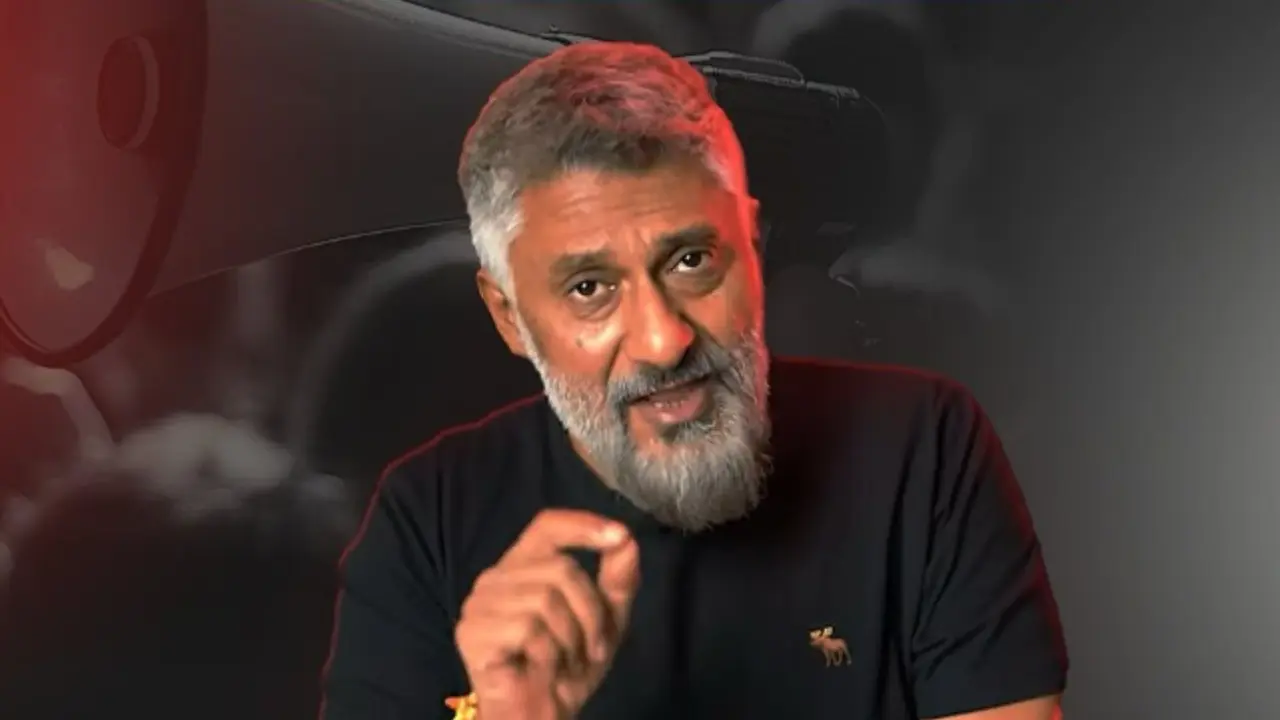
Chandrima Pal (BOMBAY TIMES; September 4, 2025)
Vivek Ranjan Agnihotri likes to make all the right—pun intended—moves. Ahead of the release of The Bengal Files, the third instalment of his Files series, he picks a Bengali-themed restaurant in suburban Mumbai for an interview, tells us that he likes Kishore Kumar’s Bengali songs and settles down for a Bengali meal with shukto and fish paturi . Excerpts from the conversation.
Let us imagine you had zero opposition to The Bengal Files, which releases in theatres tomorrow. That you had no political outfit, entity or individual to name and blame in your interviews. How would you promote your film?
I would have felt suffocated. I would have failed. My idea was to pick up taboo subjects, and in my mind the problem was that even after 78 years of Independence, we are still fighting with the same problems that led to the Partition. Unless you acknowledge there is a problem there can be no healing, no solutions. The purpose, the whole objective of my movies is to start a conversation. Since the trailer has launched, everybody is writing about Direct Action Day or Gandhi’s role, they are dissecting the film. Many Bengali Hindus are now admitting that their parents or grandparents had spoken about Direct Action Day and the Partition trauma. This, I believe, marks the beginning of healing from a generational wound.
No other place has sacrificed as much as Bengal: it was the cradle of the Renaissance, the wellspring of nationalism in all its shades—Congress, communist, centrist—with both Vande Mataram and Jana Gana Mana emerging from here. Bengal gave India its cultural crown, from cuisine and poetry to cinema, the Bengal School of Art shaped by Abanindranath Tagore. For me, Bengal is India’s lighthouse. My purpose was to shock people into realising how much we’ve lost.
How can you connect Bengal’s loss of cultural and intellectual capital directly to the Hindu– Muslim conflict at the heart of your storytelling? Isn’t it too much of an oversimplification?
That’s a very deep question. Which other state in the world has been divided three times? Without Direct Action Day or the Noakhali genocide, there would not have been Partition. Gandhi himself spent seven months in Noakhali, yet afterwards Bengalis were told not to speak of their pain—silenced by political forces that wanted to take India on a different path.
Later, communist ideology took deep root in Bengal, but it viewed everything only through oppressor versus oppressed. That western lens does not fit India, where the so-called majority was ruled and persecuted by minorities for 1,200 years—our literature, music, architecture, everything was distorted. That is why, I argue, Bengal’s decline cannot be seen separately from communal fault lines.
Films have been made on the Holocaust, Hiroshima, slavery— always with a core of humanism, empathy. Many feel your films don’t address that.
First, let’s be clear—which lot of people? Viewers? Critics? I am very research-oriented. And why should I force closure when history itself has none? Lal Bahadur Shastri’s death has no closure. Kashmir still has no closure—people were killed in Pahalgam just recently. But this film does have closure. What I believe should be done, that’s the closure.
Suppose this film triggers unrest. Would your role as a filmmaker end with reopening certain chapters in history?
Look at The Kashmir Files. People warned it would cause unrest. Nothing happened. Instead, I received thousands of emails from Kashmiri Pandits saying the film began their healing process. I can guarantee Bengali Hindus will say the same after this film; they already are, across screenings in the US.
Both communities suffered losses. Isn’t everyone part of the healing process?
Of course. Healing belongs to everyone. But not everyone had the luxury of moving on. Many were forced. Did we really move on? Germany and Poland confronted their past—they outlawed Nazi glorification, built museums, preserved Auschwitz.
Should India simply say “move on”? Or acknowledge that we have a genuine Hindu–Muslim faultline—Partition, Bombay blasts, Pahalgam killings, constant election rhetoric. If America could confront slavery through films, articles, debate, why are we in India told to stay silent about our own history?
Some of the cast members of your film — Saswata Chatterjee and Sourav Das — are facing backlash for being part of the film.
What backlash? Sourav and I had lunch recently. He never distanced himself. A journalist twisted his words, and he immediately asked, “Show me my tweet, quote me if I said that.” Same with Saswata. He never disowned the film.
Saswata did say he wasn’t told the full context.
That’s media manipulation. Do you think an actor of his calibre would sign without reading the script? He has to say things to survive in Bengal. I even spoke to his family—they shrugged it off. Look, he speaks Bengali throughout, eats paturi maach, plays a Murshidabad MLA. He knew what he was doing. After Nana Patekar in Parinda, we have not had such a cold-hearted villain in our cinema.
You say there will be closure at the end of the movie. What kind of closure?
Cinematic closure. But let’s be real—I cannot close the Hindu– Muslim conflict in Bengal or India. Who am I?
You often say you listen to your audience, pick stories that people want told. There are so many other stories that need to be told.
Honestly, what India needs right now is silence. All politicians should shut up for five years. Dalit leaders, Brahmin leaders, Muslim leaders, TV anchors— everyone. Just shut down the noise. And focus only on eradicating corruption. Solve that and 90% of India’s problems vanish.
Do you have political ambitions?
I’d rather die than join politics. But yes, I understand politics deeply. My father was a freedom fighter, I’ve debated politics since childhood. That’s why I can say what I say; most filmmakers can’t.
Many filmmakers, despite festival acclaim and dealing with socially relevant issues, can’t get theatrical releases. You always manage to make controversial films and take them to your audiences. What’s your secret?
Conviction. A filmmaker must guard their work like a mother rabbit protecting her babies from vultures. Most filmmakers lack that instinct. I don’t. I fight till the end.
But is it right to say they do not have the conviction to fight for their creative freedom?
Look, if you make a film on caste, someone’s offended. On women’s persecution, men are offended. On Muslims, Hindus are offended. Everyone is offended. But cinema cannot be hostage to sentiment. Honestly, I do not understand Muslim trauma or pain. Maybe if I am born as a Muslim in my next life, I would. But I still have the right to tell stories drawn from history and testimony.
And when films like Santosh don’t make it to audiences?
Then I fight for them. I don’t know why they don’t come to me, I would be happy to fight for them. Even my ideological enemies, I defend their freedom of speech. I fought for comedians like Kunal Kamra and Samay Raina.
Would you speak up for Umar Khalid?
He’s in jail, it’s sub judice, so I won’t comment.
Gopal Mukherjee aka Gopal Patha is a complex character. North Kolkata always remembered him as one of those powerful, street-cred strongmen—like Fata Keshto.
Yes, yes. They were the fiercest. Part of the akharas, too.
Utpal Dutt wrote in Towards a Revolutionary Theatre that after Direct Action Day, leaders used people like Gopal Patha to settle political scores—a muscleman on hire. He ran a family meat business, he ate meat, he spoke Bengali, he was no saint. You have said that after this film, kids will see him as a hero. Given the ideology to which you are aligned, are you okay with glorifying a figure like that?
Why? Bengalis eat meat. What’s wrong with that? Hindus in Kerala eat beef, Kashmiri Pandits ate meat too. India is not a vegetarian country; 73% of Indians eat non-veg. To reduce Gopal to food habits or language is just superficial politics. I believe in total freedom of food, speech, lifestyle.
----------------------------------
‘I hate disclaimers. They assume audiences are stupid’
Trailers don’t need disclaimers. The film will have one, because the law demands it. I hate disclaimers. They assume audiences are stupid. Does a painting carry a disclaimer? Cinema is art. My disclaimer will be the usual: “based on true incidents, survivor accounts, historical texts… intention not to hurt anyone.” Plus the silly statutory warnings—smoking kills, animals unharmed, etc. But because Jinnah was a chain-smoker, I was forced to add two extra minutes of anti-smoking ads.
----------------------------------
‘I am a storyteller, not a social scientist’
I am nobody to find answers. I am not the Prime Minister, not a social scientist. I am a storyteller. My job is to observe and narrate, not to prescribe solutions. People expect too much from filmmakers. Journalists often ask me — why don’t you rehabilitate Kashmiri Pandits? I tell them, I am not a politician. It’s like asking Satyajit Ray after Pather Panchali to eradicate poverty. That’s not how art works.
Kangana Ranaut flight chaos: IndiGo bars nine media personnel
8:06 AM

Saurabh Sinha (THE TIMES OF INDIA; October 26, 2020)
New Delhi: IndiGo has barred nine electronic media personnel from flying for a fortnight after its internal probe panel found they had behaved in an unruly manner on a Chandigarh-Mumbai flight (6E-264) of September 9 that had, among others, actress Kangana Ranaut on board.
An IndiGo official said the ban period for the journalists was from October 15 to 30.
Directorate General of Civil Aviation (DGCA) had directed IndiGo on September 11 to “initiate suitable action against those responsible for violation of regulatory provisions and guidelines and submit an action-taken-report, failing which suitable action will be initiated against the airline”. Following the regulatory directive, the airline set up a probe panel as per nofly list rules.
“Earlier this week, IndiGo informed us that its probe panel found media personnel on the flight behaved in an unruly manner that violated flight safety and Covid protocol. The airline grounded these media personnel for two weeks. It sent its probe panel findings and action-taken-report to DGCA and other airlines,” sources said.
Sources said it was up to other airlines to follow action taken by IndiGo against those found guilty of unruly behaviour. Till now Indian carriers have collectively barred passengers, like in cases of MPs barred from flying after misbehaving with airline personnel.
On January 28, IndiGo decided to ground standup comedian Kunal Kamra for six months (later halved) after he confronted TV anchor Arnab Goswami on a flight. Other airlines had also barred Kamra, with AirAsia India and Vistara doing so for one-and-a-half-months.
The suspension was the lowest no-fly period handed out by an airline in India.
On September 9, Ranaut was making a pre-announced return to Mumbai. Inflight videos of 6E-264 showed that soon after the aircraft touched down in Mumbai, electronic media personnel left their seats and rushed to the front row where Ranaut was seated to try to record visuals. Crew repeatedly made announcements for passengers to observe norms.
One of the announcements said: “Please understand, we all are equal. Please do not harass any passenger. Kindly follow all safety rules and remain seated till seatbelt is on.”
DGCA sought a report from the airline and, after receiving it, the regulator had observed that “a number of violations have happened on the day...”
The violations listed in the letter included “not stopping the large number media personnel boarding the flight with cameras in Chandigarh by taking help of security personnel; these passengers not following crew instructions during flight and even after landing; not following Covid-19 protocol”.
DGCA has warned all airlines that allowing a repeat of such behaviour will lead to the airline being suspended for two weeks from operating on the route on which the incident takes place.
Why parallels can be drawn with Kunal Kamra airline row and Sanjay Leela Bhansali’s slapping incident
4:32 PM

The internet exploded on January 28, 2020, after comedian Kunal Kamra, known for his critique on government, uploaded a video wherein he is criticising Republic TV co-owner and news reporter Arnab Goswami in an IndiGo flight. Throughout the length of the 1 minute 50 seconds long video, Kunal can be heard taking on Arnab and the latter being completely oblivious to it, wearing earphones and using his laptop. After he uploaded the video, Kunal also put out a statement wherein he claimed that he apologized to the pilot and the on board crew members for his behaviour. The video, as expected, went viral and evoked mixed reactions. Some congratulated him for his what they called bravado. The rest found it in a very bad and cheap taste.
Trouble arose when IndiGo put out a statement on the night of the same day that they have suspended Kunal Kamra from flying on their airline for six months as he indulged in ‘unacceptable behaviour’. Around 30 minutes later, Hardeep Singh Puri, the Union Minister for Civil Aviation, who was tagged by IndiGo in their statement tweet, made a response to their tweet stating, “Offensive behaviour designed to provoke & create disturbance inside an aircraft is absolutely unacceptable & endangers safety of air travellers. We are left with no option but to advise other airlines to impose similar restrictions on the person concerned”. One more hour later, Air India followed in the steps of IndiGo and suspended Kunal Kamra. They were joined by SpiceJet and Go Air the next day in putting indefinite restriction on the stand-up comedian.
As expected, the ones who hate Kunal Kamra to the core for being extremely critical of BJP, went into a celebration mode over these bans. The rest of them and even the more neutral ones were left shocked. Rightfully, many netizens reminded that graver acts have been committed by our politicians particularly on flights. A recent example is of BJP MP Pragya Thakur, who didn’t allow a SpiceJet flight in December 2019 to take off for 45 minutes because of a seat issue. A video is out showing disgruntled passengers blasting her for using her VIP status in an unfair manner. SpiceJet, however, took no action against Pragya. Then, 3 years ago, the case of the then Shiv Sena MP Ravindra Gaikwad slapping an Air India employee and even beating him with his shoes is unforgettable. The politician even bragged about in front of the media. He was put in an unofficial no-fly-list by airlines for around 9-10 days. He later stated in the Parliament that he regrets what happened and then went on to lie that he only slightly pushed the employee and that he never attacked him with his chappals! This white lie was enough for Air India and others to forgive him.
More and more analysis of the incident came to light as the day passed yesterday. It was revealed that neither Arnab Goswami nor IndiGo crew made any formal complaint against Kunal Kamra. Hence, this act of IndiGo suspending him was against the rules. Same goes for Air India, SpiceJet and Go Air, who shockingly and hastily also announced a suspension on Kamra though the incident didn’t take place in their aircraft! Arun Kumar, director general of Directorate General of Civil Aviation (DGCA), on record made it clear that the said ban is a clear violation of rules. A few hours, DGCA backtracked and claimed that such a ban doesn’t violate any rules. However, a quick Google search on the rules makes it clear that no due process was followed.
As I read through the material on this controversy and discussed it with friends, I was transported back to an incident that occurred 3 years 1 day before this incident. It took place in Jaipur where blockbuster and reputed filmmaker Sanjay Leela Bhansali was filming for his ambitious period film Padmavati On January 27, 2017, protestors, belonging to an organization called Sri Rajput Karni Sena, descended on the sets and slapped the director. Their grouse was that Bhansali was distorting history. The film was based on brave Rajput queen Padmavati who committed ‘jauhar’ before she could be captured by Alauddin Khilji. The members of this violent organization made this attack on the assumption that there exists a romantic dream sequence between Padmavati and Khilji. Later, it came to light that no such scene existed in the script in the first place.
As expected, many right-wing fanatatics were overjoyed on hearing about the attack on Sanjay Leela Bhansali. They felt ‘he deserved it’ for messing up with history. Most of the industry remained silent. But the rest of the film personalities and most of the netizens demanded strict action against the attackers. Lokendra Kalvi, the founder of Sri Rajput Karni Sena, even admitted in front of the media that his men carried out the attack. However, the pro-attack group argued that no action should be taken since Bhansali never lodged a complaint. Also, the then Rajasthan CM Vasundhara Raje, also from BJP, never reacted to this attack though it occurred in her state. Again, the reasoning given was that how can she or Prime Minister Narendra Modi react to such ‘trivial matters’!
Now, let’s come back to Kunal Kamra row. Even here, as we mentioned above, Arnab Goswami never lodged a complaint. The same goes for the airline staff. Yet, the government in the form of Hardeep Singh Puri jumped in to criticize Kunal’s behaviour and ‘advised’ other airline to also ban him! To all those who got away by giving ‘no-complaint-means-no-action’ theory during Bhansali row, I’d like to ask all of them – what is your defence now?
It’s pretty clear why the government felt obliged to come in the defence of Arnab. The veteran reporter is known to be extremely close to the government. Most of the times, he is seen singing praises of BJP and defending its policies and criticizing the rest. There have been few instances when guests on his show have made it clear that he’s a BJP stooge; to which Arnab has blasted them and reiterated that he is a fair journalist. However, all these claims of Goswami can now go out of the window as anyone can make out that the government has come out to teach his ‘enemy’ a lesson on his behalf!
What Kunal Kamra did is unacceptable. Those supporting him will be upset if tomorrow the same treatment is meted out to their favourite anchors like Ravish Kumar or Barkha Dutt. They claim that even a Republic reporter did the same in a flight with Tejaswi Yadav but this is just making a whataboutery comment. Also, the manner in which they trended #BoycottIndigo and #BoycottAirIndia was foolish, especially since this same lobby was seen laughing over futility of a similar campaign #BoycottChhapaak two weeks back! However, one can’t deny that airlines have just bowed down in front of the government in placing these bans. They might get away now but in future, when a neta would indulge in such a behaviour (or even worse) and they’ll let him off, they’ll be taken to task by the netizens.
Subscribe to:
Posts (Atom)