Showing posts with label Kulbhushan Kharbanda. Show all posts
Showing posts with label Kulbhushan Kharbanda. Show all posts
After playing Duryodhan, I’m excited to play Raavan on TV-Puneet Issar
8:56 AM

Tanvi Trivedi (BOMBAY TIMES; November 5, 2025)
At 32, Puneet Issar became popular as Duryodhan in B R Chopra’s Mahabharat, and now at 65, he’s all set to play Raavan in the TV show Shiv Shakti Tyag Tandav. The actor says, “When I played Duryodhan at that time, my age, height, physical structure... everything matched very well. It was like I was born to play the role. People still recognize me as Duryodhan.”
Now he’s excited to play Raavan on TV. “I have essayed this character in plays such as Ishwar and Raavan Ki Ramayan earlier, and now I’m happy to do that in a TV show.” He adds, “I feel at 67, this is the right time for me to play Raavan. He was a man in his mid-60s when he faced Lord Ram. The grace, poise and wisdom — they come naturally to me now.”
Beyond mythology, Issar has also been part of many films, from Coolie to Jayeshbhai Jordaar, “I’ve played the villain opposite three generations of heroes,” he says, happy to be balancing different medium, including theatre. “I’m passionate about plays, I call theatre my creative backbone. It keeps you alive and sharp,” he adds.
‘Today’s villains lack the fierce aura’
Issar believes that Bollywood villains no longer exude the same menace and authority they once did. He says, “Earlier, we had daunting and fierce villains — whether it was Amjad Khan as Gabbar Singh, Amrish Puri ji as Mogambo, or Kulbhushan Kharbanda as Shakaal. Somehow, such powerful, one-dimensional roles are not being written anymore. I don’t know who’s to be blamed for that.” He adds, “The villain has to look more towering than the hero. Only then does the hero’s victory look strong. But I don’t see that too often now.”
Raring to go at 90, Shyam Benegal is “working on two to three projects”
8:34 AM
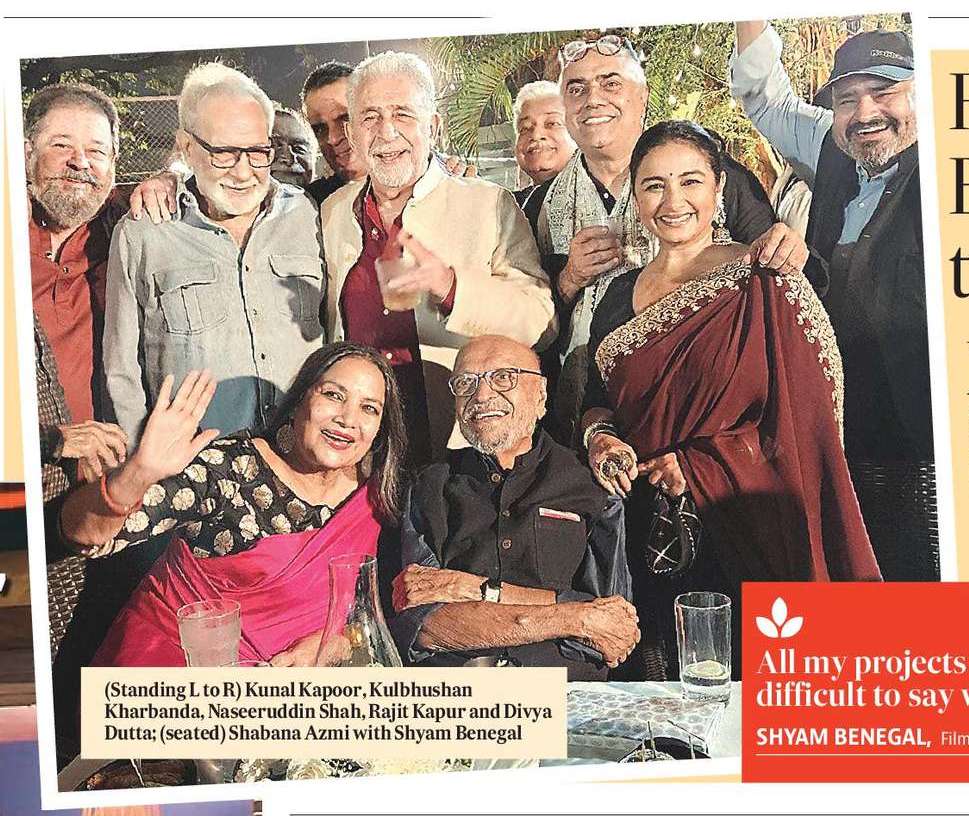
HINDUSTAN TIMES (December 16, 2024)
Many would consider turning 90 a significant milestone in life, but filmmaker Shyam Benegal doesn’t attach too much importance to birthdays. “We all grow old. I don’t do anything great (on my birthday). It may be a special day, but I don’t celebrate it specifically. I cut a cake at the office with my team,” he said.
This year, however, his loved ones made it special for Benegal on his birthday (December 14). His 90th was celebrated at Bombay Gymkhana in Fort, Mumbai with family and friends, including actors Naseeruddin Shah, Shabana Azmi, Divya Dutta, Kulbhushan Kharbanda, Rajit Kapur, and Kunal Kapoor, among others.
Despite the physical challenges that come with age, including frequent hospital visits for dialysis three times a week, Benegal is committed to his passion for filmmaking.
He told PTI, “I’m working on two to three projects; they are all different from one another. It’s difficult to say which one I will make. They are all for the big screen.” The director’s most recent film was the 2023 biographical, Mujib: The Making Of A Nation.
Surender Mohan Pathak sues Mirzapur makers for depicting his novel Dhabba as erotica
8:11 AM

Veteran Hindi writer Pathak enraged after Mirzapur 2 makers depict his novel Dhabba as erotica; claims voiceover has no resemblance to the original text
Mohar Basu (MID-DAY; October 30, 2020)
Popular Hindi fiction writer Surender Mohan Pathak is seeing red at the second season of Mirzapur. In the third episode of the Amazon Prime Video series, Kulbhushan Kharbanda's character is seen reading Pathak's novel, Dhabba, as the voiceover describes an erotic scene. Claiming that the content suggested in the voiceover is dramatically different from the original text of Dhabba, the veteran writer has described it as a violation of the Copyright Act and written to the production house Excel Entertainment, seeking the removal of the said scene.
"I am waiting for their response to my notice. If I don't hear from them within the stipulated period of one week, I'll file a case in Delhi High Court against the makers of Mirzapur 2," says Pathak.
Best known for his crime fiction series Vimal, the author, 80, says he was unaware of the development until his fans brought it to his notice. "When the complaints started pouring in, my daughter showed me the scene. The makers added their own filthy, disgusting [lines] as a voiceover and passed it off as the content of my novel, which was published 10 years ago. They used cheap porn to titillate the viewers, and to tarnish my image as a well-established mystery writer. In the voiceover, a character named Baldev Raj is mentioned; there is no such character in Dhabba. Many readers, who haven't read the novel, could get a wrong impression that the author, in his old age, has lost his mind and resorted to writing pornography to gain publicity. I consider it a conspiracy to defame me."
The novel features in another scene in the second episode, where Rasika Dugal's character takes charge of her life after suffering sexual abuse and battling suicidal thoughts. One might argue it's a powerful scene that establishes the importance of women characters in a largely male-driven plot.
When writing, Pathak counts depiction of sex and violence as off-limits. "I have written 270 mystery novels and thrillers in the past six decades, and they have gained immense popularity due to their gripping storyline and my distinctive style of writing. Never have I depicted violence and sex in graphic detail in any of my works," he asserts.
mid-day reached out to writer-creator Puneet Krishna, Excel Entertainment and Amazon Prime Video, who remained unavailable for comment.

Sholay grew out of my love for westerns while Shaan was more like a Bond film-Ramesh Sippy
8:04 AM

Roshmila Bhattacharya (MUMBAI MIRROR; January 21, 2020)
Suave and well-spoken, the Sholay maker doesn’t look like a man who has built his career on risks, but his first directorial, Andaz, brought together a widow and a widower, a taboo subject back in 1971. Ramesh Sippy recalls that when he took the subject to Shammi Kapoor, with whom he’d bonded during Brahmachari, produced by his father G P Sippy, with him as the executive producer, the actor asked him if he really wanted to tackle such a serious subject at such a young age. The 23-year-old debutant was sure he didn’t want to do another song-and-dance film with the Yahoo star even though he aced them. “I knew I was taking a chance, but with their children playing matchmakers, I thought the audience might be happy to see Ravi and Sheetal come together at the end of Andaz,” he reminisces.
Sippy took another gamble, pairing an ageing Shammi ji who was on a journey of rediscovery, with the fresh-faced Hema Malini who was on the threshold of her career. With Rajesh Khanna, whose Aradhana had made him a craze, entering the picture in a guest appearance, the filmmaker was able to carry off the awkward romance. “It was too much to expect a super-hit, but the film did well,” says Sippy, who turns 73 on January 23.
That gave him the confidence to attempt a double role with Hema Malini next. Dilip Kumar’s Ram Aur Shyam had already experimented with the twin track successfully, but Sippy believed the idea could be explored better with a subdued woman being exploited by her family and pulled out of misery by another woman who’s her lookalike. “The year was 1972 and women were slowly coming to fore, refusing to be taken for granted, and as part of this young world, I wanted to do my bit,” he smiles, admitting that his heroine was not confident of pulling off the dual challenge, but he pushed her into giving the two characters distinguishing traits while juggling with multiple projects. “It was hard work, but with two successful actors, Dharmendra and Sanjeev Kumar, who were really fond of her, agreeing to be a part of a part of my woman-centric film, Seeta Aur Geeta, worked well,” he smiles.
In a chequered career of nearly half a century, Sippy today is also remembered for giving Hindi cinema two unforgettable villains in Gabbar Singh and Shakaal. The original choice for Sholay’s daku was Danny Denzongpa, the best of the baddies then. But by the time the film went on the floors, he was in Afghanistan shooting for Feroz Khan’s Dharmatma, and had to apologetically bow out.
Unwilling to take an established actor and run into date problems again, Sippy took heed of his writer duo Salim Khan and Javed Akhtar’s suggestion to consider actor Jayant’s son, Amjad Khan. “I had seen him in a play on apartheid in South Africa opposite my sister and invited him to my office. He was a mountain of a man with a peculiar face and voice but turned out to be the most colourful character in Sholay,” he recounts.
He was also such a larger-than-life character that when Shaan came along five years later in 1980, with Kulbhushan Kharbanda as Shakaal, many were expecting another Gabbar and were disappointed. But Sippy points out that he wanted to get away from the rustic dacoit and came up with a sophisticated, clean-shaven villain who keeps playing with his bald pate. “I had seen Kulbhushan in Shyam Benegal’s Manthan and knew he could perform. But the setting was different here, moving from a rocky terrain to an almost futuristic den. Sholay grew out of my love for westerns while Shaan was more like a Bond film with car chases, gadgets, special effects and an international crime lord operating from a remote island. It was an expensive film and I am grateful to my father for having faith in me and pumping in so much money into it,” he says.
In 1985, the leap of faith took Sippy into Saagar, an epic romance in 70 mm, which brought Dimple Kapadia back to the screen and reunited her with her Bobby co-star Rishi Kapoor. For any other maker that would have been enough, but Sippy took it a step further, roping in Kamal Haasan whom he’d seen in Ek Dujje Ke Liye and turning his film into a love triangle. “Kamal Haasan had great intensity and juggled between light and tragic scenes with amazing dexterity,” he points out.
Saagar was India’s entry for the Oscars and though it didn’t make the cut, RD Burman’s “Chehra hai ya chand khila hai… Yeh to bata tera naam hai kya?” still makes me fall in love with the ethereal Dimple Kapadia who’s never looked more beautiful. “That’s the magic of cinema. Everyone, from my actors to my writers, composers and other technical crew contributed to making these movies memorable,” Sippy avers.

Shammi Kapoor in Andaz, Hema Malini in Seeta Aur Geeta, Amjad Khan in Sholay, Kulbhushan Kharbanda in Shaan and Kamal Haasan, Dimple Kapadia and Rishi Kapoor in Saagar
Sonakshi Sinha in a slice-of-life drama, produced by Fukrey director Mrighdeep Singh Lamba
7:19 AM

Nayandeep Rakshit (DNA; January 18, 2019)
After Dharma Productions’ big-budget period drama Kalank, Sonakshi Sinha has given her nod to her second project this year. The Happy Phirr Bhag Jayegi heroine has greenlit a slice-of-life drama, which will be backed by T-Series and will also mark Fukrey director Mrighdeep Singh Lamba’s foray into production. Written by Gautam Mehra, it will be helmed by debutante Shilpi Dasgupta.
A source tells us, “It’s a yet-to-be-titled ensemble movie with Sonakshi leading from the front. She plays a typical Punjabi from Hoshiyarpur, who loves her family a lot and tries to strike a balance between them and her dreams. It is the no-holds-barred journey of a girl, who breaks taboos and opens minds in the process.”
The Ittefaq actress evinced interest in the project after the narration. The source adds, “Sonakshi has an author-backed role. The rom-com will also feature Varun Sharma, Annu Kapoor and Kulbhushan Kharbanda. Casting is underway for an actor, who will play Sona’s love interest.”
The movie goes on floors on January 25 in Punjab and will release on August 2 this year. Confirming the news of her signing the project, Sonakshi says, “I’m extremely happy to be part of a film, which is so close to the world around us. I will get to step into the shoes of a small-town girl, and face the hilarious, madcap challenges thrown at her. It’s full of flavour, fun and emotions. I am looking forward to this journey.”
Mrighdeep tells us, “When emotions are combined strongly with laughter, it’s a story worth one’s time. The movie explores the extraordinary dreams of an ordinary girl in a madcap world.” Producer Bhushan Kumar adds, “It is a slice-of-life film with a superb ensemble cast that will make you laugh, cry and fall in love with every character.”
Mid-Day Exclusive: Check out Kangana Ranaut shooting for Manikarnika - The Queen of Jhansi
8:30 AM

mid-day catches up with Kangana Ranaut on the sets of Manikarnika as she juggles her dual role of actor and filmmaker with equal ease
Mohar Basu (MID-DAY; October 7, 2018)
Lines from T S Eliot's Love Song of J Alfred Prufrock played in my ears as I entered the set of Manikarnika in ND Studios. "Do I dare disturb the universe…?" It might as well be the motto of Kangana Ranaut's career — the actor is hell-bent on turning every rule in the book upside down. While the industry debate whether she is a wild girl on the loose or a masterclass in the making; I decided to catch up with Ranaut as she donned the director's chair for Manikarnika - The Queen of Jhansi, finding herself in the eye of another storm.
The original director Krish aka Radha Krishna Jagarlamud took off to shoot an NTR biopic in Hyderabad, while Ranaut decided to take the onus of completing the project. Incredibly calm, dressed in blue linen kurta-pyjama, sans any makeup, she sat in front of the monitor, observed every move of the actors like a hawk. "I am sleep deprived," she said and explained her schedule. "I was at Film City last night to check how far the action scenes have advanced. I got back at 2am and have been on set since 7am. But then, this is a biopic of Rani Lakshmibai. It won't be worth it, without blood, sweat, tears and toil..."
Sweat glistened over the gash mark on her forehead from an injury she incurred during a sword fight sequence last year. Prod her about eyebrows being raised over her decision to direct the rest of the film and she said, "I am a mischief maker. We hatched this ploy to keep Nick Powell [action director] here. He was to go to Bulgaria and was willing to commit dates to us only after six months. We have taken away his passport," she said with a devilish laugh.
The actor was whisked away by Kiran Deohans, the cinematographer, who took over the schedule after she came on board. Deohans, who is known for his work in Jodhaa Akbar (2008), seems to have cracked her wavelength. Together, they discussed the shot, the camera movements, the lighting before they got rolling again. "She doesn't function like a first timer. She knows exactly what she wants and it has been a smooth ride," said Deohans.
Before I could catch hold of Ranaut again, she was visited by Ashwiny Iyer Tiwari, the director of her next, Panga. Given the reports about the discord between them, one expected to see some awkwardness. But they were giggling like schoolgirls. As Kangana called for a special adrak chai for Tiwari (a set regular), she remarked, "Aaj lag rahi hai ye director — sleep deprived, no make-up, uncombed hair and with stress on the face. Iska matlab hai kaam acha jaa raha hai."
Ranaut thoughtfully added, "To be an actor is a privileged job. It's about blowing kisses to the crowd, sitting pretty and never getting into the grime. Most artistes are in the industry for the wrong reasons, the fame and money. I want to believe I am here for the love of the craft. So, no matter how exhausting this is, I am enjoying every bit of it." When I broached the topic of taking credit, she dismissed it saying, "When male actors take the onus of their films, do they demand credit? Then why is it made to look like I am hijacking a project? I am doing what is in the best interest of a film that rides on me. It will be a landmark moment in Hindi cinema when this film does well. Producers will invest big bucks in movies headlined by women. This isn't about seeing my name as a director."
Ask her if the idea of direction scared her initially and she said, "The idea of putting out a film that doesn't live up to its name scared me more. The reworking was crucial. After the studio saw the film, there was a good chance Manikarnika wouldn't have seen the light of day. There were glaring discrepancies in the plot line. Directing this film isn't difficult. Vijayendra Sir [K V Vijayendra Prasad, the writer] has written an impactful script; Kiran sir has set the shot beautifully, I am just going by the written word."
An hour post lunch, the act resumed in another corner of the set with a palki scene that featured Mishti Chakraborty — Subhash Ghai's find from his forgettable film, Kaanchi (2014). Ranaut guided her and in two takes, she was done. I asked Ranaut about her process —does she usually tell her actors what expressions to give? "Every actor should be able to bring their own to the table. To tell them how to do their job is insulting them. The director has to just ensure everything he/she is filming must be in sync with the larger picture; anything beyond is overstepping."
How do you direct yourself? "Oh, that's tough because of the nature of this film. Running to the monitor after every scene in heavy clothes is exhausting." Chakraborty reappeared with a phone and handed it to Ranaut. She slipped into the part of a parent-figure, requesting the teacher to grant her kid two days' leave. "It's the director of Mishti's South film. We are shooting a song in 10 days and it was clashing with that film. So I had to put in a request for her."
As the setting sun peeked from the hills nearby, Ranaut marched towards a horse-riding scene. Kulbhushan Kharbanda, suffering from a severe back pain, climbed on a wooden horse as she read the dialogues for him. "Good scene Kul Sir," she said on the mic before figuring the arrangements for Kiran sir's farewell later in the evening. Miles to go before you sleep, I asked her and she quipped, "But I have promises to keep," completing the Robert Frost poem for me.

Kangana Ranaut with Nick Powell


The actor with Mishti
For a tiny person, I have a lot of confidence. No one messes with me-Kriti Kharbanda
8:01 AM

Renuka Vyavahare (BOMBAY TIMES; June 28, 2017)
A n interview with the
vivacious actress Kriti Kharbanda can easily be summed up as 'confessions of a talkaholic'. Meeting this South siren feels like
bumping into an old friend with whom you can aimlessly chat about
anything under
the sun. The conversation meanders into random territories and you find
yourself identifying with her idiosyncrasies. The Bengaluru girl talks
about living alone, being a toughie and her upcoming release, Guest Iin
London. Read on...
You were born in Delhi, then shifted to Bengaluru and now live in Mumbai. Which city are you most comfortable in?
I'm a loner and I'm most comfortable living by myself, but Bengaluru is home to me as my family is there. Having said that, once you come to Mumbai, you can't turn your back on it. I've grown close to Mumbai now. For someone like me who gets bored very easily, this life is perfect. I can't be at one place for too long. Travelling broadens your thinking as a person and as an actor. Also, I like to watch people; I go early to airports so that I can observe people. You can use that observation to your advantage when you are essaying a character. You can slip in some character traits of those people into your roles.
Has Maximum City changed you as a person?
You discover who you truly are only when you live alone. Mumbai is the only place where I have lived alone, so I had to be self-sufficient. I am a much happier person today. When I meet people, I meet them because I want to, not because I am lonely. Today, if I don't like someone, I make it very obvious. Mumbai has taught me to love and look after myself.
Looks like you've undergone a transformation of sorts.
A major transformation has happened to me in the past year. Earlier, I was always there for everyone, always giving and not receiving anything. But you soon realise that you cannot be nice to everybody all the time. I've stayed in a protected atmosphere back home. When you are alone in your apartment, you have to be self-sufficient. Today, I choose myself before everyone else. Mumbai has made me realise my worth. At three in the morning when you are upset, you are the only one who can hug yourself to sleep.
Since you are popular in South cinema, it must have been tough for you to start all over again in Bollywood?
My life had become monotonous, so the shift to Mumbai came as a good challenge but when you start from scratch, you value what you had. The leap was amazing. When I step out in Bengaluru or Hyderabad, I get mobbed. That doesn't happen here (Mumbai) and I would be lying if I say I don't feel insecure about that. Every person is insecure in his/her own way. I am glad that happened as it has made me who I am today.
Don't you think Bollywood has a wider reach?
Yes, because of the language. The whole of North India speaks Hindi. But you cannot deny how huge some stars are down South - Rajinikanth, Suriya, Mahesh Babu etc. have a massive fan following.
Don't you think actors from South are often stereotyped, especially when they try and make a foray in Bollywood?
Fortunately for me, there was no stereotyping as such but I am aware that it happens. Initially, people don't take you seriously. There is a perception that 'Ise glamour ke liye picture mein dal do'. I get asked if I can speak Hindi because I've done South films. But these weren't obstacles as such. My last name helped in a way. Also, I had a lead role in Raaz Reboot, so that helped too.
Did the film's failure deeply affect you?
I got a positive feedback for my role in Raaz Reboot but of course it hurt. A failure is bound to break your heart. I was bummed out that the film didn't do well. I personally thought it was a decent film. I wish it had done better but I did my best as an actor. There is nothing in my hands beyond a point. The one thing that I'd like to change about it is probably the result (laughs).
As an actor, what was the transition from horror to a full-fledged comedy like Guest Iin London (GIL)?
It was a relief because I wanted to try my hand at something different. Though I have had a career down South, most of my characters have been performance-driven even if they were bubbly. My character in GIL is exactly how I am. I got an opportunity to be myself on screen. Anaya Patel (her character in the film) is as whiny, emotional and talkative as I am in real life. I got to play a role that is much more than a love interest of someone. Also, I am super excited to have worked with actors like Tanve Azmi and Paresh Rawal in this film.
The story revolves around guests who overstay in someone's house. Have you faced that in real life?
I don't like visitors so the irritable expression in the film came naturally to me. I can't do small talk. I love people with whom I can share moments of comfortable silence. If I am quiet, it doesn't mean I am upset. I love talking and meeting people face to face, but that's outside. At home, I like my peace. A lot of my friends have still not seen my house in Mumbai because I mark my territory (laughs).
Any such particular incident that took you by surprise?
I was shooting in Hyderabad and was putting up at a hotel. A friend called to ask where I was as she was visiting the city. I shared my hotel details with her. The next day, I get a call from the reception saying my friend has showed up. She came to my room with her luggage and said, “Since we are both staying at the same hotel, why should I get another room?“ She stayed with me for four days. After much contemplation on the last day, I told her that I can't do this, I need my space. For a tiny person, I have a lot of confidence. No one messes with me!
Kartik Aaryan is known to be high on energy. How did the chemistry work between the two of you?
I thought Kartik would be a fun, chirpy person but he is actually a quiet guy. I didn't know that about him. He is very serious about his work. When you look at him, it doesn't feel like that. We didn't even have each other's phone numbers until almost 80 per cent of our film was shot! I keep teasing him that he was not nice to me initially and obviously he dismisses my claims. On a serious note, he comes with no baggage. I enjoyed working with him. We get along very well as friends since we are of the same age.
Do you still get asked if you are related to Kulbhushan Kharbanda?
Oh yes, I get asked if I am his daughter, granddaughter or niece. Even during Raaz Reboot, the makers asked me if I was related to him but I clarified that we just share our last name. I am a rank outsider. But thanks to him, in some way, people are able to relate to my name. Weirdly, I have never met him.
You were born in Delhi, then shifted to Bengaluru and now live in Mumbai. Which city are you most comfortable in?
I'm a loner and I'm most comfortable living by myself, but Bengaluru is home to me as my family is there. Having said that, once you come to Mumbai, you can't turn your back on it. I've grown close to Mumbai now. For someone like me who gets bored very easily, this life is perfect. I can't be at one place for too long. Travelling broadens your thinking as a person and as an actor. Also, I like to watch people; I go early to airports so that I can observe people. You can use that observation to your advantage when you are essaying a character. You can slip in some character traits of those people into your roles.
Has Maximum City changed you as a person?
You discover who you truly are only when you live alone. Mumbai is the only place where I have lived alone, so I had to be self-sufficient. I am a much happier person today. When I meet people, I meet them because I want to, not because I am lonely. Today, if I don't like someone, I make it very obvious. Mumbai has taught me to love and look after myself.
Looks like you've undergone a transformation of sorts.
A major transformation has happened to me in the past year. Earlier, I was always there for everyone, always giving and not receiving anything. But you soon realise that you cannot be nice to everybody all the time. I've stayed in a protected atmosphere back home. When you are alone in your apartment, you have to be self-sufficient. Today, I choose myself before everyone else. Mumbai has made me realise my worth. At three in the morning when you are upset, you are the only one who can hug yourself to sleep.
Since you are popular in South cinema, it must have been tough for you to start all over again in Bollywood?
My life had become monotonous, so the shift to Mumbai came as a good challenge but when you start from scratch, you value what you had. The leap was amazing. When I step out in Bengaluru or Hyderabad, I get mobbed. That doesn't happen here (Mumbai) and I would be lying if I say I don't feel insecure about that. Every person is insecure in his/her own way. I am glad that happened as it has made me who I am today.
Don't you think Bollywood has a wider reach?
Yes, because of the language. The whole of North India speaks Hindi. But you cannot deny how huge some stars are down South - Rajinikanth, Suriya, Mahesh Babu etc. have a massive fan following.
Don't you think actors from South are often stereotyped, especially when they try and make a foray in Bollywood?
Fortunately for me, there was no stereotyping as such but I am aware that it happens. Initially, people don't take you seriously. There is a perception that 'Ise glamour ke liye picture mein dal do'. I get asked if I can speak Hindi because I've done South films. But these weren't obstacles as such. My last name helped in a way. Also, I had a lead role in Raaz Reboot, so that helped too.
Did the film's failure deeply affect you?
I got a positive feedback for my role in Raaz Reboot but of course it hurt. A failure is bound to break your heart. I was bummed out that the film didn't do well. I personally thought it was a decent film. I wish it had done better but I did my best as an actor. There is nothing in my hands beyond a point. The one thing that I'd like to change about it is probably the result (laughs).
As an actor, what was the transition from horror to a full-fledged comedy like Guest Iin London (GIL)?
It was a relief because I wanted to try my hand at something different. Though I have had a career down South, most of my characters have been performance-driven even if they were bubbly. My character in GIL is exactly how I am. I got an opportunity to be myself on screen. Anaya Patel (her character in the film) is as whiny, emotional and talkative as I am in real life. I got to play a role that is much more than a love interest of someone. Also, I am super excited to have worked with actors like Tanve Azmi and Paresh Rawal in this film.
The story revolves around guests who overstay in someone's house. Have you faced that in real life?
I don't like visitors so the irritable expression in the film came naturally to me. I can't do small talk. I love people with whom I can share moments of comfortable silence. If I am quiet, it doesn't mean I am upset. I love talking and meeting people face to face, but that's outside. At home, I like my peace. A lot of my friends have still not seen my house in Mumbai because I mark my territory (laughs).
Any such particular incident that took you by surprise?
I was shooting in Hyderabad and was putting up at a hotel. A friend called to ask where I was as she was visiting the city. I shared my hotel details with her. The next day, I get a call from the reception saying my friend has showed up. She came to my room with her luggage and said, “Since we are both staying at the same hotel, why should I get another room?“ She stayed with me for four days. After much contemplation on the last day, I told her that I can't do this, I need my space. For a tiny person, I have a lot of confidence. No one messes with me!
Kartik Aaryan is known to be high on energy. How did the chemistry work between the two of you?
I thought Kartik would be a fun, chirpy person but he is actually a quiet guy. I didn't know that about him. He is very serious about his work. When you look at him, it doesn't feel like that. We didn't even have each other's phone numbers until almost 80 per cent of our film was shot! I keep teasing him that he was not nice to me initially and obviously he dismisses my claims. On a serious note, he comes with no baggage. I enjoyed working with him. We get along very well as friends since we are of the same age.
Do you still get asked if you are related to Kulbhushan Kharbanda?
Oh yes, I get asked if I am his daughter, granddaughter or niece. Even during Raaz Reboot, the makers asked me if I was related to him but I clarified that we just share our last name. I am a rank outsider. But thanks to him, in some way, people are able to relate to my name. Weirdly, I have never met him.

J P Dutta to host reunion bash for cast & crew on 20th anniversary of Border
7:58 AM

Avinash Lohana (MUMBAI MIRROR; June 9, 2017)
 J P Dutta’s 1997 war-drama, Border, turns 20 on June 13 and the
67-year old filmmaker is all set to host a reunion bash on Sunday at a
South Bombay five-star to mark the occasion with the cast and crew,
including Sunny Deol, Suniel Shetty, Akshaye Khanna, Pooja Bhatt,
Raakhee, Jackie Shroff, Tabu, Kulbhushan Kharbanda and Puneet Issar.
J P Dutta’s 1997 war-drama, Border, turns 20 on June 13 and the
67-year old filmmaker is all set to host a reunion bash on Sunday at a
South Bombay five-star to mark the occasion with the cast and crew,
including Sunny Deol, Suniel Shetty, Akshaye Khanna, Pooja Bhatt,
Raakhee, Jackie Shroff, Tabu, Kulbhushan Kharbanda and Puneet Issar.His daughter Nidhi is looking into arrangements for the bash and has confirmed to Mirror that all invites have been sent out and Pooja, Suniel and Jackie recently dropped by their office. “We hadn’t even realised that our film was nearing its 20th anniversary until someone from Florida called to remind us. I told dad that we must celebrate the occasion,” she says, adding that she was just five when Border was being shot in Bikaner.
Meanwhile, Dutta Sr has more vivid memories from the Border days. “Once, I played the song 'Sandese Aate Hain' to a troop of 500 jawans who were assigned to us for the film. After listening to it, they quietly dispersed to shed a tear in private,” he reminisces, adding that the film will remain relevant as long as the world is grappling with wars.
For the upcoming bash, Nidhi is making a video to take the attendees down memory lane. “A crew member had captured all the behind-the-scenes action while the movie was being shot. I have compressed it into a video. We will also be giving out tank and plane-shaped mementos to the team members and there’ll be a coffee table book too,” says Nidhi.
Nidhi, who has earlier assisted Dutta on the Abhishek and Aishwarya Rai Bachchan-starrer 2006 film Umrao Jaan, reveals that she has no plans currently to make her acting or direction debut. Meanwhile, her father is working towards getting a new project off the ground. Will it be Border 2? “No Border 2, but another war film, yes,” Dutta Sr signs off.
I feel like giving that young girl in the picture a tight hug-Tillotama Shome
7:29 AM

Tillotama Shome on playing Alice in her first film and her contest with the looking glass
As told to Yoshita Sengupta (MUMBAI MIRROR; October 19, 2014)
'Relax, it's a film,' said Naseeruddin Shah, playfully slapping me on my back. 'Mistakes are a critical ingredient of an actor's life,' said Kulbhushanji (Kharbanda).
Everyone around was merely trying to restore order in Wonderland. Alice's Wonderland. I was Alice (it was also the name of the character I was playing in the 2001 film) on the sets of my first film, Mira Nair's Monsoon Wedding.
Blissfully unaware of the technicalities of filmmaking, I Alice-d around the sets, basking in the benevolence of Mira Nair, who allowed me to do what I wanted, with few but clear instructions. The strong shouldered Director of Photography Declan Quinn allowed me to meander. He said, 'You do what you have to do and the camera will follow.'
One scene had me in front of a mirror. I had to repeat a particular sequence, catching the light, balancing on one foot, and ensuring that the body does not shift axis — else the camera would be visible in the mirror.
I was anxious, alarmed and nervous. I made one mistake after another. Each take compounded my guilt of slowing down the team. As I sat quietly by myself in tears, Kulbhushanji walked up to me and asked what was wrong. I told him that I was an unmitigated disaster. In return, he regaled me with stories of the mistakes he had made.
A few hours later, I delivered what was required of me. Quinn, walked up to me and whispered, 'Mirrors are difficult; not just for you, but for the biggest actors.' Mira, the captain of the ship, enveloped me in her warmth and restored order in Wonderland by making me feel important.
I was humbled by this - a huge team, comprising legends, where each of them was working hard to ensure I was comfortable.
Recently, I met Kulbhushanji at the Mumbai Film Festival. We reminisced about the mirror scene. We laughed a lot and then he said, 'Your Hindi has become really good, shabash beta!' His shabashi meant the world to me.
On many occasions, Mira and I have also laughed over this photograph and my general Alicelike cluelessness. When she came to see Qissa in New York, she stood up after the film and called it a powerful dream. She appreciated my work and spoke of a possibility of us working together again. It felt like a parent had approved of the man in my life. It reminded me of the charmed mirror.
You can look in the mirror and yet not find yourself. Veterans like Mira and Kulbhushanji, kept things real and that's the lesson that this photograph gives me.
More than a decade has passed since the film. I have done a quite a few 'mirror' scenes, including one in Shanghai, Tasher Desh and Qissa. But, even today, when I look at this photograph, I feel like giving that young girl in the picture a tight hug and telling her that everything will be fine.
I would do the same thing if, on a set, I come across a nervous debutante struggling with a scene.
For weeks, Smita Patil didn't speak to me-Mahesh Bhatt
2:17 PM

Roshmilla Bhattacharya (MUMBAI MIRROR; April 22, 2014)
The announcement of the 61st National Awards last week brought back a flood of memories for Mahesh Bhatt whose 1982 directorial Arth bagged the national honours for actress Shabana Azmi and editor Keshav Hirani. For long though, the now cult favorite did not find buyers because of its path-breaking finale which had the heroine turning her back on her husband and her admirer to walk alone as a single mother to her adopted child.
"It's DNA was perceived as a threat to the established narrative of a man-woman relationship and distributors would walk out of a screening to tell me that the film was a disaster," says Bhatt.
Then he ran into Hrishikesh Mukherjee at a USIS event in honour of The Sound of Music director Robert Wise. "I believe you've made an unusual film called Arth?" Hrishida asked him. Bhatt dejectedly admitted that he was having problems selling it and the veteran filmmaker retorted, "Then it must be really good."
Hrishida was the chairman of the National Award jury that year and when Bhatt informed him that his producer Kuljit Pal, who wasn't clued into the festival and award circuit, had missed the application date, he was told to enter the film promptly. Hrishida promised him that it would get a viewing if it was a deserving film.
"As soon as the news was out that Shabana had bagged the Silver Lotus for Best Actress, Arth became the focus of media attention, Rajkumar Barjatya asked to see it and immediately after, bought the film for distribution. And that paved the way for me making Saraansh with the Rajshris," informs Bhatt.
Over three decades later, a scene from the film where the long suffering wife has a drunken confrontation with her husband's mistress, still remains memorable.
An inebriated Pooja (Shabana) totters up to her husband (Kulbhushan Kharbanda) and his mistress (Smita Patil) and tells them, "Pati ki seva mein aurat ho kabhi ma aur kabhi behan banna padta hai aur bistar mein kabhi randi." Shocked and speechless the duo turn tail, a lecherous guest (Dalip Tahil) tries to paw Pooja who is finally rescued by the ghazal singer (Raj Kiran).
"We picturised the scene towards the end of the day and I was in a hurry to can it because being on a shoestring budget, I couldn't afford to pay the junior artistes over-time. But Smita who was suddenly a star after signing a film with Amitabh Bachchan, had second thoughts about letting Shabana get away without her retaliating. But what could she say to a drunk, wounded woman who had lost her husband and was shaming herself in the bargain. To my relief Smita understood and told me to get on with the scene," says Bhatt.
Thirty-two years later, he recalls shooting the scene in one take and the staggering silence that followed at the end after every actor had bared his or her soul for the camera. After the edit, several filmmakers, including BR Ishara, an iconoclast himself, told Bhatt that no Indian wife would react that way and the scene was blasphemous. But Bhatt argued that this was a woman fighting like an animal for her mate and stuck to his guns, insisting Arth had to be made his way or no way.
Shabana's no-holds-barred performance bagged her the National Award and fanned the 'cold war' between her and Smita. Overnight, Bhatt was persona non grata with Smita, as she alleged, being shortchanged with Shabana walking away with all the accolades.
"For weeks, she didn't speak to me, till we ran into each other on the staircase at Park Hotel where I'd gone to meet Vijay Tendulkar. Smita was ranting. I coaxed her to look into my eyes and assured her that I had no intentions of being dishonest with her. May be it was my lack of talent that had prevented me from doing justice to both characters. Suddenly her eyes overflowed with tears and hugging me fiercely she laughed, "I can't even hate you!' And we were friends again," smiles Bhatt.
Quiz him on the famous rivalry and he describes it as a struggle for space between two extremely talented actresses, pointing out that at times creative energy can develop an aggressive streak.
"Both actresses had great respect for each other's work but while Smita never admitted that Shabana gave her sleepless nights, the latter did confess that her rival disturbed her. And after Smita's death Shabana said that she had become poorer after the loss because there was no one now to bring out the best in her," says Bhatt. "It was one of the bravest confessions I've heard from one of India's greatest actresses."
Subscribe to:
Posts (Atom)