Showing posts with label Koshish. Show all posts
Showing posts with label Koshish. Show all posts
I hope Vishal Bhardwaj continues making films for children like The Blue Umbrella-Gulzar
10:22 AM

The lyricist-poet talks about why his connection with young audiences endures and how their world still moves him to create with heartfelt passion
Natasha Coutinho (HINDUSTAN TIMES; January 12, 2026)
Veteran lyricist-poet Gulzar, who at 91 remains discerning about the projects he chooses, is set to return to writing lyrics for a children’s film titled Masab Tank. Speaking at his Bandra bungalow, Gulzar reflects on why writing for children continues to matter deeply to him. “It’s not just a desire or an ambition, it is an obligation. Unfortunately, it is treated in a very left-handed way by writers.”
Explaining what drew him to Masab Tank, Gulzar shares, “Masab Tank is an area in Hyderabad where children’s playgrounds have been taken away and replaced by buildings. This project really touched my heart,” he says.
Having penned some of the most memorable children’s songs in Indian cinema — from Lakdi Ki Kaathi (Masoom, 1983) to Jungle Jungle Pata Chala Hai from the iconic 1990s television series The Jungle Book — Gulzar says his engagement with children’s writing is far from over. “Writing for children will continue till I grow up enough to be a child again,” he smiles.
He hopes his protégé, filmmaker-composer Vishal Bhardwaj, will carry the baton forward. “I hope Vishal continues making films for children like The Blue Umbrella (2007). He has that rare sensitivity required to create songs that truly connect with children,” Gulzar says.
The concern for children, Gulzar adds, runs through his family as well. His son-in-law, businessman Govind Sandhu has written a book inspired by the plight of children affected by war in Gaza and Ukraine, while his daughter, filmmaker Meghna Gulzar, has authored a book focusing on differently-abled children.
Gulzar also speaks passionately about his long association with Arushi, an institute for specially-abled children. “I came across the institute while making my film Koshish (1972). Every year, these children come to the city to participate in a marathon, and I have been walking alongside them for almost two decades,” he says.
As for future collaborations, when asked whether audiences will see him working with Meghna on her upcoming film Daayra, starring Kareena Kapoor Khan and Prithviraj Sukumaran, Gulzar reveals that it may have to wait. “She said that her script doesn’t allow for any songs. So that collaboration will have to wait,” he ends.
I was asked to replace the word chaddi from Jungle Jungle Baat Chali Hai-Gulzar
11:26 PM

Natasha Coutinho (BOMBAY TIMES; November 14, 2024)
Celebrated Indian poet, lyricist, author, screenwriter and film director Gulzar has penned iconic children’s songs like Lakdi Ki Kaathi from Masoom (1983), Jungle Jungle Baat Chali Hai from The Jungle Book (1989) and Panga from Makdee (2002), the latter two composed by Vishal Bhardwaj. Not many know that even the popular prayer Humko Mann Ki Shakti Dena from Guddi (1971) was written by him. On the occasion of Children’s Day, in a chat at his Bandra bungalow, Gulzar spoke to us about some of his favourite works for children.
‘Many are not aware that the lyrics of Humko Mann Ki Shakti Dena were written by me’
Gulzar explains that the idea behind the song was to portray what a young schoolgirl prays for and how she expresses her thoughts. He says, “Humko Mann Ki Shakti Dena went on to become the morning prayer at many schools. Many people don’t know the lyrics were written by me. I was recently working with Shaad Ali (director) at the recording studio, and he mentioned that they used to sing Humko Mann Ki Shakti Dena in school. He was taken by surprise when Shankar Mahadevan mentioned that the lyrics were written by me. If you speak from your heart, it reaches children. Back then, the great Indian poet Kedarnath Singh had told me, ‘Your work has gone beyond your name, which is a great thing.’”
‘Writing for children isn’t about getting the grammar right’
Talking about how he develops the idea that connects with children, he cites the example of Lakdi Ki Kathi (Masoom), a song that has resonated with children across generations. “The idea came from the thought that if you make a child sit on a walking stick and call it a horse, they know it isn’t real, but they still enjoy the experience because of their imagination. It’s also important to use places that they are familiar with, for example, they have heard their parents speaking about visiting the sabzi mandi (vegetable market) or Mehrauli and so on. So, the song must have a familiar environment. Writing for children isn’t about getting the grammar right, it’s about throwing grammar out of the window and connecting with the child’s thought process. Children enjoy tongue twisters, what we give them in textbooks is boring.”
‘I was asked to replace the word chaddi from the song Jungle Jungle Baat Chali Hai’
Recalling a controversy over the lyrics of another popular song, he shares, “NFDC had some objection to the lines, Jungle Jungle baat chali hai, pata chala hai, arre chaddi pehen ke phool khila hai (The Jungle Book, 1989).
“I was told, ‘Gulzar saab ab aap poetry mein chaddi bhi le aayenge.’ There was a silly suggestion to replace the word chaddi with lungi. I asked them if Mowgli in The Jungle Book had put on anything else throughout the film? Ab chaddi ko kuch aur bolenge? Vishal Bhardwaj (music composer for The Jungle Book) has a knack for understanding children, he made films like Makdee and The Blue Umbrella, but didn’t find encouragement from the trade. Vishal himself is a little child for me.”
‘I have been working with physically challenged children since 1972’
Gulzar shares, “Since the time I made Koshish in 1972, I have been working with physically challenged children. Every year these children come down from Bhopal and I walk with them at the Mumbai Marathon. These children feel so happy when they appear on television and that gives me immense joy, too. I wish to continue working with children till I’m alive.”
'Inspired to write poems during Covid'
He says, "I wrote a poem on a crow during COVID-19, when death was surrounding us, ambulances were constantly passing by, people were wearing masks but this crow near my house, was busy building it’s nest. Hearing the little crows caw was so inspiring. I ended up writing 14 children’s poems that were published by my friend Sushil Shukla with illustrations by Allen Shaw."
Photo: Prathamesh Bandekar
Mrs Undercover director Anushree Mehta to adapt celebrated retro classics Koshish, Bawarchi, Mili
8:42 AM
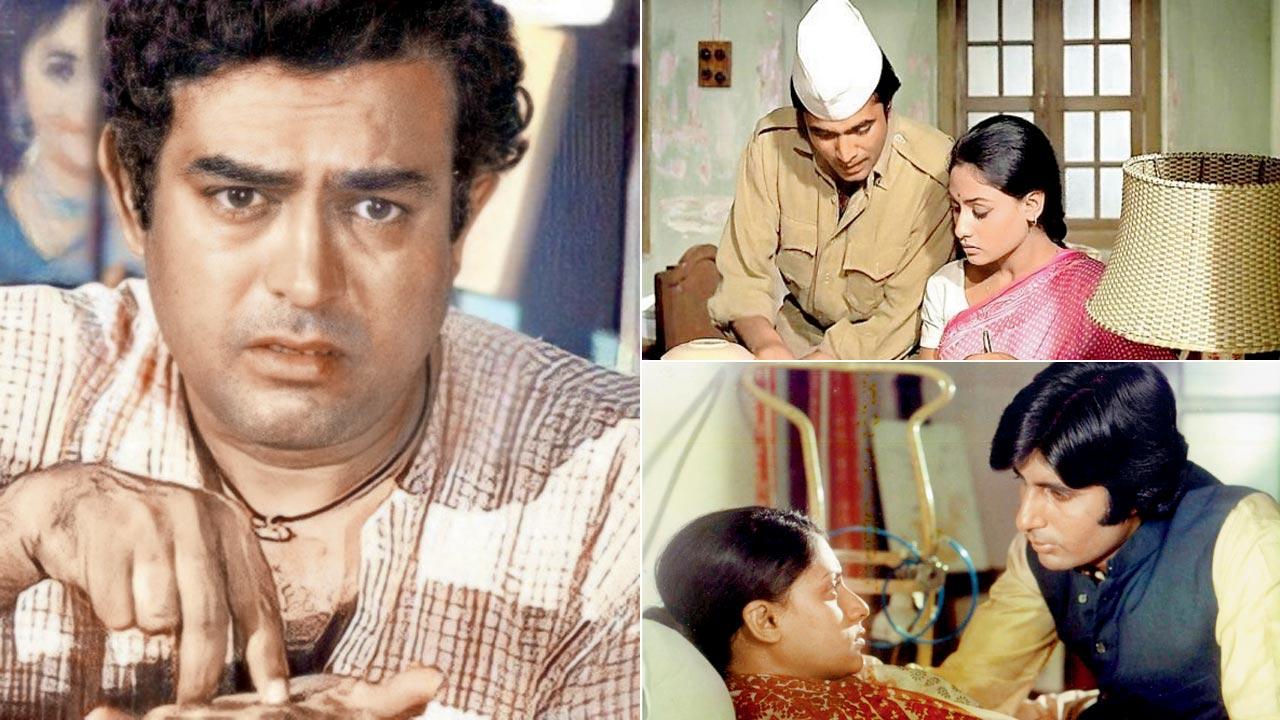
Hrishikesh Mukherjee’s Mili, Bawarchi and Gulzar’s Koshish to be revisited by Mrs Undercover maker Anushree and producer Sippy
Priyanka Sharma (MID-DAY; July 12, 2023)
It wouldn’t be wrong to say that the ’70s cinema was the polar opposite of today’s offerings, their slice-of-life stories in stark contrast to our current trend of larger-than-life movies. And who captured the joys and anguish of everyday life on screen better than the late Hrishikesh Mukherjee, and Gulzar?
In an attempt to remind viewers of the charm of human dramas, Mrs Undercover director Anushree Mehta and her business partner Abir Sengupta are revisiting the noted filmmakers’ classics—Mukherjee’s Bawarchi (1972) and Mili (1975), and Gulzar’s Koshish (1972).
The duo are teaming up with producer Sameer Raj Sippy, grandson of late producer N C Sippy, who had originally backed the three gems. Mehta says the decision to adapt the classics came from a personal space.
“It is a huge responsibility as Koshish, Bawarchi and Mili are celebrated in India and across the globe. Gulzar saab and Hrishi-da set the standards of filmmaking for generations to come,” she shares. To Sengupta, the remakes are a way of introducing the new generation to the magic of the past.
He says, “These are the films we have grown up on and that the new generation should also witness, to know our rich cinematic legacy.”
The three adaptations are currently in the development stage. Once the scripts are locked, the makers will finalize the cast and the directors. With the remakes, Sippy says the idea is to retain the essence of the original stories while viewing them through a contemporary gaze. “We want to take the stories and bring them in today’s scenario, with a modern outlook.”
Subscribe to:
Posts (Atom)