Showing posts with label Khalid Mohamed interview. Show all posts
Showing posts with label Khalid Mohamed interview. Show all posts
Meena Iyer pays a wonderful tribute to Krishna Raj Kapoor
9:19 AM
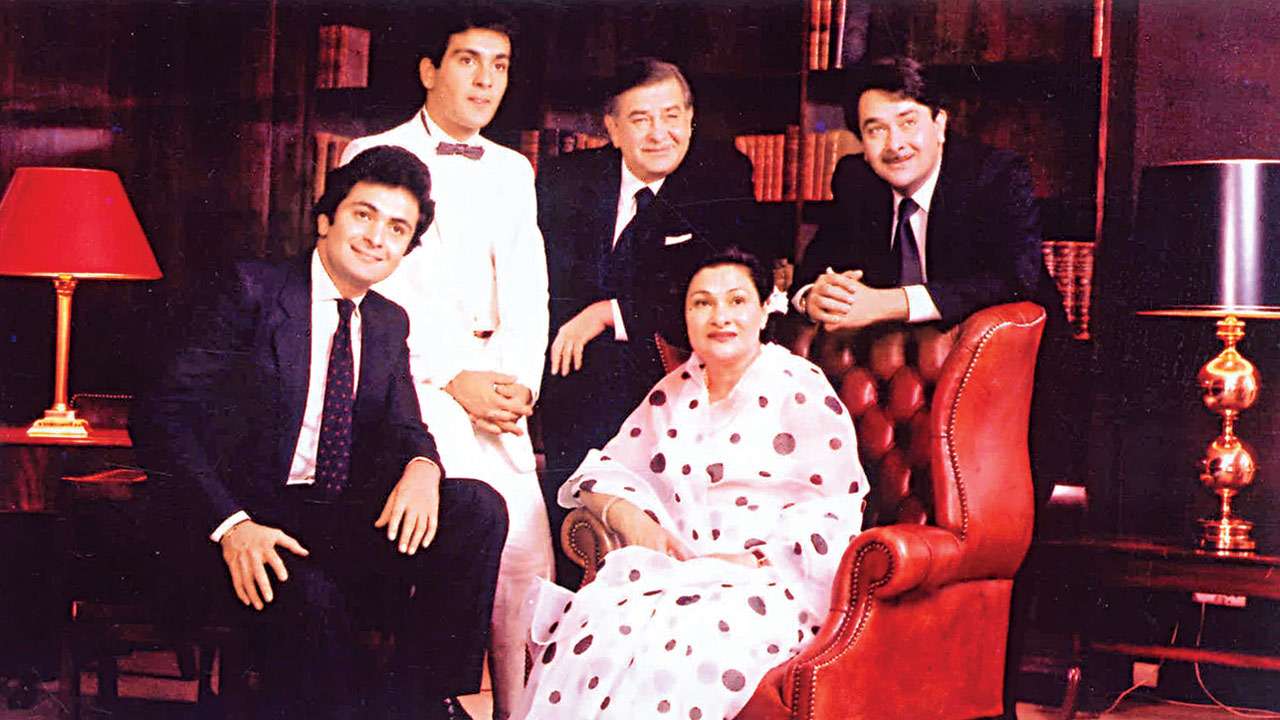
Krishna Raj Kapoor With her hubby and sons — Rishi, Rajiv and Randhir Kapoor
Meena Iyer (DNA; October 2, 2018)
On Monday morning, the Hindi film fraternity woke up to the extremely sad news of Krishna Raj Kapoor’s demise. I will always remember her as the First Lady of Bollywood. It was her elder son, Randhir, who said, “I regret to announce that I lost my mother early this morning. She died peacefully.” The wife of Padma Bhushan recipient and Dabasaheb Phalke awardee, filmmaker Raj Kapoor, Krishnaji (88) died of a cardiac arrest at 5 am on October 1, 30 years after she lost her husband on June 2, 1988.
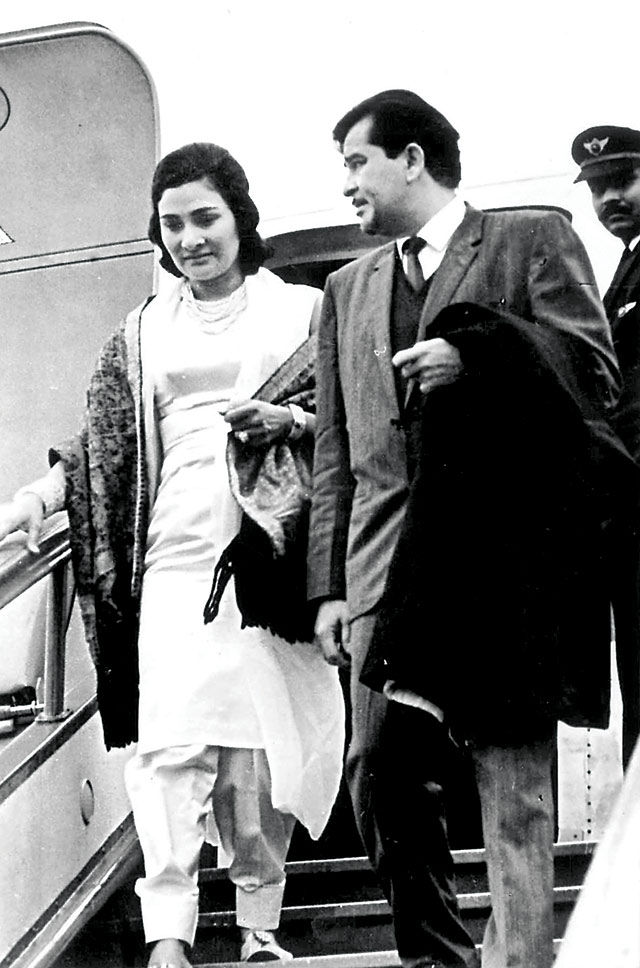 Krishna Raj Kapoor with husband Raj Kapoor
While friends and family members poured in to pay their last tributes, her son Rishi, who left for the US with Neetu and Ranbir on Saturday, couldn’t be present for the last rites. Speaking of Krishnaji, well, a hundred memories live with me. From her immaculate, usually, clad-in-white appearance to her bright lipstick and well-manicured painted nails, almost everything is etched vividly in my mind. Apart from being a benevolent human being, she was also extraordinarily sharp.
A CHARMING HOST
On one of my visits to her Deonar residence two years ago, I bent to touch her feet and she reprimanded me saying, “Betiyaan, pair nahin chhooti.”
Yes, the Punjabis do not permit their daughters to touch the feet of
elders because they feel a girl should never have to ‘bend’ as they are
considered Goddesses. So, while Rishi Kapoor, with whom I had gone to
their family home, touched his mum’s feet and got blessed in turn, I got
a hug from the lady.Next, we were treated to a glass of chaas. And, then asked to go about our business. We were picking out photographs for Rishi’s autobiography, Khullam Khulla. And, Krishnaji had kindly given us access to the treasure trove of family albums spanning seven decades that are lying safe in aluminium trunks on the bungalow’s first floor.
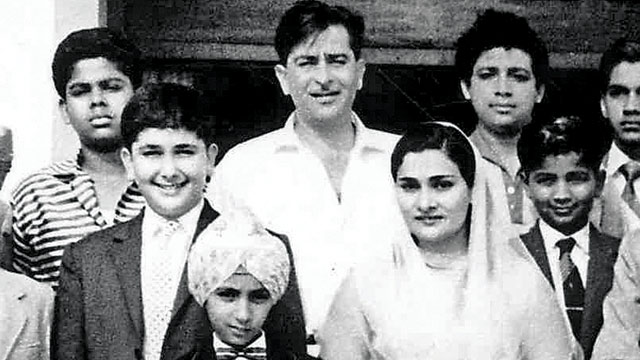 Krishna Raj Kapoor with Raj Kapoor and a young Rishi
At lunchtime, the lady of the house appeared dressed in a dark-coloured salwar kameez, her sartorial choice a rare exception. When we requested her for a photograph, she promptly pulled out her orange lipstick, dabbed her lips and said, “I’m ready.” Like the rest of her khandaan, she didn’t relish the fact that I was a vegetarian because the choices for a herbivorous person are limited at the Kapoor lunch table. Once that hurdle was crossed, she enthusiastically fed me aloo-gobhi and garam parathas, explaining how the cauliflower was broken into pieces, not cut in the Kapoor family kitchen. Minutes later, she saw Chintu eating without wearing a napkin. She wrinkled her nose and said, “Napkin pehen loh.” It was sweet to see a 64-year-old Rishi (in 2016) being pulled up by his mother for his lack of table manners on that occasion.
A WOMAN OF STEEL
Like I said at the start, Krishnaji
was her own person. She didn’t suffer fools and though the world
believed that she lived in her legendary husband Raj Kapoor’s shadow,
this was not true.In his book, Chintu spoke so affectionately of his mother. He said, “When my dad wanted to cast me as the young Raju in Mera Naam Joker (1970), he had to take permission from my mother, who gave him the go-ahead with a caveat saying — it should not interfere with my school studies.”
Not many may know this. Chembur would not have been the destination for the famed RK Studios that came up on a barren plot of land there seven decades ago. Bollywood’s showman wanted the studio to be built at Tardeo back in the day. Legend has it that when Krishna heard that Raj saab had a choice of choosing between Tardeo and Chembur, she promptly told him to choose the latter. The reason, according to the family grapevine, is that Nargis had a home in South Mumbai and Krishna didn’t want anything too close to her place as she was romantically involved with Raj for many years.
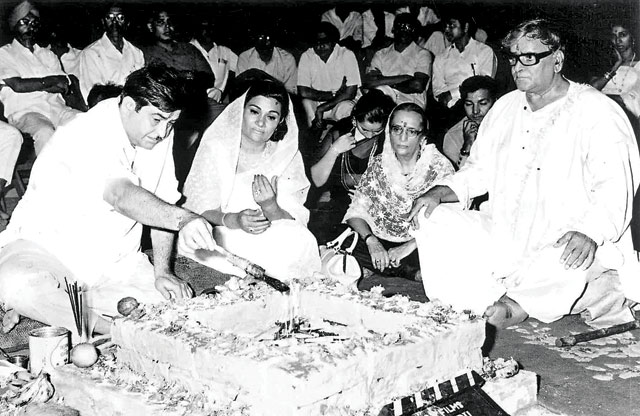 Krishna Raj Kapoor with Raj Kapoor and Prithviraj Kapoor
It is also a legendary tale that when Krishna learnt of Raj saab’s reported involvement with Vyjayanthimala, she walked out of her home with her children and headed to Natraj Hotel in South Mumbai. Raj later bought his estranged family a home in another location but, eventually, Prithviraj Kapoor intervened and the domestic squabble was sorted. Yet years later, Krishnaji had matured and mellowed. She was a changed person altogether. Rishi also recalled how, when Nargis set foot in the R K Studios compound after 36 years, in January 1980 on the occasion of his marriage to Neetu Singh, she was nervous. But it is said that Krishna took her aside and put her at ease saying, “My husband is a handsome man. He is also a romantic. I can understand the attraction. I know what you are thinking, but please don’t beat yourself up over the past. You have come to my home and I cannot tell you how happy I am.”
A DOTING MOTHER-IN-LAW
Neetu Kapoor, who
spoke to her mother-in-law every single day after her marriage until the
very end, addresses her as her most favourite person in the world. Mrs
Kapoor made a few daily calls. Besides Rishi and Neetu, Amitabh
Bachchan, whose daughter Shweta is married to Krishna’s grandson, Nikhil
Nanda, used to chat with her almost daily when he was in Mumbai. Big B
always made it a point to inquire about her health and she, in turn,
told him details of her failing health and she blessed him.When Neetu turned 60 on July 8 and was heading to Paris for the celebrations, her only wish was that her ma-in-law should accompany her! Here in Mumbai, too, the saas-bahu had a fixed routine. Krishnaji and Neetu usually frequented a Chinese restaurant at a five-star in BKC. Besides eating there, the senior Mrs Kapoor would also carry a parcel of their signature Peking Duck back with her to Deonar to share it with her other two sons — Randhir and Rajiv — who spent time with her at the bungalow.
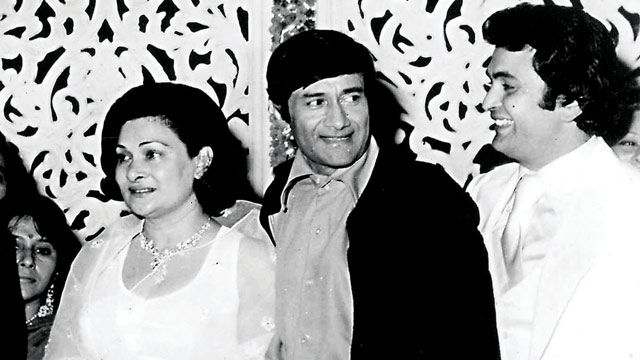 Krishna Kapoor, Dev Anand and Rishi Kapoor
There are innumerable stories about the senior Mrs Kapoor, but one of my favourite ones is the one where she called Rishi and Neetu on New Year’s Eve last year to ask them about their plans. “We are listening to Shirdi Sai Baba bhajans,” said Neetu because both Chintu and she had stopped going out on NYE for a few years now. To which the matriarch of the khandaan told her, “I am out in Khandala partying with my friends. They will ring in my birthday (January 1) in just a bit. So, you old people listen to bhajans, I will party on your behalf.”
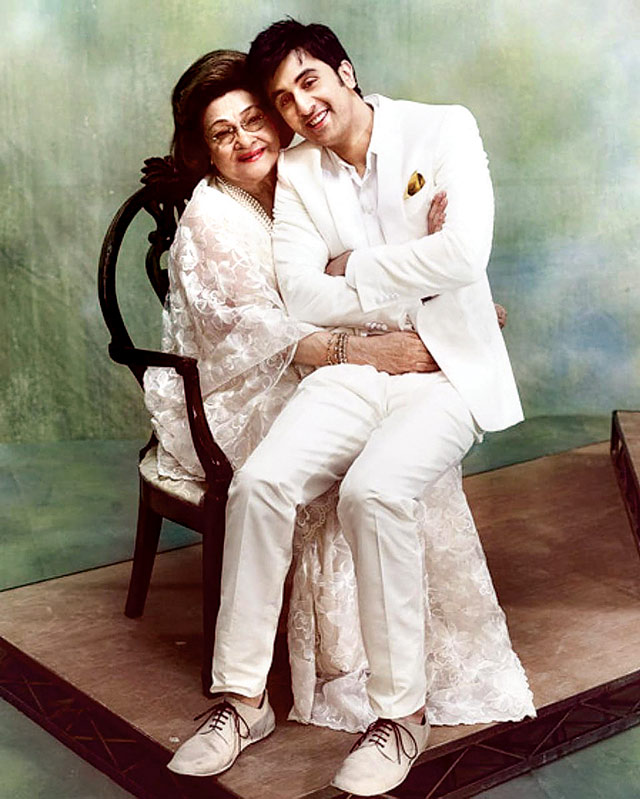 She shares a laugh with grandson Ranbir Kapoor
FOR THE LOVE OF HER GRANDSON
Ranbir Kapoor had grown particularly fond of his grandma when he
stayed with her a couple of years ago. The duo spent hours bonding,
watching television and generally chatting about cinema. And though Mrs
Kapoor was slightly uncomfortable around his two Mastiffs, Leo and
Guido, she was happy to have them around because it also meant keeping
her grandson close. She tiptoed around them, but was happy to watch her
favourite pota play in the garden with his pets.
NOT WITHOUT HER SISTERHOOD
Besides her family, Krishnaji’s
favourite people were journalist Nishi Prem (who was virtually a
neighbour in Chembur) and Dimple Kapadia. Until a few years ago, Salman
Khan’s mother Salma was also extremely close to Krishna. However, of
late, Salma hadn’t been such a regular with this gang. They were part of
her kitty group and the girls met up regularly for some food and fun.
Neetu recently hosted them at her Bandra residence and their joie de vivre reverberated around her Bandra residence, long after Krishnaji and Nishi had driven off to Chembur.Actually, some people never really go away. They continue to live in your memory forever.
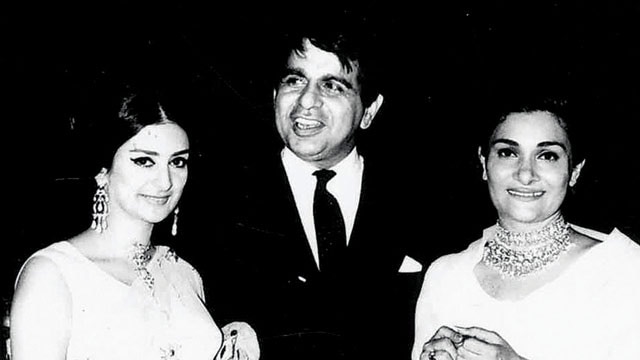 Krishna Raj Kapoor with Saira Banu and Dilip Kumar
Remembering Krishna Raj Kapoor, Bollywood's Lady in White: A tribute by Khalid Mohamed
9:16 AM

KRISHNA RAJ KAPOOR (1931 - 2018)
Krishna Raj Kapoor was a model star wife for whom the hearth and home mattered above all
Khalid Mohamed (MUMBAI MIRROR; October 2, 2018)
She was married to a showman, but any kind of attention embarrassed her. She was particularly adept at deflecting conversations that harked back to the good and bad old days. Instead, she’d want to know how you’d been doing, why you’d lost weight, and whether you had managed to make another trip to the Nantes film festival in France.
Krishna Raj Kapoor, who passed away following a cardiac arrest at the age of 87 on Monday morning, followed the cardinal rule of speaking only when spoken to. She was aware she could be glorified as a woman of forbearance. She was aware she could be extolled as a woman who remained rock firm against a shoal of calumnies. She didn’t need that. Her silence spoke volumes.
The only time I heard her murmur a sentence of regret, was when she couldn’t retrieve the hundreds of stills clicked by a photographer assigned to cover the studio shoots of the R.K. banner films. “Pata nahin,” she had smiled wanly, “he doesn’t wish to part with them or even make copies.”
Her eyes, though, would disclose a certain tenderness, touched by a hint of melancholia. Her self-discipline in serving as a binding force to India’s greatest showman, Raj Kapoor, must have taken a toll. If he exuded flamboyance, she radiated restraint. You could call it a classic case of opposites attract -- and despite hiccups -- be together till the last breath.
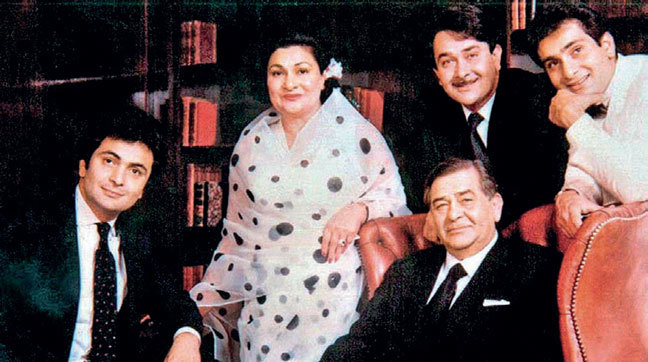
The couple with their sons Randhir, Rishi and Rajiv
Indeed, she became a role model for film star wives, inwardly conscious that it’s ultimately the hearth and home which matter. Subservient she could never be. She was an equal and at points, even the superior one, a status which can now be accorded to her unflinchingly. During her lifetime, she would have been offended by any form of panegyric.
The story of the Rewa born girl is the stuff that love stories are made of. At the age of 16, the daughter of police inspector general Raisaheb Kartar Nath Malhotra, married the upcoming actor Raj Kapoor who was 22 then. The blue-eyed dreamer had seen her play a tanpura on visiting the home of her brother actor Premnath.
Inspector general Malhotra was the maternal cousin of R.K.’s father Prithviraj Kapoor. So, they were distantly related. What is colloquially known as ‘an arranged love marriage’ was fixed. Rewinding to the wedding ceremony, the late thespian Ashok Kumar, would often chuckle, “Krishna peeked at me from under her ghunghat and told Raj, ‘Oh he’s so handsome!’ He didn’t quite like that and must have sworn that he would become much more famous than me. Which he did.”
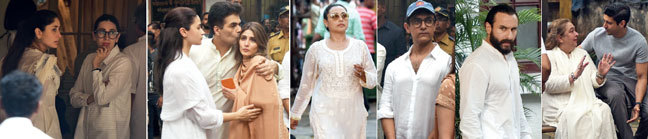
Sisters
Kareena and Karisma rushed to RK cottage with parents Randhir and
Babita in the morning; Karan Johar consoled Riddhima Kapoor-Sahni; Rani
Mukerji, Aamir Khan and Saif Ali Khan were among the visitors who turned
up to pay respects; Farhan Akhtar was seen with Rima Jain; PICS: RAJU
SHELAR
Accustomed to a large family – she had 11 siblings including Rajendra Nath and Narendra Nath who went on to become actors – the bride segued into the patriarchal Prithviraj Kapoor family which had anchored itself in a Matunga neighbourhood.
Raj Kapoor’s career was on the ascent, simultaneously as an actor, producer and director. Her family helped him with a financial loan to build the R.K. Studio in Chembur. “Dad and my grandfather weren’t flush with money those days,” son Rishi Kapoor has recalled, adding, “Relatively, my mother’s family was well-off.”
Raj Kapoor’s spiralling popularity was accompanied by his legendary romance with Nargis. The passion play between the creator and his muse was no secret. The on-screen chemistry, evidenced notably in Barsaat, Awara and Shree 420, was so palpable that the pair became socially acceptable off-screen even in the corsetted 1950s.
Krishna Raj Kapoor didn’t recoil or threaten the showman with ultimatums. Mother to five children — Randhir, Ritu, Rishi, Rajiv and Rima — her winning card was tolerance.

The
Bachchans — Aishwarya Rai, Jaya, Abhishek and Amitabh — arrived for the
last rites; Anil and Sunita Kapoor were among the early visitors, while
their daughter Sonam was also present; Boney Kapoor stayed close to
Salim Khan through the evening, as Arjun Kapoor turned up with sister
Anshula
Tolerance, in such a context, may sound regressive. For a mother, however, tolerance was the unalloyed strength and priority. Within and outside the film industry, polygamy was rampant. Suffice it to say she had to withstand it, an option which is exercised to this day and millennium by Bollywood’s first wives’ club — till it comes to a breaking point.
Raj Kapoor and Nargis parted ways without any demands on the wife’s part. The actress left the banner on her own volition to act in Mehboob Khan’s Mother India. Presumably, the showman was becoming far too possessive, she wanted to strike out.
The breaking point for Krishna Raj Kapoor came with the Raj Kapoor-Vyjayanthimala affair in the course of filming on the overseas locations for Sangam. Whispers about the liaison reached a crescendo point. With her children, Krishna moved out of the R.K. Cottage in Chembur to a suite at the then-Natraj Hotel on Marine Drive. No acrimonious statements, no arguments. Enough was enough.
Inevitably, the Vyjayanthimala chapter came to an end. The R.K children were back where they belonged: home. Other R.K. heroines, Padmini and Zeenat Aman, were linked with Raj Kapoor, transiently. It was the wife who became the irreplaceable Lady in White, an imagery associated with the showman who often showcased his heroines in spotless white costumes.
Krishna Raj Kapoor’s style was timelessly elegant. She would be seen most often in understated embroidered white and pastel shaded organza, chiffon and georgette ensembles. A string of pearls would be supplemented on festive occasions with diamonds. Right till advanced age prevented hours-long, traffic-clogged car rides, she would travel from Chembur to Kemp’s Corner in South Mumbai to get her hair coiffed by Ray George Stevenson of the six-decades-old Raechelle salon.
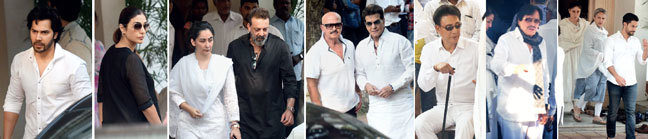
Varun
Dhawan, Tabu, Maanayata and Sanjay Dutt, Rakesh Roshan, Jeetendra,
Danny Denzongpa, Sanjay Khan dropped by to pay their respects; Kareena,
seen here with mother-in-law Sharmila Tagore and actor Kunal Kemmu
She allowed herself a few pleasures, like hosting a game of cards regularly at the R.K. Cottage. Her circle of friends included her sister Uma Chopra (wife of Prem Chopra), Shukla Kumar (wife of Rajendra Kumar), Salma Khan (wife of Salim Khan), Nirmal Kapoor (mother of Anil Kapoor) and Munni Dhawan.
Unlike quite a few star wives she didn’t interfere with R.K.’s creative process, keeping out of story, music and edit sessions, but ensuring that the bar and kitchen were kept open for the filmmaker’s collaborators around the clock.
Above all, the paramount joy in her life was to see her sons and grandchildren evolve in their careers. For instance, she had jetted off to Lake Placid in the U.S. to wait every evening for Rishi Kapoor to return to the unit hotel from the shoot of Aa Ab Laut Chalen. She’d ask, “Hope it all went off smoothly?” and if the first-time director wouldn’t answer, she’d say calmly, “Don’t worry, tomorrow all will go well.” This, in fact, was her credo.
Grandchildren Ranbir and Riddhima adored her. Although she had to travel in a wheelchair, she was at the centre of the celebrations of Neetu Singh Kapoor’s 60th birthday in Paris earlier this year.
You can detect the same look in the eyes, be it in the photographs of her as a young woman, as a resilient widow when Raj Kapoor passed away 30 years ago, or as a loving grandmother on Instagram.
The movies, star wives, relationships and tolerance levels have kept altering dramatically over time. That look of tenderness — with a hint of melancholia — in Krishna Raj Kapoor’s eyes never did.
Hundreds of Tanushree Duttas in Bollywood, writes Khalid Mohamed
8:06 AM

Khalid Mohamed (MUMBAI MIRROR; September 29, 2018)
There are hundreds of Tanushree Duttas out there in the show business who want to tell their true-life stories, but cannot.
This is Bollywood, not Hollywood, home to the #MeToo movement. Moreover, the question of being financially compensated just doesn’t arise, or rarely figures in such scenarios.
Nana Patekar, charged with sexual misconduct by actress Tanushree Dutta at the shoot of the film Horn OK Pleassss... eight years ago, has stated that he will now see her in court.
Tanushree Dutta has not responded immediately. No compensation has been demanded from Patekar for her thwarted career nor from the allegedly complicit director Rakesh Sarang, producer Samee Siddique and choreographer Ganesh Acharya who, according to her, were witness to the incident.
She is the first leading lady to have spoken up, prompting supportive tweets from a measurable cross-section of Bollywood’s actors, including Farhan Akhtar, Priyanka, Parineeti Chopra, Twinkle Khanna, Sonam K Ahuja, Raveena Tandon and Richa Chadha.
Amitabh Bachchan, Aamir Khan and Salman Khan have ducked the question upon being quizzed by the media at promotional functions.
Currently, public curiosity is vicariously high on the face-off between the 34-year-old actress and the 67-year-old stalwart Nana Patekar who has described her “like my own daughter.”
Several insiders of the Bollywood trade are cynical about Tanushree Dutta, stating that her accusations are an attention-grabbing ploy. Others, while respecting Patekar as a brilliant actor, point out to his mood swings and his liaisons with actresses — among them Manisha Koirala — which went on the rocks.
None of these put-downers are relevant to the case which touches upon the oldest bugaboo in the movies. It’s more than high time, though, that the individual parties here — Tanushree Dutta versus Patekar, Sarang, Siddique and Acharya, are all given a fair hearing and due justice meted, which would be a landmark in the realm of Bollywood, as it is expected to be in Hollywood vis-à-vis the ongoing-trial against Harvey Weinstein.
Indian avatars of Weinstein have been around in the Mumbai film industry since forever. Some attempt to be discreet, appointing middle-men to fix meetings with aspiring heroines at five-star hotel suites. Others get more brazen with time, inviting wannabe heroines and starlets to spend some “chill time” at their seaside resorts on the city’s outskirts.
An ageing industrialist, who viewed himself as a one-man MGM studio, was fond of weekend dawn-to-dusk parties at Alibaug. Starlets in bikinis would dot the freshwater pool. Photographs were strictly disallowed. He went bankrupt before he could get his first magnum opus rolling.
By contrast, a former prolific producer-director would invite vulnerable aspirants to a Madh island resort. One of them, a former Miss India, said (off-the-record naturally), “It was all so cheesy that I caught an autorickshaw and got the hell out of the resort. Needless to say, I didn’t get the role which he said I was perfect for.”
Undeniably, statements from anonymous sources are insufficient evidence about Bollywood’s favourite sport and pastime. They are being cited here because over the decades a set-pattern has emerged.
Catch-phrases, “Are you willing to wear a bikini?”, “How about a script reading in Bangkok for a couple of days?” or that old chestnut, “My wife doesn’t understand me. So I’m looking for a friend, a good friend — you understand?” are the inevitable pick-up lines.
Even if any A, B or C is about to venture into filmmaking, the first crack is, “Oh, so you can now enjoy the casting couch.” The rank chauvinistic attitude towards women can be detected in every profession. In filmmaking, unfortunately, it is a given.
A rage from the 1970s laughs, “This thing about the casting couch is so passé now. Everyone of us has gone through it, without exception. Once during a lunch break, when I was alone in my make-up room, this famous director barged in and pounced on me till I began to scream.” A near-similar instance was reported when Mamta Kulkarni cried foul against Rajkumar Santoshi during the filming of China Gate (1998). Her allegation was that the director demanded a kiss.
There have been occasions when allegations of rape and sexual assault have come out into the open. Circa 2004, acting aspirant Preeti Jain had claimed that Madhur Bhandarkar had raped her 16 times between 1999 to 2004 and had promised to marry her. The case was eventually decided against her and she was charged with conspiracy to murder Bhandarkar. Subhash Kapoor, director of the Jolly LLB series, was accused of rape by actress Geetika Tyagi. She was said to have presented video footage and had wept on camera, “I cannot trust any man who asks me out for coffee without feeling f…..g jittery.” Subsequently, Geetika has shown up in a couple of TV series.
After the initial sensationalism and media interest, the to-and-fro accusations become old news. Associations for the welfare of film artistes exist but seem to be already overburdened with miscellaneous issues. After the quick tweets from co-artistes, the pros and cons of various cases, fade into a misty la-la-land as it were.
Above all, screen heroines subjected to sexual insinuations and transgressions, do not speak up if they have been victimised by A-listers. Besides putting an end to their intensely-competitive careers, it would be one woman’s voice against a power grid. Thereby hang an incalculable number of stories untold.
Earlier this year, the usually feisty choreographer Saroj Khan on being asked to comment on Telugu actor Sri Reddy’s protest against the casting couch, had remarked, “This is not a new thing, this has existed for a long time. Everyone wants to take advantage of girls, even the government.” She later apologised for the comments.
With a variety of mind-sets and attitudes, then, towards the status of women in the film industry, right now the plot thickens.
Khalid Mohamed talks about his emotional bond with Sonam Kapoor
10:16 AM

An account of the emotional connect between today’s dulhania, Sonam Kapoor, and her adopted uncle
Khalid Mohamed (MUMBAI MIRROR; May 8, 2018)
So, an anointed uncle is now gaping at a blank computer screen just hours away from Sonam di Wedding. Uncle deletes several start-off lines and paras.
He can’t just toss off ‘congratulations’, ‘all the best’. Neither can he quite summon up the precise words to express the feeling of pure joy for the baby who’d once gurgle, smiling wide in his arms. So unlike other infants given to squealing with horror on being subjected to a gooey stranger striving to be baby-friendly.
Best to write straight and simple, then, stop calling her a baby, and quit cloaking myself in third person. Reason: If I’ve ever felt like an adopted uncle, minus any sliver of an agenda, it’s by Sonam Kapoor, daughter of my chuddy buddy Anil Kapoor. Buddy AK may have sulked with me, gone off the radar briefly if he had a reason (a not-so-complimentary review, for instance). By contrast, Sonam has consistently stressed, “Please don’t like my performance if you don’t. You can’t be biased.” Music to a reviewer’s ears.
Actors, as the whole wide world knows, can’t take criticism. Gratifyingly, Anil Kapoor may have bristled for a day-and-a-half at most but has then accepted the darts sportingly. Which is why, he’s one of the scant few (the other is Rishi Kapoor) with whom my professional and personal equations have remained steadfast over the decades. The wonderful side-effect of this is a bond with my buddy’s angel child, Sonam, ever since she was born on a rain-lashed day on June 9, 1985.
“Saala, you chat with her more than you do with me,” Anil has frequently complained gamely. To that I’ve retorted, “Ha! That’s because she can talk about any subject under the sun, and not only about the movies. And also because she remembers to send me chocolates on my birthday, which you never do chum!”
I’m sure that I’m not the only privileged one to be on the receiving end of Sonam’s affection. She’s a natural at giving way more than she takes. In passing when I’d told her about a stalwart filmmaker going through a lean phase, she had volunteered right away to send over a hefty amount of money. I wasn’t sure. What if he’s offended? “Not to worry, I’ll do it discreetly,” she won the argument. “It only makes sense to return to the film industry whatever little I can.”
As a teenager, she was away schooling in Singapore. During the holidays, she’d be devouring books (among her favourites count Milan Kundera’s The Unbearable Lightness of Being, J.D. Salinger’s Catcher in the Rye, Rohinton Mistry’s A Fine Balance and Leon Uris’ Exodus). Sonam was growing up tall, she’d be teased about taking part in the Miss India beauty pageant. “Who me?” she’d grimace, but not without a telling sparkle in her eyes.
Along with Ranbir Kapoor, she formed the reception committee, welcoming the invitees to the premiere of Black at Mumbai’s Imax Wadala. Aha there, she was poised to become a film star after all. “I don’t know uncle, let’s see.” The let’s-see happened with Saawariya, a gruelling introduction to the camera-lights under the mentorship of the tough-as-nails Sanjay Leela Bhansali.
Swiftly, Sonam assumed the image of a haute couture fashionista, splashed on every glossy magazine cover and enticing flash-bulbs to go hellzapoppin’ on the Cannes red carpet. Predictably, the buzz persisted that she’s all glamour, no substance.
Quite unfair that. She has asserted her buoyant screen presence in a concatenation of films — especially in Raanjhanaa in which she portrayed an activist student — peaked by the gutsy incarnation of the braveheart flight purser Neerja. The armada of naysayers did have to eat that bitter confection called humble pie.
Post-Neerja, I had to interview her. “But I’ll feel so awkward,” she procrastinated. “I won’t be able to keep a straight face.” Never mind. In fact, it was a hair-raising experience for me. The q-and-a was fixed at a beauty salon, where I was entreated by her to get my scalp styled. No, no, not my kind of baal-game.
We conversed while her hair was shampooed. “This is so hilarious,” she chortled, sending me back home with quotable quotes on the lines of, “I’ve been writing short stories. I have concepts for three scripts and I hope to direct a film myself. I was fed up of being branded as a fashion diva. This did affect my self-pride. I wanted to disown myself. But see, there’s light at the end of depression. I’ve smartened up.”
Next, I was commissioned to do a video interview. By now, she was going steady with today’s dulha, Anand Ahuja. She avoided the topic du jour beyond a point on camera.
To change the subject, I asked her if she could bring tears to eyes, there and then. A pause and then she did, tears streaming till she had to be stopped. “Oh, oh I’ve made you cry like a baby,” I apologised. “Uncle but then you’ve always treated me like a baby,” she grinned.
No second thoughts on this, then. For me, Mrs Sonam Kapoor Ahuja, will always be the child who’d gurgle happily in my arms.


Scissorhands on a rampage: Khalid Mohamed decodes the history of film censorship in India
8:09 AM

Film critic and director Khalid Mohamed decodes the history of film censorship in India and points out that it has never been quite as dictatorial as it is now
Khalid Mohamed (MUMBAI MIRROR; June 10, 2016)
Careless whispers are on. A media honcho in the know, goes pssst, "Believe me, Udta Punjab will be banned. A decision has been taken in Delhi."
I don't believe him, I don't want to. A neighbour impales me in the elevator and quotes Faiz Ahmed Faiz, "Aur bhi gham hain zamaane mein... I'm fed up of the Udta ya Doobta Punjab, jo bhi hai issue. All this is publicity. You are all biased in favour of Anurag Kashyap."
I want to box him on the ears. If I don't, it's because he does possess the freedom of expression - a catchphrase which has become as meaningless as a light bulb without electricity.
And acutely so, within the Walkeshwar headquarters of the Central Board of Film Certification (just call it Censor Board, guys) blessed with a deceptively soothing view of the Girgaum Chowpatty oceanfront. Deceptive because bolts of thunder and lightning have struck the headquarters, especially during the Emergency era of the mid-1970, and are currently exacerbating the damage done already.
In the course of four decades, 16 chairpersons have further warmed the hot seat and exited most often unceremoniously. Not one of them could quite escape brickbats and assorted calumny. Pahlaj Nihalani's story, however, has been close to a tragedy. Ensconced in the seat since January last year, the former filmmaker has been the most unique of them all, a Nero fiddling away while Bollywood burns. Normally, honorary appointees of the central government require the goahead from their individual ministries before doling out interviews.
Apparently, that stricture doesn't exist any more, since Nihalani has become the dada of dial-a-brain-boggling quote. By comparison the most dictatorial of the former chairpersons, today strike me as new-born lambs. Take the mild-mannered Virendra Vyas, a bureaucrat to the core but redeemed by his congeniality, and openness to discourse. He would tremble on being interrogated. If he served tea, he would believe it or not, joke, "I hope the tea is not as weak as my answers."
Next: K L Khandapur, and N S Thapa, both documentary filmmakers from the Films Division, were shunted to the Censor Board, as the chief and his next-in-charge respectively. Khandpur was grim and inscrutable, Thapa an outspoken warrior. If the censor file of the cuts imposed in Sholay went missing from the office, he sensed foul play. V C Shukla, the I & B Minister then was going beyond limits. Thapa leaked the story to The Times of India, emphasising, "Quote me if you want to, I don't care."
None of the appointees before and after Khandpur and Thapa could leave their imprint on the censorship policy. The liberal-minded Hrishikesh Mukherjee attempted to but quit within 18 months, citing health reasons. Politically correct, he didn't place his dismay on record though.
Indeed Leela Samson, Bharatanatyam exponent, is the only chairperson who has categorically told the I & B ministry where to get off. When controversy erupted over the sudden clearance of Messenger Of God, Samson assented to her first dialogue for the press, pointing out the "interference, coercion and corruption of panel members and officers of the organisation who are appointed by the ministry."
Before that, around the early '90s, B P Singhal - former director-general of the UP police, Rajya Sabha MP and often described as 'the pillar of Hindutva' — couldn't cut through the thickets of censorship codes (which are still hopelessly arbitrary). At meetings with the panels, he would behave as if he had landed at the wrong party.
Either someone up their in the celestial heavens or in the ministry, had a Eureka moment. Why not appoint Mumbai's film industrywalas as chairpersons? Of them, Asha Parekh shudders, "Oh my god, at least three filmmakers made my life miserable. I promise to tell all in my autobiography." Vijay Anand lasted less than a year, shocking the powers-that-were when he suggested licensing triple XXX cinemas to screen porn.
Now, that's a thought. Shakti Samanta, Arvind Trivedi and Anupam Kher went through their tenures. No progress, no dramatic changes. Sharmila Tagore survived in the chair for as many as seven years after which the chairperson-makers developed an itch. Enter Samson, who carried out her duties diligently without being recompensed with so much as a polite thankyou.
The BJP emerged tops at the general elections. And presto, Pahlaj Nihalani was smiling wider than the Worli-Bandra sea link. The once spic-and-span Walkeshwar office is now as dark and dingy as any red-taped government department.
Truly, give me the good old days when a top censor officer would dare to point an accusing finger at a minister for Sholay. Right now, under Nihalani's tutelage film lovers might as well stay at home and cut paper dolls. RIP Cinema.
Sadhana: The enchantress from the swinging '60s
7:52 AM

Film critic, writer and director Khalid Mohamed bids adieu to the eternal heartthrob Sadhana
Khalid Mohamed (MUMBAI MIRROR; December 26, 2015)
SEPTEMBER 2, 1941 -- DECEMBER 25, 2015
 "Sorry, there are only
paapads, sour cream and carrots,“ she forwarded the plate of hors
d'oeuvres to go with the Siberia-sized pegs of scotch on the rocks. “Could I add some water?“ I spluttered on gulping the scotch stronger than Samson and Hercules put together. “You can switch to wine,“ she suggested. “No, no this is fine, just some water,“ I husked on that scalding
summer evening, striving to sound cooler than the purring
air-conditioner in their ocean-fronted apartment on Bandra, Carter Road.
"Sorry, there are only
paapads, sour cream and carrots,“ she forwarded the plate of hors
d'oeuvres to go with the Siberia-sized pegs of scotch on the rocks. “Could I add some water?“ I spluttered on gulping the scotch stronger than Samson and Hercules put together. “You can switch to wine,“ she suggested. “No, no this is fine, just some water,“ I husked on that scalding
summer evening, striving to sound cooler than the purring
air-conditioner in their ocean-fronted apartment on Bandra, Carter Road. A conversation had been fixed a week before the premiere of Geeta Mera
Naam directed for some puzzling reason by Sadhana Shivdasani. Quite
mysteriously, her mentor-director-husband R K Nayyar had handed over the
reins.
Maybe Nayyar wasn't in the rosebud of health, maybe she just wished to
call the shots. Whatever. Right at that moment, though, Nayyar was
discursive and laughed, “I don't envy you your job of seeing awful films
week after week. It's remarkable that you've retained your sanity. I
like your reviews.“ “Thank you,“ I shone, a glow-worm in the evening darkness, desperately hungry for compliments.
A conversation had been fixed a week before the premiere of Geeta Mera
Naam directed for some puzzling reason by Sadhana Shivdasani. Quite
mysteriously, her mentor-director-husband R K Nayyar had handed over the
reins.
Maybe Nayyar wasn't in the rosebud of health, maybe she just wished to
call the shots. Whatever. Right at that moment, though, Nayyar was
discursive and laughed, “I don't envy you your job of seeing awful films
week after week. It's remarkable that you've retained your sanity. I
like your reviews.“ “Thank you,“ I shone, a glow-worm in the evening darkness, desperately hungry for compliments.Interjected Sadhana, “Come on R K. Our films aren't awful at all. You guys are so cynical.“ “Yes, yes Mrs, if you say so,“ Nayyar helped himself to another scotch in the fraction of five minutes. “Geeta Mera Naam is good, very good.“ His eyes liquidy by now, shifted towards me, “Mrs has done a marvellous job. I didn't know she had a talent for action scenes. Marvellous, quite marvellous.“
I took care to be uptight. I had to pretend that I was no fan-chhokra-boy of the actress who was introduced in her big Bollywood break with Love In Simla. Culled from Pygmalion, the story presented her as a plain Jane who blossoms into a pretty princess of hearts. Durga Khote, playing her grandmum, threw Jane's pair of spectacles away, huffing, “You can do without these.“ Stupidly, I've longed to chuck my specs away ever since, but what worked for Sadhana doesn't work for daft impressionables like me. Never.
In retrospect, it's foolish to develop a crush on movie heroines. Or is it admiration for the characters they enact, infallibly welling over with the sharbat of human kindness? Confession: heroine-crazy I was. Sadhana was meant for adoration. Oh that fringe tickling her forehead, oh those madeira eyes, oh those rose petal lips, oof that clear-as-a-bell voice, lots of oohs-'n'aahs there.
And Sadhana could be equally hypnotic in black-and-white: rowing a shikara in Ek Musafir Ek Haseena, bossy in a swimsuit in Budtameez, and as a ghost she could induce serious goose bumps sashaying through the spooky environs of Woh Kaun Thi. Eastman Colour gave her another dimension: impeccably cosmeticised in Mera Saaya, Arzoo, Waqt, and Mere Mehboob kahin nazar na lage - in which her eyes glimpsed through a veil enticed the smitten Rajendra Kumar jump through hell and hoops.
Sadhana was my enchantress among the trinity of heroines of the swinging '60s. Asha Parekh was too squeaky-sweet to be true, Saira Banu was too much of a porcelain poppet. By contrast, the Love in Simla princess was real, strolled along the Marine Drive during the early morning hours, and watched The Guns of Navarone, Jerry Lewis comedies and Seven Brides for Seven Brothers at the same weekend noon shows that I did.
 Summoning up all my courage, finally, I'd
marched up to her at the Regal's soda fountain to launch into a
panegyric, “I really loved you in Love in Simla, Parakh,Woh Kaun
Thi...Inteqam toh too good, Ek Phool Do Maali mein
bhi...blah..blah..blah.“ She wasn't hearing a word. I persisted,
she relented, smiled, handed me a packet of crisps, “Thank you bacha.
Enjoy the chips“ What me, a bacha? And I didn't even like potato chips.
Crush over.
Summoning up all my courage, finally, I'd
marched up to her at the Regal's soda fountain to launch into a
panegyric, “I really loved you in Love in Simla, Parakh,Woh Kaun
Thi...Inteqam toh too good, Ek Phool Do Maali mein
bhi...blah..blah..blah.“ She wasn't hearing a word. I persisted,
she relented, smiled, handed me a packet of crisps, “Thank you bacha.
Enjoy the chips“ What me, a bacha? And I didn't even like potato chips.
Crush over.Repressing that Regal encounter, in the line of professional duty, I felt strange. Here I was chez Sadhana, guzzling whisky and scooping sour cream on paapads. R K Nayyar and I were flying high as kites, immune to Sadhana's attempts for a sensible conversation on her go at film direction. Nayyar broke into song, the Madan Mohan gem “Lag jaa gale“. Sadhana said, “R K enough is enough,“ and removed the crystal glass from my hand. Reminded she, “I told you to have wine, didn't I?“ “Yes, wii....ineshhh,“ I slurred.
The enchantress called for a taxi, instructed the driver to get me home safe-and-sound, “Call me when you reach home...bacha.“ Bacha protested, “No prrrr.oblemshh.“ “Problem toh hai,“ she said correctly. “Go now and take care.“
Today, I wish the Love in Simla princess had taken far more care of herself. I wish she hadn't isolated herself. I wish I could have interviewed her sensibly that evening. Couldn't help it. A schoolboy crush, and the bold and beautiful Sadhana can happen only once in a lifetime.

Well-known film chronicler Feroze Rangoonwalla passes away
7:40 AM

A remembrance by Khalid Mohamed.
MUMBAI MIRROR (August 5, 2015)
Suddenly the brownstone colony he lived in, bang opposite the Mumbai Central Railway station, was demolished. A tower was to loom up, displacing the concatenation of rooms occupied since the days of the British Raj, by Parsi families.
That's where Feroze Rangoonwalla lives, I'd be told, time and again, by senior journalists in the course of taxi rides through the city's throbbing artery. Oh really? Must visit him, I'd up-and-down my head, a Noddy in Wonderland, curious for a dekko of his legendary collection of movie stills, stretching from the silent era to the anger-strewn 1970s.
The archivist-collector-writer, who most often turned out in a cotton black jacket over a white shirt, was dial-a-photograph. You need a rare picture, call him, and he'd remind you to mail the cheque (a pittance) for the photo loan. Fair enough. Abroad vintage photos made a cult of the Hollywoodphile John Kobal.
Why not Rangoonwalla here? His surname presumably alluded to the origins of his ancestors, who migrated to Bombay. His persona was that of a retentive High Court lawyer, he moved briskly, he talked scantly, and smiled rarely. When he did flash a hello, it was out of protocol. After all his best buddies were the movies, not the Johnnies come lately in his beat.
Feroze Rangoonwalla would nod curtly at the film previews organised at the Blaze auditorium in Colaba. He wouldn't chatter over samosas in the interval, preferring to jot notes in a pad which added to the bulk of papers stuffed in a black rexine briefcase.
Inevitably, his reviews which would appear in a weekly trade paper, were elaborate but never vitriolic. He was gentle. An unusually trenchant review has stayed with me though. He was critical about a fruit bowl kept on a police inspector's table in one of those revenge sagas. Why was it there? Was this inspector bananas or what?
Feroze sir, as we would address him, unbeknownst to many, began directing a film funded by the FFC (now NFDC). The technicians and the actors, developed some serious differences with sir. The film, featuring the Film Institute graduate Rameshwari, was scrapped after a board meeting. As it happened, I saw him, leaving the boardroom that day, silent. He didn't say a word, and instead of waiting for the elevator, he walked down a steep flight of stairs.
Post his retirement, I did 'phone him for a conversation. He responded, yes, sure come over, but he was not well, he would call me back in a week, maybe two weeks.
He didn't.
I just hope that his collection of those luminous photographs will survive, like the memory in my eyes of sir, who smiled ever so rarely.
Subscribe to:
Posts (Atom)