Showing posts with label Kasoor. Show all posts
Showing posts with label Kasoor. Show all posts
Waman Bhonsle was my friend, philosopher, guide and the first genius I came across in the industry-Vikram Bhatt
7:51 AM

The filmmaker remembers National Award winning editor Waman Bhonsle who passed away yesterday
Onkar Kulkarni (BOMBAY TIMES; April 27, 2021)

Post the news break, the film fraternity was quick to post condolences and share memories on social media. Vikram Bhatt was one of the firsts to share a few words on social media about the man who was his friend, philosopher and guide. When BT reached out to the filmmaker, he said, “He is the first genius that I came across in the film industry. He was so good when it came to editing. He was my friend, philosopher and guide. He’s taught me so much. I was a Chief Assistant on Agneepath (1990) when I first met him. He took me under his wings. He taught me the finer points of film editing. That was the time when the process used to be different as there were no computers.”

After Vikram turned to direction, he continued to closely work with Waman but soon the latter made an exit. “He edited my films all the way till Ghulam (1998). Then, computers came in, however he didn’t want to take the leap. When I was making Kasoor (2001), I told him that I will hire a guy who he can sit with and do the editing. He said, ‘No, Vikram, if I cannot hold a film in my hand then I can’t edit it.' I missed him. There was a time when he used to be so busy with film projects that he used to give filmmakers 3-4 hours everyday. The who’s who have worked with him, right from Subhash Ghai, Raj Khosla, Shekhar Kapur, Mahesh Bhatt, Gulzar saab, Boney Kapoor, Mukul Anand, and the list is endless.”

Covid claims Bollywood composer Shravan Rathod
7:57 AM

THE TIMES OF INDIA (April 23, 2021)
From Husnlal-Bhagatram to Shankar-Jaikishan, from Kalyanji-Anandji to Laxmikant Pyarelal, Hindi film industry has a rich tradition of musical partnerships. Nadeem-Shravan forged an illustrious link to this abiding chain composing a staggering bunch of chartbusters in the 1990s. On Thursday evening, the alliance was snapped forever as the Coronavirus claimed the life of Shravan Rathod at a Mumbai hospital. He was 66.
Speaking to Bombay Times, Nadeem Saifee said, “My Shanu is no more. We have seen an entire life together. We saw our highs, we saw our lows. We’ve grown up with each other in many ways. We never lost touch and no physical distance could ever separate the two of us. I am in deep pain as I say this but my friend and my companion, my partner of so many years is no more. It has left such a vacuum.”
The pair started off with ‘Dangal’ (1977), the first Bhojpuri film made in colour. ‘Kashi Hile Patna Hile’, a reworked version of the popular folk track, ‘Aarah hile Chhapra hile’, became a sensation. The two graduated to Hindi cinema in the 1980s.
Tuneful melodies for films such as ‘Maine Jeena Seekh Liya Hai’ (1982) got them work but major success eluded them.
The duo hit the jackpot with Mahesh Bhatt-directed ‘Aashiqui’ (1990). Every song in this intense romantic drama, from ‘Dheere dheere se meri zindagi mein ana’ to ‘Bas ik sanam chahiye’—rose to the charts. The film also vaulted Kumar Sanu, who sang a majority of the tracks, to the top. Nadeem-Shravan became a hot property.
The 1990s belonged to them. ‘Saajan’, ‘Deewana’, ‘Dil Hai ke Manta Nahi’, ‘Phool aur Kaante’, ‘Hum Hain Rahi Pyar Ke’, ‘Raja Hindustani’ and ‘Pardes’—they lorded over the decade blending old school melody with modern instrumentation. Songs such as ‘Mera dil bhi kitna pagal hai’ (Saajan) to ‘Pardesi pardesi jaana nahi’ (Raja Hindustani) to ‘Do dil mil rahe hain’ (Pardes) were as popular among the college crowd as the truck drivers on the highway. The pair won the Filmfare award three years in a row, 1991-93, for ‘Aashiqui’, ‘Saajan’ and ‘Deewana’ and again in 1997 for ‘Raja Hindustani’.
It seemed that the two would rule over Bollywood for another decade or two. But things were never the same after Nadeem’s name cropped up in the killing of a music baron and he fled to London. The duo still kept providing scores together in films such as ‘Kasoor’ and ‘Dhadkan’. The two split once, then reunited. This time, sadly, the separation is final.
Irrfan Khan was the only actor from India to make a mark in mainstream Hollywood cinema
8:40 AM

Box Office India Trade Network
Irrfan Khan passed away after a two year battle with neuroendocrine tumour. The actor was just 53 years old. Irrfan Khan started his career in television in the mid 80's and worked mostly in television through the 90's and came to the notice of the Hindi film industry in the early 2000's. It was the work in thrillers from the Bhatt camp like KASOOR, GUNAAH and FOOTPATH which led the way to more assignments in the Hindi film industry.
The biggest achievement of Irrfan Khan as an actor was that he is the only actor from India to make a mark in mainstream Hollywood cinema with films like LIFE OF PI and JURASSIC WORLD. There have been many that have tried (male and female) but only Irrfan Khan manage to succeed.
The popular films of Irrfan Khan in Hindi cinema were PIKU, HINDI MEDIUM and GUNDAY. It is a coincidence that the last film to release before the lockdown was an Irrfan Khan starrer, ANGREZI MEDIUM. This film remained in theatres for four days before the entire country went into lockdown.
Aditya Roy Kapur and I both have been a part of the hippie world at some point in our lives-Mohit Suri
11:17 AM
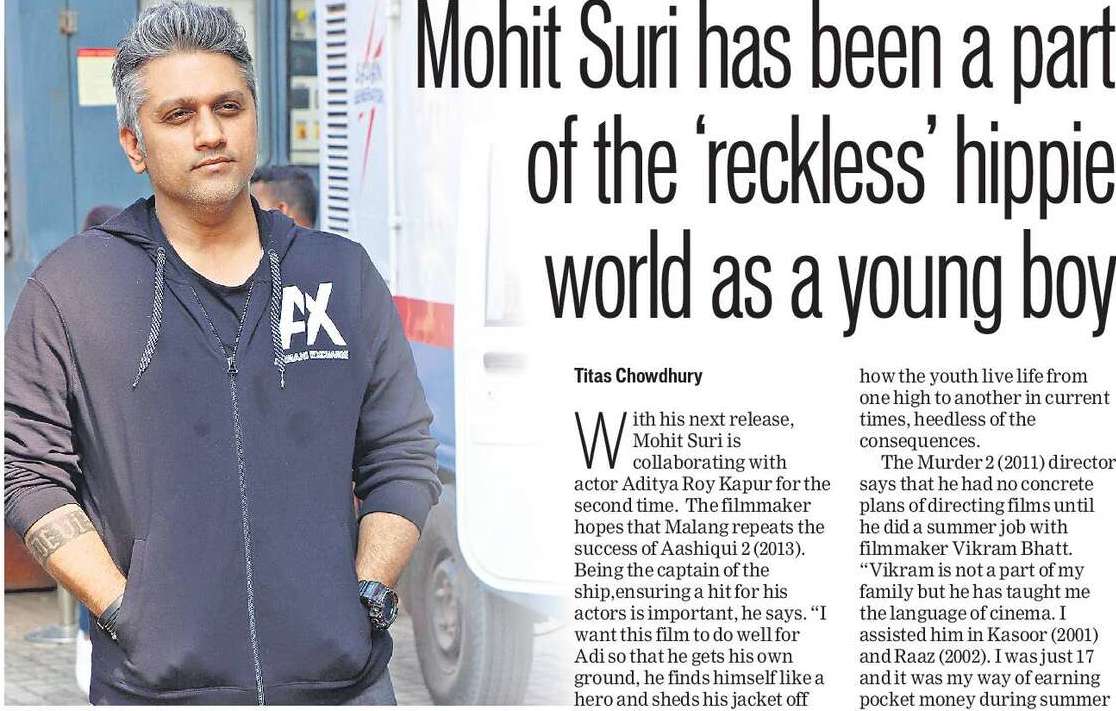
Titas Chowdhury (HINDUSTAN TIMES; February 2, 2020)
With his next release, Mohit Suri is collaborating with actor Aditya Roy Kapur for the second time. The filmmaker hopes that Malang repeats the success of Aashiqui 2 (2013). Being the captain of the ship,ensuring a hit for his actors is important, he says. “I want this film to do well for Adi so that he gets his own ground, he finds himself like a hero and sheds his jacket off like a hippie. I also owe a hit to Kunal (Kemmu). He was the boy I launched. He’s tired of hearing that he is an underrated actor. He keeps saying, 'If you feel I am underrated, give me that level of success.' And he deserves it. He’s one of the best actors I have worked with,” he says.
Mohit says the movie is inspired by the days he used to spend in Goa as a young boy. “Aditya and I both have been a part of the hippie world at some point in our lives when we were younger and irresponsible. I had gone to my cousin’s wedding in Goa and we saw a young couple pass by on a motorbike. My cousin laughed and asked me if I would allow my daughter, Devi, to come to Goa and do the reckless things that one did. It made me wonder that there could have been some mishap considering the rash things that we did,” he says. He explains that the film portrays how the youth live life from one high to another in current times, heedless of the consequences.
The Murder 2 (2011) director says that he had no concrete plans of directing films until he did a summer job with filmmaker Vikram Bhatt. “Vikram is not a part of my family but he has taught me the language of cinema. I assisted him in Kasoor (2001) and Raaz (2002). I was just 17 and it was my way of earning pocket money during summer break. I went to my uncle, Mr (Mahesh) Bhatt and asked him for a job. Vikram was very supportive.”
And what does Mohit think about his own brand of cinema? “I am happy making movies. I am happiest when I’m on a set. I started at 17 and now I am 38. I wouldn’t want my life to be any other way. A brand is what other people make of you and I want to live up to what they say,” Mohit says.
All of us have heard someone selling a question paper for a certain price-Shreyas Talpade & Aftab Shivdasani
7:35 AM

Renuka Vyavahare (BOMBAY TIMES; May 3, 2019)
Though Aftab Shivdasani and Shreyas Talpade have been a part of many comedies, their next outing, Setters, is based on the malpractices in the education system. While Shreyas plays a setter responsible for the criminal practices, Aftab essays the role of a cop who wants to bust the scam. In a candid chat with Bombay Times, the two spoke about being stereotyped as comic actors and dealing with social media. Excerpts:
Over the years, you both have been stereotyped as actors who are best suited for multi-starrer comedies. Setters being a crime thriller must have been refreshing.
Shreyas: People have almost forgotten that I started my career with films like Iqbal and Dor. They were serious films. Over a period of time, our association with comedies became really strong. After solely doing comedies for the past few years, I am glad I am doing something like this. I was pleasantly surprised when I was offered a subject and a role with grey shades. Every actor has an urge to do something else, reinvent himself and films like these give you that opportunity. People’s expectations from us are films like Masti, Grand Masti and Golmaal, so getting a serious film was refreshing. We have tried to play our parts with utmost sincerity and I hope that comes across.
Aftab: What Shreyas said is true for me as well. I started off with Mast and Kasoor and was appreciated for them. Then I did some love stories and comedies like Awara Paagal Deewana, Hungama and Masti, and people suddenly started identifying me with those genres. Yes, stereotyping happens to a certain extent. There is a perception that guys like Shreyas and I are more suitable for comedy films. Both of us were trying to find something that’s lucrative and substantial. You need a good script and a director to project you the right way. We hope we get accepted in a film like Setters, which will open the doors to more films like these. Also, it works both ways; a lot of actors, who are known for serious roles, don’t get offered comedies either.
What is Setters all about?
Shreyas: Setters is based on education and employment mafia. I think all of us have heard about this when we were in school or college…someone selling a question paper for a certain price. I had a perception that these leaks happen at a local level and maybe four-five people are involved in it. When I read the story, I told Ashwini (director Ashwini Chaudhary) that it’s quite an imagination and he corrected me by saying, this really happens. A massive mafia is involved in this. It’s structured and organised, comprising educated and tech-savvy people, who know how to crack the legal system. I am the ‘setter’ here, who’s a bad guy.
Aftab: I am the good guy, a cop, who is after this ‘setter’. It’s a cat-and-mouse game, more like catch-me-if-you-can. The story is about oneupmanship. We both have to be on top of our game to outdo each other. The kind of gadgets and technology the setters use are advanced, so, as someone in charge of security, we have to be one step ahead of them.
Shreyas: There’s no preaching here. It’s an entertainer based on a concept that’s real.
Aftab, after Great Grand Masti (2016), you disappeared from Bollywood in a way. Why did you go missing?
I did two South films and a British film after Great Grand Masti, which I didn’t really speak about because I wanted to test the waters. Even the English film is a content-driven, serious film, which will release sometime this year. I wanted to see what it’s like to work outside my comfort zone, which is Bollywood. Having said that, if I was offered interesting films here, I would have chosen them but I didn’t get any, so I waited for the right opportunity. When Setters came my way, I was excited to play a police officer, who wants to bust a racket and imprison the culprits.
Shreyas, people often look at you as a good fit for supporting cast. Do you think you have been slotted in this category?
That did happen to a certain extent with me. I am not from a film family or don’t have a film background, and when people like me are approached by seniors or friends in the industry, it isn’t easy for us to say no. They’ll say, yeh kar lena and you do it, even when you are not completely convinced about those films. You fear that agar woh bura maan gaye toh baat failegi ki yeh ladka akdu hai. You learn the hard way to be assertive. It’s your career after all. If you are not convinced about a film, what will you portray on screen? Certain films will work, certain won’t, but there came a point when I decided to take a break. I might as well tell stories that I am convinced about instead of acting in ones that I am not. So I got into production (Marathi) and then directed the Hindi remake of Poster Boys. I’d rather do what I want to do and, of course, you have to wait for a right script like Setters.
Aftab, you started off as a child actor with Mr India. Do you think the chances of burning out are a lot more when a person starts out that early?
Isn’t that an advantage? I don’t look at it as a burnout; you get a head start. You gather experience with time and there’ no substitute for that. If you love what you do, you will never burn out. If I wasn’t an actor, I wouldn’t know what to do with my life. I am an extremely passionate guy and I am happy that I got an opportunity to start off at an early age. I developed a liking for the camera from a young age and decided that I will be around it till the time I die.
Does being a part of a certain group in Bollywood help in terms of getting work?
Shreyas: Yes, to a certain extent. Those things (hanging out with certain people) can get you one film at the most, but eventually, you will have to survive on your talent. If you are good at your work, you don’t have to worry about kal kya hoga?
Aftab: Your talent speaks for itself. There are so many people who have had successful careers despite not being associated with groups. They made it on their own. Social circles don’t forward your professional career. You shouldn’t get into a group because you want work. People shouldn’t know you for the amount of drinks you had with them, but the kind of talent you have.
What are your thoughts on the changing phase of paparazzi and domination of social media in India?
Aftab: People with millions of followers are popular on a virtual platform, which is social media. Does that translate to box office collection? No. They might get money to endorse a brand as a post, but are they happy making that as a career? If yes, then that’s great. But I think real popularity is when people will pay to watch your film because they genuinely like you for what you do and what you are. That’s true appreciation. I heard this beautiful quote, ‘This social media freak had thousands of friends on Facebook. But when he died, no one showed up at his funeral.’ All you get is RIP. It’s good to be on social media — use it, be on it, but that’s not the world we should be living in! It’s virtual. Don’t get lost in it.
Shreyas: I make it a point to call people on their birthdays instead of posting a message on social media. I believe in meeting my friends and extended family. My sister was surprised that I wasn’t on Instagram. It felt like a crime. I am on the platform now. I agree with what Aftab says, online validation might not translate into professional success. As far as the paps are concerned, people who work with us now say things like, ‘Sir, airport ke liye kaunsa shirt pehnoge?’
Aftab, you must be relieved that your family can see Setters as it’s been passed with a ‘U’ certificate. It’s something that’s not common with your films.
My last ‘U’ certificate film was in 2011. I haven’t had a ‘U’ certificate film for eight years! Setters has been certified ‘U’, not even ‘U/A’, so I am throwing a party for it. I do regret that over the years my audience shifted from ‘U’ to ‘A’.
Setters, produced by Lovely Films Production and NH Studioz, releases today.
It pains me when a film actor or a cricketer is a youth icon-Irrfan Khan
8:35 AM

Our definition of heroes needs to change, but our definition of good cinema might already have, says Irrfan Hollywood could pose a serious threat if Bollywood does not provide better content
Anshul Chaturvedi (BOMBAY TIMES; May 30, 2016)
You are one of the few
global actors India has. What are you doing with a film titled Madaari
like it's one of those snake charmer-monkey trainer cliches?
Chhoti si kahani thi, joh itni hit kari ki sochte rahe, yaar, yeh film ho sakti hai kya? We sort of explored it a little bit and then we thought yes, there is a film. It's the reality of our country. There were certain important things that I want to address. Aisa nahin hai ki ab subject mil gaya toh film banao. Subject kis liye hai? Kya hai? Subject kar kya raha hai? Hum kyun banana chahte hain usko? Uske liye kuch cheezein thi important. There is a fact that we don't realise sometimes - that a hero lies in every man and in every woman. And most of the times, 99 per cent of the times we die, we perish before realising it. And the other thing is the accountability of our system. Kisi bhi ek aam aadmi ke saath kuch hota hai, toh where does he go? The courts are so overloaded that hamara CJI gets emotional and breaks down in front of the PM. Where do we go? There are certain facts which are very, very disturbing, and it concerns everybody. So, this film addresses that and we could not find the title of the film till we were halfway through the film.
Madaari nachaye ja raha hai?
Connotations wohi hain. Ki matlab jamura aur madaari ka khel hai. Zindagi mein kayi baar aap madaari hote hain, kayi baar jamure hote hain. That's how Madaari came.
Is the film art or mainstream?
Now, art films don't exist. What do you call art film? Where is the art film?
In Irrfan's portfolio?
Main art film ki den nahin hoon, main aisi film ki den hoon jiski definition media ne dhundi nahin hai. It is now not about art, it was not about mainstream. What would you call Piku? And Talvar? There is art in Talvar. A film which does not have songs, which does not make too much of noise, people start calling it art film, that is the tragedy of our times. This is a new kind of cinema which is emerging, and I think it has to pick up and it has to become bigger before Hollywood actually gulps you. Hollywood is coming with so much speed that you can't even understand!
Gulps you like Ka? The Jungle Book has earned more than Rs 180 crore in India I suppose that's more than SRK's Fan?
Yes! This is the first time that has happened. And another first is that Hindi version ka business zyada tha. Can you see the appetite of the audience which is desperately wanting to be engaged? That is where our film industry is on the back foot, where it is often not able to provide.
You've said earlier that you were paid less in Hollywood but you were working there because you wanted to change your working style. Their writing style is so much superior, it is much more detailed you can practically smell the character that they are writing...
I would like to add to that. See, Hollywood is America and the soul of America is marketing. The whole nation is built on marketing, so they understand it. And baaki unki koi bhi industry kuch bhi kar rahi ho, but the game (sports) industry and cinema industry they have captured it and specialised in it the world over. And many big countries, industries have been gulped by them. European cinema ko poora Hollywood kha gaya hai UK khatm ho gaya, France khatm ho gaya, Italy ... Their kind of craft knows how to engage people. Hamare yahan actors star nahin hain. Wahan actors stars hamesha se rahe hain. Chahe woh Clint Eastwood ho, Al Pacino ho, Robert De Niro ho ya Brando ho. Jo hamare yahan tha pehle.
Joh behtareen actor hota tha wohi superstar hota tha... till that changed in the '80s-'90s?
Yes, and then there was decadence. After Rajesh Khanna there was a strange kind of degeneration, with films mostly creating heroes indulging in self-pity, who make melodrama about self-pity, about how much pain he is in, that is when Govinda and all happened. You can't see that in isolation. That happened because theatre was dying down, VCR was introduced, middle class was not coming. The audience was gone. There was a particular kind of audience, and cinema was catering to them. The whole atmosphere was like that.
We went lower in search of the consumer?
Because the consumer was like that. People only liked that. Once, during a shoot, (Mahesh) Bhatt sahab aaye, chillaye mere par 'Arey yaar Irrfan, gandi acting kar, spoon-feed them. Spoon-feed. Yeh achhi acting se nahin chalega, dukan band ho jayegi'.
What movie was this?
Kasoor pehli film thi yeh. And he had a point. He was addressing that audience, he has a great communication with that audience that's not interested in nuances. Cinema was not capturing those nuances, so there was this space for nuances. Fortunately, now, the audience is exposed to world cinema. They want similar things from India. That's why Talvar, that's why Piku. All these films are being lapped up by the audience. 4 crore ki film 70 crore ka business kar rahi hai. Aur jahan tak Hollywood ke craft ka sawaal hai even when they make films for kids, it's not just the kids who can enjoy it, even parents can. Like Jurassic World or Jungle Book. We have not made any successful horror film or a successful children's film. We are still lagging behind. (But) The system is changing. You will be surprised by the way things will change. The way Priyanka has suddenly gone there, Deepika has gone there things are moving in a very interesting direction as far as India is concerned.
Is it easier for Indian actors to get a footing in Hollywood after the sort of work people like you or Priyanka have done?
No, no. It is not easy. It is 50 times more difficult to break into Hollywood than it is here. An actor who gets one or two auditions there is exhilarated. Just two auditions. If he gets them, he thinks he is there. Uss industry mein break in karna is not easy. I don't think that they are looking at India and saying aao ji aao.
How has Priyanka made a mark this early?
I don't know. I have seen people some famous stars also, I don't want to name people who have spent so much time trying. Chappalein ghis gayin, as we say, but kuch nahin, nothing. Kuch actresses do-do saal tak wahan padi huin hain aur kuch dhele ka kaam nahin mila. How something happens there or here there is no formula to it. That is the mystery of cinema!
In an earlier interview some years back, you had spoken about the baba in Jaipur who saw your kundli in 1983... (a minute's break for laughter)... and you said he told you you'll be famous only after 2000. So he gave you a 16-17 year waiting period. It's been 16 years since 2000. How does life look from this vantage point? Do you ever ask about your future now?
Yeh joh art hai, iska kuch percentage sahi jaata hai, dekhne wala hona chahiye. Like a doctor who is able to diagnose accurately because he knows how to assess you. But it is suicidal to depend on it. It deprives you of facing life spontaneously Some times, what is predicted happens, sometimes it doesn't happen. But to take life spontaneously, to be prepared for whatever is going to happen that enriches you. If you know, or think you know, or if I knew ki ab se yeh hoga, 2000 se aisa hoga, aur waisa hua it hasn't done good to me. It shows some kind of insecurity within me. I am insecure, which is why I depend on that. It shows that I don't trust the process of life. That's a folly, that's a weakness.
Like knowing where a bowler will be pitching the ball before he bowls it?
Exactly! And if the ball is an outswinger and you were told it will be an outswinger aur aap ne uss pe shot maar diya, toh aap ko aage, kahin na kahin, apni ability pe question mark rahega. Ki woh faculty joh meri thi, agar main judge kar ke maarta, woh exercise nahin hui.
Given that you came to Delhi to watch the IPL eliminator KKR vs SRH I was thinking of the extremely interesting logic you had once used in explaining that you had wanted to be a cricketer, but then thought that there is scope for only 11 players, while there can be any number of actors so you opted to be an actor!
Yes, that is exactly how I thought in my naive mind then. I had to break out of that mould I was in. I don't know where it was from - but the desire I had was to escape from the perception people had of me. That was the basic desire. In my school days, I used to dislike how people looked at me, what they thought of me. I wanted to escape that. I think that made me come out of my shell and express myself. You are looking at me in a particular way - and I am not that. I am something else. What am I - I don't know.
So you were clear about what you did not want to be. And then you began to find out what you wanted to be.
Yeah, yeah. That's why cricket. That's why acting. That's why trying to find out what I wanted to be. Once I was watching an Ashok Kumar film - Mamta. And I was fascinated by the role of a barrister, and I thought that I'll become a barrister. I was always looking for things that would take me away from where I was. Pata nahin yeh interview mein bolna chahiye ki nahin... Jab main teenager thaa, hamare bagal mein ek showroom hua karta thaa, Jaipur mein. Wahan angrez aaya karte thay. Unki air-conditioned bus hua karti thi. Mera cousin wahan neeche khada hua karta thaa kabhi jab woh buses ja rahi hoti thi, aur aise hi khade ho ke hi-hello kiya karta tha tourists ko uska intention hua karta thaa ki woh shayad use kuch de dein. And I was part of it! I still remember that time - my mental makeup. How we were fascinated by these people and they looked like they were from another planet. I just wanted to get away from there, from being that.
In a previous interview, you'd said that you 'felt like a nobody' after watching a shooting as a child - did you want to be on the other side of the shooting someday, be a somebody?
Nahin, tab woh khayal hi nahin aaya thaa. I was too young. Maine Bachchan sahab ki shooting dekhi thi. And I felt very bad, I felt like a nobody. Ghar aa kar maine yeh incident apni mother ko bataya. She said 'Mujhe bhi aisa laga thaa. Amer Fort mein Dara Singh ki kisi film ki shooting chal rahi thi, aur mujhe bahut bura laga tha wahan jaane ke baad'. Toh main yeh identify kar paaya ki humari feelings ek jaisi hain - magar woh kyun hai aisi, mujhe samajh nahin aaya. Uske baad main zindagi mein kabhi shooting dekhne nahin gaya. Zindagi mein kabhi kisi se autograph nahin maanga. Ek baar maangne gaya thaa, (iconic Pakistani batsman) Zaheer Abbas se. Main bhaga bhaga gaya thaa, kisi tarah se mauka mil gaya thaa, friendly match tha, itni strict security nahin thi. And he just looked at me - and kept walking. Uss ke baad se I have never approached anyone for an autograph.
Which is why you are so uncomfortable walking away when people ask you for a picture?
Sometimes you don't have the time, sometimes you're not in the mood. But I really feel bad sometimes, ki maine kyun mana kar diya... Abhi do din pehle main Lokhandwala mein ghoom raha thaa raat ko, ek auto ruka aur ek ladka utar ke aisey aaya (arms outstretched) ki maine socha kya ho gaya, koi bam phodne aaya hai kya. He ran towards me. And when he reached me, I saw he was exuberant. 'Sir, sir, photograph...' I was in a different mood. I said, 'Yaar, tu haath mila le, bhai tu photograph rehne de'. Uske chehre ka rang badla aisa ek second mein woh main bhool nahin sakta. Ab mujhe lagta hai maine gale kyun nahin lagaya. What irritates you sometimes is that people don't value themselves ...bahut saste mein jaise apne ko... Aur photo bhi kheench gaya tab bhi satisfaction nahin hai, selfie chahiye. Iss pravritti se thodi uljhan hoti hai. All the time one is not in a zone to do all this.
In an interview a couple of years back you'd said 'Wanting fame is a disease.'
Yes, I still think that. One day I will want to be free from this disease, from this desire. Where fame doesn't matter. Where just experiencing life and being okay with it is enough. Right now, you can say I am a patient of the disease. In the very beginning, that was all I wanted when I thought of being an actor - ki bas main famous ho jaun.
Are you currently at peace?
Comparatively, I think I am. But our industry is such that we keep propelling ourselves in new directions. I don't have formulas, but I have landmarks to achieve. To do the kind of films that I want to do. To engage audiences in a larger way. To redefine things. That is my basic concern - things need to be redefined... It pains me when a film actor or a cricketer is a youth icon. I don't have anything against them. They are great entertainers; they are useful to the society. They contribute to people's lives. But they are not heroes. We haven't redefined heroes. Heroes are different people. Heroes are people who sacrifice their own concerns and do something bigger, who change people's lives. We film stars and cricketers shouldn't be aspirational in such a big way for the healthy growth of the society. It's a sign of consumerism at its extreme. That's why I find it so cool and so hip to see that photograph of the women scientists of ISRO celebrating a launch. That's heroism. That's cool, that's hip! Lekin main agar kahin se udhaar le kar, kuch bana ke, thodi der ke liye aapka time pass kara de raha hoon, just because I am famous, you aspire to become me - that's not cool, that's pathetic.
Chhoti si kahani thi, joh itni hit kari ki sochte rahe, yaar, yeh film ho sakti hai kya? We sort of explored it a little bit and then we thought yes, there is a film. It's the reality of our country. There were certain important things that I want to address. Aisa nahin hai ki ab subject mil gaya toh film banao. Subject kis liye hai? Kya hai? Subject kar kya raha hai? Hum kyun banana chahte hain usko? Uske liye kuch cheezein thi important. There is a fact that we don't realise sometimes - that a hero lies in every man and in every woman. And most of the times, 99 per cent of the times we die, we perish before realising it. And the other thing is the accountability of our system. Kisi bhi ek aam aadmi ke saath kuch hota hai, toh where does he go? The courts are so overloaded that hamara CJI gets emotional and breaks down in front of the PM. Where do we go? There are certain facts which are very, very disturbing, and it concerns everybody. So, this film addresses that and we could not find the title of the film till we were halfway through the film.
Madaari nachaye ja raha hai?
Connotations wohi hain. Ki matlab jamura aur madaari ka khel hai. Zindagi mein kayi baar aap madaari hote hain, kayi baar jamure hote hain. That's how Madaari came.
Is the film art or mainstream?
Now, art films don't exist. What do you call art film? Where is the art film?
In Irrfan's portfolio?
Main art film ki den nahin hoon, main aisi film ki den hoon jiski definition media ne dhundi nahin hai. It is now not about art, it was not about mainstream. What would you call Piku? And Talvar? There is art in Talvar. A film which does not have songs, which does not make too much of noise, people start calling it art film, that is the tragedy of our times. This is a new kind of cinema which is emerging, and I think it has to pick up and it has to become bigger before Hollywood actually gulps you. Hollywood is coming with so much speed that you can't even understand!
Gulps you like Ka? The Jungle Book has earned more than Rs 180 crore in India I suppose that's more than SRK's Fan?
Yes! This is the first time that has happened. And another first is that Hindi version ka business zyada tha. Can you see the appetite of the audience which is desperately wanting to be engaged? That is where our film industry is on the back foot, where it is often not able to provide.
You've said earlier that you were paid less in Hollywood but you were working there because you wanted to change your working style. Their writing style is so much superior, it is much more detailed you can practically smell the character that they are writing...
I would like to add to that. See, Hollywood is America and the soul of America is marketing. The whole nation is built on marketing, so they understand it. And baaki unki koi bhi industry kuch bhi kar rahi ho, but the game (sports) industry and cinema industry they have captured it and specialised in it the world over. And many big countries, industries have been gulped by them. European cinema ko poora Hollywood kha gaya hai UK khatm ho gaya, France khatm ho gaya, Italy ... Their kind of craft knows how to engage people. Hamare yahan actors star nahin hain. Wahan actors stars hamesha se rahe hain. Chahe woh Clint Eastwood ho, Al Pacino ho, Robert De Niro ho ya Brando ho. Jo hamare yahan tha pehle.
Joh behtareen actor hota tha wohi superstar hota tha... till that changed in the '80s-'90s?
Yes, and then there was decadence. After Rajesh Khanna there was a strange kind of degeneration, with films mostly creating heroes indulging in self-pity, who make melodrama about self-pity, about how much pain he is in, that is when Govinda and all happened. You can't see that in isolation. That happened because theatre was dying down, VCR was introduced, middle class was not coming. The audience was gone. There was a particular kind of audience, and cinema was catering to them. The whole atmosphere was like that.
We went lower in search of the consumer?
Because the consumer was like that. People only liked that. Once, during a shoot, (Mahesh) Bhatt sahab aaye, chillaye mere par 'Arey yaar Irrfan, gandi acting kar, spoon-feed them. Spoon-feed. Yeh achhi acting se nahin chalega, dukan band ho jayegi'.
What movie was this?
Kasoor pehli film thi yeh. And he had a point. He was addressing that audience, he has a great communication with that audience that's not interested in nuances. Cinema was not capturing those nuances, so there was this space for nuances. Fortunately, now, the audience is exposed to world cinema. They want similar things from India. That's why Talvar, that's why Piku. All these films are being lapped up by the audience. 4 crore ki film 70 crore ka business kar rahi hai. Aur jahan tak Hollywood ke craft ka sawaal hai even when they make films for kids, it's not just the kids who can enjoy it, even parents can. Like Jurassic World or Jungle Book. We have not made any successful horror film or a successful children's film. We are still lagging behind. (But) The system is changing. You will be surprised by the way things will change. The way Priyanka has suddenly gone there, Deepika has gone there things are moving in a very interesting direction as far as India is concerned.
Is it easier for Indian actors to get a footing in Hollywood after the sort of work people like you or Priyanka have done?
No, no. It is not easy. It is 50 times more difficult to break into Hollywood than it is here. An actor who gets one or two auditions there is exhilarated. Just two auditions. If he gets them, he thinks he is there. Uss industry mein break in karna is not easy. I don't think that they are looking at India and saying aao ji aao.
How has Priyanka made a mark this early?
I don't know. I have seen people some famous stars also, I don't want to name people who have spent so much time trying. Chappalein ghis gayin, as we say, but kuch nahin, nothing. Kuch actresses do-do saal tak wahan padi huin hain aur kuch dhele ka kaam nahin mila. How something happens there or here there is no formula to it. That is the mystery of cinema!
In an earlier interview some years back, you had spoken about the baba in Jaipur who saw your kundli in 1983... (a minute's break for laughter)... and you said he told you you'll be famous only after 2000. So he gave you a 16-17 year waiting period. It's been 16 years since 2000. How does life look from this vantage point? Do you ever ask about your future now?
Yeh joh art hai, iska kuch percentage sahi jaata hai, dekhne wala hona chahiye. Like a doctor who is able to diagnose accurately because he knows how to assess you. But it is suicidal to depend on it. It deprives you of facing life spontaneously Some times, what is predicted happens, sometimes it doesn't happen. But to take life spontaneously, to be prepared for whatever is going to happen that enriches you. If you know, or think you know, or if I knew ki ab se yeh hoga, 2000 se aisa hoga, aur waisa hua it hasn't done good to me. It shows some kind of insecurity within me. I am insecure, which is why I depend on that. It shows that I don't trust the process of life. That's a folly, that's a weakness.
Like knowing where a bowler will be pitching the ball before he bowls it?
Exactly! And if the ball is an outswinger and you were told it will be an outswinger aur aap ne uss pe shot maar diya, toh aap ko aage, kahin na kahin, apni ability pe question mark rahega. Ki woh faculty joh meri thi, agar main judge kar ke maarta, woh exercise nahin hui.
Given that you came to Delhi to watch the IPL eliminator KKR vs SRH I was thinking of the extremely interesting logic you had once used in explaining that you had wanted to be a cricketer, but then thought that there is scope for only 11 players, while there can be any number of actors so you opted to be an actor!
Yes, that is exactly how I thought in my naive mind then. I had to break out of that mould I was in. I don't know where it was from - but the desire I had was to escape from the perception people had of me. That was the basic desire. In my school days, I used to dislike how people looked at me, what they thought of me. I wanted to escape that. I think that made me come out of my shell and express myself. You are looking at me in a particular way - and I am not that. I am something else. What am I - I don't know.
So you were clear about what you did not want to be. And then you began to find out what you wanted to be.
Yeah, yeah. That's why cricket. That's why acting. That's why trying to find out what I wanted to be. Once I was watching an Ashok Kumar film - Mamta. And I was fascinated by the role of a barrister, and I thought that I'll become a barrister. I was always looking for things that would take me away from where I was. Pata nahin yeh interview mein bolna chahiye ki nahin... Jab main teenager thaa, hamare bagal mein ek showroom hua karta thaa, Jaipur mein. Wahan angrez aaya karte thay. Unki air-conditioned bus hua karti thi. Mera cousin wahan neeche khada hua karta thaa kabhi jab woh buses ja rahi hoti thi, aur aise hi khade ho ke hi-hello kiya karta tha tourists ko uska intention hua karta thaa ki woh shayad use kuch de dein. And I was part of it! I still remember that time - my mental makeup. How we were fascinated by these people and they looked like they were from another planet. I just wanted to get away from there, from being that.
In a previous interview, you'd said that you 'felt like a nobody' after watching a shooting as a child - did you want to be on the other side of the shooting someday, be a somebody?
Nahin, tab woh khayal hi nahin aaya thaa. I was too young. Maine Bachchan sahab ki shooting dekhi thi. And I felt very bad, I felt like a nobody. Ghar aa kar maine yeh incident apni mother ko bataya. She said 'Mujhe bhi aisa laga thaa. Amer Fort mein Dara Singh ki kisi film ki shooting chal rahi thi, aur mujhe bahut bura laga tha wahan jaane ke baad'. Toh main yeh identify kar paaya ki humari feelings ek jaisi hain - magar woh kyun hai aisi, mujhe samajh nahin aaya. Uske baad main zindagi mein kabhi shooting dekhne nahin gaya. Zindagi mein kabhi kisi se autograph nahin maanga. Ek baar maangne gaya thaa, (iconic Pakistani batsman) Zaheer Abbas se. Main bhaga bhaga gaya thaa, kisi tarah se mauka mil gaya thaa, friendly match tha, itni strict security nahin thi. And he just looked at me - and kept walking. Uss ke baad se I have never approached anyone for an autograph.
Which is why you are so uncomfortable walking away when people ask you for a picture?
Sometimes you don't have the time, sometimes you're not in the mood. But I really feel bad sometimes, ki maine kyun mana kar diya... Abhi do din pehle main Lokhandwala mein ghoom raha thaa raat ko, ek auto ruka aur ek ladka utar ke aisey aaya (arms outstretched) ki maine socha kya ho gaya, koi bam phodne aaya hai kya. He ran towards me. And when he reached me, I saw he was exuberant. 'Sir, sir, photograph...' I was in a different mood. I said, 'Yaar, tu haath mila le, bhai tu photograph rehne de'. Uske chehre ka rang badla aisa ek second mein woh main bhool nahin sakta. Ab mujhe lagta hai maine gale kyun nahin lagaya. What irritates you sometimes is that people don't value themselves ...bahut saste mein jaise apne ko... Aur photo bhi kheench gaya tab bhi satisfaction nahin hai, selfie chahiye. Iss pravritti se thodi uljhan hoti hai. All the time one is not in a zone to do all this.
In an interview a couple of years back you'd said 'Wanting fame is a disease.'
Yes, I still think that. One day I will want to be free from this disease, from this desire. Where fame doesn't matter. Where just experiencing life and being okay with it is enough. Right now, you can say I am a patient of the disease. In the very beginning, that was all I wanted when I thought of being an actor - ki bas main famous ho jaun.
Are you currently at peace?
Comparatively, I think I am. But our industry is such that we keep propelling ourselves in new directions. I don't have formulas, but I have landmarks to achieve. To do the kind of films that I want to do. To engage audiences in a larger way. To redefine things. That is my basic concern - things need to be redefined... It pains me when a film actor or a cricketer is a youth icon. I don't have anything against them. They are great entertainers; they are useful to the society. They contribute to people's lives. But they are not heroes. We haven't redefined heroes. Heroes are different people. Heroes are people who sacrifice their own concerns and do something bigger, who change people's lives. We film stars and cricketers shouldn't be aspirational in such a big way for the healthy growth of the society. It's a sign of consumerism at its extreme. That's why I find it so cool and so hip to see that photograph of the women scientists of ISRO celebrating a launch. That's heroism. That's cool, that's hip! Lekin main agar kahin se udhaar le kar, kuch bana ke, thodi der ke liye aapka time pass kara de raha hoon, just because I am famous, you aspire to become me - that's not cool, that's pathetic.

Subscribe to:
Posts (Atom)