Showing posts with label Karma. Show all posts
Showing posts with label Karma. Show all posts
Aishwarya Rai Bachchan, Akshaye Khanna, Anil Kapoor will not be there in Taal 2-Subhash Ghai
11:06 PM

Upala KBR (MID-DAY; April 30, 2026)
Sequels, and then some more. That’s what Subhash Ghai is thinking of these days. Almost 27 years after Taal (1999) became a smash hit at the box office, the filmmaker revealed to mid-day that he is crafting its sequel.
Starring Aishwarya Rai Bachchan, Akshaye Khanna, and Anil Kapoor, the popular musical told the story of a talented village singer who rises to stardom after being heartbroken. So, will the sequel take the story forward? “We cannot have the same actors of Taal today as they are older. So, an extension of the original story is out. But it will be a musical love story. I want fresh faces to play the lead roles,” he said.
Those hoping to see Rai in a cameo, at least, are in for disappointment. The filmmaker said, “Mukta Arts has never had these gimmicks of having stars as cameos in their movies. So, Akshaye, Aishwarya, and Anil will not be there in Taal 2. If we require star power, we can request anyone, but the character needs to be justified.”
Ghai has been writing the love story over the past few years. Even as he has developed its world, he is certain of not directing it. He stated, “I’d like to have a well-known director to helm it. We plan to announce Taal 2 by October.”
That isn’t the only sequel Ghai is considering. He is also developing the second part to his all-star action drama, Karma (1986). “The time has come when people want to see a story’s sequel. Like in Karma, what happened to Dr Dang or Baiju [Anupam Kher and Jackie Shroff’s characters respectively]? Karma 2 is next in the pipeline.”
Lip lockdown; Superman can’t kiss but Devika Rani did, and how
8:24 AM

A 33-second kiss just got chopped, but a 2-minute lip-lock once rolled uncensored and unapologetic. Sunday Times looks at how we went from reel freedom to real prudish
Shruti Sonal (THE TIMES OF INDIA; July 20, 2025)
A filmmaker and two censor board officials sit inside a dark theatre. On screen, a kiss unfolds. As the seconds tick by, the discomfort on the officials’ faces deepens. After coming out, the three bicker over the scene’s duration. One official suggests trimming the kiss, while the other thinks it should be cut altogether.
This is a scene from Varun Grover’s fictional short film ‘KISS’, but it mirrors reality quite closely. In recent days, India’s censor board has sparked controversy again, this time for snipping a 33-second kissing scene from the Hollywood film ‘Superman’ for being "overly sensual". Even as audiences were bewildered by the abrupt cut in a film certified for 13+ viewers, social media erupted in memes.
But things weren’t always this prudish. Let’s rewind to 1933 when a silent film titled ‘Karma’ featured a kiss that is still considered India’s longest on screen. It starred Devika Rani and Himanshu Rai, who would later establish Bombay Talkies. Some say the kiss lasted up to five minutes, but Kishwar Desai, who chronicled the moment and Rani’s life in her National Award-winning book ‘The Longest Kiss’, says the actual scene lasted under two minutes. Yet, it was ground-breaking.
“It was one of the very few kissing scenes from films that have survived from that era. But pre-Independence India was a very different country. This kiss was just treated as part of the screenplay. The fact that Devika and Himanshu were a real-life couple helped, but there were other examples of actors exchanging kisses too,” says Desai.
Much of this openness, Desai explains, had to do with the cinematic influences shaping Indian film at the time, such as Hollywood which, in the 1930s, had bold portrayals of sex and intimacy in films like ‘Unashamed’, ‘Blonde Venus’, and ‘New Morals For Old’ — a clear departure from the prudishness of the Victorian era.
Foreign technicians and directors also brought in a very different sensibility, points out Desai. “Even ‘Karma’ was made both in Hindi and English. The director, J L Freer Hunt, was a Britisher. Rai was very clear that he wanted the film to appeal to an international audience,” she adds.
LOVE OUT LOUD
Far from being an exception, such scenes were quite common in early Indian cinema, says film scholar Meraj Ahmed Mubarki, who spent months poring over archives from the 1920s. Films from that era — often starring Anglo-Indian or Parsi actors — featured prolonged kissing scenes, sensuous dances, and significant body exposure.
Patience Cooper, a leading actress of the time, appeared in multiple such films: ‘Laila Majnu’ (1922) and Bengali drama ‘Krishnakanter Will’ (1926) included scenes with the heroine’s bust exposed, while ‘Aankh Ka Nasha’ (The Witchery of the Eyes, 1928) featured a passionate kiss. The 1932 film ‘Zarina’ sparked a big controversy for including not one or two, but 86 kisses.
It's not that censors didn’t exist. The Cinematograph Act had come in 1918, and independent film censor boards were established in Bombay, Madras, Calcutta, Rangoon, and Lahore. But they were more preoccupied with politics than kissing.
In fact, the first film to be banned was ‘Bhakt Vidur’ (1921), which came just a few months after the Rowlatt Act, and featured a mythological figure modelled after Gandhi. When it came to sexuality and desire, the British were quick with cuts in American or British films, says Mubarki. “Censor committee reports show that the British were beginning to worry about how Indian audiences would react when they saw a white woman disrobing, taking a bath, sharing a drink, or kissing on screen. Films were a window to the world of the colonizer, and they had to keep it distant,” he adds.
CULTURE CONUNDRUM
Things started changing in the mid-thirties, both in Hollywood and at home. Monika Mehta, author of ‘Censorship and Sexuality in Bombay Cinema’, says that from the late 1930s onwards, a question began playing on the minds of filmmakers: “What is Indian culture right and how should it be defined in relation to western culture?” In trying to answer this, the film industry became a site for questions of morality and ethics, she adds.
Another factor was the film industry’s negotiation with the patriarchy. “In the context of Hollywood, a big kiss foregrounds the formation of the romantic couple. In the context of India, there was a fear that this notion of the romantic couple would unsettle the joint family system,” says Mehta.
FAMILY FRIENDLY
The concerns were not just ethical, but also commercial. After Independence, the ‘family audience’ emerged as the primary moviegoing demographic, replacing the predominantly male viewers of earlier decades. Elements that could make them uncomfortable were done away with, says Desai.
“In the later films Devika Rani did with Bombay Talkies, there was no kiss. Although she was a fairly liberated woman in real life, on screen she became a saree-clad lady who is very much into family. She was playing interesting roles, but they didn’t break the mould of an ideal Indian woman,” Desai adds.
Even in film magazines, the onscreen kiss became a topic of discussion. In the April 1940 edition of FilmIndia, for instance, a reader asked the editor: “Indian films use a duet to express love. Don't you think they would do well to use a kiss instead?”
The magazine’s editor Baburao Patel, famous for his caustic language, replied, “Yes, a kiss would be the shortest cut which perhaps the audience would also like, if it is passionately given. But what about the literary bile of the dialogue writer who wants to spit out love through the painted lips in the shape of senseless words? Then there are the Censor Boards with their unromantic inspectors and tired fossils as members of the Boards. Won't they fall to pieces if they see a good long-winded kiss on the screen?”
After Independence, autonomous regional censors were merged — first into the Bombay Board of Film Censors, and then reorganized as the Central Board of Film Censors in 1952. Films like ‘Karma’ gave way to nationalist and mythological offerings, which showed women as caregivers or upholders of chaste, family values. “After the turbulence of Partition, the film industry had to come back with an Indian image, which was very carefully crafted,” Desai says.
In this new image, overt depictions of desire gave way to more symbolic expressions such as two flowers coming together or a pair of feet peeking out from under a blanket. When some films tried to move away from that, like ‘Satyam Shivam Sundaram’ in 1978, huge controversies erupted. In its coverage of the Zeenat Aman-starrer, The New York Times wrote, “In a sharp break with the tradition of modesty, the kiss has come to the Hindi motion picture screen, titillating some film audiences, scandalizing others, and fuelling a national debate over censorship.”
Decades later, the kiss keeps getting caught in the censor’s crosshairs.
Had Dilip Kumar or Amitabh Bachchan played Dr Dang, they would have been considered heroes but not me-Anupam Kher
8:07 AM
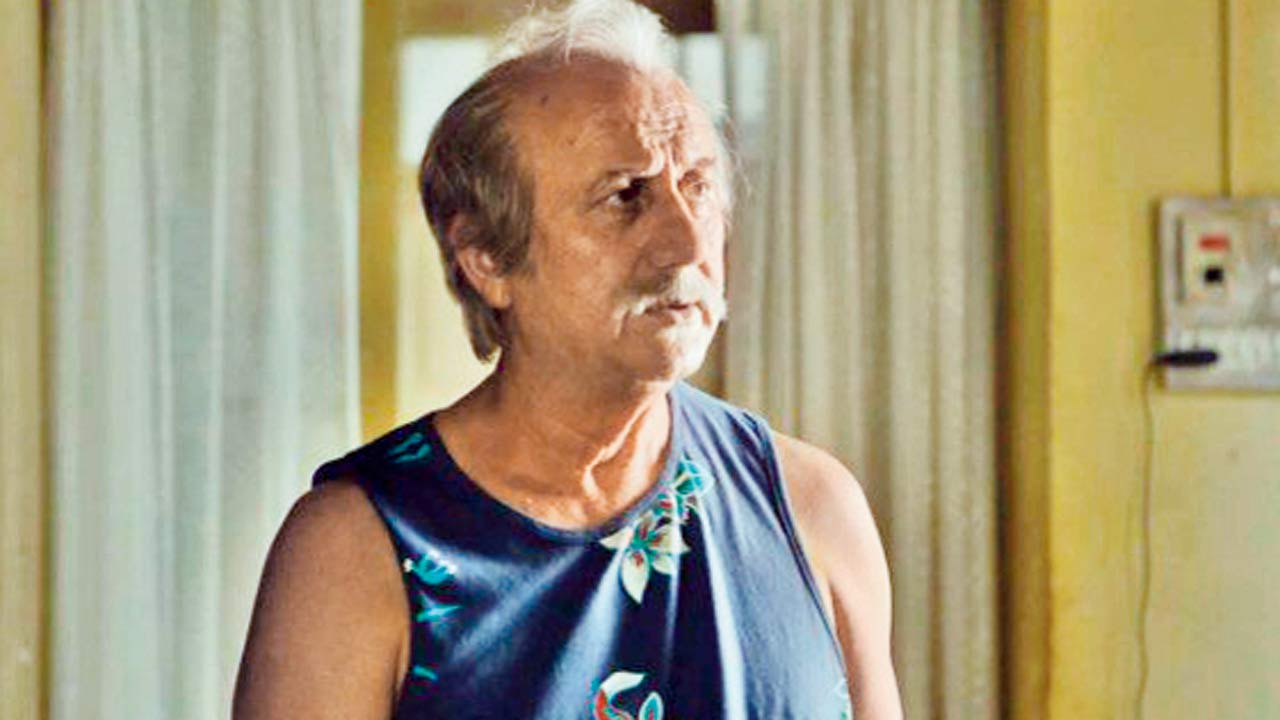
Vijay 69 actor Anupam Kher on learning to swim to play role of a 69-year-old athlete
Priyanka Sharma (MID-DAY; November 2, 2024)
Never one to disappoint with his film choices, Anupam Kher gripped the attention of cinephiles when he announced that he was set to play a 69-year-old man with aspirations of competing in a triathlon. Kher, also 69, says that like his character Vijay, he also believes that there is benefit in “attempting things that are considered difficult”.
“I am the actor who likes to break stereotypes. I want to push boundaries and do things that people say are not possible. People try their best to ensure that one remains mediocre, because [that’s how they] see [themselves]. Who decides if you can do something or not?” he enthuses with the passion he showcases on screen.
“I didn’t know how to swim, but this film required my character to do so. I could have easily told the team to work with a body double for those sections. But the film is about courage, and if the actor did not showcase that, it would be a contradiction. I didn’t want that,” he says.
Featuring in Akshay Roy’s directorial venture, Kher says, has left him yearning for similar challenges. As physically taxing as it may seem, Kher says he’d like to feature in a film like Vijay 69 “every two years”. “When you have done so much work, you have to make your job difficult.”
Place power in the hands of bankable actors like him, and it’s easy to see that a film will have several takers. In fact, Kher’s vast body of work is testimony to the fact that films based on aged characters have found favour among the masses. We are compelled to ask the actor why similar stories that revolve around elderly protagonists are not brought into the market. Kher opines that the masses are “conditioned to believe” that the kind of success that the protagonist of the film enjoys is reserved for the young.
“We believe in clichés. We like success stories. But Vijay 69 is also a success story. Our society tends to look at older characters from a sympathetic lens. In Vijay 69, my character is ready for a fight anytime. There’s no age barrier in his head. He is quite unabashed in his approach. And that’s such an attractive quality about him,” he shares.
Having worked for nearly four decades, Kher has been part of a diverse filmography. However, it was early on in his journey that he learnt a crucial aspect about the disparity between acting and popularity.
“I always considered myself the hero of a film. I had told Subhash Ghai [director] that my character in Karma [1986], Doctor Dang, is the hero. Had Dilip Kumar or Amitabh Bachchan played that role, they would have been considered the heroes. But, when Anupam Kher plays it, that’s not how it is referred to. An actor who has knowledge will know that anyone who acts well is a hero. I understood this because I was an educated actor. In our industry, those who act poorly are considered good actors, and the one who would perform well would be called character actors. It was torturous, sometimes. I used to look at a hero and think, ‘He is such a bad actor.’”
Dilip Kumar will remain the greatest actor ever of Hindi cinema
8:49 AM

Box Office India Trade Network
One of the greatest legends of Indian cinema, Dilip Kumar, passed away at the age of 98 due to a prolonged illness. Dilip Kumar started his career in just before Independence in 1944 with JWAR BHATA and had a defining career of around 55 years and a film count of only 56 films.
His first film JWAR BHATA released in 1944 and success was not too far away as films like JUGNU (1947) and SHAHEED (1948) scored at the box office after which there was no looking back. Although these things are always arguable, the fact is that Dilip Kumar is the greatest actor that the Indian screen has ever seen. The biggest actors who have come after have imbibed from him and even the actors today who may not even be aware that they are being inspired by Dilip Kumar but who they think they looking up to was in all probability inspired by Dilip Kumar. Basically acting in India all started from this man.
There was a phase in the late 40's and early 50's that his films were working only because the audience was coming to see his acting. These slow films which we can call towards the dark side were working just because of the histrionics of Dilip Kumar as no one before had seen such acting. The masses were lining up in cinemas across India to see films which may not be offering huge entertainment but they did not care as all they wanted to see was the histrionics of Dilip Kumar. This was the period where Dilip Kumar got the tragedy king tag. This has never happened with any other actor as they had to be backed by a genre or more commercial elements to pull through and this holds till today.
These films were becoming HITS due to the histrionics and then there were the BLOCKBUSTER films like AAN, AZAAD, INSANIYAT, NAYA DAUR, MADHUMATI, PAIGHAM and KOHINOOR which were more in the commercial element of those times and smashed box office records. These films created Dilip Kumar the Superstar The likes of AAN, AZAAD and INSANIYAT also set the precedent for that big budget Hindi commercial potboiler which was to dominate Hindi cinema for years and still does.
The peak of the career came in the early 60's with films like MUGHAL-E-AZAM (1960) and GUNGA JUMNA (1961) which created history and remain today among the biggest BLOCKBUSTERS of Hindi cinema. The performance in GUNGA JUMNA is also probably the greatest ever by an actor in India. The workload slowed after that though the big HITS still came with RAM AUR SHYAM (1967) and GOPI (1970) but it was difficult now to fit into that traditional hero format due to age.
Dilip Kumar took a break for a few years and then did something that no actor ever managed to do before or after as he returned as more of a character actor. But this character actor was the main lead of these films and drove those films to huge success. Films like KRANTI (1981), VIDHAATA (1982), KARMA (1986) and SAUDAGAR (1990) all were were BLOCKBUSTER films and all driven by Dilip Kumar despite playing older characters. There were others like DHARAM ADHIKARI and KANOON APNA APNA which also saw average success. This was the part of his illustrious career which sets him apart from all other actors as no one else has managed to get such success as a character artist. It has to be said that you have to be a Dilip Kumar to get such roles without being the hero and there has only been one Dilip Kumar.
Simply put Dilip Kumar will remain the greatest actor ever of Hindi cinema unless we see some miracle over the next 100 years.
When we used to play scrabble, Dilip Kumar would make up his own words-Poonam Dhillon
8:31 AM
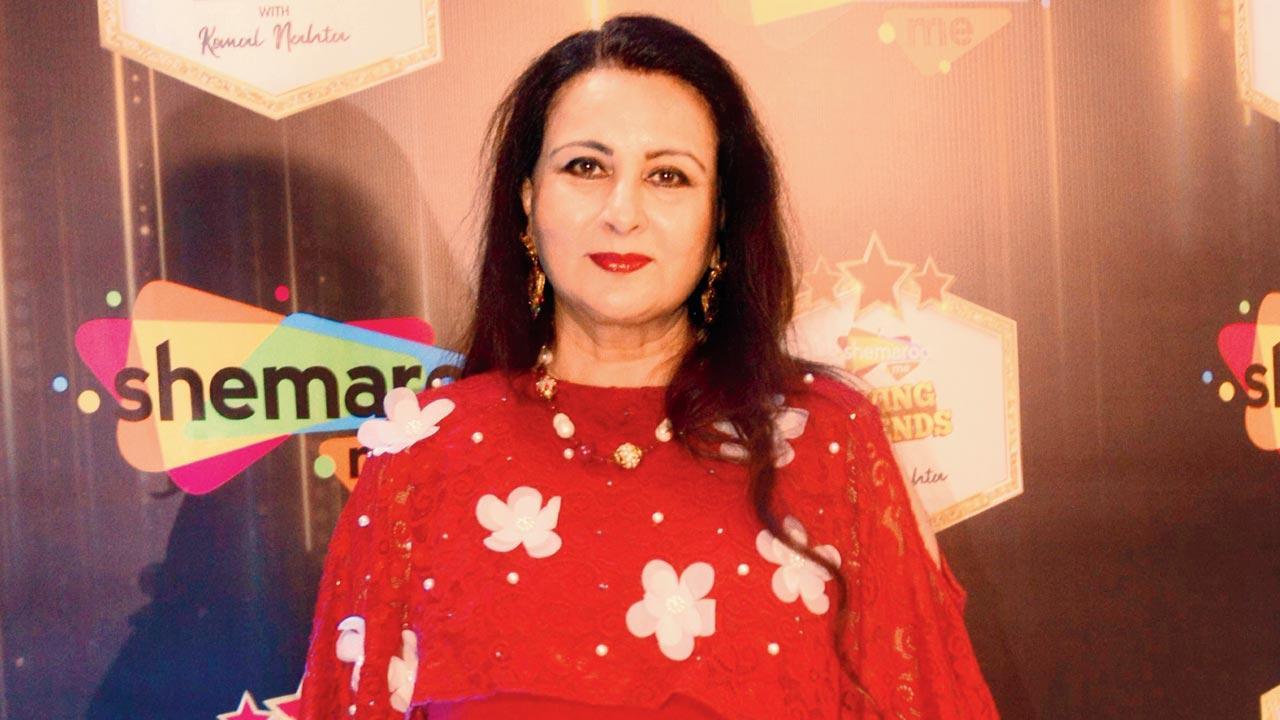
As told to Mohar Basu (MID-DAY; July 8, 2021)
Film sets in today’s times are so different from what they were in the ’90s. Now, we simply finish our shoot, and hide behind our phones. Back then, when we were shooting for films like Karma, conversations kept a set alive. We did an extensive Kashmir schedule. By the time we were working on that film, Yusuf uncle was already a legend. Everyone was in awe of him. He was the most senior actor on our set. Actors like Naseer [Naseeruddin Shah] and Jackie [Shroff] were also on set, but Dilip sa’ab was who we all revered. He never carried the weight of his stardom on the set. He was lovable and kind. It was the speciality of that generation.
I would tell Yash ji [Yash Chopra] that Dilip sa’ab doesn’t realise how big a star he is. Today, an actor with only two films behind him changes his attitude. Dilip sa’ab had achieved it all by the time I worked with him, but he was always down to earth. I would love to talk to him.
His vocabulary was so good! He was graceful and gracious. Of course, he was motivated by his craft, but what made him special was that he was a good human being. On Karma, we were initially inhibited, but we broke the ice soon. My fondest memories involve those in which we’d huddle together to play scrabble on set. Sometimes, he would use words which were challenging [to comprehend]. And Naseer would suspiciously tell him, “No, sir. That’s not a word.” He would make up words and I would nag him and say, “Yusuf uncle, you are cheating.” He was adorable. When busted, he’d handle it cutely. His innocence and childlike quality wooed all of us.
I am glad to have known him from close quarters. Even now, when my son Anmol was going to make his debut, I would give him Dilip saab’s films to watch. He is an institution who will continue to inspire generations.
Dilip Kumar asked me to work on Raaj Kumar’s role in Saudagar-Subhash Ghai
8:27 AM
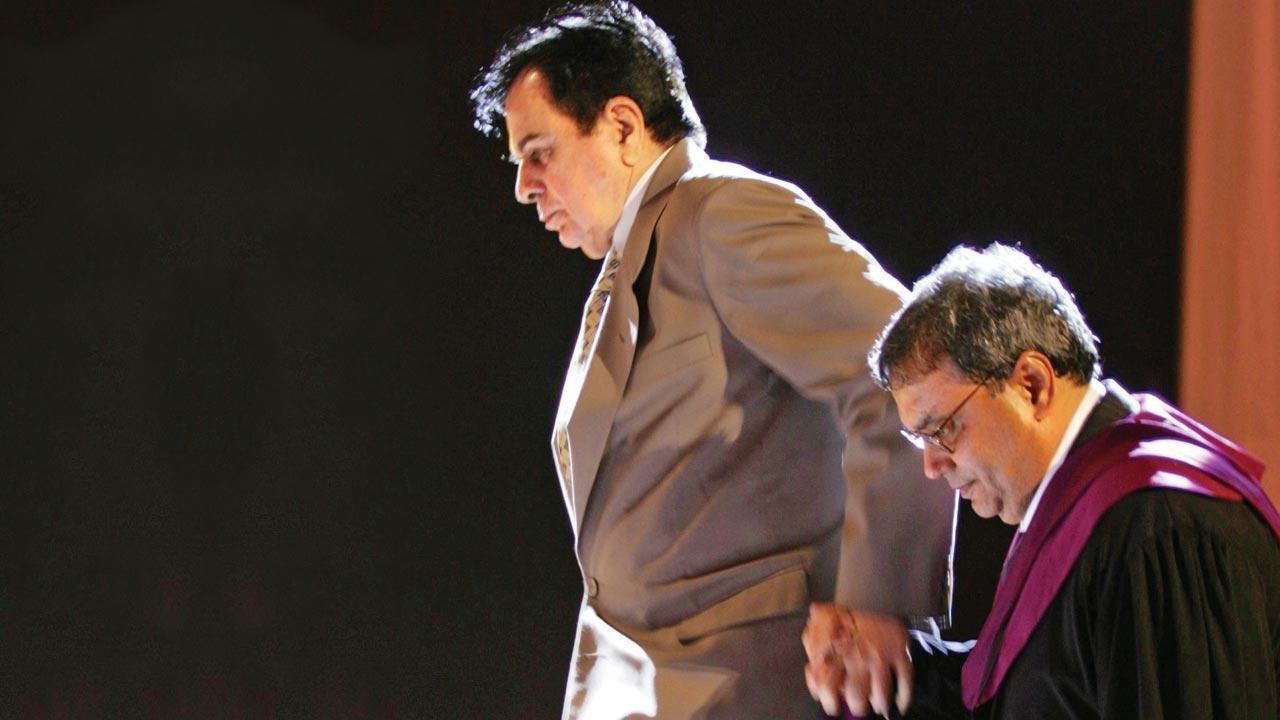
Subhash Ghai on his 40-year association with Dilip Kumar
As told to Upala KBR (MID-DAY; July 8, 2021)
My association with Dilip saab goes back 40 years. My first narration to him was for the film Vidhaata [1982], but he didn’t hear the story, instead he started talking to me as a friend and asked about my previous film Krodhi [1981]. I kept wondering why he was asking me. He loved the story [of Krodhi] and immediately said, ‘Yes, you think well and understand cinema, so we will do the film’. I rewrote the script because I had a responsibility towards him and wanted to live up to his expectations. He reheard the script of Vidhaata after six months.
One of my favourite memories of Dilip saab was during the filming of Vidhaata in Goa. The car designated to pick him up from the airport and drop him off at the shoot location, didn’t reach on time. He boarded a taxi, found the location and came alone. I was so embarrassed, so was the unit. I immediately went to him and began apologizing. He smiled and said, ‘Don’t worry. These are production hassles. If technicians suffer, artistes suffer too. You focus on getting a better shot for the movie’.
As an actor, he had a unique style and manner, which made him a great artiste. Dilip saab delivered dialogues from his heart. In every take, his words would [slightly] differ, but he would convey the required emotions [accurately] in every scene. Whenever we met socially or for dinner, he would ask me to narrate a story more than five times. Without commenting on [the characters], he would tell me, ‘You are working. Good. Just carry on working’. And I’d understand that I had to work more on his characterization. During the shoot, he would always know more about the story and character than me.
Among all my films with him, my favourites include — Vidhaata, Karma [1986] and Saudagar [1991]. He was always concerned about giving equal importance to the other characters. He’d say that it is always the story and characters that work in movies and not Dilip Kumar. [In fact], during Vidhaata, he would often ask me if I had done something to groom Shammi Kapoor’s character. He [even] asked me to work more on Raaj Kumar’s role in Saudagar. I realised [much later] what he meant — the story and characters matter, not the star.
I'm going to give singing a shot-Anil Kapoor
7:50 AM

Anil Kapoor on plans to do his own playback and being a proud papa
Sanyukta Iyer (MUMBAI MIRROR; September 13, 2017)
When Subhash Ghai was filming his 1986 action-drama, Karma, he came up with the idea of making his hero, Anil Kapoor, sing alongside Poonam Dhillon. “I began recording but it sounded horrible. So, I asked Subhashji to get the country’s best singer to croon instead and we got Kishore Kumar,” Anil reminisces.
Now, almost three decades later, director Atul Manjrekar is keen that Anil records two songs for his upcoming musical-drama Fanney Khan. “I am going to give singing my best shot. My character is a failed singer and I have two songs to sing. But I will be the first to reject them if my voice is not up to the mark. The makers want the film to be as real as possible, which is why they want me to sing.” Anil adds that he used to learn semi-classical music, but stopped a while ago. Now, he promises to resume riyaaz every morning for his prep.
The official Hindi remake of the Oscar-nominated Dutch film, Everybody’s Famous!, Fanney Khan produced by Rakeysh Omprakash Mehra, also features Aishwarya Rai Bachchan and Rajkummar Rao. “Around five years ago, Rakeysh pitched the story to me and his friend Rohit Khattar made me watch the original. I loved it! We’ve wrapped up a chunk of it and I resume shooting today. We will be done by October,” Anil reveals.
In the film, he sports two looks — a young and budding singer in a glam avatar and the father of an 18-year-old girl working in a small company. “The real reveal in the look will comes later,” Anil says, adding that the silver in his hair is the result of the struggles and hardships his character has been through.
Earlier this week, Anil took off to London to attend the wedding of his close friend’s daughter, fashionista and millionaire heiress, Anooshe Mussarat, who tied the knot with bizman Edmund Kissner. At the wedding, Anil shook a leg with daughter Sonam, but Rhea stayed back in Delhi to oversee the production of her next, the Shashanka Ghosh-directed Veere Di Wedding. “Anooshe is like my daughter and I had scheduled four days off well in advance. Interestingly, Rhea kicked off her film on September 1 and I began Fanney Khan two days later. Right now, her shoot is on in full swing. Veere’s a fun, girl-film, a total entertainer,” the doting dad promises. Prod Anil further on how much of a say he had in his daughters’ professional lives and he says, “This film is their baby! Rhea, Sonam, Shashanka, Kareena (Kapoor), Swara (Bhaskar) and the whole team put everything together. Rhea’s got a studio on board and rolled with film. I am just a proud father.”
Check out Shakti Kapoor as a very old man in Rupesh Kaul's Karma
7:42 AM

MUMBAI MIRROR (July 22, 2017)
While his kids, Shraddha and Siddhanth, are busy promoting their film, Haseena Parkar: Queen of Mumbai, Shakti Kapoor has kicked off a new film titled Karma. It will see the 58-year-old actor in a pivotal role and is directed by Rupesh Kaul.
The film is being made primarily for the festival circuit and Shakti is excited to play a role of an elderly man for which he will go completely makeup-free.
Dilip Kumar told Subhash Ghai about me, You have got a dangerous actor-Anupam Kher
7:33 AM

Roshmila Bhattacharya (MUMBAI MIRROR; December 15, 2015)
Anupam Kher had gone to a
suburban five-star hotel for a party and bumped into Subhash Ghai in the
lobby. The actor, who had wowed with his nuanced performance in
Saaransh and had bagged Aakhree Raasta with the Big B, walked up to the
filmmaker and told him he really wanted to work with him. He was told to
drop by at the office the next day where Ghai surprised him by offering
him the role of the lead villain in his upcoming film, Karma. Much later
he was informed that it was his purposeful, relaxed, confident walk
that had landed him the much-coveted character of Dr Dang, the
mastermind of a terrorist organisation who becomes the nemesis of Rana
Vishwa Pratap Singh after he breaks out of his jail, slaughters his
family and leaves him with a lifelong grudge which translates into a
covert mission to kill him. The patriotic Singh also known as Dada
Thakur was being played by Dilip Kumar, Anupam's idol.
Karma was the biggest film being made at the time and took off with a grand mahurat at Mehboob Studio. Even though the leading ladies, Sridevi and Poonam Dhillon were present, the first shot was canned on the five men--Dilip Kumar, Naseeruddin Shah, Anil Kapoor, Jackie Shroff and Anupam Kher. And after that, even Anupam's buddy Satish Kaushik, who would earlier joke that Kher would never become a star, had to admit that it was time to join him because he was now up there with the best.
“I'd been shooting with Rahul Rawail all night. We wrapped up at 5 am and I drove straight to Essel Studio for the first day's shoot of Karma without having slept a wink only to learn that my first shot was with Dilip saab. It was a 100-feet shot with me having to speak all the lines and him reacting to me. I asked Subhashji if we couldn't start with something shorter and he just gave me a dirty look,“ Anupam recalls.
The thespian walked in around 11 am, without bodyguards, hangers-on, or even his manager. But just his larger-than-life presence was enough to hush up the 200-odd people on the sets. Anupam walked up to him confidently and shook his hand even though they had met only once before when he had gate-crashed a party. Dilip Kumar, perhaps thinking he was a person he knew well but couldn't recognise, met him warmly and told him, “Bahut din ke baad dikhaye diye, where have you been?“ The younger actor was amused and mesmerised and for the next half hour, simply gazing at his idol, whose performances in films like Gunga Jumna, Madhumati and Ram Aur Shyam he had grown up admiring. “I ran away from school to watch Gopi,“ he laughs. After a while, Ghai took him aside and told him that with that devotional expression on his face, he would never be able to bring on camera the menace of Dr Dang. Anupam assured him he would pull it off. They only started shooting after lunch, around 3 pm and the first shot was okayed in one take. Dilip Kumar told Ghai, “Subhash, you have got yourself a dangerous actor.“ He then turned to Anupam and predicted, “You will go far.“ For his younger colleague, it was the ultimate certificate of approval from the master himself and he was even prepared to be slapped by him for real when they shot what was one of the turning points in the film. His idol quipped, “Beta, Pathan ka haath hai.“
They spent a lot of time between shots talking about everything, from cinema to Kashmiri cuisine, from flowers and fruits to politics. By the time they reached the climax Anupam was sure Dilip Kumar had grown fond of him though he treated everyone with equal warmth. For Anupam, he was an actor unlike any from his generation or after, thanks to his larger-than-life persona. On Sunday, when Dilip Kumar was honoured with the second highest civilian award in the country, the Padma Vibhushan, among the many things Anupam recalled, was him saying, smilingly, “Tum bahut shararati ho...“
Karma was the biggest film being made at the time and took off with a grand mahurat at Mehboob Studio. Even though the leading ladies, Sridevi and Poonam Dhillon were present, the first shot was canned on the five men--Dilip Kumar, Naseeruddin Shah, Anil Kapoor, Jackie Shroff and Anupam Kher. And after that, even Anupam's buddy Satish Kaushik, who would earlier joke that Kher would never become a star, had to admit that it was time to join him because he was now up there with the best.
“I'd been shooting with Rahul Rawail all night. We wrapped up at 5 am and I drove straight to Essel Studio for the first day's shoot of Karma without having slept a wink only to learn that my first shot was with Dilip saab. It was a 100-feet shot with me having to speak all the lines and him reacting to me. I asked Subhashji if we couldn't start with something shorter and he just gave me a dirty look,“ Anupam recalls.
The thespian walked in around 11 am, without bodyguards, hangers-on, or even his manager. But just his larger-than-life presence was enough to hush up the 200-odd people on the sets. Anupam walked up to him confidently and shook his hand even though they had met only once before when he had gate-crashed a party. Dilip Kumar, perhaps thinking he was a person he knew well but couldn't recognise, met him warmly and told him, “Bahut din ke baad dikhaye diye, where have you been?“ The younger actor was amused and mesmerised and for the next half hour, simply gazing at his idol, whose performances in films like Gunga Jumna, Madhumati and Ram Aur Shyam he had grown up admiring. “I ran away from school to watch Gopi,“ he laughs. After a while, Ghai took him aside and told him that with that devotional expression on his face, he would never be able to bring on camera the menace of Dr Dang. Anupam assured him he would pull it off. They only started shooting after lunch, around 3 pm and the first shot was okayed in one take. Dilip Kumar told Ghai, “Subhash, you have got yourself a dangerous actor.“ He then turned to Anupam and predicted, “You will go far.“ For his younger colleague, it was the ultimate certificate of approval from the master himself and he was even prepared to be slapped by him for real when they shot what was one of the turning points in the film. His idol quipped, “Beta, Pathan ka haath hai.“
They spent a lot of time between shots talking about everything, from cinema to Kashmiri cuisine, from flowers and fruits to politics. By the time they reached the climax Anupam was sure Dilip Kumar had grown fond of him though he treated everyone with equal warmth. For Anupam, he was an actor unlike any from his generation or after, thanks to his larger-than-life persona. On Sunday, when Dilip Kumar was honoured with the second highest civilian award in the country, the Padma Vibhushan, among the many things Anupam recalled, was him saying, smilingly, “Tum bahut shararati ho...“
Subscribe to:
Posts (Atom)