Showing posts with label Karan Taurani. Show all posts
Showing posts with label Karan Taurani. Show all posts
PVR Inox plans a new script beyond the big screen
10:23 AM

Group is reshaping its cinemas as ‘social hubs’ amid weak footfalls, said a senior executive
Javed Farooqui (THE ECONOMIC TIMES; April 29, 2025)
PVR Inox is reimagining its upcoming cinemas as multi-purpose social hubs, even as movie watching remains central to its offering, a senior company executive said.
This shift comes in response to declining footfalls, attributed to a lack of strong film content, and lacklustre financial performance.
Pramod Arora, CEO – Growth & Investment at PVR Inox, said the company is integrating cafés, co-working spaces and live entertainment into its theatres.
PVR Inox reported revenue of Rs 4,642.4 crore for the nine months ended December 2024, down from Rs 4,958.2 crore in the same period of the previous year. It posted a net loss of Rs 155.6 crore for the first nine months of the last fiscal year compared with a net profit of Rs 97 crore a year earlier.
On Monday, its share closed 0.5% higher at Rs 982.65 on the BSE, compared with the 52-week high of Rs 1,748.25.
Arora said the goal is to create venues where people can socialize, work, dine and relax — even without watching a movie — to maximize the utilization of cinema properties.
Additionally, the company is expanding aggressively into tier-2 and -3 cities under a FOCO (franchisee-owned, company-operated) asset-light model. It currently operates 1,734 screens across 351 properties in 110 cities in India and Sri Lanka.
The asset light model has helped the company reduce its net debt, which has declined by almost Rs 300 crore in 9M FY25 to Rs 996 crore.
Under this approach, the capital expenditure is fully or partly funded by developers, while PVR Inox handles operations and management. As of December 2024, it had signed 220 screens across 22 cinemas under this model.
Arora also noted strong interest from real estate-focused investors in this model, although he did not name them. "They're all coming forward to convert cinema properties into more social, amenable, and communal spaces," he said.
"PVR Inox has been attempting to de-risk its operations through the capital light model. However, a key challenge is that large developers are unlikely to agree to this arrangement, as their core business revolves around building malls and leasing space," said Elara Capital senior vice-president Karan Taurani.
“Smaller developers, on the other hand, may be more open to the FOCO model, leveraging PVR Inox’s strong marketing clout.”
Multiplexes continue to grapple with declining footfalls, driven largely by the persistent lack of compelling Hindi film content, he said.
According to a FICCI-EY report, India’s total screen count grew 2% to 9,927 screens in 2024, though screen density remains significantly lower than in markets like the US and China. The report highlighted that only 6% of India's population visits a cinema hall annually, with many opting for lower-cost alternatives like OTT platforms and television.
Meanwhile, cinema admissions in India fell by about 5%, from 900 million in 2023 to just over 857 million in 2024, even as the average ticket price rose from Rs 130 to Rs 134, the report said.
Pushpa blooms again, but takings for 2024 wilt a bit
8:05 AM

BO collections down 3% on waning crowds, dependence on higher ticket price, big grossers
Javed Farooqui (THE ECONOMIC TIMES; January 12, 2025)
Mumbai: Indian cinema’s box office receipts totalled Rs. 11,833 crore in 2024, marking the second-highest collection after hitting a record in the previous year, according to Ormax Media's annual box office report.
Box office receipts declined 3.21% from Rs. 12,226 crore in 2023, while footfall fell a steeper 6% year-on-year to 883 million, well below the pre-pandemic peak footfall of over 1 billion recorded in 2019, indicating increased dependence on average ticket price (ATP), which went up 3% to reach a historic high of Rs. 134.
Kannada and Telugu films saw ATP hikes owing to government cess and premium pricing, while Hollywood and Hindi films recorded the highest ATP of Rs. 245 and Rs. 203, respectively.
Sanket Kulkarni, head of business development (theatrical) at Ormax, saw the trend of relying on higher ticket prices rather than increased footfall to drive box office revenue continuing, signalling that cinema-going is increasingly becoming an event-driven activity, rather than a habit, especially in the case of Hindi films.
“Release schedule optimization, better supply of films, understanding the changing taste of the audiences and strategic utilization of franchises would be key for maximizing box office collections in 2025,” he said.
Hindi cinema faced a tough year, with collections falling 13% year-on-year to Rs. 4,679 crore, reducing its share by four percentage points to 40%. Despite hits such as Pushpa 2: The Rule (Hindi) and Stree 2, only six original Hindi films crossed receipts of Rs. 100 crore each, compared to 16 in 2023.
Shift in Audience Preferences
Notably, 31% of Hindi cinema’s revenue came from dubbed south Indian films, and collection from original Hindi films fell 37% on-year. Footfall declined 16% to 230 million, significantly below the pre-pandemic levels of more than 300 million. Experts said that despite declining footfall, Indian cinema showed resilience in 2024, with revenue driven largely by a few blockbusters. They highlighted significant growth in regional cinema, suggesting a shift in audience preferences, even as they cautioned that sustaining engagement would remain a key challenge.
“Though there has been a decline in terms of footfall, 2024 has been a year of tentpole movies and amongst them, Pushpa 2 turned out to be the biggest, holding the pole position of the highest grosser in Indian cinema, beating Bahubali 2's record by collecting Rs 1,200-plus crore,” said Nitin Menon, managing partner of NV Capital.
“Though the overall box office collection is similar to 2023’s, the worry is footfall, which is below pre-pandemic levels. High ticket prices, shorter OTT (over-the-top) windows and a lack of good content continue to be large factors in the dipping occupancy levels.”
Karan Taurani, senior vice-president at Elara Capital, said regional film markets continued to thrive, while the Hindi film industry faced challenges. “I wouldn’t be surprised if box office collection drops by 20% in 2025, especially if Hollywood films underperform. The decline in footfall has become a persistent issue and rising average ticket prices are insufficient to offset the losses,” he said.
Regional Touch
Malayalam cinema had its best year yet, with box office revenue surging 104% from the previous year to Rs 1,165 crore, doubling its share to 10%. Footfall increased 88% to 12.6 crore, driven by hits such as Manjummel Boys and Aavesham, which performed well even outside Kerala. Telugu cinema set a record with Rs 2,348 crore in box office revenue, up 4% from the year ago, though footfall dropped 12% to 213 million. This marked the third consecutive year that Telugu cinema exceeded Rs 2,000 crore, led by Pushpa 2 and Kalki 2898 AD.
Cinema houses, OTTs wary as Karnataka govt levies 2% cess
7:56 AM

Javed Farooqui (THE ECONOMIC TIMES; July 23, 2024)
The Karnataka government's decision to levy a 2% cess on movie tickets and over-the-top (OTT) subscriptions will lead to an additional burden on cinema chains and OTT platforms, who will pass on the price increase to consumers.
Industry experts, though, say that the price increase will be marginal and the revenue generation for the state government will be miniscule. As per industry estimates, the state government can expect Rs. 60 crore in incremental revenue from the levying of the 2% cess.
While the stated objective of the state government behind levying the cess is the welfare of film artists and cultural activists, experts note that effective implementation will be key to achieving this objective.
According to Elara Capital SVP Karan Taurani, Karnataka would be contributing an estimated 15% to the national box office collections of Rs. 10-12,000 crore annually. In terms of OTT subscriptions, the state's estimated share of the Rs. 10,000 crore subscription OTT market would be 10%.
"The 2% cess will lead to a positive impact of Rs. 60 crore for the Karnataka government. It's a mild negative for both the box office and OTT subscription businesses," he stated.
He noted that OTT platforms, which are already raking in heavy losses, will have a small negative impact on their plans to scale up. Similarly, cinema chains will be compelled to hike ticket prices even as footfalls are 20-30% lower compared to pre-covid levels.
Chandrasekar Mantha, Partner, Media and Entertainment Sector Leader, Deloitte India, said the proposed 2% cess on movie tickets and OTT platforms will likely be passed on to consumers.
"The movie industry in Karnataka currently pays an entertainment tax of 30%, and the additional cess may slightly increase ticket prices. Similarly, OTT platforms will need to comply with the 2% cess based on their subscription numbers for the state," he stated.
Kalki 2898 AD brings Indian box office back to life; expected to collect Rs. 900 crore worldwide
8:17 AM

Javed Farooqui (THE ECONOMIC TIMES; July 2, 2024)
The Telugu epic sci-fi film Kalki 2898 AD has buoyed the Indian film box office market by garnering over Rs 350 crore in domestic and over Rs 500 crore in global box office collections including India.
According to film trade website Sacnilk, the film grossed Rs 369 crore domestically and Rs 146 crore from overseas markets in the first four days since its release on June 27.
The film, which draws inspiration from Hindu mythology and features Amitabh Bachchan, Kamal Haasan, Prabhas, Deepika Padukone, and Disha Patani, is the first major blockbuster hit of 2024 in an otherwise underwhelming first half due to a lack of big releases.
As per Ormax Media, the cumulative domestic box office collection stood at Rs 3,791 crore between January and May, with Fighter and Hanu-Man being the only films to gross over Rs 200 crore at the box office.
Experts believe that Kalki has done well across segments and markets due to its star power, strong content, and high-quality production value.
"Kalki is doing well not just in metros but also in non-metros. The film has a healthy mix of star power and content. The production quality and the VFX are also very good," said film trade analyst Taran Adarsh.
While concurring with Adarsh, Elara Capital SVP Karan Taurani said the film could collect box office collections of up to Rs 700 crore domestically and up to Rs 900 crore worldwide.
Cinepolis India MD Devang Sampat said the footfalls of cinema, though 15% below the pre-pandemic level, will remain at the same level in 2024 and 2023.
"The footfalls in the first half have remained at the same level as in 2023. In the second half, films like Kalki, Pushpa 2, and Singham Again are expected to drive footfalls," he noted.
According to Ormax, the total cinema footfalls stood at 943 million in 2023, compared to 1.03 billion in 2019.
Miraj Entertainment MD Amit Sharma said Kalki is the second biggest Telugu film opening ever after Baahubali 2. "Kalki is undoubtedly a pan-India film, considering its diverse cast from the Hindi, Telugu, Malayalam, and Tamil film industries. The movie has done fantastic business overall."
Experts note that the second half of the year will see a rebound of the box office after a lull in the first half due to the Indian Premier League (IPL), the ICC Men's T20 World Cup, and the general elections.
"The content line-up looks promising across both Indian and Hollywood films. We have strong franchise-based films like Pushpa 2 - The Rule and Singham Again. There are other mid-budget movies that could do well," Taurani added.
Adarsh said it's difficult to predict the box office numbers for the second half due to the volatile nature of the film and exhibition industries.
"With upcoming releases like Sarfira, Indian 2, Bad Newz, and Deadpool & Wolverine in July, the box office numbers should remain strong, similar to the performance we saw last year in August," said Miraj Entertainment’s Sharma.
PVR Inox’s fortunes may ride on spectacle films, starting with Kalki 2898 AD
8:02 AM

Rajesh Naidu (THE ECONOMIC TIMES; June 27, 2024)
Will the dystopian, multi-starrer, big budget film Kalki 2898 AD lift the fortunes of exhibitors?
Since the release of the first trailer of the movie on June 11, the stock of PVR Inox has gained nearly 8% reflecting expectations of high collections in the coming weeks. This gain follows a relatively dull spell for the company amid poor performance of some of the big budget movies and lack of any major Hollywood releases in the first half of 2024. The stock has lost 12.5% so far this year.
The Rs 600 crore mega budget movie produced by C. Aswani Dutt under Vyjayanthi Movies banner and starring Amitabh Bachchan, Kamal Haasan, Prabhas, and Deepika Padukone has attracted an advance booking of over 1.3 million tickets across languages including Hindi, Tamil, Telugu and Malayalam before its release on June 27.
Trade analysts say that given the genre of the film, ticket prices for 3D and non-3D shows are in the range of Rs 350-2,000. Also, according to them, it has become the first Indian film to surpass US$2.6 million worth of advance booking in the US. Karan Taurani, senior vice-president at Elara Capital, expects the film to record Rs 120 crore at the domestic box office and Rs 175 crore internationally on the opening day.
In addition, upcoming Hollywood spectacle films such as Deadpool & Wolverine, Transformers One, Borderlands. And Alien: Romulus are likely to provide strong revenue for PVR Inox in the coming quarters. At present, PVR Inox has a share of 50-70% in the Hollywood box office collection in the country, 30-40% share in Hindi movie collection and 10-25% in the case of regional movies.
Given its leadership position with 1,760 screens, future releases are likely to result in higher footfalls, food and beverages income, box office and advertising revenue for PVR Inox in the coming quarter.
Jio Cinema may disrupt SVOD market with low pricing plan
7:42 AM

Javed Farooqui (THE ECONOMIC TIMES; April 25, 2024)
Viacom18-owned Jio Cinema is set to disrupt India’s subscription video-on-demand (SVOD) market with one of the industry's lowest pricing plans for premium content.
Beginning April 25, Jio Cinema Premium will offer Indian and Hollywood entertainment content at an introductory tariff of Rs 29/month for a single device and Rs 89/month for up to four devices, the company said. This comes close on the heels of the success of its free strategy in the advertising VOD space.
Live sports and catch-up broadcast content will continue to be available for free, the company said, adding that Jio Cinema, like other broadcast-owned OTT (over-the-top) platforms, will use a hybrid monetization strategy.
The new pricing is a significant drop from its Rs 999/year and Rs 99/month plans, which offered only Hollywood content. Unlike the existing plans, the new plans will be ad-free, the company said.
Jio Cinema Premium will provide users with web originals, movies and content for children, along with Hollywood content from HBO, NBCUniversal and Paramount Global. Viacom18's linear TV content will also be made available before the broadcast premiere.
The company’s new tariff plan will hot up competition with Disney+ Hotstar, Netflix and Prime Video, which collectively have 50–60 million subscribers.
"The new pricing is a sharp reduction for an ad-free experience. They are providing more content over and above the Hollywood content and charging less for this," said Elara Capital’s senior vice president Karan Taurani.
He said Jio Cinema Premium will impact the SVOD industry negatively since the Indian Premier League (IPL), the most premium media property, continues to remain outside the paywall.
"The SVOD players will not be able to increase average revenue per user due to Jio Cinema's aggressive pricing," he said.
Experts say the move marks Jio Cinema's pivot towards a hybrid monetization model, and the ongoing IPL cricket tournament provides the perfect launch pad for it to implement its new pricing.
Viacom18’s CEO-Digital Kiran Mani said Jio Cinema Premium's goal is to redefine premium entertainment for Indians. “The introduction of Jio Cinema Premium breaks the numerous cost and quality barriers that exist in accessing premium entertainment," he said.
In a recent note, Taurani had said that Jio Cinema’s revenue for FY24 is estimated at Rs 2,700 crore, based on Network18's financials for the last financial year.
Jio Cinema has been offering premium Indian content across entertainment and sports channels for free. The platform has built a strong advertising business on the back of free streaming of impact properties like IPL and Bigg Boss.
Jio Cinema's free sports streaming has had a cascading effect on the industry, with OTT market leader Disney+ Hotstar also offering the Asia Cup, 2023 ICC Men's World Cup, and Pro Kabaddi League for free to mobile users.
Barring Netflix and Prime Video, most of the large OTT players, including Disney+ Hotstar, ZEE5 and Sony LIV, have a hybrid monetization model.
In September 2022, the Competition Commission of India (CCI) approved the amalgamation of Jio Cinema, which was owned by a Reliance Industries subsidiary, into Viacom18.
Viacom18 is in the process of merging with Walt Disney-owned Star India to create a $8.5-billion media behemoth. The merged entity will have Jio Cinema and Disney+ Hotstar, two of the strongest OTT apps in the country.
Not BOGO, Free Tickets, loyalty schemes but content behind blockbuster theatre footfall
2:30 PM

Such offers work for certain section of audience and provide limited incremental benefits: Experts
Rajesh Naidu (THE ECONOMIC TIMES; April 9, 2024)
ET Intelligence Group: At a time when upcoming elections and ongoing Indian Premier League (IPL) dominate public discourse and mindshare, multiplexes have roped in banks to lure audiences to theatres. As many as 78 credit cards of various banks have rolled out attractive offers on movie tickets such as buy one get one (BOGO) free ticket, discount up to a certain ticket price, providing a fixed number of free tickets in a month, cash back on tickets, or pre-paid cards that offer tickets at cheap rates on weekdays.
So, are these offers boosting footfalls in theatres?
Sector experts are of the view that such strategies provide limited incremental benefits. Any significant improvement in footfalls and food and beverages (F&B) sales will depend on the popularity of the film, they said. "Loyalty programmes can work for a certain section of audience and fill up shows on weekdays where occupancy rates are typically lower," said Ashish Pherwani, leader, media and entertainment sector, at EY. "But the content must resonate with audiences. Only then will these initiatives provide incremental benefits."
He said, "BOGO free ticket offers help improve occupancy as well as increase food and beverage revenues. But it can be used only for certain films or time bands."
Karan Taurani, senior vice-president at Elara Capital, said BOGO offer is likely to contribute 12-13% to total revenues generated by Hindi films. "But audiences avail these offers only if the content is good in theatres," he said.
"A few mid-budget films have worked in the March 2024 quarter. This is perhaps the first time when a few films have worked in a quarter and offers on tickets have added to footfalls," Taurani said.
According to analysts' estimates, loyalty programmes and other offers on tickets boost occupancy in theatres on weekdays by 16-20%.
Multiplexes bet big on Adipurush after dull fourth quarter
8:28 AM

Javed Farooqui (THE ECONOMIC TIMES; June 16, 2023)
Cinema exhibitors are betting big on actor Prabhas’ epic mythological film ‘Adipurush’ to bring back footfalls after a challenging fourth quarter that witnessed a drop in footfalls due to the underwhelming performances of films barring ‘Pathaan’ and ‘Avatar: The Way of Water’.
PVR Inox Co-CEO Gautam Dutta said the multiplex chain has received a stupendous response to the pre-bookings of ‘Adipurush’. “The advance bookings for the first day of the release have been doubling with each passing day after we clocked over 1.50 lakh admissions yesterday,” Dutta said.
He said the film is truly a made-for-the-big-screen experience that would appeal to all age groups. “We are witnessing maximum bookings for the Telugu version after Hindi. While senior citizens would prefer to watch this movie due to its mythological angle, children would show interest due to VFX,” Dutta noted.
Made at an estimated budget of Rs 500 crore, the multilingual film released today in Hindi, Tamil, Telugu, Malayalam, and Kannada across 5,000 screens in India.
BookMyShow COO Ashish Saksena said the advance sales for the film crossed 1.5 million tickets on the platform. "While the Telugu version is naturally leading the charts on the platform in terms of ticket sales, Hindi is a close second. The 3D format is the most preferred format of watching the film on the big screen with over 72% of movie-goers opting for the immersive movie-watching experience," he stated.
Elara Securities SVP Karan Taurani said Adipurush will come as a respite for cinema exhibitors who have been facing dwindling occupancy levels, which are still below pre-pandemic levels. He noted that The Kerala Story has been the only silver lining for the industry.
"We expect a strong opening day in South India, as net box office opening there could be in the range of Rs 50–60 crore for dubbed languages, whereas Hindi too would be healthy at Rs 20 crore. In terms of lifetime domestic box office, we expect a net box office collection of Rs 350 crore to Rs 400 crore," he added.
Junglee Pictures CEO Amrita Pandey said June has always been a phenomenal release period over the years for youth and family movies. "We are now looking forward to the June and July theatrical releases performing well at the box office. The theatrical admissions for Zara Hatke Zara Bachke have been extremely encouraging for the industry."
Film business expert Girish Johar expects Adipurush to generate high footfalls across languages since this is the first major tentpole film that will be released after Pathaan.
"Another factor going in the film's favour is the fact that this is the holiday season for school kids. The story is deeply rooted in Indian culture, so it will attract family audiences," he said.
Johar also stated that the audience's preference for watching the kind of movies in theatres has totally changed. "Audiences are willing to watch content-driven films in theatres." They are not bothered about the genre or the cast of the film."
Dutta said that the recent trend of multilingual content being popular among pan-India audiences is holding true. "We would continue to see more of such movies doing well on the national scene," he noted.
According to a GroupM-Ormax Media report, the gross box-office collection stood at Rs 10,637 crore in 2022.
OTTs may not bankroll films with a poor box office show
10:23 AM

Premiums charged for rights may fall as streaming platforms looking to reduce costs want to gauge commercial merit first
Rajesh Naidu (THE ECONOMIC TIMES; May 11, 2023)
The share of digital streaming platforms in the total revenue generated by films is on the rise amid the expanding presence of such platforms. However, according to analysts, this trend may not continue in future as streaming platforms realign their budgets to improve the profitability of their operations.
The proportion of the revenue generated through the sale of digital rights in total revenue of films increased to around 21% in 2022 from nearly 10% in 2019. On the other hand, the share of revenue through the sale of television broadcast rights fell to 5. 8% in 2022 from over 11% in 2019.
Due to the rising usage of over-the-top (OTT) platforms, production houses were able to compensate to a great extent for poor box-office revenue by increasing revenue from the sale of digital rights.
Karan Taurani, senior vice president at Elara Capital noted in a report that major studios and production houses which released films of big stars demanded high premiums on the sale of digital and OTT rights to streaming platforms. This premium increased the total revenue from films.
However, in the coming months, analysts believe that the premium on the sale of digital and streaming rights may come down. According to Taurani, only quality films may get a premium on the sale of digital and OTT rights as streaming platforms plan to cut down costs by close to 30%. Such platforms are also asking producers to release films in cinemas first to gauge their commercial merit before allocating budgets.
End of HBO deal may take some shine off Disney+ Hotstar
8:08 AM

Platform lost 3.8m users after losing IPL rights, non-renewal of Jio deal
Javed Farooqui (THE ECONOMIC TIMES; March 9, 2023)
Mumbai: Disney+ Hotstar will no longer be the default destination for HBO content in India beginning March 31 following non-renewal of the deal, potentially leading to higher subscriber churn for the OTT platform that also lost out on the digital rights to the Indian Premier League (IPL) — the richest tournament in the sport.
Disney+ Hotstar has been the home of HBO content ever since the two companies signed an exclusive pact in 2015. As of December 2022, the platform had 57.50 million paid subscribers.
In the October-December quarter, the platform had lost 3.80 million subscribers after losing IPL rights and the non-renewal of content deal with telecom giant Reliance Jio.
“Starting March 31, HBO content will be unavailable on Disney+ Hotstar. You can continue enjoying Disney+Hotstar’s vast library of content spanning over 100,000 hours of TV shows and movies in 10 languages and coverage of major global sporting events," the platform said in a message on its official social media handle.
Experts say that Disney+ Hotstar will find it tough to add new users in the coming quarters. “The absence of IPL, the termination of its partnership with Jio, constrained entertainment budgets, and the recent discontinuation of HBO content on the platform — all of these factors will significantly diminish the value proposition for subscribers, a considerable number of whom are slated for renewal in the upcoming months,” said Mihir Shah, VP, Media Partners Asia.
He added that the platform might lose a large number of subscribers by the end of 2023, notwithstanding the presence of the ICC Cricket World Cup later in the year.
“Despite some promising content lined up for the second half of the year, such as the Asia Cup and the ICC fifty-over World Cup, Disney+ Hotstar is currently facing a slippery slope, with the potential loss of close to 15 million subscribers by the end of 2023,” he said.
Elara Capital, research analyst (media, consumer discretionary & internet), Karan Taurani believes that the loss of IPL and HBO content will make it challenging for the platform to retain subscribers. “We expect the negative impact of IPL loss on the subscriber base to be in the 25-30% on a gross basis and the net impact to be 15-20% in case they added up subscribers because of other content,” Taurani said.
National Cinema Day, blockbusters run of films prove that appetite to watch films in cinemas is still very much there
8:19 AM

From the first lockdown in March 2020 to the first half of 2022, whether moviegoers will return to cinemas like in pre-pandemic years remained a big question. But India’s first ever National Cinema Day, coupled with quite a few blockbusters, proved that the appetite to watch films in cinemas is still very much there
BOMBAY TIMES (December 24, 2022)
Sitting in a darkened cinema hall with friends and family, popcorn in hand, enjoying the latest releases – an activity we all took for granted became a distant memory during the two years of Coronavirus. Overnight, the century-old pastime became a safety hazard.
In 2022, when it was finally safe to go to cinemas and there was a slew of releases, the box office saw more duds than hits. There was debate over whether cinemas are relevant in the post-pandemic world. Now, as we approach the end of 2022, with major Hollywood films having sold out opening weeks and south blockbusters raking in the moolah, box office analysts say there is enough evidence to show that the pandemic-induced phase of struggle is finally over.
Executives of pandemic-battered movie theaters say that after surviving this three-year battle, even though they do not have all the answers yet, one thing is certain: audiences are back to cinemas as you can’t bring halls home.
--------------------------------------------------------

Price drop on National Cinema Day a success
Niharika Lal (BOMBAY TIMES; December 24, 2022)
After theatres in the USA and the UK slashed ticket prices on their National Cinema Day on September 3, the Multiplex Association of India (MAI) and cinemas across the country decided to follow suit, by celebrating National Cinema Day in India on September 23 with tickets priced at 75 (a considerable drop from the average price of 200-300).
The move was a big success and moviegoers queued up at as early as 6am to watch films back-toback. Several cinema and trade experts – who had initially predicted that it seemed unlikely that theatres would recover from the blow delivered by the pandemic – were proven wrong when houseful boards went back up at cinemas. Over 65 lakh viewers flocked to cinemas that day.
National Cinema Day also started a discussion around experimentation with an affordable price model. Several theatres offered movie tickets for a special festive price of 100 for consecutive weeks.
Eventually, stakeholders came to the conclusion that while there can’t be “uniform lower ticket price”, discounts and promotional prices on a per-movie basis can be the way ahead.
--------------------------------------------------------

Advance bookings are back
Niharika Lal (BOMBAY TIMES; December 24, 2022)
The recently-released Avatar: The Way Of Water has recorded more advance ticket sales in India in its first week than any other Hollywood film this year, outpacing all other Hollywood record-holders of 2022. With the return in demand for advance bookings, cinemas have started selling tickets a week or 10 days in advance for select movies. Cine experts talk about what the comeback of this trend means.
Devang Sampat, CEO, Cinepolis, says, “It is the franchise films – like KGF and now Avatar – which see the most advance bookings, because the audience knows what to expect. In the case of RRR, fans of Baahubali flocked to theatres. When viewers know that they will get the value for money, they purchase tickets in advance.”
Karan Taurani, cinema analyst, adds, “The major factors that prompt a higher rate of advance bookings are positive word of mouth, large-scale content, festive releases or franchises for which there is anticipation.”
Sometimes, price can play a role too. For example, on National Cinema Day, cinemas across the country witnessed a huge spike in advance bookings because tickets were priced at 75.
Raj Bansal, exhibitor and industry expert, adds, “It indeed signals the recovery of the cinema business. I wouldn’t be surprised to see fans creating a new record as we clock the year. This trend is going to continue for the most-awaited releases of the coming year too.”
--------------------------------------------------------
Houseful boards – a relic of the past?
Niharika Lal (BOMBAY TIMES; December 24, 2022)
Queuing for cinema tickets and houseful shows seem like things from the past. Cinemas – used to 30-50% occupancy on normal pre-pandemic days – have discarded the houseful boards long back. Now, these boards can only be found lying in a forgotten corner of some single screen theatres, a reminder of a bygone era.
Yogesh Raizada, exhibitor, says, “Houseful shows are so rare now that when it happens it reminds us of the guzra zamana of moviegoing. Those days are long gone when you would see a houseful board outside cinema halls. Barring two or three films in a year, that too for a few specific shows, none of the shows are sold out now.”
Cinema experts say, “Ab na ticket ki maaraamaari hoti hai, na darwaaze tootte hain.”
Adds Girish Johar, cinema business analyst, “Houseful boards are not just boards, these are sentiments. And those emotions are now missing – a sign of relief for the cinema proprietor and disappointment for viewers who couldn’t get a ticket. Ab agar houseful board kahin dikh jaye toh photo click kar lena chahiye.”
Agrees Raj Bansal, cinema expert and exhibitor, “In the era of single-screen theatres, giant sold-out boards would be kept outside the screens to tell moviegoers that all tickets have been sold out. Ab shows kabhi sold out hi nahi hote. The audiences do not exactly come in droves anymore.”
Still in nascent stage, pay-per-view streaming model has huge potential
8:51 AM

Niharika Lal (BOMBAY TIMES; October 8, 2022)
Did you miss Tom Cruise’s Top Gun: Maverick or Brad Pitt’s Bullet Train in cinemas and now want to watch the film at home? Try TVOD – Transactional Video On Demand – also known as pay-per-view, as these recent releases are available on rent across multiple platforms. When cinemas were shut in the beginning of the pandemic, viewers shifted to video-on-demand services in increasing numbers, but as people return to cinemas, TVOD is still clicking with a section of viewers, who purchase both old and new films.
TVOD IS TAKING BABY STEPS IN INDIA
During Amazon Prime’s TVOD launch, Gaurav Gandhi from the platform said, “The TVOD movie rental service gives customers more choice in how they want to access and watch content. It enables them to pay per movie, instead of a flat monthly fee.”
Zee also experimented with models of pay-per-view releases with their hybridized release of Salman Khan-starrer Radhe on ZeePlex. Commenting on it, a Zee official had said then, “The pay-per-view format is meant to enable the audiences to make the choice as to where and when they want to consume the content that is available to them.”
The TVOD platform BookMyShow Stream was launched last year and Ashish Saksena, COO – Cinemas, BookMyShow, says, “TVOD has been amongst the most exciting spaces to be for content makers and studios alike, as the culture of ‘Pay for what you want to watch’ is fast gaining traction, rather than having multiple subscriptions. We have witnessed high interest and engagement across varied cross-sections of the audience for both rent and buy options.”
However, he adds, “The TVOD model is currently not being utilized fully by Indian-home-grown studios and content owners. As an emerging business model nationally, there is a strong case for the massive potential that the TVOD model holds.”
Other platforms offering pay-per-view are YouTube, ShemarooMe Box Office and Apple TV Plus.
‘CATERING TO NICHE, URBAN AUDIENCE CURRENTLY’
Sharing what works for the TVOD model, Girish Johar, producer and business analyst, says, “It’s a combination of a lot of things. An entire family can watch a movie for the price of one ticket, which is indeed quite reasonable, and plus they can watch it from the comfort of their home and when they want to. It also is somewhat like the VCR era when families would gather and watch a film together. Currently, it is urban-centric but has scope of growth.”
However, he adds, “In the US and European market, TVOD is very mature, but in India it is at a nascent stage. Radhe was TVOD release, but didn’t do well in terms of audience because the market is not that mature and also because Salman’s audience is not your TVOD audience. Our entertainment is still very different and TVOD doesn’t have to be a replacement but it can be one of the avenues. You see more mature content from Hollywood on TVOD because their market is more mature than in India. Over the years it may reach at that stage, but at present it is for a niche audience.”
Talking about the challenges, media and internet research analyst Karan Taurani was recently quoted as saying, “The TVOD market in India is very premature and the Indian audience would pay for a bouquet of services and variety of content, but refrain to pay on a transaction basis. Scalability of TVOD remains a big challenge as there is only a very niche audience. ”
‘WITH TVOD, YOU GET ACCESS TO NEW RELEASES AND CLASSICS’
Saurabh, a 27-year-old government employee, says, “There are many films which are not released in India or have limited shows so you miss those. For instance, I had seen French Dispatch on pay-per-view because it was not released in India. There are some films which have shows during the weekday, when officegoers can’t go, but with TVOD you can just purchase or rent the film online.”
Rashmi Ahuja, 31, who works in an ed-tech company, says, “Pay-per-view definitely gives you more options. Sometimes someone recommends a classic film, but it is not available anywhere. However, with TVOD, you can get access to these by paying just 100-200.”
WHAT IS THE PAY-PER-VIEW MODEL?
In pay-per-view (or Transactional Video On Demand), viewers have the choice to pay for only the content they want to watch. Instead of paying a flat fee for an OTT platform, people can only pay for the film or show they wish to watch. In SVOD (Subscription Video On Demand), the viewer gets access to the complete library of the OTT platform and there is no time limit to watch the content
available, while in TVOD, the audience has access to the film/show for a limited period of time.
Is Brahmastra a hit? Film industry stakeholders discuss different aspects of its business
8:47 AM
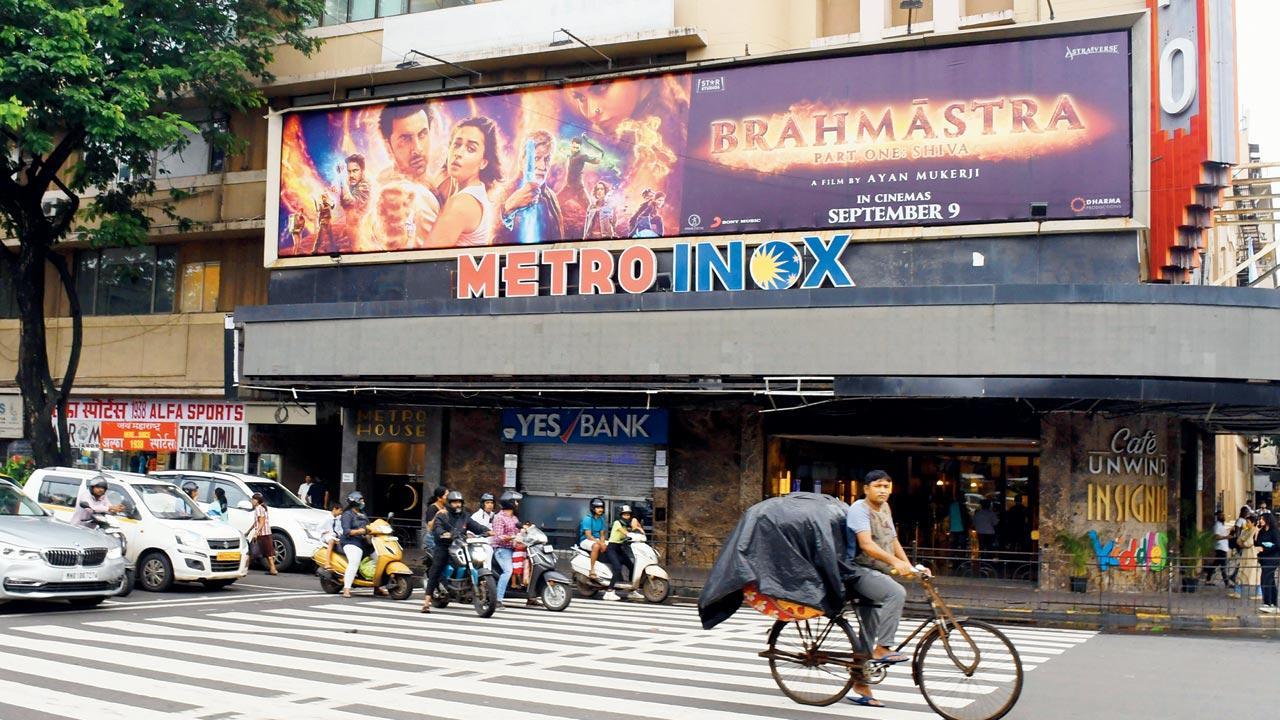
Why does Brahmastra’s proclaimed collection not match the scene in theatres? Is it inflated ticket prices or bravado, we ask stakeholders
Heena Khandelwal (MID-DAY; September 18, 2022)
It is important that Brahmastra: Part One–Shiva do well not only for the people directly associated with it, but for everyone in the Hindi film business. Film exhibitors and distributors pointed this out in mid-day’s report ‘Content is the problem, not #boycott calls’ (dated September 4, 2022). After Aamir Khan’s Laal Singh Chaddha and Akshay Kumar’s Raksha Bandhan’s lacklustre show at the box office, everyone was desperate to resuscitate Bollywood.
The Ayan Mukerji film saw the light of day after eight long years. Made at a budget of Rs. 410 crorse—a major chunk of which was spent on VFX—it opened to promising box office numbers, with a gross collection of Rs 300 crores worldwide in the first week, as pointed out by its producer Karan Johar.
But is the audience paying for this shot-in-the-arm? On Monday, a colleague bought a ticket for Rs 650 for a 2D show at a theatre in Malad; stubs for 3D versions in premium theatres crossed Rs 1,000. “Ticket prices have inflated,” says Kolkata-based film critic and trade analyst Sumit Kadel. “Producers have increased ticket prices by 30 to 40 per cent for weekend shows.”
This raised box office numbers, echoes Mumbai-based entertainment analyst Karan Taurani. “Prices were hiked by 35 to 45 per cent. This film has been adapted for 3D and IMAX 3D, which comes at an additional cost.”
Taurani adds the technology demands budgets of Rs 500 crore and more. “To make it profitable for producers, ticket pricing has to be higher,” he explains. “The audience is also willing to pay because they want to watch compelling content that is larger than life.”
Speaking for multiplex chains, Sanjeev Kumar Bijli, joint managing director of PVR Limited, said that just like airlines, cinema halls also have different ticket price slabs for the same film. Rajender Singh Jyala, chief programming officer of INOX Leisure Ltd, adds that price varies from theatre to theatre and area to area within a city. “A theatre in Nariman Point would charge Rs. 400, while a theatre in the same multiplex chain in Ghatkopar would charge Rs 200.”
He elaborates on the ticketing policy: INOX has four pricing categories—regular, popular, blockbuster and mega-blockbuster. “If a film looks promising, it is considered popular,” he says. “It is a blockbuster when it has a strong star cast and is made on a good scale. Only a few films—such as KGF - Chapter 2 and RRR—make it to the block-buster category. Brahmastra was put in the blockbuster category. If a regular ticket is priced Rs. 100, tickets for a popular film would fall between Rs 115-120, for a blockbuster it would be Rs 130-35, and a mega-blockbuster would be Rs 145-150.”
However, he dismisses reports that say ticket prices for Brahmāstra have been hiked. “In fact, the rates for Brahmastra are lower than those for KGF - Chapter and RRR,” he says.
A report in an online portal pointed out how stocks for PVR and INOX were gaining steam after Brahmastra’s release. “We are in the business of movies,” says Jyala. “If films do well, our stock prices gain momentum, and if they don’t, that too affects us.”
Much has been made about the box office collection. Mukerji puts it at a gross business of Rs 75 crores worldwide on opening day, and Rs. 300 crores in the first week. Domestically, according to Bollywood Hungama, the film opened to Rs. 36 crores on the first day, did a business of Rs 120 crore over the weekend and Rs 170 crores in its first week.
“The exhibitors are very happy,” says PVR’s Bijli, adding, “PVR saw 12 lakh admissions over the weekend across the country; it testifies that people do come to theatres. We feel that the movie has potential to run another week.”
Seconding him, INOX’s Jyala says the film has had a sizable box office collection considering the environment around it, including the call for boycott. “All big films are released around the holidays, but Brahmastra is the second highest non-holiday weekend film of all time; the first was Baahubali 2: The Conclusion,” says Jyala.
The scenes on ground contradict this confidence. Social media was filled with pictures of empty theatres, and soon there were memes, one of which said, ‘Brahmastra box office collections surpass GDP of India, Dharma Productions become world’s fifth biggest economy.”
Taurani has an explanation: “The weekday drop has been very high. Generally, if you compare weekday business to that of a weekend, the drop is usually 45 to 50 per cent; Brahmastra dropped 60 per cent.” Could word-of-mouth be blamed? “Yes,” says Taurani.
When asked if footfall and revenue have touched pre-COVID levels, Taurani says, “Yes, it happened last quarter when KGF - Chapter 2 and RRR had released. We saw a growth of 13 per cent even as the footfall was down by 10 per cent. [But] this quarter we are expecting a decline of 45 per cent when it comes to revenue and 50 per cent when it comes to footfall because none of the films has done well.”
Usually, traders call out fudged numbers. “But this time,” says film journalist and trade analyst Amod Mehra, “the outcry is from the public; and it is because the figures don’t match what they saw in theatres.”
Mehra says the situation is dismal in non-metro cities. “Mumbai and Delhi have prominent theatre areas, where many people go to multiplexes,” he says. “Places such as Lucknow, Jammu and the interior parts of Maharashtra are seeing empty theatres. The film performed well on Friday, Saturday, and Sunday, but the collection dropped Monday onwards. By Tuesday, shows were being cancelled.”
Then why does the box office say otherwise? And can the claim be verified? “In the good old days, trade papers and magazines would collate figures from every theatre,” says Mehra. “Then one could judge whether figures announced by film producers were inflated. There was also a fear of being exposed, so even if producers fudged numbers, it was only marginally. Today, if a film makes Rs 70 crores, you can exaggerate to Rs 100 crores, and it will be published without verification. Besides, earlier producers would manipulate box office collection by buying tickets and sending them to friends. Today, you can book tickets online, and cancel them one day or a few hours prior. So it may seem that seats are filling up fast, but in a theatre you’d find them empty.”
All this effort to raise hype pays off, says Mehra, because it becomes the benchmark to determine digital rights. “Whether it is satellite or OTT, these rights are swayed by box office collection. If a film is declared a hit, the producer can sell it for, say, Rs 150 crore,” he says. “But if declared a flop, the OTT rights could come down to R100 crore. Besides, every filmmaker wants to declare their film a hit, as do the actors. It decides their future [in the industry]. So everybody chimes in.”
Will Brahmastra register a profit? Unlikely, say distributors. While they recognise and acknowledge that the scale of the film brought audiences back to theatres, and proved that a Hindi film can have a huge opening, it would be far-fetched to say it will be a hit.
Manoj Desai, executive director of G7 multiplex and Maratha Mandir cinema, says the film did well over the weekend, but dropped in appeal Monday onwards. “Instead of running it at both Galaxy and Gaiety [theatres], we decided to run it only at Gaiety, keeping Galaxy free for other movies. Maratha Mandir is running only two shows instead of three,” he says, betting that the film won’t recover the cost of making. “The expectations were high,” he sighs, but blames the poor plot. “BrahmÄstra was an astra used in the Mahabharata, but here, they turned it into a love story.” Though every action film has a kernel of a love story within, this one couldn’t do it justice, he thinks.
Breaking it down to how profit for a film is calculated, Mehra says, “From a ticket priced at Rs 100, Rs 18 goes to GST. From the remaining Rs 82, Rs 41 goes to the producer/distributor, and Rs 41 remains with the multiplex. So, if a film does Rs 100 crores at the box office, it is bringing the producer’s home only Rs 41 crores.”
Brahmastra was made on a budget of Rs 450 crores, including promotion cost; so it will have to do a business of at least Rs 500 crores at the domestic box office to break even. This excludes money from digital rights and overseas release. “Say it gets Rs 150 crores from digital rights and Rs 50 crore from overseas [collection],” calculates Mehra, “it will still have to do a business of Rs 500 crore to earn the remaining money. This seems like a very distant dream.”
However, Mukerji has already confirmed that the second installment in the trilogy will be released in December 2025. “What Dharma did right is that they sold all rights to Disney,” says trade analyst Kadel. “Disney has been making films worth Rs 3,000 crores in Hollywood, [so] spending Rs 400 crores isn’t a deal breaker. Besides, they are looking at creating an intellectual property.”
The moving forward of National Cinema Day, so that it doesn’t interrupt the film’s collection, can be seen as a hefty vote of confidence. The Multiplex Association of India had announced it on September 16, which would be marked by all multiplexes selling tickets at Rs 75. However, it was postponed to September 23.
When asked why, a source close to the development said that distributors thought it would be best that the movie continues to gather momentum at the box office. “Cinema day was pushed by a week so that it doesn’t affect any major film’s chances,” he said.
Subscribe to:
Posts (Atom)