Showing posts with label Karan Singh Tyagi. Show all posts
Showing posts with label Karan Singh Tyagi. Show all posts
With Kesari Chapter 2, I was referencing Catherine Zeta Jones-Masaba Gupta
10:58 AM

Masaba Gupta, who leads the cabaret song Khumaari in Kesari Chapter 2, on referencing Catherine Zeta-Jones’ act in Chicago
Mohar Basu (MID-DAY; April 24, 2025)
A week before her January 2023 wedding, fashion designer and actor Masaba Gupta got a call. It wasn’t the expected congratulatory call; instead, it was casting director Panchami Ghavri requesting her to front a dance number in Kesari Chapter 2. “I thought it was a bizarre request to come my way,” recalls Gupta, whose cabaret song, Khumaari, is a surprise element in the Akshay Kumar-led period drama.
Not many know that in her teenage years, Gupta trained at Shiamak Davar’s institute, and has always been enthusiastic about dancing. Tell her it shows in the song, and she attributes it to director Karan Singh Tyagi’s vision.
“He had this thought [of casting me]. It was earlier meant to be a burlesque number, and then, it became a cabaret song. The fact that I knew I could do justice to it made me say yes. I’ve been a dancer all my life, and always wanted to do something like this. My gut feeling was that I should do it because it was a Dharma film, set in the right backdrop, and it could be something that I could lend myself to,” she says.
Before the shoot, Gupta rehearsed for two-three days with choreographer Vijay Ganguly. She even had a reference in her head. “I was referencing Catherine Zeta-Jones from her performance in [Chicago]. In my head, it was a toned-down performance of Zeta-Jones’ in All That Jazz,” she smiles, adding that while the dance was a breeze, she faced an unexpected hurdle.
“I had bad cramps because of the tight corset, and was curled up in the vanity van between takes. But it sorted itself out thankfully, and everyone was patient with me.”
Empires have to listen to the common people of this country-Karan Singh Tyagi
9:41 AM
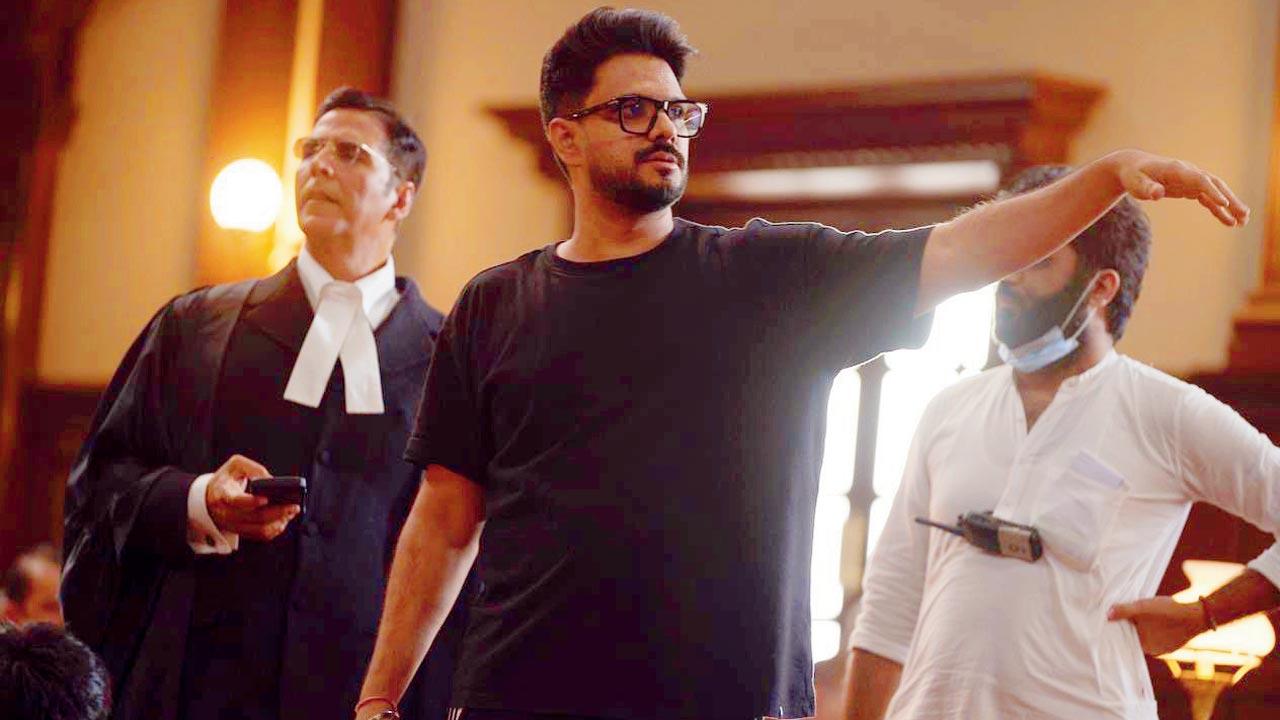
Kesari Chapter 2 director Karan Singh Tyagi, who makes his big-screen debut with the movie about the massacre, explains why the 106-year-old incident is still relevant
Mohar Basu (MID-DAY; April 13, 2025)
“They were told to disperse. They didn’t. So I opened fire.” That chilling line was reportedly uttered by General Reginald Dyer after ordering troops to open fire on thousands of unarmed civilians in Amritsar’s Jallianwala Bagh. Over a century has passed since that April afternoon in 1919, but the brutality of the massacre continues to haunt India’s collective memory.
For lawyer-turned-filmmaker Karan Singh Tyagi, who makes his big screen debut with Kesari Chapter 2, the story still remains as relevant as it was 106 years ago, despite countless filmmakers—from Shoojit Sircar and Richard Attenborough to Ram Madhvani—having looked at the event from various lenses.
“The event speaks to the present times that we live in. It’s a post-truth world where fake news is rampant. I was fascinated that when people read about the Jallianwala Bagh tragedy, the next day, the truth was suppressed,” says Tyagi.
“There were regional newspapers that wanted to report the truth, which got burned down. There’s this famous poem written by a survivor called Khooni Baisakhi—the British Empire went to great lengths to ban that poem. The Empire started spreading a fake narrative through their publications, especially the English media, where the victims were labelled as terrorists. The whole narrative that the British Empire spun was that the people at Jallianwala Bagh were armed, and General Dyer had to shoot in self-defence. I think it’s a fascinating story to bring to the people in 2025,” he adds.
Tyagi wanted to look at it from two lenses. “One is from the empire machinery and what they did pre-April 13 and post-April 13. And the second is the human aspect of the tragedy.”
It almost seems like history is cyclical, because in 2025, wars continue to be waged around the world. We ask him if as a filmmaker, he feels compelled to tell a larger tale? “When you’re true and you’re authentic to your own story, the more specific, the more real you make it, it becomes universal. This is the story of Sankaran Nair, who was knighted by the British Empire. And, he was the only Indian member on the Viceroy’s executive council. For him to then take on the British in the most dramatic of ways is a story of valour. When he resigned from the council, he told the Viceroy [who can be compared to the PM today] that ‘your empire is being run by yes-men so why don’t you make the jamadar replace me’.”
Being a student of law and politics, his core interest has always been in stories that involve the state, its fallacies, tragedies and injustices. “I read the source material and was enamoured. The book is called The Case That Shook the Empire. Sitting down with the authors was key because they are the heirs of C Sankaran Nair—his great grandson, Raghu Palat and his wife Pushpa Palat. I did my own independent research as well. There’s a lot of literature on Jallianwala Bagh. There is a Canadian author, Kim Wagner, who has written a fantastic book. There is an Indian author who’s not gotten his due, called VN Datta. There’s Kishwar Desai’s book. There are independent accounts of survivors chronicled in the two commissions that were set up. These materials uncover an argument that the film makes as well. The Jallianwala Bagh massacre was actually a planned conspiracy to kill. There was a plane that flew over the Bagh to check whether enough people had assembled. There were troops called in—Gurkha troops and Baluch soldiers—and the Sikh infantry was kept completely in the dark because they would be up in arms if they knew.”
We tell Tyagi about the documentary in which Caroline Dyer, General Dyer’s great-granddaughter, is seen defending him. “That interview really angered me. She labelled the people who came to Jallianwala as looters. The film is important because you’ll be shocked to know that the empire went into overdrive after the massacre. They went to extreme lengths in order to laud General Dyer as a hero.”
The film started off as an independent movie despite being headlined by the original star Akshay Kumar. “Do you know Kesari is the colour of revolution? For us, the baton of revolution is being passed down to this story where one man is taking on the empire. Revolution seems like a big term but its essence is quite simple—standing up for what’s right,” says Tyagi.
There’s a reason why Kumar is a superstar who has stayed at the top of his game for decades, he says. “He’s been incredible in his support for me. I just want the audience to watch the film because I feel this is one of his best performances. He’s heard stories from his grandfather, from his father. So he feels a personal connection to the tragedy.”
The film is a few days away from release and Tyagi says he and his writers Amritpal Bindra, Sumit Saxena and Akshat Ghildial hope that the audience will take back the famous Pablo Neruda quote from Kesari Chapter 2: “Empires perish because they listened to their lawyers and ministers and not to their poets’. Empires have to listen to the common people of this country.”
500 men in turbans roped in to reconstruct the Jallianwala Bagh massacre for Akshay Kumar's next
8:43 AM

Over 500 men in turbans were roped in to reconstruct the Jallianwala Bagh massacre for the biopic on C Sankaran Nair
Mohar Basu (MID-DAY; December 3, 2023)
The highly anticipated biopic on late lawyer-activist C Sankaran Nair, featuring Akshay Kumar, is currently in full swing. Debutant director Karan Singh Tyagi is shooting an elaborate sequence depicting the infamous Jallianwala Bagh massacre. For which, almost 500 Sardars have passionately gathered at the State Reserve Police Force (SRPF) ground in Andheri, where the sprawling set is built to shoot the pivotal scene.
The film, titled The Untold Story of C Sankaran Nair, based on Raghu and Pushpa Palat’s book, The Case That Shook the Empire—will capture the essence of his life and chronicle the lawyer’s courtroom battle against the British Empire to uncover then Punjab Governor Michael O’Dwyer’s role in the genocide. Nair served as a member of the Viceroy’s Executive Council in 1915, but resigned after the massacre in 1919.
A source from the set informs that the shoot started last week. “A massive crowd is shooting the sequence. It will take over 10 days to shoot the scene,” said the source of the film, which also stars R Madhavan and Ananya Panday.
Ananya Panday in talks to play a lawyer in Akshay Kumar's next, produced by Karan Johar
8:26 AM

Sources say Panday in talks to play a lawyer in KJo’s The Untold Story of C Sankaran Nair, led by Akshay
Mohar Basu (MID-DAY; June 7, 2022)
While Karan Johar is busy promoting Jugjugg Jeeyo, his production house has begun the groundwork for the C Sankaran Nair biopic. The courtroom drama, titled The Untold Story of C Sankaran Nair, will be helmed by debutant director Karan Singh Tyagi. Where Akshay Kumar has been roped in to step into the shoes of the late lawyer-activist, it is now heard that the makers are in talks with Ananya Panday to play a crucial part.
Nair served as a member of the Viceroy’s Executive Council in 1915, but resigned after the Jallianwala Bagh massacre in 1919. The drama — based on Raghu and Pushpa Palat’s book, The Case That Shook the Empire — will chronicle the lawyer’s battle against the British Raj to uncover Punjab Lieutenant Governor Michael O’Dwyer’s role in the massacre.
A source reveals, “Ananya will essay the role of a feisty junior lawyer in the film. She has yet to sign the dotted line, but word is that she has been finalised for the part.” The film is expected to roll after Kumar wraps up a chunk of the Soorarai Pottru remake.
Dharma Productions remained unavailable for comment.
It’s time we started telling our own history, rather than depend on the British version-Raghu Palat
8:01 AM

Raghu Palat is the writer and great-grandson of Sankaran Nair, on whose book Karan Johar’s movie is based
Anna Mathews (BOMBAY TIMES; July 4, 2021)

Karan noted that he is “extremely excited and honoured” to back the film that will “unravel the legendary courtroom battle that Sankaran Nair fought against the British Raj to uncover the truth about the Jallianwala Bagh Massacre. Sankaran Nair’s bravery ignited the freedom struggle across the country and is a testament to the power of fighting for the truth.” The film is titled The Untold Story of C Shankaran Nair.
The project is set to be based on the book, The Case That Shook The Empire, written by Sankaran Nair’s great-grandson Raghu Palat and wife Pushpa Palat. Raghu is happy and proud that Sankaran Nair’s ground-breaking fight, which changed the course of Indian history, is being brought into the limelight.
“It is time that we started telling our own history, rather than depend on the British version, where they made themselves to be benign administrators,” says the retired banker and writer.
In fact, it is in writing our history that Sankaran Nair was confronted with a defamation suit. It was brought against his book Gandhi And Anarchy, in which he held Punjab Governor Michael O’Dwyer responsible for the Jallianwala Bagh Massacre, in which about 400, of a large group of peaceful protesters, died in a shooting. When he refused to withdraw the book on O’Dwyer’s demand, a case was brought against him at the Court of the King’s Bench in London in 1922.
Sankaran Nair, advocate general of the Madras Presidency, was the only Indian on the Viceroy’s Executive Council. He had resigned after the massacre. “It was not too difficult to get the precise historic details of the case. I had had the opportunity to speak to my father and grandfather about him. Also, Sankaran Nair had written an autobiography, and his sons-in-law Madhavan Nair and former ambassador K P S Menon had written about him, so we had records at home. Also Indian and British news reports on the case, which took place from April 30-June 30, 1922, the longest case in British civil history, were available,” says Raghu.
So, how did the case, which will be the focus of the movie, play out? In a system that was heavily biased, it wasn’t surprising that the 11-member jury ruled overwhelmingly against Sankaran Nair. “The sole voice in his favour came from famed economist Harold Laski. But the British Parliament made the judge resign for his biased handling of the case. Also, his book propelled the freedom fight and gave the thrust to push for Independence, rather than settling for dominion status, which is until then on the cards,” points out Raghu.
The film is set to be directed by Karan Singh Tyagi. The cast has not been finalised yet.

Subscribe to:
Posts (Atom)