Showing posts with label Karan Johar interview. Show all posts
Showing posts with label Karan Johar interview. Show all posts
I will never make Kabhi Khushi Kabhie Gham 2-Karan Johar
8:35 AM

Sonal Kalra (HINDUSTAN TIMES; March 21, 2026)
Iconic — the adjective doesn’t just describe the body of work, but the man behind it as well. Filmmaker-host-actor Karan Johar, in a candid chat on The Right Angle with Sonal Kalra, talks about everything under the sun — his upcoming films and the underworld threat looming large over the film industry to the rumours around a possible comeback of a much-loved film. Excerpts
The biggest speculation right now is whether Kabhi Khushi Kabhie Gham 2 is on the cards. There’s also buzz around whether it has something to do with the Takht script being revised. Any comments?
There is no Kabhi Khushi Kabhie Gham 2 (K3G2), and there is no derivative of Takht being made. I’d never make a K3G2. I’m not saying K3G was the best film ever made, not at all. Every film has its flaws, but what K3G has in abundance is nostalgia. Generations have grown up watching that film — for what they’ve loved, what they haven’t, what they’ve cried about and laughed with. They love the movie, and I’m very grateful to the universe that I got to create a film that still lives on. I would never mess with that nostalgia or the love the film has, because you’re setting yourself up for disaster when you make a film like K3G2. So yes, the absolute truth is there is no K3G2.
About Takht...
There isn’t a revival of Takht right now on the cards. But that is a film I will definitely make while I can still breathe and stand on my feet.
I consider it to be the strongest screenplay that was developed, written by Sumit Roy. Full credit to him — he’s the writer of the film — and I believe it’s the best-written piece of work in my career. What I have been developing is something nobody’s actually talking about. Thank God for that. So in the garb of this rumour, in the garb of this K3G speculation, actually jo ho raha hai, jo main likh raha hoon, jo main banane wala hoon, uske baare mein koi baat nahi kar raha.
You have just returned from a vacation with your kids, Yash and Roohi. Who’s closer to how you were as a child?
Roohi. She’s a quieter, empathetic, hypersensitive child. She also follows parental instructions, which is what I did. I was a good kid. Yash is a little more of a brat, but he’s also very sensitive. They are good kids.
We’re hearing about you and Sidharth Malhotra coming together for a film. Is there something you want to share?
Sid has been a student (launched by me in Student Of The Year; 2012), and he’s also been very close to the film company. We consider him and Kiara (Advani) family to us. Sid and I have been chatting about the possibility of coming together for a strong film, but right now it’s all too soon.
What is it with you and these blind items that seem to take a liking to you?
I have no idea! Maybe I don’t have an interesting life, so this is what makes my life interesting. I always say: love me, hate me, just don’t be indifferent to me. And I’m glad that Reddit, blind items or speculation keep the interest in what I’m doing alive. That means I may have done something right in my life to have created this sense of curiosity around me. Many of those blind items, when I read them, I find hilarious. Some of them are quite close to the truth, and some are distant from reality... Many a time, I’m amused, but I no longer get upset or angry at either the trolling or the speculation.
It’s good to hear you say that, because like everyone else, you’ve also had moments where it’s affected you. Today, many in the fraternity face intense negativity. If you had to give one piece of advice to stay unaffected, what would it be?
Many celebrity friends have asked me, ‘Why are you so calm even in a crisis?’ Even when there was a lot of Bollywood bashing happening at one point, a very close friend, who is also a movie star, came over and said, ‘Is everything okay? Why are you so calm? You should be reacting’. My parents raised me to know that if something is completely untrue, and people don’t know the person you are, then what is the point of getting upset? I would be upset if what they were saying about me was actually true.
Recently, you said talent management is becoming a difficult profession to sustain. Having spent three decades in the industry and launched many careers, do you feel there is less gratitude among the younger generation today?
The younger generation, with social media, technology and constant noise around them, is very restless and anxious. So I think we’re dealing with an anxiety-ridden generation that wants validation of stardom very fast. I don’t blame them because they are judged daily. None of us, when we started off, were recipients of this level of judgment. The kind of scrutiny that exists today is traumatizing. It can take a toll on your mental health. So I don’t judge them for decisions they make in their life and career that I may or may not agree with. I get it. I hear them. I see what they’re going through.
If you ask me whether I want my children to enter this profession, I can’t give you a resounding yes, because I know how tough it is, even for insiders.
There’s also an anti-incumbency factor when it comes to staying with one agency for long…
It’s the way of the world, and you have to accept it. As a filmmaker, I don’t work with just one actor all the time. I want to try different artistes, stories and technicians. So if someone wants a fresh start or a different approach, that’s fine. Anyone who has left our agency, I will always wish them well and continue to work with them. Many have left and I still collaborate with them. I’m not a talent manager per se, it’s just one arm of my company. I’m a filmmaker first. If someone is right for my film, I won’t cast them based on which agency they belong to.
There’s also concern about recent threats in the industry. Do you feel those difficult times linked to the underworld could return?
It is very worrisome... My thoughts are with those facing it today. But I do believe we are in good hands. Authorities act immediately and provide security. Every time I’ve reached out in a difficult situation, my city and state have been very supportive. I’ve always felt protected here, and I believe we will continue to be.
What makes Karan Johar the most angry, and what makes you the saddest?
What makes me angry is people who are not on time. I have an aversion to lack of punctuality. What makes me sad… I’m an old-fashioned loyalist. I will always be grateful to Aditya Chopra (filmmaker), Shah Rukh Khan (actor) and Yash Raj Films for being my mentors and my beginning. I say with pride that I would wipe the floors of YRF and Red Chillies. I would do anything that was asked because I owe my entire being to them. I don’t know if that level of loyalty exists anymore. But I am grateful to those who remain loyal to me. That is the first quality I look for in a person.
I just gave up drinking coffee. When I would shoot for KWK, I would drink nimbu paani or just water-Karan Johar
9:46 AM

Madhureeta Mukherjee (BOMBAY TIMES; October 1, 2024)
He made the idea of conversations over coffee cool, glam and irresistible. What brewed on his chat show Koffee With Karan (KWK), was hotter than the hamper and more addictive than the cuppa coffee. Over the last two decades, some of the flavours have changed, some of the goss has been tossed, but the stars still spill enough beans to give you that stimulating blend.
On International Koffee Day (blame KJo for the K), Karan Johar talks about the coffee drinking culture and the vibe around it – on and off the show.
You made conversations over coffee as glam and glossy as some of your movies, and of course, even changed the way ‘koffee’ was spelt for the entire nation.
I remember once being reprimanded by an English teacher who bumped into me, and she said, “Thanks to you, all my students write coffee with a K!” And this was in that phase of my life when I thought K was my lucky alphabet. I remember the point when I was thinking what I should call my talk show. I wanted the show to be about friends coming together, chatting candidly and just off the cuff. Nothing loaded, nothing heavy. And I thought, that’s what you do when you have coffee with friends. So, that’s where it all began. Back then, at one point, people would see me and start screaming coffee, coffee... and I had to tell them, my name is not coffee, I am not a beverage!
It’s been two decades since the first season of KWK. The coffee on your show has also changed flavours, and you have found different ways to brew a conversation with your guests. How do you feel about that?
I’ll tell you what happened – in the first couple of seasons, the stars had no filters, because there was no social media going crazy online and everything was not like a click bait headline. And then, I could tell that slowly with every season, the stars became more guarded. So, then I made my show more gamey and fun, where you could see them at least dropping their guard as cool people, even if they weren’t disclosing their personal opinions. I don’t blame them for not opening up, because they were afraid of a PR nightmare, and I understand that because today, we have to watch our P’s and Q’s when we talk, and our thoughts are racing ahead of our words.
Growing up, you were a shy and introverted boy. Then you turned into a filmmaker, which required you to be behind the camera. What prompted you to face the camera as a chat show host, as that’s quite a mindset shift for a filmmaker?
In 2000, I hosted two segments of an award show for the first time, and back then, it was an unusual choice for a filmmaker to be a host. Then, I did it the next year, and the year after that for other awards shows. And in the interim, just on a whim I got this idea about doing a chat show. I was always a huge fan of Phool Khile Hain Gulshan Gulshan hosted by Tabassum and Rendezvous with Simi Garewal. I believe that both these illustrious ladies are the real OGs, and they are responsible for the talk show culture in our country. I came in much later, but I’d like to believe that I did it my way.
In your observation, do you think the new generation of actors are far more guarded and wary of opening up in conversations?
The younger generation, while they may be more energetic, are more careful. They’re far more guided by their publicists and strategy management teams. I don’t blame anyone. Everyone’s guided to say the right thing and to come across in the right way. But there is a generation before them that is so pure and organic, and there is a generation even before them who don’t have any filters because they don’t fear consequences. They’ve achieved enough in life. It’s the new generation that are building their careers, and they fear consequences. They are living in a social media generation, where nothing they say can go unheard or unnoticed. At times, it gets blown out of proportion and you become a headline.
The show has evolved, and naturally, you have too. Over the years, people have seen a side of your personality that they wouldn’t get a glimpse of if you were only making movies. Would you say it is a good thing to have happened?
You know, it can be good and bad. People who are really close to me, know me for the person I am. But there are many who form an opinion of me after seeing the show. They think you are this bi***y, gossipy person. But what you are doing is playing a part of the drama, and it’s for fun. And that’s not all that I am doing. I am simultaneously contributing to the arts and cinema. Somehow, I am stuck with a lot of perception problems. I feel that people perceive me in a certain way because of the part I have played as a talk show host. Not all of me is what’s on the show. The perceptive people can see through the surface glamour, but there are many who can’t do that.
Have there been any life-changing moments or conversations that happened over a cup of coffee in reality?
Well, during most of my sessions with my therapist I have had coffee, and some of those have been life-changing in many ways and there is no shame in saying that. Many of us seek help, I call it urban angst where we are living in cities, surrounded by noise of all kinds, virtual and literal. Many of us feel the need to express our emotions in the confines of a space, where you feel safe. In many such sessions, I have had coffee, so I guess I have had about 20 such life changing conversations over coffee.
Did You Know?
Karan gave up coffee for a few years. He reveals, “At one point in my life, I just gave up drinking coffee. When I would shoot for KWK, I would drink nimbu paani or just water. Eventually, I went back to coffee. I had a mannat, and I wanted to give up something I really liked. So, every time I have to give up something I really like, it’s always coffee.”
Conversations over coffee often make you break boundaries and barriers with people. I think some great conversations have happened over coffee in real life as well. Coffee also gives you that skip in your step kind of energy. I love my coffee, though I am not addicted to it
-----------------------------------------------------------
Some episodes in the last season were intense, and we got mixed reactions, like some said this is not really KWK. But my reaction to that was, your coffee also has to keep changing, your cup of coffee can’t always be steamy. It can’t always be served the way you want it
It comes naturally that women in my films have agency-Karan Johar
5:40 AM

Niharika Lal (BOMBAY TIMES; November 23, 2023)
In recent decades, films with female leads have performed well at the box office. Yet, there has been an assumption that producers do not support female-led films, and that they are generally less successful. During a recent session at IFFI, Karan Johar spoke about how gender is not a criterion for judging a story.
‘I’LL CONTINUE TO TELL STORIES OF WOMEN’
“Telling the story of a female comes naturally to me. I’m not even thinking that it is something great I’m doing; it is something that comes naturally, whether it was Raazi, Gunjan Saxena, Ae Watan Mere Watan, or the short films I have directed like Bombay Talkies. It comes naturally that women in my films have agency. These are natural, organic decisions that come from the roots of my upbringing, and I will continue to tell those stories.”
‘ONLY FOLLOW THE CONVICTION OF STORYTELLING’
Talking about box office performances of female-led films, Karan pointed out how cinemas were written off, yet both cinemas and OTT have maintained their strong positions. Giving the example of 12th Fail, he added, “It was being said that small films would not be able to attract a theater audience, but look at the performance of 12th Fail. So, one can’t follow any trend, and the only trend that one should follow is the conviction of storytelling.”
‘FILMS MADE IN ALL LANGUAGES ARE OUTSTANDING’
Responding to a query on why he doesn’t make films in other Indian languages, Karan said that the language he is comfortable telling a story in is Hindi, as it’s the language he was raised in. However, he added that he is a fan of all Indian language films.
“I was one of the first people to introduce Baahubali to the Hindis-peaking audience of this country. I believe that films made in (all) languages, whether it’s Kannada, Malayalam, Telugu or Tamil are outstanding. Thanks to streaming platforms, we can now see these movies and fall in love with the power of these stories. I’m blown away by the impact of Mani Ratnam’s PS-I and PS-II films, by KGF which has opened doors for Kannada cinema, and equally by mainstream films like Pushpa or RRR. So much is happening in Hindi cinema, but at the same time, so much is happening in Indian cinema, and we should be proud members of Indian cinema.”

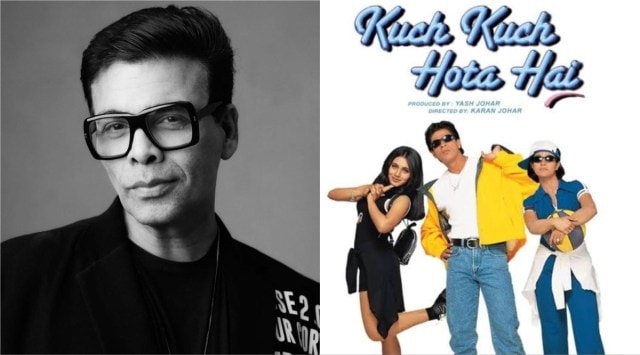
25 Years of Kuch Kuch Hota Hai: I saw my father smile during the release of a film for the first time in many years-Karan Johar
8:28 AM
Onkar Kulkarni (BOMBAY TIMES; October 16, 2023)
As Kuch Kuch Hota Hai (KKHH) celebrates its 25th anniversary, in a chat with BT, Karan Johar takes us down the memory lane of a film that launched his career as a director in Bollywood. The filmmaker talks about what went into making this movie, and the love and criticism he’s got for it over the years…
In an interview, you had said that you began working on KKHH when Dharma Productions had backed five-six movies, which hadn’t worked.
At a time like that, what gave you the confidence to go all out with making your debut as a director with such a large-scale film?
After my father’s (Yash Johar) first film Dostana (1980), he had given a series of films that had not worked commercially. I have seen the tough times he went through and the financial losses we faced. Actually, it was Yash uncle (Yash Chopra) who I consider a father figure, who had asked me to direct a film for his banner. But when I went home and told my father that, he said, ‘You are my son, and it would be nice if you directed (a film) for Dharma Productions’. I asked him if we could afford it? He had faith in me, and he said he would take a loan. He also said, ‘Karan, we will give it our best shot, but in the worst-case scenario, if the film doesn’t work, I don’t want you to keep doing something where you will continuously see failure, and that is only what I ask for’. That was the advice he gave me.
My father was a very loved man by the industry, and everyone wanted the film to work for him, it wasn’t about me. When the film made the money, we bought our first home in Mumbai. I saw my father smile during the release of a film for the first time in many years!
In a country that’s obsessed with cricket, what made you pick basketball to portray some key emotions and scenes in the film?
I needed a sport that was interactive and looked kind of sexy when two people are playing it in close proximity. It couldn’t be cricket, football, table tennis or badminton, it had to be basketball, because you are actually playing it in a way that can be intimate between two people. Remember that scene in the second half where Anjali (Kajol) plays the game in a saree, and Rahul (SRK) is wearing a shirt and a tie? There’s something sexy about it. So yes, that’s the only reason, otherwise, I had no clue about basketball as a sport.
We were shooting in Mauritius, and I kept calling it a ‘goal’ until Shah Rukh took me aside and corrected me and said, ‘Karan there are a lot of people who are actually laughing at you because it is called a ‘basket’…you score a basket, you don’t score a goal! This isn’t football’.
While the film appealed to a huge section of the audience, it has also faced its share of criticism over the years. Like some think the film is too shallow and superficial, in fact, at times even you have laughed at some of the memes and jokes around it. Twenty-five years later, how do view it?
Absolutely, I take it all in a good stride. I feel Kuch Kuch Hota Hai is a result of my passion for Hindi cinema and what I grew up on. I was younger and less evolved when I made the film. I was not aware of what I am today. My woke metre was zero, so, the gender politics is very questionable in the film. And yes, it can come across as superficial and there are logical loopholes. Today, I would not make those errors. I made a film like Rocky Aur Rani Kii Prem Kahaani recently, which has been praised for its wokeness. I didn’t have this maturity at that time. I had a different sensibility, but you grow with time. I can’t regret it because I made it with a different mindset. But I am completely in agreement with the criticism. I also want to add that there was a certain innocence with which I made Kuch Kuch Hota Hai. It was never made with a bad intention.
From KKHH and Kabhi Alvida Naa Kehna to Ae Dil Hai Mushkil and Rocky Aur Rani Kii Prem Kahaani, all these films have a common thread – coming-of-age romance, intense love and heartbreaks. Have you personally felt close to these subjects and emotions?
Each one of these films is my growth as a human being. I did Kabhi Alvida… at 31, when I had seen enough of life. I had seen people struggle in their relationships. That film came from a lot of conversations I had with my married friends at that time or people who I had seen from a distance go through relationship traumas. Ae Dil… is a piece of my own heart. I felt like I had succumbed to an unrequited love story, and it was a personal film for me. Rocky Aur Rani…, is a result of a lot of younger people that surround me on a daily basis. It’s about their thoughts on gender fluidity and equality, as well as what true feminism is. I have leveraged my observations and relationships and have always been able to create stories around them. I believe life gives you the best stories and a strongly led life will always give you amazing stories. All you have to do is open your heart and mind to those stories and you can always be a relevant filmmaker.
Karan on his equation with Shah Rukh Khan
"I was working as an AD on Dilwale Dulhania Le Jayenge where Shah Rukh and I became friends. I was already close to Kajol as we have kind of grown up together. Shah Rukh and I got organically very close to each other where he became almost like my brother. When I wanted to make my first film, it was just natural that he would be a part of it. He had told me that whenever I made my first film, he would like to do it and he followed through with his promise. Thereon, it wasn’t just a relationship of a director-actor, but we became family. It is not just a legacy of love that we have created cinematically…it is also the legacy of love we all have as human beings for each other."
Karan On casting Rani Mukerji
"Rani was worried as Shah Rukh-Kajol was an iconic pair and they had a legendary film behind them – Dilwale Dulhania Le Jayenge. I told Rani to trust me, and she was a trooper from day one. She always says that she’s very thankful that we didn’t change her voice because in Ghulam her voice was dubbed. I always felt her voice was amazingly individualistic, and there was no way that I would want to change that."
KKHH - Rapid Fire
Your favourite scene from Kuch Kuch Hota Hai...
The moment where Shah Rukh and Kajol meet after years at the summer camp. There’s this awkwardness and the sad version of the song plays in the background. In that moment, they do their signature gesture also in a very uncomfortable way. They don’t know what to say and how to say it. It is the most beautifully uncomfortable moment that I have created on screen.
Anjali or Tina... your favourite character?
That’s a tough one. How do I answer it? It’s like asking me to choose between Yash and Roohi, I can’t!
If KKHH was to be remade with a younger lot of actors, what would the casting be like?
I think they are an irreplaceable cast, but if you put me in a hypothetical situation, then I would say Alia would be a great Anjali. Maybe, Janhvi (Kapoor) or Ananya (Panday) would be a great Tina. Rahul is tough… maybe Ranveer Singh.
Our contracts with Shah Rukh Khan read: ‘It was a pleasure working with you. Thank you so much!’-Karan Johar
8:49 AM
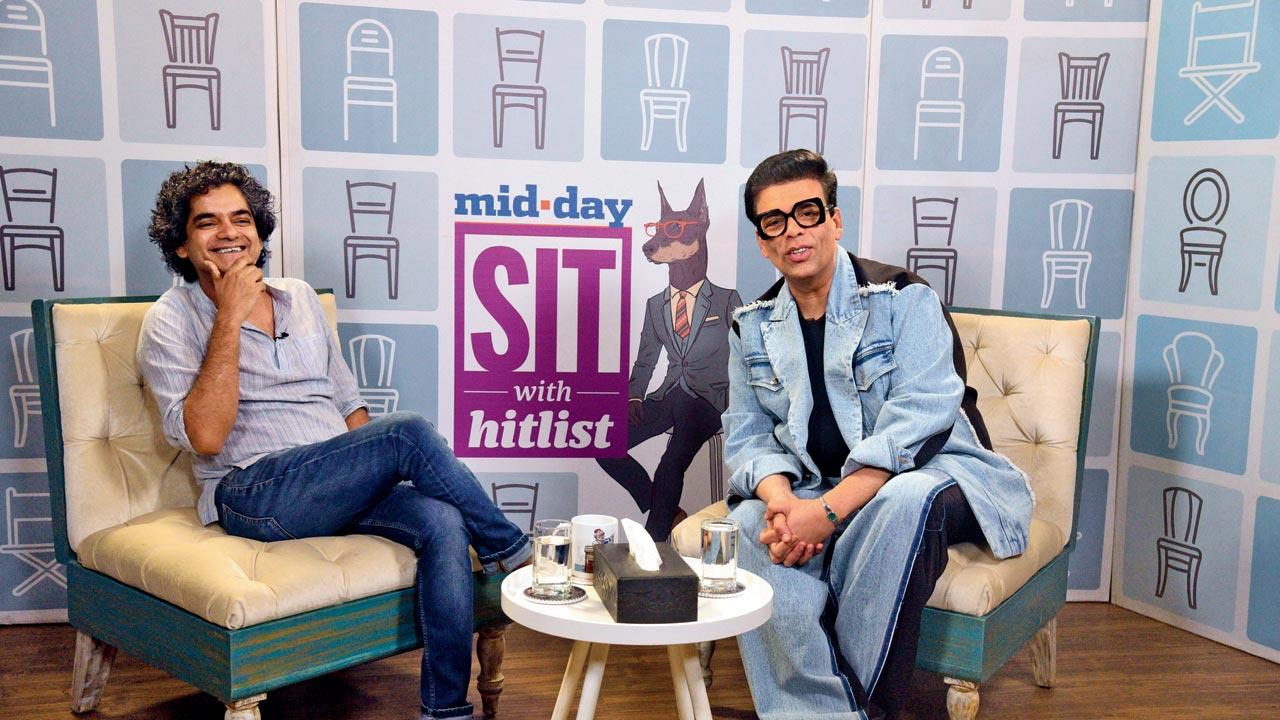
In the mother of all interviews, Karan Johar explains his inexplicable friendship with SRK, what a single superstar director must do to find love, and why he no longer prays for success
Mayank Shekhar (MID-DAY; September 17, 2023)
Back when Karan Johar was 15, having just finished his Class X, his mother, Hiroo, received a call from her friend, popular television director Aanand Mahendroo (Dekh Bhai Dekh).
Mahendroo had heard that Hiroo’s son is “extra plus-size,” as Karan puts it, and asked her if he might want to act in his TV show. That’s the sort of “large kid” he was looking for.
Karan was on his summer holidays. He’d only done school-level dramatics. But, why not? He went over from his Malabar Hill home to the far suburbs, to meet Mahendroo, who wasn’t in office. He waited for “four hours, doing nothing”.
Next to him, also waiting in the same room, was a slightly older bloke—sipping tea, engrossed in solving a crossword. No chit-chat or eye-contact. Soon as director Mahendroo entered his office, he spoke to this gentleman first. That conversation lasted hardly a minute.
Mahendroo offered the person a part in a TV series. The gentleman casually shot back, “No, I don’t want to do TV. I liked the tea. And stayed to finish my crossword!” And he flipped, and left. “Crazy! You know who he was? The actor from Fauji,” Mahendroo told Karan.
Meaning, Shah Rukh Khan (SRK). That’s how Karan met (or did not meet) SRK, first. Mahendroo offered Karan the teenaged part that he had in mind for him.
This involved shooting, for fun, during the holidays, at RK Studio, along with kids his age. The show was the much-loved Indradhanush (1989)—sci-fi, on Sunday Doordarshan, about a group of children, who discover a time machine.
That chubby boy, Srikant, in the group, was how many of a certain vintage would’ve first seen Karan Johar on screen. Only, they don’t remember, or realise it. It’s a legit trivia question. “Yeah, my acting career essentially started with Indradhanush, and ended with Bombay Velvet (2015),” Karan, 51, mock-sighs now.
While this was a summer activity for him, Indradhanush came out only a couple of years later. By when, he was already in the final year of junior college (Class XII). Kids randomly started ragging him, once he came on TV.
“Hello? I’m your senior, what’re you ragging me for,” he told them. The other person going through a similar experience in the same junior college was Jugal Hansraj (popular child-actor from Masoom, 1983).
Karan says, “Jugal had done some ad for MBD Books: ‘For me, for you, MBD Books’! Those days, if you borrowed a VHS tape, you’d always see Jugal doing this ad. Him and I got ostracised in college together!”
Since we’re on a trivia trail—besides that they’re friends from college, what’s the pop-culture connect between Jugal and Karan?
The hook line of the film’s title-track, Kuch Kuch Hota Hai (KKHH, 1998)? Well, Jugal Hansraj composed that earworm. To the best of our knowledge, he hasn’t composed anything for public consumption since. “He says he chose to retire at the top,” Karan laughs.
The love-triangle, KKHH, that opened in theatres on October 16, 1998, was Karan’s directorial debut, starring SRK. SRK and Karan, as is well-known, became friends, when the latter (22 then) was assisting Aditya Chopra on Dilwale Dulhania Le Jayenge (DDLJ, 1995).
Ever since, Karan’s done multiple films with SRK in the lead, signifying a career combo of sorts—Kabhi Khushi Kabhie Gham (K3G, 2001), Kabhi Alvida Naa Kehna (KANK, 2006), My Name is Khan (MNIK, 2010).
That number crosses way over a dozen, if you factor in co-productions, and SRK’s cameos—including Ae Dil Hai Mushkil (Ae Dil…, 2016), or the colossal Brahmastra (2022).
Given SRK is arguably the highest paid movie-star in India, I wonder what he charges, when he drops in for a cameo. Karan claims, not a buck: “Not for Ae Dil… Nor for Brahmastra, for which he shot for 14 days! But that is our relationship.”
Surely, the superstar would have been paid in kind; expensive return gifts, perhaps? A Cadillac, maybe? None of that, or so Karan says: “I give him clothes. I don’t think he has ever asked me for money, even for a film that he has done [as lead].
“Whatever is given, is given. Our contracts with Shah Rukh read: ‘It was a pleasure working with you. Thank you so much!’ That’s the contract. There is no contract!”
No piece of paper? “I don’t have anything detailed on paper. Whether it is with Adi [Chopra], or Shah Rukh—I will do anything that is asked of me [as well]. I am here, because of them. How can I forget that? Loyalty is the most required quality in a person, and it rarely exists.”
“I remember when Shah Rukh was shooting for RA.One [2011], he had a double unit. He called me to shoot [the second unit] for six days, because [director] Anubhav [Sinha] was doing a big action sequence. And he needed simple patch-work kind of scenes shot. I flew from Bombay, and did it. These are not big deals.”
Karan’s latest film, Rocky Aur Rani Kii Prem Kahaani (RARKPK, 2023), was his seventh feature, after a gap of seven years, in his 25th year at the movies as director. He says, “I keep hearing it as a comeback, which makes me sound like Mumtaz, who returned after many years in America [with David Dhawan’s Aandhiyan, 1990]!
“I spent three years on Takht [a film that didn’t work out, apparently for financial reasons]. Maybe, three years went on PTSD [post-traumatic stress disorder]. Another two years on the pandemic. But I’ve always been here.”
RARKPK is also his first directorial, without SRK in any form (SRK was co-producer on Student of the Year). There are probably also other firsts—such as his maiden movie shot entirely in India? “Yes.” First directorial that’s actually LOL funny? “I think so. There were funny moments in all other movies, but this one is funny up to a large point, and funny even after.”
Even if you’ve seen the blockbuster, what is RARKPK about? Let’s step back a bit. To start with, about a man, with an artistic bent, born into a business family, where he’s unlikely to succeed, as a result. The family deals in making and selling sweets, in Delhi. That’s Dharmendra’s character, isn’t it?
Only that it’s evidently inspired by Karan’s late father, Yash Johar, when you consider that young Yash was similarly inclined to the arts, i.e. photography.
His family business was based in Delhi. And they made and sold sweets. Just that the company wasn’t called Dhanlakshmi. Karan recalls, “I have no clue why our family shop in Delhi was called Nanking, which is the name of a Chinese restaurant in every Indian town. We sold sweets with that name!”
Upon learning about Yash’s evident lack of interest in the family business, and an artistic ambition instead, his mother, as in Karan’s grandmom—“we called her Mataji”—asked Yash to head to Bombay. Soon as he arrived in Bombay, he landed an internship with The Times of India as a photographer.
“This took him to several sets, like Mughal-e-Azam, and other films,” which is the industry he switched to, working his way up, “starting out as ground manager, then production manager, and eventually, production controller—to working for Navketan Films, for 12 years—and being the only production controller to get front-roll credit.
“Everybody in the film industry knew and loved him: Dev Anand, Vijay Anand, Raj Kapoor, K Asif, Sunil Dutt… Everybody had worked with him.”
Perhaps the insecure/seasonal nature of films as an industry did not suit Yash, after a point. That’s when, Karan says, Yash took a sabbatical, and eventually started an import-export firm, named Yash One Exports, which, in turn, became Karan’s family business.
“We were middle agents for material like wrought iron, that would go to a place called Pier Imports, in Paris and New York, sourced from Faridabad and Saharanpur. It was a very stable income.”
The movie-bug, I suppose, is a hard one to swat or suppress for too long. Karan says, “It was Ramesh Behl [father of Srishti and Goldie Behl] of Rose Movies, who got my father back into films. That’s how he approached the writers Salim-Javed, who had a script.”
Thus, Raj Khosla’s Dostana (1980), starring Amitabh Bachchan, was born. He adds, “Ironically, my mom and Amit uncle had gone to [boarding] school together—he was in Sherwood, and she was at St Mary’s, which is the sister school.”
Who funded Yash’s maiden production? The Hinduja family, namely S P Hinduja. What was S P Hinduja’s son called? Dharam. This is how Dharma Productions gets its name: “Yup, that’s how the journey began 43 years ago!”
By all means a boutique beginning. Which is also a fair assessment of how today’s insiders are often, if not inevitably, yesterday’s outsiders.
The insider-outsider debate having hounded Karan over the past few years, with extensive trolling online, over supposedly favouring film industry kids, so to say, over a huge horde of aspirants, who set foot in Mumbai, without any filial connections to assist them in finding the proverbial foot in the filmy door.
This is what got termed the “nepotism debate”, with Karan allegedly at its fountainhead. Later in the conversation, he points out, “Between features, ad films, digital arm, and talent management agency—at any point in time, Dharma has an employer base of 800 to 1,000 people. And we make sure they are well taken care of. Now, 98 per cent of them are not from the industry.
“Why is this data not talked about? Why are we talking about that one star/industry kid getting an opportunity? What about the other thousand, contributing massively?
But if you want to make a narrative that works negatively, you will make any narrative. The negativity is on whoever is making the narrative. Not on me. Honestly, I haven’t, and I will not apologize for anything. Also, I will cast who I feel is right. If that person happens to be related to somebody in the industry, then so be it.”
Around 2005, I had asked Karan, during an interview, why he makes films. The answer was along the lines of the usual, which is to create worlds, tell stories. What he didn’t get, he told me then, is why he produces movies. And that it can be a really thankless job, at times. I wonder if he feels the same, almost two decades later.
He says, “Around then, I think we had produced Kaal (2005). Things have changed since. Unlike then, now, we have active producers, with credits, on the set, working on the logistics and tough stuff, which is really tough.
Apurva [Mehta; Dharma CEO], of course, is in the thick of things—he is the fulcrum of the studio. I am creatively jamming, sitting on rushes, final edit, all the fun stuff. That’s why I’m very happy to produce multiple films.”
Nikkhil Advani’s Kal Ho Naa Ho (KHNH, 2003), also an SRK starrer, was in fact Karan’s first film as producer, while he had also written its script. Nikkhil had assisted Karan on KKHH and K3G. They were also friends from school.
Subsequent to KKHH, Nikkhil left Dharma. Recently, he went on record to suggest how the rather public bad-blood between them had cost him three years of no work—deemed an industry pariah of sorts, therefore.
To which Karan responds, “I didn’t know if it was a gap of three years that he got no work. The fallout is too far gone, firstly. I attribute my knowledge of cinema and camera grammar to him. I was quite clueless on my first film. I just knew mid-shot, wide-shot and close-up. He mentored my technique. I will be forever grateful to him for that. But we are wonderful now, when we meet—exchanging shared nostalgia and memories. We had a creative fallout. It was a time that he was hurting. I was hurting. It was at an unfortunate time, because my father was very critical [during the making of KKHH].”
Beyond expanding his company, Dharma, into a legit creative force in Bollywood, Karan’s contribution on the business side could well be as a case-study on personal branding. After Subhash Ghai in the 1980s, I can’t think of too many filmmakers, altogether behind the camera, who became a recognisable face, among the public.
How many directors in the world do you know who actively endorse so many products, from laptops, paint, to soups and sunglasses! This naturally extends to brand ownerships too. Neuma, the restaurant that replaced the iconic Indigo, in South Bombay, is associated with him.
He informs he has a jewellery brand, Tiyaani. “There are several things I’m invested. Both with people and products, I go by instinct.” He’s more so a proper pop-icon to the point that, as they said in the good ol’ Tata Steel commercial, from back in the day—he also makes films.
This public-facing side, he remembers, really kickstarted with picking up gongs for KKHH, at award shows, in 1999: “I was giving these long, eloquent speeches, that were shown on television. Then, in February, 2001, Pradeep Guha and Khalid Mohamed, who worked for The Times of India, asked me to host the Filmfare Awards. I did it for free, because it was, I thought, a great opportunity.”
He hosted the Filmfare Awards for free? Surely, Filmfare was making enough money from it! “Well, they didn’t pay me in 2001. Subsequently, I have been paid by the same organisation, and I’m very grateful for it.
2003 onwards, for four years in a row, I hosted the Zee Awards, on primetime. And then in 2004, I started [the catty chat-show] Koffee With Karan, on Star World, which made me further a recognizable face.”
Koffee With Karan has had seven seasons on Star network since. Strangely, Karan doesn’t own the intellectual property: “If they want, they can have Karan Thapar host it. And maybe I could still do Conversations with Karan!” I’m guessing, it could be spelt with a ‘C’. Karan’s own numerological fascination with the letter ‘K’ for all his film titles stopped, once his production Kurbaan (2009), after Kaal (2005), didn’t perform at the box-office.
My needless peeve with Koffee With Karan, though, is how it may have ruined interviewing skills of film journalists, in particular! Wherein they get access to some of the finest talents/minds. And they waste that opportunity playing ‘rapid fire rounds’ with them, rather than actually mining experiences, or picking brains. This tic-tac rapid-fire stuff is all over my Instagram Reels, really.
Karan says, “The other problem is when they have a checklist of 12 questions, and I can see them going back to it, while you are rambling away. The person [at the other end] just nods, ‘Yeah, yeah, sure, sure…’ They just go on to their next question. Well, an interview is when someone listens!”
This hour-and-half long conversation (available unedited on YouTube), as part of the Sit with Hitlist series, with a live-audience of mid-day journalists, took place about 10 days after the release of RARKPK.
The film, noticeably, being the cooler-talk in the office, leading up to this chat. Given that it’s a newsroom, one of the things loudly discussed was how Karan has portrayed his lead character, Rani (Alia Bhatt), a journalist herself, dressed in the fanciest sarees in the film. Who wears that to work? He points to three women in the room!
The other time he’s had a journalist in the lead was Rani Mukerji, playing a newspaper editor, in the short films’ anthology, Bombay Talkies (2013). Was the Rani of Rocky Aur Rani named after this Rani, by the way?
“No. But this Rani and that Rani are both derived from a member of the media called Poonam Saxena. She’s always in a saree, and I found that wonderful. I love the saree, per se.”
Delhi-based journalist Poonam Saxena, incidentally, also co-wrote Karan’s memoir, An Unsuitable Boy. My instant memory from that 2016 book is Karan writing candidly about his dating life, or lack thereof, in terms of how difficult it is to be rich/famous, and meet new people. And that he hired a professional agency, based in London, to suitably match him with potential dates across the world.
“That process is still on. It has been a couple of years. I have been on telephonic dates, Zoom dates, during the pandemic, and some dates, physically, in person. Because the people are all over the world, so you meet, when you land up being in the same city. It hasn’t landed anywhere!”
The reason, it appears, is professional: “We live in a world—and I can speak for myself—that is impossible for people who aren’t in it to understand. I love my work so much. The rest of the time I devote to my children and mum. I don’t know where’s the place to find [for another person]. And I don’t want an unequal relationship, where the other person is just following my diary.”
This, I can vouch for Karan, despite his multiple professional forays. There are only two people in Hindi cinema I’ve known, over years, who are likely to respond to a work text (in this case, by a journalist) almost soon as you’ve sent it—one is Amitabh Bachchan; the other, Karan. Surely there are others too, but none likely to be half as busy as both. “I have what you call/message reply anxiety,” Karan says.
That said, he’s himself been in an unequal relationship, or unrequited love, as it were. And that he got his “most personal and angsty film” out of (Ae Dil…). I wonder if the person he based that “ek tarfa pyar” picture on, actually saw it. And what did he say? “Yeah. It was initially awkward, because his character [Anushka Sharma] also dies in the end!”
This one-sided relationship lasted about eight years for Karan. It taught him never to get into one: “Love can make you and break you. It can tear you apart. The pain is physical, not symbolic.” The said person is very part of his “ecosystem; but thankfully, not from the [film] industry, otherwise it would be too messy.
“There was a polarised opinion on the last act of Ae Dil… But the GenZ got it. Because they’re going through this intense, crazy, mad love. I just found it in my late 30s, that carried on till the 40s!”
Ranbir Kapoor played ‘Karan Johar’ in Ae Dil... The character is diametrically opposite to Rockstar Ranveer Singh aka Rocky Randhawa—“West Delhi guy, who wears his heart and Gucci on his sleeves”—in RARKPK. As actors too, apart from similar sounding names, Karan reckons, Ranveer and Ranbir, two of Bollywood’s best, have nothing in common, besides genius-level talent.
“Ranbir is a producer’s delight. He can be on the set for 16 years straight. He feeds off the director. Ranveer feeds off the world. For Rocky, he spent days in Delhi, interacting with local influencers, including hanging out at a West Delhi party.”
That’s fine, but really, what nectar of life is Ranveer inhaling to be turbo-charged, 24x7? “I’m surprised he’s not a Gemini. There are two people living inside him. The second person, you will never see—he barely hangs out. He’s conserving his energy to explode, once he is out, with his characters, and at events!”
Not to forget his onscreen partner, Alia Bhatt. RARKPK was their second film after Zoya Akhtar’s Gully Boy (2019). The alchemy is insane: “Well, that comes from familiarity. They’re genuine friends, which make for great onscreen chemistry; like Shah Rukh and Kajol. Unlike actual couples, who are so comfy with each other, that they have to conceal it on the screen!”
Before the release of RARKPK, Karan confesses, he was a nervous wreck, in a way that he’s never been before. His therapist diagnosed this could be late reaction to traumatic events. One of which, of course, was the merciless trolling he went through, especially after actor Sushant Singh Rajput’s death, in June, 2020.
Karan quit X (formerly known as Twitter) in October, 2022: “When I read abuses against my children, that was it. And who all do you speak among faceless, nameless people, and some with strange names, too?”
The “big ball of anxiety” also had to do with film RARKPK itself: “It’d taken me back to the syntax and DNA of what I began [filmmaking] with. For some reason, my confidence was at an all-time low. When K3G came out the same year as Gadar, Lagaan, Dil Chahta Hai, there were some saying that people have moved on! I didn’t want that to happen.”
Opinions certainly matter to Karan: “If we don’t get validation from the people that surround us, we will feel alienated.” The night before the release, once positive texts from the press show began pouring into his WhatsApp inbox, he felt mighty relieved, even surprised.
For, he believes, “My reputation precedes me—this guy dancing on reality shows, hosting talk shows, wearing mother’s clothes, can’t make a good film! We did a deep dive on the Internet for the trolling I get. These were the things that came out. Am I going to change for it? Be someone else? No. Critics will turn around.”
On the sly, Karan is pretty much a film critic himself—although only over a restricted WhatsApp group of eight film folk—“it’s an eclectic blend,” he clarifies.
He posts lengthy/detailed reviews of every films he watches—“I write the best in that group. What we share there is sacrosanct. It can’t be forwarded. And the reviews can go from love to WTF! I’ve even reviewed my own film [production] once.”
Speaking of pre-opening jitters, actually the saddest WTF moment for Karan may have well been 10 days before the release of Ae Dil… He dropped what looked like a hostage video, apologising for casting Pakistani star, Fawad Khan, in his film. Given the timing, in the wake of Uri attacks, and hostile Indo-Pak relations.
He admits, “Anything for a filmmaker, outside of the film, right before its release, is hurtful. There was pain. I really don’t want to get into the politics and optics of it. But even seven years later, I carry the baggage of that situation. When I go back in time, I feel disturbed. The same thing happened around My Name is Khan.”
That there were no extraneous issues to fire-fight before RARKPK, Karan feels, must’ve given him time to take on a more real pressure: “Weirdly, I’ve had a tough time, during my directorial releases. Dad passed away during KHNH. Yash Chopra passed away the same week as Student of the Year…”
We’ve saved the most chilling account for the last. Consider the release of his debut film—25 years of which he celebrates in October, 2023. As in the première of KKHH. Which was held where? Liberty Cinema. That’s how he wanted it—both DDLJ and Dil To Pagal Hai (1997) had similarly opened first at the South Bombay theatre.
Where was Karan, during his own premiere? Locked up in a room, in the theatre, while the screening was on, and his assistants Nikkhil and Tarun Mansukhani took turns to update him on audience’s reactions.
Shortly before the release of KKHH, the underworld had called his father to stall the film’s release. The police, offering protection, had promised that the show must go on. Given the threat, Karan was kept away from the premiere screening itself.
Post the show, the party moved to Khyber restaurant, nearby: “There, they said we have a [tallied guest] list. But six uninvited people have entered [the venue]. Now, it could have been just six gatecrashers. But that night, my father said we are leaving the country. At 4 am, my mum, dad and I, three scared people, left for London.
“First, we settled into a tiny apartment in a discreet location. My mother, somewhere secretly, was hoping that if this film is not a big hit. You know, it’s fine!” Better not to call attention with success.
Karan watched KKHH first, with the public, at a large London single-screen cinema, where he saw “300 people leaving, during the interval.” His heart sank.
“My mother mentioned the audiences have left, maybe, with a tinge of some happiness! My father said, that’s not possible. He walked outside and there was a huge line in the ladies’ washroom. He asked why there was such a crowd. They said, ‘Can’t you see, our mascara is off. We have cried so much!’”
The following Tuesday, from a London phone booth, Karan found the courage to call up Aditya Chopra, whose Yash Raj Films was distributing KKHH: “Adi asked me: what is the most expensive thing you want to buy? I said, I want to move to a bigger house with mom and dad. He said: So, come back to Bombay, and buy the biggest house—your movie is a blockbuster!”
Sensational. And since this is Karan’s silver jubilee script from his own life, should it not star SRK in the lead. He adds, “There was an actual dream I would always have of the great Shammi Kapoor, emerging in a Mercedes, at my movie’s première. Which actually happened at the Liberty Cinema, with KKHH.
Shah Rukh knew about this dream of mine. The moment Shammi Kapoor came in, he went inside [the theatre], and brought me out of the [secluded] room [into the foyer]. So, I saw that happen.
I had tears in my eyes, because it was literally my dream getting realised. Shah Rukh said: ‘You stand here. You watch this moment. Nothing will happen. I will take the bullet for you’.”
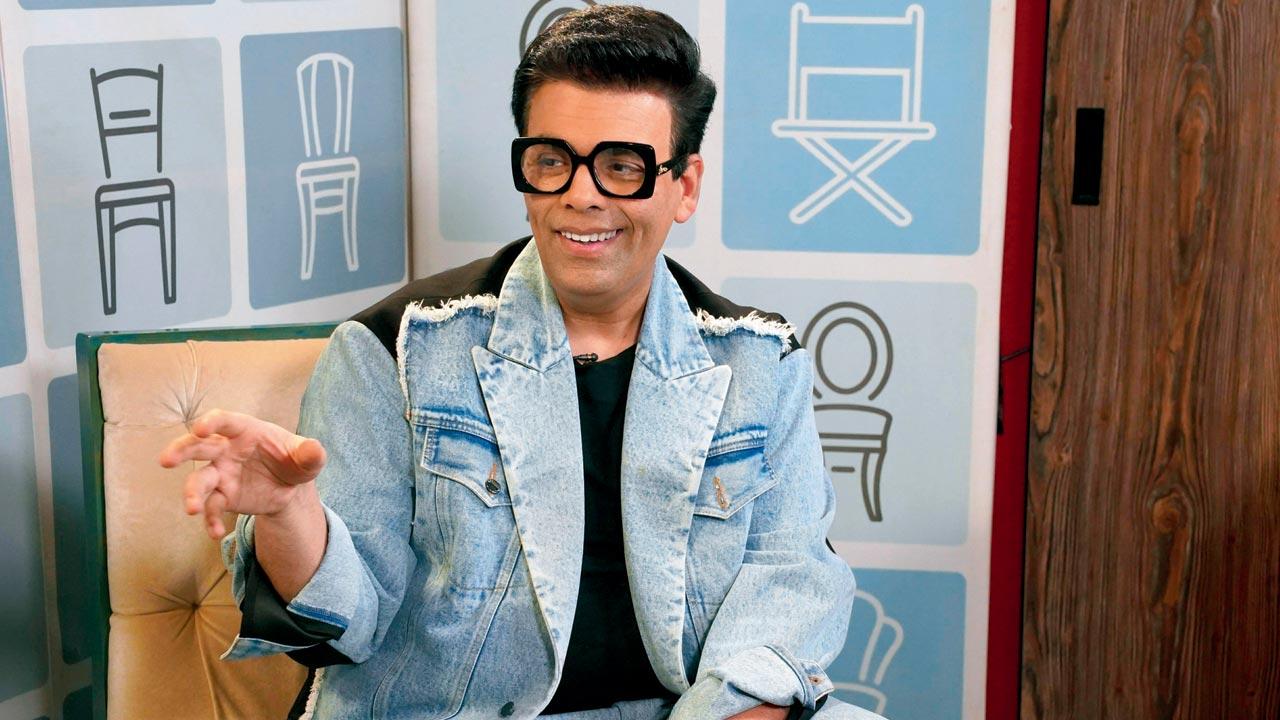
I’ve broken all the myths around filmmakers-Karan Johar
9:00 AM

Dismissing misguided notion that directors should have serious personalities, Karan on how judge act on Jhalak Dikhhla Jaa showcases his love for dance
Uma Ramasubramanian (MID-DAY; August 30, 2022)
There is little that is outside Karan Johar’s comfort zone. It all comes naturally to the filmmaker — from going behind the camera, to being the sassy host of a chat show, or being a judge on Jhalak Dikhhla Jaa. Ready with the 10th season of Colors’ dance reality show, Johar says he thoroughly enjoys it, thanks to his Punjabi genes. “I am not a trained dancer, but I have the energy of a Punjabi,” he quips in his trademark humour.
“[Earlier], we were taught that if you are a filmmaker, you should have a serious personality. I have never [lived by] that; I stay true to my energy. I have broken all the myths around filmmakers. No matter how mad I look, if I feel like dancing on the stage, I will. Dancing comes from a place of abandon.”
To the filmmaker-judge, dance is synonymous with a sense of freedom. It’s also a reminder of the joys of his childhood days. “My father [Yash Johar] would encourage me to dance when my friends used to come over. He would say, ‘Karan dances well to Dafli wale dafli baja. Karan, nacho.’ I would dance with abandon. My parents encouraged me, regardless that it was Jaya Prada’s steps [I was emulating]. Nobody told me you are a boy, and so-and-so should be your behaviour pattern.”
In the upcoming season, Johar will be joined by Madhuri Dixit-Nene and Nora Fatehi on the judges’ panel, as television actors Dheeraj Dhoopar, Rubina Dilaik, Shilpa Shinde, and others put on their dancing shoes. Many often call out reality shows for being scripted, but Johar dismisses such talk. “For Jhalak, we have never been prepped or told what to say. Every time I have been a judge on a reality show, it has always been me [voicing my thoughts]. I have never followed a script.”
He goes on to add that at home, he has an ardent fan of reality shows in mother Hiroo Johar. “I have seen my mother clap for contestants or cry for them. Sometimes, when I go home, I see that she is upset because a certain contestant has been eliminated. I have even taught her how to vote. My kids [Yash and Roohi] don’t watch reality shows. The day they will go to YouTube and watch my [episodes], I am scared they will hold it against me.”
The cinema-going audiences want the tadka of Hindi cinema that got diluted over the decades-Karan Johar
11:00 AM

Noting that south films’ success proves that drama and emotions rule the day, Karan Johar says he is making classic family entertainer in 'Rocky Aur Rani Ki Prem Kahani'
Uma Ramasubramanian (MID-DAY; July 12, 2022)
That familiar rush of thrill, joy, and chaos. That’s what Karan Johar felt when he began filming 'Rocky Aur Rani Ki Prem Kahani' (RARKPK) late last year, wielding the directorial baton almost six years after 'Ae Dil Hai Mushkil' (2016). Tell him it’s a long time to be away from a movie set, and he agrees wholeheartedly, stating, “It made me realize that I love being on set the most. At 50, [I have decided] that I will not take such long gaps.”
The break was unintentional. Johar had initially planned to helm the magnum opus, Takht. When the project hit a roadblock due to the pandemic and several other factors, the filmmaker went back to the writing table and developed RARKPK, featuring Ranveer Singh, Alia Bhatt, Dharmendra, Jaya Bachchan and Shabana Azmi. He believes the family drama is perfectly in sync with the audience’s taste that has changed dramatically in the past two years.
“As filmmakers, we all have to go back to the basics, if we want commercial [success]. If you want to make an artistic film, go ahead, but know that your audience will get limited. Now, the cinema-going audiences want the tadka of Hindi cinema that got diluted over the decades. The [success of] KGF - Chapter 2, RRR, and Pushpa: The Rise - Part 01, [2021] [proves the theory]. We need to go back to [the elements] we grew up on — drama, songs, dance, and emotions. The phase of small-town, high-concept movies is great, but this is the reality of our times.”
His upcoming film is a quintessential “happy Indian family drama”, he says. “There is unabashed naach-gaana. Dharam ji is a ball of love, and at 86, he is so passionate. Shabana ji is an acting institution. With Jaya ji, whom I call aunty J, I feel like I have a mom on the set.”
Even as he is confident about RARKPK, Johar knows that any film will have its share of criticism. The director views it as an important step to improve his craft. “I read the criticism before the praise. The praise does nothing for you, but what’s bad or what’s mediocre needs to be told. I even read what the trolls [write]. I feel the more grounded I am, the more I will be able to fly.”

Physically, I may be ageing, but I am a millennial in my head-Karan Johar
8:30 AM
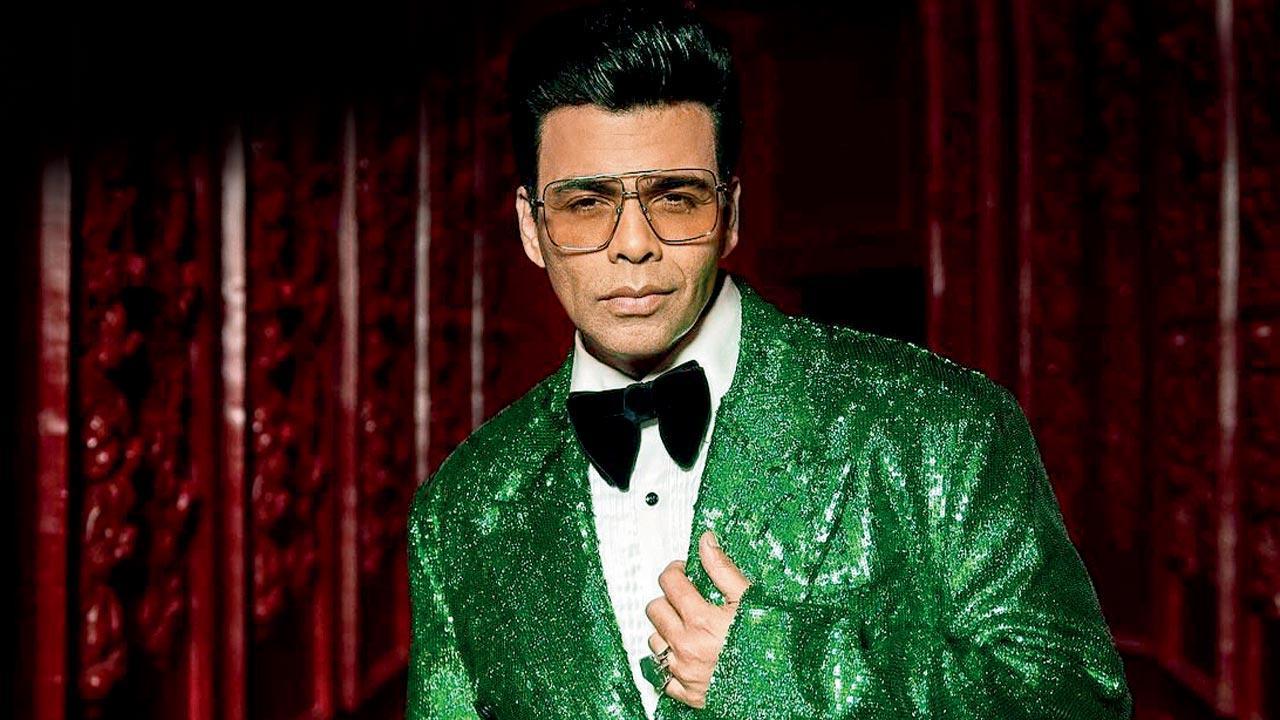
From staying relevant at 50 to taking the show’s criticism in his stride, KJo discusses it all as he readies for Koffee with Karan 7
Uma Ramasubramanian (MID-DAY; July 6, 2022)
It’s that time again when stars will grace the couch. Some will play it safe, others will unleash their mean streak, leading to drama and controversies. And host Karan Johar wouldn’t have it any other way. As he gears up for the seventh season of Koffee With Karan, the filmmaker-host insists that he has always been respectful of his celeb guests’ privacy. “I never ask questions that are not in the public domain,” he begins.
“I never bring up the things that I know about them personally because that’s where our friendship lies. Say, if there are articles about Vicky [Kaushal] and Katrina [Kaif] getting married, I will ask about it. But if no one knew that they were dating, and I did, I would never bring it up [on the show]. That’s the line I draw.”
He may be mindful in his own way, but the chats over steaming cups of coffee have brewed many controversies. Where Kangana Ranaut began the nepotism talk, cricketers Hardik Pandya and KL Rahul were dropped from a few matches after their sexist remarks on the chat show. Johar too has been in the line of firing many times. “Whenever the show has been criticized — for reasons that are justified or not — [the blame] is rightfully on me. It’s called Koffee With Karan. Who else will you blame? You can’t blame the coffee,” he grins.
So, is there a new approach to the new edition? “Initially, we thought about having a live audience. But we felt it would take away the intimacy of the show. I think the more I evolve, it shows in every season. I have become more relaxed and unapologetic.”
The upcoming season of the Disney+ Hotstar offering will see a mixed bag of guests — from usual suspects Ranveer Singh, Alia Bhatt, Varun Dhawan and others, to Gen-Z actors like Sara Ali Khan and Ananya Panday. At 50, the filmmaker straddles the role of a mentor and friend effortlessly.
“Sometimes, when you reach a certain age, you start behaving like you want respect, and want to be spoken to in a certain way. I don’t [subscribe to that line of thinking]. If I want to be friends with Ananya or Shanaya [Kapoor], I have to stop playing the Karan Johar card. We discuss their love lives, heartbreaks, and I am happy to be part of the conversation where we feel like we are the same age. My work remains relevant because I get into their headspace. Physically, I may be ageing, but I am a millennial in my head.”
I am the reason why Kalank failed-Karan Johar
9:01 PM

Monika Rawal Kukreja (HINDUSTAN TIMES; February 21, 2020)
It has been a year since the period drama Kalank released and tanked at the box office. But it seems that filmmaker Karan Johar is still not over the failure of his much-touted production. As he readies to direct his next big film, Takht — yet another period drama — Karan assures that he “won’t repeat the mistakes” he made in the past.
Readily taking all the onus of Kalank’s failure, the filmmaker says, “Whenever a film fails, you can always say that a group makes it, so everyone is equally responsible. But, being the most senior member of that group in terms of the creative crew guiding that ship, if it failed, I’d take complete responsibility as it was my failure more than anyone else’s.”
Directed by Abhishek Varman, Kalank starred popular actors Sanjay Dutt, Madhuri Dixit Nene, Varun Dhawan, and Alia Bhatt, among others. Karan asserts that besides reflecting upon one’s failure, it’s important to acknowledge the failure (in front of the public), and “more important to acknowledge why we failed”.
Given that Kalank was closest to Karan’s heart as it was his father, late Yash Johar’s dream project, he admits that he got a little carried away with its execution. “I’m the reason Kalank failed because I took the film into directions it should not have gone to. I could have guided it into the right zone; made it in a better way and encouraged the director to do well on his own,” says Karan adding that he had full faith in Abhishek.
“He’s an exceptionally talented filmmaker who has worked very hard to achieve the visuals and storytelling of Kalank, but it failed. I really failed the director and I told him that it’s not his failure as much as it’s mine and I hope we can go beyond this with the next film we do together. I hope we can erase the failure,” says the filmmaker who directed a horror anthology, Ghost Stories, for an OTT platform, earlier this year.
However, not regretting even for once that he made Kalank, Karan insists that come what may, he would “never erase” the memories of the film. “A lot of love and passion went into the making of that film and one can’t dilute that. There are people who will respect certain parts of that film with time,” says Karan sounding hopeful.
Besides Kalank, quite a few big budget films haven’t done well at the box office over the last couple of years, case in point being Tubelight, Zero and Thugs of Hindostan (all 2018). Karan feels it’s just a matter of time and things won’t remain this way, always. “Right now, when a massive mammoth budget film fails, there’s so much emphasis on the money lost and the industry makes a big deal about it. Also, it takes away from the core passion that went into the storytelling. So, I hope we all can redeem ourselves, soon.”
I got the Padma Shri news in a forest in Italy-Karan Johar
8:20 AM

Karan Johar on fulfilling late father Yash Johar’s dream with this national honour and not letting past skirmishes with film folk get in the way of work
Roshmila Bhattacharya (MUMBAI MIRROR; January 29, 2020)
What was your first reaction to the Padma Shri?
I was shocked! I was trying to call my mother to speak to my kids while scouting for locations for Takht in a forest in Italy but couldn’t get through. I walked around exasperatedly in search of reception when suddenly, the phone rang. I don’t usually answer calls from unknown numbers but thank God I answered this one. It was from the ministry. I couldn’t believe this was happening to me. I managed to thank them but after the call ended, I went numb. I was standing there alone, when this news dropped. I called my mother despite the terrible network. She broke down when I told her I’d got the Padma Shri.
It must have been an emotional moment for her…
For both of us. When Kuch Kuch Hota Hai bagged a National Award (for Best Popular Film Providing Wholesome Entertainment) in 1998, we got the call at home and my father (late producer Yash Johar) turned to me, saying, “Ek din main chahta hoon tu Padma Shri jeete.” I’d protested then, saying I was too young to know where my life would go and asking him not to give me this kind of stress. But papa reiterated it, saying it was his desire, and while he knew he would not win it in his lifetime, he wanted his son to get it one day. My mamma reminded me of that conversation. It’s the fourth most prestigious civilian award in the country and my heart is bursting with pride. A national honour brings a little more responsibility which I am willing to shoulder.
Did you feel your father’s presence that day?
I always believe that when you lose a parent, you gain God. Every night, I talk to my father like I am praying. I tell him about my fears, excitement and reservations. I have a conversation with him every day and that day, too, I told him, “Papa, we did it together.” Just as I made my father proud, I hope my kids will make me proud one day.
In a career replete with awards, did you ever feel that this one was overdue?
There’s a right time for success, achievements and accolades. There is no award that you should have received. If you didn’t get it earlier, maybe it was because you didn’t deserve it. Maybe I don’t deserve this today, but it has come my way and I should be grateful for it and protect its sanctity.
Controversies have already cropped up about Adnan Sami also being given the honour...
We are a democratic country, so everyone is entitled to their opinion. But Adnan has contributed strongly to the music industry and we must respect the authorities for honouring him.
Ekta Kapoor, a fellow filmmaker and a close friend, has also been honoured with the Padma Shri…
It’s bizarre how our journeys are almost karmically connected. Both our career highs happened at the same time—mine with KKHH and hers with Kyunki...Saas Bhi Kabhi Bahu Thi—both of us are Geminis, single parents and have named our sons after our fathers. Now, we will receive the Padma Shri on the same day.
 And Kangana Ranaut as well…
So much has been said about Kangana, me and some kind of rivalry or simmering tension. But at every public event we’ve met, we’ve greeted each other graciously. Whatever may have been said or insinuated in print, I think I’m too old and wise to hold any kind of malice in my heart for anybody. As a filmmaker, I respect Kangana’s talent, craft, and what she brings to the table. She is an actor who has proved her mettle and is deserving of the honour. Besides Ekta and Adnan Sami, I am honoured to receive the Padma Shri alongside Kangana.
Can we hope to see the two of you collaborate on a project?
Years ago, a lot was said about Anurag Kashyap and me in print. But when Kurbaan was being made and Rensil (D’Silva, director) told me Anurag was the best person to write the dialogue, I called him up. He was surprised but I felt if he is the best for the job, we should get him. A lot too was written about Ram Gopal Varma and me, but I rang him up for the title Bhoot and in one second, Ramu said, “Take it, Karan.” He was so large-hearted, I respect him for that. Tomorrow, if I have a film for which I need Kangana, I will pick up the phone and call her. Whatever the problem, whatever may have been said on social media, is irrelevant to me. I’m a filmmaker and she’s an artiste and no amount of personal bias should come in the way of that relationship. I believe in that and will stand by it.
Buzz is, you are returning as a director in March.
Yes, I start Takht, my most ambitious project, in March. I did recce in India and Europe all through January. I’m excited about the content and terribly nervous about the execution. I can’t wait for this ensemble cast to come together.
And when is Brahmastra arriving?
You will hear about the release date of Brahmastra Part 1 very soon.
Have you simultaneously been working on Part 2 and 3?
Yes, Ayan has got the structure of both parts ready and the writing material is firmly in place. He has been working on it every single day since the last five years. It’s his brainchild completely and has got terrific support from the cast, including Ranbir (Kapoor), Alia (Bhatt) and Mr (Amitabh) Bachchan, who have worked tirelessly. For five years, I have seen the boy struggle and create something that Indian cinema has never seen.
The only thing Shah Rukh Khan shot for last year was a cameo in Brahmastra...
I don’t want to reveal his role but Ayan, Ranbir, Alia and I will be eternally grateful to him for coming on board with his vision and inputs. The energy Shah Rukh Khan brings with him when he walks on to a film set is unparalleled.
What is it like, as a producer, to nurture talented young directors like Anurag Singh (Kesari) and Raj Mehta (Good Newwz)?
I’m proud of the fact that we have introduced so many first-time filmmakers amid all the nepotism talk. Out of nearly 20 filmmakers, 16-17 are from outside of film families and have been given an opportunity to create something special. I have then leveraged these opportunities. Our next film, Bhoot: The Haunted Ship, is directed by Bhanu, while Colin D’Cunha is making Dostana 2; both debutants. Shershaah is Vishnuvardhan’s first Hindi film. We are proud that as a film company, we extend opportunities to not just actors but technicians, too. As a producer, I can tell so many stories and cover so many genres. It’s a great run into a new decade.
How does it feel to go on the floors with the Dostana sequel, 12 years after the original?
We struggled for a decade but couldn’t come up with an idea for Dostana 2. Finally, Somen Mishra, our project development head, cracked it, and we decided to go ahead with it. To put a No 2 next to a title is always a big responsibility and I didn’t want to come up with a sequel till we had a story to tell and now we do. It’s a young, brave film; a film that tells it like it is.
Meanwhile, you took Fighter on the floors last week…
We are yet to give the film a title, but I am excited to work with Puri Jaggannadh and Vijay Deverakonda on a fun script. We aim to make it a pan-India film in every way. A Baahubali has brought the crossover phenomenon to India. The idea now is to get stories from all over the country under one big umbrella of Indian cinema. The mantra at our production house now is high-content or big-event films.

I will never direct a horror film again-Karan Johar
8:55 AM

Monika Rawal Kukreja (HINDUSTAN TIMES; January 19, 2020)
With a lineage of films that mostly include romantic dramas and commercial potboilers, one won’t really expect Karan Johar to step on to uncharted grounds. Yet, he has done it time and again with films such as Dostana, My Name is Khan, Kalank or even his latest anthology, Ghost Stories. In a candid chat, Karan talks about why there’s a constant need to step out of the comfort zone and how the web empowers writers that in turn empowers content in cinema, too.
You’ve directed as well as produced content on the web. What’s it about this space that you find to be most intriguing?
For storytellers and content creators, it’s a Renaissance period. The digital space is just exploding, and tremendous content is coming out on various platforms. The web is empowering writers, and I’m glad because we needed to be empowered. Web content is driven by writers, and the moment they’re empowered, they’re more motivated, and therefore, are writing even better feature films. So, this explosion digitally has also empowered content in cinema.
Your production, Drive (2019), didn’t fare well. Do you regret releasing it on an OTT platform?
The initial plan was to release it theatrically, but then I realised the way the content has gone, it would be better for it to be on a digital format. And it was very brave of the OTT platform also to take the leap along with me. There are thousands of stories being told, so, sometimes you need to shake up and break the clutter with certain decisions. That’s what we did with a film like Drive. I’m not speaking about the film because that’s for people to judge.
Your latest outing, Ghost Stories, is a genre that audience wouldn’t relate to the brand Karan Johar. While directing it, how much did you personally connect with it?
Horror and I don’t connect at all, and very honestly, they’ll not happen again. This is my first and only horror story that I’ve made for Netflix. It’s not a genre that I enjoy watching, so why should I enjoy making it?
So, was it more of a challenge?
Yes, because I felt like this gives me the ability to be out of my comfort zone and tell a story being uncomfortable. I think every filmmaker should be, at one point, uncomfortable to tell a story because that challenges their core directorial spirit. So, making this horror anthology has been the most challenging schedule in my 21-year-long journey.
Why don’t we see many anthology films releasing in a theatre?
It’s a format much attuned for the digital zone because we, in cinema, are very used to the syntax of storytelling — an escalated drama, a mid-point where you come out, chat about it and go back. Here, we have four narratives, four stories that start and stop one after the other that you’re more likely to watch in your private space. What’s great about anthology is that it gets you to chat about each film and also you compare them with each other.
I'd give Shah Rukh Khan in Kuch Kuch Hota Hai a spine and more EQ-Karan Johar
8:34 AM

Karan Johar's debut and one of India's most enjoyed love stories turned 21 last week, catching social media's fancy. About time, we thought, we ask the maker of a film that gave Bollywood its biggest director, for a sincere post-mortem
Abhishek Mande Bhot (MID-DAY; October 27, 2019)
In a world of what-ifs, Kuch Kuch Hota Hai would've never got made. Or if it had, it wouldn't have been made under Dharma Productions. While the Yash Johar-run firm had some interesting movies under its belt - Dostana (1980), Gumrah (1993) and the National Award-winning box office disaster Agneepath (1990) - it remained a mid-list production firm that, safe to say, wouldn't have survived post-liberalisation India.
The debut vehicle of Johar's son, Karan, changed that. For the first time ever, Dharma had landed itself a blockbuster. Kuch Kuch Hota Hai released in 1998, on the same day as Bade Miyan Chote Miyan. Twenty one years later, this last week, KKHH trended online and unleashed a wave of nostalgia, while the Amitabh Bachchan-Govinda starrer was forgotten.
The '90s were defined by a handful of movies - the machismo of Ghayal and Agneepath (1990) made way for the importance of family values in a fast-changing India with Hum Aapke Hain Koun (1994) and Dilwale Dulhaniya Le Jayenge (1995) before, finally, introducing us to Rahul Khanna who wore snug tees, chains that spelt c-o-o-l and had girls drool. How that was possible is a question we can only ask in hindsight.
Karan Johar is the first to admit it. "Rahul doesn't stand for very much. He's a deeply confused character, doesn't know what he wants and, really, didn't do a lot much in the movie. Whatever happened to him was because there were people pushing him - his dead wife's spirit, his eight-year-old daughter, and Anjali herself. What made him endearing was his charm, his large heart and Shah Rukh's personal charisma."
Johar confesses that the ethics and politics of the movie were all wrong. "There was no logic or backstory to the characters. You don't know what Shah Rukh, or anyone else, does for a living in the movie. And the eight letters - one for each birthday - made no sense, either."
He was 24 when he wrote these characters. He hadn't studied film and was driven by a passion for larger-than-life cinema that bordered on melodrama. "Growing up, I saw my mother play Hindi film songs - everything from Rafi and Kishore Kumar to Geeta and Guru Dutt. KKHH was a homage to all the movies I grew up watching - everything from Kabhi Kabhie and Bobby to Silsila."
His influences have since changed. If Bollywood was his primary point of reference in adolescence, now he makes a conscious effort to engage with regional cinema as well as international digital shows. After this interview, he is set to meet Tamil filmmaker Vetri Maaran whose films Asuran and Vada Chennai are among those he recommends.
"I'm also a fan of Atlee's [Kumar, Tamil director] work; I loved Bigil," he says, "And I watch everything in the Telugu commercial space." Lately, Johar has also been watching The Family Man, The Loudest Voice and Fleabag.
"But my sensibilities changed because I surrounded myself with newer and younger energies. I became more democratic and began practising an open-door policy; that helped me understand where I was going wrong and act on it," he says, "I also became more comfortable in my own skin and stopped comparing myself and my work with others." Johar says he could see these influences working on him as early as the time he was making Kal Ho Naa Ho.
"Saif [Ali Khan] was apprehensive of playing Rohit Patel. I had to tell him that it wasn't a sign of weakness but rather quite the opposite. I explained that a man who can stand by someone he loves while knowing she loves someone else is a strong person. It's not what makes him weak but human." The role would put Saif's career on the fast track, making him a bankable star. Incidentally, Saif had turned down a similar role just a few years earlier—Aman Mehra in Kuch Kuch Hota Hai.
The conscious effort to stay relevant also helped Johar create stronger women in Ae Dil Hai Mushkil, his last major feature film that critics count as among his 'most grown-up movie yet'. Here, Anushka Sharma's Alizeh continues to rebuff Ranbir Kapoor's advances till the very end. If KKHH's whiny Rahul earned sympathy, Ae Dil's Ayan (Kapoor) earned a fair amount of criticism. "I didn't know how else to end the movie," Johar says, "I wanted the film to have that arc." At the end, it was Alizeh to whom your heart went out. In some ways, the two movies bookend Johar's directorial career so far.
Johar says today's Rahul would be someone who's more assured and strong. "I'd give him a spine and more EQ [emotional quotient]. I'd also introduce more confrontation. Rahul, today, would be able to have an open conversation with Anjali. He'll know that she likes him and he'd address that with her. If Tina were to die, he'd come to terms with his feelings for Anjali and go back to her, not sit moping."
There's a scene in KKHH where Rahul learns of Anjali's impending wedding and taunts her. She, in turn, refuses to confront him and walks away. "That's not how I'd written the scene. In my original draft, Anjali tears into Rahul and calls him out. She says he doesn't know how to stand up for himself. I threw out the scene because I thought it would cause a disservice to my leading man. Today, I'd keep it. Because now I understand, it's what would make them more human. More real."

I have humongous respect for Varun Dhawan-Karan Johar
8:59 AM

Meena Iyer (DNA; June 3, 2019)
The nice thing about Karan Johar is that he is as candid about his failure as he is about his success. When asked whether he broke down after the no-show of Kalank, the filmmaker explained how he couldn’t afford to. Read in his own words how he made his setback his strength.
What happens when a film from your banner (Dharma Productions) fails?
Success and failure are something you have to learn to deal with. I am very clear that when you have a success, you have to meet it with relief. But then, you have to move on to the next thing. You can’t celebrate that success; you cannot analyse it. As far as failure is concerned, you have to contemplate and you have to learn. There is always a reason why you fail. Post Kalank that is what I did. I reasoned with it, I contemplated it. My director Abhishek Varman and I sat down and we analysed where we fumbled. I have to be involved with each film Dharma produces, because I am not just the producer, I am the creative producer.
To me, when Kalank fails, it is my failure. I’m the older one, I’m the wiser one. I’m the more knowledgeable person about what works and what doesn’t. If the film has faltered, it is largely my responsibility and my blame. Of course, no one person can take the blame, but I choose to because I felt that the material was something I was aware of for not one year but 15 years. It was a film that was close to my heart and perhaps that is the reason why I lost a certain objectivity. I failed the movie by not being the right governing force. And this taught me so much. There are two ways I could have gone about this. I could have sunk in this failure or I could have questioned, ‘Why?’ Or I could have said, ‘Why did this happen and let me learn from this.’ Let this be a new 2.0 feeling where I am a lot more analytical. I am putting my projects through a lot more trials and tribulations before it is out there to an audience. When you fail and learn from it, that to me is a success. I will never look at Kalank as a failure. I will look at it as a success because it has taught me how not to fail like this.
Hits and flops aside, do you have meltdowns sometimes?
Let me say, I cannot be the one who has a breakdown. I hold the Dharma (company and family) together. I am the driving force of Dharma. I am someone who everyone in the company looks at. When everyone looks at you and you crumble, then you spread that energy across the company.
There was not a single point after Kalank when I had a breakdown, meltdown or low moment, whatever you want to term it. I was like—we have to take this positively; we have to emerge on top from this. I have a strong and talented team and lots of internal love. I must say here that every cast member of Kalank and the director (Abhishek Varman) were like soldiers. They fought till the very end. Even when they felt they had lost all hope; they took back something solid from the experience. I love that spirit.
You were saying Varun Dhawan is special. Why?
Varun came to me and said, ‘Karan, let’s make this up to the audience and to the studio which backed us. Let us, the same team get together and make it up to them by giving them a winner. Let us not get cowed down by this failure. Instead let us move on to something more positive.’ I have humongous respect for Varun. Tell me, how many lead actors will do something like this? How many actors will walk into the room of the producer and not blame him or her for the failure? Alia Bhatt, Sanjay Dutt, Madhuri Dixit, Sonakshi Sinha, Aditya Roy Kapur…all of them called me with only love and respect. They said, ‘We stand by the film.’ No one called with the feeling, ‘Why did this happen to us?’ They were all like, ‘No, this has happened. Now, let us make sure we will rise above this.’ The spirit of the cast and crew is what gratified me. I am happy that the people I have surrounded myself with are strong, happy and positive. I have learnt from this whole experience.
Why do you keep taking the blame for Kalank?
I will never go through a phase of delusion where I will blame the audience. If a film fails, it is my fault, it is our fault. I am the older one and I have to be the wiser one. I shouldn’t be making mistakes. Let me say this. All of us are allowed to have interpretational errors in cinema. We may interpret a subject matter in such a way that may not go into your liking. Or your thinking. But when you make a colossal film, you cannot go wrong. That means there was something we didn’t look at initially and closely. And I take that responsibility. I told the director, there is no one person to blame. And, if there is, then please hold me responsible. I should have been much more vigilant.

(Clockwise from top left) Varun Dhawan, Alia Bhatt, Aditya Roy Kapur, Sonakshi Sinha, Sanjay Dutt and Madhuri Dixit
Takht is my interpretation of period cinema-Karan Johar
8:11 AM

Meena Iyer (DNA; May 30, 2019)
There is a slight change in the schedule of Karan Johar’s next directorial, Takht. Before he left for his birthday break to New York, the acclaimed filmmaker had told us that the movie will kick-start towards the end of 2019. However, now some trade sources say that Takht could be mounted early next year. And, the reason for this is simple.
Before he embarks on the journey of the magnum opus that stars seven top actors — Anil Kapoor, Kareena Kapoor Khan, Ranveer Singh, Alia Bhatt, Vicky Kaushal, Bhumi Pednekar and Janhvi Kapoor — KJo wants to fine-comb the prep. He wants every strand in place before he goes on set. He tells us more about the film…
Is Takht your most ambitious venture?
Yes. It is scary. I was in a prep meeting with all the teams and suddenly they said, ‘Karan, you are looking a bit stressed.’ I told them I was feeling anxious. Each time I think of the scope of work that needs to be done, I feel intimidated. It is daunting and huge. It is challenging but also exhilarating. I’ve never made a period film and I want to do my interpretation of that world and syntax. I know period dramas have been attempted and achieved in Indian cinema. There is no point in me doing something that you have seen before. I need to give it my slant, my energy. I am hugely nervous but also excited.
Have people asked you why you are venturing into Sanjay Leela Bhansali’s world?
I have been asked that and other such questions. While I am a huge fan of SLB, as someone who loves his work, I understand that he has set the benchmark already. However, I am hoping that what I do with Takht will be completely individualistic. Takht will have its own energy and charm.
Talking of which, you have probably courted the right energy in getting Ranveer, Alia and Vicky on board…
It is a first for me with Ranveer, Bhumi, Janhvi and Anil ji. The latter has never worked in a Dharma Production. I am so glad that the first time we are collaborating with Anil ji is on a film which I am directing. I have worked with Vicky and Alia before. Kareena has acted in my film Kabhi Khushi Kabhie Gham (2001). However, we will be teaming up after a long gap. I am collaborating with people I love and respect. This, to me, is the best combination. Everyone is working towards making a special motion picture. And that is my biggest endeavour.
So, the movie will go on floors by the end of 2019?
Yes, it will go on floors by the end of this year.

(From L-R) Ranveer Singh, Alia Bhatt, Vicky Kaushal and Kareena Kapoor Khan

Many exciting things have happened in my 40s-Karan Johar on turning 47
8:47 AM
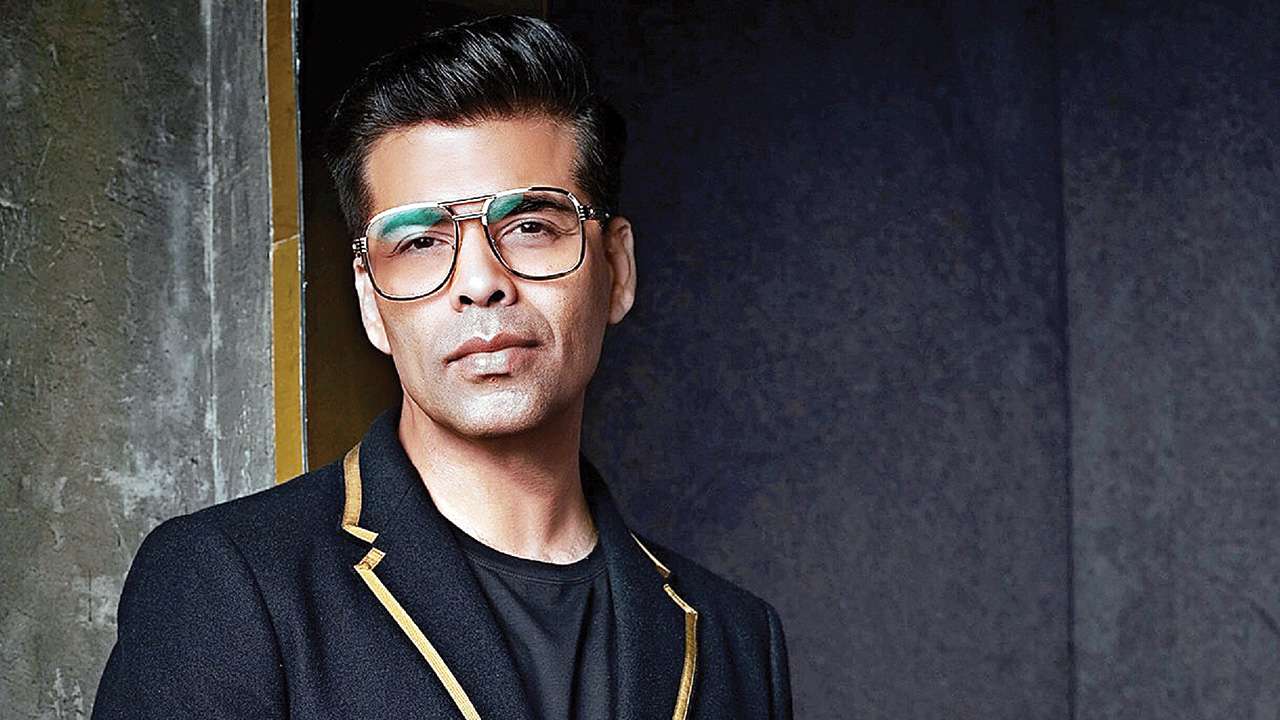
Meena Iyer (DNA; May 25, 2019)
It’s Karan Johar’s 47th birthday today. As reported by After Hrs earlier this week, the blockbuster filmmaker-cum-talk show host has flown to New York to celebrate his big day.
Before he took off, we got our fix of KJo’s magic and mantras. Charismatic as always, he addressed everything from midlife crisis to his anxieties with a candour that is rare and so welcome.
Over to Karan:
First things first, what are your thoughts on turning 47?
There was a point of time when I was very excited about turning 40. I thought it would be a new innings in my life, which in any case it was. So many exciting things have happened to me in my 40s. Like my company (Dharma Productions) has grown, my kids — Roohi and Yash — came. It has been a new life with my babies; they have changed my 40s around. I thought there would be the advent of a love story. I put the message out into the Universe and it came true through my children. The love that I was seeking in terms of a relationship, which I never had, and the loneliness that I felt is gone. The decision to have my children has changed my 40s around and it has changed my mother’s 70s around. It has transformed the fulcrum of our existence. At 47, I have two emotions. One of excitement that I am heading towards the mid-point of my life. There is so much I have to achieve before I turn 50. And the second is anxiety. Sometimes, I feel I have lesser and lesser time with my babies with whom I have the best love story going on.
But do you have any thoughts about ageing too?
There are some thoughts. When I started dressing in a certain way two years ago, I suddenly realised that what I was actually going through was a midlife crisis. I realised I was growing older, so suddenly a lot of colour came into my wardrobe. All the hipster clothes, which maybe I am too old for, came. I don’t care what others think. I am happy with the colours and designs. There are many thoughts in my head — fear, anxiety, excitement and acceptance of my midlife crisis.
However, no outward signs of your midlife crisis are showing?
Well, I just felt I should do everything that I have wanted to do. At a certain point in my life, I may not be able to pull some of this off. If I feel like pouting to my camera, I do just that. There is a lot of abandon. With wisdom comes abandon and there is a certain carefree spirit in my demeanour. I have accepted how I am and I’m not apologetic about it.
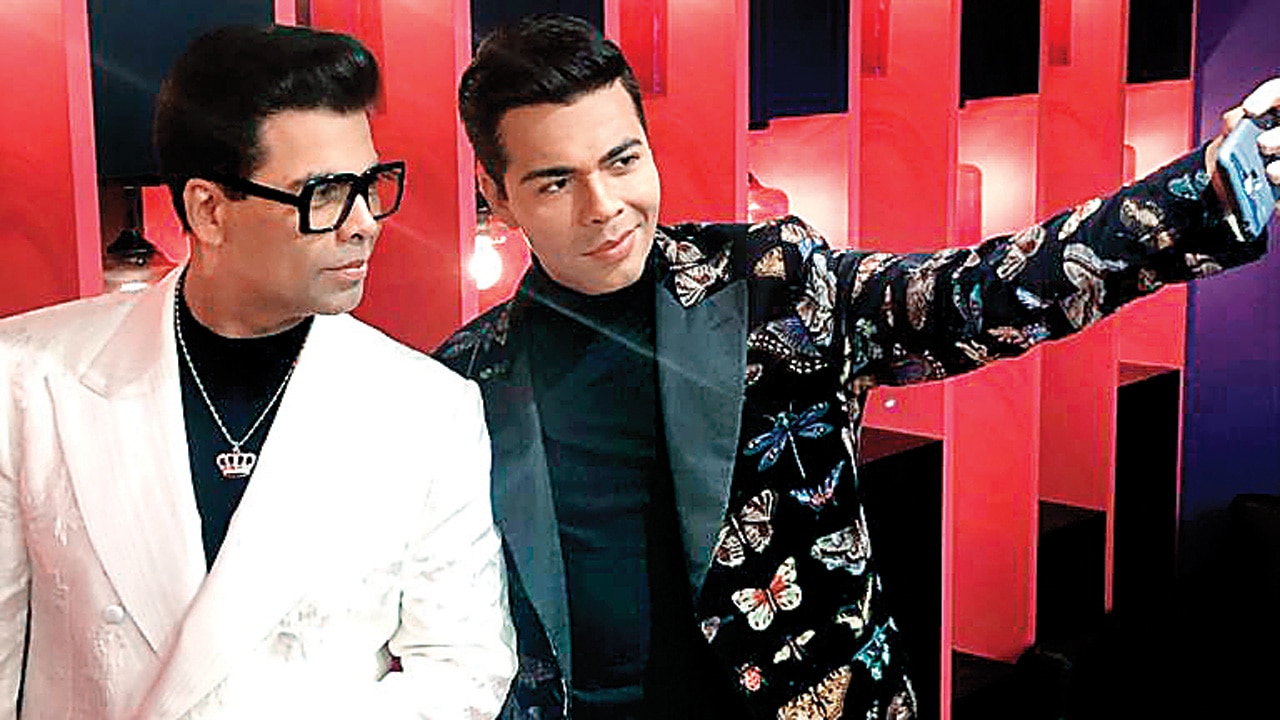
Karan Johar with his wax replica at Madame Tussauds in Singapore
Karan, the seven years since your 40th have seen many highs for you — your book (An Unsuitable Boy), your statue at Madame Tussauds, etc.
I feel fortunate that I have been given a platform to achieve my dreams (making the films I want) and also fulfill some of my hobbies. I have done everything that I love. I love fashion, so I have dabbled in it. I like the idea of being a talk show host and I have that going on for the last 14 years. I love walking on red carpets across the world and I have done that. I have always wanted to tell my story and I did that in my book. I was excited to be at Madame Tussauds because I said, ‘Heck, why not a filmmaker? Why do only actors have to have all the glory?’ I’m happy I’m there. Everything I have always wanted to do cinematically and in my hobbies, I have been able to do in my 40s. I feel blessed. It has opened my plethora of dreams and I feel happy that I achieved most. Now, I feel I have to create new dreams and set new benchmarks. I am hugely excited about what can come beyond this year, beyond 47.
Is there a part two to An Unsuitable Boy?
Yes, there is. I have spoken to Poonam Saxena (my co-author), Shobhaa De and my publisher at Penguin who were with me on my first book. I will definitely do another one. But not immediately. There is so much more to talk about, but I will wait a few years. As I expressed earlier, there’s a lot to address like my fears and anxieties. My babies, who have brought a new aura and energy into my life, will feature in part two of An Unsuitable Boy.
You have a new office closer to your home?
Yes, I do because that way I can spend more time with the babies. Besides this office in Andheri, I also have one in Bandra for my digital work. I have made some structural changes around my professional routine so that I can give my kids the maximum time. I am also blessed to have a mother who is completely hands on. She is there for me and my babies 24/7. This makes me feel peaceful and happy. Instead of making Roohi and Yash work around my schedule, I have been a good parent and worked my schedule around them. That way I can maximise my time around them.
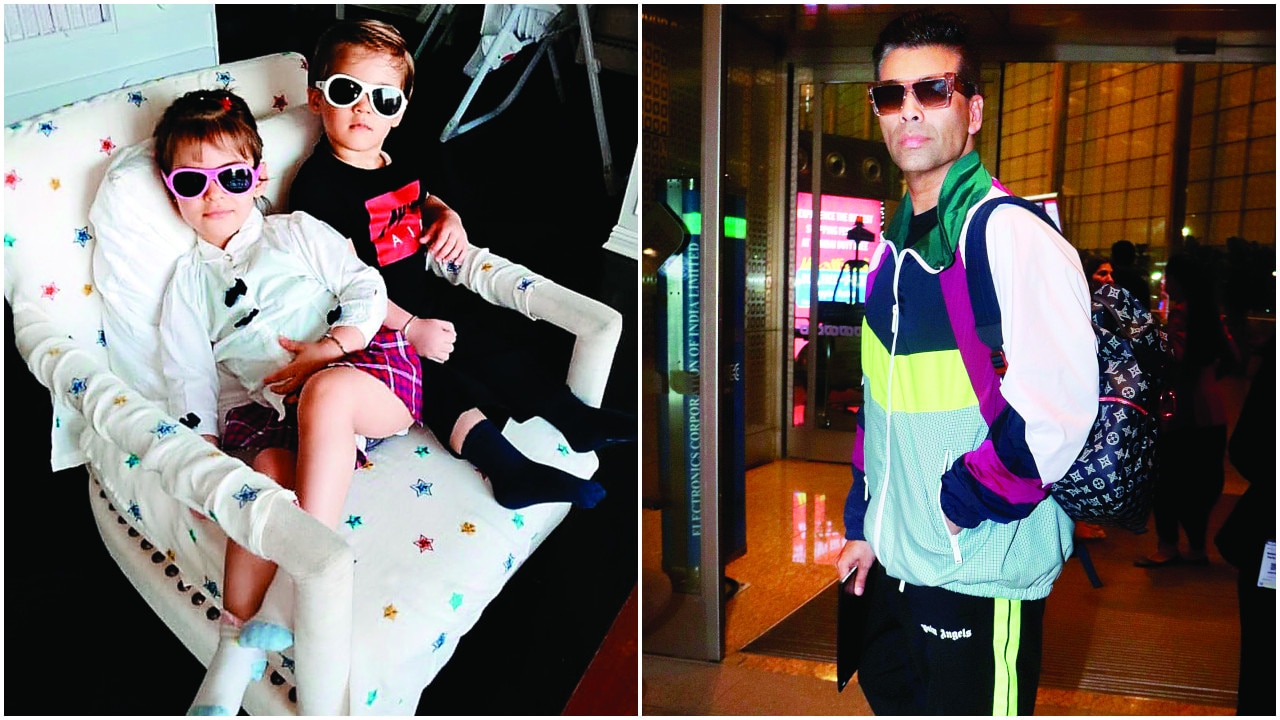
His kids — Roohi and Yash (left) and his style is always on point
Is Roohi more possessive about you?
No. I am only trying to get her attention. I have to chase her to give me a hug and a kiss. On the other hand, each time my son spots me, he flashes a big smile and welcomes me with open arms. Only a parent can understand what that feels like. He gives me all the hugs and kisses I crave for. When I walk into the room, Yash runs into my arms. What happens in my heart at that time is something I cannot describe in words. Barring your own children, who else meets you with so much excitement? I’m always running behind Roohi, who is totally her grandmom’s girl. She calls my mother, ‘Mamma’. My son is interested in me and Roohi is interested in my mother. So, we have our balance right.
Finally, what’s with the grey showing at the temples? Is it deliberate?
No! It’s my hair colour that has let me down (laughs).
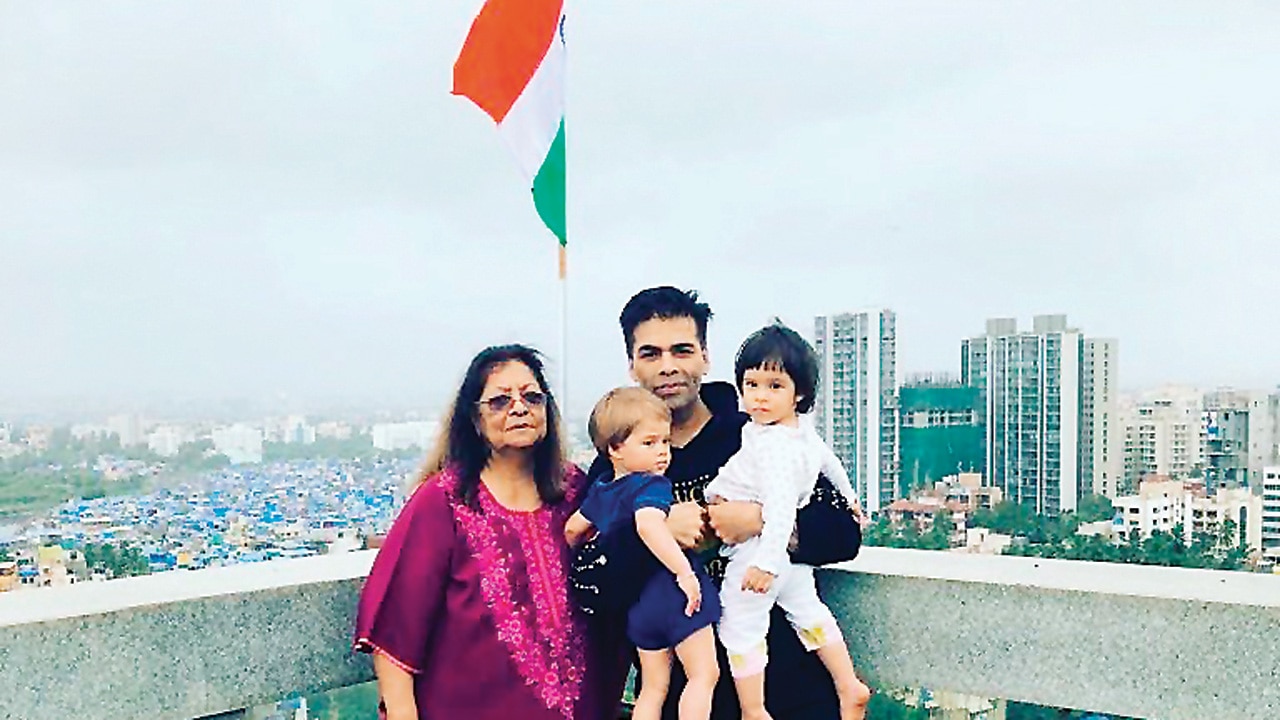
Karan with his mother Hiroo Johar and his twins, Yash and Roohi
Subscribe to:
Posts (Atom)