Showing posts with label Kantara. Show all posts
Showing posts with label Kantara. Show all posts
Bhumi Pednekar to play warrior queen Belawadi Mallamma in The Pride Of Bharat - Chhatrapati Shivaji Maharaj
2:49 PM

Neha Maheshwri (BOMBAY TIMES; July 27, 2026)
Bhumi Satish Pednekkar has come on board the cast of The Pride Of Bharat - Chhatrapati Shivaji Maharaj. The actress will portray Belawadi Mallamma, the warrior queen of Karnataka, in the historical drama headlined by Rishab Shetty, who essays the role of Chhatrapati Shivaji Maharaj.
Bhumi says, “I’m honoured to be part of a film on the life and legacy of the great Maratha warrior-king, Chhatrapati Shivaji Maharaj. It’s a privilege for me to play Karnataka’s brave warrior queen, Belawadi Mallamma, and bring her to life on screen. I am a huge Kantara fan, and Rishab Shetty’s stunning performance blew me away. So, the moment Sandeep narrated the film, the actor in me instantly said yes. This is unlike anything I’ve done before, and I’m grateful to the makers for seeing me in a completely new light.”
Directed and produced by Sandeep Singh, The Pride Of Bharat - Chhatrapati Shivaji Maharaj is a two-part saga. The film also stars Arjun Rampal and Vivek Oberoi and is set to go on floors later this year.
As reported by us earlier, following Pritam’s decision to take a break from mainstream music, the makers roped in Amit Trivedi to compose the music for the historical drama.
A source had shared with us, “The team believes Amit Trivedi’s ability to blend powerful orchestration with deeply rooted Indian melodies makes him an ideal fit for the film’s vision. The music has to capture Chhatrapati Shivaji Maharaj’s courage, vision, legacy and the emotional heartbeat of the story. The makers were looking for a composer who could balance scale with emotion, and they are confident Amit’s music will elevate the film’s narrative while staying true to its historical essence.”
Character graph ke pehle business graph ki baat karte hai yahan-Amit Rai
10:52 AM

Onkar Kulkarni (MUMBAI MIRROR; July 17, 2026)
After OMG 2, filmmaker Amit Rai could have easily followed up with a bigger, star-led commercial film. Instead, he has returned with Ohh My Dog, a film led by a 12-year-old boy and an indie dog. Rai says, “The urge to tell that story is always the main reason to go forward, irrespective of whether it is a big or small budget film. Stars, studios and budgets are subservient to the story and not vice versa.”
He admits he could have mounted a larger commercial film after OMG 2. “I chose to tell this story because it came to me organically. I have a dog who is like my son, and I have been amazed by the love and loyalty he has. It was he who inspired this story.”
Rai is also unsparing in his assessment of where he believes the Hindi film industry is headed. “The problem with our industry is that we are not making films but mounting projects. There is something essentially wrong in the way we approach storytelling. Character graph ke pehle business graph ki baat karte hai yahan, scene construction se jyada PPT, pie charts aur territory par focus hai.”
He believes storytelling has taken a backseat. “Many of us have forgotten that film is essentially about story, characters, situations and human emotions. Film business is because of the story and not vice versa. Given the myopic approach of the decision-makers, the room for meaningful storytelling has shrunk. It is a rat race here. No one is eager to take risks with unique concepts. I am not a fan of formulas. I follow stories. I reinvent myself with every story — that is the only formula I follow.”
Drawing a comparison with regional cinema, Rai says audiences are rewarding originality over formula. “In the era of digital and content saturation, you cannot keep offering the same content. That is the reason Hindi films are losing relevance and business to regional films, who are offering cinematic experiences, right from Pushpa to Manjummel Boys, Dashavatar, Kantara and Mahavatar Narsimha.”
Big budgets, bigger losses: Is pan-India ambition hurting Kannada cinema?
8:39 AM

Single screen theatres are banking on re-releases. The re-release of Puneeth Rajkumar’s ‘Appu’ in 2025 and ‘Jackie’ in 2024 witnessed houseful shows and contributed significantly to the revenue. Credit: DH file photo
S R Ramakrishna, Pranati A S (DECCAN CHRONICLE; March 15, 2026)
Bengaluru: Kannada cinema, with a history of 92 years, is grappling with a new dilemma — should it cater to the pan-India expectations generated by blockbuster hits such as KGF and Kantara, or make less expensive cinema with better box office prospects in Karnataka?
In the six years since the gangster drama KGF hit the screens, many filmmakers in Karnataka have attempted richly mounted, big canvas productions, with national and international audiences in mind. Not many have succeeded, and the focus on scale has created a void in an industry otherwise conservative in its spending.
The industry is paying a hidden price for its obsession with pan-Indian cinema, many insiders told DH.
The sequels to KGF and Kantara (in the latter case, the story goes back in time from where the first film began) have continued their winning streak at the box office, but most other ambitious ventures have tanked.
Kabzaa (2023), starring Shivarajkumar, Upendra and Sudeep, and 45 (2025), starring Shivarajkumar, Upendra and Raj B Shetty, are just two of the many films that came in the wake of the big hits and lost their way. Some films have fared so poorly that their producers have sworn off films for life.
Of the 253 Kannada films produced in 2025, only a handful have recovered their investments. The numbers were equally discouraging in 2024, with just 10-12 moderate grossers and almost no big hits. Film production is always a gamble, but when the odds are so bleak, the enthusiasm for creative risks takes a hit.
Ravichandra A J, producer of the sleeper hit Blink (2024), believes production houses with deep pockets — for example, Hombale Films, which made KGF Chapter 1 and 2 — should not remain wedded to lavish spectacles. “They should back young filmmakers,” says Ravichandra, who has distributed Shakhahari and Second Case of Seetharam, films with tight budgets.
The theatrical success of Blink, a sci-fi shot with theatre actors on a shoestring budget, brought hope. While most films pitched to pan-Indian audiences failed, Blink went from being hyper-local to becoming pan-Indian, finding love on OTT. It was dubbed into six Indian languages and released on Amazon Prime.
A producer who requests anonymity believes the gloom can be dispelled by enlightened project choices. “When an industry is in distress, production houses must make films with reasonable budgets, say with Rs 50 lakh to Rs 100 crore. An industry needs films made at different budget points. In Telugu, six or seven production houses are actively making all kinds of films. Mythri Movie Makers, for example, makes a Rs 500 crore film and follows it up with a Rs 5 crore film.”
The production numbers are high mainly because of Karnataka’s subsidy policy. More than 200 films are made every year, many with an eye on the subsidy rather than the box office. The government gives subsidies to 100-125 films a year, with each film getting Rs 10 lakh. Subsidies have hit a road block though. Citing a financial crunch, the government hasn’t given subsidies from 2018-19. Just last week, Chief Minister Siddaramaiah promised to clear the dues, and the talk is that, going forward, subsidies will be discontinued.
Amid the despondency, cinema from the Karnataka coast has driven home many telling points. Su From So (2025), scripted and directed by J P Thuminad, did not bank on big promotions; instead, it went entirely by word of mouth. The comedy, produced by Raj B Shetty’s Lighter Buddha Films, drove home an anti-superstition message, and became the second-highest grosser of the year. Rare hits of the past couple of years, such as Su From So, owe their success to their writing, and not so much to stars or big banners.
Actor-producer Dhananjaya K A believes actors and producers who have reaped the fruits of blockbuster hits should encourage younger filmmakers from diverse backgrounds, and that is the way to keep the industry ticking.
He tasted success as an actor with Tagaru (2018) and the Telugu hit Pushpa: The Rise (2021), and set up Daali Pictures in 2021 with the objective of promoting fresh talent. His productions Badava Rascal (2021) and Tagaru Palya (2023) impressed audiences with their storytelling strength and production compactness.
Craft of writing
Some filmmakers such as Rishab Shetty assert, and rightly so, that truly local stories can have universal appeal, but the lens is blurred when an entire industry begins to chase pan-India dreams. As film critic Swaroop Kodur says, stories are no longer rooted when an industry is obsessed with catering to huge, imaginary audiences.
A consequence is that films blindly follow other films, with no attention being paid to original writing. When a film is structured exactly like last year’s hit, it is more redundancy than inspiration. Kabzaa came out of KGF, and so many 'Kantaras' are still in the making.
Formulaic films have existed since the beginning of cinema, and certain tropes are indispensable in storytelling, but for a film to be fresh, filmmakers trying to break the mould say, it must draw from contemporary realities. “Big films have always captured our imagination, but we are at a point when we are exhausted by the hype. There is so much to deal with in real life, and then we have a visual overload because of social media, and so increasingly, cinema is taking a backseat,” Kodur says.
In Karnataka, unlike in neighbouring Kerala, the literary community has remained distant from the film industry. Some Kannada directors, such as Puttanna Kanagal, were aware of literary works, and often based their films on novels and their songs on the poetry of the greats, but that was another era. With some exceptions, most filmmakers in current Kannada cinema are oblivious to the wealth of possibilities in contemporary literary writing.
Aravind Kaushik, director of offbeat films Nam Areal Ond Dina (2010) and Tughlaq (2012), says the industry lacks filmmakers who see their art as a medium to express their unique perspectives. “Instead, the focus has shifted towards market-driven content, prioritizing entertainment and box office success over meaningful storytelling. This disconnect leads to inflated budgets and a loss of connection between the film and its audience,” he says.
Ticket pricing
Multiplex culture, with its premium ticket pricing, is designed for big-budget films, and so it is detrimental to smaller, independent cinema, he says, advocating a curated distribution system that works on the lines of film festivals and cinema clubs. A ticket should ideally be priced below Rs 200, and that would make cinema more accessible and democratic, Kaushik says.
Producers are flooded with pitches, and they see a pattern. “Every director wants to make a pan-India film. Out here, Kannada audiences have lost trust in the industry. We have to first gain their trust back. We have to understand the market here and the focus should be on the market here. Instead, everyone is after the ‘pan-India’ market,” says a producer. Talking about the Arjun Janya directorial 45, a multi-starrer produced by Ramesh Reddy that fizzled out at the box office, he says, “Good producers sadly are falling into the wrong hands.”
Ravichandra believes that nothing may come out of the Rs 200 ceiling on tickets in the short term. As a marketing strategy, Second Case Of Seetharam, a slick police procedural starring Vijay Raghavendra, opened preview shows for Re 1. And yet the halls remained empty, he says. Subsequent reports said the film had picked up and was doing well in Tamil Nadu. Ravichandra argues that the ceiling on ticket rates, if implemented, will create a more democratic cinema viewing culture in the future. A production house in Bengaluru is contesting in court the Siddaramaiah government’s decision to cap ticket rates at Rs 200.
Cinema as ‘content’
Where writing is concerned, Kaushik underlines the importance of the individual voice: “Any form of art including cinema becomes a product later. It is primarily an expression of who the artist is.” The market for mass-produced ‘content’ reaches a point of saturation, and that is where the Kannada film industry is at today, he says.
“We have to up our game as far as storytelling is concerned. Filmmaking in itself is not very difficult today. So the primary question we have to ask ourselves is why we are making a film. Everyone is running behind big budgets, where every actor aims to become a star and every movie aims to become a pan-Indian movie,” he says.
Insiders agree the industry is facing numerous challenges — the inability to invest in writing, the refusal to accept failure, and a focus on short-term gain rather than long-term consistency.
A new problem is the paranoia that has gripped filmmakers when their productions are panned by critics. Many production houses orchestrate a positive reception for their films by paying TV and social media channels for promotions. The first three days after a release are crucial for a film’s success, and many producers set aside money to create a buzz. Sometimes, they end up blaming independent critics for the failure of their films.
OTT challenges
A season of misselling may have created a crisis of credibility for Kannada films when it comes to OTT. “They treat calls from Kannada productions like credit card spam calls,” a filmmaker says. When hyped films, sold to OTT in 2023 at fantastic rates, fared miserably at the theatres, the OTT bosses became wary.
Amazon Prime Video now follows a pay per view model for Kannada films — Rs 4 per hour of viewing. If a viewer watches a full film, the producer gets Rs 10. Netflix buys outright streaming rights for Telugu and Hindi films, and JioHotstar is picking up films in Tamil, Telugu Malayalam and Hindi. Zee buys both streaming and satellite rights of films that have performed well in theatres.
The argument that Kannada cinema has a limited market is often countered by hits that defy the odds, and film buffs recall fondly how, when Rajkumar, Vishnuvardhan, Ananth Nag, Shankar Nag, Srinath and Ambarish were delivering commercial hits, a cinema inspired by literature emerged parallelly. The industry is at such a crossroads all over again.
You can’t expect a Pushpa, Kantara or RRR from Bollywood; makers want to play safe-Madhur Bhandarkar
10:10 AM

Toshiro Agarwal (BOMBAY TIMES; December 19, 2025)
Filmmaker Madhur Bhandarkar feels that talent can emerge from any platform when it comes to showbiz—theatre, TV, OTT or films. “Also, if a filmmaker wants to narrate a story today, all they need to do is take out a mobile and create the entire narrative,” he adds. Speaking to us on the sidelines of the second edition of Symbiosis Film Festival, the Page 3 and Fashion director touched upon his style of filmmaking, Bollywood’s lack of conviction and more. Excerpts:
‘My movies are grounded and my stories, basic’
In the 2000s, Madhur’s brand of cinema was celebrated as raw and realistic. Ask him how his storytelling has evolved over the years and he says, “My storytelling hasn’t evolved at all. I’m still making what I used to make back in the 2000s. I always say that I am a storyteller, not a tech-savvy filmmaker. My movies are very grounded and my stories are basic, about everyday lives of people. It’s just that my films have aged well as I mainly focus on human dramas.”
The Babli Bouncer and India Lockdown filmmaker adds that human drama is something that will connect with you ‘even after 100 years’. “Technology will come and go, but the emotions or complexities of relationships will always be relevant no matter what the backdrop is, be it a corporate world, or politics, or even the film industry. My style is to make realistic cinema and I will continue to do so,” he says.
‘Storytelling has changed, but Bollywood lacks conviction’
“Every five years, there is a major revamp in the film industry,” says the filmmaker, who will return to the big screen next year with The Wives. He feels that with OTT, a lot has changed. “The audience is now more aware of world cinema. As a result, Bollywood’s storytelling also has changed a lot. However, Bollywood lacks rawness and conviction. If tomorrow somebody narrates a story like Kantara to a Bollywood filmmaker, they will not be entertained,” opines Madhur.
Applauding Rishab Shetty for his vision, the Heroine filmmaker adds, “You can’t expect films like Pushpa, Kantara or RRR from Bollywood. Because Bollywood wants to play safe with tried and tested remakes of south Indian films. Actors ko original movie dikha denge, bol denge zyada mehnat nahi karni hai, yeh picture hai, South mein chal gayi yahan bhi chal jayegi. Despite this, in the last five years, most Hindi remakes of south films have flopped. There are so many stories in Bollywood that are waiting to be explored.”
‘There’s a lot of noise about everything due to social media’
His films have drawn contrasting opinions, and Madhur says he understands that. “There will always be people who liked something and others who didn’t like it. The reception of a film will never be unanimous,” he says, adding, “But, nowadays everyone is just picking films apart. Thanks to social media, everyone has a voice and now there is a lot more noise. Having said that, I care only about my audience. They are the reason I am where I am today.”
On the backlash on Ranveer Singh’s Kantara reenactment at IFFI
Madhur was at IFFI when the incident involving Ranveer Singh trying to mimic Rishabh Shetty’s Kantara performance happened. Sharing his stance on the controversy, he says, “I felt that he took it a little too far. That said, he owned up to it and apologised, which is commendable. I think he was praising the performance and got lost in the flow. In the process, he crossed a line.”
Rishab Shetty reacts to Ranveer Singh’s Kantara mimicry controversy
9:51 AM

At the International Film Festival of India (IFFI) in Goa, actor Ranveer Singh courted controversy when he mimicked daivas on stage. Now, Kantara actor-director Rishab Shetty has commented on the incident at an event in Chennai.
Without naming Ranveer, Rishab spoke on stage about how there’s always a risk when making a film like Kantara that culture and tradition may be reduced to pop culture. He stated that as a filmmaker, he took the guidance of several elders to ensure that everything was portrayed with respect.
He said that once a film releases, people tend to mimic it. “That makes me uncomfortable. While much of the film is cinema and performance, the daiva element is sensitive and sacred. Wherever I go, I request people not to perform it on stage or mock it. It is emotionally deeply connected to us”, said Rishab.
Controversy arose when Ranveer mimicked daivas while meeting Rishab at IFFI, ignoring his request not to. Ranveer later apologised on Instagram, saying he respected all cultures and traditions.
Anti-heroes are fine, but heroes ab rakshas ki tarah lagtey hain-Tigmanshu Dhulia
10:54 AM

Filmmaker Tigmanshu Dhulia criticizes the violence, hyper-muscular heroes, and demon-like characters in today’s action films
Deep Saxena (HINDUSTAN TIMES; December 3, 2025)
Filmmaker Tigmanshu Dhulia has major problems with the violence, bloodshed, hyper-musculinity and rough anti-hero looks of actors in most action-packed films today. Calling out heroes wearing demon-like looks in superhit films, he is surprised that they are doing well at the box office.
“The problem with today’s films, which are being made in abundance and are being loved by the audience, is with the angry characters! These KGFs, Kantaras and all show too much violence and bloodshed. This maar-kaat started with Baahubali (2015) and is just growing,” says Tigmanshu. He adds, “Bematlab ki maar-kaat rahe hain, khoon baha rahe hain! And, in a series, such films are coming and are being liked by the audience.”
Trying to decode their appeal, he says, “Probably, there is an anger in society and people are not able to vent it out, so they are maybe connecting with these films and liking them. I don’t understand the DNA of such films, but personally, I don’t like it at all.”
The filmmaker adds, “Anti-heroes are fine, but heroes ab rakshas ki tarah lagtey hain and youngsters like it and follow the trend. With such long hair and beards, they just look like rakshas we have seen in Ramayana and Mahabharata. Pata nahi kya ho raha hai!”
On the sidelines, when asked about skipping films like Animal (2023) —which has been singled out for its violence and other factors—he says, “Yes, that is also true and I don’t agree with certain things, but overall I liked the film!”
The filmmaker clarifies that his films, too, are alpha male films but exist within a framework of morality. “Yes, my films are typically alpha male films, and I admit that I can’t make (Sanjay Leela) Bhansali-type films! But, they draw a moral line – they won’t tease a girl, and if they do wrong, it will be for a bigger cause.”
He explains, “My characters are in search of freedom, and they question the authorities. Probably, that has come from the fact that Allahabadis (people from Prayagraj, Uttar Pradesh) don’t fear anybody, and that is a unique character of the people of the city. Since I was a kid, I have liked action, cowboy-type films, and that reflects in my characters, be it Haasil (2003), Paan Singh Tomar (2012) and others.”
The South is eating OTT’s lunch; Bollywood isn’t the main course anymore
9:49 AM

Once built around a Bollywood-first script, India’s streaming economy now finds its biggest growth engines and creative bets firmly rooted in the southern states
Javed Farooqui (THE ECONOMIC TIMES; November 26, 2025)
Over the last decade the gravitational pull of India’s entertainment economy has shi fted unmistakably southward. What began as sporadic national curiosity, gradually swelled into a full-blown cultural crossover. When Naatu Naatu from the Ram Charan-NTR Jr starrer RRR lit up the Oscar stage, it signalled that southern cinema was no longer rising quietly; it was asserting itself at the centre of India’s mainstream imagination.
That momentum has now spilled decisively into the OTT universe. For years, India’s streaming landscape ran on a Bollywood-first operating system. Budgets, narratives, and viewer targeting were all sculpted around the Hindi-speaking market.
But the lockdown years changed viewing behaviour dramatically. Housebound and hungry for fresh stories, audiences began exploring Tamil, Telugu, Malayalam and Kannada films in unprecedented numbers. The runaway popularity of Pushpa: The Rise - Part 01, Kantara and RRR ensured that southern storytelling was no longer incidental, it was central.
Among the southern-language industries, Malayalam cinema has emerged as the most intriguing outlier. Despite being the smallest in scale, it has consistently punched above its weight. Films like Manjummel Boys and Aadujeevitham - The Goat Life have travelled across states, while titles such as 2018 and Premam have shown modest overseas draws. Its combination of creative discipline and financial prudence has strengthened the entire value chain, making Malayalam cinema an appealing proposition not just for theatres but also broadcasters and streaming platforms chasing quality content with dependable economics.
Battle for Eyeballs
Today, the fiercest battle for subscribers, originals and film rights is unfolding in southern India. Tamil Nadu, Telangana, Andhra Pradesh, Kerala and Karnataka have become high-growth markets. Every major platform is investing aggressively, drawn by more than 250 million people, deep digital penetration, mature entertainment habits and a willingness to pay.
L V Krishnan, chief executive officer of TAM Media Research, notes that southern audiences have historically shown about 50% higher content consumption. “With growing digital penetration and diverse storylines, content consumption is being further boosted by streaming platforms. Easy and cost-effective AI-driven dubbing has broadened the appeal of southern content to a global audience.”
India’s streaming ecosystem has exploded to 57 OTT platforms, spanning national giants and regional players like Aha, Sun NXT and ETV Win. Ormax Media estimates the country’s OTT audience will touch 600 million by year-end, powered by rising connected-TV usage expected to hit 129 million. With 562 million smartphones and nearly 50 million connected-TV screens, digital entertainment is now the default mode of consumption.
Content Counts
Content supply has kept pace —India churns out close to 200,000 hours of original programming a year—from over 1,600 films to more than 2,600 hours of premium OTT series, says a FICCI-EY report. Paid streaming is also expanding, with subscription video users projected to rise from 47 million in 2024 to about 65 million by 2027.
Although platforms do not reveal regional subscriber splits, executives say the South contributes disproportionately to paid users and viewing hours. The region’s 143 million OTT users nearly match North India’s 151 million despite its smaller population base, according to Ormax. Half the southern population already consumes OTT content, the highest penetration in India.
The investment momentum reflects this energy. Platforms are building larger content teams in Chennai and Hyderabad, experimenting with new pricing models and aggressively commissioning original series that reflect local culture rather than merely ticking regional boxes. The era of token presence is over; depth is the new strategy.
For Netflix, Prime Video and ZEE5, southern growth is fuelled by blockbuster films and originals. For JioHotstar and Sony LIV, sports strengthen their entertainment pipeline. Local giants such as JioHotstar and ZEE5 also benefit from steady daily TV content that reinforces platform stickiness.
“Streaming created a watershed moment for South cinema. During the pandemic, high quality subtitles and dubbing removed language barriers and audiences discovered stories they never had access to,” said Monika Shergill, VP content, Netflix India.
On a New Platform
In 2022, South content viewership grew 50% year-on-year, with South titles appearing in Netflix’s global non-English Top 10 list in about 17 countries the following year. This number has now risen to 26. Last year, Vijay Sethupathi’s Maharaja became Netflix’s most-watched Indian film globally.
“South storytelling is not just becoming bigger in India, it is becoming mainstream. A large part of our slate today consists of South movies, and we acquire the Hindi dubbing rights along with multiple subtitle and dubbing language rights. This allows these powerful films to travel across different audiences,” Shergill said.
Early OTT investment focused heavily on acquiring South Indian films. Titles such as Pushpa, Kantara, Kalki 2898 AD and KGF fetched some of the highest digital acquisition fees. Films still trigger subscriber spikes, but platforms are now investing more in long-form originals to build retention.
Netflix recently announced six new Tamil and Telugu originals, underscoring long-term commitment.
“We currently have about 26 shows in development, negotiation or production for the South. This is the largest pipeline of South Indian content we have ever had,” said Nikhil Madhok, director and head of originals, Prime Video India, adding that 60% of users watch content in multiple languages.
Sony LIV is developing 13 regional originals, 11 of them from the South. Sony LIV’s business head Danish Khan said the South’s strong legacy in films and television raises creative expectations. “Tamil and Telugu are large markets both within India and internationally. Malayalam has become a supplier of strong stories across India.”
Khan noted that consumption patterns in South India mirror national trends—sports, films and originals drive engagement. Sony LIV acquires only select Malayalam films for cost efficiency. The subscriber split is around 80:20 male to female and viewership is 70:30 in favour of men. “OTT penetration in South India is already high and content consumption per user is higher than the national average,” he said.
“We anticipate a substantial rise in the volume of OTT content originating from the South in the coming years.”
JioHotstar plans to triple its South slate to 1,500 hours of original and acquired programming over the next year. JioStar head of entertainment, South cluster, Krishnan Kutty said one-third of the platform’s viewers are from the South and account for a disproportionately high share of watch time.
“The Tamil and Telugu markets are the largest in terms of heft and creative ecosystem. Kerala punches far above its weight because it has a strong pool of storytellers. Some of our most successful movies and specials have come from Kerala. In Karnataka, we are at an early stage, but we are very excited about that market too,” Kutty said.
ZEE5 chief business officer Siju Prabhakaran said, “South contributes up to 45% of our total OTT watch time. Language packs contribute roughly 60-70% of our new subscribers. Each market has a business head who understands local culture and stories. For us, content is the hero.” ZEE5’s language packs are priced at Rs. 99 per month and Rs. 699 annually.
Plot in Story-telling
Executives say South Indian audiences are shaping a distinct OTT playbook. The region’s entrenched TV habits and strong cinema culture push platforms to create habit-forming content. Films remain the biggest subscription catalyst, with Prabhakaran estimating 50- 60% of new subscribers still coming from movies. Prime Video also notes the South’s affinity for films.
To build retention, platforms are adopting TV style storytelling. JioHotstar’s 80–100 episode series are “breaking conventional norms of digital content” as viewers return weekly. ZEE5’s OTT-first reality shows are among its biggest non-fiction subscription drivers.
The South is no longer a regional appendage to the national entertainment market. It has become the creative engine powering India’s soft-power ambitions. As language barriers fall and audiences embrace Indian stories, creators from Tamil Nadu, Telangana, Andhra Pradesh, Kerala and Karnataka are leading the charge. Streaming has not only expanded southern cinema’s audience; it has reshaped India’s entertainment economy and its cultural centre of gravity.
THE GREAT EXPANSION
- JioHotstar plans to triple its South slate to 1,500 hours over next year.
- Prime Video has 26 South-origin shows in the pipeline.
- SonyLIV has 13 regional originals, 11 of them from the South.
- ZEE5 says the South accounts for 45% of its OTT watch time, driven by aggressively priced language packs.
- Netflix has announced six new Tamil and Telugu originals; says views of South content grew 50% YoY in 2022.
When Rishab Shetty narrated Kantara, I thought, ‘If I don’t do this, I’m an idiot’-Gulshan Devaiah
10:26 AM

Mohar Basu (MID-DAY; October 11, 2025)
A man of cinema — that was Gulshan Devaiah’s first impression of Rishab Shetty when they met in 2019. The impression only strengthened when he saw Kantara (2022) and was admittedly blown away by it. “We tried to work together on two or three films, but it didn’t happen. I knew he’d call me someday. When he did, he said, ‘I’ve written a part for you’,” recalls Devaiah, who is being widely praised for his performance as the eccentric King Kulashekara in Kantara: A Legend Chapter – 1.
Devaiah vividly remembers Shetty’s narration of the mythological drama. “When Rishab narrated it, I thought, ‘If I don’t do this, I’m an idiot’. I knew it wasn’t the biggest part or that I wasn’t the protagonist, but the main attraction was Rishab — his passion towards telling his stories. You learn by working with such people.”
Kantara: A Legend Chapter – 1 marks Devaiah’s Kannada debut. Not many know that the actor hails from Karnataka. “I belong to Kodagu. I grew up speaking the language, so what a debut this is,” he exclaims.
Before facing the camera for the Shetty and Rukmini Vasanth-starrer, Devaiah did extensive workshops to bring his character alive. His attempt was to go beyond the written word. “I came up with many ideas. Part of the character was made in the script, part in my head, and the rest was made on set. Rishab gave me a lot of creative freedom,” he smiles.
Recently, he called his character Kulashekara as an “entitled, jealous, good-for-nothing, perpetually drunk idiot.”
Ask him to elaborate, and he says, “Humans like Kulashekara exist — perpetual drunks with sensitive egos. Even in our film industry, there are so many like that. If your approach is sincere, such characters will feel real. Kantara is a fantasy, but I had to give it the feeling of being real. You see glimpses of humanity in him, especially in his brief interactions with his daughter. From the film’s perspective, he’s a villain. From his perspective, he’s the beginning and end of everything — a self-indulgent person. Both views are valid.”
mid-day recently reported that after people showed up in theatres dressed up as Daiva, Shetty urged his fans to refrain from such acts, deeming them disrespectful. Devaiah reflects, “When I saw the film, it made me feel in a way I didn’t expect, and I respected that. I support the makers’ plea. People should refrain from making it a cheap gimmick for virality.”
Did Kantara: A Legend Chapter – 1 affect Sunny Sanskari Ki Tulsi Kumari’s box office run? Trade experts weigh in
9:57 AM
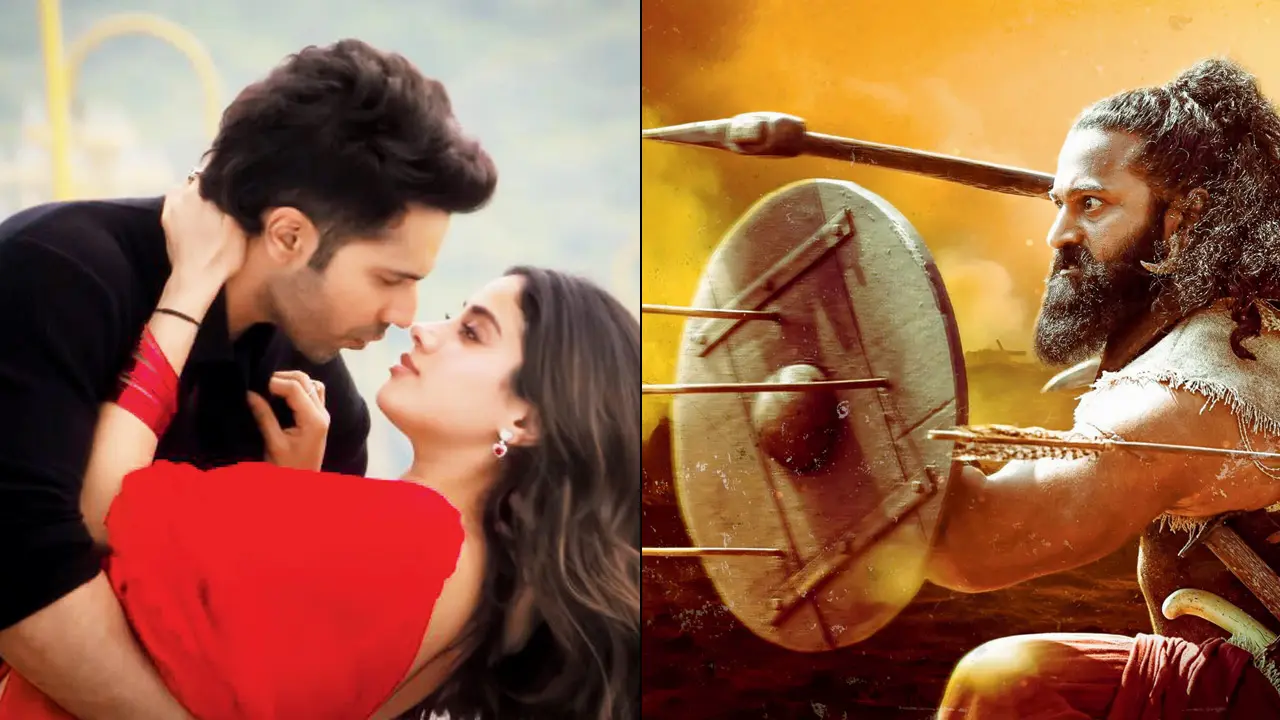
With the Hindi version of Kantara: A Legend Chapter – 1 earning almost double of Sunny Sanskari Ki Tulsi Kumari, trade attributes it to the former’s brand value and the rom-com’s lack of novelty
Priyanka Sharma (MID-DAY; October 6, 2025)
Two diverse offerings, a mythological spectacle and a romantic comedy, were presented to the audience over the extended four-day weekend. The audience has made its pick known, loud and clear. Rishab Shetty’s Kantara: A Legend Chapter – 1’s Hindi version is poised to end its opening weekend run at over Rs 60 crore, in contrast to Varun Dhawan and Janhvi Kapoor’s Sunny Sanskari Ki Tulsi Kumari, which has reportedly made over Rs 30 crore.
Set to amass a whopping Rs 200 crore by the night of October 5 across languages, the dominance of Shetty’s Kannada feature in the South market is not surprising. Bihar-based exhibitor and trade analyst Vishek Chauhan notes that the mythological drama is ruling the Hindi belt too. “In Karnataka, it’s a blockbuster, and [in other markets too], the film is making big money. It’s a super hit in Hindi,” he tells mid-day.
Given Kantara’s (2022) phenomenal run in the Hindi belt, the trade expected the second instalment to open bigger. However, Chauhan considers that an unrealistic ask. He reasons, “The trade thought that since the original broke out like the KGF and Pushpa franchises, the second part would follow the same trajectory and open at Rs. 30-40 crore. But Kantara doesn’t have any commercial hooks, like songs or romance. To expect it to open like a conventional blockbuster is [wrong]. The 2022 film’s [Hindi version] opened at Rs 2-3 crore, and this one did at Rs 17 crore. So, it has done six times the first part’s opening day.”
Rajasthan-based exhibitor Raj Bansal says while the festival release benefitted both the films, Sunny Sanskari ki Tulsi Kumari’s opening was compromised due to the clash. “I believe Sunny Sanskari… earned around 25 per cent less than it should have,” Bansal tells mid-day, before pointing out that Shashank Khaitan’s directorial venture has little going for it.
“There is no novelty in the story; it’s routine feel-good cinema. We have about a dozen of such stories coming. So, the audience didn’t get excited about the film. Varun’s last few films haven’t fared well. That also affects a release’s opening day collection.”
With the collections set to take a drop on Monday, trade expects Sunny Sanskari… to wrap up with a lifetime business of Rs. 60-70 crore. Chauhan adds, “This is concerning for Varun because this will be another flop for him. He needs to introspect because [rom-coms] were his turf.”
Will Kantara: A Legend – Chapter 1 affect Sunny Sanskari Ki Tulsi Kumari at the box office? Trade speaks up
8:50 AM
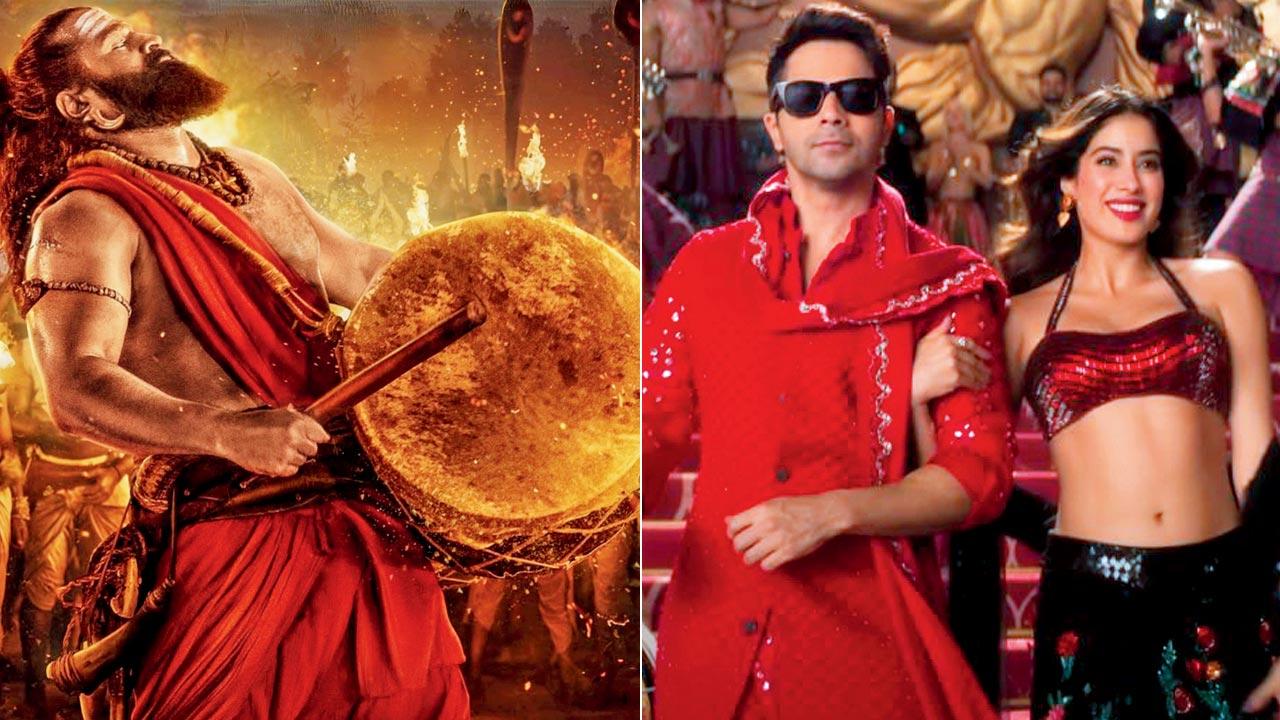
Mohar Basu (MID-DAY; September 29, 2025)
Festival releases often translate into a box-office clash. With Sunny Sanskari Ki Tulsi Kumari and Kantara: Chapter 1, however, the war has begun even before they hit the theatres on October 2. The two releases are engaged in a screen war, which started when the distributors of the Rishab Shetty-starrer asked that the mythological action drama be allotted all single-screen theatres across the country and a dominant share of prime shows in multiplexes. This sparked a backlash from the makers of Sunny Sanskari Ki Tulsi Kumari, who have now insisted on equal screen division across key territories.
Even as the two movies’ advance booking has opened, exhibitors fear being the worst hit as they will end up disappointing at least one major distributor no matter what they decide. Single-screen owners, especially in Tier-2 and -3 towns, are said to be under intense pressure from each party to increase the respective film’s shows.
The ongoing clash has left the trade on edge. Delhi-based screen owner Gurmeet Seble told mid-day, “Such clashes hurt everyone — producers, exhibitors, and sometimes even the audience, who may find their choice of film unavailable at their nearest theatre.”
Ramesh Bala, a leading trade analyst, noted that while Kantara: Chapter 1 is expected to dominate screens in South India, the Varun Dhawan and Janhvi Kapoor-starrer will benefit in the northern region.
“In the past, Kantara commanded the maximum share of screens in the South. In the North, the division of screens depends on advance bookings, with multiplex chains adjusting their show counts closer to release based on early demand. Dharma Productions has influence in the North, especially in multiplex circuits. That gives Sunny Sanskari... a negotiating edge in those markets,” he analysed.
Bala pointed out that the two films belong to different genres, and hence, will target different sections of the audience. “A middle ground will have to be found before the release weekend. By the Monday after the release, word-of-mouth will decide the hold.”
Trade analyst Taran Adarsh revealed that there isn’t a neat 50-50 division across Mumbai screens. “In most multiplexes here, Kantara is getting more screens. The buzz is based on the euphoria of the last part [Kantara, 2022]. Sunny Sanskari... is a happy family film with a wedding backdrop and will pull crowds in the North sector.”
Chhaava opened up Maharashtrian history to the world-Siddharth Singh, Garima Wahal
8:39 AM
Akash Bhatnagar (HINDUSTAN TIMES; April 13, 2025)
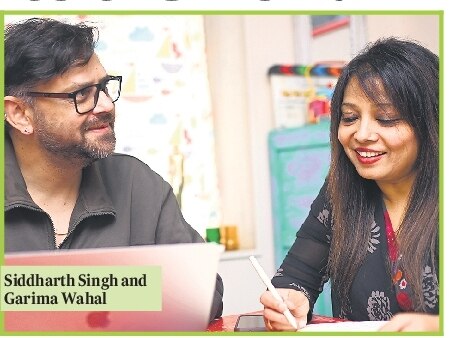
Two months after its release, Vicky Kaushal-starrer Chhaava is still seeing an impressive theatrical run. Now, lyricist-writer-director duo Siddharth Singh and Garima Wahal are hoping to use this success to lay the groundwork for their film on Chhatrapati Shivaji Maharaj.
Siddharth says, “In a sort of subtle way, (films like Chhaava) open up Maharashtrian history to the world.” Garima agrees, “They have touched upon this one incident and that worked well with the people. There is so much more to say and to show that it’s hard to contain in a single film.”
The project, which goes on floors soon, stars actor Rishab Shetty as Chhatrapati Shivaji Maharaj. Ask if a Kannada actor can accurately portray a Maratha King and Siddharth replies, “The region used to be called Dakkhan (Deccan) back then and included not just Maharashtra but Karnataka, Andhra Pradesh and Telangana, etc. Also, all actors are dying to portray larger-than-life characters. You just have to find a match.”
Garima tells us, “Rishab is a powerhouse of an actor. He brought alive mythology in Kantara (2022). When films were falling at the box office left, right and centre, he brought out something so original.” She adds, “So, to us, there is no one better than Rishab to portray the iconic role of Chhatrapati Shivaji Maharaj.”
No violation of norms; Kantara 2 gets clean chit from forest officials
9:03 AM
HINDUSTAN TIMES (January 22, 2025)
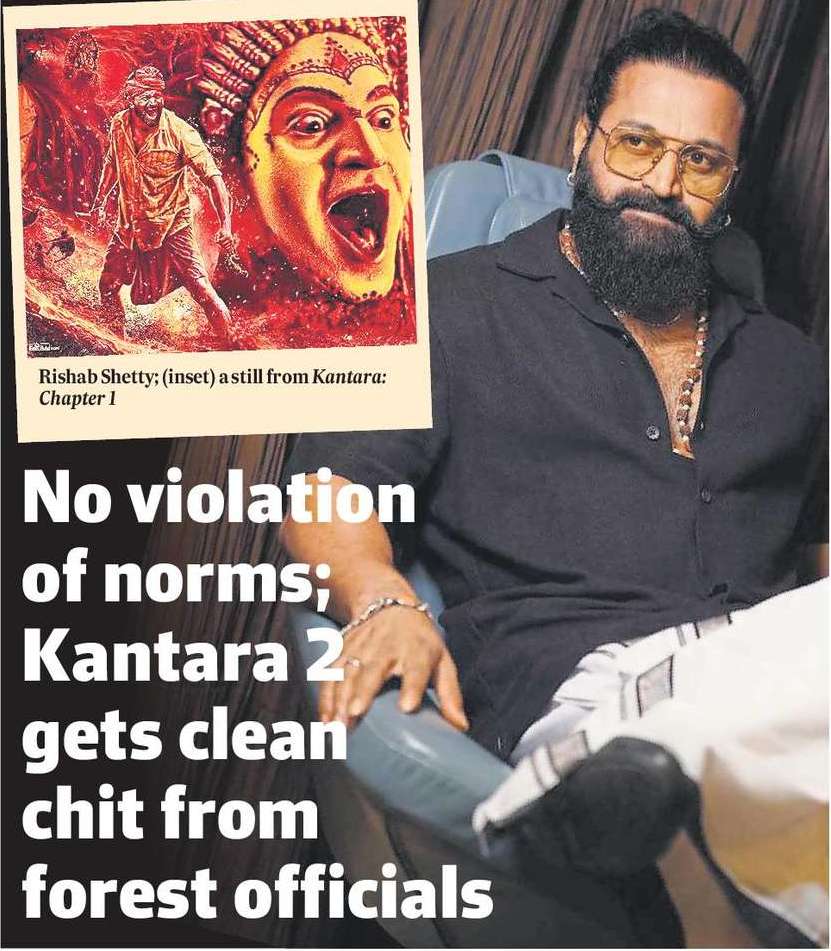
Following allegations by local villagers that the crew of Kantara: Chapter 1 has violated norms during the shoot of the film in the Heruru forest area of Karnataka, Forest Department officials have refuted the claims.
A prequel to Kantara (2022), Kantara: Chapter 1, acted in and directed by Rishab Shetty, is expected to release later this year, and is currently being filmed in the forests of Karnataka. According to the villagers, the crew had brought the filming equipment to the location without obtaining the necessary permissions. The Forest Department officials then imposed a fine of Rs. 50,000 on them and granted permission to shoot from January 5 to 25, they said.
The local people further said that the crew was causing destruction by bursting crackers in the forest, which forced wild animals to flee into the nearby villages. They also accused the unit members of assaulting them over raising objection.
However, Forest Department officials have refuted the allegations after inspecting the shooting site. Yesaluru Deputy Range Forest Officer Somashekar told Deccan Herald, “They had created a small fire on the gomala land, where the team has obtained permission for shooting. However, no rules were violated in the deemed forest area.”
Deputy Conservator of Forests Saurabh Kumar added, “The film team is shooting after obtaining necessary permission. The officials have inspected the spot. Suitable measures would be taken based on the report”.
Dubbing rights bring in big bucks for South films
9:20 AM

Streaming & satellite rights of dubbed versions accounted for a quarter of their revenues in 2024, up from 10% 7 yrs ago
Rajesh N Naidu (THE ECONOMIC TIMES; January 2, 2025)
Mumbai: South Indian films generated as much as a quarter of their revenue by selling streaming and satellite rights of their dubbed versions in 2024, compared with less than 10% seven years ago, according to distributors and industry analysts.
Streaming giant Netflix paid Rs. 175 crore for the Hindi dubbed version of the recently released multilingual blockbuster Kalki 2898 AD, trade analysts said. The film's dubbed rights in southern languages were sold to Amazon Prime for Rs. 200 crore, they said. India's largest blockbuster film, Pushpa 2 – The Rule, recently sold the streaming rights of all languages for Rs. 275 crore, according to box office research firm Sacnilk.
"Among the various languages a pan-India southern hit is dubbed, it is the Hindi dubbed version which fetches the highest revenue to a producer given its reach," said Ramesh Bala, an entertainment sector analyst based in Chennai. A southern film can sell streaming and satellite rights separately for each dubbed language. For instance, the satellite and digital rights of a film originally made in Telugu and dubbed in Hindi, Tamil, Kannada and Malayalam can be sold separately to television channels and streaming platforms.
G Dhananjeyan, cofounder of Tamil Nadu-based production house Creative Entertainers & Distributors, said the 2017 movie, Baahubali 2: The Conclusion, opened the eyes of southern producers to an additional source of revenue: theatre release of a dubbed version in Hindi.
Over the past seven years, southern films such as KGF - Chapter 2 (2022), Kantara (2022), RRR (2022) and Kalki 2898 AD (2024), which have succeeded on a pan-India level, have consciously followed this strategy. The dubbed Hindi version of Baahubali 2: The Conclusion recorded lifetime box-office collections of Rs. 510.90 crore. The satellite rights of the Hindi dubbed version were sold to Sony TV Network for Rs. 51 crore, while its digital rights were sold to Netflix for Rs. 25.5 crore.
A large part of the success of these southern films can be traced back to the early acceptance of dubbed southern films on television.
Ameya Naik, a producer and founder of event management company Fantasy Films, said: "Pan-India channels such as Zee TV laid the foundation for a pan-India southern hit. The channel bought dubbed southern films as there was a potential audience for them. Then, the emergence of YouTube channels such as Goldmines Telefilms fuelled the interest of North Indian audiences in dubbed southern films."
This increasing acceptance in the North also led to a new trend: southern films featuring Bollywood stars. Examples include Ajay Devgn (RRR), Sanjay Dutt and Raveena Tandon (KGF - Chapter 2) and Amitabh Bachchan (Kalki 2898 AD).
Chhatrapati Shivaji is a national hero; I feel immense pride in bringing his story to the screen-Rishab Shetty
2:36 PM

Sridevi S (BOMBAY TIMES; December 6, 2024)
Rishab Shetty is stacking up some interesting roles in the near future. After wrapping up Kantara Chapter 1, he is expected to join Prasanth Varma’s Jai Hanuman, and post that, he will be playing the titular role in Sandeep Singh’s historical saga, Chhatrapati Shivaji Maharaj.
In an exclusive chat with Bangalore Times, the national-award-winning actor, revealed that besides the two films, he has two more projects in the line-up, and one of them will make Kannadigas very, very proud. “My plate is full, but not overflowing,” Rishab says. Excerpts:
‘Playing Shivaji is an honour beyond words’
Every actor’s dream is to explore different characters, says Rishab. “I am glad that opportunities are knocking on my door. I haven’t ventured out or sought these roles intentionally. They are coming to me, and I feel so privileged to have achieved this. Shivaji’s life and legacy have always fascinated me, and there is a deep sense of pride in being associated with such a great historical figure. Opportunities like biopics come only once in a lifetime. As an actor and a performer, I feel that it’s an honour to bring his story to life on the big screen. Sandeep’s vision for the film was so grand, that as soon as I heard the film, I said yes without blinking an eyelid. He is a national hero whose impact transcends history, and I feel immense pride in bringing his story to the screen. And to put myself in the shoes of one of the most revered iconic characters of Indian history is a blessing in itself,” he explains.
‘I know this biopic will be full of drama, grandeur and emotions’
Back in time, there was no concept of nations, only Kingdoms. So, for me, the chance to share Shivaji’s life with people is appealing. As actors, we look for scripts that excite the audience and that have a storyline peppered with ample drama, grandeur, and emotions, and I can say with confidence that this will be one such film.
‘For the next two years, I am dedicated to being a director’s actor’
Rishab reveals that besides these two magnum opus projects, he has signed two more films that he will be working on in the next two years.
“I cannot reveal much, but among the two, one of them is going to make Kannadigas very proud. Post Kantara Chapter 1, I am not directing any films anytime soon, and I will only be acting in all four projects. I am looking forward to bringing my directors’ visions on screen for the next two years.”
Fenil's Bollywood Talk # 845
10:22 AM

STREE 2 CONTINUES ITS DREAM RUN; EXHIBITORS OPT FOR RE-RELEASES TO FILL IN SOME SHOWS
With three films released on Independence Day, out of which two suffered, there is a dearth of new releases for the next month. Very few films are up for release in September and none of them seem exciting as of now.
Stree 2, meanwhile, continues its dream run. It collected a huge Rs. 294 crores in the first week. The collections jumped on the second Friday which made it clear that it’ll have a huge weekend. After collecting Rs. 18.50 crores on Friday, it collected Rs. 33 crores on Saturday and a whopping Rs. 41 crores on Sunday. This is unbelievable for a film devoid of stars. On Monday, on account of Janmashtami, it collected Rs. 18 crores and thus crossed the Rs. 400 crores mark. The two-week collections are expected to be around Rs. 433 crores. Its collections in the second week would be around Rs. 139-140 crores and this is simply phenomenal.
Stree 2 would jump yet again in the coming weekend and would cross the Rs. 500 crores mark in its fourth week. It’ll continue to be in cinemas for a long, long time.
Khel Khel Mein, which clashed with Stree 2, suffered due to the clash. But it’s now holding up well in select centres. It’s common to see shows getting filled up even on weekdays, but only in some theatres in a few cities. It’ll collect Rs. 28 crores in two weeks and collections hopefully would cross the Rs. 35 crores mark. This film, too, would hang in cinemas for many weeks. The hope is that those who have seen Stree 2 will now opt for this film.
Tomorrow, two films are up for release – A Wedding Story and The Diary Of West Bengal. The first one is a horror and stars some known faces but it would go unnoticed. The latter seems like a propaganda flick and such films don't have an audience anymore. Hollywood films like Afraid and The Crow, too, will struggle to get an audience. Surya's Saturday, the Hindi version of Nani's Telugu flick Saripodhaa Sanivaaram, also releases tomorrow but awareness is very limited.
Meanwhile, taking advantage of the re-release trend, three old films will try their luck in cinemas tomorrow – Rehnaa Hai Terre Dil Mein, Gangs Of Wasseypur 1 & 2 and Kantara.
With three films released on Independence Day, out of which two suffered, there is a dearth of new releases for the next month. Very few films are up for release in September and none of them seem exciting as of now.
Stree 2, meanwhile, continues its dream run. It collected a huge Rs. 294 crores in the first week. The collections jumped on the second Friday which made it clear that it’ll have a huge weekend. After collecting Rs. 18.50 crores on Friday, it collected Rs. 33 crores on Saturday and a whopping Rs. 41 crores on Sunday. This is unbelievable for a film devoid of stars. On Monday, on account of Janmashtami, it collected Rs. 18 crores and thus crossed the Rs. 400 crores mark. The two-week collections are expected to be around Rs. 433 crores. Its collections in the second week would be around Rs. 139-140 crores and this is simply phenomenal.
Stree 2 would jump yet again in the coming weekend and would cross the Rs. 500 crores mark in its fourth week. It’ll continue to be in cinemas for a long, long time.
Khel Khel Mein, which clashed with Stree 2, suffered due to the clash. But it’s now holding up well in select centres. It’s common to see shows getting filled up even on weekdays, but only in some theatres in a few cities. It’ll collect Rs. 28 crores in two weeks and collections hopefully would cross the Rs. 35 crores mark. This film, too, would hang in cinemas for many weeks. The hope is that those who have seen Stree 2 will now opt for this film.
Tomorrow, two films are up for release – A Wedding Story and The Diary Of West Bengal. The first one is a horror and stars some known faces but it would go unnoticed. The latter seems like a propaganda flick and such films don't have an audience anymore. Hollywood films like Afraid and The Crow, too, will struggle to get an audience. Surya's Saturday, the Hindi version of Nani's Telugu flick Saripodhaa Sanivaaram, also releases tomorrow but awareness is very limited.
Meanwhile, taking advantage of the re-release trend, three old films will try their luck in cinemas tomorrow – Rehnaa Hai Terre Dil Mein, Gangs Of Wasseypur 1 & 2 and Kantara.
Indian films, particularly Bollywood, often portray India negatively-Rishab Shetty
4:17 PM
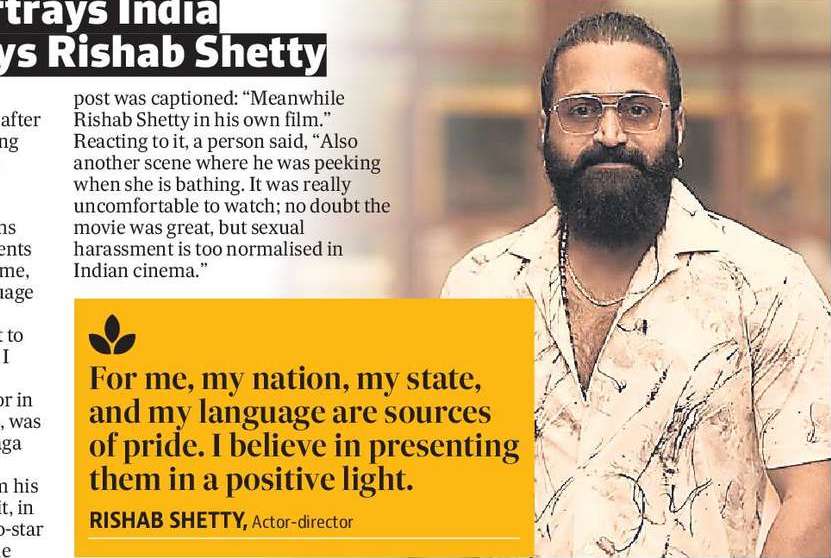
HINDUSTAN TIMES (August 22, 2024)
The internet isn’t happy with actor-director Rishab Shetty after he criticized Bollywood, saying that it presents films in a negative light.
“Indian films, particularly Bollywood, often portray India negatively. These so-called art films get showcased at international events and receive special attention. For me, my nation, my state, and my language are sources of pride. I believe in presenting them in a positive light to the world, and that’s exactly what I strive to do,” Shetty, who won a National Film Award for Best Actor in a Leading Role for Kantara (2022), was quoted while speaking to MetroSaga in Kannada.
Meanwhile, a clip of Shetty from his film Kantara was shared on Reddit, in which he was seen pinching his co-star Sapthami Gowda on her waist. The post was captioned: “Meanwhile Rishab Shetty in his own film.”
Reacting to it, a person said, “Also another scene where he was peeking when she is bathing. It was really uncomfortable to watch; no doubt the movie was great, but sexual harassment is too normalized in Indian cinema.”
Led by Aattam, South Indian cinema walks away with top honours at National Awards
9:10 AM

Best Director Award For Barjatya Marks Bollywood’s Presence
Manash Gohain (THE TIMES OF INDIA; August 17, 2024)
New Delhi: Southern cinema grabbed centerstage winning a clutch of major awards in the 70th National Film Awards. The best feature film award went to the Malayalam movie “Aattam: The Play”, while Rishabh Shetty received the best actor award for the Kannada hit “Kantara.” Best actress prize was shared by Nithya Menen for the Tamil film “Thiruchitrambalam” and Manasi Parekh for the Gujarati movie “Kutch Express”.
Sooraj R Barjatya (Hum Aapke Hain Koun) seized the best director award for “Uunchai”, marking Bollywood’s presence among the top categories. Nina Gupta received the best supporting award for the same film while Pavan Malhotra, known for his riveting performances in films such as Salim Langde Pe Mat Ro and Bagh Bahadur, earned the supporting actor award for Haryanvi film, Fouja.
The jury members presented the list of winners for 2022 to Union I&B minister Ashwini Vaishnaw on Friday.
Malayalam cinema led the charge, winning eight awards, including for best child actor, best screenplay, and best editing. Overall, 20 south Indian films bagged awards a cross various categories in the feature film segment. In the feature film category, out of the 24 awards, excluding the sub-category of best feature film in each language, 20 awards were shared by Malayalam, Haryanvi, Kannada, Gujarati, Tamil, and Bengali movies. Only six awards were bagged by three Hindi films, with two being shared with other regional language movies.
“Fouja” won two other awards: best debut film by a director for Pramod Kumar and best lyrics by Naushad Sadar Khan.
The award for Best Popular Film Providing Wholesome Entertainment also went to a non-Bollywood film, the Kannada blockbuster “Kantara”, which explores the intricate connection between humanity and nature through its folklore-based storytelling. Rishabh Shetty played the dual roles of a father and son in this film.
The top honour, the best feature film “Aattam: The Play”, directed by Anand Ekarshi, revolves around a theatre troupe and the changing dynamics after its only woman member alleges she has been groped by one of the men.
The best female playback singer award went to Padma Shri awardee “Bombay” Jayashri Ramnath, a champion of Indian Carnatic music, for the track “Chaayum Veyil” from the Malayalam film “Saudi Vellaka CC 225/2009” (Saudi Baby Coconut CC.225/2009), which also won the best Malayalam film award.
A R Rahman won the National Film Award for best music director (background music) for his work in Mani Ratnam's ‘Ponniyin Selvan-Part 1’, which was also named the best Tamil film. Pritam got the award for best music director (songs) for ‘Brahmastra-Part 1’.
------------------------------------------
Rishabh Suri, Mugdha Kapoor, Soumya Vajpayee, Yashika Mathur, Akash Bhatnagar (HINDUSTAN TIMES; August 17, 2024)
I was not expecting it: Manoj
It’s Manoj Bajpayee’s fourth National Award and this time it’s a Special Mention for the actor for the film Gulmohar (2023). We break the news to him, and he exclaims, “Wow! Best Hindi film too! I must call my director (Rahul V Chittella) right away. I was not even expecting an honour. He is deserving of it, as he made such a beautiful film.” Bajpayee feels grateful that his work is getting recognised now: “There have been performances and films that went unrecognised.”
I am still processing it: Manas
Manasi Parekh, who bagged the Best Actress award for Kutch Express (2023), says, “I am shooting for my new film, and got a message from (actor-filmmaker) Anand Tiwari: ‘Congratulations on the National Award’. I exclaimed, ‘What!’ I am still processing it, I can’t believe it.” The actor looks at the award as a vindication for her hard work: “I love what I do. What makes this win sweeter is that my husband and I produced Kutch Express. I want to do the best work and make the best of films.”
Kantara is a tribute to our land: Rishab Shetty
Rishab Shetty, who won Best Actor for Kantara (2022), with the film also winning the Best Film Providing Wholesome Entertainment award, tells us exclusively, “The win feels overwhelming. I wanted to bring authenticity and a raw portrayal of our heritage. The film is a tribute to our land and the deep-rooted stories that have been part of our cultural fabric for many years, true to the essence of the Kannada culture. I’m thankful to the Daiva for their divine blessings and dedicate this award to the Daiva Nartakas.”
This feels so special: Pritam
Pritam Chakraborty, who won the Best Music Director award for Brahmāstra: Part One – Shiva (2022), says, “This feels so special. I am really grateful to the jury. I want to thank the makers and everyone who was associated with the movie for their support and trust in me. But, most importantly, a big thank you to the audience for their love to our music.”
’This is such an auspicious day’
“I didn’t know that the National Awards were going to be announced today!” says director Chandoo Mondeti, whose film Karthikeya 2 won the National Award in the Best Telugu film category. Mondeti also tells us how he heard of the win after a friend called to congratulate him. “It is such a happy day for us. Karthikeya 2 is a very special film. This is such an auspicious day,” the filmmaker beams, adding that celebrations will follow right away: “It is such great news for me and everyone associated with the film.” This is Mondeti’s first ever National Award.
Like a pat on the back, says Pavan Raj Malhotra
Actor Pavan Raj Malhotra, who won the National Film Award for Best Supporting Actor in the Haryanvi film Fouja, says, “This is my second award, and it feels really good. I remember the first time around, there used to be a rehearsal before the main ceremony without the President and I was wondering how to greet him. Suddenly, I uttered the words ‘Jai Hind’ and it was perfect. This kind of recognition is what every artiste works for. It’s like a pat on the back and as far as I know, these awards are not manipulated. Fouja is actually close to my heart as it is about the desire to join the army; it is a great honour to be a part of the Indian Army. I don’t know how much of an impact this might have, but I have been working for 40 years now. If you keep working and doing what you like, these awards just make you feel appreciated.”

India's box-office collections reach an all-time high of Rs 12,226 crore in 2023
8:21 AM

Hindi film industry bounces back with Rs. 5,380-cr mop-up last year: Ormax
Javed Farooqui (THE ECONOMIC TIMES; January 22, 2024)
Box office collection in India reached an all-time high of Rs 12,226 crore in 2023, exceeding the previous record of Rs 10,948 crore in 2019, and growing at a healthy 15% over 2022, according to the Ormax Box Office Report 2023.
This was the first time that box office collection surpassed Rs 12,000 crore, indicating a recovery in the Indian film industry, which had been battling a post-pandemic slump in business. Box office collections in 2022 were Rs 10,637 crore, just short of breaking the previous record set in 2019.
"One of the key drivers for the success of box office in 2023 is the industry’s ability to deliver event films that are a ‘theatre-worthy experience'—a must for the film to emerge as a theatrical success," said Ormax Media Head of Business Development (Theatrical) Sanket Kulkarni.
According to the report, cinema footfalls rose 6% in 2023 to 943 million, though it lagged the pre-pandemic high of 1.03 billion in 2019.
Kulkarni said footfalls have remained below pre-pandemic levels as audiences have turned selective in their theatrical choices because of post-pandemic inertia and the rise of video streaming platforms.
The average ticket price (ATP) increased by 9% over 2022, from Rs 119 to Rs 130, owing to a growth in box office contribution from Hindi cinema, which has a higher ATP compared to South-language films.
After a lacklustre performance in the post-pandemic phase, Hindi films had a record year in 2023, with gross box office collection of Rs 5,380 crore, crossing the Rs 5,000 crore mark for the first time.
According to the report, Hindi cinema's box office share hit a pre-pandemic high of 44%, from 33% in 2022. Tamil and Telugu cinemas maintained their 2022 share with a box office collection of Rs 2,265 crore and Rs 1,961 crore, respectively in 2023.
Meanwhile, the share of Hollywood movies fell by 3 percentage points in 2022 due to the absence of a Rs 200-crore grossing film, with overall collection at Rs 1,139 crore.
Kannada cinema shed its box office share by 5% points to finish the year at Rs 312 crore due to the absence of big-ticket films.
Box office collections are getting increasingly skewed in favour of big-ticket films, with the top 10 films contributing 40% of the total box office receipts of Rs 12,226 crore.
Kulkarni said audiences are more likely to watch a film in a theatre if there is a compelling reason to do so. He added that franchise films are gaining traction and engagement across languages, accounting for 45% of theatrical box office collection, up from 17% in 2019.
Over 1,000 films were released in 2023; however, only five films crossed the gross box office of Rs 500 crore.
Shah Rukh Khan's Jawan was the highest-grossing film of 2023, making Rs 734 crore, followed by Ranbir Kapoor's Animal (Rs 645 crore), Shah Rukh Khan's Pathaan (Rs 636 crore), Sunny Deol's Gadar 2 (Rs 619 crore), and Prabhas' Salaar: Part 1 – Ceasefire (Rs 512 crore).
Interestingly, the top four films of 2023 are all original Hindi-language films. In comparison, South Indian films dominated the top ten list in 2022, with KGF - Chapter 2, RRR and Kantara collecting Rs 970 crore, Rs 869 crore, and Rs 362 crore, respectively.
Salaar: Part 1 – Ceasefire, Rajnikanth's Jailer, and Vijay's Leo were the three South Indian films that grossed more than Rs 400 crore at the Indian box office in 2023.
Ormax noted it sourced the box office data from credible industry sources, including producers, distributors, exhibitors, and trade analysts.
I won’t leave the Kannada film industry for other languages-Rishab Shetty
8:26 AM

Niharika Lal (BOMBAY TIMES; December 2, 2023)
Rishab Shetty, who was in Goa for IFFI, had recently announced the prequel to Kantara. There, he spoke about how he had the idea of a prequel in mind while filming for the first part.
“While doing Kantara, I had it in my mind; I had story elements; the story was in two parts. During promotions, the filmmakers ended up announcing a franchise, but I didn't want to do that. While I had this thought in mind, I kept it to myself and thought we would make a second film only if the first one is received well by the audience.”
He also spoke about why he sees the success of his film, Kantara, as a responsibility, the flawed concept of talking endlessly about a film during promotions, and the importance of word-of-mouth publicity. Excerpts:
‘IT’S NOT US WHO SHOULD BE TALKING ABOUT THE FILM, IT’S THE AUDIENCE'
Rishab says that people now only want to talk to him about his upcoming film, but that is something he is not on board with. “I feel that, in the name of promotions, we actors and directors end up talking more about the film than the audience. It's not us who should be talking about the film, it's the audience. Baat toh kaam pe hona chahiye, aur woh logon pe chhorna chahta hoon main,” he said.
RISHAB SHETTY WON THE SPECIAL JURY AWARD FOR KANTARA; IT’S THE FIRST KANNADA FILM TO WIN THE AWARD AT IFFI
“Last year, we came to IFFI to promote Kantara. It was a really proud moment for us this year that Kantara was in the competition section at IFFI. In fact, it was the support and love of the audience because of which the film not just found a place at the box office but in the history of Indian cinema,” he says.
‘FOR STATES OUTSIDE KARNATAKA, I AM JUST A ONE FILM WONDER’
“For outside states (other than Karnataka), I’m considered a one-film wonder. They feel I have done one movie and (wonder) what else I will do! This question will always remain. So, I feel it is my responsibility to do my next film with all my strength,” says Rishab, who has directed four films, and acted in over 16 films in Kannada.
‘NO MATTER HOW EXCITING THE OFFERS ARE, I WILL NOT LEAVE THE KANNADA FILM INDUSTRY’
When asked if he would be interested in doing Hindi films, Rishab said, “After the success of Kantara, I received offers not only from Hindi films but from several other languages besides Kannada. There are many beautiful opportunities that I am missing because I feel I should not leave the Kannada film industry. It’s a sentiment. ‘Ek film hit hua toh ye industry chhod ke ja raha hai, aisa nahi hona chahiye.’”
‘IF THE MOVIE’S CONTENT IS GOOD, IT CAN GO BEYOND THE LANGUAGE BARRIER’
Speaking about the fact that now movies are doing well, irrespective of language, Rishab shared that if his Kannada film reaches people in other states, he’ll dub the film and release it. He said, “Hindi cinema is still performing much better when it comes to theatrical performance. If content is good, then people will appreciate the film, irrespective of language. We need to explore it and make sure our content should be globally rich.”
‘OTT PLATFORMS ARE NOT TAKING KANNADA MOVIES AT PRESENT’
“Festival films get limited exposure in theaters, but there should be a way to get these films released in theaters. However, OTTs are not entering the Kannada industry at present, after a few films backfired. They are refusing to take more Kannada films, and if this is the case, we won’t be able to recover our money from the theatrical release of Pedro, Shivamma, and another Film Bazaar film that is a work-in-progress. If I release them theatrically, these three will be my last movies from my own production house,” he says.
Working across mediums doesn’t take away from my stardom, it elevates it-Prosenjit Chatterjee
8:18 AM
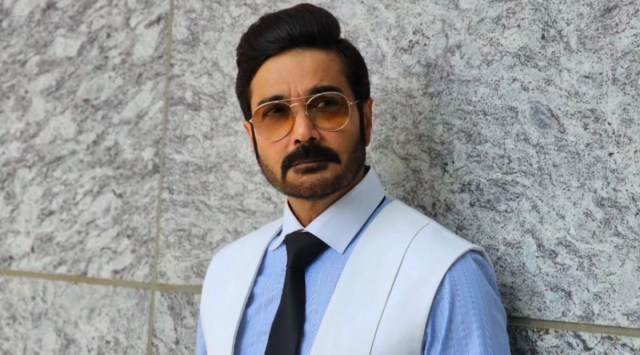
The actor, who made his web debut with Jubilee, talks about experimenting with various mediums, his long, successful career in films and more...
Madhureeta Mukherjee (BOMBAY TIMES; July 2, 2023)
Superstar of Bengali cinema, Prosenjit Chatterjee, recently made a remarkable debut on OTT with Jubilee. The actor, who has reigned in his industry for over three decades, as a leading commercial star and has also shown his acting prowess in parallel cinema – which is rare, says that even today, he feels like a frontbencher on set. And in his words, Prosenjit says, “I am ready to take on any challenge to do different kinds of roles, such is my hunger as an actor.” In a conversation with us, he talks about how he lives and breathes cinema.
You recently made a remarkable web debut with the show Jubilee and followed it up with Scoop. Prior to this, in the Bollywood space, you were seen in Shanghai. As a superstar in Bengali cinema, didn’t you want to explore more roles in Hindi cinema, or was the work that was offered to you here not creatively exciting?
After my debut film in Hindi (David Dhawan’s Aandhiyan), while I was shooting in Mumbai for a Bengali film, Pahlaj Nihalini told me, ‘You are a big star, chalo film karte hai.’ I did some more films here, but I never planned or structured my career in Bollywood. I was a rockstar in mainstream Bengali cinema. I had 22 releases in one year. I felt that I was not alone and that I was taking an industry along with me. In Bengal, people would say that I was number 1 and 2, 3, 4, in mainstream cinema. I wasn’t sure that if had come here (Bollywood), I would have become Shah Rukh Khan. If I had taken that chance, I probably wouldn’t have done justice to the filmmakers in Bengali cinema, as they were the ones who believed in me and made me a star. Today, I can do that because I don’t have those challenges. My intent is to get one new audience every day. I like the fact that my audience cuts across generations. I love to work with new directors. Yes, I am a star, but I broke that image for my films. OTT is the future, and all the big actors are doing it. I don’t think working in different mediums takes away from my stardom, it elevates it.
You made a shift from mainstream to middle-of-the-road Bengali cinema at some point, was that well thought through?
Yes, it was planned. I knew back then that the language of cinema would change. Even before I did Srijit Mukherji’s Autograph, I saw the growth of multiplexes. Every ten years, in our cinema, there has to be a shift in the audiences’ tastes. In my own way, I have observed and studied the change that is going to happen. For over 30 years, I have been a mainstream commercial actor, and I am grateful that this is not my area now. I had created a record of sorts—where I was shooting in my own city (Kolkata) for 19 days at a stretch but didn’t go home for 19 days. Back then, there were no vanity vans, so I would sleep in my car. Now I tell the younger actors, ‘Abhi aap log isko aage le jao (laughs!)’. I am enjoying what I am doing now.
But you do believe that commercial cinema needs to thrive, right?
Yes, absolutely! It has to survive, but we have to do it differently. What is commercial cinema – one that will be watched by people in large numbers? But why do we think that the audience will not understand good cinema – whether it’s commercial or not? We are underestimating the audience. Rituparno Ghosh would tell me that he cast me in Chokher Bali, as he, too, wanted to cross that border. So, I feel I need to support this kind of cinema (middle-of-the-road). Chokher Bali that was made 20 years ago, was a pan-India film, but at that time, no one would talk about it. We didn’t do it for business, today, it is a business model.
Bengal has given us so many iconic filmmakers and actors, what do you think the Bengali film industry needs to do to expand the reach of their cinema and get their footprint pan-India?
Cinema of every language has its own strength, and we need to tap that. Bengali cinema won’t be able to do a Baahubali or an RRR right now, and it’s not because of the budget. Bangla’s strength lies in its literature. We need to make subjects that stem from there and resonate across audiences. Why did I like Kantara? It’s because it struck a chord as it spoke about something close to their culture, which I wasn’t aware of. We need to give the larger audience those subjects that are close to our culture. I would love to do South films and Marathi films. The Marathi film industry has such great actors and directors.
Is your son Mishuk showing a keen interest in becoming an actor?
He is a big fan of Shah Rukh Khan and Bengali actor Dev. He’s a good footballer, and now he’s turned 18 and I feel ki usko actor banna hai. I have told him that I will help him prepare and guide him as I know what a commercial actor needs to do and be. But then, mein usko market mein chhod doonga. I have told him that I am not going to launch him, even I wasn’t launched by anyone. His journey has to be his.
Subscribe to:
Posts (Atom)