Showing posts with label Kamini Kaushal. Show all posts
Showing posts with label Kamini Kaushal. Show all posts
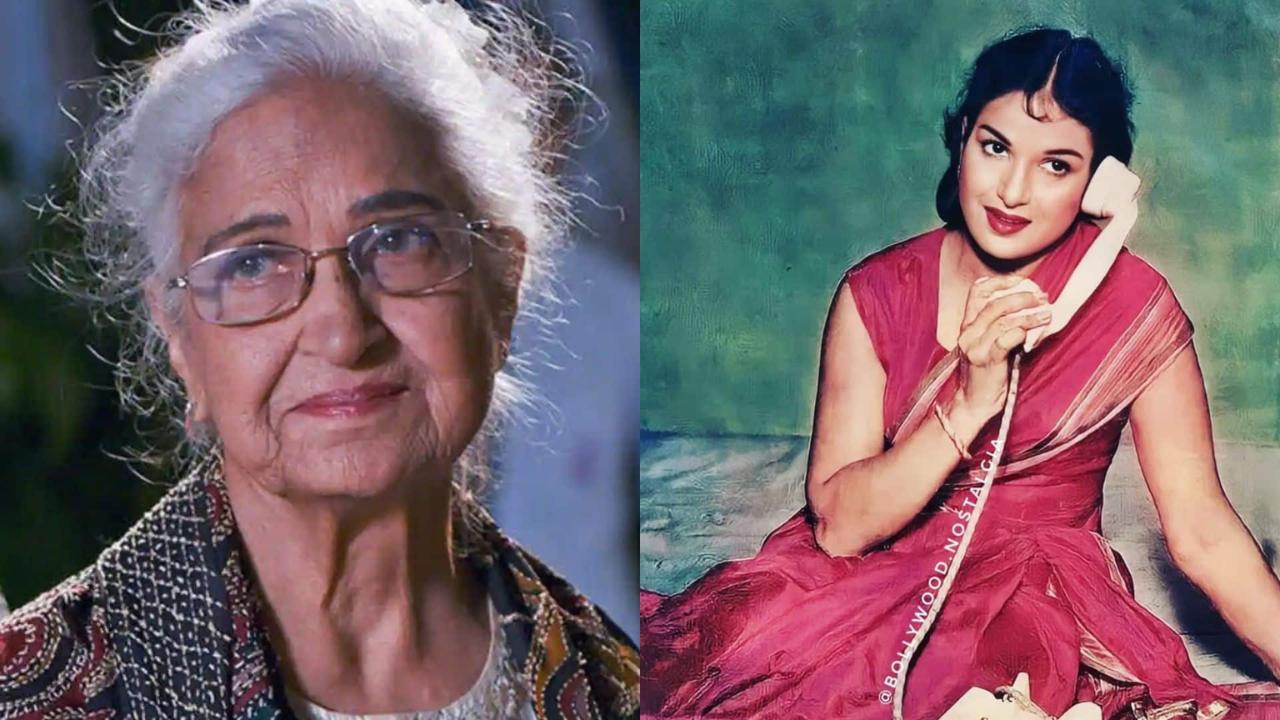
Kamini Kaushal, leading lady in first hits of Dilip Kumar and Dev Anand, passes away
8:35 AM
Avijit Ghosh (THE TIMES OF INDIA; November 14, 2025)
Kamini Kaushal, who made her film debut in Chetan Anand’s classic ‘Neecha Nagar’ (1946), who sparkled as the leading lady in the first box-office hits of Dilip Kumar (‘Nadiya Ke Par’, 1948) and Dev Anand (‘Ziddi’, 1948), and who enjoyed a fruitful second innings as character actor in films such as ‘Upkar’ (1967) and ‘Do Raaste’ (1970), passed away at her Mumbai residence late Thursday night. She was 98. The news was confirmed by Sajan Narain, a close friend of the family, to news agency PTI.
Like the leading character of her last film, ‘Laal Singh Chaddha’ (2022), Lahore-born Kaushal’s career too was marked by her presence in significant moments of film history. ‘Neecha Nagar’ was a Grand Prix winner at Cannes. Raj Kapoor also acted with her in his second film, ‘Jail Yatra’ (1947).
Kaushal was the first heroine with whom Dilip Kumar formed a winning pair. ‘Shaheed’ (1948), ‘Shabnam’ (1949) and ‘Arzoo’ (1950), being three other films. In the opening credits, she was billed above Kumar in all these films, which underscores her seniority and star value at the time.
Director Bimal Roy’s ‘Biraj Bahu’ (1954), based on Saratchandra’s 19th century novel, was the high noon of her acting career. Kaushal was pitch-perfect in the title role capturing the tone and tang of a rural Bengal homemaker whose life unspools from idyllic to calamitous.
The Times of India described her performance as “dignified, refined, sympathetic, beautiful, rounded to the last nuance and shade and tone of expression, a histrionic gem of flawless perfection, the finest of her career.” It fetched her Filmfare’s best actress award.
Her second innings as a supporting actor began with Manoj Kumar’s ‘Shaheed’ (1965), where she played his mother. She became a regular in his positive nationalism films. ‘Upkar’ (1967) offered her the stand-out part of a widow torn between two sons with opposing approaches to life. Another notable role came in Raj Khosla’s superhit family drama, ‘Do Raaste’ (1969), where she played an amiable bhabhi who tries her best to keep the family from falling apart. In Ravi Tandon’s ‘Anhonee’ (1970), Kaushal delivered a deliciously wicked surprise to her fans playing the devious and plotting stepmother willing to kill for money.
Life dealt her unkind cuts. Born on Feb 24, 1927, Uma (her real name) lost her renowned botanist father, Shiv Ram Kashyap, when only 7. The five siblings -- two brothers and three sisters -- were brought up by her mother. Undeterred, she graduated from Lahore’s Kinnaird College displaying a flair for sport and plays.
Then Kaushal’s elder sister died in a motor crash and she “came to Bombay to nurse her two little nieces and her brother-in-law BS Sood who had been seriously injured. She decided to look after him as a wife for the rest of her life” wrote Sushila B Rani in the book, Stars of the Indian Screen (1952). Sood was an officer with Bombay Port Trust.
At this stage, she was offered ‘Neecha Nagar’ by Chetan Anand, who named her Kamini Kaushal. In 1954, she also acted and produced ‘Chalis Baba Ek Chor’, a comedy with a bunch of kids that flopped.
Kaushal participated actively in public life and freely spoke her mind. While inaugurating a women’s section of the Indo-Soviet Cultural Society in Bombay in 1958, she underlined the need to build closer understanding between the peoples of India and the Soviet Union. “Cinema was never my be-all and end-all,” she told TOI in 2008.
In 1969, G D Khosla committee’s report on Film Censorship spoke up in favour of celluloid kissing which created a strong conservative backlash. Kaushal supported the report. “A kissing sequence done gracefully would be a good substitute for blaring erotic songs,” she said at a Lions Club function in Delhi that year.
Making puppets was a passion in her late life. She was also an active chairperson for the Children’s Film Society of India. Kaushal floored everyone with her spirit, elegance and self-deprecating humour while delivering the Filmfare Lifetime Achievement award acceptance speech in 2015. “Ours was a quieter period…may be our eyes spoke more than our bodies,” she said. The audience connected and clapped.
But there was also a tinge of sadness. “I am missing our gang today. Most of them are gone. Just not fair. I feel very lonely here today. All of them are disappearing and going away one by one. Which breaks your heart…,” she said. Everyone stood up when she finished her speech.
Now Kamini Kaushal has joined her gang.
"Madhubala's ceaseless laughter became an ideal balm for Dilip Kumar's bruised heart..."
8:23 AM

Dilip Kumar and Madhubala had a near, perfect romance, until her interfering father got in the way. A new illustrated biography on the veteran actor, challenges some myths around the famed love story
MID-DAY (October 27, 2019)
After a somewhat tentative debut in Jwar Bhata and Pratima, the actor came of age in Milan, which was followed by the super-duper hit Jugnu opposite none other than Noor Jehan. Dilip Kumar had now hit the purple patch of his career and three mega hits followed in quick succession —Shaheed, Shabnam and Nadiya Ke Paar. The leading lady of all these hits was the comely Kamini Kaushal—reportedly Dilip Kumar's first flame and also his first serious heartbreak.
Kamini Kaushal's real name was Uma Kashyap. She was the daughter of Rai Bahadur S R Kashyap, a renowned Botanist, president of Indian Science Congress and dean of the pre-partition Punjab University. She was one of his five children which included three brothers and two sisters. She was very well-educated and had studied at Lady MacLagan School and Emily Kinnaird College of Lahore. She was also a champion swimmer. When her elder sister, who was married to B S Sood, a high ranking official of Bombay Port Trust, died in a car crash leaving behind two small kids, Uma married him and moved to Mumbai. It was here that legendary director Chetan Anand discovered her talent and cast her in his award-winning Neecha Nagar as Kamini Kaushal. As an actress, she quickly ascended to stardom with films like Jail Yatra, Aag (opposite Raj Kapoor), Do Bhai, etc. Soon, Filmistan's S Mukerji signed her opposite Dilip Kumar in his Shaheed (1948) which was a box-office success.
Famous Kathak exponent and actress Sitara Devi (who starred with Dilip in Hulchul and shared a sister-brother relationship with him) and producer director P N Arora of All India Pictures (in whose super hit Pugree Kamini Kaushal starred) have been on-record authenticating the Dilip Kumar–Kamini Kaushal romance. It is said that Sitara Devi ji had met the rumoured couple huddled together and travelling aimlessly in the first-class compartment of Mumbai's local trains. P N Arora has said, on-record, that Dilip Kumar often visited Kamini Kaushal on the sets of Pugree and once Kamini's military-man brother strode on the film's sets, brandishing a pistol, threatening to kill Kamini if she did not call off her clandestine romance with Dilip Kumar. He also threatened to kill Dilip Kumar. Around that time, Shahi Latif–Ismat Chugtai's Aarzoo, in which Dilip–Kamini featured for the last time, was in the making. Ismat Aapa had reportedly warned Dilip Saheb against the futility of the said romance. The hot-headed brother of Kamini Kaushal reportedly shot himself, having failed to end the Dilip–Kamini romance. This came as a blow to Kamini Kaushal and Dilip Kumar and they put a stop to their romance.
Kamini exuded urbane sophistication and bonded very well at an intellectual level with Dilip. On the other hand, both Madhubala and Dilip being Pathans shared a commonality of ethnic and cultural background. Thus, a vivacious Madhubala's ceaseless laughter became an ideal balm for Dilip Kumar's bruised heart. Madhubala's real name was Mumtaz Jehan Begum Dehlavi. She was third born among the seven daughters (Kaneez, Fatima, Altaf, Chanchal, Zahida and Shahida being others) of a handsome Pathan Attaullah Khan and his beautiful Iranian wife. Her father was a headstrong, stubborn and egoistic man, and a harsh disciplinarian. Her mother was simple, illiterate and a homely woman. Attaullah Khan apparently had lost his job with the Imperial Tobacco Company, Delhi due to his arrogant, hot-tempered behaviour and attitude. He moved to Mumbai with his family but could not fend for them. He made his daughter work in films to make ends meet.
The legendary Dilip Kumar–Madhubala romance is said to have took off on the sets of this film, as the duo hit the ground running, enacting the dulcet duet, 'Nain mile nai huey baware'. One has to revisit Tarana to fathom the chemistry between Dr Motilal (Dilip Kumar) and Tarana (Madhubala) which even after six decades floors you with its innocent charm. Prior to being romantically drawn to Dilip Kumar, Madhubala was reportedly dating the leading man of her hit film Badal, the handsome Prem Nath. Grapevine has it that there was some time when Madhu was dating Dilip and Prem Nath simultaneously. Reportedly, when Prem Nath came to know that his friend Dilip was seriously involved with Madhubala and that she was drawn to him as well, he withdrew and married Bina Rai, his charming co-star of Aurat.
On his part, Dilip Kumar never missed any opportunity to recommend Madhubala for a role opposite himself. The iconic Amar originally had Meena Kumari in the female lead, but she fell off with its renowned maker Mehboob Khan after the latter's squabble with her husband writer-director Kamaal Amrohi. Dilip Kumar promptly persuaded Mehboob Saheb to take in Madhubala. Similarly, when Nargis opted out of Mughal-E-Azam, Dilip Kumar convinced K Asif to let Madhubala play Anarkali which ultimately became her best ever performance. The mahurat announcement of the celebrated classic Daag also had Madhubala's name as the leading lady but something went wrong and Nimmi played the part.
However, the perfect romance of this well-matched perfect couple did not culminate into marriage. Many were of the opinion that it was Madhubala's father Attaullah Khan who stood in the way of their marriage for the fear of losing the breadwinner for the large family. The truth lies somewhere around this premise. As the Dilip Kumar–Madhubala romance was peaking, Attaullah Khan once asked Dilip Kumar to star as the hero of a film he wanted to produce under his own banner and also had his daughter Madhubala in it. We believe that the moment Attaullah did that, he encroached upon Dilip Sahab's professional side via his personal life. Yusuf Saheb never wanted Dilip Kumar to be exploited for somebody's gain.
As is widely believed, Attaullah Khan was not opposed to the Dilip Kumar–Madhubala marriage but had his own axe to grind in the whole affair. He wanted the superstar of the era to work exclusively and on priority for his own home productions. On the other hand, Dilip Kumar, who had been positively considering marriage to Madhubala, was unwilling to tolerate any interference in his professional endeavours. Dilip Saheb reportedly laid down two conditions for getting married to Madhubala. One, he would financially support the Khan's family but Madhubala would have nothing to do with her father after wedding; and second, she would stop working in films. This was a clever killing-two-birds-with-one-stone strategy—if Madhubala agreed to quit films, her father's hold on her would automatically diminish. Both Dilip Saheb and Attaullah hardened their positions in the ensuing tug of war to the point that Madhu had Dilip's ultimatum to choose between him and her father. She opted for her father ending the fairy-tale romance.
Excerpted with permission from Dilip Kumar: Peerless Icon Inspiring Generations by Trinetra Bajpai and Anshula Bajpai, published by Bloomsbury India

The actor with Kamini Kaushal, his first love and also his first serious heartbreak

Dilip Kumar with Madhubala. Pics/Dilip Kumar: Peerless Icon Inspiring Generations, Bloomsbury India
On-camera accounts of legends who shaped Indian cinema to be archived
8:18 AM

Mohua Das (THE TIMES OF INDIA; May 19, 2019)
What makes for a classic Bollywood movie? A beginning, middle and an end; a hero, heroine and villain; a few challenges; and a generous dose of drama, mystery and romance. Can real life stories be just as exciting and is there any power in sharing these tales with a larger audience? Turns out, there are few things more stimulating than a story straight from the mouths of those who lived it.
In an initiative to discover, document and preserve unwritten personal recollections, anecdotes and informal tales of Indian cinema legends, the Film Heritage Foundation (FHF) in Mumbai has partnered with the Academy of Motion Picture Arts and Sciences to co-produce and archive “on-camera spoken accounts” of those who shape India’s filmmaking legacy. The shared mission titled Oral History Project will chronicle unmediated truths in the form of audio and video interviews of how one became who they are and what they’re on their way to becoming.
The subjects of the project will span 25 filmmaking professionals including actors, directors, cinematographers, writers, music composers, illustrators, film projectionists, film lab technicians, make-up artistes and others.
The Academy’s visual history program has been recording oral histories on video and documenting representatives from a wide variety of film professions since 2012. Till date, the program has conducted more than 140 interviews in seven languages featuring film professionals including Rachel Portman, Alejandro G. Inarritu, Douglas Slocombe, Ann Roth, Rick Baker, Agnes Varda and others. The project has also collected over 2000 interviews from various sources in their bid to establish a “primary preservation repository” for filmmaker interviews globally.
It was last year when filmmaker and archivist Shivendra Singh Dungarpur – who set up the FHF in 2014 and been rallying to preserve India’s motion picture heritage – was invited by the Academy to deliver a keynote speech when he was approached with the proposal. “Oral history has been on our Foundation’s wish list since inception. We had begun the programme with Kamini Kaushal and were very excited at the new prospect of collaborating with the Academy which has years of experience in the area. They have developed an excellent format which informed our methodology for research, interviewing, transcripts and records. It’s heartening that oral narrative of and by living legends in cinema will be available for posterity, for researchers and scholars to understand them better,” explained Dungarpur who completed the first slew of interviews this month. “We decided to start with stalwarts who represent the three major film industries—Tamil, Bengali and Hindi. Next on list are veterans Shyam Benegal, Gulzar, Asha Bhonsle, Ilaiyaraaja, Salim Khan and others.”
The pilot slate features actors Amitabh Bachchan, Soumitra Chatterjee and Madhabi Mukherjee; directors Adoor Gopalakrishnan, Mani Ratnam, and Buddhadeb Dasgupta; and Vishwa Mehra (R K Studios’ production manager, and brother-in-law of Prithviraj Kapoor). The interviews spanning four to six hours each threw up endearing memories that will serve as a living testimony of their life.
Take for instance Amitabh Bachchan. It can be hard to imagine a chapter in the megastar’s life when the Big B wasn’t that big nor the tallest star that tall as a kindergarten boy at the St Mary’s Convent High School. “That’s the time I first appeared on stage and played the role of a chicken… with feathers,” he narrates before confessing about a time in the early phase of his career when his photograph was rejected by Filmfare for a talent hunt contest. Also, who would have thought that Mani Ratnam, the man who crossed over from the South and gave Hindi cinema some of its greatest hits in the 90s was brought up with a lot of “orthodox and constraints and not allowed to watch movies”? “I was really into maths and physics and was working as a project leader in a financial consultancy firm” when he quit and joined the crew of a Tamil film, he recounts. Auteur Adoor Gopalakrishnan spoke about how his debut film was removed from theatres soon after its release because theatre owners and audiences complained about the lack of song and dances; Ray actor Madhabi Mukherjee described the genius of filmmaker Ritwik Ghatak and his extraordinary lensing abilities including a time when he used his spectacles as the lens for a shot.
“A key thing in oral history is that the person should opt to speak without the interviewer putting words into their mouth. The questions are based on extensive research and have to be open ended, in a way that lends direction to the narrative arc and allows the person to reveal himself without being probed,” explained Dungarpur.
To counter India’s culture of dusty archives, this oral cache will be made available for scholars, students, aspiring filmmakers, journalists and movie lovers to actively engage at the Academy’s archive and museum in Los Angeles and the FHF in Tardeo. “The aim of our collaboration is to ensure long-term preservation of interviews through digital archiving. In the future we hope to develop an online access plan,” he said.
Remembering Ashok Kumar aka Dadamoni, the man with a delightful chuckle
8:11 AM
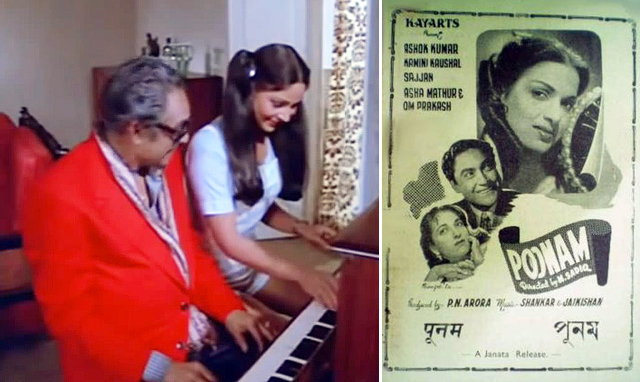
Dadamoni, Rati Agnihotri in a still from Shaukeen; poster of Poonam (below)
Roshmila Bhattacharya (MUMBAI MIRROR; October 11, 2018)
I met him for the first time as a wide-eyed 22-year-old trainee journalist. And even as I was stuttering over the “Sir”, he cut in to say gently, “Call me Dadamoni.” With that one word he steadied my skittish nerves and I made a friend for life. Since our birthdays were a day apart, Ashok Kumar who’d have turned 107 on October 13, would always insist that he was younger than me which, going by the twinkle in his eyes and his Puckish humour, he was.
Rati Agnihotri, the giggly PYT of Basu Chatterjee’s Shaukeen whom the three old men — Ashok Kumar, Utpal Dutt and AK Hangal — compete with each other to impress, agrees with me, saying his chuckle was the most delightful sound she’d heard. “And the hilarious anecdotes Kishore da (Kishore Kumar) and Dadamoni would narrate had us clutching our sides with uncontrollable laughter. He was tailor-made for that role, except he wasn’t lecherous, he was one of the nicest persons I’ve met,” asserts the actress.
Another co-star, Kamini Kaushal, flashbacks to one of her earlier films, Poonam, which had Dadamoni as the much older hero, mesmerised by her singing. She narrates how she’d met him for the first time when he’d come to her college, Kinnaird in Lahore, to attend a cultural programme organised for the war relief fund as the chief guest. “I was a final year honours student in English literature, spirited, fun-loving and uninhibited. After my solo dance performance, I was standing in the row right behind him, and to catch his attention, I stealthily pulled his hair from behind,” the nonagenarian actress shares.
Kamini ji adds that when they started working together in Poonam, she asked him if he remembered her from that incident, and he nodded with a laugh, “Of course I do, you naughty girl.” That set the tone of their relationship. “I was a kid and he was years older, but we were buddies,” she smiles fondly at the memory.
For Rati, Dadamoni was someone she could talk to about anything and everything. “He was learned and honest. Given how young and inexperienced I was then, his anecdotes from his life’s journey were like Aesop’s Fables for me,” she asserts.
Rati goes on to recall how during the shooting of a song for Tawaif, she had admitted to him that the 18-hour workdays, 24x7, for months on end, were taking their toll, leaving her drained and susceptible to infections. Dadamoni who had studied homeopathy, immediately prescribed some little white pills which her parents got from a pharmacy in Princess Street. “They worked miracles,” the actress marvels years later.
That wasn’t the end of his lessons. During the shooting of B R Chopra’s social drama, there were times when Rati would get a little anxious because this character with her body language and colourful vocabulary, was very out of character for the young girl. “I would nervously ask Dadamoni how to do a particular scene Chopra uncle had briefed me on. He would tell me reassuringly, ‘Beta, tum jaise kar rahi ho, sahi hai.’ This gave me the confidence to play the role naturally, without trying to force myself to become someone I wasn’t,” she says.
Today, when I look back to our conversations, I realise I got my share of Aesop’s Fables too, between chuckles, which still echo in my ears.
What's common between Manoj Kumar-starrer Shaheed and Ajay Devgn-starrer The Legend Of Bhagat Singh
7:52 AM

Roshmila Bhattacharya (MUMBAI MIRROR; March 22, 2018)
His first role made Ghulu a hero in his mohalla but through endless rehearsals and costume trials, no one realized that the little boy was suffering from acute stage fright and was dreading his turn in the spotlight.
D-day dawned shimmering with excitement. His family took their place and the curtains parted. All the actors were in place on the makeshift stage, except one. Realization was collective: Where was Ghulu? Where was their Bhagat Singh? There was a mad scramble to find the star player who’d jumped over the wall and melted away into the darkness. His no-show meant that the show had to be eventually cancelled. No one ever let him forget it. Surprisingly, Ghulu grew up to be an actor who christened himself Manoj Kumar and at 22, picked up the pen to immortalize his childhood hero.
On March 23, 1931, Bhagat Singh had been hanged for the assassination of a British police officer, John Saunders. Manoj Kumar had grown up on stories of the martyr but when he asked his leading lady about him, she shocked him by saying blithely, “Of course, he’s a famous dacoit.”
Determined to set the record straight, the actor took four years to complete his script only to discover that after two disastrous, Bhagat Singh biopics, Shaheed-E-Azam Bhagat Singh and Shaheed Bhagat Singh, no one was interested in a third. It was only after Hariyali Aur Rasta had turned him into a star, that his publicist-friend, Kewal P Kashyap, offered to produce Shaheed with him in the lead.
Interestingly, Shaheed was also the title of Dilip Kumar and Kamini Kaushal’s 1948 tragic love story which Manoj Kumar had seen as a boy of 10. Kamini played Bhagat Singh’s mother in his Shaheed. The actress had been incredulous to learn that he wanted her to play his mother. “I don’t want you to play just anyone’s mother but Bhagat Singh’s mother,” he’d explained and she had come out of retirement to shoot for the film when seven months pregnant, radiating the glow of impending motherhood.
Shaheed premiered in 1965 with then Prime Minister Lal Bahadur Shastri among the guests. Thirty-seven years later, Rajkumar Santoshi’s 2002 biopic, The Legend Of Bhagat Singh, with Ajay Devgn, opened, as did Dharmendra’s 23rd March 1931: Shaheed with Bobby Deol as the 23-year-old patriot and elder brother Sunny playing Chandrashekhar Azad. It was a Bhagat Singh festival that year with a few more films, including Shaheed-E-Azam with Sonu Sood. But it was Ajay’s act that remains unforgettable. Ramesh Taurani had once confided that when Santoshi came for a narration, he refused to reveal which actor he had in mind for the lead but while he was outlining his story, the producer could only visualize Ajay in the role. When he told the director this, Santoshi admitted Ajay was his choice as well.
Ajay bagged the National Award for Best Actor for his performance, The Legend Of Bhagat Singh was also adjudged Best Film. Earlier, Shaheed had bagged Manoj Kumar three National Awards. The martyr’s real mother whom the actor fondly called Chaiji, was seated beside him at the Rashtrapati Bhavan during the ceremony and joined him on stage as the whole auditorium rose to its feet to give them a 10-minute standing ovation.
However, for Manoj Kumar the bigger reward came after the film’s release when during a shoot of Amaanat in Goa, he went to a government tea house for a cup of tea. When he asked for a bill, he was told it was already paid for by the sweeper who’d bought him his chai. The old man confided he had never heard of Bhagat Singh till he saw Shaheed and learnt of his sacrifice. “The least I can do is to offer you a cup of tea,” he said quietly.
Manoj Kumar on Shaheed and the idea of 'dying twice'
7:46 AM

Roshmilla Bhattacharya (MUMBAI MIRROR; March 18, 2014)
Eighty-three years ago, on March 23, Bhagat Singh was in his cell when jail officials arrived with his death warrant. The 23-year-old revolutionary, who had been tried and convicted for the murder of British police officer John Saunders, is believed to have quietly requested them to give him a few minutes so he could finish the last chapter of Karl Marx's book. Once done, he let himself be marched to the gallows with a smile playing on his lips.
Manoj Kumar who relived the martyr's short but eventful life in the 1965 patriotic drama Shaheed, insists that Bhagat Singh could have saved his life with an apology. In fact, Chandrashekhar Azad had planned the perfect escape plan for him. But he chose to be publicly executed because he believed his death would inspire the country's youth to rise up against British imperialism.
While reliving his idol's life, the actor and his unit stayed in Ludhiana jail for two months and interacted with the real qaidis. One of them, a Sardar sentenced to life for several murders, confided that he’d been a jail warden in Bhagat Singh’s time and nothing being filmed was exaggerated or out of sync.
“Even the gallows that Bhagat Singh, Sukhdev and Rajguru walk towards were real gallows,” asserts Kumar, who at the age of 10, had been chosen to play the fiery nationalist in a street play but ran away before the curtains went up, overcome by an acute attack of nerves.
Soon after, he accompanied his uncle for his first film, Jugnu. The film’s hero, Dilip Kumar whom he knew as Suraj, died at the end and the young boy cried all the way back home.
But a few months later, he spotted Suraj again on the posters of Shaheed (1948) and coaxed his uncle to take him for the film. On screen, he was amazed to see Suraj resurrected as Ram, fighting his father and the British, before dying a second time.
This time he returned home bemused and asked his mother how many times a man could die. In response to her “once” he prodded, “What if he dies twice?” To that beeji had replied, “Then he is a farishta, an angel.” That day Hari Krishna Goswami who was later rechristened Manoj Kumar for the silver screen, decided he was going to be a farishta too…. He went on to die a martyr’s death on screen.
Kamini Kaushal, who had played Dilip Kumar’s heroine in the 1948 film, played Manoj Kumar’s mother in the Shaheed that came 17 years later. The actress had retired and settled down to quiet domesticity since and was surprised when she discovered what Kumar had to offer. “You want me to play a mother?” she asked. “Not just any mother but Bhagat Singh’s mother,” he retorted. Kamini Kaushal agreed and shot for the film while being seven months pregnant.
The revolutionary’s real chaiji confided to the actor that he reminded her in many ways of the son she had lost to the freedom struggle and even started calling him Bhagat. She was at Rashtrapati Bhavan when Manoj Kumar walked up to receive his first National Award. He invited her up on stage and as the old lady dressed in white stepped in the dais, the auditorium erupted with thunderous applause. Reminisces the actor, “The standing ovation continued for a good 10 minutes.”
Indeed, some memories live on, forever.
Subscribe to:
Posts (Atom)