Showing posts with label Kamal Sidhwa Taraporevala. Show all posts
Showing posts with label Kamal Sidhwa Taraporevala. Show all posts
Lockdown Effect: Single screen theatres to fold by year end?
8:22 AM

Four months into the lockdown, and with cinemas unlikely to open before October, owners and trade pundits fear single screens may fold by year-end
Mohar Basu, Uma Ramasubramanian (MID-DAY; June 22, 2020)
Cinemas across Europe and the US may be opening their doors again, but a big-screen date with their favourite star remains elusive for the Indian audience. Even as the government is easing the restrictions in phases, reopening of theatres is likely to be among the last steps in the 'Unlock India' plan. The theatre business, currently in its fourth month of shutdown, has suffered a blow, with the single screens being the worst hit. Three landmark movie halls — Shanthala and Padma in Mysuru, and Maharani in Chennai — have bitten the dust in the past three months.'
With trade circles suggesting that cinemas will not re-open before October, exhibitor Akshaye Rathi worries that "about 250 to 300 single screens may be wiped out". He rues, "There's no support from any quarter, be it from the film industry or the government. By October, the number of theatres downing its shutters may touch 1000-plus."
Rathi adds that problems will continue to plague the humble single screens even after they resume operations. "The initial expenditure will be way higher than the revenue coming in," says Rathi, adding that they will witness high footfalls only when big-ticket offerings hit the marquee.
With rent, maintenance charges and staff salaries, the theatre owners' expenses have been rising with no revenue to offset them. Manoj Desai, executive director, Gaiety-Galaxy, notes that the government has offered little relief. "The government should do away with GST. We are paying the property tax, BMC tax and electricity charges. Ideally, these should be excused for the moment."
mid-day reached out to Regal Cinema owner Kamal Sidhwa Taraporewala, who declined to comment on the losses incurred due to the lockdown. Since 2018, rumours have been abuzz about the Colaba theatre struggling to stay afloat.
Gurmeet Singh Seble, MD, Seble Cinemas in Delhi, adds, "The Shaheen Bagh protests continued from December to February, and the lockdown came into effect in March. So, single screens here were affected even before the Coronavirus pandemic."

Mumbai's Regal cinema stares at shutdown as losses mount
8:12 AM
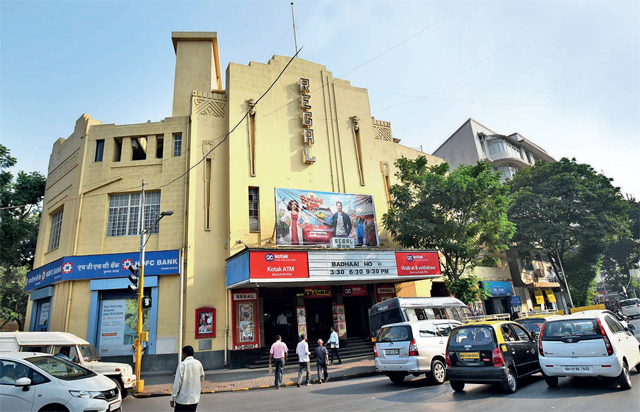
The cinema has been racking up a loss of Rs 1 cr annually; talks with a multiplex chain to add at least two more screens and a food court have been unsuccessful so far
Khalid Mohamed (MUMBAI MIRROR; November 7, 2018)
Regal, one of the city’s oldest single screen cinemas as well as its first air-conditioned theatre, is on its last breath. “It’s just a matter of time. Regal could close down any day,” rues Kamal Sidhwa Taraporevala, granddaughter of Framji Sidhwa who founded the cinema 85 years ago.
In recent years, the cinema has been posting a loss of Rs 1 crore annually. The average occupancy rate has dwindled to around 15-20 per cent of the 1,160 stand-alone seater. Ticket sales have nosedived drastically since the proliferation of multiplexes at the turn of the millennium.
Compared to the hefty rates of multiplexes spiralling between Rs 500 and Rs 1,000 a pop, the tickets are moderately priced between Rs 150 and Rs 250. For potential blockbuster Bollywood movies produced by the top banners, the rates are hiked at the market strategy of the distributors who take away the lion’s share of the revenue.
Run by a board of directors of Globe Theatres, Regal—like one of its other cinema properties, the Capitol right opposite the Chhatrapati Shivaji Maharaj terminus—is more than likely to fall into a state of neglect. The Capitol closed down 11years ago.
Both Kamal and her cousin Jal Tata, who is on the board of directors, point out that while retaining its heritage status, Regal could be redesigned to include at least two more screens and a food court. Negotiations with a multiplex conglomerate, however, have been fruitless so far.
Faramji, who started out as an usher-cum-projectionist in a horse-stable-turned-cinema in Rangoon, had partnered with businessman and philanthropist Kaikhushroo Kooka to lease the land at Colaba Causeway since it was just a stroll away from the naval base and a luxury hotel patronised by international travellers.
The two-storey Art Deco structure and its interiors were assigned to the British architect Charles Stevens and the Czech artist Karl Schara, respectively.
Regal opened its doors on October 4, 1933, with the Laurel and Hardy feature The Devil’s Brother. The comic duo had sent a telegram of congratulations to the Regal management.
Following Framji’s death, his son Dhunji nurtured the cinema, upgrading it with a 70 mm screen and Dolby sound system, after acquiring a degree in sound and motion picture engineering from the New York University.
Jal Tata, a virtual encyclopaedia of movie lore, recalls that Filmfare Award functions were held at the cinema for four years in the 1950s. Music concerts by the legendary violinst and conductor Yehudi Menuhin and singer Marian Anderson were hosted there to packed houses. Among the top international movies which scored the longest runs at the cinema are The Sound of Music (38 weeks), Enter The Dragon (31 weeks), The Ten Commandments (31 weeks), Titanic (30 weeks) and Gandhi (26 weeks). Every James Bond movie would generally score a run of 20 weeks.
Once, the Regal foyers used to be adorned with original Hollywood studio portraits of Audrey Hepburn, Marilyn Monroe, Jerry Lewis, Cary Grant and Charlton Heston. With time, though, these have vanished with the wind. Perhaps, they faded and were shredded.
However, the cinema largely still retains its Art Deco ambience, like the tall mirror panel embossed with Uncle Oscar, the trophy presented at the Academy Awards ceremonies.
Kamal recalls that during his last years, her father Dhunji was depressed. She adds: “His last words to us were to preserve Regal but convert it into a multi-screener. The family has always been emotionally attached to the legacy but unless we are practical, we would be fighting for a lost cause.”
Is the imminent closure of Regal absolutely final, then? Kamal’s despondent response: “Yes, unless there’s a miracle.”
Mumbai's iconic Regal Cinema is struggling to stay afloat; sends SOS to regular patrons
8:15 AM

Colaba's struggling single-screen theatre, Regal Cinema sends out SOS to regular patrons in a bid to stay afloat in difficult times
Mohar Basu (MID-DAY; July 27, 2018)
Yesterday, Mumbaikars woke up to the realisation that yet another SoBo institution - Colaba's Regal Cinema - is struggling to stay afloat. Early in the day, a message started making the rounds on Facebook: "Mission Impossible 6 at the Regal Cinema. Please patronise the Regal, one of the last single-screen cinemas left in Mumbai!" A matter-of-fact text that struck a chord with several cinephiles who grew up watching their favourite films in the South Bombay heritage building.
mid-day reached out to Kamal Sidhva Taraporevala, the third-generation owner who still resides in the Regal building. When quizzed why she sent out that message, she said, "The footfall is heartbreakingly low. It's a 1,100-seater cinema, and we sometimes struggle to fill 150. We have advance bookings, but the sales drops are unimaginable. I don't even want to get into the statistics, but you can imagine what it's like from the figure I gave you."
"In the 1990s, we used to run full houses. And now, we see 100-200 people on good days. It's a family business, and I sent that message out to friends who prefer to watch English movies. Distributors have stopped giving enough movies to single-screen cinemas; they prefer multiplexes. We have no control or choice over what movies we can show."
Bittersweet nostalgia
The empty seats at Regal are a stark contrast from the theatre's glory days back in the '70s and '80s, when films ran for 13 to 15 months at a stretch. "I remember that Gandhi had run for months and months, and the queue would snake right around the block. Before that, Enter The Dragon, had run for 13 months. I remember times when the challenge was to fight black market ticketing. For as long as I can remember, the cinema was always full, and look now..."
The cinema was started by her grandfather in 1933, and the building's history is part of the charm of watching movies there. But its heritage status has also made things difficult for the owner. "The business is not generating enough money for us to take on the extra expenditure of redoing it into something else, for instance a multiplex. That will be a major gamble. There is also the issue that the government won't allow us to convert it for any other business (say a restaurant). If it's a cinema, it has to be used as a cinema. This is why so many single screens are lying vacant," Kamal explained.
Picture abhi baaki hai
The challenges of running Regal are abundant, Kamal added. "Just switching the electricity on for 100 people is making it impossible to run. But even at this point, we are hopeful. We haven't considered selling out yet."
She added that a little empathy from the authorities would go a long way in protecting single-screen theatres. "There is a huge gap in protecting the interests of the single screens. Anything we need to do to keep it running has to be done privately, including generating the funds."

Subscribe to:
Posts (Atom)