Showing posts with label Kabul Express. Show all posts
Showing posts with label Kabul Express. Show all posts
I’d love to do a film in the spy universe-John Abraham
8:50 AM
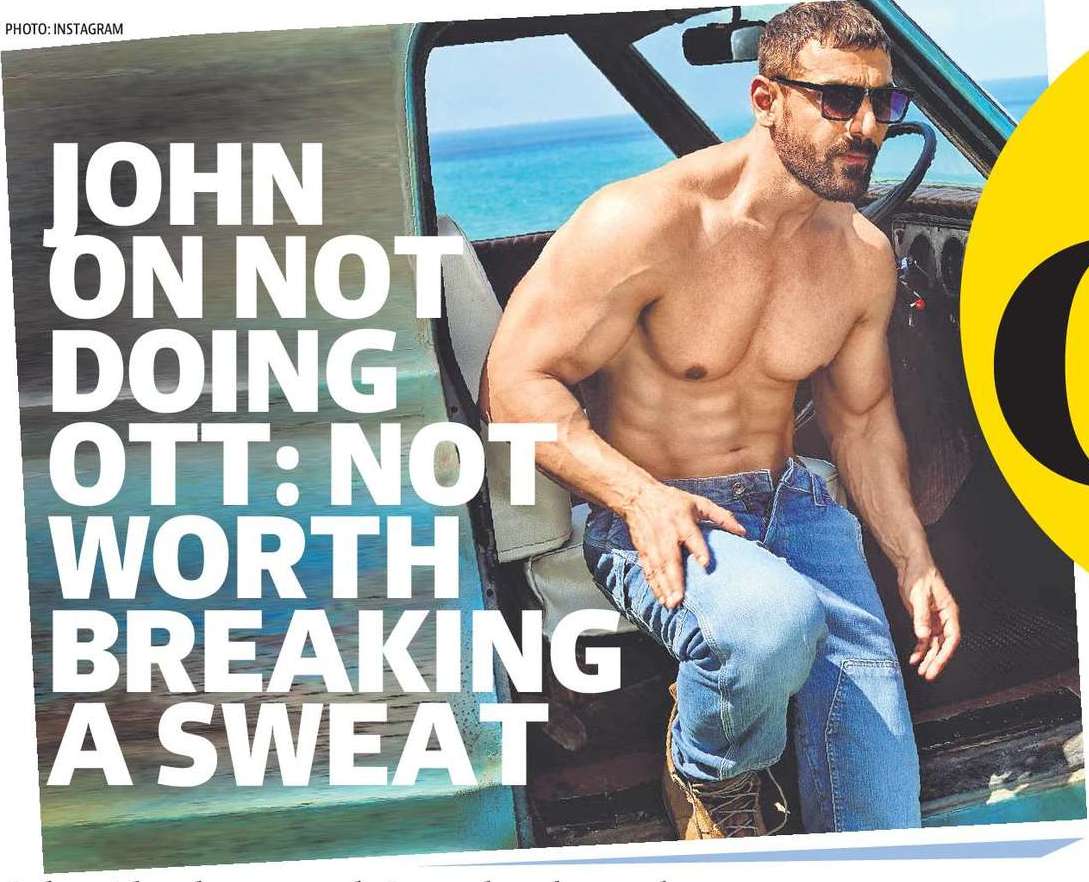
John Abraham explains why the web space hasn’t enticed him yet as an actor or producer
Akash Bhatnagar (HINDUSTAN TIMES; May 26, 2025)
akash.bhatnagar@partner.hindustantimes.com
John Abraham-starrer The Diplomat this month made its way to OTT and has been earning rave reviews. While the web medium has become the go-to platform for everyone, including many stars, John, who also produced The Diplomat, has no plans to foray into OTT any time soon.
“To do OTT, you need a big office setup. You need a lot of people working towards something where you don’t even own the IP. You make a commission from the series and that goes into your overheads. So, I don’t see any sense in breaking a sweat on doing these series,” says the producer.
Does that mean the 52-year-old would never back an OTT project, even if it’s a substantial one? “I’d love to do that [as a creator]. But that would happen because I want to tell that story, not because I want to make a business model out of it.”
But how about foraying into the space as an actor? “At this point, I don’t want to come on OTT for a series or film. In my head, I believe I was made for the big screen. I have a lot of respect for OTT though, because most of the content, at least internationally, and some Indian projects too, are outstanding,” he responds.
Meanwhile, there’s buzz about a film on his character Jim from Pathaan (2023) being planned in the spy universe.
Mention this to John, and he says, “I’d love to work with (producer) Aditya Chopra again, because if there is one person who has positioned me perfectly as a hero or anti-hero, it’s him. First Dhoom (2004), then Kabul Express (2006), then New York (2009) and then Pathaan. So yes, I’d love to do a film in the spy universe.”
Using on-screen artillery in films: Kabul Express had real Kalashnikovs; night-vision glasses in Uri were from Juhu Beach
9:15 AM

From the age-old revolver to today’s advanced weaponry — the evolution of on-screen artillery is an interesting chapter in Bollywood history
Natasha Coutinho (BOMBAY TIMES; October 20, 2023)
What’s a good ol’ Bollywood actioner without a gunfight or three? Indeed, the story of how Hindi cinema has depicted arms and armaments is as interesting as the century-plus history of Bollywood itself. The long-barrel revolvers and 303 rifles have been around for decades – see the posters of Dev Anand’s CID or of Sholay, for example – but it’s only in recent years that Hindi films have started matching Hollywood blockbusters bullet for bullet, so to speak.
From espionage thrillers to cross-border wars and gangland dramas, as the scope of the Bollywood action flick grows exponentially, our films now show an astounding array of guns, artillery, tanks, explosions and more. We go behind the scenes to explore how the industry creates all the firepower that is required to make a big bang at the box office.
‘AFGHANS GOT US A TRUCKLOAD OF KALASHNIKOVS IN KABUL EXPRESS’
Action scenes require the maximum planning and pre-production, because there is much at stake in terms of the safety of people involved. Today, with VFX, things have become simpler than what they were 10-15 years ago. During Ek Tha Tiger (2012), we did stunts physically, with 200 foot wooden towers falling from one building to another. In Kabul Express (2006), every gun that you see is real. Those days guns were easily available, and Afghans got us a truckload of Kalashnikovs. We had an Afghan action director, Abdul Basir Mujahid, who insisted on firing a rocket in our honour despite my telling him not to. In the middle of a shot, he jumped off an SUV and fired it and that shot is there in the movie. We were shocked because the whole place resounded with the noise, but Afghanistan being Afghanistan, no one batted an eyelid!
— Kabir Khan, director

‘GOT GUNS FROM SERBIA, BUT THE NIGHT-VISION GOGGLES WERE FROM JUHU BEACH!’
My team and I are particular about authenticity, and when we started prepping in India for Uri: The Surgical Strike, we realized that replicas of original guns weren’t easily available here. There are customs issues and getting the guns may take months. We had a choice between going ahead with the AK-47 replicas available here, or trying something new. Luckily, Serbia had opened up a rebate structure, and getting equipment similar to the choppers, Mirages and guns we needed became easier. However, we also did a little jugaad and the night vision goggles were binoculars with a green light inside from Juhu beach. While shooting in Serbia, we could only afford four stunt people. If you watch carefully, the same people play terrorists and armymen and even come back from the dead to play other characters! — Aditya Dhar, director
‘WE BUILT PROTOTYPES OF MANY GUNS, AND VFX DID THE REST’
The Night Manager was a tricky series because it is the story of an arms dealer. We had to ensure that the arms shown were technically correct and matched the stuff used in modern warfare, apart from being visually appealing. After extensive research, we zeroed in on a wish list. Other than a few assault rifles, not many weapons were readily available for filming. Necessity is the mother of invention. We studied and built prototypes of many guns with our SFX partners and made its impact look cinematically as close to the real ones with ample help from our VFX team.
— Sandeep Modi, director

‘WE PROVIDE FILM TEAMS WITH AN ALBUM TO CHOOSE THE RIGHT GUNS FROM A PARTICULAR ERA’
The 1980s and ’90s saw several dacoit films and those needed rifles and double-barrelled guns. Times have changed and films now require M4 carbines and AK-47s, Glocks and Berettas. Even if gun models are limited in real life and we have to repeat them, the audience wants something new in each film. That’s why we have custom-made guns like those seen in Don 2 and Lucifer. when the trigger is pulled, there is a sound like gunfire, which is the cue for the actor. Muzzle flash is later added via VFX. When we are approached for a film, we give the team an album, from which they can select guns. We also recommend the gun that should be used for a particular era, though sometimes we take cinematic liberty if the gun looks good on screen.
— Vishal Tyagi, SFX supervisor and armourer

‘WE USED A DRILL MACHINE TO REPLICATE AN ANTI-AIRCRAFT GUN’
Research is an important part of our job, and for Tiger Zinda Hai we had to show Baghdad city, Chinooks and other army choppers. We built the set in Abu Dhabi and since a real Chinook would’ve cost Rs. 30 crore, we created mock-ups. Tubelight had Indo-China war sequences and we had a team that made study models and converted normal cars into tanks. For the upcoming Chandu Champion that shows the 1971 war between India and Pakistan, we required an antiaircraft gun that vibrates. We used a drill machine to get the repetitive movement, while the VFX team added the bullets, and the sound department handled the rest. In the past, we would make a mould of mud and create guns from it; today you can just print a dummy gun from websites and the process is effortless. VFX has also made life easier. For example, we built a chopper for Bade Miyan Chote Miyan without the rotating blade, which will be added through VFX. For blast scenes, we create the smoke, while the fire is added via VFX
— Rajnish Hedao, production designer
‘WE MEET SENIOR OR RETIRED OFFICERS FOR HELP IN RESEARCHING THE RIGHT GUNS’
While selecting guns, we must be careful because Mumbai police firearms are different from those used by Rapid Action Force or the Army. We meet senior or retired officers who help us with our research. It takes us a long time to prep for car stunts because even if the shot shows a car toppling, we have to ensure people inside are safe. The web series Aar Ya Paar has an archer as the protagonist and we got on board a national archery coach to work with the cast. We created artificial bows and arrows lighter than the real ones, so that actors could handle them easily. Our job begins two-three months before the shoot.
— Swapnil Bhalerao, production designer working with Rohit Shetty for 18 years

The Taliban won’t allow Afghanistan film industry to survive-Kabir Khan
8:14 AM

Sugandha Rawal (HINDUSTAN TIMES; August 20, 2021)
Filmmaker Kabir Khan is disturbed and concerned about the ongoing Afghanistan crisis with Taliban gaining power, and he fears it will first cut the entertainment cord of the country. “It is bizarre that after 20 years Taliban can come back. It makes me remember one little incident from my documentary, where we were interviewing some of their members. One senior Taliban member just looked straight into my camera, said, ‘You think we are gone, we will be back’,” he says.
The 52-year-old, who documented his own experiences in his directorial debut, Kabul Express (2006), is worried about the safety of the people. “One of my friends, actor Bashir has been forced to go underground,” he reveals.
The director feels artistes are anyway soft targets. “In the first avatar of Taliban in 1996 -2001, they did not even allow photography. I have serious doubts whether they will let the film industry, which is pretty dynamic now, survive. We know their opinion on cinema and music. The Taliban ideology will not allow them to continue.”
But is he planning a follow up to his documentary? “It is early days. I want to see how it all pans out. But there could be a possibility of doing some work,” he adds.
There were snipers sitting on top of mountains in minus 15 degrees to keep us safe-Kabir Khan
7:00 AM

Roshmila Bhattacharya (MUMBAI MIRROR; December 20, 2019)
 On December 15, 2006, Kabir Khan rode into Hindi films on the Kabul Express. Thirteen years later, he admits he could make an entire film on the making of his debut directorial. In fact, a lot of what he went through himself, found its way into the script.
Before the Taliban took control, Kabir and his executive producer on the film, Rajan Kapoor, had gone to Afghanistan to make a documentary for the Red Cross on the effect of war on children there. That project remained incomplete, but stayed on their mind, and when they saw the Taliban regime crumbling, the duo decided to return to the war-ravaged country and complete it. “But while other journalists and filmmakers were entering via Peshawar, we knew that being Indians we would never get a visa for Pakistan, so, we flew to Uzbekistan, then, drove down to Tajikistan and tried to cross the border into Afghanistan. But the airports had been bombed out, snow storms had caused an avalanche, so, roads were blocked while the rivers were flooded. Even the helicopter we were to take, crashed on the eve of our departure,” Kabir reminisces.
They were stuck there for two weeks, and, on Rajan’s urging, returned to the air base one last time where they learnt that two Russian helicopters were on their way to Kabul with medical supplies. For $2000, one of the pilots agreed to smuggle them across in the cargo. “But just before we were to reach Kabul, the pilot took the chopper down to 15-20 feet above ground, and told us to jump out with our bags as we couldn’t be seen travelling in an Air Force plane. We had no choice but to comply. Surrounded by snow-capped mountains, the first thing we saw, as we touched terra firma, was a Mujahideen walking towards us with his Kalashnikov cocked. And I told myself, ‘This is how your end was written’,” the filmmaker shivers at the memory.
As the man walked towards them, both Rajan and he started shouting in desperation, “Hindustan, Hindustan”. Surprisingly, he responded, asking, “Hindustan? Amitabh Bachchan?” In answer to their nod, he broke into a Big B song and when told that they were on their way to Kabul, made a quick call. “And like John (Abraham) and Arshad (Warsi) in the film, we entered Kabul riding in a military tank,” he chuckles.
They were shooting in December 2005, in real locations, and after around two weeks, they were asked to meet the Indian ambassador who informed them that he had got an intelligence tip-off that the Taliban had sent five men with instructions to kidnap and kill Kabir, Rajan, John and Arshad. “There had been a lot of stories in the international media about a Bollywood unit filming in and around Kabul and this had upset the Taliban who had sent out spies to track where we were living and shooting, before dispatching the hit men. And when the world’s most dreaded terrorist organisation sends out death threats, you couldn’t but take them seriously,” points out Kabir.
The two actors were sent home and the unit may have returned too, but the government felt that if the Taliban managed to chase them out without them completing their shoot, it might tarnish the country’s image. “The Afghan security minister got in touch and assured us that we would be given adequate security. We were provided with 60 commandos, equipped with everything from rocket launchers to guns. After reviewing the arrangements, the military attaché assured us that the Taliban did not have the firepower to take on this kind of security,” recalls Kabir, adding that this was the only time his producer Aditya Chopra called to assure him that no film from their production house had been stopped midway and that they would recreate Kabul anywhere in the world if need be. Knowing this, Kabir was told to decide what he wanted to do. He decided to stay back and shoot in Kabul once John and Arshad assured him they were returning too. “Not too many heroes would risk their lives to complete the film of a first time director, but they were truly brave and showed a lot of faith.”
And for the duration of the shoot, the unit rode around in a mile-long motorcade of SUVs with guns sticking out of every window in a radius of 100-km outside Kabul. “Some of the locations were still under Taliban regime and inaccessible but we pulled it off thanks to the support of the local government and its people. There were snipers sitting on top of mountains in minus 15-20 degrees to keep us safe. We were there for two months and shot the film over 38 days with a lot of local, non-trained actors. My first film ran on pure passion, sheer grit and a lifetime of courage,” Kabir signs off.
India is not a safe place for women and animals-John Abraham
8:01 AM

John Abraham on issues plaguing us and ways to tackle them, being non-confrontational and his action -packed love story
Roshmila Bhattacharya (MUMBAI MIRROR; August 3, 2018)
After giving over a year to your home production, Parmanu, you’ve been doing fi lms back-to-back. Satyameva Jayate will be followed by RAW: Romeo Akbar Walter and Batla House, which rolls in September.
Good content had accumulated, RAW and Batla House are exceptional scripts. And I’m happy I’m busy not just for the sake of being busy.
Satyameva Jayate touches on issues like corruption and molestation. Is hardcore violence the way to tackle them?
Satyameva Jayate is a clap-worthy, dialogue-baazi commercial film and as an audience, we sometimes like to be a part of a make-believe world where we can see our wishful thinking come true. I’m not endorsing violence, but I feel that we’ve become too sophisticated in the dealing with these issues. My character Veer is a vigilante who handles things in a certain way which I think will resonate with our audience. And there’s an antidote in Manoj Bajpayee’s character, DCP Shivansh, who believes what’s right is right and what’s wrong is wrong.
You’re a big guy yet one doesn’t hear of John Abraham getting into fistfights. How do you handle your anger?
I’ve never raised a finger on anyone, never got into a physical fight. I’m a peaceful, non-confrontational guy who can’t even raise his voice. When I’m angry I smile a lot and use sarcasm to vent. Someone told me once to always contain my anger and words for issues that need it rather than comment on everything. That can be emotionally draining and people stop taking you seriously. So, now I’m cautious of what I say and when I say it.
You have a reputation of being an honest guy who follows rules and believes in the system. How do you reconcile with what’s not right with the world?
You need to operate from within your own eco-system for it to percolate outside and bring about a change. I’m very clear with my producers, accountants and my team that we must never get into a murky space and cheat anyone. Corruption is everywhere and at every point of time. I’ve been told straight that if I don’t pay bribes, I won’t survive. I don’t agree. I may not be the most morally upright person in the world, but I know if I’m honest in what I’m doing, it can make a difference. I tell youngsters that they need to have a conscience and if their parents tell them any different, they should disagree.
You’re very protective of and respectful towards women. How do you react to the depravity we read about every day?
As a proud Indian, I have the right to look at things happening in the country critically. I say this on record that India is not a safe place for women and animals. We’re one of the few countries where we disrobe a woman by just looking at her. It’s sad and getting worse. I’m scared, and this makes me question the society and the country I live in. I don’t endorse capital punishment, but I believe we need to instil the fear of death in these sick men to ensure that they don’t commit such crimes.
Batla House touches on terrorism. What’s your personal take?
I’m a politically aware person yet I’m apolitical and I have no religious opinions. I come from small minorities from both my parents’ sides and consider myself an Indian first. I believe the world is getting polarised. Certain fringe elements will become very dominant and will subsequently represent a small part of a certain community with the result that a larger part of another community will react to that representation violently. It’s a domino effect and through films like Batla House and characters like Sanjeev Kumar Yadav we are addressing the issue head-on, telling people it’s important to pledge allegiance to your country rather than your religion.
What’s it like to play a RAW agent, usually an unsung hero?
Romeo Akbar Walter (RAW) is a compelling script and Robbie Grewal is an intelligent and passionate director. It is an honest depiction of what happens to these agents when they’re moved around by the agency and the government. It delves into their personal lives, the finality of it all. Yes, they are unsung heroes. No one bothers about what happens to them. The other day, I read about this war veteran selling things on the road. We have no respect for our soldiers and tweeting our concerns, like many actors do, doesn’t make anyone any more concerned. Some of us do it from a space of honesty but some do it around the time of a film’s release to build an image. I’d like to clarify that I’m not saying this to promote Satyameva Jayate, for me these issues were a matter of concern before and will remain even after.
RAW will see you in eight looks…
It’s actually 18 looks and it is being shot in 80 locations. It’s a true story, we have deviated a bit but most of it is factually accurate.
Does it take you into the Kabul Express space?
It does. I’d gone to Afghanistan for Kabul Express just after the Taliban fall. I’m taking RAW to Kashmir now; a film set can’t replicate what you feel when you’re in a danger zone and I enjoy that even if there’s a possibility that you may not return. After Kabul Express, I wanted to shoot my next film in Baghdad and I was told I was losing my mind.
Will the Marathi film you’re producing, Savita Damodar Paranjpe, be remade in Hindi?
I saw the play years ago, it was compelling. When the director, (Swapna Waghmare Joshi) told me there was a possibility of acquiring the film rights, I gave the nod. Some of our best content comes out of Marathi, Malayalam and Bengali cinema because they don’t have the crutch of a big budget. This psychological thriller needed to be made in Marathi first but since the subject is relevant across India, we can adapt it in other languages.
What’s next on the production front?
Besides two web series, there’s a film titled Attack for now. It’s a love story with a lot of action which is fun because I love breaking my bones.
I can work with Kabir Khan only as long as he gets me the best of scripts-Salman Khan
8:04 AM

Manishaa R (DNA; June 11, 2017)
The teaming up of Salman Khan and director Kabir Khan has been one of the most celebrated collaborations in the industry, with two back-to-back hits in Bajrangi Bhaijaan and Ek Tha Tiger. Over the past few days, there has been a lot of speculation about the rapport they share with each other and the reported “creative differences” that surfaced between them while working on the war-drama Tubelight. Kabir in a recent interview admitted that their relationship had “evolved over the years”, stating that their sensibilities never matched initially, but they blended their sensibilities, which worked for them in Bajrangi Bhaijaan.
However, Salman Khan recently revealed that their equation had more to do with Kabir’s great script-sense and stories, reiterating the fact that his consistent track-record with any director had more to do with the scripts, than anything else, “If Kabir gets me a bad script tomorrow I may not do the film, no matter what the comfort level would be or what he would say. We can work together only till the time he gets me the best of scripts and only till the time, I give him my best work,” he said. However, he later described the great bond he shared with the reckoned director as a coming together of two different ideologies, “It is a very good understanding of two people who think differently. He comes from that documentary style of filmmaking, which is more realistic and I come from a different style altogether and my emotions and understanding for commercial cinema are different. He tries to pull me towards him and I have to pull him up,” he said in his matter-of-fact tongue-in-cheek humour.
Salman also recalled the long professional relationship he had shared with Kabir and how it was his work in Kabul Express that first got him interested in the director, “Kabir and I have known each other before Ek Tha Tiger. He had first shown me his work in Kabul Express way back,” he said. In fact, he was the one who prodded Katrina Kaif to sign New York with Kabir, though she initially had her own reservations about doing the film, “Having seen Kabir’s work, I told her she must do the film. It had a different setting and dealt with the subject of terrorism and it seemed very interesting. Subsequently, Katrina began to share a great rapport with him,” he said, adding that they both shared a great comfort level with Kabir, having worked with him in two films each.
Om Puri proved his calibre in a five-minute cameo-Kabir Khan
7:36 PM

As told to Roshmila Bhattacharya (MUMBAI MIRROR; January 7, 2017)

When the Kabul Express script came up, I approached him for a role and we had longer discussions. He was eager to do the film but we were shooting on the roads in Kabul and he was suffering from a back problem so he had to opt out. But we kept in touch and I discussed all my films with him. He was always on my wish list.
At one point I had toyed with the idea of approaching him for Irrfan’s (Khan) role in New York and also for Girish Karnad’s role in Tiger. He gave his voice for the opening scene of Phantom. And I was so glad when I finally shot with him for Bajrangi Bhaijaan. He proved his calibre as an actor, shining through in a fiveminute cameo of a Pakistani maulvi. We shot for four days in Rajasthan and every morning he would greet me with a warm, Punjabi-style hug and all day his booming voice and laugh would surround us. He was a brilliant actor and an even brilliant human being. Very genuine, no pretences, his heart was in the right place. For hours we’d discuss issues. His son, Ishaan, who is training to be an actor, would spend time on the sets with us.
It was a pleasant experience and I was happy to have him back in Tubelight. It’s another endearing role and much longer. We’ve finished most of his portions. There’s just one scene left which we were to shoot on January 8. When I go back to the sets, we’ll celebrate Omji’s life. He used to joke that if I didn’t take him in all my films now, he would break my leg. I’ll remember those moments.
John Abraham talks about his most daredevil stunts
7:51 AM

Roshmila Bhattacharya (MUMBAI MIRROR; October 28, 2016)
FORCE (2011) & FORCE 2 (2016)
 In Force I weighed 100 kgs with the fat count at six per cent which
means I was 94 kgs of pure muscle. We needed an able villain to
withstand ACP Yashvardhan and found him in Vidyut Jammwal. We had
thought the action would be the film’s USP but the two biggest takeaways
were me lifting the motorcycle and my romance with Genelia (D’Souza).
In Force I weighed 100 kgs with the fat count at six per cent which
means I was 94 kgs of pure muscle. We needed an able villain to
withstand ACP Yashvardhan and found him in Vidyut Jammwal. We had
thought the action would be the film’s USP but the two biggest takeaways
were me lifting the motorcycle and my romance with Genelia (D’Souza).The 2011 film was a remake of Suriya’s 2003 Tamil film, Kaakha.. Kaakha. He’s a friend and after seeing my film he came home and told me that Force was memorable for him for the romance, along with the strength and the pain in my eyes.
We’ve found another able villain (Tahir Raj Bhasin) for the sequel who may not have Yashvardhan’s physicality and back flips, but he can think and so is far more dangerous not just for the ACP but also the country at large. After the Uri attacks in which so many of our brave soldiers were killed, Force 2, inspired by true stories, is more topical.
While promoting Force despite being injured, I was expected to lift up and throw a motorcycle down in every press conference. During Part 2, director Abhinay Deo and I asked ourselves how we could better that. The answer was to lift a car. I could have lifted a Nano or an Alto, I chose a front-heavy E-class Mercedes Benz with people inside and it became another talking point.
Matt Damon has the Bourne Identity series, Sylvester Stallone The Expendables and Rocky, Vin Diesel Fast and Furious, Bruce Willis Die Hard and John Abraham the Force franchise which will get bigger and better with every film. There’s no romance or songs, but it’s not a bloody thriller, it’s a sensible, credible film.

ROCKY HANDSOME (2016)
 This, according to me, is the best action film in Indian cinema, poetry
in motion. Sad that people who saw it on TV didn’t get to see all that
we had shot because we left out 40 per cent of the sequences and the
censors cut out another 20 per cent. I don’t know why the film didn’t
work but Akshay Kumar called me up after seeing it, raving about the
action and insisting I continue doing such films irrespective of their
box-office fate.
This, according to me, is the best action film in Indian cinema, poetry
in motion. Sad that people who saw it on TV didn’t get to see all that
we had shot because we left out 40 per cent of the sequences and the
censors cut out another 20 per cent. I don’t know why the film didn’t
work but Akshay Kumar called me up after seeing it, raving about the
action and insisting I continue doing such films irrespective of their
box-office fate.I went to Thailand and learnt a Malay-Indonesian form of martial arts called Silat where you play with knives from the guy who trained Tony Jaa in Ong Bak. Every evening, I would scream in the shower because my back was cut and my body bruised black and blue. I would ask myself if the pain was worth it and the answer always was, “It’ll turn out fantastic!”
The film had eight action sequences, seven filmed over four-five days. The climax took eight days. I was pretty much invincible, either hammering or getting hammered. My navicular bone was broken, the bone in my forearm cracked and my rib-cage was fractured when I was hit by a stick which did not completely break. I looked down and saw my chest was blue. I simply strapped myself up and continued fighting...
MADRAS CAFÉ (2013)
I grew up with the memory of our late Prime Minister Rajiv Gandhi’s assassination on May 21, 1991, while campaigning for the Lok Sabha elections in Sriperumbudur. When Shoojit Sircar chanced on this story and approached me, it was a life’s dream come true. But when we went shopping, we realised it had no buyers and after Vicky Donor decided to make it ourselves.
While shooting the climax, Shoojit and I got goosebumps because the two actors playing S Nalini Sriharan and T Suthendraraja alias Santhan looked so much like the originals. I wanted to feel the impact of the blast so I stationed myself in a ‘safe’ area, away from other actors. Just before the bomb went off, I turned, a blast of hot air hit my back and I fell. It was eerie!

SHOOTOUT AT WADALA (2013)
This film was all about adrenaline and testosterone. Manya Surve was the quintessential gangster, built like a bull, who had his reasons for crossing over. It’s an iconic character today and when Varun Dhawan and I were in Nagpur recently to promote Dishoom, he was awed to see the Manya Surve craze there!
In the climax, I’m shot 30 times. At one point Anil Kapoor stands behind me and fires at my head. The gun was faulty, and when he pulled the trigger, I collapsed. Action director Tinu Verma thought that like Brandon Lee I had died and broke down. Anil was in a daze till I stood up!
My ears rang with the sound of the gun for 15 days after that and the skin of my neck on one side, from ear to collarbone was burnt, gunpowder embedded in it. We retained the shot, it looked fantastic on screen!
NEW YORK (2009)
 Kabir Khan had come to me with a war-documentary he’d and I agreed to
shoot Kabul Express in Afghanistan even after RAW agents intercepted a
Taliban message ordering my execution. I was provided security by the
Afghan Intelligence. I had 60 soldiers around me, yet there was a
suicide bomb attempt on my life 30 minutes before we went on the set.
Kabir Khan had come to me with a war-documentary he’d and I agreed to
shoot Kabul Express in Afghanistan even after RAW agents intercepted a
Taliban message ordering my execution. I was provided security by the
Afghan Intelligence. I had 60 soldiers around me, yet there was a
suicide bomb attempt on my life 30 minutes before we went on the set.One day, when Arshad Warsi and I went for coffee to a UN-approved hotel, once the home of President Najibullah, a rocket went over our heads and crashed into the US consulate. Condoleezza Rice, then US Secretary of State, was visiting and this was the Afghans way of saying they didn’t care for the Americans. I recall Arshad saying exasperatedly, “Why are we here? You have a reason to die, I’m going to die for no reason!”
Kabul Express led to New York, inspired by the 9/11 terror attacks. The action sequences looked simple but required b***s of steel. For one, I had to scale down from the 52nd floor of a glass building in Philadelphia, strapped to a window cleaning contraption, and warned that once the slide began, there’d be no going back. We were on the 30th floor when we were stopped. Barack Obama, who a couple of weeks later, on November 4, 2008, took the oath as America’s President, was on his campaign trail.
I was hanging from a glass building, surrounded by other glass buildings, oscillating like a pendulum, slamming the suction pipe to stay in place. The baddie with me, broke down when we reached the ground, relieved to be alive. A kung-fu kick or flipping off a wall is easy, its stunts like these that are death defying!

ZINDA (2006)
This anti-hero transcended the realms of evil. He kept the protagonist (Sanjay Dutt) imprisoned for 14 years and sent his daughter into a prostitution ring. Only at the end do we learn he had his reasons. I could see the audience cringing because this guy was cold-blooded, merciless and out to destroy. Yet, they’ve gravitated towards me when I play an anti hero.
The climax was shot on the 60th floor of a building. Sanjay had to punch me and I had to go flying down 10 floors. That was the first time they were using cables in India and I chose to do the scene myself. They couldn’t get it right, so I hurtled down 17 floors, banging into glass, before they reined me in.
Sanjay beat me to pulp and I kept asking for more. Reminded me of Sunny Deol bashing up Shah Rukh Khan in Darr.
Sylvester Stallone once said that action is not just about how hard you can hit but also about how hard you get hit.

DHOOM (2004)
When Aditya Chopra approached me for Dhoom, he warned me that I had no heroine or songs. I was okay as long as I had my bike and asked if I could choose it. It was my most attractive co-star. All the bikers in the film were my friends who did the film for me. In Goa, I’d sit with them and clean my bike between shots.
My double, Shashi met with an accident, his leg coming under the wheel of a truck, after the first action sequence, and had to be hospitalised. So I was my own double, doing all the stunts myself and begging Adi to let me take off my helmet occasionally so people could see it was me drive a 1000 cc motorcycle into a moving truck.
I did wheelies at 140-160km/hr and endos or stoppies too. My biggest reward was watching young boys do wheelies on their bikes after seeing Dhoom which went on to become a cult film. With due respect to Part 2 and 3, even today, if you ask anyone what Dhoom is about, they’ll say bikes. John Abraham too has become synonymous with motorcycles and a naturally cool quotient. I sincerely believe that if there is another Dhoom, it should have me.
Due to my Afghanistan experience, I've been inspired to make real life stories-John Abraham
8:05 AM

The actor-producer insists that his films will be commercial but will send out strong messages
Sanyukta Iyer (MUMBAI MIRROR; June 23, 2015)
Celebrity ambassador for the United Nations High Commission for Refugees (UNHCR), John Abraham, on Saturday lunched with Barlin, a Somalian refugee who is now an Indian social worker, Sri Lankan refugees Divya and her sister, currently residing in Tamil Nadu, the Rohingas from Myanmar and a few Afghani and Iranian refugees.
And the 42-year-old actor-producer is inspired to make a film about refugees in India because cinema is the best voice to express their plight.
"India is a great country and we are accommodating as many people as we can. But Divya and her sister still had to seek special permission from the Tamil Nadu government to come and visit me today. The youth needs to be aware of such permissions that refugeees need to seek," he pointed out, addressing the little-known fact that refugees need special documentation.
John, who turned producer with Vicky Donor, is very clear that he wants to make mainstream cinema.
"My films too will be in the commercial format but I want to get a message across," he insists.
Back in 2006, John and Kabir Khan had shot Kabul Express, a film in Afghanistan soon after the Taliban had been overthrown by the ISAF, a group of countries headed by the US. "While I was there, I saw a lot of Afghanis leave their country and flee to neighbouring countries like India. Since then, I've been inspired to make real-life stories," he reveals.
His last production, Madras Cafe, explored the Sri Lankan crises, the assassination of our late Prime Minister Rajiv Gandhi, and the plight of refugees in India today.
"As an actor and producer, I will only do films that are close to my heart, film which carry a lot of weight and are meaningful," he asserts.
Subscribe to:
Posts (Atom)