Showing posts with label Kaalapani. Show all posts
Showing posts with label Kaalapani. Show all posts
I didn’t even know it was called beatboxing then, I just did what Priyadarshan wanted-Tabu remembers Virasat
8:10 AM

Roshmila Bhattacharya (MUMBAI MIRROR; June 1, 2019)
“One day Priyan (Priyadarshan) called me to say that there was a film he was doing and he wanted me in it. I instantly agreed, no questions asked, and after returning from the shoot of a Telugu film with Nagarjuna in Seychelles, took the first flight out to the location,” reminisces Tabu, sharing that till she reached Pollachi, she had no idea about the film, her role or her co-stars.
Her director greeted her with the news that they’d start shooting the next day, meanwhile he’d organised a show of the original film for her. “That’s when I learnt that we were doing, Virasat, the Hindi remake of Kamal Haasan’s Thevar Magan,” the actress laughs, recalling that while watching the 1992 Tamil drama, she’d wondered which role Priyadarshan had in mind for her, if it was that of Shakti’s girlfriend, Bhanumathi, played by Gautami.
Then, after the interval, Revathy’s character, Panchavarnam, a village girl Shaktivelu is forced to marry after her groom runs away on the wedding day, entered the picture. “And when I saw the scene of her trying to impress and entertain her husband’s girlfriend with a song, I knew this was what Priyan wanted me to play and was thrilled,” she narrates.
The scene of her Gehna singing “Payalay chunmun chunmun” for Pooja Batra’s Anita is memorable even today for its verbal percussion. “I didn’t even know it was called beatboxing then, I just did what Priyan wanted. There were no rehearsals, I was praying we’d get done with it quickly because it was already 2 am and this was the last scene of the day. I was relieved when we canned it in one shot,” Tabu reminisces 22 years later — Virasat opened on May 30, 1997 — with the same charming innocence.
She raves about Kamal Haasan’s writing in the original, Ravi Chandran’s cinematography in Virasat with its canvas of colours still so fresh two decades later, the way Priyadarshan directed the Hindi remake, and Bharathan directed Thevar Magan. “Every character was so well etched and your heart goes out to Pooja’s Anita after she realises she’s lost her love to me by a strange twist of fate,” Tabu points out, raving over Revathy’s potrayal in the original.
Tell her that her innocent Gehna was just as unforgettable and she says she was only following Priyadarshan’s instructions. She adds that even though they had a reference, the setting had changed and the characters adapted to cater to a more pan-India audience. “And Priyan was clear that he didn’t want me to act with an image in my head, actually not even act, but just do what came spontaneously,” she avers.
She adds, “I was very young and if he told me to go stand under a tree, I’d walk towards it obediently, then move left or right, according to his cues. Watching me, a flummoxed Anil commented after a few days that I had a lot of trust and faith in my director,” she laughs.
Virasat was Anil’s first film with Priyadarshan, but Tabu had worked with him earlier in his 1996 Malayalam film Kaalapani . She reveals that she’d been quick to give her nod since Malayalam films were high on content and she believed that since she knew Telugu, Malayalam couldn’t be difficult. “Then, I was given a 12-page dialogue and discovered not a single word was familiar and wailed I couldn’t do it. Priyan compromised and said, we’d start with four pages and he’d give me time to prepare. I imagined I’d get a week at least but he told me to go sit under a tree, I had 30 minutes to get it right,” she recounts. She got it right, going on to do more Malayalam films.
Kaalapani was one of Priyadarshan’s most ambitious films with Tabu as Parvathi whose husband, Govardhan Menon (Mohanlal), a doctor and nationalist, is wrongly accused of bombing a train, and on their wedding day, deported to cellular jail in the Andamans. Parvathi waits for him all her life and Tabu made her presence felt amongst heavyweights like Mohanlal, Prabhu, Vineeth and Amrish Puri, looking ethereal even without makeup. “Priyan upturned a whole bottle of coconut oil on my head the first day and for the rest of the shoot, I happily went around with my hair oiled and in two braids, the large red bindi he’s obessesed with, dotting my forehead,” she giggles, redalling how once the team that included cinematographer Santosh Sivan, goaded her into getting dressed in 20 minutes, telling her that actresses took hours to get ready. “And when I was smiling into the camera encouraged by their 'beautiful' comments, they told me they were referring to the sunset they had wanted to capture when they threw me the dare,” she laughs. Tabu has worked the most with Priyadarshan. “He tells me only he can bear me through five films, and I tell him it’s because he loves me so much.”
Even if I wasn’t working, it wasn’t that I was waiting for the right role-Tabu
7:58 AM
Harshada Rege (DNA; January 17, 2019)
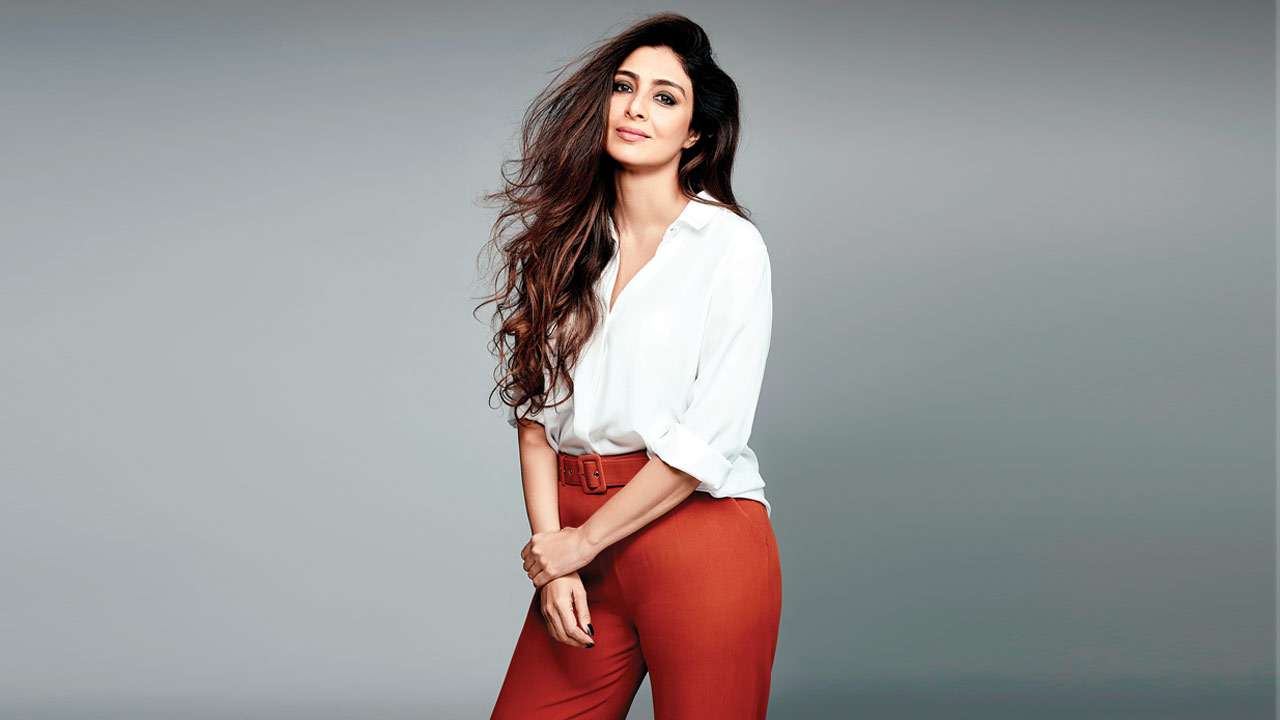
If you had to describe Tabu in a few words, they would probably be versatile and rule-breaker. Her filmography right from Maachis (1996) to AndhaDhun (2018) is enviable. She seems to enjoy masala movies like Golmaal Again (2017) as much as she loves bringing to life characters like Ghazala in Haider (2014) or Simi in Sriram Raghavan’s crime thriller. While her body of work is intimidating, talking to her is a lot of fun. Before I begin my conversation with her, I confess that I am a huge fan of her work and should not be blamed if I fumble. “Don’t worry, I’ll forget those bits,” she reassures me. On that note, we begin our chat. Excerpts…
AndhaDhun has had a great run at the box office, but it was quite a risky project...
I always wanted to work with Sriram. I have immense respect for him as a filmmaker as well as for the way he tells stories. The characters in his films are different from what we see in other movies. I had met him at the preview of Badlapur and told him that I wanted to collaborate with him. A few months later, he approached me with this idea, which was so unusual. I jumped at it because this was a journey that I had not attempted before.
Go on...
With him, everything seems natural and easy because he sounds so convinced about the story and the characters. Working with him has been a learning experience for me. The film was pushing the boundaries in several ways. And it gave me a lot more than what I thought it would. Also, it was a democratic, collaborative process, which made it so much more enjoyable. The entire experience has been rewarding. I felt like I could own the experience and the success. I am sure everyone who worked on the film feels that way because they were made to feel a part of it. The movie was plot-heavy, and the characters were woven in a different format. And Simi was definitely a challenging character.
From Maachis to Haider and now this black comedy crime thriller, are you surprised that such diabolical characters come your way?
(Laughs) I am not surprised, but I am excited to get these characters because they are extremely engaging. The role has to engage me mentally and emotionally, so that I feel that I have to go all out. The more challenging it is, the more utilised I feel. These roles have always appealed to me as they allow me to go beyond the usual, stretch my limits, explore myself and keep growing. That has been my only mantra. Yes, I agree these characters are quite diabolical, especially Simi. The dichotomy of that character is that it looks very organic and natural because that’s the way Sriram makes his films, but they are not your usual characters. There are so many layers, and I am sure people are looking at the ones that are beyond what you can see on the screen. Many plots and sub-plots are woven in the script, and yet, you don’t deviate from the story.
You are often described as being a rule-breaker or a risk-taker. Do you identify with these tags?
I am sure it’s valid, but I have never made the choices thinking I want to be called the rule-breaker. The titles are the end result of what I did organically. Maybe subconsciously, I don’t feel that there is just one way or a correct way to do things. I haven’t believed in such demarcations either in my personal or professional life. The kind of person you are will reflect in the choices you make. It’s great to do things according to the norm, too.
And most often, we do lead our lives according to them, but I don’t see any reason to not do anything that’s not the norm. This is cinema, a creative field, so everybody should be allowed to do what they want to and express themselves. The roles I picked up didn’t feel like a risk to me; it was the only way I could live or do my work. For me, that was natural because these parts were exciting and gave me an opportunity to do something that one wouldn’t normally get to do as a creative person. It is also because of the people who are writing them. They do it with so much depth. It’s just about doing justice to that. The characters and the vision of these directors resonated with me and what I wanted to say through my work. So, they are just a reflection of me and my life.
There was a time when you were not doing many films. Were you always confident that the right roles would come to you if you were patient? Weren’t you insecure?
I have never been insecure. Even if I wasn’t working, it wasn’t that I was waiting for the right role. I knew that I would do something only if I was convinced about it. I had to be clear about the reason why I am doing a particular film. It’s not that I wanted to make the most correct or impactful or dramatic choices, but it all came down to whether I knew why I was doing it.
Despite the constant influx of younger actresses, you have carved a niche for yourself...
I never did anything with the thought of creating a niche for myself. That space was created by doing the things I wanted to do and doing it my way. I never thought ke mujhe yeh jagah banani hai, toh mein aisi filmein karti hoon. I picked what would work for me or suit me. I don’t know whether you can create a space for yourself by going about it consciously. It is rewarding when people say that I have made a place of my own. It has come with a lot of conviction and love for the work that I do. I am happy when I work with a lot of love towards the project.
As an actor, following your own path has always been important to you...
Yes, I wanted to do things my way. I did not follow a certain path because that was the done thing. I didn’t adhere to things like expressions aise hi hone chahiye, ya heroine ko aise hi karna chahiye; that was very annoying for me. I hadn’t come with a rule book or even with the intention of becoming an actress. People always want to tell you what to do and what not to, especially at the beginning of your career. And I would always wonder, ‘Why not?’ I knew that if I was allowed to express myself in my own way, it would work. Everyone doesn’t have to be the same. There’s no point in that. That’s why when films like Kaalapani (1996), Maachis (1996), Hu Tu Tu (1999) and Chandni Bar (2001) came my way, it was exciting because I knew that through these, I could ignore the, ‘yeh hi chalta hai’ thought and go beyond it.
Subscribe to:
Posts (Atom)