Showing posts with label Kaala Paani. Show all posts
Showing posts with label Kaala Paani. Show all posts
Jassi Jaissi Koi Nahin sequel should be made for OTT-Mona Singh
8:30 AM

Set to play a gangster in her next, Mona Singh on challenging stereotypes with her character choices
Priyanka Sharma (MID-DAY; June 25, 2024)
In her 21st year in the industry, Mona Singh is enjoying herself the most, and she has OTT to thank for it. Having played two diverse characters in her last two shows—Made In Heaven 2 and Kaala Paani—and gearing up for six more series, the actor is happy the digital medium has embraced her. In a chat, she reflects on building her TV career on unconventional choices, maintaining balance between OTT and movies, and choosing characters that effect change for women. Edited excerpts from the interview.
The last two years have been a game changer for you—from Laal Singh Chaddha (2022) to Made In Heaven 2, Kaala Paani and now Munjya. Your talent is finally meeting diverse opportunities.
I feel that way too. The narratives have changed for women, where we have more to do now. We don’t have just one or two shades, but 50 shades to portray! I have found more success, recognition and satisfaction as an actor in this phase of my career because of OTT. These kinds of stories wouldn’t have been made on TV or on the big screen. I feel happy and grateful to be a part of this industry during this change. Also, maintaining a balance between films and OTT is not easy. It’s great that I have been able to do it.
Many actors are unable to transition to other mediums because they establish a strong image on TV. Do you think being selective about your projects kept you away from stereotyping and made it easier to bag work in other mediums?
There was nobody to guide me. I had no one taking me under their wing. So, right from Jassi Jaissi Koi Nahin, I understood that I had different views and beliefs. After Jassi, I took a break from daily soaps because I knew if I jumped right into another, everything would be compared to my first show. I have been conscious about the kind of roles I choose, the people I work with and the breaks I take because you have to maintain your exclusivity. You cannot be overexposed. Today, wherever I stand, it’s because of my choices.
While you refused fiction shows after Jassi, your peers went on to do many more shows and became small-screen stars. Weren’t you worried that not doing a daily soap would make people forget you, or lead to less work?
When I did Jassi, I was 22. But I took my own decisions. Acting is the only profession where you don’t know what’s happening tomorrow. You don’t know which show you may be offered. I took my chances. There were actors switching from one set to another, but I didn’t want to do that because I knew I was here for the long haul. I didn’t want to burn out too soon. I wanted to stay relevant and adapt to different mediums. So, I had to take some tough calls and refuse shows that I didn’t want to do. I never succumbed, and because of that, I am still around.
Starting with your unconventional heroine, you made refreshing choices not only on screen, but also off it. Were there instances where you were told to be a certain way because you are a female actor?
I come from a home where my parents never told me what to do. The only condition that my parents had was that I finish my graduation. They have never told me to be a certain way just because I’m a woman. Yes, relatives would have an opinion on it. They told my parents, ‘Oh! Your daughter wants to be an actor? She might bring shame to your family.’ But my parents paid no heed. They gave me wings to fly. Kids do well when their parents let them be. In a household, where parents have too many restrictions, kids become the best liars.
Jassi empowered many girls and that is something I try to do with every character I play. My thought process while choosing a character is that it should inspire women, change and impact society in a positive way. As women, we’re always told how to be, what to eat, whom to marry, where not to go and I’ve never given in to that.
Are you playing any unconventional role soon?
I have five-six shows coming up. I’m playing a gangster in Pan Parda Zarda, which also features Tanvi Azmi, Tanya Maniktala and Priyanshu Painyuli. That character is completely grey. There’s a mad movie that I have done, which will release by the year-end or next year.
Have you ever discussed a Jassi Jaissi Koi Nahin sequel?
We used to discuss the possibility of a sequel, but then everybody got busy with their lives. I feel it should be made for OTT.
Manjummel Boys to Merry Christmas, filmmakers are going beyond borders
3:21 PM

The pan-Indian movie has gone beyond dubbing or casting the odd crossover star. A new breed of directors is making cinema that reflects India’s linguistic diversity
Shruti Sonal (THE TIMES OF INDIA; March 24, 2024)
In 1991, when Kamal Hassan-starrer Tamil psychological romantic drama ‘Gunaa’ hit the box office, it had an average run. However, over the next few years, the film achieved a ‘cult status’, with its song ‘Kanmani Anbodu’ — composed by the legendary Ilaiyaraaja — becoming a rage. The film’s most lasting contribution, surprisingly, was something else. Parts of the film were shot in the hill station Kodaikanal, including a cave known back then as the Devil’s Kitchen. The notoriously dangerous cave became so popular as a tourist spot as a result that it began to be known as ‘Guna Caves’.
Over three decades later, Kamal Hassan, ‘Kanmani Anbodu’ and Guna Caves have gripped the imagination of cinephiles again, this time through a Malayalam film. ‘Manjummel Boys’ is a dramatic re-telling of the real story of a bunch of friends whose trip to the caves in 2006 turned into a disaster after one of them got trapped in it. The film — stripped of any ‘star’, songs, or even a female lead — has sprung a surprise and emerged as the first Malayalam film to enter the Rs 200 crore club.
A fourth of that has come from Tamil Nadu. Ruban Mathiavan, managing director of Chennai-based G K Cinemas, says even after five weeks, some shows are running housefull. “It has already earned equal to what films with Tamil superstars earn. Kamal Hassan and the Ilaiyaraaja song have been a huge factor in it,” he says.
Not just in this particular film, but in multiple movies and web shows today, linguistic and state boundaries are blurring. From dialogues to pop culture references, filmmakers cater to an audience that’s increasingly multi-lingual, mobile, and more comfortable with subtitles than ever before.
REGIONAL DELIGHTS
Big star-led blockbusters such as ‘KGF’, ‘RRR’ and ‘Baahubali’ led the way, but have now opened the floodgates for more experimental forms of content, says Harshit Bansal, founder of Humans of Cinema, an online community of cinephiles that has nearly four lakh followers on Instagram. “Audiences are now more comfortable with the cinematic languages of different regions. From action sequences, songs and background music, to how women are portrayed... Everything differs. A Marathi film looks very different from a Tamil film. Audiences are realizing that they don’t need to turn to Hollywood or Korean cinema in order to get something different,” Bansal says.
What this means is that ‘pan-India’ content today has dived deeper, moving away from lazy remakes, television re-runs with oft-hilarious and unsynced dubbing, or merely putting together stars from different regions in order to broaden the appeal.
For instance, two different versions of Sriram Raghavan’s ‘Merry Christmas’ were simultaneously shot in Hindi and Tamil. In an earlier media interview, Raghavan said he didn’t want any of the versions to ‘sound dubbed’. While the story of the slow-burn romantic thriller was almost identical, the references were carefully tweaked: the Hindi version had references to Rajesh Khanna, the Tamil one had Kamal Hassan. Two different teams of writers were hired for the languages, and original songs were composed for each! Bollywood’s Katrina Kaif and Tamil actor Vijay Sethupathi were leads in both versions, but the secondary cast differed.
However, some things remained the same. Both the versions were dedicated to director Shakti Samanta, and Sethupathi’s credits referred to him via his popular Tamil title ‘Makkal Selvan’ (people’s treasure).
In last year’s biggest hit ‘Jawan’ too, references to an old song being played at a pivotal point in the film differed in each version. The Hindi one had ‘Bekaraar Karke Yun Na Jaiye’ (Bees Saal Baad, 1962), the Tamil one had ‘Paattu Padava’ (Thennilavu, 1961), and the Telugu one had ‘Ee Mounam’ (Doctor Chakravarthi, 1964).
In ‘Manjummel Boys’, director Chidambaram didn’t shy away from letting the audiences know his inspirations. Illustrations from ‘Kanmani Anbodu’ play in the background as the title credits come on screen. The boys buy a CD of the film and play the song on the trip. They refer to the caves as the ‘place where the Kamal Hassan song was shot’. And, perhaps most fittingly, the love song plays in the climax itself, with the lyrics now spotlighting the power of friendship instead.
“The idea to put the song in the climax was in my head even before I started writing the film. I asked my team to get the rights to it before the production started. I told them if we can’t get them, then I won’t make the film. Everything else was written around it,” the director says.
Interestingly, the second half of the film has more Tamil dialogue than Malayalam, which Chidambaram says is ‘organic’ because of the setting. “Lingual boundaries are blurring. Even if one has to make a movie in Bengaluru, the characters can’t just speak Kannada. There will be a mixture of Kannada, Hindi, English, Tamil, Telugu. Similarly, Malayalam content also has to change. That’s how our country is today,” he adds.
ACCENT KHICHDI
In the world of OTTs too, different settings are being explored in order to offer something fresh to the audiences. From characters speaking a mish-mash of different languages to stories being set in far-away locations, creators are opting for it all. Netflix India’s dark comedy ‘Killer Soup’, for instance, is set in a fictional hill station in South India, and has dialogues in Hindi, Tamil, and Dakhni. Starring Manoj Bajpayee and Konkana Sen Sharma as the leads, it is based on a 2007 murder case in Telangana, and has emerged as a sleeper hit.
Harshad Nalawade, one of the writers of the show, says the fictional setting allowed them to also create more eccentric characters that spoke in peculiar accents and mannerisms. “We didn’t want to make yet another show that is set in a small town in north India. I think a section of the audience is tired of content coming from the north, and there’s no fresh world that they are seeing. So this was the opportunity to actually explore that,” he says.
Raj and DK’s hugely popular shows ‘The Family Man’ (season two) and ‘Farzi’, which featured a few Tamil dialogues alongside Hindi, made it easier for the audience to consume more of it in subsequent shows, the writer adds.
One thing is clear. For more and more viewers in India today, language is no bar. As South Korean director Bong Joon-ho said in his 2020 Oscars acceptance speech: “Once you overcome the one-inch tall barrier of subtitles, you will be introduced to so many more amazing films.”
--------------------------------------------------
MAKING UP A REEL LANGUAGE FOR REAL
Others are creating a whole new language themselves. At the global boxoffice, the sequel to Denis Villeneuve’s scidrama ‘Dune’ has earned accolades for offering viewers a glimpse into the fictitious Chakobsa language, created by a group of linguistic experts who borrowed from real-world languages.
In India, grim survival drama ‘Kaala Paani’ has managed to do the same. Set in the Andaman and Nicobar islands, it traces the journey of tourists and officials who try to tackle the outbreak of a mysterious disease.
The fact that it featured tourists from multiple parts of the ‘mainland’ made the use of a multilingual setup necessary, says creator Sameer Saxena. However, the main challenge was to create a fictional language spoken by the ‘Oraka’ tribe featured in the show.
“We got language scholars from across the world, and made a guidebook from scratch, with all the alphabets and pronunciations. We didn’t want it to sound similar to any of the existing tribal languages,” Saxena points out.
The end product was rather finessed, as opposed to the often-derogatory representations of tribal languages that have existed previously. (Think : the jhinga la la hoo hoo songs in the past.)
You have to understand that Rohit Shetty's vision is pure entertainment-Sandeep Saket and Anusha Nandakumar
8:12 AM
With the Singham franchise set to expand into the OTT space, we catch up with two writers who have helped shape the bullet bonanza
Gautam S Mengle (MID-DAY; January 7, 2024)
While most of us are going gaga over the actors joining Rohit Shetty’s “cop universe”, there are two new entrants to the same world who have been quietly working behind the scenes, patiently shaping it, scene by scene.
Meet Sandeep Saket and Anusha Nandakumar, both part of the writers’ room of the seven-episode series, Indian Police Force (IPF), set to hit Prime Video on January 19. They met at the Satyajit Ray Film and Television Institute while they were studying writing, and love blossomed, leading to marriage. Today, the couple has a string of achievements to their name, and they are just getting started.
“My maternal grandfather was a filmmaker,” says Nandakumar, who was born and brought up in Pune, “and I grew up listening to stories of what would happen on the set. But it was only when I got involved with the cultural committee at Fergusson College that the film bug truly bit me.”
If you thought the name sounded familiar, you wouldn’t be wrong. Nandkumar is one of the three co-founders of the online comedy content platform Bharatiya Digital Party, responsible for many a chuckle among the Marathi audience. “We were creating content every day and I grew to love writing. I applied for a direction and film writing course at Satyajit Ray, and down the line, also found that I loved writing fiction more than non-fiction,” she says.
Saket, too, had his own journey of self-discovery. “I met a lot of people from the film and theatre space while pursuing my Bachelor’s in History at the Hindu College in Delhi, which set me on my chosen path. I chose screenwriting as a course at Satyajit Ray, but in reality, screenwriting chose me. It is a relationship; we are still discovering each other,” he says, and it takes us a minute to realize he’s not referring to Nandakumar. Writers!
IPF, though grand and much-awaited, is hardly their first rodeo. They were also part of the writers’ room for Kaala Paani, which recently released on Netflix and is receiving critical acclaim. Before that, in 2021, they also published their first book, The War That Made R&AW, which focuses on the formation of India’s counter-terrorism agency under spymaster RN Kao and its work during the 1971 liberation of Bangladesh from Pakistan.
“We approached writing the book the way we would write a screenplay,” recalls Nandakumar. “We did need some handholding through the process but we were doing what we love doing best: telling a story.”
With Shetty’s cop universe, they say, the challenge lies in taking real-life heroes and writing their stories for the reel, which is easier said than done. The couple says that most of the characters and incidents in IPF are all based on real life.
“There are umpteen number of films, both in India and in global cinema, about cops and the work they do. Storytelling itself as an art is not a new one, it is as old as humanity. What we are doing today is based on templates established in the past. The trick is identifying that one unique aspect in every story and making that your strongest point. A cop that we talk to may only cursorily describe a chase sequence, because that’s all it was to him. Drawing out the drama becomes our job,” says Saket.
“In other cases,” says Nandakumar, “the cop is already a massive hero in real life, and the challenge is to find the right story from their already dramatic life. So, instead of pulsating action sequences, we find that emotional connect that pushed them to do their job.”
They are already working on the next instalment of the Singham franchise, as well as several other projects that have them all charged up with excitement. With the mention of the next Singham film, we can’t help but ask them about their take on accusations of “copaganda” or the attempts at shaping the opinion of the police in the people’s minds using popular culture. A recently released poster for Singham Again showed Deepika Padukone shoving a handgun in a criminal’s mouth, while smiling gleefully. The poster sparked off a heated debate about encounter culture and its cinematic depiction.
“Are encounters a more effective way of policing? I am not very sure but my job is to tell the story,” says a pensive Saket. “We live in the age of social media, where everything is the subject of intense debate. This, too, requires a debate on a larger and public forum so that we can all learn from it. Thanks to social media, people will not make statements today that they would casually make ten years ago. Why? Because they know it is wrong, that it bothers people. Likewise, if we learn something about our own subject from a wider discussion, we can take cues from the present instead of relying on templates made in the past.”
Nandakumar chips in with her own take. “If you’re writing for a Rohit Shetty, you have to understand that his vision is pure entertainment. There is another project we are working on, where the protagonist is an imperfect policeman, and gets a lot of flak for it too. A third one in the offing looks at policing in yet another completely different way. There are different cops and hence, there have to be different conversations. But yes, there really needs to be a larger conversation and debate,” she says.
Somebody commented ‘Aap toh lady SRK nikle’ as Shah Rukh Khan also had 3 releases this year-Mona Singh
8:03 AM
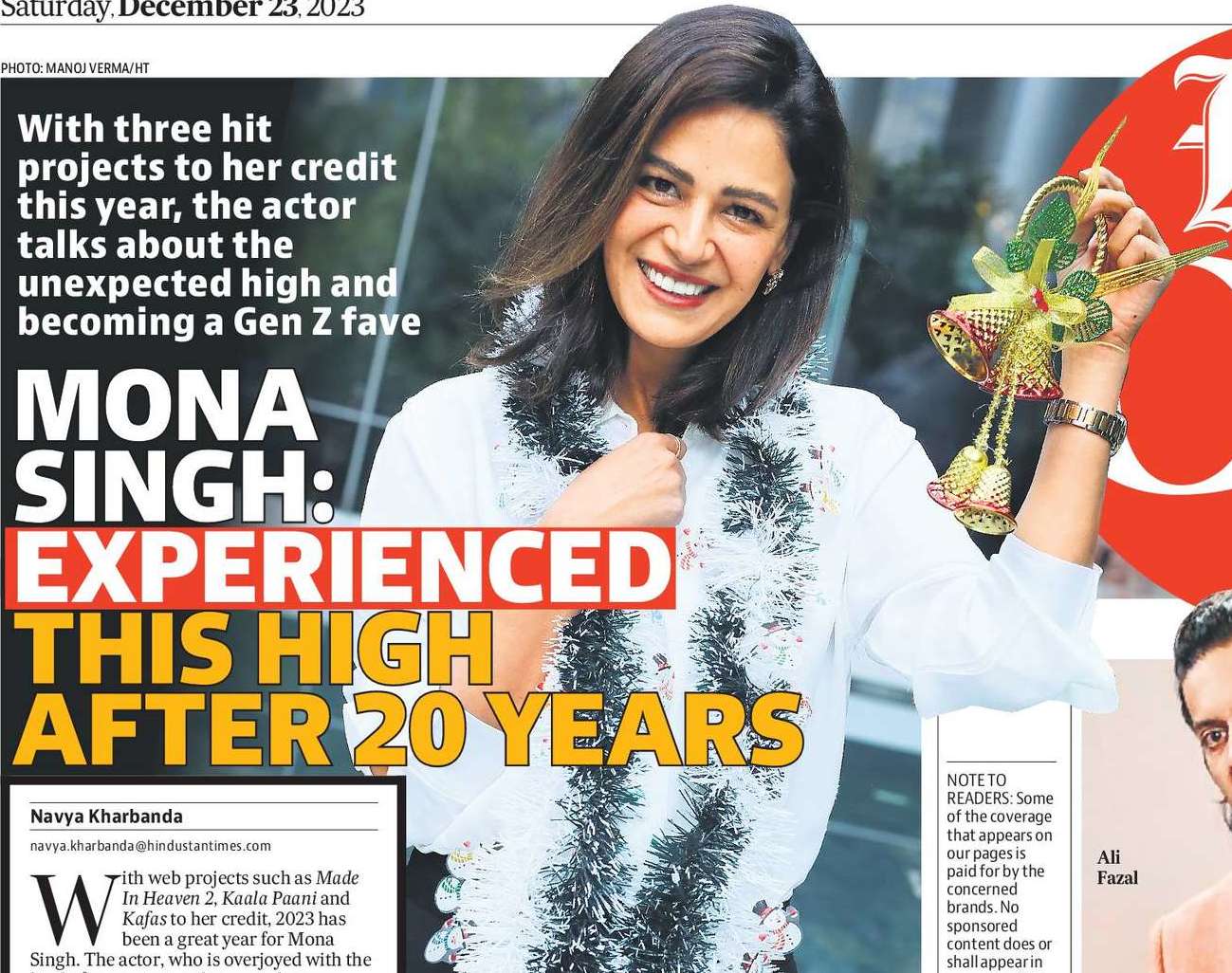
With three hit projects to her credit this year, the actor talks about the unexpected high and becoming a Gen Z fave
Navya Kharbanda (HINDUSTAN TIMES; December 23, 2023)
With web projects such as Made In Heaven 2, Kaala Paani and Kafas to her credit, 2023 has been a great year for Mona Singh. The actor, who is overjoyed with the kind of appreciation that came her way, tells us, “I got a compliment on Instagram: ‘Aap toh lady SRK nikle’, because he (actor Shah Rukh Khan) also had three releases this year. Secondly, I lost 12 kg and revamped my wardrobe and style. Bulbul Jauhari (her character in Made in Heaven) was a highlight for me this year. I’m being invited to so many round tables now.”
The 42-year-old continues, “All this (praise) is new to me. The entire industry was reaching out to congratulate me. I am grateful for 2023; I experienced this high exactly after 20 years. I saw this kind of madness in 2003 (referring to the fame she earned for her debut TV show Jassi Jaissi Koi Nahin).”
All set for a thrilling “2024 as there is a great lineup of shoots and releases”, the actor admits that OTT has turned things around for her.
She explains, “Earlier, only mothers and grandmothers would say, ‘We love you’. But now, I’m getting all the love from Gen Z as well. That’s the power of OTT. It is the only platform that can tell all these bold and beautiful stories. Every actor is shooting for OTT now, whether they are from film, TV or theatre.”
The actor never anticipated a successful 2023. “All the work that I have done this year was because of Laal Singh Chaddha (2022). Next year, I have six releases lined up and they are all because of how [my role] Bulbul was received,” Singh ends.
I have no problem playing a bad guy but can’t do a role without purpose-Ashutosh Gowariker
8:39 AM
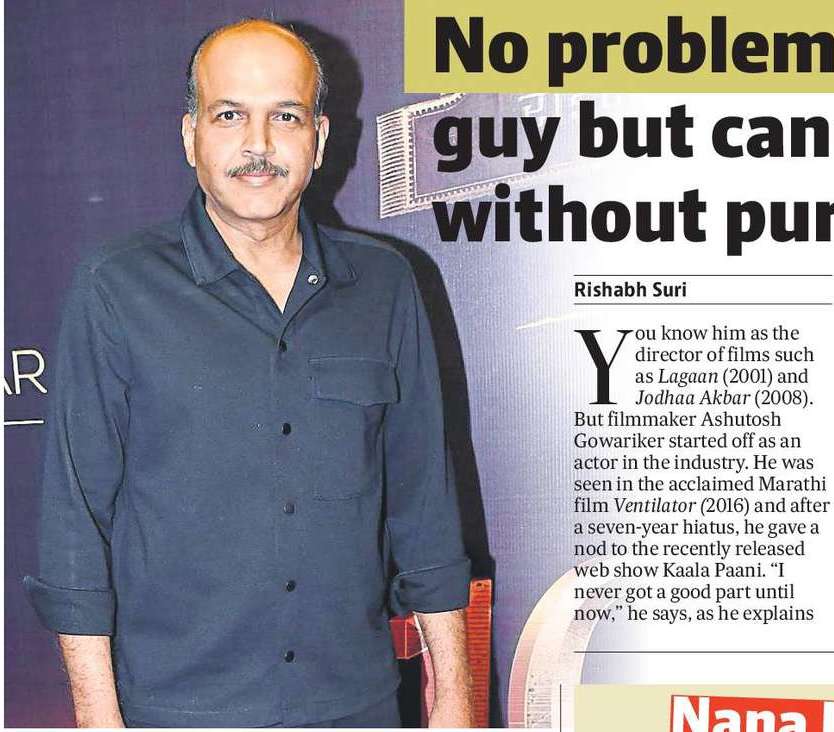
Rishabh Suri (HINDUSTAN TIMES; November 16, 2023)
You know him as the director of films such as Lagaan (2001) and Jodhaa Akbar (2008). But filmmaker Ashutosh Gowariker started off as an actor in the industry. He was seen in the acclaimed Marathi film Ventilator (2016) and after a seven-year hiatus, he gave a nod to the recently released web show Kaala Paani.
“I never got a good part until now,” he says, as he explains the long gap between his acting stints. He continues, “I am quite particular and knew the kind of roles I wanted to play on screen. I can never play the father of the heroine, or a bad guy - a role without any purpose or back story. I have no problem playing the bad guy, but I want to know his previous life, and it has to be integral to the plot line. If you move my character, the story should collapse. If it doesn’t collapse, I don’t do it.”
Gowariker admits he takes his time to commit to projects, be it as an actor or director. “It is not about rejection, but about what suits you,” says the 59-year-old, who essayed the role of a governor in the survival drama.
“I was playing someone very sure of himself and is authoritative. But, a moment comes in his life that tears him apart. A series has to be eternal because it will be remembered regardless of the box-office [numbers],” he ends.
I am not afraid of people anymore-Tabu
8:17 AM

The reticent Tabu opens up about her career choices
Sonil Dedhia (MID-DAY; November 9, 2017)
We don't see you often on screen. Are the roles coming your way not good enough?
There are roles coming my way and I have got the best of offers over the years. The people I work with should be established filmmakers and I should cherish the acting experience. I don’t choose films for great roles. I have done fewer films because often what I am offered is something I do not want to do. My approach to selecting films is different.
What do you think before signing a film? Mujhe paisa mil raha hai ki nahi [laughs].
Mujhe paisa mil raha hai ki nahi [laughs]
Is money your priority?
It is, but on a serious note, I should like what is being offered. Otherwise, even if you are paying me any amount, I won’t be a part of it. Also, as you grow in your career, you start being fearless; experience teaches you to test new waters and not be scared.
What have you have become fearless about?
I am not afraid of people anymore. I don’t think too much because I know I can handle most situations. I am not affected by things anymore and I can tackle situations in a better way. I have also started experimenting with the kind of roles that I do. Haider was a risk-taking character, but people today remember me as Ghazala [her character’s name] and not as Shahid Kapoor’s mother.
In most of the films that you have done, invariably the onus lies on you because of the characters that you have played.
That’s why I did Golmaal Again [laughs], there was no added responsibility. Most of the other cast members have been a part of the franchise since its inception. I was like a guest, who would go on the set, enjoy the privileges and make new friends.
Does it get exhausting when you play emotionally draining characters?
There is a huge part of myself when I am playing these characters, especially when I am going through their emotional journey. Films like Drishyam, Hu Tu Tu, Astitva, Maqbool, Chandni Bar and The Namesake took a part of me. Acting is a crazy profession. It takes a toll on every one, that’s why logon ko actors pagal lagte hai. Mentally and emotionally we have to get into a particular zone, come out of it and keep doing it. Most of the time, I can switch off once the camera is off because as an actor when I wrap up a film, I want my responsibility to end there. I don’t like to be accountable because it takes away the joy of my process. I am engaged in the film and the character and that is my journey. I have found my space and I am fortunate that the audience has never rejected me. This is the reason I am still here or else I would have run away long back. Mujhe ek mauka chaiye bhaagne ka [laughs].
You must have been approached with the same kind of roles throughout your career.
Yes, but I have rejected them because I don’t want to be part of a formula. I don’t want to be boring. The films that I mentioned earlier were not done thinking that I will become the poster girl for intense characters. It is the people around you that make you conscious. They started advising me about what I should do and what not. Agar mera ek role hit ho jaata, toh bolte the yehi karo, career ke liye achha hai. But I didn’t take it seriously and did what I felt like.
In the ’90s what was your thought process while choosing films?
I just wanted to look good, wear good clothes, sing songs, dance and romance the heroes [laughs]. Then how did you pick up some powerful roles early in your career? Over a period of time you also want to express yourself. I was subliminally looking for a platform to showcase my talent. I was excited when films like Kaala Paani, Maachis and Chandni Bar came my way. It was like I had found something that I really wanted to do. I am lucky that these films came to me. I was also ready for it. I am always thankful to all the directors who trusted me that I could pull off such roles. I bonded with the people who were involved in making these films. The sheer fact that I have been able to portray various emotions in the characters that I have done is a huge high for me.
Do you ever sit back and watch your films and cringe on some of the roles that you’ve done?
No, never. I don’t dislike any of the films that I have done. Every project has a journey and I never went in it with a plan. But sometimes when I see myself on TV and I am like, ‘Did I do this? Aisa bhi acting karti thi main’ [laughs]. Despite being a part of cinema, I am a non-cinema person. I grew up in Hyderabad and there was a lot of importance towards academics. My sister [Farha] was a movie buff, but I never liked watching films. I had no intention of being an actor. Everything in my life happened by chance, so I don’t assess my work so. It may come across that I have done a lot of thinking because of the films that I have done, but that’s not the case.
If you had to pick one favourite film of yours, which one would it be?
Itna difficult question [thinks]. Hu Tu Tu was a complex role for me and Cheeni Kum’s character is close to my heart. I don’t know if anyone has watched Jaal: The Trap but that is one of my favourite roles [laughs]. I am sure a lot of people will feel it’s an unusual choice but I enjoyed doing the film.
Is there a director who you can never say no to?
Vishal [Bhardwaj] is someone who I can collaborate on any film because I trust him implicitly. I heard two scenes of Haider and said yes to the film. Even if he had not narrated me the script, I would have done it. I know that he would come to me only if it is worth my time.
Have you ever done a film, just to be a part of it?
I think I can say that about Life Of Pi. The character did so much justice to me that it wasn’t like that I did it just because I wanted to work with Ang Lee. When I saw his film, Crouching Tiger Hidden Dragon. I was stunned. I wanted to meet him. So when I got an email from his team that he wanted to meet me I started dancing [laughs]. It turned out to be one of the most loved films of my career.
Would you like to do more films in the West?
I think I have done two of Hollywood’s better movies [The Namesake and Life Of Pi] and both of them happened without any agents or me trying hard. I don’t really like to run or pursue anything until it happens organically. I’m sure Hollywood se bhi offers aayenge.
Subscribe to:
Posts (Atom)