Showing posts with label K A Abbas. Show all posts
Showing posts with label K A Abbas. Show all posts
The Dharmendra-Hema Malini love story outlasted gossip, glare and distance
10:11 AM

Mohua Das (THE TIMES OF INDIA; November 25, 2025)
The first time Hema Malini saw Dharmendra wasn’t on a set lit for romance but during the interval of a K A Abbas film premiere. She was still the new, luminous face everyone was talking about. He was already the kind of man who made other men glance twice in the mirror before entering a room. Broad shoulders, movie-star jawline, and the kind of old-school manners that could make you forget what you were about to say. When he laid eyes on her, she overheard him tell Shashi Kapoor in Punjabi, “Kudi badi changi hai” (The girl is quite pretty).
Their first meeting on set came soon after. In 1970, when they were cast together in Tum Haseen Main Jawan, Dharmendra’s interest became impossible to miss. By her own admission, she turned him down more times than she could count and each time he came back, a little more charming, a little more insistent. The pursuit was relentless. Dharmendra had a reputation.
Before Hema entered the frame, Dharmendra’s name had already floated through the gossip columns, mostly with Meena Kumari. In the early phase of his career, he was rumoured to share more than just screen chemistry with the legendary actress. Their closeness became a talking point during a difficult period in Meena Kumari’s personal life.
Dharmendra, however, always downplayed it: “I was not in love with Meena Kumari. She was a huge star and I was her fan. If you call the relationship between a fan and a star as love, then consider it as love.” Their first film Phool Aur Patthar turned him into a star.
But this was different. This was the Dream Girl. Through the ’70s, they became an unbeatable on-screen pair. Seeta Aur Geeta, Jugnu, Raja Rani, Sholay, Azad… each film added to the idea of Dharam and Hema. The more the rumours of an off-screen romance swirled, the more their on-screen draw seemed to grow and more the gossip pages feasted on it.
For Hema, it wasn’t an easy love story to step into. Her mother, Jaya Chakravarthy, kept a close watch on her — from film sets to public appearances — and Hema never questioned it. Until Dharmendra came along. The otherwise compliant Hema was suddenly ready to fight the world for a man who, in her words, made her happy “I just knew that he made me happy. And all I wanted was happiness,” she said in the biography, Hema Malini: Beyond The Dream Girl.
In May 1980, the curtain lifted. The two were married away from the flashbulbs without the press getting wind. But it wasn’t the beginning of a fairy-tale domestic life. Dharmendra was already married to Prakash Kaur, with four children Sunny, Bobby, Vijeeta, and Ajeeta. Divorce was not on the cards. But all sides remained tightlipped on how the arrangement was arrived at.
What followed was one of Hindi cinema’s most unconventional marriages. Hema moved into her own home, while Dharmendra stayed with his first family and even now, she lives in the house across the road from him in Juhu. Through it all, she was labelled the “other woman”, yet she stood her ground, faced the scrutiny, and refused to be defined by it.
As she put it in an old Lehren interview: “Nobody desires to live apart from their spouse, but sometimes circumstances force such situations, and one has to accept them. I am happy with myself. I have my two children, and I have brought them up very well. Of course, he (Dharmendra) was always there, always. Everywhere.”
With Hema, he would have two more daughters — Esha in 1981 and Ahana in 1985 — and remain deeply involved in their lives. Despite the complexity, it was a blended family that baffled outsiders but somehow found its own balance.
Though they were paired romantically in 28 films, the Dharam-Hema post-wedding screen story never took off. Razia Sultan (1983), their first release after marriage, underperformed. Scripts for the pair dried up. Individually, they kept working but Bollywood had moved on, pairing these reigning stars with newer faces. The last time they’d been on screen together was that same year.
For Dharam and Hema, the hyphen between their names now belonged more to life than to cinema. Yet the partnership endured. Despite the early drama — from parental disapproval to headlines picking apart their relationship — they stayed together.
Shiv Kumar Sharma was offered a role in Amitabh Bachchan's debut film, Saat Hindustani
8:17 AM
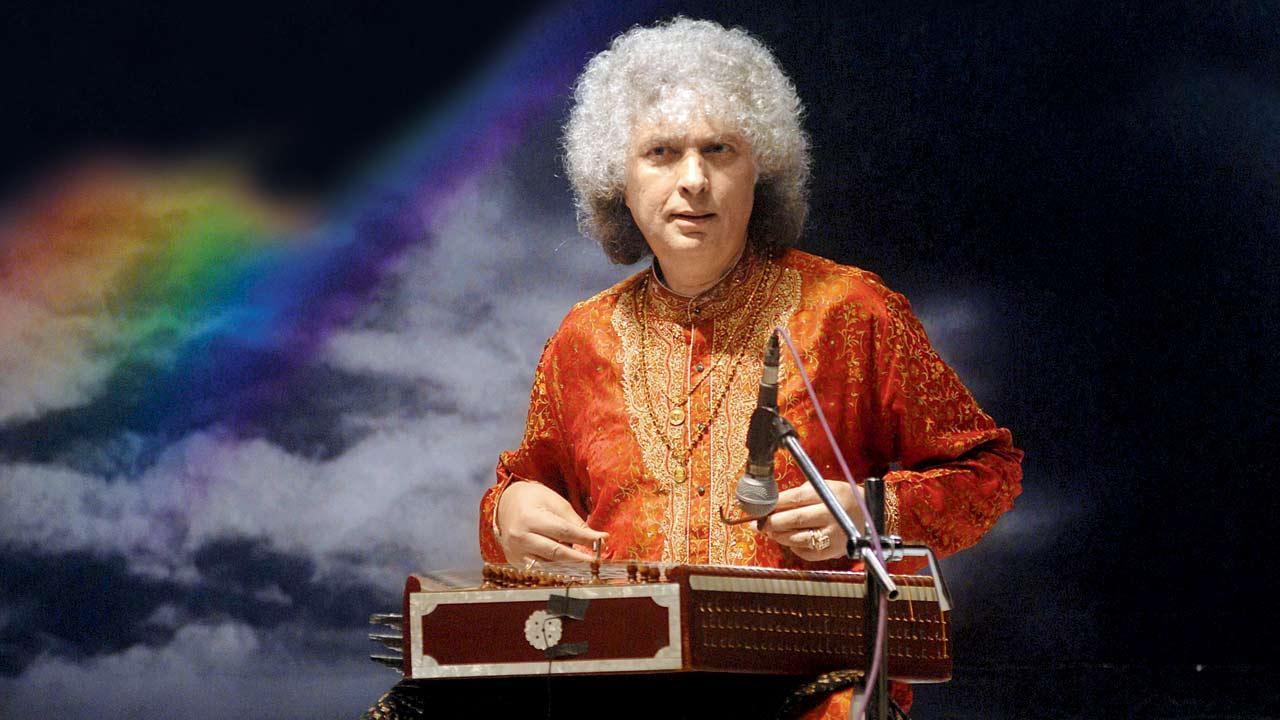
Ustad Amjad Ali Khan, flautist Rakesh Chaurasia remember the maestro who gave the santoor its exalted status in Indian classical music
Yogesh Pawar (MID-DAY; May 11, 2022)
The year 1967. Filmmaker K A Abbas was explaining a situation to musicians gathered for the background score of his Dharti Ki Pukaar. When his eyes fell on a young musician, he called him aside. The young man felt Abbas wanted something specific in the music, but was shocked when he was offered a role in Saat Hindustani (1969). “Dikhte-bolte bhi theek ho... kad-kaathi bhi sahi hai,” Abbas told him.
The young man folded his hands, and said he was happy to only pursue music. Had the 29-year-old agreed, he would have debuted along with Amitabh Bachchan. What that trajectory would’ve done for Pandit Shiv Kumar Sharma, we’ll never know, but the silver screen’s loss was music’s gain. The octogenarian legend was suffering from kidney problems for the past six months and was on dialysis. He breathed his last on Tuesday morning, following a massive cardiac arrest soon after his bath, according to his family.
Among those condoling the maestro’s demise was Prime Minister Narendra Modi, who tweeted: “Our cultural world is poorer with the demise of Pt Shiv Kumar Sharma ji. He popularised the santoor at a global level. His music will continue to enthral the coming generations. I fondly remember my interactions with him. Condolences to his family and admirers. Om Shanti.”
Talking to mid-day, sarod maestro Ustad Amjad Ali Khan said his demise marked the end of “a musical era”. “We were close. Our families share a great rapport. We are all deeply saddened by this tragic news. With him, a musical era has ended. We live in a cruel time when so many legends are bowing out. Apart from a pioneering musician, he was an exceptional human being.”
The santoor, previously confined to Jammu & Kashmir, rose meteorically to ensconce itself as a classical instrument, thanks to Sharma. Though connected with the Sufi tradition of Kashmir and called shatatantri veena in ancient texts, it didn’t enjoy its current exalted status at that time. The santoor maestro’s father Pt Uma Dutt Sharma came across the santoor as a music supervisor with a local radio station and felt it could lend itself to the classical style. A young Shiv Kumar (initially trained in tabla and singing) was introduced to santoor at 13. Within three years, he was playing it on the radio.
Despite purists curling their lip at the santoor, filmmaking legend V Shantaram was impressed with the 18-year-old Sharma and asked him to play for his Jhanak Jhanak Payal Baaje (1955) under Vasant Desai. Back in Srinagar, following an argument when he refused a secure job in the Jammu and Srinagar Radio, Sharma left home and came to Bombay with his santoor and Rs 500. Pt Shiv Kumar Sharma has often told this writer of those tough times. “I’d only have an anna in my pocket and nothing to eat. I’d accompany others on tabla since the negative criticism of the santoor meant no concerts,” he’d reminisce.
Odd film assignments helped sustain both him and his fire for the santoor. While the instrument was traditionally played in Kashmir on a small stand, with the player squatting in front, he placed it on his lap to cut vibrations. He worked on the tuning, increased range and discovered how to use mallets to reproduce the Indian vocal nuances. A decade of his toil finally saw the music fraternity warm up to his instrument. With Silsila (1981), both he and flautist Pandit Hariprasad Chaurasia turned film composers, following it up with Faasle (1985), Vijay (1988), Chandni (189), Lamhe (1991), Sahibaan (1993) and Darr (1993).
“In some songs, like Tere mere hoton pe, you can clearly see how he brought in elements of classicism and folk music from the mountains,” remembers ghazal exponent Pankaj Udhas, who says he has never met a more disciplined musician. “Once at an event, he gently stopped me from drinking water immediately after my meal, saying it was bad for digestion,” said Udhas, adding, “Even in his 80s, he never slouched on stage and sat ramrod straight.” He also spoke of Sharma’s prowess over rhythm. “As someone who had played tabla and could sing, it was interesting to see how he would even for Zakir bhai [Zakir Hussain] at times when they played together.”
Santoor exponent Satish Vyas, who trained under Sharma from 1975 to 2006, says he feels orphaned. “Both Pandit ji and his wife treated me like their son. Even when he corrected me, guruji did it gently, playing on each disciple’s strength.”
Sharma knew flautist Rakesh Chaurasia, his colleague Pt Hariprasad Chaurasia’s nephew, from when he was little. “Extremely loving and indulgent, he’d come up after a concert and praise even the smallest improvisation I tried. Sadly, I’ll miss uncle’s loving caress now,” says the flautist.
Career milestones
- Sharma gave his first public performance in Mumbai in 1955.
- In 1960, he recorded his first solo album.
- In 1967, he teamed up with flautist Hariprasad Chaurasia and guitarist Brij Bhushan Kabra to produce the concept album, Call Of The Valley.
- The santoor virtuoso was honoured with the Sangeet Natak Akademi Award in 1986, the Padma Shri in 1991, and the Padma Vibhushan in 2001.
50 years of Mera Naam Joker: How Manoj Kumar halted students' protests happening on the sets at Ooty station
8:08 AM

Roshmila Bhatthacharya (MUMBAI MIRROR; December 19, 2020)
Raj Kapoor had booked the Udagamandalam railway station in Ooty, part of the Nilgiri Mountain Railway, a World Heritage Site, for his four-hour cult classic Mera Naam Joker. They were shooting the scene where the schoolboys chug back to their boarding school after a vacation. Sixteen-year-old Raju, the chubby class clown, played by Rishi Kapoor, is waiting to receive his favourite teacher, Mary (Simi Garewal), with a bouquet of flowers, and admits it’s been lonely without her.
To the filmmaker’s dismay, the station was crowded with agitating students who, while admitting that they personally liked Hindi movies, were part of the Tamil Nadu Students’ Anti-Hindi Imposition Agitation Council. The Council was demanding the scrapping of the three-language formula and an end to teaching Hindi in the state. It also wanted to abolish the use of Hindi commands in the National Cadet Corps (NCC) and have Hindi films and songs banned, along with the closure of the Dakshina Bharat Hindi Prachar Sabha (Institution for Propagation of Hindi in South India).
In the face of the protests, shooting was cancelled for the day and Raj Kapoor returned to the hotel, with his co-actor Manoj Kumar. The latter was entrusted with the responsibility of speaking to the students and their leaders the next morning, to persuade them to let work continue smoothly. Mr Bharat was quick to point out that he had crossed over from Lahore in the wake of the Partition and learned Hindi here. “I would have joined your protests if you had wanted Tamil as the national language, but you are campaigning for English over Hindi, and so I cannot respect you,” Manoj saab thundered. Raj saab broke into appreciative applause and told the protestors that he was ready to return home but that didn’t stop him from agreeing with Manoj saab. “But by then the students were so shamefaced, they promised to let us shoot, without interruption or disruption,” he reminisces.
By pointing out a discrepancy in K A Abbas’s screenplay, Manoj saab had earned the showman’s lifelong respect and had reworked the entire first chapter of Mera Naam Joker. “Raj saab would quietly sit in my hotel room while I was writing, occasionally ordering a cup of tea for me or putting the ashtray closer to my hand. It amazed me that this man, whose films I went to watch, first day, first show, was doing all this for me,” marvels Manoj saab, adding that the showman believed that his late lyricist-friend Shailendra’s spirit had entered him, which explained his beautiful thoughts and lines.
Prod him on the RK he got to know in Ooty and when they were in Delhi together for over a month, representing the film industry in the taxation case to the government, and pat comes the answer, “He was not a hypocrite; he said what he believed, and while he was fond of food and drinks, he did not touch a drop of alcohol when he was working. I agreed to do a cameo in Mera Naam Joker not because he was a superstar or the showman but because he was a karam yogi who worked without thinking of rewards. Main koi heera nahin, par Raj saab johri zaroor the.”
Manoj saab was to write the Joker sequel, but after Part 1 bombed, the idea was shelved. “I then took a story to him, revolving around a man and a dog who dies for him. I called it Sahab ji—that’s how we addressed each other and wanted to direct it. Raj saab liked it but told me it was too late for him,” rues the actor-filmmaker, who would prescribe homeopathy pills for Raj saab who was suffering from chronic asthama.
Raj Kapoor was born on December 14, 1924. He passed away on June 2, 1988. He was only 63. Mera Naam Joker released 50 years ago on December 18, 1970. Remembering his Sahab ji, Mr Bharat says, “Joker ka show khatam nahin hua. The show goes on…”

Simi Garewal, Manoj Kumar and Rishi Kapoor in Mera Naam Joker
In Urdu, ‘awara’ means ‘khushboo’ and even today, the ‘fragrance’ of Raj Kapoor fills our senses-Manoj Kumar
8:22 AM

Manoj Kumar with wife Shashi and Raj Kapoor at a suburban hotel, celebrating his National Award win for Shaheed; with Rishi Kapoor in Mera Naam Joker (below; right)
Roshmila Bhattacharya (MUMBAI MIRROR; June 3, 2020)
 I knew about the Joker long before Joaquin Phoenix brought him home to me. And unlike his trigger-happy Arthur Fleck or Pennywise the Dancing Clown of It, my funnyman with the painted smile and cherry nose did not give me the shakes; he made me smile, sigh and sing, “Jeena Yahaan, Marna Yahaan, Iske Siva Jaana Kahaan.” On Raj Kapoor’s 32nd death anniversary on June 2, I decided to rewind to the film closest to his heart, Mera Naam Joker, with the man, who, though on screen for a short time as David who woos Mary away from an adolescent Raju, had a major role to play in this 224-minute story.
Let’s start with Raj Kapoor’s Shree 420, which released in the Capital’s Regal cinema. Among those who queued up for tickets, first day, first show, was a young boy fondly called Ghulu. He entered the auditorium, took a corner seat and, as the lights dimmed, gave himself up to the story of Raj, Vidya, Maya and a life gone astray. Suddenly, when the song, “Shaam Gayi, Raat Aayi Ki Balam Aaja” came on, a group of men stood up, started to whistle and create a commotion.
“In a flash, a man dressed in white raced past me towards the stage. As he went up on the dais, the lights came on and I saw an enraged Raj saab calling the men, hired by rival distributors to run down the film, ‘bhaade ke tattu’. He told them that he’d made the film with heart and honesty and God would reward him. Pointing to the door, he told them to get out and shame-faced, the men complied,” Ghulu, who grew up to become Manoj Kumar, reminisces, adding that at night, when his naani wondered why he couldn’t sleep, he told her all that had transpired and asked her who was this man who could talk so fearlessly. “‘He’s a karmayogi—one who connects with God through actions’—she told me, and the words stayed with me.”
A decade later, Manoj saab was shooting for Raj Khosla’s Anita at Mehboob Studio when he got a call from Raj saab, who wanted to come over and meet him. He offered to drop by himself and a couple of days later, was at RK Cottage at 2 pm, where Raj saab requested that he oblige him by doing a cameo in Mera Naam Joker. “I immediately agreed. We decided to shoot after I’d released my Upkar,” he narrates.
Soon after, while he was away in Delhi or maybe Kolkata, Raj saab tried calling him and was brusquely told he had got the wrong number. On his return, Manoj saab was surprised when singer Mukesh relayed this to him, saying Raj saab was upset, thinking that he was being avoided as Manoj saab didn’t want to do Mera Naam Joker. Almost immediately, Manoj saab called Raj saab and asked to see him.
“We met at 4 pm at (composer) Jaikishan’s residence, where I assured Raj saab that neither I nor my wife Shashi would dare discomfit him. I told him I was looking forward to working with not the showman but a karmayogi and went on to tell him about the earlier incident at Regal. Raj saab quietly heard me out, then, put his head in my lap and started crying,” he recounts.
Soon after, Manoj saab flew down for the shoot in Ooty where, while narrating a scene that they were to shoot the following day, Raj saab stopped abruptly, alerted by the expression on his face that he didn’t agree with something. When prodded, Manoj saab pointed to a certain dialogue which made a reference to Gandhi ji’s assassination. He pointed out that since Raju was an adolescent then, the Father of the Nation would have been alive. Taken aback, Raj saab retreated to his room on the first floor, but after half an hour, came down, telling Shashi ji to persuade Manoj saab to re-write the scene for him. “When I demurred, pointing out that (K A) Abbas saab (who had penned the story and screenplay) was a senior writer, he made me speak to him on the phone and he gave me his permission,” the writer-actor-filmmaker reveals.
Raj saab was so impressed with his dialogue, particularly one where, in response to young Raju’s query about who’s the biggest joker till date, David points his thumb towards the sky and reacting to Raju’s “Bhagwan” reasons that God, like the joker, does everything for others, apne liye kuchh nahin. “Appreciating that dialogue, Raj saab called (DoP) Radhu Karmakar and a few others to listen to me as I narrated what I’d written, pointing out that I had encapsulated the philosophy of the joker in these lines,” Manoj saab recalls, adding, “The first story in this three-story film was reworked by me, but I didn’t do it for name, fame or money. I paid for my travel expenses and hotel stay and refused to take credit as writer. Mera Naam Joker was my tribute to karmayogi Raj Kapoor. In Urdu, ‘awara’ means ‘khushboo’ and even today, the ‘fragrance’ of Raj Kapoor fills our senses.”
Subscribe to:
Posts (Atom)