Showing posts with label Jashn-e-Rekhta. Show all posts
Showing posts with label Jashn-e-Rekhta. Show all posts
Unfortunately, our world is getting closer to the scenario depicted in Karejwa-Varun Grover
7:59 AM
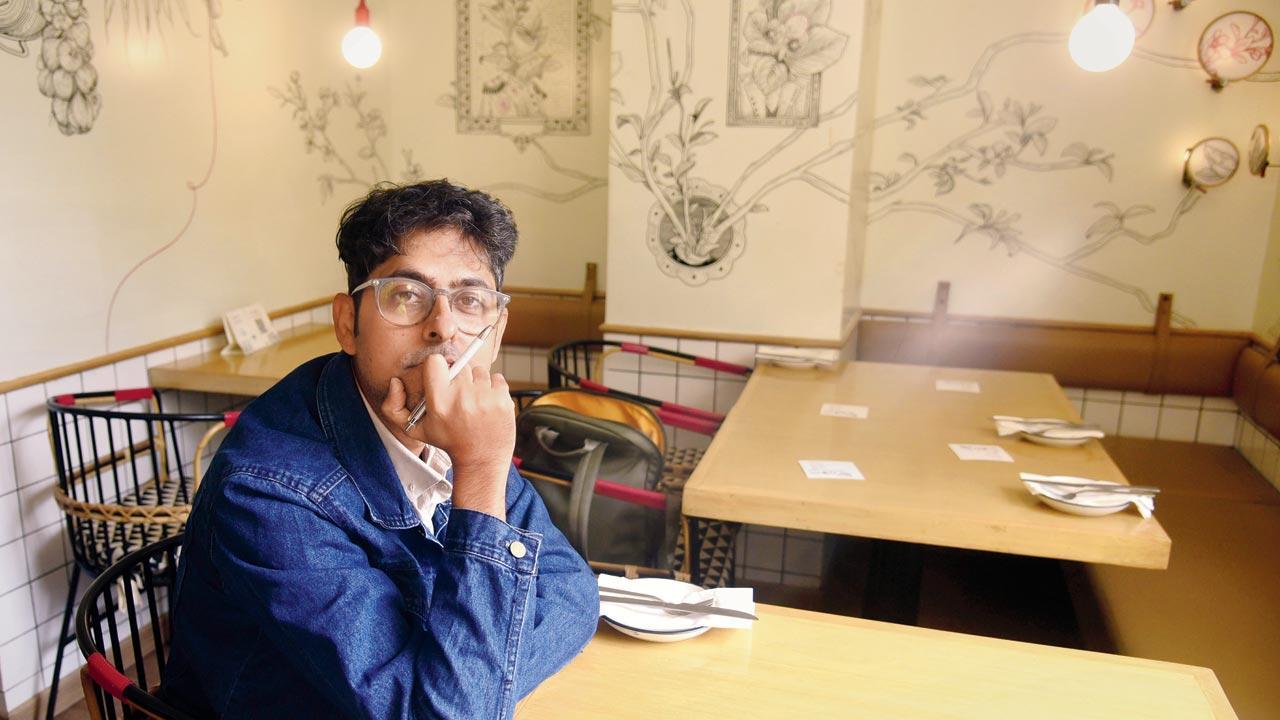
It’s a busy time for Varun Grover. The multi-hyphenate—through stand-up, cinema and books—aims to look at the world through a wry lens, all the while spotting a glimmer of goodness in difficult times
Neerja Deodhar (MID-DAY; December 17, 2023)
For most people, the impending end of the world would cause a state of panic, helplessness, chaos. Their whole lives would flash before their eyes, as city governments and national institutions tried—in vain—to control the situation, perhaps even minimize people’s legitimate fears. In Varun Grover’s story Karejwa, set in a doomsday scenario with exactly 30 minutes left on the clock, the young protagonist Pintoo dreams of only one thing: the titular sweet, more tender than a gulab jamun.
Karejwa has travelled a long road since it was first published in Chakmak, a children’s monthly, in 2015. Five years later, Grover joined hands with Bakarmax, a comics and animation studio, to turn it into a web comic, edited by Sumit Kumar and illustrated by Ankit Kapoor. Last week, the studio and lyricist launched it as a graphic novel.
In the last eight years, Grover has not felt the need to revise the plot or the characters who inhabit the story. Not because of a creative urge, but especially not because of the social and political environment today. “Unfortunately, our world is getting closer to the scenario depicted in Karejwa. In fact, it’s becoming more plausible with every passing year, given people’s prejudices and dogmas, and the bits about how different institutions may react to this fate… The plot looks more real than it did eight years ago,” Grover tells mid-day.
In many ways, Karejwa is emblematic of the lyricist-comic-writer’s creative process. Karejwa’s visuals, the choice of the dish at its core, and its infatuation with certain foods are all seeped in Varanasi, where it is set. All India Rank, Grover’s feature-length film about a young boy enrolled in one of Kota’s many IIT coaching centres, is set in the 1990s. So rooted are the plots of the graphic novel and film that they cannot simply be set anywhere else in India.
“This is the main criteria in my mind because it makes the story original. I think authenticity is its own aesthetic—it’s an aesthetic I try to chase. The other aspects, like the emotional elements, can be subjective based on the viewer’s own experiences, but the time and place are easy to determine. This is why Kumar and Kapoor visited Varanasi before they began their work, to get a real taste and texture of the city,” he explains.
From his stand-up bit titled Padmaavat & the Parrot to his debut short film KISS, about the censorious forces in India’s film certification bodies, Grover does not hold back from being wry and observational—it may be the qualities he is best known for, apart from his lyricism.
Did he sharpen this way of looking at the world during his years as a comic? He says it’s the other way around. “I became a stand-up comedian because of this attitude in life, of being detached while also finding a wry or satirical perspective on things. I think that is the only way to survive… Perhaps the world has always been this way, even a century ago. But I can say with certainty that the world today is difficult to cope with,” he comments.
“Without some degree of attachment and humour, I think I’d fall apart under the weight of anxiety that comes with living in this world.” The school boy Pintoo, with his innocent search for a sweet while the world ends, is Grover’s way of looking for a sense of light-heartedness amid darkness.
As he works across formats and mediums, the lyricist-writer says that sometimes he knows what will work for a particular idea, and sometimes he doesn’t. Over the years, he has developed the practice of journaling and documenting the ideas and leads he gathers—across email chains he maintains with himself, and on WhatsApp groups featuring only him. “Sometimes, I’ll mention that the idea is for stand-up, or a phrase that can be used in a film song, or an idea I like or am deeply fascinated by,” he explains.
“There was a time when I read about a bird called the bar-tailed godwit, which takes a long, non-stop migratory flight across continents. When I came across this bird, I didn’t know what to do with it, but when Rajkumari—my partner—and I were writing Biksu [a Hindi graphic novel], there was an instance where we wanted to talk about resilience and focus. We revisited the bird in my list of ideas.” The page featuring the bar-tailed godwit would go on to become Grover and Rajkumari’s most cherished in the book.
As he looks forward to another tour of his comedy show Nothing Makes Sense in January, Grover ends 2023 on a moving note. At the recently concluded Jashn-e-Rekhta festival in Delhi, singer-writer Swanand Kirkire broke into the song Shauq from the film Qala, only to be drowned out by an eager audience who knew its lyrics in entirety. Grover, who wrote the song two years ago, was left feeling joyful and overwhelmed; he knew the song was a popular one, but watching the attendees sing in tune shifted something inside him.
“This happened at Rekhta, where attendees come out of a love for Urdu poetry and prose, not Swanand and myself. And they knew the words of the antara, at a time when most songs are 30-second Reels and we don’t know if the audience listens to songs beyond this mark. That was what struck me,” he concludes.
Javed Akhtar reveals how Laxmikant-Pyarelal hesitatingly approached him for aarti and he stunned them
8:17 AM

Javed Akhtar discusses the influence of Urdu on everyday language, films
Niharika Lal (BOMBAY TIMES; December 12, 2023)
Participating in several sessions at the ongoing Jashn-e-Rekhta in Delhi, Javed Akhtar narrated his poetry and discussed the influence of Urdu on everyday language, especially in Hindi cinema. Giving an example of the vast vocabulary of Urdu he shared that there was a film for which Laxmikant-Pyarelal hesitatingly approached him, saying that there is an aarti in the film, and he has to write it.
He said, “I told him, ‘Give me the tune, I will write it.’ When he gave me the tune, it wasn’t an aarti but a song’s tune. Maine unse kaha aapne mujhe gaane ki tune di, aarti ki nahi di. Aarti mein ek crescendo hota hai, aarti aise hi nahi khatm ho jati hai. Maine toh apni taraf se likh diya hai aur woh crescendo, main Krishna ke naam se likh diya hai. Aap tune compose kar lijega. Woh crescendo tha: ‘Woh krishna kanhaiya murlidhar manmohan kanh murari hai, gopal manohar dukhbhanjan ghanshyam atal banwari hai, woh kans vinashak maharathi sudarshan chakra ke dhari hai...’ Laxmikant was perplexed. He told me, ‘Itne naam toh humein nahi maloom, tumhe kaise maloom?’ I told him, ‘Ye saare naam hain Urdu shayari mein’.”
He added that from Jan Nisar Akhtar, Gulzar, and Kaifi Azmi to Anand Bakshi — for many lyricists of Hindi cinema, it was Urdu that polished their language and craft.
--------------------------------
“We think this time is important because we are in it, but it is not. A nation's history cannot be judged in the span of 20-25 years. Nation ki history ko 10-15 varsh ya 25 varsh mat dekhiye. Hindustan ki rooh kahin aur hai.”
I broke down after shooting a marital rape scene-Divya Dutta
8:34 AM

Niharika Lal (BOMBAY TIMES; December 22, 2019)
Speaking at a session at the recently concluded Jashn-e-Rekhta in Delhi, Divya Dutta shared the trauma of doing a rape scene in a film. She said, “Some time back, I was shooting a film which had a marital rape scene. When we do such scenes, directors, actors and crew are quite sensitive and ensure that it goes right. Directors ensure that nobody is on the set for that scene apart from those who are part of the shoot. Sab kuch dhyan rakha jata hai. We did that scene, and after shooting it, when I went home, I broke down. I cried a lot. I felt violated by the sheer feeling of the entire thing.”
Divya says, “When I read about rape cases, I feel a sense of anger and helplessness. What should I do? Should I express my anger on social media? Is that it? Kya hum keval ek hashtag ban kar nahi reh gaye hain?” Emphasising on the importance of stricter laws and the need for parents to raise their boys right, she said, “I am shocked when I see videos on social media — a girl is being beaten up and someone is shooting it, rather than helping her. I think we all need to take personal responsibility, and take action when we see anything wrong happening around us. I do that when I see any man harassing a woman. I go and stop that, even if they are actors. Someone might object — why is she intervening, but I will. I think everyone should do that, too.”
‘ISS BAAT KA MUJHE MALAL RAHEGA KI KABHI SHAH RUKH YA SALMAN KO ROMANCE NAHI KIYA’
Talking about her filmography, Divya said, “I was rejected for many films. Once, I was called for a film which was a big project. I went there and waited, and then someone came to me and told me, “Pehle tum moti thi, tab bahut cute thi. Ab patli ho gayi, ab nahi chahiye. Tum jao.’ This disappointed me so much that I packed my bags, and then I got a call for Train To Pakistan.” She jokingly said, “Haan, iss baat ka mujhe malal rahega ki maine kabhi Shah Rukh ya Salman ko romance nahi kiya (on screen). But, there was Irrfan in my life. Now I’m in my 40s and I’m doing romantic, negative and comic roles and I’m having fun in life.”

After Arth released, women started coming to my house with their marital issues-Shabana Azmi
3:47 PM

Niharika Lal (BOMBAY TIMES; December 21, 2018)
Almost two years after performing Kaifi Aur Main at Jashn-e-Rekhta, Shabana Azmi and Javed Akhtar were back on the same stage to talk about their parents – Jan Nisar Akhtar (Javed Akhtar’s father) and Kaifi Azmi (Shabana Azmi’s father). Narrating their stories, reciting poems and sharing anecdotes from their childhood, the two veterans kept the audience entertained with their engaging tales.
GOT INVOLVED WITH WOMEN’S MOVEMENT AFTER ARTH: SHABANA AZMI
Reminiscing her childhood days, Shabana Azmi told the audience that she used to live in a small house of 120 sq ft, and eight families had to share one washroom. But she said that at that time, it was all about community and togetherness. She said, “Humare yahan paise bilkul bhi nahi hote thay. Paison ki kami toh thi, par baaki cheezein jo humein mili, woh thi values – social justice, women empowerment, equality. Aisa nahi tha ki humein bitha ke lecture diya gaya, but the way my parent used to live taught me these values. That’s how I grew up.”
Talking about her father, Shabana said, “Kaifi sahab ne Aurat 1940s mein likhi thi, uss zamane mein unhone likha tha – ‘Uth meri jaan mere saath hi chalna hai tujhe.’ Kaifi uss waqt gender equality ki baat karte they jab auraton ka kaam rasoi ghar aur bachchon tak tha.”
Shabana Azmi, who played the role of a woman who was deserted by her husband in Mahesh Bhatt’s Arth (1982), shared with the audience how she started working for women’s rights after this film. She said, “It was obvious for me to work for causes because of the parents I had, and the kind of films I worked in, uska asar toh mujh par hoga hi. Maine ek film mein kaam kiya tha, Arth, aur jab Arth release hui toh mere ghar mein jhund ki jhund auratein aane lagi, iss ummeed ke saath ki unke shaadi ke masle main hal karungi. Main toh bahut ghabrati thi kyunki main toh samajhti thi ki main keval ek actor hoon, lekin women’s movement ke saath jo mera kaam shuru hua woh iski wajah se hua.”
I USED TO THINK STALIN WAS MY GRANDFATHER: JAVED AKHTAR
During the session, Javed Akhtar also shared his childhood stories with the audience. He said, “When I was four years old, in our house there were no photos on the walls. But there was just one photo of Stalin. Mujhe chaar saal ki umar mein iss baat ka yakeen tha ki yeh mere grandfather ki tasveer hai. Aur mujhe yaad hai, when it finally dawned upon me that Stalin is not my grandfather, toh mujhe kitna bura laga tha!”
He also shared how he would prepare himself to eat prison food. Explaining why, he said, “My father Jan Nisar Akhtar was in jail when I was a kid. I remember, when I used to complain, ‘Mujhe daal nahi pasand’, aur maa bolti thi ‘Jail mein yehi daal mili toh?’, main phir chupchap kha leta tha. I don’t know who told me that they serve green chillis in jail, but I used to practise eating chillis too.”
‘LEFTIST WRITERS USED BOLLYWOOD FILMS AND SONGS TO SEND THEIR MESSAGE ACROSS’
As the discussion moved on to Bollywood, Javed Akhtar said, “I think leftist writers obviously couldn’t afford mass media at that time, and hence they used Hindi films and songs to reach out to people. Film ke zariye unhone apne message ko logon tak pahunchaya, chahe woh Kaifi Azmi ho, Jan Nisar Akhtar, Majrooh Sultanpuri, Shailendra ya Ismat Chugtai. Unhone filmon se apna paigam logon tak pahunchaya.”
Explaining, he said, “Woh writers aise keh dete thay toh kisi ki pata hi nahi chalta tha, aur baat bhi pahunch jati thi – ‘Jeena isi ka naam hai’, ‘ Dil ka haal sune dilwala’, ya phir jab Sahir (Ludhianvi) ne likha tha - ‘Aasmaan pe hai khuda aur zameen pe hum, aaj kal woh is taraf dekhata hai kam.”

I was told to remove Shakespeare from my script or my film wouldn’t get money-Vishal Bhardwaj
8:12 AM

Niharika Lal (BOMBAY TIMES; December 19, 2018)
The last day of Jashn-e-Rekhta saw the venue swarming with people who had come to attend Vishal Bhardwaj’s session, and while most were expecting a discussion on politics, Shakespeare and Bollywood, they were left pleasantly surprised when Vishal unveiled his inner poet and started reciting shayari from his all-time favourite, Bashir Badr, as well as his own. Vishal’s shayaris were unique not only because of topicality, but also because he spoke about the modern man’s woes like Google Maps, network, phone and e-mails, too.
‘JAB ISS TARAH KA SUPPRESSION HOTA HAI, USS WAQT ART ZYADA KHILTI HAI’
Vishal Bhardwaj spoke about the Sabarimala temple issue through his first shayari, which concluded with, “...pujte ho devi ko lekin aurat ko mandir mein nahi jane dete, aap bhi bas”. Talking to the audience, he said, “Aaj ke waqt mein toh ‘Bol ke lab azad hain tere’ bahut hi zaruri hai. Mujhe lagta hai jab bhi iss tarah ka suppression hota hai, uss waqt art sabse zyada khilti hai, kyunki jab tak koi dabayega nahin hamare gale ko, toh hamari cheekh kaise niklegi?”
Vishal also spoke about how phones keep making their way into his ghazals, saying, “Meri ghazlon mein phone ghoom-phir ka aata rehta hai, mere har naye sher mein phone aa hi jata hai.” He then went on to recite his phone-inspired ghazals, “‘Aankh ka lihaj tha ya ke hausla na tha, usne text mein likha keh sake jo lab nahi.’ Ek aur hai, ‘Woh baat karte-karte hi khamosh ho gaya, mujhko laga network toot gaya’. We also keep checking travel time on Google Maps even if we know that we won’t go, so I wrote this, ‘Tumse milna namumkin hai, phir bhi dhoondte hain Google pe ki ab nikle toh kab tere ghar pahunchenge’.”
‘IRRFAN WANTED A FEW MORE LINES SO I WROTE ‘MAIN’ IN HAIDER’
In Haider, Irrfan recites a nazm, Main – “Darya bhi main, darakht bhi main … Jhelum bhi main, chinar bhi main … dair bhi hoon, haram bhi hoon … Shia bhi hoon, Sunni bhi hoon, main hoon pandit … main tha, main hoon aur main hi rahoonga,” – which became quite popular after the film’s release. Talking about why he wrote these lines, the director said, “There was a scene between Irrfan and Narendra Jha, and Irrfan asked me to give him more lines. I told him that if I will write more, toh woh shayari ho jayegi. Usne kaha, haan mujhe shayari karni hai, that’s when I wrote this.”
‘FINANCER TOLD ME NOBODY WILL GIVE YOU MONEY’
Talking about literature, Vishal Bhardwaj said that the film industry resists literature because they consider it to be boring. He said, “On my script, it was written, ‘inspired from Shakespeare’, and a financer friend told me that I should remove Shakespeare’s name from my script because nobody would give me money. Whenever we talk about literature, the first thing that one assumes is that it must be boring because anything related to literature is boring, which is definitely not true. In school, Shakespeare scares you, I think the age when I read Shakespeare was the right age, for me. In gang wars, people kill each other and it ends there, but I wanted to go deep to find out the equations of a gang war. Maine bahut shiddat se usko chaha tha, toh woh mujhe mil gaya.”
Before the session ended, Vishal sang some songs for the audience including, Yeh Ishq hai and Pehli baar mohabbat ki hai, and the audience responded by giving him a thunderous applause for the performance.
Subscribe to:
Posts (Atom)