Showing posts with label Jan Nisar Akhtar. Show all posts
Showing posts with label Jan Nisar Akhtar. Show all posts
There is influence of Russian literature in the modern Urdu novels-Javed Akhtar
9:36 AM
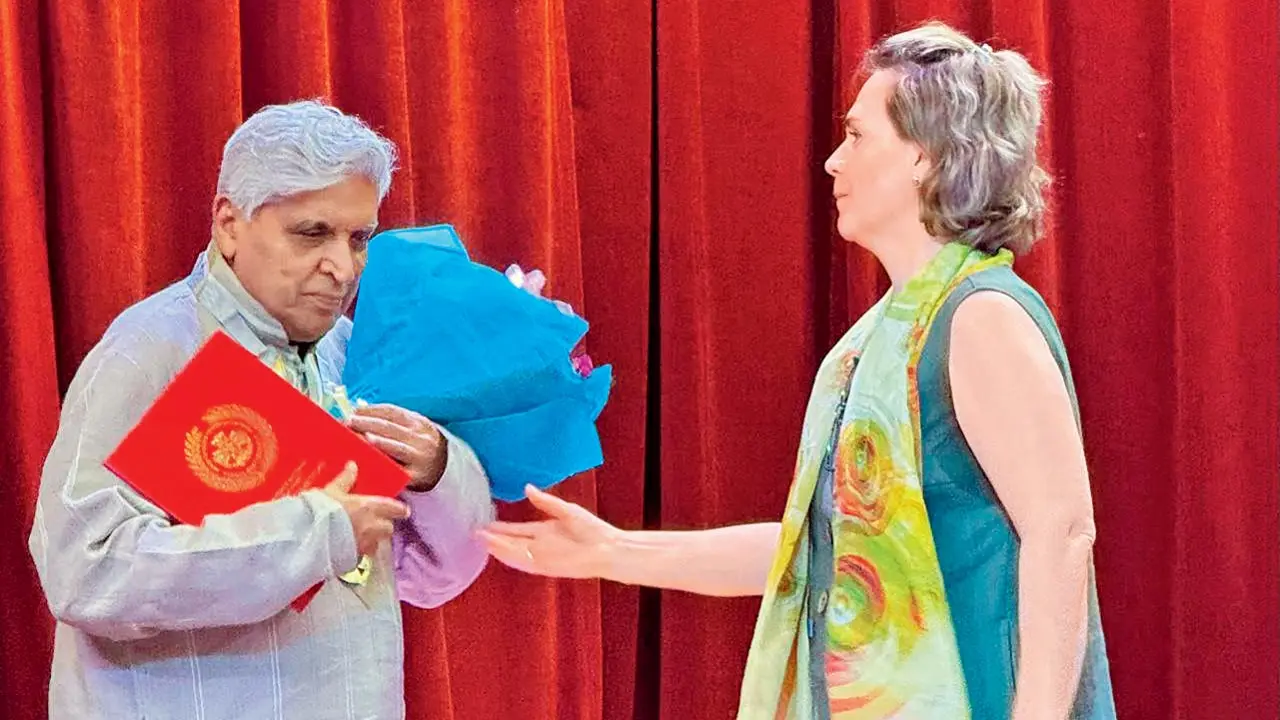
Niharika Lal (BOMBAY TIMES; June 8, 2025)
Javed Akhtar received the Dostoevsky Star Order – a literary award given to those promoting Russian literature and culture – in a ceremony held at the Russian House in Delhi on Friday. The ceremony coincided with Russian Language Day, celebrated annually on June 6, the birthday of the legendary Russian poet Alexander Pushkin.
Drawing a parallel across cultures, the lyricist added, “I believe that Pushkin was the Ghalib of Russia and Ghalib was the Pushkin of India.”
Akhtar, accompanied by Shabana Azmi, spoke about the importance of translation, comparing Pushkin to Ghalib.
‘IF THERE HADN’T BEEN TRANSLATIONS, I WOULDN’T HAVE READ BOOKS BY WRITERS LIKE BALZAC’
Talking about the power and paradox of language, Akhtar said, “It’s strange that languages were made for communication, and more often than not, languages become a barrier in communication. But in the barrier, there are windows of translation. I shudder to think that if there had not been any translations then I would not have been able to read (works of) so many great writers of Europe. I would not have read Balzac.”
Talking about India’s deep-rooted literary ties with Russia, the lyricist spoke about the Progressive Writers Movement that gained momentum in India in the 1930s.
He said, “There was a great writing movement in India in 1936, and it was greatly influenced by Russian literature. There is influence of Russian literature in the modern Urdu novels and Urdu short stories as well.”
------------------------------------
Honoured with the Dostoevsky Star Award last week, noted screenwriter and lyricist Javed Akhtar on how his thinking was influenced by Russian literature from a young age
Upala KBR (MID-DAY; June 9, 2025)
As a teenager, Javed Akhtar would devour Urdu translation of Russian literature, particularly Fyodor Dostoevsky’s works. Had someone told him then that he would be honoured with the Dostoevsky Star Award later in life, he wouldn’t have believed it. Last week, the noted screenwriter, poet and lyricist was felicitated with the award by the Russian House for promoting cultural dialogue and preserving literary heritage.
For Akhtar, 80, it’s a matter of pride to receive the Dostoevsky Star Award. “Dostoevsky is one of the most respected novelists and journalists. In our Khandala house, we have his portrait on the door of our study. I don’t think any Indian writer has received the Dostoevsky Star Award before. One of my books, where my poems have been translated by Ramdas Akella in the Russian language, was released at the function,” says the veteran writer.
Akhtar — who has shaped Indian cinema with movies like Zanjeer (1973), Sholay (1975), Mashaal (1984), and Lakshya (2004), among others — notes that Indian and Russian literature have been inspired by each other over centuries.
“The novel structure and short stories of Anton Chekhov, Maxim Gorky, or Dostoevsky inspired our writers. Similarly, Indian writers inspired them as some of our classics, including the Bhagavad Gita, were translated in Russian. At an impressionable age, I was introduced to Russian literature because they were translated in Urdu and English. My thinking and dramatic structure got influenced by them.”
The event, which took place on June 6 in Mumbai, was a bittersweet moment for Shabana Azmi, actor and Akhtar’s wife. She says, “I wish his father Jan Nisar Akhtar, and my father Kaifi Azmi were here to see him receive it.”
Javed Akhtar and Shabana Azmi to launch works of their poet-fathers
8:03 AM

Unique endeavour that saw Shabana, Javed collate pieces of respective fathers-in-law culminates in book launch
Upala KBR (MID-DAY; December 2, 2022)
Veterans Shabana Azmi and Javed Akhtar are set on a new endeavour — come Sunday, the duo will launch the works of their poet-fathers in the form of published pieces. Dhanak, a collection of pieces written by Jan Nisar Akhtar, and Daaera, which will include the works of Kaifi Azmi will be unveiled at an event in Delhi.
Shabana tells mid-day, “I can’t remember who initiated this conversation. It was such an organic process. Both of us are admirers of these two great poets. The least we could do as their progeny was make a selection of their work available to a larger audience. Minakshi Thakur, the editor and publisher, loved the idea. The books have long forewords by us, which will provide glimpses into their personal lives and their poetry.” While Shabana served as the editor on her father-in-law’s works, Javed edited Azmi’s collection.
Highlighting her husband’s process in zeroing in on the poems he wanted to include in Azmi’s collection, Shabana says, “He didn’t want to include ghazals, because, he believes they get lost in translation. He wanted to choose only nazms. I, on the other hand, find ghazals charming and feel they should reach larger audiences because they exist only in Urdu.”
However, her job, she says, was a tad challenging. “I went over [Akhtar’s] work, month after month. I chose to include a poem that Akhtar saheb has dedicated to his daughter, Uneza, that she has translated because it has such a strong emotional resonance. Akhtar saheb is such a prolific writer that it is daunting to make a selection of only 25 poems. I wondered what his fans, or Javed’s brother Salman would opine of my selection. In the end, I decided to choose the ones that spoke to me, personally.”
The late poets’ love for writing, she reveals, brought them together at some point in their journeys. “They belonged to the same circle, and were members of the Progressive Writers Association. They knew each other well. In fact, my mother remembers meeting Javed for the first time when he was just five years old, and had accompanied his mother Safia Akhtar to our house. Our parents come from such similar backgrounds that Javed often remarks that we should have had an arranged marriage!”

Daeera — a collection Kaifi Azmi’s works — means circle, and is also a poem of Azmi, Dhanak (right) means rainbow, and was a title suggested by Javed
After Arth released, women started coming to my house with their marital issues-Shabana Azmi
3:47 PM

Niharika Lal (BOMBAY TIMES; December 21, 2018)
Almost two years after performing Kaifi Aur Main at Jashn-e-Rekhta, Shabana Azmi and Javed Akhtar were back on the same stage to talk about their parents – Jan Nisar Akhtar (Javed Akhtar’s father) and Kaifi Azmi (Shabana Azmi’s father). Narrating their stories, reciting poems and sharing anecdotes from their childhood, the two veterans kept the audience entertained with their engaging tales.
GOT INVOLVED WITH WOMEN’S MOVEMENT AFTER ARTH: SHABANA AZMI
Reminiscing her childhood days, Shabana Azmi told the audience that she used to live in a small house of 120 sq ft, and eight families had to share one washroom. But she said that at that time, it was all about community and togetherness. She said, “Humare yahan paise bilkul bhi nahi hote thay. Paison ki kami toh thi, par baaki cheezein jo humein mili, woh thi values – social justice, women empowerment, equality. Aisa nahi tha ki humein bitha ke lecture diya gaya, but the way my parent used to live taught me these values. That’s how I grew up.”
Talking about her father, Shabana said, “Kaifi sahab ne Aurat 1940s mein likhi thi, uss zamane mein unhone likha tha – ‘Uth meri jaan mere saath hi chalna hai tujhe.’ Kaifi uss waqt gender equality ki baat karte they jab auraton ka kaam rasoi ghar aur bachchon tak tha.”
Shabana Azmi, who played the role of a woman who was deserted by her husband in Mahesh Bhatt’s Arth (1982), shared with the audience how she started working for women’s rights after this film. She said, “It was obvious for me to work for causes because of the parents I had, and the kind of films I worked in, uska asar toh mujh par hoga hi. Maine ek film mein kaam kiya tha, Arth, aur jab Arth release hui toh mere ghar mein jhund ki jhund auratein aane lagi, iss ummeed ke saath ki unke shaadi ke masle main hal karungi. Main toh bahut ghabrati thi kyunki main toh samajhti thi ki main keval ek actor hoon, lekin women’s movement ke saath jo mera kaam shuru hua woh iski wajah se hua.”
I USED TO THINK STALIN WAS MY GRANDFATHER: JAVED AKHTAR
During the session, Javed Akhtar also shared his childhood stories with the audience. He said, “When I was four years old, in our house there were no photos on the walls. But there was just one photo of Stalin. Mujhe chaar saal ki umar mein iss baat ka yakeen tha ki yeh mere grandfather ki tasveer hai. Aur mujhe yaad hai, when it finally dawned upon me that Stalin is not my grandfather, toh mujhe kitna bura laga tha!”
He also shared how he would prepare himself to eat prison food. Explaining why, he said, “My father Jan Nisar Akhtar was in jail when I was a kid. I remember, when I used to complain, ‘Mujhe daal nahi pasand’, aur maa bolti thi ‘Jail mein yehi daal mili toh?’, main phir chupchap kha leta tha. I don’t know who told me that they serve green chillis in jail, but I used to practise eating chillis too.”
‘LEFTIST WRITERS USED BOLLYWOOD FILMS AND SONGS TO SEND THEIR MESSAGE ACROSS’
As the discussion moved on to Bollywood, Javed Akhtar said, “I think leftist writers obviously couldn’t afford mass media at that time, and hence they used Hindi films and songs to reach out to people. Film ke zariye unhone apne message ko logon tak pahunchaya, chahe woh Kaifi Azmi ho, Jan Nisar Akhtar, Majrooh Sultanpuri, Shailendra ya Ismat Chugtai. Unhone filmon se apna paigam logon tak pahunchaya.”
Explaining, he said, “Woh writers aise keh dete thay toh kisi ki pata hi nahi chalta tha, aur baat bhi pahunch jati thi – ‘Jeena isi ka naam hai’, ‘ Dil ka haal sune dilwala’, ya phir jab Sahir (Ludhianvi) ne likha tha - ‘Aasmaan pe hai khuda aur zameen pe hum, aaj kal woh is taraf dekhata hai kam.”

Images: Farhan Akhtar goes back to his ancestral home in Khairabad
7:40 AM

Sanyukta Iyer (MUMBAI MIRROR; August 18, 2017)
On Thursday, Farhan Akhtar took a nostalgic trip to Khairabad, the
hometown of his great grandfather, Muztar Khairabadi, and his great
grand-uncle, Bismil, both renowned Urdu poets. For the first time, he
stepped into his sprawling ancestral home which had belonged to his
great great grandfather, Fazle-Haq Khairabadi, a scholar of Islamic
studies and theology who had played an important role in the Revolt of
1857. Located 100 km from Lucknow, the small town in Uttar Pradesh used
to be a trading centre for the East India Company in the
pre-Independence days, known for its market of Kashmiri shawls,
Birmingham jewels and elephants from Assam.
“I was keen to learn about my roots and pay my respects to my ancestors. My first and second cousins, with their families, live there now,” Farhan told Mirror from the UP town, adding that his filmmaker-sister, Zoya Akhtar, had pointed out earlier that it was a good day to remember his Parsi roots too. Their mother, Honey Irani, a Zoroastrian, and the siblings wished everybody “Navroze Mubarak” on Thursday too.
The 43-year-old actor-filmmaker is in this part of the country to promote Nikkhil Advani’s upcoming film, Lucknow Central. At Khairabad, he interacted with not just family, but also locals and children for around five hours. Then, he paid homage at the grave of his great grandfather, Muztar Khairabadi’s mother.
The ancestral property is a seven-room bungalow with a garden and backyard shared by four families. “I’ve heard many stories about this place growing up and now, I’d like to know it better. In cities, everything grows rapidly and progresses fast, but in smaller towns like Khairabad, life is slow-paced. I want to put smiles on the faces of these children. I’d like to do for this place what Shabana and Baba Azmi have done for Azamgarh,” Farhan asserted, referring to the work the Mijwan Welfare Society has done for women and child development in Azamgarh using hand-woven chikankari designs as a revenue booster for families.
Interestingly, Farhan’s award-winning lyricist-father, Javed Akhtar, owes his nickname to a line in a poem penned by his father, Jan Nisar Akhtar, when the family was residing in Lucknow. The line goes, ‘Lamha, lamha kisi jadoo ka fasana hoga’, and even today, in Khairabad, he’s known as ‘Jadoo chachu’. Farhan’s time in Khairabad was made “sweeter” with sheermal parathas and meetha paan. The fitness freak has been binging ever since he arrived in Lucknow on Tuesday. “I’m overwhelmed by the love. I’ll definitely be back soon,” he signed off.
Aamir Khan's Lagaan jacket, Javed Akhtar's writings to be auctioned
8:15 AM

Roshmilla Bhattacharya (MUMBAI MIRROR; February 8, 2014)
 This
could be your chance to bring home beautifully framed, hand-written
verses written by four generations of one of Bollywood’s most cultured
families.
 According to a source, Rahul Bose had gone to Javed
Akhtar for some of his poems but when the writer-lyricist heard that he
wants to auction them to raise money for his NGO, The Foundation, he
pulled out some Urdu poetry and Krishna bhajans written by his
grandfather Muztar Khairabadi, and romantic verses by his father Jan
Nisar Akhtar, along with writings describing his dreams of an
independent India. "What’s more, he even convinced his children,
Farhan and Zoya, to contribute some of their writings to the cause,
while Shabana Azmi donated the gold medal that she had won at the FTII,"
adds the source.
 Winning this top acting prize was what had
encouraged Shabana to pursue a career in films rather than theatre.
Exactly three months after she won the medal, she landed a role in Shyam
Benegal’s Ankur for which she bagged the National Award for Best Actress. The
gold medal which had been lying, half forgotten, in a cupboard, will go
under the hammer later this month, along with the bundi (jacket) worn
by Aamir Khan in Lagaan.
The source elaborates that 16 memorabilia contributed by 16 iconic Indian from diverse fields will be auctioned off at an event titled The Idea of India which seeks to reinforce the idea of India as a secular, inclusive and democratic country.
Subscribe to:
Posts (Atom)