Showing posts with label Jagga Jasoos. Show all posts
Showing posts with label Jagga Jasoos. Show all posts
With Arijit Singh, it’s only about the art, not about the clothes you wear-Nikhita Gandhi
10:16 AM

Torna Chakraborty (BOMBAY TIMES; April 11, 2026)
Nikhita Gandhi, who recently enjoyed an afternoon hike around Rabindra Sarobar with us over a chilled bhaanr of lassi, also wanted to spend some time with the friendly strays in the lake’s vicinity. But every single one of them seemed to be cooling off in some shaded corner, away from the scorching sun. We too settled down in a cool, breezy spot to have a candid chat about her three dogs and the unconditional love they offer every day, and why she feels that adopting Indies is important.
‘Please rescue and adopt, preferably Indies’
Nikhita revealed that her journey as a pet parent began with a rescue dog, who she co-parented with friends in Mumbai. For someone constantly on the move, the Qafirana singer admits that being a pet parent comes with its own challenges.
“It’s a huge responsibility. I practically live in airports, but I make sure there are people to take care of them at home. We make sure that they’re never alone,” she says, adding, “Spending time with them feels therapeutic, especially when you have a bad day. They can sense it. There’s so much love in the house because of them.”
A strong advocate for adoption, she hates the bias against Indies. “All three of my dogs are Indies. Please rescue and adopt them. I believe in giving them a home. They bring immense love, comfort, and healing that changes your life,” she adds.
‘Kolkata will always mould me as an artist’
Nikhita calls herself a Benjabi (Bengali + Punjabi) and swears by how the city continues to play an important role in her journey.
“Kolkata is an artistic city. There’s an ease here, a cultural acceptance of the arts that allows you to dream freely. That will always mould the artist I continuously evolve into,” she said.
From learning Odissi as a child to training in Hindustani classical music, her foundation is unmistakably rooted in the city. The singer never misses her bhar-er chaa, even though she is a coffee person, the city somehow manages to break that habit. Growing up in Lake Gardens, her ritual was to take a stroll by the lake. She also acknowledged the strong presence of Bengalis in the music industry and said she never felt disconnected from the city.
“I have bumped into so many Bengalis in the music industry. We have been singing and dancing since childhood. So it’s a very natural course to enter the arts and to enter the music industry.”
‘With Arijit, it’s always about the art’
Nikhita’s latest track with Arijit Singh is trending, and that too after he decided to step away from playback singing.
Speaking about her association with the singer, she says, “My first song with Arijit was Raabta from Agent Vinod, and since then, we’ve been part of so many popular tracks such as Ullu Ka Pattha from Jagga Jasoos, Aavan Jaavan from War 2, and more. With him, it’s only about the art – not about the clothes you wear, or your branding – just the art. It’s a very beautiful thing for me – that I get to be a part of his legacy, and that he’s such an important part of mine.”
----------------------------------------------
I feel the bias against Indie dogs is akin to racism. It’s like you’re discriminating against our own breed of dogs
My school teacher rejected me and told me I didn’t have it in me to be a dancer-Vijay Ganguly
10:00 AM

Once told by a teacher that he didn’t have what it takes, Vijay A Ganguly has just bagged a top award—more importantly, his choreography has colonised dance floors around the world
Nisrin Saria (MUMBAI MIRROR; February 22, 2026)
On the way to the Super Star Hall in Andheri on the metro, I noticed the person in front of me absently scrolling through reels — until one made her stop. It featured two girls dancing to the viral hook step of Shararat from the film Dhurandhar. She watched it on a loop, as though mesmerized. That is the thing about a truly great piece of choreography: it cuts through. The man behind those moves, Vijay A Ganguly, just won The Iconic Gold Awards 2026 for the same dance on February 18.
Ganguly, 45, walks into the second-floor of the dance studio dressed in a black sweatshirt, denim jeans, and black-and-white sneakers. He greets his team with enthusiasm, and immediately joins a brainstorming session for a patriotic track in an upcoming film. “When creating the choreography for this song, I want to do something that even soldiers stationed at the border in freezing temperatures could dance to,” says the Worli resident.
A meticulous process guides how each song eventually unfolds on screen. “There is always a plan before hitting the set,” Ganguly says, noting the importance of research and alignment with the director and actors. Yet, he remains open to the occasional lightning strike of spontaneity.
He points to a viral moment in Dhurandhar, where Akshaye Khanna’s Rehman Dakait character dances to Sher-e-Baloch. “That wasn’t planned. He just started dancing, and we kept the camera rolling.”
Inside the hook step
For Shararat, the creative groundwork began eight months before the first day of shooting, he says. Director Aditya Dhar provided a steady stream of reference videos to help Ganguly deconstruct the specific nuances of Balochistani wedding celebrations. Typically, at festive gatherings, these celebrations include folk dances like Chaap and Do-Chapi, which are performed in circles with rhythmic clapping and coordinated steps, often to the beat of dohol and sorna. What the film captured, Ganguly says, represents only a fraction of the energy festive Balochi dances can generate.
“What we have filmed represents only about 30 per cent of the energy that goes into it,” Ganguly says. He recalls footage of women jumping off stages, falling, then springing back up, an atmosphere he describes as “pumping with energy.” The task was to translate that raw, communal intensity into something cinematic without losing its force.
The resulting video has since amassed over 200 million views on YouTube, with the hook step being recreated globally—a clear metric of success. The impact, however, didn’t end at the steps; it was in the utility of the design. “The costumes couldn’t be revealing, but a sharara would have restricted the choreography, so we added a slit for mobility,” Ganguly reveals.
This was a relatively easy assignment, he says of Shararat, noting the final step was a mix of two options chosen by Aditya Dhar. In contrast, he designed 32 versions for Stree 2’s Aaj Ki Raat. Despite his fame in dance, editing remains his true passion: “I edit all my songs myself; Shararat was 90 per cent cut by me on my little laptop.”
Growing up near the camera
Being on set comes naturally to him, as he grew up watching his father, filmmaker Anil Ganguly, at work. “My sister Rupali and I would accompany my father and seeing how everyone listened to him on set made me want to do the same or at least something similar,” he admits. He appeared in several of his father’s films, including Saaheb, Dushman Devta, and Sadak Chap, absorbing the rhythms of production long before he understood them.
Performance, however, did not begin with easy validation. “When I was ten and wanted to take part in my school play, I auditioned to Everybody Dance with Pa Pa Pa by Mithun uncle, but my teacher rejected me and told me I didn’t have it in me to be a dancer.” The verdict lingered. For years, performance slipped into the background, returning later by chance.
A wrong that made a right
In 1999, he walked into Shiamak Davar’s academy to submit the fee cheque for his sister’s class. The receptionist assumed it was for him and enrolled him instead. Persuaded to try one session, he started at the back of a beginner’s batch, caught Davar’s attention and stayed on, eventually teaching there for 13 years.
In 2013, he left to pursue films. “That’s when my struggle started again — my father had told me at 18, ‘Find yourself; I won’t make calls for you.’”
He waited outside offices for any job he may land. Jagga Jasoos, a four-year musical, shifted his trajectory. Close to quitting in 2016, he held on after his father reminded him, “Time se pehle kisi ko kuch nahi milta.” Galti Se Mistake became his breakthrough and won him the 2018 Filmfare Award.
Ganguly is clear that he does not believe in a formula. “One of my favourite works remains Main Parwaana from Pippa because it blended jazz with Bollywood.” It did not go viral. Not everything does.
Craft without pronouns
In an industry where dance is often linked to names like Farah Khan or the late Saroj Khan, Ganguly maintains, “When it comes to dance, there is no gender.” He points to Chaka Chak from Atrangi Re as proof. As COVID restrictions thinned his team, assistant Abhishek Pai became the reference for the entire routine. “We had to set the song immediately and Abhishek became the blueprint for it,” he says. The result became one of the film’s most recognizable numbers.
Now, Ganguly champions what he calls expression-led dancing, inspired by Govinda, where a fleeting facial reaction can outshine an elaborate step. His guiding principle comes from his father: treat the crew with respect. “People leave their families and work long hours for you. If they are there for you, that day should feel worth it.” should feel worth it and you must treat them with respect.”
Once closed off to anything beyond choreography, he is now open to whatever cinema offers, be it acting, producing, directing, or simply learning the art of lighting a scene. “After all,” he says, “choreography was never the plan, yet it became my calling.”
Anurag Basu on Kishore Kumar biopic: "Keeping my fingers crossed that it happens this time"
8:50 AM
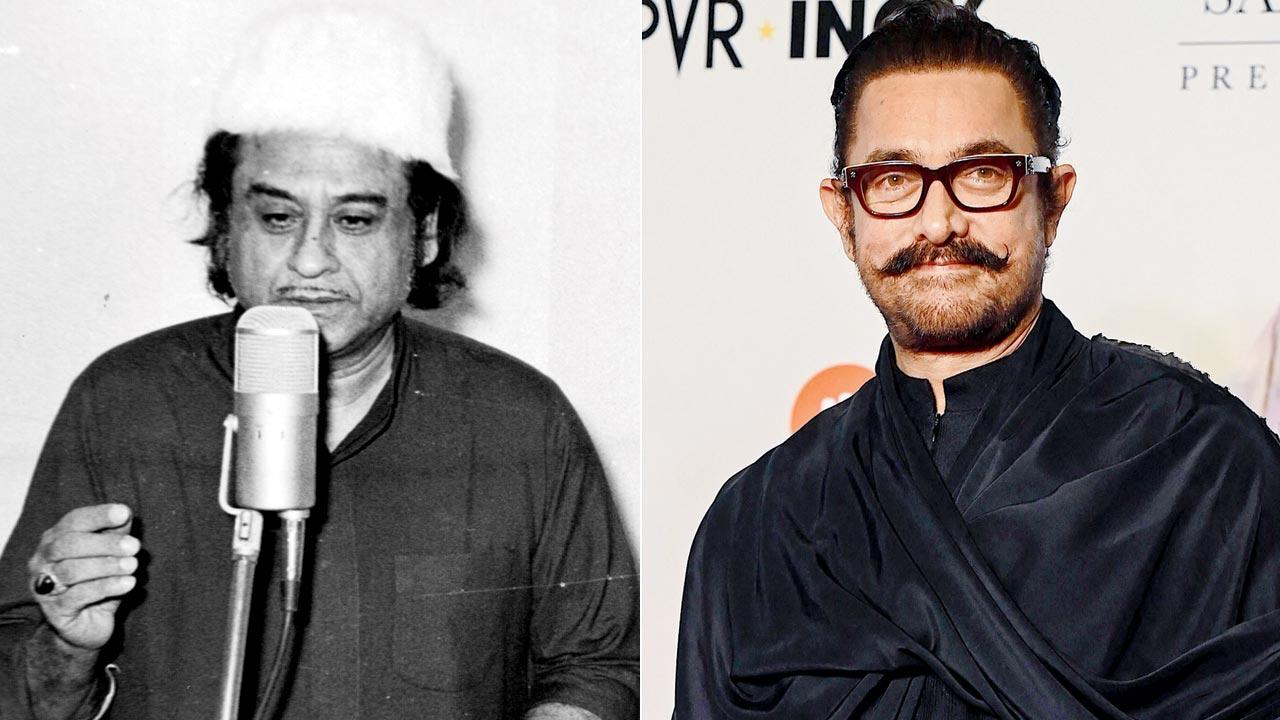
Amid rumours that Aamir Khan will headline the Kishore Kumar biopic, filmmaker Anurag Basu says he hopes to roll his decade-in-the-making film soon without jinxing it
Priyanka Sharma (MID-DAY; July 8, 2025)
A biopic of Kishore Kumar has long fascinated filmmaker Anurag Basu, and for good reason. The late singer and actor greatly influenced Hindi cinema’s music landscape. While Ranbir Kapoor was initially attached to lead the biopic, recent rumours suggested that Aamir Khan would step into the shoes of the maverick artiste. So, as we caught up with the filmmaker, we asked if he was indeed set to direct Khan on his passion project.
“No comment,” he chuckled, before adding, “Until everything is finalized and the contract is signed, I don’t think I should speak on it.”
Basu’s long-cherished project has gone through an eventful journey, with the makers earlier struggling to get the approval of Kumar’s kin for the story.
“This project went through a lot of ups and downs. So, I’m keeping my fingers crossed that it happens this time and I go on set with the story, which I’ve been trying to tell for the last decade. So, I won’t jinx it by speaking about it.”
Rumours have also surfaced about his reunion with Kapoor, who led his past offerings Jagga Jasoos (2017) and Barfi (2012). The director is hopeful of a third outing, as he said, “I hope it happens soon. Woh aadat bohot kharab kar deta hai [he spoils you a lot]. We keep talking about working together again.”
When not talking films, the duo talks about Kapoor’s lifestyle brand. “He has gifted me a pair of shoes again. Pehli baar galat size bheje thhe,” Basu laughed.
S S Rajamouli heads to Kenya for Mahesh Babu-Priyanka Chopra-Prithviraj-starrer
9:28 AM

S S Rajamouli to shoot SSMB29’s next leg in Kenya; actioner becomes the second major Indian film after Jagga Jasoos to be shot there
Mohar Basu (MID-DAY; June 23, 2025)
S S Rajamouli’s action adventure, the working title of which is SSMB29, has taken him from Odisha to Hyderabad since it rolled last year. Now, the filmmaker and leading man Mahesh Babu have zeroed in on the next destination. Sources reveal that the director will begin an elaborate three-week schedule in Kenya in July.
It has been learnt that the Kenya leg will feature some intense action sequences. A unit insider reveals, “Rajamouli sir chose the country because it has everything the film needs — savannahs, highlands, and dense forests.” The portions will be filmed across multiple locations, including the Tsavo National Park, the Aberdare National Park, and on the outskirts of Nairobi.
Also starring Prithviraj Sukumaran and Priyanka Chopra, SSMB29 tells the story of a globe-trotting explorer on the quest for some artefacts. The production team has roped in stunt coordinators of the region to execute the action set-pieces.
The source adds, “Some sequences involve wildlife interaction, and combat in the jungle. Rajamouli sir has envisioned chase sequences in wildlife corridors, and ancient ruins.”
Interestingly, SSMB29 becomes only the second major Indian film after Ranbir Kapoor’s Jagga Jasoos (2017) to be shot extensively in Kenya.
There were date issues with Triptii Dimri; she is still my best friend-Anurag Basu
8:38 AM

Rishabh Suri (HINDUSTAN TIMES; February 4, 2025)
Filmmaker Anurag Basu’s battle with blood cancer started in 2004, when he was told he only has a few weeks left to live.
On World Cancer Day today, the 54-year-old shares how he gave himself ‘targets’ to achieve on his way to recovery: “It started with me wanting to see my unborn daughter’s face when my wife Tani was pregnant. Then it was to walk and touch a stool in the room.”
Anurag emphasizes that awareness is of utmost importance. “Even today, when someone in the family is diagnosed with it, we try to hide it, and not tell others. Jab tak aware nahin karenge, tab tak early diagnosis bhi nahin hoga,” he says, adding, “Life doesn’t get over if you are diagnosed with cancer. You should treat it like common cold... Isiliye main apne cancer ke baare mein khulke bolta hoon.”
’THERE WERE DATE ISSUES WITH TRIPTII’
Anurag Basu’s next starring Kartik Aaryan found itself in the middle of drama recently as rumours suggested that Triptii Dimri was removed from the film. There were reports that this was because ‘her image’ didn’t suit the role, after a string of bold roles.
Anurag clarifies to us, “Image was not the reason. I’m the last person to judge an actor on the basis of characters they play onscreen. Aashiqui was not even the story anymore... I don’t know the source of these stories.”
He cited dates as being the issue. “Triptii is shooting for a film with Vishal Bhardwaj, and my film goes on floors this month, too. Triptii is still my best friend,” he says, adding, “I don’t know what the film is called right now, the shoot starts this month. We haven’t finalized the female lead, it’ll be announced in a week.”
---------------------------------------------------------------
Rishabh Suri (HINDUSTAN TIMES; February 4, 2025)
Dance, drama and stories — filmmaker Anurag Basu enthralled his audience at the Kathakar International Storytellers Festival. From the story behind his cult hit Murder (2004)to the fate of Ranbir Kapoor-starrer Jagga Jasoos (2017), Anurag didn’t shy away from answering any questions.
‘I didn’t think it was the right story’
Murder, starring Emraan Hashmi and Mallika Sherawat, was a raging success. When asked about how he came on board to direct this film, the 54-year-old shared, “Mahesh Bhatt (director) sahab met me at the Delhi airport once, and I told him how I had left my first film as a director because of a fight. So, he gave me a chance to direct this film. Then I met Mukesh Bhatt (film producer and actor) sahab, and got to know about the plot. In response, I remember I said, ‘I don’t think it’s the right story’.”
He continued, “But Mukesh ji asked me, ‘Unfaithful (2002) film dekhi hai? [That is the idea]. Aur uss zamane mein yeh poocha jata tha ki ‘Kaunsi DVD bana rahe ho?’ So, I asked him, ‘Can I write the story myself, based on what I have heard and without necessarily watching Unfaithful?’ Now, I hope humari film alag bani.”
‘RANBIR WAS THE FIRST CHOICE FOR BARFI!’
Anurag’s collaboration, the 2012 film Barfi!, starring Ranbir Kapoor, received both critical acclaim and box office numbers. But fate wasn’t as kind to their next, Jagga Jasoos, as it didn’t notch up the desired box office collections.
But Anurag revealed that he was prepared for things to go south. “Hum banate banate darr rahe the. Ranbir even asked me, ‘Dadu, Ae Dil Hai Mushkil (2016) aur Jagga ke beech mein pehle kaunsi release karein?’ So, I told him, ‘Ae Dil... is a sure-shot hit. But I don’t know about Jagga’.”
He continued, “I am from the small town Bhilai (Chhattisgarh) and I know what people like watching. However, that doesn’t mean we’d stop making different content. Bahut pange the Jagga mein. Though the way you all applauded after hearing the film’s name now, it means a re-release could also be a good idea.”
Jagga Jasoos was the only film in my career that hurt me-Ranbir Kapoor
8:16 AM
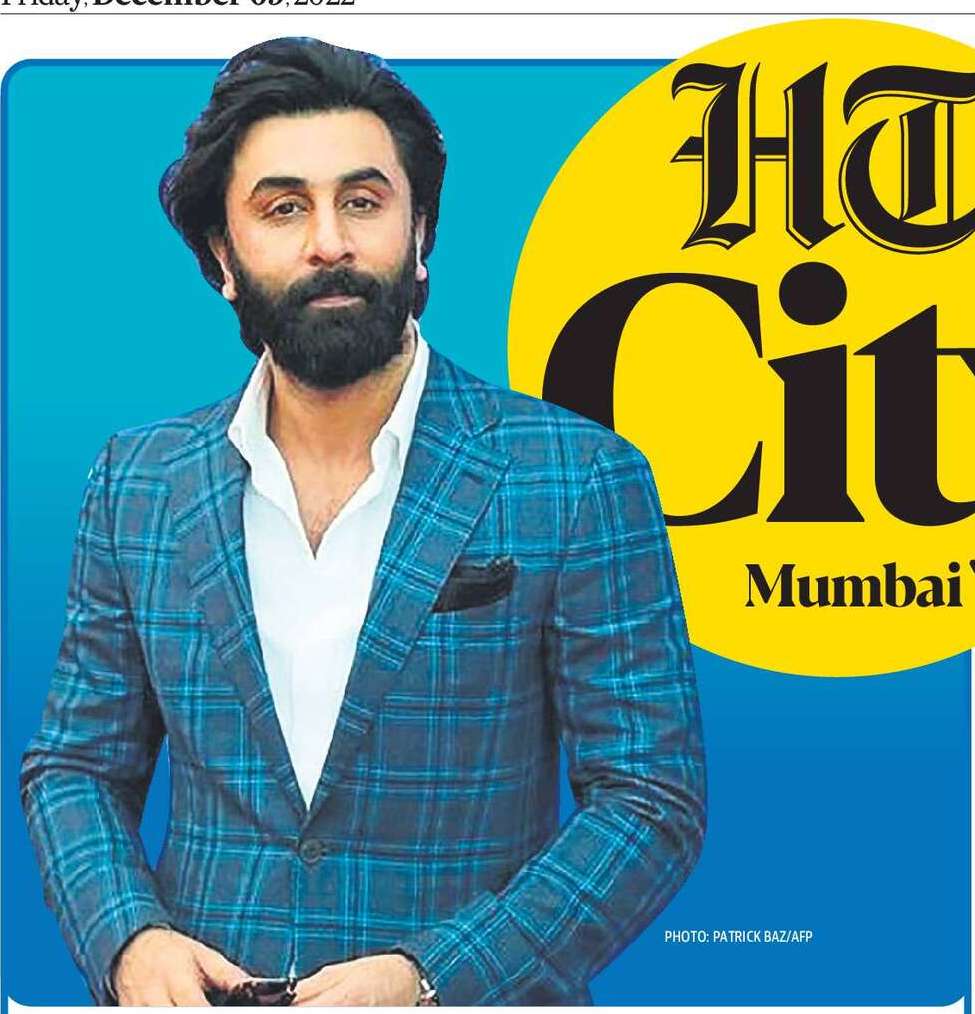
BOMBAY TIMES (December 9, 2022)
Ranbir Kapoor, who attended the Red Sea International Film Festival 2022 in Jeddah on Wednesday, discussed his life and acting career during an In Conversation session. Excerpts:
ON THE ‘PRETTY BAD LAST FEW YRS FOR INDIAN CINEMA’
“It’s been pretty bad these last few years. The entire culture of going to a theater for a community viewing of a movie seems like it’s dying, and it’s only there for the big ticket films, but I hope with strong storytelling, and renewed vigour, Indian cinema comes back,” said Ranbir.
ON WHY JAGGA JASOOS’ FAILURE ‘REALLY HURT’
He also described his 2017 film Jagga Jasoos – his ‘passion project’ – as “another disaster. ” “It’s a film that I produced. It was directed by Anurag Basu. It was a very heartwarming and sweet idea, but it didn’t do well, which really hurt. That’s the only film in my career that hurt me,” he was quoted as saying.
ON SOUTH FILMS’ SUCCESS
Talking about the popularity of South Indian movies, Ranbir said, “They’re doing really good storytelling. ” Giving the example of RRR, he added, “It’s got all the songs, dances, action, friendship, and comedy. So it’s a multigenre film, but those are hard films to make. ”
--------------------------------
HINDUSTAN TIMES (December 9, 2022)
Actor Ranbir Kapoor, who made his first public appearance after welcoming his daughter, Raha, with wife, actor Alia Bhatt, spoke about the box-office failure of Shamshera. During a media interaction at the Red Sea Film Festival in Jeddah (Saudi Arabia), Kapoor said it’s the hardest movie he has worked on.
“It was a big box-office disaster, but the biggest mistake I made on Shamshera was that I stuck on a beard. When you’re shooting in the heat, and you stick on a beard, it’s like your face is melting,” he said.
The 40-year-old also addressed his 2017 box-office failure, Jagga Jasoos. “It’s a film that I produced. It was a passion project. It was a very heartwarming and sweet idea, but it didn’t do well, which really hurt. That’s the only film in my career that hurt me.”
Talking about the dismal state of Hindi films at the box office in the recent times, the Brahmāstra: Part One – Shiva actor said that the situation has been “pretty bad these last few years”.
Kapoor added, “The entire culture of going to a theatre for a community viewing of a movie seems like dying, and it’s only there for the big-ticket films. But I hope with strong storytelling, and renewed vigour, Indian cinema comes back.”
Throwing light on his long-term career plans of making films, Kapoor said, “I have always wanted to direct a movie. But I’ve really not mastered the courage to write a story. I’m not a writer, and I’m really shy when it comes to sharing my ideas with others. But I’m working on it, and it’s something that is in my 10-year plan: To start directing movies and hopefully act in them too.”
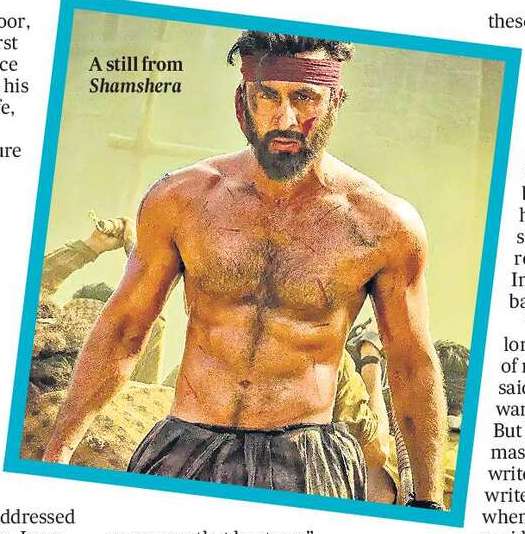
We ensured Ranbir Kapoor's lifting sessions weren’t hampering his Jagga Jasoos look, while staying on track for Sanju-Kunal Gir
8:40 AM
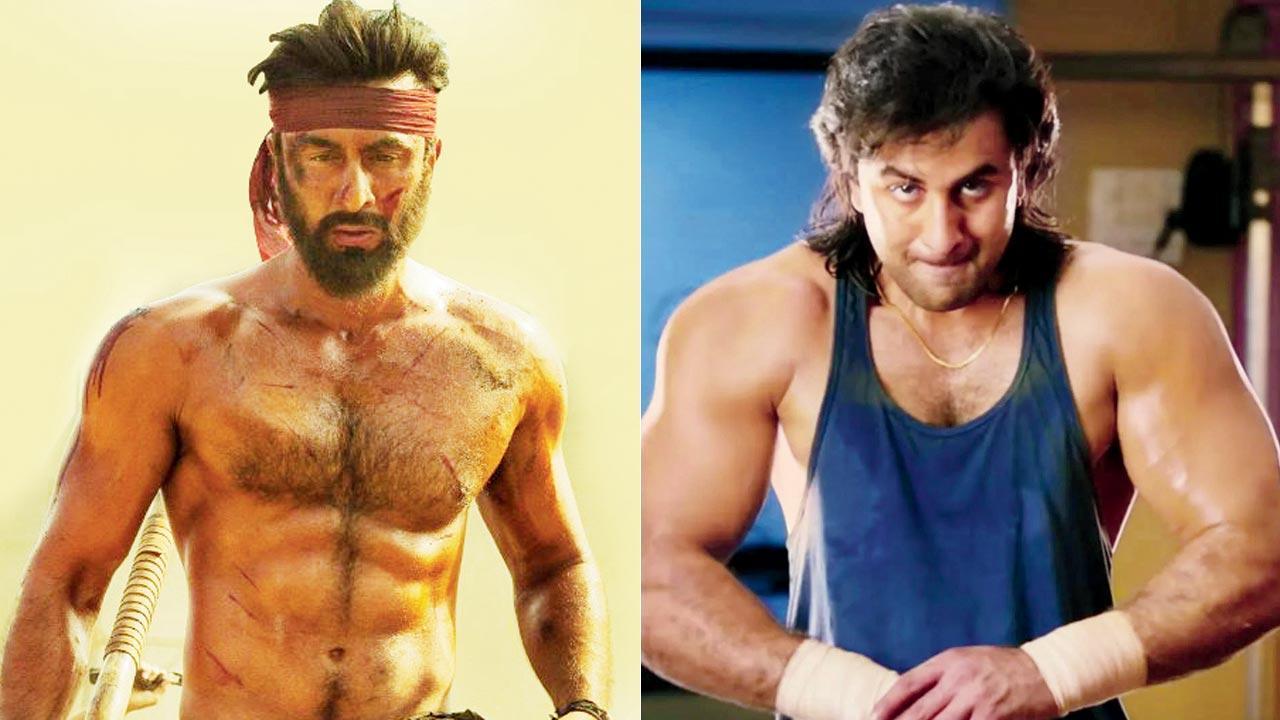
Long-time trainer to actor chronicles putting him through rigorous routines for films like Jagga Jasoos, Shamshera, and Brahmastra
Sonia Lulla (MID-DAY; October 5, 2022)
In the last few years alone, Ranbir Kapoor juggled between the shooting schedules of Sanju, Shamshera, and Brahmastra: Part One – Shiva — three films that saw him sport significantly different physiques. Aptly complementing his trainer for his astute understanding of fitness science, Kapoor has often credited Kunal Gir for enabling him to look the part in all his films.
Tracing his journey with Kapoor, Gir recalls how he had to switch his diet to mould him from the 72-kilo Jagga Bagchi in Jagga Jasoos, to the 84-kilo Sanjay Dutt, in Sanju. “In the midst of shooting for Jagga Jasoos, we had to start preparing for Sanju. We had to work in such a way that his lifting sessions weren’t hampering his look in Jagga Jasoos, but we were still staying on track to film Sanju. For Jagga, he was on a two-meal plan, because he had to have a young look. From there, we had to put him on an eight-meal plan for Sanju. Doing that was tough, so we would make him eat four meals, and then have four protein shakes as supplement,” says Gir, adding that for Dutt’s film, their aim was to build size, not definition.
“We put him on a calorie surplus and increased his workload to facilitate a 12-kilo weight gain.”
Gir says the process of muscle building is synonymous to creating a sculpture. “You first pile on as much clay as you can, which is what we do by adding the right calories and building raw muscle mass. In the process, you also gain some fat, which is why you look bigger. Then, you chip away at the fat, with cardiovascular activities, and by limiting the carbohydrate and fat intake, while keeping the protein consumption high, thereby revealing the muscular look.”
The shooting schedules of Brahmastra and Shamshera were well-timed. Kapoor needed to burn off the fat that he had put on for Sanju to acquire a lean look for Brahmastra, and the physical shape that he needed for Shamhera sat somewhere in between.
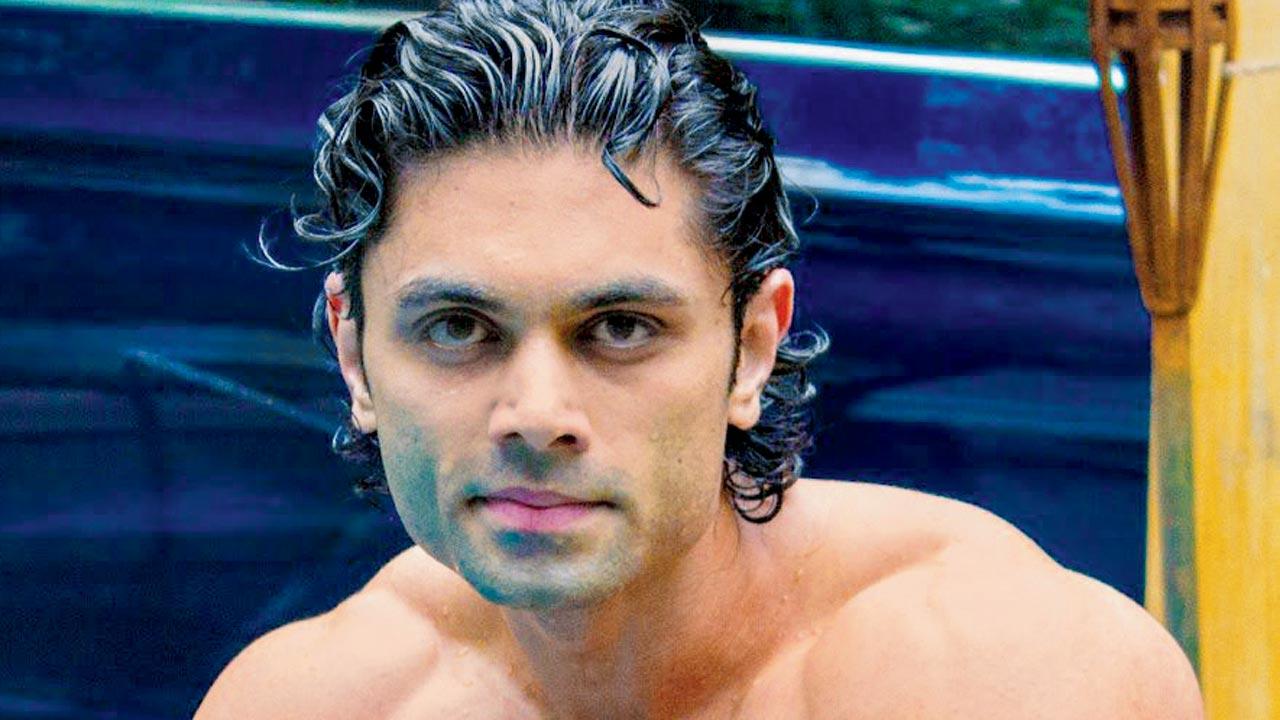
Kunal Gir
Top five biggest losers of all time; '83 is on number 1 position
8:44 AM

Box Office India Trade Network
There have been many disaster films in Hindi cinema since the Sohrab Modi film JHANSI KI RANI in 1953 which was the first film to lose a huge amount of money. The film only lost 30 lakh but at that time there were hardly any films made on a budget of 30 lakhs and it was a huge amount for that time.
There are two ways at looking at disasters - one is the amount of money they lose and then there are complete washout films which just tank but sometimes they do not lose the most money as the budgets are lower and many times there is decent recovery from non theatrical revenue against the budget.
These washouts would include films like RAM GOPAL VARMA KI AAG (2007), DRONA (2008), KHELEIN HUM JEE JAAN SEY (2010), ZANJEER (2013), BOMBAY VELVET (2015) MIRZYA (2015), FITOOR (2016), RANGOON (2017) among others. '83 does not come in this list as its not what you call a washout but more of a rejected film. The washout films are the ones where the public just does not care for these films and don't even give them a chance.
Below is a list of the top five losers in Hindi cinema and these are the films to have lost 50 crore or more but only one of these films is a disaster and a washout also and that is BOMBAY VELVET. The others are also disasters due to heavy losses but they are rejected films and not washouts. The number in brackets is the loss of the film. The washout result of BOMBAY VELVET can be seen by the footfalls against the other films. ZERO will remain with the highest footfalls of these films as its likely that '83 will not even reach the level of MOHENJO DARO.
1. '83 (80 cr)
Footfalls - 52 lakhs apprx (2 weeks)
2. Bombay Velvet (70 cr)
Footfalls - 22.24 lakhs
3. Zero (70 cr) (on valued SRK remuneration)
Footfalls - 68.74 lakhs
4. Mohenjo Daro (55 cr)
Footfalls - 60.17 lakhs
5. Jagga Jasoos (50 cr)
Footfalls - 49.74 lakhs
The idea of starting Jagga Jasoos all over again is enough to give me the chills-Anurag Basu
4:30 PM
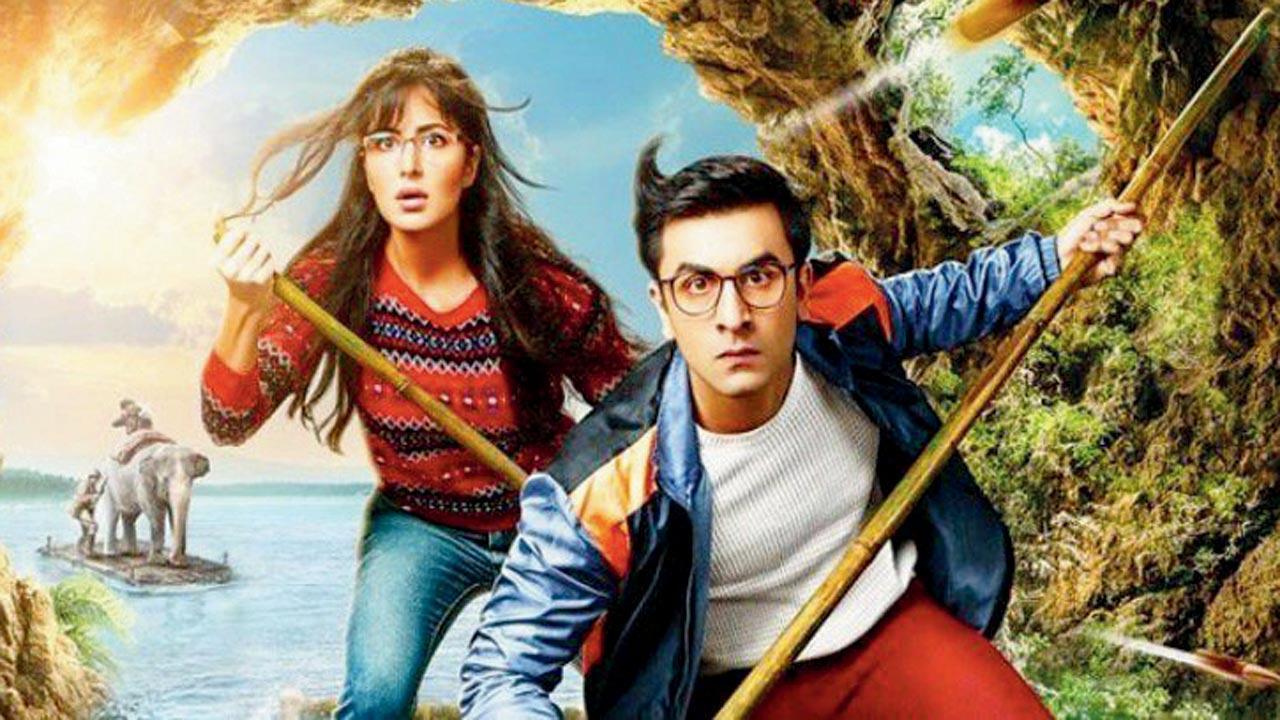
Four years after Jagga Jasoos tanked at the box office, director Anurag Basu says OTT platforms have approached him to make web series on Ranbir-starrer
Mohar Basu (MID-DAY; September 2, 2021)
Jagga Jasoos (2017) remains Anurag Basu’s most creatively satisfying work. That the audience did not buy into his charming, almost fantastical world is a different story altogether. Thankfully, with the advent of digital entertainment, the show business and audience preferences have changed in the four years since the Ranbir Kapoor and Katrina Kaif-starrer bombed at the box office. Would the adventures of Kapoor’s wide-eyed Jagga Bagchi interest the viewers today? Some think so.
Basu says that over the past two years, he has fielded offers from some streaming giants to convert Jagga Jasoos into a series. “I wouldn’t name the platforms, but we had offers of developing it into a series. But if it didn’t work in theatres, how do we know it will work on OTT? Pritam is excited about the idea, and wants us to start working on it. However, I am in a strange space [regarding it]. When you do something with so much love and it doesn’t work, you don’t want to try it again. The idea of starting Jagga all over again is enough to give me the chills,” says the filmmaker.
Basu and Kapoor had jointly set up Picture Shuru Productions to back the adventure comedy. Even if he entertains the idea of taking the story ahead as a web series, the director notes that his leading man’s busy date diary will be a roadblock. “We keep talking about working together again, but that won’t happen anytime soon. Ranbir is extremely busy right now,” he says.
For now, the filmmaker is working on a yet-unannounced episodic project for a major OTT player — his second outing on the web after the Netflix film, Ludo. The film recently won him the Best Director award at the Indian Film Festival of Melbourne. “[Ludo was released] in 35 languages and 200 countries; this kind of reach wouldn’t be possible in a theatrical [run]. OTT gives more strength to filmmakers. I believe the audience knows its mind, and it’s not correct to offer them shallow works. People have become more cinema-literate in the lockdown. My fear of whether [a project] will work or not, has now reduced considerably.”
Ranbir Kapoor & I never fought on Jagga Jasoos. We never crossed the film's budget-Anurag Basu
8:10 AM

From life to near-death, television to films, hits to flops to hits again, doing 'adda' with Bollywood's top survivor, director Anurag Basu
Mayank Shekhar (MID-DAY; December 26, 2020)
Offering him a chance to graduate from directing on television, to debuting in films, producer Mukesh Bhatt asked Anurag Basu in the early 2000s how much he would charge. Mukesh, well-known in Bollywood to be frugal with expenses, suggested, "Rs 7 lakh?"
Basu agreed so instantly to the number that, taken aback, and in that split sentence, Bhatt revised that Rs 7 lakh into a two-film deal! "In just two seconds, huh," Basu laughs. "But it was my stepping stone, I was just an outsider, getting to learn a lot; I would have done it for free," he says; no complaints still.
This would've been for his forgotten debut Saaya (2003, starring John Abraham, Tara Sharma). Having delivered a box-office dud, the sets for Basu's second film had also been mounted, when he had stopped showing up at the office of Vishesh Films (run by brothers Mukesh and Mahesh Bhatt). He told the producer, he'd "lost confidence" in the film they were about to shoot/start in a few days.
But there was a half-constructed set, paid for, while Vishesh Films were already reeling under a string of flops. "Ghuma phira ke", Basu narrated an idea around what Mukesh had suggested. Driving back home, he found actor Kashmera Shah sitting at the Barista coffee shop in Lokhandwala. He stopped to ask if she'd dance for a song, which Anu Malik composed in a couple of days.
They utilised that set for a track, Dil ko hazaar baar roka, and carried on with another film altogether. Which was? Murder (2004). It gave Basu tremendous box-office cred. The film went on to collect Rs 75 crore. And Basu received? Rs 3.5 lakh - second tranche of his two-movie deal - making him perhaps the best directorial ROI for a producer, in the history of Hindi films!
Male audiences across North India lined up to catch the skin-fest Murder - evidently inspired by Adrian Lyne's Unfaithful (2002) - mainly to ogle at Mallika Sherawat. It's Emraan Hashmi, the male lead, who became the single-screen sensation: "He became a rage!"
Every producer at the time, top ones included, had a DVD of a sleazy Hollywood film that they wanted Basu to convert into a Hindi movie! Murder itself belonged to a B-movie genre (that subsequently became a franchise).
How Basu elevated it still is with a certain level of soft lighting and warm aesthetics: "Aesthetics are in-built, you cannot change it. It's the way you see things. I used to also shoot television like that," he says.
In fact, you can notice even more of that - surely the film industry did - in Basu's Gangster (2006), a musical drama, loosely based on underworld don Abu Salem and his moll, '90s starlet Monica Bedi's escapades. Who became the star from that movie? Debutant Kangana Ranaut.
"Of the 20-25 girls we auditioned for the part, her face just stuck in my head - there was something unique about her," Basu recalls. Did he foresee her success? "In the beginning, she needed guidance for everything. But she is a really fast learner. I have seen her growth during the filming of Gangster itself."
What about her public persona, as the relentless online troll, if you may? Did he see this coming? "Not really. We usually don't meet, but whenever we do, this [public] persona is not the Kangana I [know] personally. So I think there are two Kanganas. Beech wali [the other one] I don't understand."
Basu, 46, Bengali boy from Bhilai, moved to Bombay to pursue a graduation degree in physics, and look around for work in the entertainment industry alongside. Lives of the young in the steel township he comes from are chiefly centred on cracking medical and engineering exams. He got exposed to story-telling and performance arts, because of the theatre group that his father ran as a hobby. And they'd travel with plays at amateur theatre competitions across India.
In the sense of Bollywood, Basu belongs to a productive class of the early '90s actors/filmmakers, from various parts of India, looking to build a career in showbiz, and who gradually took over Bollywood's reins later.
He started out as a 22-year-old assistant allowed to direct a scene in the popular television show Tara - putting his foot down among veteran actors, so they took him seriously, which was becoming an issue. He exited TV about a decade after, as the highest paid director: "I used to make as much from a month of TV, as I did from my first film."
There are also the common stories of doing producers' rounds, hanging around Prithvi in Juhu, approaching Shyam Benegal, Sriram Raghavan to assist. Also, accidentally, dancing behind Mithun Chakraborty, as the hero's friend, in a film called Dalaal (1993) - because the director was Bengali (Partho Ghosh), and they were looking for a bilingual Bengali assistant to help communicate at an outdoor location!
There is a scene in Vikramaditya Motwane's film AK vs AK (2020), where the self-referenced protagonist, director Anurag Kashyap, is casually referred to as Anurag Basu. This is partly true in the reverse as well, as it turns out, since Basu would get messages meant for Kashyap back when there were pagers for communication (or the lack of it).
In fact, they have a lot more in common, I discover, during this conversation, including Benegal, Raghavan, Prithvi, a play that both were meant to do for Makarand Deshpande. And, inevitably, stories around the adorable old miser Mukesh Bhatt!
Where similarities between Kashyap and Basu end is, of course, in their cinematic worldview. Even a gun-toting thriller with dames and dons, Ludo (2020), in Basu's hands, turns into a joyously musical carnival of atrangi/colourful/shiny characters! His films are more fantastical in their approach, yet experimental in their own right. While it may not seem so, he says, they are actually drawn from reality.
The semi-silent musical Barfi, he reveals, is based on a real-life girl Razia (played by Priyanka Chopra, and who she actually met later), and a boy with hearing impairment called Murtaza (that was Ranbir Kapoor).
Basu knew these two from a special school in Goregaon, which had a branch near his Andheri office. He had locked Barfi's script, the sleeper super-hit of 2012, at the same time as he'd finished writing Super 30, based on Bihari math wiz Anand Kumar, that later got made with Hrithik Roshan, directed by Vikas Bahl.
Likewise, the lead character (played by Ranbir) in the full-blast, theme-park adventure Jagga Jasoos (2017), of a young man who stammers, but not when he sings, is essentially Basu's long-time music collaborator, Pritam!
Katrina Kaif's character in the same movie, he says, is wholly modelled on his clumsy wife Tani: "Calamity Jane, that's her. She could be holding a cup, and be left with just the handle. Lots of stuff that happens [to Katrina] in the film has actually happened before me in real life with Tani."
Calamity is also how Jagga Jasoos got blasted as, by a wide section of the film industry, upon release - given how long it took to make it in the first place (roughly over four years). "Yeah, too long, actually," Basu admits. "We could have finished a year before. There is not a single thing I can pinpoint [for what went wrong]. Ranbir [the lead] was shooting and promoting four films [Besharam, Bombay Velvet, Roy, Ae Dil Hai Mushkil] during this time. I could have put my foot down and requested him not to. But then, Pritam also wanted time to make music. I didn't know where to balance. Even after all this time, we were rushing with post-production, five months before release!"
Then there was the story from Jagga Jasoos sets about veteran actor Govinda being hired, he'd even shot, and then was fired: "Govinda ji did come with us. With such delays already with the shoot, [there was confusion] if Govinda ji is coming on the set, or is he cancelling the flight, or is he taking the fight, or are we cancelling shoot? It was so unpredictable. I couldn't have taken that stress, yaar. We were shooting outdoor in South Africa, everything was lined up. I just had to [let go of him]."
Not that Basu isn't used to this level of stress - more so, a barrage of take-downs, post the release of a film. The biggest case study in his career might well be Kites (2010), a hugely ambitious trans-Atlantic release, headlined by Hrithik Roshan, with the Mexican tele-novella star Barbara Mori in the female lead.
Kites opened to theatres in India with desis wondering what language the film they had walked into was in - English, Spanish; or Hindi? The budgets clearly didn't match the public response to this immensely stylised romantic thriller.
Basu himself felt as lost during the making of Kites, he remembers, as the audiences did after its release: "Take a film like Gangster. I wanted to shoot in Korea. I asked my producer [Mukesh Bhatt] if I could. He'd be like, 'Here's Rs 3 crore - finish the film within it. Now I don't care if you go to Honolulu, or anywhere else.' So, I knew my budget; production was in my hands. That's what I was used to. With Kites, it wasn't like that. I was just going there and directing. And we would discuss how we are going to execute [the scenes]. I was not thinking of market, returns… It started out as a small, indie [film]. It was taking its shape, with four or five people making decisions. Also my vision and [producer] Rakesh ji's [Roshan] were separate. Eventually, yeh naa idhar ka raha, naa udhar ka [it belonged to neither an international nor a local audience]."
Which isn't to tone down Basu's own reputation, mostly suggested warmly by his colleagues, of him revelling in the chaos of filmmaking - deriving magic from the spontaneity of a moment, rather than over-planning. While this may cause major heartburn, if the money involved is massive, it has surprisingly served him well in the mainstream.
Actors who've worked with him often speak about showing up on the set, with little idea of what they're meant to do. The scene develops as they go along. This can be a scary process, yes. It hasn't stopped him from attracting some of the top Bollywood stars around. Case in point is Ludo (2020), with more bona fide movie-industry leads (Rajkummar Rao, Abhishek Bachchan, Aditya Roy Kapur, Pankaj Tripathi, et al) than you can fit into two-and-half hours, without each seeming like cameos.
"I was not like this when doing television. This process of mine started somewhere during the making of Gangster. Kangana was new. Shiney [Ahuja] used to come over-prepared. There used to be a struggle to get the performance right. Too many retakes. Also, when I started wearing the hat of writer, director and producer [with Life In A Metro], I didn't have to deliver a script to anyone." The key reason for playing it by ear, he believes, is that "actors don't usually get the full arc of a film." It's better if they live in the moment.
"Also, I don't commit to a scene till the last moment. In [Life In A] Metro, for example, there is a scene where Kay Kay [Menon] and Shilpa [Shetty] confess about cheating on each other. She talks about Shiney [Ahuja]. I was staging the scene, with Shilpa and an assistant, who's also an actor. And there's a dialogue that just slipped off the tongue; Kay Kay asks, 'Bachcha toh mera hai na?' [I'm the kid's dad, right?] That wasn't there in the script. It appeared in the heat of the moment on the set. I thrive on that actually."
Which is also similar to how Basu winged it with Life In A Metro (2007) in the first place. He had only written the script until interval point, when he met (then) UTV's head honcho Ronnie Screwvala for a narration. To adequately fill time, and keep Screwvala and others sufficiently entertained, he got composer-friend Pritam to tag along, and play music all through the narration. The script got sold, while he was halfway into fleshing it out!
Everybody calls Basu, Dada (for elder brother), in Bollywood. As Bengali adults are affectionately named - regardless of their age. Director Basu Chatterjee was Basu Da even to millennials; he died at 93. A well-known Bengali trait with Basu is actually his penchant for the adda (fun chat), as I can sense, while he generally eases into talking about his life, with a gentleness/lightness of touch that often eludes the successful/self-aware.
As a person/artiste, he finds himself connecting the most with the other great Bengali, Kishore Da - Kishore Kumar: "Every time I read about him, I realise, arre, he thinks like me - his madness, his world, it is fascinating." Basu has been sitting on the draft of a Kishore Kumar biopic for years, determined to make it. It hasn't worked out, yet. "It will be made by me, promise, very soon," he says.
Like Kishore Da, Basu is also a polymath of sorts. You can gauge that from his last movie, the mad, mad Ludo, that dropped on Netflix in November. He was the film's cinematographer, writer, director, producer, along with playing the role of the traditional sutradhar (narrator) on screen. This was one of the early movies to finish shoot while the pandemic was still on. Surely they would've taken adequate precautions shooting the final scenes. Although having sanitiser on set and shooting with a mask on isn't novel for Basu.
Shortly after the success of Murder, he was diagnosed with late-stage cancer. Doctors gave him a few weeks, max: "It just happened too quickly. One day I just saw my reflection, and I didn't know this is what I was looking like - the internal bleeding was happening, buckets of blood going out. I just wanted to breathe right, until I went on the ventilator for 17 days. It took a toll on my dad, actually. His health deteriorated after that. It was tough on my family."
There is a scene in Life In A Metro, where Nafisa Ali's character dies in an ambulance, in a traffic jam: "I thought this was going to happen to me, when I was being shifted from Lilavati [Hospital] to Tata [Memorial Centre]."
This was also the time Basu was in the midst of a film called Tumsa Nahin Dekha (2004, starring Hashmi, Dia Mirza). But the film, as he says, was all in his head. And he was struggling for life. Each day, he would relay instructions recorded into a dictaphone from his hospital bed, to keep the shoot going.
The treatment, of course, carried on for a couple of years: "I had become really thin; had my mask on. There were hospital bills to recover, with treatment in the ICU that had gone on for really long. There was a survival issue, with regard to money. I went to my old television colleagues at Zee and Sony, and they gave me shows to do. I had no film. So, it was back to square one. I did television for over a year."
He got on a film-set finally with Gangster: "I also had Life In A Metro to make. But decided that I may as well be with Vishesh Films at the point. [Producer] Mukesh ji used to carry a sanitiser in his bag, yell at me if I wasn't being careful. They were not greedy; they were careful about my health. They asked me to wait, and I didn't want to."
A close brush with death, one presumes, changes man forever. I ask Basu if he sees it that way - a before and after, as it were: "My rights and wrongs are the same. But I have become less cynical about things, I'm more positive."
On an observable plane, he concludes, "That is [also] when I decided to turn producer. [Life In A] Metro happened because of that. I thought, when I make movies, I should also make money. It is important to keep money for your family."

During Jagga Jasoos shoot, we'd play Ludo-Anurag Basu
7:49 AM

Ludo director Basu discusses why the "endless" board game, played by Ranbir Kapoor, Katrina Kaif & Co while making the 2017 film, seemed an apt title for his next about four intersecting stories
Shaheen Parkar (MID-DAY; November 4, 2020)
When Anurag Basu began shooting for his then-untitled film in 2019, rumours were rife that the ensemble drama — featuring Abhishek Bachchan, Rajkummar Rao, Pankaj Tripathi, Aditya Roy Kapur, Fatima Sana Shaikh and Sanya Malhotra, among others — was a sequel to his 2007 offering, Life In a Metro. The movie was unofficially referred to as Metro 2 till the filmmaker christened it Ludo last December. The film immediately caught cinephiles' attention, courtesy its quirky title. However, few people know that the name has its roots in Basu's last directorial venture, Jagga Jasoos (2017).
The filmmaker says that zeroing in on a title for the Netflix film — revolving around four different journeys that intersect in the end — was far from easy. When brainstorming for the name, he found his mind racing back to the shoot of the Ranbir Kapoor and Katrina Kaif starrer. "I remembered that throughout the shoot of Jagga Jasoos, we all used to play Ludo on the set. We would continue to play the board game even while travelling [from one location to another]. It was fascinating how the game was endless. [Since] this is a story of four different journeys coming together, the name Ludo fell in place."
The 2017 musical mystery adventure had taken over four years to complete. Before the film reached the finish line, Kapoor and Kaif, who were in a long-term relationship, parted ways.
After Jagga Jasoos, Basu reveals that he had four to five scripts on his table as he struggled to decide his next. "Tani [wife] and Pritam da [composer friend] pushed me towards this script. Ludo shows you that you don't meet people by accident, they are meant to cross your path for a reason," states the director.

I have four subjects ready, but I am not sure which one to go with-Anurag Basu
8:39 AM

Anurag Basu on future project, Jagga Jasoos, Metro sequel and next film, which was hit by the pandemic
Roshmila Bhattacharya (MUMBAI MIRROR; June 12, 2020)
 While many have been feeling angry, restless and caged-in during the Coronavirus lockdown, Anurag Basu’s friends have been messaging him, saying, “You must be happy because you’re always in a state of perpetual lockdown.” The director admits with a laugh that periodically, he does go underground for five-six weeks, when he cooks for the kids and goes into his corner. “When the lockdown started, I imagined it wouldn’t last longer than two-three weeks and compiled a long to-do list, comprising writing and other stuff. I haven’t even got started on it,” he sighs.
Well, for many, who were hurtling along at a crazy pace with little time for family, the last few months have been an eye-opener and life-changing. What about him? “Hamare liye yeh naya nahin hai; my life changed back in 2004 (when he was diagnosed with acute promyelocytic leukemia, a type of blood cancer, and the doctors gave him around two months to live). Since my wife Tani was seven months pregnant at the time with our elder daughter, Ishana, I set myself small targets, starting with three months, so I could see my child. Then, a couple of weeks more… a month, two months, six months, a year... Taking baby steps. I went back to the set while my chemotherapy was still on, wearing a mask,” he flashbacks.
He cheated the Big C and, in the process, his priorities and lifestyle changed. “Now, Ishana and Ahana (younger daughter) are imbibing it without me telling them to. Those who knew me earlier will tell you this one is very different, new and improved Anurag,” he chuckles, adding that it started with small changes and the process continues. “Poora insaan toh nahin badal sakta, but my concept of right and wrong changed.”
While on the topic, one wonders if Ranbir Kapoor confided in him when he learnt that his father, Rishi, had cancer. “He did. I was among the first few to know,” admits the filmmaker. “We discussed what line of treatment he should take. I shared the number of my doctor with him and they spoke to him and told me what they had decided.”
There were no conversations during the treatment, but after the senior Kapoor returned from New York, just before Ranbir’s birthday on September 28, they had dinner together. “Neetu ji spoke about the treatment, Chintu ji, like always, was in his element, trying to dig into cake. Since he was not allowed to have sweets, Neetu ji tried to keep him away and this led to a fight between them. It was very cute,” he laughs. They met last on Ranbir’s birthday.
On April 30, we lost Rishi Kapoor. The day before, his good friend, Irrfan Khan, who was also battling cancer, breathed his last. Anurag was distraught. He admitted that, on Irrfan’s urging, he had scripted a sequel to his 2007 musical drama, Life In A… Metro. Irrfan, who was hilarious as the socially inept bachelor boy Monty in Part 1, was the first actor to be signed on. “I know I’ll make Metro again, I just wish I could have made it with Irrfan, too,” Anurag sighs.
For now, there’s Ludo, which is completely ready and was to open on April 24. The on-going Coronavirus pandemic has delayed the release. “I completed it in a year,” he exults. That’s quick, given Jagga Jasoos took so long. “Jagga went completely out of control. But I had made Gangster in six months. Ranbir was very busy at the time, with Ae Dil Hai Mushkil, Bombay Velvet and Tamasha, and I was just sitting at home. It was frustrating at that time, but I am not blaming anyone. Film hi aisi thi. I had entered a zone that took a lot of time,” he reasons, pointing out that it is easier to make films when you repeat yourself, but when you ask yourself what new to do, the answer takes a long time to present itself, particularly later in your career. What’s heartening is that, over time, more so during the lockdown, there have been lots of tweets, messages and positive reviews from those who caught up with it, finally. “It was not a flawless film. On the contrary, it had lots of flaws. But we are all proud of Jagga Jasoos.”
So, what next? Anurag shares that he has four subjects ready, but he’s not sure which one to go with. “That was one of the the things on my to-do list. I haven’t decided yet,” he admits. Is one of them the Kishore Kumar biopic? Anurag confirms the same, saying he has worked on the subject too long and too hard, to let it go and move on. “Too much energy and passion has been invested in it, which is why it keeps popping up,” he acknowledges, pointing out that the problem isn’t only about rights. “The family is keen to make the film, but there are lots of issues. I need support from someone to push it through. But whenever I make it, it will be with Ranbir.”
Meanwhile, is he happy with Ludo? “People who have watched it liked it. I remember Barfi! for all the fun we had while making it. Jab shooting mein mazaa aata hai, toh film theek hi ban jaati hai. We had a blast during Ludo, too, there was the same synergy and energy in the team,” he signs off on an ebullient note.

I told Dharam ji that it was Nafisa ji’s suggestion to kiss and vice versa. They both agreed and I got away-Anurag Basu
8:37 AM

Roshmila Bhattacharya (MUMBAI MIRROR; May 9, 2020)
 “Do you know Irrfan’s (Khan) character in Life In A…Metro was originally a Bengali by the name of Debu? In the film’s first photo shoot, he was wearing a dhoti and a topor. But while we were shooting his first scene, I could visualise Irrfan in the climax, entering the station on a horse. Since Bengali grooms don’t come to their wedding on a ghoda, I told him we’d have to take the shot again and this time he should introduce himself to Konkana’s (Sen Sharma) Shruti as Monty. Irrfan being Irrfan, just laughed and went along,” narrates the film’s writer-director Anurag Basu, whose musical drama, revolving around the lives of nine Mumbaikars, opened 13 years ago, on May 11.
 That wasn’t the only impromptu decision Anurag took. While driving from his home in Goregaon to Koperkhairane station in Navi Mumbai where the last scenes were shot, he was mulling over Shilpa Shetty and Shiney Ahuja’s track. In the original script, she was to leave the city with him. But plagued by second thoughts, he texted all his female colleagues, and even his wife Tani, asking for their opinion. “They all insisted that she should give her marriage with Kay Kay Menon a second chance for the sake of their daughter. When men write female characters, they tend to make them more feminist than they really are,” Anurag offers by way of explanation. The last-minute change, he admits, left Shilpa bemused, and she still hasn’t forgotten this twist in the tale.
 In the film, Shilpa and Kay Kay’s marriage had turned into a union of two indifferent strangers, with the latter involved in a clandestine affair with his sister-in-law’s roommate and his office colleague, Neha, played by Kangana Ranaut, whom Anurag describes as “ghar ki ladki”. He informs that his Gangster leads, Kangana and Shiney, were the first to come on board. Irrfan was a little miffed that despite their long TV association, Anurag had not cast him in Gangster. “I made up with a role in Metro which showcased his lighter side, which I was acquainted with from our TV shows. As Monty, Irrfan was a riot,” asserts the director, admitting that the idea of a Metro sequel came from the actor who passed away last week. “I had approached him to play Ranbir’s (Kapoor) accident-prone, adoptive father in Jagga Jasoos. He was busy with other films then, and since Jagga Jasoos’s dates were all over the place, we couldn’t collaborate on that project. But he told me, ‘Chal, Metro sequel banate hain.’”
 When Irrfan repeated this to him, during the Qareeb Qareeb Singlle promotions, Anurag sat down to take the story further. “Metro 2 mujhe Irrfan ke saath hi karni thi,” he sighs, heartbroken over the loss. Will it happen now, you wonder, and he says, “I don’t know… I really don’t know.”
He repeats the “I don’t know” phrase when you wonder how this anthology of stories connected through characters whose lives were entwined, came together. After a reflective pause, he points out that Murder and Gangster, which came in quick succession, were in the same space, with the Bhatt stamp, so, he wanted to try something very different. “Films like Metro were common in the West, but we had not experimented with the narrative here,” he points out.
 He used a unique narrative device, with a rock band popping up at crucial plot points to take the story forward through songs which otherwise did not fit into the screenplay. The Metro band was headed by the film’s composer and Anurag’s dear friend, Pritam, and included Suhail Kaul, Soham Chakraborty and Bangladeshi singer James. Was it easy getting them to face a movie camera? “Pritam wanted to lose some weight. I told him to grow a beard instead, to look like a rock star. He used to be clean shaven before Metro, but hasn’t lost his beard since. I wouldn’t even let him shave off his beard or cut his hair to get married because we were still shooting the film,” laughs Anurag.
He goes on to confide that Shiney’s character, Akash, a struggling theatre artiste, whom Shilpa’s Shikha is drawn to, grew out of his own experiences on stage. “The play he performs was one of mine, I called it Collage when we brought it to Mumbai. Akash was very close to me,” Anurag acknowledges emotionally.
His biggest fanboy moment was directing his idol Dharmendra. “I remember when we were shooting at Sion station, it was as if all of Dharavi had descended there that day. I was amazed by Dharam ji’s fan following,” he says, the awe still evident in his voice. And how did he persuade the senior actor to kiss Nafisa Ali? “I told Dharam ji that it was Nafisa ji’s suggestion and vice versa. They both agreed and I got away,” he signs off with a laugh.
Every moment is a fan moment when working with Gulzar saab. I’m always in awe-Pritam Chakraborty
7:52 AM

Juggling a sports film, a superhero fantasy and a drama can be daunting. But The Sky Is Pink composer Pritam tells us it’s the only way he can work
Sonia Lulla (MID-DAY; October 7, 2019)
Even though it is the story — inspired by actual events — that’s the biggest draw of The Sky Is Pink, composer Pritam Chakraborty has managed to keep cinephiles further invested in the film owing to his score. In an interview with mid-day, he discusses what went behind composing for the Priyanka Chopra and Farhan Aktar-starrer, and juggling multiple films.
When you have the biggest production houses wanting you on board, what are the parameters you consider before taking up a project?
Generally, I have two ways to decide whether I want to take it up. The first is if I want to collaborate again with friends whom I have associated with in the past. The other is the script. If the script is exciting, [I] look forward to working on it.
In the case of The Sky Is Pink, I had heard very little of the story, initially. When Shonali [Bose, director] approached me, I turned her down because [my diary was] choc-a-block. But, when I heard the story of Aisha [Chaudhary], and saw the way Shonali spoke of the film, I felt for the family. Doing this was an emotional [decision].
While Gulabi Sky and Dil Hi Toh Hai have released, can you take us through the other songs in the film and the genres you’ve explored?
[Much like viewers] I also thought that the film would offer many opportunities to create emotional songs. But there aren’t many. There’s one song called Zindagi, which is my favourite. The others are feel-good [songs]. Dil Hi Toh Hai is a celebration of love. Gulabi Sky is [a play on] the film’s title. Nadaniya celebrates Aisha’s emotions. I thought there would be more emotional numbers, but Shonali wanted to cut through the heavy emotions with [a] brighter [palette]. Also, collaborating with Gulzar sa’ab [was fantastic]. Every moment is a fan moment when working with him. I’m always in awe.
You have mammoth projects like Brahmastra, ’83, Aaj Kal and Gulabo Sitabo, in the pipeline. Do you work on them simultaneously?
I don’t like to work on one project at a time because I can’t sit on one thing constantly. I have a [limited span of] attention, which helps me, in a way, because I can take up multiple projects. I can easily move in and out of the sound zones that I allot to different scripts. If I don’t juggle projects, I get bored. I usually devote no longer than two days for one song. After I finish one track, I’ll move on to another, from another film. Also, I am very moody. I won’t do something if I’m not enjoying it in that moment. The job is difficult. The projects I do are varied and I must keep each soundtrack [suited] to the script. Even if two films that I’m simultaneously working on release together, they should sound different, like it was in the case of Jagga [Jasoos] and Jab Harry Met Sejal, or Barfi and Cocktail.
Is there a soundtrack from your recent releases that has stayed with you?
Jagga Jasoos. I don’t think I’ve worked as much on any project as I did on it. Generally, projects that do well don’t remain a favourite. See, you are likely to focus your attention on a person who is talented, but still under-performs [laughs]. I wish it [Jagga Jasoos] had done better. Then, there are songs from [well-performing] films, that [go unnoticed]. There’s Ghar, from Harry Met Sejal. It’s close to my heart, but didn’t do very well. It was also not promoted.
I am fine with people wondering how someone like Govinda could refuse a James Cameron film-Govinda
8:58 AM

Renuka Vyavahare (BOMBAY TIMES; August 4, 2019)
Govinda’s effortless dance moves, comic timing and flashy style set him apart from his contemporaries. His recent revelation of being offered James Cameron’s science-fiction epic, Avatar, set tongues wagging on social media platforms. In a heartfelt chat with Bombay Times, the actor reacts to being mocked, talks about his tumultuous film career, what caused his rift with David Dhawan and the lessons learnt from all of it. Excerpts:
Your revelation in a recent interview that you were offered James Cameron’s Avatar (2009) has become a matter of joke on social media. The memes have gone viral. Do you stand by your statement that you were offered the Hollywood blockbuster?
I am not active on social media, but my daughter Tina keeps me in the loop. I am fine with people wondering how someone like Govinda could refuse a James Cameron film. I can understand where they are coming from. I respect that thought. They are entitled to have that opinion, but to say how come Govinda got that offer in the first place, is wrong. It’s not like meri aukad nahi hai. It’s prejudiced behaviour. Chai wala aagey kaise badh sakta hain? TV actors films mein kaise aa sakte hain? This is that same elitist, superiority complex. Yeh galat hai. Aapko vishwas nahi karna hai toh mat kijiye, but don’t say things like this.
Did James Cameron mention anything about seeing your work? How did your casting come about?
I was a superstar then. He must have seen my films, but I am not too sure about that. There was a sardarji, who knew me well, and belonged to the medical world. He was my senior, and Dev sahab’s (Dev Anand) friend. He was also one of the financers of the film (Avatar). James Cameron and he met me in London, where I was narrated the story of Avatar. In a way, while I was talking to him, I suggested the title to him. Mere muh se woh shabd (Avatar) nikal gaya aur unhone pakad liya. However, I refused the film. The sardarji even complained to Dev sahab that I had refused this big Hollywood film despite the massive money that I was offered for it. Dev sahab even called me and asked about it.
The film was being directed by one of the most celebrated filmmakers in the world. Why did you refuse the film?
When I heard the subject, I thought I won’t be able to match up to the physicality required to essay that character, that needed to be covered in body paint for over 400 days (Australian actor Sam Worthington played the role of Jake Sully, a disabled former Marine in Avatar, the part which was offered to Govinda). Iraada accha tha, but uss process ko sehne ki kshamata mujh mein nahi thi. I remember Yash Chopra ji had also offered me a similar role in Chandni (1989), which was eventually played by Rishi Kapoor. The character is physically challenged for a certain portion of the film. I had refused that one as well. Dates were an issue, plus, you need to be able to do justice to a role that’s physically demanding. Also, at that point, given the image that I had, I wasn’t sure if people would accept me in such a role.
Hollywood has a certain working pattern and casting process. Many believe that if someone like Irrfan would have spoken of turning down Avatar, it’s still believable since he has worked in American films. You didn’t have that kind of background (of working in films in the West) and perhaps, that’s why it was looked upon as a joke?
People making a laughing stock of me is not new. I was mocked even at the beginning of my career because I dared to become an actor. They thought, I am from Virar gaon, yeh kaise hero banega! Even after my films did well, a certain section of people believed iska success toh fluke hai. When I worked with legends and superstars, they said, ‘Govinda won’t be even noticed in their presence. Yeh mahaan logon ke saamne kya acting karega.’ When my films started doing well, I was conveniently labelled as a ‘comedy actor’ and not a ‘good actor’ and I would only get nominated for awards in the comedy category. When you don’t segregate other genres (romance, tragedy, drama, etc.) why make only comedy a separate category? The intention was to push me to a corner and restrict my reach. Eventually, I realised that this is how the industry treats you when you don’t have a Godfather. You have to find a way to survive. I became Govinda because of my hard work. I had to look after my entire family, so acting was more than just a passion for me. It was my means of survival. The struggle was to succeed with whatever limited means I had.
Why did you speak about being offered Avatar after so many years?
How is that no one wondered why Govinda was asked this question on that show? I did not tell the anchor (of the television show) about it before the show at all. He must have heard about it from someone. In fact, I was shocked when I was asked about it. I couldn’t have avoided the question, so I gave an answer, and whatever I said, is the truth. Jo sach hai, woh bola. Maybe people thought yeh uss layak nahi hai. Gadar: Ek Prem Katha, Taal, Devdas, Nayak, Chandni and Slumdog Millionaire… I have declined all these films, too. Why just Avatar, kya baaki films achhe filmmakers ne nahi banayi? All these films turned out to be huge hits.
What was your reason for turning down Slumdog Millionaire?
I was offered the role that Anil Kapoor played. Danny Boyle had come to meet me. I think this was right after Partner (2007) had released. Jab aapka bad patch chal raha ho and everyone is demoralising you, aapka khud par se vishwas thoda hil jata hai. I was surprised that he came to meet me. I didn’t do that film, but told him it will do well. I loved the thought of the film that you don’t have to be highly educated to make it big in life, you have to be streetsmart. However, I had two objections with that film… the poop scene in the beginning and the title. I wasn’t comfortable with the word ‘Slumdog’ and that scene.
But when these films that you refused, turned out to be blockbusters, did you regret it?
I have always trusted my instinct and though it has mostly benefited me, but of course, I also know that you can go wrong at times. You assume people want to see you a certain way, and so you avoid taking risks. When the screenplay writer read out the script of Gadar to me, I felt that it had too many gaalis (cuss words). I was later told that, ‘You didn’t do it, Sunny Deol did and it’s a huge hit. Aap darte ho.’ I told them Sunny Deol ji is Dharmendra ji’s son. Unkey parivar mein aadha dozen stars hai. Main toh Govinda hoon aur mujhe apni puri family ko dekhna hain, so it is difficult for me to take risks. Hum thodey se haath jodke hi nikley hain.
Why do you think people are finding it hard to believe that you were offered Avatar?
I thought about this a lot. I am a blessed child of my parents and of course God. I have never had a supporter or a Godfather, who showed me the way. I started looking for work at the age of 14 and managed to get it at 21. Where was the time to work on myself? I am neither educated enough, nor politically correct. There was no one to tell me how I could present myself or how to socialise with people. Fashion kya hoti hai, yeh maloom tak nahi tha. Today, actors have a team of stylists and PR, who tell them what to do, say and wear. In those days, these things didn’t exist. I was labelled as a massy entertainer and I had no issue with it as it suited me. That could be a reason why the thought of me rejecting Avatar sounds funny to people. Woh ek ‘massy’ (dance and comedy) image logon ke dil mein beth jaati hai. I was never called a superstar; I was always ‘Virar ka chokra’ in all the articles. When I was listed by a media house in the UK in 1999 among the Top Ten Most Popular actors in the world along with Mr Amitabh Bachchan, (we were the only Indian actors on that list), I couldn’t believe it.
David Dhawan and you gave multiple hits together. What went wrong between you two?
I haven’t spoken to him for over nine years now. On one occasion, he was talking to my secretary, who had put the call on speaker. David told him, “Govinda ko jo bhi chotey-motey roles miley, ussey kar lene chahiye. Ab woh hero nahi ho payega.” My secretary had called him after I couldn’t work with him on Chashme Baddoor (2013). I heard what he said on that call about me. We haven’t spoken since then. Hota hai film line mein yeh sab. I have learnt not to expect much from people when it comes to your profession. However, there are also those who acknowledge me. Rohit Shetty, Ranveer Singh, Salman Khan, Amitabh Bachchan sir, Shah Rukh Khan, Aamir Khan… I want to thank all of them and my fans who still believe in me.
You shot for certain portions of Jagga Jasoos, but those scenes were chopped from the film without you being aware of it. Did that upset you?
I look at the film industry as family and somewhere I was wrong in the way I thought. You should not have these expectations. Perhaps, these people are not wrong. I need to change myself and get more professional and practical in life. Time pe pohcho, time pe niklo, don’t immerse yourself in work beyond that. I am doing that now.
Your alleged lack of discipline and superstitious attitude were cited as the main issues according to many.
If I wasn’t efficient, I wouldn’t have done the number of films that I have. If you are doing your work sincerely, imaandari se kar rahe ho, you don’t look at work as a ‘number of hours’ thing. It’s not possible. I wasn’t so ruthless ke kisika paisa laga hai, but I will leave because mera time ho gaya hai aur ghar jaane ka. I will finish that and only then I will leave. But yes, times have changed for the better. Everything is more organised now, so I am working on being punctual, too. Payments happen on time. Having said that, back then the work atmosphere was more family-like, which isn’t the case today. As far as being superstitious is concerned, who in Bollywood isn’t?
You started working early in life. What are the lessons learnt?
If your films do well, everyone behaves like they are your children. If your films don’t do well, sab aapke baap ban jaate hain. After I quit politics, I signed some big films, but they got stuck and took years to release. Mani Ratnam’s Raavan, for instance, took a while to release. I figured you can’t plan anything in life. God is the ultimate planner. Usiki chalti hai. Yes, I regret not doing as many films, but now I am open to trying different kinds of cinema across platforms.

We are caterers of mediocrity-Rekha Bhardwaj
8:28 AM

Rekha Bharadwaj breaks down why the finesse in the independent music industry isn't arguably translating to Bollywood
Sonia Lulla (MID-DAY; February 18, 2019)
Ashe chronicles the goings-on in the Bollywood music industry, Rekha Bhardwaj sprinkles this conversation by drawing examples of artistes and films, spanning decades. Her fine observation skills and deep understanding of cinema trends are made evident, even though she isn't one to go to town when critiquing the industry. Set to serenade fans on an upcoming episode of MTV Unplugged, Bharadwaj talks to mid-day about the reason behind the increasing gap in the quality of music being churned out in and out of the film industry.
Edited excerpts from the interview:
There is a lot of talent in the independent music scene. Why do you think that quality arguably isn't translating to Bollywood music?
[Independent music] platforms still have a long way to go [before they can become popular]. Abroad, an artiste first releases an album, then the song is picked up for a film. But, songs are an integral part of our films, [and hence] we have incorporated film songs [on this platform too], to meet the demand. We are, primarily, a melodramatic society, and caterers of mediocrity. A majority of our population appreciates mediocrity, and that's why it exists in films and fine arts. Also, since crores are invested in films, certain requirements must be met. Today, the film business is a three-day affair, governed by collections from Friday through Sunday. Few are [driven] by a creative pursuit. The independent music genre has come to the fore after 20 years. I struggled for 11 years to release the album that was to launch me. There's a lot that we have to do to put up the quality [of music] that we desire. Rural audience won't appreciate sophisticated music. They would prefer folk music, while the youngsters would, maybe, choose noisy tunes. Remixes too are horribly executed. They are derogatory to the original classic.
How do you suggest that can change?
Artistes should be more concerned about content, [which comprises] language, diction and musicality. The younger musicians must educate themselves about our musical heritage. Also, [a lot depends on] aesthetics. I've sung many item songs, and am proud of all of them, including Namak Ishq Ka, and Ghagra. When Gulzar sa'ab writes a naughty, raunchy song, you will still find it aesthetically appealing. Aesthetics must be maintained in the lyrics, composition and rendition.
Is the industry receptive of singers with unique voices, like your own?
After Namak Ishq Ka, a lot has changed. The younger lot of composers have a background in Western music, and are hence open to experimenting with all sort of voices. Jagga Jasoos, for instance, had so many new voices, and a beautiful range of singing. Also, pronunciation must be paid heed to. For example, in Bombay Velvet, all the songs were nice. Some singers, like Neeti Mohan, paid attention to diction. When singing in Urdu, one should be certain to pronounce correctly. Neeti was, while a few others weren't. When the diction is correct, 60 per cent of your job as a singer is done. Unfortunately, even lyricist don't care if their words are being pronounced right. We pay heed to accents and pronunciation when singing English numbers. But, Hindi songs are tackled with carelessness.
You've often spoken positively about the influence of Western music in India. Why is that so?
This is something that was even evident in old music. In fact, earlier, Catholic musicians from Goa formed a major part of our industry. If you listen to older melodies, like Madan Mohan's Khelo Na Mere Dil Se, you'll notice that the introductory music will not reveal the melody that comes in later. The music arrangers then were classically trained in Western music, and also understood Indian nuances. The young generation is talented since they are exposed to all genres. But, there's a thin line between good and bad influences.
How does a platform like MTV Unplugged benefit the industry?
When a song is composed for a film, it's based on situations. Here, we're not bound by demands. I've recreated Darling [for the show], and used a brass section. There are two originals too, one of them being an Amrita Pritam poem.
My next film has multiple plots, but it is not a sequel to Life In A Metro-Anurag Basu
9:08 AM

Anurag Basu on his next film, which features Abhishek Bachchan, Aditya Roy Kapur, Rajkummar Rao and Pankaj Tripathi, and other aces he has up his sleeve
Himesh Mankad (MUMBAI MIRROR; December 20, 2018)

 After the release of Jagga Jasoos in July 2017, Anurag Basu quietly started shooting a film on the streets of Kolkata. A leaked picture from the sets suggested the director has teamed up with Abhishek Bachchan for the first time in his career. While speculation is rife that it is a sequel to his 2007 film, Life In A… Metro, Anurag categorically refutes the rumours, saying, “It has multiple plots, but it is not a sequel to Life In A… Metro. The genre and story are totally different and fresh. We have yet to decide the title and will figure the release date only after we wrap up the film.” The film has a promising ensemble cast. “It features Abhishek Bachchan, Aditya Roy Kapur, Rajkummar Rao and Pankaj Tripathi in the lead,” adds the filmmaker but refuses to divulge any more details.
 After his current assignment, Anurag will team up with Kangana Ranaut for the third time, after Gangster and Life In A… Metro for a film titled Imali. “I’m not sure when the film will go on the floors because currently, both of us are tied up with multiple projects. But we will sit down soon and decide on the timeline, the film is happening for sure,” he asserts.
It has been Anurag’s dream to direct a Kishore Kumar biopic with Ranbir Kapoor playing the singeractor-filmmaker. He already has a script and screenplay ready but bring up the subject and he sighs, “Dukhti rag pe haath rakh diya, this one film I’ve really worked hard on. It took quite some time to research Kishore, but now with the script and screenplay locked, I could take it on the floors tomorrow if everything goes as planned.”

 He admits that it would also be difficult to get a producer on board for Jagga Jasoos 2 but says he’d love to helm the sequel and insists there’s an audience for it too. “I wish I could convince someone to produce it for me or maybe God should give me enough money to do it myself,” smiles Anurag who currently is all set to returns as judge for the third season of Sony’s talent hunt show, Super Dancer.
He reveals that interacting with the families of participants coming from small towns helps him discover a different world. “There is a lot of positive energy on this set and I like being around with the team. Jagga Jasoos had such well-choreographed songs because this show changed my vision and boosted my creativity. Many people enquire about my dance class and a few believe I’m a choreographer. I take so much efforts to direct a film, but people recognise me today as the judge of a dance show,” he laughs, adding that TV is a great medium to reach the masses.
I thought Wake Up Sid was my Titanic-Ranbir Kapoor
8:17 AM

Ranbir Kapoor in an exclusive chat with mid-day talks about 'marrying' the director's mind; sending harsh messages to his dad Rishi via his mom, why there will never be a Raj Kapoor biopic, and more...
Mayank Shekhar (MID-DAY; July 6, 2018)
Actor Ranbir Kapoor visited the mid-day office to 'Sit with Hitlist', as it were, right before the release of Sanju. Which is just as well, since he usually meets the press only to promote his films, a rule of sorts, we hope, he would make exceptions to, once in a while. For, the last time mid-day was trying to get in touch with him was in late 2016, when we wanted to put him on the cover of a new product we were launching. We asked his best-friend, filmmaker Ayan Mukerji, to put in a word, we exchanged text messages with Kapoor for a couple of days; until, he totally disappeared! Only fair then that we start this conversation with:
You obviously don't like being interviewed, now, do you?
No, I don't. Maybe it is because I am an introvert. And when I don't have a movie to talk about, I really feel naked to be asked [questions about myself], because I find it hard to lie about certain things.
Which is true. There should be a serious meme online with, 'Ranbir honestly says'. You've spoken about your parents' marital problems, developing a drinking problem, because you were chilling at home, alone. In the early years, you've spoken about having been a stoner once, and then your dad's lawyer called to warn that you could go to jail for saying that. Are you more careful now?
No, I don't want to be careful, I prefer to be honest. It's always nice when someone talks to you for the hard work you've put in, or the fact that someone just recognises your work. When I started my career, there was a lot of spotlight on my personal life — not about my parents, but about my partner. So I got scared, and it made me cautious. And I don't know how to lie, or manipulate a situation. If somebody wants to know about my life, and it kind of changes something in their life, inspires them, or helps them learn from my mistakes, then of course, I wouldn't mind talking.
We met last year before the release of Jagga Jasoos, and then, of course, you were gone after. What did you make of the reactions to that film?
I was disappointed for various reasons. I was collaborating with a director like Anurag Basu who had worked his a** off for three years. Katrina [Kaif] and I did other projects, but he was just on this. In our heads, it is usually hard to accept that our film wasn't very good. When the audience rejects it, you feel that maybe they didn't get it, or the film was way ahead of its time. But that's not true. A good film is a good film. Nothing else matters. It was sad that the film didn't do well. But thankfully, as actors, we have other projects that we've already surrendered ourselves to; we're on a different journey, which helps. Also, I'm a detached person by nature, which applies to the final verdict of a film as well.
You had earlier done Barfi (2012) with Basu; apparently you didn't have any idea what was going on in that film as well, and then everyone loved it. You had similar thoughts about Jagga; that it could have gone either way?
I think so. Barfi was made in such a way that we — including Priyanka [Chopra], Ileana [D'Cruz] — had no clue what was going on. We would come on set, and Dada [Basu] would ask us, "Aaj kya mann hai karne ka? Chalo aaj tum teen pani-puri khaane jao." And so we would improvise on that scene. We didn't have a script. There was a story. There was a heart, and character synopsis. When we finally saw the film the three of us were like, "Wow, this is something great." But we didn't feel that while making the film. So we thought, chalo, if we could pull that off, it might just work with Jagga as well. Both films were made in the same way, just that he spent a lot of time on Jagga, as it was a musical, father-son story, my character stammers, was a detective…There was too much going on. I think there were some genius parts. But on the whole, it didn't really come together.

Your dad totally bajaoed the poor director in the press after the film. Poor guy must have felt terrible, no?
Of course, I felt really bad for Dada. And he said something about Pritam da [music composer] as well. I only have empathy for them. But, to be honest, I have never looked my father in the eye. I always look down and speak to him. And only say, "Yes!" So, it was very hard for me to confront him on these things. But I always pass on a harsh message through my mom. What do I do, I can't control him.
You seemed to be in a happy space before Jagga's release though, because you said you were working with Rajkumar Hirani on Sanju.
When you work with a successful director, you already have that cushion. It's like somebody has your back. Because even when Sanju's promo and posters came out, the amount of love we received was because of Rajkumar Hirani and Sanjay Dutt's fan-following first.
And certainly yours, too.
Of course, but I haven't received such response to any of my earlier films. When I was constantly hitting failure, it was not in my control either. For me, Bombay Velvet (2015), Jagga Jasoos (2017), Tamasha (2015) were entertaining films. That's why I was part of them. They were my choices. So you need to take a step back, and ask yourself what's going wrong. That answer requires patience. In my case, people in the industry said, "Commercial picture karo. Body banao." It confuses you. But you need to take in everything: Suno sabki. Karo apni. I am feeling better now.
Correct me if I am wrong: Your dad Rishi Kapoor had taken you to Hirani after Lage Raho Munnabhai (2006) and requested him to work with you. You were also considered for 3 Idiots (2009), and there were talks about PK (2014) as well, in which you made a cameo. Clearly, Aamir Khan stole those parts, right?
Not at all. Let's just put it this way, I didn't deserve to be in those films, given the time and place I was in my life. Post Lage Raho Munnabhai, my father saw Raju sir's mother, fell flat on her feet, and told her, "Your son is a genius, and I hope he works with my son at some point." Because my father is like that. When he likes something, he just overdoes it!

You spent an entire year on Sanju, even while you weren't shooting through it all, simply hanging around in Raju's office, observing the process; in the same way that you spent 45 days in A R Rahman's studio during Rockstar (2011). Is that your method?
Yes, it is. Before I start a film, one of the things I try to do is completely marry the director's mind. As an actor, I am just channelling what he has written. The other thing is to understand the material. A role like Sanju doesn't come often in an actor's life. So, I understood that this is the film that I need to work my a** off for. Also, it's very rare that an actor feels so inspired towards a film. Post-Rockstar, Sanju was that film for me.
It's also a character you've seen all your life. He's been your neighbour at Pali Hill. Forget the irony of it all, just as a tabloid story of 70 years: Nargis and Raj Kapoor were the nation's top on-screen couple, even creative partners. And then, generations later, Raj Kapoor's grandson plays Nargis's son on screen. It is kinda crazy, right?
It is. But Sanju sir would always tease me when I used to work out in his gym during Barfi, "Yeh kya movie kar raha hai, Barfi. Iske baad kya karega? Laddoo. Phir, peda? Body bana. Be a man. Hero ban." But he has a lot of affection for me. He would always say, "If there is a film made on me, then I would like you to do it!"
He actually offered you the role...
He did. This was couple of years before Raju sir had thought about it. When the offer actually came to me, I wasn't really excited. I was like, "I can't do it. My personality is so different. He is larger than life, macho, alpha-male. And how can you make a biopic on an actor, who is still so relevant and working? How will I convince people?" But once I read the script, my perception completely changed.
Wasn't (late) Yash Chopra once supposed to make a biopic on Raj Kapoor and Nargis Dutt's life?
Yes, there were certain talks. But, I guess, when you are making an actor's biopic, it has to open certain classified files, and reveal the human side, the flaws and mistakes. You can't highlight only the good side of a person. I don't think my family would allow such a biopic on my grandfather to be made. But, yes, there was interest that Yash ji has shown in making it.
In the same way that Kishore Kumar's family didn't allow you to make a biopic on him?
Yes. In fact, a lot of people called us during the making of Sanju to find out if there was a mention of them in the movie! Raju sir had to come clean on those accounts most of the times. You can't mention someone, and just stop your film! We had to fictionalise certain things, or change some names.

Then there's your body-language in Sanju, which straddles a thin line between performance, and mimicry, that so many people love to do of superstars. In fact, that may well be a definition of old-world super-stardom —when the public starts mimicking your walk, talk, voice, for fun. Have you found someone who mimics you well?
[Mimicry artiste] Sanket [Bhosale, who does a drunk Sanjay Dutt really well, and who I had met while prepping for the part] has done me as well, and it's pretty good. But as the years have passed in Indian cinema, a lot of stylised acting has diminished. It has become more natural and spontaneous. It's hard to mimic spontaneity, and this holds true with all the actors in my generation. Everyone seems quite relatable in that sense. But I think the way someone talks, or dances, you can mimic. I guess Sanket has done a good job with me.
What's the first mannerism you notice about yourself, watching someone mimic you?
When someone mimics you, that means you are successful, and that you are doing something right. But the first reaction watching it is: That doesn't sound like me. The second reaction is always: Wow. It's pretty cool that someone is relating to me. I have tried to mimic Amitabh Bachchan from Agneepath (1990), Hrithik Roshan in Koi Mil Gaya (2003), Shah Rukh Khan in Dilwale Dulhaniya Le Jayenge (1995), Salman Khan in Hum Aapke Hai Koun (1994), Aamir Khan in Rangeela (1995)…. I never thought someone would mimic me.
And were you good at it?
No, I suck at it. I don't have the talent to modulate my voice, or study each mannerism, and swing it back. In Tamasha, I had to do Dev Anand's mimicry. For that, I actually took classes. But it still seems caricaturish.
The other thing about stardom is when one is pitted against the other. The Khans, for instance, have been exclusive 'rivals' for almost 30 years now; feeding off each other, as if there's no chance anyone else can enter this zone. In your generation, the big story is Ranbir Kapoor vs Ranveer Singh; correct?
It will be pompous for me to say that it is the thing.
Will it be pompous to compare yourself with Ranveer Singh?
To anybody. But yes, I have a great opponent if I can say so [myself]. When I see his [Ranveer's] films, I get inspired. He is quite magical on screen. And I think I'll help him do better. And he will help me do better. There are times when his movies really set cash registers ringing. I would want to beat that. And it's not only the two of us. There is Varun [Dhawan], Tiger [Shroff], Sushant [Singh Rajput]. When I started out, there were only two or three. Now, there are 15. But I am really excited about this media competition.
Why media competition? It's a genuine numbers' thing, isn't it?
I think it's exaggerated by the media. I don't sit at home thinking, "Achcha, Ranveer ne aisa kiya, toh mujhe bhi karna padega!" But this media-created competition will be exciting.
Also the two of you have followed a cliché of show business. For instance, everyone refused Zanjeer (1973), and Bachchan was born. Everyone, or at least Aamir refused Darr (1993), that pretty much made SRK. And you refused Band Baaja Baaraat (2010), then there is Ranveer Singh!
I started out being very choosy about the films I was doing. And my dad never understood this side of an actor, where he does one film at a time. He comes from a school of thought where you work all the time: three-four releases a year. And then he said, "You have to understand that for every film you say no to, you're creating another actor, who's going to get better than you." But that's destiny. I can't do every film. And, I don't have any regrets about the fact that I didn't do a particular film, and so, some other actor came up!
Speaking of new talents, one of the films you move on to is with Luv Ranjan, who you called up right after watching his low-budget debut, Pyaar Ka Punchnama (2011). Do you do that very often?
It's the only time. Of course, when I like a film, I always congratulate. It's important for the fraternity to celebrate others' film-successes —whether it's a performance, or the director's work. But with Luv, I saw Pyaar Ka Punchnama on a flight to London. Soon as I landed, I messaged him, "Hey, I really enjoyed your film. This is Ranbir, and I would love to collaborate with you on a film." We left it at that. Over the years, we spoke about various subjects. In passing, he also narrated the subject of Sonu Ke Titu Ki Sweety.
Did he offer that to you?
Not that he directly offered it to me, but we were just talking about films. And, finally he narrated this one I absolutely liked — a no-holds-barred, ba**sy entertainer, if I may say so. It's not the kind of film that Luv has made.
And Shamshera is the next one, which seems like a macho/dacoit film, the sort of image that has propelled Bollywood's major stars for front-benchers —Bachchan, Salman, or Sanjay Dutt, if you may. Did you consciously choose not to be that macho hero?
To be honest, I can't be that macho hero. I don't have that personality. Salman Khan, Ajay Devgn or Akshay Kumar bring macho-ness to any part. If they did Jagga Jasoos, they'd make Jagga Jasoos seem macho. I like the story [of Shamshera], set in 1800s, about a daku tribe, fighting for their rights, and it could add to my macho-ness on screen, given the intensity. It's got an aspirational vibe to it. Sanjay Dutt plays the antagonist. I'm excited about the part. It's very new.
That will be surreal again: Ranbir Kapoor with Sanjay Dutt?
I told the director that when he [Dutt] doesn't come on set, I could do his part as well —quickly get my prosthetic done, do all the over-the-shoulder shots. But I'm very happy about the two films I'm about to explore.
You've spoken about how you were tired of being that same guy film after film…
Yes, the coming-of-age films. I'm done with the Harry Potter phase in my life. It's time to take the next step.
But you've also spoken about how, growing up in a sheltered environment, yet playing characters so different from each other, you're always trying to explore something deeper within. That you almost force a conflict in your life, which helps you broaden your emotional bank. That's like your character from Rockstar, no?
No. There's a dialogue in Tamasha where my father says, "Jinki life mein conflict nahi hota, and they wish it upon themselves, ek din itni buri tarah woh conflict aayega, that you'll wish that you'd never wished for it." I like to play parts that emotionally challenge me, where you can really surrender. Roles that make you feel empty from inside, because that makes you feel alive. It's boring to superficially go on set every day, say some dialogue, romance an actress, sing a song. That's fun too. It's part of the deal, and you need to do that. But, I've always leaned towards the tragic, intense side. If you consider Rockstar and Yeh Jawaani Hai Deewani: Rockstar was a 100 times harder part, Yeh Jawaani was easy — coming on set, with positive energy, having fun with a great ensemble cast. It was a party. I got a lot of respect for Rockstar, within the industry, and the media. But the love I get for Yeh Jawaani is something that I'll never get for Rockstar. Today, if you saw [before this interview]...
Yes, that little fan-girl was crying uncontrollably when she met you.
She had seen Yeh Jawaani 250 times. Those are the films people like watching. They like watching entertainers — films that don't take themselves too seriously. We're not saving people's lives. We're entertainers, and that's what we should stick to doing.
I guess in a role like Yeh Jawaani, you have to channel your actual personality a lot more, in the same that way Shah Rukh and Salman do?
Salman Khan and Shah Rukh Khan are very easygoing with who they are. It's like wearing a T-shirt. You don't put on, or play any character. People love them for who they are first. That's hard for me to do. It's easier me to have crutches of a character, like in Barfi, Wake Up Sid (2009), or Rocket Singh (2009). You're channelling something emotionally, through something else. But to be yourself is very hard. Character-driven films are more exciting because you feel, "Okay, I can be this, and be that." But, to some extent, just to continue being you, is another challenge, which I need to get more comfortable with. I guess you have to believe in yourself. Yeh Jawaani was more about Ayan's belief in me.

Speaking of your personality, what I find really odd is that, at one level, you call yourself an introvert, and that you like to spend most of your time alone, not that you're lonely. But, since the age of 13, you've always been in a relationship. That means you also seek companionship all the time. Last year, you said, was when you were single for long, for the first time. I'm assuming that's changed?
See the thing is...
Has that changed?
There are so many questions here. I don't want to cause any misunderstanding, which I'll end up clearing for the next six years of my life! To find love, relationship, companionship repeatedly is very rare. When you isolate yourself so much from the world, you tend to find that one person you can devote, or direct every feeling and emotion towards. Because it comforts and shelters you. That one person makes your life easy. And sometimes it comes in the form of friendship. Most of the times, yes, it comes in the form of a partner.
You didn't answer my question...
That's my answer.
Are you single right now or not?
Erm... I'm not single. I'll never be single.
Are you dating Alia Bhatt?
Main iss sawal ka jawab dene ke liye Raazi nahi hoon!
That was a great answer! So many films of yours have have had so much gyan on relationships, is there one where the world-view is closest to your own?
Well, I do believe characters do extra-ordinary things only when they are in love. No selfish character will do anything extraordinary. And when you're young, starting out, mostly love stories are written for you. It's a great genre. What you stand for, believe about love, politics, people, society, kind of reflects in your films. Because I'm not really doing anything apart from my movies.
You obviously don't make any political statements.
I don't make any political statements because I don't follow politics. Politics makes no difference in my life. I'm not at the brunt of anything. I live a luxurious life. I don't have water, or housing problems. I don't have any issues, so who am I to comment on politics?
Your next film is Brahmastra, in which you play a superhero. You're a natural actor; will you ape a superhero? (Mohar Basu)
Brahmastra is not a superhero film. You can call it a supernatural romantic fairytale. And Ayan [Mukerji] will never write a character that has no truth in it. I think it's too early for me to talk about what Brahmastra is about, but Ayan's going to spend the next 10 years of his life on this trilogy. That's all he wants to do. So I'm really excited. We need your excitement also.
So that's the next 10 years of your life too?
Yes. What Ayan's doing is allowing me to do two films between every [edition of] Brahmastra. So I make this film every one-and-a-half years.
Is it overconfidence to plan a franchise even before the first one is a hit?
But he's written it in a format of three films. So when Brahmastra part 1 ends, you know it's not the end. There's so much more to it.
Are there any personal tricks that you apply on every film as an actor? (Veeral Pathak)
Apart from marrying the director's mind, and really understanding the text, I do a lot of silly things — like, it may sound silly to you that I wear one perfume for every character [I play]. I have a very strong sense of smell, so when I smell that fragrance, it kind of connects me to that character.
What were you wearing for Sanju?
I went to his [Dutt's] house and stole his perfume! It's this really strong, macho perfume that I would never wear otherwise. Every AD on the set was like, "What are you wearing?" But it helped me stay in character! Then, I'm very bad at remembering lines. When I have long dialogues, I stress over not how I'm looking, or how I'll perform, but that I don't get the dialogues wrong. That's very embarrassing for an actor. And that's happened only over the past two-three years. I used to be pretty good at this before. I'm very scared. Can't be old age, I'm only 35. What's wrong? Too much coffee? Is it bad habits?
Stoner?
That was another lifetime.
Drinking problems?
Another lifetime! Like I said, every film comes with a new process. Because Sanju was a biopic, dealing with a real-life character, you had to go deeper. During Ae Dil Hai Mushkil (2016), I asked Karan Johar what my process should be, he said, "Just shut up and come on set with a big smile. That's what you are!"
So much of it could also come naturally to you, being the fourth-generation actor. Speaking of which, you are named after your grandfather; he was, in fact, 'Ranbir Raj Kapoor'?
That's because of this weird theory that all of our names should begin with R. I don't know why. They ran out of names eventually, I guess. My grandfather used to sign Ranbir Raj Kapoor, but never used that name. So Shammi Kapoor suggested I be named Ranbir!
Is there any particular story about Raj Kapoor that always get shared at family gatherings?
Lots of them. We speak about him as anyone would speak about their grandfather. For instance, the fact that post 8.30 pm, no one would want to cross paths with him — not even his wife or kids — because he would have three drinks, and then anyone who came around would get a lecture of their life. People would crawl by his door to avoid his gaze! I was six years old when he passed away, and I am told he was very fond of me. So whenever my mother would shout at me, he would call and be very upset with her.
I recently read a biography of Shammi Kapoor, and figured his life was as good as a movie. He was something else!
Sanjay Dutt actually used to tell me that he used to hear Shammi Kapoor stories the way we hear Dutt's stories! I really can't speak about those stories on this platform, because they're absolutely crazy!
What really connects you and Shammi Kapoor is that you are the only two Kapoors to have finished class 10, without having failed it once! True?
But I have done Standard 12 also! (Laughs) I remember I was assisting Dad on Aa Ab Laut Chalein, when my Class 10 results came out. We were in America. And I had secured 54 per cent. When my dadi [grandmother] saw it, she thought hamare ghar mein Einstein paida hua hai! She threw a party in America, gave me a lot of dollars to shop. I felt like a scholar in my family!
On the same (funny) note, did you see the recent Hindi version of Deadpool 2? There's a line there by Ranveer that thoroughly lampoons Bombay Velvet. It's not like it was the worst movie ever, and you take a lot of pot-shots at the film too.
No I didn't know about this [in Deadpool 2]. Well, the expectations were way too high with that film. There was this massive star I was being made out to be, a certain arrogance coming from the filmmakers—massive budget, and its subsequent earnings. That's really the thing. I take potshots at every film I do. I tasted such a big disaster with my very first film [Saawariya], being the butt of jokes at all award functions.
Literally.
Literally, yes! I was born in the industry, and understand the value of success, failure. You should own it, it's yours. When you are making a film, everybody is on a journey. You've spent 80-85 days, it seems the truth. It's only when you see the film, you say...
Was there any such point with Bombay Velvet, for instance?
When Karan [Johar] and I saw the film, a year before its release, we sat in the car and the first thing I asked was, "I know we are screwed, but how screwed are we?" Karan said, "Too screwed!"
So you knew?
Even if you know, you live on hope that maybe audiences will like it. I was shooting Wake Up Sid and Ajab Prem Ki Ghazab Kahani simultaneously. Ayan's Wake Up Sid had a cool, young vibe. Ajab was being directed by Rajkumar Santoshi, who comes from a certain generation. All his ADs were older than him. I thought Wake Up was my 'Titanic'. It released in August, made Rs 40 crore, got me credibility. And then I was wary of Ajab, thinking my career would be over after that. Katrina always told me, "You're stupid; it's going to be a success. You should stand by it." When it released, it did double the numbers. That's when I realised that as a Bandra boy, who goes abroad to study, I don't know what India, or Indian cinema, is. This industry doesn't have a fixed formula.
From an audience perspective, what could have been most disappointing was your third film that same year: Rocket Singh!
I get so much love for that movie. But where were these people when the film released? I remember Aditya Chopra said that I should not promote the film, because I had already promoted two films that year; found commercial, and critical success. I thought Rocket Singh was my 'Munnabhai'. But there was something wrong with it. It didn't speak to people the way it should have. If it was a good movie, it would have done well.
Transcribed by Mohar Basu, Sonil Dedhia and Sonia Lulla

Subscribe to:
Posts (Atom)