Showing posts with label Jabbar Patel. Show all posts
Showing posts with label Jabbar Patel. Show all posts
I am proud that I worked in Marathi and regional cinema even before it became glamorous-Sonali Kulkarni
8:26 AM
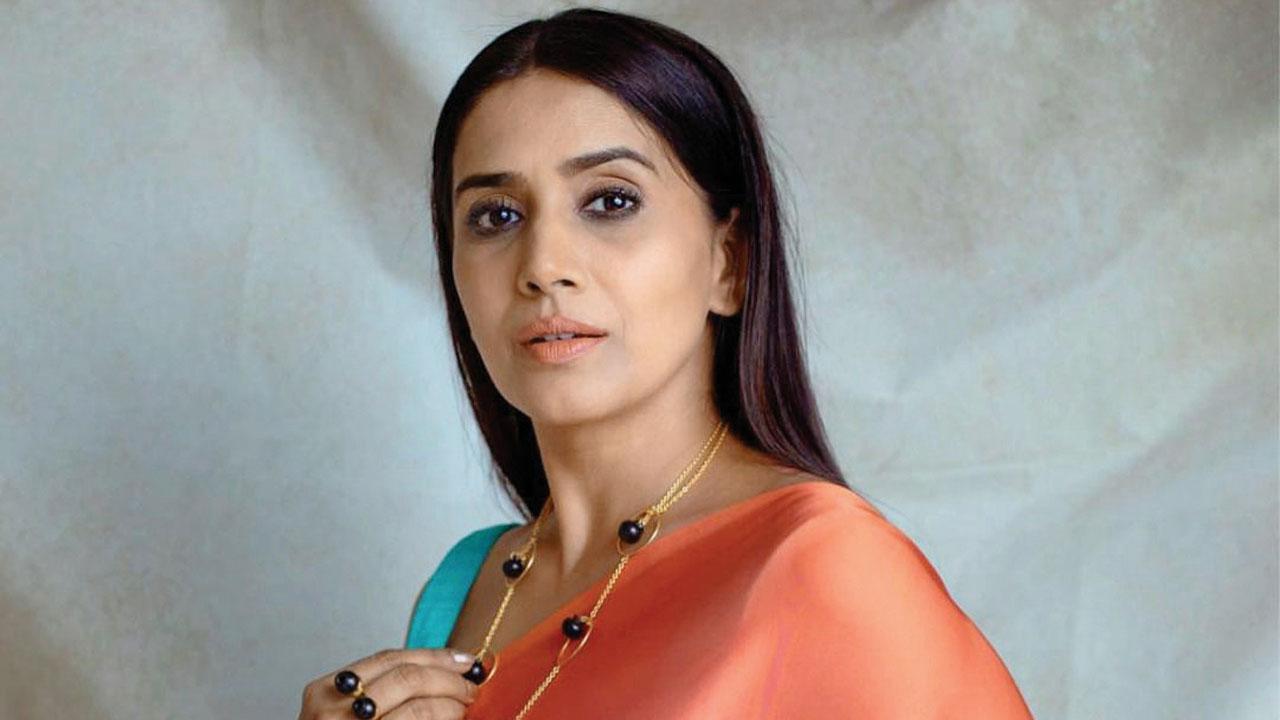
Making her web debut, Sonali Kulkarni discusses her script choices
Letty Mariam Abraham (MID-DAY; January 4, 2021)
Sonali Kulkarni has always marched to her own beat — juggling theatre and regional cinema when her peers were Bollywood-bound. And her choices have held her in good stead. When it came to her web debut, the actor was certain she would take the plunge only if the content spoke to her. SonyLIV’s Whistleblower, which revolves around an admission scam, delivered on that count. Kulkarni discusses how her role of a news channel editor left her optimistic and the society’s apathy towards the growing corruption.
Edited excerpts from the interview.
What was your first reaction to the script of Whistleblower?
When my director [Manoj Pillai] gave me the narration, he did not start with how important I was to the story. Instead, he told me the story first. We are a complex society, and even while leading our individual lives, we somehow contribute to this society. Wrong things are constantly happening every day. What is our take on them? As a news channel editor, my character Zainab Parker has the discretion to decide how she exercises that power. The character made me feel optimistic in these times of corruption. She is idealistic and has the courage to stay with an issue.
At a time when journalism is being criticized for its supposedly agenda-driven narration, how did it feel to play an ideal character?
Whistleblower highlights that people are wrong, not the profession. Just because a few people went astray and sold their [ideals], the entire profession is criticized. My performance is a tribute to all the wonderful people I met in my life. Kumar Ketkar was my first boss when I used to write as a guest editor for Indian Express’ Loksatta. I had some fearless bosses who never [told me that] my opinion has to follow a particular narrative. I have been a part of this industry as a writer and actor, and I am empathetic towards every one of them.
Whistleblower revolves around an admission scam. Is it based on reality?
The show is fictional, but we have taken impressions from real life. The series depicts reality throughout. For us, some subjects are pure, like education and medicine. We don’t want to think that a doctor will say, ‘Give me Rs 50,00,000 and I will ensure the patient gets a heart transplant.’ [In some ways], the education system is corrupt. I remember [years ago] when I was told that my daughter was speaking primarily in Hindi and is not fluent in English. This, when she was three! A child, who is learning to speak, cannot decide which language s/he is fluent in.
How does the show encourage people to take a stand?
The show encourages people to be aware citizens and walk that extra mile. In Marathi, we have a saying: Shivaji janmu de punn koni doosryacha ghari. We all talk about our rights, complain about the things going wrong in our neighbourhood, but we don’t do anything about it. We are not willing to extend ourselves as we are comfortable in our own cocoons. The show will shake us out of our comfort zone.
After working for so many years, do you feel that Bollywood hasn’t given you your due?
I don’t think like that. I have made my own choices. I am proud that I worked in Marathi and regional cinema even before it became glamorous [with the OTT boom]. Today, we are talking about Bengali, Malayalam and Telugu films. We now know stars and directors from [regional] film industries. So, I am supremely proud of my choices since the beginning of my career. At the same time, I am also a proud homemaker. My industry didn’t tell me to sacrifice everything and immerse myself [in work] to encash my youth. I had wonderful teachers in Satyajit Dubey, Girish Karnad, and Jabbar Patel, who added insight to my life. I am ready to take on another 25 years in the industry.
Mental disorders are considered 'low caste' in the hierarchy of medicine-Mohan Agashe
7:49 AM

The veteran actor on his tryst with mental illness, his jinxed FTII stint and why he desperately needs a secretary
Angona Paul (MUMBAI MIRROR; July 31, 2016)
Kitted out in his trademark Nepali cap and a trendy little bluetooth headset, Dr Mohan Agashe strikes a stark contrast to the Alzheimer's-stricken Dr Chakrapani Shastri he portrays in the recently-released Astu. Little surprise there, given that the man is a psychiatrist by profession.
The National Award-winning film is about a retired professor (Shastri), who suffers from Alzheimer's and gets lost when he steps out of his daughter's car to follow an elephant in a busy market area. Agashe has been working in the field of mental health for some time now; in 1991, he was instrumental in establishing the Maharashtra Institute of Mental Health in Pune. The film, according to him, is "about the magic of empathy". "It focuses not simply on cognizance of the disease, but the importance of understanding and accepting the afflicted," says Agashe, adding that overthinking and analysing makes people insensitive. For this character, Agashe reached back to his empathetic self of yore. "Years ago, when I wasn't a seasoned doctor, and therefore more sensitive, I had seen a case of nominal aphasia," he recalls. The condition makes it difficult for patients to remember the name of an object although they can clearly describe what its functions are. "I remember the struggle as the poor man tried in vain to put a name to the object — a set of keys. The expressions of joy and embarrassment on his face when someone finally helped him with the word were engraved on my mind," shares the actor, who also co-produced the film.
Becoming a producer happened by default, insists Agashe. After the producer, who was to fund the post-production, backed out, the team — helmed by directors Sumitra Bhave and Sunil Sukhtankar, and producer Sheela Rao — resorted to crowd-funding. Afraid that the time it was taking would result in "a miscarriage of a perfectly fine film", Agashe decided to chip in. "I thought... I am retired and I do have some money from my provident fund and pensions, so let's finish the film," he says.
The decision turned out to be a learning experience about the economics of film distribution. "Earlier, I used to curse my friend, Jabbar Patel, saying 'how come you make films and don't bother releasing them!'. I know better now," laughs Agashe.
Astu, completed in 2013, was well-received across the festival circuit and even picked up National Awards for Best Screenplay (Sumitra Bhave) and Best Supporting Actress (Amruta Subhash). But after the festival fever subsided, the team realised that distributors were wary of picking it up. "It was a case of content versus commerce," says Agashe.
"So as an experiment, in July 2014, the directors and I requested the owners of City Pride and Prabhat to give us at least one show. The film ran for six weeks, which convinced us that it had potential." However, the returns from ticket sales were abysmal after the theatre owners had taken their share. "That made me realise how many screens a film had to get, and how many tickets need to sell for it to recover its costs just from the box office," he adds, ruing, "Unless you spend big on publicity or have a big star, it's not possible."
The challenges notwithstanding, the actor also had the satisfaction of several audience members coming up to him and admitting that if they had seen such a film before, they might have behaved differently with their parents or grandparents. "Mental disorders, you see, are considered 'low caste' in the hierarchy of medicine," says Agashe. "You wait till dark to go to your doctor. You refuse to recognise him in public," he half-jokes. Astu, according to him, taught him how films can help in "subtly smuggling in education".
Quiz him on FTII and the recurrent strikes, and the actor, who also had a controversial stint at the institute, bristles up. "Going on strike is a way to rebel for youth, in general. Even when Adoor Gopalakrishnan, an ex-student of FTII and a brilliant filmmaker, was at the helm and suggested changes in the syllabus, students had opposed," he avers, adding, "Don't blame students; they are a transient population. This is politics — exploiting the emotional energy of former and current students."
That said, he is visibly excited about his next film with Astu director Bhave. Titled Kaasav, the film will explore depression. "I also want to work on a book called Behind the Mask, on doctor-patient relationships and the role of faith in healing. It will be a one-man show, in the format of direct or intimate theatre," he shares. Looks like a lot is on his plate. Any other projects, we query. "I am looking for a woman, for all kinds of relationships...," he declares, pausing for dramatic effect. "Except that of a wife," he concludes with a guffaw. "I need a caretaker or manager — you see, my house and affairs are in utter disarray," explains the 69-year-old bachelor, whose latest flick, Lost & Found, a treatise on love and loneliness, has just hit the screens.
Film and TV school to open in September on Raj Kapoor's farm in Loni-Kalbhor
7:48 AM

Will offer two and three year specialised courses in various disciplines
Roshmila Bhattacharya (MUMBAI MIRROR; July 1, 2015)
 Last year, on May 16, the World Peace Center (Alandi) and MAEER's
Maharashtra Institute of Technology (MIT), Pune, launched the Raj Kapoor
Memorial--The Golden Era of Indian Cinema at their Rajbaug Educational
Complex in Loni-Kalbhor. The late filmmaker's sons, Randhir and Rajeev
Kapoor, inaugurated the museum which stands alongside Raj Kapoor's
bungalow. It journeys through his repertoire, reviving memories from
films like Mera Naam Joker, Bobby, Satyam Shivam Sundaram and Prem Rog
which were shot on the 125-acre Loni farm which he had bought in the
'60s. There are also tributes to other filmmakers
Last year, on May 16, the World Peace Center (Alandi) and MAEER's
Maharashtra Institute of Technology (MIT), Pune, launched the Raj Kapoor
Memorial--The Golden Era of Indian Cinema at their Rajbaug Educational
Complex in Loni-Kalbhor. The late filmmaker's sons, Randhir and Rajeev
Kapoor, inaugurated the museum which stands alongside Raj Kapoor's
bungalow. It journeys through his repertoire, reviving memories from
films like Mera Naam Joker, Bobby, Satyam Shivam Sundaram and Prem Rog
which were shot on the 125-acre Loni farm which he had bought in the
'60s. There are also tributes to other filmmakers This September, the MIT School of Film and Television will come up on 25 acres of the same property which also houses the Vishwashanti Sangeet Kala Academy, along with the samadhis of Raj Kapoor, and his parents Prithviraj and Ramsarni Kapoor.
The school will offer post graduate diplomas in direction, editing, sound and cinematography. These are three-year courses--one-year foundation course and two for specialisation. "There are also two-year courses in scriptwriting and production design. There will be 20 students in each batch," said Dr Jabbar Patel, filmmaker and chairperson of the institute.
Speaking to Mirror just before he flew off to the US to deliver a keynote address at a conference on cinema, Dr Patel said, "The basics of the curriculum will be similar to that at the Film and Television Institute of India (FTII), Pune, but we will offer far more advanced technical training."
It all started after the Kapoor family, over a decade ago, donated the property to Vishwanath Karad, the founder president of World Peace Center, because it was Raj Kapoor's wish that the land be used for educational and not commercial purposes. Karad, the founder-director of the MIT Group, built the college there.
Dr Patel's hospital is just 50 kilometres from the farm and he would drop by sometimes to watch Raj Kapoor shoot and chat with him. One day, years later, he was reminiscing with his college mate, Vishwanath Karad, and his son Rahul, when the idea of starting a world class film school came up. "We've been working on the project for the last two-three years, it will open this September," he informed.
The governing council of the school includes stalwarts like Mani Ratnam, Shaji N Karun, Mammootty, Girish Kasaravalli, Goutam Ghose and Jahnu Barua. Mentors include Binod Pradhan for cinematography, Resul Pookutty for sound design, A Sreekar Prasad for editing, Jayant Deshmukh for production design, Kamlesh Pandey for scripting, Shankar Mahadevan for music and Samar Nakhate for direction.
"There will also be faculty members from the film fraternity, drawn from different disciplines, who will take classes and conduct workshops, along with academicians and technicians from abroad. We are trying to get it affiliated with world class film schools in Europe and America," said Dr Patel.
He pointed out that like the memorial, the school too will be a worthy tribute to Raj Kapoor who lived and worked at the farm. "Raj Kapoor saab was one of the legends of Indian cinema, whose name was second only to Jawaharlal Nehru, our first Prime Minister in the '50s and '60s," says Dr Patel. "He'd be happy to see young talent blooming on his beloved Loni farm."

Subscribe to:
Posts (Atom)