Showing posts with label Jab Jab Phool Khile. Show all posts
Showing posts with label Jab Jab Phool Khile. Show all posts
Brij Katyal never said ‘no’, never asked questions, never even asked for money-Neena Gupta
7:57 AM
Roshmila Bhattavcharya (MUMBAI MIRROR; September 15, 2018)
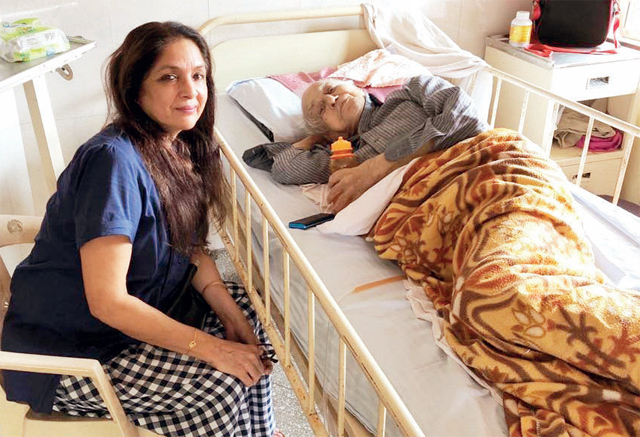
A week ago, Neena Gupta had shared a picture of her sitting by the bedside with Brij Katyal at a free-of-charge hospice, Shanti Aeedna Sadan, at Mount Mary, Mumbai, thanking them for looking after her writer-friend and pointing out that despite all the words of wisdom and the movies that tell us not to give everything away to anyone before dying, we continue to make the same mistakes and suffer. “Lecture nahin hai, samne ki sachchai hai,” she reiterated in her post that quickly went viral. On Thursday, the octogenarian who had penned three emotional TV dramas with Neena in the lead, Dillagi, Pal Chhin and Saans, the last two directed by the actress, passed away. He was suffering from cancer.
Neena remembers Katyal as very good and a prolific writer who has also written films like Jab Jab Phool Khile and Yeh Raat Phir Na Aayegi and continued to write till his last days. “But more than that, he was a good human being. After Saans, there were times when I would request him to write something for me to submit to a channel. He never said ‘no’, never asked questions, never even asked for money,” she informs, adding that though they were good friends they lost touch when he went off to Jakarta to pen a serial for Jakarta Television Network.
When she learnt that he wasn’t keeping well, she immediately called him to enquire. In answer to her urgent, “What happened?” Katyal replied, saying he had something to confide and came over to her place with the news that he had been diagnosed with cancer. “But he was very positive, telling me that he would become well, he was undergoing some ayurvedic cure. But he didn’t get better, rather he got worse and I urged him to go in for proper treatment. But basically, there was no money,” she sighs. Was he alone then? Was there no one to take care of him? “He had a family, a son and two grandsons both of whom are married,” she replies, but doesn’t get into details, simply says that he was eventually moved out of home into the Mount Mary hospice where she went to meet him. “I was showing him photographs on my phone, I even showed him the trailer of my new film, Badhaai Ho, but he didn’t react much. They were planning to take him to another hospital where they could put a tube in to feed him. I heard later that he was slightly better, that he was speaking, but the cancer had spread,” she sighs again.
Is there something special she will remember him by, you prod, and she laughs, “Whenever we met, the first thing he would tell me was that I was looking prettier and younger, never mind if I was in my ghar ka kapda.”
Shashi Kapoor honoured with Dadasaheb Phalke Award; Kunal Kapoor, Shabana Azmi speak up
7:58 AM

As Shashi Kapoor is honoured with the Dadasaheb Phalke Award, we bring you the man and the filmmaker loved by all.
Roshmilla Bhattacharya (MUMBAI MIRROR; March 24, 2015)
Gentleman actor
When the name of the next Dadasaheb Phalke awardee was announced on Monday, the news was met with cheers as it was none other than Bollywood's evergreen charmer Shashi Kapoor.
The reigning heartthrob of the '70s, a pioneering crossover star, a leading patron of theatre and a producer of good cinema, the 77-year-old star of iconic films like Deewar, Satyam Shivam Sundaram, Trishul, Kabhi Kabhie and Junoon, has held sway over audiences for many decades now.
The veteran actor-producer is the 46th winner of the honour conferred by the Indian government for outstanding contribution to the growth and development of Indian Cinema. He joins father Prithviraj Kapoor and brother Raj Kapoor in the haloed halls of Phalke winners.
Shashi began his tryst with acting at the age of four, with plays directed and produced by his father. He made his debut as a leading man in the 1961 film Dharmputra, and went on to do over 100 Hindi films.
He was also one of India's first actors to go international, collaborating with Ismail Merchant and James Ivory on films like The Householder (1963), Shakespeare Wallah (1965) and Bombay Talkie.
Even as he juggled acting, he produced critically acclaimed films like 36 Chowringhee Lane, Junoon, Kalyug and Vijeyta and turned director with Ajooba. He also revived his father's Prithvi Theatre, along with his late wife Jennifer Kendal.

'I was a crazy fan'
Shabana Azmi talks about her first co-star who never had a kind word to say to her but was rock solid in a crisis.
I would save my pocket money to buy Shashi Kapoor's posters from Grant Road which I would get him to autograph when he came to Prithvi Theatre on Sunday. I was a crazy fan and to suddenly land a role opposite my childhood idol in Shabana Azmi was unbelievable!
On the first day, we were shooting the song Dil mein tujhe bitha ke. During rehearsals when the dance director, Satyanarayan, demonstrated the moves, I was aghast! I couldn't get so intimate with Shashi Kapoor, I told my hairdresser, and burst into tears in my make-up room.
Minutes later, my hero was banging on the door wanting to know what the problem was. When I tearfully explained, he mocked, "Mummy, mummy mujhe actor banna hai!" Calling me a silly girl, he told me to come out when the shot was ready. When I arrived on the set, I found that he had changed all the moves so I'd be more comfortable.
He never had a kind word to say to me. He always scolded, bullied or made fun of me. But in a crisis, he was rock solid. In '86 I had taken up the cause of slum dwellers in Colaba whose homes had been demolished to make way for an MLA hostel. We knocked on several doors, demanding alternate housing for them, before Anand Patwardhan and I, along with three slum dwellers, went on a hunger strike.
No actor had gone on a hunger strike before and our fraternity was confused about whether to express support for me. On the fifth day, my blood pressure started falling and my mother was worried. Shashi Kapoor turned up wanting to know our demands. He left soon after and went straight to the Chief Minister, Shankarrao Chavan, telling him that the film industry had always supported the government in a crisis and he couldn't let the demands of one of its members go unheard. The Housing Minister conceded to them on the CM's instructions and urged me to have a glass of juice.
I was on stage, about to thank Shashi Kapoor for negotiating the deal for us, when I saw him step away from the media glare, slip away into an alley and disappear. He didn't want any accolades and never spoke about it, ever. That's the kind of person he is.
He was the only mainstream actor at the time who put his money, not into real estate or any other speculative business, but into theatre and cinema that wasn't commercially safe. Films like 36 Chowringhee Lane, Junoon, Kalyug and Vijeta. Aparna Sen, whose 36 Chowringhee Lane he produced, admits she's never known a more generous producer. I can attest to that. During Junoon which featured many theatre actors, moving away from the norm, he refused to segregate his cast into 'small' and 'big' actors and insisted everyone be put up in the same good hotel.
When we went for the Moscow Film Festival, with just eight dollars in foreign exchange, we were all strapped for cash. But despite the presence of bigwigs like FC Mehra and Raj Kapoor, Shashi Kapoor footed every bill.
I'm over the moon to know that he's the recipient of this year's Dadasaheb Phalke Award. He has been a trailblazer in so many ways. He was the first actor to have worked in Hollywood.... The first mainstream actor who on turning producer made art cinema.... He built an institution like Prithvi Theatre which has given the city a vibrant cultural space. All that he earned he gave back to the world of art.
I would save my pocket money to buy Shashi Kapoor's posters from Grant Road which I would get him to autograph when he came to Prithvi Theatre on Sunday. I was a crazy fan and to suddenly land a role opposite my childhood idol in Shabana Azmi was unbelievable!
On the first day, we were shooting the song Dil mein tujhe bitha ke. During rehearsals when the dance director, Satyanarayan, demonstrated the moves, I was aghast! I couldn't get so intimate with Shashi Kapoor, I told my hairdresser, and burst into tears in my make-up room.
Minutes later, my hero was banging on the door wanting to know what the problem was. When I tearfully explained, he mocked, "Mummy, mummy mujhe actor banna hai!" Calling me a silly girl, he told me to come out when the shot was ready. When I arrived on the set, I found that he had changed all the moves so I'd be more comfortable.
He never had a kind word to say to me. He always scolded, bullied or made fun of me. But in a crisis, he was rock solid. In '86 I had taken up the cause of slum dwellers in Colaba whose homes had been demolished to make way for an MLA hostel. We knocked on several doors, demanding alternate housing for them, before Anand Patwardhan and I, along with three slum dwellers, went on a hunger strike.
No actor had gone on a hunger strike before and our fraternity was confused about whether to express support for me. On the fifth day, my blood pressure started falling and my mother was worried. Shashi Kapoor turned up wanting to know our demands. He left soon after and went straight to the Chief Minister, Shankarrao Chavan, telling him that the film industry had always supported the government in a crisis and he couldn't let the demands of one of its members go unheard. The Housing Minister conceded to them on the CM's instructions and urged me to have a glass of juice.
I was on stage, about to thank Shashi Kapoor for negotiating the deal for us, when I saw him step away from the media glare, slip away into an alley and disappear. He didn't want any accolades and never spoke about it, ever. That's the kind of person he is.
He was the only mainstream actor at the time who put his money, not into real estate or any other speculative business, but into theatre and cinema that wasn't commercially safe. Films like 36 Chowringhee Lane, Junoon, Kalyug and Vijeta. Aparna Sen, whose 36 Chowringhee Lane he produced, admits she's never known a more generous producer. I can attest to that. During Junoon which featured many theatre actors, moving away from the norm, he refused to segregate his cast into 'small' and 'big' actors and insisted everyone be put up in the same good hotel.
When we went for the Moscow Film Festival, with just eight dollars in foreign exchange, we were all strapped for cash. But despite the presence of bigwigs like FC Mehra and Raj Kapoor, Shashi Kapoor footed every bill.
I'm over the moon to know that he's the recipient of this year's Dadasaheb Phalke Award. He has been a trailblazer in so many ways. He was the first actor to have worked in Hollywood.... The first mainstream actor who on turning producer made art cinema.... He built an institution like Prithvi Theatre which has given the city a vibrant cultural space. All that he earned he gave back to the world of art.

'When he heard the news, dad smiled, laughed a little'
 Kunal Kapoor, Shashi Kapoor's son, goes back in time to remember his father who never brought work home.
 Dad never gave much importance to awards. For him the only two serious recognitions were the President's Golden Medal and the Dadasaheb Phalke Award which he's just received. When he heard the news he smiled, laughed a little.
Dad never brought his work home but he'd try to schedule his outdoor schedules to coincide with our school holidays. Since most of the films then were shot in Kashmir, we went to the valley often. If he packed up early, we'd go out for lunches, long walks, shikara rides and even picnics.
One of my earliest memories are of Jab Jab Phool Khile, though I was too young then to even know the name of the film.
Dad plays a poor Kashmiri boatman who falls in love with a rich tourist. He dressed like a local in pathani salwar and a cap. His co-star, Nanda, was a top star. I met her during my first mainstream film, Ahista Ahista. She played Padmini Kolhapure's mother and we spoke fondly of dad.
My last trip to Kashmir was for Kabhie Kabhie. Yashji (Chopra) unit was like one big happy family. After pack-up every evening, there'd be badminton matches. Neetu (Singh) was there, it was just before she married Rishi (Kapoor), and Raakheeji who cooked her prawn curry.
After I became an actor and a producer, we often discussed cinema and theatre, but more of other people's work than our own. He admired his older brother Raj Kapoor and respected Satyajit Ray. I recall meeting Sohrab Modi whose Sikander he was impressed by, a couple of times.
We played father and son in Vijeta which he produced. I was really nervous but he made it easy for me, never saying, "Don't do this." On the contrary he'd say that if you don't fall down, how'd you learn to pick yourself up.
I visited the Junoon sets. When director Shyam Benegal learnt that I could ride a horse, he put me int a shot. The film released in '79, but when I was restoring it recently, I realised that over three decades later, it's still a good film, not at all dated.

Subscribe to:
Posts (Atom)