Showing posts with label J P Dutta interview. Show all posts
Showing posts with label J P Dutta interview. Show all posts
Hope 29 yrs from now, another generation is still watching Border-J P Dutta
2:59 PM

Debarati S Sen (BOMBAY TIMES; August 16, 2026)
Nearly three decades after its release, Border remains more than a war film — for many Indians, it is an Independence Day ritual. As the 1997 classic continues to find new audiences across generations, filmmaker J P Dutta looks back at the emotion that made the film endure, his deeply personal understanding of patriotism, and the responsibility of cinema to keep the stories of India’s soldiers alive.
For many families, watching Border has become an Independence Day ritual. What do you think keeps audiences returning to the film year after year?
I think people return to Border because the film carries an emotion that resonated deeply with them. Somewhere along the way, it stopped belonging to just one generation. Parents showed it to their children, those children grew up and showed it to theirs, and the emotion was strong enough to travel from one generation to the next. I don’t think it is about saying that today’s cinema has lost something or that patriotic films today are any less sincere. Every filmmaker has their own narrative and way of telling a story. Perhaps Border simply touched a certain place in people’s hearts and stayed with them. They remember the battles, the songs and the dialogues, but ultimately, I think they still remember how the film made them feel.
Do you think the meaning of patriotism changed since you made Border? If you were making the film today, what, if anything, would you do differently?
Times have changed, and naturally the way patriotism is expressed in cinema has changed too. But I don’t believe its fundamental meaning or feeling can ever change. For me, patriotism was never about aggression; it was about pride, sacrifice and duty. It was about a young man standing at the border, knowing his family was hundreds of kilometres away, yet choosing to protect something larger than himself. That is what our soldiers have always done, and I felt that emotion needed to reach every home. Cinema was the medium through which I could do that. I come from an Armed Forces background. Many of my cousins and uncles served, and my younger brother was also in the forces. So, I have seen and understood that sacrifice closely. That is why, for me, whether then or today, the emotion and meaning of patriotism remain the same. If I were making Border today, it would perhaps be technically different because I would have access to more technology. But the language, narrative and, most importantly, the emotion would remain exactly the same. Emotionally, I would not change the film if I were to make it today. That is where patriotism lives for me.
Some might believe that watching Border every Independence Day has turned the memory of war into nostalgia. Do you see it that way, or do you think the film continues to keep the sacrifice of our soldiers alive? What responsibility does cinema have in preserving that memory?
If Border has become a film families watch together every Independence Day, I don’t think that trivializes the sacrifice. In many homes, the soldiers depicted in the film have become almost household names. Generation after generation knows their stories - who Bhairon Singh was, who Kuldeep Singh Chandpuri was, and for me, that itself is a triumph. I don’t see it as the trauma of war being turned into entertainment. Cinema is a medium, and I used it to tell the story of these men. It has been almost 29 years, and I can only hope that 29 years from today, another generation will still be watching Border and remembering the soldiers. The film has immortalized those soldiers forever. And, somewhere, I think it has given me a little immortality too.
Border 2 will have chest thumping patriotism-J P Dutta
8:12 AM

The filmmaker talks about the much-awaited Border sequel and what makes the franchise still relevant
Renuka Vyavahare (BOMBAY TIMES; June 26, 2024)
J P Dutta’s epic war film Border celebrated its 27th anniversary this month with an announcement that the film will get a sequel in 2026. Sunny Deol will resurrect his role in the much-awaited instalment to be directed by Anurag Singh and written by Nidhi Dutta (JP Dutta’s daughter). The director of the 97’ original, spoke to Bombay Times about Border 2 and how he will closely overlook the project as its creator.
‘Border 2 will be about other battles fought in the same war’
For those curious, Border 2 will also be based on the 1971 India-Pakistan war, but a different battle. “Yes, the sequel will be about other battles fought in the same war. Stories of bravery and heroism of our armed forces will always be relevant as well as our love for our country. We respect the soldiers who have laid down their lives for us and hearing those stories is important,” says the veteran director, stressing on the relevance of the sequel.
‘All my actors in Border gave it their all’
Reflecting upon the massive success of the original, he said, “As a maker, you just know that sometimes, certain films have a destiny of their own, but in the case of Border, it was the stories of valour. Our armed forces are so inspiring with everything they do that if the emotion is caught and portrayed the right way, it can create magic in the hearts of people. Also, my actors gave it their all. They portrayed the characters so well.”
‘The sequel will have the same sensibilities as my previous films’
On the creative front, Dutta informs us that Border 2 was written two years ago by his daughter, Nidhi. “She wrote the story and when she came to me, I was thrilled that she had imbibed the love for the armed forces from me. She was able to pen down the emotion genuinely. Having Bhushan Kumar on board with us only made our will to make this film stronger.”
People’s sensibilities have changed over the years. The patriotic language is subtler. Will the sequel have a different sensibility than the first movie, we wonder.
Dutta clarifies sternly, “The film will have the same sensibilities as my previous films - telling stories that make you want to join the Indian Army. Subtlety is not for a franchise like this. Border 2 will have chest-thumping patriotism.”
Dutta is confident about Anurag taking over as a director. “Anurag will helm the film as a director. I liked his work in Kesari (starring Akshay Kumar), and he seemed like a man with sensibilities like mine, and thus, a perfect choice to take the franchise ahead. I will overlook the creative process to make sure the emotion and sensitivity of the armed forces is kept in mind, as they have put their trust in me for years. Will I return to direction in the near future? You never know,” he concludes.
The character of Dharamveer in Border was turned down by Akshay Kumar, Ajay Devgn-J P Dutta
8:37 AM
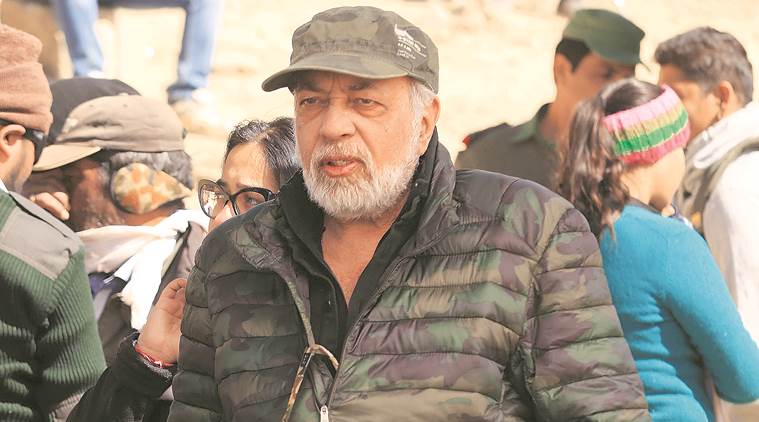
The filmmaker is expected to attend some of these screenings, which will be held in different parts of the country between September and December this year
Rachana Dubey (BOMBAY TIMES; August 13, 2021)
This year marks the 50th year of the Battle of Longewala, which was fought in the early days of December 1971. As a part of homage to the war heroes, a host of screenings of the film Border (1997), based on the said war, are expected to be held in different cities with Army officials and their families in attendance. Filmmaker J P Dutta, whose brother, Deepak Dutta, a flight lieutenant at that time, had fought in the war, is also expected to attend some of these screenings.
The filmmaker made the film nearly 25 years after the war, with Sunny Deol, Akshaye Khanna and Suniel Shetty in pivotal roles. It’s 24 years since the film’s release, but it’s fresh in the minds of the audience and the filmmaker even today. For Dutta, it’s a professional milestone and a personal experience of his sibling being on the battlefield.
Talking about it, the filmmaker, who’s known for his war dramas and whose last release was Paltan (2018), says, “My brother Deepak had fought in the War of Longewala. Those days, my mother used to be glued to the radio to hear the updates and also the names of the jawans who were martyred. My mother was worried about my brother. Those moments and the memories of that time keep coming back to my mind. When you reach a certain age, you start living in the past and it is the only thing you can feel connected with — what was and what is. My daughter Nidhi wants me to visit every single city where the movie will be screened next month onwards for the armed forces, their families and families of war heroes. I am 70 now and I am not sure how many cities I can visit, but it will be an experience that I will cherish.”
Making a war-drama like Border was not easy. Dutta had waited 25 years to procure clearances to make the movie. He also had a tough time casting an actor for the part of Dharamveer, a role that was eventually essayed by Akshaye Khanna, a newcomer at that time. “Border was the first film I was producing,” reminisces Dutta, adding, “I came from a middle-class background. When I came into films, my father, O P Dutta’s financial position was weak. We did everything together — from the very first film I directed which was Ghulami (1985), all the way up to Umrao Jaan (2006). Border was the first film I produced. All those affairs of money, getting into the big game and the big picture were playing on the mind. Sometimes, when I think of Border, I am reminded of all the stress I went through while making it. Being creative by the day while shooting, and then, later by night, being driven by numerous other things that were going on around the movie... I would finish shooting sometimes at 10 in the night and at times, we would go on till 2 am. After that, my accountant and I would go through the day’s expenses. The experience of making Border was personal in so many ways.”
When prodded about the casting decision for Dharamveer’s character, the filmmaker recalls, “The character was turned down by Akshay Kumar, Ajay Devgn... I was this spoilt director as I would not narrate the entire script; I would just tell the actor about their character and how it would play out. They knew Sunny Deol had been cast to play Kuldeep Singh Chandpuri, so actors wanted to know how the film in its entirety plays out. I refused to give anyone the entire script in their hands. I used to be very confidential about my scripts. Border was based on the real details I had about the war. It entailed a lot of research and I chose to keep a closed fist as far as the script was concerned. It took a while, but I found Akshaye Khanna and he played the part well. Getting Sunny and Suniel Shetty was a home run. In fact, Suniel and I had not done any work before this film, but he and I clicked. Ditto, Jackie Shroff.”
When asked what according to him brings the audience back to Border each time war dramas and patriotic films are in the spotlight, Dutta says, “There is a human element to the story, which went beyond the war and the border. I think that is what worked. I still don’t know what drove me to make Border. I just feel grateful to God that I could make the film.”
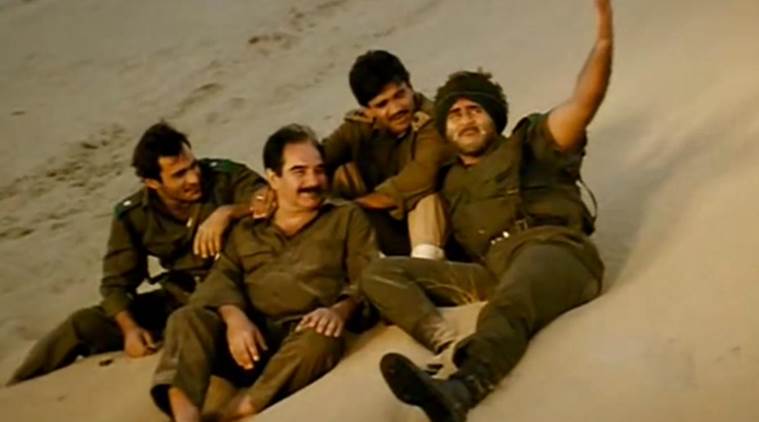
We have never perceived China as an enemy so far, but in reality, it was always a threat-J P Dutta
8:08 AM

Amid India and China's clash in Ladakh, Paltan director JP Dutta reflects how his film about 1967 Nathu La skirmish was deemed irrelevant on release
Mohar Basu (MID-DAY; July 1, 2020)
 In 2018, when J P Dutta released Paltan, a re-telling of the 1967 Indo-China military clash along the Sikkim border, the film was deemed irrelevant. At the time, the neighbouring country was a strong market for Hindi films, and Indian actors — including Sonu Sood who featured in Paltan — were doing a string of Chinese movies. Cut to 2020: the two countries are engaged in a military standoff in Ladakh's Galwan valley.
The filmmaker says that the cross-border tension was simmering for a long time. "It is ironic that the audience could not [relate] to the film. It is because we have conventionally believed that Pakistan is our primary enemy. We have never perceived China as an enemy so far, but in reality, it was always a threat. When I read about the 1967 skirmishes between Indian and China, it caught my attention. I knew it was a story that needed to be told. Not many know that five years after 1962, the Indian army inflicted a heavy toll on the Chinese in a limited confrontation in Sikkim. We are strong enough to fight back any invasion from China," emphasises Dutta.
Incidentally, his film Refugee (2000) — that marked the debut of Abhishek Bachchan and Kareena Kapoor Khan — clocked 20 years yesterday. "Their successful careers give me immense pride," beams the filmmaker.
What makes me proud is that we have not taken the Pulwama attacks lying down-J P Dutta
8:24 AM

Filmmaker JP Dutta, who completed his war trilogy in 2018 with Paltan, speaks to BT about the attack executed by the Indian Air Force during the wee hours of yesterday morning
Rachana Dubey (BOMBAY TIMES; February 27, 2019)
 I woke up with the news that 12 Mirage 2000 fighter jets from India have struck and destroyed terrorist camps across the Line of Control (LOC) in Pakistan, killing about 300 terrorists. It shook me up and it also somewhere made me feel that we’ve somewhat avenged what we lost in Pulwama. Those were some 40 jawans, who were not on the border but sitting inside a truck when they were blown away. India as a country has never been the aggressor, but it does pick up the weapon in its defence. What makes me happy and proud is that we have not taken the Pulwama or Uri attacks lying down.
Paani sar ke upar se jaa chukka hai. Retaliation in equal measure is often the only option left. It’s important to retaliate because enough is enough. You can’t turn a blind eye and keep looking the other away when someone attacks you. It’s a reality that we have lost so many soldiers to several such attacks in the past. We have lost civilians on so many occasions — train blasts, Mumbai terror attack in the 1990s, the 26/11 attack… I mean how much more should India tolerate?
I have friends and relatives in the Armed Forces. From what I understand, if you want to make a strong impact, the attack has to be from the top, something that our Air Force officials did in the wee hours today. The terrorist camps were destroyed. Increasingly, wars will be fought in this manner because everyone understands the impact an air strike can have. It will just be boots on the ground.
Birender Singh Dhanoa, our current Air Chief Marshal, was my brother, late Deepak Dutta’s colleague and friend. Today, I feel proud of what he has pulled off. He and all the other armed forces chiefs are capable people and with their experiences, they know what they’re doing. They have a very clear mind and they’re tough officers.
In recent times, it was the images of those coffins carrying the bodies of those jawans that killed something in me. It reminded me of everything I’ve experienced from close quarters. Today, we probably have avenged the deaths of some of our soldiers.
Terrorism is like cancer in an advanced stage. It only needs chemotherapy. What is sad is that we have never attacked Pakistan or tried to create hysteria on their land, among civilians but they have only done that. Twenty years ago, we foiled their attempt to infiltrate through Kargil. They don’t seem to be affected at all, not even when children on their soil are killed in a Taliban-led terror attack. They have always refused to acknowledge the fact that there are terrorist base camps operating on their soil.
My brother Deepak had fought the Longewalla battle when Pakistan’s attempt to infiltrate India was foiled. That’s how I wrote the story of Border when I was still in college. I vividly remember my mother being glued to the radio to know what was going on, praying that her son is not one of the martyrs. She spent days sitting by the radio set. I had a song in Border, ‘Mere dushman, mere bhai, mere hum saaye’. I have never understood why can’t they live in peace and let us also be.
Today, while I feel happy that the Air Force officers put out an act of bravado in the form of the air strike, I also say a silent prayer, thanking god that no family today lost a loved one.
People got to know about 1967 Indo-China clashes after Paltan’s trailer released-J P Dutta
8:32 AM
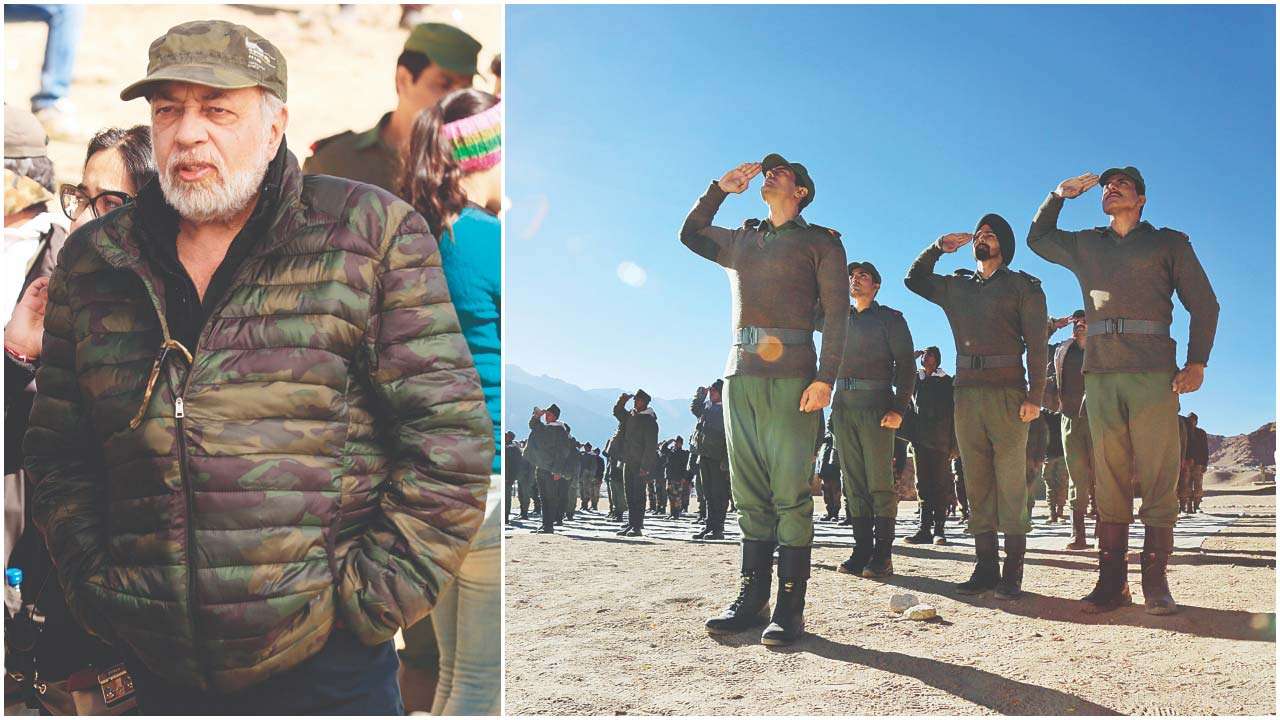
Hiren Kotwani (DNA; September 5, 2018)
Despite making movies on varied subjects like the caste, feudal and zamindari systems, warring royalties, and the Umrao Jaan (2006) remake, JP Dutta is best known as Bollywood’s war movie specialist for making Border (1997) and LOC Kargil (2003). The National Award-winning filmmaker, whose career spans over three decades, has revisited the genre and has completed his war trilogy with Paltan, which is backed by Zee Studios.
In the film, Dutta tells the story of Indian forces that fought Chinese aggression in 1967 and forced them back in the clashes at Nathu La and Cho La in Sikkim. In this interview, he talks about his latest release (which comes 12 years after his last outing, Umrao Jaan) and the Indian armed forces. Read on...
Having made different kinds of films, why did you choose to make Paltan?
I had promised that I would make a war trilogy. This is the third part. I’ve kept my word.
What, according to you, makes the story of 1967 Indo-China clashes so important?
When you talk of Indo-China conflicts, people only remember the one in 1962. I believe that wasn’t a ‘war’ because when one takes place, you know the enemy. Back then, the enemy chanted ‘Hindi-Chini Bhai Bhai’, but they stabbed us in the back. The UN was refusing to make Communist China its member, but our then-Prime Minister, Pandit Jawaharlal Nehru, insisted on its inclusion. Keeping in mind that India was pressuring and strongly recommending China’s membership, he didn’t think they would attack us, but they did, that too without any warning.
The conflict took place 50 years ago, isn’t it a little late to tell this story now?
Not many people know about this episode. Only after Paltan’s trailer released that more Indians got to know that something like this had happened in 1967. No one spoke about it and there’s no mention of it in our history.
When you made Border and LOC Kargil, you shot at actual locations...
Since 1967, the infrastructure at Nathu La has changed. It’s a different terrain now. There’s a gate at the place where the clashes happened. So, it doesn’t match the story. But it wasn’t difficult to recreate the place in Ladakh. We share a 4000-kilometre border with China; it’s similar to how Nathu La was back then.
LOC Kargil showed how the Indo-Pak battle was fought at multiple points...
Even there, we didn’t have the advantages. The enemy was at higher points and we had to fight our way up to recapture our territory. In Paltan, the drama and emotions are almost like that in Border — of one battalion fighting the opposing army. And the clashes are eyeball-to-eyeball, like Doklam.
Even though you’ve made socially-relevant movies, your name is associated more with war films. What fascinates you about this genre?
Many such tales need to be told. People want to see all sorts of films with diverse subjects. The story of a soldier staying away from his family and sacrificing his life to guard us and so we can sit in an air-conditioned room and talk in peace makes it necessary and worth the while to tell others.
In recent years, people’s opinions about the armed forces have been on two extremes. What’s your take on this?
We don’t care about our army, unless there are floods or a natural disaster or until the enemy is at the gates. The fear comes in, we get scared and we wake up to the soldiers.
Why do you think people have this attitude?
I feel it’s because India has only experienced battles and not the two World Wars like the West has. They understand the value of a soldier, country, respect for the national flag, etc. Both the World Wars impacted the entire world, except India, though many of our people were fighting for the British Army. The attitude towards the army depends on the individual and the families. The four walls of your home are the biggest school you’ll go to. What your parents talk about, what you listen to and say as you grow up, plays a crucial role.
What are your views on the word ‘jingoism’ being used to describe patriotic films in Bollywood?
Whoever uses this word for India needs to look up the dictionary, understand its meaning and what our country is all about. Our nation is a liberator, not an aggressor. We’ve never attacked any country in our entire history, ours is the only country that has always tried to defend itself against foreign invaders. Jingoism is not the right word for our country.
We hear the Ministry of Defense has appreciated the film and would like you to make another war movie.
Well, the MoD has liked the film. They always wish that I do well. I get a lot of respect from them and I also respect them immensely. It’s mutual.
What are you planning after Paltan?
I don’t know what’s next. I’ve registered 21 titles and every title is for a different subject. Let’s see...
I am the medium between the jawans and the audience-J P Dutta
8:30 AM

Rachana Dubey (BOMBAY TIMES; September 5, 2018)
After Border (1997) and LOC: Kargil (2003), J P Dutta is all set to complete his war drama trilogy with the upcoming release, Paltan. The film is based on the 1967 Indo-China military clash that took place at Nathu La, along the Sikkim border. The movie unveils the untold story of our brave soldiers, who fought an intense battle to ward off Chinese infiltration.
Point out that he is among the few Indian filmmakers, who are associated with war dramas and Dutta says, “It’s sad that mine is one of the only names that people associate with war dramas. Why is it that in our country, most filmmakers don’t connect with that man standing with a gun, guarding the borders of our nation, which has never been an aggressor or provoker, ever? A mother sends her son to the border so that you and I can spend time with our mothers. What a strong family it must be that stands behind a soldier. When filmmakers make war films, often, the idea is to not just educate viewers about what happened, but also to make them realise the futility of a war.”
Dutta, who has also written Paltan, says that the idea of sharing his vision with the audience drives him to make such films. “I am the medium between the jawans and the audience and that drives me to go after their stories. Also, tales of clashes like the one that took place at Nathu La have been brushed under the carpet.”
The director shares that making war dramas don’t drain him emotionally. “They egg me to move and seek my next story. I feel as if soldiers from across our country are calling out to me to narrate the stories of the battles that they fought for all of us,” he says.
Paltan, presented by Zee Studios & Produced by J P Films, releases on September 7

It’s frustrating that most of us are not proud of our country-J P Dutta
8:05 AM

The storyteller in J P Dutta is frustrated that people are not interested in knowing what goes on at the border; as he revisits his favourite subject with Paltan, the filmmaker talks about the stories that touch him, the tussle with Abhishek Bachchan, and why he was off the radar for long
Shaheen Parkar (MID-DAY; September 2, 2018)
Over a decade after his last Bollywood outing, the Abhishek Bachchan- Aishwarya Rai starter Umrao Jaan (2006), J P Dutta is back on the scene with Paltan. The veteran filmmaker is synonymous with war sagas, which include LOC Kargil (2003), Refugee (2000) and Border (1997). At his office at Four Bungalows, Andheri, there are tomes about the world’s biggest battles fought over the ages.
He studied history, so he considers himself a historian, who considers cinema as a medium to tell the real story. “It’s frustrating that most of us are not proud of our country. That national pride is lacking. We should be aware that we have been plundered for generations. We were never the aggressor. We have become a passive nation.”
Dutta's obsession with war-based films is because “these stories touch me the most. People need to know about what goes on at the country’s borders and the valour and sacrifices of the army folk.”
Paltan is based on the Indo-China skirmish in 1967, in which India emerged triumphant. The clashes at Nathu La and Chog La along the Sikkim border was for the control of Sikkim. He says, “This was a proper war as the two countries knew what they were fighting for, unlike the 1962 war, which was an act of terror. Those were the days of Hindi Chini Bhai Bhai, but they took us unawares. The Chinese army burnt bonfires to distract us and slipped into our land to wreak havoc.”
Dutta has been in constant touch with the army and concerned authorities for the research and permissions required. He says, “It took me two and a half years to get the nod. I wanted it to he factually correct.” About his long absence from the scene, he says, “I had begun work on a film, which I shot in Switzerland, Italy and Rajasthan. It was in 2008 when there was an economic crises worldwide. The film studio cut my budget to 45 per cent. They pulled the carpet from below my feet. I am a passionate filmmaker and did not want to compromise. I told them our creator is also our destroyer. I had conceived the project and was also ending it.” There was also a personal loss, when his dad (O P Dutta) passed away. “He used to write the dialogues for my films.”
Dutta is also known to shoot most of his films in Rajasthan, which include Ghulami, Batwara and Border. “I am known as Jaipur Dutta. I like to shoot in stark landscapes. Someone referred to me as the filmmaker who shoots in naked landscapes like in deserts and mountains. It is in the nothingness that you feel close to God.” Paltan, which stars Arjun Rampal, Sonu Sood, Luv Sinha, among others has Dutta’s daughter Nidhi looking after the production. “Luckily, there were no hiccups even though we shot at high altitudes.”
About present day Bollywood, the veteran filmmaker says, “I belong to the generation when actors were men, there was Raj Kapoor, Shammi Kapoor, Vinod Khanna and the heroines were women like Meena Kumari and Nutan. Today’s actors, Shah Rukh Khan and Salman Khan, are boys. The heroines are girls. But then, things change.”
Dutta is already planning his next. “It could be a war film, something that touches me and everyone should know about,” he concludes.
You could call me the filmmaker who shoots in naked places-J P Dutta
8:00 AM

J P Dutta on completing his trilogy of war dramas, why he is no longer interested in the Battle of Saragarhi, and his upcoming project
Roshmila Bhattacharya (MUMBAI MIRROR; July 23, 2018)
What was it like going back into the battle field 15 years after LOC Kargil?
I had made a commitment in the media that I’d make a trilogy of war films which I have completed with Border, LOC and now Paltan. And when I went back into the battle field, I felt like I’d never left. It was like two friends meeting after years and picking up from where they’d left off.
You selected a difficult location to pick up from, the first schedule being in Ladakh…
You could call me the filmmaker who shoots in naked places, from Rajasthan and the Rann of Kutch to Ladakh, I zero in on locations that are devoid of greenery. I don’t know why my journey takes me to these barren states but showcasing them on screen help them grow economically and give tourism a boost. I shot through the winter months of October, November and December when the temperature would sometimes drop to minus 20 degree but my producer-daughter Nidhi made sure my team and I were well taken care of.
Border was inspired by your late brother’s experiences as an Air Force pilot. What was the muse behind Paltan?
I have friends in armed forces and once when I was talking to a senior officer he mentioned this battle. It is a story which had got pushed under the carpet by the government of the day for whatever reason and I knew instantly that it had to be told. Like Arunachal Pradesh and Ladakh which the Chinese are waiting to grab, they had designs on Sikkim too and the reason Sikkim is a part of India today is because of three battalions--the Grenadiers, the Rajputs and the Gurkhas — who stood their ground when the People’s Liberation Army (PLA) attacked the border post of Nathu La in the early of September 11, 1967. We are awe-struck by China’s might today but we gave this powerful country a bloody nose in this battle.
Have you recreated the battles of both Nathu La and Cho La?
No, only Nathu La or else the distributors and exhibitors would crib that I had made another four-hour LOC.
Today, given the strained Indo-China relations, do you expect any objections?
When you are true to your country’s history no one can take objection. I’ve met men who fought in the battle. Their inputs have been woven into the script. It’s a realistic picture. Anyone can make a war film but it’s important to be aware of the ethos of the armed forces to do justice to them. My family— uncles, cousins and brother — were in the armed forces so I know it like the back of my hand.
Is the film on the Battle of Saragarhi still on?
Too many people have jumped into that battle. My film would have played it on an international platform because there are many foreigners involved. Right now, it’s not on my mind because I’m not happy with the way Hollywood works. You reach a stage and age when you don’t need to be told what to do and what not. Hollywood works in a different way and it makes me uncomfortable.
What is happening to Nidhi’s acting debut with Nafisa Ali’s son Ajit Sodhi?
The film, Jee Bhar Ke Jee Le, is ready and we are in talks with people to release it. It should see the light of the day soon. Meanwhile she’s shaped up into a brilliant producer.
So, with a producer in the house are there plans to make another film soon?
I am planning a historical and have a couple of options in mind. It’ll also be a true story.

The other day Rahul Nanda also asked me why I keep making these epic films. “Why can’t you make a small film?” he wondered and Nidhi butted in, saying, “Rahul uncle, papa can’t think small.” When we were doing Paltan, Javed (Akhtar) saab, Anu Malik and I were conscious that after the music we had made together, in particular Border (right), we would have to raise the bar with this one. These challenges excite you as a filmmaker.
So, when you look back on Paltan five years from now what will you remember?
(Laughing) That it was the easiest film I’ve made.
If there was no armed force, no Army, there would be no India-J P Dutta
7:50 AM

A quick scan at the films that have comprised a major chunk of his career is sufficient to ascertain that J P Dutta has left no stone unturned to pay tribute to the Indian Army. It is only fitting then that the filmmaker be invited by Chief of the Army Staff, India, Lt. General Bipin Rawat, for celebration in Delhi today to commemorate the Army Day.
“My love for the Indian Army can best be described by this quote [from The Dark Knight]: ‘All humans die, but few have lived,’” Dutta told mid-day from Delhi last evening. “The armed forces have lived because of their defining work. What they have done for their country cannot be put into words. Protecting a country like India, which is not a conqueror, but a liberator, a democracy where every religion is accommodated, is not easy. If there was no armed force, no Army, there would be no India. Making movies for those who take bullets in their chest for us, is the least we can do.”
Currently working on his next, Paltan, also based on the Indian Army, Dutta recently completed a month-long shooting schedule in Ladakh. While two songs were also canned, the unit will now begin filming the soldiers’ back stories in Chandigarh. “I have returned to direction after a gap, and working on this film is a dream come true. I have completed 95 per cent of the movie.”
While his outings have usually revolved around the lives of the men in uniform, Paltan, he says, will focus on their personal relationships. “The emotions we are dealing with here are more complex and varied. It’s about the relationships that these soldiers leave behind and how it affects the families. Border [1997] dealt with the soldiers’ love interests, but Paltan will also showcase their siblings and parents. It will also display the soldiers’ brotherhood, as they save each other when at war.”
J P Dutta gets ready to battle again
7:32 AM

After a decade, will flag off two films, one on the Indo-China war of '62, the other on the Battle of Saragarhi fought in the 19th century
Roshmila Bhattacharya (MUMBAI MIRROR; December 18, 2015)
It's been nine years since he directed the period romance, Umrao Jaan. Now, J P Dutta whose 1997 war drama, Border, bagged the Nargis Dutt Award for Best Feature Film on National Integration along with two other National Awards for best lyrics ("Sandese Aate Hain", Javed Akhtar) and Best Male Playback Singer (Hariharan, "Mera Dushman") and swept four Filmfare Awards, is gearing up to return to action with two war films.
The first is on the 1962 Indo-China War which is expected to roll in September in Ladakh and wrap up by November end. "I make realistic films so I want to stick to the time frame of the real war and shoot in real locations," says the filmmaker, pointing out that he has three scripts cleared by the Ministry of Defence on the three wars that were fought in '62, '65 and '71.
Prod him on why he wants to recreate a war that we lost and Dutta reasons, "We lost the Sino-Indian war but bravery was not lost. Fighting for the sovereignty of their country, a battalion of soldiers stood to the last man against great odds. We've seen such examples of heroism in films like 300 before." Will the film feature big names from Bollywood like Border and its sequel, LOC : Kargil does? "For sure," he retorts. "Without stars you don't get a budget, nor are you able to sell your film."
There's another war film he wants to make on an international scale for a global audience. This one is inspired by the Battle of Saragarhi fought before the Tirah Campaign on September 12, 1897, when 21 Sikhs of the 36th Sikh of British India defended an army post against 10,000 Afridi and the Orakzai tribesmen in the North-West Frontier Province, now in Pakistan. The 21-member contingent chose to fight to death and the battle it is considered by some as one of history's great last-stands. The Sikhs commemorate Septembeer 12 as Saragarhi Day and two gurdwaras in Punjab have been named after it.
"Since the story touches on the relationship between the Sikh soldiers and the British officers commanding the battalion, I need a huge British involvement, an international cast and crew. I've spoken to Hugh Dancy, the Hannibal TV star, and Remi Adefarasin, the cinematographer of Shekhar Kapur's Elizabeth and Steven Speilberg's mini-series Band of Brothers. Both are keen but I've to work on the logistics carefully before I can kickstart this project. It can only take off after the other film," admits Dutta.
Point out that Ajay Devgn's sequel to SOS: Son Of Sardar is also on the same subject and Dutta says that no one has copyright over history. Also, no two stories can be similar. "I have been doing a lot of research at the British Library and even have the original blueprint of the fort in question," he asserts. "So I can only say, each to his own."
Subscribe to:
Posts (Atom)