Showing posts with label Indian Air Force. Show all posts
Showing posts with label Indian Air Force. Show all posts
The difference between the enemy and you is that you are dignified, you are graceful-Adil Hussain
9:56 AM

Niharika Lal (BOMBAY TIMES; August 25, 2026)
When the Golden Arrows Squadron of the Indian Air Force pulled off what became the world’s highest-altitude air operation, they changed the course of the Kargil War. Air Marshal Vinod Patney (retd), who served as Air Officer Commanding-in-Chief of the Western Air Command during the 1999 war, was awarded the Sarvottam Yudh Seva Medal (SYSM) for his leadership. In the series Operation Safed Sagar, Adil Hussain plays the officer – delivering a performance marked by a commanding ease.
In a conversation with us, Adil spoke about the series, what it took to step into the role, and how he found the human being behind a senior officer’s uniform.
‘I said I would read the entire script and decide whether to be part of it or not’
Before Adil agreed to play Air Marshal Patney, he had a few questions. “‘Is it a hyper-jingoistic thing? There would be a bit of jingoism or violence because it’s a war story. But are we glorifying it? Or are we showing it so that people do not get inspired to become violent?’ These were the questions I had,” he says. “I said I would read the entire script and decide whether to be part of it or not,” he tells us, adding, “And after reading two or three episodes, I realized it was very different. So I was very sure about Operation Safed Sagar from the beginning.”
‘60% of the success of this series is because the creator is a former Air Force officer’
Adil credits much of the show’s realistic portrayal to the Air Force consultants. “Of course it makes a huge difference,” he explains, “The nuances, the details of their lives, the technicalities, the way they behave, look, think about their relationship between them and their aircraft, the way someone cleans the aircraft – all these things, when you see them by yourself, make a huge difference. When you have access to the actual people, actual aircraft, actual machinery, the person who comes and cleans the hangar, the person who works in the canteen, how the senior airmen behave, how they have fun and how they carry themselves in every aspect of their airfield – it’s a huge advantage.”
Besides, it traces back to one person: co-creator Kushal Srivastava, who served in the Air Force himself before becoming a creator. “I would say almost 50%, or maybe 60%, of the success of this particular series is because Kushal Srivastava is from the Air Force,” he emphasizes.
‘I had the advantage of playing the role, not the character’
Air Marshal Patney’s Sarvottam Yudh Seva Medal makes him a decorated figure within the Air Force, but he is not a face familiar to the public. An actor playing him cannot draw on decades of footage and public memory. “I had the advantage of playing the role, not the character. There is a difference. Characters are defined by the characteristics of the person. The role is defined by what role this person has played in the entire thing,” shares Adil.
He elaborates, “He has this no-nonsense attitude, an absolutely dedicated person. I did not imitate him. I didn’t have to look like him, I didn’t have to walk like him. But the inner attitude – his sincerity, dedication and absolute masterful understanding of strategic warfare – these are universal qualities of any great leader. I embodied that.”
He reaches for a comparison outside military drama: Invictus (2009), in which Morgan Freeman played Nelson Mandela. For Adil, Freeman’s performance offered a useful lesson in approaching a real-life figure without becoming an imitation of them.
“Morgan Freeman never wanted to look like Nelson Mandela. He played the role, and I think it’s one of the best depictions of Nelson Mandela, in spite of him not looking like or behaving like him or sounding like him. So I took a similar artistic decision. I’m not going to imitate him. I will play the role – a person who embodies all these great qualities of a leader, which is called the archetype,” Adil tells us.
‘The Air Force personnel gave me access to sit in the pilot seat & look at the console'
Filming at Air Force stations came with its own discipline. He recalls, “I shoot in Mumbai all the time, and suddenly I get to know that there’s an Air Force Station in Madh Island. And then you’re there and everything is confiscated at the gate. There are strictly enforced rules that no photography is allowed. In hindsight, we were really happy to be in each other’s company. We could dedicate our time to preparing for the scenes that were coming up.”
The warmth, he says, went both ways. “The kind of warmth that all the Air Force personnel had, whether at Madh Island or Chandigarh Air Force Station, was wonderful. They had all seen my films, so they were very sweet. They came to take photos and sometimes gave me access to sit in the pilot seat and look at the console. That was amazing.”
The officers, watching a shoot unfold for the first time, came away with new respect. “They were also realizing how hard it is to make a series. They were telling us, ‘Oh my God, we didn’t know it was so hard. You stand in the sun for hours and take one shot’. I was like – yes, it is,” he laughs.
‘Dignity, grace are disappearing... It is important to inspire that’
If there’s a word viewers and Adil return to more than any other in explaining why the portrayal landed, it’s dignity. Adil explains, “The difference between the enemy and you is that you are dignified, you are graceful. You do not behave the way your enemy would. That is the difference: you do not fall from your grace, and yet you protect your country with utmost dedication. That is one of the strengths of this series.”
He extends the thought well past the show itself. “Dignity and grace have been lost, or are slowly disappearing from human society in every part of the world. So it is important to bring about, or inspire, or fill in the aspiration of people to walk towards a higher quality of human beings – dignity, grace, compassion, dedication, honesty, serving with absolute sincerity, whatever you do, whether you are an actor, a farmer, an airman, a military person, a doctor or a teacher.”
While we’ve not done sorties in the sky, we did taxiing procedures in the MiG-Siddharth
9:16 AM

Siddharth says he approached ‘Operation Safed Sagar’ as a human interest drama that examines how the Indian Air Force’s mission affected the officers and their families
Priyanka Sharma (MID-DAY; August 1, 2026)
Intent is the soul of every story told. And it’s that very intent that drew Siddharth to Operation Safed Sagar, also starring Jimmy Shergill and Abhay Verma. The Netflix series might be about the Indian Air Force’s (IAF) mission during the 1999 Kargil War, but to the actor, it’s more about the inner lives of the young officers who fought the battle.
Recalling his reaction when he read the script of the Abhijeet Singh Parmar and Kushal Srivastava creation, Siddharth told mid-day, “A lot of research had been done with a good heart and intent. By the time it came to me, it was very clear that it’s not a show about war. It’s not a show about action, or dogfights, or bravado in disguise. Those are elements of the story. But for me, it’s a human interest story. The individuals, their families, what the war did to them and what they did to change the course of the war is what Operation Safed Sagar is about.”
According to the actor, now is the right time to tell the story about the world’s highest aerial operation fought by the IAF. Why? Because of what long-format storytelling affords, he reasoned.
“We have not gone screaming about a crazy action [mission]. We’ve gone into understanding that there were young boys who went into battle for specific reasons. The altitude it happened at, the political climate at the time, the diplomatic situation on both sides of the border — [these factors] make it a layered story. Today we have the luxury of making something so detailed, thanks to long-format storytelling.”
For Siddharth, sitting in an MiG was an experience he had never dreamt of. “While we’ve not done sorties in the sky, we did taxiing procedures. [At such times,] you suffer from imposter syndrome because you’ve not done anything to deserve this honour. But the [IAF] trusted us; they gave us enough time and resources to do the research,” he shared.
The spirit of ‘Rang De Basanti’ (2006) could be felt in the student protests that ran across the country till July 25. Siddharth, who was part of the iconic movie, hopes that ‘Operation Safed Sagar’ too has a similar impact. “My hope is that in 20 years, you’ll be celebrating [this show] the way you celebrate ‘Rang De Basanti’. It will inspire young people to do good things,” he said.
I took Fighter's story to Siddharth Anand in 2016; he aid it wasn’t massy enough-Ramon Chibb
10:38 AM
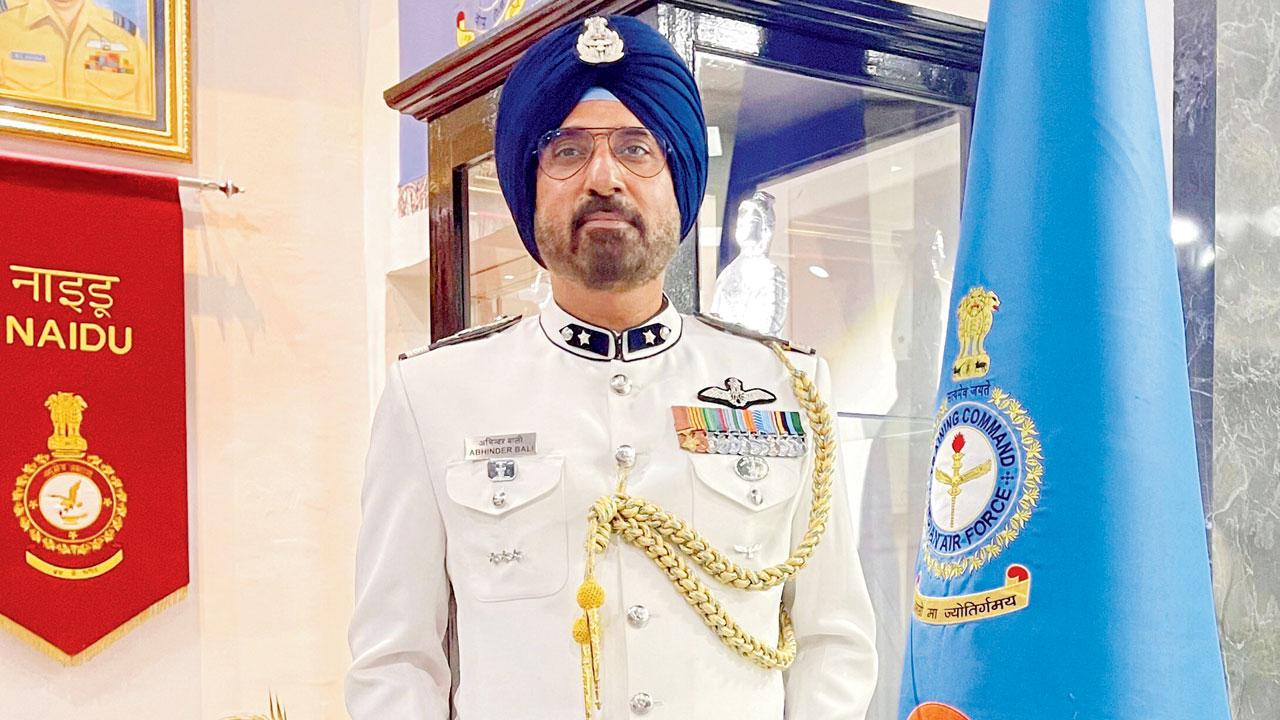
Fighter was so authentic that its screening got a standing ovation from the real heroes. Its co-producer, second unit director and writer, a former fauji, made it happen
Mitali Parekh (MID-DAY; February 11, 2024)
What the audience may not see, but any personnel from the Indian Air Force would is how the left shoulder of the uniform is the fun shoulder: “You can wear any badge you like there, with the permission of your Commanding Officer,” Ramon Chibb tells us over a video call from Goa where he is holidaying. “The right shoulder is for patches of the crafts you fly and the India patch.”
Minni [Squadron Leader Minal Rathore played by Deepika Padukone] wears a fun ‘Don’t Bug Me’ one as opposed to Patty’s [Hrithik Roshan as Squadron Leader Shamsher Pathania] and Bash’s [Basheer Khan, Akshay Oberoi] ‘Fighter Forever’. The lay audience may not register these details of authenticity, “but the Air Force did,” says Chibb gleefully, and you can tell that validation is enough. The screening of the movie for the armed forces ended with a standing applause.
Chibb co-produced the movie, wrote the screenplay and served as second unit director for Fighter. He also makes an appearance as Air Commodore Abhinder Bali, Chief Instructor at the Dundigal Air Force Academy in Hyderabad where Patty is transferred. Chibb served in the Infantry for five years, after being unable to follow his father into the IAF due to compromised eyesight. But he was, incidentally, at the commando training facility in Belgaum around the time Nana Patekar was preparing for his role in 1991 film Prahaar: The Final Attack. That movie, and 1982’s Vijeta are the two movies he credits with diving deep into research and firm marriage to authenticity. “It’s what Hollywood gets right,” he says, “When I see Gregory Peck in The Guns Of Navarone, I can see that they got the weapons he used right.”
Chibb, who later became a pilot and has a home next to the flight school in Hadapsar, Pune, wrote the story in 2015 and took it to director Siddharth Anand in 2016. “He said it wasn’t mass-y enough, ‘but let’s work on it together to make it into a film that could be understood by the audience’. Siddharth is a true cinema guy, he has a large vision.”
Pulwama and Balakot were added later, as was Minni, because women were allowed to serve as fighter pilots only in 2015. Chibb drew up a career sheet for each character: The posts they held, the medals they would have won, the crafts they would have flown and the wars they would have fought in to become the best air fighters in the country to be included into the Air Dragon team. It couldn’t be just because they were box office superstars.
So, Minni would be an all-weather pilot, a member of Sarang Aerobatic Display team, and be decorated with the Vayu Sena medal for an act of courage to be included into Group Captain Rakesh Jaisingh’s (Anil Kapoor’s Rocky) dream team. She would have been commissioned in 2010, have 1,500 hours of flying under her belt and served in Bikaner, Leh, Siachen, Ambala, and Hakimpet. Similarly,
“Fighters are split into two categories,” explains Chibb, fuelled evidently by enthusiasm, “into those who fly Russian and non-Russian aircrafts since we have a huge inventory of the former. Patty would have flown the Kiran, Pilatus PC 7, Mig 21 and 29, before coming to the Sukhoi 30—the first with a two-crew cockpit. It’s telling of his personality as a lone ranger and only child,” say Chibb, and it is also integral to the plot to have both protagonists—Roshan and Kapoor—in the climax.
“We had the blessing of the IAF from the beginning and shot at Tezpur, Dundidal and Pune air bases. Kudos to Siddharth that he let me run away with the details. ‘This is your world,’ he said, ‘Keep it real’. So even the walls of the houses are typically fauji—decorated with every photograph of the characters’ journey from being cadets to officers, with medals, emblems, swords of honour” of which we catch a glimpse in Bash and Patty’s homes.
Then there was the internalization of fauji codes: That there is a hierarchy that you obey without questioning; and manner of speech. Patty obeys his father’s orders to get tea for his friends more easily than he does his superiors. He asks for permission to speak from his superiors. “Hrithik bought into these nuances impeccably. He wanted to know all these things; he’ll make a great filmmaker,” says Chibb.
They also drop in easily into a peer’s place, as they do at Patty’s Jammu home, when a training gets cancelled. There are impromptu picnics and gatherings. “This is what I saw when growing up. People would land up at any time and say, ‘Ma’am khana khila do’. There is always the fear that one of them might not come back; so they party harder. We wanted to build all this into the film, and not just go, thak-thak-thak from one action scene to another.”
So, if you pay close attention to when we first hear Group Captain Jaisingh speak to his team, it’s in staccato. “That’s how officers brief. Anil sir would say to me, ‘Tu bol ke dikha’ and then repeat the dialogue, ‘Ab main bolta hoon’. He shadowed the Squadron Leader at Tezpur to get the mannerisms right,” he says. Squadron Leader Rathore’s character was based on all the women at flight school who were better than Chibb and “never let us hear the end of it. I always thought they made good pilots. They were more focussed, learned faster and of course, were not bogged down by us clowns.”
Chibb may not have realized his childhood dream, but it’s evident when we speak to him that he has been happy to do the next best thing: “I flew in those planes, shot them, and even rigged the camera on to them for some shots.”

I was blown away by the world of the Indian Air Force-Hrithik Roshan
8:25 AM

Madhureeta Mukherjee (BOMBAY TIMES; January 29, 2024)
Hrithik Roshan has been hugely appreciated for his performance as Squadron Leader Shamsher Pathania in Fighter. The aerial action film, which sees him sharing screen space with Deepika Padukone, is his third collaboration with director Siddharth Anand. In a conversation with us, Hrithik talks about getting a glimpse into the world of the Indian Air Force and pushing his limits as an actor. Excerpts:
Fighter is Indian cinema’s biggest aerial action movie to date. As an actor, how much effort went into playing Squadron Leader Shamsher Pathania, aka Patty, in terms of physical training and fitness?
There was an equal amount of mental, emotional and physical prep that went into bringing Patty to life. Firstly, Patty is a character I share no real-life similarities with in terms of personality. The emotional and mental prep was harder than anything I did physically to achieve the frame and fitness level of a fighter pilot. My physique had to mirror the body of the Sukhoi Su-30 MKI jet – so I had to be lean, sharp and agile. As for the mannerisms and body language, I spent a lot of time observing and interacting with a real-life Fighter Pilot named Allan at the Tezpur Airbase.
Additionally, I practised the Fighter lifestyle while shooting at Assam’s Air Base and Dundigal Air Force Academy in Hyderabad. I lived, trained and exercised there and exchanged notes with the cadets, who were all a huge help. Getting the voice of Patty right was important too, he talks at a certain decibel in a very cocky manner. He is younger and less evolved than the other recent characters I have played. He is more spontaneous and quicker to react as opposed to respond. The voice isn’t heroic like Krrish or mysterious like Kabir (from War), I took inspiration from the banter between cadets. I had to keep it real. No extra bass. Just say it like I do.
The film is shot in interesting locations like the Air Force Station at Tezpur Assam and the Dundigal Indian Air Force Academy in Hyderabad, which has been an important shooting location for the film. Tell us about your shooting experiences and challenges.
Shooting at real locations always enhances the scenes and adds to the overall performance for me as an actor. Each location – be it the Airbase in Assam or Air Force Academy in Hyderabad lent its distinctive flavour to the scenes and progression of the film and its story. The majority of the fighter jet scenes from the first half of the film were shot at Assam’s Tezpur Airbase. Shooting on the runway, tarmac and hangar with the Sukhois next to us will always be an unforgettable experience for me. I was like a wide-eyed child completely blown away by the world of the Indian Air Force.
During these schedules, we had to adhere to all the operational guidelines and codes of conduct. Security protocols had to be followed at these real locations. Electronic devices, including smartphones, were not allowed, so the entire crew switched to an analog way of life. It was a once-in-a-lifetime experience, and I am truly honoured to have collaborated with the Indian Air Force and had the opportunity to be a part of an ambitious film like Fighter.
This is your third film with Siddharth Anand. Your tuning with him by now must be quite perfect.
I’ve known Sid for over 10 years now, and our bond goes beyond films and film sets. I would say that Sid and I balance each other out in many ways, while sharing a similar drive to venture into the unknown or path less travelled. The equation that we share is of real-life fighters. We are not shy about putting up a fight with each other to try and test out new ideas. What largely helps our collaboration is the mutual respect we share. It’s a bond beyond egos and all about testing limits. When we talk, it’s almost like playing verbal table tennis and hitting one another with whacky ideas.
Though the audience has loved you as an action and romantic hero, you have never feared experimenting with a range of roles in your career. Will you continue to follow that process and path in the future?
It isn’t a conscious process or a strategy, I simply follow my instincts when it comes to selecting characters and films. The role or subject has to be something that excites me as an actor first, and then, as an audience. As an actor, I am fearless, and my choices are only motivated by creativity.
You are someone who loves watching all the movies on the big screen. There was a point in the last three years when people were questioning the survival of theatrical films. With the recent success of theatrical experiential films, are you excited about how people are loving and lapping up big-screen films?
Yes, I am someone who enjoys consuming content, be it on the big screen, TV or streaming online. So, I understand and respect all forms of consuming content. While OTT gives you a very personal experience of watching films, series or documentaries, cinema halls give you a community-watching experience. In India, community events are occasions that call for celebration, and I’m extremely happy to see the audience get entertained by a film over a shared experience of collective viewing. While family entertainers, rom-coms and films that deliver a unique theatrical experience have a certain mass appeal, I’m particularly happy to see content-driven films, too, being celebrated in cinemas. Films like 12th Fail and Sam Bahadur are having long legs in theatres, solely due to their content and strong performances by Vikrant Massey and Vicky Kaushal.
IAF objects to uniform, lingo in Anil Kapoor-Anurag Kashyap starrer AK vs AK
10:22 PM

THE TIMES OF INDIA (December 10, 2020)
New Delhi: The Indian Air Force has demanded “withdrawal” of certain scenes from an upcoming Netflix film, ‘AK vs AK’, after its trailer was tweeted by actor Anil Kapoor. “The IAF uniform in this video is inaccurately donned and the language used is inappropriate. This does not conform to the behavioural norms of those in the armed forces of India. The related scenes need to be withdrawn,” said the IAF, in a tweet from its official handle.
After a storm on social media, with many military veterans attacking the film that will be released on December 24, Kapoor tweeted a video to “sincerely apologise for unintentionally hurting anyone’s sentiments” because the trailer showed him using “unparliamentary language” while wearing an IAF uniform.
In the video Kapoor tweeted to “sincerely apologise for unintentionally hurting anyone’s sentiments” he explained that his character in the film was an actor playing the role of a distraught IAF officer whose daughter has been kidnapped. “I have always had the utmost respect and gratitude for the selfless service of all our defence personnel,” he said. Netflix, too, tweeted that its intention was not to “disrespect the armed forces of India in any regard”.
As per Netflix, "AK vs AK" is a Vikramaditya Motwane movie, starring Kapoor and director Anurag Kashyap, playing "themselves as actors". In the one-minute trailer, Kapoor is seen using foul language while sparring with Kashyap.
As was reported by TOI in July, in what some may perceive to be unwarranted censorship in a democratic country, the armed forces have demanded they be allowed to preview all films, documentaries and web series made on them to check for distortions that may hurt the sentiments of serving personnel and veterans.
The IAF in August had also complained to the Central Board of Film Certification against the “undue negative portrayal” of the work culture in the force in the film “Gunjan Saxena, The Kargil Girl”.
In its letter to the censor board, with copies marked to the Karan Johar-owned Dharma Productions and Netflix, the IAF said, “In the aim to glorify the screen character of ‘Ex-Flight Lieutenant Gunjan Saxena', M/s Dharma Productions presented some situations that are misleading and portr ay an inappropriate work culture especially against women in the IAF.”
Times View: The IAF is a much-respected institution. Their reputation is unlikely to be sullied by a scene or two in a commercial movie. The IAF should ignore such trivial acts rather than take serious offence.
Creative liberty: How much is too much for a biopic?
8:39 AM

Directors feel a film on a true story shouldn’t over-dramatise real incidents
Juhi Chakraborty (HINDUSTAN TIMES; August 18, 2020)
 The recently released web-only film Gunjan Saxena: The Kargil Girl courted controversy after the Indian Air Force (IAF) objected to the portrayal of its work culture in it. They said that in a bid to glorify the screen character of ex-Flight Lt Gunjan Saxena, the film “presented some situations that are misleading and portray an inappropriate work culture, especially against women in the IAF”. Another recent project, Shakuntala Devi, too drew criticism about how the over-the-top drama overshadowed the brilliance of the legendary mathematician.
Thus arises the question that when it comes to real-life stories and biopics, how much creative liberty should a director or writer take?
 Tigmanshu Dhulia, who helmed the biopic Paan Singh Tomar (2012), says it’s subjective, adding it should be fine as long as one is not deviating or changing history. “If a film is on a person or an event which not many know of, then I could take a lot of liberties because nobody knows about that person. But fictional elements should be minimal. You may fictionalise a private moment, but beyond that one should not, as then it becomes unethical,” he says.
 Lamenting how Bollywood films, which claim to be on real life, lack research, director Ananth Mahadevan says many get carried away. “I took the pain to do so much research when I made films such as Gour Hari Dastaan (2015) and Mee Sindhutai Sapkal (2010). Bollywood directors somehow feel it is okay and well within their rights to romanticise the subjects they pick up, whether it is a sportsperson or an Air Force pilot or mathematician,” he says, adding, “They feel it’s alright to go over-the-top and over-dramatise situations. They don’t care if something is authentic, they think creative liberties can be stretched.”
 No stranger to dealing with real-life stories, the man behind films such as Shahid (2013), Aligarh (2015) and Omerta (2018), Hansal Mehta says, “When you make a true life story it is about the intent of the filmmaker. It should be to actually tell a story and to let the world know of the person in a better way.”
 Filmmaker Ali Abbas Zafar says there are two types of films, one inspired by real stories which can be fully fictionalised, and others completely based on reality which go on to become biopics. “I think as a filmmaker what is important is to have that clarity of thought. If you dabble in something in hardcore reality, I think you need to be 100% authentic to the story. If you are making something loosely based [on real life] then, as a writer and director, you can take the liberty of making a film which has combination of fact and fiction,” he says.
Echoing the sentiment, director Vivek Agnihotri says while there is no written rule about how much is too much when it comes to creative liberty, there is some restraint one should show while recreating a real-life story. “One can take leeway as long as it does not tamper with the original story. A bit of tweaking is fine with dialogue and scenes, but it should be in tune with reality,” he shares.
IAF writes to Censor Board over ‘negative portrayal’ in Gunjan Saxena
9:09 AM

THE TIMES OF INDIA (August 13, 2020)
New Delhi: The Indian Air Force (IAF) has complained to the Central Board of Film Certification against the “undue negative portrayal” of the work culture in the force in the new film “Gunjan Saxena: The Kargil Girl”.
In its letter to the Censor Board, with copies marked to the Karan Johar-owned Dharma Productions and Netflix, the IAF said, “In the aim to glorify the screen character of ‘Ex-Flight Lieutenant Gunjan Saxena’, M/s Dharma Productions presented some situations that are misleading and portray an inappropriate work culture especially against women in the IAF.”
The film is a biopic on former IAF officer Flight Lieutenant Saxena, who became the first woman helicopter pilot to fly in combat to evacuate wounded soldiers during the Kargil conflict in 1999. Saxena, whose father is a retired Army officer, was even conferred a gallantry award. IAF said Dharma Productions had earlier agreed to represent the force with authenticity and make efforts to ensure the film inspired youngsters.
But “certain scenes and dialogues” in the movie and its trailer, which were submitted for a preview, portrayed the IAF in an “undue negative light” as if it has institutionalised gender bias, said the letter.
IAF said it has ensured that “the organisation is gender neutral and has always provided equal opportunity to male and women personnel” since women started being inducted as officers in the force in the mid-1990s. After having women transport aircraft and helicopter pilots for over a couple of decades, the IAF has also commissioned eight as fighter pilots since 2016.
Annexing the summary of the objectionable scenes in the film, the IAF letter said Dharma Productions was advised to delete or modify them. “However, the production house has not deleted the scenes,” it said.
Vivek Anand Oberoi to back a trilingual on Balakot airstrike
8:05 AM

Rachana Dubey (BOMBAY TIMES; August 23, 2019)
 Vivek Anand Oberoi is all set to back a movie that salutes the valour of the Indian Air Force (IAF). The movie will be based on the Balakot airstrike, the capture and the subsequent release of Indian Air Force’s Wing Commander Abhinandan Varthaman — an aftermath of the Pulwama terror attack that took place in February this year. The movie will be shot in Jammu and Kashmir, Delhi and Agra, and will go on floors later this year.
Vivek has received the required permission to make the film. Plans are afoot to make it a trilingual — in Hindi, Tamil and Telugu — with established actors from these industries playing pivotal roles, including that of Abhinandan and Squadron Leader Minty Agarwal, who guided the IAF’s interception mission to stop Pakistan’s fighter jets. While Abhinandan has been awarded the Vir Chakra, Minty has become the first woman to receive the Yudh Seva Medal.
Talking about the project, Vivek told us, “As a proud Indian, a patriot and a member of the film fraternity, it’s my duty to highlight what our armed forces are truly capable of. This film is a powerful tool to underline the achievements of brave officers like Abhinandan, who went behind enemy lines and did what makes every Indian proud of them. The Balakot airstrike was one of the most well-planned attacks by the IAF. I followed everything in the news, right from the attack in Pulwama to the airstrike. There was a lot that was speculated and spoken about back then; this film will put all of that to rest, once and for all. I thank the IAF for trusting us with this story and we hope to do justice to it.”
Subscribe to:
Posts (Atom)