Showing posts with label Hitesh Kewalya. Show all posts
Showing posts with label Hitesh Kewalya. Show all posts
If content is called king then why are you not paying kingmakers, ask writers
8:14 AM
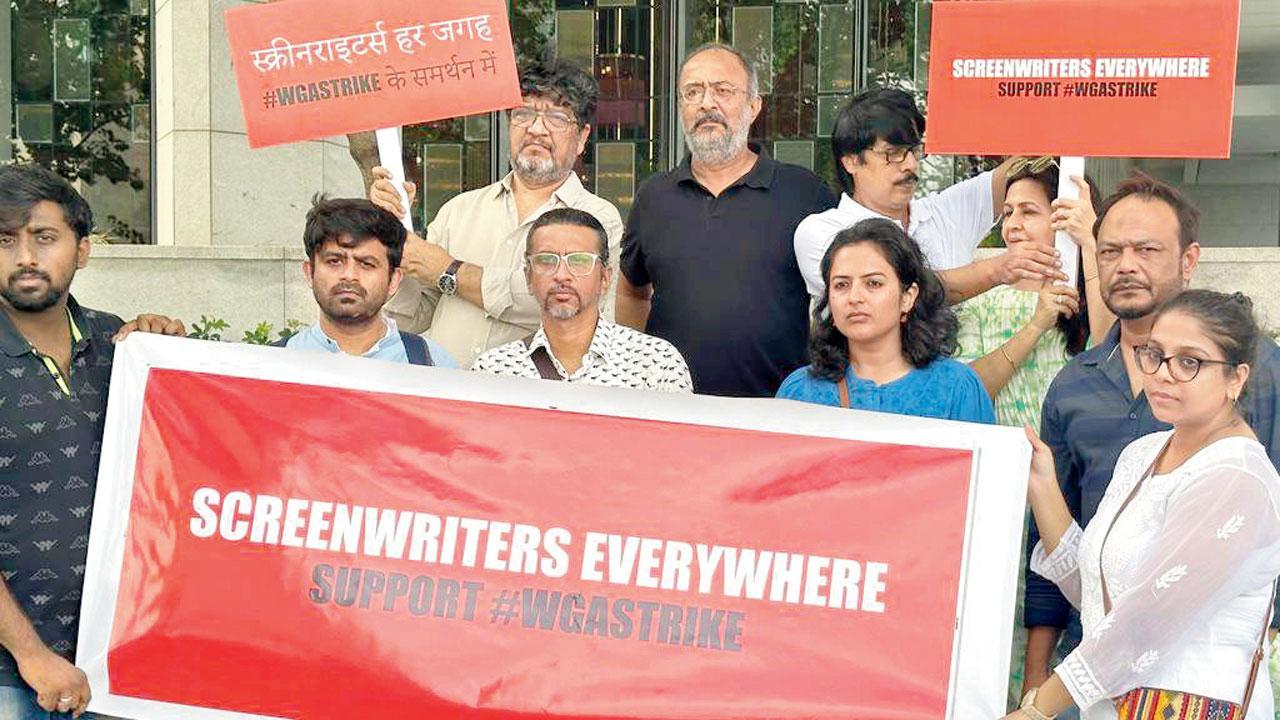
While writers in Hollywood are on strike demanding better pay from studios, screenwriters in India say that their condition is much worse compared to their US counterparts
Niharika Lal (BOMBAY TIMES; June 14, 2023)
The Writers Guild of America (WGA) strike, which kicked off in early May, is a result of a clash between writers, who see themselves working more but earning less in the streaming era, and studios attempting to rein in costs. Back in India too, writers of films and TV shows have demands that are quite similar – credit, compensation and fair contracts. However, many writers here feel that the situation is much worse compared to US.
Many writers point out, “Jinki stories pe taaliyan aur seetiyan bajti hain unko aksar screening pe bulana bhool jaate hai.” While the scenario has been slowly changing, writers feel it will take years for them to be at par with their US counterparts.
‘INDIAN WRITERS’ FEE MUCH LOWER THAN U.S. WRITERS’
In solidarity with the strike, India’s Screenwriters Association (SWA), asked all members working on US projects to stop working. SWA is fighting several battles on behalf of Indian writers. Anjum Rajabali, screenwriter and senior activist of SWA, shared his thoughts on the issues that Indian writers are facing:
‘CONTRACTS ARE ONE-SIDED’
Those who work on US projects are much better paid. In India, screenwriters, especially the new ones, receive fees far lower than the value of their work. Moreover, the contracts are one sided and protect their (producers and studios) rights, while the writer is left vulnerable. Credit is not guaranteed, termination can be at the whim of the producer, impossible indemnity is demanded from the writer.
‘OTT TREATS INDIAN WRITERS DIFFERENTLY COMPARED TO THEIR U.S. COUNTERPARTS’
More writers are now gainfully employed because of OTT. However, platforms brought in their own contract culture, with clauses that writers find unreasonable. OTT platforms treat Indian writers differently than their US counterparts. While US writers are striving to increase writers’ fees to fair levels, even their existing fees are still much higher than what Indian writers receive. Moreover, in the US, every time a show is aired anywhere outside of a cinema hall, the writer receives an additional remuneration.
‘SWA WILL NEGOTIATE FOR CREDIT’
Credit has to be given based on the work that the writer has done and not at the producer’s discretion. In case of a dispute between writers, SWA’s experts should arbitrate the issue by examining the respective written contribution of the writers to the final script and decide. Credit, dignified fees, regulation of the termination clause, indemnity, freedom to seek redress from the union are some of the clauses that need discussion with producers.
‘WHAT INDIAN WRITERS ARE SEEKING IS A SYSTEM CHANGE’
Screenwriter Mitesh Shah says, “What writers are seeking is a system change – equitable contracts, better compensation, credit guarantees, royalties. Streaming has given a lot of opportunities to writers. Things are certainly getting better but it’s still a long way to go. Be it a film or a web-series, everything starts with a blank page, and writers need to be accorded their due for filling up that page.”
Most writers say that they usually work on four-five projects at a time. Akshat Ghildial, who has written films like Badhaai Do and Badhaai Ho, shares, “From the initial idea to the dubbing, writers are paid in chunks. Kabhi kabhi chaar saal tak film ki total payment nahi aati. Agar aapne blockbuster likha hai toh aapki fees thodi zyada ho jayegi. Agar actor ki ek film blockbuster ho jaye to uski fees skyrocket ho jati hai, aisa writers ke saath nahi hota,” adding, “If content is called king then why are you not paying kingmakers?”
HOLLYWOOD STARS BACK U.S. WRITERS
The ongoing strike in US also saw many celebs step forward to stand in solidarity with screenwriters. Julia Louis-Dreyfus, Tina Fey, Rob Lowe and Modern Family stars Nolan Gould, Sarah Hyland and Jesse Tyler Ferguson, were among stars who protested with writers
WHAT INDIAN WRITERS HAVE TO SAY:
"A director doesn't ask for design credit when sharing his vision with a costume designer. But when it comes to writing credit, I have heard of many instances where directors have demanded their name be included. Sabko lagta hai writing sabko aati hai. Koi bhi aake suggest karta hai yeh dialogue work nahin kar raha"
- Akshat Ghildial, who has written films like Badhaai Do and Badhaai Ho
"It is quite common for some producers and directors to demand writing credit even for a minor input. It happened once with me when a producer wanted writer credit for giving feedback on the screenplay (that project never got made). In the last couple of years, writers have openly criticized these demands, which has changed things. Giving feedback is not the same as writing."
- Pooja Tolani, who has written Sacred Games
"The Indian screenwriting ecosystem is still learning how to read and execute a fair contract, negotiate good remuneration and deliver a good script"
- Hiteh Kewalya, who has written Shubh Mangal Zyada Saavdhan
"Because a lot of work is being done, the incremental value of writers have gone up in the last few years. But has it changed anything for writers and their rights in India? I'd say not much"
- Trishant Srivastava, who has written Jamtara
WHAT DO WRITERS DEMAND?
> Fixed minimum basic compensation
> Contract clauses like payment linked to approval, producer’s discretion if credit needs to be given
> Royalties – profit share in remakes and reruns
To express solidarity with WGA, Screenwriters Association holds symbolic protest in Mumbai
4:44 PM
Priyanka Sharma (MID-DAY; June 15, 2023)
It has been over a month since the Writers Guild of America (WGA) went on strike, following the breakdown of their negotiations with the Alliance of Motion Picture and Television Producers (AMPTP). The WGA union criticized the studios for not providing fair employment conditions to writers.
On Wednesday, 20 members of the Screenwriters Association (SWA) observed a silent protest outside the Netflix India office in Bandra Kurla Complex, Mumbai to express support for its US counterpart. The development came as a part of the decision taken by the International Affiliation of Writers Guild (IAWG) to mark World Solidarity Day.
Screenwriter Anjum Rajabali, executive committee member of the SWA, says, “Whenever any guild faces any obstacles, IAWG ensures the rest of us stand by them. This time, it was decided that writers’ guilds across the world, including India, parts of Europe, and Australia will hold a symbolic protest on the same day.”
Besides Rajabali, SWA chief operating officer Suhael Anwar, Shubh Mangal Zyada Saavdhan writer-director Hitesh Kewalya, Mohenjo Daro dialogue writer Priti Mamgain and Comicstaan writer Adhiraj Singh constituted the group.
Rajabali explains that the protest was motivated by the fact that most streaming platforms are members of the AMPTP that was in negotiations with the WGA. “This is not against [a specific streamer]. It is to boost the morale of the WGA members,” he emphasizes.
I discussed idea of sporting eyebrow slit with Anubhav Sinha-Ayushmann Khurrana
8:18 AM

Ayushmann Khurrana breaks down how Anubhav Sinha and he lent rugged charm to his character in Anek
Mohar Basu (MID-DAY; February 5, 2021)
Earlier this week, Ayushmann Khurrana reunited with his Article 15 director Anubhav Sinha for Anek. Soon, his first look as Joshua, which sees him sporting an eyebrow slit, became a talking point on social media. The actor reveals that it was his idea to lend a rugged charm to his character by way of the eyebrow cut.
“The objective was to create a distinct look. So, I discussed the idea of sporting an eyebrow slit with Anubhav sir. I have to thank him for being open to my suggestion; that’s what makes our creative partnership so exciting,” says Khurrana, who is currently shooting for the film in Kaziranga, Assam.
Anyone who has worked with the actor will tell you that he often gives creative inputs for his roles. In fact, he had suggested sporting a nose ring in the same-sex love story, Shubh Mangal Zyada Saavdhan (2020). “I had bounced the idea off Hitesh [Kewalya, director] and Aanand L Rai sir [producer] who included it in the look. Similarly, Shoojit sir [Sircar, director] was happy when I wanted to have a lisp in Gulabo Sitabo. I make these mental notes and discuss them with my director. Fortunately, I have always had filmmakers who have appreciated what I bring to the table.”
"Safety is more important than passionate scenes": Intimate scenes could be a no-go in Bollywood?
8:28 AM

In the post Covid-19 era, physical or emotional intimate scenes could be a no-go in Bollywood
Shreya Mukherjee and Sonil Dedhia (HINDUSTAN TIMES; May 18, 2020)
 “Do phool takraayenge, aur hum samajh jaayenge,” quips actor-filmmaker Satish Kaushik as he conjectures how romantic and intimate scenes could rewind to the ’70s and ’80s in the post Coronavirus era. But on a serious note, considering how new rules of on-screen intimacy — emotional and physical — are being outlined across the world in these times of social distancing, “safety is more important than passionate scenes,” says Kaushik.
Filmmaker Shoojit Sircar had recently raised the topic about how the shooting of intimate scenarios in films will change after this pandemic.
And while actor Dia Mirza had a fitting reply, “Guru, the entire process of making a film is intimate!”, screenwriter-director Hitesh Kewalya says in a country like India, where we work shoulder-to-shoulder, “it’s difficult to maintain social distancing to begin with. It won’t be easy, but we’ve to find a way”, says the Shubh Mangal Zyada Saavdhan director.
 Cinematographer Sudeep Chatterjee, who is working on Gangubai Kathiawadi, believes “physical and emotional intimate scenes can be managed” by putting the “actors, who’d be performing these scenes, in quarantine and monitoring their health before shooting, or with certain camera angles, and use of technology and visual effects”.
Actor Kunal Kemmu gives his perspective by saying since he has a two and half year old daughter at home, he would like to check into a hotel till a schedule is completed. “It would cut off the risk of my family being affected even if there are any chances. Obviously, there is no clarity as to when we will start shooting but production houses are deciding on certain norms keeping in mind the safety of everyone,” he says.
 Though intimate scenes often become talking points and generate interest, trade expert Atul Mohan feels not many “actors would be ready to take the risk” of doing such scenes. “We’ll have to avoid shooting such scenes,” he adds.
Intimacy coordinator Amanda Cutting, who has worked on web series Mastram and also on an unaired prequel pilot for Game Of Thrones, says that protocols have already been put in place in Spain, Australia and Italy, and India could take a cue from them. “We’ll have to look at different options. Can intimacy be done without kissing? Absolutely. An intimate moment can be two people making eye-contact or a hand touching another hand which tells a passionate love story,” she says.
Action director Sham Kaushal says that change is the law of the nature and a lot of things are going to be different when it comes to how we approach the shoots now. “We’ll have to reinvent our working style and be cautious. Also, the technology is so advanced. We can take help of VFX to show a few things.”
Censor board member and writer Mihir Bhuta says regulations from the World Health Organisation and the Ministry of Health, in this regard are awaited. Bhuta, who is avoiding adding group scenes in his projects, adds, “Physical intimate scenes involves two people at a time. That can be done by getting them tested and quarantining them. But that’d be difficult for over 25 people on the set.”
Musician Karan Kulkarni lashes out at Tanishk Bagchi
8:27 AM

Debarati Sen (BOMBAY TIMES; March 8, 2020)
 Music composer Karan Kulkarni is upset with Tanishk Bagchi after the latter recently said that the background score of Shubh Mangal Zyada Saavdhan had parts of his compositions and songs. Kunal says, “Tanishk may have composed the songs for the film, but the background score was created by me. I have always believed in and worked on original music and none of my works have had remixes or borrowed parts. I am known in the advertising industry for my unique sound. For someone to point a finger and claim that my work is his, must take a great deal of insecurity. I thought this used to happen back in the day, but for it to still exist, really surprises me. I never got to hear the songs of Shubh Mangal Zyada Saavdhan before its release. So, how would I have used them in my music? I have videos to prove that we have done it all ourselves.”
Kunal, who has composed songs and done the background score for films like Shahid, Mard Ko Dard Nahi Hota, Tumhari Sulu and others, further says, “As a musician, you generally try to promote and encourage other musicians and support a healthy ecosystem. After all, it is an art form. If composers start fighting between themselves and start accusing each other, then I don’t think that’s a healthy system for us to be in. I don’t have anything to say against Tanishk, but why is he trying to accuse me? This is not something that I would do to another musician unless it was true.”
TANISHK BAGCHI REPLIES...
When we spoke to Tanishk about this, he said, “Karan is a good musician and I am not blaming him for anything. Using parts of songs as background score is common. I feel that when you do a full album, if the background music also comes to the music director, then it becomes easier for him to set the vibe of the entire film. But again, I am not accusing anyone. My idea is clear regarding this; when you have songs in the film, why not compose for the entire film with background score, themes, teasers, trailers and end credits? Generally, themes are made from the main songs.”
MEANWHILE, SHUBH MANGAL ZYADA SAAVDHAN’S DIRECTOR HITESH KEWALYA TWEETED THIS...
“Have all the love and respect for your work @tanishkbagchi originals+remixes. And am sure you will do well as a background music director too, but don’t discount the original work @karankulkarni has put in for SMZS. Using some riffs in the background music helps create a cohesive sound for the film (sic).”
I am okay playing a relatively smaller character in Shubh Mangal Zyada Saavdhan-Ayushmann Khurrana
9:00 PM

Acknowledging that co-star Jitendra Kumar has a 'more interesting arc' in Shubh Mangal Zyada Saavdhan, Ayushmann says he was drawn to his part as it had agency
Mohar Basu (MID-DAY; February 21, 2020)
 For anyone who assumed that he spent weeks deliberating whether he should greenlight Shubh Mangal Zyada Saavdhan, Ayushmann Khurrana bursts the bubble. "It was an easy decision to make because the script was funny and commercial," he reasons. However, the actor accedes that he bided his time before zeroing in on the character he would play in the same-sex love story. "Hitesh [Kewalya, director] had asked me to choose the role I want to play. Jitu's [Jitendra Kumar] character is in the closet, and hence, has a more interesting arc. But I didn't want to play the victim this time, I wanted to be the instigator. My character is confident about his sexuality. He is rare [in that regard] because he doesn't give a damn about [what society thinks of] his sexual orientation. I am okay playing a relatively smaller character."
As the building block for his part, the actor referred to Lie With Me by Philippe Besson, an acclaimed book about queer love. "I wanted to know what a gay man goes through daily. I met this guy called Sharif in Delhi, who explained to me that a heterosexual man can go anywhere and find someone to date. But how do you spot a gay man? It's difficult for them to find love."
Khurrana hopes the film will be an "induction for an average Indian homophobe." "With the film, we had to adopt an over-the-top approach to reach out to people. I wish people would say, 'Chalo apne ladke ke liye ladka dekhne chalte hai'. Realistically, that won't happen. But, as long as parents understand that their child has the right to live his truth, that's a big win. With this film, we have focused on how a family warms up to the idea of their son being gay."
I want to be fearless as a person and as a filmmaker-Aanand L Rai
8:59 PM

Onkar Kulkarni (BOMBAY TIMES; February 21, 2020)
 Over the past 13 years since he entered Bollywood, Aanand L Rai has donned both hats with elan — that of a prolific producer and a fine director. And now, he is excited about his latest release, Shubh Mangal Zyada Saavdhan, which he has co-produced with Bhushan Kumar. The film, starring Ayushmann Khurrana and Jitendra Kumar as the lead romantic pair, deals with the subject of homosexuality in a light-hearted manner. As the movie hits theatres today, Rai talks to BT about being in love with his films, the emotional support he seeks from his actors, and how a serious subject like that of Shubh Mangal Zyada Saavdhan, needs to be told through a heavy dose of humour. Excerpts...
What encouraged you to come up with a homosexual love story at this point? Did the scrapping of Section 377 (by the Supreme Court in September 2018) encourage you? Or, is the fact that in recent years, films like Aligarh (2015), which dealt with the subject in a serious manner, received a good response from the audience?
When we started working on this subject, Section 377 had not been scrapped. The verdict came during the course of the film and we had to tweak our climax because of it. The reason I decided to make Shubh Mangal Zyada Saavdhan is different.
As a filmmaker, I felt the need to understand their world. There was a time when I wasn’t able to understand the universe of Tanu Weds Manu (2011) and Raanjhanaa (2013). Jaise hi mujhe iss topic pe kuch samajh aaya, I thought of sharing it with the audience. As a team, we really wanted to work on this subject, especially when Hitesh Kewalya (writer-director) came up with a good script. It all started with Shubh Mangal Saavdhan (2017), when we presented a subject like erectile dysfunction to the family audience. The idea of the franchise is to bring all the topics that are discussed behind closed doors into people’s drawing rooms. It is all about how you make them family entertainers. Ayushmann knew that we were working on this subject, and he got sold on the idea the moment he heard the script.
This movie depicts the romance between two men. So, was it tough getting the lead pair’s (Ayushmann and Jitendra) onscreen chemistry right?
The film is not about the romance between two men, it is about the society accepting two men involved in a romantic relationship. Hum logon ko lagta hai ki yeh unki problem hai, par actually problem hamari hai. It is our problem that we don’t understand a human relationship like this. So, the only way to reach out to the audience, with a heavy subject like this, is through a good dose of humour.
Like most of your previous movies, this film, too, is set in a small town. What is it that attracts you to this milieu?
I would say that my films are set in middle-class settings, not small towns. I understand that world much better. That’s the way I have been brought up and it reflects in my movies. Today, I might be a filmmaker, living in a bigger home, driving a bigger car, but I will always remember my upbringing. I was born and brought up in Delhi, in a middle-class family. My mom was a fine arts teacher in a government school. I remember growing up in a government colony. So, be it Lucknow, Kanpur or Haridwar, the backdrop of my film will always be middle class.
As a producer, this is your second film with Ayushmann (after Shubh Mangal Saavdhan). Have you ever thought about directing him?
It is not easy to get a script for an actor who you understand so well. I am just waiting for the right script to direct him. My process is different — I first fall in love with the story and then decide upon the actor. However, we have discussed the idea of working together as a director-actor. He is looking forward to a pure romance or a pure action film. I told him action toh nahi, magar pure romance pe kuch soch sakte hai.
Your last directorial Zero (2018), starring Shah Rukh Khan, Katrina Kaif and Anushka Sharma didn’t perform as expected at the box office. Given that there are a lot of expectations attached to each film, how did you deal with it?
Like I said, I am a director who falls in love with his stories and that encourages me to make a film. I think I was in awe of Zero, I was madly in love with it. I think I overdid it. Bolte hai na, zyada pyaar bachche ko bigaad deta hai. I think this is what happened with Zero, but the experience taught me a lot. As far as my association with Khan saab (SRK) is concerned, I will relish it all through my life. I got a partner in him, so it was never a star I worked with. He was an emotional partner, who gave me a lot of support. I am not a craftsman, so I need emotional support every time I make a film. When I was working with Khan saab, he never made me feel like it was such a huge film. He made me believe in my story, and made me go through the journey the way I wanted to. However, like it happens after the release of every film of mine, I went silent post the release of Zero, too. That is all. Our association was not affected by the film’s box-office performance. I think silence is the best way to take both, success or failure. Just go quiet. Absorb. Learn. Understand.
You said that you learnt a lot from Zero. How is that experience helping you with your next directorial, Atrangi Re, featuring Akshay Kumar, Dhanush and Sara Ali Khan?
I won’t be careless. In fact, I have never been careless in my life. I was always a good student, and will remain a good student throughout my life. No experience has disturbed me as such, it has only made me understand a few things. So, I am looking at playing my innings the same way, I have been playing since the last 10-15 years. I can’t change myself. I am fearless. Once again, I am in love with my film and my story and I am enjoying it. I want to be fearless as a person, and as a filmmaker.

This is hopefully the last time people talk about a same sex kissing scene-Jitendra Kumar
8:23 AM

Riya Sharma (BOMBAY TIMES; February 19, 2020)
 He wanted to do an entertaining romantic film, and in Shubh Mangal Zyada Saavdhan, Jitendra Kumar is doing exactly that. The only difference is, instead of romancing a girl, he will be romancing Ayushmann Khurrana. In a chat with us, Jitendra says that SMZS is actually a love story between two individuals with a family bhasad. From addressing homophobia in the film to his family’s reaction to his character, the actor talks about how the film aims to normalise same-sex relationships. Excerpts:
You play Ayushmann Khurrana’s love interest in Shubh Mangal Zyada Saavdhan — was it a calculated risk?
There was no calculation. I got to know that the makers were thinking of casting me in a film on a same-sex relationship, I met them and read some scenes with our writer-director Hitesh Kewalya. Hitesh could see in me what he wanted from the character. Then, I met Aanand (L Rai, co-producer) sir, did one more reading and I was part of the film. I was more keen to know how the story has been written. They were sure that I was the right person to play the character but I wanted to know more about the story. When I got to know the entire story, I really enjoyed it. The most interesting part was how the topic (of same-sex relationship) was normalised visually in the film. Joh hum general ‘conventional’ romance dekhte hain between people of the opposite gender, waisa hi romantic feel iss couple ke saath hai.
Many actors talk about how certain roles can be emotionally draining. In the trailer, we can see your character being beaten and dealing with parental disapproval. You are going through the same emotions that many others go through when they come out to their families. How did you prepare for that emotionally, since your character did not require you to change physically?
I have a few friends who have come out to me. When I got to know their stories, I realised how badly they have been treated by their own family. Mujhe zyada pata nahi tha, par jab Section 377 pe verdict aaya I was shocked to know that having a same-sex relationship was considered a criminal activity till then. As far as the movie is concerned, jab bhi aap ek naya character karne ja rahe hote ho toh aap physically changes laate ho — the way you walk or talk. So I started watching videos of people who are open about their sexuality. While watching their interviews and talks, I also got to know about the pain they went through and I felt emotionally connected to them. Then I realised that there are many who are ‘normal’ in the way they talk and behave and I felt stupid that why was I even looking for such stereotypical things? In the script also, my character’s requirement was that he should look like any other boy.
In metros, people are becoming more open about same-sex relationships. How do you think people in small towns, like the one in which the film is set, will react to two men in love?
This film is about people who have homophobia. And we have no education on the topic. In our textbooks, we are only taught about reproduction with the opposite gender and we get to know about samesex relationships only through negative information. It has been seen as taboo for long, so obviously, people won’t accept it as something natural in a day. This story is about them. I think the movies that have been made so far on the topic have reached only those who already knew about it and were evolved. This might be the movie that reaches the small towns and cities of the country. Ek raat mein kuch nahi badlega par unhe ye zaroor feel hoga ki ek natural cheez hai. It is not even a choice, we say ‘It is a choice, let them do whatever they want to’. But it is natural for them to love people of the same gender. The audience will get to hear these things a lot in the film so I think the next time, they will be a bit more accepting if someone tells them that they are homosexual. People won’t be shocked, kyunki ye movie woh shock khatam karne ka kaam kar degi.
The film has been pitched as a rom-com but the topic is sensitive. How did you maintain a balance and make sure you didn’t offend anyone?
Hitesh had done that as part of the script. When we all heard the story, we felt it was like any other love story. Family ki bhasad hai par romance normal hai. There were a lot of discussions on the set, all of us would give inputs, add a particular word to a scene to normalise the topic.
Your kiss with Ayushmann is being talked about a lot. Why do you think it is such a big deal?
This is the first time the audience has seen something like this on the big screen, and it’s natural for them to react. I remember the kiss in Raja Hindustani (between Aamir Khan and Karisma Kapoor), people talked about it a lot as well. Whenever we see something new on the big screen that we are generally awkward to talk about, toh thodi baatein hoti hai. This is the first, and hopefully the last time, people talk about a kissing scene between two people of the same gender.
How did your family react to it?
When I was finalised to play this part, they got to know that I am doing a lead role in a romantic film, but thodi different romantic film. Of course, my parents were a bit awkward and they didn’t talk about it openly for two-three days, but they were happy. Later, we discussed it and they were okay with it. But I think log ab dheere-dheere evolve ho rahe hai. Jaise meri family, jo middle-class, small town se hai, unka reaction waisa nahi tha jaise maine socha tha. But it is okay for people till the time it is being shown in a movie or is happening with someone else. The real reaction would come when it would happen in our family, but ek raat mein nahi hoga, time toh lagega.

We wanted to break away from the stereotypes associated with homosexual people-Hitesh Kewalya
8:38 AM

Director Hitesh Kewalya talks about showcasing a same-sex relationship in a sensitive and humourous manner in Shubh Mangal Zyada Saavdhan
Onkar Kulkarni (BOMBAY TIMES; February 18, 2020)
 His first film as a writer, Shubh Mangal Saavdhan, revolved around the subject of erectile dysfunction. The film was praised for blending a taboo topic in a sensitive and humourous manner with a love story between Ayushmann Khurrana and Bhumi Pednekar. The project also gave Hitesh Kewalya the opportunity and confidence to work on his next, this time, as a director. His directorial debut, Shubh Mangal Zyada Saavdhan, showcases a love story between two men — Ayushmann Khurrana and Jitendra Kumar — and their struggle to convince the latter’s family to accept their relationship. Hitesh says, “This idea was discussed as a sequel even before Shubh Mangal Saavdhan went on the floors. With the success of the first film, I thought that I could tackle a subject that was more difficult, but very important with Shubh Mangal Zyada Saavdhan.”
Talking about the franchise, Hitesh says, “Both the films have focussed on different aspects of male sexuality. The idea behind the franchise is to present such topics in an entertaining manner and then have them becoming a talking point. The aim is to start a conversation around subjects that are considered taboo. People have to realise that these things exist in society and it is only conversations that will lead to evolution. Thematically, we are in the realm of sexuality, and this seemed like a natural progression.”
Unlike some Bollywood films, which poked fun of homosexuals and their relationships, this film portrays a love story sensitively, infused with humour. The scenes between the two young boys, their relationship and their family’s reaction towards their love have attracted a lot of attention. Ask Hitesh what led him to focus on issues faced by homosexual couples, and he replies, “The moment you stop differentiating between a man-woman and man-man relationship, everything becomes crystal clear. I have a lot of friends who are gay. My first encounter with the LGBT community was when I was studying at a design school. When I spoke to them, I got to know about their struggles. I realised that at the core of our existence, our emotions are the same… all we need is a bit of empathy. With this film, we wanted to break away from the stereotypes associated with homosexuals. Right from the inception, Ayushmann had no qualms about doing this role, and both the boys have given it their best.”
For Yaar Bina Chain, we made Ayushmann Khurrana recreate the step of Anil Kapoor-Vijay Ganguly
8:36 AM

Vijay Ganguly on choreographing Yaar Bina Chain from Saaheb, which was directed by his father, for Shubh Mangal Zyada Saavdhan
Sonia Lulla (MID-DAY; February 9, 2020)
 During the shoot of Saaheb (1985), Vijay Ganguly, then five, would run about the set as his director father Anil Ganguly filmed Yaar Bina Chain with the movie's leads Anil Kapoor and Amrita Singh. Almost 35 years later, in a quirk of fate, Vijay found himself being appointed to choreograph the rehashed version of the song for Ayushmann Khurrana-starrer, Shubh Mangal Zyada Saavdhan. "Initially, the team, including director Hitesh Kewalya, simply told me I would be working on a remix of Bappi da's [Lahiri] song, and that they were sure I would be excited about it. As soon as the track began, I was taken aback. I thought, what are the odds that of all the choreographers and all the songs, this one would come to me?" exclaims the choreographer, talking about the song that releases on Tuesday.
In keeping with the theme of the same-sex love story, the track—now titled Arrey pyaar kar le—has Khurrana romancing his on-screen love interest, Jitendra Kumar. "Since the song didn't have [the usual] guy-girl dynamics, there wasn't much that we could [use] from the original. So, we decided to [reference] the period instead. When my dad made the film, the unit went to Ballard Pier, used water, and employed the star filter that made water [droplets] look like light. So, we used the same filter for our song to [evoke a sense of nostalgia]. We also made Ayushmann recreate a step of Anil sir." He adds that Khurrana, delighted to learn of the coincidence, urged him to invite his mother and actor sister Rupali Ganguly to the shoot.

Vijay Ganguly with Bappi Lahiri on the set
Ayushmann Khurrana is so fluid with his body, expressions-Hitesh Kewalya
9:38 AM

Hitesh Kewalya on his leading man and making fun of homophobia in their next
Akash Bhatnagar (MUMBAI MIRROR; February 6, 2020)
After writing Shubh Mangal Saavdhan, Hitesh Kewalya reunites with Ayushmann Khurrana as a director for its sequel, Shubh Mangal Zyada Saavdhan, which centres on a gay love story. The director says that while making the film, he has tried his best to avoid all stereotypes that routinely plague LGBTQ characters in Hindi films. “It was difficult, but when Shubh Mangal Saavdhaan (SMS, which revolved around erectile dysfunction) worked, it gave us the confidence to tackle a tougher topic and make it accessible to the family audience,” he explains.
He goes on to say that it made sense to make fun of homophobia as the idea was to break that pattern in the Indian society. “Also, the bias around a heterosexual man writing a film on homosexuality for a family audience,” he asserts, adding that he got the story idea even before the first part went on the floors.
For inspiration and to understand the subject, Hitesh traced his steps back to his childhood. “I grew up in the Delhi of the 1980s-’90s, when homosexuality wasn’t even discussed. With time, I understood that it is not a modern-age ‘disease’ or a ‘metro concept’,” he states.
The Supreme Court decriminalised Section 377 in 2018, which also played a huge part in the director’s prep. “I realised that our society is discussing this topic whole-heartedly now. It felt like the right time to have this conversation in a more light-hearted manner than we had been having till now,” he explains.
Ask him if basing the film in Benaras was difficult and Hitesh says, “It’s a misconception that small-town people are not open about it. In some North American tribes, people with alternate sexuality are identified as two-spirited. So, there has always been acceptance. It just keeps changing over time.”
Ayushmann’s wife Tahira Kashyap recently shared that their eight-year-old son did not find anything unnatural about homosexuality. When asked if he had to explain it to his own eight-year-old son, Hitesh says he didn’t need to. “Two years ago, our house-help was getting married. He asked her who she was getting married to, to which she replied, ‘a boy, obviously’, and he pointed out that a girl can get married to a girl as well. That’s evolution. If tomorrow, my son tells me that he likes a boy, I will say it’s okay, because love is love,” he shares.
He is all praise for his leading man. “Ayushmann has become so fluid with his body, expressions and reactions but is still that middle-class boy who became a Roadie. That’s what makes him important as an actor,” he shares.
Is Part 3 on the cards, too? “We have some ideas in mind but nothing concrete yet. The franchise will definitely go forward. If an idea’s time has come, nobody can stop it. The day it strikes, we will start writing,” he signs off.
There was no question of hiding the kissing scene from the promo-Hitesh Kewalya
8:21 AM

Addressing homophobia in Shubh Mangal Zyada Saavdhan, director Hitesh Kewalya discusses why he didn't shy away from including the kiss between leads in the trailer
Mohar Basu (MID-DAY; February 5, 2020)
 At the very start of the chat, writer-director Hitesh Kewalya admits that he faced more than a fair share of resistance with Shubh Mangal Zyada Saavdhan. But the director had the perfect comeback for those who asked him why he was telling a same-sex love story in his maiden outing: "I would turn around and ask them, 'Why not?'"
Kewalya believes the Ayushmann Khurrana starrer is a much "required" film in today's times. "The gay community has rarely been portrayed with the dignity and respect they deserve. This film is made with the motive of appealing to as many people as possible. So, we've taken the route of humour. Laughter opens people up to difficult conversations," he reasons, adding that he spent a year developing the screenplay. "Every week, either Ayushmann or the producers would call and ask, picture bani kya? This film takes on homophobia; it holds a mirror to society and its need to box us into gender identities. How can we, as a society, pick out a certain kind of love and say that it must be banished? Why is this non-issue being made into an issue?"
While Sonam K Ahuja's Ek Ladki Ko Dekha Toh Aisa Laga (2019) was applauded for being Bollywood's first mainstream same-sex relationship drama, it was also criticised for not delving deep into the love story or showing physical intimacy between the leads. Though he hasn't seen the movie, Kewalya understands why one would be cautious while dealing with such delicate material. "People are scared despite the decriminalization [of Section 377]. Sexuality is rarely discussed in films anyway. Initially, Ayushmann and Jitu [Jitendra Kumar] had their share of guffaws, but four scenes later, they were professionals and have created a couple that people will root for."
On his part, however, the writer-director has been assured in his depiction of same-sex love, not shying away from including the kissing scene between Khurrana and Kumar in the trailer. Fortunately, the Censor Board has cleared the scene in question. Ask him if he was in two minds about showcasing the kiss in the promo, and he asserts, "There was no question of hiding any bit of the film. We wanted to play on the front foot. Why shouldn't we? After Shubh Mangal Saavdhan [that he wrote the dialogues for], we understood the audience we were dealing with. We are sure about our story, and are going all out with the hope that society changes, one film at a time."
Even Ayushmann Khurrana had been lobbying for me-Jitendra Kumar
7:57 AM

Jitendra Kumar, actor’s love interest in a social comedy, on his first lead role in a Hindi film and how his co-star made it easier
Avinash Lohana (MUMBAI MIRROR; January 31, 2020)
 Joining the ever-growing tribe of engineering students-turned-Hindi film actors after Sushant Singh Rajput, Kartik Aaryan, Kriti Sanon and Vicky Kaushal, is Ayushmann Khurrana’s newest love interest.
After making his feature length debut with the Shweta Tripathi-starrer Gone Kesh, former civil engineering student Jitendra Kumar plays a leading man for the first time in Hitesh Kewalya’s Shubh Mangal Zyada Saavdhan. The IIT Kharagpur alumnus rose in showbiz ranks after playing characters like Gittu (Permanent Roommates), Jeetu Bhaiya (Kota Factory), and Arjun Kejriwal, a spoof on Delhi Chief Minister Arvind Kejriwal.
The 30-year-old actor and Bollywood fan has been mimicking Shah Rukh Khan, Amitabh Bachchan, Nana Patekar, Akshay Kumar and Hrithik Roshan since his days as an IIT aspirant in Kota, the national hub of entrance exam prep. “But parodying the Delhi chief minister didn’t come easy. One day, I just happened to get the voice right and shot the video immediately. Even Kejriwal sir praised my acting skills,” smiles Jitendra, adding that he is happy to have moved on to explore other acting opportunities.
He was in Bhopal for a digital show when he was approached for Shubh Mangal Zyada Saavdhan, which revolves around a same-sex couple. Jitendra says that he wasn’t apprehensive about the subject but wanted to know if the film was written responsibly. “I met Hitesh two months after the offer came along. When I heard the narration, I realised how simply things were explained to the families in the narrative. I instantly knew I wanted to be a part of the film,” the actor shares, adding, “I discovered later that even Ayushmann had been lobbying to get me on board.”
Jitendra had first met his National Award-winning co-star in 2009, when the latter visited the IIT campus as an MTV VJ to cover a cultural festival. The duo would reunite a few years later to work on two sketches during the promotions of Ayushmann’s earlier films, Nautanki Saala! and Hawaizaada. “We are both music lovers and I figured we would bond over that. But almost a week into the shoot, I realised I knew nothing about music; Ayushmann is the biggest music lover I know. He knows everything about a song, right from the lyricist to singer and the composer. But he was impressed when I introduced him to the soundtrack of this Malayalam film called Kumbalangi Nights. We had a lot of time on hand that day as the shoot was halted due to unexpected rains in Varanasi,” reminisces Jitendra.
There has been a lot of buzz around their kiss in the film. What was it like shooting for it? “I am a reserved person, but Ayushmann made me comfortable. He is easy to work with and is quite friendly,” Jitendra gushes.
Ask him about his expectations from the upcoming big screen turn, and the actor says, “I am playing lead parts in web shows as well, but the finances and economics there and in films are different. I hope Shubh… will result in more lead roles and good stories on the big screen. I know there will be struggle, but I am game,” he asserts.
Whenever there is a vacancy in a government office, my parents ask me to go for it-Jitendra Kumar
7:54 AM

Despite Cheesecake's success and a Bollywood film in his kitty, TVF star Jitendra Kumar on how it's a long road ahead to fame
Letty Mariam Abraham (MID-DAY; December 17, 2019)
After Kota Factory, Pitchers, Truth aAd Dare With Dad, Jitendra Kumar, the poster boy of TVF, released a five-episode series, Cheesecake, with co-actor Akanksha Thakur. The MX Player show revolves around a couple who reignites the spark in their marriage as they welcome a dog into the family. In conversation with mid-day, Kumar talks about finding an unlikely co-star in a dog, his Bollywood debut and meeting his family's expectations.
Edited Excerpts from the interview.
How did you come on board for Cheesecake?
The concept belongs to Palash [Vaswani, director] and he is a pet lover. He got writer Gautam Ved on board, and along with Sameer Saxena [executive producer], the project began to take shape.
Are you pet-friendly?
Not really [laughs]. Despite my fear of dogs, I insisted on doing the show. The track of the married couple was interesting and different from the projects Akanksha and I have been part of. We trained with the dog to make it seem natural. Since she loves dogs, the training was essentially for me. It was fruitful because I gradually got comfortable with Aryan.
Was it difficult to shoot with a dog?
I think Aryan is more experienced than us. He has done several commercials and films. After his shot, he would immediately be taken to his vanity van because he couldn't bear the heat [laughs].
There were rumours about Pitchers 2 going on floors. Is it still on the cards?
The concept of start-ups is no longer fresh. We had started work on the script but realised that there is not enough material to play with. So, it's currently on hold.
You are making your Bollywood debut with the same-sex love story, Shubh Mangal Zyada Saavdhaan. What was it like to romance Ayushmann Khurrana?
Romancing a girl comes easily because you've done it before; that's not the case here. Initially, it was awkward, but we got comfortable as we did readings, [understood] our characters and the situations they face. Before filming a romantic scene, the director [Hitesh Kewalya] would come to us and say he wants to see the chemistry between us. Thankfully, it flowed naturally when the camera rolled.
Has your family finally accepted you as an actor?
They are supportive of my decision. But whenever there is a vacancy in a government office, they call me, asking me to interview for the job. This happens especially when I'm going through a low phase.
Ayushmann Khurrana brings out the best in every actor-Maanvi Gagroo
7:04 AM

Web star Maanvi joins Khurrana in Shubh Mangal Zyada Saavdhan
Mohar Basu (MID-DAY; October 2, 2019)
 A fortnight into the shoot of Shubh Mangal Zyada Saavdhan in Varanasi, Maanvi Gagroo considers herself lucky to have found a place in the Ayushmann Khurrana-fronted venture. The actor plays goggle Tripathi, the “quirky” sister to Jitendra Kumar’s Aman Tripathi in the social comedy that deals with same sex relationships.
“Ayushmann brings out the best in every actor,” says Gagroo, adding that it was the talented ensemble cast, coupled with the powerful message of the film, that made her come on board. “Hitesh’s [Kewalya, director] vision for the film convinced me. I am proud to be associated with a movie that is progressive while maintaining a mainstream approach.”
The web star sees little difference in the functioning style of the two mediums. “The approach to the script remains the same. It boils down to the people you’re working with.”
Shubh Mangal Saavdhan's sequel titled Shubh Mangal Zyada Saavdhan; Ayushmann to play a gay character
8:02 AM

BOMBAY TIMES (May 9, 2019)
 The makers of successful family entertainers like Raanjhanaa and franchises Tanu Weds Manu and Happy Bhag Jayegi, are set to give yet another quirky entertainer in Shubh Mangal Zyada Saavdhan.
Directed by Hitesh Kewalya, the film is a sequel to the 2017 sleeper hit, Shubh Mangal Saavdhan (SMS), starring Ayushmann Khurrana and Bhumi Pednekar in the lead. While SMS addressed the complex subject of erectile dysfunction with humour, the sequel delves into the subject of homosexuality.
Taking the highly anticipated franchise ahead are producer Aanand L Rai of Colour Yellow Productions, who is known for his eclectic choice of stories and actor Ayushmann Khurrana, who’s now synonymous with experimental films.
Says Aanand, “The success of SMS encouraged us to turn it into a franchise, which tackles taboo subjects in the most light-hearted manner. With Zyada Saavdhan, we have a great story in hand and who better than Ayushmann to play the lead. Hope audiences enjoy it as much as the first film.”
Ayushmann adds, “It is a beautiful story told in the quintessential Aanand Rai-style of film-making, which is known to touch hearts and leave a smile on the face. It is a pleasure to collaborate again with the master storyteller of our times.” Talking about the sequel, he reveals further, “It is one of the most brilliant scripts that I have read in a long time, and it also handles the subject of homosexuality, sensitively. An out-and-out entertaining film, it will also make you think, which is the hallmark of good cinema.”
With Shubh Mangal Zyada Saavdhan scheduled to release early next year, the casting for it is already underway.
-----------------------------
Himesh Mankad (MUMBAI MIRROR; May 9, 2019)
The Ayushmann Khurrana and Bhumi Pednekar-starrer 2017 sleeper hit Shubh Mangal Saavdhan is now being turned into a franchise. The second film in the series has been titled Shubh Mangal Zyada Saavdhan and will feature Ayushmann again, along with another actor who is still to be cast. It is expected to go on the floors in the last week of August. The film will be shot in a start-to-finish schedule with the entire ensemble cast and the makers are targeting an early 2020 release.
While the original was based on the 2013 Tamil film, Kalyana Samayal Saadham, and marked the Bollywood debut of its director R S Prasanna, the sequel will be helmed by Hitesh Kewalya who had written the earlier social comedy. “The first draft of the script has been locked. This time the makers have decided to bring homosexuality as the main theme in a mainstream Hindi film,” revealed a source close to the development.
Producer Aanand L Rai confirmed the news, saying, “The Shubh Mangal Saavdhan franchise is our tribute to the churning that keeps our society alive. Every installment will deal with a topic that touches every person but no one wants to speak about it publicly. Like the first film, this one too will broach a taboo subject with great sensitivity and light humour. I anticipate a lot of conversations and cheer around the second film too.”
According to the source, it is another social comedy set in a small town. “It revolves around how a conservative family comes to terms with the fact that their son is gay. The humour is situational,” added the source.
Before moving to Shubh Mangal Zyada Saavdhan, Ayushmann will wrap up Dinesh Vijan’s Bala which kicked off on Monday and features him as a small-town guy who is battling premature balding. It is directed by Amar Kaushik of Stree fame and also features Bhumi Pednekar, Yami Gautam, Saurabh Shukla, Javed Jaffrey and Seema Pahwa.
Aanand L Rai has multiple genres lined up for 2018
8:27 AM

BOMBAY TIMES (January 9, 2018)
Over the years, Aanand L Rai has garnered appreciation and credibility as a filmmaker. His banner, Colour Yellow Productions, saw success twice in 2017 — with the quirky entertainer Shubh Mangal Saavdhan and India’s official entry to the Oscars, Newton.
Today, the filmmaker is collaborating with some talented actors and directors from across the board. The year started with a bang, with the teaser of Zero, Rai’s much-anticipated directorial with Shah Rukh Khan. He is also gearing up to release the Anurag Kashyap-directed Mukkabaaz on January 12, which is a love story of a boxer set in a small town. This will be followed by Manmarziyan, which will also be helmed by Anurag. Since Rai is synonymous with small-town romances, he will be releasing director Rahul Shanklya’s Nimmo, a small film with a big heart. Also awaited is Happy Phirr Bhag Jayegi, sequel to the 2016 hit Happy Bhag Jayegi. Directed by Mudassar Aziz, the film, which stars Sonakshi Sinha, promises double the dose of comedy. Rai is also collaborating with director Navdeep Singh (of NH10 fame) for a thriller, set in the late 18th century, which will see Saif Ali Khan playing a bounty hunter. Rai will once again be working with Newton director Amit Masurkar on another film that is expected to go on floors this year. Also in the pipeline is an unexpected comedy from Shubh Mangal Saavdhan’s writer Hitesh Kewalya and a riveting drama Heer scripted by Manmarziyan’s writer Kanika Dhillon.
On his part, Rai says, “2017 proved to be a successful year with entertaining and content-driven films doing well at the box office and 2018 looks equally promising with new collaborations. While we have been associated with family entertainers, we also want to present a gamut of genres to the audience. The process of scripting, casting, scouting for locations and putting together the entire project is very exciting and the team is ready and excited to start working with these immensely talented filmmakers.”
I never felt the need to mention erectile dysfunction in Shubh Mangal Saavdhan-Hitesh Kewalya
8:02 AM

Writer Hitesh Kewalya talks about his Bollywood break, the limp-biscuit idea in Shubh Mangal Saavdhan, and drawing inspiration from real life for his work
Harshada Rege (DNA; October 29, 2017)
When you put the words, ‘erectile dysfunction’ and ‘Bollywood film’ together, you expect the result to be a crass comedy with double-meaning dialogues and vulgar innuendos. But this year’s Shubh Mangal Saavdhan proved to be among the most entertaining films. While the acting and direction definitely were up to the mark, it was the writing that was delightfully crackling. What’s more, this was screenplay and dialogue writer Hitesh Kewalya’s Bollywood debut. Whether it was the limp-biscuit symbolism or a mother (Seema Pahwa) explaining the sexual act to her daughter (Bhumi Pednekar), the writer had the audience chuckling through the film. At the age of 37, Hitesh has worked in the ad world, written for television and has now a Bollywood film to his credit. Here, the writer who calls himself literary illiterate, talks about his journey in Bollywood, how he came up with the limp biscuit idea and drawing inspiration from real life.
Tell us about your journey to Bollywood...
I am from Delhi. I came to Mumbai about 12 years ago after learning filmmaking from NID. Like most NID graduates, I joined advertising. I worked for an ad production house for a year. Before I went to NID, I wanted to become a radio jockey, but I couldn’t because I wasn’t a graduate and they wanted one. I did write for someone. I dabbled in a lot of other things like theatre. At NID, I wrote short films and dialogues for others. But when I came to Mumbai all that stopped. I was in the ad production house so there was not much to do for me. It was not satisfying for me so I quit and stayed jobless for a year.
Go on...
I started writing TV promos around 2006-2007 when a lot of new channels were being launched. That led me to writing for television. Then I got a chance to write for television. I wrote Miley Jab Hum Tum. And because I always wanted to write a film, I started writing those on commission basis. Unfortunately, none of those materialised into films. In fact, the first film I had co-written was with Amit Masurkar, who has made Newton now. We wrote for about a year-and-a-half, but we couldn’t sell it then. Somewhere I was a little disillusioned. I had literally given up, but I would jump at every odd opportunity. Then I started writing scripts for myself and stopped worrying about whether the film would happen or not. My work on television was on, so I didn’t have to worry about running the kitchen. That went on for a while. That’s when I really started to enjoy the process.
How did Shubh Mangal Saavdhan happen?
In 2015, I met Sandeep Nair, who is an associate producer of the film and has been working with Aanand L Rai. He asked me what I was doing and since I was writing a script that time, he asked me to pitch it to them. I felt he was just saying it to be nice. That script was still in a very nascent stage. But soon he called me and asked whether I would write the dialogues for SMS. I met R S Prasanna for the first time for that. I jumped at the idea. They said we’ll meet once the screenplay is done. They later called me and said that the screenplay is not working out and whether I would want to write it. I tried it and they liked it. When I began working on it, at that time itself we had decided that I would not see the original, so that I am not influenced by it. The film would have been different if it had been a verbatim adaptation. Once the film was shot I saw it.
Where do you draw your influences from?
I would say everything that I write is inspired by real life. The world that I have seen, the place I have grown up around. I would say 50 per cent of my work is inspired by real life and the other half is what I wanted to say through those characters. It a mix of both that comes out well. When two different worlds meet, there’s a commotion. Like when patriarchal ideas meet today’s thoughts it creates friction. Like the foam that you see when two waves meet. This foam is very interesting. It’s not like our parents are our enemies. They care for us and we respect them, yet there are some things they say or some ideas they have that we don’t agree with. The dialogue that comes out of the two different worlds is very interesting and that’s what I try to capture.
People had issues with the climax of the film...
I still stand by the climax. Maybe it didn’t come out the way it was supposed to. The take on it was that the leap is not a heroic one, but was metaphoric in nature. It could have been from one roof to another, it didn’t have to be the two udan khatolas. The idea was that I liked the visual of this modern Indian man balancing between two philosophies. We are in a state of flux as a society. We have grown up in a patriarchal society, but when you go out you are expected to be a certain way when you go out in the society. Maybe because of the heroic nature of the leap people couldn’t interpret it the way it was.
You never once mention erectile dysfunction in the film...
I never felt the need to mention it. If I say it in English it’s fine, but if I say it in Hindi then nobody will understand it, and in layman’s language, it would be too crass. That’s when the biscuit idea came.
Was that a Eureka moment?
It definitely was. It wasn’t something that I had thought about and knew that I would use it at a certain time. Post the movie, I had a lot of people calling me and saying that they now make that association when they eat a biscuit. But I can’t pinpoint the moment that it came to me. My wife does love eating Parle G with tea. (laughs) It’s a very middle-class thing. It’s very us. Most of us do it in office at our desk and not people who are sitting in five-star hotels. My brain made the association at the right time.
This year has been the year of writers in Bollywood...
The thing is these voices have always been there. I have written for TV in a similar manner. It’s not like I have changed the way I write. Aap medium ke liya apni soch nahi badal sakte. But those voices need to be heard. There’s just so much noise around that these voices get lost in it. This year has been different because despite that noise, those voices have been heard. Whether it is because these kind of films have worked or the audience has woken up, but they have been heard. I am hoping that going forward they are heard as well.
Has the audience changed?
We have to give credit to the audience for choosing the cinema that they have opted to see. As a country, as a society, we are changing. We are looking inwards. We want to hear our stories. The hero, who is a superhero, concept has dimmed. We are at a stage where we are looking at hero among us. Someone like my father. Not a hero who can bash up 10 people, but someone who does the right thing. This is the new middle-class that’s forming. The time for run-of-the-mill stories seems to be over. I don’t want to see those stories because I don’t believe in them, I can’t relate to them. At one point, I wanted to see things that are larger-than-life because that was the only medium of escape, but now I have a lot, so now I will choose what to watch.
Do you think other streaming channels are to be given credit for this change?
I won’t give credit to them. They have a certain kind of audience, especially in big cities. But if you look at it on the level of the country it’s just a small fraction. I started watching Netflix and Amazon Prime Video recently. As a society, we are growing. Are we influenced by cinema or is that a reflection? That question is like asking who came first the chicken or the egg! But social media is a big influence. We are talking a lot more, seeing a lot more. We are exposed to more content.
What are your literary influences?
I am a very distracted reader. I can’t read fiction. I can count on my fingers the number of books that I have read. But I read a lot of non-fiction. I like reading about philosophy, history, politics, so that has been my influence. I watch a lot of films. Woody Allen, Sai Paranjpye, Hrishikesh Mukherjee, I love their films. I am a very filmi person in that sense, I am a big Amitabh Bachchan fan, his films left a huge impression on me. When it comes to a writer, I love Gulzar. I love reading his work, listening to it.
Do you have certain rules as a writer?
I write every day. I start out wanting to do a lot, but that doesn’t happen, but I know that I have to sit every day, even if I write a line it’s fine. I have learnt that there has to be a discipline, within it there can be indiscipline. I can sit for eight hours and not do anything. It’s okay if nothing happens, it will happen tomorrow. My favourite time to write is in the morning. I try to crack a scene or come up with some idea. Often, I make notes, and then on one or two days, I write it out.
How important is it for a writer to be present on the sets?
I think it is very important. Material ka jo source hai uska set pe hona zaroori hai. Till I am writing a story it’s mine, then everyone interprets it differently, right from the director to the actor to the DOP. From all those thoughts comes out an interpretation that we get to see as the final product that is the film. It’s a collaborative process. But the material that everyone is using, has come from one person and it’s important for him to be there to understand the nuances and hidden meaning. It’s important to have the communication. It’s also important for the writer to be there because between all these interpretations, you need to have that person who knows the exact thought behind it.
Do you face writer’s block? How do you deal with it?
Of course, I do. I face it on a daily basis. The only way to deal with it is to sit in one place. You tell yourself that what I am writing right now is great. The next day you may feel that it’s crap, but it’s important to sit and do the writing. I often do things that may not be related to what I am writing. I will distract myself, probably watch a nice film. You have to push, cajole, abuse yourself. Another thing I do, is I go to a public place and look at people because for me material comes from there. Even in a gents bathroom, you can overhear very interesting conversations. I eavesdrop a lot. I can spend hours just looking and listening to people. Nowadays, people smile a lot while looking into their cellphone. So, then I think what must be making them smile. What kind of smile is it? Is it the sort you have when you get a message from your mother or friend or girlfriend or daughter? It’s become a habit.
Is eavesdropping a great tool for a writer?
Definitely. Eavesdropping is a writers’ biggest tool, that is how I keep in touch with reality. I don’t do it consciously. Instead of taking a rickshaw I walk. The idea is to keep yourself open to possibilities, be it when you are travelling or sitting in a coffee shop. The material is all around us, it’s about how much we can hold. I try to not work on too many things. Even when I was doing TV, I was only doing one project. I have to be happy when I am doing it so I am working. It has to do something when it goes out to the world.
Do you have a bouncing board?
I try not to discuss my work. For SMS, the mentor was Himanshu Sharma. He was the first to hear and respond, but otherwise, I narrate what I have written to my wife, Nupur, sometimes. But mostly, I prefer to keep it to myself. I am worried that when I am narrating something the other person, the way he/she reacts may influence me. I may end up nipping a good idea in the bud because of a person’s reaction. Also, you need to pick the right sounding board for that particular subject. But I try to rely on my judgment.
Who are the directors you admire?
I love Rajat Kapoor’s work, specially Aankon Dekhi. I admire Mani Ratnam’s movies that I have grown up watching Roja and Bombay, which were politically charged but very human. I have always loved Shoojit Sircar, Aanand L Rai, Dibakar Bannerjee’s work. I often like films more than filmmakers.
Any recent film that you wish you had written?
Newton.
What’s next? Is direction on the cards?
I am developing another script for Aanand L Rai. Another four to six months and we will see how it goes. I definitely want to direct. I have never chased anything vigorously. The only thing I do vigorously is writing. That should explain why I have made my film debut at the age of 37. I have directed short films, so it has always been on my mind.
Do you think we lack incubation funds for writers to come up with good scripts?
Things are happening, but we are so huge in numbers. How do you pick and choose? These things are random. There are screen-writers labs. I have sent many stories, but they weren’t selected. That doesn’t mean they were bad. Also, we never learn to appreciate films, we look at films as entertainment. Even if film appreciation isn’t taught, storytelling has to be given importance in schools. Storytelling is used in various aspects. A good teacher is a good storyteller. A good salesman is a good storyteller.
Are writers a badly paid lot?
See, because we are so many in numbers it is difficult to decide who is good. If you come on the back of a success you have proved yourself, but there are many who are good but aren’t getting paid because they don’t have a successful film behind them. I would say, people who have managed to prove themselves are okay, but people who have not been able to make it, they find it difficult.
Do you think film profits need to trickle down to the writer too?
Profits should trickle down to everybody, not just the writer depending on the scale of work.
What do you think about the whole genre of the keep-your-head-at-home genre?
You can’t keep your mind at home. Even when you are eating food — picking between vegetarian or non-vegetarian food — it’s a political and social choice. There’s nothing that is done without a reason or thought be it your clothes of food or anything else, especially in today’s world. Another thing is that people shouldn’t mix entertainment with comedy. Any experience that gives you catharsis is entertaining. And that’s very important — a film should move you — either its concept, idea, comedy, emotions, or sheer imagination.
Ayushmann Khurrana learns piano for Sriram Raghavan’s thriller, Shoot The Piano Player
7:47 AM

Actor on learning a new instrument, his ‘unique’ romcom and wife Tahira’s filmmaking journey
Avinash Lohana (MUMBAI MIRROR; August 29, 2017)
Fresh off the success of Ashwiny Iyer Tiwari’s Bareilly Ki Barfi, Ayushmann Khurrana is elated to have R S Prasanna’s Bollywood directorial debut, Shubh Mangal Saavdhan, as its follow-up. “Writer Hitesh Kewalya narrated the story to me in Lucknow while I was shooting for Bareilly so both the films are really special to me. Besides, both Bhumi (Pednekar, co-star) and I are coming from successful films like Bareilly and Toilet: Ek Prem Katha. The cumulative positivity of the two films will bode well for Shubh Mangal Saavdhan,” the 32-year-old actor asserts.
Ayush, who plays a small town guy grappling with erectile dysfunction in the Aanand L Rai produced romcom, remembers being shocked when the part came along. “This one is an antithesis of Vicky Donor but after the narration, I found the script to be so entertaining and unique that I instantly said yes,” he reveals, reiterating that the “taboo subject” lends immensely to the film’s uniqueness.
Another upcoming project, Sriram Raghavan’s tentatively titled thriller Shoot the Piano Player, marks a paradigm shift in the roles and genres he is known to dabble in. Besides taking on a dark character, Ayushmann, who has already shot for 30 per cent of the film, adds that he also learnt how to play the piano as part of his prep. “I am glad that I have been able to learn a new craft. As a musician, it helped me a lot. I have been training under Akshay Verma, a Los Angeles-based trained pianist. We have not used a double for the piano scenes in the film. I was training for two months regularly, four hours of practice every day,” he informs.
While he treads new territories, Ayush’s wife Tahira Kashyap is charting her own filmi path. “She has directed a short film called Toffee, which I co-produced with (casting director) Mukesh Chhabra. We’re now sending it to film festivals. She has a keen sense of scripts, storyline and screenplay and reads all my scripts,” the actor says, adding that Tahira is currently polishing a few scripts she has written in a bid to turn to feature films. “She keeps on writing new drafts as she is extremely critical of her work,” Ayushmann signs off.
I'm aware that the audience will joke that the sperm donor has gone missing here-R S Prasanna
7:47 AM

Avinash Lohana (MUMBAI MIRROR; August 14, 2017)
 R S Prasanna is gearing up
for his Hindi directorial debut with the Ayushmann Khaurrana-Bhumi
Pednekar starrer, Shubh Mangal Savdhan, a remake of his 2013 Tamil
romcom Kalyana Samayal Saadham. The film revolves around Mudit and
Sugandha who are heading towards an arranged marriage when it is
revealed that the boy suffers from erectile dysfunction. “I've always
loved films that push the envelope. After the original released, many
people wrote to me admitting that their
marriage was on the rocks because of this ailment,“ Prasanna says,
adding, “The film asserts that love is
important and the challenge of the subject excited me be cause I know
it'll open up
a debate.“
Prasanna met producer Aanand L Rai in Mumbai at his Tamil film's screening in 2014. “Afterwards, he gave me a hug and invited me to his office. At that point we hadn't even discussed a remake but when we started working on it, he cautioned me, saying 'Prasanna don't Bollywoodise the film'“, he says.
He assures that this story and some of the characters are different from his Tamil film. “Only the core concept and the feel remains the same. In fact, our writer Hitesh Kewalya didn't see the original until we finished shooting,“ informs Prasanna, who spent two weeks in Delhi, Rishikesh and Haridwar with Hitesh as part of their “cultural recce“.
His wife Minakshi is an army girl and has lived all over the country so he claims he's comfortable with North Indian culture. “We had a wonderful time sampling street food and trying to understand these places, people better. I was able to connect with them when I was writing,“ says Prasanna, asserting that he's familiar with Hindi as he lived in Mumbai as a child and his mother was born and brought up in Matunga.
He locked the final script in October 2016, roped in the cast by November and rolled in early 2017. So, was Ayushmann cast because he's become synonymous with the sperm donor of Shoojit Sircar's Vicky Donor? “That's the immediate afterthought but not the reason why he was cast. He has brought so much life and charm to this character though I'm aware that the audience will joke that the sperm donor has gone missing here,“ laughs Prasanna, who became a father a second time recently but refuses to talk about it.
Given the subject, is he anticipating censor problems despite the fact that we have a progressive CBFC Chairperson in Prasoon Joshi now? “I sometimes joke that ours is the cleanest film as it's about a guy who can't even have sex,“ he laughs. “On a more serious note, many lives are affected by this biological problem. But so what if you can't get it up, stand up for love.“
Subscribe to:
Posts (Atom)