Showing posts with label Hemant Kumar. Show all posts
Showing posts with label Hemant Kumar. Show all posts
I have always felt scared of falling short-Kavita Krishnamurti
3:31 PM
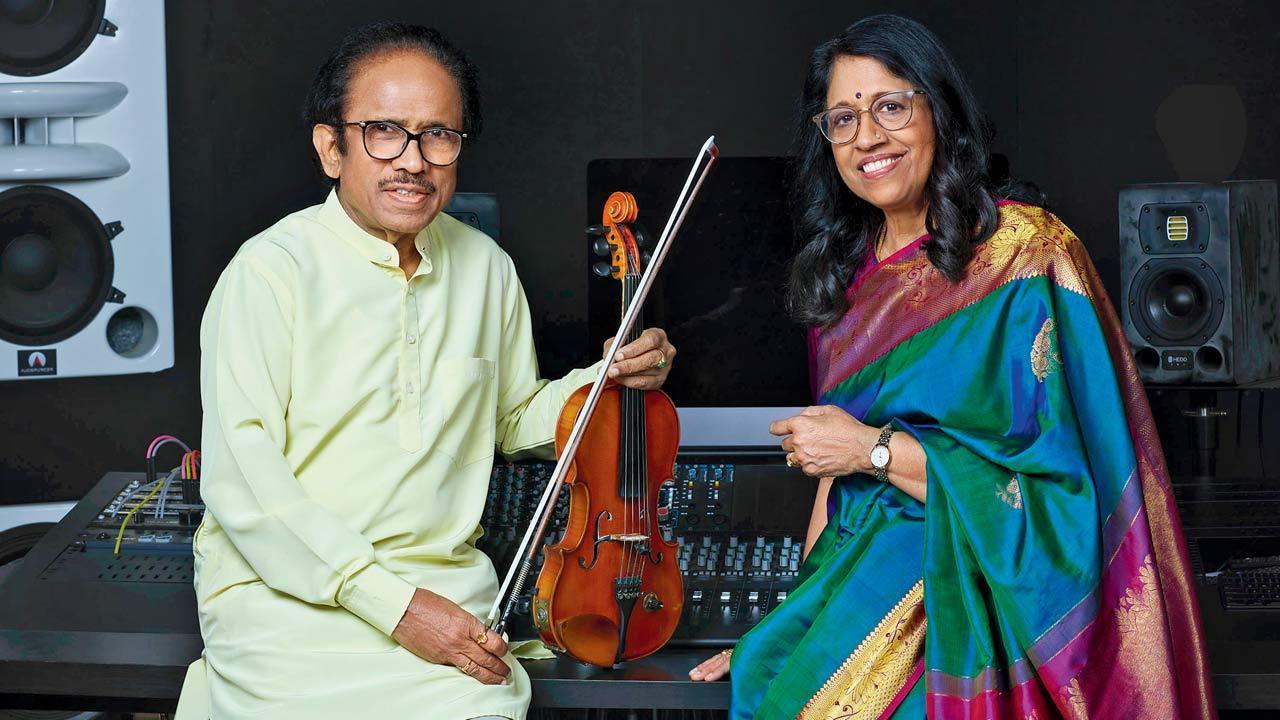
Violinist L Subramaniam with wife Kavita Krishnamurti. Pic/Jatin Kampani
Set to celebrate her journey spanning five decades with a city concert tomorrow, veteran singer Kavita Krishnamurti says striving for perfection keeps her motivated to pursue music each year
Sonia Lulla (MID-DAY; November 22, 2024)
Entertainment websites are often filled with tales of Kavita Krishnamurti’s musical journey commencing from her schooling days, however, the veteran singer appears to chronicle her experiences as vividly as though they occurred only yesterday. She recalls how a chance interaction with Hemant Kumar opened doors for her in the industry after he introduced her to Manna Dey, and the impact that being the dubbing artiste for Lata Mangeshkar had on her life. Her conversations are peppered with names of veteran musicians, as well as those who, despite being skilled, were unable to find a place in the limelight. If one taught her appropriate methods to breathe while rendering a song, another enabled her to understand the importance of learning musical notes.
At a city concert tomorrow, Krishnamurti is set to encapsulate these experiences into a set that promises to take music aficionados on a memorable journey. In this conversation, she discusses what’s in store for fans, and why she is certain her best work is yet to come. Edited excerpts from the interview:
When you have to encapsulate your life experiences into a musical event, how do you go about doing it?
First, it’s important to choose the most important songs to sing. Some part of the performance will be a tribute to all the great people I have worked with. I will subsequently [render] songs belonging to the time when I sang for Subhash Ghai and K Viswanath. I have videos of people, including music directors and actors, who have spoken about me and the songs we have worked on. There will also be details on how I got to sing popular songs like Hawa Hawai, and work with different composers like A R Rahman. The tribute section will celebrate those senior singers I have worked with and will narrate those stories about them that are relevant to my life. Finally, the show will include some of my popular songs from across the decades.
Your work has been pivotal to the lives of people across generations, with your most recent song being in last week’s release, The Sabarmati Report. How do you perceive this longevity?
I have grown up listening to the greatest artistes. I grew up listening to Lata ji, Asha ji [Bhosle], Manna da [Dey], and Kishore da [Kumar]. So, the standards that were set when it came to music were very high. I have always felt scared of falling short. I’m only weighed down [by pressure] when people praise the way I had rendered an old song. I wonder if I will be able to sing it on stage in the same way that I did 30 years ago. I keep telling myself, I have a few more years to sing, and I cannot allow myself to think that the best is over. I am also motivated by my husband, who, even at this age, after having performed for 70 years on stage, and at top concerts, sits at night to practice and says, ‘I’m not getting this note right.’ I feel I am listening to impeccable music, but he thinks he needs to do better.
Looking back at the last 54 years, which moments do you believe were most instrumental in shaping you as an artiste?
Singing with Hemant da [Kumar] was a big learning experience. He made me sing with Lata ji, and that was an eye-opener. Seeing her stand next to me and sing with perfection was unbelievable. After she would finish singing, I’d hear her voice and understand her approach. Another legend from whom I learnt was Manna Dey, who would reduce me to tears in each of his concerts because his music could transport me to heaven. He lived the life of a great artiste—he was dedicated to music till the age of 94, when he passed away. He was also a family man. He was attached to his wife, and I saw perfection in their relationship. He’d tell me, ‘Keep your feet on the ground, because when you go up, you also have to come down. Remember to keep track of your own money, go to the market, and buy your own stuff.’ [He] lived the life of a common person. Then, singing for Laxmikant-Pyarelal was also a defining experience, as was dubbing for Lata ji. I’d sing the song with the full orchestra, and then [after she would record it], notice how she sang it. I learnt so much about what great singing truly is.
Just imagine all the films Guru Dutt would have made had death not snatched him away too soon-Biswajeet
8:27 AM

Guru Dutt with Waheeda Rehman in Sahib Bibi Aur Ghulam; Biswajeet (right)
Roshmila Bhattacharya (MUMBAI MIRROR; July 11, 2020)
 April 20, 1963. The then President, Dr Sarvepalli Radhakrishnan, was presenting the 10th National Awards. Among those present at the Vigyan Bhavan that evening was Biswajeet Chatterjee, whose Bengali film Dada Thakur, based on the life of publisher-satirist Sarat Chandra Pandit, had bagged the President’s Gold Medal for the All India Best Feature Film. Satyajit Ray, whose Bengali film Abhijaan received the All India Certificate of Honour for Second Best Feature Film, could not make it to the function, but Guru Dutt was there to accept the President’s Silver Medal for Best Feature Film (Hindi) for his period drama, Sahib Bibi Aur Ghulam. “We bumped into each other in the lobby of Delhi’s Hotel Ashoka and Guru da whisked me off to the coffee shop for a cuppa and a chat,” the veteran actor reminisces 57 years later.
What makes this coffee meet interesting is that Biswajeet da was the filmmaker’s first choice to play Bhootnath, through whose eyes this story of aristocratic debauchery in feudal Bengal plays out. Bimal Mitra, who had helped the film’s writer-director Abrar Alvi turn his voluminous novel set in colonial India into a workable script, had taken Guru Dutt saab and his singer-wife Geeta Dutt, along with Abrar saab, to see the play, which drew packed houses every week at Kolkata’s Rang Mahal theatre, to check out the young actor playing Bhootnath. “He liked my performance and invited me to dinner at the Grand Hotel. I had always assumed that Dutt was an abbreviation for Dutta and that Guru da was a Bengali. So, I was happily chatting with him in fluent Bangla till Surya Ladia, his distributor-friend who’d escorted me there, started speaking in Hindi. Frowning, I asked him if he was from Kolkata or a probashi Bengali who’d grown up outside the state. He laughed and admitted that he was a Konkani but had spent his growing up years in Kolkata, studied dance at Uday Shankar’s academy and his guru was Jhoola and Kismet director Gyan Mukherjee,” shares Biswajeet da, who, after being offered the role of Bhootnath in Guru Dutt’s home production, was even introduced to Meena Kumari, Waheeda Rehman and the rest of the team as the film’s ‘hero’ at the filmmaker’s studio.
It’s another story that Biswajeet da regretfully turned down the offer, and peeved with Shashi Kapoor, his next choice for Bhootnath, for coming to a 6 pm narration three hours late, Guru Dutt saab shaved off his trademark moustache and looking years younger, stepped in front of the camera. “When I saw the film, I thought Guru da was perfect and looked every inch a Bengali. He had an uncanny likeness to a popular Bengali actor, Anil Chatterjee, and had pointed this out to both,” he recounts.
He was afraid Guru Dutt would be upset with him for turning down Sahib Bibi Aur Ghulam, but while filming his debut Hindi film, Bees Saal Baad, Biswajeet da would stay with his producer, singer-composer Hemant Kumar, and Guru Dutt would often drop by his good friend Hemant da’s Khar residence, ‘Geetanjali’. “And never did he convey through word or gesture that my refusal had irked him, even during a music session of Sahib Bibi Aur Ghulam with Hemant da. In fact, on occasions, I’ve been invited to his Pali Hill bungalow, where, true to her promise, Geeta di prepared a Bengali feast for all of us,” Biswajeet da reveals.
All through these years of camaraderie, Biswajeet da was most impressed with the way Guru Dutt seamlessly made the transition from commercial romcoms and thrillers like Baazi, Jaal, Aar Paar, Mr & Mrs 55 and CID to classics like Pyaasa, Kaagaz Ke Phool, Chaudvin Ka Chand and Sahib Bibi Aur Ghulam, in which he played the lead by default. I recalled Abrar Alvi saab telling me that after shooting two reels of Pyaasa, his director-friend had suddenly gone to Dilip Kumar with the role of Vijay. “It was only when Dilip Kumar turned it down, that he returned to play the protagonist. Even for Kaagaz Ke Phool, he had approached Chetan Anand, who had demanded as high a price as his brother Dev Anand and had only acted in Chaudhvin Ka Chand because he could not afford a big star after the debacle of Kaagaz Ke Phool,” Abrar saab had narrated.
Biswajeet da, who believes Pyaasa was his best performance, admits that he had hoped he’d get another chance to work with Guru Dutt after he came to Mumbai. “Geeta di dropped by my place one day with Nazar, Mehboob Khan saab’s assistant director, and informed that she was producing a film which he was to direct. She asked me if I’d play the leading man. I agreed immediately without even a script narration. But a few days later, Guru da passed away and Geeta di never spoke of the film again,” he rues.
Guru Dutt was born on July 9, 1925, and 39 years later, he was found dead at his Peddar Road apartment. He was working in two outside films at the time — Picnic with Sadhana and K Asif’s Love And God opposite Nimmi — and his own production, Baharein Phir Bhi Aayengi with Mala Sinha and Tanuja. “I had gone to meet Guru da at his studio shortly before his death. When I enquired about him, the watchman told me he had just driven past me,” Biswajeet da flashbacks. “He would do his make-up in his own studio before going for the shooting of Love And God. In his Majnu costume and beard, I had not recognised him. Even after all these years, I remember Guru da for the gentleman he was, soft-spoken, with a sweet smile always playing on his lips. Just imagine all the films he would have made had death not snatched him away too soon.”
100 years of melodies: Biswajit remembers Hemant Kumar
8:28 AM

Hemant Kumar with Biswajit and Lata Mangeshkar
Roshmila Bhattacharya (MUMBAI MIRROR; June 16, 2020)
Today, on singer-composer-filmmaker Hemant Kumar’s birth centenary, his protégé Biswajit Chatterjee remembers his ‘Mejhda’ as a God-gifted singer who always played down his golden voice, saying it was ‘uparwale ki den’ and he couldn’t claim any credit for it.
He was also a versatile and trendsetting composer—his classic ‘been’ music in the song “Man Dole Mera Tan Dole” from the 1954 film Nagin is still played, and not just on every TV show or film revolving around a snake, but also by stage and street performers. Ravi, who was his assistant at the time, created that music on the harmonium with Kalyanji bhai (of the musical duo Kalyanji-Anandji) supporting on the clavioline. “Both went on to become very successful music directors in their own right,” informs Biswajit da, adding that, as a producer, Hemant da was always ready to take risks.
His mentor launched him, an unknown hero from Bengal, in his debut production, the 1962 film Bees Saal Baad, and repeated him two years later in the suspense-thriller, Kohraa. While the former was a loose adaptation of the 1951 Bengali hit Jighansa, for which Hemant da had scored the music, and which was based on the Sherlock Holmes murder-mystery The Hound Of Baskervilles, Kohraa had its muse in Daphne du Maurier’s 1938 novel Rebecca. “Though they were in a darker genre, both these films had all the ingredients of commercial Hindi cinema—thrills, chills and great music. But the black-and-white Khamoshi, a remake of director Asit Sen’s Bengali film, Deep Jele Jai, and Rahgir before that, a remake of another Bengali film, Palatak, were huge risks for a producer. But wanting to do something new and different, he was wiling to take a chance,” says the veteran actor.
For Rahgir, Hemant da came back to Biswajit da, who, by then, had established himself as a guitar-strumming desi Elvis, and told him straight, as was his nature, that he wanted to cast him in a deglamorised role of a young man in a dhoti and ghamcha searching for the meaning of life. “Though Palatak was a huge hit in Bengal, Mejhda admitted that he didn’t know if there would be an audience for it in Hindi. Rahgir was a beautiful film with Mejhda’s evergreen “Janam Se Banjara Hoon Bandhu” and I was in the running for a National Award that year for my performance in it,” he flashbacks.
In the early ’60s, whenever he flew down to Kolkata for the shoot of Bees Saal Baad, Biswajit da would stay at Hemant da’s residence and was privy to many discussions between him and director Biren Naag in Hemant da’s music room over the songs, which went on till late in the night. “One day, I was surprised to see Gouri da (Gauri Prasanna Majumder, the number one lyricist in Bengal at the time) there. Mejhda had brought him down to write a song for our film. He penned, 'Kato Din Gelo Kato Raat, Tumi Elena Elena Elena Go', and returned to Kolkata. Mejhda handed over his song to Shakeel Badayuni, who translated it as 'Kahin Deep Jale Kahin Dil' which he set to tune and recorded with Lata ji,” shares Biswajit da, adding that even “'Yeh Nayan Dare Dare' has its muse in the Bengali song, ‘Ei Raat Tomar Amar’, from Deep Jele Jai”.
Biswajit da goes on to inform that during the making of the film, there were times when funds ran out and even though he was ailing at the time, Hemant da would go and do shows. The money earned would be handed over to the production controller to plan the next shoot. Bees Saal Baad premiered at Lotus theatre in Worli. “Dilip Kumar and Satyajit Ray were there, along with Lata ji (Mangeshkar) and Asha ji (Bhosle). After the screening, Lata ji, who was like family to him, invited us over to their place for dinner,” the veteran actor reminisces.
Biswajit da once asked him, who was his inspiration, and Hemant da picked out Pankaj Mullick for his simple, lovely renditions. He points out that Hemant da himself didn’t like any kind of musical jugglery. His songs were sweet and made you feel at peace. “Even his humming was melodious,” he asserts, remembering his dada as a dedicated artiste, committed to his art and always immersed in work. “He spoke his mind, hated flattery or sycophancy. If he had any vices, it was that he was a chain smoker. And if there was something he loved, it was mangoes. Dressed in a lungi and sando ganji, he’d sit on the floor with a basket, a mountain of peels and pits piling up besides him,” he chuckles.
He recalls many Chinese dinners with the family and late-night visits to Juhu beach. “Dressed in a lungi and a shirt, he’d drive us himself. There were no food stalls then or joggers. At around 10-11 pm, the beach was totally deserted. We’d sit on the sand around him and listen to him sing 'Ami Cheeni Go Cheeni Tomar Re Ogo Bideshini' and 'Yeh Raat Yeh Chandni' while the moon played hide-and-seek with the clouds and the waves lapped gently. It was magical,” Biswajitda remembers.
He himself was a popular singer in Bengal and there were times when they came together for Hemant Kumar-Biswajit Nights. His mentor took the stage at 8 pm and continued till a little past midnight, after which Biswajit da would take over and sing till dawn. “These concerts usually took place in winters and he’d sit wrapped up in a shawl which covered even his head to ward off the cold,” he laughs.
The ’60s matinee idol sighs that the concert he’d planned in Kolkata to commemorate Hemant da’s birth centenary had to be cancelled because of the coronavirus pandemic. “Mejhda was an instituion unto himself. Nagin and the Bengali film Shap Mochon released around the same time and both were blockbusters,” Biswajit da points out, saying that Hemant da sang not just in Hindi and Bengali, but in Tamil, Telugu, Malayalam and even Marathi. He popularised Rabindra Sangeet on screen and his “Vande Mataram” from Anand Math still resonates in our collective conscience. He even composed for an American English film, Siddhartha , with director Conrad Rooks incorporating two of his Bengali songs, “Pather Klanti Bhule” and “Oo Nadi Re”. “With him, an era ended, but Hemant Kumar can never be forgotten. His music will live on for another 100 years,” Biswajit da asserts, humming “Beqaraar Karke Humein Yun Na Jaaiye, Aap Ko Hamari Kasam, Laut Aaiye” as he signs off.

Lata didi ke saath gaane mein darr lagta tha-Asha Bhosle
6:53 AM

Debarati Sen (BOMBAY TIMES; December 20, 2019)
 It was just another hot Mumbai afternoon as we made our way up to the first floor of R D Burman’s house to meet Asha Bhosle for an interview. But, something changed as soon as we entered the house and found her practicing with a big bunch of musicians for a concert where she paid tribute to S D Burman, Salil Choudhary, Hemant Kumar and R D Burman. Witnessing the singer in her home ground, no holds barred, is what made the afternoon special. It was magical to see her talking about the taal, asking them to give a different note, discussing the nuances of sur and once in a while reprimanding someone with a smile, ‘Tumhi visarle ka?’ Later, with a cup of hot chai in her hand, the 86-year-old soprano diva, sat down for a candid chat with Bombay Times, where she shared anecdotes from a career spanning seven decades, and spoke about her legendary didi (Lata Mangeshkar), who has just returned home after being hospitalised for pneumonia. Excerpts...
‘I STARED AT DIDI IN AWE WHEN SHE RETURNED FROM THE HOSPITAL'
Thoughts of her elder sister Lata Mangeshkar is clearly uppermost on the singer’s mind. She gets emotional while talking about her didi being hospitalised for nearly a month. “Kal didi ghar aayi after being hospitalised for pneumonia,” she says, adding, “She was looking beautiful and has lost weight, too. So, I told her, ‘Heroine aa gayi humari.’ She smiled in response and I stared at her in awe, and all her songs came to my mind, one after the other, in quick succession.” The admiration in her voice is hard to miss when she talks of her elder sister, “At 90, she is a legend no one can ever forget, but even in the earlier days, it was not easy to sing with Lata didi. When you were standing with her, you had to be 99 per cent there, if not 100. Didi ke saath gaane mein darr lagta tha. With her, it was about being ready mentally, dhaadas zaroori thi, and himmat jutake hum gaatein the unke saath.”
‘SOMETIMES KISHORE DA WOULD BE A CHALLENGE’
The singer believes that her relationship with her sister is based on respect and purity. And if there was anyone else from her contemporaries who kept her on her feet while singing, it was Kishore Kumar. “I’d never feel scared to sing with anyone except didi and sometimes, Kishore da. I knew that he would do something different or something new in the song and iska mujhe jawab dena hai. Kishore and I’d often have this, ‘Tu apna taan bol, main dekhta hoon tu kya karti hain’. That is how we’d sing. These were some amazing relationships. Pyaar-vyaar ke jhanjhat ke rishte toot jatein hain, but paak rishta end tak rehta hai. Inn logon ke saath mera bahut hi paak rishta tha,” she says, adding, “When I listen to any Kishore da song, his image comes up right in front of me. I still remember how he’d laugh and make everyone else laugh. Unka hasana bahut hee mashhoor tha.” She’s also known for her memorable duets with Mohammed Rafi, whose versatility and repertoire as a singer was well-known. Talking about him, Asha says, “Rafi sahab se kabhi bhi daar nahi lagta tha, because unhe jo sikhaya jaata tha, he’d sing just that. But yes, I’d get intimidated by compositions of some music directors like Jaidev and Madan Mohan sometimes. Kuch tedhe cheez laatein the gaane mein, which would scare me. Salil da (Chowdhury) was a lot into English opera. He had great knowledge of western music, so his songs were completely different. Har sur jump karta tha unke gaano mein. In fact, every music director had their own mood, style and idiosyncrasies that we had to adapt to. It was tough, but we’d concentrate in making them great."
‘I LOVED HEMANT DADA SINCE I WAS A KID’
She considers singer-musician Hemant Kumar her all-time favourite. “Hemant dada mere bahut hi priye singer the,” she states. “No one else has a voice like him even now. When I was a child, we used to stay at Nana Chowk. I had not begun singing for films then, but every evening I’d listen to Hemant dada’s songs on the radio. There were other singers like Jagmohan Sursagar and Pankaj Mullick, but I’d wait for his songs. I still remember one of his songs that I loved then — ‘Aanchal Se Kyun Baandh Liya Mujh Pardesi Ka Pyaar, Jaane Wale Se Rukne Ki Asha Hai Bekaar’. I was in love with his voice. He was also tall that I had to to crane my neck to look at him when I first saw him. Woh bade aadmi the in every sense and also, a great human being. We began working together later and became friends.”
‘PANCHAM EXCELLED IN EVERYTHING’
If there is anyone that she calls her ‘guru’, it is her late husband, music director R D Burman. “Pancham (RD’s nickname) was my guru. I learnt so much from him. Mujhse kya kya gawaaya, kya kya sikhaya hai,” she smiles while recalling some songs in disbelief. Calling him a versatile composer, she adds, “Just like a sundae with 10 different ice creams, that’s how Pancham was. He excelled in everything, including western, folk and so many other genres. S D Burman (musician and RD’s father) would always tell me, ‘Asha, tu zara Pancham ko bol ki woh folk na bhulein’. And Pancham would tell me, ‘Mere Baba ko bolo ki thoda western milayein (laughs!)’. Toh aisi jodi thi unki... Sometimes I’d worry when I had to sing for Pancham as he would give me some tough compositions, but then it would be so much fun, too.”
‘CAN’T NEW MUSIC DIRECTORS COMPOSE THEIR OWN SONGS?’
While the singer recalls some of her experiences with delight, she is clearly not amused with the trend of remixing old songs. “Can’t new music directors compose their own songs? They take old songs and bigaad bigaad ke unka remix banate hain,” says the singer, adding, “I would have appreciated if they do a remix well, but they don’t. Songs like Chura Liya, Hungama Ho Gaya, Yeh Mera Dil are tough. Whoever created these tracks were intelligent and talented people — unke paas gala tha, dimaag tha. And these days, inn logon ke paas dimaag bhi nahi hai, gala bhi nahi hai. Kya kar rahein hain they don’t know.” She doesn’t like the tod-mod that happens with classic songs. Not mincing words, she says, “Fools go in places where even Gods hesitate to tread. When singing a Lata Mangeshkar song, a Kishore or Rafi song, unhe sochke kadam rakhna chahiye. I don’t like the todmod that happens in remix. It’s like ‘kahin ki eenth, kahin ka roda, Bhanumati ne kunba joda’. In earlier days, bahut mehnat hoti thee, bahut riyaz hota tha. Now, the world has become fast, no one has the patience or dheer for anything.”

Hemant Kumar went everywhere in a dhoti, shirt and chappals and there was no doubting his genius-Biswajit Chatterjee
8:39 AM

Biswajit and Hemant Kumar
Roshmila Bhattacharya (MUMBAI MIRROR; June 22, 2019)
A few months ago, at a stage show in Ahmedabad, there was an overwhelming demand for “Yeh Nayan Dare Dare”. Veteran actor Biswajit who has crooned this Kohraa chartbuster at many such concerts across the country and the globe, was not surprised. Hemant Kumar’s voice, he reasons, still resonates in our collective consciousness.
He was a friend of the singer-composer’s youngest brother Amol Mukherjee and a frequent visitor to their Bhowanipore home in Kolkata. In fact, on Biswajit da’s first trip to Mumbai, it was Hemant Kumar whom he addressed as Mejhda, who took him around and introduced him to Filmistan Studio’s owner Tolaram Jalan and the big boss Shashadhar Mukherjee. But no film offers came his way and Biswajit da returned to Kolkata and the stage where he was drawing full houses as Sahib Bibi Golam’s Bhootnath. That’s where Guru Dutt spotted him and offered him the same role in his screen adaptation. But after many second thoughts, Biswajit da turned down Guru Dutt’s Sahib Bibi Aur Ghulam even as he wondered apprehensively if anyone would offer him another Hindi film.
Hemant Kumar did, meeting him backstage one evening during a performance to tell him the time had come for him to quit theatre. “I am making a Hindi film, Bees Saal Baad. I’ve already signed Waheeda Rehman and I want you as my hero.” And so, Biswajit da came to Bollywood and quickly caught the eye in the thrillers, Bees Saal Baad and Kohraa, earning himself the adage of ‘suspense hero from Bengal’. Both films are remembered for their evergreen scores and he recalls Bengali lyricist Gauriprasanna Mazumder and Hemant Kumar working together at the latter’s Pali Hill residence, Geetanjali, on a Bengali song, “Koto Din Gelo Koto Raat, Tumi Elena Elena, Elene Go”. This song was then handed over to Shakeel Badayuni to rework as the theme song of Bees Saal Baad. The haunting “Kahin Deep Jale Kahin Dil” bagged both the lyricist and its playback singer Lata Mangeshkar Filmfare Awards.
Two other still-hummed tracks picturised on Biswajit da, “Zara Nazron Se Kehdo ji” and “Bekaraar Karke Humein Yun Na Jaiye” were rendered by Hemant Kumar himself. “Mejhda had lent his voice to several of my hit Bengali songs, including 'Nijhum Sandhaye' (Monihar), 'Kache Robe' (Chowringhee) and 'Ei Meghla Dine Ekla' (Sesh Porjonto). We carried our collaboration forward into Hindi cinema. Just before Bees Saal Baad, Mejhda had hit a rough patch professionally yet he indulged debutant director Biren Nag’s requests for huge sets and never cut corners. Whenever money was short, he would simply take off even though he was ailing at the time, do a few concerts and hand over every rupee to the production controller. Such was his passion for cinema!” Biswajit da marvels of the man who would have turned 99 on June 16.
He went on to do more films with Hemant Kumar, from the Hrishikesh Mukherjee-directed comedy Biwi Aur Makan to the intense drama, Rahgir, which got him a National Award nomination in the Best Actor category. “The film had some very beautiful compositions by Mejhda, from 'Janam Se Banjara Hoon Bandhu' which was penned by Gulzar to 'Baid Ke Palle Pade' which was sung by Kishore Kumar,” Biswajit da informs.
Having seen his mentor through his highs and troughs, he points out that Hemant Kumar’s behaviour, lifestyle and friends never changed. “He went everywhere in a dhoti, shirt and chappals and there was no doubting his genius. My mother was among the first to spot his talent when he was just coming up. She would have been so proud if she had lived to see him sing for me,” he says emotionally.
Biswajit da was just as proud that Hemant Kumar composed the Indian music for Conrad Rooks’ American English film, Siddhartha. The Shashi Kapoor-Simi starrer incorporated two of his Bengali songs, “Oo Nadi Re” and “Pather Klanti Bhule”. “Recordist Minoo Katrak would say that Mejhda’s golden voice was meant not just for Bengal and Bollywood but Hollywood too,” he signs off with thoughts of how to pay a tribute to his mentor in his centenary year.

Nagin ran to empty theatres; then the 'been' music caught on-Jayant Mukherjee
7:26 AM

Roshmila Bhattacharya (MUMBAI MIRROR; January 12, 2016)
In early 50s, filmmaker Sashadhar Mukherjee invited director Hemen Gupta, singer-composer Hemant Kumar and actor Pradeep Kumar to come down to Mumbai from Kolkata and collaborate on a production for his studio, Filmistan. The film was Anand Math, based on Bankim Chandra Chattopadhyay's 1882 Bengali novel by the same name, set against the Sannyasi Rebellion in 18th century Bengal. "The film didn't run but over 60 versions of "Vande Mataram" have come up since, but none could beat the one scored by my father," asserts Jayant Mukherjee, Hemant Kumar's son.
Anand Math was followed by Shart, another musical success for its evergreen "Na Yeh Chand Hoga Na Taare Rahenge" but a commercial failure. "Disheartened by the flops, baba decided to return to Kolkata and reached CST Station from where ma secretly called up S Mukherjee and informed him that they would be taking the train in a few hours," reminisces Jayant.
The filmmaker told her that he was on his way and not to inform Hemant. The composer who was smoking dejectedly turned to come face-to-face with an angry Sashadhar who caught him by the scruff of his neck and asked him why he was going back. "You need to give a hit first, else it will be an insult to me since I brought you down," he reasoned, and soon after offered him Nagin.
Mukherjee's son, Deb, points out that his father had put Pradeep Kumar on the road to success with the historical Anarkali. "Both Shammi Kapoor and Pradeep Kumar had auditioned for the role of Prince Salim. My father opted for the latter even though he didn't speak Urdu, hiring a teacher so he got the pronunciation right and cast Shammi in Hum Sab Chor Hai. Anarkali was a superhit and my father decided to repeat the director-actor jodi of Nandlal Jaswantlal and Pradeep Kumar in Nagin. Since his Anarkali, Bina Rai, didn't know dancing, they opted for Vyjayanthimala who rocketed to the big league with this film. Hemant Kumar and Pradeep Kumar also never looked back after Nagin," informs Deb.
However, Jayant is quick to remind that for the first two weeks, Nagin ran to empty theatres. As a boy of 10, he remembers accompanying his baba to Regal and Lido cinemas where only flies buzzed around and, seeing him return home, bitterly disappointed.
"But then a miracle happened. The 'been' music caught on across India and the film blazed like an Australian wildfire, going on to celebrate a platinum jubilee run," Jayant exults.
Interestingly, even though Hemant Kumar had planned to use a real 'been' which he got from a sapera (snake charmer) for the song, "Man Dole Mera Tan Dole" he eventually got the music he wanted by combining a clay violin strummed by Kalyanji and the harmonium played by his assistant Ravi.
The story revolved around Mala and Sanatan who like a '50s Romeo-Juliet, fall in love despite the acrimony between their tribes. According to Jayant, the most ludicrous thing about the plot was that Vyjayanthimala lay sleeping for two weeks after she is bitten by a snake, till her lover plays the 'been' to bring the reptile back and take away the poison so she can be reunited with him.
"But the film went down well with the audience, perhaps because of the dozen songs, five of which were used one after another, in the climax," he marvels.
Deb adds that for the first 10-12 reels, his producer father let the director have his way before asking to see it. "Hemant Kumar had come up with five songs of which one had to be selected and used just before the interval. My father took that twist in the plot to the end, playing all five songs, one after the other, getting a lab in London to colour just those reels while the rest of the film was in black-and-white," he adds.
Hemant Kumar bagged the Filmfare Award for Nagin which had some unforgettable tracks like "Mera Dil Ye Pukare Aaja", "Jadugar Sainyya Chhodo Mori Bainyya" and "Tere Dwaar Khada Ek Jogi" to name a few. But the song that made hisssstory was "Man Dole Mera Tan Dole" with its "been" music which reportedly had brought a snake slithering into a theatre in Hyderabad during a show.
Aparna Sen does not give credit to anyone working with her; manipulates things-Moushumi Chatterjee
8:03 AM

Priya Gupta (BOMBAY TIMES; May 13, 2015)
Moushumi Chatterjee, 60, is
chullbula, honest and compassionate. She does her puja and
reads the namaz and considers herself spiritual. She lives for others,
but has a mind of her own. Her original name was Indira (petname still
Indu), but was changed to Moushumi when she entered films as there
already was an Indira Gandhi and an Indira cinema theatre in Calcutta. We
met her over a cup of coffee just ahead of the release of her film Piku
in her penthouse apartment in the Gitanjali building in Khar that was
earlier a landmark address -her father-in-law Hemant Kumar's most famous
Gitanjali bungalow that was broken down by her husband after his
father's death and made into apartments. She talks to Bombay Times about
why she still misses Hemant Kumar, her respect for Amitabh Bachchan and
why she will never work with Aparna Sen again. Excerpts:
Why do you feel that a woman should not be asked her age?
How many years does a woman live her life on her own terms? That's the reason a woman should not be asked her age. As a woman, you are always compromising with either your parents or husband or children or even friends.
What are you like?
I am mischievous and childlike. Ages back, when I entered the film industry, Raj Khoslaji told me at the time of shooting Kuchhe Dhaage, 'Moushumi, you are either 8 or 80.' So, I am naïve in many ways and mature in others. I remember when Dharamji (Dharmendra) came to sign me for Ghayal and I told him, 'Why don't you take someone else?' He said, 'No one in your generation has the innocence you have.' I am also basically very lazy by nature. When I got married, my father told my father-in-law Hemant Kumar, 'She is a wild horse. Leave her loose, otherwise, she will fall herself and will also make you fall.' I was always naughty, but never a spoilt brat. You can make me do anything with love. But I always tell my daughters, 'Don't give shit and don't take it either.'
How did you become the daughter-in-law of the Hemant Kumar?
Ever since I was very young, I was a movie buff. I would bunk school to go and see a film. My grandfather was a judge and my father in the army, and I come from a very conservative family. One day, I was returning from school when a director, who lived close by, saw me. He wanted to cast me in Balika Badhu and came to my house to take my father's permission. My father initially said no till the director's wife, who was also a big actress, requested him to allow. I was in Class V only and my film was a jubilee hit. I also won a Filmfare Award. After that everyone wanted to make me their daughter-in-law or marry me. Hemant Kumar was the music director of the film and he was a big director and singer. He liked me and also wanted me to marry his son Jayant Mukherjee (lovingly called Babu). When I was in Class X, my aunt was in the last stage of cancer and wanted to see me married. So, within a month, my father-in-law Hemant Kumar, who I called Kaku (initially) and Baba later, got me married to his son and exported me to Mumbai. Shakti Samanta offered me the role of a blind girl in Anuraag that my father-in-law, being an artistic person, encouraged me to do. It became a jubilee hit. I was not just a minor wife, but also soon became a minor mother.
Talk about your father-in-law Hemant Kumar?
He was both my father and mother. He died of a heart attack 26 years back in 1987. He was very affectionate and a very kind-hearted human being. After my parents, if I really respected someone, it was him.
Do you have friends in the industry?
I don't have friends in the industry. I am lucky. And I am lucky that I don't have any enemies either.
Do you consider yourself a lucky person?
I will say God is not kind to me, he is partial to me. At the age of 18, I had a daughter in my lap, had a Mercedes car that I had bought with my own money. And I have been lucky to have such a good husband and daughters. And had an awesome father-in-law who never made me feel in Mumbai that my parents are not here. When he died also, he kept howling saying, 'Kaku Baba... get up.' Industry has tolerated a lot of nonsense of mine and had so much patience with me. My career was unplanned. I was just about 18 when I had my first child and I remember my doctor telling me, 'For the first time in my nursing home, a baby is having a baby.' I had already done Anuraag and everybody told me don't have the baby. They all thought that I was not serious about my career as I also returned the money to many producers and I too thought that that was the end and that I would just settle down. But then films after films clicked and I bounced back. I am a positive person and don't think that anything happens without a reason. I know that you can be a big celebrity, but at home if you are still a celebrity or a queen and don't do what you have to, then you cannot make a home. I learnt from a very young age and am very down to earth and I know that everything is very temporary, be it your name, fame or money. Today it is there and tomorrow it will not be there. The only thing that will remain is your behaviour, your sincerity and your thinking.
Do you miss your father-in law?
Yes. Every time I fight with my husband, there is nobody to support me and I miss him then.
What did Hemant Kumar like the most about you?
That I came to know only after he expired as one of his friends, Ajit uncle, told me. He said, 'You know Indu, once me and Hemant were coming back from one recording in the car, and I asked him, 'There were so many offers for Babu. Why were you adamant about Indu?' And I believe my father-in-law told him, 'Ajit, I have seen so much of the world, being a celebrity, but maine iss bachchi mein jo mann dekha na, woh maine kahin paaya nahi aaj tak.' I miss him and really wish that I could have done even more seva for him than I did.
Talk about your experience working with Amitabh Bachchan after many years in Piku?
I have a lot of respect for Amitji not just only because he is a great actor, but given the facelift he has given to our industry. He is still way ahead of his generation. I once took my sister-in-law to meet him and she was frozen. I am very proud of him.
Did you have a favourite co actor?
I am actually a Chintu fan. Rishi Kapoor is my favourite actor, but he is a spoilt brat. Chintu was arrogant at
times and he still is but he is my most favourite as he is an awesome actor.
Your last film was Goynar Baksho that was directed by Aparna Sen. How was your experience?
Aparna Sen is a very good writer and an awesome director, but I will never work with her again. I feel that she does not give credit to anyone working with her and she manipulates things. To me, she is a phoney person who does not want to share credit with people who have worked on the film. Even though I was the actress of Goynar Baksho, she tried her level best to push her daughter Konkona. Though let me tell you that I am a big fan of Konkona as an actress. Konkona is also a genuine person. Aparna is an insecure person even though she is so good looking and has so much talent.
Why do you feel that a woman should not be asked her age?
How many years does a woman live her life on her own terms? That's the reason a woman should not be asked her age. As a woman, you are always compromising with either your parents or husband or children or even friends.
What are you like?
I am mischievous and childlike. Ages back, when I entered the film industry, Raj Khoslaji told me at the time of shooting Kuchhe Dhaage, 'Moushumi, you are either 8 or 80.' So, I am naïve in many ways and mature in others. I remember when Dharamji (Dharmendra) came to sign me for Ghayal and I told him, 'Why don't you take someone else?' He said, 'No one in your generation has the innocence you have.' I am also basically very lazy by nature. When I got married, my father told my father-in-law Hemant Kumar, 'She is a wild horse. Leave her loose, otherwise, she will fall herself and will also make you fall.' I was always naughty, but never a spoilt brat. You can make me do anything with love. But I always tell my daughters, 'Don't give shit and don't take it either.'
How did you become the daughter-in-law of the Hemant Kumar?
Ever since I was very young, I was a movie buff. I would bunk school to go and see a film. My grandfather was a judge and my father in the army, and I come from a very conservative family. One day, I was returning from school when a director, who lived close by, saw me. He wanted to cast me in Balika Badhu and came to my house to take my father's permission. My father initially said no till the director's wife, who was also a big actress, requested him to allow. I was in Class V only and my film was a jubilee hit. I also won a Filmfare Award. After that everyone wanted to make me their daughter-in-law or marry me. Hemant Kumar was the music director of the film and he was a big director and singer. He liked me and also wanted me to marry his son Jayant Mukherjee (lovingly called Babu). When I was in Class X, my aunt was in the last stage of cancer and wanted to see me married. So, within a month, my father-in-law Hemant Kumar, who I called Kaku (initially) and Baba later, got me married to his son and exported me to Mumbai. Shakti Samanta offered me the role of a blind girl in Anuraag that my father-in-law, being an artistic person, encouraged me to do. It became a jubilee hit. I was not just a minor wife, but also soon became a minor mother.
Talk about your father-in-law Hemant Kumar?
He was both my father and mother. He died of a heart attack 26 years back in 1987. He was very affectionate and a very kind-hearted human being. After my parents, if I really respected someone, it was him.
Do you have friends in the industry?
I don't have friends in the industry. I am lucky. And I am lucky that I don't have any enemies either.
Do you consider yourself a lucky person?
I will say God is not kind to me, he is partial to me. At the age of 18, I had a daughter in my lap, had a Mercedes car that I had bought with my own money. And I have been lucky to have such a good husband and daughters. And had an awesome father-in-law who never made me feel in Mumbai that my parents are not here. When he died also, he kept howling saying, 'Kaku Baba... get up.' Industry has tolerated a lot of nonsense of mine and had so much patience with me. My career was unplanned. I was just about 18 when I had my first child and I remember my doctor telling me, 'For the first time in my nursing home, a baby is having a baby.' I had already done Anuraag and everybody told me don't have the baby. They all thought that I was not serious about my career as I also returned the money to many producers and I too thought that that was the end and that I would just settle down. But then films after films clicked and I bounced back. I am a positive person and don't think that anything happens without a reason. I know that you can be a big celebrity, but at home if you are still a celebrity or a queen and don't do what you have to, then you cannot make a home. I learnt from a very young age and am very down to earth and I know that everything is very temporary, be it your name, fame or money. Today it is there and tomorrow it will not be there. The only thing that will remain is your behaviour, your sincerity and your thinking.
Do you miss your father-in law?
Yes. Every time I fight with my husband, there is nobody to support me and I miss him then.
What did Hemant Kumar like the most about you?
That I came to know only after he expired as one of his friends, Ajit uncle, told me. He said, 'You know Indu, once me and Hemant were coming back from one recording in the car, and I asked him, 'There were so many offers for Babu. Why were you adamant about Indu?' And I believe my father-in-law told him, 'Ajit, I have seen so much of the world, being a celebrity, but maine iss bachchi mein jo mann dekha na, woh maine kahin paaya nahi aaj tak.' I miss him and really wish that I could have done even more seva for him than I did.
Talk about your experience working with Amitabh Bachchan after many years in Piku?
I have a lot of respect for Amitji not just only because he is a great actor, but given the facelift he has given to our industry. He is still way ahead of his generation. I once took my sister-in-law to meet him and she was frozen. I am very proud of him.
Did you have a favourite co actor?
I am actually a Chintu fan. Rishi Kapoor is my favourite actor, but he is a spoilt brat. Chintu was arrogant at
times and he still is but he is my most favourite as he is an awesome actor.
Your last film was Goynar Baksho that was directed by Aparna Sen. How was your experience?
Aparna Sen is a very good writer and an awesome director, but I will never work with her again. I feel that she does not give credit to anyone working with her and she manipulates things. To me, she is a phoney person who does not want to share credit with people who have worked on the film. Even though I was the actress of Goynar Baksho, she tried her level best to push her daughter Konkona. Though let me tell you that I am a big fan of Konkona as an actress. Konkona is also a genuine person. Aparna is an insecure person even though she is so good looking and has so much talent.

Subscribe to:
Posts (Atom)