Showing posts with label Heeba Shah. Show all posts
Showing posts with label Heeba Shah. Show all posts
Thanks to my mother, and Naseeruddin Shah’s prodding, I keep going back to theatre-Amruta Subhash
8:30 AM
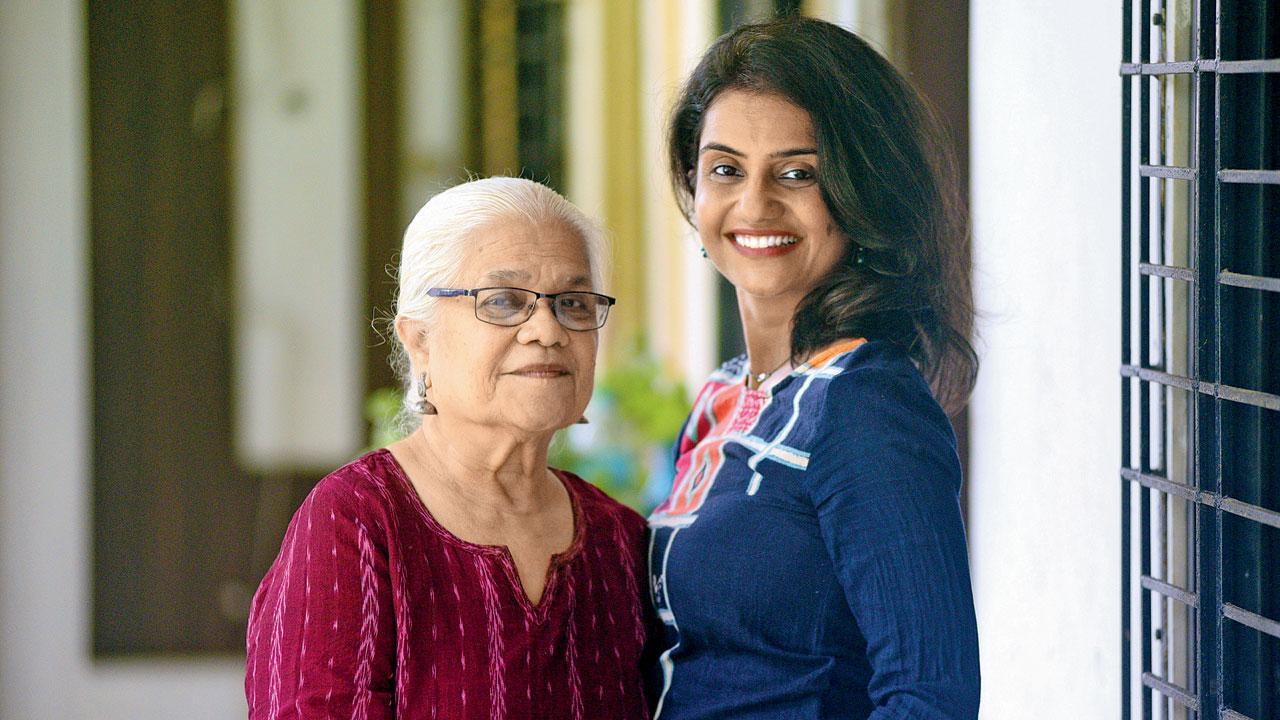
As she readies to return to theatre with Firse Honeymoon, Amruta Subhash credits actress mother Jyoti for lessons on performance, life and everything in between
Aastha Atray Banan (MID-DAY; August 7, 2022)
“I once came home from school and mom was mumbling under her breath, reading a script. I asked her, what she was doing, and she said ‘one needs to spend some me time with the character. When one does that, the character opens up and speaks to you’,” says actor Amruta Subhash, while recalling a memory from her childhood. It has now become her go-to mantra when prepping for a role. We are sitting with the Bombay Begum actress and her theatre veteran mother Jyoti, who you will remember as the grandmother in Gully Boy, at their Kala Nagar home. Subhash’s Filmfare trophies and press cuttings adorn the study table.
The mother-daughter are in sync. Subhash recently put up a video on social media, celebrating her mother’s 75th birthday, expressing awe at her “waterfall” energy. “My mother was at NSD [National School of Drama], and one of her batchmates was Naseeruddin Shah, who was also my teacher. Later, I was course mates with Heeba [Shah’s daughter]. We would always share notes about how our parents were so accomplished, and what would we need to do to match up. Even now, when Naseer sir meets me he says, ‘Ya, I know you got an award for that show, but then are you doing theatre?’.”
That question perhaps did the trick. Subash, now along with working on two OTT shows, is returning to theatre with Firse Honeymoon. The play, written and directed by her husband Sandesh Kulkarni, who played Ganesh Gaitonde’s father in Sacred Games, is a relationship story. “It’s every couple’s story... What happens when the spark burns out? It’s about a couple revisiting the scene of their honeymoon 12 years later.”
Growing up, theatre was all around her. Thanks to her mum, she was surrounded by theatrewalas like Satyadev Dubey and Shriram Lagoo. Jyoti recalls, “At NSD, we did folk plays from all over the country, but we were also exposed to German, French and Russian plays. Artistes from those countries would come down and work with us. I remember acting with Naseer in Eugène Ionesco’s The Lesson.”
The septuagenarian has just finished shooting for a small part in Rajkumar Hirani’s Dunki, which stars Shah Rukh Khan. “My memory doesn’t serve me well, so doing larger parts is harder for me,” she confesses. Amruta adds, “When mom met SRK, she told him that she had met his father, who used to run the canteen at NSD. He leaned, and lowered his forehead so that she could kiss him.”
The mother and daughter seem content with where they are in life, and it reflects in their energy and beaming faces. “At 75, I have realized that nothing is constant. But some things remain the same. As far as art is concerned, or human expression is concerned, or valuation of each expression is concerned, that stays the same. So is our idea of good and bad. One is always striving to be better, and that struggle happens with actors all the time.”
Amruta admits that there is lot to learn from her mother. She remembers attending the rehearsals of Girish Karnad’s Tughlaq, where Jyoti played the evil stepmother. “I used to think, ‘at home, mum is so sweet, making bakhri for us, and on stage she is screaming’. What happens to her? I knew then that I wanted to learn everything about this process of being able to transform oneself.”
But the most important lesson that Amruta says she has learnt from her mother is to remember that the core of an artiste is about performing. “It’s not about seeking validation from how many people are watching the show. My mum comes from the tradition of Rashtriya Seva Dal [a grassroots-front organisation of the Indian National Congress]. They inculcated some values in my mum, which she inculcated in me. Everything is not about money, everything is not about being famous—the core is what you are getting out of it, and finding out what makes you happy. Thanks to my mother, and Naseer sir’s prodding, I keep going back to theatre, which gives me that happiness.”

I will not do anything on screen that will embarrass my family-Riva Kishan
8:02 AM

Rachana Dubey (BOMBAY TIMES; December 31, 2019)
 Riva Kishan, Bhojpuri star Ravi Kishan’s daughter, is all set to make her Bollywood debut with Sab Kushal Mangal. The young actress, who wanted to pursue a career in cinema ever since she was a child, spoke to BT about the advice her father gave her when she decided to join the industry, working with a senior co-actor like Akshaye Khanna and more. Excerpts:
Bollywood saw over a dozen debuts in 2019. Priyaank Sharma and you will be the first pair to be launched in 2020. Are you nervous that the spotlight will be on you?
I am aware of the newcomers who were launched in 2019 and what each one has done and is doing. I don’t compare myself with anyone because we all have had our individual journeys into this profession. We are such different people that there is no reason for anyone to compare us.
This film was an unexpected gift when I was visiting Mumbai. I was in London, where I was attending acting workshops when this project came my way. It’s been a year-long journey since then, and today, I don’t feel nervous. I’ve tried my best to live up to my director’s vision. My father (Ravi Kishan) is always there for me and had prepared me to face this industry a long time ago. In fact, although I was a nerdy kid, I could never stay away from doing plays and dance acts in school. I worked with Naseeruddin Shah’s theatre group. His daughter Heeba Shah is someone who has taught me a lot.
Why did you want to make your debut with Sab Kushal Mangal?
It’s a clean movie with a power-packed story and two heroes falling for my character. What else could I ask for in a debut? The story was beautiful, but uske baad, badi mehnat karni padi set pe. Aasan nahi tha acting karna, halanki narration sunne mein bada mazaa aata hai. On the first day of shooting, Priyaank and I filmed a romantic song. I was nervous and emotional. After the initial bouts of hesitation, we were both chilled out. We had done workshops together, but that is different from the actual shoot.
Akshaye Khanna is such a senior and fine actor, was it intimidating to share screen space with him?
I was nervous before meeting him on set, but after I met him, things were different. He didn’t make me feel like a newcomer and never made me conscious of the fact that I’m a novice. It can be difficult to work with seasoned actors, but if they warm up to you, things can be a little easy. Akshaye sir was encouraging and supportive. We fumbled with our lines and at times, we would also goof up, but he never lost his cool. He would give us a little pep talk and help us overcome the difficult portions of the scene.
Given that you’re the first girl from your family to become an actor, how did they react to your decision?
My father and mother were very supportive and that’s what matters to me. Dad knew about my passion for cinema since I was a kid. When I was ready to step into the business, he had the most practical and valuable advice for me. He told me about the pros and cons with absolute clarity. Yes, my family is traditional, but I was never stopped from pursuing what I liked. My father told me, ‘Gandh mein mat padna. You don’t have to do everything that comes your way. If you love it, live it.’ I also understand that as the eldest child in the family, I have to be careful about the decisions that I make. Although I know that people’s mindset changes with exposure, I am very clear that I will not cross the line of decency and do anything on the screen that my family will be embarrassed about.
Will that restrict your career choices?
No, I am not limiting myself to anything. As long as people like me as an actor, they will give me work that they think I am capable of pulling off. I will leave the rest to destiny. I’m here to act and do a good job of any role that comes my way. Aur main itna pre-plan nahi kar sakti life ko, nahin toh mera present out of focus ho jayega. I’ll take it one day at a time.
Your father is a superstar in Bhojpuri films, and you will inevitably be compared to him. Does that bother you?
I don’t even think about it because whether I am compared to him or not, he will be my father and someone I deeply admire. To the world, he is a Bhojpuri actor, but to me, he’s my father, and I am like him. I don’t feel any pressure because I have his genes and that’s enough for me.
When was the first time you realised what your father does? Which was his first film that you saw?
It was his first Bhojpuri film called Saiyan Hamar. I was a little girl then. In the scene that I saw, my father was being beaten up by the baddies. I started howling as I could not bear to see someone hitting him. I stopped watching his films till I grew up. I used to enjoy the fact that dad also threw kicks and punches. As a child, I’ve visited his sets though he never let any of us see him work. In fact, he didn’t even come to my set when I was shooting. He allowed me my space as an actor. Of course, he was always a call away even when he was in the thick of election campaigns. There are times when my mother misses my calls because she has a thousand errands to run, but my father has never been unavailable to me.

There is a serious lack of constructive criticism towards theatre in India-Ratna Pathak Shah
7:38 AM

Prominent film and theatre personality Ratna Pathak Shah is joined by actor Heeba Shah, in a candid conversation about performing arts in the country and more
Reema Gowalla (BOMBAY TIMES; May 16, 2019)
Naseeruddin Shah’s play, The Father had an exhaustive twoweek run outside the city recently. Centred around the subject of dementia, this production also features actors Ratna Pathak Shah and Heeba Shah, who essay the same roles in the play, but in different shows. We caught up with the two a little before their last performance. Excerpts:
Most interactions nowadays are limited to taking a selfie ...
Ratna: We don’t always get to interact a great deal with the audience, partly because of the length of the piece. And at the end of two hours, it’s difficult, especially for Naseer, to find more energy to interact with people. But what’s more unfortunate is that all are interactions have become limited to taking a selfie. We often say that no to photographs. But almost 50% of people, largely consisting of the middle-aged crowd, turn back and walk away. It’s the younger one who usually behind to talk to us; ask questions.
Do you think theatre, in a way, can be considered a source of living in India?
Heeba: Maybe in a way, you could. But it’ll require you to go out and ensure that you have a lot of grants coming in for your play. Right now, the kind of sponsorship that is available for films, is not there for theatre, unless the play is a replica of the film that one is doing. Having said that, I think it is good in a way. Because, the advantage of theatre as an art form is that it is not done entirely for money. It’ll be ideal, if you could survive on theatre and make a lot of money out of it, as in, we put in as much hard work on stage as our counterparts do in films. But again, there are certain aspects that are exclusive to theatre alone. There is always the factor of excitement on stage; you get the energy to live and be happy with it. On stage, you get to rekindle your flame that is about to go off. The creative freedom is always more in theatre.
Ratna: However small your production is, it costs money to bring about a play. And it’s not easy to raise that kind of money. India nurtures various kinds of theatre. There is commercial theatre in different languages, in which actors do manage to survive with the money they earn. I think film versus theatre is a bad comparison to make. Both are two completely different mediums that are made with different intentions and likewise incur different costs. The lack of money is a big issue in theatre. So, if you ask whether or not an actor or a playwright can survive by doing theatre alone? The simple answer is no! Partly because, we don’t believe in giving royalties. There are a number of people in this country who do theatre without giving any royalty to the writer. It also goes under the heading of ‘poor theatre’. This problem needs to be addressed too. Again, there is the lack of quality theatre also. One needs to constantly push boundaries to bring in good plays. The issues in theatre are complicated, and there are no easy answers to them. Nonetheless, despite having so little money in it, there are so many people who still want to do theatre. This art form gives you something that no other work can give.
How can the government help?
Ratna: We need more theatre hubs all over the country. And that is where I feel real government intervention can help — give us a place for rehearsals and spaces where we can perform. The government has completely abdicated its responsibility, and so have the corporates. They would rather organise an awards night, as part of their CSR activities, which would actually be of no benefit for the theatre community. Instead, that money should be directed towards building new spaces and make them available for theatre practitioners at a cheaper rate.
What’s your take on the lack of criticism towards theatre?
Ratna: We are past our prime. But for the younger lot in this country, this atmosphere is no good for creativity. Having said that, there is also a serious lack of constructive criticism towards theatre in India. But when I say criticism, I mean it in its technical sense — critical analysis. It does not necessarily mean finding negative things in somebody else’s work. This kind of an approach cannot lead to good work. There should be feedback — some mechanism, by which I am judged for what I am doing. There is a tremendous lack of criticism within the theatre community itself. Again, there is no professional criticism. Nobody is being made to stand up for their opinions. If you didn’t like my play, tell me why you didn’t like it. Don’t give me a half-baked patronising statement. I feel, this is very dangerous.
Yours is a family of theatre people. What happens when there is a disagreement among each at home regarding a play?
Ratna: When we have disagreements, we sulk for some time, and then we make up. Of course, discussions are often centred around theatre. But I don’t think we have identical opinions. There are things that I like, but the others don’t. And sometimes, it’s the other way round. We enjoy talking about theatre and performances a lot. In The Father, for instance, Heeba and I play same role. Of course, the age difference is obvious. But initially, there was a major problem in thinking of Naseer as my father. I thought I was doing it well until somebody pointed out saying, “Hey, he is your father in the play, not your husband. So, stop treating him so seriously.” That’s when I realised that she was right. We don’t take our parents half as seriously as we do our partners. You tend to speak with your parents with a familiarity that you don’t often manage with your partner. That incident changed my entire perspective of the play.
It is so boring to play the good guy-Naseeruddin Shah
7:50 AM

A deliciously wicked Naseeruddin Shah on what gets his creative juices flowing, what Hindi cinema lacks today and why he’s not signing more films these days
Roshmila Bhattacharya (MUMBAI MIRROR; September 21, 2017)
From Macbeth to Titus Andronicus it’s been a long journey with the Bard. Has the interpretation of Shakespeare’s plays changed for you as an actor?
Everybody feels that Shakespeare has only recently been discovered by the Hindi film industry. That’s not true. Even before Vishal Bhardwaj’s Maqbool (an adaptation of Macbeth), Omkara (Othello) and Haider (Hamlet) there were versions of Hamlet by Sohrab Modi and Kishore Sahu. Then, there are all the clichés we’ve borrowed. Shakespeare in Hindi cinema is not new, adaptations per se are, for which Vishal can take the credit.
Shakespeare’s plays lend themselves wonderfully to popular Hindi cinema because like our film writers, he too was writing for particular actors and companies with the intention to entertain. I don’t think he dreamt that 400 years after his death, his plays would still be performed in languages across the world. It is testimony to his powerful story-telling. Commercial Hindi cinema is also about stories. It’s immaterial how well or how badly the film is made, if the story is good, it will grab the audience’s interest.
What was it about Titus Andronicus that made you agree to do an adaptation?
Let me start by saying that the film, The Hungry, is far less gory than the play. Titus Andronicus was Shakespeare’s first play and you can see him trying to find his feet as a playwright in this blood-drenched story. In the film, the violence is implied and that works for it in a powerful way. I thoroughly enjoyed playing this despicable, hateful person. It is so boring to play the good guy. Luckily, I haven’t had to play too many. I’d rather play the deliciously wicked subedar in Mirch Masala or the don in Bombay Boys, one of my favourite performances. Tathagat Ahuja in The Hungry is, on the surface, refined and cultured but has this blood lust that can’t be satisfied. Fortunately, my mum is no more. She’d have hated to see me in these roles.
What makes you accept a film today? Is money the incentive?
If it states something I believe in, I’d happily be a part of it irrespective of the length of the role or the money. I accepted The Hungry not because it’s Shakespeare but because the script had the same kind of chilling effect on me as when I heard about the Chadda brothers shooting each other or Indrani Mukherjea strangling her daughter (Sheena Bora). I spent the first 30 years of my life in small towns like Aligarh, Meerut, Ajmer and Nainital. I’ve seen such landlords who live like kings and for whom there’s a different set of rules. This script evoked that world.
What excites me about acting is that you can live so many imaginary lives. But I’m getting bored with movies now. Apart from The Hungry, I’ve done one-scene appearances in Neeraj Pandey’s Aiyaary and Ravi Jadhav’s Marathi film Nude. There’s also a Gujarati film, Dha (Idiot), in which I play a small part of a jaadugar.
In a recent interview you said a Jaane Bhi Do Yaaro (JBDY) remake is no longer relevant. Is there a film that would lend itself to a remake or a sequel?
JBDY could lend itself to a sequel but it’d have to be a completely different film. A sequel wouldn’t be possible as Ravi (Baswani), Om (Puri) and Bhakti (Barve) are dead and the others have turned fat, lazy and prosperous, including director Kundan Shah. Also, the scale of corruption has magnified since the bridge collapsed and a cop accepted a bribe of an atthani. Today, you’ll have to take away a few lakhs to make Kundan worried. After the film released, some income tax officers I met asked me to urge Kundan to make a film on the IT department. I suggested it, he didn’t act on it. But the times are crying out for films that reflect the truth of what’s happening.
You could direct it yourself?
I’m not technically equipped to direct and don’t have the inclination to learn new techniques at this stage. I’d rather direct on stage where I’m more at home, open to re-examining my work, changing, adding and subtracting from it.
Today with the audience spoilt for choice, what will bring them to the theatres?
Well, any old film with 10 stars will no longer work. They never did but the industry persisted with them as they brought in big bucks. Now we have to strive towards “special occasion films” which are entertaining and made with conviction. Films like Masaan, Dum Laga Ke Haisha, Kaun Kitne Paani Mein, Nil Battey Sannata and Lipstick Under My Burkha. These filmmakers are not sitting in an air-conditioned room and posing as bleeding heart liberals, they are making films on subjects that concern them and touch their lives. This ‘movement’ beats that of the ’70s, which had a lot of pretentious filmmakers who turned out to be hypocrites. The success of films like Toilet - Ek Prem Katha and Lipstick... over the monstrous Mubarakans is a sign that content is working.
Your daughter, Heeba, is working with Majid Majidi while son Vivaan is inclined towards commercial cinema. You discuss films with them?
Yeah, we talk cinema, theatre and literature, but they don’t ask and I don’t advise them on their choices. They may make some mistakes, but I’ve had my share too. Heeba got Mango Souffle, Poorna and even Majidi’s film on her own steam. I’m proud of it. Vivaan doesn’t have much of a choice, he does whatever comes to him. He’d be happy to do a serious film too but so far he’s only got the intended blockbusters like 7 Khoon Maaf and Happy New Year which didn’t quite bust the box office. He’s happy working.
From the current crop, has any actor caught your eye?
Rajkummar Rao and Nawazuddin (Siddiqui) are getting their due. Then, there’s Kalki (Koechlin) and Konkona (Sen Sharma) who are not new but are among our finest actors. This generation of actors is leagues ahead of mine. At Rajkummar’s age, I couldn’t have delivered the kind of performances he has done in films like Trapped. We have directors, investors and a skillful bunch of actors. What we lack are writers and stories.
Should films like The Hungry and Waiting that have a story to tell get a wider release than the monstrous Mubarakans?
With a film like Mubarakan the audience knows exactly what they are in for while with a Waiting they are taking a chance, so I don’t forsee big releases for niche films. As it is, the film industry is pretty resentful of a Lipstick’s success. We should just be content that these movies are getting made and will survive to be seen a 100 years later along with the Mubarakans. Then, people can judge.
I am yet to meet anyone in the film industry with whom I can talk about acting-Naseeruddin Shah
8:06 AM

Neha Maheshwri Bhagat (BOMBAY TIMES; November 2, 2016)
When you are facing one of
the best talents in the country it's easy to get intimidated.
Especially since Naseeruddin Shah's reputation of being brutally honest
precedes him. And, he doesn't disappoint. The actor doesn't mince words
- be it about his family, films, theatre in India, or the recent outrage
against Pakistani artistes working in our movies. We catch up with Naseer
as he prepares to stage Riding Madly Off In All Directions, which
premieres at the Prithvi Theatre Festival presented by
Bombay Times. The fest will be held from November 3 to 14. Excerpts...
You are staging a play with your entire family (wife Ratna Pathak Shah and children Heeba, Imaad and Vivaan) for the first time. What made you think this was the right script?
I wanted to do a play with my family, and have loved Stephen Leacock's stories for long. I don't know what makes me choose a script; it's instinctive. Something stirred within me when I read those scripts, and I felt that they could make for a stimulating theatre evening; something that's not just entertaining, but also food for thought.
 Do the dynamics change when you work with your family?
All my children have the potential to be very good actors, but they resist my attempts to educate them. I don't yell at them as much as I do at other actors whom I love, too. Any other student would go home and forget about my yelling, but if I yell at my children, it can seep into our personal lives. You can call it ego or consideration for treating my family members differently. Having said that, I am not less demanding. I push them, as I want them to do well. Over the years, I have also learnt that yelling isn't the way to handle actors. I got yelled at as a student; my teachers would get absolutely hysterical. I too started doing that and I regret it greatly. I have perhaps done more damage by yelling and it has taken me long to realise the fact.
Is theatre more educating than cinema?
I have great doubts about either theatre or cinema being effective mediums of education. Theatre can give you an insight into something, but it can't alter your perception of life. That will happen only to those who desire to delve deeper into this mystery called life. There are zillions of PhDs and MAs who talk the most illiterate stuff and zillions of trained actors who don't know the first thing about their job. So, it's all about self-education.
Do your children have the same approach towards theatre as your wife and you?
I don't think theatre means as much to them. I have to accept my children for whatever they are. Their approach might prove to be valid at some point and mine, a little too traditional. They take life more lightly than we did and that's because they didn't face the same struggles. But then, who am I to wish that they should face struggles? What the hell have I worked so hard for? I aspired to give them everything that I didn't have. Why should I wish that they go through the same nightmares that I went through? In fact, I envy them. I don't doubt their integrity or intelligence. I may be critical of their approach, but who knows where it may lead them.
But doesn't struggle enhance the actor in you?
My children have a different kind of struggle - to prove themselves, which is no less than my struggle to earn my bread. They have already got a head start on the work front. I had nobody in the city when I came here. They have known a lot of people since they were born.
You are selective about your roles in Bollywood but more active in theatre. Why?
I owe it to this medium, as it has given me a lot. Everything I have learnt about life, literature, poetry, speech and aesthetics has been through theatre. I was not a good student in school. Studying mathematics was torture and I always cursed it, as I would always score zero. Forget theatre, mathematics is taught so badly. No teacher ever has tried to tell us about the magic of numbers. I realised it when I was doing tables with my son.
Does your inclination towards theatre also stem from the fact that there aren't enough roles for actors like you in Bollywood?
We don't have those kind of writers in cinema. In theatre, I can pick anything from the last 5,000 years. I can do a William Shakespeare, Oscar Wilde and George Bernard Shaw. Great writing transcends time.
And what about actors?
(Laughs) I can count on half the fingers of one hand the number of conversations I have had with other actors. Frankly, I am yet to meet anyone in the film industry with whom I can talk about acting. You can talk about parties, films, girls and anecdotes, but not acting.
Is theatre today better than it was in the 80s or 90s?
It's an illusion. The kind of theatre the corporates are patronising are efforts in the wrong direction, including the attempt to bring Broadway here. We don't need Broadway; we have got Hindi cinema. Broadway serves the same purpose in the West as Hindi commercial cinema does here. It's got jaadugari; it's part discotheque, part magic show and part music concert. It's not theatre and that's what these corporates are encouraging. They call it spectacular stuff, which is nonsense in my view. Secondly, it's not presented with consummate excellence, which you see in a Broadway production of the West, because they have been doing it for 100 years now. We are new at it and hence, clumsy. I neither believe in that kind of theatre nor do I watch it.
You are brutally honest, which is an antithesis of an actor...
Yes, I suppose. As a director too, I was brutally honest. I love my actors and want them to do well. Sometimes to get them to do well, you have to torture them.
Because of that, you often get mired in controversies, the latest being the Rajesh Khanna incident. Do you regret having said that?
I don't regret what I say, as I have always said what I meant. The media tends to exaggerate, but I have got used to it. So, I am inclined to speak a little less to the media, because I don't want what I say to be sensationalised. I don't want to sound like Donald Trump (laughs), but the fact is, sometimes the media tries to make their headlines sensational. I had said the same thing about Mr Khanna earlier, no one got upset then. So, I think it's something to do with the atmosphere prevailing today.
Your Pakistani short film Jeewan Hathi is yet to release. What do you think of it, considering the ongoing tension between the two countries?
I don't think it will ever be screened here. The deal will fall through, as the channel, which produced the film, has stopped telecasting Pakistani shows. They had planned an Indo-Pak collaboration with five Indian and Pakistani filmmakers' short films, which were to be shown together.
You are staging a play with your entire family (wife Ratna Pathak Shah and children Heeba, Imaad and Vivaan) for the first time. What made you think this was the right script?
I wanted to do a play with my family, and have loved Stephen Leacock's stories for long. I don't know what makes me choose a script; it's instinctive. Something stirred within me when I read those scripts, and I felt that they could make for a stimulating theatre evening; something that's not just entertaining, but also food for thought.
All my children have the potential to be very good actors, but they resist my attempts to educate them. I don't yell at them as much as I do at other actors whom I love, too. Any other student would go home and forget about my yelling, but if I yell at my children, it can seep into our personal lives. You can call it ego or consideration for treating my family members differently. Having said that, I am not less demanding. I push them, as I want them to do well. Over the years, I have also learnt that yelling isn't the way to handle actors. I got yelled at as a student; my teachers would get absolutely hysterical. I too started doing that and I regret it greatly. I have perhaps done more damage by yelling and it has taken me long to realise the fact.
Is theatre more educating than cinema?
I have great doubts about either theatre or cinema being effective mediums of education. Theatre can give you an insight into something, but it can't alter your perception of life. That will happen only to those who desire to delve deeper into this mystery called life. There are zillions of PhDs and MAs who talk the most illiterate stuff and zillions of trained actors who don't know the first thing about their job. So, it's all about self-education.
Do your children have the same approach towards theatre as your wife and you?
I don't think theatre means as much to them. I have to accept my children for whatever they are. Their approach might prove to be valid at some point and mine, a little too traditional. They take life more lightly than we did and that's because they didn't face the same struggles. But then, who am I to wish that they should face struggles? What the hell have I worked so hard for? I aspired to give them everything that I didn't have. Why should I wish that they go through the same nightmares that I went through? In fact, I envy them. I don't doubt their integrity or intelligence. I may be critical of their approach, but who knows where it may lead them.
But doesn't struggle enhance the actor in you?
My children have a different kind of struggle - to prove themselves, which is no less than my struggle to earn my bread. They have already got a head start on the work front. I had nobody in the city when I came here. They have known a lot of people since they were born.
You are selective about your roles in Bollywood but more active in theatre. Why?
I owe it to this medium, as it has given me a lot. Everything I have learnt about life, literature, poetry, speech and aesthetics has been through theatre. I was not a good student in school. Studying mathematics was torture and I always cursed it, as I would always score zero. Forget theatre, mathematics is taught so badly. No teacher ever has tried to tell us about the magic of numbers. I realised it when I was doing tables with my son.
Does your inclination towards theatre also stem from the fact that there aren't enough roles for actors like you in Bollywood?
We don't have those kind of writers in cinema. In theatre, I can pick anything from the last 5,000 years. I can do a William Shakespeare, Oscar Wilde and George Bernard Shaw. Great writing transcends time.
And what about actors?
(Laughs) I can count on half the fingers of one hand the number of conversations I have had with other actors. Frankly, I am yet to meet anyone in the film industry with whom I can talk about acting. You can talk about parties, films, girls and anecdotes, but not acting.
Is theatre today better than it was in the 80s or 90s?
It's an illusion. The kind of theatre the corporates are patronising are efforts in the wrong direction, including the attempt to bring Broadway here. We don't need Broadway; we have got Hindi cinema. Broadway serves the same purpose in the West as Hindi commercial cinema does here. It's got jaadugari; it's part discotheque, part magic show and part music concert. It's not theatre and that's what these corporates are encouraging. They call it spectacular stuff, which is nonsense in my view. Secondly, it's not presented with consummate excellence, which you see in a Broadway production of the West, because they have been doing it for 100 years now. We are new at it and hence, clumsy. I neither believe in that kind of theatre nor do I watch it.
You are brutally honest, which is an antithesis of an actor...
Yes, I suppose. As a director too, I was brutally honest. I love my actors and want them to do well. Sometimes to get them to do well, you have to torture them.
Because of that, you often get mired in controversies, the latest being the Rajesh Khanna incident. Do you regret having said that?
I don't regret what I say, as I have always said what I meant. The media tends to exaggerate, but I have got used to it. So, I am inclined to speak a little less to the media, because I don't want what I say to be sensationalised. I don't want to sound like Donald Trump (laughs), but the fact is, sometimes the media tries to make their headlines sensational. I had said the same thing about Mr Khanna earlier, no one got upset then. So, I think it's something to do with the atmosphere prevailing today.
Your Pakistani short film Jeewan Hathi is yet to release. What do you think of it, considering the ongoing tension between the two countries?
I don't think it will ever be screened here. The deal will fall through, as the channel, which produced the film, has stopped telecasting Pakistani shows. They had planned an Indo-Pak collaboration with five Indian and Pakistani filmmakers' short films, which were to be shown together.

I was in a play before I actually watched one-Imaad Shah
9:26 AM

The Shahs of theatre, who have plays running over the weekend, on how their world's a stage
Reema Gehi (MUMBAI MIRROR; June 5, 2016)
He's almost through with the day's rehearsals as he settles at the patio of a studio in the narrow lanes of Aram Nagar. Vivaan Shah's version of Edgar Allan Poe's Comedy Of Horrors, which opened at a literature festival last year, plays tonight. "To my mind, this is a children's play for adults," he points out.
During the day, dad Naseeruddin Shah stages Gadha aur Gaddha, while sister Heeba Shah wowed the audience with The Conference of the Birds (Parindon Ki Mehfil) — based on a 12th Century Persian poem Mantaqut-Tay by Fariduddin Attar — yesterday. "We were all busy with our own professional commitments and passions during the last couple of years. Now, we have a strong need to focus on our Motley (theatre group set up by Naseeruddin and Benjamin Gilani in 1979) like we did in our early teens," says Vivaan. "We want to come back, even if it means working backstage, doing production work, or sound. This was long overdue."
Older brother Imaad, who has composed music for Gadha aur Gaddha, nods, "Well, it's our family endeavour and enterprise. And by family, I mean everyone who has worked their backs off in making every production happen. We may have our own ambitions to fulfil, but Motley is where we started from. I don't see it as external from us." Heeba adds, "Post NSD, I thought I could manage on my own. But I couldn't. Working with Motley helped and it became easier. We work like crazy, but it's great fun. You feel at home."
During the last couple of years, Heeba continued to pursue her passion for dance, Imaad found his calling in music (he is part of the electro funk/ nu disco duo MADBOY/MINK comprising his girlfriend Saba Azad and him, while composing and scoring for films), Vivaan channelled his interest in commercial cinema with films such as 7 Khoon Maaf, Happy New Year and Bombay Velvet. But theatre remains a common pursuit running through their vein. "I think, theatre is the only life we knew. The initiation just happened. Nobody asked us. I was in a play before I actually watched one," says Imaad referring to his roles in plays such as Samuel Beckett's Waiting for Godot and William Shakespeare's Julius Caesar, while he was still a child. "That's when I was first introduced to the smell of backstage. Till date, it takes me back to my childhood."
Vivaan enthusiastically pitches in, "I remember how actors and production managers used to tell us 'shhh', when we used to make a lot of noise or try to play cricket backstage."
Watching rehearsals at home in the evenings was a norm, and the three feel immensely grateful "to grow up around some of the most interesting people in the world," says Vivaan. "Starting from our parents (Naseeruddin and Ratna Pathak Shah) to the whole gang at Prithvi, Mak, Benjamin, Akash Khurana."
To Imaad they were their "most favourite people in the world."
Heeba recalls an incident when she was still in school, and couple of her friends were over, "and these guys were rehearsing at home, and they were quite alarmed when they heard people screaming," she laughs.
"Speaking of rehearsals," Imaad points at Vivaan, "There was this one time we were rehearsing for Julius Caesar back in the 1990s and there was a scene where Akash Khurana was lifted up on the back and it was a serious scene, and a little Vivaan screamed, 'Ganapati Bappa Morya.'" While participating in rehearsals is inevitable, reading the text over and over again is considered sacrosanct within the Motley circle. "You read a text until it becomes part of your being," says Heeba. "Many a time I get impatient, but that is how we have been trained."
Imaad reasons, "If you actively sit and mug it, you won't remember. Re-reading helps build muscle memory."
Theatre aside, music is a common passion that bonds the Shah siblings. "In fact, the music I was exposed to thanks to Ims and Heeba aapa has shaped me as a person," says Vivaan. "Heeba aapa sang Madonna's Papa don't Preach to Imaad as lullaby. That's where his fascination with disco comes from."
Heeba (daughter of the late Parveen Murad) was well into her teens when her father remarried his co-actor Ratna. From playing the protective older sister, the dynamics in their relationship changed as the boys grew up, "and as we started hanging out with each other more," says Vivaan.
Spending the weekends at "aapa's house" in Malad, after she moved out of their home in Bandra, is a fond memory still fresh in Vivaan's mind. "We started discovering the arts whether it is theatre, music, dance or film." The three have gotten very thick in the last seven years. Imaad says, "I guess growing up does that to you. All of us have reached a certain point where we have started recognising each other as friends. We like to take what we can from each other's passion." Heeba smiles, "They are my sounding boards. They not only give me feedback, but also offer solutions. And that just shows how much they care."
Brutal honesty is the cornerstone of their bond. "We take harsh honesty from each other and don't feel insulted. Viv's feedback for my first film was that I was terrible and I viewed that as constructive criticism. I don't understand people who surround themselves with 'yes-man'", says Imaad. "I am a strong proponent of the thought that everyone's opinions deserves space, especially in the world we are living today. So, within my core inner circle, I ensure that line of communication is constantly open with regard to feedback."
Subscribe to:
Posts (Atom)