Showing posts with label Guwahati. Show all posts
Showing posts with label Guwahati. Show all posts
Salman Khan steps up to aid Assam flood victims with relief drive
9:21 AM

As Assam battles one of its worst floods, Salman Khan teams up with his fan club in the state to distribute food; Bhumi Pednekkar provides ration and hygiene kits
Upala KBR, Mohar Basu (MID-DAY; July 28, 2026)
Devastation and destruction have gripped Assam over the past 10 days, as the state has been battling one of its worst floods in recent years. In the wake of the floods, members of the Hindi film industry have begun mobilising relief efforts on the ground. mid-day has learnt that Salman Khan, who has been shooting Vamshi Paidipally’s yet-untitled next in Mumbai, has been coordinating with his fan club in Assam to distribute food and essential supplies to the state’s worst-hit areas.
A source close to the actor told mid-day, “He connected with the Salman Khan Fan Club [SKFC] Assam and planned a phased process to aid the affected.”
In the first phase of the initiative, Khan’s NGO Being Human has joined forces with the SKFC Assam to distribute ready-to-eat food packets in Sivasagar, from Guwahati.
“Each packet consists of biscuits, jaggery, poha, puffed rice, bread, cheese, and jam. Salman’s priority is to make sure families have enough food to last for at least three days until the situation improves,” added the source.
They are also distributing sanitary pads, mosquito coils, drinking water, and water purification tablets.
The second phase, to be started next week, will focus on distribution of ration kits and medicines. In the final phase, Being Human will undertake the responsibility of reconstructing schools and hospitals in severely affected areas.
Actor Bhumi Pednekkar has also extended support by partnering with Bharat Disaster Relief Foundation (BDRF), which is currently providing ration kits, hygiene kits, drinking water, and other essential supplies to families in Sivasagar.
A source said, “When Bhumi found out that BDRF was driving relief efforts in Assam, she partnered with the non-profit organization.”
Fans queue up from 3 am as Zubeen Garg's last film opens to packed houses with 4:25 am show
2:53 PM

Mukut Das (THE TIMES OF INDIA; November 1, 2025)
Guwahati: Assamese cinema witnessed an unprecedented spectacle Friday as queues began forming outside theatres across the state at 3 am for the release of cultural icon Zubeen Garg's last film, Roi Roi Binale. By 4:25 am, halls were packed for the pre-dawn shows of what has become a musical catharsis for millions seeking closure since the artiste's death just over a month ago.
Many arrived carrying flowers to shower on Zubeen the moment he appeared on screen as a blind singer in what he had proudly promoted as "Assam's first-ever musical". Emotions soared as his personal favourite and biggest hit, Mayabini, reverberated through theatres before the opening credits rolled. Some cried; others screamed his name.
Rajesh Bhuyan, who co-directed the film with Zubeen, said Roi Roi Binale had turned into something far greater than cinema. "This is the first time in Assam's history that a film is being screened before sunrise. And why not? Zubeen's final act doesn't just entertain - it heals," he said.
The title track, already topping charts, is a recreation of the song from Zubeen's 1998 album Sobdo. "Through the film and its music, we wanted to evoke hope after pain," Bhuyan added.
Zubeen's wife Garima, sister Palme Borthakur and other family members watched the film in a Guwahati theatre in the evening, leaving a seat symbolically vacant between Garima and Palme.
CM Himanta Biswa Sarma said he would watch the film later to avoid crowding theatres. "We'll request Jonaki Hall in Guwahati to organize a special screening," he said. The BJP-led cabinet has decided to hand over the state's GST share from Roi Roi Binale to the Kalaguru Artiste Foundation, set up by Zubeen for the welfare of the underprivileged. "There's no provision for tax exemption, so the GST collected will be transferred to his foundation," Sarma added.
With tickets for all shows over the next week sold out, Roi Roi Binale is on course to shatter Assamese box-office records. Most theatres are screening up to seven shows a day. Fans outside Assam await its release in select cities.
Zubeen died in Singapore on September 19, plunging Assam into collective mourning.
I want to know exactly what happened the day Zubeen died-Garima Saikia Garg
8:00 AM

Shantanu Nandan Sharma (THE ECONOMIC TIMES; October 26, 2025)
In the serene hills of Sonapur, just beyond Guwahati’s bustle, the place where Assam’s music icon Zubeen Garg was cremated is a site of pilgrimage, visited by thousands every day. On the night of October 21, when ET reaches the spot, there are about 4,000 people—some lighting lamps and incense sticks, others draping gamosas, the traditional red-and-white scarves, over photographs of their beloved Zubeenda.
A group of young fans climb a small hillock nearby and their voices ring in the dark sky—“Joi Zubeen da”, “Justice for Zubeen”. Night buses from Guwahati pause for a few minutes for passengers to step out—with bowed heads, they leave flowers, prayers and tears for the legend whose voice had once united them all.
It has been over a month since Garg’s untimely death on September 19 in Singapore, where he reportedly drowned while swimming without a life jacket. Authorities in Singapore and Assam continue their investigations to determine whether there was foul play.
The site in Sonapur is now called Zubeen Kshetra after his wife, costume designer Garima Saikia Garg urged his fans not to use the word samadhi (memorial). She said the effort would be to keep Zubeen alive forever. She has kept the sindoor on her forehead—a symbol of their bond that began in 2002 when she married the celebrated singer of Maya and Mayabini fame. In their modest apartment in Kahilipara, Guwahati, a new piece of digital art adorns the wall: there’s Zubeen with his guitar and Garima in her red bindi.
In an interview with Shantanu Nandan Sharma, she talks about the lingering questions she has about the day he died—“How could everyone neglect an artist like Zubeen Garg in such a manner?”—and her attempts to protect and preserve his legacy. Edited excerpts:
Tell me about this image of you and Zubeen Garg on the wall.
It is a digital artwork prepared by Ashwini Barkataki, an artist from Jorhat. It reflects my decision to retain the sindoor and the bindi after Zubeen’s death. The guitar represents Zubeen’s music and his strong presence. I love this photo as it captures the emotions I’m going through now. That I need to be strong is also very much visible on my face here.
Do you suspect any foul play in Zubeen’s death?
I want to know what exactly happened on that day. Zubeen was taken out for a yacht party on September 19, but I—and our entire family—want to know every minute detail from the previous night. A video circulating on social media shows how he was enjoying the previous night, singing “Tears In Heaven” (by Eric Clapton) with a local artist. But if you see his videos the next day (on the yacht), he is wearing the same dress. I want to know whether he got a chance to sleep that night at all. Zubeen was not a person who woke up early in the morning. He was not a day person. He always slept during the day and got up at 3 or 4 in the evening. Nothing in the world excited him during the day. He used to go to bed in the morning, and we ensured he never got disturbed during the day. But that day (September 19), he was taken to the yacht so early.
The previous night, he replied to a WhatsApp message from one of our team members in Guwahati at 11:25 pm. That means he was awake at 2 at night Singapore time. I want to know whether he slept that night. Were there people sitting around him the whole night? Was he taken out for the party very early in the morning? We have learnt that he did not get a chance to have breakfast. Also, from his face, as seen in the video, you can make out that he did not sleep the previous night. He was looking very tired. He seemed so exhausted.
How did you come to know about the tragedy?
There were two missed calls from his manager Siddharth (Sharma, now in judicial custody). I called him back. It was about 1:15 pm (India time). He picked up the phone, and I heard him crying, ‘Dada, dada.’ I asked what happened to dada (Zubeen). I immediately suspected there could have been a seizure attack, so I first asked him: ‘Did he take the medicine in the morning?’ He did not reply. I asked him: ‘Are you taking him to the hospital, or have you called a doctor to the hotel?’ I had no idea that Zubeen was not in the hotel but inside a yacht.
What happened then?
I heard him say CPR (cardiopulmonary resuscitation, an emergency procedure that is given when heart stops). I could not believe it. Zubeen had no cardiac issues. I said, ‘Tell me what happened to Zubeen?’ Siddharth passed the phone to someone who identified himself as Abhimanyu Talukdar (president of the Assam Association of Singapore) who said Zubeen was in the water and possibly had a seizure attack. I got scared. I asked: ‘Why then is CPR being given?’ He was fumbling. I asked: ‘Is Zubeen breathing properly? When did the convulsion stop?’ After all, such convulsions last 15–20 seconds, sometimes less.
I also asked him if there was a doctor there or not; who was giving him the CPR? I was told some coastguards were giving him CPR. I was shocked. Why coastguards? I was screaming. He assured me that they were all trained. Only then did I come to know that Zubeen was in a yacht and there was no doctor nearby. I was told it would take some 10 minutes or so to reach the coast where there was an ambulance.
What did you do next?
I immediately informed Bhanti (Zubeen’s younger sister and academic Palme Borthakur) and my brother. I started praying. I also kept calling, asking how long it would take them to reach the hospital. Every time the answer was: 5–10 minutes. It was at that moment that I decided I would fly to Singapore as soon as possible. I had to be with him at the hospital during the treatment.
And then?
I realized I needed a visa to go to Singapore. So, I called up Pabitra Margherita (minister of state for external affairs, who was once Zubeen’s roommate and anchored his music shows in the 1990s). He told me to send a photo of my passport, and assured me that there wouldn’t be a problem getting a visa. I was readying to go. By then, I kept calling to ask whether Zubeen was being treated by doctors or not. After some 45 minutes, I came to know they had reached the hospital. Siddharth called me to get the prescription of medicines Zubeen was taking as the doctor was asking for it.
Which medicines did Zubeen take regularly?
Zubeen took two medicines regularly—Starpress tablets for blood pressure and Levipil for seizures. These two were a must. He also took Vitamin E tablets. Much later (after his mortal remains reached Guwahati), when I was asked to identify his bags, I spotted these three medicines in the bag he was carrying (to the yacht). As he was not having breakfast, maybe he thought he would have some food during the day and then take the medicines.
Did you make any video call to see Zubeen’s condition?
I made video calls, but I did not see his face. Once in the hospital, Sanjive Narain (a media owner who was in Singapore to participate in the Northeast India festival) spoke with me. I requested him, please show me Zubeen. I also told him, if he’s in the ICU, never take the ventilator off. Zubeen will fight back. Singapore has some of the best doctors. Let them try their best. As I was speaking with him over the phone and praying to god for Zubeen’s recovery, there was already a large gathering outside our home. That meant the news (of his death) was already out. No one told me directly that Zubeen was no more. I understand that.
Do you feel there is too much politics around him now, against the backdrop of his immense popularity?
I won’t talk politics, but everything (leading to his death) was not as easy and straight as I initially thought. If you see what happened from the previous night, it was pure negligence. When Bhanti (sister-in-law) and I watched the videos after two-three days, we were wondering how everyone could neglect an artist like Zubeen Garg in such a manner. How could such an incident happen when there were some 14–15 people around him? How was he allowed to swim without a life jacket?
When the shooting (of his upcoming film) Roi Roi Binale was going on in Sri Lanka, he was swimming in the sea, but we persuaded him to return. This time too, Siddharth and Shekhar (Jyoti Goswami, a drummer and bandmate of Zubeen) were there. They were like our family members. Even Amrit Prabha (an Assamese singer, in jail now) was there. Siddharth and Shekhar, in particular, accompanied Zubeen all the time. They know everything. The video shows how exhausted he was after returning to the yacht. He should have been stopped from playing in the water again. At least they could have done that. He should have been taken away right then. It was such negligence.
Do you suspect any conspiracy behind it?
I can’t say if there was any conspiracy — the investigations are on. While there are many videos, the last part is somehow missing.
Have you seen the last video (of unconscious Zubeen being carried to the yacht)?
I have not seen that video either. We want to know the exact sequence till the last moment. Until I know every minute detail, I won’t be able to live peacefully. It’s such deep pain... I can’t even explain it.
What are your next steps in carrying forward Zubeen’s legacy?
We must carry forward his ideology and legacy. First, we have to protect the intellectual property rights of his creations. He sang around 40,000 songs, many of which he composed. We need to protect and archive them. We want Zubeen’s memorial to be known as Zubeen’s Kshetra to keep him alive in our hearts. We must never feel that he’s no more. He must always live with us.
Is there any indication how soon the structure will be built?
It will take time. We don’t want to hurry this. We have some ideas which we have put up in the first meeting of the committee [the Assam government formed an 11-member committee to oversee the planning and building of a memorial at Sonapur].
You just mentioned protecting the intellectual property rights to Zubeen’s creations. Aren’t these with Zubeen?
Not all copyrights are with us. Things have yet to be streamlined. Also, much of the work Zubeen did needs to be documented and preserved for future generations. It will be a gradual process. I won’t be able to work at Zubeen’s pace, but I’m sure his admirers across the state will help me in this endeavour.
Will Zubeen’s last film, Roi Roi Binale, where he reportedly plays the role of a blind person, be out on October 31 as scheduled?
It was his dream film, and it will be released as scheduled. On September 21, he was to return from Singapore and finalize some post-production work. That did not happen. We completed some patchworks recently. He told us he was not very happy with two-three scenes.
There have been a lot of news reports claiming that you don’t know much about Zubeen’s finances. Is that right?
I have never been involved in money matters. Zubeen himself believed that husband and wife must not be involved together in financial matters. Even in my own work (as costume designer and film producer), he gave me complete freedom. He did help me but never interfered in my professional work. He was okay even if I was away for a month for work. I mostly accompanied him to his shows, but I never got involved in his fees or monetary deals. In fact, he himself did not show much interest in such matters.
Several reports suggest he was careless in monetary matters, that he did not even know how much money he earned or spent.
I won’t say he was careless, but he did not want to get involved in such matters. He believed that spending time on balance sheets would hamper his creativity. Zubeen lived in a different world. New ideas used to hit his brain all the time. There were times when he would suddenly rise from sleep and start composing a song or create new music. If he had one or two sentences of a new song or new music, we sometimes recorded those instantly. There was no point telling such a creative man that he should handle his finances better.
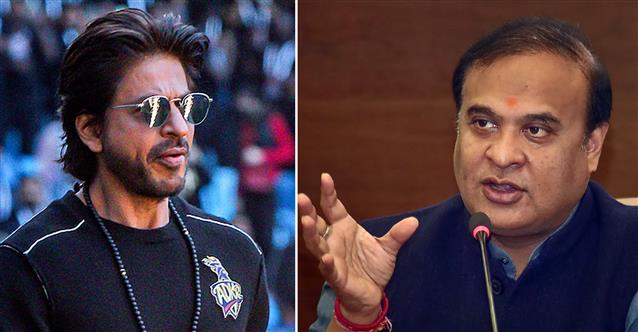
Shah Rukh Khan makes 2 am call over anti-Pathaan stir; CM Himanta Biswa Sarma says he will give security
8:41 AM
THE TIMES OF INDIA (January 23, 2023)
Guwahati: Actor Shah Rukh Khan called up Assam chief minister Himanta Biswa Sarma at 2am on Sunday, expressing his concern over the protests in Guwahati against the release of his film ‘Pathaan’ reports Kangkan Kalita.
On Friday, Bajrang Dal activists stormed a cinema hall in the city on Friday and tore down and burnt posters of the film.
In a tweet on Sunday, Himanta said, “Bollywood actor Shri @iamsrk called me and we talked today morning at 2 am. He expressed concern about an incident in Guwahati during screening of his film. I a ssured him that it’s duty of state govt to maint ain law & order. We’ll enquire and ensure n o such untoward incidents,” Sarma tweeted.
Quizzed about the incident by media persons on Saturday, Sarma had said he was not aware about what ‘Pathaan’ is and no Shah Rukh Khan called him seeking help in the matter. “Shah Rukh Khan would have called me if there was any problem but he has not,”
Sarma had said, adding, “Action will be taken if law and order has been violated and a case has been registered. ” Even as the Bajrang Dal has threatened that it will not allow the release of ‘Pathaan’, hall owners are getting ready to run house-full shows.
Some shows were in stadiums with thousands in attendance and some in pubs-Vir Das
8:31 AM
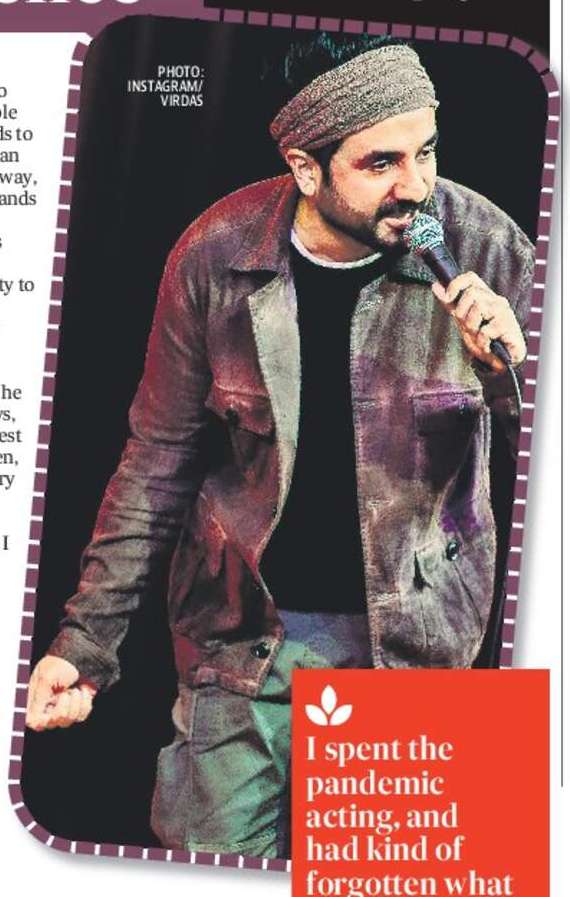
After touring for a year, Vir Das says he is ready to take a pause and embrace the silence
Sugandha Rawal (HINDUSTAN TIMES; January 11, 2023)
Vir Das spent all of 2022 on the road, touring over 25 countries through 183 shows, and is now ready to take a pause and embrace the silence. The comedian-actor says the tour helped him fall in love with stand-up comedy once again.
“I spent the pandemic (two and a half years) acting, going from one set to another, and had kind of forgotten what a privilege it is to be on tour, and how tough it is. You really have to agonize about every single word, and put in the hours,” Das confesses. The 43-year-old says, “So I took most of this year off, just to be on tour and not to act. And I fell in love with stand up again.”
In fact, being on the road inspired him to infuse all his tour experiences into his latest stand up special, Landing. He explains, “The special comes off from the point when you are heading home after having been to 25 countries, doing 183 shows. When you are about to land, you think about home, childhood and how you got to this point. The theme of the show is what it means to come home, have a home, and what it means to be an Indian who gets to see the entire world.”
So, what does it mean to come back home?
“For me, it’s a feeling of comfortable silence. I tend to perform for millions of people every year. And that life tends to be the sound of an airplane, an airport, busy traffic and freeway, and then the sound of thousands of people laughing and screaming. To come home is truly like not having those sounds, and to have the ability to sit in silence. That, to me, is comfortable,” says Das, who has also acted in Whiskey Cavalier and Hasmukh.
Talking about the lessons he learnt while on tour, Das says, “The plan was to write the best show anyone has ever written, so that we set a rule that every stage is a good stage. And every crowd size, a good crowd size”. “I went to cities I have never been to, like Guwahati. We did about 47 cities in India. Some shows were in stadiums with thousands in attendance and some in pubs like the one in Shillong. The show in Shillong was as good, just not as profitable. But if you love the art, these things don’t matter,” he adds.
Right now, Das is on a break from touring, and is focusing on writing content for his acting gigs.
Zubeen Garg airlifted to Guwahati after sustaining a minor head injury
8:06 AM

HINDUSTAN TIMES (July 22, 2022)
Singer-music composer Zubeen Garg was airlifted to Guwahati, Assam, on Wednesday evening, hours after he was admitted to a private hospital in Dibrugarh town after he sustained a minor head injury.
Multiple reports state that the doctors conducted a CT scan and Garg has received several stitches on his head. He is said to be safe right now, with his vital parameters being stable.
Earlier, on learning of Garg’s hospitalization, Assam chief minister Himanta Biswa Sarma had directed the deputy commissioner of Dibrugarh district to ensure that Garg, who was undergoing treatment at Sanjeevani Hospital in Dibrugarh, receives quality medical attention. Sarma had even directed to arrange for the artiste to be taken to Guwahati or outside the state for further treatment by air ambulance, if necessary.
The chief minister had also directed state health minister Keshab Mahanta to oversee the entire process of providing necessary medical services to the musician.
Garg reportedly fell down in the washroom of the resort he was staying in at Dibrugarh and was immediately rushed to the hospital for treatment.
The musician has composed songs for Assamese, Bengali as well as Hindi films. He made his singing debut in 1992 with Anamika. His discography includes songs such as Ya Ali from the 2006 Hindi film, Gangster, and Dil Tu Hi Bataa from Hrithik Roshan-starrer Krrish 3 (2013), among others.
Raghav Juyal called ‘racist’ for comments in viral video; issues clarification
8:05 AM

BOMBAY TIMES (November 17, 2021)
Actor, dancer and TV show host Raghav Juyal was recently trolled online for a video clip that went viral from Dance Deewane 3, where he was seen talking in gibberish Chinese to a contestant from Assam. In the video clip, Raghav is seen introducing a young participant from Guwahati, Gunjan Sinha, in “Chinese” gibberish, using words like ‘momo’ and ‘chowmein’. Many people called Raghav racist for his behaviour.
The dancer-actor took to social media to narrate his side of the story. In a video that he posted online, he said, “I want to tell people what happened before this particular clipping. People should watch the entire show and then judge the clip. It won’t be fair to pull out that particular clip and judge it for my mental health and also for those who know me. The little girl, Gunjan, who is from Guwahati in Assam, was a part of the show. We often ask kids about their hobbies and talents. She said my talent is that I can talk in Chinese, by which she meant gibberish. We would laugh hearing it as kids often speak such things. Everyone clapped and asked her to speak in Chinese. She spoke, and from there, it continued. Staying on that track, I called out to her in that manner during the last episode. It was a creative that was running through the show. If you see the episodes you will understand it and won’t call me racist based on one clip.”
He further added, “I am very connected to the North East. I have family in Sikkim, Arunachal Pradesh, and some very close friends in Nagaland with whom I am have grown up. I am someone who presents things in a politically correct manner and take a stand for what is right. In fact, I get hate for that. I am sorry if anyone is hurt by it. Before making a clip viral, I want everyone to see those episodes to know the story behind it.”
Raghav also shared another video where Gunjan was seen telling judge Madhuri Dixit Nene that she likes to speak Chinese and then the host shares some light moments with the participant by conversing with her in the gibberish.

Images: Filmmaker Bharatbala filmed the silence of India during the lockdown
8:37 AM

Rachana Dubey (BOMBAY TIMES; June 9, 2020)
Three years ago, filmmaker Bharatbala (known for his National Anthem videos among others) embarked on a mission, Virtual Bharat, to capture the essence of India through 1,000 short films of under 10-minutes each. However, he didn’t know he would end up shooting the country virtually, one day. When the national Coronavirus lockdown was announced on the night of March 24, his team and he decided to film the historic chapter in modern history on camera. The lockdown continued for nine weeks, and so did the filmmaker’s efforts.
Titled Uthenge Hum, the film had a pan-India team of over a 100 people, and it captures the emptiness and the silence of the lockdown across villages and cities in 14 states.
Bharatbala roped in the filmmaking crew that he had assembled in the last few years while making about 85 films for his ‘Virtual Bharat’ project across the country. He was stationed in Mumbai with his team while supervising shoots across India through virtual video calls.
Bharatbala says, “This film, which took off when the lockdown began, is for posterity. I went ahead with an idea, not knowing how it will shape up. Srinagar, Guwahati, Chennai, Kochi, Mumbai — we went all over the place. We sought permission to move around. On a single day, I have shot portions in Lucknow, Varanasi and Guwahati. It’s sad to say, but this was a unique chance to capture the silence and emptiness in a nation of 1.3 billion people.”
The filmmaker adds, “This film brings out the stark social divide without me saying a word. We need to rethink and rebuild our systems. The lockdown had everyone on their knees and it proved that everything can wait.”


Amid lockdown, Ya Ali singer Zubeen Garg reaches Assam from Mumbai in a bus
8:24 AM

Sanskrita Bharadwaj (HINDUSTAN TIMES; May 18, 2020)
Singer-composer Zubeen Garg, who was undergoing treatment at a hospital in Mumbai before the Coronavirus lockdown, has finally reached his hometown, Guwahati. How? By travelling on a bus from Maharashtra to Assam. Garg had fallen unconscious during an event in Assam.
He was accompanied by his wife Garima Saikia Garg, and two other friends.
Though he was discharged after recovery from the Mumbai hospital he was admitted to, he got stuck in the city because of the lockdown. “I have a flat in Mumbai, but there were two cases in the building, and it was sealed. So, we had to rent a room and a kitchen in a hotel. There were four of us. We were cooking our own food. But I wanted to go back to Assam,” Garg says, adding, “We contacted the Assam Bhawan in Mumbai. The government was arranging commute for 132 other people, including 62 cancer patients and their family members, who were stranded in Mumbai to reach Assam. They also reached the state in sleeper buses. All of them were in six different buses. And four of us were in another sleeper bus. We left on May 8 and reached on May 12. Assam Police coordinated with authorities in all the other five states that we had to cross through.”
Narrating his experience, Garg said, “There were lots of people on the road, trying to get back home. It was heartbreaking to see so many people trying to reach their destinations. We had to slow down because of the movement of these people.”
Upon reaching, Garg and co, were quarantined at a hotel in Guwahati for about three days. They will be in home quarantine now until May 28. When asked how he felt when he found out his test was negative, he says, “I wasn’t scared. In Mumbai, I was in the ICU where nobody was allowed. Then, even when we were in the hotel, we hardly ventured out. We took all the necessary precautions. People don’t know where the virus is, we can’t see our enemy. We have to stay indoors for sometime now and we will have to keep our surroundings clean. We will have to avoid gatherings. And, all of this will hamper our economy.”
Working on Players helped me realise what I didn’t want to do-Bhaskar Hazarika
6:58 AM

Sanskrita Bharadwaj (HINDUSTAN TIMES; December 13, 2019)
 With an enthusiastic crowd patiently waiting outside the Cinépolis Fun Republic theatre, Andheri, it was heartening to see how Aamis (Ravening) — filmmaker Bhaskar Hazarika’s much-talked-about Assamese film pulled in people from a diverse spectrum, and not just the Assamese diaspora. What the crowd perhaps wasn’t expecting was a macabre end to what seemed like a sweet love story.
Two films down and Hazarika has somewhat made a reputation as somebody, who is drawn to experimenting with dark themes and complex characters. His debut film, Kothanodi (2015), won a National Award for Best Film in the Assamese language. Based on characters and events described in Burhi Aai’r Xadhu (Grandma’s Tales), a beloved anthology of folk stories compiled by the Assamese literary giant Lakshminath Bezbaroa, Kothanodi proofed to be its sinister retelling. And, if it managed to spook people out, Aamis is a notch above that, a film that will make you question topics such as morality, and forbidden relationships. “I like watching films from the masters of horror and sci-fi,” says the director, and indeed, this love for the dreadful reflects in his work.
Earlier this year in April, Aamis had premiered at the Tribeca Film Festival (TFF) in New York, USA, where it was nominated in five categories, including Best Film. The film also received two awards at the Singapore South Asian International Film Festival, Best Director for Hazarika and Best Actress for Lima Das. After watching the film, director Anurag Kashyap took note of it and wrote on his Instagram account, “have not seen anything like this coming out of India” before. Kashyap, who has been known to present independent films from across India in theatres, declared that he will be presenting Aamis. But, this was the first time he presented a film from North-East India.
 Aamis is a story set in urban Guwahati, Assam and written by Hazarika himself. It revolves around the lives of a doctor, and a PhD student, bonding over food — a variety of exotic meat. The story then takes a bewildering turn, which may even leave many in disbelief.
Starring debutants — Lima Das and Arghadeep Barua, Aamis, Hazarika says is based on the Romeo and Juliet template. He, who’d earlier cast popular actors such as Adil Hussain and Seema Biswas for Kothanodi, says that it is important to not have familiar faces while working on that template. “It is easier for the audience to relate to new faces when it’s a love story,” he says.
When asked if he looks at himself as somebody who might be at the risk of being typecast as a teller of grim tales, he says, it’s only coincidental that both his films touch upon the deviant. “I am currently working on a comedy film, and I have also written a thriller,” he adds.
Writing for an A-list Bollywood movie, is what most aspiring filmmakers look out for, but Hazarika chooses to focus on independent content. In 2012, he got writing credit for the Abbas-Mustan thriller, Players, a remake of the American film, The Italian Job (2003). Hazarika says being a part of that film was an eye-opener of sorts for him. “It helped me realise what I didn’t want to do,” he adds.
For a long period of time, regional cinema meant only southern films. But with films such as Sairat (Marathi, 2015) making a mark, it doesn’t seem impossible for the mainstream to open up to films from North-East India, as well. Assamese cinema, especially, seems to have undergone a qualitative change with filmmakers taking on unconventional topics. For instance, in 2017, Village Rockstars, directed by Rima Das, was selected as India’s official entry to the 91st Academy Awards. But do these filmmakers make films keeping a universal audience in mind? “We have to create universal content, which will work outside,” Hazarika says. This belief is why he started Metanormal Pictures, a small studio based in New Delhi, with a vision to create original cinema from India, especially, with a focus on regional content.
Is the audience, then, ready to take on such films?, we ask. Hazarika, who looks at filmmaking as his “job” and not particularly a “passion”, says it’s not a filmmaker’s responsibility to educate people to come and watch films from a certain region. “That’s too much pressure on the maker,” he concludes.
Filmfare’s Black Lady travels to Assam
8:12 AM

Vineet Jain, MD, Times Group and Sarbananda Sonowal, CM, Assam
In a first, the 65th annual awards will be hosted in Guwahati on Feb 15, 2020, in partnership with the Assam Tourism Development Corporation and in presence of Bollywood biggies
Prabin Kalita (MUMBAI MIRROR; November 26, 2019)
The 65th annual Filmfare Awards will be held in Guwahati on February 15, 2020. On Monday, the Assam Tourism Development Corporation (ATDC) and Worldwide Media of the Times of India Group, signed a memorandum of understanding (MoU) to this effect in the presence of the state’s Chief Minister Sarbananda Sonowal. Describing it as a “historic milestone”, Vineet Jain, Managing Director, Times Group, said that he was looking forward to bringing the Black Lady to the picturesque city. Also present were Chandan Brahma, Minister of Tourism, Assam, and Jayanta Malla Baruah, Chairman, ATDC.
Pointing out that cinema is not new to the North-Eastern state, Jain made a reference to its cultural doyen, Jyoti Prasad Agarwala, who had made Joymati, Assam’s first film back in 1935. “The association between Bollywood and Assam is decades old, with the state providing a mesmerising backdrop for Hindi films. Ek Pal, which had featured Shabana Azmi, Naseeruddin Shah and Farooq Shaikh, was shot in Jorhat in 1986. The National Award winning Daman, starring Raveena Tandon, was filmed here in 2001 and more recently, in 2016, the Shahid Kapoor-starrer Rangoon in Dhemaji,” he informed.
This is the first time Filmfare’s annual gala will be moving outside Mumbai and Jain asserted that it would strengthen the state’s bond with Asia’s biggest entertainment industry, Bollywood. “Assam is the gateway to the North-East and we could not have asked for a better partner to spread the cheer of cinema in this region. I am aware of the Honourable Chief Minister’s vision of making Guwahati the hub of South-East Asia and the Times Group can be a media partner in this journey,” he stated, adding that cinema is soft power influence which when used wisely, can help boost economic development. “People across the world often shape their perception of a country, state or city through entertainment. For long, the film industry has served as an ambassador of culture and tourism.”
The 65th Filmfare Awards to be held in Awesome Assam in partnership with ATDC, would reach a two billion worldwide reach, which the ATDC hopes will translate into phenomenal footfalls in the near future.
Touching on the figures, the CM reiterated that the event could become a platform to showcase Assam’s tourism potential to the world.
“Assam is the hotbed of biodiversity and our cinema is old and all-encompassing. Even Prime Minister Narendra Modi on his recent Mann Ki Baat radio programme urged people to visit North-East India. We recently held the Brahmaputra Pushkaram festival and visitors were overwhelmed by our love and hospitality. The Times Group’s choice of Assam as a venue proves that we are capable of hosting this mega event,” Sonowal said.
Jain stated that Assam is renowned for its art, culture, landscape and people, and Filmfare Awards 2020 will capture the essence of the state. Viewed by millions across the country and abroad, it will project it as a favourite tourist destination. “We are committed to delivering an unforgettable experience to the people of Assam,” he maintained.
CEO of Worldwide Media, Deepak Lamba, who signed the MoU for Times Group, in his address said that the Filmfare Awards has spanned generations and evolved into one of India’s most spectacular events. “We are taking legacy forward by bringing the best stars of the industry, who will entertain and perform, to Guwahati on a night of celebration. It is a landmark moment for each one us as the eyes of the filmmaking industry, both Indian as well as global, will now be on Assam, as we showcase its diverse culture, traditions, music, dance etc. Filmfare will open up picturesque Guwahati to the world and portray its beauty through a unique lens,” he promised.
Alyque Padamsee was full of life and full of innovative ideas-Bharat Dabholkar
8:23 AM

Bharat Dabholkar pays a tribute to advertising guru and theatre doyen Alyque Padamsee, who passed away in Mumbai yesterday
Bharat Dabholkar (BOMBAY TIMES; November 18, 2018)
 God — that’s what Alyque Padamsee was known as when he was heading Lintas. And I believe that he did deserve that title.
I never worked with him, but he was an icon for all of us youngsters then, who joined advertising. Though television hadn’t arrived in a big way, he was one of the few prominent faces in advertising who was seen in newspapers talking with conviction on topics concerning advertising and life in general. Later, on TV channels, one would frequently see him… this larger-than-life personality, talking in his famous nasal drawl.
And then one realised that he was the best known name in theatre, too. In fact, he dominated English theatre in India and some of the biggest productions were directed by him. Jesus Christ Superstar, Evita, Butterflies Are Free and Tarantula Tanzi are just some of them. I, of course, took a lot of liberties with him. On a TV debate, I once said that his theatre was only a xerox machine that reproduced foreign plays in India. He took that well, but gave me a short on-screen lecture. When he did Evita, I did a take-off on that in Bottoms Up and called it Savita. When he did Tarantula Tanzi in a boxing ring, I did Ayatollah Panzi in a wrestling ring. He came to watch all of this. I remember him sitting in the audience and making meticulous notes on a writing pad. He would give them to me at the end of my shows. His double life in advertising and theatre was truly fascinating and it inspired me to attempt a similar life. I never worked with him in advertising or in theatre (I didn’t have the right accent, not to mention the acting ability that he demanded). Recently I took him to Guwahati for a marketing seminar and that’s the first time I saw him addressing a large gathering of marketing professionals and youngsters and I was mesmerised. His energy and communication skills were truly fascinating. At the dinner after the seminar, he told me that he was writing another book, which was more personal. And in conversation, I mentioned that I was a lawyer and I had studied Mohammedan law, which had a provision for Mutah marriage (a legal marriage for a pre-stipulated period). He laughed and said, ‘Damn it, you idiot, why didn’t you tell me this years ago?’ He was like that. Full of life and full of innovative ideas. He will be missed.
Why should films backed by big studios be the only ones to go for Oscars?-Rima Das
8:49 AM

Rima Das, whose film Village Rockstars is India’s nominee for the 2019 Academy Awards, on why she doesn’t mind being an independent filmmaker
Kunal Guha (MUMBAI MIRROR; November 4, 2018)
“There were no natural disasters, we had fun,” says Rima Das, about the floods she experienced as a child in Kalardiya, 50 km southwest of Guwahati. “As a child, you looked forward to heavy rain and water all around. We would make rafts out of banana leaves to go to school, go fishing and sometimes, school would be shut too.”
It’s this childlike perspective that Das, 36, has tried to capture in her multiple National Award-winning Village Rockstars, which is India’s entry for the 2019 Academy Awards. Set in rural Assam, the film follows the story of a young girl who dreams of owning a guitar and forming her own band. Das says it’s a story that reflects her own dreams and aspirations. “Miracles happen. If you dream, they can be achieved,” says the one-woman-crew who wore multiple hats during the production — that of a director, producer, editor and cinematographer.
Das, who aspired to be an actress, considers herself to be an accidental filmmaker. When she arrived in Mumbai in 2003, after completing her masters in Sociology from Pune University and after clearing the National Eligibility Test (to pursue teaching like her father), it seemed her tinsel town ambitions would never take off. “I did a few plays at Prithvi, but I wasn’t getting the roles I wanted,” she says. “So I thought I would make a film and create a role for myself.” This is when Das came across the Canon 5D, “a small camera which offered cinematic results”. Her first “experiment” resulted in the short film Pratha (2009), which was well received on the festival circuit and gave her the “confidence to go ahead”.
A few years later, Das released her first feature Antardrishti (Man With The Binoculars), inspired by a friend who had purchased a pair of binoculars for his father in Kalardiya. The film, which was shot in Kalardiya, was completed in 2016. While Das was determined to make it to the front of the camera, she found being both an actor and director too much to handle. “I couldn’t focus on either and eventually direction took over.” Antardrishti was screened at Cannes in 2016, the Mumbai Film Festival and the Tallinn Black Nights Film Festival in Estonia the same year. “When I started out, people told me there are 10,000 films submitted for Toronto Film Festival and 12,000 films submitted for Cannes, who is going to watch your film? But we are here, right? People told me a women empowerment film won’t win a National Award. But here we are.”
The idea for Village Rockstars struck Das when she was filming Antardrishti and came across a group of children dancing with make-believe musical instruments to a tune playing from a loudspeaker. As the movie enters its fifth week in theatres, Das feels “it’s truly a regional film that has gone mainstream.”
But this isn’t the response she expected. “When I made Village Rockstars, it was, for me, a festival film. There is no background score, there are many layers and it is not a structured film. But the response was heartening.”
Das credits the festival circuit as an enabler, as it “helps [the film] reach out to a wider audience”. “I didn’t even think of various interpretations [of the film] that others pointed out during the one-on-one audience interactions.” To create a buzz around her Oscar contender, Das has acquired an agent in LA and plans to host screenings to build awareness and generate interest.
While Das has received Rs 1 crore from the Assam government towards her Oscar campaign, she agrees that being backed by a studio would’ve made things smoother. On the other hand, she isn’t entirely sure if it would allow her complete autonomy over her project. “A few [studios] who have approached me lately, say they will give me the freedom to do whatever I want… but I can’t say how it would be because I haven’t experienced it yet. Mine has been a different journey,” she says. “When I take money from other producers, I would have to be more careful and listen to them too.” But she also admits that lack of funds can be detrimental when lobbying for a film that hasn’t had an international release. “There are 87 films being entered in the Best Foreign Language Film category so people should know about our film too. Films like Roma (Spanish) and Shoplifters (a Japanese film which won the Palme d’Or at the Cannes Film Festival this year) are backed by big studios and can afford to spend over 10 crore to create visibility, we can probably spend one, but it’s OK. Why should films backed by big studios be the only ones to go for Oscars?”
Vivek Oberoi to kick off 11,000 km marathon for children
7:56 AM

Mohar Basu (MID-DAY; September 4, 2017)
Vivek Oberoi has been an active propagator of several social causes, including those that focus on the girl child. In his latest endeavour, the actor is set to join hands with Nobel laureate Kailash Satyarthi to spread awareness about child abuse with a nation-wide march.
The actor tells mid-day, “It takes a great deal of dedication to bring about change in the society. We should support the causes of child sexual abuse, sexual exploitation, assault and trafficking. I’m grateful to Kailash Satyarthi for inviting me, and giving me the opportunity to be part of this noble cause.”
The duo will kick off the march on September 11 in Guwahati as part of the Bharat Yatra campaign, and will cover 11,000 kms to culminate it in Delhi on October 11. In an earlier interview, Satyarthi had expressed his concern for abused children, stating, “There is a sense of fear around child sexual abuse. How can we make a ‘New India’ if we are still driven by fear of reporting crimes against our children?”
Prominent Bollywood actors to attend, perform at Indian Super League opening ceremony at Guwahati
8:15 AM

Sanyukta Iyer (MUMBAI MIRROR; October 1, 2016)
 Varun Dhawan, along with Dishoom co-star Jacqueline Fernandez and
“Dulhaniya” Alia Bhatt, took a private jet ride to Guwahati on Friday
morning. The trio will be performing at the Indian Super League opening
ceremony tonight and were welcomed with band, baaja, mint tea and
personalised cakes with titles of their films embossed with chocolates,
peppermints and fruits. Also present at the ceremony will be football
fans Abhishek Bachchan, Ranbir Kapoor and John Abraham who also own
teams in the league.
Varun Dhawan, along with Dishoom co-star Jacqueline Fernandez and
“Dulhaniya” Alia Bhatt, took a private jet ride to Guwahati on Friday
morning. The trio will be performing at the Indian Super League opening
ceremony tonight and were welcomed with band, baaja, mint tea and
personalised cakes with titles of their films embossed with chocolates,
peppermints and fruits. Also present at the ceremony will be football
fans Abhishek Bachchan, Ranbir Kapoor and John Abraham who also own
teams in the league.“Varun and Alia will perform to a medley of their songs and were rehearsing to “Saturday Saturday” earlier this week. The trio will be accompanied by 150 backup dancers and live playback singers for the finale,” adds a source close to the actors.
Jackie who was teased by Varun for wearing pull on slippers on the jet but admitted that she loves being called "Jacky Fernando" by him. The duo also argued over which was more popular, Instagram stories or Snapchat stories.
On Friday afternoon, the actors were at the stadium to cheer on the players, posing with footballs. Varun and Ranbir also played soem footie while the girls confessed they didn’t know much about the game other than some gorgeous English Premiere League players. They will watch the first three matches while in Assam. They are also hoping to pack in some workouts together and a dip in the hotel’s pool.
Meanwhile, amidst torrential rains in the city, Sachin Tendulkar, MS Dhoni and PV Sindhu also landed on the ground as the players were prepping up for the match.
Gunday distributors arm-twisting in Assam; forcibly removed an Assamese film?
1:02 PM

Asira Tarannum (MID-DAY; February 19, 2014)
If sources are to be believed, YRF distributors in Assam have forcibly replaced an Assamese film — titled 'Raag' — with their latest release, 'Gunday'.
It is being said that Raag — which has been produced by the Assam Film Development Corporation (ASFDC) and Manna films, and has been directed by Rajni Basumatary — has fared quite well in Assam. A source says that the film, that stars Adil Hussain, would have continued its good streak if it was allowed a run in the second week, but the YRF film’s distributors apparently had it removed from local screens to make way for 'Gunday'.
While Raag’s director remained unavailable for comment, the film’s lead actress, Zerifa Wahid vouches for the encouraging response received by the film so far. “A government funded project, this film was doing good, but it has now been removed from local screens to allow room for 'Gunday'. It’s unfortunate that we have fallen prey to this. Such incidents have happened in the past as well,” she says.
She adds that the film was doing brisk business in towns outside Guwahati too. “The YRF exhibitors took up all the five slots leaving us with no shows. A lot of people wanted to watch our film, and I hope they get to see it later. I also hope that audiences get to watch Hiya Diba Kak, another Assamese film that is scheduled to release next week. Bollywood films shouldn’t force us out of the running; there is a strong need for cultural awakening,” she says.
A source on condition of anonymity says, “This production house has wielded its clout against several regional films; they do this to low-budget Hindi films as well. It needs to be stopped.” When contacted, a YRF spokesperson denied the story. “No terms and conditions were laid down for the release of 'Gunday',” was their official statement.
Subscribe to:
Posts (Atom)