Showing posts with label Freedom At Midnight. Show all posts
Showing posts with label Freedom At Midnight. Show all posts
Jinnah wanted to be in Bombay even as he governed Pakistan-Nikkhil Advani
9:00 AM

As a boy in 1980s Bombay, Nikkhil Advani tuned out his grandmother’s stories of Partition. Forty years later, he has made it his business to tell them
Anindita Paul (MUMBAI MIRROR; September 20, 2026)
In the late summer of 1947, as the British empire unspooled into the blood and panic of Partition, Nikkhil Advani’s ancestors left Sindh on a commercial flight. They were not among the millions crammed onto wooden train roofs or marching through the dust of the Punjab; his father, Suresh, was an infant, born in 1946 into an affluent, well-connected Sindhi family in Karachi and Hyderabad. When his great-grandfather sensed the geopolitical tides turning, he booked tickets, gathered the family, and flew to Bombay. They landed unmaimed, stepped off the tarmac, and walked straight into the cold, levelling reality of displacement.
On the journey, Advani’s grandfather carried a heavy money belt strapped around his waist. But the cash was not his. He worked for Habib Bank, which was shifting its headquarters to Karachi at Muhammad Ali Jinnah’s behest, and had been entrusted to deliver the funds to its Bombay branch. He handed over every rupee. For Advani’s grandmother, Lila, the story was a testament to her husband’s unyielding integrity—though during the lean years that followed, she would occasionally wonder aloud how different their lives might have been had he simply kept it.
The family’s fortune was gone. In the single-room flat on Raghavji Road that they lived in, Advani’s grandmother nursed no soft, weeping nostalgia for lost estates; she wanted her sons to work towards careers in engineering, and demanded flawless academic credentials.
“I don’t want to belittle those who suffered the horrors of migration by pretending their pain is mine,” Advani says. “My family was fortunate. But the atmosphere in that one-room flat was defined by a single imperative: every generation must outperform the last.”
A generation, removed
Growing up in the comfortable, cosmopolitan Bombay of the 1980s—his father by then a corporate executive in a pharmaceutical firm—young Advani initially tuned out his grandmother’s constant monologues about Partition. “To a kid in a safe, prosperous city, it felt like an endless lecture,” he admits. “My reaction was, ‘Who cares? I’m not struggling.’ It took 30 years to realize those weren’t history lessons; they were meant to remind us of how we had built – rebuilt – everything from scratch.”
When Advani announced his intention to forgo a conventional career for the unstable world of Hindi cinema, his grandmother viewed it as sheer madness. How could making movies constitute a proper profession? What she may not have realized just then was Partition wasn’t this family’s only inheritance. A deep love for cinema may have been handed down genetically, too. Advani’s grandfather, the one who had guarded the bank’s cash through that trip from Karachi, had a Friday ritual: he would leave his jacket draped over his office chair so that his manager would assume he’s around, while he slipped out to catch a matinee.
Besides, Advani’s true artistic education unfolded outside formal classrooms. After studying at St Xavier’s College and taking a film appreciation course at FTII, he served an apprenticeship alongside the fiercely political, iconoclastic directors of 1990s Bombay—Saeed Mirza, Kundan Shah, and Sudhir Mishra. These were sets where filmmaking was treated as social inquiry rather than commercial gloss. Nights were spent in messy apartments listening to Hindustani classical records and late-night ghazals; Mishra once dragged him to a gathering at Shekhar Kapur’s house where Nusrat Fateh Ali Khan sang until daybreak. Advani absorbed the music, the politics, and the intellectual friction without quite knowing where to put them.
“When you’re young, you’re like a sponge,” he says. “You don’t always have the context for what you’re taking in, but it stays somewhere inside you. Then, years later, something happens and you realize, ‘Oh, I heard this before. I saw this before. I was around this before.’”
Flying Blind in 1947
That delayed understanding eventually collided with his work as a director. When Advani turned his camera to history, he eschewed monumental hagiography in favour of panicky, unscripted friction. In Freedom At Midnight, his epic streaming chronicle adapted from Larry Collins and Dominique Lapierre’s book, Independence arrives through argument, and administrative absurdity—where bureaucrats haggle over splitting railways, treasuries, and even the instruments of a police band in Lahore.
At the centre of the storm, the architects of Indian independence—Gandhi, Nehru, Patel, Jinnah, Mountbatten—are stripped of their textbook composure. They sweat in humid rooms. They operate in a lacuna of intelligence.
“Today, we have the privilege of hindsight,” Advani, now 55, observes. “Eighty years later, it is easy to debate what a statesman ought to have done. But in 1947, they were flying blind—there was no precedent, no telemetry, no script. I wanted the audience to be there with them, without knowing what was going to happen.”
That idea also drove The Revolutionaries, adapted from Sanjeev Sanyal’s book. The series turns its lens toward armed anti-colonialists like Rash Behari Bose, Bagha Jatin, and Sachindra Nath Sanyal, whose militant struggles were largely swallowed by official Congress narratives. Yet rather than reducing them to violent zealots, Advani recovers their intellectual world—their debates over Irish resistance, poetry, and philosophy, alongside the quiet, personal sacrifices of women like Pratibha Lahiri.
“I knew after Freedom At Midnight that critics would point at the stories I have left out,” Advani says. “In modern India, if you leave a vacuum in historical storytelling, someone may fill it with cheap propaganda. My job isn’t to hand out moral verdicts, though of course I pull the frame toward the people I admire. My job is to resurrect the volatility of the moment before the history books froze it in place.”
Ruptures of Empire
That insistence on context over caricature met its stiffest test in his portrayal of Muhammad Ali Jinnah. Freedom At Midnight drew both sharp praise and fierce pushback for humanising the founder of Pakistan.
“Before Jinnah was the Quaid-e-Azam, he was just a Bombay guy,” Advani says. “And he wanted to be in Bombay even as he governed Pakistan. I found that incredibly interesting.”
He has watched that fluid relationship with the past extend to his own filmography. Younger audiences now dissect his earlier mainstream hits like Kal Ho Naa Ho or Chandni Chowk To China through entirely modern lenses—sometimes with nostalgia, sometimes with utter bewilderment.
“The people asking me for a Chandni Chowk sequel today were four years old when it was released,” he laughs. “They didn’t care about narrative structure; they just saw Akshay Kumar [who plays a chef in the film] fighting a giant potato and somehow it worked for them.”
Films wait intact for the next generation; family memory does not. With that in mind, on his father Suresh’s 80th birthday this year, after the release of the second season of Freedom At Midnight, the family invited Gitanjali Chandrasekharan’s Talered, a platform that specializes in customised oral histories, to help them document their vanishing memories of Sindh. The result, a custom-made coffee-table book with a record of survival, food, family jokes, and small evasions, was then gifted to family members.
Nikkhil Advani on shooting funeral scene in Freedom At Midnight: "People felt they were in the same room as Gandhi’s body"
9:25 AM

In today’s divided climate, showrunner and director Nikkhil Advani on making Freedom At Midnight 2, balancing multiple viewpoints in a beloved, politically charged story
Letty Mariam Abraham (MID-DAY; January 13, 2026)
Revisiting India’s history isn’t just about watching events unfold — it’s about pausing, cross-checking references, and asking if every detail holds up. That’s exactly how we watched Freedom At Midnight. For showrunner-director Nikkhil Advani, adapting Dominique Lapierre and Larry Collins’s celebrated book Freedom At Midnight was no easy task — it demanded sensitivity, balance, and an uncompromising commitment to historical accuracy. Yet, it was also a journey he relished. In conversation with mid-day, Advani speaks about why the entire 14-episode series was shot in one go, the pressure of portraying real-life figures on screen, and why the scene following Mahatma Gandhi’s assassination remains his favourite. Excerpts from the interview.
What was the reaction to the first season of Freedom At Midnight?
The response to the first season, I think was good. It was a tough show to make. Given that so many people had read the book [Freedom At Midnight], and it’s a favourite topic for so many, [people thought] we’d screw it up. To be able to overcome that and balance so many points of view was [not easy]. It’s a huge ensemble piece, the responsibility of getting it right is much higher than on a fiction show. The reviews were heartening. We got so many calls and tweets [saying] ‘they balanced it’ — be it in the pragmatism, [Pandit Jawaharlal] Nehru’s ideology when he torn between Gandhi’s stance and [politics of it]. I think we got a lot of things right and got some stuff wrong.
Beyond the book, how did you ensure the things you showed were accurate?
Anything that we felt that needed to be backed up [with facts], or when there was a different point of view on an incident or fact, we [referred] to our strong research team. The writing room basically followed three things. One, that every scene is to follow the logline. Then SonyLIV’s head Danish Khan said while we are watching a lesson in history, there should be a level of drama, that constant ticking clock, which is also there in the background music and you feel it when a bomb is going to blow up, or something is going to happen. The third big thing was the moment somebody in the writing room read [a fact] differently, we backed it up with outside sources and annotations.
Today, opinions are more polarized than ever. Did you feel the pressure to balance the narrative?
As a filmmaker, you’re always dealing with polarized opinions. It’s just because of social media today that possibly it’s easier for me to understand what somebody very far away is thinking about what I’ve made. People always had dissenting opinions and polarized opinions, but we followed the book as our source material. It was a chaotic and confusing time, and nobody predicted it would blow up the way it did.
While filming, at any point, did you feel emotionally charged about the patriotism depicted?
For me, patriotism is a very personal. Whether it is Akshay Kumar trying to airlift over 170,000 Indians (in Airlift), or a film about a man discovering that the motherland is everything through a story of migration, even Mrs Chatterjee vs Norway [2023] is extremely patriotic. The subject is very interesting. As for Freedom At Midnight, I think that Nehru’s Tryst With Destiny speech is such a big moment in all our lives. If I’ve made people feel proud of being an Indian at the end of the seven episodes, then I’ve done my patriotic duty.
When you cast Chirag Vohra, Sidhant Gupta, and Rajendra Chawla — did you envision them carrying the show so beautifully?
That’s the big advantage of the platform. Their whole thing was cast for the character and don’t bother about stars. So, whether it’s Chirag, Rajendra Chawla, or Sidhant, they are all incredible theatre actors. Most of them have worked with top directors who I hold in high regard. They were all good actors.
Did anyone’s performance surprise you?
It did not surprise me, but one of my favourite performances Anurag Thakur who plays Madanlal Pawar. He will be the standout performance of season two. I think Anurag Thakur is a name that most cinephiles and lovers of great good storytelling and good cinema are going to be talking about for the next 15-20 years. There’s also a scene after the assassination that is my favourite. I remember when Chirag was made to lie down on the funeral pyre, the room had about 80 people, but there was pin drop silence. People felt they were in the same room as Gandhi’s body. I got goosebumps. The way Sardar and Nehru brokedown was too good. I never imagined the scene to come out so beautifully.
Did you know?
Nikkhil Advani shot ‘Freedom At Midnight’ Seasons 1 and 2 together. He says, “For ‘Rocket Boys’ also we shot both seasons together. When you make a period show of this scale, genre, and pilot, you have to make it together because it just makes production sense. It took a year to write the 14 episodes, and they were written together.”
Sidhant Gupta says playing Pandit Jawaharlal Nehru was both painful and fascinating
10:21 AM

Akash Bhatnagar (HINDUSTAN TIMES; November 14, 2025)
As the country marks the birth anniversary of Pandit Jawaharlal Nehru today, actor Sidhant Gupta says he feels honoured to have portrayed the first PM of India in Freedom At Midnight. “There comes a big change after you truly play a character. Your perspective shifts, the way you see life changes. It’s like your mind opens up. The one thing I took away from him is that if you want to be a hero, you have to give a damn about people. It’s as simple as that,” he says.
Reflecting on the process of embodying Nehru, Sidhant calls the experience both “painful and fascinating”. The pain, he says, came from spending nearly three hours each day in prosthetics. “But the fascinating part is how the physical transformation helps your internal system. When you wear that prosthetic, something changes within you,” he adds.
Sidhant also acknowledges a shared trait between him and the former PM: a sense of calm. “Look at the world we live in, the pace is only increasing,” he says, adding, “If you want to grow, fulfil your dreams, and make this life count, there’s no other way but to find calmness and stillness. You have to stay in touch with that. That’s your hope.”
On his memories of Children’s Day, Sidhant recalls learning about Nehru in schoolbooks and the affection with which he was referred to: “We used to call him Chacha Nehru, and that felt really special. Someone we never knew, who had been the Prime Minister of India, suddenly felt like your father’s brother, there was a familiar warmth to that.”
My friends started out with me, but raced ahead-Ira Dubey
9:16 AM

Accepting that everybody has their own career path, Bollywood actor Ira Dubey on her connection with Fatima Jinnah as she gears up for Freedom At Midnight 2
Letty Mariam Abraham (MID-DAY; February 18, 2025)
In the last decade-and-a-half, Ira Dubey has largely concentrated on acting, be it in a wide range of plays or in shows like Potluck and Scoop. But now, the actor is ready for the next step in her career—writing and direction. Will wearing multiple hats be overwhelming? Maybe. But Dubey is excited about the road ahead that will see her not only direct her first film but also return to the new season of Freedom At Midnight where she plays Fatima Jinnah, a leading women’s rights activist in Pakistan. In conversation with mid-day, she talks about life of an actor on stage, films and OTT, her love for writing, and battling self-doubt. Edited excerpts from the interview.
Does juggling writing, acting and producing a show get overwhelming?
One has to try and find [the time]. I have been a stage actor for almost 20 years. Theatre is close to my heart. I won’t ever give it up. If you had the good fortune of having theatre in your life, I don’t think you’d ever give it up for that very reason. Whether it’s Naseer [Naseeruddin Shah] sir or late Om Puri or Shabana ji [Azmi] or my mother [Lillete Dubey], some of our finest actors come from theatre and still go back to it. That’s because it’s an actor’s medium more than a film.
Are you planning to foray into direction as well?
I’ve been a festival director and I’ve directed [plays] for stage, but I haven’t helmed anything on film yet. I’m writing something that I would like to direct. The journey of writing and directing films began last year. Every time you want to try on a different hat, you become a student. I didn’t go to film school to learn directing, I haven’t assisted any directors. But then, some of the most successful directors never studied film. It can be overwhelming, but you have to strike a balance. When you live in a city with rent and bills to pay, [it becomes difficult] to sustain your writing career and enjoy yourself. I have to balance that now with finding the time to write and research.
How do you deal with writer’s block?
I don’t even know if I have experienced writer’s block. I used to enjoy writing very much when I was younger. I used to write poetry, I was a voracious reader. I used to read a book a day up to my 20s. Then, life took over and I focused more on my acting career. I moved away not only from reading, but also from writing. So, it’s like I’m opening a very old door. Writer’s block is something that you have to [go through]. It’s like that famous Robert Frost quote: The best way out is always through.
Do you battle with self-doubt?
I think all of us do. I think self-doubt is healthy in a way, and in some ways, it’s not. Again, it’s about finding out how you walk that line. I’m a perfectionist. I was an overachiever in school. It has taken me 15 years to find that part of myself. You don’t have to be the master at everything you do. It’s more about coming into your own, knowing that a lot of it is about the process, and is not result-oriented.
When did you start asking yourself these questions?
Some of it began after I lost my dad in 2015, and some I’ve always had. I went through a dark period in my 20s. It’s something I may talk about in a film someday. There are certain low periods in everybody’s life. How you deal with those and emerge out of them teaches you so many things in retrospect. Going through [a dark phase] in my late teens and early 20s, and then losing my father at 31 propelled me towards this self-awareness.
How do you view your film career?
I don’t know where I am in my film career, to be honest with you. I always quote this example—my mother started working in films in her 40s. Clint Eastwood started directing in his 70s. People’s careers have turned around in their 50s and 70s. Life is unpredictable. When I look back, there were moments in those 15 years where I have been very frustrated, wished things were different, been envious of other people and wondered why things were happening for them and not for me. I have friends who started out around the same time as me, but they’ve raced far ahead of me. I felt the pinch. But at the end of the day, the belief in yourself, your ability, and your talent are far more important because those will carry you forward.
What is the status of Potluck season 3 and Freedom At Midnight season 2?
We were hoping there will be a third season of Potluck. The second season of Freedom At Midnight will be out in August. In 2017, I was asked to do a reading of a book called Mr And Mrs Jinnah: The Marriage That Shook India. I completely fell in love with the book and acquired the rights to develop a two-season show that didn’t ever get made. I remember meeting Nikkhil [Advani] and Mira Nair [for it]; she was quite interested, but she needed time as she was working on a couple of things at the time. Just before COVID hit, I had to give it up because somebody wanted the lifetime rights and I couldn’t afford that. In 2022, Nikkhil offered me Fatima’s character in Freedom At Midnight. Nikhil’s partner, Madhu Bhojwani, had watched me in three plays and loved me in them. The role just made perfect sense. I didn’t give a damn about the fact that she had grey hair or that she was older. Fatima is an absolutely fascinating character.
I’m glad that after 21 years, people are still watching Kal Ho Naa Ho, dancing to Maahi Ve-Nikkhil Advani
8:13 AM
Niharika Lal (BOMBAY TIMES; December 10, 2024)
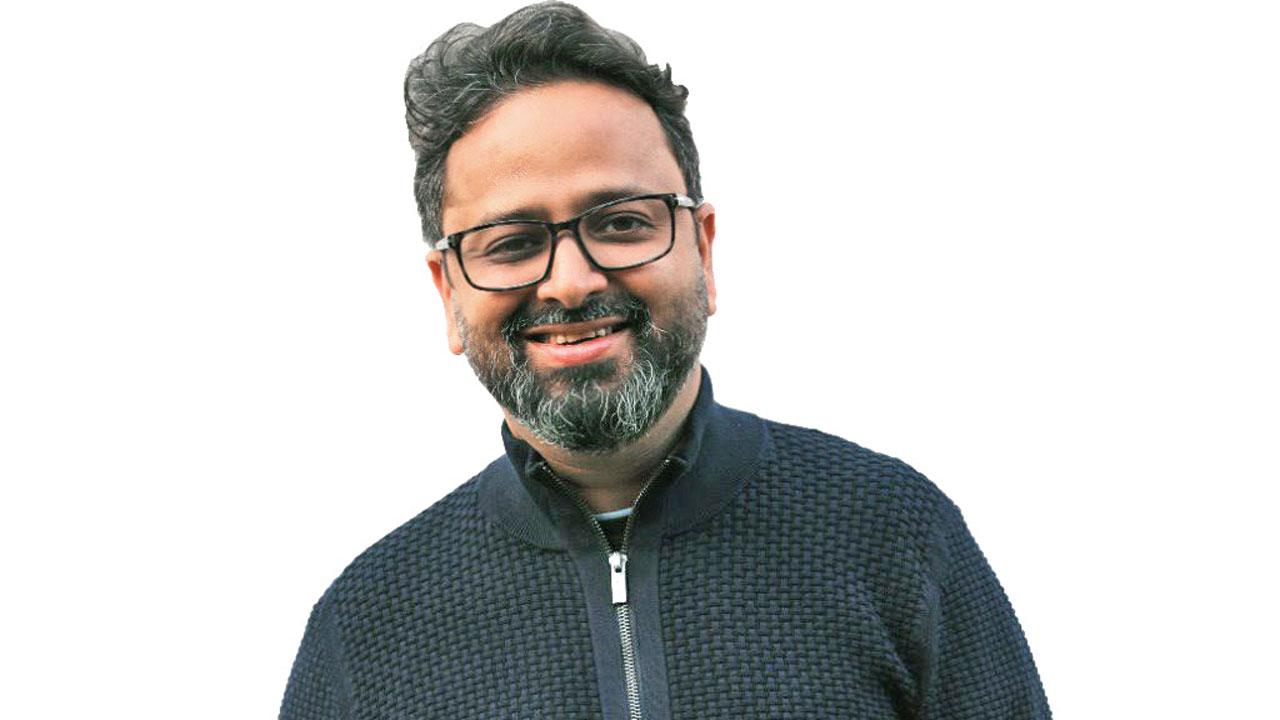
Call it serendipity or coincidence, Nikkhil Advani ended up with two releases on the same day last month – the re-release of Kal Ho Naa Ho and the release of the period drama Freedom At Midnight. He says he can’t really take credit for either of the projects or the release dates. “I was just offered the projects, and I didn’t say no,” he said during a conversation.
‘I ENJOY BEING ON SET’
Nikkhil says he enjoys filmmaking. “I enjoy being on set. I love being in a writers’ room. As a showrunner and producer, I constantly have to be in rooms where budgets are being discussed and, more importantly, where budget cuts are being slashed. I’ve never really enjoyed being in an editing room, though. I hate it because every time I watch my footage, I find myself thinking, ‘I could have shot this better. I wanted it to be better. Maybe we can change this,” he says.
‘IT WAS A CONSCIOUS DECISION TO USE LIGHTS LIKE THE CROWN’
Watching Freedom At Midnight may remind the audience of the historical drama The Crown. Nikkhil says, “Was it a conscious decision to be like The Crown? Yes, very much. What The Crown does is use very harsh backlight from the windows, and they shoot a lot on sets. We were also shooting extensively on sets, so it became an automatic reference point for us. Agar aap blue ya green screen use karte ho, then half your budget goes into VFX, and you can’t do anything else.”
He further explains, “These are things I’ve learned over the years. For instance, if I want the audience to feel a little more stressed out, I use darker colours and wood paneling. Colours were thought out very carefully because I wanted the audience to be emotionally connected to every scene of Freedom At Midnight.”
‘TRIED TO BE AS AUTHENTIC AS POSSIBLE’
Nikkhil says that as far as authenticity is concerned, the team tried their best. He explains, “But I don’t think it can ever be enough, right? The people being spoken about and shown in this story were giants. It’s not just about getting their physicality, speech, or walk right. What they thought, what they said, their vision – it was immense. What I tried to do was put the audience into a room with them and show, yeh log kaise thay.”
‘People still dance to Maahi Ve and send me clips’
“Neither did I have a choice about the release of Freedom At Midnight, nor did I have a say in the re-release of Kal Ho Naa Ho,” shares the filmmaker, adding, “I’m just glad that after 21 years, people are still watching Kal Ho Naa Ho, dancing to Maahi Ve, and sending me video clips.”
He says, “I didn’t consciously make these choices. Someone offered me Freedom At Midnight, and someone offered me Kal Ho Naa Ho. Maine keval bola, ‘Mujhe kaam chahiye, mujhe kaam karna hai.’ My sister (Monisha Advani) and my production partner, Madhu (Bhojwani), often ask me, ‘When will you turn around and start saying no?’ And I reply, ‘I won’t. I’ll never say no. If I’m offered a project, why would I say no?’ Logon ke paas kaam nahi hai. People often say, ‘You’re doing so much work,’ and the reason is simple I say yes to everything. When I was doing the post-production for Vedaa, I was simultaneously shooting Freedom At Midnight. I don’t say no; I only say yes. Karan (Johar) told me to do Kal Ho Naa Ho, and I said, Okay.”
Vivek Agnihotri has not seen Freedom At Midnight, the trailer. He has not seen anything-Nikkhil Advani
4:46 PM
Sugandha Rawal (HINDUSTAN TIMES; November 23, 2024)
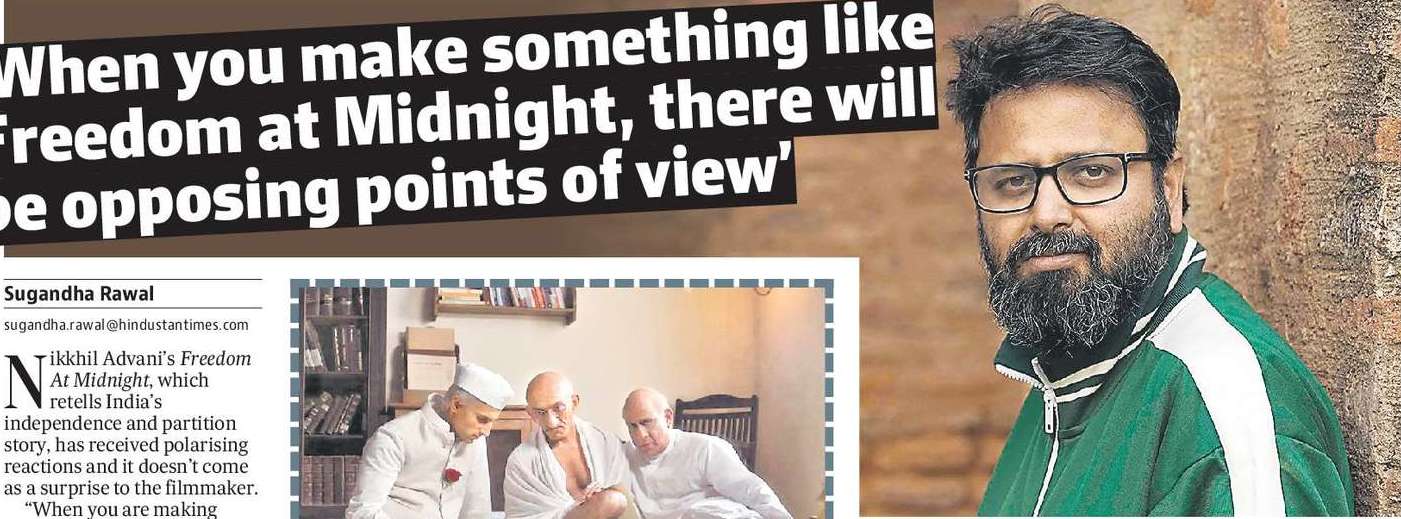
Nikkhil Advani’s Freedom At Midnight, which retells India’s independence and partition story, has received polarising reactions and it doesn’t come as a surprise to the filmmaker.
“When you are making something like Freedom At Midnight, there will be opposing points of view,” Advani tells us, adding, “I’m sure there are experts who know more about the partition and days leading to independence. And they will have some point of opinion”.
He asserts, “What we have tried to do is just stick to the events that took place between August 16, 1946, to January 30, 1948, which are indisputable. These events took place in history. We have just followed events and tried to take the audience into those rooms.”
Mention director Vivek Agnihotri’s tweet that criticises the filmmaker for allegedly not depicting the history with full honesty, he replies, “He has not seen the show, the trailer. He has not seen anything (about the show). He has just read an article from a magazine and shared the tweet.”
Advani further states that he has done his best to give a balanced narrative, stressing that he was only focused on capturing the harrowing pain of the tragic chapter of Indian history and not on taking any sides. “There’s only one side here. And it is that the partition was horrible and it should never have happened. People were torn apart, and friends were torn apart. There is no other side,” he stresses.
Sharing his own experience, he reveals, “My grandparents were part of that (partition). I’m a second-generation refugee. Although I was born in 1971, my grandparents spoke about the times. I have heard some of the saddest and most tragic stories. It is indisputable that partition was a very tragic consequence.”
“The show has a definite end,” Advani concludes by saying that he doesn’t plan to turn it into a franchise.
I’m not hiding behind the character of Jawaharlal Nehru-Sidhant Gupta
3:07 PM
Resurfacing on the scene with Freedom At Midnight, Sidhant Gupta says he didn’t go on a signing spree after Jubilee’s success as he wanted to stay true to his craft
Priyanka Sharma (MID-DAY; November 10, 2024)
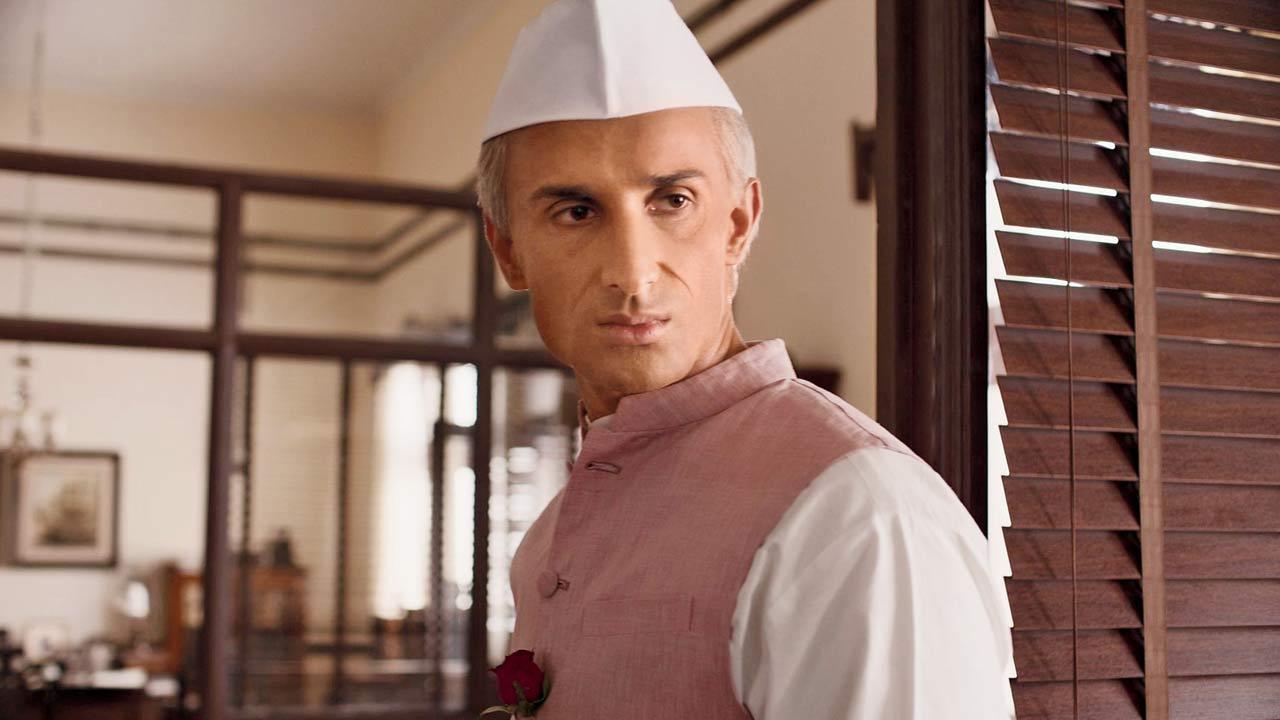
What does one do after emerging as a breakout star? Most likely, go on a signing spree. But Sidhant Gupta, who burst on the scene last year with Jubilee, vanished from the spotlight. Now, over one-and-a-half years on, the actor is back on screen as India’s first prime minister Pandit Jawaharlal Nehru in Nikkhil Advani’s period drama, Freedom At Midnight.
“As an actor, you get to know yourself as you move along, when success and acceptance come in. Why am I doing this work? This has been a life-changing question for me. I asked myself this when no one wanted to work with me, and I ask myself this today as well. When I read the script of Freedom At Midnight, I got my answer,” begins the actor. He is aware that the audience would have expected to see more of him after Jubilee.
But he instead dived deep into the Sony LIV series, which follows the events leading up to India’s partition and independence in 1947. “Nothing else mattered, not the perception of people. I didn’t want to take the safe route. I don’t want to keep doing the same three-film [deal] and back-to-back shifts. I want to stick to my guns,” he says.
That is not to say that Gupta is averse to commercial outings. After Jubilee, the actor read multiple scripts, but stayed true to his pursuit as an artiste. “If the characters are appealing, I might do those [mainstream projects] as well. I’m not hiding behind the character of Jawaharlal Nehru. I’m doing the job that actors sign up to do, which is to become someone else.”
Besides the creative satisfaction that Freedom At Midnight—also starring Chirag Vohra and Rajendra Chawla—offered, Gupta immensely enjoyed being on Advani’s set. He says the creator-director treats his unit like a family.
Recalling an incident from their Patiala shoot, the actor shares, “One day, we had to stall the shoot as the rains weren’t stopping. A day’s cost is enormous in such a huge show. So, usually, you see directors and producers thinking about how to save money. But Nikkhil sir took the entire unit to Chandigarh for a day and threw a bash. When I told him it was commendable, he replied, ‘This will drive the team for the next 15-20 days.’”
Check out Sidhant Gupta as Pandit Jawaharlal Nehru in Nikkhil Advani's Freedom At Midnight
9:46 AM
Sharing exclusive picture of Sidhant as Nehru, Freedom at Midnight creator on how the series adapted from the eponymous book looks at India’s independence struggle through personal accounts
Letty Mariam Abraham (MID-DAY; May 3, 2024)
There is something about history that draws Nikkhil Advani, something about real-life events that make for compelling storytelling. A case in point—Rocket Boys that focused on Homi Bhabha and Vikram Sarabhai. Now, the director-showrunner is gearing up to bring the most important chapter of Indian history to the screen with Freedom At Midnight.
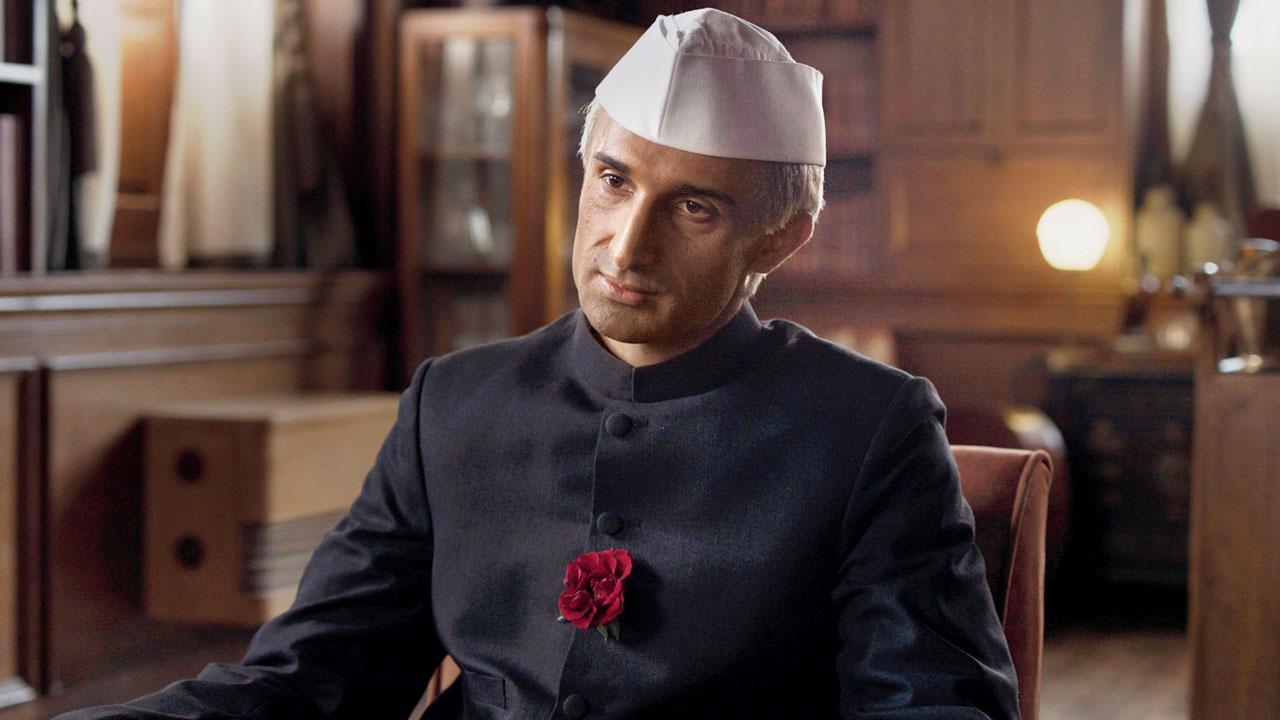
In June 2022, Advani had announced the historical drama that is based on Dominique Lapierre and Larry Collins’ acclaimed book of the same name. Almost two years on, he has shared the series’ first look with mid-day, which sees actor Sidhant Gupta as Pandit Jawaharlal Nehru.
“This show is a profound tribute to the luminaries of our freedom movement—Mahatma Gandhi, Jawaharlal Nehru, and Sardar Vallabhbhai Patel,” says Advani. While Gupta will be seen on screen after his breakout role in Jubilee (2023), Chirag Vohra and Rajendra Chawla will slip into the roles of Gandhi and Patel respectively. The Sony LIV series took birth over a simple conversation between Danish Khan, the platform’s business head, and Advani.
“Over the course of interacting on [shows], Danish sir and I have become not just collaborators, but also friends. He took one second after hearing the initial pitch of Rocket Boys to greenlight it. For Freedom, he came to me with a sparkle in his eye and asked, ‘How would you like to make your favourite book into a show?’”
The rest, as they say, is history. The team took the project on floors in late January this year. Besides being an ode to the heroes, Advani says Freedom at Midnight is also a means to take the audiences back to their roots, as they view India’s freedom struggle and the Partition through untold tales.
“We know the major sacrifices and struggles that led to our independence. What Dominique Lapierre and Larry Collins got was access to Lord Louis Mountbatten’s diaries and notes. So, in between all those milestones, we have some personal accounts that make that time come alive. We have tried to capture that.”
Gurinder Chadha to visit India to select actors for new film on Lord Mountbatten
7:38 AM

DNA (January 29, 2015)
Casting for director Gurinder Chadha’s next,
tentatively titled Viceroy's House will be finalised as soon as next
week, if all goes well.
The London-based Bend It Like Beckham director arrives in Mumbai next week for casting. The film will chronicle the last six months of Lord Mountbatten’s tenure in India, which marked the end of the British Raj.
Shares the director, “There are these so-called facts that we grew up reading about Mountbatten’s closing months in India. And there are these secret documents which I’ve unearthed. These point to another truth which I’ll reveal in my film.”
She has bought the rights to two very important books on the subject as well. “My husband Paul Mayeda Berges (who has co-scripted The Viceroy’s House) and I have bought the rights of two books Narinder Singh’s Sarla’s The Shadow Of The Great Game and Larry Collins & Dominique Lapierre’s Freedom At Midnight. These, plus the documents we’ve unearthed, will serve as the basis of the plot,” says Gurinder.
Buzz is, Chadha was keen on casting Colin Firth as Mountbatten, Naseeruddin Shah as Jinnah and Saif Ali Khan as Jawaharlal Nehru, but she counters, “I want actors who fit perfectly into every part. I see a lot of very natural actors in India now. And I’m eager to work with them.”
Gurinder will also go location- hunting during her trip to India. “I’ll be shooting in and around Jodhpur and Rajasthan.”
Subscribe to:
Posts (Atom)