Showing posts with label Fauji. Show all posts
Showing posts with label Fauji. Show all posts
Salaar 2 is not happening in 2026; Prabhas-starrer sequel has not even been discussed yet
10:21 AM

Amid heightened buzz around Salaar: Part 2, sources reveal the action franchise’s second instalment is not happening in 2026 as Prabhas will kick off ‘Fauji’ next
Mohar Basu (MID-DAY; January 22, 2026)
Over the past few days, rumours have intensified about the teaser of ‘Salaar: Part 2 — Shouryaanga Parvam’ dropping online on January 25, leading social media to go into overdrive about the Prabhas-starrer. However, insiders close to the production have told mid-day that the much-hyped sequel to director Prashanth Neel’s ‘Salaar: Part 1 — Ceasefire’ (2023) is not happening anytime soon.
“The sequel hasn’t even entered the discussion stage yet, let alone a shoot timeline,” said a source associated with the action thriller.
In fact, Prabhas’s next to go on floors is the period war drama ‘Fauji’, directed by Hanu Raghavapudi. According to insiders, the actor is expected to kick off the project next week in Hyderabad, juggling it with filmmaker Sandeep Reddy Vanga’s ‘Spirit’.
The source added, “Prabhas will be managing ‘Fauji’ and ‘Spirit’ together for the foreseeable future. The fate of ‘Salaar 2’ will be decided only after the director wraps his current project with Jr NTR, and Prabhas’s dates free up. That is likely to happen sometime in 2027.”
mid-day reached out to Hombale Films, the production house behind ‘Salaar’, which didn’t respond till press time.
--------------------------------
‘Salaar’ director Prashanth Neel is currently busy with his pan-India action film, reportedly titled ‘Dragon’. It stars Jr NTR, Tovino Thomas, and Anil Kapoor.
30 years of Karan Arjun: Salman Khan, Shah Rukh Khan are still the biggest superstars-Rakesh Roshan
10:21 AM

Renuka Vyavahare (BOMBAY TIMES; November 17, 2024)
A true-blue Bollywood revenge-reincarnation drama of the 90’s, Karan Arjun’s deeply emotional tale and casting coup made it iconic. Till date, it continues to be the only blockbuster co-starring superstars Shah Rukh and Salman Khan as leads. Slated to re-release in theatres after 30 years, on November 22, filmmaker Rakesh Roshan spoke about his celebrated film, need for its comeback and spilled some precious trivia in a chat with Bombay Times. Excerpts…
Why re-release Karan Arjun after 30 years, a film that has seen huge success already?
Despite the film releasing 30 years ago, both Salman and Shah Rukh are still the biggest superstars. That was a big bonus for me to re-release Karan Arjun. People want to see them together on the big screen in full-fledged roles. Their fans will love it. Kajol is actively doing films, the film’s music and dialogues continue to be a hit. So, I thought, lets re-release this on a bigger scale worldwide in over 2000 screens. I also want to see if the emotions that worked back then, will they work today? Agar picture dobara chalti hai, matlab emotions abhi zinda hai. Nahi chalti hai, toh its symbolic of the change this generation expects. It’s a test for me as a filmmaker.
If you were to make a sequel or a reboot, who would you cast in lead roles?
I won’t remake Karan Arjun or make a sequel but If I were to think of an alternate jodi for the movie today, I would cast Hrithik as Karan and Ranbir Kapoor as Arjun.
It’s not easy to cast two superstars as parallel leads. There’s always that fear of insecurity, rivalry and one upmanship popping in. How did you deal with this pressure as a filmmaker?
Before the shoot commenced, I sat with them together, face to face narrated them the whole story and dialogues with emotions. I told them jo bhi kehna hai, ab boliye, set pe matt boliye. Main jo bhi bolta tha woh karte thay. And I made sure dono characters mein koi unnis bis ka pharak na ho. Dono bis hi thay. Maine kaafi naapa hua tha woh sab. I had been an actor, so I knew yeh musibat aa sakti hai. At scripting level itself I made sure they were equal roles. There was no one upmanship or upper hand.
What made you think of Salman and Shah Rukh for these roles?
Salman’s physique was exceptionally good. None of the actors in those times had that built. He started that fit body trend. Also, I find his eyes arresting. I wanted someone for Karan’s role, joh chup chaap rehta hai par uski aankhen bolti hai. He fit the bill. I had worked with Shah Rukh in King Uncle (1993) and liked him immensely in Fauji so I wanted him to be Arjun. King Uncle (1993) could have been SRK’s debut film but that’s a long story.
What happened there? Why didn’t King Uncle turn out to be his debut film?
I was the first person to sign Shah Rukh, give him the cheque. I asked him to join the film industry. When I signed SRK for King Uncle, Amitabh Bachchan was supposed to play the titular part in that film but for some reason he couldn’t do it, and Jackie Shroff eventually played that role. This caused the delay and in the meanwhile his other films released first which he had signed after King Uncle. If it wasn’t for the delay, King Uncle would have been his debut film. I knew his potential. I liked him the moment I saw him in Fauji (TV serial). I remember seeing him for the first time at a restaurant. He was with Viveck Vaswani. They were eating. I walked upto him and said I really liked him in Fauji. I asked him if he would be interested in movies. He said no (smiles). I left my telephone number with him and said if he changes his mind, he can give me a call. He called the next morning. Then and there I gave him the cheque. I don’t know why he said no the first time. He was a kid then and maybe he thought later that it was a good role and an opportunity to work with Amitabh Bachchan that changed his mind.
Reincarnation, dramatic transformation, powerful comebacks have been recurring themes in your movies. What drew you to it?
For a common man, these ideas work because he also wants to do something in life. My failure as an actor perhaps drew me closer to ‘zero se hero’ banna theme. People used to say they found me pleasant as an actor, but my acting career never took off. My film Kaamchor (1982) was a hit, Jaya Prada went on to become a huge star, but it did nothing for me. Despite the film’s success, I didn’t get many offers so I thought may be God wants me to do something else. Maybe I was destined to be a filmmaker and Hrithik became a huge star, so I got to live my acting dream through him.
A film standing the test of time is its real success. Looking back, did you feel Karan Arjun would achieve that?
When I was conceptualizing this film, 80-90 per cent of my team didn’t approve of it. It felt like I was swimming against the tide because I believed in it. ‘Sir yeh kya bana rahe ho’ they would ask but when they saw my sincerity and passion, they surrendered to my vision. Reincarnation was a hot theme back then but only in love stories. Ma-bete ka angle wasn’t explored as much. Ek ma Bhagwan se kehti hai ke uskay bete maare gaye aur usko unko lautana padega, her prayers being answered is the theme of Karan Arjun and what made it what it is today.
None of your films would be complete without the music of Rajesh Roshan, your brother. Take us through this relationship.
We belong to a musical family. Music is in our blood. If he made something that I didn’t like, I would openly criticize. Kyunki hum bhai thay, hum jhagda kar sakte thay. I had that freedom. If I worked with others, I couldn’t tell them yeh bakwaas hai. I had to sugarcoat my words, so I preferred working with him. That openness and our warring nature brought out the best in us and benefited the film’s music.
Will we see you donning the director’s hat anytime soon?
We are working on Krrish 4 and we will be announcing it once things are clearer. Also, I will continue naming my films starting with K (smiles).
-----------------------------------
As the 1995 smash hit Karan Arjun lines up for re-release, director Rakesh Roshan on the ideal cast for a reboot and how Shah Rukh Khan didn’t buy into the reincarnation plot
Priyanka Sharma (MID-DAY; November 18, 2024)
One’s blockbuster re-releasing in theatres can be a sweet reminder of the long way they’ve come in their career. But filmmaker Rakesh Roshan is still feeling the Friday jitters, ahead of the November 22 release of Karan Arjun (1995). “It’s a test for me and filmmakers to see whether those emotions work with today’s younger generation,” he explains.
Jitters or not, the director agrees that a re-release is the perfect way to celebrate the Salman Khan, Shah Rukh Khan and Rakhee-starrer’s 30th anniversary that is due in January 2025. Very few films since have been able to bring the two Khans together in the same frame. “Shah Rukh and Salman are still the biggest superstars. The film is talked about even today. There are memes of the dialogues, ‘Bhaag Arjun bhaag’, and ‘Mere Karan Arjun aayenge’,” says Roshan, proud of how the film has found a place in pop culture.
One could attribute it to the film’s story that was gripping yet demanded suspension of disbelief—two brothers, essayed by Salman and Shah Rukh, are killed mercilessly by their menacing uncle and take birth again to seek revenge. Will the theme of reincarnation hold today?
Roshan thinks so. “Even if I made this story today, people might have believed it because it’s a fairytale. Make what you think is not possible. The audience knows it’s not possible, but they get immersed in the storytelling.” He further reveals that Shah Rukh didn’t buy into the reincarnation plot. “Though he wasn’t convinced with the plot, he wanted to do it. After the film became a hit, he said, ‘I was absolutely wrong.’ Then, he also made Om Shanti Om [2007],” Roshan laughs.
The director made Karan Arjun with two up-and-coming stars, something that many filmmakers today believe is next to impossible. “Singham Again has five heroes,” Roshan cuts in. In fact, he has a simple mantra that he thinks would convince stars to headline a two-hero film. “If you want to make a two-hero film, you make it balanced. In Karan Arjun, I made sure both the characters had equal meat. I’ve been an actor. So, I knew that if I was offered a film where my role was even slightly weak, I wouldn’t do it.”
So, if he made Karan Arjun today, who would he cast? The director admits that revisiting the movie won’t organically come to him at this stage. “If someone wants to revive the film, I’m up for it. There are many actors who will be magical on screen together. For Karan Arjun, Hrithik [Roshan] and Ranbir Kapoor would be my choices,” he grins.
This new book explores Shah Rukh Khan's fandom
3:01 PM
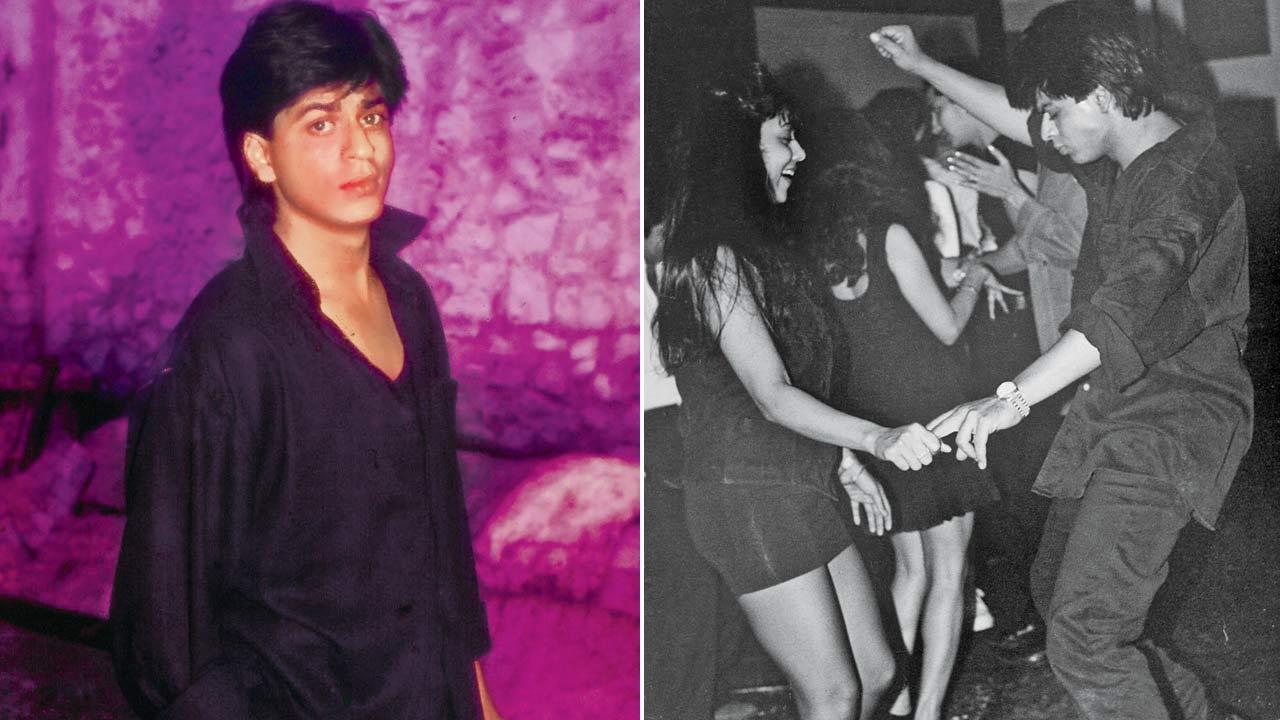
Shah Rukh Khan; (right) Dancing through life: Shah Rukh and Gauri show young love’s got rhythm
A new book aims to encapsulate what actor Shah Rukh Khan means to his fans. This extract talks about an early hit, Fauji, and how it heralded the birth of the superstar we know, and love, even now
Mohar Basu (MID-DAY; November 10, 2024)
Shah Rukh’s breakthrough in television came with Fauji, helmed by the jovial Colonel Raj Kapoor, who appeared on Jeena Isi Ka Naam Hai to talk about the actor.
Speaking about Colonel Kapoor, Shah Rukh said, “I never thought I could act on screen. Let me share a story: After my father passed away, my mother and I were searching for a house to rent. When we found one, my mother insisted that I see it first before confirming. When asked where I was, she replied, “He’s off acting.”
Kapoor’s son-in-law Kamal Dewan suggested I go to him, who was directing a serial. That’s how Fauji, which was aired in 1989 and had thirteen episodes, came to be.
Fauji served as Kapoor’s homage to the Indian Army, presenting a realistic portrayal of cadet life as young men trained to become commandos. Shah Rukh was already acting in another serial titled Dil Dariya at that time and shot for Fauji during lunch breaks—such shooting schedules were common for actors then who worked on multiple projects at the same time. The audition for Fauji involved a rigorous physical test, including a 1.5-mile run at dawn, followed by an impromptu boxing match. Shah Rukh impressed with his discipline, by not giving up on the race even when many co-auditioners dropped out. He was initially designated to land a smaller role while Kapoor’s son Bobby was to play one of the leads, Abhimanyu. But Bobby, who was already the cameraman, had to bow out.
It’s the way of this industry, as Karan Johar points out in Zoya Akhtar’s debut movie Luck By Chance: “Industry mein outsiders aise hi toh aatey hai. Koi alag tarah ka role likhta hai, koi badaa star nahi karta hai and finally ek naye ladke ko break mil jata hai [This is how outsiders get into the film industry. Someone writes a different sort of a role, big stars refuse to do it and then finally a newbie gets his break]. Zanjeer was turned down by seven actors before a struggling star, Amitabh Bachchan, picked it up.”
Shah Rukh has been destiny’s child in that sense, or probably was always at the right place at the right time. His two big Bollywood hits, Darr and Baazigar, landed in his kitty just like that.
How Shah Rukh landed Fauji, over and above the rigour he showed, is funny, to say the least. At the launch of Samar Khan’s and Sonali Kokra’s book SRK: 25 Years of a Life, he recounted, “I went there, I auditioned and he gave me a sweet role—in the whole Fauji serial, the Colonel orders me to go and count the crows on the tree. I would run and say, ‘There are four crows’. This was my role in the whole serial. I thought this was so strange… How could I tell my family that this was my role? … I did that and it was one of the nicest roles, and they’ve all loved me like a family. I am not saying this with false humility, but maybe the goodness I have at this age is because of the wonderful men and women I’ve met in my life.”
Amina Shervani, who wrote and acted in Fauji (as Kiran Kochar), said that for its time, Fauji was an extremely expensive show to make. It cost nearly Rs 2 lakh per episode to shoot. It was facing a four-year delay in its pilot launch. The Fauji team rallied in 1988 to ensure an early release the following year. They obtained permissions from the Ministry of Defence, Doordarshan and the Army headquarters. Despite challenges, the dedicated team pooled their talents and resources to bring the series to fruition.
In an interview to The Print, Shervani said, “I remember the Army was supposed to give us sten guns and other equipment to use, but they didn’t let us touch anything. So I flirted with a commando to steal a broken, defunct sten gun, and made a mould of it. We made twelve aluminium moulds that looked quite real. And one day, I was carrying them back from the studio in an auto, and the cops stopped me, and there I was—with twelve real-looking guns. Fortunately, we had done films for Delhi Police before that, so the police commissioner knew what we were really doing.”
This was the late 1980s and the turmoil in Punjab meant that procuring materials such as fuel for the demolition and explosion scenes was difficult, as the authorities had put strict rules in place. And so, for the scenes in the show, these had to be sourced from Shah Rukh’s mother, who owned a kerosene company. Dynamite was acquired through connections with friends who had contracts for stone and mica mining in the Aravallis, allowing the team to create their own explosives.
One would think these would be the biggest challenges in the making, but the real hurdle was getting Shah Rukh to cut his hair. Shervani said, ‘”Shah Rukh just wouldn’t cut his hair. He would keep smoking, and his mother would be worried that nothing would come of his passion for theatre.”
When Fauji was aired, it resonated with people in a big way. Shah Rukh’s charm captivated viewers, propelling him to the forefront of the show. His character, Abhimanyu, became central to the story, showcasing Shah Rukh’s knack for both romance and action. This was the first time he started becoming a household name. One of the many fans of Shah Rukh from that era is my own mother, Ellora Basu. When I first told her I am working on this book, she recounted to me how her love for Shah Rukh dates back to the late 1980s.
“Watching Fauji was like witnessing the birth of a superstar. Shah Rukh Khan’s charm as Abhimanyu Rai was not to be missed, and we knew he was destined for greatness from the very first day the show aired.”
As a child of that time, she told me how there was a general sense of fatigue with the trope of the ‘Angry Young Man’ that ruled movies and television then. “I wasn’t interested in television until Fauji came along. That was a young show. It had stories that my siblings and I could relate to. The show brought in young people to television viewing. A large part of our love was because of Shah Rukh. He was always a sincere actor, but more than anything else, he had the ability to charm you. It could be called screen presence, but in his unique goofy, boy-next-door way, he was someone you’d want to root for in a story. That’s the sign of a hero!”
Extracted with permission from Shah Rukh Khan: Legend, Icon, Star by Mohar Basu, HarperCollins India
----------------------------------------------------
‘Even at his worst, he finds it in himself to be a kind person’
Author and mid-day writer Mohar Basu says that the book, Shah Rukh Khan: Legend, Icon, Star, came into existence because they wanted to view Shah Rukh and his influence on cinema, culture and community from a third eye perspective including the lens of his fans. We spoke to her about what inspired her most as she wrote the book, and how she managed to write it as a detached writer, and not die-hard fan.
Excerpts from an interview.
What anecdote about SRK inspired you the most personally after writing this book?
There are a lot of absolutely fantastic stories about Shah Rukh, and a great selection of these has made it to the book. But the one that stuck with me was this story about Shah Rukh rushing back to India after his wife had a miscarriage while he was in New York shooting for Pardes. To get home quickly, he flew from LA to New York and then caught an Air India flight to India. There was rush and confusion at the airport and a fan persistently followed him for an autograph, despite seeing him flummoxed. When he finally reached his gate, he realised the lady actually was Akshay Kumar’s fan and thought he was Akshay. He didn’t want to break her heart so quickly signed an autograph as “Akshay Kumar”. This story shows what makes him as loved as he is. Even at his worst, he finds it in himself to be a kind person.
As a journalist, writing about fans and a star, what were some things you were careful about—so that it didn’t end up pandering to a star, but spoke of something deeper?
The relationship that fans have with the star they love has been a point of academic research. We all know how powerful and dynamic fandoms are. The approach we had decided early on in the project was to view Shah Rukh and his influence on cinema, culture and community from a third eye perspective including the lens of his fans. Why do people love him so much for so long is a question that was repeatedly asked at every step along the way. My editor at HarperCollins India, Bushra Ahmed, in fact, kept reminding me that fan psyche was at the forefront of this book. This is why we decided to write an entire chapter about why people love and desire him and tackled every aspect of it. Most interviews were done for this chapter because everyone found different things that drew them to him. Married women loved his love story, younger women saw him as a benchmark of what they seek from a man they are in a relationship with, some love the fact that he is a great father and everyone finds themselves drawn to him because he is respectful. The men loved his ability to work hard. The approach was pretty sociological. Some amount of my own training as a journalist and my education in sociology came in handy. We have tried to create a multi-layered, non-lateral narrative which I hope best portrays the power that SRK holds. The love for Shah Rukh runs deep and his charm is an added bonus.
What’s something your book has that you don’t think has been ever addressed about SRK before?
The impact of Shah Rukh Khan on community and culture, not just cinema, is at the heart of this book. The broad highlights of his life are well-known but this book looks deeper into the phenomenon that is SRK. For instance, take my favourite SRK film—Chak De India. The finest sports film India has ever made. And why has that movie been hard to top? It blended in entertainment and social themes perfectly. No other film has been able to reflect how diverse the country is and then SRK says that iconic dialogue— “Mujhe states ke naam na sunai dete hai, na dikhai dete hai. Bas ek mulk ka naam sunai deta hai.” Or more recently, a film like Dear Zindagi. A fan spoke about how she had always felt different and knew she wasn’t okay but Dr Jug made her to check in to therapy and she is better because of it. We often discuss how stars, especially in a country like India, actually impact real lives and how fans look up to them to inform their own perspectives. This book attempts to do show you how Shah Rukh Khan goes beyond being just a superstar.
Prabhas to shoot films one at a time due to distinct looks
9:07 AM

Sources say Prabhas, who is shooting The Raja Saab and has three movies lined up, can’t juggle them as he has distinct avatar in each film
Upala KBR (MID-DAY; September 23, 2024)
It’s a hectic few months ahead for Prabhas, who will move from one cinematic world to another. Even as he joined the shoot of The Raja Saab in Hyderabad in August and has Fauji, Spirit and Kalki 2898 AD sequel in the pipeline, juggling them is not an option. Reason? We’ve heard the actor sports a distinct look in each movie.
Currently, the superstar is filming Maruthi’s directorial venture, The Raja Saab, which has him play a common man, who visits his ancestral property and unwittingly sets off a chain of events. A source reveals, “In the horror comedy, Prabhas sports a distinct hairstyle. Owing to this, he cannot shoot for another film simultaneously. He will wrap up the film by next month.”
Prabhas will then go back in time for director Hanu Raghavapudi’s Fauji. Set against the backdrop of the Razakar movement, the film explores how the paramilitary volunteer force resisted the integration of Hyderabad State into India. The unit kicked off the shoot with Iman Esmail and Jaya Prada in Karaikudi, Tamil Nadu, last week.
The source elaborates, “Prabhas will join the proceedings in October. Since he plays a Razakar soldier, he will have to bulk up. Considering it’s set in the late 1930s, his outfits and on-screen avatar will be starkly different from how he has been showcased in the last few offerings.” It will be a straight three-month schedule for the period action drama.
That brings us to 2025. Come February, Prabhas will grow out his hair and film Kalki 2898 AD sequel. Simultaneously, Sandeep Reddy Vanga will develop the script of Spirit, ahead of kicking off shoot in April 2025. “Like he had imagined Ranbir in two different looks in Animal [2023], the director has envisioned a distinct avatar for Prabhas’ cop character. They will have look tests after the script is ready.”
Ananth Mahadevan's soon-to-be published book to narrate stories behind milestone TV shows
8:36 AM

Filmmaker Ananth Mahadevan’s soon-to-be-published book, Once Upon A Prime, takes us through milestone shows of Indian TV
MUMBAI MIRROR (April 29, 2020)

How Kishore came to sing for Yeh Jo Hai Zindagi
 The title refrain of Yeh Jo Hai Zindagi is still high on the television memory charts. When pop star Ajit Singh composed it, S S Oberoi blew a bugle, “lets get Kishore Kumar to sing it!” Kumar, the maverick actor-singer-composer, had not stepped out of the movie circuit before. In his legendary style, without batting an eyelid, he rattled off a figure of 18,000 rupees, the fees he charged for a film song. Oberoi didn’t blink either. He could see the song playing on television every week. Over 52 episodes it would amortize to less than 4,000 rupees a week. And so, Kishore Kumar sang for television.
When Colonel Kapoor ran behind ‘Fauji’ Shah Rukh Khan with a stone
He (Director Colonel Raj Kumar Kapoor) first ran into the 23-year-old lad named Shah Rukh Khan at Gulmohar Park in New Delhi. Kapoor’s brother-in-law auditioned him along with a bunch of others, and let them loose on the training ground. The Colonel put them through a grind unfamiliar to them. Not surprisingly three of them dropped out with a curt “we haven’t come here to join the army”. Only Khan kept up with Kapoor.
It ended in a sparring match with both donning boxing gloves. “I goaded him to hit me and he finally did. I could sense his aggressive nature. It was a presence that the camera loved. My Abhimanyu Rai was born, though honestly, I hadn’t penciled him in for the part. He was a bit of a bum though, turning up late for shoots. Once I ran behind him with a stone and that put an end to his punctuality ills.”
The other ‘bums’ weren’t a piece of cake either. The Colonel had recruited a barber on the set to clip their Samson locks. Yet the cadets continued to sport long hair. “I later discovered that they were bribing the barber,” he says. Corruption had seeped into the ‘army’, courtesy the civilians.

Govind Nihalani asked Indira Gandhi for government support for Tamas
Tamas lay untouched in Nihalani’s (director Govind Nihalani) room for more than a week. He preferred to read it when he had sufficient time out from filming. When he did get down to reading it, every sentence struck him not as words, but images. Something told him ‘this is it’. He decided that he wanted to do it, but didn’t have a clue how to go about it.
It was around that time that Nihalani’s searing human drama, his first film, Aakrosh (The Cry of the Wounded) was selected in the Indian Panorama section of the International Film Festival of India, held that year in Delhi. The directors of the films screened were invited for a tête-à-tête with then Prime Minister Indira Gandhi. An evening with Gandhi, however, turned into a rationed two minutes with each person.
Nihalani who was deeply under the influence of the book came straight to the point. “Madam, if a serious film were to be made on the Partition, would the government extend support?” “What do you mean by government support?” she enquired.” “The National Film Development Corporation, for instance. Regular producers do not fund this kind of film.” Gandhi instantly asked him when he wanted to make it. “It is a sensitive film. It will all depend on the political situation at that time.”
Nihalani realised that her sharp mind had taken cognizance of the Hindu-Muslim elements in the story. The communalism in the film and the country would not be without repercussions. “I realised I was sitting on a potent subject. I was certain as hell that I wanted to make the film.”
Why the Big B was apprehensive about KBC
Amitabh Bachchan’s participation in (Kaun Banega Crorepati) evoked the expected skepticism. I was privy to groups turning into all-knowing prophets of doom: “What works in formula films will not work on TV”, “Imagine diminishing his status to that of a television host”, “Did he need this at this stage of his career?”… Strangely, Bachchan himself echoed some of the sentiments “Yes, I was most apprehensive about the idea of going on to the ‘small screen’, as were most of my family members. I felt that the uncertainty of my ability to pull off something like this, was weighing more than the actual danger of reducing my size from 70mm to 21 inches. But as is with most pioneering efforts, since there were no yardsticks or examples to use for reference, I merely took the decision, and the plunge. I have never thought of myself as being in possession of any stature or for that matter being some kind of a star. I looked upon this as another job to be done and that is how I approached Kaun Banega Crorepati.”

Doordarshan turns 60; netizens get nostalgic
7:53 AM

MUMBAI MIRROR (September 16, 2019)

Prasar Bharati CEO Shashi Shekhar Vempati said, “It is not only that Doordarshan has turned 60 but the history of television broadcasting in India now spans six decades—a milestone for all of TV industry.”
Doordarshan Director General Supriya Sahu added, “Doordarshan is in the DNA of India… Starting off as an experiment in 1959, Doordarshan can take pride in the fact that it has emerged as one of the leading broadcasters in the world.”
Doordarshan took off on September 15, 1959, becoming a service in 1965, when it began beaming signals to reach TV sets in living rooms in and around the national capital. By 1972, services were extended to Mumbai and Amritsar and then to seven other cities by 1975.
All this time, it was part of the national broadcaster, All India Radio. On April 1, 1976, it transited to become a separate department in the Ministry of Information & Broadcasting. Over the years, DD has grown into a network operating 34 satellite channels, besides providing free-to-air DTH service having 104 in its bookings.
Many a career were launched on this platform, including that of Bollywood star Shah Rukh Khan who became a household name after his serial Fauji (above). Many shows went on to become classics like Chitrahaar, Mahabharat, Dekh Bhai Dekh, Fauji, Malgudi Days, among others.
I can’t understand Indian TV; don’t know who devranis and jethanis are-Shah Rukh Khan
8:03 AM

Shah Rukh Khan takes a trip down memory lane, reminiscing his good ol’ TV days and discussing how the medium has evolved over the decades...
Nayandeep Rakshit (DNA; February 20, 2015)
The first TV star to have truly made it big in B-Town,
Shah Rukh Khan stands as a towering inspiration for actors looking to
make the leap from the small screen to the big one. Two-and-a-half
decades later, he reminisces about the “good old TV days” as he readies
to host &TV’s new quiz show — India Poochega Sabse Shaana Kaun?
Here, he keenly talks about his new stint with IPSSK, explaining why he
won’t ever do a Bigg Boss or be a judge on a reality show...
You’re one of the few actors to successfully make the transition from TV star to movie star...
If that’s the case, I’m also the only guy who came from films to television and hasn’t succeeded again. So I need to succeed at TV because that’s where it all started. With all due respect to KBC and Paanchvi Paas and Wipeout, I don’t think I have been able to recreate the magic of Fauji or Dil Dariya or Ummeed or Wagle Ki Duniya or Circus again.
From Fauji to India Poochega Sabse Shanaa Kaun, a lot has changed on Indian television. Comment.
Unfortunately or fortunately, I am bound by the fact that I like to do a certain kind of television. It may be fiction, which I don’t know if that will ever happen. If that’s non-fiction, I like the question-answer type. I am not very turned on by the other reality shows. The shows are really wonderful, but I am not turned on by the idea of hosting it. Somewhere down the line I need to understand. I have a team — the &TV team that tells me — ‘Look, we need to do it like this’. Now that is not my forte — knowing what the market is like. So I try my best learning it from the people I work with. But I hope that someday, I can re-create the magic of Fauji. Inshallah!
You love the Q&A format of the game, but it has not worked for you previously. India Poochega has a novel concept. Do you think it will help you redeem yourself on television?
I don’t do any work for redemption. Having said that, if you keep doing something long enough and are good enough with the passion that you have and the hard work that you put in, it will work one day. It cannot go wrong. This is what my experiences have made me believe. So I have worked for 25 years and when I made films, I went wrong. When I became a producer, I went wrong. It might sound arrogant but it’s absolutely not that way. But then I went on to make few of the biggest films made in Bollywood after having made some films that did not do well. You cannot have instant success. Success can only happen instantly when you are new. The biggest problem of success is that you lose the ability to surprise people. You lose the freedom to go wrong. So yes, we have to keep doing it again and again. With the talent, hard work and the team that we have presently on India Poochega, we want to bring something to the table that is new and different. So if you go wrong once, you try again. You go wrong again but you cannot stop trying and striving for the better. You keep on trying till you get it right and shifting, changing and evolving with the team you work with. So hopefully, with the &TV team and India Poochega Sabse Shaana Kaun?, I will be able to create something that will be new on television and entertain people. I don’t know how big or small it will be but that won’t stop me from trying.
Does criticism bog you down or hurt you?
Criticism hurts me, but I don’t get bogged down. I am a different kind of a person. The more you tell me I am wrong, I will try and do it again and again to prove it to you that it’s right in the long run. I have no other reason to be doing what I can — to be able to entertain. If I have done it for 25 years, now it’s my duty. It’s like a responsibility on me. I don’t want to sound pompous but I have been doing this for so long that now I am like, ‘Can I do something new?’ I think people who are at the top of their game should try doing new stuff every time. I get really impressed by people who are different and they try something new and then I’m like ‘They have nothing to lose’. If the person who has the most to lose does not try something new, then there’s something wrong for sure. I’ve played the game long enough now to know that if I go wrong whatever number of times — be it with VFX, RA.One, Phir Bhi Dil Hai Hindustani, KKR or other TV shows, it won’t pull me down. You have to believe that new things do get understood by some people. As an artiste, it’s our duty to explain that what we are doing may not have adhered to your sensibilities right now, but this may be the thing you like later on.
So many offers might have come to you after KBC or after Wipeout. Why choose India Poochega?
There have not been many offers! (Laughs) I think after Wipeout, I got busy and there were only one or two offers, but they were already on TV. I need to do something that I feel happy doing. I wake up in the morning and work 20 hours a day. So if I don’t feel happy, I won’t be able to pass on that happiness. It’s not at all for money. Unfortunately, I like the Q&A format a lot more. I do it all the time with my kids. They like it and I enjoy it. I like to be the host of a quiz show because in spite of what others might think about me, I feel I am an intelligent person. So I need to do this. I like people winning money and the other things that I have been offered has never interested me. Love and work — if it does not turn you on, don’t do it!
Will we never see you turn judge for a reality show?
I have been a judge on reality shows, when we go for film promotions. I am the worst at judging people. I like everyone and I want to give everyone a 10 on 10. I don’t like judging anyone. When I was judging Miss India and the other one — Grasim Mr India, both times I faced difficulties judging the people. One time, I was sitting in the parking lot and I told Maureen (Wadia) that I cannot select one person. I asked her to tell me who she likes and who the best is, I will just come and announce it. Same thing happened during Miss India. That time, Waheedaji, Juhi and Azharuddin were on the panel so I asked them to select unko jo bhi achche laage. That’s one thing I cannot do at all.
No Bigg Boss as well?
With due respect to all the other shows, I don’t think I am fit for anything other than the shows I have been associated with. As for Bigg Boss, no it’s not my cup of tea. In terms of how the contestants lead their lives and all, it’s a beautiful show. And I think Salman does it really well and Farah’s done it really well too. I see snippets of it. People in my house see it. I have never been intrigued to host it. But yes, watching it as an audience, I am open to seeing Bigg Boss. As a host, I don’t think I will be very good at it.
There’s an amicable synergy building between the mediums of films and TV...
I am not exploring. I started here. The other people who are doing it and exploring the medium are all fantastic. Salman, I believe is fabulously watchable as a host. Even Dus Ka Dum was very cool and now he’s doing Bigg Boss. I am sorry, but I can’t speak like this about Salman or Aamir, but generically, I don’t think actors think like that. They think of it the other way — that this is the show which has attracted me so what can I add to the show? People enjoy themselves on the small screen and that’s why Salman or Aamir do it. Aamir really loves the social service stuff that he does and is very pertinent of his ideas. He’s happy doing it. For me, I am a television star hoping to be a film star. So when I become a film star, I will try to be a TV star again. I am still struggling, but these guys are good at their job.
You have also said that you are more interested in Western sitcoms than an Indian soap or serial. Why?
I can’t understand Indian TV and I ‘ll be honest about it. I am sorry Zee TV, &TV, Sony TV, Star or Colors, but I don’t understand television stuff here at all. I am too urban for it. Maybe I am too uneducated or unemotional. I sell all that myself in my films but I don’t understand that on TV. I don’t know who devranis and jethanis are. I come from a different kind of family, so I don’t understand all that. I understand good story-telling. Even the Indian 24 was beautiful. I like Prison Break. Actually, let me be very honest, when television started early on, there were shows like Hum Log, Fauji, Buniyaad, Yeh Jo Hai Zindagi, Wagle Ki Duniya, Nukkad. They had more essence and were funny, entertaining yet edgy and different. There was a TV series with another fantastic serial which Kitu Gidwani was a part of and was based on Moonlight. Even Hum Paanch and Indradhanush were interesting. It’s not a comment on what people are making today because at the end of it, it’s a business and people want to make sure it works. Maybe the choices were less back then which is why these shows got more attraction. Today, the choice is a lot in terms of the number of channels that we have today. The choice and content is very narrow. Nobody wants to take a chance and go wrong. The channels should try and take more risks now because sometimes you need to create an audience. People say, ‘Log dekhte nahi hai’. Par aapne dikhaya kya hai? Failing one time does not mean it was rejected. It simply means that they were not ready for it. So we need to do it again. If you give the audience enough choices, they will make some interesting choices too.
Do you ever see yourself doing a fictional show on TV?
If they can afford me! But I doubt television can afford me.
What if the makers create a special character for you?
They still won’t be able to afford me. I am very spoiled (smiles). I would love to do if it’s something really amazing as a character. Sometimes, I sit down with my friends and discuss it each time we meet. So I tell them, ‘Let’s do it, let’s do it’. But eventually, I understand that they want me to do things that work, not the stuff that’s risky but I can make it work. I kind of get out of the room quietly without telling them. I am a little bound when it comes to films but on television, I would like to sacrifice everything to be a part of a really nice show. I was joking about the price and all. You allow me to come on television because it reaches homes without a huge amount of charge. I have said it even when I was not a big star that a door knob can be a star on television. It all depends on how you film your story. When I talk to the channel heads, they are initially very excited about the idea I have. But eventually the novelty of the idea gets lost. They will tell me, ‘aisa karna padega. We have to make 52 episodes and we have to make these changes’ and it becomes really difficult to teach them the process. So, I just take myself out of it.
'Tu galat SRK ke saath chali gayi'-Shah Rukh Khan to Vidya Balan
9:00 AM

Renuka Vyavahare (BOMBAY TIMES; February 17, 2014)
Vidya Balan unabashedly admits that she finds Shah Rukh Khan very charming. Says she, “Amongst the married men, Shah Rukh is so charming.” She adds, “He’s not been a co-star but there’s something about Shah Rukh. Also, he and my husband Siddharth Roy Kapur have the same initials and I get away with a lot because of that. When I went for the screening of Kabhi Alvida Naa Kehna and he puts out his arms in the song Mitwa, for a minute I saw myself running to him! I remember I was young when the television show Fauji released but I knew my sister and her friends were crazy about him. At that point, I was going through the I-don’t-like-boys phase, so I didn’t like him. I actually fell in love with him when I saw Dil Se and that’s not a film, a lot of people mention in context to SRK.” The actress is sure SRK knows about her liking for him. “Of course, he knows. I think he has read about it and he keeps saying, ‘Tu galat SRK ke saath chali gayi’, to which I say, ‘Par aap toh kahaan ghaas daal rahe the’. All of this is a joke,” she concludes laughing.
Subscribe to:
Posts (Atom)