Showing posts with label Eros Cinema. Show all posts
Showing posts with label Eros Cinema. Show all posts
Kamathipura locals oppose plan to change Alexandra theatre plot reservation
10:11 AM

Richa Pinto (THE TIMES OF INDIA; August 12, 2026)
Mumbai: Minister Ashish Shelar's assertion that a land's original reservation cannot be altered to only suit a particular use appears to be at odds with BMC's actions. Proposals for changes in land use have been made for multiple sites in the city and a 1,005 sq m plot housing the now defunct century-old Alexandra Theatre in Byculla and a 3,439 sq m plot in Versova meant for a fire station and a civic post are set to be the latest casualties.
BMC will move a proposal on Wednesday before its improvements committee seeking to remove the Byculla plot's cinema/entertainment reservation and rezone it for residential use.
Opposing the plan, the Kamathipura development committee on Tuesday urged BMC to retain the existing reservation and protect one of the few remaining recreational amenities in the locality.
In a letter to BMC chief Ashwini Bhide, the committee said the state govt, through MAHADA, is undertaking a group redevelopment project spread across around 34 acres in Kamathipura. It said the redevelopment will substantially alter the neighbourhood and have a significant impact on available recreational and public amenities. It said it is, therefore, important to preserve land reserved for such amenities. The committee urged the civic administration not to alter the reservation "under any circumstances".
According to BMC's proposal, the theatre has been closed since 2007 and owing to the current condition of the premises and changing trends in the entertainment sector, running it is no longer economically viable. Besides, it said, the building is in a very dilapidated condition. The proposal said an application seeking cancellation of the cinema reservation and inclusion of the plot for residential use was submitted by Sameer Qazi of the state WAQF board to deputy CM Eknath Shinde on Feb 25. The state urban development department subsequently sought BMC's opinion on the proposed change
The plot's occupant, Rafiq Patel, also submitted an application to the civic development planning department. Following scrutiny and verification by the civic departments concerned, a proposal to delete the cinema reservation is now being placed before the improvements committee. Approval of the civic House of corporators will also be required for the change.
------------------------------------------
It’s curtains? Only 50 single-screen cinemas remain in Mumbai Metropolitan Region
Bella Jaisinghani (THE TIMES OF INDIA; September 16, 2026)
Mumbai: The fortunes of Alexandra Cinema, a famous single screen theatre in Nagpada, rose and ebbed like ocean tides in the last 105 years since it was founded by Ardeshir Irani and Abdulally Esoofally in 1921. Once a favourite haunt of movie-goers for its Sunday Hollywood classics, it gradually fell into disrepute for showing X-rated fare. In 2007 the last film was screened, and around 2011, Alexandra transformed into an Islamic study and prayer centre. Now it is set to be demolished to make way for a residential complex.
Audiences recall the magic of watching movies in such standalone theatres in the 1960s-70s where a samosa and ticket cost Rs 2-5 each. Spectators would freely whistle and applaud when Amitabh Bachchan beat Mohan Sherry in Trishul, laugh heartily at Mahmood’s antics in Ginny Aur Johnny, and throw coins at Jayshree T’s mujra ‘Humne maana hum pe saajan’ (Dada).
Glitzy multiplexes are a different prospect, say critics, adding tickets and food are prohibitively expensive and collective outpouring of emotion is seldom witnessed.
The Cinema Owners and Exhibitors Association of India (COEAI) provided TOI an updated list of June 2026 which shows that only 45-50 single screen cinema halls remain functional in MMR. The rest, around 125, have closed down. A requiem is being written every other week.
Owners of single screen theatres say that faulty government policies including high taxes, electricity bills, tiresome licence procedures and lack of incentives have left them suffocated. In fact, tax holidays are granted to multiplexes owned by rich corporates. The prospect of redevelopment is enticing -- only if the mandate to include a movie hall in the new premises is removed, they say.
Senior film critic Rajiv Vijayakar says, “I have watched movies in single screen theatres across India because my father had a transferable job. The atmosphere, the enthusiasm of the audience cannot be compared to a multiplex. Rarely do you see people clapping now -- maybe in some cases like Dhurandhar.”
He recalls, “Decades ago I had gone for a short three-day holiday to Mussourie, and every afternoon, I would visit a particular 50-seater theatre to watch films. I remember seeing CID 909, Shehnai and Yaadein. In Delhi I watched The Bridge On The River Kwai and Lawrence Of Arabia in Sheela Cinema, which had installed the first 70 mm screen in India. In Chennai I recall going to a nice theatre located in the basement of a building.”
Vijayakar moved to Bandra in the 1970s where Bandra Talkies and New Talkies became his standard haunt followed by Gaiety-Galaxy. “Of course it was a lovely era but let me not omit the occasional rat sightings in single screen halls,” he laughs. He recommends that the govt grant a tax holiday to single screens to revive them.
The challenge of OTT and web series is not the sole hurdle. Nitin Datar, past president of COEAI, spells out a series of factors that have brought the curtains down on single screen theatres.
“The first cause would be the [unfavourable] policies of the govt of Maharashtra, like very high property tax, electricity rates and [cumbersome] licence renewal. Then, multiplexes which were the new entrants were given a tax holiday for a period of five years, and in that duration, they earned around Rs 15-20 crores. But when our single screens asked govt for a similar incentive to compete with multiplexes, we were denied it and left high and dry,” he says.
“Thereafter the Maharashtra govt gave a tax free scheme like multiplexes to theatres in the state -- except in corporation areas like Mumbai and Pune. But after GST was introduced, govt discontinued this policy. Meanwhile exhibitors had spent a huge amount on renovation -- and they came into losses. Then the govt almost put compulsion on single screen theatres to go for digital projection and computerized ticketing. So first we used to sell paper tickets, now it was computerized. And the benefit of this was taken by agencies who monopolized the process,” Datar says.
If that were not enough, big distributors and producers were acting like a “monopoly” cartel. “Due to pressure by multiplexes, they did not supply films to all the single screen theatres,” he says.
COEAI and other associations requested the govt for subsidy and loans so single screens could survive and compete, to no avail.
Datar is presently renovating his own Uday Cinema in Ghatkopar into a commercial complex, including two screens in the mandatory cinema hall.
A high profile revival in recent years was that of Eros Cinema, Churchgate, in Jan 2024. A spokesman for Metro Realty which owns the theatre said, “The redevelopment of Eros was a capital intensive and challenging project, envisioning adaptive reuse of spaces in an iconic heritage building. It now houses an IMAX cinema, flagship store and ten dining options.” Similar financial backing is often not available to single screens in non-prime locations.
Kapil Bhopatkar’s family has owned Bharatmata Cinema in Lalbaug since 1941. The hall underwent a full makeover in March. Bhopatkar says, “The challenges for a single screen are multiple. Firstly we have no control over the content that we screen. I don’t make the films that I exhibit at Bharatmata. After all only if the film does well, the theatre does well. Moreover, we pay unusually high electricity bills because we are charged at a commercial rate. We pay huge sums in property taxes and of course there are vast upgradation costs. We need some kind of govt support and ease of licencing regulations. Those owners who want to exit the business and apply for change of user should be allowed to go.”
Bharatmata has been revamped in a tie-up with 1 Cinema, Rajat Haksar and Sunil Patil. “Ours is a heritage structure so we retained the exterior but changed the interiors -- chairs, AC, a bigger screen, better sound and 2K projections.”
Even as newer direct to home technology and OTT overtakes the cinematic experience, several generations of film lovers long for that one Drive-In or Navrang that did not force them to break the piggy bank.
------------------------------------------
Alexandra Cinema case raises wider plot reservation concerns
Sanjeev Devasia (THE TIMES OF INDIA; August 30, 2026)
Mumbai: As a proposal to change the reservation of the plot housing the shut Alexandra Cinema in Byculla to a residential plot is pending before the BMC improvement committee, questions have been raised over whether the reservation for other cinema/theatre plots will similarly be changed merely because the theatres have remained closed.
While demanding that the proposal regarding Alexandra Cinema be kept in abeyance or rejected, Congress improvement committee member Meher Haidar has demanded that the status of all cinema theatre reservations/designations under DP-2034 be made public. She has also sought a comprehensive white paper on the cancellation/amendment of reservations for RGs, PGs, open spaces and other public amenities. “This is a serious attack on public interest in the city’s planning,” Haidar said.
She pointed out that DP-2034 contains 119 cinema theatre reservations/designations, covering a total area of 3,09,284 sq m. “If the designation of one closed cinema theatre is cancelled today, will this not create a precedent for owners of other shut cinema theatres to seek cancellation of reservations for their plots?” she asked.
Shiv Sena (UBT) member Visakha Raut, who opposed the proposal, said multiplexes are beyond the reach of the common man. “Besides, you need to preserve cinemas in certain areas, including in the vicinity of Alexandra Cinema, for people from the lower- and middle-income groups,” she said. Shiv Sena (UBT) member Sachin Padwal said, “This will create a precedent, and what entertainment options will people in that particular area have?”
As per provisions of DCPR-2034, at the time of redevelopment of such plots, a cinema/theatre facility has to be provided over 30% of the plot area or with a minimum seating capacity of 300 seats, whichever is less. “If a cinema theatre is closed, it can be modernized and restarted. Then why is the reservation itself being cancelled?” Haidar asked.

Eros cinema to rise again; heritage features intact
8:27 AM

Bella Jaisinghani (THE TIMES OF INDIA; January 28, 2024)
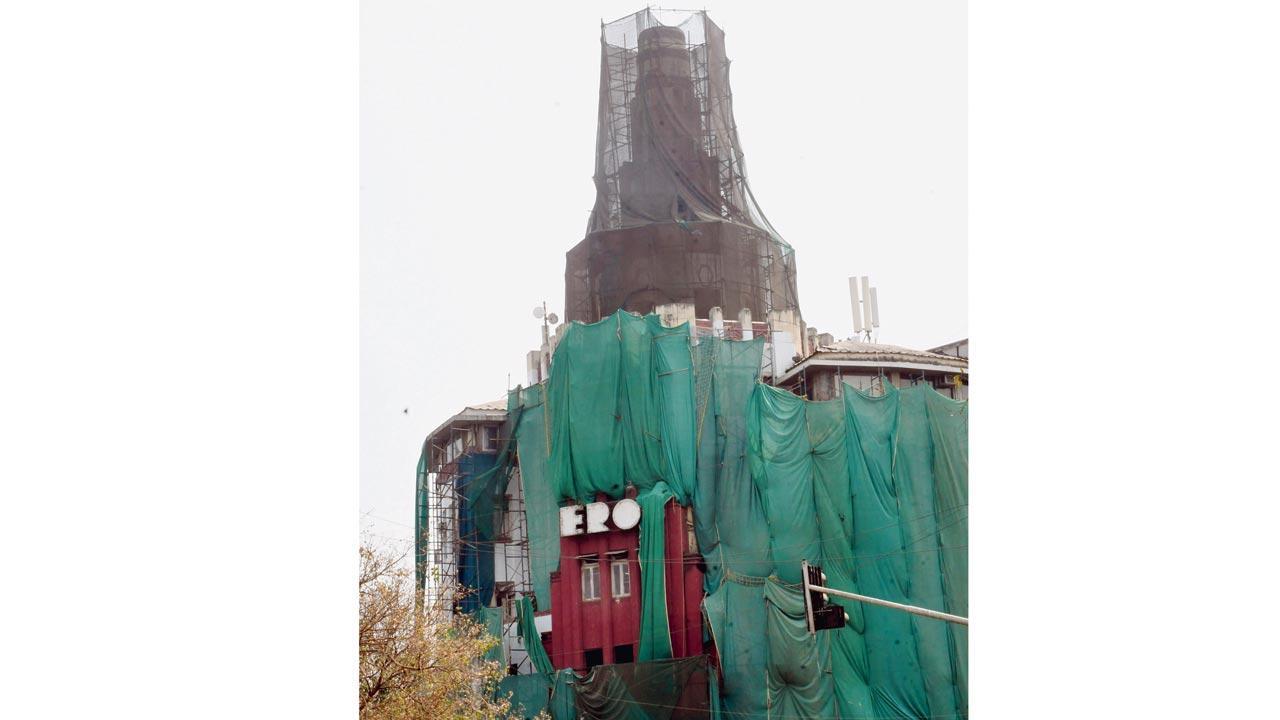
Mumbai: The iconic Eros cinema hall at Churchgate, long veiled under a green curtain, has been refurbished and restored, and is set to draw a different generation of leisure seekers shortly. It was started in 1938 and had familiarized generations of Mumbaikars with the best of English cinema in its Art Deco setting, which has been preserved.
In its new avatar, Eros will be a 300-seater cinema on the upper storey apart from two levels of retail and food courts.
Other landmark single-screen theatres in South Mumbai such as Liberty, Regal, New Excelsior, New Empire, Sterling and Central Plaza have all faced challenges to their existence amid the onslaught of multiplexes and the pandemic.
Atul Gupta, managing partner of Metro Realty, the firm which has undertaken redevelopment of Eros, said, “The structure will house a 300-seater cinema. It will become the first IMAX cinema hall in the world that is located in a 90-year-old building and will have two levels operating as retail and F&B spaces. We have preserved heritage Art Deco elements including the circular lobby, staircases, murals and other features, just as we did in Metro Cinema. We have honoured all heritage guidelines.”
Gupta said, “The theatre was shut for 10 years, and we decided to take over after our successful experience of renovating Metro Cinema as an 8-screen multiplex. So we signed a deal with the owners of Eros, the Cambata family, who continue to own the property but have given it to us on lease for 30 years.”
Conservation architect Kirtida Unwalla was the consultant entrusted with preserving the Art Deco ethos of the Grade 2A cinema hall. She said, “The essential elements of the Art Deco form are all preserved. In fact, we have not only preserved but enhanced the 6-ft-tall artistic panels depicting the journey of cinema and other arts. The famous 2 staircases are still there, and we have retained and restored the old doors and windows on the ground floor. The ‘frozen fountain’ has been reproduced to the scale possible. That is a rich element of Art Deco. We have carried out all the work after securing permission from the heritage committee.” The new features too are in sync with the Art Deco style, including a canopy of light.
Meanwhile, speculation surrounding the new cinema gathered steam online. Eros theatre team invited those who had expressed misgivings and alleviated their doubts at a trial show a few days ago.
Single-screen theatres have fallen on hard times. Mrunal Gole, owner of Liberty Cinema, said the hall has been shut since Covid with government rules not enabling relaunch. Nitin Datar, president of COEIA (Cinema Owners and Exhibitors Association, India), said a list of policies has forced a majority of the 150 single screens in Mumbai to shut. “Barely 40-50 halls are left. If one refurbishes a large theatre, it can cost up to Rs 1 lakh per seat to do so, given the expenses on AC, seating, projection and other infrastructure. Our ticket rates are Rs 40-70, how can we manage?” he said.
Amid the gloom, one single-screen theatre that has got its revenue model right is Hindmata Gold in Dadar. General manager Amit Singh said, “We thankfully have 80-90% occupancy and we show the latest movies because our ticket and food rates are accessible. Many families are returning to single screens given the low costs.”
Veiled Eros cinema structure sparks fears for Art Deco precinct; BMC asks Twitter users to calm down
8:23 AM
Bella Jaisinghani & Richa Pinto | TNN (THE TIMES OF INDIA; April 30, 2023)
Mumbai: The hearts of heritage watchers fluttered with anxiety Saturday after pictures emerged of the iconic Eros Cinema in Churchgate veiled behind a big green curtain. The iconic single screen cinema which has been a pillar of the city’s Art Deco heritage since 1938 is engulfed by speculation over whether any proposed renovation will deprive it of its unique character.
More horrifying was the prospect of demolition that was discussed on social media, although the fact that Eros is located in a heritage precinct precludes that possibility. The Cambata family that owns Eros is settled abroad and was not immediately available for comment.
Film maker Apurva Asrani tweeted, “Heartbreaking to see Eros Theatre being torn down. This South Bombay Art Deco landmark, built in 1938, was where I bunked college to go to. It’s where I went on my first date & where my first film ‘Satya’ released in ‘98. Sad that Mumbai can’t preserve its heritage buildings.”
A BMC official, who was formerly with A ward, admitted that there was a proposal to revamp Eros Cinema. Earlier reports had said the theatre was being refurbished with new use and part theatre. The plan was to convert the 1,200-seater theatre to 300 seats. The interiors would be altered which would change the character of the theatre. But the external facade would be preserved.
Assistant municipal commissioner of A ward Shivdas Gurav said that in the last two days the ward has cleared debris that was lying behind the theatre after locals objected. “This debris belonged to a garage that was lying in the premises which had not been picked up and locals had complained about it. We only cleared that,” he said.
In 2019, citizen stakeholders who took the lead for south Mumbai’s Victorian Gothic and Art Deco Ensembles being inscribed in the UNESCO World Heritage Sites list in 2018 had raised concern over the condition and future of Esplanade Mansion and Eros Cinema in the precinct.
They had said efforts should be made for the preservation of Eros Cinema and other structures which face threats from extensive internal change.
The fact is that single screen theatres have fallen on hard times with the arrival of multiplexes and online streaming platforms. Revenues are scarce and many iconic theatres have had to shut down. Prime real estate fetches higher revenues once commercialized.
------------------------------
BMC asks Twitter users to calm down; says facade is undergoing restoration
MID-DAY (April 30, 2023)
While Twitter was abuzz with rumours about the iconic Eros Theatre in Churchgate being pulled down, BMC officials on Saturday told mid-day that the building was only undergoing restoration.
Eros Theatres stopped operations in 2017, following in the fate of many single screen cinema halls in the city.
When contacted, Aparna Bhatte, deputy municipal architect of BMC, said, “As per my knowledge, the building is not being pulled down. It’s undergoing repairs and restoration since 2018-19.”
On Saturday, following rumours about the building being torn down to make way for a mall, social media users began to shares their memories of visiting the iconic south Mumbai theatre. Filmmakers Vivek Ranjan Agnihotri and Apurva Asrani, and comedian-actor Vir Das were among those who took to Twitter.
Speaking with mid-day, a BMC official said: “Are those tweeting photos and spreading rumours even taking any effort to confirm what’s happening? One tweet follows another, and people just blindly follow these without any confirmation.”
Coming soon at Eros: a store & a 300-seat cinema
8:41 AM

Eros, located in Grade II-A heritage building at Churchgate, shut down in 2017 because of poor ticket sales
Yogesh Naik (MUMBAI MIRROR; December 29, 2018)
Eros, one of Mumbai’s first single screens and an integral part of the city’s Bollywood history, could soon reopen in a new avatar with a smaller theatre on its first floor and a sprawling departmental store on the ground.
Mumbai Heritage Conservation Committee is looking at a proposal by the Cambata family, which owns the space, to turn the theatre’s lobby and stall section into a department store and the balcony into a 300-seat theatre.
Eros, which is located in Grade II-A heritage Cambata building on the junction of Maharshi Karve Road and Jamshetji Tata Road at Churchgate, shut down in 2017 because of poor ticket sales in the face of competition from multi-screen theatres.
A few months later, the building was attached by the collector upon the orders of the labour commissioner following the Cambatas inability to clear the dues of the employees of Cambata Aviation, the family’s ground handling business at the Mumbai international airport.
The redevelopment plan is parallely being reviewed by the state governnment’s Urban Development Department and the BMC’s Building Proposals Department. The project will require multiple permissions as Cambata building is part of Mumbai’s World Heritage Site of Victorian Gothic and Art Deco Ensemble and it is located in the Oval sub-precinct of the Fort precinct.
The proposal seeks change of user and alterations within the part of the building that housed the cinema hall. It promises that the art-deco elements in the theatre’s lobby and the atrium will be retained and rejuvenated.
In a statement released on Friday, Metro Realty, which has won the mandate to redevelop the property, said the structure has deteriorated considerably in the past 80 years and it will be a challenge to restore it to its past glory. “We have the experience of rejuvenating Metro Cinema and we intend to do the same here,” said Atul Gupta, director, Metro Realty.
The Cambata building has several tenants, including a bank and a coffee shop, and the theatre is surrounded by commercial establishments on all sides. Once the redevelopment is complete, the current entrance to the theatre will become the entrance to the departmental store, while the access to the cinema hall will be from the east façade of the building.
Eros Cinema with a capacity to seat 1204 people, opened in 1938. The two wings of this art deco building meet up in a central block. The foyer is in white and black marble with touches of gold. Marble staircases with chromium handrails lead up to the upper floor.
Regal, Eros: Will single screen theatres in Mumbai be a thing of the past?
7:58 AM

Eros, Regal and many other iconic single screen theatres in the city are slowly grinding towards shutting shop or being sold to multiplex chains
Rachana Dubey (BOMBAY TIMES; December 12, 2018)
It has been almost two years since Eros Cinema, located at a busy intersection near Churchgate railway station in Mumbai, has halted operations. For many months, it has been in the news, with a question mark on what the future holds for this iconic cinema hall in Mumbai. Reportedly, even Regal, once considered the pinnacle of South Mumbai’s cinematic dreams, is struggling to sell tickets. A solo-screen in a theatre just does not cut it anymore, not in a business model where multiplexes can run dozens of shows across half-a-dozen screens at the same time.
A visit to the Eros building had revealed that it had been shut for repairs and maintenance, although there was nothing evident on the ground floor visible from the gate. Enquiries around the property suggested that talks were going on with a multiplex giant and a London-based realtor for either turning the cinema into a multiplex or a shopping complex, but neither seems to have moved forward in the last year or so.
Actor Randhir Kapoor remembers watching films at Eros. He believes that it is indeed difficult for the industry, especially the senior frat, to imagine Mumbai without its iconic cinemas in their original form. “I used to study around the corner where Eros is located. I have great memories of watching films like My Fair Lady (1964) and The Young Ones (1961) at Eros. It was one place that so many youngsters those days frequented for their fill of English films. The place also hosted censor previews. I’m sure it’s the lack of business that has forced its owners to let Eros change hands. I will miss the Eros of yore…” he sighs.
YOUR HERITAGE, YOU PROTECT
Eros is not the first, and sadly, may not be the last of its kind in Mumbai. The city roughly has close to a 100 single screen cinemas struggling for survival, most with dismal businesses. Tickets at most single screens are still sold at marginal rates as compared to the cushy multiplexes. They also have huge seating capacities and not every film they run is a sell-out.
In the midst of the mushrooming slick multi-screen culture, people have somewhat forgotten what a rustic cinema hall feels like. Unfortunately, some of the old single screen theatres are in absolutely dilapidated and stained conditions. For proof, one could walk out of Grant Road towards Bhuleshwar. The tainted lanes house several cinemas which are probably breathing their last. Screenings of even C-grade films have not been helping them much. Some of them even resort to soft-porn and Bhojpuri movies for making ends meet, which occasionally works. In the pre-internet, satellite TV and download days, going to a nearby cinema hall was one of the prime forms of family entertainment but not today.
Cinemas had large-sized screens with space to seat 600 to sometimes 1,100 people. In the last decade, single screens have fallen on hard times. Multiplexes not only have four to five screens where several movies are shown simultaneously, but also have restaurants, bars and shopping arcades, which lure more people. In the last five years alone, several medium and big-sized single screens have downed shutters or been through a supposed face-lift. However, the city continues to have bus stops that are named after cinema halls, some of which do not even exist anymore.
Historian Deepak Rao recalls, “Watching a movie on the first weekend was a norm for many Mumbaikars. First day, first show had such importance in our lives but that charm is lost now. Stall, balcony, dress circle, box… I mean even booking a ticket had its own beauty and fun.” He also adds, “The halls were decorated with chandeliers, mirrors, paintings and carpeted staircases. Maratha Mandir was a 1,000-seater and it has hosted some of the grandest of film premieres of the bygone era. South Mumbai was a thriving hub of cinema halls. It had so many that some of the lanes and junctions were known by the theatre located there. Regal, Metro… these exist even today but they don’t exude the same beauty.”
He goes to the extent of saying that it won’t surprise him if single screens are completely wiped out from the face of the city. “Single screens may work in smaller cities but even there, they won’t survive for long. Mumbai itself has fewer examples of single screens, which have survived the test of time. Deepak Cinema in Lower Parel for example. It’s in an area where there aren’t too many options for people to watch a movie,” says Deepak Rao, adding, “The government will not do anything for the upkeep of Eros or another place like that because for them, this is not a heritage structure that they can spend on. Your heritage, you protect.”
SAVE SINGLE SCREENS, NOW
With time, and increasing competition from plexes, single-screens are barely surviving with loyal patrons and people seeking cheap movie tickets on a weekday or a weekend. Most owners feel pricing the tickets right is the only way to get footfalls.
Nitin Datar of the Cinema Owners and Exhibitors Association of India was shocked to read about the current condition of Eros and Regal. He believes, “There are single screens that have turned into multiplexes and I’m not sure if they are fully satisfied with the results. For the current state of iconic single screens, I can’t blame Mumbaikars. While they preserve their cultural heritage, the generation of patrons visiting single screens doesn’t quite exist now.”
 He adds, “Around 55 cinemas have closed down due to heavy taxes and no relief or support from the Central and State Government. Film piracy has also crippled their business. Distributors often have unfair demands from single screens as compared to the terms they set while dealing with multiplexes. Service providers of content are increasing their rates which has become unaffordable not only to single screens but also to producers and distributors at large. In India, out of 15000 cinemas, 8500 are running in Maharashtra. In comparison, China, in 2007 had only 3527 cinemas, but after policy changes in 2015, there now have 31,627 cinemas. Their industry has benefitted. So, unless some drastic steps are taken by the government bodies, single screens will be wiped out with 20 to 30 percent screens shutting down in the next few years.”
Siddharth Roy Kapur, who heads the producers’ guild, had a meeting with Prime Minister Narendra Modi, too. He, along with a couple of industry representatives, met the PM to discuss why Bollywood deserves an industry status. When we asked him what filmmakers could do to help single screens survive the test of time, he told us, “In the larger scheme of things, there’s an urgent need for cinema to be exempted from the GST. There are many hurdles for anyone who is trying to build infrastructure that enables cinema watching. Double taxation is also hurting the industry at large. Having said that, every business has its own model and it’s way of functioning, making it viable in its construct. What the guild can do at this point is to put forth a word about the taxation structure, requesting it to be made viable for single screens to function. China has multiplied their screen capacity by a mile. With some policy changes, we, can do it, too.”

Has Mumbai's iconic theatre Eros closed down?
7:51 AM

Bafflingly it’s been closed for several months. Here’s rewinding to the Eros cinema that was
Khalid Mohamed (MUMBAI MIRROR; February 23, 2018)
The Man Hunts the Girl. The Girl Hunts the Man.
That catchy tagline of the thriller, To Chase A Crooked Shadow, commanded housefulls for months at Mumbai’s Eros cinema back in 1958.
Now 60 years down, the Eros is a Ghost Paradiso. Its tall, hard metal carved gates have been padlocked for months, if not for over a year — a closure which has gone unheeded and unmourned.
After all, who has the time to care about a grand forlorn structure, bang opposite the city’s commuteremitting Churchgate railway station? In the name of redevelopment in the Maximum Metropolis, who cares for must-dekkos in the art-deco landmark anymore?
The story of Eros — either inadvertently or tantalisingly named after the Greek god of love, implying sexual desire and yearning — is way more complicated than any dysfunctional family plot. All I can figure is that on January 19, last year, the Cambata building which houses the cinema was closed down following contentious labour issues. The next day, it re-opened, chugged along for a while, and then went pffft. Not news, it happens. In any case, burly security guards on being badgered, looked at me as if I was from some fringe group, out to spark trouble. Exit, information seeker.
Questions nagged: If Eros is on the cusp of renovation or takeover by a multiplex baron, how come there isn’t a shadow of such intent on the spot? Could the God of Love become a Mall of Branded Goodies perchance?
Out out paranoia. Desist! Keep out of the legal parameters. Just stroll over to the nearby Inox ‘plex or better still, to the good ‘ol Regal. If not, go back to your memory files and relish the feel great times at L’Eros when Mumbai was Bombay, when cinema meant rapture and enchantment, be it in the stalls, dress circle or balcony.
The first two rows right before the screen, covered by a velvety curtain before the show commenced, were 10 annas a ticket. I avoided the pits, simply because the faces looked more distorted than reflections on a carnival’s funny mirror.
The stalls were where it’s at, the middle M and N rows perfect for the sound acoustics. Ears had to be alert to grasp the rat-a-rat American English dialogue. Or it had to be the balcony’s front row, to avoid craning my neck so as to see every millimetre of the screen. If it was the second or third row, I’d been cursed infallibly to sit right behind the tallest man, woman or child in the world. The A row, balcony, was the coolest.
I’d like to believe it’s not that simple thing called nostalgia which prompts me to reel back to the magic kingdom that was at Churchgate. It was built in 1938 (note: I’m not that old, I wasn’t there for its opening). As in love, there’s always the first time. For me that was a weekend treat to see the six-packed Burt Lancaster do his swashbuckling act in Crimson Pirate. It was premiered in India years after it became a rage with the kids in the US. The technicolour film was joyous, action-packed, fantasy-come-true but there was a kind of unhappy ending. Farrokh, my neighbourhood gang’s Tom Sawyer behavea-like sprinted down the curved marble straircase right into the transparent exit door. Result: a nasty bump on his head.
Over time, there were the wowie westerns (aah, Rio Bravo and Cheyenne Autumn), musicals (sigh, My Fair Lady), comedies (‘ol blueeyes Frank Sinatra’s Rat Pack), tearjerkers (sniff, The Heart is A Lonely Hunter). Incidentally, one of the longest stayers at Eros, was the sex-on-the-rocks, strictly for adults only Blow Hot Blow Cold which I had to crash into, courtesy an eyebrow pencilled smudge of a moustache. The marathon-runner was the ultimate date flick Pretty Woman. Julia Roberts flossed her teeth, can’t remember if Richard Gere did.
A total Eros recall isn’t doable, I could go yawn nauseam. Truly, I don’t know whether I will see it the way it was with its vintage soda fountains and the unforgettable studio portraits of Audrey Hepburn, Paul Newman and more. Curiously, though, a classic portrait was suddenly replaced by a frame of Urmila Matondkar. That could be leftover publicity material from Rangeela which had opened at the Eros. Maybe.
For the longest while, films distributed by Warner Bros in India would be exclusively released there. A Hindi film would pop up occasionally. Example: the roll-in-the-aisles comedy Pyar Kiye Jaa. Eventually, Bollywood ruled. Old-timer exhibitors would know why the shiftover. Lagaan played at the Eros, practically every film has since the ‘90s, separate films at separate shows.
To date the Man Hunts the Girl, the Girl Hunts the Man at the movies. And something tells me that all movie lovers of the city will keep hunting for the return of Eros.
Censor Board had refused to clear Gurmeet Ram Rahim Singh's first film MSG: The Messenger of God
3:01 PM

Former CBFC member Nandini Sardesai reveals why the board members had rejected the movie outright
Roshni Olivera (BOMBAY TIMES; September 1, 2017)
While the last few days have
seen numerous jokes on Gurmeet Ram Rahim Singh's films doing the
rounds, not many are aware that his first film MSG: The Messenger of God
(2015) had run into censor trouble. The board members had valid reasons
for not clearing the film, but eventually, Singh, who has just been
sentenced to 20 years for two rape cases by a special CBI court in
Rohtak, managed to get the film released.
Nandini Sardesai, one of the members of the Censor Board during that time, spoke to Bombay Times about what happened when the self-styled Godman's film came up for censorship. She said, “In mid-January 2015, four CBFC members, including me, were at the Eros theatre (Churchgate, Mumbai). As usual, we did not know which film we were about to view until we reached the venue. When the papers were handed over, I read that the film we were to view was MSG: The Messenger Of God. As the film unfolded, it turned out to be some sort of a fantasy movie starring a man who called himself God. He was the producer and director and the cast comprised his followers. It was replete with miracles and magical displays, and also some explicit lewd scenes. As soon as the film was over, one of the members, who was a Sikh, told me that the man in the film had been chargesheeted for rape and was considered a Godman in Punjab-Haryana. I was taken aback to hear this. In any case, the committee, after discussion, felt that the film was promoting blind faith and superstition and as per the rules of the CBFC, it should not be certified. As per procedure, the applicants (the filmmakers) were called and informed. They argued aggressively, but the committee did not budge. Finally, I stated that they could appeal to the CBFC chairperson or go to FCAT (Film Certification Appellate Tribunal). The film was screened the next day for the chairperson Leela Samson in Chennai.“
Sardesai added, “After watching the film, Leela agreed with the committee's decision and spoke to me on the phone. Within 48 hours, the film was shown to FCAT - it usually takes a couple of weeks to get an appointment - and it was passed with a U/A certificate! Leela was furious, as the tension had been building up since a few months. She called me and announced her decision to quit as chairperson. Many board members, who had completed their tenure and had got an extension, resigned in unison. I was only midway in my tenure, so I decided to continue till the next year. I felt that I could contribute positively by being a board member than staying outside.“
“The Dera chief 's first film was launched with much fanfare and thereafter, he made similar films. He was on a high, it was apparent. He had shown he had the power to cock a snook at the authority. His next films were cleared by the new chairperson, Pahlaj Nihalani, without any ado. Last year, I ceased to be a board member, having completed my tenure. I had given my job my best shot and felt satisfied. I knew I would not be given an extension as I had been branded 'a liberal' by the chairperson,“ she summed up.
Nandini Sardesai, one of the members of the Censor Board during that time, spoke to Bombay Times about what happened when the self-styled Godman's film came up for censorship. She said, “In mid-January 2015, four CBFC members, including me, were at the Eros theatre (Churchgate, Mumbai). As usual, we did not know which film we were about to view until we reached the venue. When the papers were handed over, I read that the film we were to view was MSG: The Messenger Of God. As the film unfolded, it turned out to be some sort of a fantasy movie starring a man who called himself God. He was the producer and director and the cast comprised his followers. It was replete with miracles and magical displays, and also some explicit lewd scenes. As soon as the film was over, one of the members, who was a Sikh, told me that the man in the film had been chargesheeted for rape and was considered a Godman in Punjab-Haryana. I was taken aback to hear this. In any case, the committee, after discussion, felt that the film was promoting blind faith and superstition and as per the rules of the CBFC, it should not be certified. As per procedure, the applicants (the filmmakers) were called and informed. They argued aggressively, but the committee did not budge. Finally, I stated that they could appeal to the CBFC chairperson or go to FCAT (Film Certification Appellate Tribunal). The film was screened the next day for the chairperson Leela Samson in Chennai.“
Sardesai added, “After watching the film, Leela agreed with the committee's decision and spoke to me on the phone. Within 48 hours, the film was shown to FCAT - it usually takes a couple of weeks to get an appointment - and it was passed with a U/A certificate! Leela was furious, as the tension had been building up since a few months. She called me and announced her decision to quit as chairperson. Many board members, who had completed their tenure and had got an extension, resigned in unison. I was only midway in my tenure, so I decided to continue till the next year. I felt that I could contribute positively by being a board member than staying outside.“
“The Dera chief 's first film was launched with much fanfare and thereafter, he made similar films. He was on a high, it was apparent. He had shown he had the power to cock a snook at the authority. His next films were cleared by the new chairperson, Pahlaj Nihalani, without any ado. Last year, I ceased to be a board member, having completed my tenure. I had given my job my best shot and felt satisfied. I knew I would not be given an extension as I had been branded 'a liberal' by the chairperson,“ she summed up.

Iconic Eros cinema building attached over non-payment of dues
7:45 AM

Owner's Cambata Aviation Owes Staff Rs 100 Crore
THE TIMES OF INDIA (January 19, 2017)
The island city collector
has attached the iconic Cambata Building at Churchgate. Also called Eros
building, because it houses Eros theatre, the structure comprises about
40 offices leased out by Cambata Trust, which owns the embattled
Cambata Aviation. The action follows a delay in response from the
aviation firm in paying dues to its employees.
On Wednesday afternoon, staff from the collector's office sealed Eros cinema's entrance and also other offices, a hotel, a gymnasium, a gift shop and a medicine shop housed in the building. “We have attached the building, leased out to the Cambata family, as per the industrial court's order because of nonpayment of dues to employees of Cambata Aviation. Further action will be taken as per court orders,“ city collector Ashwini Joshi told TOI.
Labour minister Sambhaji Patil Nilangekar had earlier initiated legal action, following which equipment owned by the company was seized at the airport. Chief minister Devendra Fadnavis had intervened in the matter earlier in the month, asking the company to pay employees.
According to a police first information report filed at the Sahar police station in January first week, Cambata Aviation was sent a notice on October 26, 2016, by the district administration to deposit a certain amount within 30 days. After the period, further notices were sent. On December 22, a notice was sent informing them about equipment seizure, but the company failed to cooperate. The FIR was filed after that.
On Wednesday afternoon, staff from the collector's office sealed Eros cinema's entrance and also other offices, a hotel, a gymnasium, a gift shop and a medicine shop housed in the building. “We have attached the building, leased out to the Cambata family, as per the industrial court's order because of nonpayment of dues to employees of Cambata Aviation. Further action will be taken as per court orders,“ city collector Ashwini Joshi told TOI.
Labour minister Sambhaji Patil Nilangekar had earlier initiated legal action, following which equipment owned by the company was seized at the airport. Chief minister Devendra Fadnavis had intervened in the matter earlier in the month, asking the company to pay employees.
According to a police first information report filed at the Sahar police station in January first week, Cambata Aviation was sent a notice on October 26, 2016, by the district administration to deposit a certain amount within 30 days. After the period, further notices were sent. On December 22, a notice was sent informing them about equipment seizure, but the company failed to cooperate. The FIR was filed after that.
The actors' jaw dropped when they saw the Bombay Velvet sets-Sonal Sawant
7:51 AM

Ankur Pathak (MUMBAI MIRROR; April 29, 2015)
Recreating Bombay's tryst with the '60s
Before Tissamaharama in Sri Lanka was finalised as the location where Bombay of the '60s would be recreated for Anurag Kashyap's period drama, Bombay Velvet, the film's crew travelled across India to find a space large enough to accommodate a city with its transport lines, nightclubs and residential areas. "No place was economically viable. And we couldn't shoot two scenes in Kolkata, one in Mumbai and others elsewhere. We needed to recreate the metropolis in one location. And creating everything from scratch, on a 9-acre stretch, was a humungous task which took us over 10 months," says Sonal Sawant, the film's production designer, who has previously worked on Lakshya and Kai Po Che.
Before the central venue of the film, the Bombay Velvet Club, was created, the land had to be levelled, tram lines laid out and the famous Falkland Road and Rosie's (Anushka Sharma's character) house had to be built.
She remembers that when the actors arrived, their jaws dropped when they saw the city spread out in front of them. A miniature version was shown to Anurag earlier and his inputs were incorporated.
The visuals look like a cross between Moulin Rouge and Scarface but Sawant insists she was only inspired by Olivier Dahan's Marion Cottilard-musical La Vie en rose. "That's the first film that came to my mind when I read the script. It kept playing in my head as I went about sourcing the props," she admits.
The exterior of the Bombay Velvet club looks uncannily like Eros theatre in Churchgate. Sawant agrees that it was a reference point. And the magnificent chandeliers inside, along with the velvet curtains and the custom-made cutlery were either made-to-order or sourced from Chor Bazaar.
"On Friday, 5 pm, Mumbai's famous flea market, offers great bargains on yesteryear treasures. We picked up a lot of our furniture from there. Some we recreated and I can say confidently that no one can tell the difference between real antiques and fakes!" she asserts.
Which part of Bombay did she have the most fun recreating? "It has to be Falkland Road, popularly known as Kamathipura, Bombay's red-light area. I think we got the architecture, the narrow bylanes and all those little chawls spot on. After it was complete, no one could tell the diffterence between the real Falkland Road in Mumbai and the one in Sri Lanka," she concludes.
Subscribe to:
Posts (Atom)