Showing posts with label Dilip Thakur. Show all posts
Showing posts with label Dilip Thakur. Show all posts
50 Years of Jai Santoshi Maa: When theatres became temples and a movie became a marvel
8:55 AM

Exactly 50 years ago, ‘Jai Santoshi Maa’, the story of a goddess few knew of then, became a blockbuster, at places even outperforming mega-multistarrer ‘Sholay’. TOI analyses the film’s larger socio-religious impact since then
Avijit Ghosh (THE TIMES OF INDIA; May 18, 2025)
In the summer of 1975, filmgoers in Arrah, a small town in central Bihar, would often witness an unlikely spectacle outside their local Sapna cinema. A crowd of eager, chaperoned women — many of them elderly — would arrive in buses, tongas, indeed any vehicle, including the occasional bullock cart, from nearby villages and kasbahs. Most would appear to be first timers at a cinema. Inside the auditorium, many would take off their slippers by the aisle — a few were barefoot anyway — and watch the drama unfold on screen with awe and reverence. It was as if they were attending a satsang, or, a religious congregation. ‘Jai Santoshi Maa’ wasn’t just a devotional movie for them; it was to be a life-influencer.
What happened in Arrah was repeated for months in hundreds of tiny towns and puny mofussils across large swathes of India. The film, directed by debutant Vijay Sharma, was released on May 30, four weeks before the draconian Emergency was imposed. Sholay hit the screens on Independence Day. But nothing could stop the march of the frugally budgeted movie where the audience “showered coins, petals and rice at the screen in appreciation”.
There’s more. In its 1975 annual report, the Trade Guide rated both ‘Sholay’ and ‘Jai Santoshi Maa’ as blockbusters, ahead of ‘Deewaar’. The movie celebrated jubilee, both gold and silver, in multiple cities. In Arrah, ‘Sholay’ was shown for eight weeks. ‘Jai Santoshi Maa’ ran for 16 weeks, a record for the town. Film Information magazine noted that an extra early morning show was screened at “9 am” in Malad, Bombay, to accommodate “the ladies”. Simply put, ‘Jai Santoshi Maa’ was a phenomenon. Even after five years, the film would draw houseful crowds on re-runs.
It wasn’t just the cash returns. Since the silent era, devotional movies enjoyed a constant output in Bombay’s cinema bazaar till the 1960s. The convent-educated urban Indian may have scoffed at them, but the genre enjoyed a faithful following among the non-elite. No surprise, the opening credits were written in Hindi, not English, which was the norm.
But in the 1970s, the devotional genre took a backseat. Output declined. Barring the modestly successful, ‘Sampoorna Ramayan’ (1973), films flopped. ‘Jai Santoshi Maa’, produced by Satram Rohra, breathed life into the waning genre. The movie’s super success prompted the launch of 30 films starting with “Jai”, wrote Raju Bharatan in a summary of 1975’s Hindi films in The Illustrated Weekly of India. However, few were completed, as subsequent records show.
The film’s socio-religious impact has been far more lasting. Australian art historian Michael Brand, who produced a detailed paper on Santoshi Mata booklets in 1982, writes that “it is fairly certain that Santoshi Mata, the Goddess of Contentment, emerged during the 1950s or early 1960s”. It would be equally correct that the movie’s popularity ensured that the little-known goddess, Lord Ganesh’s daughter, was more worshipped than ever before.
An impressive Shri Santoshi Mata Mandir, with a white marble floor, is located in West Delhi’s Hari Nagar area. Patron-organiser Amit Saxena says that in the early 1970s, the temple functioned from a small hut. “The large mandir that you see today was built in 1981,” he says.
In 1981, noted anthropologist Veena Das wrote how Santoshi Ma temples proliferated after the movie’s success. Not only were new temples dedicated to Santoshi Ma, but abandoned temples to goddesses like Shitala were also re-consecrated in her name. This, she wrote, happened “not only in metropolitan cities but also in pilgrim cities like Varanasi”.
Saxena has an explanation: “After watching the film, many bhakts wanted to visit a Santoshi Mata mandir to express their devotion, to do fasting rituals or just sit there to pay obeisance. That’s why so many mandirs came up at that time.”
He further says, “The Goddess of Contentment, Santoshi Mata, tells us not to hanker after worldly possessions. I feel that in today’s materialistic world, this also attracts people.” According to Google Maps, Delhi has at least 30 Santoshi Mata temples now.
In his article, art historian Brand writes that the goddess “is mainly, though certainly not exclusively, worshipped by women of the lower middle-income group”. Temple volunteers now say the devotees now belong to every stratum. Outside the Hari Nagar temple, one notices men in swank sedans stop their vehicle, fold their hands and bow their heads before driving away. “Over the years, the temple has been visited by various dignitaries: Dr Manmohan Singh during his finance minister days, Sheila Dixit, Sushma Swaraj, Kiran Bedi and Gen V K Singh,” Saxena says.
About 200 devotees visit the temple every day. On Friday, when many of them fast, the number shoots up to roughly 2,000. “The film’s bhajan, ‘Karti hoon tumhara vrat main, sweekar karo ma’ (singer: Usha Mangeshkar), is like an anthem for the worshippers. It is played every Friday,” says Saxena. During Navratras, the mandir is open 24x7, attracting about 10,000 devotees each day.
Songs were the highlights of the 1975 movie. Written by Kavi Pradeep, who later received the Dadasaheb Phalke Award, and composed by C Arjun, who delivered the most popular tunes of his career, the tracks became chartbusters. The film’s records were often played on street squares in times when music was largely enjoyed collectively, not individually. ‘Main to aarti utaroon re (singer: Usha Mangeshkar)’ finished third in Binaca Geetmala in 1976.
This was a rare film where the youngest of the Mangeshkar sisters got to sing three solos, the climactic ‘Madad karo heyy’ being the third. ‘Yahan waha jahan tahan’, sung separately by both Mahendra Kapoor and Pradeep, also made it to the popular radio show’s charts. “The songs were even heard in Australia on All India Radio’s overseas service,” writes Brand.
‘Jai Santoshi Maa’ is plotted around the trials and tribulations of a young couple. Satyawati (Kanan Kaushal) and her husband (Ashish Kumar) are both devotees of the goddess. Satyawati faces a multitude of sorrows, which she overcomes with the blessings of her protector and benefactor.
In the movie, she is asked by ‘Devrishi’ Narad — played by Mahipal, the famous actor of mythologicals — to undertake vrat (a ritual that includes fasting) on Fridays. She does so on 16 consecutive Fridays ( solah shukrawar ) and makes the humble offering of gud-chana (jaggery and black gram) to Santoshi Mata.
Philip Lutgendorf, professor emeritus of Hindi and Modern Indian Studies, University of Iowa, says that the Friday ‘vrat’ ritual was already becoming popular by word of mouth, but the film dramatically featured and encouraged it. “Making a simple, inexpensive ‘vrat’ the centerpiece of religious practice in the film was a remarkable move on the filmmaker’s part,” says Lutgendorf, who has written extensively on the film.
Ajay Kishan, who has a puja items stall near the West Delhi temple, sells at least 50 packs of gud-chana, priced at Rs 10, every Friday. “About 10 temporary stalls come up that day,” he says.
Years after the release of ‘Jai Santoshi Maa’, worshippers of the Goddess of Contentment continue to grow. And that includes on the web. The film has been viewed 24 million times on YouTube.
DID YOU KNOW?
Mahipal, Manher Desai and Trilok Kapoor were major stars in devotionals in the 1950s and 1960s Bharat Bhushan , who won a Filmfare award for his role in ‘Chaitanya Mahaprabhu’, also acted in several socio-religious movies. All four performed as character actors in ‘Jai Santoshi Maa’.
FOLLOWING SUIT
The success of ‘Jai Santoshi Maa’ spawned several other movies on the ‘Goddess of Con-tentment’. But none of them enthused the cash counters. A TV series was also made. There are also music albums galore
SOLAH SHUKRAWAR (1977): Ashish Kumar, who played the leading man in ‘Jai Santoshi Maa’ turned producer-director here. He enlisted the services of Pandit R Priyadarshi, the genre’s biggest writer. Ravindra Jain provided the music.
SAMPOORNA SANTOSHI MAA KI MAHIMA (1981): Anita Guha reprised her role of the goddess in this film.
MAA SANTOSHI MAA (2003): Alok Nath and Meher Mittal were among the actors.
JAI SANTOSHI MAA (2006): Nushrratt Bharuccha and Rakesh Bapat starred in this movie with over 7 million views on YouTube.
JAI JAI SANTOSHI MAA (2009): Few watched this version.
SANTOSHI MAA (2015): Gracy Singh (of Lagaan fame) played the title role in this TV series.
------------------------------------------
ETIMES (May 31, 2023)
Film critic and historian Dilip Thakur reveals the many fascinating tales of Jai Santoshi Maa. He recalls, "Jai Santoshi Maa was released as Also Run. At that time, Chandrakant and Homi Wadia used to make mythological films. Jai Santoshi Maa was released as a small film but it picked up because of its songs. Main Toh Aarti Utaaru Re song became an actual real-world aarti. People across cities and villages used to sing that song as a prayer."
The film had become a spiritual revolution. Dilip Thakur remembers, "On Fridays, people used to remove their footwear outside the theatre before going inside the theatre to watch the film. They used to put flower garlands on the film’s poster. Temples of Jai Santoshi Maa were constructed at various places, most of those being unofficial."
Dilip Thakur believes, winning over the validation of female audiences was the key for Jai Santoshi Maa. He explains, "If you notice, films that are liked by women become bigger hits. During those times, women didn’t get to watch movies by themselves. So, separate shows for women were organized on Saturdays because kids would have a half-day at school. Those shows used to be called Janani (Hindi synonym for the word mother) Shows. Those shows would have only ladies and their kids. Quite a few films, with similar themes, came after that but none could become as successful as Jai Santoshi Maa."
Jai Santoshi Maa was released in May 1975. Ramesh Sippy’s Sholay featuring Amitabh Bachchan, Dharmendra, Hema Malini, Sanjeev Kumar, Amjad Khan and Jaya Bachchan was released on August 15, 1975. Thakur further explains the David-Goliath clash, "Sholay was running successfully. No other film managed to find its ground in front of the action epic. Sanyasi (featuring Manoj Kumar and Hema Malini), which came in October, got some success. But Jai Santoshi Maa is always compared with Sholay in terms of box office business in the same year. Amidst the craze of Sholay, the only film to stand its ground was Jai Santoshi Maa."
Ad film guru and filmmaker Niranjan Mehta recalls the impact that the film made on family audiences and raked in phenomenal numbers at the box office. He says, "Jai Santoshi Maa used to have 11 am show at Alankar. I didn’t watch mythological movies at that time but my mother wanted to watch Jai Santoshi Maa. So, I took her to the movie. She was very happy. The film’s music by C Arjun was very good and played a big role in the film’s success. The film was made on a budget of 3-3.5 lakhs. The cost-to-recovery ratio of Jai Santoshi Maa was higher than Sholay."
Recalling the unusual circumstances under which the film got funded, Niranjan Mehta reveals, "The wife of a certain Mr Agarwal from Calcutta was not able to get pregnant. She had kept a vrat of Santoshi Mata and later got pregnant. So, the Agarwal family funded the film to be made."
Getting the film released was another challenge. As Niranjan Mehta explains, "In Mumbai, there were at least 50 trials with distributors and exhibitors but nobody was ready to pick the film. One person picked up the film but he too didn’t have money to release it. He sold it to my friend and distributor K C Bhat. He distributed the film and earned money. I was friends with C Arjun. He used to come to K C Bhat’s office in the evenings. I also met the film’s writer R Priyadarshi."
Niranjan Mehta also had another professional association with Jai Santoshi Maa. He reveals, "I had a small advertising agency back then. I got a call from Ashish Kumar who played the lead in Jai Santoshi Maa. He told me that some of the artists from the film were doing a Hindi play based on the film. And he wanted me to do their publicity. I went to see their rehearsals at a house opposite National College in Bandra. I didn’t think that the play would work because in the film there were elements of miracles. They did a couple of shows and I did their publicity. The play didn’t succeed."
The lyrics of Jai Santoshi Maa's iconic songs were written by celebrated lyricist, Kavi Pradeep. His daughter Mitul Pradeep recalls, "Mein To Aarti Utaru Re is one of the most iconic lyrics from my father Kavi Pradeep ji's career. I was witness to making of the song, too. It was sometime in 1974 when producer Satram Rohra came to our house with music director C Arjun to meet my father. Pradeep ji reluctantly agreed to write lyrics for this project. The first song he wrote was this aarti of Santoshi Mata."
Mitul reveals that Kavi Pradeep gave the tune to the lyrics, too. She reveals. "As was his style he tuned the lyrics. The tune was based on Gujarati garba. The music director lapped it up. My father called me and my mother to sit and listen to the rehearsal, which was taking place at our residence. My father asked us to be frank with our opinion of this aarti song. It was very simple and the tune was catchy. That was the signature sign of my father's compositions. There was nothing amiss in the lyrics. We told our father, 'Any person who is spiritually inclined will like this song'."
Mitul further recalls, "Usha Mangeshkar didi came home the next day for the final rehearsal and then the recording happened in Bombay Lab in the able hands of Sharmaji. I was present at the recording. But was I aware that this song will make history and will be considered one of the evergreen bhajans by my father? Frankly speaking, I had not imagined it."
Mitul describes the hysteria that she witnessed in theatres first hand. She adds, "This iconic song directly challenged Sholay's popularity. Both films were in theatres at the same time. I went to watch the film in a local theatre. I was astonished to see the ladies performing the aarti inside the theatre auditorium. They were also dancing to this aarti. I believe I witnessed history being made with the success of Jai Santoshi Maa."
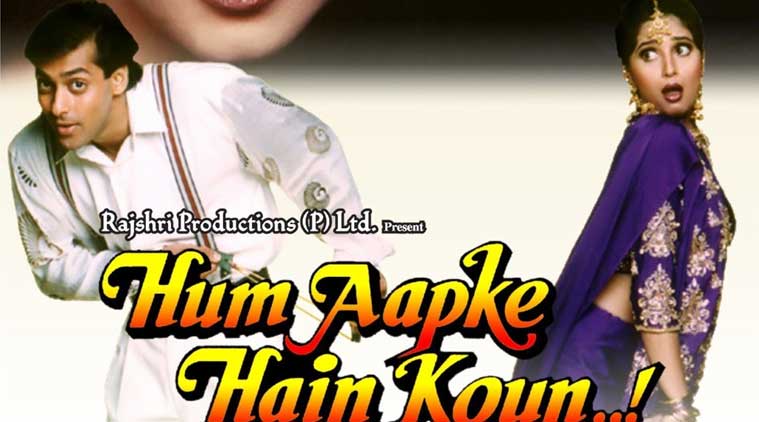
Hum Aapke Hain Koun started with 32 screens, and everyone said that it was a suicide mission-Komal Nahta
10:47 PM
TOI Entertainment Desk (April 26, 2024)
In our exclusive Box Office Nostalgia section, we revisit iconic hits and cult classics which have shaped cinema over the years. This week, we decode the number game behind one of Salman Khan and Madhuri Dixit's biggest hits - Hum Aapke Hain Koun...!
Film: Hum Aapke Hain Koun...!
Release date: August 5, 1994
Star cast: Salman Khan, Madhuri Dixit, Mohnish Bahl, Renuka Shahane, Alok Nath, Reema Lagoo, Anupam Kher, Satish Shah and Himani Shivpuri among others.
Director: Sooraj Barjatya
Hum Aapke Hain Koun...! is unarguably amongst the most ambitious and a game changer film in Indian Cinema. And the film's stupendous success is testimony to its makers' daring courage of conviction. Amongst its many successes, a few notable highlights include changing the way cinema idioms are used, and suddenly, music is taking the film's story forward. The film also revolutionized the way music was recorded for a film. The unusual and innovative marketing and distribution strategy forced the distributors and exhibitors to renovate their theatres. And the film brought the Indians back to the cinema halls – globally - like never before. HAHK also made homely and decent cool once again. While doing all the above, the film also escaped the era's biggest menace – piracy!
Hum Aapke Hain Koun...! was released in cinemas on August 5, 1994, with only 26 prints, and it was stipulated it would be released in only one theatre per city. In Mumbai, the theatre was Liberty; in Delhi, it was Delite. Only those cinema halls across the country equipped with an 'optical stereo system' were allowed to play the film. Exhibitors could choose to upgrade or miss out on being able to screen the film.
Senior trade analyst Komal Nahta reminiscences, "After ages, somebody dared to release a film on limited screens. It started with 32 screens, and everyone said that it was a suicide mission and they would destroy themselves because piracy was at its peak. But Rajshri had faith in their vision. They asked the exhibitors to renovate their theatres, and only then would they give their films for exhibition. They told the theatre owners to create an atmosphere for people to enter the theatres. They had put on lights at Liberty Cinema that would go on when the 'Didi Tera Devar Deewana' song would play."
Liberty Cinema in Mumbai was decorated for the film's grand release and upgraded to become a high-end cinema hall with optical stereo sound to match the film. Film historian Dilip Thakur said, "Before Hum Aapke Hain Koun...!, Liberty used to screen B and C-grade films, and therefore, they needed to facelift the film to bring back the audience to the cinemas."
Director Sooraj Barjatya told Etimes, "We had the biggest premiere at Liberty Cinema. I was shocked because there was no reaction. People were walking out during songs. I was scared. Adi (Aditya Chopra) and Salim Sahab (Salim Khan) had told me that the two-and-a-half songs were my indulgences and that I should cut them. I cut those songs."
The film did not take a flying start, and the initial reaction was mixed. The film was too different from the rest of the fare. The musical format took a while for the public to adjust to, and in the first three weeks of the release, Hum Aapke Hain Kaun got tagged as Chaayageet, the popular music program on Doordarshan.
P S Ramanathan of Rajshri Productions said, "Till the first three weeks, the reception was shaky, and it was only after the 5th week the film's business picked up, and that's when we started releasing the film in mono cinemas also, and it reached about 582 cinemas."
Made on a budget of Rs 6 crore, the film earned around Rs 10 lakh on its opening day and the India Gross collection of the film stands at Rs 117 crore.
Nahta recalls going to the cinema to watch the film and his initial reaction: "After one or two weeks of the film's release, Rajshri Cinema was opened, and we had been invited to the opening. The cinema's manager came to pick us up. I asked him, "What has clicked in the film for the audience? Because people are calling it a wedding tape." He said, “Kaunsi shaadi mein Madhuri naachti hai? Iss mein Madhuri naachi na?"
The film's story moves through music, and the sound needs the highest quality. Until the advent of HAHK, composers recorded music in one sitting, with all musicians performing together. With the young Sooraj at the helm, the music recording method changed forever. Every instrument was recorded separately and mixed for the optical stereo system experience.
And the game changed.
Film historian Dilip Thakur recalled, "The video piracy in the 80s almost ruined the business of cinema, and it was more of action films that were working, and family audiences had stopped going to the cinema, but with Hum Aapke Hain Koun...!, the family returned in a big way."
The world has opened up to the globalization of cinema and began with this film in a big way. While there was reluctance and most action films were working overseas, Hum Aapke Hain Koun...! changed the game, bringing the family audience back into the domestic market. It opened up an Indian diaspora to watch family films, and this film set the trend. They latched on to a movie about Indian traditions and values and celebrated weddings grandly.
Some of the inadvertent results of the film are that weddings in India became larger than life. Sooraj tells us that he wrote what he saw at home. Indian weddings were no longer just ordinary but became big celebrations, and wedding budgets shot up and reflected what one saw in Hum Aapke Hain Koun...!.
The Merchandise business boomed…
After Bobby, which was released in 1972, Hum Aapke Hain Koun...! popularized and was highly successful in attracting the audience to buy merchandise of the film from Madhuri Dixit saree to Tuffy to other accessories and clothes of Salman Khan and posters of the film, Mugs, etc. The film's merchandise is still sold online.
What makes the remake of 80s films an attractive proposition?
8:57 AM

Bharati Dubey (MID-DAY; September 22, 2014)
Last week saw the release of Khoobsurat, an official remake of Hrishikesh Mukherjee’s Rekha-starrer that was made in 1980. Shaukeen, rechristened as The Shaukeens, is all set to hit screens on November 7. Now there’s word that filmmaker Mahesh Bhatt’s 1985 autobiographical telefilm, Janam, will soon be remade. Stage actor Imran Zahid, who incidentally has played the lead role in all play remakes of Bhatt’s films, including Arth and Daddy, will be playing the lead role in this film as well.
“Kumar Gaurav, who was the lead actor in Janam, faded into oblivion, and as a result, the film didn’t get noticed either. Zahid, meanwhile, is on a high after tasting success with Daddy, the play. That said, Janam has a tricky screenplay but Imran has the resolve to hit the bull’s eye,” says Bhatt, who adds that Janam had actually won a lot of appreciation, including a berth in the panorama section of the 1986 International Film Festival of India (IFFI).
The film tells the story of an illegitimate son (Kumar Gaurav) who wants to be acknowledged by his father (Anupam Kher) and goes on to become a filmmaker. Confirming the news about the remake, Imran Zahid says, “I was probably destined to kickstart my Bollywood journey as a lead actor with Janam. The film deals with the protagonist’s turbulent relationship with his father and draws from the life of my mentor. It’s not just a challenge but my responsibility to recreate that magic.”
It’s not just Khoobsurat, Shaukeen and Janam that are getting remade; there are number of ’80s films whose remakes are now being announced. Bhatt says, “Sometimes, we have to go back in order to go forward. I call this recipe, Past Future. Our films have become bigger but they are also emptier. There is a general dumbing down of our narratives. The eighties had some films which were poor in scale but were big in content.’’
Remakes: a safe bet?
Just a month ago, Karan Johar announced that he will co-produce the remake of Ram Lakhan with Subhash Ghai and that Rohit Shetty will direct the film. Since then speculation is rife about who will play the lead roles in the film; names of actors such as Arjun Kapoor and Ranbir Kapoor have been doing the rounds.
Ghai, who has two of his 1980s films - Ram Lakhan and Hero — being remade, says, “Any film that entertains will earn good money. Make, remake or steal — today, watching films is more of an event. At that the same time, there’s nothing wrong with a remake since it is a democratic art and we ought to take it as fun.’’
Film writer Dilip Thakur does not see it as something new. He says, “Mehboob Khan remade Aurat as Mother India which became a superhit. In the ’70s, we saw many Hindi filmmakers get inspired by Hollywood films. Manoranjan, that starred Zeenat Aman and Sanjeev Kumar, took inspiration from Irma la Douce. Khatta Meetha, that was made in 1970, was inspired from Yours Mine and Ours.’’ Thakur adds that Sulakshana Pandit-starrer Sankoch was a remake of Parineeta and it was based on a novel, while Rajshri Productions’ Nadiya Ke Paar was later made into Hum Aapke Hain Kaun.
So is investing in a remake cheaper than paying a writer to come up with a new plot? Trade analyst Amod Mehra says that, “remakes are in fact the costlier option. There are times when one has to pay crores of rupees just to buy the remake rights.”
Like Thakur and Bhatt, Mehra feels theirs is a dearth of good stories and that remakes help. He says, “They are a tried and tested formula; here the audiences is able to relate to such stories and the film boasts of a high recall value. It is invokes nostalgia among older audiences and curiosity among the younger generation, so it works well.”
Script writer Jalees Sherwani says that today, business is of utmost importance to all filmmakers and remakes are a safe bet. “Since the film has worked once already, the producer tends to have more confidence that it will work again. It is not really about a dearth of stories; besides, it is fashionable to helm a remake these days.”
hitlist takes a look at some other ’80s films that will soon be remade…

Jaane Bhi Do Yaaro (1983)
Kundan Shah has reportedly penned not the remake but a sequel of this cult film. Shah has apparently written it as a political drama with a dash of comedy. But there has been no official announcement as yet. It may be pointed out that Jaan Bhi Do Yaaro was rereleased in select cinemas in 2012.
Hero (1983)
Subhash Ghai’s musical hit, Hero, is being remade by filmmaker Nikhil Advani. The film stars Aditya Panscholi’s son, Suraj Panscholi, and Suniel Shetty’s daughter, Athiya Shetty. In fact, it will be the debut film for both. The film is being co- produced by Salman Khan. The film is set to release on December 14 this year.
Ram Lakhan (1989)
Subhash Ghai’s film (pic on top) had an ensemble cast that included Rakhee, Jackie Shroff, Anil Kapoor, Madhuri Dixit and Dimple Kapadia. It is now going to being remade by Rohit Shetty. The casting is yet to take place. The film is being co- produced by Karan Johar and Subhash Ghai.
Satte Pe Satta (1982)
There have been reports about Raj N Sippy’s film being remade with Sanjay Dutt in the lead. The film is being produced by Rajesh Vasani and it will be directed by Soham Shah. Writer duo, Sajid-Farhan, has penned the script. The casting of the film is in progress.
Do Aur Do Paanch (1980)
There have been reports about the film being remade by debutant director, Akshay Puri, but there has been no official announcement so far. It is also being said that Abhishek Bachchan and Bobby Deol have been approached for the film. The original had Amitabh Bachchan and Shashi Kapoor in it and it was directed by Rakesh Kumar.
Subscribe to:
Posts (Atom)