Showing posts with label Dharma Productions. Show all posts
Showing posts with label Dharma Productions. Show all posts
Why Bollywood production houses turn to distribution
9:52 AM

Producers look to grab a larger share of revenues amid rising costs of filmmaking
Rajesh N Naidu (THE ECONOMIC TIMES; May 4, 2026)
In the past two years, Bollywood production houses are increasingly diversifying into film distribution space. Though not unprecedented, a notable aspect of this shift is that today diversification into film distribution space has become a structural and survival imperative for production houses to deal with rising costs of filmmaking and grab larger share of revenues available across the value chain of filmmaking, producers, exhibitors and film marketing experts said.
Dharma Productions, and most recently Jio Studios, are the two prominent production houses that diversified into film distribution space in noteworthy manner in the last two years.
"Cost of making films has gone up due to the huge talent cost. Then, distributors are doing away with minimum guarantees (upfront cash) to producers. A combined effect of these is production houses venturing into distribution,” explained Suniel Wadhwa, co-founder & director, Karmic Films.
A key rationale behind production houses diversifying into distribution is to retain a larger share of revenues that a film can generate, noted established producers.
A key rationale behind production houses diversifying into distribution is to retain a larger share of revenues that a film can generate, noted established producers.
Functioning as distributors helps production houses reduce their dependence on sub-distributors, explained independent exhibitors.
"Production houses are going full throttle. They have set up offices in Bihar and West Bengal," said independent exhibitor Vishek Chauhan. “They are not dependent on sub-distributors. So, a distributor’s commission is their savings,” he explained.
Independent distributors earn 5-10% of revenues as commission income. “For instance, consider Dhurandhar. The film collected Rs. 1000 crore. And if a sub-distributor’s billing is Rs 450 crore, then 10% of it is Rs 45 crore. This is a huge number,” explained Chauhan.
Unfavourable experiences with studios have also contributed to this trend, noted producers. “There are studios who offer promotion, marketing and distribution to production houses for a fixed fee. These studios take a huge share of revenues earned through a film for the money they invest. This is in the range of 10-50% of box office revenues. This is a reason why production houses have diversified into distribution,” explained producer Rajesh R Nair.
Digitalization is another enabler for production houses to venture into distribution, explained distributors.
“Today, distribution is centralized, thanks to digitalization. One can keep a tab of everything sitting in Mumbai. Due to nuanced data, production houses have been able to negotiate with exhibitors on programming and revenue-sharing,” explained Shaaminder Malik, distributor and film trade analyst.
At present, apart from production houses, players such as AA Films, Pen Marudhar, YRF and PVR Inox distribute films.
In the long run, power dynamics in the distribution ecosystem is likely to shift in favour of multiplexes, said industry veterans.
“Today, multiplexes generate 70-75% of box office revenues. This shows their power in the entire distribution ecosystem. In the long run, the power dynamics will shift in favour of multiplexes,” said Neeraj Joshi, a film marketing and strategy consultant.
Universal Music India acquires a stake in Excel Entertainment; can corporate investments ever be married to creativity?
9:45 AM

Akshita Maheshwari (MID-DAY; January 25, 2026)
In December last year, when we first heard rumours of Netflix acquiring Warner Bros, the thinkpieces came thick and fast. People said this was the final nail in the coffin for theatrical films, the moment algorithms would officially replace auteurs, and boardrooms would decide not just what gets made, but what kind of stories are even worth telling. A streaming giant swallowing one of Hollywood’s oldest studios seemed to confirm everyone’s worst fears, that cinema would finally become content, IP would matter more than ideas, and risk, originality, and the mid-budget film would be the first casualties.
Closer at home, Universal Music India (UMI) just acquired a 30 per cent stake in Farhan Akhtar and Ritesh Sidhwani’s production house, Excel Entertainment. This comes after Saregama Music invested in Bhansali Productions in December last year, and vaccine billionaire Adar Poonawalla acquired a 50 per cent stake in Dharma Productions in 2024. When corporate deals that haven’t even gone through in the West cause such a stir, is there any panic of a corporate takeover of the movies at home?
Managing director at Mukta Arts production house, Rahul Puri, says, “Giants have always existed in the business. Mukta was one of the first companies that went public and raised money from the equity markets. Then you had PNC [Pritish Nandy Communications], Balaji [Telefilms], Tips [Industries] in those early days. Even when there was a corporate interest, companies — like the [Aditya] Birla Group with Applause — tended to build organically. They didn’t necessarily partner with anyone because they had enough capital to come in and attract talent.”
He adds, “Now the mindset has changed. Corporate houses have recognized the value that creators and production houses bring. They bring a network of talent and relationships, and our business is very much about those networks.”
The style of filmmaking too has changed today. Going to the cinema is a theatrical event, reserved only for big-ticket spectacles.
“Whether it’s action films with big sequences or films on a large canvas with international travel, budgets are much bigger,” says Puri, “There’s also the ambition to make Indian films competitive globally, so quality has to go up, which affects production costs. Corporate investment is a way to de-risk producers while also giving them capital to be able to make these large projects.”
Among the three deals mentioned, interestingly, two of them happen with music labels entering films. In Indian cinema, music and films have always shared a special relationship, in business and in bed. Even bad films could rely on a banger album to be able to succeed. Before phones and social media, music was the first taste of a film, and often the biggest factor that invites the audience in.
“Unfortunately though in India, music is perceived as free. We never want to pay for music. Since the piracy boom, music has been seen as an add-on to everything else,” says Rajdeep Anand, who works in music licensing, “With UMI and Saregama getting into films, music will finally get its due.”
For Anand too, the deal is like music to his ears. “The older model was that someone would come up with a movie and a set of songs, and then labels would bid for it. But now, everything in Excel’s future that relates to music will go through UMI. Universal doesn’t have to worry about any other player coming in. If I already know my slate for the next five to ten years — what’s coming on OTT, what’s coming in theatres — I can spend time developing new talent and strategically placing which singer gets attached to which project. It gives artistes a platform even before they start off,” he explains, “Look at something like Mismatched (2020-26), Kho Gaye Hum Kahan (2023), or Gehraiyaan (2022), or something as big as Dhurandhar (2025) — they could take much bigger bets with their music. Excel has always had a great ear for music, so I am hopeful that this collaboration will bring music to the forefront.”
Puri also adds, “It is also a play to give music labels a strong flow of content separate from their traditional business, which is essentially just music distribution. They’re taking advantage of a dynamic content monetization space.”
Filmmaker Arati Kadav, whom you may recognize from Mrs (2025), shares why she thinks corporates are investing in films. “First of all, there is always the charm of being associated with the film industry,” she says, “We hear of many films making Rs 100 or Rs 200 crore, but we confuse revenue for profit. Even if a film makes Rs 100 crore, the production cost has gone up so much that the profit we earn is very less.”
Puri argues that big-ticket films might actually help with cash flow. “If a film like Dhurandhar [Jio Studios] does really well, that money can flow into smaller films. Big stars can’t make infinite films, so the surplus has to go somewhere. Ideally, into more creative films.”
Kadav also agrees, “Corporates coming in might actually impart some autonomy to production houses. For example, Dharma [Productions] could make the beautiful film, Homebound (2025) because they had the backing of Adar Poonawalla.”
We ask, what if algorithms start to dictate storytelling? She says, “Unfortunately, the climate has already become like that. Algorithms are dictating the shape of our stories already. Actors are chosen by follower counts. The world has become like that, regardless of corporations. At least if a producer with a good sensibility gets corporate money and support, and if they have good convincing power, they might actually be able to break out of that.”
Although Puri, Kadav, and Anand make this sound like a sweet deal, there are still sceptics who worry that this might mean a death for their creative vision. Filmmaker Aditya Kripalani shares his concerns, “Within corporations, you have a whole board of people and their aim is to not lose their job. I’m not saying they are wrong. But for them, the peak point of their life is to keep that job at the platform,” he says, “If I’m at a platform, it’s easy for me to have a checklist: Did it go to Cannes? Does it have a star? What numbers has that star’s previous film done? Once I have that checklist, my head will not roll if I take the film. But if I say ‘I like the film’ and the film doesn’t work, my head will roll.”
Kripalani calls back to when Netflix co-CEO Ted Sandoros said that he thinks Sacred Games (2018-19) may not have been the best choice to open in the Indian market; he would have liked to go with something more “populist”. “Exactly, there you go,” says Kripalani, “For me, the 100 per cent corporatization is when a platform makes a film. Because then the creative individual — which is the director — has no power. They are hired hands, no matter how big that director is.”
Eros International, a music giant, produced Raanjhanaa (2013), while Aanand L Rai directed it. When the film was re-released, Eros could change the ending of the film with AI, without the director’s consent, completely changing the meaning of the film. Rai was then dragged in a copyright infringement lawsuit by Eros for making Tere Ishk Mein (2025) too similar to Raanjhanaa.
An important loss in the race to corporatization is the mid-budget film. “The '1-crore films, we used to call them,” says Kripalani. According to him, movies will now split into big-ticket spectacles or OTT releases. The traditional trajectory for a director to get a big-budget would be to start with AD-ing, get to mid-budget, and then big-budget event films. With corporatization, we may just be witnessing the death of a mid-budget hit.
“In the 1990s, you used to get 2 to 3 such films a year each from Ram Gopal Varma, from Dharma [Productions], from Yash Raj [Films]. Even Munna Bhai MBBS (2003), Rock On!! (2008), Dil Chahta Hai (2001) were all mid-budget films. A film made for a certain budget with a known face, these are gone,” he says, “In the last couple of years, you have seen Superboys Of Malegaon (2024), Laapataa Ladies (2024), and maybe one or two more — there’s a handful of this kind of film that I can name.”
“I think the people who are in the biggest problem are the mid-level people. New people — like a crazy YouTuber making great content — can still get picked up. And if you’re already an established [Martin] Scorsese or [Christopher] Nolan, you’re okay,” says Kripalani, “But the people who have made five to eight films and are in the middle of their career. There is no platform left for them.”
But what do we lose when we lose mid-budget films? “We lose stories with depth. They may not deal with dark subjects, but they touch you deeply — family dynamics, interpersonal relationships,” says Kripalani, “The indie space deals with the darker sides of society. Big films are just popcorn films, which is fine. Now you’ll get either mindless spectacle or very dark films. When was the last time you got something like Dil Chahta Hai? That middle space is disappearing.”
Tuning up the band: Music labels bet on movie companies to hit the high notes
2:52 PM

Saregama & Universal’s investments in production houses aimed at a bigger play in entertainment industry: Analysts
Rajesh N Naidu (THE ECONOMIC TIMES; January 9, 2026)
Mumbai: Recent investments by music labels Saregama India and Universal Music in film producers Bhansali Productions and Excel Entertainment, respectively, point more to a larger play in the entertainment sector than consolidation of film production houses, industry experts told ET.
These investments are disparate both in structure, strategy and goals as opposed to the Adar Poonawala-Dharma Productions deal, and they have been triggered largely by the bearish business conditions in the music industry, they added.
"After a few years of bull run of over 20% compounded annual growth rate in revenue from streamers, YouTube and digital sources, labels today are seeing a bear phase as the industry consolidated, streamers merged or shut shop and free streaming is moving towards paid subscription," said a top executive at a leading industry player, on the condition of anonymity.
"Some of these labels seem to grow through reverse consolidation to build acquisition moats and create a robust pipeline. They may end up producing films," said the executive cited immediately above.
Another aspect that has triggered these investments is the fiercely competitive space of buying music rights in the open market.
"These investments ensure consistent availability of new content at a reasonable cost. In the past few years, competition intensity for music rights in the open market has become too high," said Vaibhav Muley, lead analyst, media and entertainment sector, Yes Securities.
Labels pay Rs. 10 crore-Rs. 33 crore per film if they buy music in the open market, shared analysts. A multi-year deal for music with a production house is almost 30-50% cheaper for labels, they pointed out.
Business Case
Also, these investments are effective from the standpoint of return on capital employed (RoCE) ratio-how effectively a company generates profits using its capital. Analysts shared that monetizing music across avenues provides RoCE of 30-40%, while films generate RoCE of 11%. This shows why buying a stake in production houses is a relatively less risky proposition than directly producing films.
Acquiring stake in production houses is also a win-win strategy, pointed out analysts.
"Today, labels have reasonably good cash on books. They are looking for low-cost avenues to buy music. Investment in production houses is one such route. Production houses get a minimum guarantee amount to start a film and labels in turn get music rights and ownership of films in proportion with their stakes," said an analyst, who declined to be named.
Furthermore, consolidation in the music label industry has prompted incumbents to look for adjacent diversifications.
"Labels are chasing growth. Acquiring labels have become expensive after consolidation (three labels shut shop). Then, there is subdued growth in revenue from streamers due to a shift in subscription mode. These deals reflect these realities," said the analyst cited immediately above.
Industry experts say the distinction between these investments and the Adar Poonawala-Dharma Productions deal.
"These investments do not amount to consolidation among production houses. They are different from Adar Poonawala-Dharma Productions, which is about equal partners. Whereas, after the investments, labels will function as 'strategic investors.' Along with owning music, they will own film rights in proportion with their stakes," explained Gaurav Dagaonkar, co-founder and chief executive officer of Hoopr, a leading platform for music licensing.
Analysts expect labels would integrate talent from their talent management division into the films produced by the production houses more effectively, right from the scripting stage, while also improving the monetization of music assets in these entities.
Homebound row: Dharma Productions issue statement after author alleges plagiarism, call claims baseless
4:10 PM

After ‘Homebound’ lands in legal trouble amid plagiarism accusations, mid-day digs out the list of scenes author Puja Changiowala alleges are lifted from her book; Dharma Productions calls the claims ‘baseless’
Mohar Basu (MID-DAY; December 25, 2025)
Only a week after earning a place in the 2026 Academy Awards shortlist for Best International Feature Film, Homebound has come under the scanner. On December 23, it came to light that author and journalist Puja Changiowala sent a legal notice to Dharma Productions, which backed the Ishaan Khatter, Vishal Jethwa, and Janhvi Kapoor-starrer, accusing the makers of plagiarism. She alleged that Neeraj Ghaywan’s directorial venture has drawn heavily from her 2021 book of the same name. In the latest development, mid-day has dug out the list of similarities.
Set in India during the COVID-19 pandemic, Changiowala’s book follows Meher and her Dharavi-based family, who journey on foot toward their village in Rajasthan after the government announces a strict lockdown.
The documents in midday’s possession, dated October 15, has cited a scene in the movie where the lead characters and some migrant workers discuss the issues of rent, dwindling savings, and the length of the journey as they debate leaving the city. The author has claimed that her book features the exact scene where characters discuss the same dilemmas. It has also pointed to a character saying, “Corona se baad mein, bhook se mar jayenge pehle”, which Changiowala believes is lifted from page eight of her novel.
The author has further claimed that the sequence where Khatter and Jethwa’s characters attempt to go home via a special train and are lathi-charged “is wildly similar” to her book. The notice reads, “In pages eight and nine, characters receive WhatsApp messages about a special train. The father figure attempts to [go to] the station and is also met by a police lathi-charge.”
Changiowala has sought recognition of authorship and other remedies. In a separate application dated December 23, she sought mediation and claimed preliminary damages of Rs 1 crore.
When mid-day reached out to Dharma Productions, it responded with a statement that read, “The allegations of copyright infringement are baseless and unfounded, and Dharma Productions categorically denies the same. Homebound is an officially licensed adaptation inspired by the New York Times article by Basharat Peer, with all requisite rights lawfully acquired and due credit duly provided. A legal notice has been received and duly responded to by Dharma Productions’ legal counsel.”
The statement further read, “Dharma Productions has become aware through media reports of an alleged pre-suit mediation before the Bombay High Court — however, no formal communication has been received to date. We take such allegations seriously and are exploring legal action at our end to protect the integrity of our film.”
---------------------------------------------------
One among the many contentious scenes is where Vishal Jethwa’s Chandan tells Ishaan Khatter’s Shoaib to use a Hindu alias. This allegedly tallies with events that play out on page 179 of Changiowala’s book
Saregama to invest Rs 325 crore in Bhansali Productions
9:26 AM

Javed Farooqui & Rajesh Naidu (THE ECONOMIC TIMES; December 17, 2025)
Saregama India has entered into a structured, long-term investment agreement with Bhansali Productions that gives it the option to take majority control of Sanjay Leela Bhansali’s film studio by 2030, while immediately securing rights of all future music created by the banner.
Under the deal, the Kolkata-headquartered music record label and content company will invest Rs. 325 crore in Bhansali Productions through compulsory convertible preference shares (CCPS), the companies said. It will subscribe to 9,960 CCPS of face value Rs. 10 each on or before February 14, 2026.
These preference shares will convert into equity in 2028, at which point Saregama’s stake will be between 28% and 49.9% of Bhansali Productions, depending on the conversion formula.
Following the conversion, Saregama will have the option, but not the obligation, to acquire additional shares to take its holding to 51% by 2030, giving it majority control of the studio.
Pricing for the additional shares will be determined through pre-agreed mechanisms linked to Bhansali Productions’ audited financials.
Alongside the equity investment, Saregama has entered into a music rights agreement under which it will acquire the rights to all future music created and produced by Bhansali Productions.
This provides immediate strategic value to Saregama, regardless of whether it ultimately exercises the option to become a majority owner, amid the ongoing chase for intellectual property in the entertainment industry.
The investment is expected to be earnings-per-share accretive for Saregama by FY27 and to improve margins across both its music and video segments.
“Bhansali Productions’ excellence in storytelling and content creation perfectly complements our leadership in music and entertainment,” said Avarna Jain, vice chairperson of Saregama India.
She said the partnership reflects the company’s strategy of aligning with leading creative talent while delivering long-term shareholder value.
For Saregama, the partnership strengthens two priority areas. It bolsters the video segment of its business and further consolidates its leadership in music licensing, with Bhansali Productions providing access to a steady pipeline of premium original music.
Under the partnership framework, Bhansali Productions will retain complete creative control, while Saregama will provide governance oversight and financial discipline. Bhansali Productions will also retain ownership of the intellectual property of all its films going forward.
Sanjay Leela Bhansali, founder of Bhansali Productions, said meaningful cinema requires time, trust and respect for the creative process. “In Saregama, we have found a partner that understands this philosophy. We share a deep respect for art, music and storytelling that is grounded in tradition and resonates across generations,” he said.
Aligned with its evolving content strategy, Saregama will gradually streamline its in-house film production activities over the next one to two years, focusing on strategic partnerships with marquee creators.
The company currently produces films through its in-house arm, Yoodlee Films.
In FY25, 16% of Saregama’s revenue came from video content, spanning films, digital and short-format programming. Its total revenue for the year stood at Rs. 1,171 crore.
For Bhansali Productions, the capital infusion will support a significant expansion of its content slate across formats, while allowing the studio to retain ownership of its film intellectual property.
The company has a pipeline of more than 10 feature films planned over the next three years. Upcoming projects include Love & War, directed by Sanjay Leela Bhansali and starring Ranbir Kapoor, Alia Bhatt and Vicky Kaushal, and Do Deewane Shehar Mein, a romantic drama directed by Ravi Udyawar and featuring Siddhant Chaturvedi and Mrunal Thakur.
“This is a landmark transaction, coming close on the heels of the Adar Poonawalla–Dharma Productions deal,” said Nitin Menon, managing partner at NV Capital, an investment firm focused on the media and entertainment industry. “Legacy creative brands like Bhansali Productions have strong recall value, and this reinforces the belief that high-quality IP continues to attract long-term capital.”
Over the years, associations have developed between leading film production houses and music labels. Recently, Universal Music partnered with Maddock Films to start a new music label, Mad4Music.
“Strategically, this acquisition makes sense. From the perspective of the industry, consolidation is not necessarily unhealthy,” said Tanuj Garg, partner at film production company Ellipsis Entertainment. “The deal, however, could result in increased concentration of capital among a few players,” he added.
“There is a need for more democratic models for mid-sized and independent producers who churn out equally, if not more, compelling content. This is becoming even more important,” Garg said.
ET had reported on December 2 that several Bollywood studios, including Bhansali Productions, were exploring fundraising amid market volatility driven by changing consumer behaviour, rapid OTT adoption and flat theatrical footfalls.
Despite this, M&A activity in the sector has been limited, making this only the third major Bollywood deal in the past five years.
Founded in 2003, Bhansali Productions has produced some of Indian cinema’s most successful films, including Devdas, Bajirao Mastani, Padmaavat and Gangubai Kathiawadi, as well as the Netflix series Heeramandi.
For FY25, the company reported revenue of Rs. 304 crore, Ebitda of Rs. 60 crore and profit after tax of Rs. 45 crore.
Kotak Investment Banking acted as the exclusive financial advisor to Bhansali Productions on the transaction.
Dharma Productions takes full control of talent JV after split with Cornerstone
9:02 AM

Javed Farooqui (THE ECONOMIC TIMES; December 12, 2025)
Mumbai: Dharma Cornerstone Agency, the joint venture between Karan Johar’s Dharma Productions and Bunty Sajdeh’s Cornerstone Sport and Entertainment, has been restructured, with the two partners opting to pursue independent strategies, according to people aware of the development. The split has been amicable, they said.
As part of the restructuring, Dharma is buying out Cornerstone’s 45% partnership interest in the talent management LLP. With this acquisition of Cornerstone’s entire contribution and economic rights, Dharma will assume full control and ownership of the limited liability partnership, the people said.
Financial terms of the arrangement weren’t available.
The agency represents actors including Janhvi Kapoor, Sara Ali Khan and Tiger Shroff. The talent roster currently housed under the venture is expected to remain with Dharma, which will continue to manage ongoing and upcoming engagements, the people said.
ET could not independently confirm details of the internal arrangements with artists.
The joint venture reported a turnover of Rs 110 crore for FY25, compared with Rs 77 crore in FY24. Net profit at Rs 12 crore was marginally lower than the Rs 14 crore the previous year.
The venture was set up in 2020 with the objective of supporting emerging and established talent by combining Dharma’s content and production ecosystem with Cornerstone’s expertise in talent representation. With full ownership of the agency, Dharma is expected to build a more integrated talent strategy that aligns management, training and development with its film and digital content pipeline, industry executives said.
Dharma Productions chief executive Apoorva Mehta and Cornerstone’s Sajdeh declined to comment.
Executives tracking the sector said consolidation within the talent vertical can enable tighter alignment across casting, long-term career planning and brand strategy at a time when the creator economy and influencer-led IP continue to expand.
Cornerstone will continue to operate independently through Cornerstone Sport and Entertainment, the people said. The company plans to scale its presence across sports, entertainment and digital talent. It manages K L Rahul, Sidhant Chaturvedi, Sania Mirza and Manu Bhaker among others.
People familiar with the matter said the split is cordial and reflects the strategic priorities of both entities as they refine their long-term plans. The people they manage have been informed of the development and Dharma is expected to continue honouring existing contracts and commitments, they said.
The restructuring comes at a time when India’s entertainment landscape is undergoing rapid transformation driven by streaming expansion, social media, and the growth of sports-led intellectual property. The move positions both Dharma and Cornerstone to respond more effectively to emerging commercial opportunities.
The development also coincides with a broader internal consolidation at Dharma. Dharmatic Entertainment, its digital arm, has been merged into the parent entity following Adar Poonawalla’s acquisition of a 50% stake in Dharma for Rs 1,000 crore. The merger, effective April 1, 2025, was aimed at streamlining operations and preparing the studio for its next growth phase.
Investor interest wanes as Bollywood loses the plot
8:57 AM

Bollywood’s traditional biz model lacks scalability of startups; partial exit of Disney, Viacom adds to the woes: Experts
Rajesh N Naidu & Javed Farooqui (THE ECONOMIC TIMES; December 2, 2025)
Box-office volatility, high star fees, shrinking streaming budgets, a string of big-ticket failures, rapid artificial intelligence disruption, and shifting audience tastes have stalled consolidation among film production houses, even a year after the Adar Poonawalla-Dharma Productions deal worth Rs. 1,000 crore, producers and analysts told ET.
The 50% stake sale to Poonawalla signalled the mounting financial pressure on producers as big-budget releases struggled to recover costs. Excel Entertainment, Sanjay Leela Bhansali Films, and Abundantia Entertainment are among the companies reported to be in early stake-sale talks.
“After the Dharma deal, investors have realized that the Hindi film industry, despite its iconic brands, is a highly volatile and high-variance business,” said Karmic Films co-founder and director Suniel Wadhwa. “The valuation was a premium bet on legacy, not on predictable cashflows.”
“When marquee studios show fluctuating profitability, it impacts flow of capital. Investors today are prioritizing stability, repeatability, and data-driven scalability, none of which Bollywood’s traditional model is guaranteeing,” added Wadhwa.
Executives said weak investor confidence stems from the industry’s inability to exhibit scale and returns, a mood worsened by the partial exits of global studios like Disney and Viacom from India.
“Indian M&E industry needs to work on showcasing and creating awareness,” said Reliance Entertainment CEO Shibasish Sarkar. “The sector is still fragmented, so more consolidation is needed so that mid-size companies can reach a certain scale to attract capital. India also needs to create awareness to recognize IP as a real asset class, strengthen incentives and expand copyright terms.”
We balance for vegetarians, health-conscious diners, and younger palates-Armaan Jain
8:28 AM
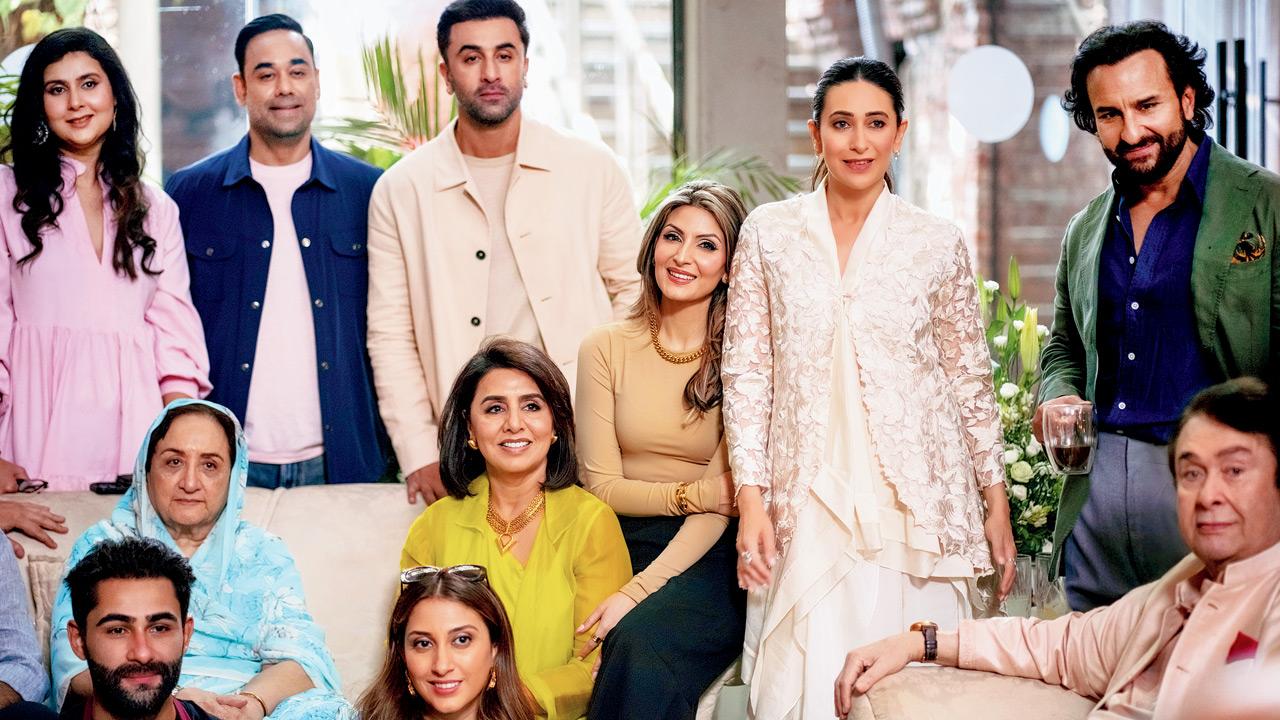
(Clockwise from left) Pooja Desai, Bharat Sahni, Ranbir Kapoor, Riddhima Kapoor Sahni, Karisma Kapoor, Saif Ali Khan, Randhir Kapoor, Anissa Jain, Neetu Kapoor (in mustard), Armaan Jain, and Neila Devi in Dining With The Kapoors. Pic Courtesy /Netflix
From classic family get-togethers to cloud kitchens across India, Armaan Jain is feeding the world, one recipe at a time
Nasrin Modak Siddiqi (MID-DAY; November 23, 2025)
Growing up in South Mumbai, Armaan Jain straddled two worlds: the cinematic legacy of his mother’s family, the Kapoors, and the finance-rooted pragmatism of his father’s. Armaan is the son of Rima Jain, Raj Kapoor’s daughter and sister to Rishi, Rajiv, Ritu and Randhir Kapoor, making him first cousin of Kareena, Karisma, and Ranbir.
“Although we had a film family, we didn’t grow up around film sets,” he recalls. “I first went on a shoot when I was 12, just because my friends wanted to see what it was like.”
Jain’s early twenties, however, were dominated by cinema. After deciding at 16 that acting was his path, he spent three to four years at Dharma Productions, learning production and direction. “Your first impression about cinema is the glamour — it’s all smoke. Once you start working, you realize all the hard work that goes into it, and learn to respect the craft.” The exposure to filmmaking proved invaluable later, as he established Aavashyak, a media company.
Jain recalls growing up surrounded by food and family. “My dad’s family is spread across Dubai, London, and other countries, so that meant a lot of travel and big reunions. My mom’s side was classic Kapoor — food, noise, endless get-togethers. For both, food was central.”
His earliest memories are steeped in kitchens. “Both my grandmothers cooked beautifully. From as young as five, I’d sit there for hours watching them. My dad would cook for the whole family — simple, home-style food. Weekends were spent shuttling between homes — some nights with my dadi, some nights with my nani. Those kitchens shaped who I am.”
On his maternal side, the scale was always grand. “Nani would feed everyone — carpenters, relatives, friends — who came home,” Jain recalls. “Food was never just sustenance; it was love, culture, a way to bring everyone together.”
The pandemic gave him the push to bring those flavours to a broader audience. Encouraged by his wife, Anissa Malhotra, he turned to his first love: cooking. “People have always praised my food. Anissa said, ‘Let’s test it out. Take these home recipes and serve them to people.’”
By 2021, The Junglee Kitchen was born. Jain cooked and packaged orders while Anissa handled logistics.
Today, The brand has seven outlets, partnering with Bengaluru’s Dil Foods, with plans to scale to 200 outlets within the next two to three years. “I see it as feeding the world, starting with India. The cloud kitchen model offers a reach that a single restaurant never could achieve.”
For Jain, the philosophy is straightforward: authenticity above all. The menu is built on generational recipes of dishes made at his grandfather’s home, Deonar Cottage, in Chembur. From kebabs to butter chicken to Junglee Maas and fragrant pulavs, some of these are family’s classics; others are what he has improvised over time.
“We balance for vegetarians, health-conscious diners, and younger palates, but the core Kapoor recipes don’t change. The ghee, the richness, the love — that stays,” he adds.
Food isn’t just a business for Jain; it’s a legacy. In his latest project, Dining With The Kapoors, that released on Netflix on Friday, one can witness his emotional attachment to the recipes. The project is life coming a full-circle moment for him. It began as a conversation with his mother around Raj Kapoor’s 100th birthday.
“We were chatting about the old days and we spoke of how food always brought us together — it’s how Indian families connect. I wanted to celebrate him in a way that was intimate, real, and not a documentary, beyond the glamour of cinema, and over one intimate sit-down meal,” says Jain who has played multiple roles — conceptualizing, writing, shooting, and producing it. He even took a brief sabbatical from his food business to focus on the film.
“Food and cinema aren’t just work for me, they are a part of my DNA. I was born two years after Raj Kapoor died. You only hear stories about him and his love for food and life, projects like this help preserve memories and traditions,” he signs off.
No one gives so much izzat to writers, directors as much as Dharma Productions-Somen Mishra
2:55 PM

Karan Johar; (right) Somen Mishra has been the bridge between the hustle of Aaram Nagar and the Dharma bubble. Pic/Instagram@somenmishra
Karan Johar might not be happy with Homebound’s box-office performance, but the rumours of Dharma making a loss are fabricated, says Somen Mishra, the man responsible for bringing in such critically acclaimed films under the studio’s banner
Priyanka Sharma (MID-DAY; October 19, 2025)
The year end is usually reserved for reflection. But for filmmaker Karan Johar’s Dharma Productions, casually described as the be and end all of Bollywood, this is the time for redemption.
At least, it seems so, with the acclaim and applause for two of its theatrical releases in the last two month— director Neeraj Ghaywan’s Homebound and filmmaker Shazia Iqbal’s feature debut, Dhadak 2. The architect of Dharma’s redemption arc, however, is not Johar. It’s the man, who is often dubbed as Johar’s right hand, who continues to embody the Aaram Nagar hustle even as he inhabits a designated corner of the swanky Dharma office, is the bridge between independent filmmakers and the Dharma bubble, and an outsider, ironically.
But Somen Mishra hasn’t only helped the company that he has been working with for over seven years now claim some glory, he has also resurrected his own image— of the man who caused the apparent downfall of Dharma. Out of the nine theatrical titles of the production house that Mishra has backed so far, there’s only been one superhit— Good Newwz— a hit in Johar’s directorial venture Rocky Rani Kii Prem Kahaani (2023) and a moderate success with Kesari Chapter 2 (2025). Even Dhadak 2, despite critical acclaim, ended its box office run at a dismal Rs 25 crore (approximately).
Notwithstanding its selection as India’s entry for Oscars 2026, Homebound is also only crawling at the box office. In fact, days after the film’s release, Johar was heard saying on a podcast that he would rethink about producing a film like Homebound because it might not always be profitable. Unsurprisingly, the filmmaker received backlash for his statement, and later had to clarify that he was “exceptionally proud of Homebound.”
“Dharma never loses money on any film because of the kind of budgets we make the films on, the kind of value we get, satellite, OTT, music. So, it rarely happens that we lose money. Most of the number and trade conversations that I have read online (about Dharma’s films) are all false. I've read the numbers of Dhadak 2 and Homebound. They’re completely wrong. They are one of the most tight budgets and very safe films for us,” Mishra tells us.
Negativity, of course, sells online. More so, if it’s around Dharma Productions. But its isn’t without a reason, with Johar’s reputation as an unrelenting godfather of star kids, which isn’t helped by the failure of films like Naadaniyaan, Sarzameen (both starring Saif Ali Khan and Amrita Singh’s son Ibrahim Ali Khan), Ae Watan Mere Watan with Sara Ali Khan, Jahnvi Kapoor-led Mr And Mrs Mahi and her latest, Sunny Sanskari Ki Tulsi Kumari. The first three, all OTT releases, also had Mishra as a producer..
“Gunjan Saxena: The Kargil Girl, on Netflix, was a success for us. Aap Jaisa Koi, which was much appreciated, starred two outsiders (R Madhavan and Fatima Sana Shaikh) and directed by an outsider, Vivek Soni. But Nadaaniyan is talked about more. Negativity in news tracks more. If I troll someone, that will track more than if I praise someone. Otherwise, with so much praise for Homebound, it should have translated much more in the numbers. But it doesn't happen. The flip side is, when something lands, the praise is also humongous, because with Dharma, you will get attention, either way. Initially, it was difficult to understand. But now I understand. I also make all the directors and writers understand that when they’re signing a Dharma film, there will be a lot of attention on them. They should be prepared for that,” he says.
In that context, the praise surrounding Homebound and Dhadak 2 naturally makes Mishra feel vindicated, and the cherry on the top is that both the directors are not only outsiders but also those that the producer always believed in. But Mishra insists it's not his credit to take.
"I can’t take the whole credit for it. I take some credit for it. It's the directors, writers and their teams, who have made it happen. When I joined Dharma, Karan's point was, 'We do one thing great but we should also do all kinds of things because cinema keeps changing everywhere.’ So, people can abuse us but I know cinema is a long process. Both Dhadak 2 and Homebound we started developing in 2021. On Homebound, three and a half years went into writing. Out of which, around 10 months went into acquiring rights from the New York Times, for which Basharat Peer had written the article on which our film is based. Another challenge was cracking the cast. But everyone on this film took a cut. They knew what we were trying to do. I said this won't be feasible if we don't make it in a certain budget. Janhvi worked for free and even for her staff, she incurred the expense. All the writers took a cut. Dhadak 2 and Homebound are the two of the most tight-budget Dharma films in a long time. I have read some of the budget numbers online which are more than double (of the actual budget). But anybody who sees the film, anybody who knows production will tell you what the numbers are," he smiles.
With Mishra, the otherwise inaccessible umbrella of Johar's company opened to outsider voices like never before -- from Ghaywan, Iqbal, Soni, Vasan Bala, Ishita Moitra, -- the list is long.
But the bridge between the two sensibilities hasn't always been smooth. With him at the helm of things, he is expected to not only protect the voice of the director and writer, who surrender their trust in him, but also the commercial interests of the company that has hired him. It's surely a delicate balance. For instance, when Dharma decided to remake Pariyerum Perumal (2018) into Dhadak 2, it became a love story. It’s the 'Dharmafication of an anti-caste film', said several of its critics online. Mishra disagrees that he is ever asked to mould a film into the palatable, tried-and-tested template of Dharma.
"When we pitched Dhadak 2, it was pitched in a mainstream space because I feel it's much more difficult to do caste in a mainstream space. If we have to make a film for festivals, then why would we take the whole route of a love story? We aren't forcing the same love story in Homebound because that is a friendship story. But we saw a love story in Dhadak 2. In the original, the female character wasn't strong. But what's the purpose of making the female character strong, if the bonding between the two characters is not strong. So, for us, it was always a love story. Call it by any name. We wanted to go mainstream and the way to go about it was to have a love story. I don't see it as Dharmafication. Otherwise, we would have put a love story in Jigra. I don’t get told by Karan that these elements should be in the film, but we have to be honest to what the story is. There are no songs in Homebound. In fact, we have a film coming up where the filmmaker told us, 'Should we put a song?' and I said, 'Please don't. Otherwise people will say Dharma made you do this'."
Fighting the perception battle for Dharma, online, also seems to be a part of Mishra's job, even though he maintains, "I have gone quiet now." Why wouldn't it be, after all he is the most accessible face of the company, someone the internet has been familiar with for longer than he rose the ranks in the industry, from the time he used to run a popular cinema blog. Fight Club featured everything-- from news to opinions -- about cinema from Mishra and others, many of whom are now part of the industry. He soon emerged as the "daring, opinionated as well as arrogant" cinema guy, who spared nothing and no one.
Naturally, people expect him to display the same attitude towards whatever is perceived wrong about his company. But defending Dharma is a full time job, he knows.
"Sometimes I carry this baggage. Like, the other day, somebody said, 'You are not supporting Neeraj Ghaywan. You made the film only to get the festival credit.' I said, 'Okay. You are not the first one to say that. We have worked hard for four years. And how much support did the filmmaker get? You ask him.' But I know you can't fight what people are saying. Do your job because whatever you say will be misconstrued as something else. Someone said, 'You didn't promote Homebound properly. If it were left to me, I would have taken the cast to the village that the story is based in.' Had we done that, we would have been told, 'You are exploiting someone's death. You are greedy.' Only your work can speak, and Dhadak 2 is the best example. Since the day we announced it, my closest friends would tell me, 'Didn't you get any other film to remake?' When they saw the film, they were very moved by it. They said they were proven wrong about it."
Mishra insists his boss gives him a free hand, and this implicit faith is built on the initial successes that the former brought to the company, even if Johar never asked for "blockbusters" from the producer. “That’s the pressure I put on myself. My first few projects, Good Newwz, Lust Stories, Gunjan Saxena and Shershaah worked. So, the moment you initially come and deliver success, the company and the bosses will trust you. You think, 'Okay my job is done, the money thing is done. What else can I do, either get good directors or different voices'."
But faith can also create fear of failure and questions like, 'What will happen to my position in the company if the failure is too big?’ Like a Jigra. Fronted by Dharma's current biggest in-house star, Alia Bhatt, the Vasan Bala-directed action drama tanked at the box office.
“With success, it helps you to do more things. With failure, which I have learnt from Karan, you move on to the next. Get your learning and move on because you can't do anything about it. I know if it had landed well, it would have opened the door for Vasan, for more filmmakers and more things on a certain budget and scale. I still like the film very much. Vasan's craft is one of the best in terms of the staging and performances. And Alia has put her soul into that film. But even after that, there was so much conversation and dissection that happened. There is no point in doing so much.”
But does it mean Dharma won’t give another chance to Vasan? we ask him. “No. I can’t say but there have been conversations (with Vasan) about what to do and what not to do (in future). I feel some of the people who have made flop films, have gone on to make great films also. The learning is what and why it didn’t connect with people. But I don't have any fear about what happens to me in the face of a failure because people here are smart enough to know why a project failed. Also, people can see the honesty and integrity in the work. Films might not connect for various reasons. And 90-95 percent of the time, either good or bad, we know it before that. We might say whatever we say, but Karan, me, us, we know," Mishra tells us.
So, did they know that Jigra wouldn't work? “Jigra had a certain cinematic thing which people have to buy into. Those who buy the second half will buy the film. Those who can't buy the second half will not buy the film, which we all of course felt bad about. But Alia had done Raazi, why would she do another thriller? People said, this or that should have happened in the film. For me, the highlight was that 40-minute action sequence. A lot of people might not like that or might get thrown off by that. But for me, that was the highlight. Those were the concerns that if people like it, then it will land. If people don't get into that, it won't land.”
Hits and flops aside, Mishra is here for a larger cause, he emphasizes. Which is to open doors for people, like how they were opened for him— a man with no connection to the movies and also the city. "I remember Nikhil Mehrotra, whom we got to write Gunjan Saxena, jokingly told me, ‘Yahan per toh darwaze hi itne bade hain.’ So, I said, ‘Don’t worry, I am here. Talk to me.’ My idea is to make people feel safe. We aren’t mafia, we are good people. We are good to writers and directors. No one gives so much izzat to them as much we do.”
And money? “That too, ask anyone. A writer told me, ‘I got a call from Dharma asking me to send them my invoice. It has never happened before with me.”
And what about him? Is he still angry and arrogant? Mishra laughs out loud. "I was never arrogant. Online what you write, people read it in a different tone. Like someone asked a question and I replied, 'This is such a dumb question,' so this person said, 'You are calling me dumb.' But I don't think I was ever arrogant. Also, because of the blog, there was a persona that people believed. But online, you create a character. When people meet me, they say, 'You are much nicer than what you are online.'"
Dharma Productions absorbs Dharmatic Entertainment in structural overhaul
10:31 AM

Javed Farooqui (THE ECONOMIC TIMES; October 4, 2025)
Dharmatic Entertainment, the digital arm of leading film production company Dharma Productions, has amalgamated into its parent company as part of the Bollywood powerhouse's strategy to consolidate operations amid the changing entertainment landscape.
The fast-track merger application, filed with regulatory authorities, has received approval from shareholders and creditors of both companies, according to company filings.
This is the first significant move by Dharma Productions following the sale of a 50% stake to entrepreneur Adar Poonawalla for Rs 1,000 crore last year, valuing the company at Rs 2,000 crore.
The consolidation, effective April 1, 2025, is aimed at streamlining the group structure by trimming the number of entities, cutting administrative overheads, and simplifying legal compliance.
With Dharmatic already wholly owned by Dharma, the amalgamation does not entail any financial consideration. The existing holding of Dharma Productions in Dharmatic will stand extinguished due to the merger.
“Dharmatic was envisioned as a digital-first creative studio, but the industry has evolved in ways that make integrated operations more impactful. This merger allows us to optimize resources and run a leaner, more efficient organization while continuing to tell powerful stories across platforms," a company official said.
Dharmatic Entertainment was launched in 2018 as a content studio focussed on creating fiction and non-fiction content for streaming platforms. It has produced shows like Fabulous Lives vs Bollywood and Koffee with Karan for OTT platforms Netflix and JioHotstar.
Homebound cinematographer Pratik Shah accused of abuse and inappropriate behaviour
9:18 AM

Pratik (left) was accused of being highly manipulative and emotionally abusive towards women by filmmaker Abhinav Singh (right)
Renuka Vyavahare (BOMBAY TIMES; June 2, 2025)
On Thursday evening, filmmaker Abhinav Singh took to Instagram and accused cinematographer Pratik Shah of being “highly manipulative and emotionally abusive” towards women. Pratik is best known for his work in Vikramaditya Motwane’s Jubilee, CTRL and Neeraj Ghaywan’s recent Cannes outing Homebound, where he was present with the film’s team.
Abhinav’s Instagram stories stirred up a hornet’s nest. In a post, the filmmaker, who had directed the short film Yatri Kripya Dhyan De, said that multiple women reached out to him to share their testimonies, and some even posted them on their own social media handles, narrating their experiences with Pratik. The latter deactivated his Instagram account soon after.
Dharma Productions, producers of Homebound, in a statement on Saturday, said, “At Dharma Productions, we have a zero-tolerance policy against inappropriate behaviour and sexual harassment towards any individual working with us in any capacity, and we treat sexual harassment cases very seriously. Mr. Pratik Shah was a freelancer on the project Homebound and was working on it for a limited period. His engagement with us has been completed. During this limited period, our internal committee for POSH did not receive any complaints against Shah from any cast or crew during his association on Homebound."
According to THR India, a complaint was lodged against Pratik with the IWCC (The Indian Women Cinematographers’ Collective) four years ago by a young cinematographer, and the Collective warned him, stressing that such behaviour is unacceptable. Why was there no accountability despite this step? Was merely a warning enough? Why was this information not in the public domain? This has largely been the sentiment.
When we investigated the matter, a source told Bombay Times, “IWCC is a forum. It’s a collective with no legal standing. It’s not an organization. It was formed by female technicians 7-8 years ago, and the complaint made to them was anonymous. They took cognizance of it in the best way they could. The forum tries to provide women with a safe space.”
We reached out to Vikramaditya Motwane, Neeraj Ghaywan and Pratik Shah, who hadn’t responded till the time of going to press.
On Saturday, Hansal Mehta shared a note on X, which read, “Abuse thrives in silence. It festers in fear. Predatory behaviour by men in positions of power must be investigated thoroughly, and if found true, must be called out — unequivocally, and without delay. For too long, predators have weaponised influence, privilege, and fear to silence survivors. That silence must be broken. But let’s be clear — abuse of power is not confined to one gender. Women in positions of authority, too, have inflicted harm. Abuse has many forms. It is not always sexual. Mental, emotional and psychological abuse can be just as scarring. Just as violating (sic).”
He added, “Workspaces — especially creative ones — often cloak toxicity in the name of ‘passion’ or ‘genius.’ That must stop. No art, no film, no script is worth the cost of someone’s safety or sanity. Victims need voice. They need redress. They need a system that listens — and acts. Accountability is not cancel culture. It is culture correction. We owe it to ourselves, and to those who come after us, to make our spaces safer. Cleaner. Kinder. Call out the predators. Call out the habitual abuser. Hold them accountable. Let no power be above decency (sic).”
Bollywood producers go regional to beat box office blues
10:06 AM

Faster turnaround time, lower costs, easy IP creations draw big brands to regional films as Hindi box-office lags
Rajesh N Naidu (THE ECONOMIC TIMES; March 18, 2025)
Mumbai: Prominent Hindi film studios are moving into making regional language films as they look to break the dry spell caused by funding constraints, high costs and low confidence in starting fresh films. In the last one month, Dharma Productions, Luv Films, Baweja Studios, and Junglee Pictures are among the production houses that have announced films in Punjabi, Marathi, Tamil and Malayalam.
Dharma Productions announced a Punjabi film 'Akaal' with actor Gippy Grewal, while Junglee Pictures announced its Malayalam foray with the film 'Ronth' (night patrol).
"The Hindi film industry is in a flux. Big films and stars are unable to draw audiences to theatres. It will take at least twelve to fifteen months to deal with these challenges," said Naveen Chandra, founder and CEO of 91 Film Studios, a production house that makes, finances and distributes regional films.
"In the interim period, Hindi film production houses are experimenting with a few regional films."
After Covid, repeated failures of big-budget Hindi films have forced the industry to reassess. Similar challenges persisted even for mid-sized Hindi films as audience's interest in these films waned.
A key parameter which works in favour of regional film is the turnaround time. "The turnaround time for regional films is faster than mid-sized Hindi films," said Chandra. "Generally, it takes 8-12 months to make a regional film, whereas a mid-sized Hindi film takes 1-2 years."
In recent years, mid-sized Hindi films have been taking longer to complete production as actors associated with them are committed to web series, endorsements and events, too. Due to this, producers said, these actors have not reduced their remuneration even after their films have failed in the box-office, making the economics of mid-budget films unfavourable. As per producers, regional films are a more viable proposition. A regional film can be made for Rs. 2.5-15 crore, whereas a mid-sized Hindi film would require Rs. 15-30 crore. Also, regional films require a considerably low investment of Rs. 50 lakh to Rs. 2 crore for promotion and advertising. For mid-sized Hindi films, this would be Rs. 5-15 crore.
Performance of regional films in recent years has also been encouraging, thanks to their engaging and rooted-in-culture stories. According to media and entertainment research firm Ormax Media, in the January-February 2025 period, regional films accounted for 52% of the total box office of Indian films, while Hindi films accounted for 45%.
Producer Anand Pandit, known for regional films in Marathi and Gujarati, said, "Today, viewers have a greater connection with regional films, as these films are largely based on original stories. A Hindi film which does an average business has an occupancy rate of 10-15% in theatres. But a regional film which does an average business has an occupancy rate of more than 25%."
Another aspect which works in favour of regional films is intellectual property (IP). Producers shared that it is easier to create IP in regional films given their sharp and defined demographics.
Suniel Wadhwa, co-founder and director of Karmic Films, said, "A prominent Hindi production house enhances the production value of a regional film. But recovery of investments (sale of satellite and digital rights) will depend purely on the quality of storytelling and unique content."
Struggling movie production houses may open their doors to buyers
10:24 AM

Cos showing interest in film production houses, which have been battling high costs, to broaden their vision: Analysts
Rajesh N Naidu (THE ECONOMIC TIMES; December 3, 2024)
A consolidation wave is likely to build steadily among film production houses in the coming months as their costs in running operations mount and interest of large and mid-sized corporations in the entertainment business increases.
Producers, independent consultants and trade analysts who spoke with ET shared that in the coming months large and medium-sized companies may acquire either a big or a bunch of mid-and-small-sized film production houses as their vision is not restricted to merely film business.
Ram Mirchandani, founder, Rampage Motion Pictures, a production house, said, "The Dharma Productions-Adar Poonawala deal has paved the way for some consolidation in the industry. We foresee either big companies acquiring well-established production houses or medium-sized companies acquiring a bunch of small boutique production houses."
A common challenge which most production houses face today is the cost and time involved from developing film projects to obtaining the right material. Developing scripts, bibles, buying re-make or other rights and then high fixed expenses in running a production house are unavoidable costs. Many a time, these costs are not recovered as projects get shelved for a variety of reasons.
"So, there is a need to fund costs. If you have investments, you can produce a film and leverage better on satellite and digital rights," said Ram Mirchandani of Rampage Motion Pictures. Changing dynamics of cost of film-making and performance of films at the box office have been another bane for production houses as they are unable to recover their investments.
Girish Wankhede, a movie trade analyst, said, "Production houses have been working on thin margins. Earlier, a hit film would recover the losses of four flop films. Today, a flop film wipes out the gains from four hit films. This shows production houses are not making enough money on their investments."
These are the reasons why production houses need money and could serve as lucrative investments for corporations. Post the Dharma Productions-Adar Poonawalla deal, there are reports which suggest that production houses Excel Entertainment (co-founded by actor Farhan Akhtar) and Abundantia Entertainment are also looking to raise money through selling stake.
Independent consultants are of the view that the interest of corporations in acquiring production houses serves their goals beyond the film business.
Shrirang Nargund, a veteran and independent consultant on entertainment business, said, "I think corporations have a bigger vision than merely investing in film business. They may want to exploit the creative talent of production houses in launching various business verticals such as gaming, web series, interactive social media content, and leveraging influencers on social media by providing them required infrastructure."
The lure of acquiring intellectual property (IP) of existing and future films is another reason corporations are showing interest in the business.
Vishesh Agrawal, a film producer, associated with films such as Dangal (2016) and Dream Girl 2 (2023) said, "Corporations do their due diligence. They will buy only those production houses which have strong IPs in their film libraries and a long proven performance across business cycles of the industry."
"It is not the first time corporations are showing interest in production houses. Earlier production houses managed without them. But today production houses need money because revenues are shrinking," he added.
On a macro level, producers believe that large corporations may want to leverage on the increasing emergence of Indian Cinema content as a 'soft power' in global markets. Producer and film business expert Girish Johar said, "Today, cinema is soft power. Indian content is consumed globally through streaming platforms. This provides a convincing reason for corporations to invest in the sector as it allows them to market and position a type of content."
Explained: What the Rs 1000 crore deal means for Karan Johar and Adar Poonawalla
8:47 AM
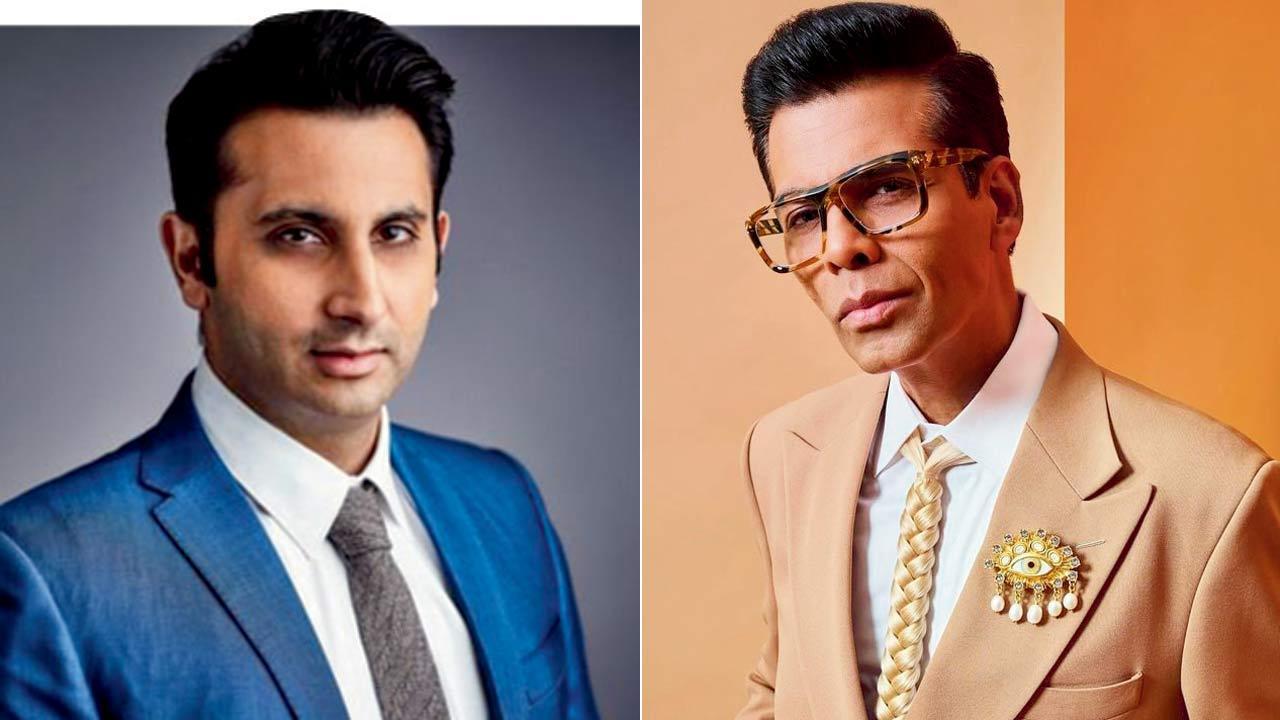
Arijit Barman and Javed Farooqui (THE ECONOMIC TIMES; October 22, 2024)
Billionaire vaccine maker Adar Adar Poonawalla, CEO of the Serum Institute of India, is picking up a 50% stake in Dharma Productions and Dharmatic Entertainment, for Rs 1000 crore, valuing Karan Johar’s film and television production and distribution flagship at Rs 2000 crore, further underpinning the ongoing flurry of consolidation in the entertainment industry.
ET broke the story online on Monday morning, ahead of a formal announcement.
Poonawalla’s is making this investment in his private capacity through Serene Productions. Dharma will retain the residual stake with Johar continuing to remain as the creative spearhead of the company, as Executive Chairman. Apoorva Mehta remains the Chief Executive Officer.
Dharma is owned 90.7% by Karan Johar and 9.24% by his mother, Hiroo.
“I do foresee consolidation in this industry. Internationally, we've seen a lot of consolidation due to new content creation methods and distribution channels,” Poonawalla told ET. “With the evolving landscape of content production and distribution, I see significant potential for such partnerships both internationally and nationally.”
The key factor that led to stitching together this alliance is Johar retaining creative control while partnering with a deep pocket family he is familiar with. The Poonawalla investment will help the production house with enough financial muscle to navigate the fast-changing demands of digitally savvy consumers who are often digital natives. The investment will also boost Dharma’s efforts to double down on content for new platforms and formats while continuing to deliver interesting stories for a global audience.
“This partnership will help us create more verticals within the organization and allow us to take creative chances. This gives us the bandwidth to expand Dharmatic Entertainment and create much more in the digital domain,” added Johar. “It also allows us to capture a lot of value in the value chain which comes with owning IP and catalogue – we have already been doing that and hope to double down on it with this capital.”
Film production is a volatile business with earnings linked to box office successes of films. Major Hindi film production houses, including Dharma, have been cautious in greenlighting new projects due to the unpredictable nature of the box office, which also impacts the value of streaming and satellite rights, ET had reported on October 14.
Johar said, the company’s attempts will be to increase the value and create more content. “We aim to produce a higher volume of films with this partnership compared to what we're currently doing. With shrinking audiences and an overreliance on streaming rights, Johar feels a strategic business shift is already underway. “Mid-budget films are the backbone of the film industry's economics, and we need to explore this segment further, alongside our tentpole productions, to create a more diverse and sustainable portfolio of films,” he said.
CHANGING DYNAMICS
The industry is experiencing major upheavals due to shifting consumer preferences, influenced by exposure to global content and the increasing dominance of on-demand consumption in urban areas. Additionally, the economic model is strained, with star salaries often consuming up to 70% of a film’s budget. Consolidation on the demand side, with the emergence of large broadcasters, streaming platforms, and multiplexes, is also putting pressure on content companies like Dharma. Satellite rights, once a steady revenue stream, have plummeted to historic lows, and the value of streaming deals, which was funding movie costs in many cases, is being corrected, further straining the economics of the film business.
In the theatrical space, multiplexes now dictate a film’s success, contributing an estimated 60–70% of Hindi films' box office revenue, while single-screen theaters continue to struggle. Post-COVID, many viewers prefer to wait 8–10 weeks to watch films on OTT platforms, leading to reduced footfall in cinemas.
Some industry players are already contemplating profit share model or box office linked payouts to offset rising star costs. “It's essential not to overload our above-the-line costs. While we respect actors' talent and craft and want to pay what's fair, all artists must understand the current challenges in the entertainment industry. There's enough potential in big films for everyone to gain,” said Johar.
Dharma has been actively seeking investments for a while and had engaged in talks with several large conglomerates and industrialists like Sanjiv Goenka’s Saregama, a company they already have business ties to become part of a cash-rich conglomerate. Some discussions with Reliance Industries and Jio Cinema also did take place.
Raine Group was the advisor to the deal.
Dharma Productions posted a nearly fourfold surge in revenue to Rs 1,040 crore in FY23, from Rs 276 crore the previous year. Net profit, however, fell 59% to Rs 11 crore due to a 4.5-times rise in expenses at Rs 1,028 crore, according to the company's latest available financial data accessed from Tofler. In FY23, the company earned Rs 656 crore from distribution rights, Rs 140 crore from digital, Rs 83 crore from satellite rights, and Rs 75 crore from music. This compares with earnings of with earnings of Rs 19 crore, Rs 167 crore, Rs 34 crore, and Rs 21 crore from these streams, respectively, in FY22.
HITS & FLOPS
Founded by Johar’s father Yash Johar in 1976, with its first venture starring Amitabh Bachchan in a film called Dostana, Dharma has been led by Johar and his team since his father passed away. Johar directed his first movie at 25, ‘Kuch Kuch Hota Hai’, and has gone on to produce close to 50 Bollywood including hits like 'Kabhi Khushi Kabhie Gham, Yeh Jawaani Hai Deewani, 2 States, Kapoor & Sons and Dear Zindagi’. Seen as a launch pad for several young actors, many from well-known film families like Allia Bhatt, Varun Dhawan, Janhvi Kapoor, Ishaan Khatter and Ananya Pandey among others. In 2018, the company launched Dharmatic Entertainment to diversify and create original content for global streaming platforms and has worked with global OTT platforms like Netflix and Amazon Prime to create and produce shows like “The Fabulous Lives of Bollywood Wives”, “Call Me Bae”. From blockbuster films Johar was also among the first of his peers to migrate to multi-media himself, becoming a chat show host for the popular Koffee with Karan show.
----------------------------------
Dark horse vaccine baron beats biggies for a 50 per cent stake in marquee Bollywood production house
Priyanka Sharma (MID-DAY; October 22, 2024)
Serum Institute of India CEO Adar Poonawalla-led Serene Productions on Monday said it will pick up a 50 per cent stake in Karan Johar’s Dharma Productions and Dharmatic Entertainment for Rs 1,000 crore.
The past few months had witnessed speculation in the entertainment industry that Karan Johar was planning to sell a stake of Dharma Productions. Saregama and Reliance were said to be frontrunners.
With this deal, Poonawalla—the CEO of Serum Institute of India (SII), and Chairman of Poonawalla Fincorp—is foraying into entertainment through his Serene Productions.
The deal, which sees Karan retaining his position as the Executive Chairman and Apoorva Mehta as the CEO, is being viewed as a win-win for both parties. In terms of numbers prima facie, this deal values Dharma— which includes its digital arm, Dharmatic Entertainment—at Rs 2,000 crore. Sources say it is an optimistic valuation.
An insider says, “Karan has got a good valuation. Technically, Dharma’s revenue fell by 50 per cent in the last financial year. In 2022-2023, its revenue was said to be at Rs 1,000 crore. Brahmāstra: Part One—Shiva [2022] was a major contributor to the profit. However, in 2023-24, even though the company witnessed a spike in its digital and music earnings, its total revenue had a 50 per cent drop as it did not have a blockbuster. But Adar has invested in the company, looking at its equity and Karan’s creative might. A part of the Rs 1,000-crore investment will be directed to the original investors—Karan and his mother Hiroo Johar—while the remaining will be allocated towards production.”
For Poonawalla, who has long been friends with Karan, it is a strategic investment as it gives him a significant stake in the media industry. Another source breaks it down, “For Adar Poonawalla, it’s a great diversification after dominating the pharmaceutical and financial sectors. This move will bring corporate culture into the corridors of Dharma. All the heavy lifting that Karan and Apoorva had been doing, in terms of cost management, will now be delegated.”
As is the norm with such deals, the company is expected to undergo restructuring. “Some of Adar’s people will take key positions at Dharma, and there will be a lot of lay-offs,” says another source.
It is understood that the roles will be clearly divided in the 50-50 partnership. Decades after his filmmaker-father Yash Johar founded Dharma in 1976, Karan took the company to new heights with his vision. He not only helmed many blockbusters—from Kuch Kuch Hota Hai (1998) to Student Of The Year (2012)—but also backed many directors, becoming something of Bollywood’s big daddy.
“Now, Karan will spearhead the company’s creative operations and lead it from the front. Adar wants to stay away from the creative aspect. So, everything related to films will be handled by Karan, including the star fees and the budget on which a film is to be mounted. Adar will look at the operational aspects, probably telling him how much money can be spent on the workforce, how much bonus to be given, and so on.”
The equal partnership that Poonawalla’s deal afforded was one of the reasons why Karan inked the deal. In contrast, Saregama, owned by Sanjeev Goenka, and Reliance Industries were reportedly in the bidding war to buy a majority stake in Dharma.
A source reveals, “Saregama was willing to acquire the stake for Rs. 800 crore. Adar outbid both the players. But another crucial reason is that neither of those giants would have gone into a 50-50 partnership. It has been seen historically that Reliance eventually acquires the companies it buys stakes in.” The partnership is being viewed as a huge boost for the Hindi film industry, which has been struggling since theatres reopened after the pandemic-induced shutdown.
When pharma meets films
- Adar Poonawalla is the CEO of Serum Institute of India, the world’s largest vaccine-producing company in terms of volume, which produced Covishield in India. He is also the Chairman of Poonawalla Fincorp.
- The Rs 1,000-crore investment in Dharma Productions marks the pharma tycoon’s foray into the entertainment industry with Serene Productions.
- In the 50-50 partnership, Karan Johar will retain his Executive Chairman position and spearhead the creative operations. Apoorva Mehta will continue as the CEO.
- Part of the investment will be directed to the original investors—Karan and his mother Hiroo Johar—while the remaining will be allocated towards production.
- Saregama and Reliance Industries were said to be in the bidding war to buy a majority stake in Dharma.
Reliance Industries in talks to acquire stake in Karan Johar’s Dharma Productions
8:05 AM
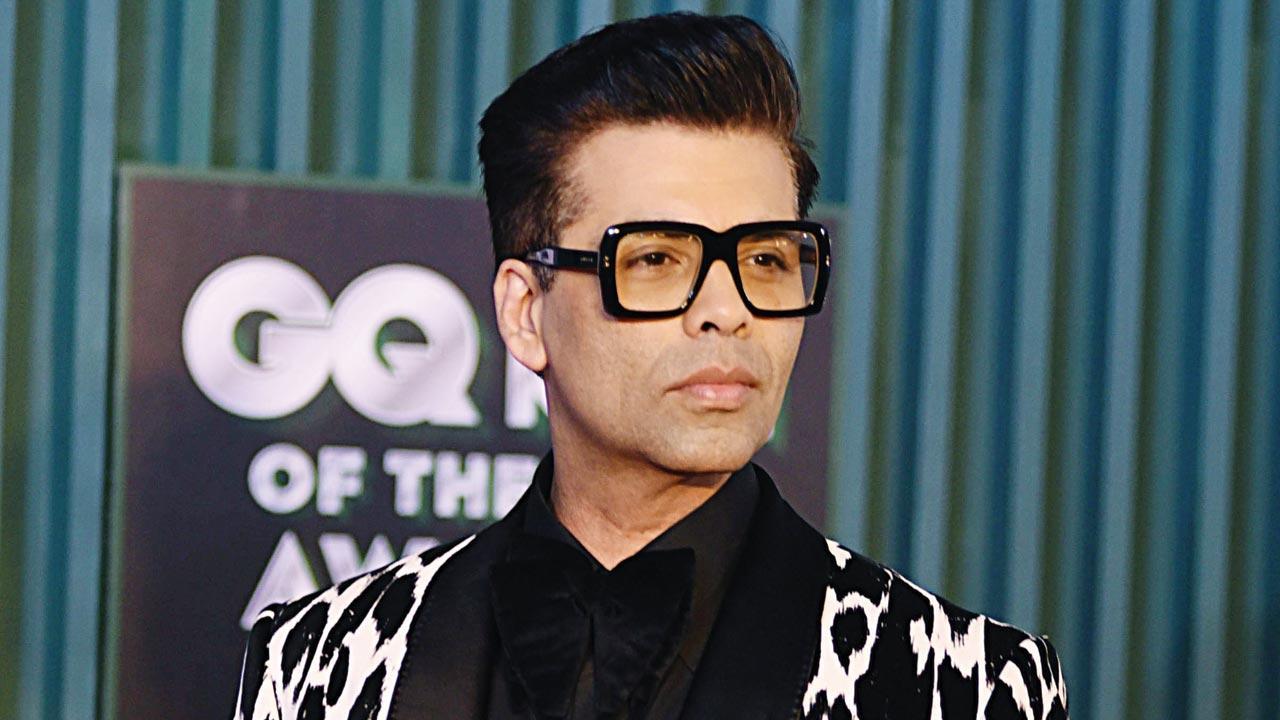
Javed Farooqui (THE ECONOMIC TIMES; October 14, 2024)
Reliance Industries (RIL) is in talks to acquire a stake in Bollywood producer and director Karan Johar's Dharma Productions, said people familiar with the matter. A deal will strengthen the oil-to-telecom conglomerate’s position in the Indian content production industry. The size of stake on the table could not be ascertained.
“Karan Johar has been looking to monetize his stake in Dharma for some time, but past deals have fallen through due to disagreements over valuation,” said a person familiar with previous negotiations, requesting anonymity.
Dharma is owned 90.7% by Karan Johar and 9.24% by his mother, Hiroo. It has produced a large number of popular Bollywood firms.
Dharma Productions’ pursuit of strategic partnerships underscores the broader financial challenges facing the Hindi film industry, including rising production costs, declining theatre attendance and shifting consumer choices due to the growing popularity of over-the-top (OTT) platforms.
Several Gains from Divestment
“In the past, RIL acquired a minority stake in Balaji. A similar arrangement could be made with Dharma,” said a second person. A potential stake purchase would boost Reliance’s content production portfolio, which currently includes Jio Studios, Viacom18 Studios, Colosceum Media and a minority stake in Balaji.
Dharma Productions make you feel valued. Your vision is respected-Nikhil Mehrotra
11:12 PM

Contrary to belief that writers have little agency in filmmaking, Mr & Mrs Mahi writer Nikhil Mehrotra says makers adhered to his vision when roping in Rajkummar-Janhvi for the sports drama
Mohar Basu (MID-DAY; May 30, 2024)
Writer Nikhil Mehrotra has three sports dramas in his resume—Dangal (2016), Panga (2020) and the upcoming Mr & Mrs Mahi. But he refrains from slotting them in the genre. To him, the sport is secondary.
“The story is about people and their emotions. If Panga was just about kabaddi, would it land? No, it had to be a woman’s story who leaves the sport and returns to it. With Mr & Mrs Mahi, I was excited about telling the story of cricket and a couple,” he explains.
Starring Rajkummar Rao and Janhvi Kapoor, Mr & Mrs Mahi revolves around a doctor whose husband—a former cricketer—discovers her talent for the game. The drama marks Mehrotra’s reunion with director Sharan Sharma after Gunjan Saxena: The Kargil Girl (2020). “It’s a blessing working with people who understand what you are trying to say even before you say it. He is aligned with my vision.”
Unfortunately, writers are often perceived to be at the bottom of the rung, having little to no say on how their material shapes up on screen. But Mehrotra says he has been lucky with Sharma and the studios he collaborated with so far. “My opinion has always mattered. Take this film for example—my opinion was sought on casting. I was expected to be there at the shoot. Dharma Productions make you feel valued. Your vision is respected, and when it is put on screen, your opinion is sought. I’m grateful to have only worked with those who value others’ creative opinions.”
This film marks the writer’s return after the polarizing Bawaal (2023), which was deemed insensitive by many for drawing parallels between a married couple’s woes and the horrors of the Holocaust. A year on, as he looks back, how did the discourse affect him?
“It impacts a writer. A part of society loved it. When I met creators and writers, they asked a lot of questions. We had expected that when we wrote the film.” But is there room to make an outrageous film today? “Outrageous can have many interpretations. Due to social media, the flak and opinions have multiplied. So, we are more mindful.”
Dharma Productions posts four fold rise in revenue thanks to Brahmastra
9:05 AM

Javed Farooqui (THE ECONOMIC TIMES; March 28, 2024)
Mumbai: Dharma Productions, promoted by film producer Karan Johar, reported a nearly four-fold increase in revenue to Rs. 1040 crore for the fiscal year ending March 2023, compared to Rs. 276 crore in the previous fiscal.
The company’s revenue growth was driven by Ranbir Kapoor and Alia Bhatt’s Brahmastra: Part One: Shiva. The film collected Rs. 418 crore in worldwide gross box office collections. Apart from Brahmastra, the company also released Govinda Naam Mera and Selfiee, featuring Vicky Kaushal and Akshay Kumar, respectively, during the fiscal.
The company’s net profit decreased by 59% to Rs. 11 crore due to a 4.5-times increase in expenses to Rs. 1,028 crore. Karan Johar owns a 90.7% stake in the company, while his mother, Hiroo Johar, owns 9.24%.
Business intelligence platform Tofler has obtained the financials from the company’s regulatory filings.
In FY23, Dharma’s income from distribution, digital, satellite, and music rights stood at Rs. 656 crore, Rs. 140 crore, Rs. 83 crore, and Rs. 75 crore, respectively. In the year-ago period, the four revenue streams contributed Rs. 19 crore, Rs. 167 crore, Rs. 34 crore, and Rs. 21 crore, respectively, to the company’s top line.
In 2020, Dharma received a show cause notice from the GST department seeking an explanation as to why GST amounting to Rs. 117 crore, including interest and penalty, for the period July 2017 to August 2020 should not be levied due to GST rate differential on certain taxable services.
Email sent to Dharma Productions CEO Apoorva Mehta didn't elicit any response till press time.
Our contracts with Shah Rukh Khan read: ‘It was a pleasure working with you. Thank you so much!’-Karan Johar
8:49 AM
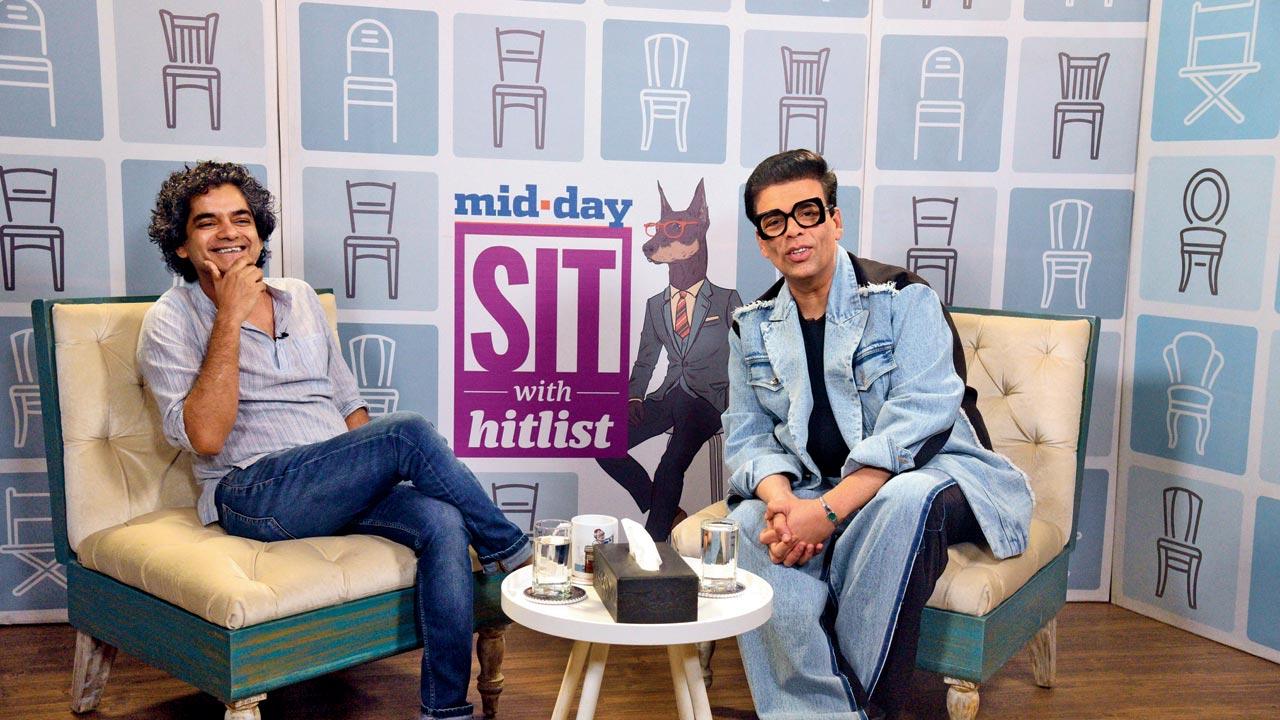
In the mother of all interviews, Karan Johar explains his inexplicable friendship with SRK, what a single superstar director must do to find love, and why he no longer prays for success
Mayank Shekhar (MID-DAY; September 17, 2023)
Back when Karan Johar was 15, having just finished his Class X, his mother, Hiroo, received a call from her friend, popular television director Aanand Mahendroo (Dekh Bhai Dekh).
Mahendroo had heard that Hiroo’s son is “extra plus-size,” as Karan puts it, and asked her if he might want to act in his TV show. That’s the sort of “large kid” he was looking for.
Karan was on his summer holidays. He’d only done school-level dramatics. But, why not? He went over from his Malabar Hill home to the far suburbs, to meet Mahendroo, who wasn’t in office. He waited for “four hours, doing nothing”.
Next to him, also waiting in the same room, was a slightly older bloke—sipping tea, engrossed in solving a crossword. No chit-chat or eye-contact. Soon as director Mahendroo entered his office, he spoke to this gentleman first. That conversation lasted hardly a minute.
Mahendroo offered the person a part in a TV series. The gentleman casually shot back, “No, I don’t want to do TV. I liked the tea. And stayed to finish my crossword!” And he flipped, and left. “Crazy! You know who he was? The actor from Fauji,” Mahendroo told Karan.
Meaning, Shah Rukh Khan (SRK). That’s how Karan met (or did not meet) SRK, first. Mahendroo offered Karan the teenaged part that he had in mind for him.
This involved shooting, for fun, during the holidays, at RK Studio, along with kids his age. The show was the much-loved Indradhanush (1989)—sci-fi, on Sunday Doordarshan, about a group of children, who discover a time machine.
That chubby boy, Srikant, in the group, was how many of a certain vintage would’ve first seen Karan Johar on screen. Only, they don’t remember, or realise it. It’s a legit trivia question. “Yeah, my acting career essentially started with Indradhanush, and ended with Bombay Velvet (2015),” Karan, 51, mock-sighs now.
While this was a summer activity for him, Indradhanush came out only a couple of years later. By when, he was already in the final year of junior college (Class XII). Kids randomly started ragging him, once he came on TV.
“Hello? I’m your senior, what’re you ragging me for,” he told them. The other person going through a similar experience in the same junior college was Jugal Hansraj (popular child-actor from Masoom, 1983).
Karan says, “Jugal had done some ad for MBD Books: ‘For me, for you, MBD Books’! Those days, if you borrowed a VHS tape, you’d always see Jugal doing this ad. Him and I got ostracised in college together!”
Since we’re on a trivia trail—besides that they’re friends from college, what’s the pop-culture connect between Jugal and Karan?
The hook line of the film’s title-track, Kuch Kuch Hota Hai (KKHH, 1998)? Well, Jugal Hansraj composed that earworm. To the best of our knowledge, he hasn’t composed anything for public consumption since. “He says he chose to retire at the top,” Karan laughs.
The love-triangle, KKHH, that opened in theatres on October 16, 1998, was Karan’s directorial debut, starring SRK. SRK and Karan, as is well-known, became friends, when the latter (22 then) was assisting Aditya Chopra on Dilwale Dulhania Le Jayenge (DDLJ, 1995).
Ever since, Karan’s done multiple films with SRK in the lead, signifying a career combo of sorts—Kabhi Khushi Kabhie Gham (K3G, 2001), Kabhi Alvida Naa Kehna (KANK, 2006), My Name is Khan (MNIK, 2010).
That number crosses way over a dozen, if you factor in co-productions, and SRK’s cameos—including Ae Dil Hai Mushkil (Ae Dil…, 2016), or the colossal Brahmastra (2022).
Given SRK is arguably the highest paid movie-star in India, I wonder what he charges, when he drops in for a cameo. Karan claims, not a buck: “Not for Ae Dil… Nor for Brahmastra, for which he shot for 14 days! But that is our relationship.”
Surely, the superstar would have been paid in kind; expensive return gifts, perhaps? A Cadillac, maybe? None of that, or so Karan says: “I give him clothes. I don’t think he has ever asked me for money, even for a film that he has done [as lead].
“Whatever is given, is given. Our contracts with Shah Rukh read: ‘It was a pleasure working with you. Thank you so much!’ That’s the contract. There is no contract!”
No piece of paper? “I don’t have anything detailed on paper. Whether it is with Adi [Chopra], or Shah Rukh—I will do anything that is asked of me [as well]. I am here, because of them. How can I forget that? Loyalty is the most required quality in a person, and it rarely exists.”
“I remember when Shah Rukh was shooting for RA.One [2011], he had a double unit. He called me to shoot [the second unit] for six days, because [director] Anubhav [Sinha] was doing a big action sequence. And he needed simple patch-work kind of scenes shot. I flew from Bombay, and did it. These are not big deals.”
Karan’s latest film, Rocky Aur Rani Kii Prem Kahaani (RARKPK, 2023), was his seventh feature, after a gap of seven years, in his 25th year at the movies as director. He says, “I keep hearing it as a comeback, which makes me sound like Mumtaz, who returned after many years in America [with David Dhawan’s Aandhiyan, 1990]!
“I spent three years on Takht [a film that didn’t work out, apparently for financial reasons]. Maybe, three years went on PTSD [post-traumatic stress disorder]. Another two years on the pandemic. But I’ve always been here.”
RARKPK is also his first directorial, without SRK in any form (SRK was co-producer on Student of the Year). There are probably also other firsts—such as his maiden movie shot entirely in India? “Yes.” First directorial that’s actually LOL funny? “I think so. There were funny moments in all other movies, but this one is funny up to a large point, and funny even after.”
Even if you’ve seen the blockbuster, what is RARKPK about? Let’s step back a bit. To start with, about a man, with an artistic bent, born into a business family, where he’s unlikely to succeed, as a result. The family deals in making and selling sweets, in Delhi. That’s Dharmendra’s character, isn’t it?
Only that it’s evidently inspired by Karan’s late father, Yash Johar, when you consider that young Yash was similarly inclined to the arts, i.e. photography.
His family business was based in Delhi. And they made and sold sweets. Just that the company wasn’t called Dhanlakshmi. Karan recalls, “I have no clue why our family shop in Delhi was called Nanking, which is the name of a Chinese restaurant in every Indian town. We sold sweets with that name!”
Upon learning about Yash’s evident lack of interest in the family business, and an artistic ambition instead, his mother, as in Karan’s grandmom—“we called her Mataji”—asked Yash to head to Bombay. Soon as he arrived in Bombay, he landed an internship with The Times of India as a photographer.
“This took him to several sets, like Mughal-e-Azam, and other films,” which is the industry he switched to, working his way up, “starting out as ground manager, then production manager, and eventually, production controller—to working for Navketan Films, for 12 years—and being the only production controller to get front-roll credit.
“Everybody in the film industry knew and loved him: Dev Anand, Vijay Anand, Raj Kapoor, K Asif, Sunil Dutt… Everybody had worked with him.”
Perhaps the insecure/seasonal nature of films as an industry did not suit Yash, after a point. That’s when, Karan says, Yash took a sabbatical, and eventually started an import-export firm, named Yash One Exports, which, in turn, became Karan’s family business.
“We were middle agents for material like wrought iron, that would go to a place called Pier Imports, in Paris and New York, sourced from Faridabad and Saharanpur. It was a very stable income.”
The movie-bug, I suppose, is a hard one to swat or suppress for too long. Karan says, “It was Ramesh Behl [father of Srishti and Goldie Behl] of Rose Movies, who got my father back into films. That’s how he approached the writers Salim-Javed, who had a script.”
Thus, Raj Khosla’s Dostana (1980), starring Amitabh Bachchan, was born. He adds, “Ironically, my mom and Amit uncle had gone to [boarding] school together—he was in Sherwood, and she was at St Mary’s, which is the sister school.”
Who funded Yash’s maiden production? The Hinduja family, namely S P Hinduja. What was S P Hinduja’s son called? Dharam. This is how Dharma Productions gets its name: “Yup, that’s how the journey began 43 years ago!”
By all means a boutique beginning. Which is also a fair assessment of how today’s insiders are often, if not inevitably, yesterday’s outsiders.
The insider-outsider debate having hounded Karan over the past few years, with extensive trolling online, over supposedly favouring film industry kids, so to say, over a huge horde of aspirants, who set foot in Mumbai, without any filial connections to assist them in finding the proverbial foot in the filmy door.
This is what got termed the “nepotism debate”, with Karan allegedly at its fountainhead. Later in the conversation, he points out, “Between features, ad films, digital arm, and talent management agency—at any point in time, Dharma has an employer base of 800 to 1,000 people. And we make sure they are well taken care of. Now, 98 per cent of them are not from the industry.
“Why is this data not talked about? Why are we talking about that one star/industry kid getting an opportunity? What about the other thousand, contributing massively?
But if you want to make a narrative that works negatively, you will make any narrative. The negativity is on whoever is making the narrative. Not on me. Honestly, I haven’t, and I will not apologize for anything. Also, I will cast who I feel is right. If that person happens to be related to somebody in the industry, then so be it.”
Around 2005, I had asked Karan, during an interview, why he makes films. The answer was along the lines of the usual, which is to create worlds, tell stories. What he didn’t get, he told me then, is why he produces movies. And that it can be a really thankless job, at times. I wonder if he feels the same, almost two decades later.
He says, “Around then, I think we had produced Kaal (2005). Things have changed since. Unlike then, now, we have active producers, with credits, on the set, working on the logistics and tough stuff, which is really tough.
Apurva [Mehta; Dharma CEO], of course, is in the thick of things—he is the fulcrum of the studio. I am creatively jamming, sitting on rushes, final edit, all the fun stuff. That’s why I’m very happy to produce multiple films.”
Nikkhil Advani’s Kal Ho Naa Ho (KHNH, 2003), also an SRK starrer, was in fact Karan’s first film as producer, while he had also written its script. Nikkhil had assisted Karan on KKHH and K3G. They were also friends from school.
Subsequent to KKHH, Nikkhil left Dharma. Recently, he went on record to suggest how the rather public bad-blood between them had cost him three years of no work—deemed an industry pariah of sorts, therefore.
To which Karan responds, “I didn’t know if it was a gap of three years that he got no work. The fallout is too far gone, firstly. I attribute my knowledge of cinema and camera grammar to him. I was quite clueless on my first film. I just knew mid-shot, wide-shot and close-up. He mentored my technique. I will be forever grateful to him for that. But we are wonderful now, when we meet—exchanging shared nostalgia and memories. We had a creative fallout. It was a time that he was hurting. I was hurting. It was at an unfortunate time, because my father was very critical [during the making of KKHH].”
Beyond expanding his company, Dharma, into a legit creative force in Bollywood, Karan’s contribution on the business side could well be as a case-study on personal branding. After Subhash Ghai in the 1980s, I can’t think of too many filmmakers, altogether behind the camera, who became a recognisable face, among the public.
How many directors in the world do you know who actively endorse so many products, from laptops, paint, to soups and sunglasses! This naturally extends to brand ownerships too. Neuma, the restaurant that replaced the iconic Indigo, in South Bombay, is associated with him.
He informs he has a jewellery brand, Tiyaani. “There are several things I’m invested. Both with people and products, I go by instinct.” He’s more so a proper pop-icon to the point that, as they said in the good ol’ Tata Steel commercial, from back in the day—he also makes films.
This public-facing side, he remembers, really kickstarted with picking up gongs for KKHH, at award shows, in 1999: “I was giving these long, eloquent speeches, that were shown on television. Then, in February, 2001, Pradeep Guha and Khalid Mohamed, who worked for The Times of India, asked me to host the Filmfare Awards. I did it for free, because it was, I thought, a great opportunity.”
He hosted the Filmfare Awards for free? Surely, Filmfare was making enough money from it! “Well, they didn’t pay me in 2001. Subsequently, I have been paid by the same organisation, and I’m very grateful for it.
2003 onwards, for four years in a row, I hosted the Zee Awards, on primetime. And then in 2004, I started [the catty chat-show] Koffee With Karan, on Star World, which made me further a recognizable face.”
Koffee With Karan has had seven seasons on Star network since. Strangely, Karan doesn’t own the intellectual property: “If they want, they can have Karan Thapar host it. And maybe I could still do Conversations with Karan!” I’m guessing, it could be spelt with a ‘C’. Karan’s own numerological fascination with the letter ‘K’ for all his film titles stopped, once his production Kurbaan (2009), after Kaal (2005), didn’t perform at the box-office.
My needless peeve with Koffee With Karan, though, is how it may have ruined interviewing skills of film journalists, in particular! Wherein they get access to some of the finest talents/minds. And they waste that opportunity playing ‘rapid fire rounds’ with them, rather than actually mining experiences, or picking brains. This tic-tac rapid-fire stuff is all over my Instagram Reels, really.
Karan says, “The other problem is when they have a checklist of 12 questions, and I can see them going back to it, while you are rambling away. The person [at the other end] just nods, ‘Yeah, yeah, sure, sure…’ They just go on to their next question. Well, an interview is when someone listens!”
This hour-and-half long conversation (available unedited on YouTube), as part of the Sit with Hitlist series, with a live-audience of mid-day journalists, took place about 10 days after the release of RARKPK.
The film, noticeably, being the cooler-talk in the office, leading up to this chat. Given that it’s a newsroom, one of the things loudly discussed was how Karan has portrayed his lead character, Rani (Alia Bhatt), a journalist herself, dressed in the fanciest sarees in the film. Who wears that to work? He points to three women in the room!
The other time he’s had a journalist in the lead was Rani Mukerji, playing a newspaper editor, in the short films’ anthology, Bombay Talkies (2013). Was the Rani of Rocky Aur Rani named after this Rani, by the way?
“No. But this Rani and that Rani are both derived from a member of the media called Poonam Saxena. She’s always in a saree, and I found that wonderful. I love the saree, per se.”
Delhi-based journalist Poonam Saxena, incidentally, also co-wrote Karan’s memoir, An Unsuitable Boy. My instant memory from that 2016 book is Karan writing candidly about his dating life, or lack thereof, in terms of how difficult it is to be rich/famous, and meet new people. And that he hired a professional agency, based in London, to suitably match him with potential dates across the world.
“That process is still on. It has been a couple of years. I have been on telephonic dates, Zoom dates, during the pandemic, and some dates, physically, in person. Because the people are all over the world, so you meet, when you land up being in the same city. It hasn’t landed anywhere!”
The reason, it appears, is professional: “We live in a world—and I can speak for myself—that is impossible for people who aren’t in it to understand. I love my work so much. The rest of the time I devote to my children and mum. I don’t know where’s the place to find [for another person]. And I don’t want an unequal relationship, where the other person is just following my diary.”
This, I can vouch for Karan, despite his multiple professional forays. There are only two people in Hindi cinema I’ve known, over years, who are likely to respond to a work text (in this case, by a journalist) almost soon as you’ve sent it—one is Amitabh Bachchan; the other, Karan. Surely there are others too, but none likely to be half as busy as both. “I have what you call/message reply anxiety,” Karan says.
That said, he’s himself been in an unequal relationship, or unrequited love, as it were. And that he got his “most personal and angsty film” out of (Ae Dil…). I wonder if the person he based that “ek tarfa pyar” picture on, actually saw it. And what did he say? “Yeah. It was initially awkward, because his character [Anushka Sharma] also dies in the end!”
This one-sided relationship lasted about eight years for Karan. It taught him never to get into one: “Love can make you and break you. It can tear you apart. The pain is physical, not symbolic.” The said person is very part of his “ecosystem; but thankfully, not from the [film] industry, otherwise it would be too messy.
“There was a polarised opinion on the last act of Ae Dil… But the GenZ got it. Because they’re going through this intense, crazy, mad love. I just found it in my late 30s, that carried on till the 40s!”
Ranbir Kapoor played ‘Karan Johar’ in Ae Dil... The character is diametrically opposite to Rockstar Ranveer Singh aka Rocky Randhawa—“West Delhi guy, who wears his heart and Gucci on his sleeves”—in RARKPK. As actors too, apart from similar sounding names, Karan reckons, Ranveer and Ranbir, two of Bollywood’s best, have nothing in common, besides genius-level talent.
“Ranbir is a producer’s delight. He can be on the set for 16 years straight. He feeds off the director. Ranveer feeds off the world. For Rocky, he spent days in Delhi, interacting with local influencers, including hanging out at a West Delhi party.”
That’s fine, but really, what nectar of life is Ranveer inhaling to be turbo-charged, 24x7? “I’m surprised he’s not a Gemini. There are two people living inside him. The second person, you will never see—he barely hangs out. He’s conserving his energy to explode, once he is out, with his characters, and at events!”
Not to forget his onscreen partner, Alia Bhatt. RARKPK was their second film after Zoya Akhtar’s Gully Boy (2019). The alchemy is insane: “Well, that comes from familiarity. They’re genuine friends, which make for great onscreen chemistry; like Shah Rukh and Kajol. Unlike actual couples, who are so comfy with each other, that they have to conceal it on the screen!”
Before the release of RARKPK, Karan confesses, he was a nervous wreck, in a way that he’s never been before. His therapist diagnosed this could be late reaction to traumatic events. One of which, of course, was the merciless trolling he went through, especially after actor Sushant Singh Rajput’s death, in June, 2020.
Karan quit X (formerly known as Twitter) in October, 2022: “When I read abuses against my children, that was it. And who all do you speak among faceless, nameless people, and some with strange names, too?”
The “big ball of anxiety” also had to do with film RARKPK itself: “It’d taken me back to the syntax and DNA of what I began [filmmaking] with. For some reason, my confidence was at an all-time low. When K3G came out the same year as Gadar, Lagaan, Dil Chahta Hai, there were some saying that people have moved on! I didn’t want that to happen.”
Opinions certainly matter to Karan: “If we don’t get validation from the people that surround us, we will feel alienated.” The night before the release, once positive texts from the press show began pouring into his WhatsApp inbox, he felt mighty relieved, even surprised.
For, he believes, “My reputation precedes me—this guy dancing on reality shows, hosting talk shows, wearing mother’s clothes, can’t make a good film! We did a deep dive on the Internet for the trolling I get. These were the things that came out. Am I going to change for it? Be someone else? No. Critics will turn around.”
On the sly, Karan is pretty much a film critic himself—although only over a restricted WhatsApp group of eight film folk—“it’s an eclectic blend,” he clarifies.
He posts lengthy/detailed reviews of every films he watches—“I write the best in that group. What we share there is sacrosanct. It can’t be forwarded. And the reviews can go from love to WTF! I’ve even reviewed my own film [production] once.”
Speaking of pre-opening jitters, actually the saddest WTF moment for Karan may have well been 10 days before the release of Ae Dil… He dropped what looked like a hostage video, apologising for casting Pakistani star, Fawad Khan, in his film. Given the timing, in the wake of Uri attacks, and hostile Indo-Pak relations.
He admits, “Anything for a filmmaker, outside of the film, right before its release, is hurtful. There was pain. I really don’t want to get into the politics and optics of it. But even seven years later, I carry the baggage of that situation. When I go back in time, I feel disturbed. The same thing happened around My Name is Khan.”
That there were no extraneous issues to fire-fight before RARKPK, Karan feels, must’ve given him time to take on a more real pressure: “Weirdly, I’ve had a tough time, during my directorial releases. Dad passed away during KHNH. Yash Chopra passed away the same week as Student of the Year…”
We’ve saved the most chilling account for the last. Consider the release of his debut film—25 years of which he celebrates in October, 2023. As in the première of KKHH. Which was held where? Liberty Cinema. That’s how he wanted it—both DDLJ and Dil To Pagal Hai (1997) had similarly opened first at the South Bombay theatre.
Where was Karan, during his own premiere? Locked up in a room, in the theatre, while the screening was on, and his assistants Nikkhil and Tarun Mansukhani took turns to update him on audience’s reactions.
Shortly before the release of KKHH, the underworld had called his father to stall the film’s release. The police, offering protection, had promised that the show must go on. Given the threat, Karan was kept away from the premiere screening itself.
Post the show, the party moved to Khyber restaurant, nearby: “There, they said we have a [tallied guest] list. But six uninvited people have entered [the venue]. Now, it could have been just six gatecrashers. But that night, my father said we are leaving the country. At 4 am, my mum, dad and I, three scared people, left for London.
“First, we settled into a tiny apartment in a discreet location. My mother, somewhere secretly, was hoping that if this film is not a big hit. You know, it’s fine!” Better not to call attention with success.
Karan watched KKHH first, with the public, at a large London single-screen cinema, where he saw “300 people leaving, during the interval.” His heart sank.
“My mother mentioned the audiences have left, maybe, with a tinge of some happiness! My father said, that’s not possible. He walked outside and there was a huge line in the ladies’ washroom. He asked why there was such a crowd. They said, ‘Can’t you see, our mascara is off. We have cried so much!’”
The following Tuesday, from a London phone booth, Karan found the courage to call up Aditya Chopra, whose Yash Raj Films was distributing KKHH: “Adi asked me: what is the most expensive thing you want to buy? I said, I want to move to a bigger house with mom and dad. He said: So, come back to Bombay, and buy the biggest house—your movie is a blockbuster!”
Sensational. And since this is Karan’s silver jubilee script from his own life, should it not star SRK in the lead. He adds, “There was an actual dream I would always have of the great Shammi Kapoor, emerging in a Mercedes, at my movie’s première. Which actually happened at the Liberty Cinema, with KKHH.
Shah Rukh knew about this dream of mine. The moment Shammi Kapoor came in, he went inside [the theatre], and brought me out of the [secluded] room [into the foyer]. So, I saw that happen.
I had tears in my eyes, because it was literally my dream getting realised. Shah Rukh said: ‘You stand here. You watch this moment. Nothing will happen. I will take the bullet for you’.”
Subscribe to:
Posts (Atom)