Showing posts with label Dastak. Show all posts
Showing posts with label Dastak. Show all posts
Mukul Dev lost his mother last year; grief can take a toll-Mahesh Bhatt
8:44 AM

Renuka Vyavahare (BOMBAY TIMES; May 26, 2025)
Actor Mukul Dev passed away on May 23. He was in the ICU for a week and was battling health issues. Mugdha Godse expressed, "Shocked and saddened. He was a great actor and a friend."
Mukul made a striking Bollywood debut in 1996 with Mahesh Bhatt’s Dastak, a thriller that also launched Sushmita Sen and Sharad Kapoor. In a conversation with Bombay Times, the renowned director recalled his impression of Mukul and what made him special in a film that launched three newcomers.
Shocked by the news, Bhatt said, “Vikram Bhatt called me up this morning and said, Bhatt saab, I have heard the news and I'm so frightened to even confirm this news. Vikram was my associate in Dastak so most of the action scenes and most of the work was done by him with all these three actors, you know. He had a deep bond with him. So, he called me and asked me to verify and then I called Pooja, she was close to Mukul and Pooja herself was astounded. And then we started to inquire from here, there, everywhere until it came through some source on Instagram that he had passed away. So, then I did confirm that to Pooja who was quite devastated, even to Vikram. Mukul was a very close member of our tribe which kind of journeyed through time, you know.”
Remembering Mukul, the director said, “What flickers on the screen of my mind is Mukul’s radiant smile. The most heart-warming smile that would be not only on his lips but in his entire gait, from his eyes, lips, eyes, his entire body would smile when he smiled. He was not aggressive in his demeanour. He was shy, not very outgoing. I don't mean he was shy that he would step back but he was always within the boundaries of his own given space. He would very respectfully carry himself within that. One thing that I noticed very early about him was he was very generous because all three of them were newcomers in the film. You always felt his warmth; never felt his obtrusive presence. There was no attempt of his to flash like a neon sign trying to make his presence felt.”
How did he discover the actor, we ask. “People would come to me because they knew that I was always looking for new people. I would cast new faces in movies. So, I think like Anupam Kher and Rahul Roy, Mukul too came to me looking for an opening in the movies. That’s how Dastak happened. The film was around Sushmita. She came with the dazzle of being Miss Universe. Obviously, tinseltown looks for faces which are radiant and have run up to the glamour world. She came with her thunder, but she was not the kind of person who would flaunt it. She had the humility to own up that she was a beginner. Like all of them. All three were equally confident. I thought Mukul had the charm and I just thought that he fitted that role, he had the language. He was a person who was quite distinct from the raw look of Sharad Kapoor. I needed someone who looked the opposite of Sharad Kapoor so I cast Mukul. He was refined and well-groomed and kind of cultured. Not somebody who like Sharad, had the dust of life on him.”
The director says he heard of Mukul through common friends over the years but drifted apart. “The harsh truth about our business is that when we work, we work on intense projects and we are so intensely engaged with each other. And that's the glue, right? And then when the movie gets over, irrespective of what the outcome of the film is, if you don't work together, you do drift apart. Because you're all fiercely engaged in your own activity of life. Especially if you happen to drift away and go to another town. I used to keep on meeting his brother, Rahul. Very charming man. I used to keep on inquiring about him. I heard he was in Delhi, looking after his ailing mother. He lost her and grief can take a toll. He was ailing himself. Loneliness is a very difficult space to deal with, especially when you have been in the arc lights. And then to be in Delhi and away from the so-called razzle and dazzle of Mumbai. This is based on what I heard but losing an ailing parent can erode you.”
On a concluding note, Bhatt said, “Mukul did leave in his own way his footprints on the sands of time. I remember him as a very warm, endearing man. Mukul Dev still smiles in my head. A radiant smile that lights up my heart.”
(When I showed interest in Aarya), my lawyer Priyanka was making nail marks on my thigh, ‘you can’t just do that’-Sushmita Sen
9:31 AM
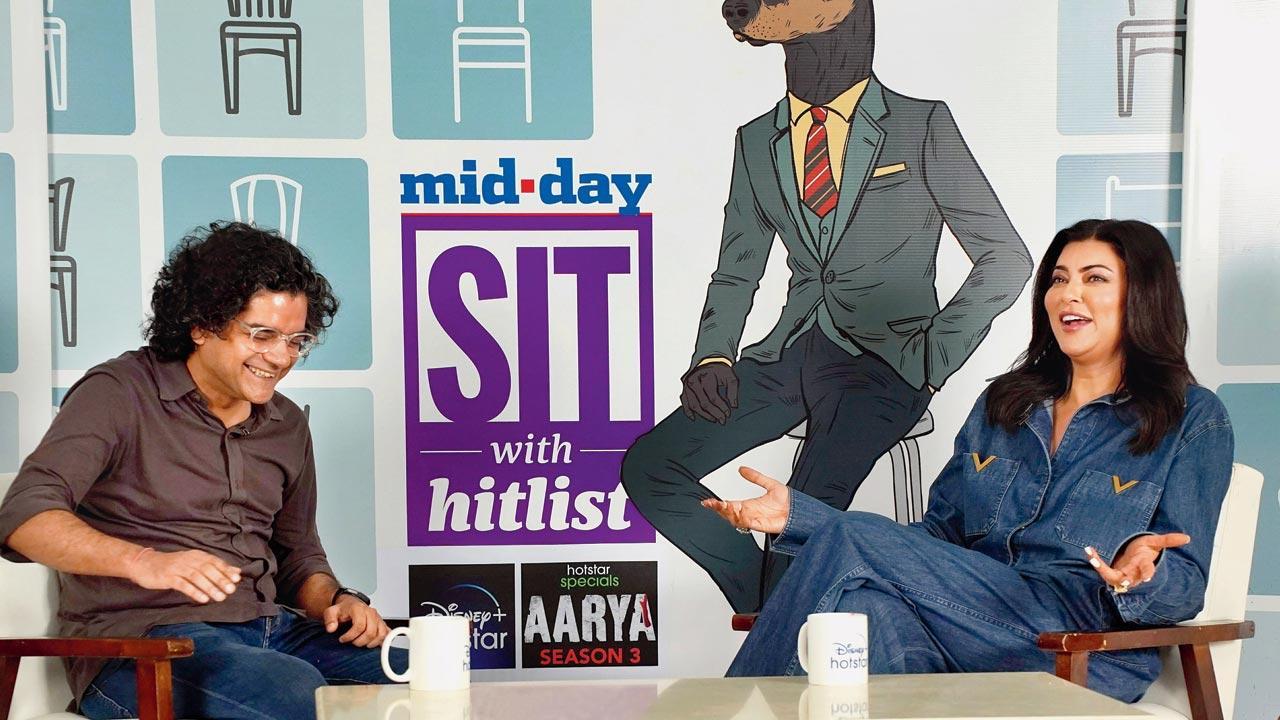
Sushmita makes sense of stardom, relationships, and a second life, including in showbiz…
Mayank Shekhar (MID-DAY; November 18, 2023)
If you were to play word-association, probably anywhere in the sub-continent, the word that would come immediately with Miss Universe is: Sushmita Sen.
Twenty-nine women on the planet have been crowned since her. Yet, as we introduce her in this conversation to a live audience, Miss Universe rightly shows up on top. Do you ever stop being Miss Universe?
“So glad you asked this,” she says. In Namibia, the following year, when the crown passed on to Miss USA, at the party in the coronation hall, Martin Brooks, then president of the organization joked that they’ll fire her the next morning. She said, “No, I shall resign tomorrow morning.” She was 19.
When the name-plate was placed on her table, it didn’t say “Former Miss Universe” as originally designated. It said Miss Universe, 1994, which is the year she dedicated to the title she won in Manila, Philippines. That she considers her second home after our own, i.e. India.
Consider a recent talk-show she was on with Jessica Soho, the ‘Oprah Winfrey’ of Philippines. On the episode, during the interview, Soho brought over several Philippine children from different islands, all of them named Sushmita: “These were 22-year-old girls: Sushmita Chagalung Mang, sometimes, Sushmita Sen Chagalung Mang…!” Incredible.
So, yes, whether others do or not, Sen remains Miss Universe, forever, and a crown she wears poised to perfection still. And that, strangely enough, bothered her daughter Alisah, 8, when she asked her mother, once, why there was so much paparazzi always surrounding her.
She told her child, hey, that’s because I’m kinda famous! “But, why,” the girl asked. “Because, you know, Miss Universe, and I act…”
Alisah semi-taunted her, instead, “But that was a long time ago, mom!”
The coin dropped for Sen. Around 2010, Sen had decided to take a break from films altogether. Something her manager and friends in the movie industry then, termed a “hara-kiri,” given the shelf-life attributed to female stars in Bollywood, anyway.
But her reasons were quite clear. If you scroll up her filmography on IMDb leading up to it: films titled Zindaggi Rocks, Ram Gopal Varma Ki Aag, Karma Confession And Holi, Do Knot Disturb, Dulha Mil Gaya… Her last film, before the sabbatical, and the reason for it, was No Problem (2010). Which is when she said, “No!” There is a problem here!
Sen recalls, “You get bored, if you are growing neither as an actor nor as a person. You need to experience/observe life in order to reflect art. Also, I had become a mother again, to a one-month-old.”
“I had adopted my first child, Renee, when she was six months old. But there’s a big difference between raising a one-month and a six-month baby. That’s when I thought to myself—I can’t leave her with a nanny to do something I don’t even like!”
As happens with showbiz—“jo dikhta hai wahi bikta hai”—that break continued indefinitely, as the “scripts offered started to dry up too.” The daughter-mother exchange was a turning point of sorts, it seems. As Sen puts it, that’s when she realized her daughter had grown up as well, with a mind of her own, “telling her off.”
What did she do? What most people with paps circling them may not. That is, pick up the phone, call up the content bosses of the top three OTT platforms in India, namely, Disney+ Hotstar, Amazon Prime Video, and Netflix.
And introduce herself, “Hi, my name is Sushmita Sen. I’m an actor, used to be one anyway. I’d like to come back to work, and I need help, because I haven’t worked in eight years.”
What might have been more baffling, for the OTT bosses, is the number of conditions she flagged, given that she’d been without a job for almost a decade: “I wanted them to know I am hungry. And I had been watching content on OTT and loving it, while Hindi cinema, with women, operated along the same lines still.”
“I told them: I want workshops. I want to learn. I want to unlearn. And I want to headline a show. I want responsibility. I don’t want to be just a character. I need a conflict so powerful that it is author backed. Their jaws dropped.”
The underlining point being something she’s followed all along: “You get in life what you have the courage to ask for. You just don’t get it [otherwise].”
She rejected multiple scripts that obviously didn’t meet all the conditions. Until Saugata Mukherjee, with Disney+ Hotstar then, currently with Sony LIV, called her back with what he suggested was an offer she couldn’t refuse. He told her nothing else.
In true Godfather style, only few hours later, she was with director Ram Madhvani, who she was pleasantly surprised to meet. He described her role as the “female Michael Corleone.”
Within five minutes, she said yes: “My lawyer Priyanka was making nail marks on my thigh—‘you can’t just do that’!” Sen says what she had learnt from her “first innings [in Bollywood] was not to get carried away by a script. The words to screen require a team.”
This is how, in 2020, we finally saw Sen in Aarya, on screen, after years, doing gymnastics, in the opening scene. We saw her husband in the series, Chandrachur Singh, who’d also been away for so long that some (like me) mistook him for Shashi Tharoor, for a second. “Yeah, I saw those memes,” Sen laughs.
Madhvani’s International Emmy-nominated Aarya is a dark, crackerjack crime thriller, based on the Dutch drama, Penoza, that follows the life of Sen’s eponymous character, as she navigates the world of drug-trade, mafia, murders and revenge, across the rugged terrains of Rajasthan. Aarya is still par for the three-season course.
A better shocker for audiences would’ve been Sen showing up as a transgender lead—playing the activist Gauri Sawant, who went through sex-change, in Taali (on Jio Cinema). You only have to notice Sen in the younger portions of the series, where she’s a young boy with slight stubble, to appreciate the transformation. “That’s when I felt totally beautiful [in my skin],” she says.
The process presumably must’ve been the same: training, workshop, learn, unlearn. The only criticism likely to come her way for Taali, and something she was prepared for, is usurping a role rightly reserved for a transgender actor, after all. She defends, “Frankly, I wasn’t okay to play the role in Taali, until I knew Gauri Sawant herself wants me to play her.”
“The crew was resistant to get in touch with me [Miss Universe, etc], until Gauri coaxed them into it. She told them, I want my life to be beautiful. It has been spelt out to be ugly for far too long.” Sen declares she may have actually underplayed Sawant in the part: “She’s way too spit-fire strong in actual life!”
• • •
While there are several Sushmitas named after Sen, born around the mid ’90s, in Philippines, and in India too—a better name for her might well be Alice. And I don’t mean this in the way of the song, ‘Who the f*** is Alice!’ But, of course, the book, Alice in Wonderland.
Think about it. Enough female actors, in particular, during interviews, you’ll observe, say they never actually wanted to be actors. Which is euphemism for how they never chased fame. It’s only true for Sen, in all honesty. She never even did inter-school plays, growing up.
Shortly after winning the Miss Universe title, she built a home and life in Los Angeles—“that’s where my financial independence was”—for three years.
She had a career in modelling sorted, perhaps looking at entrepreneurship thereafter. It was while she was visiting her parents in Delhi during the time that filmmaker Mahesh Bhatt called her to meet, since he happened to be in Delhi too. She told him over the phone, “If it’s for a role, I’m not interested. I can’t lie. It’ll show on camera.”
This, one can vouch for, even during this conversation. Between 2010-2012, during her acting sabbatical, Sen ran the Miss Universe franchise from India, then owned by Donald Trump. She adds, “This didn’t make it easy or fun. I enjoyed sending girls from India to compete for the pageant, but I didn’t like the people I was working with, so I quit.”
On Trump, she says, “There are some people who leave an impression, not necessarily because of their achievements or power. Just for the people that they are. He is not one of them.”
Okay, we digress. In the mid ’90s, Bhatt persisted for coffee, nonetheless. They met and he told her a few things flatly, “You don’t have to act. You have to play yourself, that is Sushmita Sen. Also, when did I say you’re a good actor, I’m a damn good director.” So Bhatt-like!
The film he had in mind was about a Miss Universe getting stalked, which became Dastak (1996), a big-budget production, shot in Seychelles, Switzerland… It was the only film Sen was ever going to act in.
Here, of course, no dialogue coaches, workshops, acting instructor—Sen was, right away, called in for the film’s mahurat. She recalls, “I had mugged up my lines. I came out of the [vanity] van, and there were 40 media persons lined up for the shot. Bhatt Saab said, ‘Let them watch. It’s after all Miss Universe’s mahurat’. Before I was to give my shot, he changed my entire scene.”
“It became about a woman dealing with a man lunching at a morgue, from whom she has to collect a dead body. I was 22. No acting experience. For two years, I’d been professionally trained to be a lady. Here, I was to show aggression, that I don’t understand, throwing my earrings at the morgue man. I wasn’t getting it right. Bhatt Saab began to tell [brother-partner] Mukesh, ‘Yeh kisko leke aaye ho? She doesn’t know anything!’”
It’s at this point Sen broke. She told Bhatt off: “I told you I can’t act. I’m done. You can’t insult me, in front of all these people. There was a showdown.” Bhatt retorted, “That’s the anger [I was looking for]. Now show it in the film’. This is where Bhatt Saab is Bhatt Saab.”
The entire posse of media folk around her were actually ‘junior artistes’, brought in, holding cameras, pretending to be press!
Dastak, Sen says, got almost entirely shot with her first takes, given how raw she was, as a performer, and how she might feel spent/exhausted, with multiple dabs at the same scene.
The ’90s, of course, were another time, even as they were times that were changing. Looking back, Sen argues, “Thank God for the world that existed back then—I would’ve never been an actor by now.”
What followed Dastak is Alice in Bombay/Bollywood, where everyone, biggest names onwards, knew her already, from her pageant stint. A story I had heard about Sen, which only she can verify is if she first met Amitabh Bachchan in the men’s loo. Dying to pee and no place to go, she walked into the men’s loo, and there was Bachchan saying hi to her… True story? Apparently not.
“This could’ve happened with [me and] someone else. It’s possible. Lucky for whoever saw me in the men’s room. But if it was Mr Bachchan, I’d remember!”
For all its usual highs and lows, Sen did become a legit Bollywood star. The acting experience, or lack thereof, didn’t count for much. What did, in some sense, if you wish to place her in the pantheon is how many Bengali actors become Bollywood heroines.
As in, somehow the male equivalent of Sen, right from Rakhee, Sharmila Tagore, down to Kajol, Rani Mukerji etc, are usually Kapoors or Khans. Rather than male Bengali leads. For the heck of a conversation, I ask her why that is so. She sighs, “It’s an interesting thought. But with due respect to Bengali men, Bengali women are something else!” Point taken.
The other thing that Sen has in common with a full constellation of female Bollywood stars is the number of them who come from defence services’ backgrounds. Their parents having served in the forces—from Priyanka Chopra, Anushka Sharma, Preity Zinta, Lara Dutta, Aishwarya Rai, Neha Dhupia, Gul Panag…
You lose count, really. And this is equally true for women in film crews you bump into often. Sen’s dad served in the Indian Air Force.
She has clearly thought about this phenomenon before: “I think if you’re going to be an outsider [in any industry], it helps to be raised with certain qualities that services’ kids have. Our fathers get posted to a new location every three years, which means everything changes for you—your uncle-aunties, friends, school… This makes you grounded as a person, adapting to new places.”
The other thing Army daughters enjoy, I reckon, growing up in closed cantonments, is a sense of freedom—that isn’t as common among girls, living in the towns/cities right outside the gated, services’ establishments. Sen argues, “On the other hand, we grow up over-protected, but that also makes us fearless.”
Between class IX to XII, Sen went to Air Force Golden Jubilee Institute (AFGJI) in New Delhi. It’s a school I’m familiar with, having been to The Air Force School, next-door, around the same time.
A shout-out is warranted, only because AFGJI is a unique kinda school, for classes merging, wherein airmen’s kids study along with officers’ and civilian’s children. But more so, the school has an inclusive section dedicated to special children, struggling with certain mental faculties.
Sen is happy I bring this up, since it did influence her personality at an early age: “The beauty of interacting with special children in that school was that you got graded for participating in competitions, where you help the other child win, in order to win yourself.
“We got graded 25/100 for just that. So, for instance, you had to push the wheelchair in a run, and you lost, if both of you did. It takes the approach that we aren’t different from each other. Only, that I can’t move forward [in society], unless all of us do.”
After school, Sen had her eyes set on an economics degree from St Stephen’s College. While in line for admissions, realizing that she hadn’t made the percentage cut-off, heartbroken, she headed off to a nightclub the same evening. It’s what happened on that night, that she never had to go to college, ever.
She remembers, “There was a gentleman at the nightclub named Ranjan Bakshi, looking at me. He claimed to be from The Times of India, and wanted me to apply for Miss India. You know how it is, in Delhi…”
Yes, we all do. Sensing a creepy uncle-type, Sen’s friends gave her cover, fobbing off the old gent. But her group of friends returned soon after, with the same man, who had The Times of India business card, asking to be taken more seriously.
This is how she landed at the Miss India contest. There was also the parental block before that. Her father was upset. He had IAS aspirations for his daughter. He didn’t speak to her for some time.
Even when she had entered Miss India, she had to convince him about the swim-suit round: “I can’t participate in the contest, and not do the swim-suit round, which is part of it. I told him, baba, I have to wear a swimsuit. But I promise you, I will add respect to it. It will not be ‘chhablami’ [crass].”
Sen adds, “When I won Miss India—for my dad, being a defence person, it was me representing India. He bawled his lungs out. I had given him the biggest moment, being his daughter.”
This is the point in the interview Sen is in tears herself; asking for tissue. She came good, even further, for her father, when she was awarded an honorary D.Litt by NR Narayana Murthy, in Kolkata, many years later. She was unwell. Her dad went to receive the degree, on her behalf. So much for never entering college.
• • •
The reason Sen will be Miss Universe for Indians, foremost, forever, is also her stardom belongs to a time when mass culture itself was so monocultural.
We followed a handful of celebs. Information on them was scarce. Mystique, supreme. There developed a para-social relationship with the star. Wherein we formed our own opinions on them based on the little we know. And we took immense pleasure in it.
As a kid, when Sen won the global title, I confess to her, we’d gossiped about how she had dumped her boyfriend right after. Feeling sad for the boy we knew nothing about. Rajan, something? “Rajat Tara,” she reminds us. Of course!
“I was the best-man at his wedding in Belgrade,” Sen says, recalling how he remains her BFF still: “I was so fortunate to have him as my first boyfriend. You don’t dump a guy like that. You could outgrow.” That she’s famous and single (as in unmarried) since she was 18—I also wonder if normal dating has been difficult for her.
Sen says hiding who you’re dating is more tiresome: “Takes away too much energy. There are times in my life, when I’ve wanted to give respect to a relationship [by being open about it] and I have, without waiting [for the other person to].”
Which brings me to the X/Twitter post on her relationship with former IPL boss Lalit Modi that blew up social media in 2022. Sen rightly asks me to check my facts. She put out no such post herself (Modi did).
What she did was respond to the madness on Instagram: “I just posted for how silence must not be misconstrued with weakness. I wanted people to know that I was laughing. And got done with it.”
“You can’t be 47, in the public eye for 30 years, and be afraid of the public. You have a relationship with them. They can get strained sometimes, as with all relationships. But that’s okay. I was looking at memes calling me gold-digger, but monetizing the same content, online. Also, let’s get the facts straight. I don’t even like gold. I like diamonds!”
Okay, switching gears to something more serious: “Oh, that wasn’t serious,” Sen chides. Obviously not. Her relationships are not what we know her for.
In many ways, Sen is the female equivalent of Shah Rukh Khan. And I don’t mean SRK in 2023, with two blockbusters under his belt. But all the years before it as well, wherein people never lost the personal connect with the star, regardless of hits/flops.
As with Sen, who’s equally articulate, can charm the pants off you, and while she hadn’t been onscreen for nearly a decade— people remained interested in what she said, and more so, what she did. In terms of life’s choices.
Take the case of her two children, Renee, 24, Alisah, 18. Both of whom she fought in the court to gain her right to adopt them as a single mother.
The impact that must’ve had on millions of Indians, similarly looking to be parents, but not necessarily out of wedlock. And that you couldn’t be a “fertile, single woman,” and adopt a child at all: “The last such person to do that [before me] was a 29-year-old divorcee. And it wasn’t me alone, who won the court case. It was worth the fight. There were so many of us [in the same situation]. Even when we won the court case, and I was 24—once I brought my [adopted] child home, there was problem at the passport office. They refused to leave the line on who’s the father, blank.”
“I had to go back to the judge, who issued the letter to the passport office stating that a refusal to do this would be contempt of court. What happiness, we are jumping timelines!”
A decade later, she knocked on the Supreme Court, because the laws didn’t allow you to adopt a girl child, twice. Which is strange: “At the orphanage, there are no boys. Even if there are a few, they get adopted immediately. There are parents who have already adopted, but they can’t bring another baby girl. That defeats the purpose.”
“It took us 10 years to win that case. We won on November 17. On November 19, which is my birthday, my [second] daughter came home. It’s as if she was waiting for this, to be born. Of course, you can say ‘not applicable’ to a father’s name in [her government] documents as well!”
It’s an empty nest for her now, as Sen puts it: “Both my children have now moved into their own lives. I’m learning to be jobless [on that front]!” Which explains her changing priorities, she suggests. Only, in July, 2022, she suffered a massive heart attack, which is becoming inexplicably common at middle-age, lately.
Sen already has a family history of a heart condition—a reason both she and her brother (Rajeev) get medically examined, regularly. She was “hyper-active, shooting” for the third season of Aarya.
Sen says, “This was all of a sudden. I had just been checked. It couldn’t be the heart. But I had a 95 per cent blockage in my artery. In the 45 minutes of that episode, the last 15 minutes of which I was running parallel between life and death, I just knew that God has plans for me.”
“Miraculously, the arteries opened up for the blood to pass through. The doctor was laughing with me while putting stents on the operating table. It’s like a new lease of life. I finish my 47th year, with so much that has happened.”
Sen turns 48 on Nov 19, 2023, a day after this is published.

Dastak was a dreamy launch for me-Mukul Dev
6:53 PM

Juhi Chakraborty (HINDUSTAN TIMES; November 29, 2021)
Dastak (1996) marked his debut in the film industry and as the film clocks 25 years today, actor Mukul Dev is also celebrating the milestone of his silver jubilee in Bollywood.
“I was signed on by actor Amitabh Bachchan’s company and my debut was supposed to be Naam Kya Hai,” reveals Dev.
While that first film didn’t materialise, the actor credits it for helping him bag Dastak.
“Its promos were out on TV. I came into the limelight because of that. Mahesh Bhatt (filmmaker) saab had seen them and had also watched me on TV. These two things played in my favour,” he shares.
The 51-year-old recalls working in his debut, in which he played ACP Rohit Malhotra. The movie also marked the launch of Sushmita Sen as an actor. “I knew Sushmita from my Delhi days when we were modelling. It was a dreamy red carpet launch that anyone could ever get. It was wonderful to work with Sushmita, Bhatt saab and Sharad (Kapoor). We were all so new at that time; a lot of guidance came our way,” reveals the actor.
Dev describes his career of 25 years in Bollywood as a long and fulfilling journey.
“Even if I want to, I cannot complain. The kind of launch I got with Dastak and then the films I did after that. I did TV, Hindi films and then regional films. It is very satisfying and when I look at the competition that is going on today, I think I have done pretty alright for myself. It is not too bad at all,” he ends.
I didn’t even know what the National Award was-Rehana Sultan remembers Dastak & Sanjeev Kumar
7:37 AM

Roshmila Bhattacharya (MUMBAI MIRROR; November 9, 2017)
Monday, November 6, was Sanjeev Kumar’s 32nd death anniversary. While the world raised a toast to some unforgettable performances in films like Koshish, Khilona, Arjun Pandit, Aandhi, Angoor, Sholay and Trishul, my mind flashbacked to a little remembered black-and-white film from 1970. Dastak marked Rajinder Singh Bedi’s debut as a director in films and was based on one of his own plays, Naqle-Makaani. It won its leading man his first National Award, as also Rehana Sultan and composer Madan Mohan.
Almost half-a-century later, Rehana recalls being surprised by a call on sets from Sanjeev Kumar informing her about the coveted award. “I didn’t even know what the National Award was and wondered why they would give it to a newcomer. Thinking I had misunderstood him, I replied, ‘Oh aap ko award mili hai?’, to which he retorted with a faint trace of irritation that if it were only about him, he wouldn’t be calling me. He rang off, leaving me shedding tears of joy,” says the veteran actress.
Seeing her crying, the unit members assumed she had got some bad news from home. When she confided that she had won a National Award there was jubilation and it was early pack-up. She accompanied Sanjeev Kumar and Madan Mohan, who were wearing matching tuxedoes, to the prestigious function. “I was like this village belle who’d just arrived in the city whose bright lights left her wide-eyed and speechless. It was one of the happiest moments of my life,” says Rehana.
Dastak revolved around a newly-married couple whose search for a home in an overcrowded city ends up with them renting an apartment, which had earlier housed a tawaif. Believing that the young and demure wife was a replacement for the bazaar-soiled Munnibai, her customers come knocking on their door at odd hours, and not even the presence of her husband deters them. Finally, fed up, Salma runs home to her abbu and sister in the village, complaining that it’s hard to find a decent place to stay in Mumbai. Her father sighs that even they are short of space and she has no option but to go back. “That scene with my father and sister was the muhurat shot. It was okayed in one take and Bedi saab liked it so much that he retained it in the final cut,” she exults.
Bedi saw Rehana in a short diploma film while she was still studying at the Film and Television Institute of India (FTII) in Pune when he was there as a guest lecturer. When she came down to Mumbai after finishing her course, a fellow student asked her to call Bedi who invited her over to his office located in Tardeo. “I asked him when I should come over and he said ‘barah baje’ which made me giggle as I remembered the famous sardar joke. Realising this, Bedi saab told me I could drop by at 12.15 pm or 12.30 pm, it didn’t matter,” she recalls. Bedi finalised her instantly as Sanjeev Kumar’s heroine without any audition.
The actor turned out to be a really nice guy who, unlike the exasperating junior artistes, wasn’t constantly giving her instructions on how to do a scene. Rather he would tell her she had done a good job and to not let anyone else but Bedi saab direct her. “He also had a wicked sense of humour, cracking jokes with a straight face. Once he told me to go to Bedi saab and say that I didn’t want to do the film because Sanjeev Kumar was harassing me. I did and a harried Bedi saab pleaded with him not to upset me, or we would be without a heroine. He eventually admitted that he had pulled a prank on Bedi saab with some convincing acting from me,” Rehana chuckles.
Their director wasn’t laughing when she messed up take after take in a scene which required her to go flying to Sanjeev Kumar and him drawing her into his arms, saying solicitously, “Kya hua?” She would start giggling the minute he spoke and Bedi finally packed up early only for the silsila to continue the next day. He almost blew a fuse, till his actor suggested he bury his face in Rehana’s shoulder before asking the question. “He never got angry or upset, woh bahut araam se har chez bardasht kar lete the,” Rehana reminisces fondly.
During the course of the shoot, Sanjeev Kumar revealed himself as a foodie and after discovering that Rehana’s mother was a great cook, he dropped by at their place twice for some finger-licking paya. “After the film was over we met only a few times at parties and functions. I would have loved to feed him more paya but he went away too soon. He was just 47 when he left a heartbroken nation mourning him,” she sighs.
Dastak: Rehana Sultan felt ticklish every time Sanjeev Kumar touched her back
7:44 AM

Roshmilla Bhattacharya (MUMBAI MIRROR; February 3, 2015)
Knock on your memory door and you would remember Mahesh Bhatt's 1996 film, Dastak, which paved former Miss Universe Sushmita Sen's entry into Bollywood.
Knock a little harder and you may just remember another Dastak from 1970, popular Urdu writer Rajinder Singh Bedi's debut production.
Based on one of his own plays, Naql-e-Makani, it was Rehana Sultan's second film after Chetna made her an overnight sensation. The audience came in hordes, expecting to see more of the legs which had made Chetna's poster the talk of the country, only to find them demurely covered up in this sensitive black-and-white film in which she was Sanjeev Kumar's wide-eyed begum.
Both Rehana and her onscreen miyan bagged the prestigious Urvashi Awards, as the National Awards were known then, for their nuanced performances.
Rehana played Salma, who moves from the village to the city and into a rented apartment, with her husband. But her peaceful domesticity is disturbed by frequent knocks as lascivious strangers lurch drunkenly to her doorstep, even when her husband is hovering around protectively. In time, the couple learn that they come looking for the nautch girl who lived their earlier. They are not unhappy to find a younger and prettier replacement, never mind that this girl desperately puts up a fight as her home pulls her down that same road to degradation. She finally burst out of its doors and flees down the street, away from the house, the galli, the city and may be the world itself...
After seeing the film Satyajit Ray sent Rehana a congratulatory letter complimenting her on her work. Yet, the FTII graduate was not Bedi's first choice for the role. The debutant producer, who was also the film's writer-director, had his heart set on Aruna Irani who he had seen in a play. But by the time the film took off, it was too late to launch Aruna, who had established herself as a dancing girl-cum-vamp, in a heroine's role.
So, then, he turned his attention to Leela Naidu who had impressed in Anuradha and Yeh Raaste Hain Pyaar Ke. But he quickly realised that Leela with her classic profile and anglicised accent was not a good fit for a middleclass Muslim bride.
Then, he saw Rehana in a short film when visiting the Film Scool in Pune and knew instinctively that he had found his Salma. But she had disappeared.
Having completed her course, Rehana had returned to Allahabad. Fortunately, a friend from the institute traced her there and told her to return to Mumbai, asap, and contact Bedi. She did and he signed her without even an audition.
Rehana justified his confidence by pulling off the complicated mahurat shot in one take.
Later, however, she went on to mess up an intimate scene with Sanjeev Kumar in the house by giggling through 20 retakes because every time he put his hand on her back, she felt ticklish. Still, Bedi never regretted turning down Mumtaz who had offered to do the film for free.
Rehana lived the role, probably because she herself came from a middle-class Muslim family in a small town. And she knew the problems of renting a flat in Mumbai.
After being turned down by several landladies because she was young, beautiful, single and a non-vegetarian, she had finally landed PG digs in Chowpatty. However, one night, when she returned from a visit to Allahabad, she was told that she couldn't stay there anymore.
Her furious landlady had learnt that she was an actress and refused to let her stay in the apartment, even for the night. Rehana finally stayed the night with a friend who lived in the building opposite hers before moving into a new place.
"Years later, my landlady came to visit her son who was living in the same building as me and dropped by to meet me. It was a pleasant visit with neither of us making any reference to the eventful exit," she reminisced with a laugh years later.
Subscribe to:
Posts (Atom)