Showing posts with label Daddy. Show all posts
Showing posts with label Daddy. Show all posts
I have been in relationships since I was 16; I am as free as a bird now-Pooja Bhatt
9:53 AM

Onkar Kulkarni (BOMBAY TIMES; April 17, 2026)
From Bombay Begums and Big Girls Don't Cry to Bigg Boss OTT 2, Pooja Bhatt has made her way in the digital entertainment space. The actress, a prominent name in the 1990s who later transitioned to filmmaking and took a long hiatus from acting, made her comeback through OTT platforms. But she insists she’s no newcomer to this medium — after all, Doordarshan was her version of OTT back in the ’90s!
‘Doordarshan was the OTT of those days’
For Pooja, streaming might be the current trend, but she appeared in living rooms long before it became a phenomenon. She explains, “My birth came from OTT when I was 17. I was in a film called Daddy, produced by DD, and it was released on TV. So, Doordarshan was the OTT of those days. This medium is not new to me. These platforms are modern OTT.”
‘Film schools don’t teach you how to deal with failure’
Pooja, who hosted the podcast The Pooja Bhatt Show last year, hopes that shows like these offer young actors a reality check. “Someone needs to tell them that showbiz is not only a glitzy road full of highs. You are signing up for a lifetime of uncertainty and doors being slammed in your face. It’s a journey where you will be second-guessing yourself and asking, ‘Am I really good?’ These are things they don’t teach you enough in film schools. They won’t talk about failure, loss or how to deal with replacements.”
‘I have been in relationships since I was 16. I am as free as a bird now’
Following her divorce in 2014, Pooja has embraced singlehood and lives life on her own terms. “It is glorious. I am enjoying being single. I have been in relationships probably since I was 16. I am as free as a bird now. I am the captain of my own ship. I call my own shots. I have so much love to offer to the world. I have friends, cats, books and my craft. I am a nomad and I travel a lot. I want to be able to pick up my bag and go whenever I want. I discovered gymming at the age of 50. For me, my gym is my temple now.”
‘I will always be somebody who will celebrate love’
Sharing her thoughts on marriage and love, she continues, “I will always be someone who will celebrate love. I have a combination of friends - some who have been married for 40 years and some who have been divorced four times. I am not missing out on anything. For the first time in my life, I feel complete. I think it has taken me a long time to realize that it is not only about finding the right person, but about being the right person. I quit alcohol eight and a half years ago. Quitting alcohol was the easy part, but when you do that, you realize what you were running away from while that drink was being used as a painkiller. Love is no different.”
Many OTT decision-makers are going back to old methods of casting big names-Pooja Bhatt
11:32 PM
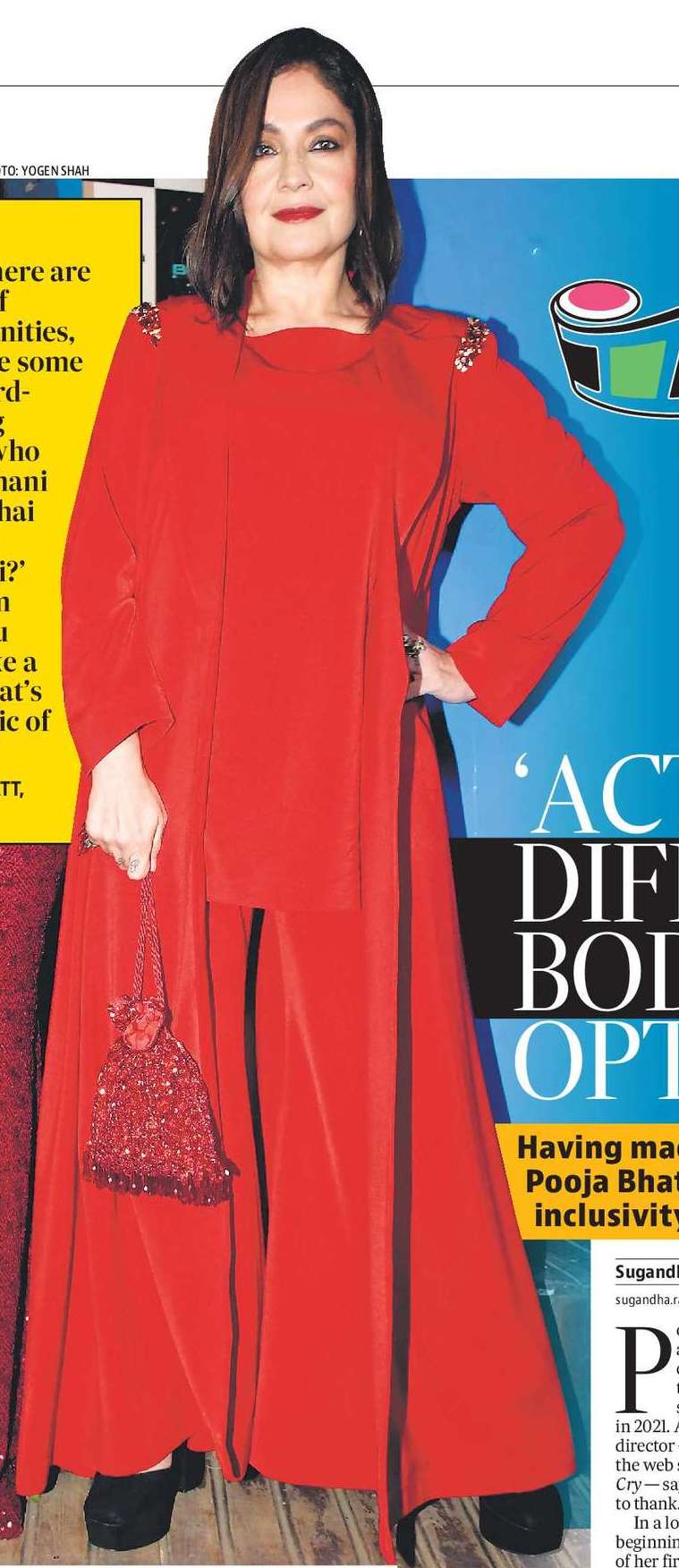
Having made her acting comeback with a web show, Pooja Bhatt hails the medium for its diversity and inclusivity, but fears star culture may change that
Sugandha Rawal Tagra (HINDUSTAN TIMES; April 13, 2024)
Pooja Bhatt’s return to acting after 21 years came on her own terms, with the web series Bombay Begums in 2021. And for that, the actor-director — recently seen in the web show Big Girls Don't Cry — says she has the medium to thank.
In a lot of ways, Pooja’s beginnings on OTT remind her of her first brush with acting 27 years ago. “My launch was through Daddy (1997), which my father (filmmaker Mahesh Bhatt) decided to release on Doordarshan. He was advised against it because TV was a bad word back then,” she recalls, adding, “But when it released, Daddy took me into people’s hearts and homes overnight because of its relevant theme. It proved the medium is not important, the story is. And that is what OTT also proves.”
Age no bar
Pooja — whose recent film Sanaa is doing the rounds of film festivals — made her digital debut with the layered character of Rani in Bombay Begums. Following this, she explored the non-fictional side of the space with the reality show, Bigg Boss OTT. Her most recent appearance, as the principal in Big Girls Don’t Cry, gave her another chance to portray a complex character.
Such diversity, she feels, can also be credited to OTT. The 52-year-old shares, “With the influx of streaming platforms, there are more roles for actors of different age groups, body types and backgrounds. Back in the day when I entered [showbiz], it was all about a hero, heroine, villain and hero’s friend. Those lines have blurred completely, which is wonderful.”
Giving her own example, she narrates, “I came back after 21 years and I got a character like Rani, which is close to my age. She is a woman who is dealing with menopause, marriage issues and love. She isn’t coloured with one brush.”
While she’s all praise for the freedom and opportunity that OTT provides, Pooja fears that star culture is taking over the space. “Many decision-makers are going back to old methods of casting [big] names before looking at the story. There are some backward-thinking people who ask, ‘Yeh kahani toh kaamal hai magar star kaun hai?’ And I am like, ‘Star se kya hota hai?’ You can make a star; that is the magic of OTT,” says the actor, whose next is also a web release.
Genelia Deshmukh, Arjun Rampal, Sudhir Mishra remember Nishikant Kamat, who married content with commerce
8:37 AM

Upala KBR, Uma Ramasubramanian (MID-DAY; August 18, 2020)
 The past 15 years have witnessed the resurgence of Marathi cinema. Among those leading from the front in the emergence of the new wave was filmmaker Nishikant Kamat. His directorial debut Dombivali Fast (2005) was a biting commentary on how the common man will rarely win against the corrupt system. Where it fetched him the National Award for Best Marathi Feature Film, the drama also compelled the Hindi movie industry to look at Marathi cinema — until then regarded as its poor cousin — as a treasure trove of powerful stories.
Interestingly, Kamat was at the centre of another milestone in Marathi cinema that occurred less than a decade later. His brainchild, Lai Bhaari (2014), which marked the Marathi debut of actor-producer Riteish Deshmukh, was a raging hit at the box-office. In rivalling the earnings of some Bollywood films that year, it redefined the commerce of regional cinema. Perhaps, Kamat had imbibed the importance of box-office figures from the Hindi film industry, having spent over six years in Bollywood by then.
 Genelia Deshmukh, who collaborated with the filmmaker on John Abraham-fronted Force (2011), remembers him as a "one-take director". "Nishi would walk you through the entire scene — discussing your expression, the mood of the scene and would ask you to relive an experience that comes closest to the sequence to be shot. Every scene would be preceded by a detailed chat because once he went on the floors, he would shoot the scene in one take. Most of my scenes in Force were filmed in a single take," she recounts.
Where he was analytical and sharp about the work at hand, Deshmukh says he was also deeply emotional. "During the Force shoot, I remember he broke down after we shot the scene where my character dies. He was the kind of person who was deeply invested in every character. Also, I have never seen a director who treated his crew so well. He would tell actors, 'Say what you want to me, but not to my bachchas.'"
While the mystery thriller Drishyam (2015) and Irrfan-fronted Madaari remain some of his best works, director Sudhir Mishra believes Mumbai Meri Jaan (2008) was perhaps his most underrated movie. "He was kind enough to involve me in the making of Mumbai Meri Jaan right from the beginning. I had seen the rough cut and it was easy to see that his outlook towards films was exceptional. He was one of the most underrated filmmakers; it may be because he didn't belong to any Bollywood camps, he did his job quietly."
When not giving instructions to actors, the director would frequently face the camera, playing menacing antagonists to Abraham in Rocky Handsome (2016) and Harshvardhan Kapoor in Bhavesh Joshi Superhero (2018). Arjun Rampal, who shared screen space with him in Daddy (2017), says Kamat enjoyed his stint in front of the camera as much as he did behind it. "During the shoot, he told us, 'I am just an actor here. Bolo, director saab, what do you want me to do?' And he did such a marvellous job in the film!" Rampal considers himself fortunate to be directed by Kamat in a few episodes of his web series, The Final Call. "Before every shot, we used to read out the scene several times over. He would always ask me how I would like to do a particular scene, and place his cameras accordingly."
His Best Works

Dombivali Fast (2005)
Telling the story of a middle-class bank employee whose existence is hinged on the frustration at the hands of law and lawmakers, the film walks us through the systematic breakdown of his mental state and how it turns him into a vigilante.
Evano Oruvan (2007)
Kamat adapted his critically acclaimed Dombivali Fast in Tamil with R Madhavan in the lead, thus proving that powerful stories have a universal appeal.
Mumbai Meri Jaan (2008)
Starring Madhavan, Soha Ali Khan and Irrrfan among others, Mumbai Meri Jaan skillfully took the audience through the aftermath of the 2006 serial bomb blasts in Mumbai.

Force (2011)
The John Abraham and Vidyut Jammwal-starrer is one of the first slick actioners that kickstarted an entire genre of such movies. A remake of Gautham Menon's Kakha Kakha, the film is a revenge saga between a cop and a dreaded gangster.
Lai Bhaari (2014)
Marking Riteish Deshmukh's debut in Marathi films, Lai Bhaari was a runaway hit and changed the face of commerce in regional cinema.
Drishyam (2015)
A remake of a Malayalam film, the Ajay Devgn-starrer is the unofficial adaptation of Kiego Higashino's popular novel.
Madaari (2016)
Starring Irrfan who played a vigilante in the film, Kamat narrated a fictional tale which is inspired by the collapse of the Mumbai metro bridge in 2012.

Obstacles do not bother me. I emerge stronger-Pooja Bhatt
8:22 AM

Pooja Bhatt on her web movie Cabaret finally seeing the light of the day, why the film did not get a theatrical release, and on reuniting with dad Mahesh Bhatt for Sadak 2
Shaheen Parkar (MID-DAY; January 13, 2019)
Like filmmaker father Mahesh Bhatt, Pooja Bhatt minces no words in stating her opinions. She is an interviewer's delight. You don't need to ask too much. The actor-turned-filmmaker knows exactly what you are looking for. She's witty, entertaining and articulate. Right now, she feels akin to a mother who has just delivered a baby. Her production, Cabaret, which was stuck for over two years finally released on Zee5 on January 9. "All this while I was like a single mother, taking care of the project, I finally found a partner [the digital medium] with whom I can share my joy," she laughs.
About 14 years ago, Bhatt had announced Cabaret with Mallika Sherawat, who at that time, was her dad's protégé. This was after Sherawat had tasted stardom with Murder (2004). The project did not roll. But Bhatt is quick to point out that this Cabaret is different. "It is the writer-director Kaustav Narayan Niyogi's vision. Initially, I had thought of going along with my script, but he reworked it and made it his own. It's his debut and he, too, had to patiently wait for the film to release. The other day, he was driving past Juhu beach and saw a hoarding of Cabaret. He stopped the car and called me. There was a long pause, but we had said so much in those unspoken moments. We are relieved and hope to celebrate soon with the cast and crew."
Cabaret stars Richa Chadha, Gulshan Devaiah and cricketer S Sreesanth. "Richa has charted her own path, Sreesanth is still in the after-glow of Bigg Boss and Gulshan will find his way. The timing of Cabaret's release could not be better for me. Guess it was destined to release now."
Bhatt explains what went wrong. "Cabaret was complete and ready for release. Every film is allotted a budget for production and marketing. Budgets are written in stone. We live in a time where marketing is an important part of filmmaking. Whenever I make a film, I ensure that we don't lose money or that nobody wants to see it. Just before the release of the film, the producers [T-Series and Wave Film] slashed the promotion budget. The promos were on air and the buzz had been created. I had to take a painful decision: Whether to go ahead with the release with the truncated amount or pull the plug. I chose the latter. It was a tough decision but had to be taken."
The digital world is a whole new medium. "I may be an old school filmmaker and actor but I have got the maverick streak from dad. He made films like Daddy (1989) and Janam (1985) for Doordarshan, these were the days when no new film would release on the small screen. Filmmakers felt he was crazy to do it, but now, three decades later, films are being made specially for the small screen."
Bhatt says she is used to battling roadblocks. "Filmmaking involves a lot of people and there are differences. Obstacles do not bother me. I emerge stronger. It is a learning experience. At the end, all is well that ends well. I only need to head to my farmhouse in Kalote, a two-hour drive from Mumbai and I am recharged. It is another planet where I spend time with my dogs and get recharged to face new challenges."

'It's homecoming for all of us'
Pooja Bhatt begins work on her next, Sadak 2, in April. The romantic thriller is a sequel to her father's 1991 film, which starred Sanjay Dutt and her. The film is also remembered for the late Sadashiv Amrapurkar's performance as the villain, Maharani. Sadak 2 marks Bhatt senior's return to direction after a hiatus. It is also the first time Pooja is teaming up with sister Alia.
"It's homecoming for all of us. I am acting after ages. My last film as an actor was Everybody Says I'm Fine in 2001. I am working with my dad after long and so is Alia. I am reuniting with Sanju after ages. So, there will be a lot of bonhomie on the set." She also terms it as payback time for dad from whom she has learnt the craft. "I will be working in front as well as behind the camera. It is a matter of pride for me as I have never assisted him. We plan to roll in April."
Pooja also accompanied her dad for the location hunt in Uttarakhand. "We have already begun work on the music, it is heartwrenching. Aditya Roy Kapur is already on board. We will soon cast the rest."

Alcoholism sirf mard ki jaagir nahi hai, women battle with it too-Pooja Bhatt
9:00 AM

Mahesh and Pooja Bhatt speak about why their film Daddy is relevant in modern India, and why it needs a female interpretation
Jaspreet Nijher (BOMBAY TIMES; May 9, 2018)
Filmmaker Mahesh Bhatt and his daughter Pooja Bhatt are known to speak their mind. Recently, before the staging of the theatrical adaptation of their film, Daddy, in Chandigarh, they spoke to us about the relevance of this 1989 film today, and their own battle with alcoholism. Pooja, who made her Bollywood debut with Daddy, is keen on re-narrating the story, albeit from a female perspective. In a conversation, the duo spoke to us in characteristic Bhatt style — unrestrained and effusive.
Why the need to reinterpret the film Daddy into a play?
Mahesh: At a time like this when there is all-pervasive darkness, when your leaders boast of connecting every village and city with electricity, there is an inner darkness, which you can’t look away from. At this time, it is pertinent to reopen Daddy, which was based on human evolution. The idea of these adaptations, for both films Daddy and Arth, came from this bright theatre actor Imran Zahid whom I met in Delhi more than a decade ago. To get out of Mumbai and come to Delhi, to meet these uncontaminated, clean youth with a fresh naivety, touched me so much that I agreed to their idea. To see the film from their perspective, but not from a patronising view, is also difficult without the need to interfere.
How much of yourself from the film do you see in the play?
Mahesh: I am not obsessed with my imaginary greatness. I am a fumbling, stumbling human, and the film deals with the most vulnerable, fragile phases of my life, when I had almost come to the brink of the abyss. But I looked the darkness in the eye, and pulled myself back, and I am still here. The human heart is as old as life itself, and hence the struggles shown in the film are still very relevant for the human race, and this narrative of man oscillating between dread and hope.
Pooja, how much of the play reflects your subjective emotions from the film?
It is ironic. I keep telling my siblings I have an edge, for you have only seen the flight of Mahesh Bhatt, I have seen him in the gutters. I have seen him pick himself up from that gutter and return to life. And the irony of that reality was, the girl who picks up her father from the dumps, and weans him off alcohol had to herself struggle with it many years later. So, life comes back a full circle. Alcoholism mard ki jaagir nahi hai. Men can turn to alcohol and tom-tom about it, but no one expects women to have a problem, especially if they are in the public eye. If I didn’t have the same blood and genes in me as my father’s, I wouldn’t have been able to pull myself out. We call ourselves role models, but roles models aren’t people who look pretty at all times. They are someone who show people they are as human as others, they have the same frailties where they fall and pick themselves up then, and share it with the world.
So, we are referring to the same genes that make you as unrestrained in speech as Bhatt saab?
Oh, that is a genetic flaw! All four of us siblings have the same core, even if we have different perspectives. My father gave me the inheritance of a quote from Swami Vivekananda, ‘Be truthful and be fearless’. How many of us actually live the things we retweet on Twitter, and walk our talk by sharing our weaknesses with the world? It’s been many months since I’ve been sober now. But people don’t want me to talk about it. I didn’t drink hiding inside, so I will not recover in the closet. We have to take away this word shame from our supposed frailties- from rape, domestic abuse, alcoholism. I drank like I lived — copiously and fully, and I will recover like that.
You ever felt the need to take your subjective battle to your films?
Yes, in fact I am in talks over it. We have seen a Sharaabi with Amitabh Bachchan, a Daddy with Anupam Kher, but where is the female perspective? So, I have been promised that I will be given a script with a woman protagonist dealing with alcohol. With women, this problem runs even deeper. We conceal our drinking because we don’t drink with our husbands and parents. And the pressure is even more because we compete with men, we are body shamed and morally lectured.
Raajneeti taught me how to stand in front of the audience and address them right-Arjun Rampal
5:33 AM

As told to Natasha Coutinho (MUMBAI MIRROR; February 19, 2018)
I’ve always wanted to play the guitar but never got down to learning it till I signed Rock On!! The director, Abhishek Kapoor, was very clear that all of us who were part of the rock band Magik had to get close to the instruments we were playing. For Purab Kohli it was the drums, for Luke Kenny the keyboard and for Farhan (Akhtar) and me it was the guitar. I took a lot of classes, around three-four hours of practice every day.
And that wasn’t all. I was also required to watch a lot of videos so the guitar would seem like an extension of me. I remember I saw a lot of Steve Vai videos and also bought a Steve Vai guitar of my own, one that I was comfortable playing. We had to make my character, Joseph Mascarenhas, look like one of the boys from the by-lanes of Bandra, with a guitar strung on his back and I think I eventually pulled Joe off on screen because the performance bagged me the National Award for Best Supporting Actor and also the Filmfare Black Lady.
 Another character that I could really dive into was Prithvi from
Raajneeti. He was a politician and the film’s director, Prakash Jha,
described him as a “caged tiger”, underlining the fact that he wanted
Prithvi to move in a particular way, with arrogance and aristocracy
since he came from a second or maybe it was third generation of a family
of politicians. I researched history of certain political families to
figure out how these guys dressed, their gait and the confidence with
which they spoke. At the same time, Prithvi was also a people’s person
so he had to be out there. Usually I’m more comfortable in a space where
I don’t have to overact but this character couldn’t be subtle and
underplayed. I had to make him loud without being a caricature.
Another character that I could really dive into was Prithvi from
Raajneeti. He was a politician and the film’s director, Prakash Jha,
described him as a “caged tiger”, underlining the fact that he wanted
Prithvi to move in a particular way, with arrogance and aristocracy
since he came from a second or maybe it was third generation of a family
of politicians. I researched history of certain political families to
figure out how these guys dressed, their gait and the confidence with
which they spoke. At the same time, Prithvi was also a people’s person
so he had to be out there. Usually I’m more comfortable in a space where
I don’t have to overact but this character couldn’t be subtle and
underplayed. I had to make him loud without being a caricature.When it came to his look, all the ideas came from Prakash Jha. He always wanted me to wear a stole and I was petrified because the last time I had carried one was on the ramp, during my modelling days and I was hoping that wouldn’t become an impediment. I realized later that the way the stole was draped made the character larger-than-life. My one input was to wear sneakers with kurta-pajama. I had observed that all politicians wear sneakers when they go campaigning because of the amount of walking they need to do. But the one thing that Raajneeti really taught me was how to stand in front of the audience and address them right. Actors also have to learn and deliver lines but a speech is something else. You know why politicians take long pauses between lines? It’s because they are waiting for the echo of loudspeakers and the noise of applause to die down before moving on.
 For Ashim Ahluwalia’s Daddy it was a different challenge. Since this
time I was playing a real-life character (Arun Gawli), I had to be as
close to him as possible. It was difficult because I didn’t get to spend
too much time with Mr Gawli as he is serving a jail sentence. Whenever
he came out, I would meet him and observe him like a hawk. I had about
three meetings with him but watched a lot of footage to learn his body
language and mannerisms. I also used prosthetic to look like him. We
flew down an amazing makeup team from Italy who worked with me for weeks
before we went on floors to get the look absolutely right. I also had
to lose a lot of weight, look smaller, because Mr Gawli isn’t very tall
while I am. So I had to shrink my body by stooping and hunching. But the
most important prep was getting the language right.
For Ashim Ahluwalia’s Daddy it was a different challenge. Since this
time I was playing a real-life character (Arun Gawli), I had to be as
close to him as possible. It was difficult because I didn’t get to spend
too much time with Mr Gawli as he is serving a jail sentence. Whenever
he came out, I would meet him and observe him like a hawk. I had about
three meetings with him but watched a lot of footage to learn his body
language and mannerisms. I also used prosthetic to look like him. We
flew down an amazing makeup team from Italy who worked with me for weeks
before we went on floors to get the look absolutely right. I also had
to lose a lot of weight, look smaller, because Mr Gawli isn’t very tall
while I am. So I had to shrink my body by stooping and hunching. But the
most important prep was getting the language right.I had studied Marathi at my school in Deolali since standard eight so I was familiar with it and only had to brush up on it by reading a lot of Marathi, and listening to people speak so I would get the words and accent right. Since it was a Hindi film at the end of the day I didn’t have to speak the language fluently, it was making it sound colloquial that was the real challenge.
I have nothing against romcoms as long as they are driven by the leading lady-Arjun Rampal
7:49 AM

Lasyapriya Sundaram (BOMBAY TIMES; January 6, 2018)
While the general perception is that most romantic comedies are hero-centric, Arjun Rampal stresses on the fact that it’s the leading lady who should take charge as opposed to her male counterpart in films of this genre. His belief can’t be misplaced as the actor, who won critical acclaim for his turn as Arun Gawli in last year’s hard-hitting and gritty gangster saga, Daddy, is thinking of producing a romcom next. Even as he admits that he’s drawn to stories rooted in reality, Arjun seems to have decided to change tracks for his next. He says, “It’s an interesting story — a love tale that revolves around different generations of people. I’m only thinking of producing it; I don’t think I will be acting in it. The film will require a good and experienced actress.”
Given his undoubtedly good looks and acting chops to boot, Arjun would make for the ideal leading man in a romcom. So, why doesn’t he want to act in the film? He promptly replies, “I have nothing against romantic comedies as long as they are driven by the leading lady.”
Meanwhile, the actor-producer seems undeterred by Daddy not drawing in the crowds at the cinemas, even though he had hoped that it would. “We got good reviews. It is a unique film and I am proud to be associated with it as a producer and an actor. The film is getting nominations in all departments of filmmaking. We went out to do something with integrity and it’s been appreciated,” says Arjun. Admitting that he was disappointed that the movie didn’t do well outside Maharashtra, he sums it up, saying, “People didn’t go into the theatres to watch the film in the North and the South. Perhaps, they didn’t connect with the character. As a producer, it was disappointing that the film didn’t get the box office going, though it was good. But you live and learn.”
The Gawli family sat together to see Daddy & they got very emotional-Arjun Rampal
7:45 AM

Harshada Rege (DNA; September 15, 2017)
While the promotions for Daddy are pretty much over, Arjun Rampal is still busy with the movie. The actor recently travelled to Norway for the screening of the film at the Norway Film Festival. “We were the closing film for the festival,” he says. The biopic that saw Arjun taking on the role of a producer saw him juggling multiple responsibilities. But the actor seems very pleased with the end result. Here, he speaks about his vision for the movie and his changed outlook towards success and failure...
Are you happy with the movie’s business?
It’s got an overwhelming response in Maharashtra. I am very happy. Everyone who has seen it has really liked it. We were quite aware that the film is for the people here. And though it has a local flavour, it is also a human story, about a man. When it’s a human subject, things like religion or the state that he comes from don’t matter. We have made the film with that thought. Now, we hope it reaches out further slowly and steadily.
You had emphasized on the importance of controlling the budget, how has that helped with the returns?
We are pretty much safe. We got a good deal with Amazon as well as satellite telecast. It’s important to keep in mind that when you know that you are making a film on a character, who comes from Maharashtra, the film will be doing its major business here. Almost 60 to 70 per cent of the contribution of the film has come from Maharashtra. These kind of films are not very popular in the North and Delhi. But there also, it’s not that bad. It has only shown growth.
Do you look at scripts differently now that you are a producer too?
I have always looked at scripts as stories that have to be told. Every film will find its audience. Sometimes it finds it immediately, sometimes it takes time for it to grow and find it, but it will happen. A film is going to be there forever, so it’s important to choose the right subject. It has to be a subject that you can be proud of, which will contribute towards cinema.
Arun Gawli was expected to be out on parole, but that didn’t happen. Were you disappointed that he couldn’t see the film?
More than me, I think it was disappointing for the family that he couldn’t be here. The film is not going anywhere, he will watch it whenever he comes out.
Did they like the biopic?
They were super thrilled. We were happy to see the response of the whole of Maharashtra. The family sat together — they have a large family — and they were very emotional after they saw it.
Considering it has such a local flavour, do you think it would be a viable project in Marathi?
To remake this in Marathi? And act in it? No. Maybe someone else can do it though.
After making Daddy, has your outlook towards success and failure changed?
When you make a film, you have to know that it will have a certain audience. Then you make the film according to that audience. You have to understand that this will be my main market, and if it grows beyond that then it’s a bonus. When we decided to make Daddy, we knew Maharashtra is going to be our main market and we have succeeded with that, whatever comes from the outside is a bonus. You definitely have to be aware of the subject that you are making. If I made Daddy into a Rs 60 or Rs 70 crore project thinking that it has to be pan-India, then yes, I would be making a mistake. But, yes, it’s very easy to go crazy. So, how and where you position your film becomes important. Then from there, it can grow. The kind of momentum that it has got in Maharashtra, you will see it growing in its second week, not only in this state but others too.
(Crisp) Movie Review: DADDY by FENIL SETA
10:56 AM

Daddy is based on the adventurous life of gangster-turned-politician Arun Gawli but fails to be an exciting or entertaining ride for the viewers. The beginning portions are great and the 80s era is well established. The ‘Zindagi Meri Dance’ track is so amazing and it’s so unfortunate that the song will never get its due and that it has been used in such a bad film. The film drops completely in the second half and fails to excite. Also, it looks so long, despite being just 135 minutes long. Arjun Rampal however is terrific and this is surely one of his best works. Nishikant Kamat is fine and has a crucial part in the film. Other actors who leave a mark are Aishwarya Rajesh, Rajesh Shringapure, Anand Ingle and Raj Arun. Farhan Akhtar as Dawood (but as expected his real name is not taken) is quite nice in a supporting role. All in all, a great disappointment!
My rating - ** out of 5!
Fenil's Bollywood Talk # 481
9:35 AM

PERIOD OF SMALL, NOT-SO-EXCITING FILMS BEGINS!
After the release of the biggie Baadshaho last week, the upcoming few Fridays won’t be as exciting. Films with low buzz are going to release and try their luck. Tomorrow, two such films are about to release. My views:
DADDY: It is based on the dreaded ganster-cum-politician Arun Gawli and features Arjun Rampal in the lead role. It is directed by Ashim Ahluwalia, who earlier directed the festival film Miss Lovely. Initially, when the film was announced, there were apprehensions whether the film will be really worth it and whether Arjun is the right choice. But surprisingly, the trailers have been interesting. The film looks like a rich product and Arjun looks kickass! This has increased the buzz of the film but only to a small extent. Also, Arun Gawli is not that famous and is not known throughout the country. Only a section of Mumbaikars are aware about him. The opening of the film will be poor and if response is positive, it can grow but only till an extent.
POSTER BOYS: It is the remake of the Marathi film of the same name, produced by Shreyas Talpade. The Hindi version is not just directed by him but also features him as an actor along with Sunny and Bobby Deol. From the trailer, it looks like a nice, simple entertainer. Again, the buzz for the film is limited. Moreover, the film’s production values are poor and not something that would be fun to see in theatres. Poster Boys’s opening will be bad but better than Daddy. Regardless of whether it works in cinemas, it is bound to work on television.
WHICH FILM WOULD YOU LIKE TO SEE AND WHY? DO LET ME KNOW!
In the last five years, the industry has collapsed. Nobody has a formula-Ashim Ahluwalia & Arjun Rampal
8:08 AM

What happens when a Cannes-selectee and a Bollywood star collide? It’s a chemical reaction that breaks down what most thought was elementary in mainstream cinema
Anshul Chaturvedi and Aarushi Nigam (BOMBAY TIMES; September 7, 2017)
Ashim Ahluwalia, whose 2012
film Miss Lovely was an official selection at Cannes, still refuses to
call himself a part of the Indian film industry. Arjun Rampal, so far
the 'Mr Lovely' of Bollywood, tells him he's mainstream now whether he
likes it or not and to stop being a drama queen. What both agree on
is that their respective 'sides' had wondered if they'd 'sold out' or 'lost it' when they came together. And both refuse to put their film
Daddy in a box either. “It's a gangster film but not what you think that
means.“ “It's not a biopic, but it's definitely not a documentary“. “A
guy from Dagdi Chawl is going to enjoy it, so is a Korean-cinema buff“.
So what exactly is Daddy, the biopic-but-not-a-biopic on the Mumbai
gangster (and briefly, politician) Arun Gawli?
From Miss Lovely, five years ago, to Daddy now, can we finally call you a Bollywood filmmaker, Ashim?
Ashim: This word, I just don't get it. I know when I was making Miss Lovely, it was a thing I really hated because it was very difficult for me to make the kind of films I wanted to make. I think, for me, Daddy is no different from Miss Lovely, in the sense that I take complete ownership of the film. I don't feel like it's a studio movie, or a 'star' movie, which I wanted to do to break into the industry. The only aspect of 'Bollywood' here is the fact that the film is mounted on 'X' scale, and Arjun's an actor from the industry. But I think it breaks all expectations because for me, it's a very real film, and it's made in a way that's unlike anything else. I can't even compare it to any film that exists, including earlier films like Satya.
Arjun: It's a global film. It's not something we can slot as a typical gangster film, which we're used to. When you go into that genre, you have that typical treatment. The story arc is also more or less the same. Which is fair, all gangsters do have that arc, they all end up becoming Robin Hood, they become leaders of certain areas, they make their own rules. Even Gawli's like that. There is the rise of him, and then the fall. The rise and fall of a gangster is that.
Ashim, after being a critic of the mainstream industry, what made you say yes to this?
Ashim: When Miss Lovely was in Cannes, I'd have people ask me, 'so now are you ready for SRK, are you ready for this...', and I was like, dude, I don't get it. If I was, I would have done that 15 years ago. Why would I wait for so long? I clearly want to make a different kind of film. So I am very paranoid of the industry because of the relationship that directors have with it. Directors are very low in the food chain, let's be honest about it.
Lower than writers, even?
Ashim: Well, it's changing. Because the industry is collapsing, it's changing. Writers, directors...Other than the star, the music director, perhaps, then the choreographer comes in, then the action director, and then the director, somewhere near the bottom, somewhere near the spotboy, you know!
Arjun: (Laughs) That's so unfair!
Ashim: No, that's not unfair. I can name five that are not those guys - five. And if you're an intelligent director and you want to have control over the project, you don't put your head in this, right? You just don't. So I think Arjun knew that. And we'd shot a commercial together, we hit it off. I said, this guy wants to do something different, let me read the script that you've written. And I said, wait a minute, this guy's not written himself as a hero. He's written himself as a Gawli-like character, it's a very character-centric story. Because our screenplays are written around the persona of the star. The star plays 20 characters, and all of them you can't tell apart, because it's the star that dominates. Which is fine for a certain type of film. But this film needed him to be that guy. And I was excited that there was someone here who's not going to dominate it and say, let's put a song here, introduce an item number, or cast this supermodel as Asha Gawli.
Arjun, since you produced this film, you were able to do what you wanted to do?
Arjun: Absolutely! If I had sold out to a studio, the control would have gone. It's not a massive budget film, but it's also not an indie film. It's in the middle, but because of our expertise, it is a massive film. You see it in the scale, and in the detailing that Ashim brings to the canvas, it requires a tremendous amount of production support. To recreate that era takes a lot of effort. What I learnt from this film is that all the magic of a film lies purely in the detailing. And Ashim is a master of detail. You could be giving your best shot but he'd be looking at a cup behind your head in the frame somewhere!
This is your first sort of, experimental space...
Arjun: This is not an experiment at all, for me. The film has an audience that can only grow. I know that my audience is that guy in Dagdi Chawl, he has to enjoy the film, and he has to feel that his Daddy has been justified properly. That guy is your main audience, those are the people who gave us our stories. I want the cops to say, 'yes, these guys didn't mince words about something'. I want his rivals to say the same thing. I want every Mumbai guy to say, 'these characters are bang on' the guys who know the story. So it is not an experiment. It is an authentic gangster film, which is a genre I've grown up watching, and is one of the reasons I'm an actor. Seeing Brando, Al Pacino, or Amit ji in Agneepath - those were the performances that were etched in my mind at a young age and I always wanted to play one.
How is Arjun not a conventional producer?
Ashim: Because I said, let's do a biopic. Now, a biopic on Abraham Lincoln will always have his point of view, right? Here, you don't have Gawli's point of view, you have all the other people's points of view. So it's in the form of an investigation, and different people, depending on what their relation to him is, say either he is a great, wonderful, amazing guy, or he is a really dark and scary guy.
In a sense, aren't you making a documentary?
Arjun: No, but that's the whole challenge. How do you make a film that is authentic and you don't go down the propaganda route? Show all the facts, but also make it entertaining? You have to get sucked into it, you have feel what the characters are feeling. You have to feel the heaviness of the world they come from. But not a documentary. The entertainment comes from the masala in his life.
The regular accusation of making a gangster look glamorous, does that work? Because in Delhi, every third crime has a guy quoting a movie, saying I got inspired by this.
Arjun: I think there should just be a law for anybody who says a movie inspired me to do this, that you're going in for 10 years the minute you make that excuse. They shouldn't come after the industry and say you're ruining these people. That's not true. If you see our news channels, they show the goriest, most gruesome stuff all the time, uncensored. And films are censored left and right.
Ashim: The question is, is he aspirational? He is not! After watching this, you don't want to be Gawli.
Arjun: Even Gawli, it took us two-and-a-half years to convince him. It takes a lot for a man to give you those things. Somewhere he realised that this is what will make his story different from all the other guys whose stories have been made in pieces. And he was very brave to give us his story. And he also said, say it in a truthful way, and don't show me as a hero. When he saw the film also, he said, 'tumne mujhe dialoguebaazi diya hi nahi poori picture mein', and I said, 'aap karte ho kahan!' So he kind of understood that the message is, if you live in this world, this is what's going to happen to you.
If this is not a gangster film like people know it, not a Satya, or Gangs Of Wasseypur, or Raees or a Quentin Tarantino film, do you think the audience will consume what they are not used to seeing?
Arjun: But you also have a commercial actor here!
Ashim: But they are not consuming what they are used to seeing! That's why the industry is crashing. That's what people keep doing, keep giving them things they are used to seeing. 'Let's give them a gangster film where the guy wears Dolce and Gabana and walks in slow motion'. You don't want to see it again, you're done with that. The audience has actually grown up a lot, which is why we're in a position where we can make the film. We put the trailer out and we didn't expect the response we got nine million views.
During Miss Lovely, you'd said what the world thought of as Indian cinema wasn't totally representing what was coming out of India. Do you think that is still true?
Ashim: I think it has been a complete breakdown. In the last five years, the industry has collapsed. Nobody has a formula, the blueprint is gone. And for many people, it's nerve-racking. Because that blueprint was there for 50 years. You knew which star got you how much money at the box office. There was a way to calculate the entire returns on your film, based on who's the music director, how many songs and how many stars, who's the girl, etc. Now they can't, because it's just not working. It's not computing. So that's fantastic for me, fantastic for someone like Arjun who wants to do new stuff, fantastic for a lot of people in the industry who want to give it a new lease of life.
You and Arjun are still an unlikely combo...
Ashim: It's a crazy combination, totally crazy.
Arjun: There are a lot of similarities between us. Like he calls me his twin sometimes!
Ashim: An evil twin.
You two working together is essentially saying the whole system has broken down.
Ashim: It's true. In a weird way, this film is a sign of the current state of the industry. In fact, if the two of us can work together, make a film and give it this kind of release, and still not compromise on it, and say that I want people from Dagdi Chawl, I want somebody who loves Gawli, they can watch it. Yet a cinephile, who watches world cinema, who watches Korean gangster movies, is not like, 'boss what is this, why is this guy flying, why is he jumping?' They still respect the other audience.
From Miss Lovely, five years ago, to Daddy now, can we finally call you a Bollywood filmmaker, Ashim?
Ashim: This word, I just don't get it. I know when I was making Miss Lovely, it was a thing I really hated because it was very difficult for me to make the kind of films I wanted to make. I think, for me, Daddy is no different from Miss Lovely, in the sense that I take complete ownership of the film. I don't feel like it's a studio movie, or a 'star' movie, which I wanted to do to break into the industry. The only aspect of 'Bollywood' here is the fact that the film is mounted on 'X' scale, and Arjun's an actor from the industry. But I think it breaks all expectations because for me, it's a very real film, and it's made in a way that's unlike anything else. I can't even compare it to any film that exists, including earlier films like Satya.
Arjun: It's a global film. It's not something we can slot as a typical gangster film, which we're used to. When you go into that genre, you have that typical treatment. The story arc is also more or less the same. Which is fair, all gangsters do have that arc, they all end up becoming Robin Hood, they become leaders of certain areas, they make their own rules. Even Gawli's like that. There is the rise of him, and then the fall. The rise and fall of a gangster is that.
Ashim, after being a critic of the mainstream industry, what made you say yes to this?
Ashim: When Miss Lovely was in Cannes, I'd have people ask me, 'so now are you ready for SRK, are you ready for this...', and I was like, dude, I don't get it. If I was, I would have done that 15 years ago. Why would I wait for so long? I clearly want to make a different kind of film. So I am very paranoid of the industry because of the relationship that directors have with it. Directors are very low in the food chain, let's be honest about it.
Lower than writers, even?
Ashim: Well, it's changing. Because the industry is collapsing, it's changing. Writers, directors...Other than the star, the music director, perhaps, then the choreographer comes in, then the action director, and then the director, somewhere near the bottom, somewhere near the spotboy, you know!
Arjun: (Laughs) That's so unfair!
Ashim: No, that's not unfair. I can name five that are not those guys - five. And if you're an intelligent director and you want to have control over the project, you don't put your head in this, right? You just don't. So I think Arjun knew that. And we'd shot a commercial together, we hit it off. I said, this guy wants to do something different, let me read the script that you've written. And I said, wait a minute, this guy's not written himself as a hero. He's written himself as a Gawli-like character, it's a very character-centric story. Because our screenplays are written around the persona of the star. The star plays 20 characters, and all of them you can't tell apart, because it's the star that dominates. Which is fine for a certain type of film. But this film needed him to be that guy. And I was excited that there was someone here who's not going to dominate it and say, let's put a song here, introduce an item number, or cast this supermodel as Asha Gawli.
Arjun, since you produced this film, you were able to do what you wanted to do?
Arjun: Absolutely! If I had sold out to a studio, the control would have gone. It's not a massive budget film, but it's also not an indie film. It's in the middle, but because of our expertise, it is a massive film. You see it in the scale, and in the detailing that Ashim brings to the canvas, it requires a tremendous amount of production support. To recreate that era takes a lot of effort. What I learnt from this film is that all the magic of a film lies purely in the detailing. And Ashim is a master of detail. You could be giving your best shot but he'd be looking at a cup behind your head in the frame somewhere!
This is your first sort of, experimental space...
Arjun: This is not an experiment at all, for me. The film has an audience that can only grow. I know that my audience is that guy in Dagdi Chawl, he has to enjoy the film, and he has to feel that his Daddy has been justified properly. That guy is your main audience, those are the people who gave us our stories. I want the cops to say, 'yes, these guys didn't mince words about something'. I want his rivals to say the same thing. I want every Mumbai guy to say, 'these characters are bang on' the guys who know the story. So it is not an experiment. It is an authentic gangster film, which is a genre I've grown up watching, and is one of the reasons I'm an actor. Seeing Brando, Al Pacino, or Amit ji in Agneepath - those were the performances that were etched in my mind at a young age and I always wanted to play one.
How is Arjun not a conventional producer?
Ashim: Because I said, let's do a biopic. Now, a biopic on Abraham Lincoln will always have his point of view, right? Here, you don't have Gawli's point of view, you have all the other people's points of view. So it's in the form of an investigation, and different people, depending on what their relation to him is, say either he is a great, wonderful, amazing guy, or he is a really dark and scary guy.
In a sense, aren't you making a documentary?
Arjun: No, but that's the whole challenge. How do you make a film that is authentic and you don't go down the propaganda route? Show all the facts, but also make it entertaining? You have to get sucked into it, you have feel what the characters are feeling. You have to feel the heaviness of the world they come from. But not a documentary. The entertainment comes from the masala in his life.
The regular accusation of making a gangster look glamorous, does that work? Because in Delhi, every third crime has a guy quoting a movie, saying I got inspired by this.
Arjun: I think there should just be a law for anybody who says a movie inspired me to do this, that you're going in for 10 years the minute you make that excuse. They shouldn't come after the industry and say you're ruining these people. That's not true. If you see our news channels, they show the goriest, most gruesome stuff all the time, uncensored. And films are censored left and right.
Ashim: The question is, is he aspirational? He is not! After watching this, you don't want to be Gawli.
Arjun: Even Gawli, it took us two-and-a-half years to convince him. It takes a lot for a man to give you those things. Somewhere he realised that this is what will make his story different from all the other guys whose stories have been made in pieces. And he was very brave to give us his story. And he also said, say it in a truthful way, and don't show me as a hero. When he saw the film also, he said, 'tumne mujhe dialoguebaazi diya hi nahi poori picture mein', and I said, 'aap karte ho kahan!' So he kind of understood that the message is, if you live in this world, this is what's going to happen to you.
If this is not a gangster film like people know it, not a Satya, or Gangs Of Wasseypur, or Raees or a Quentin Tarantino film, do you think the audience will consume what they are not used to seeing?
Arjun: But you also have a commercial actor here!
Ashim: But they are not consuming what they are used to seeing! That's why the industry is crashing. That's what people keep doing, keep giving them things they are used to seeing. 'Let's give them a gangster film where the guy wears Dolce and Gabana and walks in slow motion'. You don't want to see it again, you're done with that. The audience has actually grown up a lot, which is why we're in a position where we can make the film. We put the trailer out and we didn't expect the response we got nine million views.
During Miss Lovely, you'd said what the world thought of as Indian cinema wasn't totally representing what was coming out of India. Do you think that is still true?
Ashim: I think it has been a complete breakdown. In the last five years, the industry has collapsed. Nobody has a formula, the blueprint is gone. And for many people, it's nerve-racking. Because that blueprint was there for 50 years. You knew which star got you how much money at the box office. There was a way to calculate the entire returns on your film, based on who's the music director, how many songs and how many stars, who's the girl, etc. Now they can't, because it's just not working. It's not computing. So that's fantastic for me, fantastic for someone like Arjun who wants to do new stuff, fantastic for a lot of people in the industry who want to give it a new lease of life.
You and Arjun are still an unlikely combo...
Ashim: It's a crazy combination, totally crazy.
Arjun: There are a lot of similarities between us. Like he calls me his twin sometimes!
Ashim: An evil twin.
You two working together is essentially saying the whole system has broken down.
Ashim: It's true. In a weird way, this film is a sign of the current state of the industry. In fact, if the two of us can work together, make a film and give it this kind of release, and still not compromise on it, and say that I want people from Dagdi Chawl, I want somebody who loves Gawli, they can watch it. Yet a cinephile, who watches world cinema, who watches Korean gangster movies, is not like, 'boss what is this, why is this guy flying, why is he jumping?' They still respect the other audience.

Fear is important. When I am scared, I know I am going to put my best foot forward-Arjun Rampal
7:58 AM

Lasyapriya Sundaram (BOMBAY TIMES; September 5, 2017)
In his career spanning 16
years, Arjun Rampal has not only won a National Award, but has also
consistently sought out roles that are performance-oriented. With Daddy,
the biopic on Arun Gawli in which he essays the tit
ular role and also dons the producer's hat, Arjun attempts
to tell a story without succumbing to the stereo
types of the quintessential Bollywood gangster saga. In a chat with BT,
the actor, who has comfortably essayed roles in
both commercial and contentdriven films, admits that he veers more
towards the latter. Excerpts...
 What drew you to a biopic on gangster-turned-politician Arun Gawli?
I love the genre of gangster films and movies made by directors like Brian De Palma and Martin Scorsese. The Godfather, Goodfellas and Scarface are some of my favourites because they have a certain energy. Gangster films are glamorous because somewhere, you know you shouldn't ape that in real life. It seems approachable and real, yet it's unreal. So, when you get an opportunity to portray a gangster in a real and true manner, you grab it. For me, there was no better subject than Arun Gawli. The film is not propagandist, but neither is it a documentary.
Eleven years ago, you produced a film, I See You. Did the fact that it didn't do well make you cautious? Is that the reason it took you almost a decade to try your hand at production again?
Well, after I See You, I was in ICU for a while (laughs). It may not have been a hit, but it didn't lose money either. I was young and it was my first brush with production, but Daddy is a different ball game altogether. It has taught me a lot about film production. Now, I can don every role. A producer's job is the most thankless. Everybody pounces on him for everything. He has to be like a saint to shoulder everybody's baggage. At the same time, it's a huge luxury to be able to make the films that you believe in.
Last year, you impressed the audience and critics as sub-inspector Inderjeet Singh in Kahaani 2: Durga Rani Singh. This year, you have taken on the mantle of playing a real-life don. These roles are in complete contrast to the ones you played at the beginning of your career. They were more on the lines of the quintessential Bollywood hero...
In the beginning of my career, I was doing films that were similar - triangular and rectangular love stories essentially (laughs). But at that point, you just want to just want to work, as you are still getting to know the industry. I was aware that I was going to make mistakes, but I didn't realise it while I was doing those films. But deep within, I was dissatisfied. So, I took a year-long break in 2005 and didn't sign any project. The first film I did the following year was Don. Farhan (Akhtar, director) was somebody I connected with instantly, as we were like-minded. Then I shot for a realistic film, The Last Lear, with Rituparno Ghosh in Kolkata before taking up the role in Farah Khan's Om Shanti Om, in which I played a 30-year-old guy with shades of grey. I had a lot fear in me when I was working with directors like Rituparno, Farhan and Farah. I was very conscious about getting into the character. Luckily, all those films gave me the opportunity to actually perform. During that phase, I realised that fear is important. When I am scared, I know that I am going to put my best foot forward. With Daddy, I was so petrified that I had sleepless nights. But, the excitement of putting something out there helps me overcome fear.
As an actor, do you prepare differently when you work with directors who come from diametrically opposite schools of thought like Farah Khan and Ashim Ahluwalia?
An actor should understand the director well. On the other hand, there's an innate actor within every director. Let me share an incident that happened while shooting with Farah. I had just wrapped up The Last Lear and was on the set of Om Shanti Om. The pitch and the projection of my dialogue delivery had to be a few notches higher than that in The Last Lear. I remember asking Farah, 'isn't this overacting?' She drew my attention to the fact that there was going to be background music and if I spoke like Marlon Brando, no one was going to hear me. Every filmmaker has a tempo or sur and an actor has to work in synergy with that.
Do you feel more satisfied with your roles in films like Daddy and The Last Lear compared with the ones you played in out-and-out commercial films?
The love and adulation you get for commercial films is huge. Being part of such movies also presented me with a lot of opportunities. Having said that, if I have to lean toward something, it would be the roles that are performance-oriented. They give you the opportunity to sink you teeth into the character and often, a part of that character remains with you for long.
So, is it difficult living the life of an actor considering the fact that a part of the character lingers on?
It's difficult for the people you are living with (laughs). During Raajneeti, nobody wanted to be around me. The role was very aggressive and I had become like that.
You said that today, you would choose a performance-oriented film over a commercial movie, though the latter brings you more love and adulation. But you must have done films just for the money at some point in your career...
Yes, you have to do films for money sometimes - either to buy a house or secure your family. Sometimes, you end up being a part of a film without your heart being in it. That's wrong. Yes, I have done films just for money, but I won't do that again. It's not fair on anybody.
Do you feel that you were typecast because of your good looks?
Being a good-looking actor has advantages as well as disadvantages. Some people might consider me only to play suave characters, but that stems from the limitations of the filmmakers who are not able to see me in different roles. So, all one can do is run away from people like that (laughs).
Do you also run away from the media scrutiny on your personal life? It gets especially hard when it involves your loved ones...
You have to learn to deal with it. People want to know about your personal life because you are a celebrity. While some people thrive on the negativity that exists in other people's lives, others focus on the positive side. It's a double-edged sword.
After having come so far and as someone with so much experience, how do you gauge success today? What does it mean to you now vis-à-vis when you started out?
Being successful means that you are able to create opportunities. You can't gauge it from a monetary perspective. To be in a good headspace when you are doing whatever it is that you are doing is success. Today, the fact that I can make the films I want to defines success to me.
While cinema has always been seen as a male-dominated industry, our society is strongly patriarchal as well. As the father of two young daughters, how do you strike a balance between being protective yet helping them grow into strong individuals?
I think it's important to be their friend and also teach them to be fearless. Children should be able to talk to their parents freely about anything and everything. Mehr (wife) and I give our daughters a lot of freedom. We encourage them and teach them to love themselves. Also, as parents, we try to be the people they can fall back on without any fear. Fear is what leads children to be dishonest.
I love the genre of gangster films and movies made by directors like Brian De Palma and Martin Scorsese. The Godfather, Goodfellas and Scarface are some of my favourites because they have a certain energy. Gangster films are glamorous because somewhere, you know you shouldn't ape that in real life. It seems approachable and real, yet it's unreal. So, when you get an opportunity to portray a gangster in a real and true manner, you grab it. For me, there was no better subject than Arun Gawli. The film is not propagandist, but neither is it a documentary.
Eleven years ago, you produced a film, I See You. Did the fact that it didn't do well make you cautious? Is that the reason it took you almost a decade to try your hand at production again?
Well, after I See You, I was in ICU for a while (laughs). It may not have been a hit, but it didn't lose money either. I was young and it was my first brush with production, but Daddy is a different ball game altogether. It has taught me a lot about film production. Now, I can don every role. A producer's job is the most thankless. Everybody pounces on him for everything. He has to be like a saint to shoulder everybody's baggage. At the same time, it's a huge luxury to be able to make the films that you believe in.
Last year, you impressed the audience and critics as sub-inspector Inderjeet Singh in Kahaani 2: Durga Rani Singh. This year, you have taken on the mantle of playing a real-life don. These roles are in complete contrast to the ones you played at the beginning of your career. They were more on the lines of the quintessential Bollywood hero...
In the beginning of my career, I was doing films that were similar - triangular and rectangular love stories essentially (laughs). But at that point, you just want to just want to work, as you are still getting to know the industry. I was aware that I was going to make mistakes, but I didn't realise it while I was doing those films. But deep within, I was dissatisfied. So, I took a year-long break in 2005 and didn't sign any project. The first film I did the following year was Don. Farhan (Akhtar, director) was somebody I connected with instantly, as we were like-minded. Then I shot for a realistic film, The Last Lear, with Rituparno Ghosh in Kolkata before taking up the role in Farah Khan's Om Shanti Om, in which I played a 30-year-old guy with shades of grey. I had a lot fear in me when I was working with directors like Rituparno, Farhan and Farah. I was very conscious about getting into the character. Luckily, all those films gave me the opportunity to actually perform. During that phase, I realised that fear is important. When I am scared, I know that I am going to put my best foot forward. With Daddy, I was so petrified that I had sleepless nights. But, the excitement of putting something out there helps me overcome fear.
As an actor, do you prepare differently when you work with directors who come from diametrically opposite schools of thought like Farah Khan and Ashim Ahluwalia?
An actor should understand the director well. On the other hand, there's an innate actor within every director. Let me share an incident that happened while shooting with Farah. I had just wrapped up The Last Lear and was on the set of Om Shanti Om. The pitch and the projection of my dialogue delivery had to be a few notches higher than that in The Last Lear. I remember asking Farah, 'isn't this overacting?' She drew my attention to the fact that there was going to be background music and if I spoke like Marlon Brando, no one was going to hear me. Every filmmaker has a tempo or sur and an actor has to work in synergy with that.
Do you feel more satisfied with your roles in films like Daddy and The Last Lear compared with the ones you played in out-and-out commercial films?
The love and adulation you get for commercial films is huge. Being part of such movies also presented me with a lot of opportunities. Having said that, if I have to lean toward something, it would be the roles that are performance-oriented. They give you the opportunity to sink you teeth into the character and often, a part of that character remains with you for long.
So, is it difficult living the life of an actor considering the fact that a part of the character lingers on?
It's difficult for the people you are living with (laughs). During Raajneeti, nobody wanted to be around me. The role was very aggressive and I had become like that.
You said that today, you would choose a performance-oriented film over a commercial movie, though the latter brings you more love and adulation. But you must have done films just for the money at some point in your career...
Yes, you have to do films for money sometimes - either to buy a house or secure your family. Sometimes, you end up being a part of a film without your heart being in it. That's wrong. Yes, I have done films just for money, but I won't do that again. It's not fair on anybody.
Do you feel that you were typecast because of your good looks?
Being a good-looking actor has advantages as well as disadvantages. Some people might consider me only to play suave characters, but that stems from the limitations of the filmmakers who are not able to see me in different roles. So, all one can do is run away from people like that (laughs).
Do you also run away from the media scrutiny on your personal life? It gets especially hard when it involves your loved ones...
You have to learn to deal with it. People want to know about your personal life because you are a celebrity. While some people thrive on the negativity that exists in other people's lives, others focus on the positive side. It's a double-edged sword.
After having come so far and as someone with so much experience, how do you gauge success today? What does it mean to you now vis-à-vis when you started out?
Being successful means that you are able to create opportunities. You can't gauge it from a monetary perspective. To be in a good headspace when you are doing whatever it is that you are doing is success. Today, the fact that I can make the films I want to defines success to me.
While cinema has always been seen as a male-dominated industry, our society is strongly patriarchal as well. As the father of two young daughters, how do you strike a balance between being protective yet helping them grow into strong individuals?
I think it's important to be their friend and also teach them to be fearless. Children should be able to talk to their parents freely about anything and everything. Mehr (wife) and I give our daughters a lot of freedom. We encourage them and teach them to love themselves. Also, as parents, we try to be the people they can fall back on without any fear. Fear is what leads children to be dishonest.

Daddy will be good homework for the audience who will see Haseena Parkar-Apoorva Lakhia
7:53 AM

Lasyapriya Sundaram (BOMBAY TIMES; September 5, 2017)
Bollywood has always had a
fascination for gangster movies and crime dramas in this genre seem to
be the flavour of the month. While Arun Gawli's life forms the basis of
the Arjun Rampal-starrer Daddy, the gangster-turned-politician's
character also plays an important role in Apoorva Lakhia's upcoming
underworld saga, Haseena Parkar, which stars Shraddha Kapoor in the
titular role.
Apoorva says, “The films are interrelated because Daddy kills Haseena's husband. It's a good thing because people will know more about Arun Gawli and his character. They will also be familiar with his role in the gang war between the dons before my film releases. I think that Daddy will be good homework for the audience who will see Haseena Parkar. I don't think Haseena's character is part of Daddy, but Arun Gawli is a part of my film.“
Earlier Apoorva had delved into the world of gangsters with Shootout At Lokhandwala (2007), which brought to life the story of the dreaded gangster Maya Dolas. Vivek Oberoi who essayed the character of the don on screen, played it with swag and in an attempt to add commercial elements, the outlaw was portrayed in a larger-than-life style. Ask Apoorva if he has glorified Haseena's character in the film and the director is quick to add, “My attempt as a director was to tell the story the way it is. When we were researching for the film, if we found instances that glorified her, we have put that across. If there were instances where she was crucified, then we have included that as well. In a biopic, one has to go with facts. Haseena's family is alive and I know them very well. So, not only do I have to do justice to her portrayal but the Indian justice system as well. It was important for us to show both sides of the coin.“
Elaborating further on Haseena, Apoorva adds, “She was like any other lower middle class girl in Nagpada or Dongri and was looking forward to a life with four kids. But once the gang war and enmity started, her husband was shot dead in broad daylight by Gawli's gang. The film examines how her brother's actions influenced her in either a positive or negative way.“
What's interesting to note is that, while Gawli was a gangster, for the inhabitants of Dagdi Chawl (where his family stays), he was their Daddy. Similarly, on one hand, Haseena was also referred to as a gangster but people whom she helped, referred to her as their Godmother.

Apoorva says, “The films are interrelated because Daddy kills Haseena's husband. It's a good thing because people will know more about Arun Gawli and his character. They will also be familiar with his role in the gang war between the dons before my film releases. I think that Daddy will be good homework for the audience who will see Haseena Parkar. I don't think Haseena's character is part of Daddy, but Arun Gawli is a part of my film.“
Earlier Apoorva had delved into the world of gangsters with Shootout At Lokhandwala (2007), which brought to life the story of the dreaded gangster Maya Dolas. Vivek Oberoi who essayed the character of the don on screen, played it with swag and in an attempt to add commercial elements, the outlaw was portrayed in a larger-than-life style. Ask Apoorva if he has glorified Haseena's character in the film and the director is quick to add, “My attempt as a director was to tell the story the way it is. When we were researching for the film, if we found instances that glorified her, we have put that across. If there were instances where she was crucified, then we have included that as well. In a biopic, one has to go with facts. Haseena's family is alive and I know them very well. So, not only do I have to do justice to her portrayal but the Indian justice system as well. It was important for us to show both sides of the coin.“
Elaborating further on Haseena, Apoorva adds, “She was like any other lower middle class girl in Nagpada or Dongri and was looking forward to a life with four kids. But once the gang war and enmity started, her husband was shot dead in broad daylight by Gawli's gang. The film examines how her brother's actions influenced her in either a positive or negative way.“
What's interesting to note is that, while Gawli was a gangster, for the inhabitants of Dagdi Chawl (where his family stays), he was their Daddy. Similarly, on one hand, Haseena was also referred to as a gangster but people whom she helped, referred to her as their Godmother.
Raees, Daddy: What makes gangster films so appealing to our filmmakers?
8:11 AM

Dhaval Roy (DNA; September 2, 2017)
With the release of the political crime drama Daddy, once again the underbelly of society finds space on the big screen. Daddy is the biopic of the gangster-turned-politician Arun Gawli, starring Arjun Rampal in the titular role. Bollywood has, over the decades, seen many such films like Parinda (1989), Agneepath (1990), Satya (1998), Vaastav (1999), Company (2002), Sarkar (2005), to more recently Once Upon a Time in Mumbaai (2010), its sequel, and Raees (2017). The bedraggled underworld has consistently found favour with filmmakers and audiences alike. A peek into the world of grime and crime, and why gangster films are so popular.
Mumbai mafia
As much as the person, it’s the story behind him that’s interesting for the filmmakers. Especially real life stories. For director Milan Luthria, Once Upon A Time in Mumbaai and its sequel Once Upon A Time In Mumbai Dobaara were not just supposedly based on Haji Mastan and Dawood Ibrahim, they were also about how the gangsters entered the world of crime. Milan says he found it interesting “They used the sea to their advantage and how smuggling began, about protection, extortion, gambling, and bootlegging.” Rahul Dholakia, who directed Raees, wanted to make something on prohibition and therefore the film happened. The underbelly has always been an integral part of Mumbai and it has always inspired writers and makers. “People want to know the behind-the-scenes and the stories of this side of the city,” says Madhur Bhandarkar, whose National Award-winning film, Chandni Bar dealt with gangsters, too along with bar girls.
Badass is good
The authority these gangsters exude makes them captivating for filmmakers and audiences alike. “Whether it’s Godfather, Untouchables, or Indian films, gangsters have always been fascinating because of their power and romanticism,” Rahul says. Milan adds, “There’s something about being bad that everyone likes. The risk they are willing to take, and the unexpected things they do are appealing.”
Normal is boring
Through every underworld era that we have lived, says Rahul, the gangsters have been formidable personalities. “Gangsters have seemed larger-than-life, very giving, and at the same time, ruthless. They have always been mysterious and hence fascinating.”
Rags to riches
Not just in films, mobsters always have big cars, moolah, glamorous girls and guns. No wonder, the anti-hero is as popular as the hero. Milan says, “The viewer sees these characters as powerful, charismatic, surrounded by hot women and having a lavish lifestyle.” They are sort of a role model because they live life on the edge. Most gangster films are about an underdog reaching the top by any means possible. “Everyone loves a ‘rags to riches’ story. For that matter, even dacoit stories have been successful,” Milan adds. Just like Gawli became a local Robin Hood from a humble background.
Glorifying criminals?
While more and more top actors like Shah Rukh Khan, Sanjay Dutt or Ajay Devgn have played gangsters in films, and now Arjun Rampal in Daddy, these films don’t glorify the baddies. Milan argues, “A filmmaker is not socially committed to doing everything right but to making a good movie.” Rahul adds, “When we made Raees, we made a conscious effort not to glorify the gangster. In the end, he does die at the hands of the cop.” Daddy director Ashim Ahluwalia has gone on record to say that they are not white washing Gawli’s character in the film.
South industry people are obsessed with fair skin; Bollywood is obsessed with skinny women-Aishwarya Rajesh
7:53 AM

Tanvi Trivedi (BOMBAY TIMES; September 2, 2017)
Aishwarya Rajesh is all set
to make her Bollywood debut with the Arjun Rampal-starrer Daddy. The
Tamil actress, who won accolades for her performance in National
Award-winning drama Kaaka Muttai, opens up about entering B-Town, her
meeting with Arun Gawli's wife Asha (who she plays on screen) and the
colour bias down South. Excerpts...
Why did you choose a gangster biopic to make your Bollywood debut?
In South too, I got recognized for my work in offbeat films. I prefer performance-oriented roles to just being a glamour girl. So, Daddy is the kind of film I wanted to make my Bollywood debut with.
So, how did you land the role of Asha Gawli?
They had a completely different cast in mind before they started shooting for the film. But as luck would have it, one of the ADs saw Kaaka Muttai and told Arjun (Rampal) about my performance in the film. Arjun then called up to ask if I could speak Hindi and I replied in the negative. Though Arjun dropped the idea of casting me, the AD sent me a small script and asked me to audition for the role. After my audition, Arjun called to say that he wanted me in the film.
What is the kind of preparation that went into playing Asha Gawli?
Honestly, I had no idea about Arun Gawli or his wife before I was offered the film. But later, I started doing research on her. When Ashim Ahluwalia (director) showed me her pictures, I realised that Asha Gawli is even more powerful than her husband. People were more scared of her than Arun Gawli. I met Gawli's daughters and they felt that I looked perfect for the role. My character arc spans about 40 years in the film, so I've used prosthetic make-up. Also, after working with Arjun, I feel more confident about speaking in Hindi.
Did you get a chance to meet the real Asha Gawli?
I was in for a surprise when I met her, as I was told that she was quite reserved. However, I found her to be quite sophisticated. When I asked her about my performance, she said, 'It was fine. You looked good'.
Do you feel that gangster biopics end up glorifying the gangsters?
We fail to understand that these gangsters have a human side, too. If Arun Gawli is called 'Daddy', there must be a reason for it. The film is all about exploring the individual and his journey rather than glorifying it.
You started your career as a TV anchor before moving on to films. Was TV a stepping stone into movies?
It's not easy to become an actress. When I participated in reality shows, people told me that I could never become an actress. They told me that I am dusky and do not have what it takes to be an actress. In South, people are very obsessed with fair skin. The hero can be dark, but actresses have to be fair-skinned. I did many small-budget films after my TV stint and they all flopped. People were not ready to accept me. It's only after Kaaka Muttai that people started appreciating me.
Do you feel that the situation is different in Bollywood?
People like dusky women in Bollywood, but there is another obsession that is prevalent here - skinny women. You have to be a size-zero to be in Hindi films. I never want to be a size zero and I can't be one as I can't stop eating. Also, you don't get too many opportunities in Bollywood, if you don't come from a film background. Or else, you will have to be an outstanding performer like Kangana Ranaut.
You share your name with another Bollywood actress (Aishwarya Rai Bachchan)...
Yes, I did think of changing my name because of that. Initially, I felt that I will never be remembered as I share my name with someone so beautiful and talented. But now I have given up on the idea.
Why did you choose a gangster biopic to make your Bollywood debut?
In South too, I got recognized for my work in offbeat films. I prefer performance-oriented roles to just being a glamour girl. So, Daddy is the kind of film I wanted to make my Bollywood debut with.
So, how did you land the role of Asha Gawli?
They had a completely different cast in mind before they started shooting for the film. But as luck would have it, one of the ADs saw Kaaka Muttai and told Arjun (Rampal) about my performance in the film. Arjun then called up to ask if I could speak Hindi and I replied in the negative. Though Arjun dropped the idea of casting me, the AD sent me a small script and asked me to audition for the role. After my audition, Arjun called to say that he wanted me in the film.
What is the kind of preparation that went into playing Asha Gawli?
Honestly, I had no idea about Arun Gawli or his wife before I was offered the film. But later, I started doing research on her. When Ashim Ahluwalia (director) showed me her pictures, I realised that Asha Gawli is even more powerful than her husband. People were more scared of her than Arun Gawli. I met Gawli's daughters and they felt that I looked perfect for the role. My character arc spans about 40 years in the film, so I've used prosthetic make-up. Also, after working with Arjun, I feel more confident about speaking in Hindi.
Did you get a chance to meet the real Asha Gawli?
I was in for a surprise when I met her, as I was told that she was quite reserved. However, I found her to be quite sophisticated. When I asked her about my performance, she said, 'It was fine. You looked good'.
Do you feel that gangster biopics end up glorifying the gangsters?
We fail to understand that these gangsters have a human side, too. If Arun Gawli is called 'Daddy', there must be a reason for it. The film is all about exploring the individual and his journey rather than glorifying it.
You started your career as a TV anchor before moving on to films. Was TV a stepping stone into movies?
It's not easy to become an actress. When I participated in reality shows, people told me that I could never become an actress. They told me that I am dusky and do not have what it takes to be an actress. In South, people are very obsessed with fair skin. The hero can be dark, but actresses have to be fair-skinned. I did many small-budget films after my TV stint and they all flopped. People were not ready to accept me. It's only after Kaaka Muttai that people started appreciating me.
Do you feel that the situation is different in Bollywood?
People like dusky women in Bollywood, but there is another obsession that is prevalent here - skinny women. You have to be a size-zero to be in Hindi films. I never want to be a size zero and I can't be one as I can't stop eating. Also, you don't get too many opportunities in Bollywood, if you don't come from a film background. Or else, you will have to be an outstanding performer like Kangana Ranaut.
You share your name with another Bollywood actress (Aishwarya Rai Bachchan)...
Yes, I did think of changing my name because of that. Initially, I felt that I will never be remembered as I share my name with someone so beautiful and talented. But now I have given up on the idea.

Arjun Rampal opts for ‘A’ certificate for Daddy
3:00 PM

Subhash K Jha (DNA; September 1, 2017)
Arjun Rampal’s portrayal of alleged gangster Arun Gawli has impressed the censor board enough to grant the film an all-clear with an ‘Adults’ certificate. Only three cuts referencing political figures have been ordered.
Arjun says he’s very happy with the Central Board of Film Certification’s (CBFC) decision. “I’d have been genuinely surprised if our film was not given an ‘A’. The film is about a personality, who shared an ambivalent relationship with the law, so, yes, it is a film for adults.” Interestingly, CBFC members offered Arjun a chance to tone down his film or keep it the way it is. “I was given the choice of an ‘A’ and a ‘U/A’ with several cuts. But the cuts would have taken away from the raw and real feel of the film. So, I was advised against it by the CBFC members. As for the three verbal cuts, they make no difference to my film.”
Arjun Rampal's efforts in vain, Arun Gawli to miss Daddy premiere in Mumbai
2:47 PM

After Arjun Rampal changes release date of the gangster's biopic to match his annual Ganesh Chaturthi parole, district magistrate denies Daddy discharge
Mohar Basu (MID-DAY; September 1, 2017)
Arjun Rampal starrer Daddy, based on the life of Arun Gawli, has grabbed eyeballs owing to the former's uncanny resemblance to the gangster-politician. As the Ashim Ahluwalia-directed biopic gears up for release on September 8, the makers had a special plan for the premiere. Knowing that the film holds a special place in Gawli's heart, they wanted the gangster to attend the film's premiere. Turns out, upon his daughter Geeta Gawli's request, the makers pushed the release date from July 21 to September 8 so that Gawli could be present at the premiere.
However, if murmurs are anything to go by, Gawli has been denied parole by the district magistrate. A source informed, "He had asked for his annual parole for Ganpati festivities. He had hoped to watch the film along with his family during this time. But, the authorities are uncomfortable with the idea of granting him parole at such a time."
Apparently, the authorities' concern is that Arun Gawli's appearance at the biopic premiere may have a negative impact on the judicial system. "They fear that if he is used in the film's promotions, it will reflect badly on them. Since Sanjay Dutt's furlough had come under such scrutiny, they don't want to repeat a similar mistake."
When we reached out to Geeta, she said, "It looks unlikely that my father will be granted a parole anytime soon. He won't be around for the film's release or premiere."
I am drawn to characters who live on the margins of society and don't play by the rules-Ashim Ahluwalia
7:46 AM

Lasyapriya Sundaram (BOMBAY TIMES; September 1, 2017)
Filmmaker Ashim Ahluwalia
doesn't like playing by the rules. While his second feature film Daddy
chronicles the life of gangster-turned-politician Arun Gawli, his
narrative style, the filmmaker insists, is not borrowed from Bollywood.
He admits that stories about people who live on the fringes of society
excite him. Also, he is happy that the Hindi film industry has got a new
lease of life thanks to the independent filmmakers, who introduce new
styles of storytelling. Excerpts from our conversation with him...
Your debut feature film Miss Lovely was about the soft-porn industry in Mumbai, while Daddy tells the story of a gangster-turned-politician. Both the movies delve into the underbelly of the city. Are you particularly drawn to these narratives?
I am drawn to characters who live on the margins of society. I feel that I am on the margins of the industry and so, I like characters who don't belong and are outsiders. Be it a gangster like Gawli, a C-grade actor or a producer making something in the middle of nowhere - when they don't belong is when they are free. You see them for who they because they don't conform. I like characters who don't play by the rules.
You don't play by the rules either, when it comes to your style of filmmaking. Which section of the audience are you targetting with a biopic on a gangster like Arun Gawli?
I think of people I know when I think of the audience. That could be my driver, who knows about Gawli. Or, it could be a friend who is a cinephile. It could even be somebody who is really into Bollywood and watches every single release. I don't think you can make a film keeping box-office collections as the primary objective. People who make a film keeping that in mind often fail. I have never felt that anything I have made has lost money. When a producer says, 'Get me a star and I will give you the money to make the film', it still doesn't guarantee box-office success. Films should engage emotionally and can't be made with a calculator. So, my logic is you are better off with me because you will make a cheaper film and get back your returns faster.
You also don't want to adhere to the norms of filmmaking that are prevalent in Bollywood and yet, you are working with a mainstream actor like Arjun Rampal. Isn't that contradictory? Then, how would you slot a film like Daddy?
My films are difficult to slot. Miss Lovely went to the Cannes Film Festival, so technically, it was an art-house movie though the narrative was about the B-grade film industry. My first documentary was about call-centre about call-centre employees, but it was shot like a sci-fi movie. I take to these hybrid forms. I don't want to be slotted as a Bollywood director, an art-house director or an independent director. The best response I got for the Daddy trailer was, 'There is so much of you in this'. I take that as a huge compliment because I can retain 'me' in my films. Arjun knew what he was getting into, as we had shot a commercial together. I don't mince my words. I find filmmaking in Bollywood to be plain lazy. The industry assumes that since everybody is used to a certain format, one can continue doing that. While working on Daddy, my question to Arjun was, 'Will I have the freedom to direct it the way I want and will you back me up?' I told him that if he wants to protect this project and doesn't want to get typecast again, he needs to co-produce the film. I have a clear image about how a space, environment or a city looks. When you are making a movie like Daddy, you know that it has to be shot in central Mumbai. If I am making a film on Arun Gawli, I can't have him wearing branded clothes. Arjun agreed with me. It's not a normal gangster movie from Bollywood. I wanted to shoot with a 27-year old French Canadian female director of photography had, who never shot in India before. I was convinced that she was right for the movie. These decisions would have had other producer balking. Filmmaking is not my bread and butter, I do commercials for that. When I am making a film, I want it to be my take.

Though you don't want to be slotted, your films are essentially seen as off-beat. How do you respond to the mainstream industry calling independent films pretentious?
Well, it's an invalidated statement for me. Independent cinema is the reason why Bollywood has become more interesting, it was dying otherwise. An actor like Nawazuddin Siddiqui has infused new life into Bollywood. Many of the current directors have also come from the independent space. There is a certain synergy between the two spaces, it's not a case of one versus the other. Christopher Nolan's first project was a black and white film, which premiered at Sundance. He is now making the Batman series; he is mainstream Hollywood now.
Where do you go from here? Clearly, you won't be helming a Bollywood fantasy drama anytime soon?
The concept of Bollywood itself is undergoing change. I hated the films of the 1990s not because they were bad films, but because they didn't allow me to make the kind of films that I wanted to make. But times are slowly changing and even the most traditional producer might call you today and say, 'I want something different'.
Ram Gopal Varma is like the 'Godfather' of the gangster sagas in Hindi cinema. What is your take on his style of filmmaking when it comes to this particular genre?
I am not even a fan of The Godfather or Ram Gopal Varma. I prefer the Italian mafia films from the 1970s, which is what Francis Ford Coppola ripped off. We are obsessed with The Godfather, and I have never understood why because that's not the only film made in that genre. Satya was an interesting film because the environment and the actors were real and that was very refreshing. That is closer to the kind of cinema I love. Though it's very filmy, it was radical in what it did for the genre within the paradigms of Hindi cinema.
Your debut feature film Miss Lovely was about the soft-porn industry in Mumbai, while Daddy tells the story of a gangster-turned-politician. Both the movies delve into the underbelly of the city. Are you particularly drawn to these narratives?
I am drawn to characters who live on the margins of society. I feel that I am on the margins of the industry and so, I like characters who don't belong and are outsiders. Be it a gangster like Gawli, a C-grade actor or a producer making something in the middle of nowhere - when they don't belong is when they are free. You see them for who they because they don't conform. I like characters who don't play by the rules.
You don't play by the rules either, when it comes to your style of filmmaking. Which section of the audience are you targetting with a biopic on a gangster like Arun Gawli?
I think of people I know when I think of the audience. That could be my driver, who knows about Gawli. Or, it could be a friend who is a cinephile. It could even be somebody who is really into Bollywood and watches every single release. I don't think you can make a film keeping box-office collections as the primary objective. People who make a film keeping that in mind often fail. I have never felt that anything I have made has lost money. When a producer says, 'Get me a star and I will give you the money to make the film', it still doesn't guarantee box-office success. Films should engage emotionally and can't be made with a calculator. So, my logic is you are better off with me because you will make a cheaper film and get back your returns faster.
You also don't want to adhere to the norms of filmmaking that are prevalent in Bollywood and yet, you are working with a mainstream actor like Arjun Rampal. Isn't that contradictory? Then, how would you slot a film like Daddy?
My films are difficult to slot. Miss Lovely went to the Cannes Film Festival, so technically, it was an art-house movie though the narrative was about the B-grade film industry. My first documentary was about call-centre about call-centre employees, but it was shot like a sci-fi movie. I take to these hybrid forms. I don't want to be slotted as a Bollywood director, an art-house director or an independent director. The best response I got for the Daddy trailer was, 'There is so much of you in this'. I take that as a huge compliment because I can retain 'me' in my films. Arjun knew what he was getting into, as we had shot a commercial together. I don't mince my words. I find filmmaking in Bollywood to be plain lazy. The industry assumes that since everybody is used to a certain format, one can continue doing that. While working on Daddy, my question to Arjun was, 'Will I have the freedom to direct it the way I want and will you back me up?' I told him that if he wants to protect this project and doesn't want to get typecast again, he needs to co-produce the film. I have a clear image about how a space, environment or a city looks. When you are making a movie like Daddy, you know that it has to be shot in central Mumbai. If I am making a film on Arun Gawli, I can't have him wearing branded clothes. Arjun agreed with me. It's not a normal gangster movie from Bollywood. I wanted to shoot with a 27-year old French Canadian female director of photography had, who never shot in India before. I was convinced that she was right for the movie. These decisions would have had other producer balking. Filmmaking is not my bread and butter, I do commercials for that. When I am making a film, I want it to be my take.
Though you don't want to be slotted, your films are essentially seen as off-beat. How do you respond to the mainstream industry calling independent films pretentious?
Well, it's an invalidated statement for me. Independent cinema is the reason why Bollywood has become more interesting, it was dying otherwise. An actor like Nawazuddin Siddiqui has infused new life into Bollywood. Many of the current directors have also come from the independent space. There is a certain synergy between the two spaces, it's not a case of one versus the other. Christopher Nolan's first project was a black and white film, which premiered at Sundance. He is now making the Batman series; he is mainstream Hollywood now.
Where do you go from here? Clearly, you won't be helming a Bollywood fantasy drama anytime soon?
The concept of Bollywood itself is undergoing change. I hated the films of the 1990s not because they were bad films, but because they didn't allow me to make the kind of films that I wanted to make. But times are slowly changing and even the most traditional producer might call you today and say, 'I want something different'.
Ram Gopal Varma is like the 'Godfather' of the gangster sagas in Hindi cinema. What is your take on his style of filmmaking when it comes to this particular genre?
I am not even a fan of The Godfather or Ram Gopal Varma. I prefer the Italian mafia films from the 1970s, which is what Francis Ford Coppola ripped off. We are obsessed with The Godfather, and I have never understood why because that's not the only film made in that genre. Satya was an interesting film because the environment and the actors were real and that was very refreshing. That is closer to the kind of cinema I love. Though it's very filmy, it was radical in what it did for the genre within the paradigms of Hindi cinema.

Arun Gawli to come out on parole to promote Arjun Rampal's fim Daddy?
3:12 PM

Deepali Singh (DNA; August 25, 2017)
For the last five years, gangster-turned-politician Arun Gawli has been serving life sentence for the 2008 murder of a Shiv Sena corporator, in the Nagpur Central Jail.
But if all goes according to plan, then ‘Daddy’, as he’s fondly called by everyone, will most likely be out on parole around the release of the film based on his life — Ashim Ahluwalia’s Daddy which comes out on September 8. And as his daughter Geeta Gawli tells us, “It’s his movie and he should be there. It’s called Daddy, after all.”
Hope for the best
Geeta had requested the filmmakers to push the date of the film’s release from July 21 to September 8, so that her father would be present to see the biopic made on his life. “We had asked them long ago (to shift the release date) and they agreed. We thought we will try and get dad out on parole around that time,” she says. And even though she says nothing is certain, they can just hope for the best. She has also heard that Arjun Rampal, who is playing Gawli in the film, will be holding a special screening of the film for her dad. “I have heard, but I don’t know when it will be,” she adds.
Many points of view
As for the movie itself, Geeta has seen it in bits and parts while it was being shot. “It’s from several points of view. I feel they have made a good film,” she says. Will her father appreciate the film? “I hope so!” she signs off.
Arjun Rampal's nose, forehead came from Italy-Ashim Ahluwalia
7:33 AM

Ashim Ahluwalia on what it took for Arjun Rampal to accurately portray gangster-turned-politician Arun Gawli in his new film
Kunal Guha (MUMBAI MIRROR; August 23, 2017)
Director of Daddy, a biopic on gangster and former MLA Arun Gawli, Ashim Ahluwalia remembers the first time he met the convicted felon in Dagdi Chawl. “I was late for the meeting so no one introduced me. He (Gawli) was seated with a few older gang members and was speaking to Arjun (Rampal) with a few cops lurking around awkwardly,” remembers Ashim, who realised that Gawli seemed a bit disturbed by his presence. Eventually, he turned to Ashim and voiced his concern, “Taping kar raha hain kya?” This is when the filmmaker was officially introduced. “He is so used to watching the door, he’s always got eyes at the back of his head,” says Ashim, who found this “on-edge” temperament an asset to drafting his onscreen avatar. The interaction also revealed that Gawli wasn’t a “proactive don”, but an “observant and reticent one”. “First thing I told Arjun was, you’re not going to be delivering monologues or speeches here. This is a guy who watches from the shadows and you can’t fathom him, he’s impenetrable,” says the filmmaker, who made Miss Lovely in 2012.
 Since the film is based on a living convict and the repercussions of
inaccurate portrayal could influence a possible appeal, it makes Ashim’s
job a tough one. But he’s determined. “I’m not doing a propaganda film.
If I were to make a film on Arun Gawli and just show him as a social
worker, it would seem unnatural. I don’t want to judge his life, I only
want to observe what it means to have a vile life for 40 years and
whatever the circumstances may be,” says Ashim, who has consciously
ensured the film doesn’t paint Gawli as an aspirational hero. “Based on
who you speak with, the story will be different. If it’s his mother, she
will tell you how he grew up in poverty and that he was just
unfortunate.”
Since the film is based on a living convict and the repercussions of
inaccurate portrayal could influence a possible appeal, it makes Ashim’s
job a tough one. But he’s determined. “I’m not doing a propaganda film.
If I were to make a film on Arun Gawli and just show him as a social
worker, it would seem unnatural. I don’t want to judge his life, I only
want to observe what it means to have a vile life for 40 years and
whatever the circumstances may be,” says Ashim, who has consciously
ensured the film doesn’t paint Gawli as an aspirational hero. “Based on
who you speak with, the story will be different. If it’s his mother, she
will tell you how he grew up in poverty and that he was just
unfortunate.”That the biopic was initially backed by a set of producers with a more conventional approach to filmmaking made Ashim an unlikely choice and he agreed only with conditions. “They wanted me to include item songs, cast A-listers and recommended someone for the part of Asha Gawli, who actually looked Norwegian. But I wanted it to be about just Gawli, there’s enough masala there. You don’t need to put him in a Dolce and Gabbana suit. I’ve already had to work with Arjun, who doesn’t look Maharashtrian,” he laughs. Eventually, the promoters backed out and Arjun Rampal agreed to produce the film.
Once on board, Ashim wanted to be immersed in Gawli’s world and interviewed him, his family, former gang members, those from opposing gangs, cops who hated him and even those who loved him. “What fascinated me was the protocol gangsters followed at the time. For instance, on religious holidays, there would be a ceasefire. Then, it was understood that you don’t kill someone who is next of kin or close family. Also, during festivals, members of warring gangs would invite each other into their homes and would sit down over a lavish spread and try to sort out their differences. If it ended badly, they would be back to killing each other on the streets the next day. This was just like how kingdoms functioned, there was so much etiquette,” says Ashim.
That Daddy covers the 62-year-old’s life from various perspectives and spans across decades required depicting Mumbai in the ’80s and Gawli in his youth. Armed with a file photo from Agripada Police Station, shot in 1979 when he was first picked up, Ashim learnt that Gawli, unlike the white kurta-topi wearing politician, “used to be a man who wore shirts with long collars and even flaunted a cool hairstyle”. “Arjun just had to get a prosthetic nose to get the look right. So we got him a nose, cheek and forehead from Italy, based on the archival photographs.” But the transformation also had to be internal and Arjun had to mirror Gawli’s body language. Picking up from video interviews and personal meetings helped, but there was a bit of hesitance. “I’d never seen a film of Arjun’s, except parts of Rock On, when we began working. We got along following a commercial we shot together. He had a paranoia about me that ‘Is this guy going to be super arthouse’ and I was worried that ‘Is he going to turn hero on me’. But when I told him that he was going to wear clothes that I bought from Mahim for Rs 200 and sweat in prosthetic makeup for 14 hours a day, he just said, ‘OK let’s do it’ and then I was assured,” says the filmmaker, who feels his lead has “not had great roles written for him” in the past.
Shot in locations in Kamathipura and also “in parts of Mazagaon, Cotton Green and Sewri in the Eastern belt of Mumbai — the last vestiges of erstwhile Bombay”, Ashim was particular about locations. “I have grown up in Bombay and have seen how police stations, dance bars etc looked like in the ’80s. These are spaces that most Bollywood movies get wrong.” But Ashim’s concerns with Hindi films also strays into storytelling. “Gangsters don’t have families in our films. They only have families when they have to get shot. But here we have a life in crime of a family man in the midst of a gang war.”
Subscribe to:
Posts (Atom)