Showing posts with label Company. Show all posts
Showing posts with label Company. Show all posts
Ram Gopal Varma eyes gritty biopic on encounter specialist Daya Nayak
10:49 AM

Mohar Basu (MID-DAY; June 18, 2026)
It’s going to get dark, gritty, and bloody when Ram Gopal Varma dives into the underbelly of Mumbai’s crime world, where the line between law and outlaw is razor-thin. Industry sources tell mid-day that early discussions are underway for the filmmaker to direct a biopic on celebrated Mumbai encounter specialist Daya Nayak. Multiple insiders indicate that the project will be backed by a big studio.
“The idea has been around for a while, but in recent months there has been renewed movement on it. Right now, the priority is getting the screenplay right and deciding the lens through which Daya Nayak’s story should be told,” says a source familiar with the development.
The film could potentially be positioned as a revival of the ‘Company’ franchise. Varma had once planned to make ‘Company 2’, centred on encounter specialists, with Nayak reportedly serving as a consultant, says another insider.
“In 2010, there were conversations around fitting it organically into the larger world of ‘Company’. While nothing has been decided yet, it has come up during discussions.”
There was no fallout between Ram Gopal Varma and me-Urmila Matondkar
8:34 AM

Renuka Vyavahare (BOMBAY TIMES; January 21, 2025)
Urmila Matondkar made fitness fashionable much before Bollywood lapped up the gym culture. Her chiselled body and glam quotient, especially in Rangeela, and her dance moves in songs like Kambakth Ishq and Chamma Chamma were a game changer in the ’90s. When it came to her performances, the director with whom she delivered some of the highs of her career was Ram Gopal Varma (RGV) with films like Rangeela. Bhoot, Jungle, Kaun? and Satya. With Satya (1998) back in the cinemas, Urmila reunited with the talented cast and crew of the film recently, including RGV, who for the longest time considered Urmila his muse. Over the years, rumours of a fallout between the two have been a topic of chatter within industry circles. In an exclusive conversation with us, Urmila addressed the speculations for the first time and recalled her memories of Satya.
‘Rangeela made me a huge star and Satya made me unlearn that’
Talking about how she had to drop the glam girl image and remodel herself as a girl-next-door for the film, Urmila says, “When Satya happened, I was probably the only known face in the movie. Rest were talented newcomers. RGV was counting on me to pull it off. Rangeela made me a huge star and Satya made me unlearn that. When you have spent many years trying to become somebody and have to shed that status overnight to become a nobody, that was me in Satya. My character Vidya in the film has no identity of her own, she is literally relevant because she happens to be Satya’s neighbour. To step back into a girl next door avatar was a huge challenge. I remember using my mother’s old saris which she was on the verge of giving up and draping them because I felt it was perfect for the role. I am glad I could use my star status in a film that went on to become one of our finest.”
‘RGV is one of our finest filmmakers’
Appreciating RGV’s contribution to cinema, Urmila adds, “Ramu ji is undoubtedly one of our finest filmmakers. Look at his body of work and the kind of talent he got into the film industry. Not just actors, but cinematographers, technicians, writers and music directors. At the screening of Satya’s re-release, Sriram Raghavan, Madhu Mantena and Anurag Kashyap were there for him as they all had started out with him. He is an institution in cinema. I am proud of the work I have done with Ram Gopal Varma. If the right opportunity comes along, I would love to collaborate with Manoj Bajpayee and Ramu ji again.”
‘I made it on my own without anyone’s backing’
Dismissing rumours about their fallout, Urmila revealed, “There is no such thing as we stopped working. There was no fallout between RGV and me. I even did special songs in his movies like Company and Ram Gopal Varma Ki Aag. The 90’s media was obsessed with everything about me except for my acting capability. Today, people openly talk about nepotism. Back in the day, too, there were actors around me who came from film families. Many couldn’t handle the fact that this nobody coming from a middle-class Marathi background was simply doing her work and shining. I made it on my own without anyone’s backing. I will say this proudly, that I am a people made star. My work has always spoken for itself.”
‘I’m glad the media today has a different perspective on women’
Urmila’s biggest grouse is her portrayal by the media in the 90’s. “My body of work included films like Kaun?, Bhoot, Ek Hasina Thi, Pinjar, Rangeela, Maine Gandhi Ko Nahin Mara… but I was still slotted as an item girl or a sex siren. Rangeela is also about a simple girl, who dreams big. The sexy image you see of her is her screen image or a character’s fantasy. I am glad the media today has a deeper understanding and a different perspective on women,” she says.
The great and not so great side of working with RGV
Speaking of the process of working with RGV, Urmila says, “It’s not that I was in every movie that Ramuji made. I am sure he didn’t think that he would put me in every movie either. He is a director who gives you great freedom to explore and that is a lot of work. He expects the actor to do a lot of work. He puts you in a dark room and tries his voice to guide you through that room, but it is you, who has to find your way out. It is you who must take that character to the finality. This work process is great and not so great part of him. It grows you tremendously as an actor, but those who cannot find their own way will not be able to make it.”
----------------------------------------------
Want to spend my life creating something as worthy as Satya - RGV
In a post on X, filmmaker Ram Gopal Varma talked about Satya and wrote, “Some of my later films might have been successful but I do not believe that any of them had the same honesty and integrity which is in SATYA.”
He added, “When Francis Coppola was asked by an interviewer about a film he made after GODFATHER, whether it would be as good, I could see him squirming because I could see that it didn’t occur to him. No one asked me about any film I was about to make post SATYA whether it will be as good, but what’s worse is that I didn’t ask myself… whatever little of my life is left, I want to spend it sincerely and create something as worthy as SATYA.” Addressing Urmila, he added, "“Satya went so beyond the rangeela glamorous quotient you were already known for. It is you alone in Satya who made the film much more than just a gangster drama to give it a deeper soul. It’s no small feat to stand out in such a man’s world, but you did it unbelievably effortlessly.”
The dialogues have references to various Bollywood films as a tribute to multiple noir filmmakers-Vasan Bala
8:13 AM
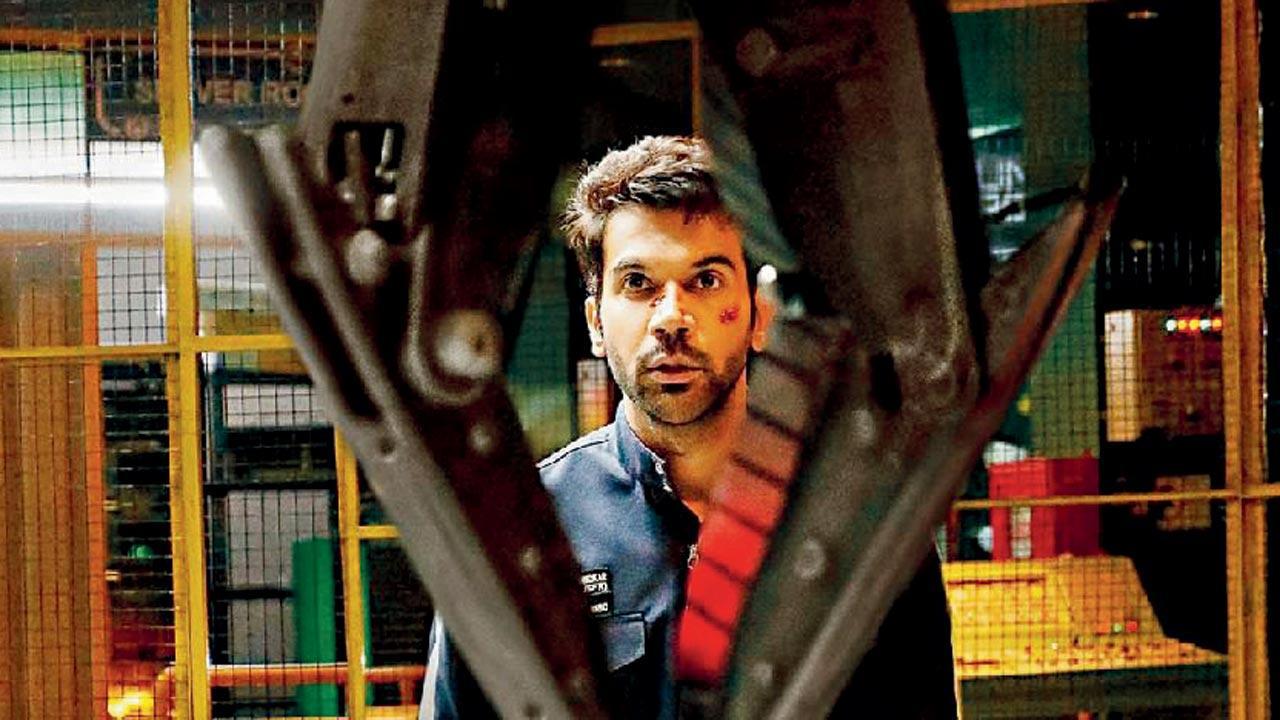
Monica O My Darling director thrilled to see audiences picking up on dialogues that are his tribute to filmmakers, including Vishal and RGV
Uma Ramasubramanian (MID-DAY; November 18, 2022)
From the get-go, it’s obvious that Monica O My Darling is Vasan Bala’s nod to his favourite noir films, from ’70s Hindi cinema to Hollywood. If the title is borrowed from one of R D Burman’s biggest chartbusters, Huma Qureshi’s opening scene reminds you of Helen’s dance numbers that were a staple in the decade.
And with that begins the 129-minute enjoyable game of spot-the-reference in the Rajkummar Rao, Qureshi and Radhika Apte-led noir murder mystery — from Nasir Hussain written on a pick-up tempo, to the name board of a building having Guru Dutt, Sriram Raghavan and Anurag Kashyap, among others, listed as residents.
Bala doesn’t stop there with his meta references. The clever dialogues too have caught the audience’s attention. “The dialogues have been placed cannily in scenes, and have references to various Bollywood films as a tribute to multiple noir filmmakers,” says the director, a follower of Raghavan’s school of cinema.
He is happy that the dialogues — a hat-tip to various filmmakers, including Vishal Bhardwaj and Ram Gopal Varma — are being enjoyed by viewers. “I didn’t think of the dialogues as punches. It started off as a fun exercise. The line ‘Main bhi dheel dene wali nahin hoon re, Chandu’ is a nod to Ramu’s Company [2002], and ‘Bol Monica, jaan meri’ to Vishal Bhardwaj’s Maqbool [2004]. After a while, it snowballed into many VHS, DVD cinema memories, and blended into the language of the characters. I am glad they gelled well with the characters who said them.”
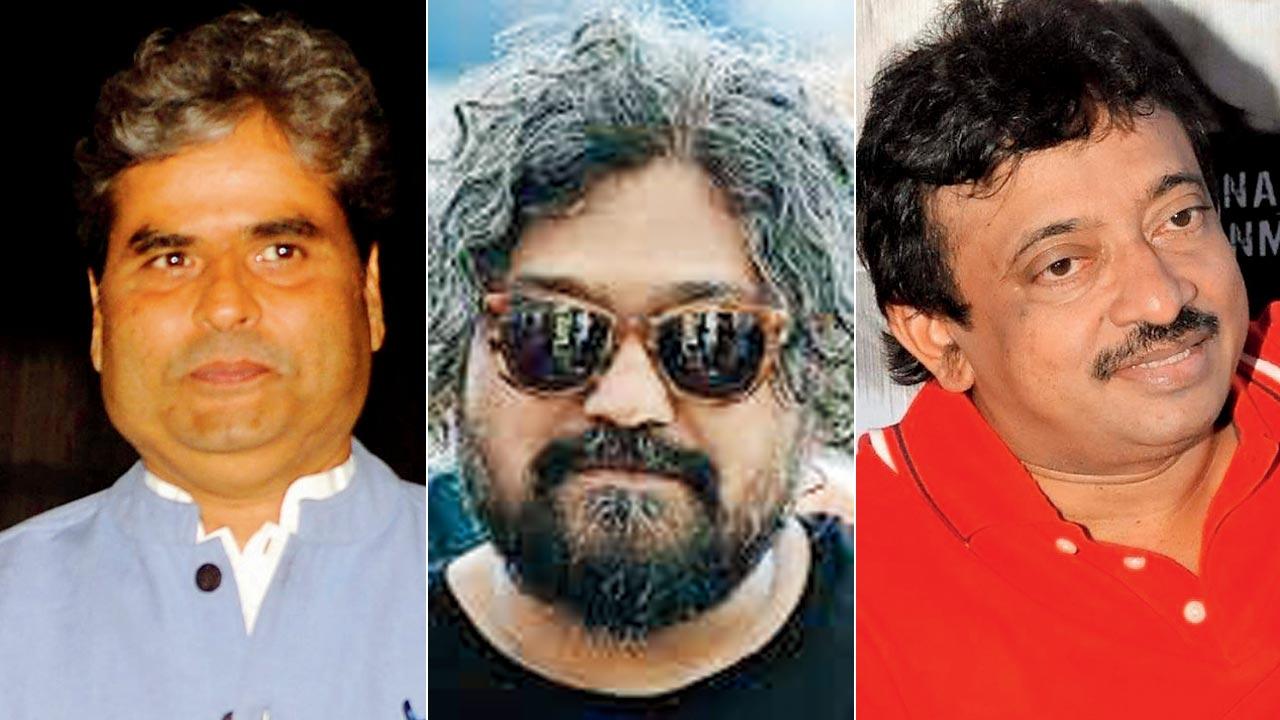
Vishal Bhardwaj, Vasan Bala and Ram Gopal Varma
A producer told me, tum kabhi actor nahi bann paoge-Vivek Oberoi
8:22 AM

Vivek Anand Oberoi, who completes 20 years in showbiz, is glad he never gave up on his dream of becoming an actor
Sugandha Rawal (HINDUSTAN TIMES; April 12, 2022)
Vivek Anand Oberoi has experienced a lot of ups and downs in his Bollywood career. From giving a hit one year to being jobless the next, he’s seen it all. As he celebrates his two-decade career in showbiz, he’s glad he never lost faith in himself.
Vivek, who marked his debut playing a gangster in Ram Gopal Varma’s movie, Company (2002), which was released today, tells us, “I still feel like that same child who first stood on the stage at the age of five at a school function and fell in love with live performance.”
Instead of being launched by his dad, actor Suresh Oberoi, in an Abbas-Mustan project, Vivek chose to work his way up through the industry. “My dad was investing his entire life’s earnings in my debut film, which I found unacceptable. However, I wanted a career based on my own merits rather than my last name,” says the 45-year-old.
Recalling his challenging times, the Saathiya (2002) actor says, “The rejection here feels extremely personal. When people believe you are a struggler with no [industry] ties, they tell you all kinds of things. They told me I couldn’t act... But everything that broke me made me stronger.”
When we press him for details on what kind of personal remarks he was subjected to during those days, the Omkara (2006) actor reminisces one incident in particular: “I remember one specific producer made me sit outside his office for eight-nine hours. After three days, he called me to his office again, looked at me, and then handed me a photograph of someone without looking at my work or certificates, and said, ‘Yeh hota hai hero, tum mein woh baat nahin hai. Tum [actor] kabhi nahin bann paoge’. I was really hurt.”
When the same producer came to his residence and offered him a project, Vivek says he celebrated his “personal victory”. The actor reveals that the producer had no idea who he was or what had happened in the past: “Perhaps it’s because he met so many people on a daily basis. But that was a huge personal accomplishment.”
The actor, who also ventured into the digital space via Inside Edge, says he has “nothing but gratitude” as he reflects on his experience. “There was a time when nobody wanted to work with me... But the journey is filled with gratitude… And I still have miles to go before I sleep,” he concludes.
When I am set to play a cop, I know I have to do it responsibly-Vivek Oberoi
8:01 AM
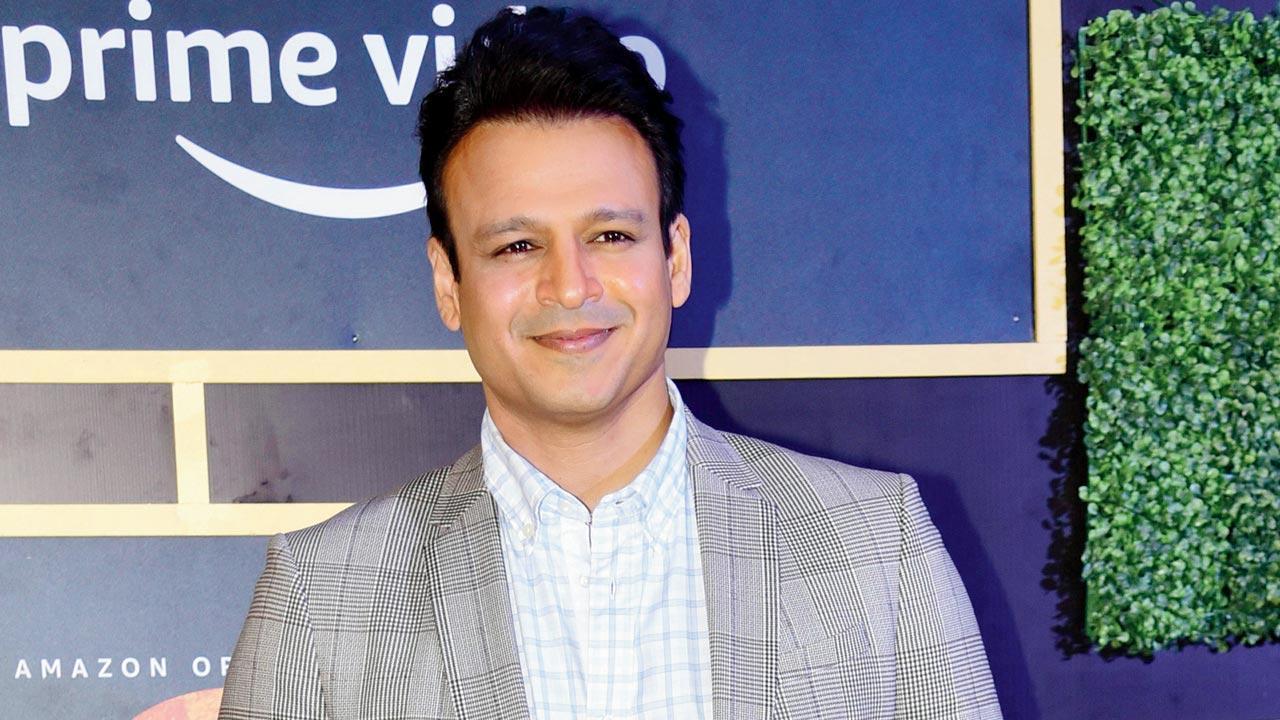
Dharavi Bank actor Vivek on how film narratives on officers have undergone an overhaul to showcase personal struggles
Mohar Basu (MID-DAY; January 12, 2022)
Vivek Anand Oberoi may have donned the uniform of a cop for cinema on multiple occasions over his 20-year career. However, he has noticed a difference in the way both he and filmmakers perceive the role. “I’ve observed police officers and realised that while they are heroes, they are also human beings with feelings and needs, and ones who can also feel weak, at times. As years have passed, I have noticed that the way cop-roles are written, has dramatically changed. Narratives have come closer to reality,” says the actor, who plays the part in the upcoming web-series, Dharavi Bank.
As a righteous police officer in Samit Kakkad’s show, he will lock horns with Suniel Shetty’s character. Oberoi sought help from his friends in the police force to prep for the part. “They’ve been a pillar of strength and have helped me prepare for films like Shootout At Lokhandwala and Company. When I am set to play one of them on screen, I know I have to do it responsibly. My endeavour is to bring out the person behind the profession.”
While the uniform, he says, plays a crucial role in enabling an actor to become the part, he had to be mindful of staying in character when he wasn’t wearing one. “Even if you don’t wear the uniform, you have to remember that the guy you’re playing is a cop. That can make things tougher,” he signs off.
At one point in my career, I was dealing with drama and politics, which was beyond my control-Vivek Oberoi
8:13 AM

Rachana Dubey (BOMBAY TIMES; December 30, 2021)
Vivek Anand Oberoi, who made his Bollywood debut with Company in 2002, will clock in two decades in the film business next year. From finding himself a launch vehicle and being among the first Bollywood actors to jump onto the OTT bandwagon to becoming a producer and an entrepreneur, Vivek has donned many hats. In a chat with BT, the actor talks about the lessons his journey has taught him and the road ahead. Excerpts:
In April next year, your first film Company will complete 20 years of its release. If one accounts for the time you spent being an assistant on different sets, you’re probably gearing up for your silver jubilee in the film industry. Does that make you feel like a senior in the industry?
(Laughs!) No. . . actually, I only sense the experience here. On a serious note, we were the generation of transition. When I became an AD (assistant director) and eventually, an actor, dialogues used to be written on the set on a fresh sheet of paper by the writers and ADs had to make copies of these sheets physically — so not only did one have to be a fast writer, but also good with Hindi. From that to this new phase in the last few years, where we increasingly have bound scripts, things have come a long way. Back in the day, power was also concentrated in the hands of a few. I was part of a generation that saw that change where people with talent began to soar. The lobbies I had seen then have now, somewhat, vanished. It has happened gradually.
What do you think led to that?
Newer talent and content came in. And with the advent of OTT platforms, the playfield became even more democratic. We are in times where one solid performance could turn you into a star, like Pratik Gandhi. Another observation of mine is that people have gone from using professionalism as a word to actually practising it. Earlier, seniors would arrive fashionably late and charm us with smiles. What one never understood was why was that okay? The younger lot today is incredible. They’re enthusiastic and are ready to rehearse and put in extra effort. Yes, the industry was like a family then, but it is not always good to be a part of every family dynamic. Lopsided dynamics didn’t ever work for me where outsiders remained outside and the insiders remained indoors.
You were among the first actors in the industry to be a part of a web show (Inside Edge). Today most actors are keen to be in the digital space. The fact that you were in that space early on, did it prove to be an advantage?
I have always tried to be the first mover and it has paid off sooner or later. I turned down a traditional launch in films by my father (Suresh Oberoi). I struggled to land a role in Ram Gopal Varma’s Company. I got it on my merit and hard work. When people thought that’s all I could do, I worked on Saathiya and then explored a space like Masti. People had told me that I shouldn’t play a villain, but I went with my instinct and I enjoyed it in Krrish 3. My journey is about taking risks and seeing what happens when you do that. When the OTT platforms dropped into our market, and I was offered a project, I was told I’d be crazy to take that route. By that time, I was already hooked on to international shows. I gauged what the space had to offer and took the plunge. Ours was the first show from India to get an Emmy nomination. While that was a big deal for me, I didn’t sign 20 other shows and movies for the same space. I am enjoying my OTT journey, where I am now producing content and acting in some of it. OTT platforms have given us actors like Vijay Verma and Siddhant Chaturvedi, who are scene stealers. There are so many lovely actors who are coming up thanks to this digital zamana.
You had worked with Suniel Shetty in Shootout At Lokhandwala in 2007 and are now teaming up again for a web show set in the underbelly of the city. Does it seem different when you team up with a senior colleague in a completely new space?
It’s a conscious call to find ways to associate with senior colleagues. Digital platforms are a great space to reunite with people you love, admire and respect. Personally, at one point in my career, I was dealing with drama and politics, which was beyond my control. Although I was proving myself time and time again, that was beyond my measure of being a good actor. Those dynamics at play were not letting me grow. I started my business, which gave me a strong financial standing. I didn’t ever have to make a wrong decision in my acting career, thanks to that. I have fun on the projects I take up because I am not doing it for the wrong reasons. you pass on the learnings from your journey? I am not the person who advises or passes wisdom, but my token advice to everyone is that acche waqt mein paglana nahi aur bure waqt mein ghabrana nahi. I just tell them to remember why they got into this profession. If someone’s only here for a bigger house or car, then it’s going to make them a part of a rat race, and in turn, make them rats for the rest of their careers. Why be that?
When I did Company, I had darkened my skin by eight shades; everybody said that it was a big mistake-Vivek Oberoi
8:14 AM

Vivek Anand Oberoi, who completes 19years in the Hindi film industry, says these are scary times for theatre owners
Titas Chowdhury (HINDUSTAN TIMES; April 14, 2021)
Vivek Anand Oberoi started his career as an actor with Ram Gopal Varma’s gangster film, Company, 19 years ago.
The film, which proved to be a turning point in his career, saw him playing a henchman to a notorious mobster. As he looks back to his debut project, Oberoi reveals, “When I did Company, everybody said that it was a big mistake. They pointed out that I had darkened my skin by eight shades, was wearing non-designer clothing, not lip-syncing songs and not dancing in the whole film.”
But he is quick to state that the film shaped his life and was one of the most fruitful experiences of his professional journey. Nostalgia struck, he says, “Company gave me so much such as the mentorship of RGV. He is an amazing director to work with. The faith and confidence that he instilled in me was incredible. He made me feel like a star on day one.”
So, how does he plan on carrying the legacy of the film ahead? “I’ve been getting messages on social media from fans who are asking me to make a series on Chandu’s life. Maybe that will become a reality someday. Company led me to make many unconventional decisions in my life,” he says.
In light of the resurgence in Coronavirus cases, Oberoi says that he worries about migrant labourers and theatre owners, and calls it a “repeat nightmare”.
He says, “There’s a mass migration again. It puts the labourers through a lot of economic hardship. My heart also goes out to daily wage earners and our brothers who run theatre chains. It has been a very tough ride for everyone. But we’ve to either adapt or die,” he concludes.
Two of my iconic films emerged from a failure-Ram Gopal Varma
8:16 AM

Rachana Dubey (BOMBAY TIMES; February 25, 2021)

Why have you left Mumbai and moved to Goa?
For most of the stuff that I am shooting, I am getting better locations in Goa. And frankly, it doesn’t matter where you are today. The visuals, the weather, and everything else is working out well for me over here. If I have some work, I will come back to Mumbai.
In one of our previous chats, you had spoken about how you want to work with credible actors who are not necessarily big stars. Going by your past record, you have worked with some of the biggest stars of our country. Has there been a mind-shift here?
Look, in a story, let’s say like Sarkar, I believe that without having the image or a personality of someone like Amitabh Bachchan as Sarkar, the narrative would not have worked. It would not have had the same impact with a new face playing the character. In Company (2002), I cast Ajay Devgn and Vivek Anand Oberoi. Ajay plays a character who is revered by people in his line of work, while Vivek’s character grows in stature from scratch. The characters influence my casting decisions. When I made Satya, I wanted an actor who could blend into the underbelly of Mumbai; he had to be someone who would fit in, easily. That’s the reason I cast Manoj Bajpayee and the rest of them.

The only thing I learned is that one can never fully learn. Every film you make is new. Even though you try to learn from your mistakes, you continue to make new mistakes. Anyone who says otherwise, doesn’t know what he is doing. We’re sum totals of what we have done in life. I don’t want to change anything about myself. A mistake could be in the perception of the outsider. Every failure has added to my personality. I don’t see them as mistakes because something which was bad at one point seems to be great at another time. I don’t quote box office when I pick on my worst works.
I think the worst film of my life was Drohi (1992) because I failed the material I had in hand. I botched it up. I don’t like Company for the same reason. I could not do justice to the material. But because of Drohi, I have a standing in the Hindi film industry. I met Urmila Matondkar while making it, which led to Rangeela (1995). I changed the backdrop of Drohi and made Satya. The credit for both those films rolls back to Drohi. I got two of my iconic films from that one film. Life, unlike a movie, goes on. Hence, you don’t need to look back every few moments for a lesson.

There is nothing anyone can teach you. You learn as much as you want to learn. Anurag’s style of filmmaking is different from mine and that is his individuality, and it is good for him. Manoj and he are talented people. I have never believed that I launched them in any manner or that I had taught them something. I have made a number of films and worked with numerous people. You brought up these two names because they have become names today. I am in touch with them, but they are busy, and we have not worked together (in recent years).
After Sarkar 3 (2017),you somewhat withdrew from Bollywood. Why?
I’m from Hyderabad. I got busy making political films there as there was a lot happening in that space. Then, I started making a movie based on martial arts, which I wanted to do for a while. It’s called Ladki. I had a balance of 15 days of shooting when the lockdown stalled everything. I’ve completed it now. You will get to see more of me. You will soon get to see a lesbian love story that I have made, it’s a crime drama. There’s another gangster drama that will shock the daylights out of people.
Do you ever feel the pace at which you continue to work can lead to burnout?
I have quadrupled my speed of work in recent times. I am doing much more now. I think people who don’t work much, burnout. I have so many stories to tell, and that is the only thing I do. I would rather ask people why they don’t feel motivated enough to clock every second of the day and do something with it.
When you introduced newcomers back in the day, there was no OTT space. Today, the digital space seems to have become a newcomer’s haven. What do you make of this trend?
The OTT platforms have helped filmmakers cut out the publicity and release costs, which were over and above the cost of making the film. One had to cast known faces so they could draw in people. Casting new faces was not seen as a reasonable decision. That’s not the case with the OTT platforms. They need content to feed their audience. If you’ve noticed, content works better than star faces in the OTT space. And like I said earlier, I never say that I have launched anyone. They were all casting decisions. In Sarkar, where a character called Rashid talks to Sarkar, I needed a new guy, an unknown person to walk in and talk to Mr Bachchan while looking him in the eye. That created a great impact. It’s not a question of modesty, but I am not here to launch anyone. I am a selfish filmmaker and every decision is for the best result.
Also, gangster dramas are back in demand today. What do you think of these new-age crime thrillers?
I’m not making a comment on anything specific, however, I see them very differently. I am into character studies. I see the emotional complexities of the people. Violence and crime are a very small part of the story. What I see is when people lead a difficult, complex life born out of tragedy — what happens to them.
Just when Once Upon A Time In Mumbaai was to flag off, we were hit by the recession-Milan Luthria
7:40 AM

Kangana Ranaut, Prachi Desai, Milan Luthria, Ajay Devgn, Emraan Hashmi and Rajat Arora
Roshmila Bhattacharya (MUMBAI MIRROR; August 2, 2019)
It’s been almost a decade since Milan Luthria’s gangster drama Once Upon A Time In Mumbaai opened in the theatres on July 30, 2010, yet it still resonates with the audience. The director reveals that it was conceived in 2008, the same year that he got married. “The offer came out of the blue and I gave my nod because I liked the idea. But just when the film was to flag off, we were hit by the recession and could no long afford to make the film,” he shares.
Even when the project was revived, it was difficult to get the dates of all the actors—from Ajay Devgn and Emraan Hashmi who played the protagonists, underworld kingpin Sultan Mirza and his right-hand, Shoaib Khan, to Kangana Ranaut, Mirza’s actress-lover Rehana, Prachi Desai cast as Shoaib’s sweetheart Mumtaz after Milan was impressed by her performance in Rock On!! and Randeep Hooda as ACP Agnel Wilson. “On the first day of the shoot, I was in the van with Ajay, and five minutes before he stepped out, he asked me how I wanted him to play Mirza. I told him I cast him for the intensity in his eyes and the way he walked. Responding with a 'Okay, let’s go,' he strode out, dressed from head-to-toe in white. “A hush descended on the set, the awe was palpable,” Milan reminisces.
He however wasn’t happy with the first shot. “I thought Ajay looked like Malik from RGV’s Company,” Milan confides, and pointed out to the actor that this was not a brooding gangster but a flamboyant character in love with a movie star. “Okay got it, roll camera,” Ajay nodded. And from that moment he was Sultan Mirza.
Emraan was a perfect foil to him but Milan admits that everyone around warned the actor against doing a negative role and taking on Ajay. “Emraan read the script two-three times before telling me that he’d do the film only if he could be the bad guy unapologetically. We were happy to comply since we’d only been trying to appease him with excuses and justifications for his character’s betrayal,” says Milan.
Kangana earned the nickname “chameleon” from her director because of the ease with which she flitted from one getup to the next. Her Rehana was an amalgamation of many actresses who’d been courted by real-life gangsters. She gifts Sultan Mirza a watch in the film which runs on his pulse beat and invites the cryptic comment, “I hope my pulse doesn’t stop before this does” which is a pointer to what is to come.
“In the original script, Shoaib tries to kill Sultan, misses and runs away. To stop the bloodbath that follows, the other dons of the underworld get the two together and make them swear on the Quran that they will not go after each other,” reveals Milan. The film eventually ended with Shoaib firing and hitting target. Sultan falls in Rehana’s lap and shows her the watch, telling her his time was up.
“The last shot was of him looking sightlessly up at the sky but Ajay pointed out that it would be impossible for him to keep his eyes open against the glare of the sun. So then, we had him falling to his knees and looking straight at Shoaib as he exits, stamping on a poster with his face emblazoned on it, along with the slogan, ‘Sultan Mirza zindabad,’” Milan recounts.
The film made Ajay’s Sultan Mirza a cult figure and proved Emraan’s brilliance as an actor too. It remains Milan’s most unforgettable film. “Even today, at a party, I’m introduced as the guy who directed Once Upon A Time In Mumbaai ,” he smiles. “To quote one of Rajat Arora’s famous dialogues from the film, ‘Iss vajah se log hamein dua mein yaad rakhenge.’”
I would have loved to do Shankar's Indian 2, but I didn't have the dates-Ajay Devgn
8:29 AM

Amid rumours that Ajay may join forces with Rajamouli, actor on why he opted out of Haasan's Indian 2
Upala KBR (MID-DAY; February 15, 2019)
 Late last year, reports suggested that Ajay Devgn may make his Tamil debut with Shankar's Indian 2. It was heard that the actor was approached to play the antagonist to Kamal Haasan's moral vigilante in the sequel to the 1996 hit, Indian. While the rumours died a natural death, there is renewed chatter about Devgn being South-bound after all - this time, with the Baahubali maker, S S Rajamouli. Buzz is that the actor will be seen in the director's mega-budget film, tentatively titled RRR, that features Ram Charan Teja and NT Rama Rao Jr.
With the spotlight on his possible South collaborations, Devgn - currently neck-deep in the promotions of Total Dhamaal - opens up for the first time on why he had to let go of the Haasan starrer. "I would have loved to do Shankar's movie, but I didn't have the dates. He wanted to shoot the movie right now. [But] I am stuck with Tanhaji."
Although rumours had then suggested that the actor had turned the film down as he was not keen on portraying a grey character, he insists it cannot be further from the truth. "For an artiste, there are no shades of grey, black or white - the more layers you have in a role, the better it is. I loved doing movies like Khakee (2004) and Company (2002) where my negative characters were appreciated. I would love to play such roles again. [Having said that], I cannot say if it [the part in Indian 2] was grey or not because I am not doing it now; it's somebody else's role."
Not surprisingly, the actor turns evasive when the conversation steers towards his rumoured outing with Rajamouli. Ask him about the project, and he offers a pithy, "No comments."
However, a trade source reveals that Devgn, who had previously done the Hindi voice-over for Rajamouli's Makkhi (2012), is in advanced talks for the action drama. "Ajay has been approached for a pivotal role. It's not a cameo as has been reported. While Rajamouli has begun the first schedule with Ram Charan and NTR Jr, Ajay is likely to shoot his portions after wrapping up Tanhaji."

Kajal Aggarwal, Kamal Haasan and Shankar at the launch of Indian 2
Vivek Oberoi excited to reunite with 'gracious and warm' Mohanlal after 16 years with Lucifer
6:45 AM

Mohar Basu (MID-DAY; July 13, 2018)
Malayalam star Prithviraj Sukumaran’s directorial venture is special for Vivek Oberoi for reasons that are more than one. Lucifer not only marks his full-fledged Malayalam film debut, but also sees him get together with South star Mohanlal 16 years after they featured in Oberoi’s Bollywood debut outing, Company.
A sense of nostalgia makes itself evident when Oberoi tells mid day, “It’s been 16 years since Company [released] and I’m so excited to reunite with Mohanlal. He is among the finest actors in the country, apart from being a great human being. We had the best time shooting for Company, and despite his stardom in the South, he was gracious and warm.”
Lucifer — set to kickoff in Trivandrum on July 18, and then in Mumbai and Kuttikkanam — sees Oberoi slip into the role of the antagonist. Given that also features Manju Warrier, Tovino Thomas and Saniya Iyappan, Oberoi says he was persuaded to give his nod to it. “The subject, script and opportunity to work with such a talented cast and crew is what drew me to the movie. Prithviraj, who makes his debut as director, gave me an incredible narration of this challenging and complex script. I was sold,” he says.
The actor begins a month-long prep next month. In order to learn Malayalam, he plans to appoint a diction coach soon to ensure that his pronunciation is on point.

If I have to start shouting out loud about myself, I might as well not work and do just that-Ajay Devgn
8:18 AM

Madhureeta Mukherjee (BOMBAY TIMES; March 14, 2018)
He raged on to the silver screen 27 years ago, on a roaring hot bike in the action drama, Phool Aur Kaante. Ever since, his career has not always been a bed of roses, but neither have the thorns left him bruised. Like he says, “Even in my low phase, I have always had one hit in a year”. Ajay Devgn has deftly balanced the art and the mart. For every Zakhm, there has been a Golmaal. For every 100-crore-hit, there’s been a critically acclaimed drama to root for. A director’s delight — he could tear the screen with rage or turn into silent dynamite. Off-screen, he’s a man of his own mind. Rare and solid. He doesn’t say much, but when he does, he fires bullets — direct and dauntless. A few days before the release of his upcoming film Raid directed by Raj Kumar Gupta, he settles into a comfortable chat (which is a rarity) with us and talks about his lucky streak, how he’s averted a mid-life crisis and the fact that the industry today has better business sense, but lacks the emotional quotient. Read on…
You are playing a tough-as-nails IT officer in Raid, who is investigating one of the most high-profile and controversial cases that we have seen. While essaying heroic characters in our films, the natural tendency is to go OTT in order to make the character seem more superhuman. Here, you seem to have played it out subtly. It is a challenge, isn’t it?
The film happened because we met this IT officer and realised that there was a great story to be told. We were toying with the idea of making it for four years. Finally, the writer Ritesh Shah narrated the story to me and I loved it. Then, we got Raj Kumar Gupta (of No One Killed Jessica fame) on board, as he understood the space that this movie is set in. I have never worked with him before, but he is this quiet and honest guy, who talks about nothing other than the film he is working on. Also, I like Ritesh because he writes dialogues that are not filmi or flowery, but hard-hitting. They don’t sound like… yeh kya line likhi hai, and yet, leave an impact. I think that whenever you have a great line, you should deliver it with nonchalance. By that, I mean that a lot of actors believe that if they have a good dialogue, they should stretch it to make it more dramatic. I feel that when you deliver such lines subtly, they work out better. In Raid, Amay Patnaik is real; he doesn’t become aggressive or resort to violence. He is not a cop, he is an IT officer who is honest and retaliates silently.
Well, OTT also works well for the audience, like in a film like Singham, where you play a hotheaded cop…
Yes, OTT works very often in our films, but it doesn’t work for every character. It can get irritating, too, so you need to strike a balance. In case of roles that demand a subtle performance, you have to express a lot through your eyes and body language. Sometimes, when people do it, there are chances that it could look like they are sleepwalking. There is a very thin line. Being cool and calm does not mean that you are performing well either.
You have always said that you don’t spend too much time getting into the skin of the character. You simply understand your character and let the cameras start rolling. Have you ever made an exception to that process for any of your roles?
I still can’t do all that prep work. I am just spontaneous, so I either feel the character or I don’t. I don’t know of any other process, or let’s say that I can’t explain it. I can understand it for myself. I start thinking and feeling like the character. My body language and thought process change and I start thinking what the character would do or wouldn’t do. Yes, I do put a lot of thought in to how I would play a character differently. For instance, after Ram Gopal Varma’s Company (2002) got a lot of appreciation, I had to think about how I would play an underworld don again in Milan Luthria’s Once Upon A Time In Mumbaai (2010). The cop in Prakash Jha’s Gangaajal (2003) is dramatically different from the cop in Rohit Shetty’s Singham (2011), though both the characters have similar beliefs.
When you are doing a film like Golmaal vis-à-vis a film like Raid, as an actor,is the ultimate feeling of creative satisfaction similar?
There is a lot of satisfaction in doing both kinds of films. Doing a comedy is tough business; the energy and timing has to be perfectly tuned. People think that it is easy to be stupid on screen, but it is not. I realised that while working on Golmaal Again (2017). On the first day of the shoot we performed a few scenes and we realised that there was something missing. We had shot the last Golmaal movie seven years ago. Since then, we had all grown up. Then Rohit (Shetty, director) played a few scenes from Golmaal 3, and we saw how stupid we were in that film. The energy was on a different level. And while shooting Golmaal Again, we were trying to be stupid, but there was a little maturity in it. So, we had to take the stupidity a notch higher and when that worked, it was as satisfying as anything else.
What was the turning point for you? Was it Mahesh Bhatt’s Zakhm (1998), a film where you received immense appreciation? For the longest time, you were asked why you didn’t do more films like that…
I don’t think that there was any turning point in my career, it was all a process. I am glad people have started doing such films now; in the 90s no one attempted these films. What we call niche films today, I was doing those films in the 90s when no other mainstream actor was doing them. I did films like Raincoat, Dil Kya Kare, Thakshak and Zakhm. Thank God, I did those films because you learn a lot from directors like Bhatt saab and Govind Nihalani, as their thought process is very deep and different. The learnings from those films can be applied in commercial cinema too, and it can work differently. I have done all kinds of cinema, because I never bothered about things like how it would affect my image as an actor. Yes, I had an action hero tag, which I think changed with films like Ishq, Pyaar Toh Hona Hi Tha and Hum Dil De Chuke Sanam, which were in a different zone. It was never a conscious choice; it all just fell into place. I don’t plan most things in life; I simply follow my heart and instinct.
Did you ever go through a mid-life crisis in your career wherein you were confused about the direction in which it was heading?
Given the fact that I didn’t ever plan my career, and I didn’t take things too seriously, I think I have been very lucky. I’ve been around for 27 years and there has never been a situation in my life where I have had one or two bad years. If I have had three releases in a year, if two have not worked, one has always worked out. Even in my low phase, I had one hit a year. I have never gone through a phase jahan mujhe kaam ki kami rahi. Everyone gets films, but it gets difficult for actors to get the kind of films that they want.
Looking back, do any of your films from the past make you cringe now?
Yes, I have done so many films just for the sake of relationships with people in the industry. Not just me, I think many other actors from my generation have done that. We knew that the film was not going to work (I won’t name them), but we still went ahead and did it for emotional reasons. I don’t regret doing it. Back then, we didn’t bother, but today, we obviously won’t do the same.
In that sense, would you say that today the industry has become far more professional and practical? Is there a certain emotional quotient missing?
That emotional quotient, which was there in the film industry in the past, has gone. Everything has changed and business has taken over. In some ways, it is good for the industry, but we also miss the old times and sometimes we wish things would go back to the way they were. Back then, we could talk and say whatever we wanted, and we would walk into each other’s sets whenever we wanted. We were like a close-knit group, which is not the case anymore.
You have always been a fairly elusive star. You are on social media, but you aren’t too vocal. Do you think that today, actors are fearful of speaking their mind, knowing that they could be lambasted for their views?
Yes, there is a fear of speaking your mind as people start targeting you. You might say something, and they might misconstrue it or turn it into something else. I think people know what you mean, and yet they want to play mischief. Hence, we have to be cautious about what we say. Sometimes, it is not about what you say but how you say it. At times, I use social media to say something important, or voice my opinion on a topic that I feel strongly about. People use social media to promote themselves, not to always make a point.
Talking about promoting yourself, one has never seen you do that aggressively. You haven’t really used the PR machinery to your advantage…
Why should I do it? I have always been this way and I really don’t want to change. I think that my work speaks for itself. If I have to start shouting out loud about myself, I might as well not work and do just that. If there are people who don’t understand this, I don’t care a damn about making them understand (laughs!).
Do you still feel the jitters before the release of a film?
I still get nervous before every role. Even today, before doing a shot I wonder if I will be able to pull it off. I think it is a good thing to feel this way, because if I start thinking… arre yeh toh ho jaayega, then it means that I have started taking things for granted.
The industry is becoming increasingly competitive. Do you ever feel insecure, or do you harbour any fears?
Not anymore. The only thing I want to do is that I want to work till I die. What can I feel insecure about after 27 years? You also have to realise that you won’t be around forever. We are all getting older; I will turn 49 this year. So, I know that I have to evolve and change and take on a different role altogether. In that sense, I am very balanced and realistic.

Ram Gopal Varma reveals exclusive, interesting details about his memorable films
11:21 AM

The filmmaker takes us through almost three decades of movie magic
Roshmila Bhattacharya (MUMBAI MIRROR; May 6, 2017)
SARKAR 1, SARKAR RAJ, SARKAR 3 (2005, 2008, 2017)
Strangely during all the films I have done with Amitabh Bachchan over the years, including the Sarkar series, only once have we had a difference of opinion. It was over a scene in the original Sarkar, where he throws his son Vishnu out of the house. I wanted him to play it cold-bloodedly, without emotion, as if the son he was chucking out were an insect. But he thought that given that they were father and son, he show some anger. I argued that when you take a decision like this, it means you have given up all hope so there should be no reason to rage. He disagreed and finally we did the scene his way. But that night, around 11 pm, he called me to say, "Ramu, I've been thinking about this scene and I feel now that you were right. Let's reshoot it tomorrow."

I see Subhash Nagre aka Sarkar as a realistic Superman, who people can look up to and depend upon to solve their problems when the establishment fails them. For me, he is a graphic comic book character who does not age, who I conceived for Bachchan, whom I, as a film watcher, had studied over the years. It was a culmination of the cumulative effect he had on me since Zanjeer. As the principal protagonist, Sarkar is integral to the franchise and I can't imagine any other actor playing the role. Sarkar has become synonymous with Amitabh Bachchan, just like doodh and milk.

BHOOT (2003)
I love to scare people. As a child, I used to hide behind the door and say, "Boo!" Now, I make horror fantasies even though I don't believe in ghosts. Yet, one night, after wrapping up the shooting of Bhoot at around 2 am, I returned to my apartment, where I live alone and in my L-shaped bedroom, I was lying on the bed when suddenly I got the feeling that the ghost from the film, Manjeet Khosla, was standing behind the wall.
I kept staring at the wall, but couldn't muster the courage to get up and check. I tried to laugh off my irrational fears, but the eerie feeling wouldn't go away. I turned my back to the wall and tried to will myself to nod off. But sleep wouldn't and I found myself turning to look at the wall again, this time calling out softly, "Manjeet? Manjeet?" I was greeted by silence and chuckling over how foolishly I was behaving, I turned again and shut my eyes resolutely.
Moments later, I heard the sound of footsteps and felt someone get into the bed with me. The soft sigh of someone breathing creeped me out. I turned, to be confronted by... nothing!
This time, I jumped up and, rushing to the phone, placing a call to Barkha Madan, the actress playing Manjeet whose ghost haunts the apartment. Only after speaking with her was I reassured that neither she nor her bhoot had entered my apartment.

COMPANY (2002)
I chanced to meet a gentleman who was very close to the D-Company, not a criminal really but more of a business associate. In the course of our conversation, he told me that in the fight between Dawood Ibrahim and Chhota Rajan a number of people had got killed, yet the two guys still had so much love for each other. "Even today, if Dawood bhai calls, Chhota Rajan will stub out his cigarette instantly. They hate each other because they love each other so much," he told me. The last sentence caught my fancy and was the genesis of Company.
The premise of a mentor and his protege whose relationship slowly sours over ego issues is true of any company. The only difference is that in a normal company, a person gets fired if he doesn't do his job well or falls out of favour with the boss. In D-Company, they get fired, literally. The gentleman, who was my muse, was shot dead just months after I met him.

SATYA (1998)
I was sitting with someone when we got the news that Gulshan Kumar had been killed. I had met Gulshanji a couple of times and was shocked. The gentleman I was with knew him well and had spoken to him just that morning at 7 am. He mentioned that he had called him back an hour later. We have this habit of recounting details when a violent death occurs. And listening to him, a thought flashed through my mind. If Gulshanji woke up at 7 am, then when did his killer jump out of bed, I wondered. Before or after killing him, did he have breakfast? I know that these questions may sound strange, even funny, but they are relevant even though we only think of assassins when they kill or when they are killed. But between the two acts, they are people like any of us leading normal lives. They could be walking on the street, sitting beside you in the bus or the movie theatre and none the wiser. To see a guy like this in his world is what sowed the seeds of Satya.
The film made Manoj Bajpayee synonymous with Bhiku Mhatre. He had caught my attention in a small role in Shekhar Kapur's Bandit Queen after which I cast him in a brief appearance in Daud. I was impressed by his focus and intensity, both as an actor and a person, and ended up giving him this iconic role in Satya.

RANGEELA (1995)
I have five favourite films—The Exorcist, Mackenna's Gold, The Godfather, Dr Strangelove and The Sound of Music. Rangeela was my The Sound of Music where every character is lovable; it's the situations that create conflict. A R Rahman was new back then and to visually interpret his music on screen was a challenge.
I didn't think there was anything special about Aamir Khan (who played the lovable Munna) as an actor, but when I met him I was impressed with his dedication, focus and earnestness. I had not seen another actor who was more sincere, which is why I cast him as the street-smart orphan who makes a living selling movie tickets in black.
Why Urmila Matondkar? Well, I had gone to sign Madhuri Dixit for a film titled Drohi. She was not available, so we signed Urmila instead. I loved her spirit, her expressive face and her happy feet. I remember once when the choreographer couldn't make it to the set on time as he had missed his train, I told her to do the song herself. I was mesmerised by the way she danced and when Rangeela came up, she was my choice to play Mili, the movie extra who aspires to be a star and ends up with two men in love with her.

RAAT (1992)
Raat was the first film I wanted to make, even before Shiva. It was a really special film in terms of camerawork, the six-track stereophonic sound, the music and Revathy's performance. But back in the '90s, when our audience was still watching Ramsay horror flicks, it was perhaps a little too subtle and sophisticated for their liking, maybe even too cerebral.
Raat aficionados have grown over the last decade. Today, I have young girls aged 17 and 18 coming up and telling me that their favourite horror film is Raat, which they have seen on TV. When I hear that it surprises me. I wonder how the film on whose technicalities we lavished so much time and attention, can work on television? I don't know if I'd want to remake Raat, but I am working on another horror film. And today, I think I have finally understood the core of this genre.
Today, I feel Company is a half-baked film-Ram Gopal Varma
8:09 AM

RGV gets candid about hits and misses; says Twitter’s an extension of his personality
Meena Iyer (MUMBAI MIRROR; March 7, 2017)
One has known Ram Gopal Varma for 28 years but that amounts to zilch. Nasty one second and disarming the next, RGV remains an enigma. He lives vicariously through the movies he views and makes. He deliberately courts the Bollywood “outcaste” image and will not pander to the egos of either his actors or the media.
Excerpts from a chat with the incorrigible filmmaker:
Amitabh Bachchan has trusted you despite the fact that besides the successful Sarkar franchise, you also made the disastrous RGV Ki Aag with him. Comment.
I have the highest regard for Amitabh Bachchan. Unlike others who only look at the end result, he sees the effort I put into both Sarkar and RGV Ki Aag. Most people don’t bother with the causes and just react to the effect. That’s understandable. I’m not complaining.
You have been around for 28 years. In the early years of your career you could do nothing wrong. In the second half, most of the films you did were wrong. Why?
To start with, it’s not true that I did not do anything wrong in the early phase. After the super successful debut, Shiva, in 1989, I gave five flops in a row. Then, there were three flops before Rangeela in 1995 which was followed by another flop, Daud, two years later. People remember only the hits after some years. The media too wasn’t so aggressive in those days.
Would you say that somewhere along the way you’ve become a little complacent?
I know that’s what people think and that I do too many things too fast and so do not focus on the job at hand. But the truth is that I spent the maximum time, effort and money on films like Daud, Ram Gopal Varma Ki Aag and Department and they are my biggest flops while films like Satya, which was made without a ready script succeeded. There is no co-relation between working hard and making a hit film though I know nobody will believe me.
Sarkar is a franchise which has kept you on top of the game. What are your expectations from Part 3?
For me, Sarkar is the epitome of what great film characters meant from the days of an angry young Amitabh Bachchan to the Godfather trilogy. Sarkar 3 is the epitome of the franchise.
How close is Sarkar 3 to your heart and will we catch a glimpse of the genius that was there in Shiva, Company and Rangeela in it?
You will find the present RGV in Sarkar 3. Ridley Scott once said that when you see a film that you have made a long time ago, you almost feel as if someone else has made it. I agree. That is because we are continuously changing through our experiences. So today, when I see Company, I feel it’s a half-baked film because I know so much more about the complexities of the underworld now.
You are really aggressive on the social media like recently you got after Tamil Nadu’s CM-hopeful, Sasikala Natarajan.
For me, Twitter is an extension of my personality and I say whatever I feel strongly about at the moment. Also, it is not a public platform, it’s something between me and those who wish to follow me
But why are you always so offensive?
I am not offensive, I’m actually gentler than a lamb. But the truth I speak sometimes sounds offensive.
Is there a film in the offing on Sasikala?
Let’s see.
There is so much of you on the social media. Yet you continue to remain an enigma. What is the real RGV like?
You can meet the real RGV on Twitter. He is a mixture of one teaspoon of genius, two teaspoons of dumbness, a pinch of humour and half a cup of ‘mad’ common sense.
You once started your day watching a movie and went to bed watching one. Does this routine continue or has it given way to some other idiosyncrasy.
Earlier I used to watch only movies, now I watch a lot of documentaries and web series.
After Urmila Matondkar and Antara Mali you stopped giving Bollywood, heroines who could occupy mind space, stopped nurturing talent…
I would say I stopped ‘talenting’. Now, don’t ask me its meaning
Zareen Khan to feature in reworked version of Khallas in Ram Gopal Varma's Veerappan
7:59 AM

Ram Gopal Varma brings back his cult song from Company for his upcoming film; says Zareen Khan 'sexifies' the new rendition
Sanyukta Iyer (MUMBAI MIRROR; May 5, 2016)
 Fourteen years after Isha Koppikar sizzled in "Khallaas" in Ram Gopal
Varma's gangster thriller, Company, the filmmaker is gearing up to
recreate the special number for his Veerappan biopic. While the 2002
film featured Ajay Devgn, Vivek Oberoi and Manisha Koirala, the biopic
has Sandeep Bharadwaj in the titular character, and Lisa Ray. Zareen
Khan, who made waves with her bold turn in Hate Story 3, steps into
Isha's shoes in the song.
Fourteen years after Isha Koppikar sizzled in "Khallaas" in Ram Gopal
Varma's gangster thriller, Company, the filmmaker is gearing up to
recreate the special number for his Veerappan biopic. While the 2002
film featured Ajay Devgn, Vivek Oberoi and Manisha Koirala, the biopic
has Sandeep Bharadwaj in the titular character, and Lisa Ray. Zareen
Khan, who made waves with her bold turn in Hate Story 3, steps into
Isha's shoes in the song. "The lyrics, 'Bachke tu rehna re... Nahin duja mauka milega sambhalna,' literally hint at Darwin's 'survival of the fittest' theory. Now the lyrics have been reworked to "Khallas Veerappan", but its spirit remains the same, with a sexy Zareen dancing in the forest," RGV informs Mirror.
Following a three-day prep which wrapped up today, the actress will shoot the fire-andwater sequence with laser beams flashing in the backdrop. "It is a surreal setting that brings out the wildness of the jungle. Some feel that the film glorifies slain sandalwood smuggler Veerappan but once the song is out, they will only be talking about how Zareen 'sexifies' it," the filmmaker states, adding that the new "Khallas" comes at a time when everyone knows Veerappan is going to be killed. "It is pure evil!"
Zareen adds, "The manner in which the song has been picturised is something that has never been explored before. Though I had very little time to prepare for it, I'm really excited because I will be sporting a completely different look."
RGV is hoping to re-invent himself with this comeback of sorts. "I looked at the last few films I directed and realised that I did not want to be repetitive. A director is as good as the subject he chooses and with this criminal who murdered 97 men, I am back in Bollywood," he smiles.
Vivek Oberoi to produce and act in Company 2; the role has shades of grey
7:49 AM

Sanyukta Iyer (MUMBAI MIRROR; July 14, 2015)

“I'm flattered that people still remember a role I shot for 13 years ago. In fact, many of my fans who don't know my name call me Chandu bhai. They want to see me as a rough, rowdy, rugged anti-hero and that's what I am going to give them in Company 2,“ the actor promises.
Even though Vivek has graduated to playing lead roles, he has made an impression in other negative roles, whether it was as Maya Dolas in Sanjay Gupta's gangster drama, Shootout At Lokhandwala, or Krrish 3's Kaal. “A large number of my fans want to see me as the bad man,“ he admits.
Company 2, as it is tentatively called now, will have him in a villainous avatar but will not be a continuation of part one. “I'm in the process of buying the rights. Producing a film is a full time job and all the more difficult since I have some acting commitments too. We can't rush things because the original film was iconic, primarily because of the genius that Ram Gopal Varma is,“ he reasons. Will RGV return to direct Part 2? “I'm not in a position to talk about where Ram Gopal Verma and I stand vis-à-vis the film.“
Vivek Oberoi to co-produce Company sequel; Ram Gopal Varma to be creative adviser?
8:09 AM

Sanyukta Iyer (MUMBAI MIRROR; February 13, 2015)
In 2002, Vivek Oberoi exploded into Bollywood with the high-voltage crime-thriller, Company. His performance as Chandrakant 'Chandu' Nagre won him the Filmfare Award for Best Debutante and Best Supporting Actor.
Thirteen years later, the actor will spin a sequel that he will also co-produce.
The 38-year-old actor who is vacationing with wife Priyanka and son Vivaan Veer in the US, gave his thumbs up to begin production before he left the country.
"Vivek read three scripts and zeroed in on this one 20 days before he left for his holiday. He will be back this Sunday and there will be another reading. He is sure Company can be turned into a bankable franchise. The film rolls in July," confirms a source close to the development.
Ajay Devgn who was shot dead in the climax of the original will not be returning in Part Two, nor will Mohanlal who played the cop, or leading ladies Manisha Koirala and Antara Mali. Chandu will have a new Kannu and the film will have an all-new cast. "It is not a continuation of the earlier story but a gangster film revolving around Chandu," added the source.
Ram Gopal Varma who directed the original film will be the creative adviser on the sequel and has been mentoring his CEO Sandeep Gangatkar to helm the project.
Sandeep who was his co-producer on Bhoot Returns and Satya 2 will make his directorial debut with Company 2.
Subscribe to:
Posts (Atom)