Showing posts with label Chandralekha. Show all posts
Showing posts with label Chandralekha. Show all posts
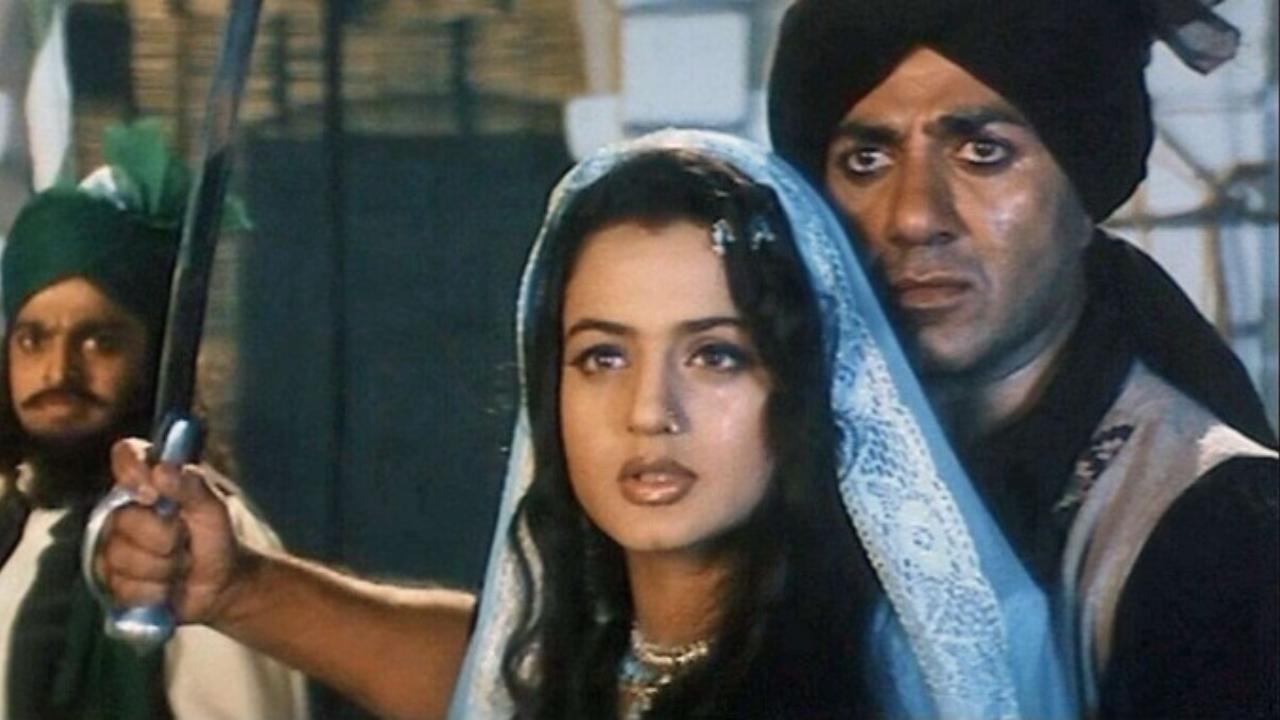
25 Years of Gadar - Ek Prem Katha: Never had exhibitors seen such a response to scenes with the public going wild
10:52 AM
Box Office India Trade Network
GADAR - EK PREM KATHA is celebrating 25 years today as it released on 15th June 2001 to a bumper response. The collections on day one were not a record but that was basically because it was not the biggest release in terms of prints. In those days, prints were important for the final number as generally most commercial films with a star cast were going to 90% plus occupancy on day one. GADAR - EK PREM KATHA opened to cent per cent capacity all over barring some stations of South India.
The collections of the film were never seen before type especially for those initial 10-12 weeks. The craze was unprecedented with the music and dialogues, certain scenes going to such a level that they became etched in public memory like never before. Never had exhibitors seen such a response to scenes with the public going wild and this was practically all over the country.
The film did an insane job at the box office when released and was one of the great films of India cinema but to get among the real cream there has to be a longevity. GADAR - EK PREM KATHA had this longevity as some scenes were such that the audience would never forget but due to the change in business, it never had that theatrical run of SHOLAY or MOTHER INDIA, which, even after twenty of years release, were a theatrical force. These films proved their relevance well after release. So, while GADAR - EK PREM KATHA had the same relevance their was no way to prove it. Yes satellite was a rage but then SOORYAVANSHAM was a bigger rage. Hence, when you want to be among the greats, you need something more than satellite.
Eventually GADAR 2 happened in 2023 and that initial and the response to the film rubber stamped the greatness and relevance of GADAR - EK PREM KATHA and how it had passed the test the time like very few before it. The reaction to GADAR 2 meant that that GADAR - EK PREM KATHA was probably the second greatest film ever seen in India after SHOLAY.
There are only 4-5 films in this bracket and time will tell if BAAHUBALI or DHURANDHAR can get there though it will be tougher for the former due to the faces in it and the music in the film as CHANDRALEKHA was a similar film in 1949. But ten years later, no one really knew about it. With DHURANDHAR time will tell though it does not have that mass appreciation at the level of a SHOLAY, GADAR or MOTHER INDIA.
GADAR clashed with another big film LAGAAN but in those days the clashes did not matter as both films had their chain of theatres in each circuit. LAGAAN had better industry reports and the general sense was that it will do better but this was related to media and industry. GADAR had been sold for higher prices and was a wider release. So, ground realities were different to what the industry and media thought even before release. The only thing was business was not about the weekend or week at that time. As a result, with the better industry reports they would have thought that the final business of LAGAAN would be better.
Prem Ratan Dhan Payo did well but when I look at it now, I don’t like to see the climax-Sooraj Barjatya
3:07 PM

One of Bollywood’s top blockbuster directors, Rajshri bossman, Sooraj Barjatya, 61, dives deep into his film journey as he switches into web-series with Bada Naam Karenge
Mayank Shekhar (MID-DAY; March 22, 2025)
Before I sit down with Sooraj Barjatya, 61 — the director rightly deemed the father of the great Indian family drama, ever since the blockbuster success of his Hum Aapke Hain Koun..! (HAHK, 1994) — I entertain an unusual thought in my head.
For decades, the gentle, reticent Sooraj has maintained a stoic, quiet public image. What if the actual man behind those conservative movies, dipped in shudh desi ghee, espousing love for mamaji, chachiji, samdhan, devar, is actually a wayward chiller, himself—given to slasher flicks at home, for his private pastime!
I playfully poke him with these fantasies, for this profile—asking him what he does for fun. He’s sweetly measured, as usual. For his hobby, he says, “I am right now into Puranas, reading the Gita, [Tulsidas’s] Ramcharitmanas; that’s my time for fun, when I am actually by myself.”
With Sooraj, what you see is what you get. There is no fakeness. We can see that. In fact, back circa 2001, he recalls, he had once gone over to Fire ‘n’ Ice, a popular nightclub in Mumbai’s Lower Parel. Director Farah Khan spotted him there. She instantly called up Karan Johar, wholly shocked: “Look, who’s here!”
Sooraj was with his wife, Vineeta. They retreated to a nightclub corner, where another partygoer simply asked him to please leave, bellowing: “Yeh [jagah] hum paapi logon ke liye hai [This place is for sinners],” Sooraj laughs.
The filmmaker was actually at a discotheque, in a sense, researching for his forthcoming film then, Main Prem Ki Diwani Hoon (MPKDH, 2003).
Which he wished to make, feeling the need to reflect something more trendy/hip. This is soon after Hum Saath Saath Hain (1999), an adaptation of the Ramayan, set in an Indian joint family.
Sooraj was in his “early thirties”, looking for a reset. He sacked his traditional music composer, Raam Laxman; brought onboard Anu Malik. For the lead cast, he had Hrithik Roshan, Abhishek Bachchan, Kareena Kapoor, instantly ready for the roster.
He says, “I feel so guilty towards all of them. Because they gave me everything. But while making that film, I realized, I am not there. This is not me. I was asking others, if they’d like what I’m making!”
A big feedback came to him from Bollywood’s resident pop-philosopher, actor Govinda. Sooraj says, “Govinda Ji sweetly met me [after MPKDH] to say that hits, flops come to everyone. That’s not the point.
“But, he told me, everyone has a purpose—ghode ka apna kaam hota hai, sheep ka apna kaam hota hai, sabka apna kaam hota hai. These words of wisdom stayed with me so much, that I then made Vivah [2006]. From that film onwards, I stopped wanting to be someone else. Then I can go to a night club to observe, and that’s good enough—but not try and become that person. It’s a liberating thought.”
MPKDH bombed in the theatres. Vivah had a “silver-jubilee [25-week] run in 125 cinemas, across the country.” Perhaps the last such film. To the point that the term ‘silver jubilee’ itself may be lost on the present generation of filmgoers.
But that’s how family films work—Sooraj, who’s also the bossman of Rajshri Pictures, the fountainhead of desi family entertainers, for over 75-plus years, explains its footfall math.
For one, he confesses, his core audience are women. They’re the ones who bring the family into theatres, in the first place. Sooraj says he’s deeply conscious of their tastes—even literally.
For instance, “Observe the food in our films. I make it a point that they’re carefully shot like advertising. In Maine Pyar Kiya [MPK, 1989], when Laxmikant Berde has to carry a tokri of puris, we kept reshooting it, because the puris had to be properly full-blown, on every take.”
Secondly, Sooraj distinguishes the mainstream family film, from a massy actioner. The latter gets the excited audiences right from Day One, for the first dib.
For example, “One would go to see a Dhoom 2, first. Which is what happened at Jaipur’s Raj Mandir theatre, where it replaced Vivah. But after eight weeks [once the audiences had seen Dhoom 2], Vivah was back for a 35-week run. People keep telling [others, about a family entertainer], and people coming, slowly, slowly...”
That’s the Rajshri experience. Sooraj recalls, “I’m going back to 1969. Two films released that year. One was Jigri Dost and the other, Jeene Ki Raah, from LV Prasad Ji’s banner. Both were with Jeetu Ji [Jeetendra], who was a big star. Jigri Dost had a house-full, whereas Jeene Ki Raah barely had collections in its fourth week.”
“L V Prasad Ji called up my grandfather [Tarachand Barjatya] to ask, ‘Where did I go wrong?’ He calmed him down, ‘You did no wrong. That’s Jigri Dost, and people will watch it first; it’s glamorous. Yours is Jeene Ki Raah, that audiences will visit, aaram se [in due course of time].’ That’s exactly what happened.”
The analogy Sooraj uses sort of settles the debate: “One is the new McDonald’s [in your neighbourhood]. But then, you have to come down to Maharaja Bhog [eventually].”
This is the theatrical thumb-rule, from those who’ve known them better. I suspect the same theory might apply to content on OTT platforms as well.
Wherein a new, flashy movie/show on a streamer catches full-on attention as the talking point on the first weekend. As if it’ll disappear after. Only, that sustainable content stays to be discovered, or rediscovered, forever.
Consider the Gen Z/Young Adult family (romantic) drama, Bada Naam Karenge (BNK), on SonyLIV. That’s the web series that Sooraj has turned show-runner with.
It bears the Rajshri stamp, like nothing you’ve watched on a streamer so far—large network of families, a sense of innocence among the young, flavour of small towns Ratlam, Ujjain, Indore…
Shailesh Kapoor, from the content tracking agency Ormax, I noticed, called the series a potential “game-changer” for the home-viewing ecosystem. I can see why. For years, the Rajshris weren’t entertained in the OTT scene; as Sooraj recalls, “They were looking for something edgier.”
BNK is a family series, quite separate from the over-the-top, overlong, swish-pan saas-bahu serials of Star Plus, that dominated Indian TV, 2000 onwards. It’s about subtle, real, young love, in the times of Corona.
What I was struck by is its unpretentious simplicity. It’s possible that you haven’t seen the series. It’s more possible that families will chance upon it at some point, while the word spreads.
The show features two lovely, debuting lead actors, Ayesha Kaduskar, Ritik Ghanshani—part of families that are loving, but conservative. And as it happens with the latter, extra-possessive of their young.
Their transgression is that they once lived together in a big city, out of a circumstance, given COVID-19. Their graver transgression, to me, for a Rajshri product, is they even drink at a party together!
Sooraj laughs, “Well, there is only one party-scene. And even there, I kept telling [director] Palash [Vaswani], if we can set it during Holi, and therefore thandai being passed around.”
It’s a world that Sooraj knows, because he spent a lot of time at his maternal grandparents’ home in Agra, growing up. Also, he says, his own Mumbai home mirrors that same joint family set-up/culture, including the youngest generations.
In the sense, more particularly, of the Marwari community, that the protagonists of BNK belong to. As does Sooraj.
Who, I find to be a fascinating lot—originally from a 50-odd kilometre radius in Rajasthan; spread across the country, broadening their business empires locally, retaining their filial and commercial connections globally.
Sooraj argues, “[Marwaris] are an amalgamation of the entire Bharat. We love to have a lot of money. But there are very few of us in the film business. Because we want to be safe. Before we invest anything, we must know how much we are going to get back. This is very difficult in this profession. Especially, creativity doesn’t come first to us. We know how to make money, out of money. But I think [Barjatyas] had to be here. And we had to tell some stories.”
Before there was fake news, there were quiz masters, who made up facts for questions at inter-school/college competitions. And since Internet hadn’t deepened enough to verify the supposedly right answer, we just won/lost points, from our guesses, and moved on.
One such question asked to my team, I remember, was the visual of a female actor in a song, perhaps from Janwar (1965), ‘Tum se accha kaun hai’.
Question: Who’s the actor, and what’s her relevance to Bollywood history? Answer: Rajshree, V Shantaram’s daughter, on whom Rajshri Pictures is named. This was during college/school. Although I won’t find that phony quiz-master again, it’s taken me years to prove this as fake fact/news.
Sooraj tells me Rajshri Productions is named after his paternal aunt, Rajshri Saraogi (nee Barjatya), who was born the same year the film company was founded by his grandfather, Tarachand. That date being August 15, 1947—making Rajshri exactly as old as independent India!
The company was founded in Kolkata, which is where young Tarachand moved to, from “Kuchaman, a small estate in Rajasthan.”
The only thing Tarachand ever wanted, Sooraj says, was to earn well for his mother: “She came from a poor background, she couldn’t eat well in her sasural. And he wanted to provide for her. That ambition drew him to Calcutta.”
Tarachand found a job as a manager in a Bengali film company, Chamaria Pictures, where he performed rather well. Except, as his family grew, he wished to expand, and go his own.
The company allowed him to pursue his side-gigs, alongside. Which is how Tarachand started a small arm, distributing films for Central Provinces-Berar, a tiny province of British India. But what films could he start with?
Sooraj says, “My grandfather would get tears in his eyes, when he’d tell me about Gemini Pictures, and Shri S S Vasan, in Madras.”
Basically, Vasan/Gemini Pictures had made a huge blockbuster, Chandralekha (1948). Tarachand urged them to dub it in Hindi. Vasan was unsure—who would watch a non-star cast pic across India?
Tarachand persuaded him nonetheless, including shooting portions of the film, with actors originally mouthing some lines in Hindi. Once done, Vasan offered “all India distribution rights of Chandralekha” to Tarachand.
It’s something the young entrepreneur couldn’t believe. “Chandralekha was the Baahubali of its times, or what Pushpa would be today,” Sooraj recalls. Such is how Rajshri entered the big league, subsequently setting up distribution offices across North India.
Similarly acquiring films from the South, for nation-wide releases, with Hindi dubs. Essentially, what’s now called the pan-India release.
And then, of course, they combined it with distributing popular Hindi titles, having established a deep trade-network.
Rajshri entered film production, only in the early 1960s. That’s the business Sooraj’s father, Raj Kumar Barjatya, oversaw. Their breakthrough was Dosti (1964), starring two unknown male leads, Sudhir Kumar, Sushil Kumar, with a phenomenal soundtrack, that continues to resonate.
Sooraj says, “Dosti took everyone by surprise. People first said, who would watch? It’s a black and white film. Langde andhe ki picture hai [it’s about a blind and lame man]. But my grandfather was spiritually inclined, and he was convinced.”
Throughout his career, Tarachand would visit The Mother at her ashram in Pondicherry with his film ideas. She had decreed that he only make films that “elevate the consciousness of humans/society.”
Dosti was one of them. He never looked back after. Sooraj remembers, “As a child, I’d be on story sessions with my grandfather, listening to all the top commercial pictures, and he’d say, ‘It’s a superhit film, but of no use to us.’ I used to wonder, if it’s super-hit, why is it of no use to us? So, then, he took me over to our company emblem, that is [Goddess] Saraswati. And he told me, ‘Jo yahan banega usmein Saraswati ka vaas hona zaroori hai [Saraswati must reside in whatever gets made here]’.”
The script of Rajshri mainly drew from Indian literature. The directors were relatively lesser known. Also, since, as Sooraj puts it, the celebrated ones would want to produce their own films.
But, more importantly, as he says, the lead actors in those films couldn’t be the popular hero-heroines of the times. The subjects were such. The superstars could simply not slip in.
He says, “For example, if you see Uphaar [1971]. There’s a crazy girl. Now, you can’t just put any star in there. You need someone without a screen image. Or a film like Geet Gaata Chal [1975], about a teenager. How can you put ‘Shah Rukh Khan’ in a teenage role? It has to be a newcomer. Those were the subjects we picked.”
For instance, Amitabh Bachchan did star in a Rajshri film, Saudagar (1973). But this is right before Zanjeer (1973). Which made his ‘angry young man’ stardom too big to fit into a Barjatya vehicle.
It took Bachchan almost 50 years to feature again in a Rajshri production, aged 79, with Uunchai (2022), directed by Sooraj; about friends, who are family.
What Rajshri mastered was essentially “the non-star film” that, in turn, gave debutants breaks into an industry that has perennially faced the insider-outsider divide.
As Sooraj says, “I can go on listing the breaks from Rajshri: first film of Sanjay Khan, Jaya Bachchan Ji, Rakhee Ji… We can go down to Mithun [Chakraborty] Da’s first commercial picture; Raj Babbar Ji’s first film was signed with us. Naseeruddin [Shah] sir’s first commercial film…”
It’s astounding alright. What’s equally astounding about Rajshri that I had heard, years ago, is they’ve had a rather precise rule-book of sorts, detailing stuff you can/can’t do in a Rajshri film. This is besides that the whole family should be able to watch the film together.
For instance, Commandment #1: You can’t have a villain in a Rajshri film. The ‘circumstance’ is the villain! Commandment #2: There should be no action. And if there is a required action sequence, the number of punches cannot exceed 14!
Not 13, not 15; 14, to be sure. No, wait, is this really true? Guess what, Sooraj says, “Yes, it is,” and asks me how I know. Actually, I have no clue how I know!
Sooraj smiles, “My grandfather and father’s point was that since the villain is a must—it’s best if it can be a circumstance. We don’t need to have too much of violence, hence.
“HAHK: Bhabhi (Renuka Shahane) dies. That’s all there is to it. She slips. It’s a circumstance. MPK: Currency notes get destroyed by water. Poor boy, so that is a circumstance. Now, Uunchai: The heroes want to climb up [a mountain]. There, age is the circumstance [for an antagonist]. As for 14 punches in an action sequence—that was told to me while making MPK, because I was a young man, and the action director can go on, with a fight sequence [if you don’t put a cap to it]. So, 14 punches. That’s it.”
And it’s not that the rules have always been followed, though. Sooraj admits, “Whenever we have deviated, it hasn’t quite gone down well.”
I bring up his last film with Salman Khan, Prem Ratan Dhan Payo (2015), for instance. He says, “Salman and I can see through each other. The first draft [of Prem Ratan] that I took to him, he said, why are we complicating things; go for simple. Yet, I put some action into it, because I wanted to [serve his audience]. I tried to play it safe. I should have just made a straight emotional affair. The film did well. But when I look at it now, I don’t like to see the climax.”
While Rajshri has been around since 1947, Sooraj was the first member from his family firm to actually direct films. His late father, Raj—better known as Raj Babu in film-industry circles—he says, “had modelled himself on Irving Thalberg of MGM Studios.”
But he had the eye/ear for great stories. And what Raj Babu left behind for Sooraj is actually a detailed file, with plot-points from movies he’s liked—whether from Rajshri or other productions.
Knowing his son’s natural inclinations as director, Raj Babu felt the file would serve as the North Star for subjects to pick. One of the notings, for instance, is where Uunchai came from.
I never got a chance to interact with Raj Babu. I do remember observing him once, from a distance, at a talk by Hollywood’s top screenwriting guru, Syd Field. Everybody was listening. I noticed Raj Babu, sitting down like a student, taking copious notes, instead. Which is ironic, only for the fact that if Syd Field, a stickler for the three-act screenplay structure, ever watched Raj Babu’s idea for Sooraj, HAHK—he could still flip in his grave. Now, that’s a film, without a conflict, up until its final 30 minutes, that defied all logic of screenwriting.
Sooraj says, “The [HAHK] structure originally belongs to [Rajshri’s] Nadiya Ke Paar [1982]. We owe it to K P Mishra’s novel, Kohbar Ki Shart. Which was a textbook in Agra University. My father had read the book. And if you relate the novel to HAHK, Madhuri [Dixit’s character] gets married to Mohnish [Bahl’s character]. What follows is a massive drought in the village, where everyone dies. That’s the third act. My father didn’t like that [final] part of the story.”
So, technically, HAHK was without a third act. Hardly ever has a film been loved more. Madhuri Dixit was its superstar. Incidentally, she had also debuted in a Rajshri production, Abodh (1984), where Sooraj was an assistant.
Back then, Sooraj was given the charge of counting Madhuri’s bangles on the sets of Abodh. Which is when his mother had come to visit.
She was dead against him turning into a director, which she felt was a financially unsafe pursuit. She would’ve liked him to own/run studio-floors instead.
Back home, she admonished Sooraj, “Is this what you’re going to do in life—count bangles?” Sooraj’s dad, with a filmmaking bone of his own, fully betted on his son.
This was at a time when Rajshri were at their financial lowest. Mad actioners had taken over Indian screens. Middle-class audience stayed in to watch films on video players, that made for a more comfortable home entertainment. It was a novelty.
The 1980s, being no different from 2025, with the cycle repeating. And people hitting theatres, only for spectacle as cinema, and bingeing on OTT platforms, at home, for everything else. It’s a phase, of course.
That said, Raj Babu and Sooraj could see the revival of musicals with Saturday Night Fever and Grease, and the like, in Hollywood. That’s the genre Sooraj picked for his first film, a young romance, while he’d only just turned 20.
MPK became a sensation. It revived Rajshri. A condition that Sooraj’s mother had laid before him turning director was that he must get married first.
Which is what he did at 21. HAHK followed. I wonder if he put all that he saw at his own wedding into HAHK! Sooraj says, “That, and so many other family weddings I had been to.”
HAHK is packed with songs and anecdotes, as in kissa, as against story, or kahaani. The beauty of the film is, of course, the space it accords the ensemble cast.
You have Salman [back from MPK] standing in a corner of scenes, while the samdhi, samdhan, mama, chacha, etc, take centre-stage! And this can only happen, because the new superstar had already trusted the director Sooraj’s conviction once.
They first met, because a model, Shabana Dutt, who had also tested for a role in MPK, didn’t land the part, but recommended Salman.
Sooraj recalls, “Salman thought he’d be given dhoti and bansuri for his role, because those are the films Rajshri used to make. He heard the script slouched on his seat, and straightened up only once he heard the ‘Kabootar jaa’ segment. But his auditions didn’t go well. His voice had no throw.”
Choreographer Farah Khan, Salman’s friend, came over to help him with the dance auditions. That bombed too. It’s just that once Sooraj got him to pose to the Rishi Kapoor romantic song ‘Oh hansini’, he could see a debutant heartthrob.
Only, that Salman was already appearing as a second-lead in a mid-tier film [Biwi Ho To Aisi]. Newcomer lead was a must. All this while, Salman kept sending Sooraj pictures of his friends he could cast instead.
Even when Sooraj went over to an ad shoot to finally express regret to Salman for MPK, the actor continued to introduce blokes on the set that he should have for the film!
Sooraj says he was floored by the “genuineness of a human being, first.” It had to be Salman. The rest is history.
Which, I realize, actually goes back to one more generation! Sooraj says, “Salim [Khan] Saab [Salman’s father] tells me he owes his move to Bombay, also to Rajshri Productions. He lived in Indore. That’s where the wedding of my tauji/uncle [Kamal Kumar Barjatya] was being held. Salim Saab said he was a ‘struggler’ then. He knew there would be lots of film dignitaries at the wedding. So, he came to see [having gate-crashed]. There, he met producer, Mr. K Amarnath, who told him, ‘Hero banega? Aaja Bombay!”
And he came to Bombay.
Pan-Indian cinema is a trend now because people are open to watching such films-Mani Ratnam
8:21 AM

Prakash S (BOMBAY TIMES; April 28, 2022)
Pan-Indian film is a term that has come to be used often now in the Indian film industry, with Bãhubali and KGF franchises, and RRR attracting fans across the country. Though the Tamil film industry is churning out films that promise to cater to the sensibilities of pan-Indian audiences, there is a notion that Tamil cinema is not matching up to Telugu and Kannada cinema in this aspect.
Mani Ratnam, whose movies like Roja and Bombay have appealed to a pan-Indian audience, addressed this concern at an event recently, and said, “This is not something new. Since many films are coming out now and becoming a success in north India, too, we’re talking about it. Earlier, Chandralekha (S S Vasan’s 1948 film), which we made, became successful in north India. No one asked such questions then. Any growth is a positive element and no one can stop this. We’re watching Hollywood films being dubbed in Tamil; so, what’s wrong with watching a Kannada film? If you make good films, then it will become a success everywhere.”
So, if Chandralekha and Roja have done it before, pan-Indian cinema is not new. But why did it not become a trend then and why now? “Well, the first part of the question doesn’t matter anymore. Now, people are filmmakers are also adapting to it,” he answered.
The ace filmmaker further said, “The standard of Tamil cinema is very rich; there are a lot of brilliant filmmakers who are very good. Many young filmmakers are opening new doors for the industry.”
Touching on the role of technology in cinema, Mani Ratnam, whose multilingual period film Ponniyin Selvan – I is in its post-production stage, said, “Any tool which will help us make better films is welcome. Cinema is an expensive art form, and it’s very important to keep the budget under control so we can make better films. It’s wonderful to see a flux of techies entering with innovative ideas to make better cinema.”
Language no bar: Post Baahubali 2, filmmakers gear up to tell their stories in multiple languages
8:09 AM

As
Baahubali 2: The Conclusion crosses Rs 550 crore nationally, filmmakers
across the country are gearing up to tell their stories in multiple
languages. But will they crack the winning formula?
Kunal Guha (MUMBAI MIRROR; July 9, 2017)
When Kamal Haasan was green lighting the cast for his next, Sabhash Naidu, a trilingual being shot simultaneously in Tamil, Telugu and Hindi, he decided that the Hindi version (titled Sabhash Kundu) would have Saurabh Shukla replace veteran comedian Brahmanandam. He felt that, apart from having a familiar face, “in a comedy, jokes can’t be bluntly translated”. “Those who watch Shabash Kundu, will savour the very different flavour of Sabash Naidu, because these are two different films being made together to save cost. If I made them separately, it would cost me Rs 80 crore, and I would find it difficult to convince my buyers. No single version idea can match a double version when it comes to number crunching,” explains Haasan, who is also directing Vishwaroopam 2, a bilingual that will release in Hindi as Vishwaroop 2.
Until recently, for most Hindi film audiences, the relationship with Malayalam, Tamil, Kannada and Telugu films was restricted to the dubbed versions that aired on the telly. But, with Baahubali’s meteoric success, regional filmmakers are gearing up to capitalise on their newfound equity by transcending linguistic boundaries — by either dubbing or simultaneously filming in multiple languages. That their films can gain national resonance when told in a language familiar to them has led to multi-linguals such as House Next Door starring Siddharth and Andrea (Tamil, Telugu and Hindi), Sudhir Babu’s biopic on Pullela Gopichand (Telugu and Hindi) and Krish’s untitled film, which will star a Bollywood biggie alongside a South Indian superstar. “Baahubali 2: The Conclusion instilled great confidence in filmmakers not just from the Telugu industry, but also others... it became the first truly Indian franchise,” says Rana Daggubati, who earned national acclaim for his performance in the two-part fantasy film.
While the recent spurt of bilinguals can be credited to national box office numbers, the trend isn’t novel. Film historian Theodore Baskaran remembers Chandralekha (1948) as one the first regional films to be remade in Hindi with largely the same crew, following the success of the Tamil version. “Till the reorganisation of states on linguistic basis, Madras was the headquarters of the South Indian film industry. All artists, writers, filmmakers lived in Madras. So it was very easy to remake a film in Malayalam and Telugu, as a majority of artists could speak the language. This is how bilinguals came into being.” Baskaran adds that multi-language films of the time were mostly mythologicals. “Earlier, filmmakers recorded the sound as they were shooting. When they were able to record sound separately, dubbing into multiple languages was possible.”
The Baahubali effect
Aalif Surti, Former CCO at Fox Star Studios India and an independent producer, says that Baahubali worked because “it tapped into the fantasy genre and connected with a certain pride that we have in our tradition”. “There are 20 people who are trying to make the next Baahubali, but in my sense, 19 of them will lose money. A few directors such as S Shankar, (A R) Murugadoss and (S S) Rajamouli can handle pan Indian cinema. I call it pre-verbal cinema — the James Cameron kind — image-driven with very simple storytelling,” says Surti, adding that he’s skeptical about whether Prabhas will get the same acceptance in a regular Hindi film, or can even compete with actors from Bollywood. “It worked because audiences connected with his character. Going ahead, there will be some dent but it will be minimal because the national audience has limited information about actors from Tamil and Telugu films. When Karan Johar launched Alia Bhatt, there was a whole ecosystem of information accessible to all — about her childhood and life. With Vijay, for example, you wouldn’t get that information. If they [actors from the South] have to get into Bollywood, they would have to move to Mumbai and invest time in PR,” adds Surti.
Shibasish Sarkar, COO, Reliance Big Entertainment, whose studio is producing A R Murgadoss’ Spyder, a film, which will either be dubbed or simultaneously shot in Hindi, is bullish about the opportunity at hand. “Films have been dubbed for a long time, but not at this scale. Initially, we would only cater to a specific segment. But Baahubali has taught us that if you create a spectacle on the screen, people will ignore the fact that the cast is known or not and it can be dubbed into the national language and will reach every corner of the country,” says Sarkar, adding that Commando 2 and Naam Shabana were recent films which offered that opportunity as the cast (Vidyut Jamwal, Adah Sharma and Taapsee Pannu) were known in South India. But the renewed box office worth and familiar faces at the helm are not the only triggers. In fact, Ajit Andhare, COO, Viacom18 Motion Pictures, feels that big-budget spectacles are not the only kind to work across markets. He says, “There are also films which may not be a crossover like Baahubali, but manage to spread the risks by having an economical design.” Case in point, The Ghazi Attack — a multi-lingual starring Kay Kay Menon, Rana Daggubati and Atul Kulkarni — familiar names from Hindi cinema. “Fundamentally, you attempt a smarter input to output design where you’re spreading your costs over a larger market. If your stories can travel, your costs can cover multiple markets.” Andhare says such films can be shot across languages without being a production nightmare. “You already have the set, so you shoot your close-ups in both languages and your long shots and your wide angles can be common.”
Language barriers
That a few movies have done phenomenally well across languages doesn’t mean every film is eligible to be shot in multiple languages, or dubbed. “It is not about riding on the trend but about finding the right story that appeals to the whole country. A visual or an action film has a better chance of appealing to a cross-section of people across India than, say, a love story,” says Ajit Thakur, CEO, Trinity Pictures, a division of Eros International. His studio is backing two Indo-Chinese coproductions directed by Kabir Khan and Siddharth Anand, and two Tamil-Hindi bilinguals — a buddy cop film directed by Krish Jagarlamudi (of Gabbar is Back fame) and an elephant-themed film helmed by Tamil director Prabhu Solomon. “In Krish’s film, we have the same set of actors, but in Solomon’s film, we are changing the actors, it depends on the requirements of the role and the script,” says Thakur, who feels that “opting for a co-production is a strategic decision that warrants various filters at the script level”.
Hassan, who has been a part of several bilinguals (Hey Ram, Abhay), believes that “the more ethnic and honest a film is, the chances of it transcending national and even international borders are higher”. “I would not like Phogat of Dangal to speak in Tamil, or watch Mughal-E-Azam or Pakeezah in Malayalam or Kannada, Gujarati or Marathi,” says Haasan, who finds multi-linguals to be more lucrative than dubbing, as “dubbed films misrepresent culture and make viewers smile and frown at the wrong time”.
Fault in our stars
That Indian cinema unites over hero-worship becomes a barrier in transporting stories from one region to another. “When a Hindi film is star-led, it has never been able to make a dent down south. Equally, stars from South have never managed the same following in Bollywood that they have back home,” says Andhare, who feels that “universal content like a Hindi Medium, Queen and Pyaar Ka Punchnama will go cross culture but films with a regional aesthetic won’t translate well”. “Surya and Vijay have a big market in Tamil and Telugu but their films don’t translate well in Hindi. Even Mohanlal recently delivered 100-crore hit but his films mean nothing in the Hindi industry,” says Surti, who feels that the ecosystem of Bollywood is stardriven and the definition of a hit is also very lenient. “In Mumbai, if a film gets an occupancy of 20 per cent, they say it is a good opening. But in the south, if it goes below 95 per cent, the film is removed from theatres. Satyam in Chennai runs at 98-99 per cent throughout the year.”
The way forward
While it’s premature to predict the degree of cross-pollination that various film industries will see in the future, studio heads are optimistic. “We need to go through the journey. There was no market and suddenly, we had Baahubali. But that doesn’t mean every dubbed film will work as well,” says Sarkar, who feels the resistance against regional dubbed films has reduced and “even exhibitors are more open to regional multilinguals”. Haasan feels that “while Baahubali has been a fortunate phenomenon, imitating it will bore the audience”. “My friend S S Rajamouli knows this and will move away from it and try to innovate a new success. What I foresee and also wish is that Indian audiences will soon accept their country’s diversity. When that happens, they will cross the parochial Rubicon.”
When Kamal Haasan was green lighting the cast for his next, Sabhash Naidu, a trilingual being shot simultaneously in Tamil, Telugu and Hindi, he decided that the Hindi version (titled Sabhash Kundu) would have Saurabh Shukla replace veteran comedian Brahmanandam. He felt that, apart from having a familiar face, “in a comedy, jokes can’t be bluntly translated”. “Those who watch Shabash Kundu, will savour the very different flavour of Sabash Naidu, because these are two different films being made together to save cost. If I made them separately, it would cost me Rs 80 crore, and I would find it difficult to convince my buyers. No single version idea can match a double version when it comes to number crunching,” explains Haasan, who is also directing Vishwaroopam 2, a bilingual that will release in Hindi as Vishwaroop 2.
Until recently, for most Hindi film audiences, the relationship with Malayalam, Tamil, Kannada and Telugu films was restricted to the dubbed versions that aired on the telly. But, with Baahubali’s meteoric success, regional filmmakers are gearing up to capitalise on their newfound equity by transcending linguistic boundaries — by either dubbing or simultaneously filming in multiple languages. That their films can gain national resonance when told in a language familiar to them has led to multi-linguals such as House Next Door starring Siddharth and Andrea (Tamil, Telugu and Hindi), Sudhir Babu’s biopic on Pullela Gopichand (Telugu and Hindi) and Krish’s untitled film, which will star a Bollywood biggie alongside a South Indian superstar. “Baahubali 2: The Conclusion instilled great confidence in filmmakers not just from the Telugu industry, but also others... it became the first truly Indian franchise,” says Rana Daggubati, who earned national acclaim for his performance in the two-part fantasy film.
While the recent spurt of bilinguals can be credited to national box office numbers, the trend isn’t novel. Film historian Theodore Baskaran remembers Chandralekha (1948) as one the first regional films to be remade in Hindi with largely the same crew, following the success of the Tamil version. “Till the reorganisation of states on linguistic basis, Madras was the headquarters of the South Indian film industry. All artists, writers, filmmakers lived in Madras. So it was very easy to remake a film in Malayalam and Telugu, as a majority of artists could speak the language. This is how bilinguals came into being.” Baskaran adds that multi-language films of the time were mostly mythologicals. “Earlier, filmmakers recorded the sound as they were shooting. When they were able to record sound separately, dubbing into multiple languages was possible.”
The Baahubali effect
Aalif Surti, Former CCO at Fox Star Studios India and an independent producer, says that Baahubali worked because “it tapped into the fantasy genre and connected with a certain pride that we have in our tradition”. “There are 20 people who are trying to make the next Baahubali, but in my sense, 19 of them will lose money. A few directors such as S Shankar, (A R) Murugadoss and (S S) Rajamouli can handle pan Indian cinema. I call it pre-verbal cinema — the James Cameron kind — image-driven with very simple storytelling,” says Surti, adding that he’s skeptical about whether Prabhas will get the same acceptance in a regular Hindi film, or can even compete with actors from Bollywood. “It worked because audiences connected with his character. Going ahead, there will be some dent but it will be minimal because the national audience has limited information about actors from Tamil and Telugu films. When Karan Johar launched Alia Bhatt, there was a whole ecosystem of information accessible to all — about her childhood and life. With Vijay, for example, you wouldn’t get that information. If they [actors from the South] have to get into Bollywood, they would have to move to Mumbai and invest time in PR,” adds Surti.
Shibasish Sarkar, COO, Reliance Big Entertainment, whose studio is producing A R Murgadoss’ Spyder, a film, which will either be dubbed or simultaneously shot in Hindi, is bullish about the opportunity at hand. “Films have been dubbed for a long time, but not at this scale. Initially, we would only cater to a specific segment. But Baahubali has taught us that if you create a spectacle on the screen, people will ignore the fact that the cast is known or not and it can be dubbed into the national language and will reach every corner of the country,” says Sarkar, adding that Commando 2 and Naam Shabana were recent films which offered that opportunity as the cast (Vidyut Jamwal, Adah Sharma and Taapsee Pannu) were known in South India. But the renewed box office worth and familiar faces at the helm are not the only triggers. In fact, Ajit Andhare, COO, Viacom18 Motion Pictures, feels that big-budget spectacles are not the only kind to work across markets. He says, “There are also films which may not be a crossover like Baahubali, but manage to spread the risks by having an economical design.” Case in point, The Ghazi Attack — a multi-lingual starring Kay Kay Menon, Rana Daggubati and Atul Kulkarni — familiar names from Hindi cinema. “Fundamentally, you attempt a smarter input to output design where you’re spreading your costs over a larger market. If your stories can travel, your costs can cover multiple markets.” Andhare says such films can be shot across languages without being a production nightmare. “You already have the set, so you shoot your close-ups in both languages and your long shots and your wide angles can be common.”
Language barriers
That a few movies have done phenomenally well across languages doesn’t mean every film is eligible to be shot in multiple languages, or dubbed. “It is not about riding on the trend but about finding the right story that appeals to the whole country. A visual or an action film has a better chance of appealing to a cross-section of people across India than, say, a love story,” says Ajit Thakur, CEO, Trinity Pictures, a division of Eros International. His studio is backing two Indo-Chinese coproductions directed by Kabir Khan and Siddharth Anand, and two Tamil-Hindi bilinguals — a buddy cop film directed by Krish Jagarlamudi (of Gabbar is Back fame) and an elephant-themed film helmed by Tamil director Prabhu Solomon. “In Krish’s film, we have the same set of actors, but in Solomon’s film, we are changing the actors, it depends on the requirements of the role and the script,” says Thakur, who feels that “opting for a co-production is a strategic decision that warrants various filters at the script level”.
Hassan, who has been a part of several bilinguals (Hey Ram, Abhay), believes that “the more ethnic and honest a film is, the chances of it transcending national and even international borders are higher”. “I would not like Phogat of Dangal to speak in Tamil, or watch Mughal-E-Azam or Pakeezah in Malayalam or Kannada, Gujarati or Marathi,” says Haasan, who finds multi-linguals to be more lucrative than dubbing, as “dubbed films misrepresent culture and make viewers smile and frown at the wrong time”.
Fault in our stars
That Indian cinema unites over hero-worship becomes a barrier in transporting stories from one region to another. “When a Hindi film is star-led, it has never been able to make a dent down south. Equally, stars from South have never managed the same following in Bollywood that they have back home,” says Andhare, who feels that “universal content like a Hindi Medium, Queen and Pyaar Ka Punchnama will go cross culture but films with a regional aesthetic won’t translate well”. “Surya and Vijay have a big market in Tamil and Telugu but their films don’t translate well in Hindi. Even Mohanlal recently delivered 100-crore hit but his films mean nothing in the Hindi industry,” says Surti, who feels that the ecosystem of Bollywood is stardriven and the definition of a hit is also very lenient. “In Mumbai, if a film gets an occupancy of 20 per cent, they say it is a good opening. But in the south, if it goes below 95 per cent, the film is removed from theatres. Satyam in Chennai runs at 98-99 per cent throughout the year.”
The way forward
While it’s premature to predict the degree of cross-pollination that various film industries will see in the future, studio heads are optimistic. “We need to go through the journey. There was no market and suddenly, we had Baahubali. But that doesn’t mean every dubbed film will work as well,” says Sarkar, who feels the resistance against regional dubbed films has reduced and “even exhibitors are more open to regional multilinguals”. Haasan feels that “while Baahubali has been a fortunate phenomenon, imitating it will bore the audience”. “My friend S S Rajamouli knows this and will move away from it and try to innovate a new success. What I foresee and also wish is that Indian audiences will soon accept their country’s diversity. When that happens, they will cross the parochial Rubicon.”
Subscribe to:
Posts (Atom)