Showing posts with label Chandrachur Singh. Show all posts
Showing posts with label Chandrachur Singh. Show all posts
Bayaan shows courage, redeems Bollywood-Meenakshi Shedde
9:46 AM
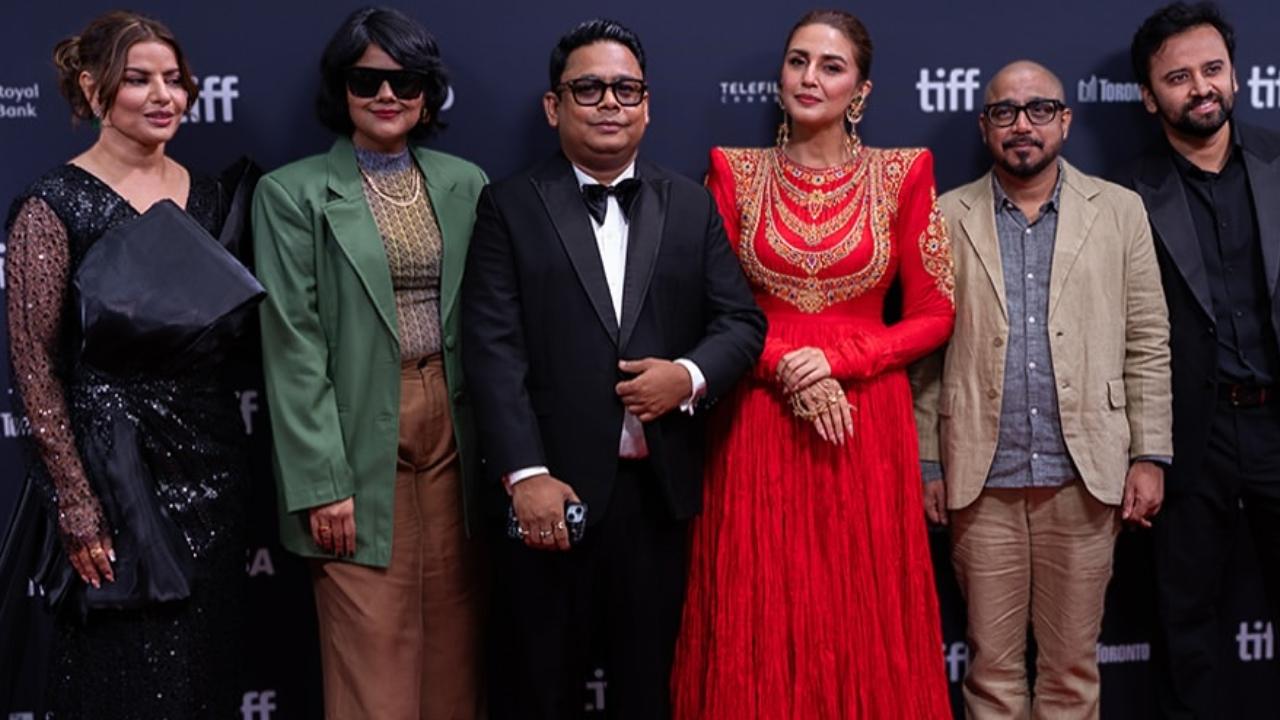
Bikas Mishra’s thriller is among a record mix of 17 Indian films and series being showcased at Toronto
Meenakshi Shedde (MUMBAI MIRROR; September 10, 2025)
Bikas Mishra’s powerful thriller Bayaan, Testimony, is one of the record 17 films and series selected at the 50th Toronto International Film Festival, TIFF, from India, South Asia and Diaspora. The film had its world premiere in the Discovery section of the festival, that runs from September 4-14.
The Indian films and series in official selection at TIFF are Anurag Kashyap’s Monkey In A Cage (Bandar, with Bobby Deol, in the Special Presentations section), Neeraj Ghaywan’s Homebound (Ishaan Khatter, Vishal Jethwa, Janhvi Kapoor, Gala Presentations); Bikas Mishra’s Bayaan (Huma Qureshi, Discovery), and Jitank Singh Gurjar’s In Search Of The Sky (Vimukt, Centrepiece).
Also selected officially are Gandhi, the series co-created by Hansal Mehta and Sameer Nair (Primetime), Satyajit Ray’s Aranyer Din Ratri (Days And Nights In The Forest, 1970, TIFF Classics), Ramesh Sippy’s Sholay (1975, restored by the Film Heritage Foundation and Sippy Films, Gala Presentations); and Sohrab Hura’s Disappeared (India/Nepal), short, in the Wavelengths: Map of Traces section.
Bayaan is Mishra’s second feature after Chauranga, that won the Grand Jury Prize at the Indian Film Festival of Los Angeles in 2015. Set in small town Rajasthan, Bayaan is a police procedural about a rookie police officer detective Roohi Kartar (Huma Qureshi) investigating the case of a ‘Maharaj,’ the head of a cult, who has raped countless girls in the ashram he heads. He has also given shelter and an education to these destitute women and orphans, who might otherwise never get the opportunity. He changes all the girls’ names, and gets inconvenient girls married to men of his choice, to cover up his tracks. He is an all-powerful figure, with influence over the police, judicial and political system, and is not seen until the last quarter of the film. Indeed, the entire system—through silence, patriarchy and misogyny--empowers the Maharaj.
Roohi finds it near impossible to get a bayaan, a testimony from the survivors that would enable her to nail the criminal. The locals are terrorised – her first witness is shot dead – and police and judiciary block her at every turn. But she refuses to give up, not even when it sets her on a collision course with her own father, also a senior police investigating officer. The film is inspired by real life events.
First of all, kudos to Mishra and producer Shiladitya Bora (Platoon One Films, along with Summit Studios and Guidant Films) for making a film on bringing a criminal cult figure to justice, in today’s India. Second, kudos for redeeming much of mainstream Bollywood with a strong woman-led film, and a competent woman police officer--without a hero. Mishra’s direction makes for a compelling thriller, and a technically accomplished one.
Huma Qureshi is in command of her role: playing the tough guy in a suit, or an empathetic listener, when required. There is an unforgettable scene in which all the ashram devotees bang thalis with spoons (oho!) to protest a summons being served on their Maharaj, described as Holy Father.
The ensemble cast, including Sachin Khedekar, Chandrachur Singh, Vibhore Mayank, Swati Das and Sampa Mandal, is very good. Mishra’s screenplay is excellent and layered, and rich with contradictions and dramatic twists at every turn, investing issues with personal stakes. Udit Khurana’s cinematography is a stand-out, creating atmospheric, delicately lit, dark and melancholic spaces, while Sreekar Prasad’s superb editing keeps the film taut. Ajay Jayanthi’s music and Pragyan Gogoi’s sound are an asset. The women crew include producer Madhu Sharma and Costume Designer Shilpi Agarwal Bora. Bollywood is in good hands with this team.
Bravo for making this powerful film - a must-see.
Huma Qureshi in Shiladitya Bora's Rajasthan-based police procedural drama Bayaan
8:27 AM

Ready to take Bayaan on floors soon, maker Bora says Huma was the first choice for the police procedural drama
Priyanka Sharma (MID-DAY; July 6, 2024)
Rajasthan is calling Huma Qureshi back. Two months after wrapping up Jolly LLB 3’s schedule, the actor is returning to the state to begin her next, Bayaan. Shiladitya Bora, who is co-producing the police procedural drama, is thrilled that Qureshi—who was the first actor to whom director Bikas Mishra pitched the script—gave her nod to the role.
“Bikas had met Huma in Los Angeles in 2019, during the Film Independent residency. She is the first actor Bikas had pitched the story to, and we’re so excited that it worked out with her,” he says.
In the drama that rolls mid-month, Qureshi plays an investigator, who is sent to a small town in Rajasthan to lead her career’s first case. Bayaan is supported by the International Film Festival Rotterdam’s Hubert Bals Fund and was developed at LA Residency. Mishra, who previously helmed Chauranga (2014), was mentored by Craig Mazin, the creator of Chernobyl (2019) and The Last Of Us (2023), on his second feature film. If Mazin’s guidance helped him enrich the story on paper, he trusts Qureshi to elevate it on screen.
Mishra states, “Huma is a powerhouse of performance and enthusiasm. Her ability to inhabit complex characters is undeniable, and her energy will elevate Bayaan to a new level.”
The film also stars Chandrachur Singh and Sachin Khedekar. Bora reveals that he approached Singh hesitatingly. “We believe in contrarian casting. We knew that Chandrachur is known for playing the charming hero. But he is such a warm and receptive actor that he instantly agreed to this part.”
Maachis is a very special film; also enjoyed working on Josh as I was working with Mansoor Khan-Chandrachur Singh
7:55 AM

Shaheen Irani (HINDUSTAN TIMES; December 4, 2021)
Chandrachur Singh is heartily embracing OTT and moving with the times. After making a comeback with the Emmy-nominated web series Aarya, the actor is now seen in Dil Bekaraar, the OTT show based on Anuja Chauhan’s book, Those Pricey Thakur Girls. He plays the role of a politician with negative shades in the series which takes the viewers back to the 1980s.
“I was excited to play an antagonist. It gives me a chance to do something different from the image that confines me into a particular style of performance,” Singh says.
The actor is popularly known for his roles in Maachis (1996) and Josh (2000) by the people who love art cinema. But he says commerce and art can’t be defined just by the genre. “Of course, Maachis is a very special film. But I also enjoyed working on Josh because I was working with Mansoor (Khan; filmmaker). I’m grateful to Gulzar ji (writer) and Rekha ji (actor) that I could work with better makers,” he adds.
While Maachis won him many accolades, the actor was never seen in such a movie later. Ask him why and he says, “There was so much work happening at that time, I could not accommodate those projects. They were all good films and eventually, this is destiny’s play.”
Having worked in both mediums, he says that he does not find any difference between working on an OTT series or a film. “It was no different than working on a film. I didn’t think that it was a different screen. I love working in both formats and look forward to working in both in the future,” Singh concludes.
Act Two: Old filmi faces get new streaming careers
9:43 AM

Sonam Joshi (THE TIMES OF INDIA; September 6, 2020)
Whatever happened to Chandrachur Singh? That was pretty much the question on the minds of those who remembered his performance in the Gulzar-directed Maachis in 1996. The role got him a Filmfare award, and plenty of critical acclaim but not too much else. Cut to 2020, the 54-year-old, who had been quietly raising his son as a single parent in Dehradun, returned to the public eye with family crime drama Aarya, which also brought back Jayant Kripalani and Sushmita Sen after a hiatus.
“My priorities were clear — I needed to be a parent. Also, I wasn’t getting the kind of offers I was hoping to get but the role Ram Madhvani offered resonated with me because Tej (who he plays) loves music and is a family man like me,” says Singh.
In the last few years, many actors who began their careers on the big screen in the 1990s and then faded away are now returning to the small screen in newer avatars through streaming platforms. There’s Sanjay Kapoor playing a father in Coronavirus lockdown thriller The Gone Game, Karisma Kapoor as a mother in Mentalhood, Bobby Deol as a godman in Aashram and police officer in Class Of '83 and Manisha Koirala as a Irani cafe owner in Maska, among others.
Casting director Abhimanyu Ray, who worked on Aarya and Class of '83 after himself taking a decade-long break from the movie industry, says Bollywood has often been judgmental towards actors perceived to be carrying baggage. “Filmmakers are afraid of taking chances and often actors are cast by what they’ve been seen in,” he says. “The downside is you get tired of seeing the same face portray the same characters again and again.” Talking about the positive response to Aarya, he adds, “These people have existed; it isn’t as if they were pulled out of a Pandora’s box, but the question is why have such good actors been forgotten?”
Ray also attributes this to mainstream actors’ aversion to web series until recently. “Many would think it would be a step down for them,” he says. “So one had to dig deeper and find actors who are talented but haven’t been around for a while.”
Actors are also willing to play their age now, and open to sharing the screen with other actors rather than hankering for the central role, says Karishma Kohli, who directed Karisma Kapoor along with an ensemble cast of Dino Morea, Shruti Seth and Sandhya Mridul in Mentalhood. “I was in awe of Lolo and stood with my jaw open on the first day of the shoot,” she recalls. Mentalhood’s casting director Aadore Mukherjee, who recently cast Bhagyashree and Sharon Prabhakar in a film and series respectively, credits “better content and good scriptwriters for bringing back actors to our screens”.
For viewers, seeing these familiar faces in a new avatar often invokes curiosity and nostalgia. Casting director Seher Latif, who picked Koirala for Maska, says the web offers freedom from box office pressure, thus opening up opportunities. About Koirala, he says, “We felt it would be a nice meaty role we’ve never seen her in before, and she also relished the challenge of working on the Parsi diction.”
Actor Sanjay Kapoor, who essayed the role of a father to a grown-up son in the series The Gone Game, says web series allow for more character development by virtue of their length. “The digital medium has given a platform to many actors who couldn’t make a mark in films, including me — I’m getting this kind of recognition after 25 years.”
Kapoor, who had shifted from acting to production due to lack of good roles, already has two other web shows on the cards. “The opportunities have definitely increased and I can do a greater variety of roles than a decade ago. Every character gets their due because of the longer format,” he says.
The fact that actors like Sushmita Sen and Lara Dutta can play leads in their 40s, something unheard of in mainstream films, also indicates a lesser degree of ageism and gender bias on OTT platforms. “When I narrated the script of Hundred to Lara, she said she’d never thought she’d be getting such a meaty role at this age,” says showrunner, creator and co-director Ruchi Narain. She points out that it is also difficult to tell the stories of strong older women in films “where everything other than a story of a young hero is considered fringe”.
Madhvani, who had worked with Sen on a commercial, says he approached her because she embodied the qualities of Aarya: “A woman who is confident, strong-willed, graceful, poised, someone who loves her family and children and would do anything to keep them safe”. He feels that for the audience to be invested in the characters and the relationships, the correct casting is of prime importance. “Tej’s character needed to be someone who was charming, innocent and lovable; Chandrachur had all these qualities along with a certain purity.”
Veteran actor Jayant Kripalani, 70, who plays Sen’s father, says it was the opportunity to play an underworld drug don that drew him to the role. “Web series are definitely a lot more adventurous and take risks with stories,” says Kripalani, who has been working on Bengali OTT shows in the last couple of years. “They fall somewhere between theatre and TV, giving an actor scope to do things they couldn’t do in front of a camera but could in front of a live audience.”
However, Ray adds that it is important that filmmakers keep thinking in imaginative ways. “It shouldn’t be the case that the actors who are now getting popular are used again and again,” he says.
20 years of Josh: When Shah Rukh Khan fought musically & Aishwarya Rai Bachchan waded through the sea
8:14 AM

Roshmila Bhattacharya (MUMBAI MIRROR; June 10, 2020)
 Mansoor Khan’s action-romance Josh, set in ’80s Vasco and unveiled on June 9, 2000, revolved around two rival street gangs, Eagles headed by Shah Rukh Khan’s Max Dias and Bichoo by Sharad Kapoor’s Prakash Sharma. Not many know that when the project was conceived, Mansoor had wanted his cousin Aamir Khan to play Rahul, Prakash’s younger brother who returns from Mumbai, falls in love with Max’s twin Shirley and decides to settle down in Goa, leading up to a bloody fight. “But Aamir wanted to play Max and thinking he could convince Shah Rukh to swap roles, Mansoor set up a joint narration with both. As soon as he arrived, Shah Rukh asked Mansoor, ‘Who’s Max?’ When told that Aamir wanted to do the role, he immediately walked out, saying he wasn’t doing the film,” recounts the film’s producer Ratan Jain.
 After a few months, they decided to revive the film with Salman Khan, Akshaye Khanna or Saif Ali Khan. Later, since Chandrachur Singh was doing well at the time, they roped him in to play Rahul opposite Aishwarya Rai’s Shirley. But soon after, Salman was offered Sanjay Leela Bhansali’s love story Hum Dil De Chuke Sanam opposite Aishwarya and wasn’t sure he wanted to play her brother. “And that’s how Max and Josh returned to Shah Rukh,” shares Ratan ji.
He reveals that there was also a change in the music director after A R Rahman sent across a song after weeks of anticipation. “Unfortunately, neither Mansoor nor I liked it and when we asked for another one, Rahman told us he’d need a month. Since we were ready to shoot and didn’t want to delay the film, we decided to go with Anu Malik,” he informs.
Twenty years later, Anu recalls how devastated he was when he learnt that after the melodious Akele Hum Akele Tum, Mansoor would not be repeating him in Josh because he wanted to work with a new composer every time. Then, one day, he returned home at 7 am, caught a few hours of sleep before his next recording and was in the shower when the phone rang. It was Mansoor, admitting that he was in a tight spot and needed Anu to rush to Film City immediately. “The set was lovely, transporting me immediately to Goa. Mansoor told me he wanted to film a fight musically between the two gang leaders and as I looked on, the words, 'Sailaru Sailare Kya Bola Phir Bol Re' flashed through my mind and I started humming. Mansoor heard me and jumped excitedly, saying this was what he’d been wanting for six months. I was finalised on the spot,” narrates Anu, adding that lyricist Sameer came up with a prelude to his hookline, 'Hum Bhi Hain Josh Mein, Baatein Kar Hosh Mein, Yun Na Aankhen Dikha' and they were ready to record with Kumar Sanu and Udit Narayan. “Both are brilliant singers, but they were not getting the vibe right, singing too romantically, so I turned to Kay Kay and Shaan, before finally settling for Nagoor Babu aka Mano, with whom, I had done a show and rapper/singer and composer Suresh Peters. To date, I perform this song on public demand.”
Anu also made a playback singer of a reluctant Shah Rukh. Lyricist Nitin Raikwar had penned a catchy mukhda, “Apun Bola Tu Meri Laila, Woh Boli, Phekta Hai Saala”. Anu hummed it for Mansoor, who loved it and wondered if they could get Shah Rukh to sing it with the swagger it needed. Anu was confident he could, but never having sung before, the actor flat-out refused to do it. Anu sat him down and sang the mukhda and antara for him, pointing out that he only had to croon it conversationally.
Once he agreed to give it a try, Shah Rukh was totally committed, writing the words down, rehearsing the song on other shoots and with Anu whenever he could squeeze out the time. “By the time we went for recording, he was pitch perfect. He got it right the first time, giving the song so much love and life. But Shah Rukh being Shah Rukh, insisted on another take. I, however, went with the first one,” reminisces Anu.
The album had other beauties, like “Hum To Dil Se Haare”, “Mere Khayalon Ki Malika” and “Haye Mera Dil Churake Le Gayi”, the latter; a hat tip to Aishwarya’s ethereal beauty. Ratan ji recalls shooting “Haye Mera Dil” with Aishwarya and Chandrachur on a tiny island in Mauritius. By the time they packed up, it was low tide and the boat couldn’t come in. “We were told we’d be picked up only the next morning. Unwilling to spend the night on a dark island, at around 7 pm, many of us, including Aishwarya and Chandrachur, decided to walk back to the main shore. At times, the water reached up to our necks, but we waded through that 2 km of sea to reach the beach around 8 pm. That’s the kind of josh Josh inspired,” Ratan ji concludes with a laugh.
I went through a phase of disillusionment-Chandrachur Singh
8:20 AM

Returning to the screen with Sushmita-fronted Aarya, Chandrachur Singh reflects on why his career went downhill after a compelling debut with Gulzar's Maachis
Mohar Basu (MID-DAY; June 8, 2020)
 When you spot Chandrachur Singh in a brief role in Mira Nair's The Reluctant Fundamentalist (2013), your heart sinks. Gulzar's find was hailed as the next big thing after his compelling debut in Maachis (1996). In 2020, Singh's 24-year career, dotted with forgettable films, hardly reflects the magic he had promised with his maiden venture.
"I am picky and thankfully, I can afford to be that. If my work is not enduring, what's the point?" he questions as he returns to the screen with the Disney+ Hotstar series, Aarya. At 52, Singh is excited to have found a powerful comeback vehicle in the Ram Madhvani-directed show. "I loved Ram's Neerja [2016]. After a long time, I felt in tune with a filmmaker's sensibilities."
The thriller has him working with Sushmita Sen. "We were to work together 19 years ago, but that film did not take off."
Promising projects being announced and subsequently shelved was a recurring theme in his career in the late '90s. Jab Pyar Kiya To Darna Kya was to be his debut film, but was put on the backburner after 60 per cent of the movie was shot. If Dariya — that was to reunite him with Tabu — was called off, Singh was replaced by Rahul Khanna in Deepa Mehta's Earth (1999). These setbacks could not have been easy to take in one's stride.
"I went through a phase of disillusionment, but a sense of surrender came along soon after. When you're inducted into the industry with a film like Maachis, your expectations are higher. But I could showcase my abilities based only on the offers that came my way. I am happy with the little work I have done. I didn't want to sell myself short. I had faith that one day, the tide will turn. Today, the OTT boom has put the focus on stories," he states.

Subscribe to:
Posts (Atom)