Showing posts with label Bombay Begums. Show all posts
Showing posts with label Bombay Begums. Show all posts
OTT has given me the opportunity to have a big car and a big house-Amruta Subhash
8:08 AM
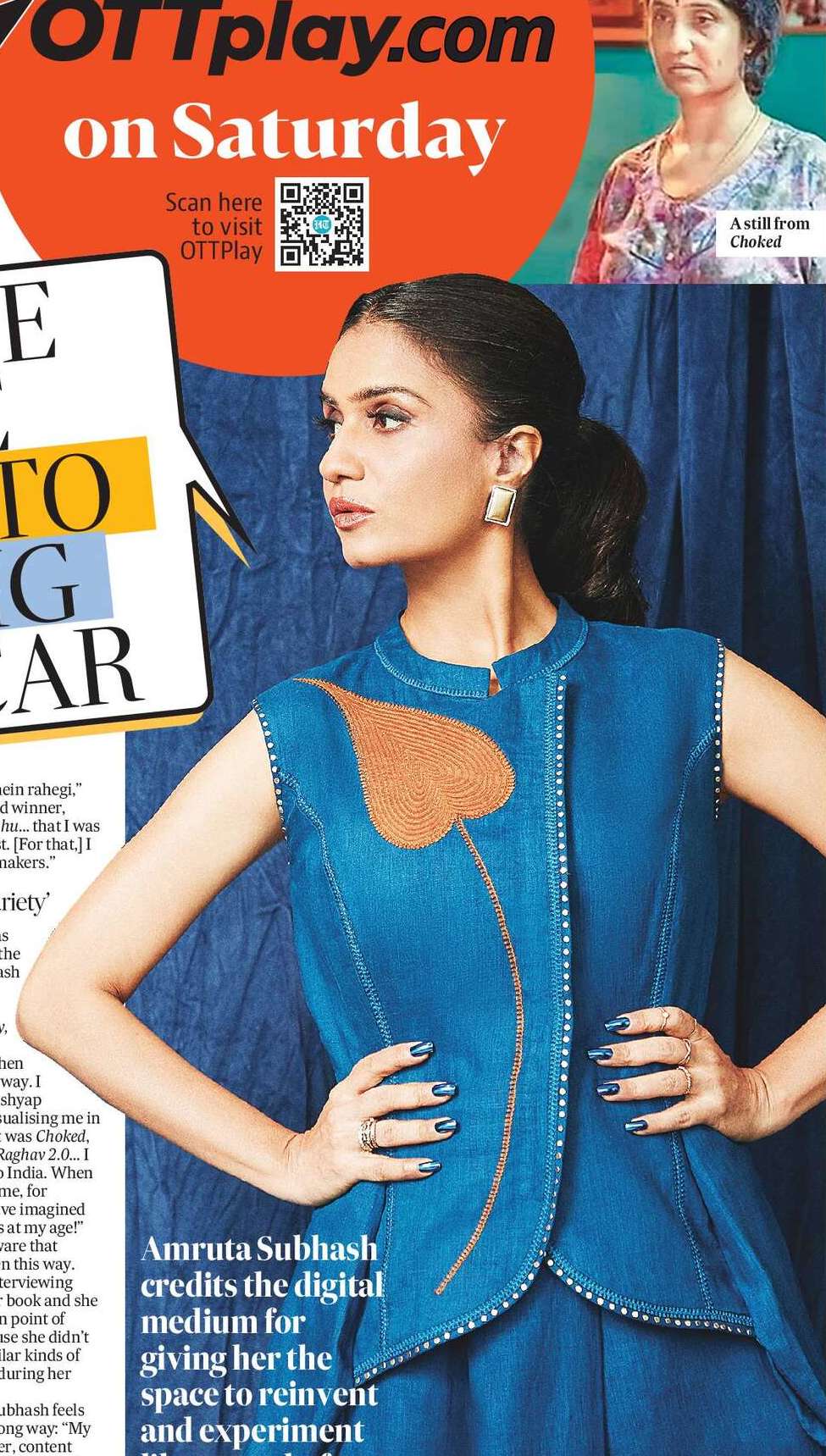
Amruta Subhash credits the digital medium for giving her the space to reinvent and experiment like never before
Rishabh Suri (HINDUSTAN TIMES; June 24, 2023)
Amruta Subhash’s career graph shot up after Gully Boy (2018). But, it came with the risk of being typecast as a mother. This is why the actor waited patiently for the right kind of work to come her way — and that paid off. What followed were web shows Sacred Games 2, Bombay Begums, Saas Bahu Achaar Pvt. Ltd., Dhamaka (2022) and now, the upcoming Lust Stories 2, all of which gave her the chance to showcase her range as an artiste, within a span of five years.
“Earlier, I used to say no to roles I wasn’t satisfied with and sit at home, not earning,” Subhash tells us. But now, with the abundance of opportunities that the web offers, things have changed for the 44-year-old, who says, “I don’t know about other actresses, but as far as I am concerned, I am paid very well here. I shifted into my big, wonderful house just two-three months back. OTT has given me the opportunity to have a big car and a big house.”
‘OTT made me the protagonist’
It was only in a web project that Subhash got the chance to lead a show. “The [film] industry tries to put you in slots and I have always tried to break [out of] them. But this thing (perception) was still there, ‘Yeh actor toh sirf supporting cast mein rahegi’,” recalls the National Award winner, adding, “It was in Saas Bahu... that I was presented as a protagonist. [For that,] I am really grateful to the makers.”
‘Films offer less variety’
The content landscape has changed drastically with the advent of OTT, and Subhash can vouch for it with her body of work on the platform: “After Gully Boy, everybody told me not to get slotted as a mother. Then Sacred Games 2 came my way. I am grateful to Anurag Kashyap (filmmaker), who kept visualizing me in different ways, whether it was Choked, Sacred Games or Raman Raghav 2.0... I am glad OTT happened to India. When Bombay Begums came to me, for instance, I could never have imagined I’d get to play a seductress at my age!”
But, Subhash is well aware that things haven’t always been this way. “Some years ago, I was interviewing actor Deepti Naval for her book and she told me that after a certain point of time, she left acting because she didn’t want to get slotted in similar kinds of roles. There was no OTT during her time,” she recalls.
This is precisely why Subhash feels the industry has come a long way: “My favourite line is that earlier, content was king. But now, content is queen too, with women being offered so many amazing characters on OTT.”
I have to be fair to my younger sister Alia, who is the better version of me-Pooja Bhatt
8:03 AM

Onkar Kulkarni (BOMBAY TIMES; January 22, 2022)
Though Sadak 2, which had released digitally in 2020, had glimpses of Pooja Bhatt from Sadak (1991), R Balki’s film, Chup - Revenge Of The Artist, will mark her return to the big screen. The psychological thriller also features Sunny Deol, Dulquer Salman and Shreya Dhanwanthary. Last year, Pooja came into the spotlight for her performance in her digital show, Bombay Begums, and she is now keen to play strong, pivotal parts in her future projects.
The actress, who assisted her father, filmmaker Mahesh Bhatt, on Sadak 2, says that she had no plans to return to acting back then. However, her role in the digital show has enthused her to face the camera once again. “I feel privileged that I could play my age on screen in this youth-obsessed world and industry. Otherwise, who gets to play such strong characters at 49? I must say, times are changing,” says Pooja, adding, “I feel this is the best time for actors of all shapes, sizes, ages and backgrounds. Today, there are far more opportunities than in the ’90s when a hero and a heroine had to look and be a certain way. Conventional Bollywood was obsessed with youth, but OTT has wiped that out. With the digital medium, there’s a new language we speak, and Bollywood needs to catch up with it.”
Talking about how she wants her second innings as an actor to shape up, she shares, “Bombay Begums was a perfect fit for me. After that, I wasn’t really looking desperately for new projects. Then this new film just came my way. I am not here to hope, plot and plan. I am here to respond to what comes my way. I am just looking to have unique experiences here. I want to learn new things, improve, grow and push my limits. I am not looking to be in a comfort zone. I am glad that in a short span, I got to do a web show and the film.”
Excited to team up with Balki, Pooja says, “He’s a fantastic director. I liked his film Cheeni Kum. One knows of Balki and the kind of work he has created in the world of advertising. He is known for his details and aesthetics, and he has a different kind of gaze. So, when this project came to me, saying yes was a no brainer.”
Remind Pooja that she has returned to the industry at a time when her sister Alia is among the top actresses, and she says, “Well, this will require a whole different discussion because I can’t sum up Alia Bhatt’s career in two sentences. I have to be fair to my younger sister, who is the better version of me. I can’t speak about her work in films in a few lines.”

Kartik Aaryan’s personal journey to become a star is inspiring-Amruta Subhash
8:20 AM
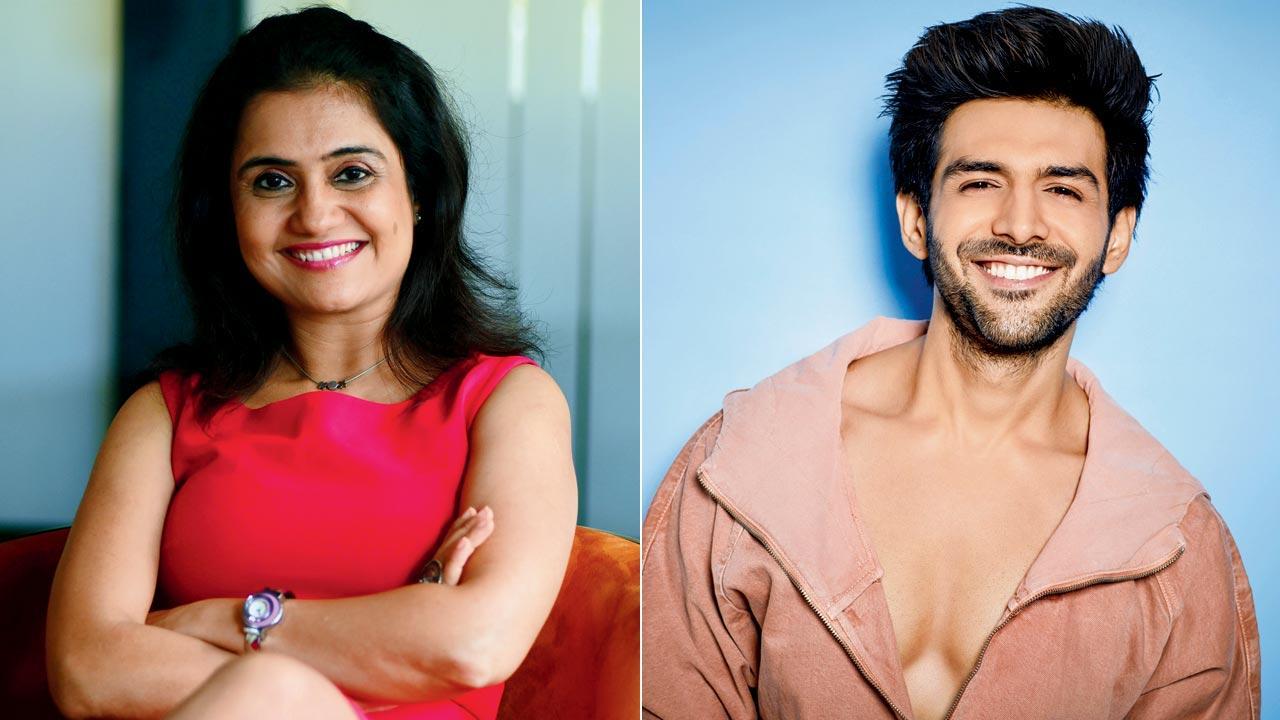
Amruta Subhash discusses dubbing from home for Kartik Aaryan starrer Dhamaka, directed by Ram Madhvani
Uma Ramasubramanian (MID-DAY; May 23, 2021)
With a penchant for not doing run-of-the-mill roles, Amruta Subhash has managed to make her mark with projects like Shwaas, Astu, Gully Boy, Sacred Games 2, among others. After playing Lily in Bombay Begums, the actor is now gearing up for Ram Madhvani’s Dhamaka, which will stream on Netflix. “I was promoting for Bombay Begums when the teaser of Dhamaka released,” says the actor, who strongly asserts that both her characters are poles apart.
While the shooting was wrapped up before the second lockdown, Subhash still had to complete her dubbing. “[Major portion of the] dubbing was wrapped up before the lockdown. However, I had to do certain [voice recordings] from home. I used an app to align the tone,” says the actor, adding that “the pandemic has taught everyone to be independent and learn new things”.
Subhash, who plays boss-lady to Kartik Aaryan’s character, says she has slipped into the power role with much ease. “I have always wanted to work with Ram since Neerja [2016]. His working style is completely in sync with theatre actors like me,” says Subhash, who is glad that “filmmakers are noticing my work and not slotting me in specific roles”.
On teaming up with Aaryan, who has had his own struggles before shining in the limelight, she says that the Bhool Bhulaiyaa 2 actor is an “instinctive actor”. “Kartik’s personal journey to become a star is inspiring. It was great to know him [off camera].”
While she waits for Dhamaka, Subhash is excited about her film with late filmmaker Sumitra Bhave, Dithee, which recently dropped on Sony LIV. They had previously worked together on the National Award-winning film Astu. “Dithee is an intense film that talks about coming to terms with the loss of a loved one. It deals with the complicated experience of grief. Ironically, I never thought this would be my last film with Sumitra Bhave.”
We should have handled #MeToo movement with an open mind-Amruta Subhash
8:24 AM

Sugandha Rawal (HINDUSTAN TIMES; April 2, 2021)
Amruta Subhash feels while the #MeToo movement started on a very strong note in India, it soon lost its course with time.
The movement took shape in the West when a wave of sexual harassment accusations swept Hollywood, making people take notice of sexism embedded deep in the entertainment industry. The conversation trickled down into Bollywood as well, bringing names such as Nana Patekar, Vikas Bahl, Alok Nath, Anu Malik and Sajid Khan under the scanner.
“In India the movement started very strong. I feel we could have handled it with more openness, jo zarori hai. You need to look at all the sides and aspects of the incident,” says Subhash, whose recent web series Bombay Begums puts spotlight on the grey areas that come with the #MeToo movement.
Picking up a reference from the show, the 41-year-old shares, “When the victim gathers the courage to share her ordeal, one person doesn’t believe her because she is accusing someone who has been her mentor and friend. But eventually she changes her stance to stand with the victim.”
After the release of the web series, the actor reveals she got a message from a woman, who herself was struggling to speak up against her boss, who was exploiting her. But one can’t be lopsided when it comes to making a judgement because “ladki bhi sahi ho sakti hai, aur kabhi kabhi ladka bhi”.
For the Gully Boy (2019) actor, it is important to embrace the trait of agreeing to disagree.“Aapko ek cheez lag rahi hai aur mujhe alag cheez lag rahi hai (accepting that is important),” she adds.
Ask her if the movement took some form of witch-hunting in India and she agrees. “We need to look at a case from all points of view. We need to understand that we are dealing with issues where many are vulnerable. We need to be sensitive,” concludes the actor.
Bold and edgy: OTT breaks sexual taboos
7:54 AM

The digital space is revolutionsing the portrayal of female sexuality by exploring its varied dimensions
Sugandha Rawal (HINDUSTAN TIMES; March 27, 2021)
For decades, female sexuality has remained a hushed topic onscreen, with no focus on the demands, needs or pleasure of a woman. But not anymore, as the OTT space is scripting a change in the narrative, while stripping off the taboo around such subjects, changing mindset – one show at a time.
“Female sexuality is finally being acknowledged in storytelling. This is a positive change. Women are finally being acknowledged as sexual beings and not merely as objects of male desire,” says actor Rasika Dugal, who received acclaim for her role of a sexually dissatisfied wife, who starts a relationship outside marriage in web series Mirzapur.
There was a time when the subject of sex came with a bundle of awkwardness, sometimes wrapped together with suggestive lyrics or visual metaphors like brushing of flowers. Yet, sex was hardly a female affair, and that is what the filmmakers are out to change now. Be it a story of four friends exploring their sexuality in Four More Shots Please!, or the importance of consent in Aahana Kumra’s Marzi, or a more complex look at sex play in recently launched, Bombay Begums.
And filmmaker Imtiaz Ali is pleased by this positive change in the way these subjects are being explored. “OTT platforms allow the point of view and the duration to look at women in a more multi dimensional manner,” says Ali, creator and writer of She, adding, “Sexuality is something that in our society is often used as a weapon to repress people. And being able to make a story about that was very interesting”.
Interestingly, now, the focus is not just on sex, but on exploring one’s sexual identity and owning it up without any hesitation. If there are women indulging in acts of self-pleasure, then there are also women struggling with their orientation. Some examples of redefined portrayal include shows such as Lust Stories, A Married Woman, Dolly Kitty Aur Woh Chamakte Sitare, and Made In Heaven.
Dugal finds it encouraging that “scripts are now exploring and celebrating femininity”; however, she has her concerns. “Filmmaking is a visual medium and there’s a long journey between the written words and the visual. Sometimes, even the most well-meaning scripts end up with sexualised images or visuals. Even with the best intentions we’re finding it hard to break away from those,” she rues.
Actor Shweta Tripathi Sharma, whose introduction scene in Mirzapur showed her character indulging in an act of self-pleasure, feels it’s time to normalise the conversation about women having desires. “This happens, there’s no point shying away from it. Let’s not be hypocritical,” she says. Recalling her introduction scene, Sharma says, “I didn’t think it was a big deal. But there were so many journalists who asked me about it, and I was like ‘Come on.. As actors, we put ourselves out to tell a story... toh iss ko itna bada mat banao.”
For Sharma, the intent of a story is more important than the act. “As long as that intention is correct, it should definitely be explored,” she says, adding, she’ll never associate with a scene which is done just to catch eyeballs. “We have huge responsibility as actors and as storytellers, and we shouldn’t exploit the power... Our moral compass should be in the right place,” she shares.
Director Abhishek Pathak feels that “the way the content is perceived by the audience has also changed in a positive way”. To this, Sharma adds, “The more educated we are, the better it will be. I think the audience is definitely more aware.”

A still from (L to R) She, Bombay Begums and Dolly Kitty Aur Woh Chamakte Sitare
After actresses in Bollywood reach a certain age, their sexuality has to be tucked away-Pooja Bhatt
8:11 AM

The actor and filmmaker says Bollywood gives a shelf life to female actors after a certain age
Juhi Chakraborty (HINDUSTAN TIMES; March 21, 2021)
It was after a hiatus of two decades that Pooja Bhatt finally made her acting comeback and during this time, while she did get busy behind the camera, she admits that roles dried up for her after a certain time or rather age.
Talking about how roles dwindle for women over a certain age in Bollywood, Bhatt says, “There’s a perception, and we’re youth obsessed. We’re terrified of mortality, which is why when you look at the average fashion magazine, everyone is talking about a product to stop the passage of time. It’s anti-ageing and making your stretch marks disappear.”
The 49-year-old actor-filmmaker says it’s this limited perception about female actors that limits opportunities for them. “Especially in Bollywood, I think we’ve decided a shelf life for women, and when she reaches a certain age, we might give her a role which is powerful and strong, but it’s quite clear that her sexuality has to be completely tucked away. You’re not looked upon as a creature that’s desirable or someone who can even talk about her desires because we don’t want to go there. I don’t know why it makes us so uncomfortable. But we’re okay with men who’re older to be having affairs with younger women,” says Bhatt, whose last Bollywood outing was Zakhm in 1998.
Taking the decision to be a part of Netflix web series Bombay Begums was a tough one, Bhatt admits, adding that she knew the audiences had the memory of her from her last film. “People expect you to be frozen in time and look the same way. But it was liberating to play my age and not worry about the passage of time,” she says, adding, “Also, there was a female director (Alankrita Shrivastava) who cast you because of that exact same reason. My face has changed, the body has changed, there are fine lines around the eyes and that is so liberating to show for a woman and for an actor in this world where everything is glossed over.”
And now, Bhatt is open to more such acting opportunities and she’d not care if something is offered to her where she has only a single scene. “I’d happily and gladly do it if it adds to the whole story. I wasn’t seeking to be launched again. When I was calm and open to change, life presented me with this magical opportunity and then I had to decide if I was brave enough to take it,” she says.
Adding words of praise for her director, Bhatt adds, “Alankrita had a very unique gaze. What struck me about it was that how she has woven this rich tapestry together where everybody is there because they need to be there. There is not one character which has been used for the sake of it or wasted.”
If I looked like Alia Bhatt, I wouldn’t have landed a role in Bombay Begums-Pooja Bhatt
7:53 AM
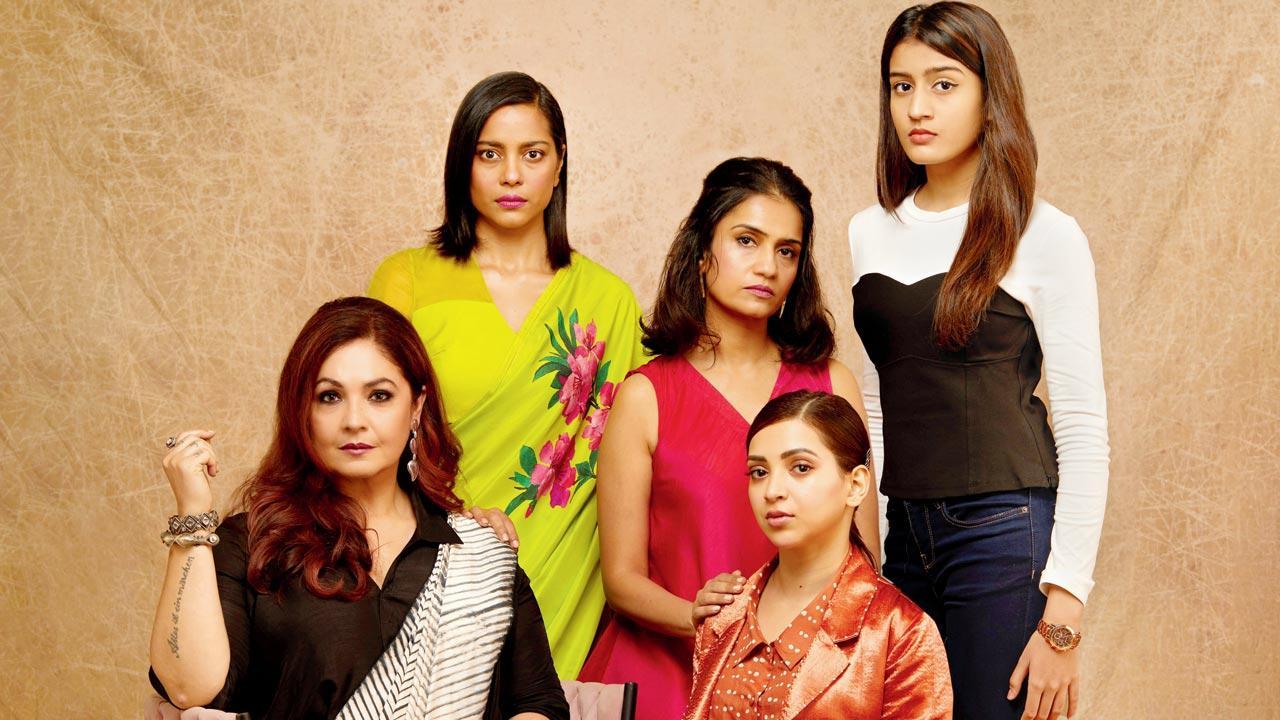
Bombay Begums stars Pooja Bhatt, Shahana Goswami, Amrutha Subhash, Plabita Borthakur and Aadhya Anand
Two women, Pooja Bhatt and Alankrita Shrivastava, who speak their mind, come together for Bombay Begums, a show that looks at the personal and professional price of being a modern woman in India today
Aastha Atray Banan (MID-DAY; March 7, 2021)
Actor Pooja Bhatt and writer-director Alankrita Shrivastava have a lot in common, but before anything else they share the relationship of fan and star. Shrivastava says she watched Bhatt’s super-hit 1991 film with Aamir Khan, Dil Hai Ki Manta Nahin 21 times. Unapologetically feminist, both women have used cinema to discuss women empowerment. Bhatt has played powerful protagonists in Zakhm and Tamanna, and directed Jism and Paap, stories that allowed the female characters to express their sexuality. Never hesitating to speak her mind, Bhatt has in her personal life too, been upfront, whether it was about her relationships or her struggle with alcohol addiction.
In the last few years, Shrivastava had made a space for herself among the women directors in Bollywood, gaining attention for films such as Turning 30 and Lipstick Under My Burkha.
With their latest Netflix show, Bombay Begums, they look at women in business. Five female protagonists belonging to the banking sector and corporate world, struggle to make their place. Shrivastava says that while women are successful in banking today, it wasn’t so when her own mother graduated from IIM in the 1970s. “I wanted to try and explore the lives of women who enter the corporate workforce, and the balance that they are expected to strike. They must succeed at the workplace, but they are also expected to be good wives and mothers. I was intrigued by this balance,” she says. The film also explores their relationship with their bodies.
“Every character is experiencing something physical, too, whether it’s menopause, their first menstruation cycle, struggling with pregnancy or figuring out their sexuality. So, that’s another common thread.”
Bhatt, who plays Rani, the head of a bank, masks her insecurities by being the boss babe. “I wanted Rani to be someone who is soft on the outside, but a tough nut within. I needed an actor who could add layers to the character. I didn’t meet any actor after I met Pooja, because for me, she was the character.”
Bhatt, who returns to the screen after featuring in Sadak 2 last year, says, “I think a lot of women will relate to Rani, because of her quirks. However successful women might become, they still like washing their intimate clothing under the basin tap in the bathroom. I relate to her journey as well; she comes with baggage. She was a bank teller, who worked her way up. She was described to me as a woman who exudes power, but also displays vulnerability. So, I identified with her arc.”
Shrivastava, through Bhatt and the rest of the cast, which includes Shahana Goswami and Amruta Subhash, covers a range of issues in the film: gender, #MeToo, sexuality, identity, and motherhood. “The film isn’t a moral lesson. But if you can feel the ups and downs the women feel—their defeat, fear, pain, and happiness—I will be glad,” says Shrivastava.
For Bhatt, 49, it’s encouraging to play a character her own age. “It was a great to be comfortable in my own skin. Members of my hair and make up team are the same as they were back in the day. One of them told me, ‘These days, looks are important. You don’t need collagen, but why not get fillers?’ And she meant it in the best way possible! I told her, ‘Meri jaan, do you realise that because my face wrinkles and shows emotion the way it does, I have been picked by Alankrita! If I looked like Alia [Bhatt], I wouldn’t have landed this role’. I want to tell women, stop trying to be someone you are not.”
I was privileged to play my age in this youth obsessed industry-Pooja Bhatt
8:15 AM
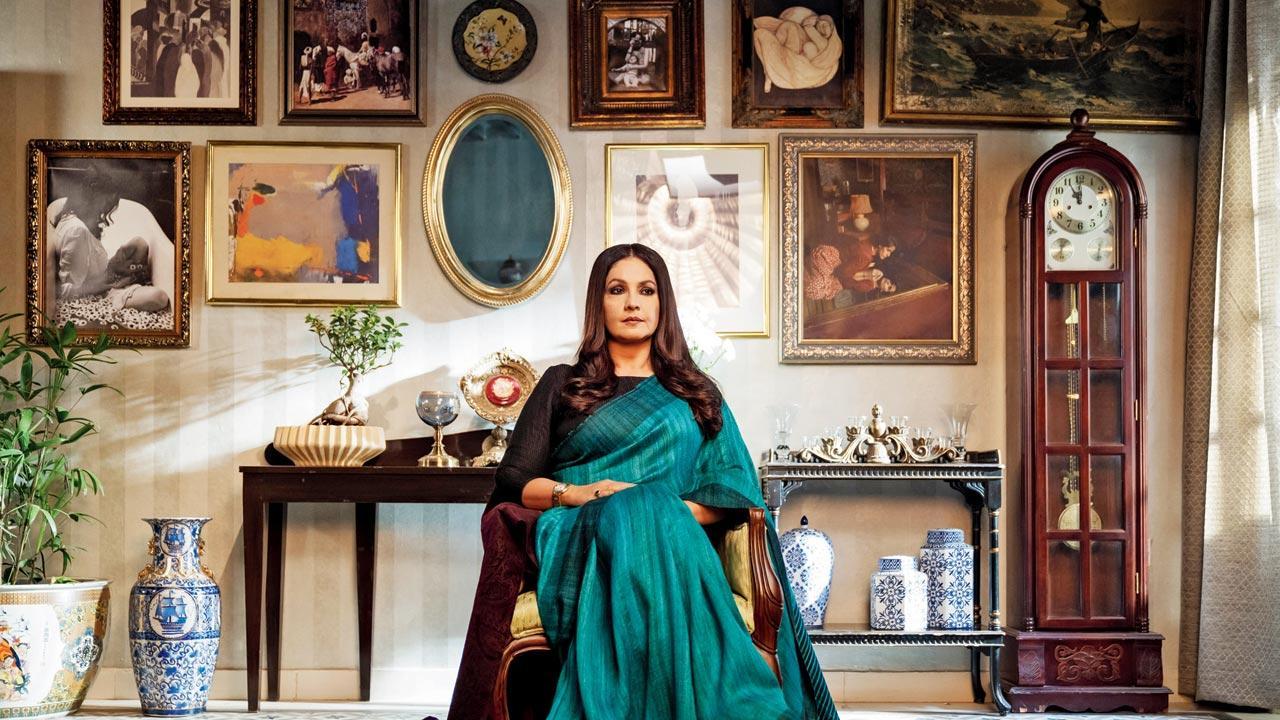
From offering age-appropriate role to examining #MeToo from a woman’s gaze, Pooja Bhatt discusses how Bombay Begums is the perfect web debut for her
Uma Ramasubramanian (MID-DAY; March 2, 2021)
“You know what they say, life happens to you when you’re busy making other plans,” begins Pooja Bhatt, who was offered Bombay Begums when she was assisting director-father Mahesh Bhatt on Sadak 2. The Netflix series marks her foray into digital entertainment. In a way, the all-women drama is also a comeback vehicle for the actor-filmmaker, who stayed away from the big screen since the early 2000s, barring a cameo in Sadak 2.
As Rani, CEO of a leading bank, Bhatt leads the Alankrita Shrivastava-directed venture that tells the story of five women navigating their dreams and desires in a male-dominated world. The biggest incentive for the actor, 49, was that the story offered her an age-appropriate role — a rarity in Indian showbiz. “I was privileged to play my age in this youth-obsessed industry. Even if you come back 30 years later, you are catering to some fantasy that people have had about you when you were 19. Unfortunately, your best work becomes something you can’t get over. In my case, it was Dil Hai Ke Manta Nahin [1991]. [Here], I had the privilege to deal with issues that women my age do. In our world, we’re told not to say our age out loud, or [discuss] issues of menopause. Beyond that, when we try to excel in a male-dominated world, any degree of fatigue or vulnerability we exhibit is looked upon as a chink in our armour.”
Even though Rani is far divorced from her, Bhatt — one of the few female filmmakers in the industry — says she understood her journey. “I have been a producer. I know how biased the business can be, so I drew from that [experience]. Alankrita told me that I don’t need to [emphasise] my power because true power doesn’t scream. That became the bedrock for the character.”
The series brings the #MeToo movement in sharp focus, examining it from a woman’s gaze. Bhatt remembers that filming the sequence was emotionally draining for the actors. “The scene sees Plabita Borthakur’s character [the survivor] recount what happened to her. It was an uncomfortable day for all of us because you are making the person go through the entire experience all over again. There is not a single false note in the show’s [treatment of the subject].”
Subscribe to:
Posts (Atom)